
Hair Transplant Scars: What FUE Donor Marks Really Look Like
AI Summary
- Hair transplant scars are usually tiny FUE donor dots, not one obvious FUT line.
- Scar visibility depends on planning: punch size, donor density, spacing, healing and hair length.
- Conservative harvesting protects safety by reducing overharvesting, donor depletion and patchy scarring.
- Existing scars may improve with SMP, hairstyle changes, FUE into scar tissue or revision.
AI-generated summary, fact-checked by our medical experts.
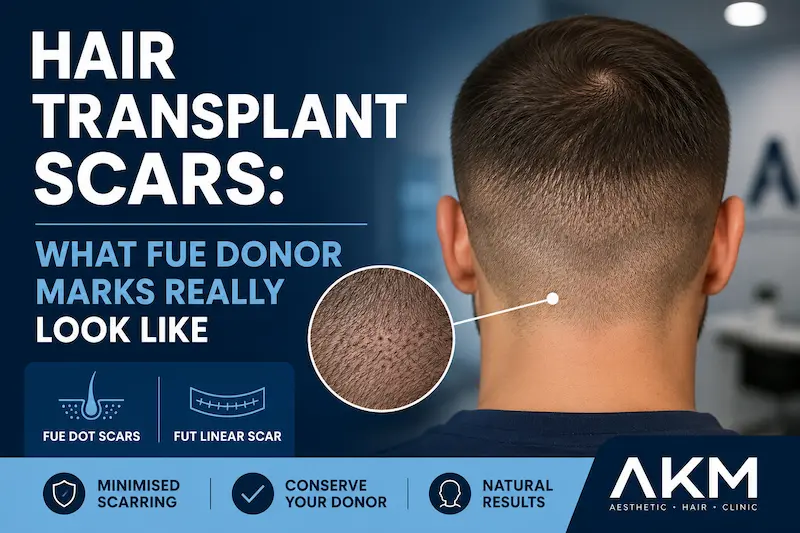
Hair transplant scars are not always the long, obvious lines many men imagine. With FUE, the donor area usually heals as many tiny, round dot marks rather than one linear scar. How visible those marks become depends on punch size, harvesting density, skin healing, hair length and how conservatively the donor area is managed.
If you are comparing techniques, the key point is simple: FUE is not truly “scarless”, but well-planned FUE scarring is usually discreet. In an FUE hair transplant, individual follicular units are removed from the donor zone, usually at the back and sides of the scalp. Each extraction is a controlled micro-wound. Each one heals. That healing is the scar.
For most patients, the real question is not “Will there be any scar at all?” It is: “Will anyone see it when my hair is cut short?” That depends less on marketing language and more on surgical judgement. Punch diameter, extraction spacing, total graft count and donor density all matter. So does your own biology.
This guide is written for men who want a direct, practical answer before travelling for hair restoration. We will look at what FUE donor marks actually look like, how they differ from FUT strip scars, why some donor areas look patchy after surgery, and what can be done if an old scar is already visible.
Table of Contents
What a Hair Transplant Scar Actually Is
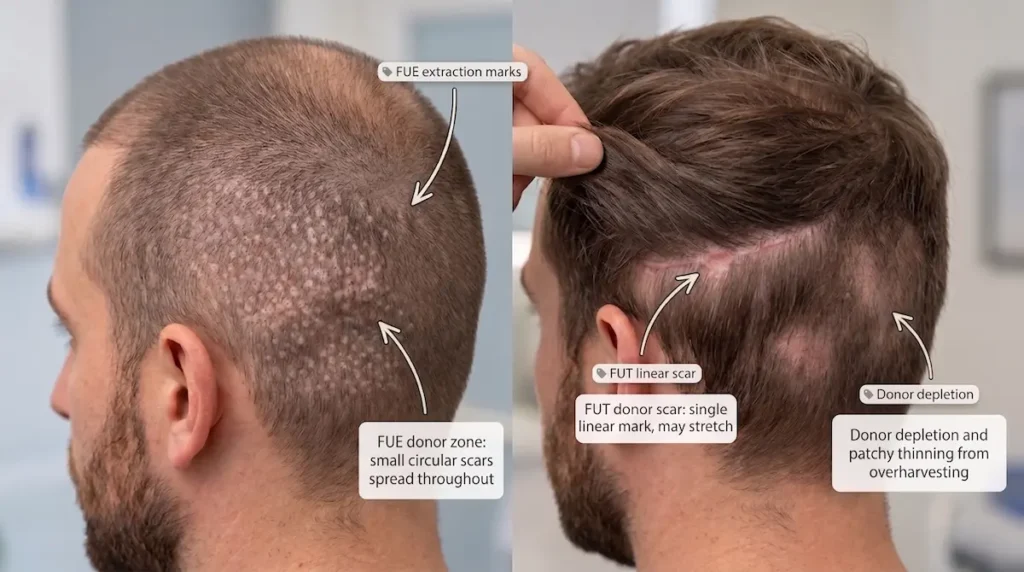
A hair transplant scar is the permanent healing mark left where grafts were removed or implanted. In the donor area, the scar pattern depends mainly on the harvesting method. FUT removes a strip of scalp and usually leaves one linear scar. FUE removes individual follicular units and leaves many small circular marks spread across the donor zone.
This distinction matters because patients often use the word “scar” to mean only a visible line. With FUE, there may be no single line at all, yet the scalp has still healed after thousands of tiny extraction points. When those points are spaced well and the surrounding hair is dense enough, the marks usually blend into the background. When harvesting is too dense, they can become visible as pale dots or patchy thinning.
Why every extraction leaves a mark
Every FUE graft begins with a small circular incision around a follicular unit. A punch tool separates that follicular unit from the surrounding tissue so it can be removed and later implanted. The diameter is small, but the process is still surgical. The skin closes by healing from the edges inward, leaving a tiny area of scar tissue.
In a good case, those dots are so small and evenly scattered that they are hidden by surrounding hair. They may look like faint white specks if the hair is clipped very short. In a poor case, especially after dense or repeated harvesting, the donor area can look thin, uneven or “moth-eaten”. That is not just scarring. It is scarring combined with donor depletion.
The medical literature explains the principle clearly: follicular units are removed one by one, which avoids the strip scar of FUT but does not remove the possibility of donor marks altogether. For patients who wear their hair short, this trade-off is often the reason FUE is considered in the first place. For more detail, see this peer-reviewed overview of the FUE technique.
FUE dot scars vs FUT linear scars
FUE and FUT scars behave differently because the donor wounds are different. FUT creates one longer incision, usually across the back of the scalp. If it heals well and the hair is kept long enough, it can be concealed. If the head is shaved or the scar stretches, it can become obvious as a line.
FUE creates many small extraction sites instead. There is no strip wound and no long line, but the donor area contains a pattern of tiny circular scars. With enough surrounding hair, these are often difficult to notice. With very short cuts, low donor density or overharvesting, the pattern can show.
| Scar type | Typical pattern | Visibility with short hair | Best hidden by | Revision options |
|---|---|---|---|---|
| FUE donor marks | Many tiny round dot scars across the donor area | May show as pale dots or patchiness if clipped very short | Even harvesting, adequate donor density and slightly longer hair | SMP, trichopigmentation, FUE into scars in selected cases |
| FUT strip scar | One linear scar across the back of the scalp | More likely to show if the head is shaved or the scar widens | Longer surrounding hair covering the line | Scar revision, FUE into the line, SMP in selected cases |
Where the donor area sits
The donor area is usually the permanent hair zone at the back and sides of the scalp. These hairs are used because they are typically more resistant to androgen-related hair loss than hairs on the top of the scalp. That does not mean the donor area is unlimited. It is a finite resource.
This is where many bad outcomes begin. A clinic may focus heavily on the number of grafts going into the hairline or crown, while paying too little attention to what is being taken away from the back of the head. A hair loss patient may care about the front view first. A good surgeon plans the back view too.
The donor area should still look natural after harvesting. It should not look stripped, patchy or see-through. A conservative plan protects today’s result and keeps options open for the future, especially if hair loss continues and a second procedure is needed later.
Discover If a Hair Transplant Is Right for You
Share your photos and medical history to receive a personalised assessment from our European Board-certified facial surgery team.
What FUE Donor Marks Really Look Like
FUE donor marks usually look like tiny pale dots scattered through the back and sides of the scalp. They are not usually raised, red or dramatic once fully healed. In many men, they are only visible if the hair is clipped extremely short and someone looks closely under bright light.
The problem is that not every FUE donor area heals or looks the same. A small number of well-spaced extractions may be almost impossible to see. A high-density harvest, especially in a patient with thin donor hair, can leave a visible pattern. The difference is not luck alone. It is planning.
Tiny pale dots up close
After the early scabbing phase has settled, FUE scars often mature into small hypopigmented marks. “Hypopigmented” simply means lighter than the surrounding skin. On some scalps, especially where there is strong contrast between skin colour and hair colour, these dots can be more noticeable.
Up close, the donor area may look like a field of very small white pinpoints. From normal conversation distance, they are usually hidden by hair unless the donor zone has been overharvested or shaved very close. This is why a man who wears a grade 3 or 4 clipper cut may be perfectly happy, while a man who wants a skin fade may notice more.
Early redness is different from mature scarring. In the first weeks, the donor area may look pink, speckled or slightly uneven. That does not mean the final scar pattern is set. Scar colour and texture continue to settle over months.
Visibility at different hair lengths
Hair length is one of the biggest practical factors in whether FUE scars are visible. At a normal short back and sides, well-spaced FUE marks may be hidden. At a very close buzz cut, the scalp itself becomes part of the look, so dot scars are more likely to show.
There is no universal “safe” clipper grade because donor density varies. Coarse, darker, dense hair can camouflage the donor area better. Fine, light or sparse hair gives less coverage. Skin tone also matters. Some men heal with dots that are close to their surrounding colour; others heal with paler dots that stand out more.
This is why pre-operative planning should include your actual hairstyle. If you normally wear your hair very short, say so before surgery. The extraction plan should respect that. For some patients, no-shave harvesting options may be discussed for discretion during the early recovery period, but they do not remove the need for careful donor management.
The “moth-eaten” look after overharvesting
The most concerning donor-area problem is not a normal FUE dot pattern. It is overharvesting. This happens when too many follicular units are removed from an area, or when extractions are not distributed carefully enough. The result can look patchy, thin or uneven, almost as if small windows have been opened in the donor hair.
Medical literature on FUE complications describes overharvesting as a characteristic donor-site problem associated with inadequate donor assessment or poor surgical planning. It can lead to visible thinning, a “moth-eaten” appearance, a window effect or permanent donor depletion. For more detail, see this analysis of documented donor-site healing outcomes.
This is the scar conversation many men are really trying to have. Tiny dots are expected. A visibly depleted donor area is not the goal. The prevention starts before the first graft is removed: donor density is assessed, harvesting is spread intelligently, and the team avoids chasing an unrealistic graft number at the expense of the back of the scalp.
For a more focused breakdown of swelling, redness and texture in the donor zone after surgery, see what happens to the donor area. This article stays with scars and long-term visibility.
Why Some Scars Show More Than Others
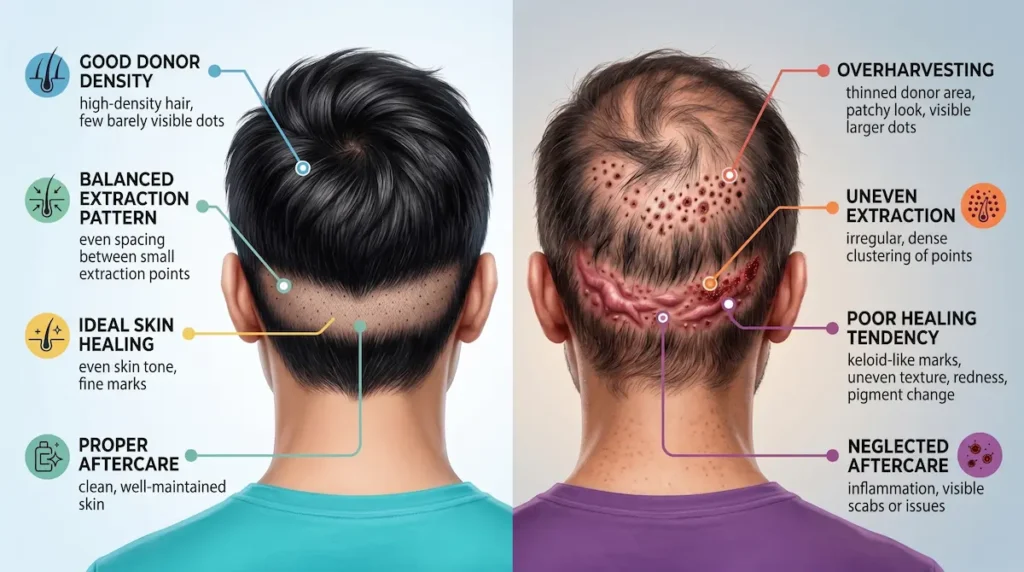
FUE scars are not determined by technique alone. Two men can have the same number of grafts and still heal differently because donor density, hair calibre, skin type, extraction pattern and aftercare all change the final appearance. The most visible scars usually come from a combination of technical overharvesting and a donor area that did not have enough reserve to support the graft count requested.
This is where a cautious consultation matters. The front hairline may be the emotional focus, but the donor area is the limiting factor. If too many grafts are taken to chase density at the front, the back of the scalp may pay the price. A natural-looking result has to protect both sides of the equation.
Punch size and technique
The punch is the small circular tool used to release each follicular unit. In general, smaller punches can leave smaller marks, but smaller is not automatically safer. A punch that is too small for the follicle may increase transection, meaning the graft is damaged during removal. A punch that is too large may remove more tissue than necessary and leave more visible dot scarring.
The right punch size depends on hair calibre, curl, follicle angle and scalp characteristics. Curly or tightly angled follicles can be more technically demanding because the hair’s path under the skin is not always obvious from the surface. That is why FUE is not just a numbers game. It is a judgement-based procedure.
Technique also affects wound shape. Clean, controlled extraction tends to heal more predictably. Repeated attempts at the same graft, excessive force, poor angle control or rushed harvesting can create larger wounds and more trauma. The scar may still be small, but small scars repeated thousands of times can become visible when the execution is poor.
Overharvesting and donor depletion
Overharvesting is one of the main reasons FUE donor scars become obvious. It means too many grafts have been taken from the safe donor area or too many have been concentrated in one region. The scalp may not show a single dramatic scar, but the donor area can look see-through, patchy or uneven.
This is especially important for men with progressive hair loss. A high graft count may look appealing in the short term, but if future loss continues, you may need more donor hair later. Once donor follicles are removed, they do not grow back in the donor zone. That makes donor conservation central to how permanent the results are.
Good donor planning asks several questions before surgery: How dense is the donor area? How large is the balding area? Is the patient likely to lose more hair? What hairstyle does he want after surgery? How many grafts can be removed without making the donor zone look thin? A safe plan may recommend fewer grafts than a patient hopes for. That honesty protects him.
Skin type, healing, and keloid tendency
Some people simply scar more visibly than others. Skin tone, inflammation, healing speed and personal scar history can all affect how FUE donor marks mature. Most FUE dots flatten and fade, but some patients develop more visible pigment change or firmer scar texture.
Keloid scarring is uncommon on the scalp compared with areas such as the chest or shoulders, but a personal history of keloids or hypertrophic scars should be discussed before surgery. It does not always rule out hair transplantation, but it changes the risk conversation. A responsible team will ask about previous scars, acne scarring, surgical scars and family tendencies.
Post-operative behaviour also matters. Picking scabs, exposing the donor area to sun too early, ignoring aftercare instructions or returning to friction-heavy grooming too soon can make healing less tidy. Aftercare will not correct poor harvesting, but it can help a well-planned donor area heal cleanly.
Experience a Seamless Hair Transplant Journey
From VIP airport transfers to 5-star hotel accommodation, we manage every detail. Enjoy a premier medical travel experience in Istanbul.
How Surgeons Minimise Donor Scarring
Donor scarring is minimised before the first extraction is made. The most important decisions are made during planning: how many grafts to take, where to take them from, how widely to distribute them, which punch size to use and how much donor reserve to preserve for the future. The goal is not only to create growth in the recipient area, but to keep the donor area wearable for life.
For UK patients comparing surgery abroad, this is the part to scrutinise. A high graft number can sound impressive. A conservative harvest plan often reflects better judgement. AKM’s approach is to keep donor management central to the plan, using a board-certified surgical team framework and long-term virtual follow-up rather than treating the donor area as an unlimited supply.
Conservative graft spacing
Conservative spacing means the surgeon does not remove too many neighbouring follicular units from the same small patch. Instead, extractions are distributed across the donor area in a controlled pattern. This preserves visual density and reduces the risk of a patchy, overharvested look.
Spacing is not random. The team has to consider natural hair direction, density differences between the occipital and temporal regions, and the patient’s likely future hair loss. A donor plan that looks safe for a 45-year-old with stable loss may not be suitable for a 26-year-old with aggressive thinning.
This is why “maximum grafts” should not be the headline promise. Maximum safe grafts is the better question. Sometimes the most skilled answer is to stage the restoration, prioritise the hairline, or avoid lowering the hairline too aggressively so the donor area is not exhausted in one session.
Punch diameter selection
Punch diameter affects both graft survival and scar visibility. A smaller punch may create a smaller wound, but it must still fit the follicular unit safely. A larger punch may reduce transection risk in certain hair types, but it can remove more surrounding tissue. The best choice is individualised.
A careful team will not select a punch size based on marketing language. They will assess hair shaft thickness, curl, exit angle, scalp mobility and graft quality. The goal is to remove intact grafts while keeping the donor wound as small and clean as possible.
Patients sometimes ask for the smallest punch available because they assume it means “no scars”. That is too simplistic. Poorly executed small-punch FUE can still leave obvious donor damage. Well-executed FUE balances punch size, graft quality and extraction distribution.
Long-term donor management philosophy
Long-term donor management means planning beyond the first set of before-and-after photos. Male-pattern hair loss can progress. A result that looks strong at month twelve may need support years later. If the donor area has been emptied too aggressively, future options become limited.
Board-certified team perspective: The donor area is not a spare-parts shelf. It is living hair with a finite supply. A good FUE plan protects the back of the scalp as carefully as it rebuilds the front, because the patient has to live with both views for decades.
This philosophy is especially important for men who want short hairstyles. If you plan to wear a close fade, the margin for donor error is smaller. If your hair is fine or your donor density is modest, the extraction plan should be even more conservative. The safest plan is the one that respects your anatomy, not the one that promises the largest number.
For UK patients, this is also where credential checking matters. Before travelling, ask who performs the extractions, how donor density is measured, what happens if the requested graft count is unsafe, and what follow-up is available once you return home.
How to Hide or Improve an Existing Scar?
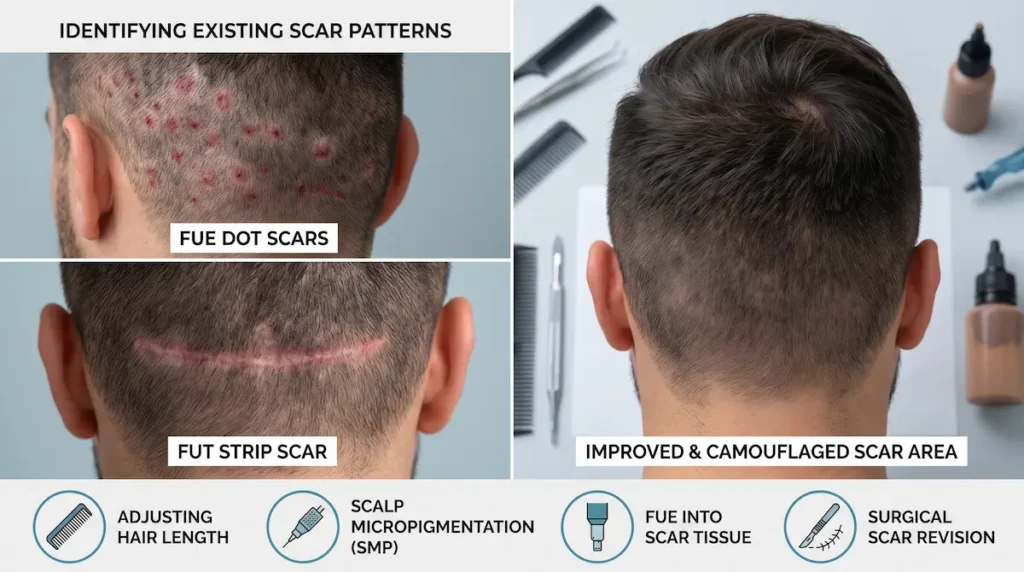
An existing hair transplant scar can often be made less noticeable, but the right option depends on the scar pattern. FUE dot scars, FUT strip scars and overharvested donor areas are not the same problem. Some need camouflage. Some need surgical correction. Some need a careful decision not to remove more donor hair at all.
The first step is a proper assessment of the donor area. A surgeon should look at the density that remains, the shape and colour of the scar, scalp laxity, hair length, previous graft survival and whether more grafts can be safely harvested. A quick promise to “fix it” without that assessment is a warning sign.
SMP and trichopigmentation
Scalp micropigmentation, often shortened to SMP, uses tiny pigment deposits to reduce the contrast between scar tissue and surrounding hair. It can work well for pale FUE dots or a linear FUT scar when the surrounding hair density is good enough to blend with the pigment.
SMP does not create real hair. It creates the visual impression of shadow or density. That means it is often most useful for men who keep their hair short but not completely shaved. On a shiny, raised or irregular scar, pigment alone may not be enough.
Colour matching is crucial. A pigment that looks natural at first can look too dark, too blue or too obvious if placed poorly. For a UK patient, it is sensible to ask for healed examples rather than fresh photos, because fresh pigment can look sharper than the final result.
Adjusting hair length
Sometimes the simplest scar solution is a haircut change. FUE dots that show at a skin fade may disappear at a slightly longer clipper grade. A FUT line that shows at a grade 2 may be hidden at a grade 4 or 5. This is not a surgical fix, but it is practical.
The best haircut depends on the scar pattern. A linear scar needs enough length to cover a line. Diffuse FUE dotting needs enough surrounding texture to break up the pattern. A patchy, overharvested donor area may need a longer cut overall so the thin zones are not exposed.
This is why hairstyle goals should be discussed before the first hair transplant, not only after a scar becomes visible. If you strongly want a very close fade, the donor harvest has to be more conservative from the start.
FUE into scar tissue or revision options
In selected cases, FUE grafts can be placed into a visible scar to soften its appearance. This is more often discussed for FUT strip scars, but it can also be considered for specific scarred areas after previous surgery or trauma. Scar tissue has a different blood supply from normal scalp, so graft survival may be less predictable.
Revision is not always about adding more hair. A wide FUT scar may sometimes be surgically revised to make the line narrower. A raised scar may need medical scar treatment before cosmetic camouflage. An overharvested FUE donor area may need a combination of SMP, careful styling and a realistic discussion about whether further graft harvesting is safe.
For men considering additional facial or beard restoration after a scalp procedure, donor planning becomes even more important. Poor planning can limit future options, especially where multiple zones need grafts. This is one reason to understand what poor donor planning can lead to before committing to a high-graft session.
Cost can also vary depending on whether the issue is camouflage, scar revision or a new FUE session. Because this article is focused on scarring rather than pricing, the detailed breakdown belongs on the cost of an FUE hair transplant page rather than inside this guide.
If you are worried about visible donor marks, ask AKM how conservative FUE harvesting protects your donor area before choosing your graft count. A good plan should explain not only where the new hair will go, but what the back of your scalp should look like afterwards.
Frequently Asked Questions: Hair Transplant Scars
These questions cover the practical concerns most men have before FUE: whether scars disappear, how short they can cut their hair, whether old donor marks can be improved and whether scarring affects future transplant options. The answers are general education only; your own donor area needs an individual assessment.
Do FUE scars ever fully disappear?
Can I shave my head after FUE?
How big are FUE scars?
Can a bad donor scar be fixed?
Does scarring affect a second transplant?
How long until donor marks fade?
Is FUT always worse for scarring than FUE?
What is the biggest warning sign of poor FUE donor planning?
Have Specific Questions About Hair Transplant?
Speak directly with our dedicated patient coordinators regarding Hair Transplant. Receive instant guidance and personalised support.
Medical disclaimer: This article is for general educational purposes only and is not a substitute for medical advice, diagnosis or treatment. Hair transplant suitability, scarring risk and revision options vary by patient. Always consult a qualified medical professional for an individual assessment.
Related Treatments

Awake Abdominal Etching in Turkey
UK guide to awake abdominal etching in Istanbul: HD sculpting, tumescent local anaesthesia, twilight sedation, recovery phases, HBOT/LLLT and GBP costs.

Facelift in Turkey
Explore facelift techniques (deep plane, SMAS), scars, recovery timelines and sedation options. UK-focused safety pathway and aftercare at AKM Clinic, Istanbul.

Hair Transplant For Women in Turkey
Hair transplant for women guide: FUE/DHI/Sapphire, recovery timeline, plus UK vs Turkey cost comparison. See inclusions and request a GBP quote.
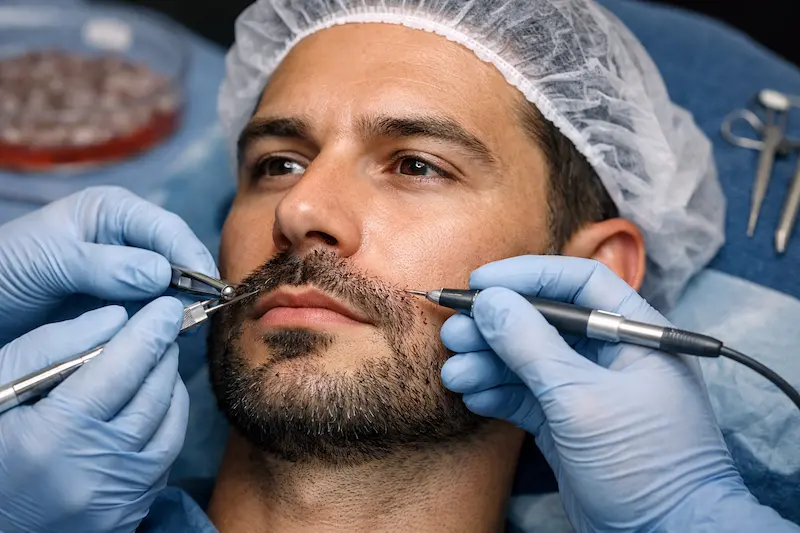
Beard Moustache Transplant in Turkey
Compare Beard Moustache Transplant cost in £ (UK vs Turkey) and see our FUE/DHI approach, recovery timeline and VIP package. Get a free quote.
Ready to Begin Your Own Transformation Journey?
Join the 2,000+ patients who have trusted Dr Akif Mehmetoğlu and the AKM Clinic team. Your journey to a more confident, naturally restored you begins with a simple, no-obligation conversation. Contact us today from the UK for your free virtual consultation.
#1: Get Your Free Personalised Quote
Start with a free, no-obligation online consultation. Share your photos, and our surgical team will provide a fully personalised treatment plan and a transparent, all-inclusive price package. There are no hidden fees.
#2: Secure Your Date & VIP Booking
Once you are ready, our dedicated patient coordinators will help you secure your procedure date. We will handle all your bookings, including your 5-star hotel accommodation and private VIP airport transfers.
#3: Arrive in Istanbul & Meet Your Surgeon
Arrive at Istanbul Airport (IST) and be greeted by your private driver. Settle into your hotel and prepare for your in-person consultation, where you will meet your specialist surgeon to finalise the details for your "natural, subtle, and restored" new look.