
Hair Transplant Scars: What FUE Donor Marks Really Look Like
AI Summary
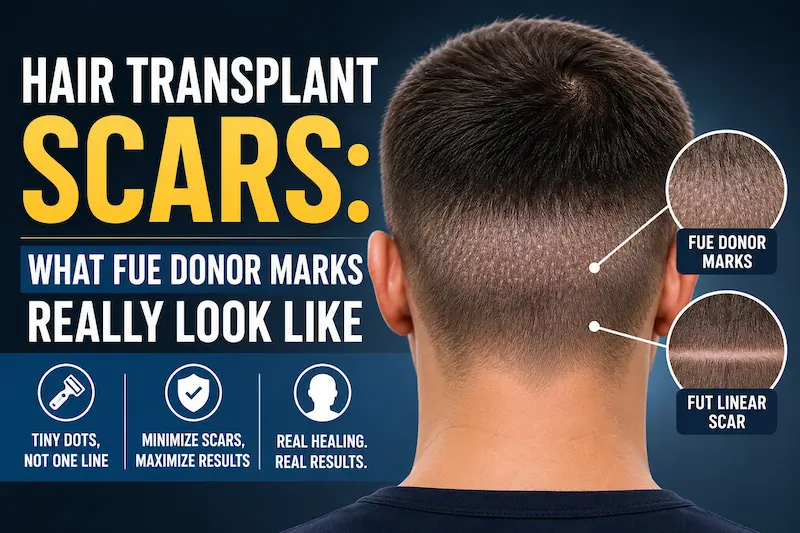
- Hair transplant scars after FUE are tiny dots, not one long FUT line.
- Scar visibility depends on punch size, harvest density, healing, and haircut length.
- Conservative donor planning helps prevent overharvesting, thinning, and patchy donor areas.
- Existing scars may improve with SMP, hair length changes, or selective revision.
Summary generated by AI, fact-checked by our medical experts
Hair transplant scars are usually much smaller with FUE than with older strip surgery, but “scarless” is not the right word. FUE typically leaves tiny round donor marks instead of one long linear scar. How visible they become depends on punch size, extraction density, skin healing, hair length, and how carefully the donor area is planned.
That distinction matters if you wear your hair short, plan a second procedure later, or worry about someone noticing the back of your scalp under bright bathroom lighting. The honest answer is not “there are no scars.” The honest answer is: FUE scars are usually small, scattered, and easy to hide when the donor area is managed conservatively.
This guide focuses only on scarring and donor marks. For the full procedure, graft extraction process, and candidacy details, see how FUE hair transplants are performed. Here, we are staying with the question most men actually ask in private: “What will the back of my head look like afterward?”
Table of Contents
What a Hair Transplant Scar Actually Is
A hair transplant scar is the skin’s healing response after donor hair is removed. In FUE, each follicular unit is extracted through a tiny circular opening. In FUT, a strip of scalp is removed and closed as a line. Both methods involve controlled surgical wounds. The difference is the shape, distribution, and visibility of the marks they leave behind.
That is why FUE is often preferred by men who want shorter hairstyles. It avoids the classic strip scar. Still, each extraction point has to heal, and healed skin can look slightly lighter, smoother, or different from the surrounding scalp when the hair is clipped very close.
Why every extraction creates a healing point
During FUE, the surgeon uses a small punch to isolate and remove individual follicular units from the donor area. A follicular unit is not just a hair; it includes tiny surrounding skin and tissue structures. Once that unit is removed, the body closes the opening through normal wound healing.
Most of those points become very hard to see once surrounding hair grows over them. But under very short hair, especially a zero or one guard, the small healed dots may be visible up close. They often appear as pale pinpoints rather than raised scars.
This is why the phrase “scarless FUE” creates the wrong expectation. FUE does not remove hair without skin trauma. It simply spreads tiny extraction marks across a wider donor zone instead of creating one continuous line. A peer-reviewed overview of the FUE technique describes FUE as individual follicular unit removal, which is exactly why the scar pattern differs from strip surgery.
FUE dot scars vs FUT linear scars
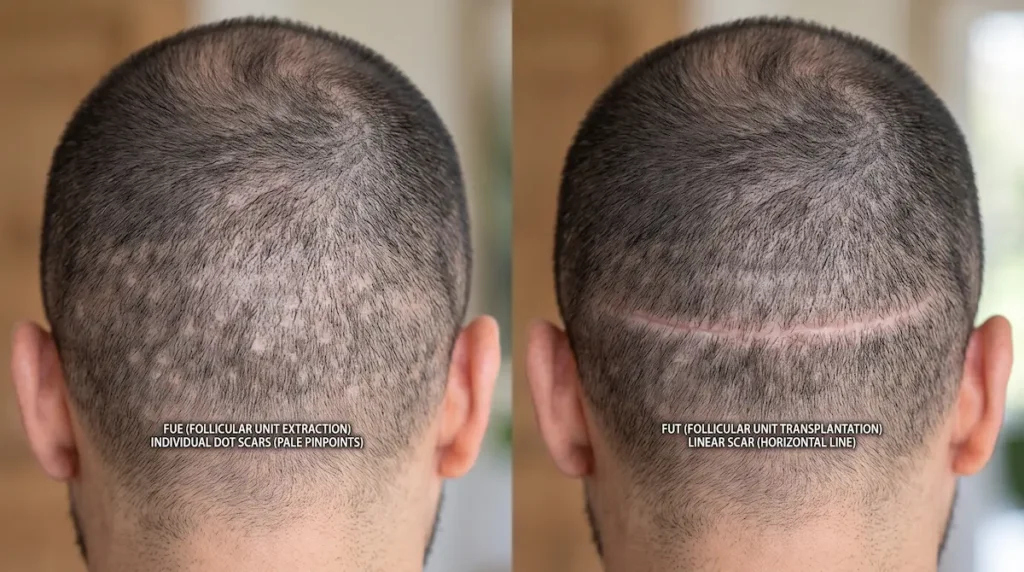
The easiest way to picture the difference is this: FUT creates one long line where the strip was removed; FUE creates many small dots where individual grafts were harvested. Neither is automatically “better” for every patient, but the scar profile is very different.
| Scar Type | How It Forms | What It Usually Looks Like | Visibility With Short Hair | Revision or Camouflage Options |
|---|---|---|---|---|
| FUE dot scars | Individual follicular units are removed with tiny circular punches. | Small, round, pale dots scattered through the donor area. | Usually subtle, but more visible with shaved or very closely clipped hair. | Hair length adjustment, scalp micropigmentation, selective graft redistribution. |
| FUT linear scar | A strip of scalp is removed and the donor area is closed in a line. | One horizontal line across the donor zone. | Can show if hair is worn very short, especially if the scar widened. | Scar revision, FUE into the scar, scalp micropigmentation. |
For a hair loss patient, the practical question is not just “FUE or FUT?” It is “How short do I realistically want to wear my hair?” A man who keeps a medium fade may never notice his FUE donor dots. A man who shaves to the skin may see them in strong light, especially if many grafts were taken from the same zone.
Where the donor area sits
The main donor area is usually the back and sides of the scalp. These hairs are chosen because they are more resistant to pattern hair loss than the thinning frontal or crown areas. A well-planned donor zone should still look even after grafts are removed.
The donor area is limited. It is not an endless bank of hair. That is why scar visibility and future density are connected. If too many grafts are harvested too tightly, the problem may not be one obvious “scar.” It may be a thin, patchy, uneven donor zone that looks moth-eaten when the hair is cut short.
That long-term planning is one reason donor management matters as much as the hairline itself. A dense front with a damaged donor area is not a good result. It only moves the problem.
Discover If a Hair Transplant Is Right for You
Share your photos and medical history to receive a personalized assessment from our European board-certified facial surgery team.
What FUE Donor Marks Really Look Like
FUE donor marks are usually not dramatic. In most patients, they look like tiny pale dots scattered across the donor area, and surrounding hair hides them well at normal lengths. The issue is visibility under specific conditions: very short hair, dark hair against lighter scars, darker skin phototypes with contrast changes, overharvested zones, or bright direct lighting.
So the real question is not “Will there be any mark at all?” The better question is: “Will the marks be visible at the haircut length I actually wear?” That is where technique, planning, and donor density make the difference.
Tiny white dots seen up close
The classic FUE mark is a small, round, lighter dot at the extraction site. It is usually flat, not raised. The dot may be more visible in patients with stronger contrast between hair, scalp, and scar color.
Frontiers in Medicine describes these donor-site changes as pinpoint white dots and notes that FUE avoids linear scarring but should not be marketed as completely scarless. That matches what experienced surgeons tell patients in consultation: the goal is not “no wound.” The goal is tiny, evenly distributed healing points that blend into the donor area.
In real life, most men do not inspect their donor area under a magnifying mirror. But barbers, bright bathroom lighting, wet hair, and very short fades can reveal details that longer hair covers easily. This is why preoperative planning should include your normal haircut, not just your graft count.
How visibility changes with hair length
Hair length is one of the biggest variables. At a medium length, FUE dots are usually hidden by the surrounding donor hair. At a close buzz cut, they may become faintly visible. At a shaved scalp, even tiny texture and color changes can show.
A good way to think about it:
- Medium donor hair: FUE marks are usually covered well.
- Short fade: dots may be visible under close inspection, depending on density and contrast.
- Zero guard or shaved scalp: even well-healed extraction points may show as pale dots.
- Overharvested donor area: the issue becomes broader thinning, not just individual dots.
This is also where expectations should be blunt. If your goal is to shave your head completely smooth after a large FUE session, tiny donor marks may still be visible. FUE gives more styling freedom than FUT for many patients, but it does not make skin behave as if no surgery happened.
The “moth-eaten” look after overharvesting
The worst donor-area result is usually not a single visible dot. It is overharvesting. This happens when too many grafts are removed from one zone, extraction points are packed too tightly, or the surgeon chases a high graft number without preserving future density.
Overharvesting can create a patchy, thinned, uneven look in the back or sides of the scalp. Patients often describe it as “moth-eaten” because the donor area no longer has a smooth, uniform density. It can be especially noticeable with short haircuts.
This is why what happens to the donor area deserves its own planning conversation before surgery. A conservative FUE plan does not only ask how many grafts can be taken today. It asks what the donor area will look like in five, ten, and fifteen years if hair loss progresses or a second transplant becomes necessary.
For a US patient comparing clinics, that is the key distinction. A low-friction sales process may focus on graft numbers. A safer surgical plan focuses on donor preservation. More grafts are not always better if the price is a visibly depleted donor area.
Why Some Scars Show More Than Others
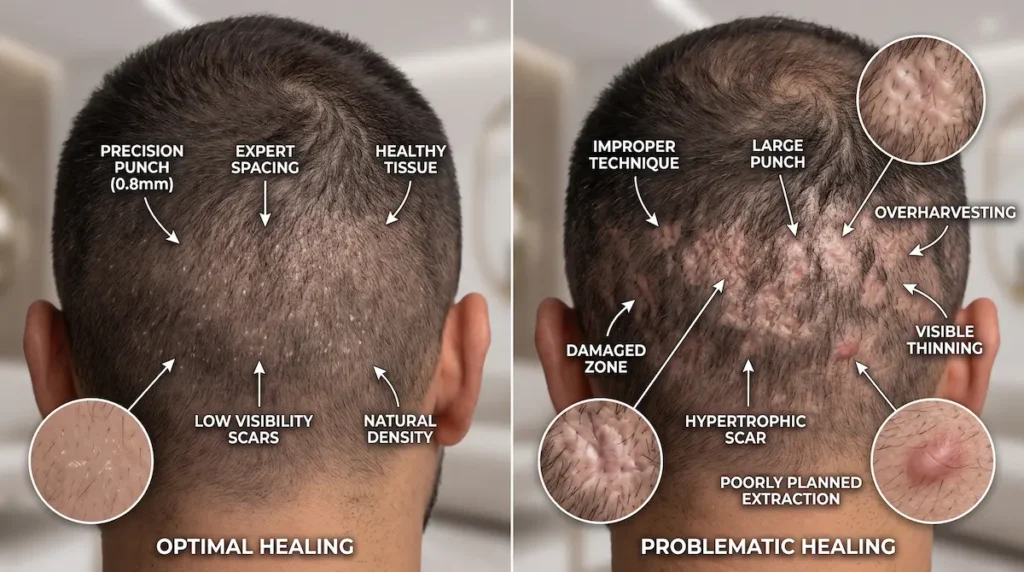
Not every FUE donor area heals the same way. Two men can have the same graft number and still end up with very different donor visibility. The difference usually comes down to punch size, extraction spacing, donor density, skin healing, and whether the surgeon respected the long-term limits of the safe donor zone.
This is where a realistic consultation matters. A clinic that only talks about the recipient area — the new hairline, the crown, the density in front — is missing half of the operation. The donor area is the supply. Once it is damaged, it is much harder to fix than to protect.
Punch diameter and extraction technique
In FUE, the punch is the instrument used to create the small circular opening around each follicular unit. Smaller does not automatically mean better, because the punch still has to release the graft safely without crushing or transecting it. Larger does not automatically mean unsafe, but a bigger punch can leave a larger healing point.
The best punch size depends on hair caliber, curl, skin thickness, graft angle, and surgeon control. Thick, curly, or sharply angled follicles can be harder to extract cleanly. If the extraction is rushed or poorly aligned, the surrounding tissue may take more trauma than necessary.
That trauma can affect the final mark. A clean, well-spaced extraction point tends to heal as a tiny pale dot. A rough extraction, repeated passes, or aggressive harvesting in a tight area can create more visible texture and contrast.
A review of documented donor-site healing outcomes describes FUE donor-site changes such as hypopigmented dots, hypertrophic scars, and visible thinning when extraction is poorly planned. For patients, the takeaway is simple: scar size is not only about the tool. It is about judgment.
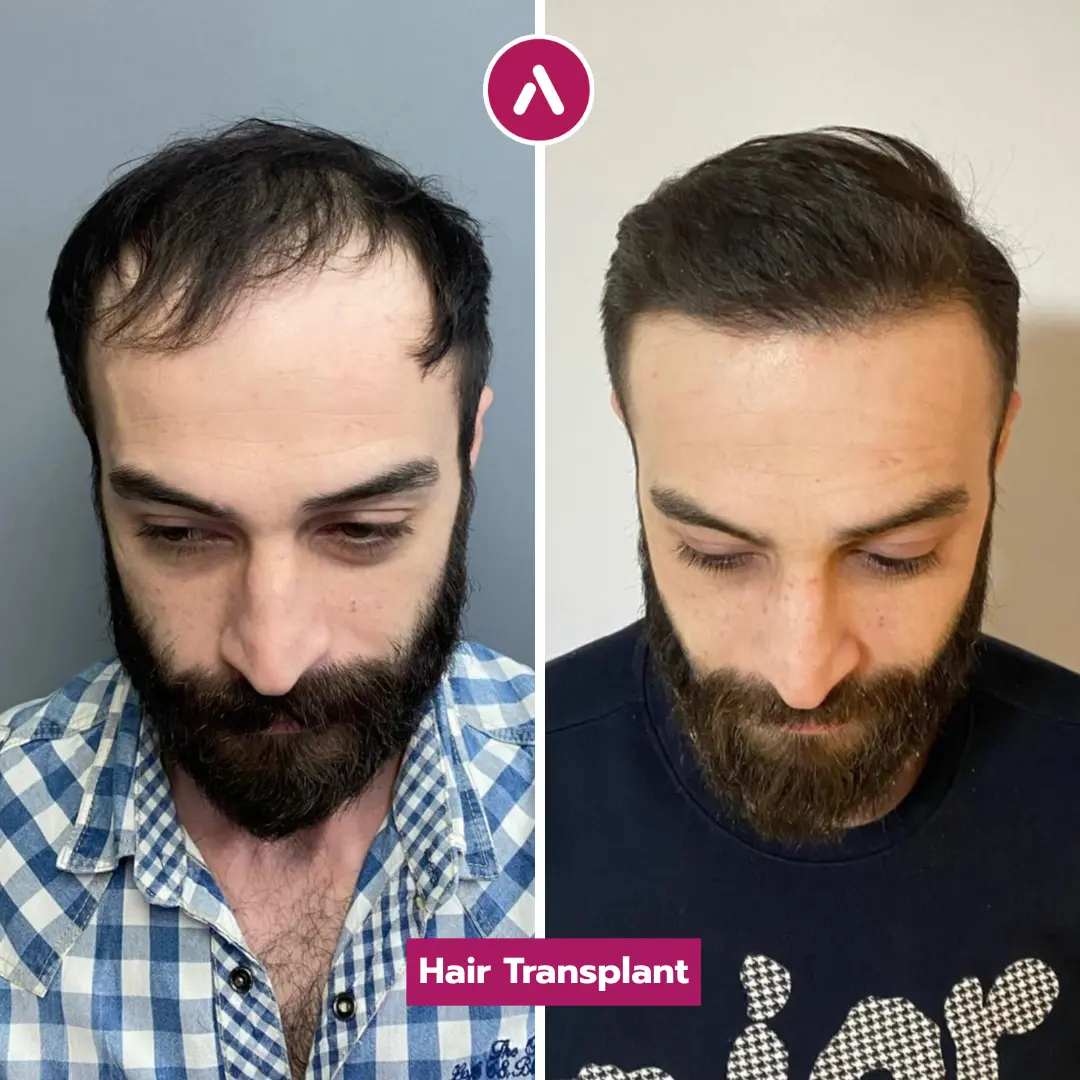
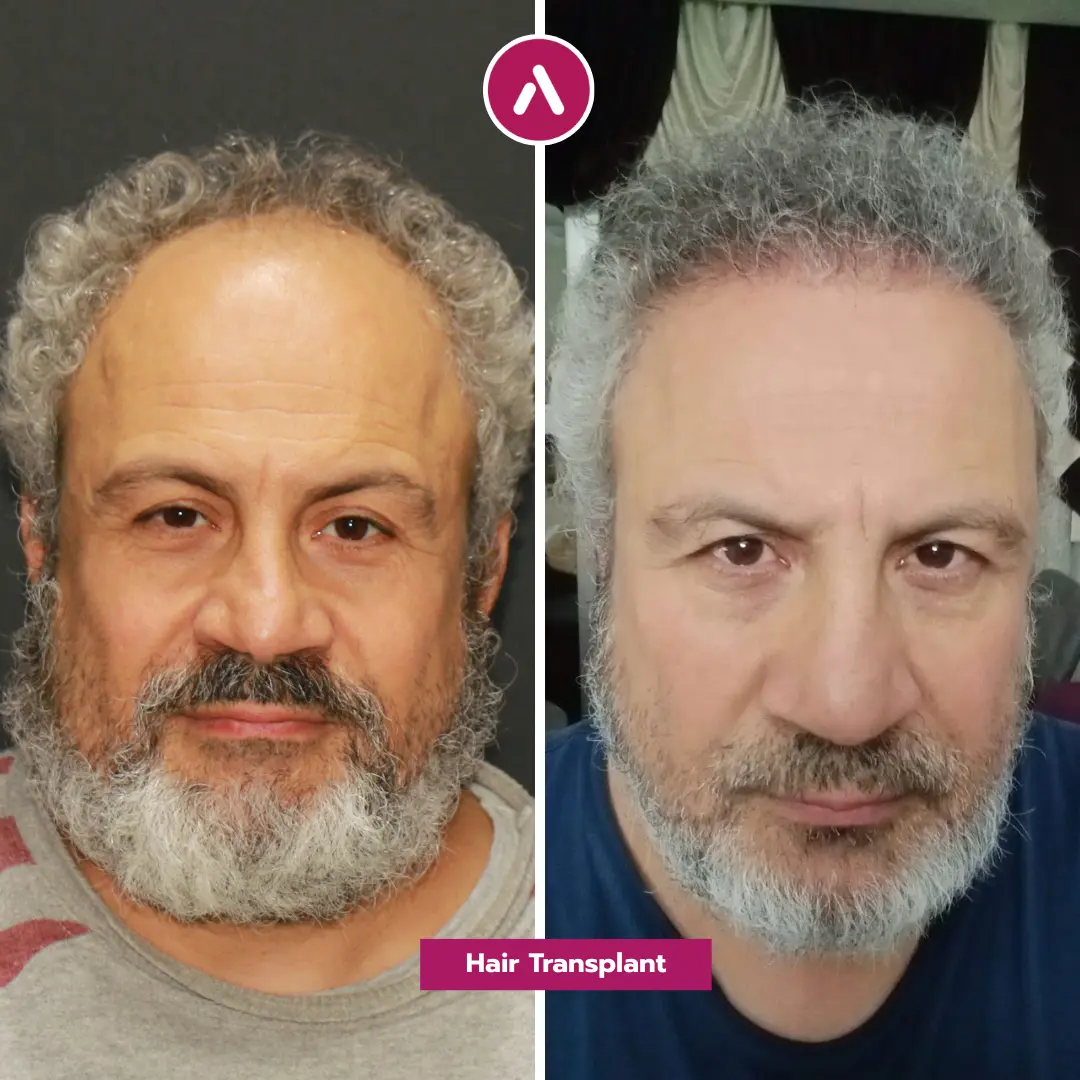
Overharvesting and donor depletion
Overharvesting is the biggest reason FUE donor areas can look unnatural. It happens when too many grafts are removed from the same region or when the total graft plan exceeds what the donor area can safely give. The result may look like thinning, patchiness, or a visible low-density zone across the back or sides of the scalp.
Medical literature describes overharvesting as a donor-site complication that can produce visible thinning and a “moth-eaten” appearance. That is not just a cosmetic inconvenience. It can reduce options for future repair if hair loss continues.
This matters because male pattern hair loss is progressive. A transplant plan that looks impressive at age 32 may be short-sighted if it exhausts the donor area before the crown or mid-scalp worsens. That is why donor conservation is directly connected to how permanent the results are. The transplanted follicles may be long-lasting, but the overall plan still has to account for future loss.
Some warning signs of aggressive donor planning include:
- Promising very high graft numbers without explaining donor limits.
- Concentrating extractions in a narrow band instead of distributing them safely.
- Ignoring your usual haircut length.
- Failing to discuss future hair loss progression.
- Treating the donor area as unlimited.
A hair loss patient should think of the donor area like a budget, not a warehouse. Spend too much today, and there may not be enough left for tomorrow.
Skin type, healing pattern and keloid tendency
Most FUE donor marks heal flat. But some patients naturally produce thicker, raised, or darker scars after skin trauma. A history of keloids or hypertrophic scars should always be discussed before surgery. This does not automatically rule out FUE, but it changes the risk conversation.
Skin tone can also affect how marks are perceived. In some patients, tiny pale dots are more visible because they contrast with surrounding skin or hair. In others, post-inflammatory color changes may temporarily make healing points more noticeable before they settle.
There is also a practical barber-shop factor. Dark, coarse hair over lighter skin can make density changes easier to see when clipped short. Fine hair may cover less even at the same length. Curly hair can give more coverage, but it can also make extraction technically more demanding.
A strong plan accounts for all of this before the first graft is removed. Scar prevention starts before surgery, not after scabs fall off.
Experience a Stress-Free Hair Transplant Journey
From VIP airport transfers to 5-star hotel accommodations, we handle every detail. Enjoy a seamless medical travel experience in Istanbul.
How Surgeons Minimize Donor Scarring
Good FUE donor work is not just about removing grafts. It is about removing the right grafts, from the right places, at the right spacing, with enough donor density left behind to keep the area looking natural. The most natural donor areas usually look unremarkable. That is the point.
For a patient, this can feel less exciting than talking about the hairline. But in experienced hands, donor-area planning is one of the strongest signs of surgical discipline. It protects your haircut options now and your revision options later.
Graft-spacing discipline
Spacing is the difference between a donor area that blends and a donor area that looks depleted. Even tiny extraction marks can become obvious if too many sit close together. A conservative surgeon distributes extractions in a way that preserves visual density.
This is not random. The surgeon has to consider follicular unit density, hair caliber, the size of the safe donor zone, and how many grafts might be needed in the future. Taking every available graft from one convenient zone is faster. It is not better.
Strong spacing discipline avoids two problems at once: visible dot clustering and donor thinning. The goal is for the remaining hair to provide enough coverage that individual extraction points do not stand out.
Board-certified team note: The donor area is a lifetime resource. A responsible FUE plan does not chase the largest graft number possible; it protects the scalp so the patient can wear his hair normally and still have options if future hair loss progresses.
Choosing the right punch size
Punch size should be individualized. A punch that is too large may increase the visible size of donor marks. A punch that is too small for the patient’s follicle type may raise the risk of graft damage or repeated attempts. Precision matters more than marketing language.
Experienced teams balance several factors:
- Hair shaft thickness: Coarser follicles may need different handling than fine hair.
- Hair curl: Curved follicles can sit under the skin at challenging angles.
- Skin firmness: Thick or tight donor skin can change extraction feel.
- Target graft count: Larger sessions require stricter spacing discipline.
- Future planning: Younger patients may need more donor reserve.
No single punch size is a universal badge of quality. The better question is: “How will you choose the punch size for my donor area, hair type, and graft plan?”
Long-term donor-area planning
Long-term planning starts with a basic truth: your donor hair is finite. Once grafts are removed, they do not grow back in the donor area. The surrounding hair can hide the extraction points, but it cannot replace donor density that was removed too aggressively.
A strong plan should ask:
- How advanced is your current hair loss?
- How likely is future crown or mid-scalp thinning?
- How short do you wear the back and sides?
- Would you accept a slightly lower graft number to preserve the donor area?
- Could a second procedure be needed later?
For some men, the safest choice is not the highest-density first session. It is a staged plan that improves the visible thinning area while keeping the donor zone healthy. This is especially important for younger patients with active hair loss.
There are also cases where a no-shave approach may help with discretion during early healing, depending on the patient’s hairstyle and graft plan. That is a separate planning question, and you can read more about no-shave harvesting options if visibility during recovery is part of your concern.
How to Hide or Improve an Existing Scar?
If you already have visible donor scarring, the right fix depends on the pattern. A FUT line scar, scattered FUE dots, and an overharvested donor zone are different problems. Some can be camouflaged well; others can be softened but not erased. The first step is identifying what you are actually trying to correct.
This is also where expectations need to be grounded. Scar improvement is usually possible. Scar disappearance is not a promise any ethical team should make.
SMP and trichopigmentation
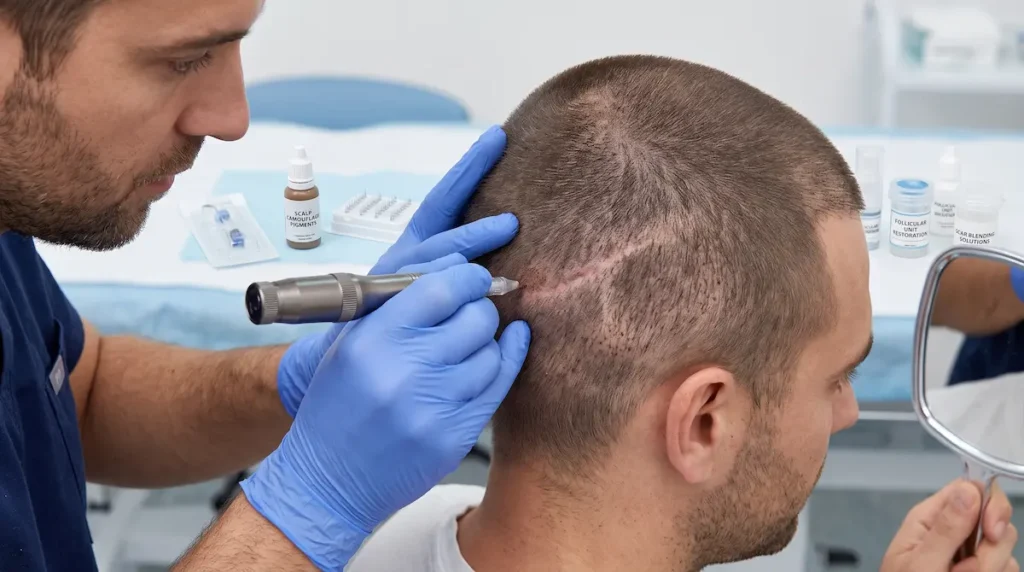
Scalp micropigmentation, sometimes called SMP or trichopigmentation, uses tiny pigment deposits to reduce the color contrast between scars and surrounding scalp. It can be useful for pale FUE dots, widened FUT scars, or areas where the donor zone looks visually sparse.
SMP does not add hair. It adds the illusion of shadow. That can help a scar blend better with closely clipped hair, but it must be matched carefully to skin tone, hair color, and haircut length. Poorly matched pigment can create a new cosmetic problem.
For small FUE dots, SMP may make the donor area look more uniform. For a linear FUT scar, SMP can soften the line, especially if some hair already covers the area. For overharvesting, SMP may help with contrast, but it cannot restore lost density.
Adjusting hair length
The simplest fix is often the most overlooked: changing the haircut. Many FUE donor marks disappear visually when the hair is left slightly longer. Moving from a skin fade to a higher guard can make a major difference.
This does not mean you have to give up short hair completely. It means finding the shortest length where the donor area still looks even. For some men, that may be a number two or three guard. For others, especially after heavy harvesting, more length may be needed.
A good barber can also help by avoiding harsh contrast in the donor area. Very tight fades can expose dot patterns and density changes. A softer blend can make the donor zone less noticeable.
FUE into scar tissue or revision options
In selected cases, FUE grafts can be placed into scar tissue to break up the appearance of a line scar or improve hair-bearing coverage in a scarred area. This is more commonly discussed for FUT scars, beard scars, eyebrow scars, or other hair-bearing scar zones. Scar tissue has different blood supply and texture, so planning has to be conservative.
If the issue is a visibly overharvested donor area, the fix is harder. Some patients may benefit from SMP, strategic hairstyle changes, or limited redistribution. But severely depleted donor zones cannot always be restored to a normal untouched look.
This is why poor donor planning is not a small mistake. It can affect future hair, beard, and repair options. For a broader look at how donor misuse can create visible problems in another transplant area, see what poor donor planning can lead to.
Cost is also highly case-specific because scar camouflage, repair, and revision planning depend on the type of scar, available donor reserve, and whether the goal is SMP, grafting, or a staged correction. For the pricing side, use the dedicated page on the cost of an FUE hair transplant rather than trying to estimate from scar appearance alone.
The most important point is prevention. It is far easier to protect the donor area during the first FUE session than to repair a depleted donor zone later. A natural hairline gets attention. A healthy donor area protects the whole result.
Frequently Asked Questions: Hair Transplant Scars
These are the questions most patients ask once they understand that FUE is not a “no-scar” procedure, but a tiny-dot scar pattern. The answers below are intentionally practical: haircut length, healing time, repair options, and second-transplant planning matter more than marketing claims.
Do FUE scars ever fully disappear?
Can I shave my head after FUE?
How big are FUE scars?
Can a bad donor scar be fixed?
Does scarring affect a second transplant?
How long until donor marks fade?
Final Thoughts: FUE Scars Are Small, But Donor Planning Is Everything
FUE changed hair restoration because it avoids the long linear scar associated with strip surgery. That does not make it scar-free. It makes the scar pattern smaller, rounder, and usually easier to hide — if the donor area is handled with restraint.
The best FUE donor area is not the one with the highest graft count. It is the one that still looks natural after healing, still supports your normal haircut, and still preserves options if hair loss progresses later. That requires conservative harvesting, careful spacing, appropriate punch selection, and an honest conversation about future donor reserve.
At AKM, the planning conversation is built around long-term donor protection, not just short-term density. If hair transplant scars are one of your main concerns, ask how your donor area will be mapped, how many grafts can be taken safely, and what haircut length you can realistically expect after healing.
Ask AKM how conservative FUE harvesting protects your donor area in a free virtual consultation.
Have Specific Questions About Hair Transplant?
Chat directly with our dedicated patient coordinators regarding Hair Transplant. Get instant answers and personalized support.
Medical disclaimer: This article is for educational purposes only and does not replace medical advice. Hair transplant results, scar visibility, healing, and donor capacity vary by patient. Always consult a qualified medical professional before deciding on surgery.
Related Treatments
Awake Abdominal Etching in Turkey
Learn what awake abdominal etching is, who it’s for, recovery timeline, risks, and USA vs Turkey value—plus how to choose a qualified surgeon.

Facelift in Turkey
Evidence-based facelift guide: deep plane vs SMAS, anesthesia options, day-by-day recovery, scars, risks, longevity, and US vs Turkey cost/value.

Hair Transplant For Women in Turkey
Understand Hair Transplant For Women: FUE, DHI, no-shave options, recovery timeline, safety, and cost-value comparisons. Start with a virtual consult.
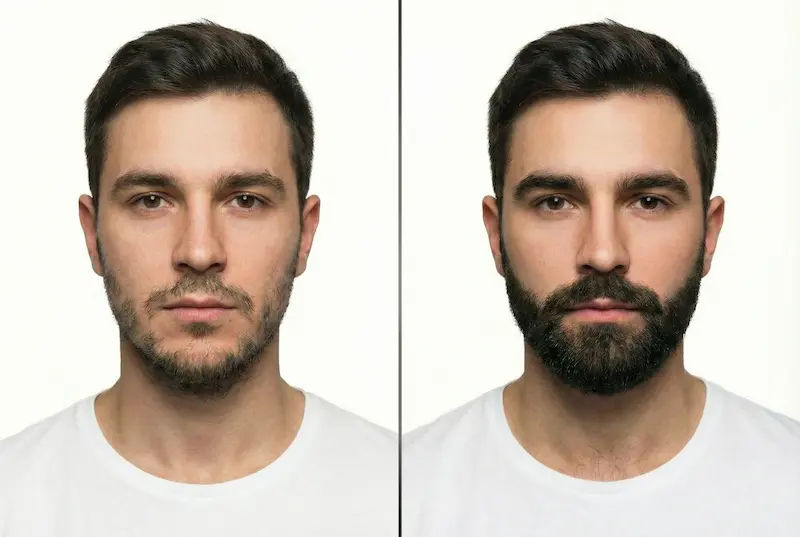
Beard Mustache Transplant in Turkey
Beard Mustache Transplant guide: candidacy, techniques, risks, and recovery timeline—plus our HBOT+LLLT Rapid Recovery & Safety Protocol. Virtual consult. 
Ready to Start Your Own Transformation Journey?
Join the 2,000+ patients who trusted Dr. Akif Mehmetoğlu and the AKM Clinic team. Your journey to a more confident, revitalized you begins with a simple, no-obligation conversation. Contact us today from the USA for your free virtual consultation.
#1: Get Your Free Personalised Quote
Start with a free, no-obligation online consultation. Share your photos, and our surgical team will provide a fully personalised treatment plan and a transparent, all-inclusive price package. No hidden fees.
#2: Secure Your Date & VIP Booking
Once you're ready, our dedicated patient coordinators will help you secure your procedure date. We'll handle all your bookings, including your 5-star hotel and private VIP airport transfers.
#3: Arrive in Istanbul & Meet Your Surgeon
Arrive at Istanbul Airport (IST) and be greeted by your private driver. Settle into your hotel and prepare for your in-person consultation, where you'll meet your specialist surgeon to finalise the details for your "natural, subtle, and revitalized" new look.