
Buccal Fat Removal for Men: What's Different and Who It Suits
AI Summary
- Buccal fat removal for men suits full lower cheeks, stable weight, and realistic contour goals.
- Masculine definition means subtle cheek refinement, not hollowing or artificial jawline reshaping.
- Safety depends on conservative planning to avoid over-resection, gaunt cheeks, and premature aging.
- Recovery and cost details should support, not drive, an anatomy-led consultation decision.
Summary generated by AI, fact-checked by our medical experts
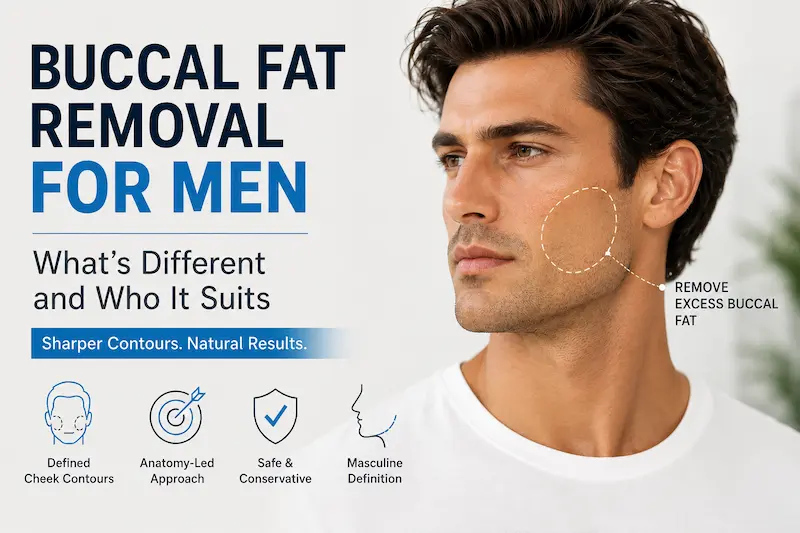
Buccal fat removal for men can help define a round lower cheek when the face has enough fullness to spare, but it should not be used to “carve” a jawline. The best male candidates have stable weight, naturally full mid-to-lower cheeks, good skin quality, and realistic goals for a sharper—but not hollow—look.
For men, the decision is rarely as simple as “remove cheek fat, get a stronger jaw.” Male facial definition depends on bone structure, cheek fullness, chin projection, neck contour, skin thickness, and how the face is likely to age. That is why how buccal fat removal works at AKM starts with facial analysis, not a one-size-fits-all resection plan.
At AKM Clinic, the goal is not a hollow or over-operated look. The planning philosophy is Natural-First: refine what is already there, preserve enough facial volume for age-appropriate balance, and avoid the “drawn” result that can look harsh on a male face. This matters because buccal fat is not just a cosmetic obstacle. It is part of the soft-tissue support that affects how the cheek reads now and later.
US patients often arrive with a clear request: a leaner lower face, a sharper cheek shadow, or a more athletic profile on camera. Those are valid goals. The key is matching the procedure to the anatomy. A man with full lower cheeks and strong underlying structure may benefit from conservative buccal fat reduction. A man who is already lean, narrow-faced, or chasing an extreme social-media contour may be better served by skipping it.
Table of Contents
How Male Facial Fat Differs
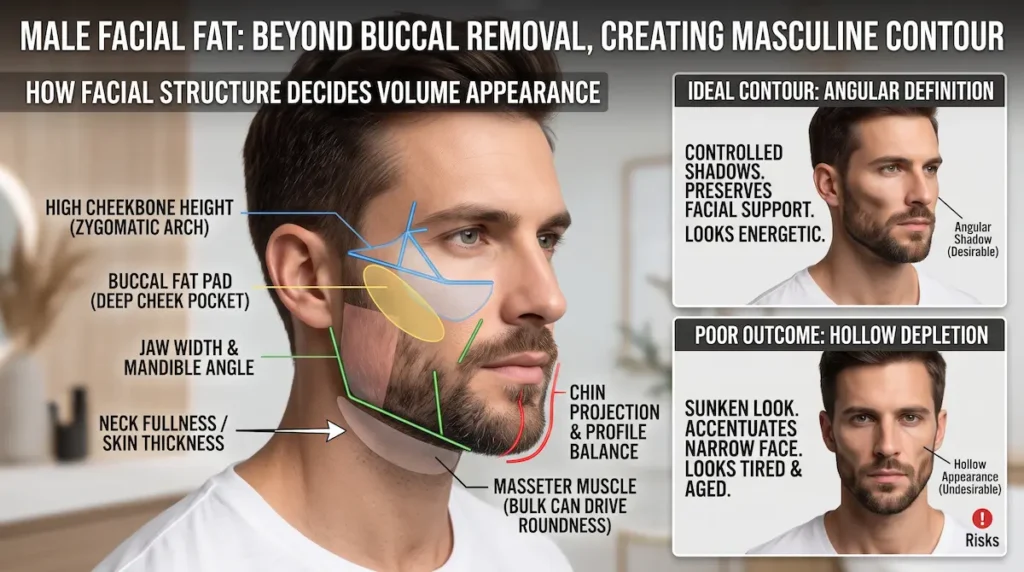
Male facial fat is not judged in isolation. It sits inside a broader structure: cheekbone height, jaw width, chin projection, beard density, skin thickness, and neck fullness all change how cheek volume appears. A round cheek on one man may come from a true buccal fat pad; on another, it may be caused by weight fluctuation, masseter bulk, weak chin projection, or fullness under the jaw.
Distribution and bone structure
The buccal fat pad is a deep pocket of fat in the lower cheek, below the cheekbone. Johns Hopkins describes buccal fat removal as a procedure that removes all or part of this lower-cheek fat pad to create a narrower facial shape and emphasize the cheekbones and jawline. For men, though, the visual effect depends heavily on the frame around it: cheekbone projection, the angle of the jaw, and the chin all decide whether the result looks defined or depleted.
A man with broad cheekbones, a defined chin, and lower-cheek fullness may see a cleaner shadow under the cheekbone after conservative removal. A man with a narrow face may not gain “definition” at all. He may simply lose softness. That distinction is critical.
This is also why facial contouring should be assessed in motion, not only in still photos. A lower cheek that looks full at rest may flatten when smiling. A face that looks round from the front may actually need chin, neck, or skin assessment from the side. Good planning uses multiple angles.
What defines a masculine lower face
A masculine lower face usually reads as structured, not scooped out. The jaw border is visible. The chin balances the nose and forehead. The cheek has some shadow, but the midface still looks healthy. The difference is subtle—and that is exactly where many poor buccal fat results go wrong.
Removing too much buccal fat can create a hollow under the cheekbone while doing little for the actual jawline. On a male face, that may look tired rather than sharper. It may also make the mouth area appear heavier because the cheek above it has lost support.
At AKM, the consultation looks at whether the fullness is truly in the buccal compartment or whether another part of the face is driving the concern. This is especially important for men who describe the goal as a “stronger jawline.” Buccal fat removal can help the cheek-to-jaw transition, but it does not build jaw bone, move the chin forward, or tighten a full neck.
Angular vs hollow
Angular means there is a controlled shadow under the cheekbone and a cleaner transition into the jaw. Hollow means the cheek looks sunken, tired, or too aggressively emptied. The first can look masculine. The second can age the face.
The risk is higher in men who are already lean, have naturally narrow faces, or plan to lose weight after surgery. Johns Hopkins cautions that buccal fat removal may accentuate a narrow face and create an overly gaunt appearance in the wrong candidate. That warning matters for men because facial fat often becomes more valuable with age, not less.
The safest planning mindset is conservative: remove only what is needed to soften lower-cheek roundness while preserving facial support. Less can be more. In male facial contouring, that is not a cliché; it is the difference between definition and depletion.
What “Masculine Definition” Realistically Means
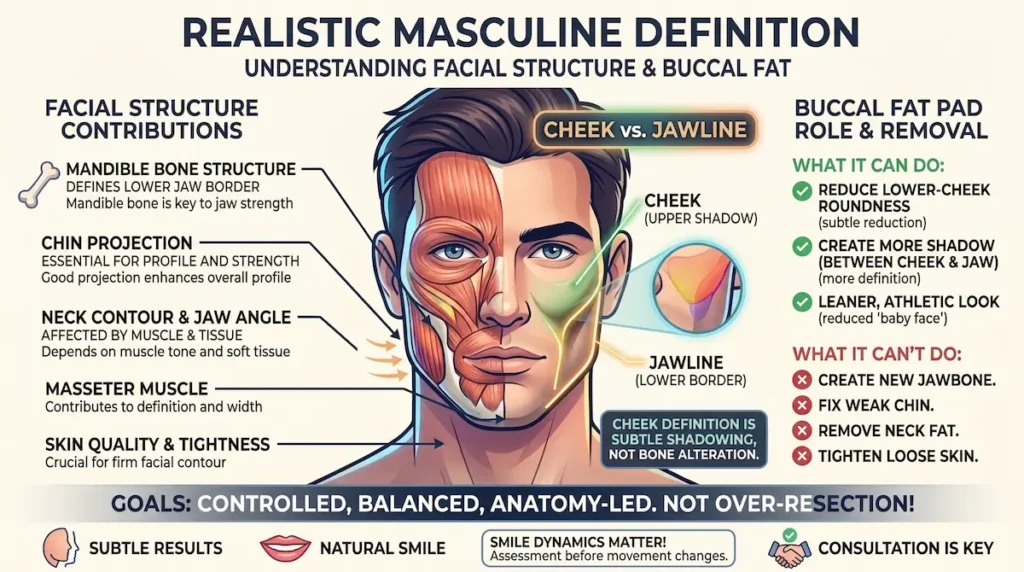
Masculine definition is often misunderstood. Many men picture a sharper jawline, but buccal fat removal works higher than the jaw border. It changes the lower cheek hollow, not the bone structure of the mandible. A realistic result is usually a subtle reduction in cheek roundness, not a dramatic transformation into a different facial type.
The look men usually want
Most male patients do not want to look surgically altered. They want the face to look a little leaner, more athletic, and more structured in photos. They may say they want less “baby face,” less cheek fullness when smiling, or a cleaner cheek shadow under certain lighting.
That goal can be reasonable when the lower cheek is genuinely full and the rest of the face can support the change. The best result does not announce itself. Friends may notice that the face looks more defined, but they should not be able to point to an obvious hollow.
This is where the consultation should become specific. Instead of asking for a “snatched” look, a better male goal is: “Can we reduce lower-cheek roundness without making my face look older or narrower?” That question leads to safer planning.
What buccal fat removal can and can’t do
Buccal fat removal can reduce lower-cheek fullness. It can create more shadow between the cheekbone and the lower jaw. It can make a round face look less soft when the candidate is right. It cannot create a new jawbone, fix a weak chin, remove neck fat, or tighten loose skin.
That distinction is supported by ASPS guidance warning that a nice jawline depends on more than the buccal fat pad alone. The jawline may involve muscle, chin projection, neck contour, skin quality, and other anatomy. Removing cheek fat when the real issue sits elsewhere is how men end up disappointed—or hollow.
For this reason, AKM treats buccal fat removal as one possible tool within facial analysis, not a universal male jawline procedure. In some men, it is appropriate. In others, the honest answer is no.
Jaw vs cheek contribution
The cheek and jawline are connected visually, but they are not the same structure. The cheek creates the upper shadow. The jawline creates the lower border. A man can have full cheeks and a strong jaw. He can also have hollow cheeks and still lack jaw definition.
This is why buccal fat removal should not be sold as a shortcut to a stronger lower face. It may help the face look leaner from the front, especially if cheek fullness is the dominant feature. But if the main concern is under-chin fullness, a soft neck angle, or weak chin projection, removing cheek fat may not address the actual problem.
Smile dynamics matter as well. Some men notice cheek fullness most when smiling; others only see it in relaxed photos. If the concern is mainly expression-related, the assessment should include how it affects your smile, because over-resection can make movement look less natural.
Realistic masculine definition is controlled, balanced, and anatomy-led. It is not about removing as much fat as possible. It is about deciding whether the buccal fat pad is truly the feature holding back the face—and whether removing part of it will still look right years from now.
Who Is a Good Male Candidate?
A good male candidate is not simply someone who wants sharper cheeks. He is someone whose anatomy can safely support a smaller buccal fat pad without losing healthy facial volume. The right candidate usually has true lower-cheek fullness, stable weight, realistic expectations, and enough facial structure to keep the result looking masculine rather than hollow.
Fuller lower cheeks on a balanced face
The clearest candidate signal is persistent lower-cheek fullness that remains even when body weight is stable. This is the “baby face” look some men describe: the lower cheeks stay round even when the rest of the body is lean. In that setting, conservative buccal fat removal may reduce cheek heaviness and let the existing bone structure show more clearly.
Balance matters. If the cheekbones, chin, and jaw already give the face structure, reducing lower-cheek fullness can create a cleaner transition. If the face is narrow, flat, or under-projected, the same reduction may look empty. The surgeon’s job is to decide which situation you are actually in.
Men with thick skin or a heavier lower face may also need a careful discussion about limits. Buccal fat removal can refine the cheek hollow, but it does not tighten skin or remove superficial facial fat. The result should be described in millimeters of refinement, not as a full-face reshaping promise.
Stable weight
Weight stability is important because buccal fat removal changes a deep facial fat pad that does not behave like ordinary body fat. If you lose significant weight after surgery, the rest of the face may slim down around an already reduced buccal area. That can make the result look more hollow than originally planned.
A stable weight also helps the surgeon judge whether the fullness is truly structural. If your face becomes much leaner whenever you diet down, surgery may not be the right first step. If your lower cheeks remain full even at your usual healthy weight, buccal fat may be a more relevant factor.
For US patients who work out heavily, cycle through bulking and cutting phases, or plan a major body transformation, timing should be discussed carefully. The safest plan is usually based on the weight you expect to maintain long-term.
Realistic goals
The best male candidates can describe the desired change in realistic terms: “less round,” “more defined,” “slightly leaner,” or “more balanced.” They are not asking for a completely different face. They also accept that the result is subtle and that final contour settles gradually as swelling resolves.
Realistic expectations also include understanding what the procedure cannot control. A strong jawline may need chin balance, neck contour, dental structure, or muscle anatomy assessment. Buccal fat removal can help one part of the picture. It cannot solve all lower-face concerns.
| Male candidate signal | Good fit or caution? | Why it matters |
|---|---|---|
| Full lower cheeks despite stable weight | Good fit | This suggests the buccal fat pad may be contributing to persistent roundness. |
| Strong cheekbones, chin, and jaw structure | Good fit | Existing structure can support a leaner cheek without looking depleted. |
| Already narrow or naturally lean face | Caution | Removing cheek volume may create a gaunt or older look instead of definition. |
| Major weight loss planned | Caution | Future facial slimming can exaggerate hollowing after buccal fat reduction. |
| Goal is a stronger jawline only | Caution | The jawline may depend more on chin, neck, bone, or skin factors than cheek fat. |
| Clear goal: less cheek roundness, not a new face | Good fit | Subtle, anatomy-led goals are more compatible with natural male results. |
Who Should Skip It — Over-Resection Risk
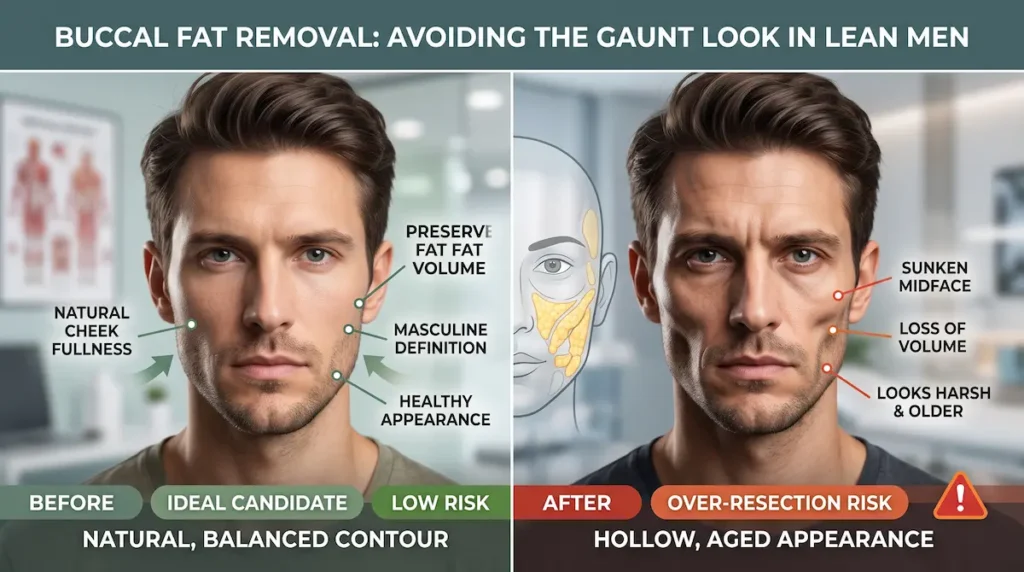
Some men are not good candidates, even if they strongly dislike their cheek fullness in photos. The highest-risk cases are men who are already lean, have narrow facial frames, or want an extreme “cut” look that depends on removing too much fat. For these patients, the risk is not just a disappointing result. It is a result that can look harsher as the face ages.
Already lean or narrow faces
If your cheeks are already slim at rest, buccal fat removal may not create a better contour. It may create a hollow. This is especially true in men with narrow midfaces, low cheek volume, or sharp cheekbones that already cast shadows. Removing more volume from that structure can make the face look drawn rather than masculine.
This is where a surgeon should be willing to say no. A conservative recommendation protects the patient, even when the requested procedure is technically possible. The question is not “can the fat be removed?” It is “will the face still look healthy after it is removed?”
Johns Hopkins’ overview of buccal fat removal candidacy notes that people with naturally narrow faces may develop an overly gaunt appearance. That principle applies strongly to male patients chasing a sharper face when there is not much cheek fullness to reduce.
Why men age into hollowing
Faces lose volume over time. Skin elasticity changes. Fat pads shift. Bone support also changes subtly with age. A cheek contour that looks sharp in your 20s or 30s may read differently later, especially if too much fat was removed.
That does not mean every man will regret the procedure. It means the plan should account for the future face, not only the current selfie. Men with naturally lean faces, strong dieting habits, or family patterns of facial hollowing should be especially cautious.
For a deeper look at this long-term question, the companion guide on how the face changes ten years later covers aging trajectory in more detail. This article stays focused on male suitability, but long-term volume preservation should still shape the decision.
The gaunt-look warning
The classic warning sign is a face that looks sharper but less healthy. The cheeks appear sunken. The area beside the mouth may look heavier. The midface may look tired, especially under overhead lighting. In men, that can be mistaken for “definition” at first, but it often lacks balance.
ASPS warns against aggressive buccal fat removal because facial fat is valuable for a youthful, balanced appearance. The warning is particularly relevant for men who request a very carved result. A controlled cheek shadow can look strong. A hollow cheek can look older.
Before traveling for surgery, ask whether your surgeon plans full removal, partial removal, or no removal based on your anatomy. A board-certified or European Board-Certified surgeon using an ABPS-equivalent standard should be able to explain why a conservative plan suits your face—or why the procedure is not recommended.
Planning a Conservative Result
A conservative male buccal fat removal plan starts with restraint. The aim is not to remove the maximum amount of fat; it is to remove the minimum amount needed to reduce lower-cheek roundness while preserving support, expression, and long-term facial balance. This is the section where the decision becomes practical: how much, why, and what else should be assessed before surgery.
Why less is more
Buccal fat is difficult to replace exactly once removed. Some volume can sometimes be restored with fat grafting or fillers, but reversal is not simple, predictable, or identical to the original anatomy. That is why a “take a little more” mindset is risky.
For men, less is often more because the target is not softness removal at all costs. The target is controlled definition. Leaving enough buccal volume helps the face move naturally, age more gracefully, and avoid the hollow-cheek look that can make a man appear tired.
Surgeon-led perspective: In male buccal fat removal, restraint protects the result. The most natural outcomes usually come from reducing the specific fullness that blunts the cheek contour—not from emptying the cheek until it looks carved. A masculine face should look structured, not starved.
Combining with jawline assessment
If the goal is lower-face definition, the consultation should include the whole jawline. The surgeon should assess the chin, neck, skin quality, lower-cheek fat, and facial proportions together. Sometimes buccal fat removal is relevant. Sometimes the better answer is to leave the cheeks alone.
This is also where age matters. A man in his 20s with very full lower cheeks may have a different risk profile than a man in his 40s with early facial hollowing. If aging changes are already visible, the discussion may shift toward volume preservation or other facial aging options rather than fat removal.
For men who are noticing early laxity or midface changes, facial aging options after 40 may be more relevant than removing cheek volume. The right path depends on whether the problem is excess fullness, tissue descent, or volume loss.
What to ask in consultation
Your consultation should not be vague. Ask the surgeon to point out exactly where the buccal fat pad is contributing to your concern. Ask whether your face is full enough to tolerate reduction. Ask how the result may look after weight loss, aging, or changes in facial hair.
It is also reasonable to ask whether the plan is partial removal rather than aggressive extraction. A conservative surgeon should be comfortable discussing limits. They should also explain what buccal fat removal will not do for your jawline.
Cost can be part of the decision, but it should not drive the surgical plan. Since this article is focused on suitability rather than pricing, use the dedicated guide to review what buccal fat removal costs in Turkey without turning the medical decision into a price-first comparison.
Recovery planning also matters, especially for men traveling internationally. Swelling can temporarily hide the final contour, and the face may look uneven during early healing. For practical expectations after surgery, review what recovery involves before choosing a date.
AKM evaluates facial structure, cheek volume, age, weight stability, and long-term balance before recommending buccal fat removal for men. The goal is a subtle, masculine refinement that fits the whole face—not a hollow result that only looks dramatic in one angle of light.
Ask AKM whether buccal fat removal suits your facial structure in a free virtual consultation. A conservative plan starts with knowing whether the procedure belongs in your face at all.
Frequently Asked Questions: Buccal Fat Removal for Men
These questions are the ones men most often ask when they are deciding whether buccal fat removal fits their face. The safest answers are anatomy-specific. Use them as a decision framework, not a substitute for a surgeon’s facial analysis.
Is buccal fat removal good for men?
The best male results are usually subtle. The face looks a little more defined, but still healthy and natural.
Does buccal fat removal make the jaw look stronger?
If your main concern is a weak jawline, under-chin fullness, or poor chin projection, buccal fat removal may not be the right primary solution. A full lower-face assessment is more useful than focusing only on cheek fat.
Will buccal fat removal age me?
That does not mean every man will look older after buccal fat removal. The risk depends on facial shape, age, skin quality, weight stability, and how conservative the resection is.
Am I too lean for buccal fat removal?
A simple test is to ask what would happen if you lost another 10 pounds. If the answer is “my face would get much thinner,” buccal fat removal deserves extra caution.
How is buccal fat removal different for men vs women?
For men, the surgeon has to judge whether cheek reduction will support a masculine face or weaken it. That is why the jaw, chin, neck, cheekbones, and aging pattern all matter.
Can buccal fat removal be reversed?
This is why conservative planning is so important. The safest male buccal fat removal result is one that does not need to be “fixed” later.
Medical disclaimer: This article is for educational purposes only and is not medical advice. Buccal fat removal results vary by anatomy, age, skin quality, weight stability, healing response, and surgical plan. Only a qualified surgeon can determine whether you are a suitable candidate after reviewing your medical history and facial structure.
AKM Clinic performs surgical procedures in Istanbul. For facial procedures, planning is led by an anatomy-first, Natural-First approach designed to avoid an operated-on or hollow appearance. No surgical result can be guaranteed.
Related Treatments




Ready to Start Your Own Transformation Journey?
Join the 2,000+ patients who trusted Dr. Akif Mehmetoğlu and the AKM Clinic team. Your journey to a more confident, revitalized you begins with a simple, no-obligation conversation. Contact us today from the USA for your free virtual consultation.
#1: Get Your Free Personalised Quote
Start with a free, no-obligation online consultation. Share your photos, and our surgical team will provide a fully personalised treatment plan and a transparent, all-inclusive price package. No hidden fees.
#2: Secure Your Date & VIP Booking
Once you're ready, our dedicated patient coordinators will help you secure your procedure date. We'll handle all your bookings, including your 5-star hotel and private VIP airport transfers.
#3: Arrive in Istanbul & Meet Your Surgeon
Arrive at Istanbul Airport (IST) and be greeted by your private driver. Settle into your hotel and prepare for your in-person consultation, where you'll meet your specialist surgeon to finalise the details for your "natural, subtle, and revitalized" new look.