

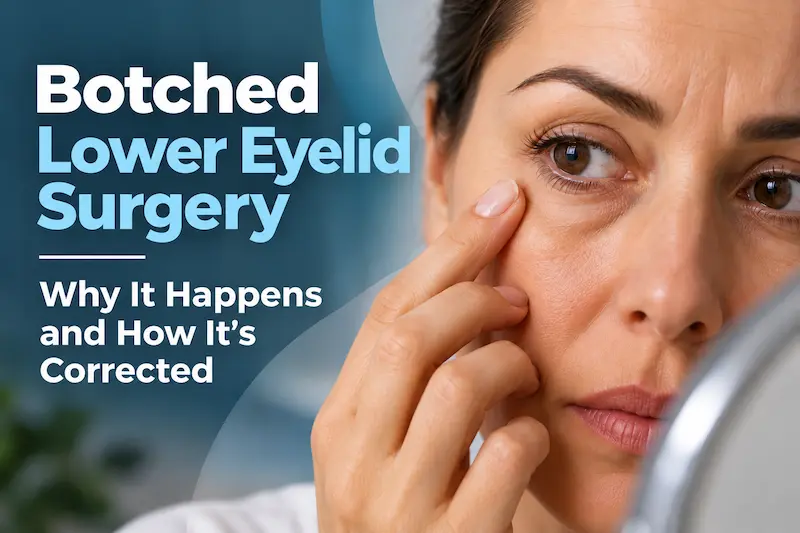
Quick answer: A botched lower eyelid surgery usually means the lower lid sits too low, pulls away from the eye, exposes extra white beneath the iris, or leaves the under-eye hollow after too much fat removal. Early problems may improve with time, taping, massage, or steroid treatment; established lower-lid retraction, ectropion, or scleral show often needs canthal support, grafting, or midface support.
Botched lower eyelid surgery is not just a cosmetic disappointment. The lower lid protects the eye, spreads tears, and frames the lower border of the iris. If it is pulled down, shortened, weakened, or hollowed out, the result can look “off” and feel uncomfortable.
For Canadian patients researching surgery abroad, the safest question is not “Will my eyes look younger?” It is “Will my lower eyelid still sit in the right position after healing?” That is why how AKM plans lower eyelid surgery starts with anatomy, lid support, and conservative tissue handling rather than a one-size-fits-all skin removal plan.
This guide explains what bad lower blepharoplasty looks like, why it happens, how careful planning helps prevent it, and which correction options may be considered when the result has already gone wrong. It is written in a calm, evidence-first way. No scare tactics. No guarantees.
Table of Contents
What “Botched” Lower Eyelid Surgery Actually Means
A “botched” lower eyelid result usually means the lower lid no longer rests naturally against the eye, or the under-eye area looks hollow, pulled, or uneven after surgery. Some early swelling and tightness can look strange during healing. That alone does not mean the operation has failed.
The distinction matters. A temporary healing change is monitored and supported; a true lower-lid malposition needs a structured exam. A surgeon has to assess lid height, lid tightness, tear function, cheek support, scar tension, and the amount of skin or fat that was removed.
Lower eyelid retraction, ectropion, and scleral show
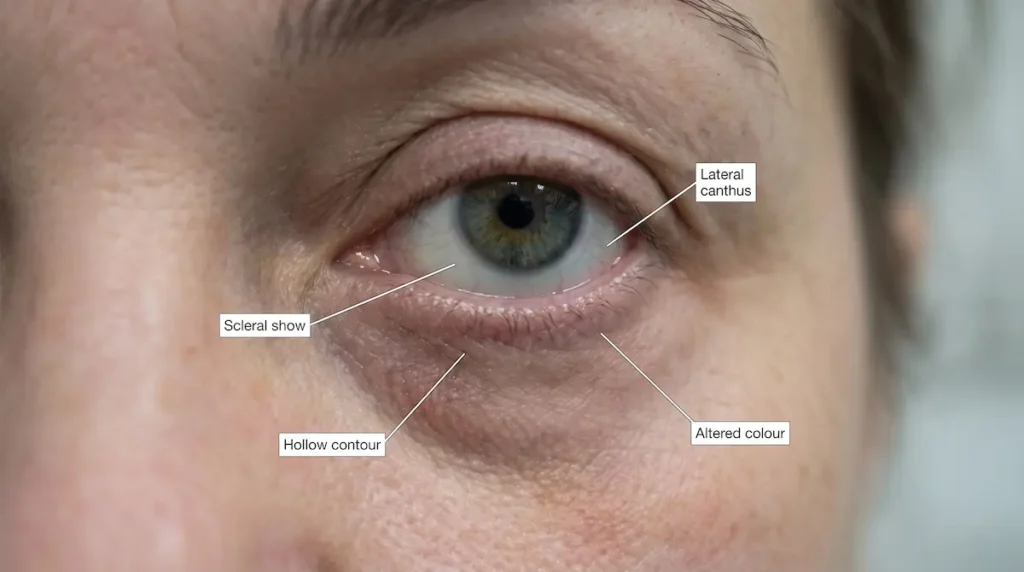
Lower eyelid retraction means the lower lid sits lower than it should. Patients often notice more white showing under the coloured part of the eye. That visible white is called scleral show. In photos, it can make the eyes look rounder, sadder, startled, or more tired than before surgery.
Ectropion after blepharoplasty is different but related. In ectropion, the lower lid turns outward or pulls away from the eyeball. This may cause watering, dryness, irritation, redness, or a feeling that the eye is exposed. It can happen when the lower lid is weak, scarred, shortened, or not supported at the outer corner.
Not every case looks dramatic. Mild lower eyelid retraction may show up only in flash photos or when the patient smiles. More significant cases can affect comfort because the lid is no longer protecting the ocular surface properly.
Rounded eyes after blepharoplasty
Rounded eyes after blepharoplasty often happen when the natural almond shape is softened or pulled downward. The lower eyelid margin may lose its slight upward tension at the outer corner. Instead of following the curve of the eye, it drops into a rounder contour.
This is one reason canthal support matters. The lateral canthus, or outer eyelid corner, acts like a stabilizing point. If the patient already has lid laxity before surgery, removing lower-lid skin without support can reveal or worsen that weakness.
There is also a diagnostic trap here. Sometimes a patient thinks the lower eyelid surgery caused droop, but the real issue is upper-lid ptosis, brow descent, or asymmetry that became more obvious after swelling settled. That is why it is worth checking whether the droop is ptosis rather than a bad result before planning revision.
Hollow under-eyes after fat removal
Another form of bad lower blepharoplasty is hollowing. This can happen when too much lower eyelid fat is removed, especially in a patient who already has a tear trough, flat midface, or age-related volume loss.
The result is not always a “tight” look. It may be the opposite: a shadowed, skeletonized, or older-looking under-eye. The skin can look darker because the hollow creates a light-shadow effect. Patients may say they look tired even after sleeping well.
Modern lower eyelid planning often favours conservative fat removal, fat repositioning, or volume-preserving techniques in the right candidate. The goal is not simply to take away bags. It is to smooth the transition between lower lid and cheek while protecting lid position.
Temporary healing changes versus a true problem
The first weeks after lower eyelid surgery can be misleading. Swelling, bruising, tightness, mild asymmetry, and small changes in eyelid shape can occur while tissues are inflamed. The colour may shift from purple to yellow as bruising resolves.
Warning signs deserve faster attention. Increasing pain, worsening redness, pus, fever, new visual symptoms, inability to close the eye, or persistent exposure discomfort should be discussed with a qualified clinician promptly. Online photos cannot replace an eye exam.
Note for Canadian patients: A lower eyelid result should be judged by both appearance and function. If the eye feels dry, exposed, irritated, or harder to close, the issue is not only cosmetic. Bring clear front-view, side-view, and upward-gaze photos to any virtual review, and describe symptoms rather than relying on appearance alone.
Why It Happens
Botched lower eyelid outcomes usually come from a mismatch between the surgery and the patient’s anatomy. The lower lid is a small structure, but it depends on skin, orbicularis muscle, orbital septum, canthal tendons, cheek support, and tear function working together.
When one of those supports is weak, aggressive tissue removal can tip the eyelid out of balance. That is why lower blepharoplasty is less about “removing bags” and more about choosing the right amount of support, release, repositioning, and restraint.
Untreated lid laxity and missed canthal support
Lid laxity means the lower eyelid is looser than ideal. It may not spring back quickly when pulled downward or away from the eye. In a lower blepharoplasty assessment, snap-back and distraction testing help reveal whether the lid has enough tone to tolerate lower eyelid surgery without extra support.
The StatPearls chapter on lower lid canthal support describes how lower eyelid laxity is evaluated and why canthal support may be needed during lower eyelid surgery. This is especially relevant when the lower lid can be pulled several millimetres away from the globe or returns slowly after release.
When laxity is missed, the eyelid may heal in a lower or outward position. That can create lower eyelid retraction, ectropion, scleral show after eyelid surgery, or a rounded-eye shape.
Too much skin or muscle removed
The lower lid has limited spare skin. Removing too much can shorten the anterior lamella, which is the skin-and-muscle layer at the front of the eyelid. If that layer becomes too tight, it can pull the lid downward or outward as it heals.
This is why “tightening” the lower eyelid is not the same as improving it. A smooth result needs enough skin to blink, smile, and close the eye without tension. Over-resection can look neat on an operating table and still behave badly during healing.
Over-removal of orbicularis muscle can also weaken eyelid support. The muscle helps blinking and tear distribution. If its function is disturbed, the patient may notice dryness, watering, or an eyelid that no longer hugs the eye properly.
Middle lamella scarring
The middle lamella is a deeper support layer around the orbital septum. Scarring here can act like a downward tether. Even if the skin closure looks clean, internal scar contraction can pull the lower eyelid into retraction.
This type of scarring is one reason established retraction may not respond to surface massage alone. Once internal shortening becomes mature, correction may need release of scar tissue and structural support rather than another simple skin excision.
Patients with previous surgery, inflammation, trauma, or significant bruising may have more complex scar behaviour. That does not mean revision is impossible. It means the plan must identify which layer is shortened and what type of support is missing.
Negative-vector or prominent eyes
Some patients are higher risk before any incision is made. In a negative-vector face, the eye projects farther forward than the cheek. In prominent eyes, the lower lid has less cheek support beneath it. Both situations can make the lower lid more vulnerable to retraction.
A patient with a flatter midface may not tolerate aggressive skin removal or fat removal well. The lid needs support from below, not just tightening from the side. If this anatomy is ignored, the eye can look round, exposed, or hollow after surgery.
This is also where brow and upper-lid assessment matters. A patient may ask for lower eyelid revision when part of the visual imbalance comes from brow descent or upper-lid hooding. In that situation, upper eyelid hooding and its surgery may need to be assessed separately, without turning a lower-lid problem into the wrong operation.
Technique choices that do not match the problem
A transcutaneous lower blepharoplasty, done through an incision just below the lashes, can be appropriate in selected patients. It also requires careful judgement because the front support layer is involved. In patients with laxity, negative-vector anatomy, or minimal skin excess, the margin for error is narrower.
A transconjunctival approach, done from inside the eyelid, can reduce external skin disruption when the main issue is fat bulging rather than loose lower-lid skin. It is not automatically better for every patient. The right approach depends on skin quality, lid support, fat position, cheek contour, and whether canthal support is needed.
Double eyelid procedures and upper-lid crease surgery have a different risk profile. They should not be mixed into a lower-lid revision plan unless the patient is truly seeking that type of correction. For that distinction, see how double eyelid surgery is planned in our blepharoplasty guide.
| Problem after surgery | Likely contributing factor | Prevention principle | Possible correction route |
|---|---|---|---|
| Lower eyelid retraction | Lid laxity, internal scarring, negative-vector anatomy | Snap-back and distraction testing, conservative skin removal, canthal support when needed | Scar release, canthopexy or canthoplasty, spacer graft, midface support |
| Ectropion after blepharoplasty | Shortened anterior lamella, weak canthal tendon, excess skin removal | Preserve skin and muscle function; avoid over-tightening | Early lubrication and taping; later canthal tightening or skin graft in selected cases |
| Scleral show | Lower lid pulled below its natural position | Assess lid height and cheek support before surgery | Canthal support, spacer graft, midface lift depending on cause |
| Rounded eyes after blepharoplasty | Loss of outer-corner support or lower-lid tension | Protect the lateral canthus and avoid excessive lower-lid traction | Canthopexy revision or canthoplasty in appropriate cases |
| Hollow under-eyes after fat removal | Too much fat removed; tear trough or midface volume deficit not addressed | Conservative fat handling or fat repositioning | Fat repositioning, fat grafting, filler in selected non-surgical cases, or midface support |
“A safe lower eyelid result is planned before the incision. The question is not only how much skin or fat can be removed, but how the lid will be supported while it heals.” — AKM Clinic surgical team perspective
For a cautious patient, that may feel like a lot to assess. It should. Lower eyelid surgery is a small operation only in surface area. Anatomically, it is a support procedure, a contour procedure, and an eye-protection procedure at the same time.
How Good Planning Prevents It
Good lower eyelid surgery begins with restraint. The safest plan is not the one that removes the most skin or fat; it is the one that improves the under-eye while keeping the lower lid supported, mobile, and close to the eye.
Prevention depends on reading the anatomy before surgery. A patient with firm lid tone, good cheek support, and true fat bulging may need a different approach than someone with dry eyes, lid laxity, prominent eyes, or a flat midface. The same operation can be safe for one person and risky for another.

Snap-back and distraction tests
Snap-back testing checks how quickly the lower lid returns to the eye after being pulled downward. Distraction testing checks how far the lid can be pulled away from the eyeball. Together, they help reveal whether the lid has enough tone to tolerate lower eyelid surgery without extra support.
If the lid returns slowly, sits low, or pulls away too easily, the plan should change. This may mean less skin removal, more canthal support, a different incision, or a decision to delay surgery until dry-eye or eyelid-surface issues are better understood.
For Canadian patients reviewing virtual photos before travelling, this is one reason a detailed video consultation matters. Photos show contour; movement shows support. The surgeon needs to know how the eyelid behaves, not just how the under-eye looks in a still image.
Canthopexy versus canthoplasty
Canthopexy and canthoplasty are both forms of canthal support, but they are not identical. A canthopexy reinforces the outer eyelid corner without fully detaching and reconstructing it. It may be used when laxity is mild and the goal is support rather than major repositioning.
A canthoplasty is more structural. It can be used when laxity is more significant, when the lower lid needs stronger repositioning, or when revision surgery requires more control over eyelid height and shape.
This is also why patients sometimes see canthopexy mentioned in aesthetic eye-shape procedures. In the right context, how canthopexy is used in fox eye surgery can help explain the support concept, but lower-lid revision is not the same as chasing a trend. Function comes first.
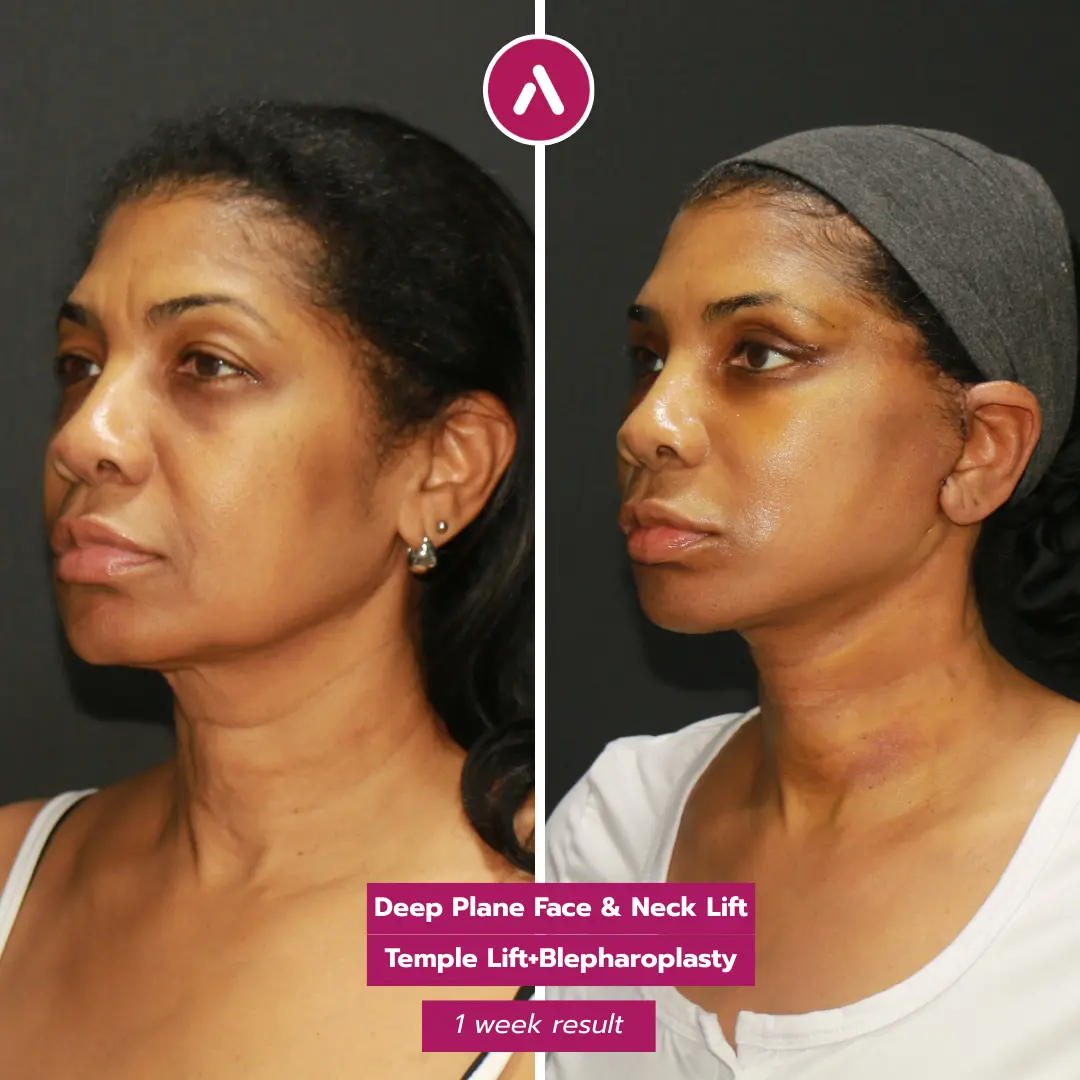
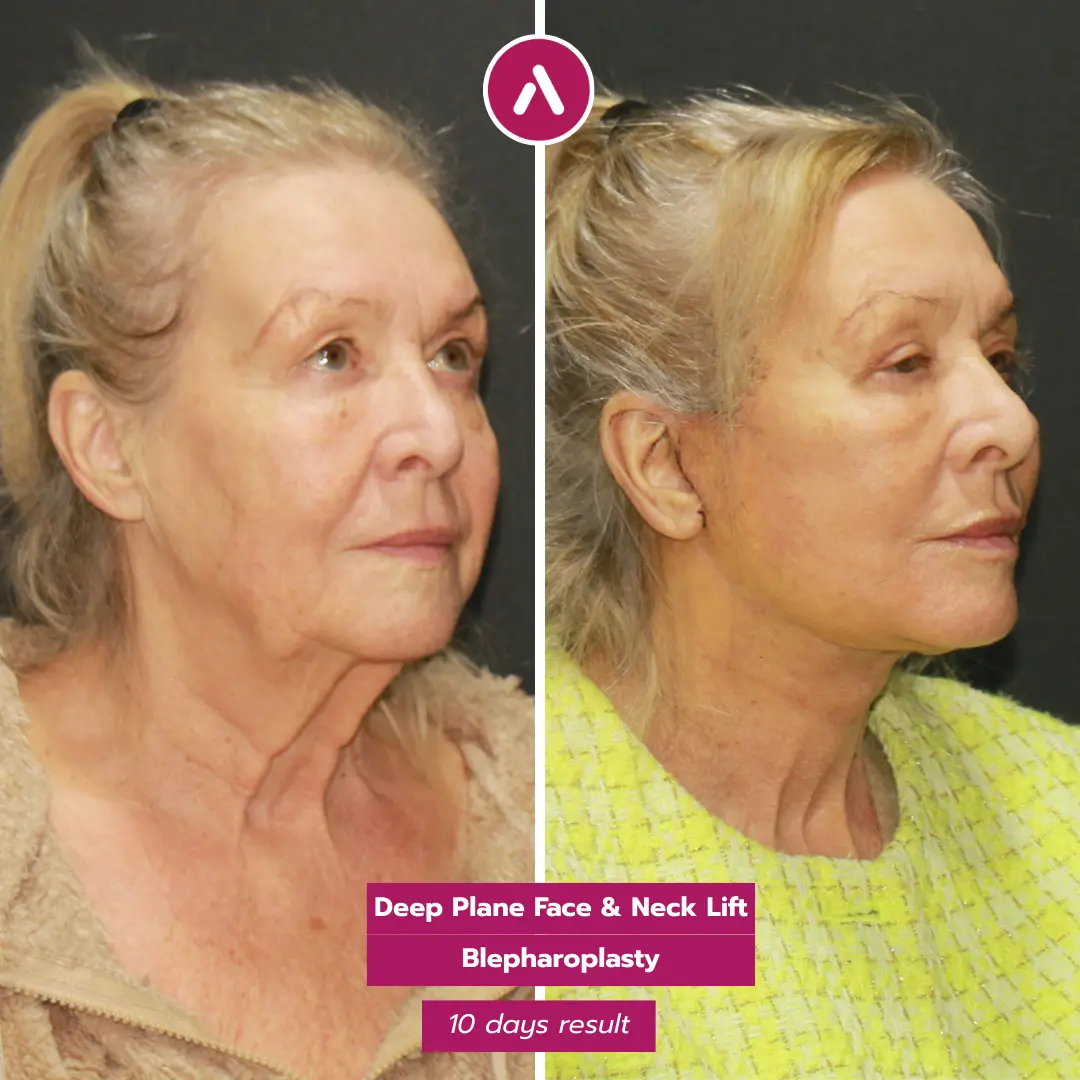
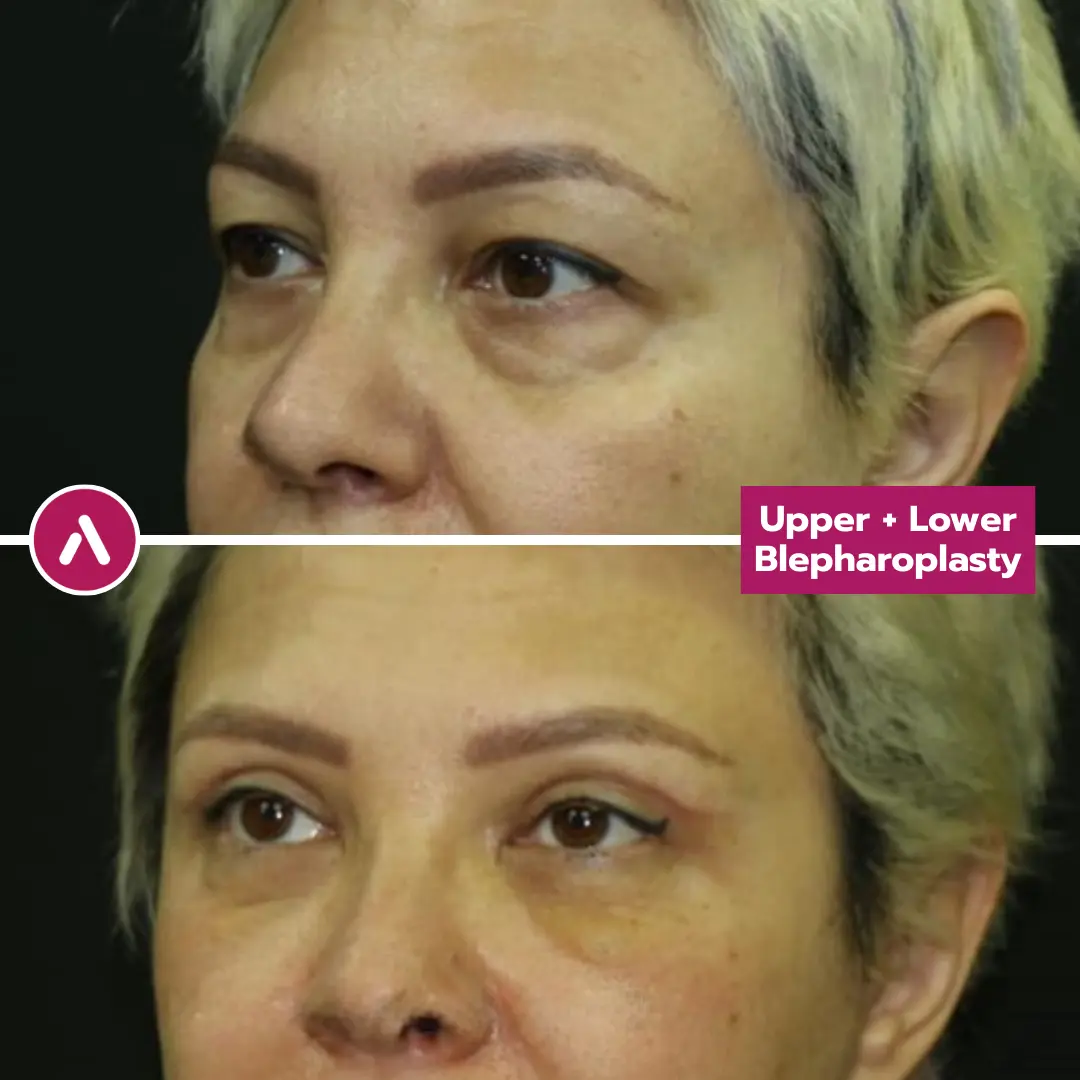
Transconjunctival lower blepharoplasty
A transconjunctival approach reaches the lower eyelid fat from inside the eyelid. It avoids an external skin incision under the lashes and can be useful when the main concern is fat bulging rather than loose lower-lid skin.
This does not make it universally safer. If the patient also has skin excess, lid laxity, or cheek descent, the surgeon still has to address those factors. A transconjunctival incision can reduce certain skin-related risks, but it cannot compensate for poor planning.
Used well, it supports a conservative philosophy: treat the fat problem without disturbing the front support layer more than necessary. Used in the wrong patient, it may simply leave another issue untreated.
Fat repositioning instead of aggressive fat removal
Under-eye bags often sit next to hollows. Removing fat alone can flatten the bulge but deepen the hollow beside it. That is how some patients end up looking more tired after surgery, even when the “bag” is technically smaller.
Fat repositioning moves or redrapes existing fat to soften the lid-cheek transition. In selected patients, it can preserve volume and reduce the risk of a hollow under-eye. Other patients may need fat grafting, filler, or midface support later, but those decisions should be made carefully.
The principle is simple. Lower eyelid surgery should improve the transition from eye to cheek, not create a sharp ledge beneath the orbit.
Planning tip for Canadian patients: The Canadian Society of Plastic Surgeons’ blepharoplasty information notes that lower eyelid surgery may include canthal support or tightening when eyelid laxity is present. Ask how lower-lid laxity will be tested, whether your eyes are prominent or negative-vector, and whether fat will be removed, repositioned, or preserved.
How Botched Lower Eyelids Are Corrected
Correction depends on timing and cause. A swollen, tight lower lid at week three is not managed the same way as a scarred, retracted lower lid at month eight. The first step is to identify whether the problem is still evolving or already established.
A good revision plan should explain the layer that failed: skin shortage, middle lamella scarring, weak canthal support, cheek descent, hollowing, or a combination. Lower eyelid revision is rarely just “more skin tightening.” Often, it is the opposite: release, support, and restore.
Early-stage care: massage, taping, lubrication, and steroid treatment
In the early healing phase, some lower-lid tightness or mild downward pull may improve as swelling settles. Surgeons may recommend massage, taping, lubrication, eye drops, or temporary support depending on the exam. These measures are individualized.
Steroid injections may be considered when scar activity is contributing to tightness, but they are not casual treatments. Around the eyelid, dosing and placement matter. Too much steroid, or steroid in the wrong plane, can create thinning or contour problems.
The main point is timing. Some early changes should be supported and observed; others need prompt care. If the eye cannot close, becomes painful, develops worsening redness, or vision changes, waiting is not appropriate.
Established retraction: canthal support and scar release
Once lower eyelid retraction is established, correction often requires more than surface care. The surgeon may need to release internal scar tissue, reposition the lower lid, and reinforce the outer corner with canthopexy or canthoplasty.
The goal is not to make the lower lid “tight.” It is to restore a stable position against the eye. Over-tightening can create a different unnatural look, so revision must balance support with a natural eyelid shape.
A review of managing post-blepharoplasty lower lid retraction describes post-blepharoplasty lower eyelid retraction as a multifactorial problem, with correction often involving midface lifting, posterior lamellar spacer grafting, and canthal suspension in selected cases.
Spacer grafts and hard palate grafts
A spacer graft may be used when the lower eyelid needs vertical height or internal support. The graft acts like a structural spacer, helping lift and support the lower lid after scar release.
Different graft materials may be considered depending on the case, including hard palate grafts or other spacer options. The choice depends on the surgeon’s experience, eyelid anatomy, tissue shortage, and whether the patient has had prior surgery.
Patients should understand the purpose of a spacer. It is not a cosmetic filler. It is a reconstructive support tool used when the lower lid has been shortened or pulled down by internal scarring.
Midface lift for cheek support
Sometimes the eyelid problem is partly a cheek problem. If the midface is flat, descended, or unsupported, the lower lid may not have enough structural support from below. In these cases, a midface lift may be considered as part of correction.
This does not mean every lower-lid revision needs a midface lift. It means the surgeon must assess the lid-cheek relationship. A lower lid cannot always be fixed by working only on the eyelid.
For patients with negative-vector anatomy, restoring cheek support may reduce downward tension and improve the transition between the eye and cheek. The revision plan should explain why that support is needed, not add procedures without a clear reason.
Skin grafts for shortage of lower-lid skin
If too much skin was removed, the lower eyelid may be short on the outside layer. In selected cases, a skin graft may be needed to add tissue and reduce downward pull.
This is usually considered when skin shortage is a true driver of ectropion or retraction. It is not the first choice for every patient. The surgeon must determine whether the shortage is external skin, internal scar, weak canthal support, cheek descent, or several problems together.
Revision is about cause, not labels. Two patients can both say “my lower eyelid surgery was botched” and need completely different corrections.
Timing: why many revisions wait around six months or longer
Many revision decisions are made after tissues soften and scars mature. For established cosmetic revision, surgeons often wait several months, commonly around six months or longer, unless there is an urgent functional problem.
Waiting can be frustrating. It can also prevent overtreatment. Swelling, stiffness, and early scar behaviour may improve, and a later assessment gives a clearer view of the true lid position.
There are exceptions. Exposure symptoms, corneal risk, severe ectropion, infection, or visual changes need timely medical assessment. Comfort and eye protection are not cosmetic concerns.
Choosing a Surgeon for Revision
Revision lower eyelid surgery asks more of the surgeon than primary blepharoplasty. The anatomy has already been altered, scar planes may be unpredictable, and the patient may be understandably anxious. A careful consultation should feel slower, not rushed.
For Canadian patients considering travel for revision, the goal is to verify judgement before committing. Credentials matter, but so does the quality of the examination: lid laxity testing, dry-eye history, vector analysis, cheek support, and a realistic discussion of what can and cannot be changed.

Look for lower-lid assessment, not just cosmetic language
A revision consultation should include lower-lid position, snap-back response, distraction, canthal tendon support, scleral show, tear symptoms, and eye closure. It should also compare old photos, current photos, and the patient’s symptoms.
Be cautious if the proposed plan is simply “remove more skin” or “tighten the eyelid” without explaining why the lid dropped or hollowed in the first place. A short answer may miss the real problem.
At AKM Clinic, revision-style assessment is approached through a surgeon-led review, with European Board-Certified Surgeons working in an RCPSC-equivalent framework for Canadian patients. The aim is not to promise a perfect eye shape; it is to identify the safest, most anatomically sound path.
Questions to ask before lower eyelid revision
- Do I have lower eyelid retraction, ectropion, scleral show, hollowing, or more than one issue?
- Is the problem caused by skin shortage, internal scarring, canthal laxity, cheek support, or fat removal?
- Do I need canthopexy, canthoplasty, a spacer graft, midface support, or volume restoration?
- What should improve, and what may remain partly visible?
- How long should I wait before revision if my eye is comfortable and protected?
- What symptoms would require urgent care before my planned review?
- How will follow-up work after I return to Canada?
Cost and related procedures should stay secondary
Cost is relevant, especially when a patient is comparing revision options internationally. It should not drive the surgical plan. Lower eyelid correction must be planned around anatomy first, then logistics and budget.
For pricing context, use eyelid surgery pricing rather than treating this article as a cost guide. Revision complexity, grafting, and combined procedures can change the quote.
Related procedures also need careful separation. If the brow sits low, the assessment may include whether the brow, not the lid, needs lifting. That does not mean a brow lift is automatically needed. It means the upper face and lower lid should be evaluated together.
Travel tip for Canadian patients: If you are flying from Canada, ask what photos, operative notes, medication history, and eye-symptom details should be reviewed before you book. A YYZ-based return plan should also include written warning signs, virtual check-ins, and instructions for local assessment if eye irritation worsens after travel.
“Revision lower eyelid surgery should start with the diagnosis: which layer is short, which support is weak, and whether the eye surface is safe. Only then can the correction be planned.” — AKM Clinic surgical team perspective
Frequently Asked Questions: Botched Lower Eyelid Surgery
These answers cover the most common questions patients ask after a bad lower blepharoplasty result. They are general education, not a diagnosis. A lower eyelid that is painful, exposed, infected, or affecting vision needs in-person medical assessment.
What does a botched lower eyelid surgery look like?
Can lower eyelid retraction be fixed?
How long after blepharoplasty can ectropion be corrected?
Why do my eyes look rounded after eyelid surgery?
Can hollowing after fat removal be fixed?
Does canthopexy prevent lower lid problems?
Is scleral show after eyelid surgery always permanent?
Should I wait before seeking a second opinion?
Considering a lower eyelid revision? Ask AKM how lower eyelid laxity is measured and protected before any surgery, and what correction options may fit your anatomy after a surgeon-led review.
Medical disclaimer: This article is educational and does not replace a personal medical examination. If you have eye pain, vision changes, increasing redness, discharge, inability to close the eye, or worsening dryness after eyelid surgery, seek prompt medical care. Surgical outcomes vary from patient to patient.