

Quick answer: Ankle liposuction removes the small, stubborn fat pads around the ankle bones and Achilles area to restore the taper between calf and ankle — the change people mean by “cankles.” It works only when the fullness is fat, not swelling or bone, and results are subtle by design. Expect longer swelling than other zones and weeks of compression stockings.
Ankle liposuction is a precise form of lower-leg contouring for patients whose ankles look thick because fat hides the natural transition between the calf and the foot. At AKM Clinic, the decision starts with how AKM approaches liposuction of small zones: identifying what is actually causing the fullness before planning any fat removal.
That matters more around the ankle than almost anywhere else. The fat layer is thin. The skin is delicate. Tendons, vessels, and nerves sit close to the surface. A conservative plan can make the ankle look more defined; an aggressive one can create unevenness, hollows, or an unnatural lower-leg shape.
For Canadian patients comparing cankle liposuction abroad, the core question is not “Can fat be removed?” It is “Should fat be removed from this specific ankle?” This guide explains how to separate fat from swelling or bone structure, why the ankle is a precision zone, what realistic results look like, and how recovery below the knee differs from liposuction on larger areas.
Table of Contents
What “Cankles” Are — and What Ankle Liposuction Can Change
This section defines “cankles” in practical anatomical terms, then separates what liposuction can refine from what it cannot change. The goal is to frame ankle contouring as a precise fat-reduction option, not a promise of a completely different lower-leg shape.
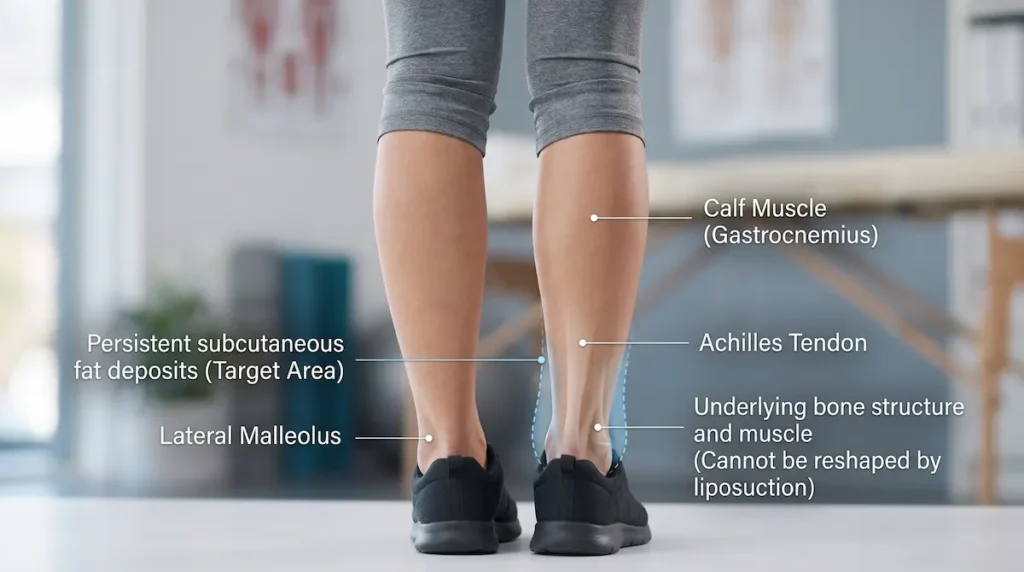
“Cankles” is a casual term for a lower leg where the calf seems to blend directly into the ankle, with little visible narrowing between the two. In surgical terms, the concern is usually about the calf-to-ankle taper: the contour line that should gradually narrow as the leg approaches the ankle bones.
Some patients have a naturally straight lower-leg silhouette because of genetics. Others have soft fat deposits that blur the ankle outline, especially around the inner ankle, outer ankle, and the areas beside the Achilles tendon. In the right candidate, ankle liposuction can reduce these small fat pads and help reveal a cleaner transition.
The calf-to-ankle taper
A refined ankle is not defined only by size. It is defined by proportion. The lower calf should narrow gently, then meet the ankle in a way that still looks natural when you stand, walk, and wear shoes.
That is why ankle contouring is often planned with the lower calf in mind. Treating only the ankle can make the calf look heavier by comparison. Treating too high into the calf can also disturb the natural leg line. The goal is balance.
For some patients, a small change around the ankle makes shoes, dresses, cropped pants, and activewear feel more flattering. For others, the true issue is not fat at all. That distinction comes before any surgical plan.
Where the fat usually sits
Ankle fullness that may respond to liposuction is typically soft and pinchable. It may sit around the malleoli, the bony points on each side of the ankle, or along the shallow grooves beside the Achilles tendon. These are small zones, so millimetres matter.
Unlike abdominal or flank liposuction, cankles surgery does not involve removing a large volume of fat. The procedure is more about contour control than volume reduction. A small, even reduction often looks better than trying to make the ankle as narrow as possible.
This is also why “before and after” expectations need caution. A good ankle result often looks natural rather than obvious. Friends may notice that the lower leg looks lighter or more elegant, but they may not immediately know why.
What ankle liposuction cannot change
Ankle liposuction cannot reshape bones, shorten tendons, remove muscle, or treat fluid retention. It also cannot create a delicate ankle if your natural skeleton is broader or if swelling is the main reason the area looks full.
It is not a weight-loss procedure. Losing weight may reduce general leg volume, but some people keep a persistent ankle fat pad even at a stable weight. Those are the cases where surgical refinement may be worth discussing.
Skin quality also matters. If the ankle skin is already loose, crepey, or poorly elastic, removing fat can sometimes make laxity more visible. A careful consultation should include both fat thickness and skin response, not just a visual judgement from photos.
“Around the ankle, smaller and smoother is safer than aggressive. The best contour comes from even, conservative fat removal that respects the tendons, ankle bones, and natural lower-leg line.”
Fat, Swelling, or Bone? Who Actually Benefits?
This section is the candidate filter. It helps Canadian patients understand whether their cankles are likely caused by localized ankle fat, edema, natural bone structure, or a medical pattern such as lipedema that needs physician-led assessment before cosmetic planning.
The right candidate for ankle liposuction has localized fat, stable weight, good skin elasticity, and no untreated medical reason for ankle swelling. The wrong candidate may still dislike the ankle shape, but liposuction will not solve the cause.
Many people use “cankles” to describe several different problems: fat, edema, lipedema, broad bone structure, thick calves, or temporary swelling after heat, travel, standing, or hormonal changes. These may look similar in photos, but they need different answers.
How soft ankle fat usually feels
Fat-related ankle fullness is usually present on both sides and feels soft rather than tight. You may be able to pinch a layer of tissue around the ankle, especially near the inner ankle or beside the Achilles tendon. The shape may stay fairly consistent throughout the day.
Good candidates often say their ankles have looked the same for years, even when their weight changes. They may have a family pattern of lower-leg fullness. Their feet may not feel heavy, painful, or suddenly swollen.
Even then, a surgeon should assess the whole lower leg. If the calf is also full, the plan may involve ankle and calf liposuction rather than isolated ankle work. That does not mean more aggressive surgery. It means the contour is planned as one continuous line.
How swelling is different
Swelling behaves differently from fat. It may worsen by evening, after long flights, after salty meals, during hot weather, or after prolonged standing. It can feel tight, shiny, or heavy. Pressing a finger into the area may leave an indentation for a short time.
Swollen ankles should not be treated as a cosmetic fat problem until medical causes are considered. Circulation issues, lymphatic problems, medication effects, injury, pregnancy-related changes, kidney disease, heart disease, and other conditions can all change ankle volume. A sudden one-sided swollen ankle, pain, redness, warmth, or shortness of breath needs prompt medical assessment.
For Canadian patients, this is especially relevant before travelling. A virtual consultation can help screen obvious anatomical concerns, but persistent or unexplained swelling should be reviewed by a physician at home before surgery planning continues.
Bone, tendon, and natural structure
Some ankles look broad because the ankle bones are prominent or the tendons create a naturally sturdy outline. Liposuction cannot narrow bone. It cannot erase the Achilles tendon, change foot structure, or create a smaller joint.
This does not mean surgery is never useful. A broader ankle can still have a soft fat pad that blunts definition. But the expected change should be framed carefully: refinement around the structure, not replacement of the structure.
A review of calf and ankle liposuction complications stresses cautious patient selection and notes that the calf and ankle are areas where poor selection or overcorrection can lead to visible irregularity. Patients considering cankles surgery should understand that undesirable outcomes in calf and ankle liposuction are often linked to treating the wrong anatomy or removing too much tissue.
Fat vs swelling vs bone: decision guide
| Possible Cause | How It Often Looks or Feels | Can Liposuction Help? | Better Next Step |
|---|---|---|---|
| Localized ankle fat | Soft, pinchable fullness that stays fairly consistent | Possibly, if skin elasticity is good | Surgical assessment for ankle liposuction candidacy |
| Dependent swelling or edema | Tightness, heaviness, evening swelling, possible indentation after pressure | No, not as a first-line answer | Medical review to identify the cause of swelling |
| Bone or tendon structure | Firm width around the ankle joint, little pinchable fat | Limited or no benefit | Realistic contour discussion; avoid over-treatment |
| Lipedema suspicion | Disproportionate leg fullness, tenderness, bruising tendency, often sparing the feet | Different pathway; not simple cankle liposuction | Physician-led diagnosis and treatment planning |
In short, the best candidates for cankle liposuction are not simply people who dislike their ankles. They are people whose ankle fullness is caused by a removable fat layer and whose skin can adapt after that layer is reduced.
Why the Ankle Is a Precision Zone
This section explains why ankle liposuction needs more restraint than larger liposuction areas. The ankle is small, highly visible, and anatomically crowded, so smooth contouring matters more than the amount of fat removed.
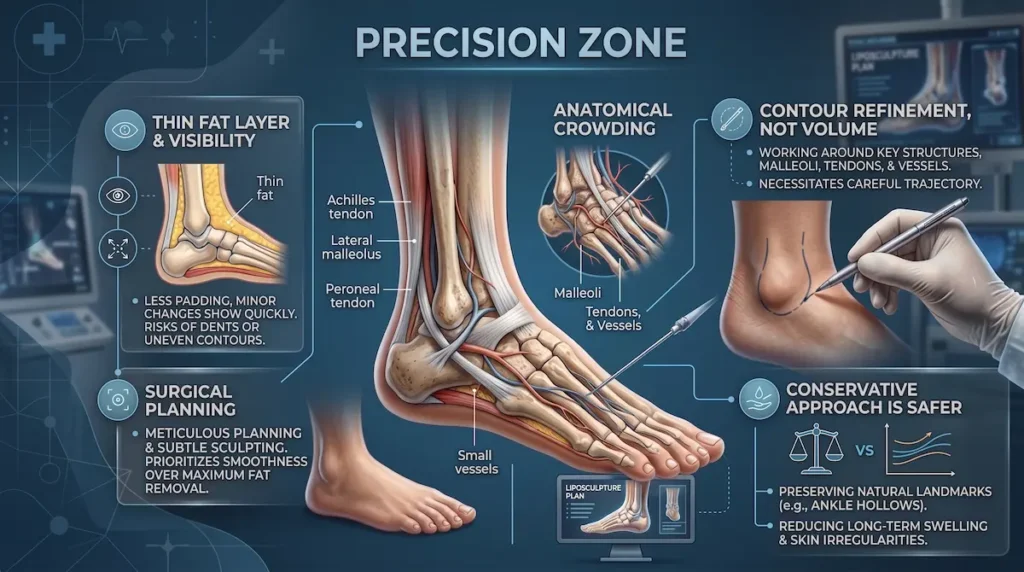
The ankle is not a large-volume liposuction area. It is a narrow, highly visible contour zone where a few millimetres can change the outline of the lower leg. That is why ankle liposuction should be approached with restraint, detailed marking, and a surgeon-led plan rather than a “remove as much as possible” mindset.
Compared with the abdomen, waist, or thighs, the ankle has less padding between the skin and the underlying structures. The tissue layer is thin, the surface is irregular, and the natural shadows around the ankle bones need to be preserved. A smooth result depends on even reduction, not maximum reduction.
Thin fat layer, high visibility
Small contour changes around the ankle show quickly. If fat is removed unevenly, the skin can reveal dents, grooves, or asymmetry when you stand or move. This is one reason the ankle is less forgiving than larger areas.
The goal is to soften the heavy ankle look without stripping the area. A slightly fuller but smooth ankle is usually better than an over-reduced ankle with visible irregularity. Subtlety is part of the safety plan.
This is also why patients who are researching the knee as another precision zone often notice similar language: small zones require conservative sculpting, careful symmetry checks, and realistic expectations.
Tendons, vessels, and ankle bones
The ankle’s shape is influenced by the malleoli, Achilles tendon, nearby vessels, and small soft-tissue pockets. A surgeon must work around these structures rather than treating the ankle like a simple fat-storage area.
Fine cannulas and careful passes help reduce the risk of contour irregularity. The plan should also respect where natural hollows belong. Removing too much from the wrong place can make the ankle look sharper in an unhealthy way, especially when swelling settles.
A recent technical paper on lower-leg contouring describes calf and ankle liposculpture as an area that requires specific positioning, careful treatment zones, and controlled technique rather than routine high-volume fat removal. That supports the more conservative planning approach used for calf and ankle liposculpture when the goal is contour refinement.
Why conservative removal is safer
Aggressive cankle liposuction can create problems that are harder to correct than the original fullness. Hollows, uneven shadows, loose-looking skin, and an unbalanced calf-to-ankle line can occur when the removal is too deep or too uneven.
Conservative removal protects the shape. It also leaves room for the skin and lymphatic system to recover. Below the knee, swelling can linger longer than patients expect, so the early result should not be judged too quickly.
Small incision placement is another part of precision planning. Ankle incisions are usually tiny, but their position still matters because shoes and movement can irritate healing skin. For more detail, see AKM’s guide to the tiny access points liposuction leaves.
“The ankle is a contour problem, not a volume problem. A careful plan removes only what improves the taper, while preserving the natural ankle landmarks that make the result look believable.”
Canadian patients should feel comfortable asking how the surgical team avoids overcorrection, how symmetry is checked, and how much change is expected from fat removal alone. Clear answers are a good sign. Vague promises are not.
What Realistic Results Look Like
This section sets expectations for the visible change after ankle liposuction. The likely result is a smoother, lighter calf-to-ankle transition — not a completely new leg shape or a dramatic reduction in joint size.
Realistic ankle liposuction results are usually refined rather than dramatic. The ankle may look less heavy, the calf-to-ankle transition may appear cleaner, and shoes may frame the lower leg more elegantly. The result should still look like your leg, only more balanced.
This is where many online images can be misleading. Lighting, foot position, swelling, camera angle, and footwear can make ankle results look larger or smaller than they are. A good consultation focuses on your anatomy, not someone else’s photo.
Subtle narrowing, not a new leg shape
The best results usually come from reducing soft fullness around the ankle bones and lower calf. This can reveal more contour, but it does not create a completely new leg shape. If the calf is muscular, the ankle bones are naturally wide, or swelling is present, the change will be limited.
That does not make the procedure pointless. For the right patient, a small contour improvement can change how the lower leg looks in fitted pants, leggings, sandals, heels, or athletic shoes. The value is in proportion.
Ankle contouring is often described as “quiet” surgery. The result may not announce itself. Instead, the lower leg looks less heavy and more tapered in everyday clothing.
Why ankle and calf liposuction may be planned together
The ankle does not exist in isolation. If the lower calf is also full, treating the ankle alone may make the calf look disproportionate. This is why ankle and calf liposuction may be discussed as one contour plan.
That discussion should still be conservative. The calf contains muscle and important soft-tissue structures, so liposuction can only reduce fat, not calf muscle. In patients with a muscular calf, the expected ankle change may be modest.
For a deeper look at lower-calf shaping, AKM’s guide to reshaping the calves together with the ankles explains how calf fullness differs from ankle fullness. This article stays focused on the ankle and cankle decision.
When results become visible
Early swelling can hide the result. Some patients see a lighter ankle outline within weeks, but the final contour often takes months as fluid settles and the skin adapts. Below the knee, patience is part of the process.
Swelling may also move downward because the ankle is a dependent area. After standing, flying, or walking more than usual, the ankle can temporarily look fuller again. This does not automatically mean the procedure failed.
Most patients should expect staged improvement: early shape change, then swelling fluctuation, then gradual refinement. Your timeline should be specific to your treated zones, flight plan, and recovery pace.
Realistic outcome guide
| Starting Anatomy | Likely Benefit | Limitations | Expectation to Set |
|---|---|---|---|
| Soft, pinchable ankle fat with good skin tone | Cleaner taper and reduced heaviness | Not a dramatic size change | Subtle but visible refinement |
| Full ankle plus full lower calf | More balanced lower-leg contour if planned together | Muscle cannot be reduced | Ankle and calf liposuction may be considered |
| Swelling that changes during the day | Liposuction is unlikely to address the cause | Medical causes must be ruled out | Physician review before cosmetic planning |
| Broad bone structure with little fat | Minimal contour change | Bone width remains the same | Avoid surgery if the benefit is too limited |
A good outcome should look smooth in motion, not just in a still photo. The ankle should taper naturally when you stand, walk, and point the foot. Over-treatment can make the result look surgical, which is the opposite of the goal.
Recovery Below the Knee — What’s Different?
This section covers recovery issues that are more noticeable after ankle liposuction than after liposuction in higher body areas. Because the ankle is low on the body, swelling control, compression, walking, elevation, and return-flight planning matter.
Recovery after ankle liposuction is shaped by gravity. Because the ankle sits below the heart for much of the day, swelling can collect there even when the surgery was conservative. This makes compression, elevation, walking, and flight planning especially important for Canadian patients travelling home after surgery.
The recovery is usually manageable, but it requires patience. The ankle may look puffy before it looks refined. Shoes may feel tight for a while. The lower leg may feel firm, tender, or bruised as the tissues settle.

Dependent swelling and why it lasts
Dependent swelling means fluid tends to collect in lower areas of the body, especially after standing or sitting for long periods. Around the ankle, this can temporarily blur the exact taper the procedure was meant to create.
This is normal in many recoveries, but it can be frustrating. You may see a better contour in the morning and more swelling later in the day. Elevation and compression help manage that fluctuation while healing progresses.
Patients should avoid judging the final result during the first weeks. Early swelling can make both ankles look uneven, even when the surgical removal was symmetrical. Final contour takes time.
Compression stockings, walking, and elevation
Compression is commonly used after lower-leg liposuction to support swelling control and tissue settling. Your garment plan should be specific: what to wear, how long to wear it, how to protect incision sites, and when it is safe to change compression levels.
Short, frequent walks are usually encouraged because they support circulation. This does not mean exercise. It means gentle movement, especially during the early recovery period.
Elevation can help reduce ankle swelling when resting. Many patients find that planned rest periods during the day make the ankles feel less tight. The key is consistency rather than overdoing activity as soon as the discomfort improves.
Flying home to Canada after ankle liposuction
Canadian patients need a clear return-flight plan. Long flights, airport walking, sitting, cabin pressure, and dehydration can all increase lower-leg swelling. This does not automatically make travel unsafe, but it does mean planning should be deliberate.
Your AKM team should advise when you are fit to fly, how to use compression during travel, when to walk during the flight, and what symptoms should prompt medical attention. Patients returning through YYZ, YVR, YUL, or another Canadian airport should plan for comfort, not speed.
A helpful rule is to avoid scheduling a packed first week back home. Even if the incisions are tiny, the lower legs may need more time to settle than expected. Remote follow-up helps track swelling, bruising, and contour changes after you return to Canada.
Cost belongs in a separate decision step
It is reasonable to ask about pricing, but this article is not a cost guide. Ankle liposuction may be priced within a lower-leg or liposuction treatment plan, depending on whether the ankle alone or the calf-and-ankle area is treated. For current CAD-only information, use AKM’s dedicated page for ankle and calf liposuction pricing.
The same applies to packages and combined procedures. If another body area is added, the recovery, garment plan, flight timing, and total quote can change. Those details should be handled in a consultation rather than assumed from a blog article.
Safety questions to ask before booking
- Is my ankle fullness fat, swelling, bone, tendon structure, or a mix?
- Would isolated ankle liposuction be enough, or does the lower calf need assessment too?
- How will you avoid hollows around the ankle bones and Achilles area?
- Where will the tiny incisions sit, and how are scars expected to heal?
- What compression plan will I follow during the flight home to Canada?
- What symptoms after travel should make me contact the clinic or seek urgent medical care?
One more point matters for patients comparing procedures abroad: avoid making the decision from price alone. Ankle liposuction is small in area, but demanding in judgement. The right plan may be to treat conservatively, treat the ankle and calf together, or avoid surgery because swelling or structure is the real issue.
For trust context, AKM Clinic reports a Trustpilot rating of 4.7/5. Canadian patients should still ask direct questions about the surgical team’s experience with small-zone liposuction, the RCPSC-equivalent credential framework, compression planning, and remote follow-up after returning home.
For readers moving through AKM’s lower-body content, this is also why scar behaviour is discussed separately in other guides, including how thigh lift scars heal over the first year. Ankle liposuction uses tiny access points, but the broader lesson is the same: planning, aftercare, and patience shape the final result.
Frequently Asked Questions About Ankle Liposuction
This FAQ section answers the questions Canadian patients usually ask once they understand the difference between ankle fat, swelling, and natural bone structure. The answers stay focused on ankle liposuction and cankles; broader liposuction recovery, calf shaping, scars, and pricing are handled on their own linked pages.
Does ankle liposuction work for cankles?
It does not work well when the ankle looks thick because of swelling, broad bones, tendon structure, or muscle bulk. In those cases, removing fat may create little visible benefit or may make the contour look uneven.
How do I know if my cankles are fat or swelling?
A simple at-home observation can help, but it is not a diagnosis. If your ankles swell suddenly, hurt, feel warm, turn red, or become one-sided, you should seek medical assessment before considering cankle liposuction.
How much fat can be removed from the ankles?
Removing too much fat around the ankle can reveal tendons, create hollows, or make the lower leg look irregular. A safer plan removes only enough fat to soften heaviness and improve the calf-to-ankle taper.
How long does swelling last after ankle liposuction?
This does not automatically mean the result is poor. The ankle is a dependent area, so fluid naturally collects there during recovery. Compression, elevation, gentle walking, and follow-up guidance are important.
Can I get ankle and calf liposuction together?
However, calf fullness may come from muscle rather than fat. Liposuction cannot reduce muscle size, so the consultation must separate fatty fullness from muscular calf structure before any plan is made.
Does ankle liposuction leave scars?
Because this article focuses on ankle contouring rather than scars, scar expectations should be discussed separately during consultation and reviewed alongside incision placement.
Is cankles surgery painful?
Pain tolerance varies. Your anesthesia plan, the extent of treatment, compression, and early walking instructions should be discussed before surgery. Severe, worsening, one-sided, or unusual pain should be reported promptly.
Can liposuction treat cankles caused by lipedema?
If lipedema is suspected, diagnosis and treatment planning should come first. Cosmetic ankle contouring is not a substitute for physician-led care.
What should Canadian patients ask before travelling for ankle liposuction?
For a small area, the decision can feel deceptively simple. It is not. The ankle is a delicate zone, so you need a clear plan before booking travel.
Final Thoughts: Is Ankle Liposuction Right for Your Cankles?
This final section brings the decision back to anatomy and safety. Ankle liposuction can be worthwhile for the right fat pattern, but it should not be used to chase a result that your bone structure, swelling pattern, or skin quality cannot support.
Ankle liposuction is best for patients with a real, pinchable fat layer around the ankle and lower calf. It is not a solution for every thick-looking ankle. The safest question is: what is causing your cankles, and can surgery improve that cause without creating a new problem?
The most successful ankle liposuction results are usually modest, smooth, and natural. They refine the ankle. They do not erase your anatomy.
That distinction matters. If your lower leg looks heavy because fat blurs the ankle bones and calf-to-ankle taper, careful liposuction may help. If the fullness is swelling, bone structure, or muscle, the better answer may be medical assessment, expectation adjustment, or no surgery at all.
AKM Clinic’s approach is to plan ankle contouring conservatively, especially for Canadian patients travelling to Istanbul. The consultation should review your photos, medical history, swelling pattern, skin elasticity, and lower-leg proportions before any treatment recommendation is made.
Ask AKM whether your ankles are a fat zone that liposuction can refine — and what level of change is realistic for your anatomy.
Medical disclaimer: This article is for educational purposes only and does not replace medical advice, diagnosis, or treatment. Ankle swelling can have medical causes that require assessment by a qualified physician. Surgical suitability, recovery, and results vary from patient to patient.