A breast lift after weight loss may be suitable if your weight is stable, your breasts have dropped or flattened, your nipples sit lower than before, and you want a more lifted shape rather than a major size increase. The best candidates are healthy non-smokers with realistic expectations and enough time after major weight loss for the body to stabilize.
Major weight loss can feel like a victory and a new problem at the same time. You may feel stronger, lighter, and healthier, but your breasts may not reflect the work you have put in. Skin that stretched over years does not always retract after fat volume disappears.
That is where a breast lift, or mastopexy, becomes a serious consideration. It does not replace the weight you lost. Instead, it reshapes the breast envelope, lifts the nipple-areola complex, removes extra skin, and creates a firmer contour using your remaining tissue. For Canadian patients comparing local private surgery with travelling abroad, breast lift planning at AKM Clinic starts with one question: is your anatomy ready for the operation now, or does your body need more time?
This guide focuses only on candidacy after major weight loss. It is not a general breast lift overview, a price list, or a before-and-after gallery. You will learn what makes someone a good candidate, when waiting is safer, and how skin quality, weight stability, implants, and timing affect the surgical plan.
Surgeon-led perspective: After major weight loss, the goal of a breast lift is usually shape and position first. Volume is a separate decision. Some patients do well with their own tissue; others need an implant or fat transfer discussion to restore upper-pole fullness.
Table of Contents
Why Breasts Change After Major Weight Loss
After major weight loss, the breast often changes in two ways at once: it loses volume and keeps extra skin. This is why many patients describe deflated or saggy breasts after weight loss even when they are happy with the rest of their body transformation.
Breasts contain glandular tissue, fat, connective support, and skin. Weight loss reduces the fatty component, but the skin and internal support structures may not shrink back at the same pace. The result can be a flatter upper breast, a longer lower breast fold, and nipples that point downward instead of forward.
These changes are especially common after bariatric surgery, GLP-1-assisted weight loss, pregnancy combined with weight loss, or a large natural weight reduction over a short period. Skin quality matters. So does time.
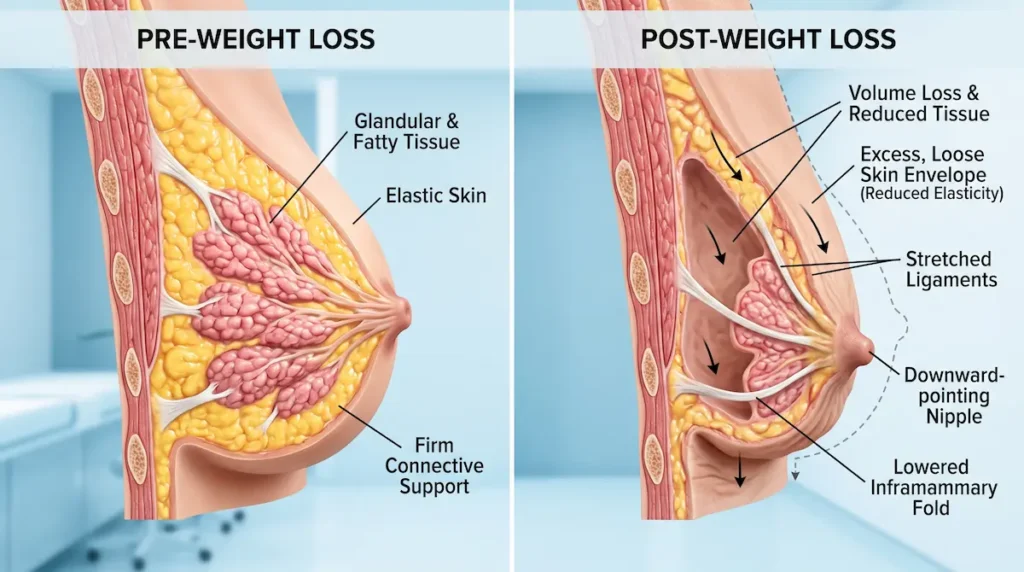
Volume loss and excess skin happen together
A breast lift after major weight loss is different from a lift for mild age-related sagging. In major weight loss patients, the issue is rarely just droop. It is often a combination of loose skin, stretched areolas, flattened breast tissue, and side fullness near the bra line.
This distinction matters because a lift can move and reshape tissue, but it cannot create unlimited volume. If there is enough lower-pole breast tissue, the surgeon may be able to reposition it for a rounder shape. If the breast is very empty, the discussion may shift toward whether an implant is needed.
The right plan starts with anatomy, not cup-size wishful thinking.
Skin elasticity determines how much reshaping is realistic
Elasticity is the skin’s ability to contract and hold a new contour. After major weight loss, elasticity may be reduced because the skin has been stretched for a long time. Stretch marks are one clue, but they are not the only factor.
During consultation, the surgical team looks at skin thickness, nipple position, breast fold location, tissue quality, and how far the nipple has descended below the inframammary fold. Photographs help, but an in-person examination gives the clearest answer.
Good skin does not mean perfect skin. It means skin that can heal, hold sutures, and support a more lifted shape without excessive tension.
Nipple position is one of the clearest signs
One practical sign is nipple direction. If your nipples point downward, sit below the breast crease, or fall near the lowest part of the breast, a lift may be more appropriate than volume treatment alone.
Implants can add fullness, but they do not reliably correct significant nipple descent by themselves. In some post-weight-loss breasts, adding volume without lifting the nipple can make the breast look heavier, not more youthful.
This is why candidacy is not based only on wanting fuller breasts. It is based on whether the breast envelope needs reshaping.
The Candidate Checklist for a Breast Lift After Weight Loss
A good candidate for a breast lift after weight loss is not defined by one number on the scale. The more useful question is whether your weight, nutrition, health, and expectations are stable enough for surgery. That is especially important after bariatric surgery or rapid medical weight loss.
Most surgeons prefer the body to be at or near a maintainable weight before reshaping loose skin. The American Society of Plastic Surgeons lists good general health, stable weight, non-smoking status, and realistic goals among key criteria for post-weight-loss body contouring candidates; you can review the ASPS guidance on body contouring candidates after major weight loss as a useful benchmark.
If weight loss continues after surgery, the lifted breast can lose volume again. If weight returns, the skin can stretch again. For many patients, the right time is when the transformation has settled.
| Candidate criterion | Why it matters | How it is assessed |
|---|---|---|
| Stable weight for at least 6–12 months | Reduces the risk of recurrent sagging after surgery | Weight history, BMI trend, photos, and current maintenance habits |
| Near your goal weight | A lift works best when major body changes are mostly complete | Discussion of remaining weight-loss plans and body contouring priorities |
| Good nutrition and protein intake | Healing depends on adequate nutritional reserves | Medical history, bariatric history, lab review when needed |
| Non-smoker or able to stop safely before surgery | Nicotine can reduce blood flow and affect wound healing | Honest smoking, vaping, and nicotine-use history |
| Realistic expectations | A lift improves shape and position, but does not erase every sign of weight loss | Consultation, photo review, scar discussion, and implant/no-implant planning |
| No uncontrolled medical condition | Diabetes, anemia, and other issues may raise healing risk if not optimized | Pre-op screening, medication review, and surgeon-led clearance pathway |
Your weight should be stable, not simply lower
The phrase breast lift weight stable may sound blunt, but it captures a key principle. A stable weight protects the result. It also helps the surgeon judge how much skin to remove and how much tissue can be reshaped.
For some patients, six months of stability may be enough. For others, especially after large or recent weight loss, a longer period is more sensible. The goal is not to punish progress. It is to avoid operating while the body is still changing.
If you are still losing weight each month, the best surgical plan may be to wait.
After bariatric surgery, timing deserves extra care
Mastopexy after bariatric surgery usually requires a more cautious timeline than a standard cosmetic lift. Many patients need time for weight to plateau, nutrition to normalize, and any deficiencies to be corrected before elective body contouring.
This is not just about the scale. Bariatric patients may have low iron, low protein, vitamin deficiencies, or changes in medication that affect recovery. Those issues do not automatically prevent surgery, but they should be identified before a date is booked.
A careful clinic will ask about the type of bariatric procedure, current supplements, recent bloodwork, weight stability, and whether your bariatric or primary care team has flagged any concerns.
Good health matters more than a perfect BMI
There is no universal BMI cut-off that makes every patient suitable or unsuitable. Still, higher BMI can influence anesthesia planning, wound tension, breast weight, and the risk of healing issues. Canadian patients should expect a direct conversation about this, without shame or sales pressure.
The question is practical: can surgery be done safely, and will the result hold?
If your health profile is not ready, the answer may be “not yet.” That is still useful information. A delayed operation often leads to a safer plan and a more predictable result.
Skin Quality and What It Means for Your Scars
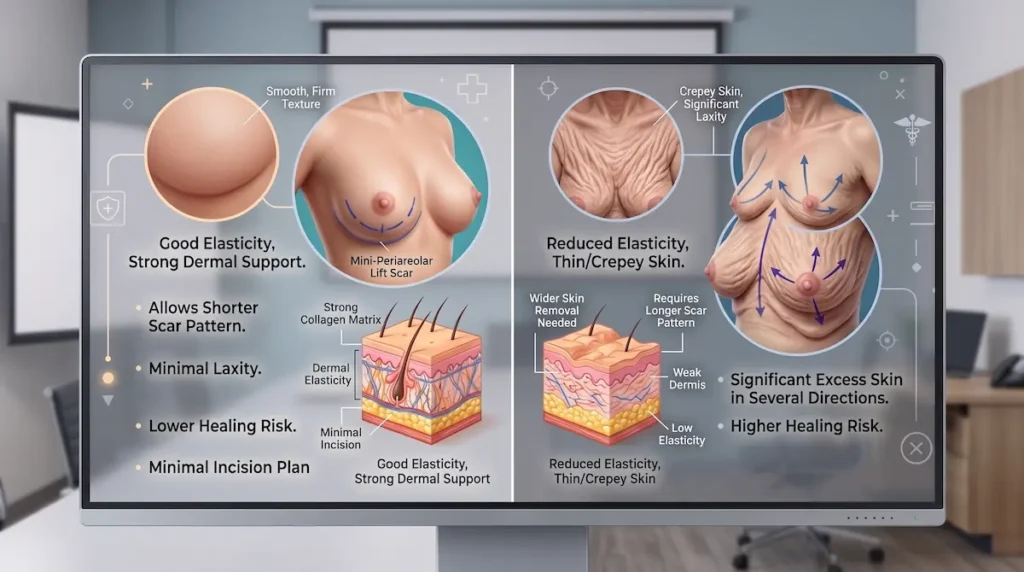
Skin quality affects both the breast shape and the scar plan after major weight loss. Thin, stretched skin may need stronger reshaping, more support inside the breast, and a longer incision pattern to avoid placing too much tension on a short scar.
This is the part many patients underestimate. A smaller scar is not always the safer or more attractive plan. If the skin envelope is loose in several directions, a limited incision may leave too much excess skin behind.
The right operation balances lift, shape, blood supply, and scar placement.
Post-weight-loss skin is often thinner and less elastic
After significant weight loss, the breast skin may feel softer, thinner, or crepey. Stretch marks can show that the dermis has been under long-term tension. The breast may fold over itself, especially when you sit, lean forward, or remove your bra.
That does not automatically rule out surgery. It means the plan must respect the skin’s limits.
A careful assessment looks at how much skin needs to be removed, how the remaining tissue can be shaped, and whether the nipple-areola complex has enough healthy blood supply. The more stretched the skin, the more precise the design needs to be.
An anchor or inverted-T pattern may be necessary
Patients sometimes hope for the smallest possible scar. That is understandable. After major weight loss, though, the amount and direction of excess skin often make a vertical or anchor pattern more realistic than a small periareolar lift.
An anchor, also called an inverted-T pattern, allows the surgeon to remove skin both vertically and horizontally. This can be useful when the lower breast has stretched downward and the nipple needs to be lifted by several centimetres.
The trade-off is clear: a longer scar can allow a stronger shape correction. A shorter scar may leave a flatter, looser breast if the anatomy needs more support.
For a separate scar-focused guide, see how lift scars mature over the first year. This article stays focused on candidacy after weight loss.
Massive weight loss creates a different surgical problem
Breast lifting after large weight changes is not the same as a standard lift for mild ptosis. A PubMed-indexed review notes that mastopexy techniques after massive weight loss require specific planning because the breast may have poor projection, stretched skin, and altered tissue support.
That is why consultation should not stop at “yes, you qualify.” It should explain which incision pattern is likely, how the breast tissue will be supported, and whether volume restoration should be part of the plan.
For post-weight-loss patients, the safest answer is often individualized rather than minimal.
Healing risk is part of candidacy, not an afterthought
Major weight loss patients may have more skin laxity, wider undermining needs, or nutritional concerns. These factors can affect wound healing. They also influence how much tension the surgeon can safely place on the closure.
Nicotine use is especially relevant. Smoking, vaping, nicotine gum, and nicotine patches can reduce blood flow. For breast lift surgery, that matters because the nipple and skin flaps need reliable circulation.
If you have diabetes, anemia, autoimmune disease, a history of poor scarring, or recent bariatric surgery, the surgical team may request additional information before confirming your plan. That is not a delay tactic. It is risk control.
Warning-sign topics such as tissue darkening, delayed wound healing, or blood-supply concerns belong in a separate complication discussion. You can review healing risks in thin, stretched skin for a deeper look at what needs urgent attention after surgery.
Canadian patient note: A breast lift after major weight loss is usually planned as elective cosmetic surgery unless there is a specific reconstructive or medically documented context. Provincial rules vary. Before travelling, Canadian patients should clarify their medical history, medications, weight-loss timeline, and any required follow-up documentation with both the surgical team and their local clinician.
Implant or No Implant? Restoring Volume After Weight Loss
A breast lift changes shape and position. It does not always restore volume. This distinction is central after major weight loss because many patients have both sagging and emptiness, especially in the upper breast.
Some patients are excellent candidates for a lift without implants. Others want more fullness than their remaining tissue can provide. Neither choice is automatically better. The right option depends on tissue, goals, safety, and how much maintenance you are willing to accept over time.
The question is not just “Do I want a larger breast?” It is “Can my own tissue create the shape I want?”
What a lift can do without an implant
A lift without implants removes excess skin, lifts the nipple, reshapes the lower breast, and creates a more compact contour. If you have enough remaining breast tissue, the surgeon may be able to use that tissue to improve projection.
This can suit patients who want less heaviness, a more natural slope, and a better fit in clothing without adding device-related considerations. It may also appeal to patients who are comfortable with a smaller cup size after weight loss.
For a closer look at this path, read reshaping the breast without an implant.
When an implant may be discussed
An implant may be considered when the breast is very deflated and the patient wants more upper-pole fullness than a lift alone can provide. This is common after large weight loss, breastfeeding, or both.
Still, implants add their own planning layer. Size, profile, pocket position, tissue coverage, future replacement risk, and breast skin strength all matter. Thin post-weight-loss skin may not tolerate a large implant well.
If implants are being considered, ask which implant type is suitable for your tissue, how long-term follow-up works after you return to Canada, and what documentation is available for the device. Canadian patients may also want to ask how implant safety information aligns with Health Canada or FDA authorization where applicable.
For patients who need both lifting and added volume, AKM explains when implants are added to a lift in more detail on the treatment page.
Auto-augmentation may help some patients
Auto-augmentation uses your own lower breast tissue to add shape and support during a lift. It can help some post-weight-loss patients create a rounder breast without placing an implant.
It is not the same as a true breast enlargement. The surgeon is rearranging available tissue, not adding new volume. If the breast is very empty, auto-augmentation may improve shape but still not create the fullness the patient imagines.
This is why consultation photos should include front, side, and oblique views. A realistic volume discussion needs more than a bra size.
Future breastfeeding plans should be mentioned early
Many major weight loss patients are also planning life after transformation: relationships, pregnancy, or future family changes. If pregnancy or breastfeeding is still possible for you, mention it before surgery.
A breast lift can affect nipple position, ducts, sensation, and future breast changes. The impact varies with technique and anatomy. It is also true that pregnancy after a lift can stretch the breast again.
If future nursing is a concern, this related guide on future breastfeeding questions after breast surgery may help you prepare a more focused consultation list.
Realistic Results and Timing Your Surgery
The best timing for a breast lift after major weight loss is when your body has stopped changing quickly. A lift can improve breast position and shape, but it cannot protect the result from ongoing weight loss, major weight regain, pregnancy, or untreated nutritional issues.
This is why a good candidate is ready physically and emotionally. You should understand the scars, the limits of your tissue, the possible need for implants, and the role of stable weight.
Results vary individually. A measured plan usually ages better than an aggressive one.
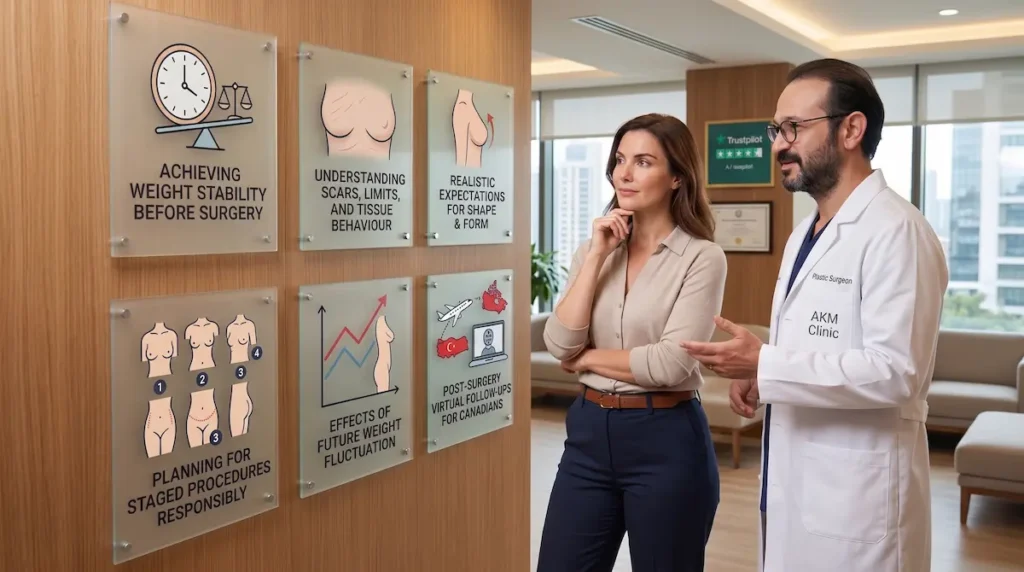
What a post-weight-loss lift can realistically improve
A post-weight-loss lift can raise the nipple-areola complex, remove extra skin, reduce folding under the breast, improve symmetry, and create a firmer breast shape. It can make bras and fitted clothing feel more balanced.
It cannot make stretched skin behave like skin that was never stretched. It cannot remove every stretch mark. It cannot guarantee a specific cup size, and it cannot stop future skin relaxation completely.
That honesty matters. Patients who understand the trade-off tend to feel more prepared during recovery.
Ongoing weight loss can change the result
If you lose a meaningful amount of weight after surgery, the breast may lose volume again. This can make the skin look looser and may reduce the lifted effect. If you regain weight, the breast may enlarge and stretch the skin envelope.
A stable maintenance pattern gives the surgeon a more reliable target. It also helps you judge what you actually want: smaller and lifted, fuller and lifted, or part of a broader body contouring plan.
For patients using GLP-1 medication or still adjusting after bariatric surgery, the surgical team may ask about recent monthly weight trends, current dose changes, and whether your prescribing clinician expects more weight loss.
Breast lift timing may depend on other body contouring goals
Major weight loss can affect the abdomen, arms, thighs, back, and breasts at the same time. Some patients want everything addressed quickly. A safer plan often stages procedures based on healing capacity, anesthesia time, and recovery support.
For example, a breast lift may be combined with another procedure in selected patients, but combination surgery is not automatically right for everyone. Longer operations can mean more swelling, more fatigue, and a more demanding recovery.
For this article, we will not open package planning or combination pricing. Those decisions belong in a personalized surgical plan.
Cost should be transparent, but it should not drive candidacy
Price matters. It should be clear before you travel. Still, cost should not be the first filter for deciding whether you are a candidate after major weight loss.
Your tissue quality, health status, weight stability, and goals decide the operation. The quote should follow the plan, not the other way around.
For a pricing-focused page, use breast lift pricing in CAD. This guide keeps the focus on suitability, timing, and surgical decision-making.
Travel and follow-up note for Canadians: If you are flying from Toronto, Vancouver, Montréal, Calgary, or another Canadian city, ask how long you should remain in Istanbul before returning home, what documents you will receive for your local clinician, and how virtual follow-ups are scheduled after you are back in Canada.
What to ask before booking
Before choosing a date, ask direct questions. How stable should your weight be? Is your nutrition ready? Can your own tissue create the shape you want? Are implants being recommended for volume or for support? What incision pattern is most likely?
You should also ask what would make the team postpone surgery. A trustworthy answer may include active nicotine use, unstable weight, low protein, unresolved anemia, uncontrolled diabetes, or expectations that do not match what the tissue can safely achieve.
AKM’s board-certified plastic surgery team evaluates post-weight-loss breast lift candidates with a surgeon-led plan and virtual follow-up milestones after surgery. The goal is not to rush the transformation. It is to choose the moment when the operation can be planned responsibly.
Frequently Asked Questions: Breast Lift After Major Weight Loss
These questions focus on candidacy after major weight loss, not the full surgical technique. The safest answer still comes from a consultation because skin quality, nipple position, breast volume, medical history, and weight stability all change the plan.
What makes you a good candidate for a breast lift after major weight loss?
You should also understand the trade-off. A breast lift after major weight loss can improve shape, projection, and position, but it will leave scars and may not restore the fullness you had before weight loss.
How long should my weight be stable before a breast lift?
If your weight is still changing every month, waiting may protect your result. A lift performed too early can be affected by later volume loss or skin stretching.
How long after bariatric surgery can I have a breast lift?
Your team may ask about the type of bariatric operation, supplements, recent bloodwork, anemia, protein intake, and whether your bariatric clinician has cleared you for elective surgery.
Do I need implants after weight loss?
The decision should be based on tissue coverage, skin strength, long-term goals, and device-related maintenance. A larger implant is not always better for thin post-weight-loss skin.
Will my skin be too thin for a lift?
If the skin quality is very poor, if nutrition is not stable, or if nicotine is being used, the safer answer may be to postpone surgery until risks are better controlled.
Will the lift restore my breast size?
If restoring size is one of your main goals, your consultation should include a clear discussion of implants, fat transfer, or lift-only shaping. The best choice depends on your anatomy.
Can I combine a breast lift with other post-weight-loss procedures?
Your candidacy depends on your health, procedure length, support system, travel plan, and how much aftercare you can manage once you return to Canada.
Is a breast lift after major weight loss covered in Canada?
Because rules vary, Canadian patients should confirm coverage questions with their provincial plan or local clinician before assuming reimbursement.
Ready to Find Out Whether You Are a Candidate?
A breast lift after weight loss is not about chasing a former body. It is about matching your breast shape to the body you have now, with honest limits and a safe plan. The best candidates have stable weight, optimized health, enough healing capacity, and clear expectations about scars, volume, and long-term change.
Your consultation should answer four questions. Is your weight stable enough? Is your skin strong enough? Can your own tissue create the shape you want? Would implants improve the plan, or add unnecessary complexity?
Ask AKM whether your weight stability and skin quality make you a candidate for a post-weight-loss lift. A surgeon-led assessment can help you decide whether now is the right time, or whether waiting would give you a safer, more predictable result.
Medical disclaimer: This article is for educational purposes only and does not replace a personal consultation with a qualified medical professional. Surgical candidacy, risks, recovery, and results vary individually.