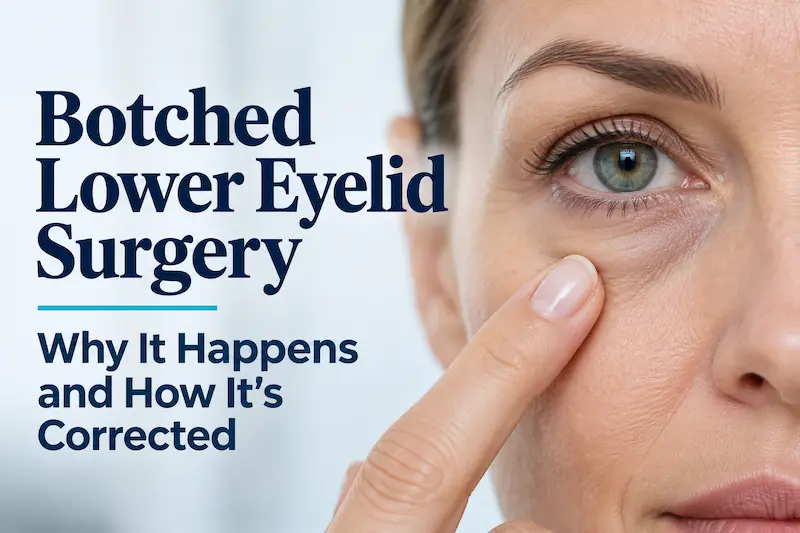
Botched lower eyelid surgery usually means the lower lid sits too low, pulls away from the eye, or exposes too much white beneath the iris. This can appear as lower eyelid retraction, ectropion, scleral show, rounded eyes, hollow under-eyes, or asymmetry. Some early tightness improves with time; established problems often need revision with canthal support, grafting, or midface support.
The lower eyelid is a small structure with a demanding job. It must look soft, protect the eye, drain tears, close properly, and move naturally when you blink or smile. That is why lower blepharoplasty needs more than simply removing a little skin or fat.
For UK patients researching lower eyelid surgery planning at AKM Clinic, the central question is not only “Can the under-eye look younger?” It is “How is the eyelid supported so it does not look operated on?” That difference matters. A smooth under-eye with a pulled-down lid is not a good result.
This guide explains what a bad lower blepharoplasty looks like, why it happens, how good planning lowers the risk, and how revision is usually approached. It is written for cautious patients who want clear answers, not vague reassurance.
Table of Contents
What Botched Lower Eyelid Surgery Actually Means
“Botched” is not a medical diagnosis. It is a patient word for a result that looks wrong, feels wrong, or affects eye comfort after lower eyelid surgery. In the lower lid, the most important signs are position, shape, closure, exposure, and volume. A temporary swollen look in the first weeks is different from a lid that has genuinely shifted away from the eye.
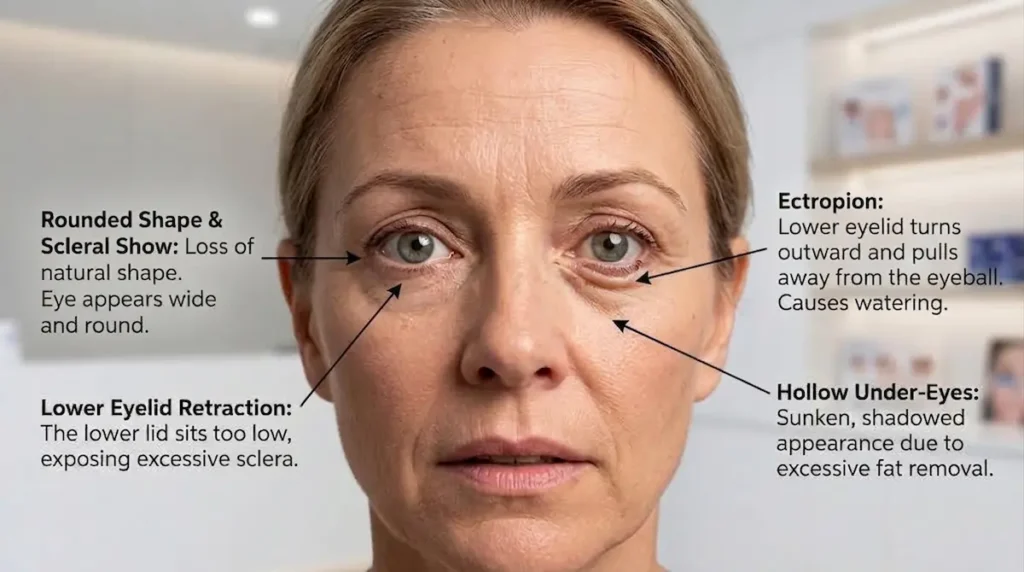
Lower eyelid retraction
Lower eyelid retraction means the lower lid sits too low. Instead of resting at, or just close to, the lower edge of the iris, it drops and exposes extra white of the eye. This can make the eye look wide, startled, tired, or surgically altered.
The key issue is not only appearance. A low lid may leave more of the eye surface exposed, which can cause dryness, irritation, watering, redness, or sensitivity to wind and light. Mild early tightness may settle as swelling softens. Persistent lower eyelid retraction needs specialist assessment.
Ectropion after blepharoplasty
Ectropion after blepharoplasty means the lower eyelid turns outward or pulls away from the eyeball. It may look like a gap between the lid and the eye. Some patients also notice watering because the tear drainage point no longer sits correctly against the eye.
In the UK, ectropion is commonly understood as a lower lid that droops away from the eye and can cause watering, dryness, irritation, and redness. In a post-surgical setting, this is not something to ignore. It deserves a proper review, especially if symptoms are worsening.
UK safety note: If you have new vision changes, severe eye pain, rapidly worsening redness, discharge, inability to close the eye, or a very dry exposed eye after surgery, seek urgent medical advice. For UK patients, that may mean contacting your operating clinic, NHS 111, your GP, an optometrist, or emergency care depending on severity.
Scleral show and rounded eyes
Scleral show after eyelid surgery means too much white of the eye is visible below the coloured iris. When this is combined with a lowered outer corner, the eye can lose its almond shape and look rounder than before. Patients often describe this as “sad eyes”, “staring eyes”, or a rounded surgical look.
Rounded eyes after blepharoplasty may happen when the outer corner support is weak, the lower lid is pulled down, or too much skin has been removed. It can also be more likely in patients with prominent eyes or a recessed midface, because the lower lid has less bony and soft-tissue support beneath it.
Hollow under-eyes after fat removal
Some bad lower blepharoplasty results are not mainly about lid position. They are about volume. If too much lower eyelid fat is removed, the under-eye may look hollow, shadowed, or older rather than fresher. This is a common complaint after aggressive fat excision.
Hollow under eyes after fat removal can be difficult to correct because the problem is not just missing fat. Scar tissue, thin eyelid skin, tear trough anatomy, cheek support, and previous surgical dissection all affect the revision plan. In many cases, fat repositioning at the first operation is safer than trying to rebuild lost volume later.
Normal healing versus a real problem
Not every worrying change in the first few weeks means you have a bad lower blepharoplasty. Swelling, bruising, temporary tightness, mild asymmetry, watery eyes, and a slightly odd shape can happen during early healing. The first month can look uneven.
What matters is direction. Is the lid gradually relaxing back into position, or is it sitting lower, pulling away, exposing the eye, or becoming uncomfortable? That distinction is why follow-up photographs, symptom tracking, and prompt communication with the surgical team matter.
| Problem after lower blepharoplasty | What the patient may notice | Typical underlying issue | Common correction route |
|---|---|---|---|
| Lower eyelid retraction | Lid sits too low; eye looks wide or pulled | Lid laxity, scarring, weak canthal support, negative vector anatomy | Canthopexy, canthoplasty, spacer graft, or midface support |
| Ectropion | Lid turns outward; eye waters or feels exposed | Anterior lamella shortening, lid laxity, over-resection | Canthal tightening, skin support, grafting in selected cases |
| Scleral show | Too much white visible below the iris | Lower lid malposition, prominent eye, weak outer corner | Canthal support, lid elevation, sometimes spacer graft |
| Rounded eye shape | Loss of almond shape; outer corner looks low | Canthal tilt change or missed lateral support | Canthopexy revision or canthoplasty, depending on laxity |
| Hollow under-eye | Shadowed, sunken, older-looking lower lid | Over-removal of fat or poor lid-cheek transition | Fat repositioning, fat grafting, or cautious filler in selected cases |
Some patients also confuse lower eyelid problems with other diagnoses. A drooping upper lid may be a muscle issue rather than a cosmetic eyelid result; our blepharoplasty guide explains how ptosis differs from blepharoplasty. Heavy upper-lid skin is a different topic again, covered in hooded eyelid surgery for upper-lid heaviness.
Why It Happens
Bad lower eyelid surgery usually comes from a mismatch between the operation and the patient’s anatomy. The lower lid may already be loose, the eye may be prominent, the cheek may not support the lid well, or the surgeon may remove too much skin, muscle, or fat. The result can be a lid that cannot return to a stable, natural position.
Untreated lower lid laxity
Lower lid laxity means the eyelid is looser than it appears at rest. A patient may look normal in ordinary photographs, yet the lid may pull too far away from the eye when tested. If this is missed, lower blepharoplasty can tip a borderline lid into retraction or ectropion.
Specialists assess this with tests such as snap-back and lid distraction. In a snap-back test, the lower lid is gently pulled down and released. A healthy lid should return quickly to the eye. If it returns slowly or needs a blink to reset, the lid is showing laxity.
The distraction test checks how far the lower lid can be pulled forward from the eye. Marked laxity is a warning sign. According to the StatPearls chapter on lower lid canthal support, lower eyelid laxity can predispose patients to scleral show, corneal exposure and ectropion, and significant laxity may require canthal support.
Missed canthal support
The lateral canthus is the outer corner support of the eyelids. It helps maintain eye shape, lid position, and the slight upward tilt many patients associate with a rested, almond-shaped eye. If this support is weak and not addressed, the lower eyelid can drift downward after surgery.
Canthal support is not one-size-fits-all. Mild laxity may be treated with canthopexy, which reinforces the existing outer corner. More significant laxity or malposition may need canthoplasty, which reconstructs the support more formally. The choice depends on the examination, not fashion.
This is also where aesthetic trends can confuse patients. Fox eye surgery and canthal support is a related concept, but a revision plan for a failed lower blepharoplasty is not the same as choosing a trendy eye shape. Revision is about restoring support, comfort, and proportion.
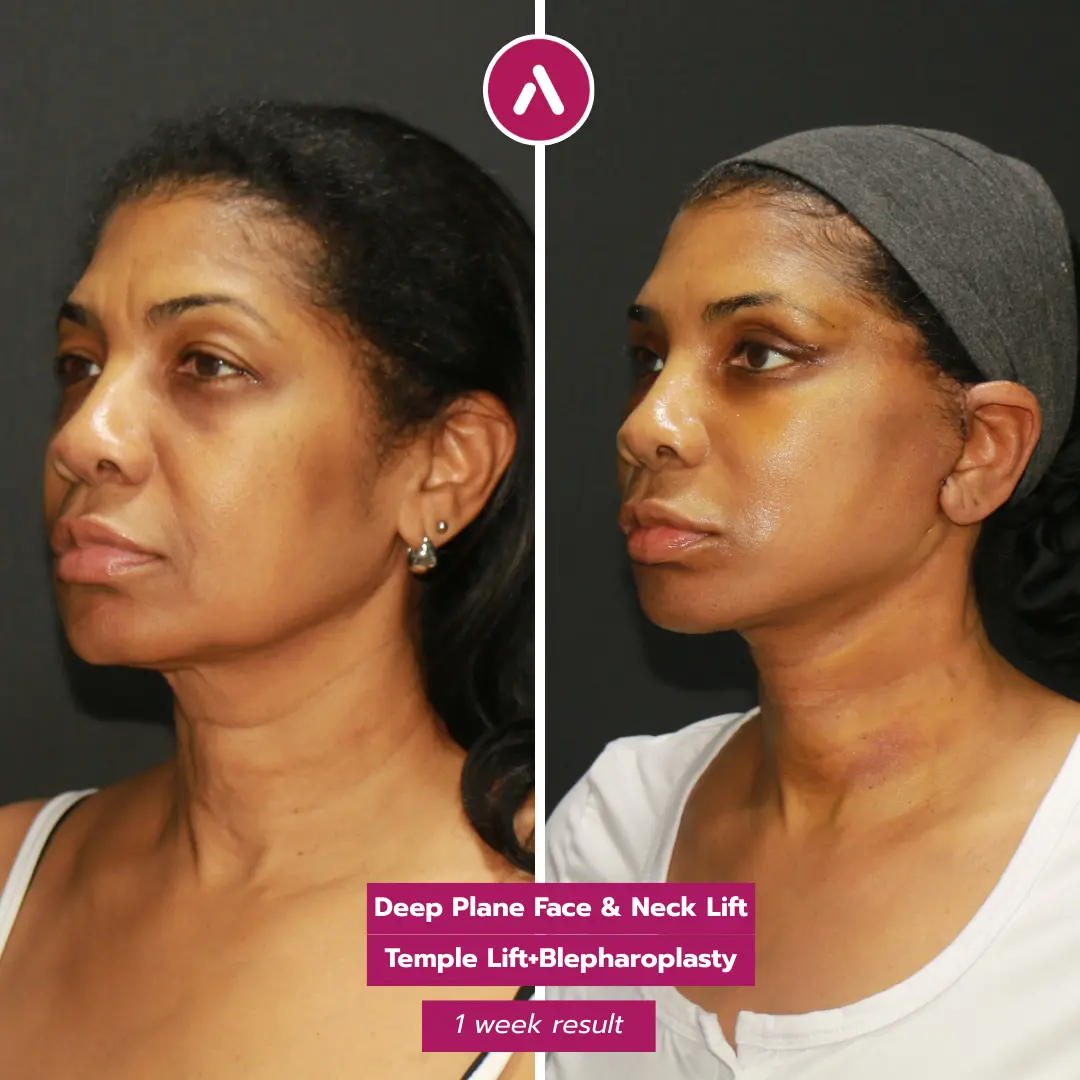
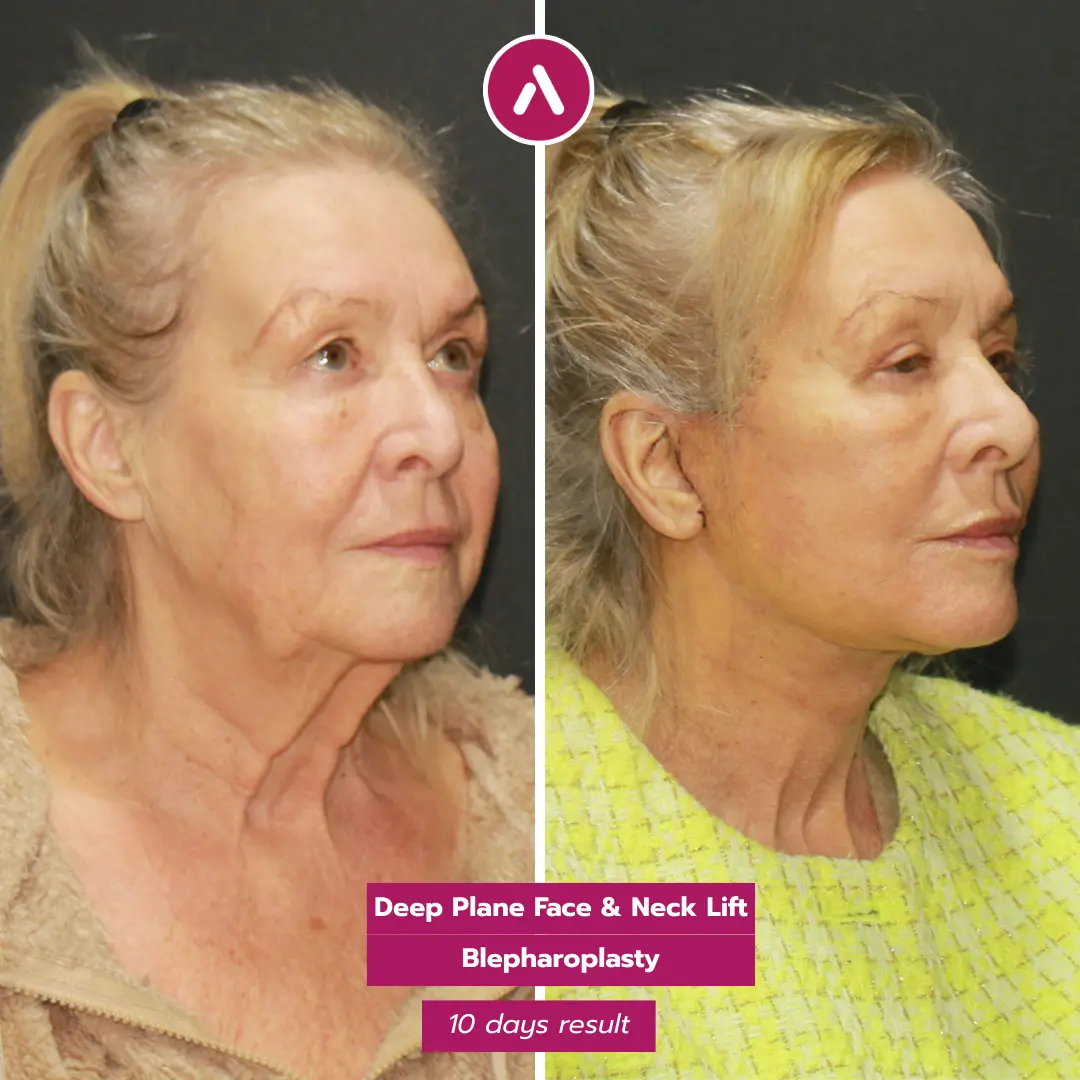
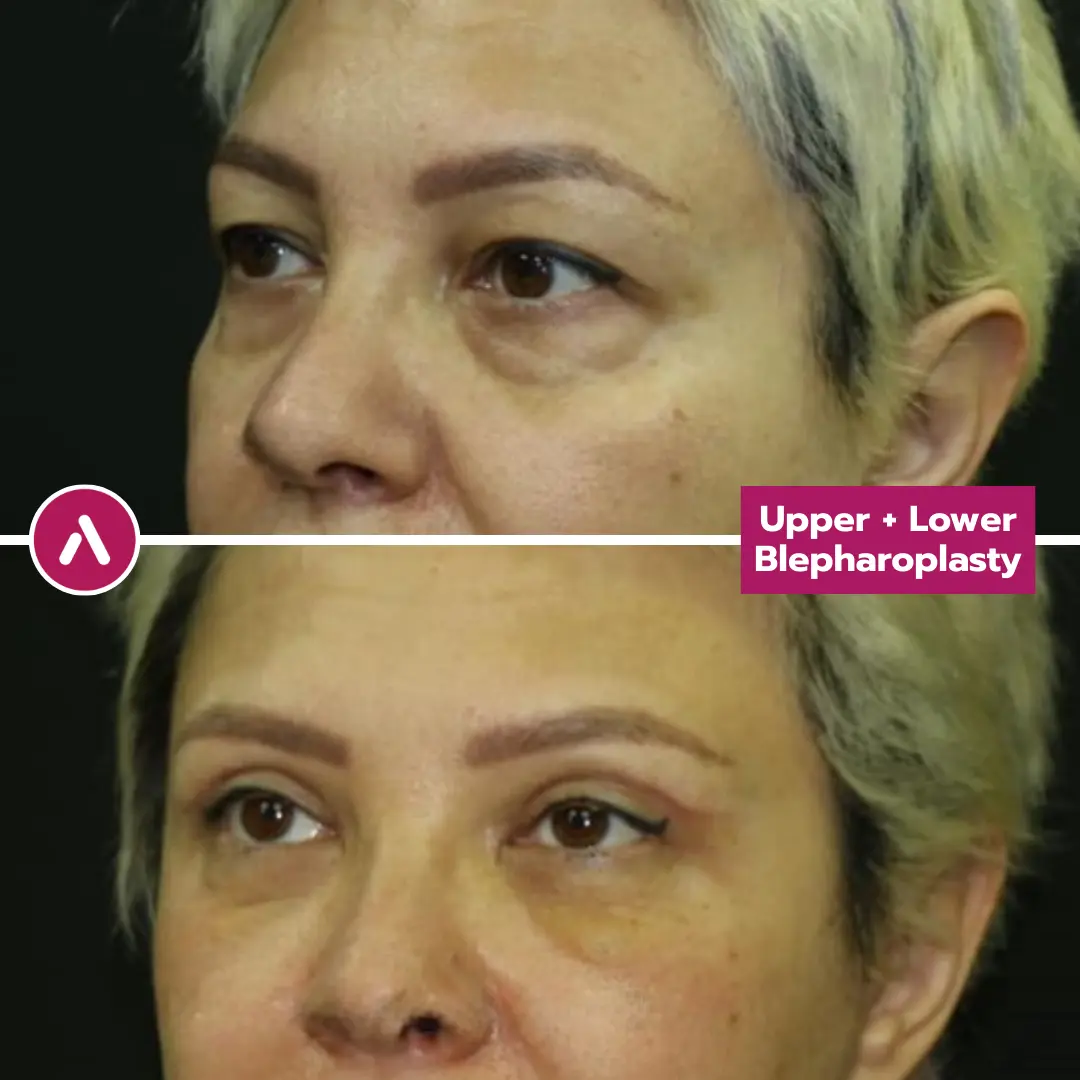
Too much skin or muscle removal
Removing too much lower eyelid skin is one of the classic causes of lower lid problems. The lower lid skin is thin and unforgiving. If it is shortened too aggressively, it can pull the eyelid down or away from the eye as the incision heals.
The same principle applies to the orbicularis muscle, the circular muscle that helps close the eyelids. Over-resection or trauma to this layer can reduce support and affect how the eyelid moves. A conservative plan respects the fact that the lower eyelid has to function every second of the day, not just look smooth in a still photograph.
Middle lamella scarring
The lower eyelid is often discussed in layers. The anterior lamella includes skin and muscle. The posterior lamella includes deeper support structures. Between them lies the middle lamella, where scar tissue can tether the lid after surgery.
When the middle layer scars and contracts, the lower lid may be pulled downward. This can be frustrating because the outside incision may look acceptable while the eyelid position is still wrong. Revision then has to release scar tissue and rebuild support, not simply “tighten the skin”.
Prominent eyes and negative vector anatomy
Some faces have a higher natural risk of lower eyelid malposition. A prominent eye sits further forward. A negative vector means the eye projects more than the cheekbone beneath it, so the lower lid has less support from the midface.
In these patients, even a technically neat lower blepharoplasty can be risky if the plan does not include enough support. The surgeon must assess eye prominence, canthal tilt, lid tone, cheek position, tear trough depth, and skin quality before deciding how much tissue to remove or reposition.
“In lower eyelid surgery, the safest result often comes from restraint. The question is not how much skin or fat can be removed; it is how the lid will stay supported, comfortable, and natural after healing.” — AKM Clinic surgical planning note
Aggressive fat removal
Under-eye bags are often caused by fat prominence, but fat is not the enemy. The lower eyelid and cheek need a smooth transition. If the fat is removed aggressively, the bag may be gone, but the under-eye can look hollow, shadowed, or older.
Modern lower blepharoplasty often favours fat preservation or fat repositioning where appropriate. Through a transconjunctival approach, the surgeon can address fat from inside the lid without an external skin incision. For the right patient, this may reduce the risk of visible scarring and help protect lower lid support.
Applying the wrong operation to the wrong concern
Not every eye-area concern is a lower blepharoplasty problem. Upper lid heaviness, brow descent, ptosis, asymmetry, cheek descent, tear trough hollowness, and skin pigmentation can overlap. If the diagnosis is wrong, the operation may be technically tidy but aesthetically disappointing.
That is why a patient considering revision needs a fresh assessment. The surgeon should not simply repeat what was done before. They should identify whether the problem is eyelid position, lid laxity, scarring, missing volume, cheek support, brow position, or a combination.
Double eyelid procedures have their own anatomy and risk profile, so they should not be merged with lower-lid revision planning.
How Good Planning Prevents It
Most lower eyelid complications are easier to prevent than to correct. Good planning starts before the patient reaches theatre: the surgeon examines lid tightness, eye prominence, cheek support, skin quality, fat position, previous filler, tear film symptoms, and the patient’s expectations. The aim is not a tight lower lid. It is a supported, natural lower lid that still protects the eye.

Testing lower eyelid laxity before surgery
A careful lower blepharoplasty consultation should include more than a quick look at the under-eye bags. The surgeon needs to test how the lower lid behaves when gently pulled down or forward. A lid that snaps back slowly, or only returns after blinking, may need support during the operation.
This matters because a patient with mild laxity may look completely normal in ordinary photographs. Without testing, the risk can be invisible. That is how a simple-looking lower blepharoplasty can become a bad lower blepharoplasty: the lid was already borderline, then surgery added swelling, scarring, and downward tension.
Assessing the canthal tilt and outer corner support
The outer corner of the eye is a structural anchor. If it is naturally weak, low, or stretched, lower blepharoplasty may need canthal support at the same time. This can mean canthopexy or canthoplasty, depending on the degree of laxity and the correction required.
Canthopexy is usually a reinforcing procedure. It supports the existing lateral canthus without rebuilding it completely. Canthoplasty is more reconstructive. It may be used when the lid is significantly loose, malpositioned, or already affected by previous surgery.
Patients sometimes worry that canthal support will create an over-lifted or artificial eye shape. It should not. Used correctly, support is not about changing identity; it is about stopping the lower lid from drifting down. For concerns around the brow and outer eye region, lateral brow lift planning around the outer eye is a separate but related topic.
Choosing the right lower blepharoplasty approach
There are two common routes into the lower eyelid: transconjunctival and transcutaneous. A transconjunctival approach enters from inside the lower lid. It avoids an external skin incision and is often considered when the main concern is fat bulging rather than excess skin.
A transcutaneous approach uses an incision just below the lashes. It may be useful when skin needs to be addressed, but it also requires discipline. The surgeon must avoid excessive skin or muscle removal, because the lower lid has very little margin for error.
The right approach depends on the patient. A younger patient with fat bulging and good skin may need a different plan from an older patient with skin excess, laxity, cheek descent, and dry-eye symptoms. The safest plan is individual, not standardised.
Preserving or repositioning fat instead of over-removing it
Under-eye fat can create bags, but it also supports a smooth lid-cheek transition. Removing too much can trade puffiness for hollowness. This is why many modern lower eyelid plans focus on conservative fat removal or fat repositioning rather than aggressive excision.
Fat repositioning moves existing fat into the tear trough area to soften the hollow between the lower eyelid and cheek. It does not suit every patient, but when the anatomy is right, it can reduce the risk of a skeletonised under-eye. This is especially relevant for patients who already have a deep tear trough before surgery.
Recognising negative vector anatomy
A patient with negative vector anatomy has an eye that projects further forward than the cheek support beneath it. This makes the lower eyelid more vulnerable. If too much tissue is removed, the lid has less support and may retract.
Good planning identifies this before surgery. The surgeon may choose a more conservative fat plan, avoid skin over-resection, add canthal support, or discuss whether midface support is needed. This is one reason revision eyelid surgery should not be planned from photographs alone.
Respecting dry-eye and exposure risk
Lower eyelid surgery affects the eye surface as well as the appearance. Patients who already have dry eye, contact lens intolerance, thyroid eye disease, previous laser eye surgery, or incomplete eyelid closure may need additional caution. These details belong in the consultation.
Cosmetic improvement should not come at the expense of comfort. A lower lid that looks smooth but leaves the eye irritated, watering, or exposed is not a successful result. Planning should include both aesthetics and ocular protection.
UK consultation benchmark: A cautious patient should ask who is assessing eyelid laxity, how canthal support is decided, what happens if ectropion or lower eyelid retraction develops, and how aftercare is handled once they return to the UK. This is the same safety mindset UK patients are encouraged to use when checking cosmetic surgery providers and surgeon credentials.
Setting realistic expectations before any incision is made
Prevention also depends on expectation setting. Lower blepharoplasty can reduce bags, soften shadows, and improve the under-eye transition. It cannot change the entire eye shape safely in every patient, erase all wrinkles, or make thin skin behave like younger skin.
A patient who demands a very tight, completely smooth lower eyelid may be asking for the very manoeuvres that raise complication risk. Conservative surgery can feel less dramatic in the short term, but it often protects the eye better in the long term.
How Botched Lower Eyelids Are Corrected
Correction depends on the exact problem. A mildly tight lower lid in the early weeks is treated differently from established ectropion, significant lower eyelid retraction, severe scleral show, or hollowing after fat removal. Revision should begin with diagnosis, not with a fixed procedure name.
The first step: wait, protect the eye, and document changes
Many early lower eyelid concerns improve as swelling settles and scar tissue softens. For that reason, surgeons often avoid rushing into revision unless the eye is exposed, painful, infected, or at risk. The first step is usually close monitoring, photographs, lubrication, and direct communication with the operating surgeon.
Waiting does not mean ignoring the problem. If the eye is dry, red, painful, watering constantly, or difficult to close, it needs review. Temporary tightness may be watched. A threatened eye surface should not be left untreated.
Early non-surgical measures
In the early phase, treatment may include lubricating eye drops or ointment, taping, massage, and time. Some surgeons use steroid injections when scar tissue is contributing to tightness, but this must be judged carefully. The aim is to soften and support healing while avoiding further harm.
Massage should only be done if the surgeon recommends it. The lower eyelid is delicate, and forceful self-treatment can worsen irritation. Patients should not copy online techniques without a proper review.
Canthopexy revision
Canthopexy revision may be used when the lower lid needs additional outer-corner support but the anatomy does not require full reconstruction. It tightens or reinforces the lateral canthal tendon to help the lid sit closer to the eye.
This can improve mild to moderate laxity, rounded eye shape, or early malposition in selected patients. It is not a universal fix. If there is significant scarring, shortage of skin, or vertical lid deficiency, canthopexy alone may not be enough.
Canthoplasty for more significant malposition
Canthoplasty is a stronger form of lateral canthal reconstruction. It may be considered when the lower eyelid is clearly malpositioned, loose, or turned outward. In revision cases, it can help restore lid contact with the eye and improve the outer corner position.
The goal is measured correction. Over-tightening can create its own problems. The surgeon must balance eyelid height, comfort, symmetry, and the patient’s natural eye shape. A good revision result usually looks stable rather than obviously lifted.
Spacer grafts for lower eyelid retraction
When the lower lid has been pulled down because there is a shortage in the deeper support layer, a spacer graft may be needed. A spacer graft adds structural height and support inside the eyelid to help lift it back towards the eye.
Different graft materials may be considered, including hard palate mucosa, cartilage, or other specialised grafts. The choice depends on the surgeon’s experience and the patient’s anatomy. This is complex revision surgery, and it should be planned by someone who routinely assesses eyelid malposition.
For patients researching the evidence, a review of managing post-blepharoplasty lower lid retraction discusses the range of approaches used for this specific problem.
Midface lift when cheek support is part of the problem
Sometimes the lower eyelid problem is not only in the eyelid. If the cheek has descended or the midface does not support the lid, the revision plan may need to lift or support the cheek as well. This can reduce downward pull on the lower lid.
A midface lift may be considered when negative vector anatomy, cheek descent, or lid-cheek separation contributes to retraction. It is not needed in every revision. When it is needed, ignoring the cheek can make the eyelid-only repair less stable.
Skin grafting when too much skin was removed
If the lower eyelid has been shortened because too much skin was removed, the missing skin may need to be replaced. A skin graft can add length to the anterior lamella and reduce downward pull. This is usually reserved for selected cases where skin shortage is a genuine driver of ectropion or retraction.
Patients often hope a simple tightening procedure will be enough. Sometimes it is. But if the eyelid is short, tight, and scarred, adding support without replacing missing tissue may not solve the problem. This is why revision planning must identify the layer that failed.
Correcting hollow under-eyes after fat removal
Hollowing after fat removal is treated differently from lid malposition. The problem may be missing volume, a poor lid-cheek transition, visible tear troughs, or scarring. Options can include fat grafting, conservative filler, fat repositioning in selected revision cases, or a combined eyelid-cheek plan.
Filler can help some mild hollowing, but it is not a cure-all. The lower eyelid is a high-risk area for injectables, especially after previous surgery. Surgical fat grafting also requires care because overfilling can create puffiness, irregularity, or asymmetry.
Why most revisions are delayed until healing matures
Unless there is an urgent eye-surface risk, many surgeons wait several months before revision. Scar tissue changes over time. Swelling can mimic malposition. Early surgery through inflamed tissue can make scarring worse.
Many established revisions are planned around the six-month mark or later, depending on severity and symptoms. That timing is not a rule for every patient; it is a principle. A painful, exposed, or non-closing eye needs faster assessment.
| Revision concern | Early management | Possible surgical correction | Key limitation |
|---|---|---|---|
| Mild early tightness | Lubrication, taping, massage if advised, observation | Often none if it settles | Must be monitored so true retraction is not missed |
| Ectropion after blepharoplasty | Eye protection and urgent review if exposure symptoms appear | Canthal tightening, skin grafting, scar release | Correction depends on whether skin, support, or scarring is the main cause |
| Lower eyelid retraction | Lubrication and assessment of eye surface | Canthoplasty, spacer graft, midface lift | Often needs layered reconstruction rather than simple tightening |
| Scleral show | Document lid position as swelling settles | Canthal support, spacer graft, lid elevation | Prominent eyes and negative vector anatomy affect stability |
| Hollow under-eyes | Wait for swelling to settle before judging volume | Fat grafting, fat repositioning, cautious filler in selected cases | Volume correction must avoid new puffiness or irregularity |
Choosing a Surgeon for Revision
Revision lower eyelid surgery is different from a first-time cosmetic blepharoplasty. The surgeon is no longer working with untouched tissue. They must assess scar tissue, missing skin, fat removal, lower lid laxity, eye-surface symptoms, canthal support, cheek position, and the patient’s tolerance for further surgery. A careful revision surgeon diagnoses first and operates second.

Look for eyelid-specific revision experience
A revision plan should not begin with “we will tighten the lid”. It should begin with a full explanation of why the lid is low, round, hollow, scarred, or exposed. The difference matters because each cause needs a different repair.
Patients should ask how often the surgeon assesses lower eyelid malposition, whether they manage ectropion and retraction, and how they decide between canthopexy, canthoplasty, spacer grafts, skin grafts, fat grafting, and midface support. A vague answer is not enough. You are asking someone to revise a moving structure that protects your eye.
Ask how lower eyelid laxity is measured
A good consultation should include lower lid laxity testing. Ask whether snap-back and distraction tests will be performed, how the outer canthus will be assessed, and what features would make the surgeon add canthal support. These questions are not overly technical. They are basic safety checks for lower eyelid surgery.
If the surgeon only discusses removing more skin or “tidying up” the result, pause. A botched lower eyelid surgery often comes from over-removal or under-support in the first place. Revision should not repeat the same mistake with a neater scar.
Check credentials without assuming UK registration abroad
UK patients are used to checking a doctor’s status through the GMC register. For surgery abroad, the wording must be accurate: an overseas surgeon is not automatically GMC-registered, but patients can still ask for equivalent specialist credentials, hospital accreditation, case experience, and written aftercare responsibilities.
At AKM Clinic, lower eyelid planning is positioned within a surgeon-led model using European Board-Certified Surgeons in a GMC-equivalent credential frame. The operation takes place in Istanbul, not in a UK clinic. That distinction should be clear before you travel.
Bring the right information to the revision consultation
Revision decisions are stronger when the surgeon has the full story. Bring pre-surgery photographs, early post-operative photographs, the operation note if available, details of any injections or filler, a list of symptoms, and the exact timeline of when the eyelid changed.
Also mention dry-eye symptoms, contact lens intolerance, previous laser eye surgery, thyroid eye disease, allergies, and any vision concerns. These details may change the risk assessment. A revision that improves appearance but worsens eye comfort is not a successful outcome.
Know the difference between improvement and perfection
Revision can improve lid position, eye comfort, scleral show, hollowing, and asymmetry, but it cannot always restore the exact pre-surgery anatomy. Scar tissue has memory. Tissue may be missing. The eye and cheek may have changed with age.
The most honest revision goal is usually a more stable, comfortable, balanced lower eyelid. That may mean a softer lid-cheek junction, less white showing, better closure, improved outer-corner support, or a less hollow under-eye. Results vary from patient to patient.
Clarify timing, costs, and aftercare before committing
Ask when revision is safe, what should be watched during the waiting period, and what symptoms would require earlier action. You should also understand whether the plan is staged. In some cases, the eyelid position must be corrected before volume refinement is considered.
For UK patients comparing private revision options, cost can vary widely because “revision blepharoplasty” may involve several different repairs. Rather than opening a price table here, review UK blepharoplasty cost guidance for Turkey and ask for a personalised assessment based on photographs and examination.
AKM planning note: Ask how your lower lid will be tested, whether canthal support is needed, how previous scarring changes the plan, and what aftercare will look like once you are back in the UK. A clinic should be willing to answer these questions before you book.
Frequently Asked Questions: Botched Lower Eyelid Surgery
This FAQ section answers the most common decision-stage questions patients ask after an unhappy lower blepharoplasty result. It is not a substitute for an eye examination, but it can help you understand which problems are usually temporary and which need specialist review.
What does a botched lower eyelid surgery look like?
Can lower eyelid retraction be fixed?
How long after blepharoplasty can ectropion be corrected?
Why do my eyes look rounded after eyelid surgery?
Can hollowing after fat removal be fixed?
Does canthopexy prevent lower lid problems?
Is bad lower blepharoplasty always the surgeon’s fault?
Should I have revision in the UK or travel abroad?
Final note: Botched lower eyelid surgery is frightening because the lower lid affects both appearance and comfort. The safest next step is a measured assessment: define the problem, protect the eye, allow healing where appropriate, then plan revision only when the anatomy is clear. A natural result is supported, not pulled.
Ask AKM how lower eyelid laxity is measured and protected before any surgery.
Medical disclaimer: This article is for general patient education only and does not replace an examination by a qualified clinician. Seek urgent medical advice if you have severe eye pain, sudden vision changes, inability to close the eye, rapidly worsening redness, discharge, or symptoms of corneal exposure after eyelid surgery.