
Thigh Lift Scars After 1 Year: What Healing Really Looks Like

AI Summary
- Thigh lift scars after 1 year usually flatten, fade, and soften but remain permanent.
- Scar placement matters: groin-crease scars hide better than vertical inner-thigh scars.
- Safe healing depends on low-tension closure, anchoring, silicone care, and sun protection.
- Revision may help widened, migrated, raised, or poorly positioned scars after full maturation.
Summary generated by AI, fact-checked by our medical experts
Thigh lift scars usually look much calmer after one year: flatter, lighter in color, and less raised than they were in the first few months. They do not disappear. Groin-crease scars often hide well beneath underwear, while vertical inner-thigh scars remain more visible. Scar width, color, and position depend on skin quality, incision type, tension, wound healing, and aftercare.
That is the honest starting point. A thigh lift can reshape loose upper-thigh skin, especially after major weight loss or age-related laxity, but the trade-off is a permanent scar. The goal is not to pretend the mark will vanish. The goal is to plan the incision well, reduce unnecessary tension, protect the healing skin, and help the scar mature into the thinnest, most stable line your body can produce.
This guide focuses only on scar healing. For the full procedure, candidacy, anesthesia, and surgical steps, see how a thigh lift is performed at AKM Clinic. Here, we will stay with what most patients actually want to know before they commit: where the scar sits, how it changes month by month, why some scars widen or migrate, and when revision is worth discussing.
Table of Contents
What Thigh Lift Scars Look Like After 1 Year
One year is a useful checkpoint because the scar has usually moved beyond the angry early phase. By this stage, most thigh lift scars are no longer bright red, firm, or sharply raised. They tend to be flatter and paler, though the exact color depends on your natural skin tone, how your body forms scars, sun exposure, wound tension, and whether there were early healing issues.
A well-healed scar after one year often looks like a fine line rather than a wound. It may still be slightly pink, brown, or lighter than the surrounding skin. Some areas may feel firmer under the fingertip. That can be normal. Scar tissue remodels slowly, and the inner thigh is not an easy location: it moves when you walk, holds moisture, rubs against clothing, and carries tension from sitting, standing, and climbing stairs.
The most important expectation is this: “faded” does not mean “gone.” Even after excellent healing, a thigh lift scar remains a surgical mark. Patients who feel prepared for that trade-off usually do better emotionally than patients who expect a scarless outcome.
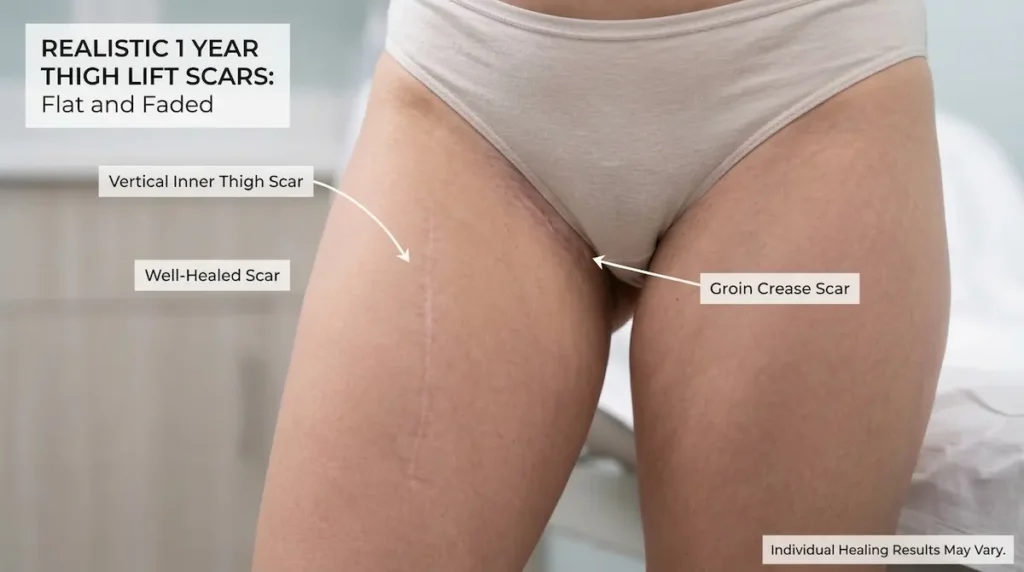
The realistic 12-month picture: flat, pale, not invisible
At 12 months, a typical healed thigh lift scar has softened. It should no longer feel tight in the way it did during the first weeks. The raised edge often settles. The color usually becomes less intense. Some patients see a narrow pale line; others see a wider line that is still pink or darker than nearby skin.
Both can fall within the range of normal. What matters is the trend. A scar that was red and firm at three months but is flatter and lighter at 12 months is maturing. A scar that becomes increasingly thick, itchy, painful, or raised after several months should be reviewed by your surgical team.
Groin-crease scar vs vertical inner-thigh scar
Scar visibility depends heavily on placement. A groin-crease scar is usually designed to sit high in the natural fold where the upper thigh meets the groin. In many patients, this horizontal or curved scar can be hidden under underwear or swimwear. It may still be visible when the leg is lifted, stretched, or viewed from certain angles, but it is generally easier to conceal.
A vertical inner-thigh scar is different. It runs down the medial thigh, often from the groin toward the knee, depending on the amount of loose skin being removed. This type of inner thigh lift scar is more visible because it crosses an exposed surface. The reason surgeons use it is practical: when loose skin extends down the thigh, a short groin incision alone cannot remove enough skin to create a meaningful tightening effect.
Why one year is an honest comparison point
Early photos can be misleading. At six weeks, the scar may look red, raised, shiny, and tight. At three months, it may still look worse than you hoped. That does not mean the final scar has declared itself. Scar remodeling continues for many months after the skin surface has closed.
By one year, enough maturation has occurred to judge the direction of healing. The scar may continue to refine after that, especially between 12 and 24 months, but the one-year mark gives a much fairer view than the early swollen phase. This is why patients comparing photos should be cautious: a three-month scar and a one-year scar are not the same healing stage.
Everything You Need to Know About Thigh Lift (Thighplasty)
From surgery steps to aftercare, get all the details on how AKM Clinic performs world-class Thigh Lift (Thighplasty) in Istanbul.
Where the Scars Sit — and Why Placement Matters
Thigh lift scar placement is not random. It reflects the amount of loose skin, where that skin hangs, and how much tightening is needed. A smaller amount of upper inner-thigh laxity may be treated with a groin-crease incision. More severe laxity often needs a vertical incision. The scar pattern is part of the surgical plan, not an afterthought.
This is also where expectation setting matters. A shorter scar may sound better, but it cannot fix every anatomy. If the loose skin extends far down the thigh, forcing a short incision can leave sagging behind or pull the groin scar downward over time. A longer scar can sometimes produce a better contour because it removes skin in the direction the problem actually travels.
Horizontal or curved scars in the groin crease
A horizontal or crescent-shaped scar sits in the groin crease. This is often used when the laxity is mostly high on the inner thigh. The incision may curve from the front of the groin toward the crease beneath the buttock. Its main advantage is concealment. In everyday clothing, it is usually easier to hide than a vertical medial scar.
The challenge is tension. The groin crease moves constantly. Moisture, friction, and leg movement can all stress the healing line. If the closure is not well supported, the scar may widen or drift downward. StatPearls describes how horizontal thighplasty uses an incision near the inguinal crease and notes the importance of anchoring tissue to help limit downward scar migration; this is why the clinical anatomy of thigh lift incisions matters so much in scar planning.
Vertical medial scars for more severe laxity
A vertical medial thigh lift scar is used when loose skin is not limited to the upper groin area. Patients after major weight loss often have laxity extending down the inner thigh. In that situation, removing skin only from the top may not be enough. The vertical incision allows the surgeon to remove extra skin along the length of the thigh.
This scar is harder to hide. That is the trade-off. It may be visible in shorts, swimwear, or during intimacy. But for patients with substantial loose skin, it can be the scar pattern that creates the most stable and meaningful contour improvement.
For a deeper look at the procedure itself, including when the vertical approach is considered, see the inner thigh lift procedure. This article stays focused on how the scar looks and heals.
The trade-off: more tightening usually means a longer scar
The most honest thigh lift conversation is about exchange. Less skin removal usually means a shorter scar and a more limited result. More skin removal usually means a longer scar and a stronger tightening effect. Neither choice is automatically better. The right plan depends on your anatomy and priorities.
This is especially important for patients searching for loose skin thigh lift scars because loose skin behaves differently from fat. Liposuction can reduce volume, but it cannot remove a hanging skin fold. Skin excision creates a scar, and the scar is the price of removing that lax tissue.
Patients sometimes ask about so-called scarless thigh lift options. Non-surgical tightening or liposuction may help selected mild cases, but they cannot replace surgical excision when the skin excess is significant. A “scarless” promise should always be treated carefully. Real surgery leaves a scar; good surgery plans it with stability, concealment, and long-term healing in mind.
“A good thigh lift scar is not created by one thing. It comes from careful incision placement, secure tissue support, low-tension closure, and patient scar care over many months. In the groin crease, stability matters as much as concealment.”
— AKM Clinic board-certified plastic surgery team
The Month-by-Month Healing Timeline
Thigh lift scar healing does not move in a straight line. Many patients feel encouraged during the first week because the incision is closed and covered, then discouraged around months two to four when the scar becomes firmer, pinker, or more noticeable. That middle phase can be emotionally difficult, but it is often part of normal scar remodeling.
The table below gives a practical timeline. It describes the scar, not your full surgical recovery. Swelling, walking, compression garments, and activity limits belong to the broader thigh lift recovery plan; here, the focus stays on how the incision line changes as it matures.
| Healing Stage | Typical Scar Appearance | Usually Normal? | Scar Care Focus |
|---|---|---|---|
| Weeks 1–6 | Red or pink, raised, tight, tender, taped, or covered with small scabs. | Yes, if the incision is closed, clean, and improving. | Protect the incision, avoid tension, keep the area dry as instructed, and follow garment guidance. |
| Months 2–4 | Often firmer, brighter, thicker, itchy, or more visible than expected. | Often yes. This can be the “looks worse before it looks better” phase. | Begin scar care only when cleared: silicone, gentle massage if approved, and sun avoidance. |
| Months 6–12 | Flatter, softer, less pink, and easier to hide in the groin crease. | Yes, if the scar is gradually calming. | Continue silicone if recommended, protect from UV exposure, and monitor any widening. |
| After 2 years | More mature, paler, and softer; still permanent, but usually less reactive. | Yes. Final scar maturity can take longer than one year. | Consider revision only if the scar remains wide, raised, unstable, or poorly positioned. |
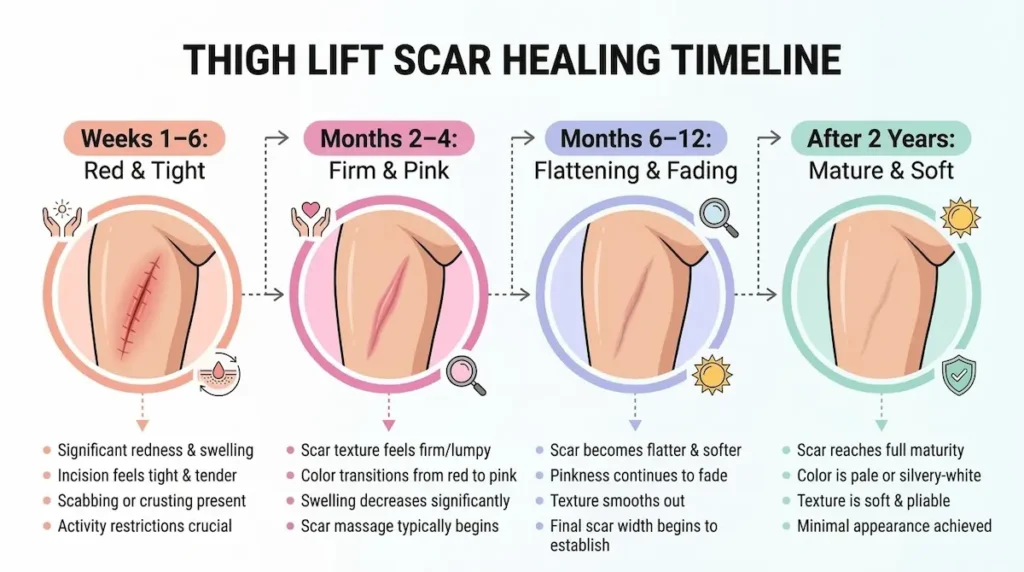
Weeks 1–6: red, raised, and tight
In the first six weeks, the scar is still young. The incision may look red, dark pink, or purple-red depending on your skin tone. It may feel tight when you stand upright or widen your stance. Small scabs, medical tape marks, mild crusting, and uneven texture are common during this stage.
This early appearance should not be used to judge your final result. The skin surface may close before the deeper tissues have settled. That is why your surgeon may ask you to avoid stretching, friction, heavy exercise, and positions that pull across the groin or inner thigh.
The most concerning early signs are not cosmetic. Increasing pain, spreading redness, foul-smelling drainage, fever, an opening incision, or blackened tissue should be reported promptly. A scar can mature only after the wound has healed safely.
Months 2–4: the firm pink phase
Months two to four can be frustrating. A scar that looked neat at first may become thicker, firmer, or more colorful. It may itch. It may feel rope-like under the skin. For many patients, this is the stage when anxiety peaks because the scar appears more obvious instead of less.
That reaction happens because collagen is actively remodeling. The body is strengthening the incision, and scar tissue can temporarily feel harder before it softens. This does not automatically mean you are forming a bad scar.
Still, there is a difference between normal firmness and a scar that needs attention. If the scar becomes progressively raised, painful, very itchy, or grows beyond the incision line, your surgical team should assess it. Early guidance may reduce the chance of a thick or widened final scar.
Months 6–12: flattening and fading
Between six and 12 months, most thigh lift scars begin to look more settled. The color softens. The line becomes flatter. Clothing friction may feel less irritating. A groin-crease scar that was easy to see early on may become much less noticeable under underwear or swimwear.
Vertical scars usually remain more visible because of their location. They can still improve a great deal, but they are not hidden inside a natural fold in the same way. A vertical scar may fade into a fine line, yet it still crosses the inner thigh surface and can show when the legs are apart.
This is a good stage for comparison photos, but only if the photos are honest. Lighting, leg position, underwear line, tan level, and camera distance can make the same scar look very different. Real healing is best judged in consistent light and from several angles.
What thigh lift scars after 2 years may look like
Thigh lift scars after 2 years are usually closer to their final form. They may be pale, soft, flat, and less reactive. Some patients notice that the scar continues to blend between months 12 and 24, especially if it was still pink at the one-year mark.
Even then, the scar is permanent. A mature scar can be thin and discreet without being invisible. The fairest goal is a stable line that does not pull, itch severely, restrict movement, or sit lower than planned.
If you are comparing different body-contouring scars, remember that each procedure has its own tension pattern. A thigh lift scar behaves differently from a circumferential body lift scar. For context, see how body lift scars look at the one-year mark.
Discover If a Thigh Lift (Thighplasty) Is Right for You
Share your photos and medical history to receive a personalized assessment from our European board-certified facial surgery team.
Why Some Thigh Lift Scars Widen or Migrate
Scar widening and migration are two of the biggest concerns after a thigh lift. They are also two reasons scar planning matters before surgery, not only after. The groin and inner thigh are high-movement areas, so a scar that looks well placed in the operating room still needs structural support and patient protection during healing.
Some widening is caused by biology. Some is caused by tension. Some follows early wound separation. In many cases, several factors overlap. A patient with significant loose skin, a long incision, high activity early in recovery, and moisture in the groin crease has more scar stress than someone with a shorter, lower-tension incision.
Tension, movement, and moisture in the groin crease
The groin crease is a difficult place for a surgical incision. It bends when you sit, stretches when you walk, and can stay warm or damp under clothing. This combination creates mechanical stress on the healing line.
When an incision is under repeated tension, the scar can widen. Instead of healing as a narrow line, it may spread into a broader band. This is one reason patients are told to limit certain movements early on. The first weeks are not only about comfort; they are about protecting the scar while the deeper layers gain strength.
Moisture can also irritate the skin. Friction from underwear, compression garments, or thigh-to-thigh rubbing may inflame the incision edge. A calm, dry, protected scar generally has a better chance of maturing neatly than one that is constantly rubbed or stretched.
Downward drift and thigh lift scar migration
Thigh lift scar migration means the scar or surrounding tissue shifts lower than intended. In the groin, this can make the scar more visible and may create downward pull near the vulvar or labial area in female patients. This is one of the scar-specific issues that should be discussed before surgery.
Good surgical anchoring helps reduce this risk. In medial thigh lift planning, surgeons may secure deeper tissue to stable fascial structures, such as Colles fascia, so the closure is not relying only on skin tension. Skin is not strong enough to hold the entire lift by itself. It stretches.
This is why a hidden scar is not the only goal. A scar also has to stay where it was placed. A high groin scar that migrates downward may become more noticeable than a slightly longer incision that was better supported from the beginning.
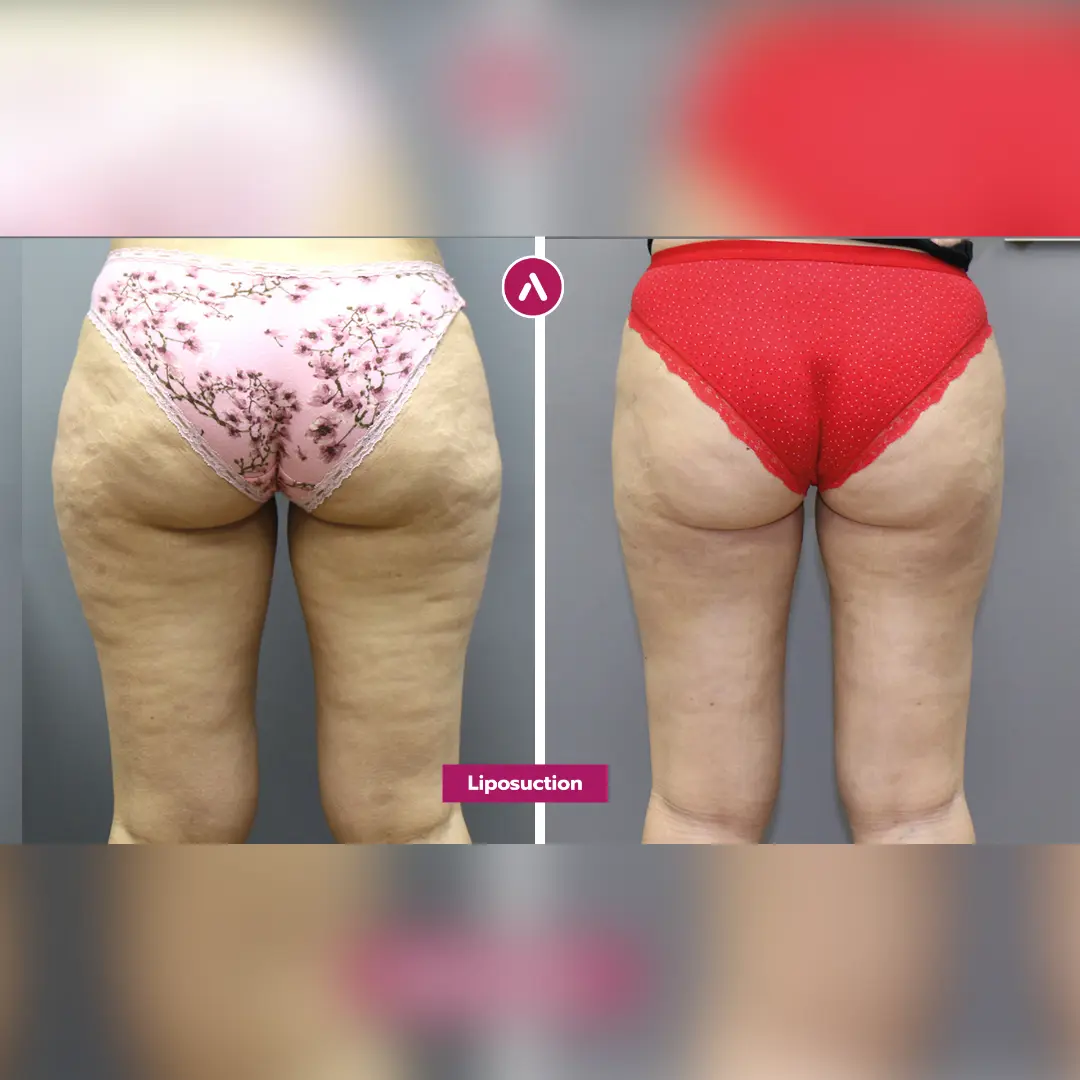
How early wound separation affects the final scar
Wound separation, also called dehiscence, can affect the final scar even if it heals without major long-term harm. When a small part of the incision opens, the body closes it by secondary healing. That area can become wider, darker, firmer, or more irregular than the rest of the scar.
A literature review of medial thigh lift complications notes that wound-related issues are among the complications surgeons must plan for and monitor after thighplasty. This does not mean every patient will have a problem. It means scar stability is a real part of the procedure, not a cosmetic afterthought. You can read a literature review of medial thigh lift complications for a clinical overview.
If wound separation happens, the priority is safe healing first. Scar appearance comes later. Once the wound is closed and calm, your team can guide scar care, silicone use, and the right timing for any future revision discussion.
Why lipedema and loose skin scars are different conversations
Some patients reach thigh lift scar content while researching lipedema, inner-thigh heaviness, or chronic lower-body disproportion. That can create confusion. A thigh lift removes loose skin. Liposuction for lipedema addresses abnormal painful fat distribution and is a different treatment pathway.
That difference matters for scars. Liposuction usually uses small access incisions; a thigh lift uses skin excision and creates longer scars. If your main concern is lipedema rather than skin hanging, read about liposuction for lipedema as a different route. The scar pattern and medical reasoning are not the same.
Caring for Scars — and When Revision Is Worth It
Scar care starts with protection. A thigh lift scar is not ready for aggressive treatment while the incision is still open, irritated, or fragile. Early on, the goal is simple: reduce tension, prevent friction, keep the area clean and dry as instructed, and follow your surgeon’s garment and movement rules.
Once the incision is fully closed and your surgical team clears you, scar care can become more active. Silicone gel or silicone sheets are commonly used to support scar maturation. Sun protection also matters, even on scars that are usually covered, because UV exposure can make healing scars darker or more noticeable.
US scar-care note: Scar care should be individualized. Silicone, sun protection, and tension reduction are common parts of post-surgical scar management, but timing matters. Do not apply scar products to an open or irritated incision unless your surgical team has cleared it.

Silicone, sun protection, and avoiding tension
Silicone is not magic, but it can help a healing scar stay hydrated and less reactive. Some patients use silicone gel because it is easier in a curved groin crease. Others prefer silicone sheets when the scar is flatter and clothing does not rub them loose. The best option is the one you can use consistently and safely.
Sun protection is just as practical. A new scar can pigment unevenly, especially if exposed during beach travel, tanning, or outdoor exercise. If the scar is exposed, cover it or use sunscreen after the incision is fully healed and your surgeon approves.
Tension control is the part patients often underestimate. During the first eight weeks, deep stretching, wide stances, heavy lifting, and sudden leg movement can pull across the scar. That does not mean you should stay still. It means movement should follow your surgical plan, not your impatience.
When a widened scar is usually revised
Scar revision is usually not considered in the early healing phase unless there is a specific wound problem that needs medical care. For cosmetic scar revision, most surgeons prefer to wait until the scar has matured, often at least 12 months. Revising too early can mean cutting into tissue that is still actively remodeling.
A revision may be worth discussing if the scar remains wide, raised, painful, unstable, very dark, or poorly positioned after full maturation. It may also be considered if scar migration has made the mark sit lower than planned. The goal is improvement, not erasure.
Scar revision also depends on why the scar healed poorly. If the original problem was tension, simply removing the scar and closing the skin again may not be enough. The new closure must address support, placement, and aftercare, or the scar may widen again.
Setting expectations before surgery
The best scar conversation happens before the operation. Ask where the scar will sit when you stand, walk, sit, and wear underwear or swimwear. Ask whether your loose skin pattern needs a groin-crease incision, a vertical incision, or both. Ask how the closure will be supported to reduce the risk of downward drift.
Cost is part of planning, but this article is not a pricing guide. If you are comparing options, review thigh lift pricing in Turkey separately so the scar conversation stays focused on anatomy, incision choice, and healing expectations.
AKM planning note for US patients: At AKM Clinic, thigh lift incision planning is handled by a board-certified plastic surgery team. International follow-up continues virtually at 1, 3, 6, and 12 months, so scar concerns can be reviewed after you return home.
The focus is realistic: a stable, well-placed scar that can mature as discreetly as your anatomy allows. Good scar planning does not promise invisibility. It protects the result by balancing concealment, tissue support, and the amount of tightening your skin truly needs.
Frequently Asked Questions: Thigh Lift Scars
These questions cover the scar-specific concerns patients most often raise before or after a thigh lift. They do not replace medical advice, but they can help you decide what is normal and what deserves a direct conversation with your surgical team.
What do thigh lift scars look like after 1 year?
Do thigh lift scars go away?
Why is my thigh lift scar widening?
Can thigh lift scars migrate?
What do thigh lift scars after 2 years look like?
Can a bad thigh lift scar be fixed?
Final note: Thigh lift scars are part of the trade-off of removing loose thigh skin. The most satisfying outcomes usually come from clear expectations: the scar will stay, it will change slowly, and the best plan is one that balances concealment, stability, and the amount of tightening your anatomy truly needs.
Ask AKM how your thigh lift incision would be planned to keep the scar hidden, stable, and realistic for your anatomy.
Have Specific Questions About Thigh Lift (Thighplasty)?
Chat directly with our dedicated patient coordinators regarding Thigh Lift (Thighplasty). Get instant answers and personalized support.
Medical disclaimer: This article is for educational purposes only and does not replace a personal consultation with a qualified plastic surgeon. Healing patterns, scar behavior, and revision options vary from patient to patient.
Related Treatments

Awake High-Definition Liposuction
Awake high-definition liposuction guide: tumescent anesthesia, twilight sedation, HD techniques, recovery timeline, risks, and value comparison.

Liposuction in Turkey
Learn how liposuction with skin tightening works, who it’s for, tech options, risks, and a realistic recovery timeline—plus cost/value insights.

J-Plasma Skin Tightening in Turkey
Learn how J-Plasma skin tightening works, who it’s for, recovery timelines, risks, and cost comparisons—plus how to choose the right provider.
Upper Back Lift in Turkey
Considering an Upper Back Lift? Learn technique options, scar placement, recovery timeline, safety, and cost comparisons to plan with confidence.
Ready to Start Your Own Transformation Journey?
Join the 2,000+ patients who trusted Dr. Akif Mehmetoğlu and the AKM Clinic team. Your journey to a more confident, revitalized you begins with a simple, no-obligation conversation. Contact us today from the USA for your free virtual consultation.
#1: Get Your Free Personalised Quote
Start with a free, no-obligation online consultation. Share your photos, and our surgical team will provide a fully personalised treatment plan and a transparent, all-inclusive price package. No hidden fees.
#2: Secure Your Date & VIP Booking
Once you're ready, our dedicated patient coordinators will help you secure your procedure date. We'll handle all your bookings, including your 5-star hotel and private VIP airport transfers.
#3: Arrive in Istanbul & Meet Your Surgeon
Arrive at Istanbul Airport (IST) and be greeted by your private driver. Settle into your hotel and prepare for your in-person consultation, where you'll meet your specialist surgeon to finalise the details for your "natural, subtle, and revitalized" new look.