
Thigh Lift Scars After 1 Year: What Healing Really Looks Like

AI Summary
- Thigh lift scars usually fade after one year but do not disappear completely.
- Scar placement matters: groin scars hide better; vertical inner-thigh scars stay more visible.
- Healing takes time: scars improve from months 6–12 and may mature after 2 years.
- Safe scar care includes silicone, sun protection, tension avoidance and review for widening or migration.
AI-generated summary, fact-checked by our medical experts.
One year after a thigh lift, most thigh lift scars have changed from red, raised marks into flatter, paler lines. They do not disappear. Groin-crease scars usually hide better beneath underwear or a knickers line, while vertical inner-thigh scars remain more visible. Because the inner thigh is warm, mobile and high-tension, some widening or downward drift can happen.
That is the honest starting point. A good thigh lift scar is not an invisible scar; it is a planned, stable scar that heals as quietly as your anatomy allows. For many UK patients, the worry is not only “Will there be a scar?” but “Will I still feel comfortable in underwear, swimwear or fitted clothing a year later?”
This guide focuses only on scar appearance and scar maturation. It does not cover the full operation, general recovery, packages or a detailed cost comparison. For the broader procedure, incision planning and suitability process, you can read about how AKM plans a thigh lift incision.
Table of Contents
What Thigh Lift Scars Look Like After 1 Year
At the one-year point, thigh lift scars are usually much calmer than they looked in the early months. The colour has often faded from red or deep pink to pale pink, beige, brown or silvery-white, depending on skin tone. The texture should feel flatter and softer, although it may still feel slightly firm in sections.
One year is a useful checkpoint because scar tissue has had time to settle. It is not always the final endpoint. Many scars continue to mature subtly into the second year, especially in areas exposed to friction and movement.
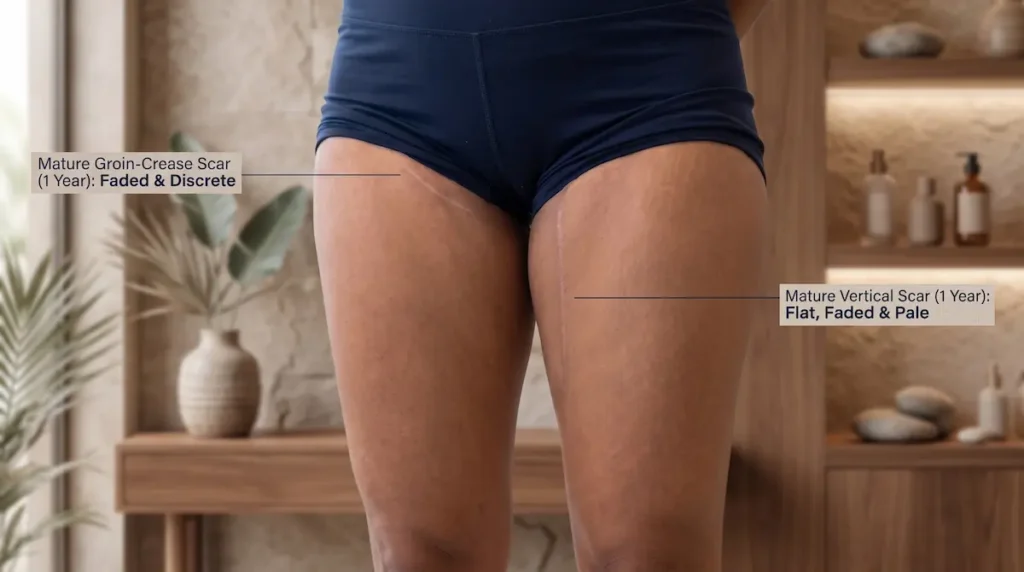
The realistic 12-month picture: flatter, paler, not invisible
A mature thigh lift scar is usually a line, not a wound. It may still be visible when you look for it. The main improvement at 12 months is often texture rather than total disappearance: less raised, less angry in colour, less itchy and less tight.
This matters for expectations. A patient who expects “no scar” is likely to feel disappointed. A patient who expects a controlled trade-off — less loose skin in exchange for a planned scar — is usually better prepared for the mirror at each stage.
The final appearance depends on several factors: incision type, skin tone, scar tendency, tension on the closure, smoking status, weight stability, aftercare and whether the scar sat in a moist fold or a moving area. No surgeon can promise a scar-free thigh lift.
Groin-crease scars versus vertical inner-thigh scars
A short medial thigh lift scar sits close to the groin crease. It may be curved or crescent-shaped and is designed to fall near the natural fold where the upper inner thigh meets the pubic area. In clothing, this is often the easiest scar pattern to conceal.
A vertical scar runs down the inner thigh. It is used when there is more significant loose skin along the thigh, often after major weight loss. This scar is more visible because it sits on a flatter, exposed surface rather than being tucked inside a crease.
Neither placement is automatically “better”. The right incision depends on how much loose skin needs to be removed and where that looseness sits. A groin-only scar may hide well, but it cannot correct every case of lower inner-thigh laxity. A vertical scar is a bigger commitment, but it can treat skin excess that a short scar cannot.
Why “after 1 year” is the honest comparison point
Early scar judgement is unreliable. In the first few months, scars often look worse before they look better. They can be pink, firm, raised, rope-like or uneven. That phase can be unsettling, especially when the surrounding swelling starts to improve but the scar itself looks more obvious.
By 12 months, the scar has usually moved through the most reactive part of healing. The line is easier to assess for width, colour, position and comfort. It is also the point when surgeons can more fairly discuss whether a scar is simply still maturing or whether it may benefit from revision.
Even then, patience still matters. Some scars keep fading between year one and year two. That is especially true for patients prone to pigmentation changes or thicker scarring.
“A well-planned thigh lift scar is not judged in the first few weeks. The goal is a low-tension closure, stable anchoring where needed, and careful scar care long enough for the line to soften, flatten and fade.”
Everything You Need to Know About Thigh Lift (Thighplasty)
From surgical stages to aftercare, discover how AKM Clinic delivers world-class Thigh Lift (Thighplasty) in Istanbul.
Where the Scars Sit — and Why Placement Matters
Scar placement is one of the most important parts of thigh lift planning. The same amount of loose skin can leave very different scars depending on where the laxity sits. A scar hidden high in the crease behaves differently from a longer inner-thigh scar exposed to friction, movement and tension.
This is also where many misunderstandings begin. Patients may search for a small hidden incision, but their anatomy may require a longer scar to remove skin properly. A careful consultation should make that trade-off clear before surgery.
The horizontal or crescent scar in the groin crease
A medial thigh lift often uses a scar placed high in the groin crease. The incision may sit slightly below the natural fold and curve around the upper inner thigh. The aim is to remove upper inner-thigh skin while keeping the scar close to an area normally covered by underwear or swimwear.
This type of medial thigh lift scar can heal discreetly in suitable patients. It works best when loose skin is mainly at the top of the inner thigh rather than extending far down towards the knee.
The groin crease, though, is not an easy healing environment. It is warm. It moves when you walk, sit and climb stairs. It can hold moisture. There is also natural pull from the thigh downward. For that reason, groin scars need careful surgical anchoring and sensible early aftercare.
Clinical descriptions of thigh lift anatomy note the importance of incision position, tissue fixation and complication control in this area. For a technical medical reference, see the clinical anatomy of thigh lift incisions.
The vertical scar on the inner thigh
A vertical inner thigh lift scar is used when skin laxity continues down the inner thigh. This is more common after major weight loss, ageing-related laxity or a large amount of loose skin that cannot be lifted through a groin-only incision.
The vertical scar may run from the groin down part of the inner thigh. In more extensive cases, it can extend closer to the knee. Its exact length depends on how far the loose skin travels.
This scar is harder to hide when undressed. It may also be more noticeable in swimwear or short clothing. But for the right patient, it can create a smoother thigh contour than a short groin incision alone.
This is the central compromise: more skin removal often means a longer scar. A shorter scar may sound appealing, but if it leaves loose skin behind, the result may not meet the patient’s goal.
More tightening means a longer scar
A thigh lift is a skin-removal operation, not just a contouring treatment. Skin cannot be removed without an incision, and the incision becomes the scar. The more tissue that needs to be removed, the more access the surgeon needs.
This is why so-called short-scar approaches have limits. They may suit mild upper inner-thigh laxity, but they are not a universal solution for loose skin thigh lift scars. Trying to force a short scar onto a long-skin problem can lead to bunching, poor tension distribution or an under-corrected result.
If your main concern is whether there is a truly scar-free option, it is better to separate marketing language from anatomy. We look at that difference in more detail in our guide to inner thigh liposuction, including why liposuction cannot remove loose skin.
For patients researching the operation itself rather than the scar alone, our thigh lift in Turkey page explains the procedure and the different incision approaches. This article stays focused on what the scar looks like as it heals.
The Month-by-Month Healing Timeline
Thigh lift scar healing is not a straight line. A scar can look calm in the first week, become pinker and firmer in the second or third month, then slowly flatten again. That temporary “worse before better” phase is one of the most common reasons patients worry too early.
The timeline below is a practical guide, not a promise. Skin type, incision length, wound tension, smoking, nutrition, aftercare and genetics all influence how a scar matures. If one side heals faster than the other, that can also be normal in the early months.
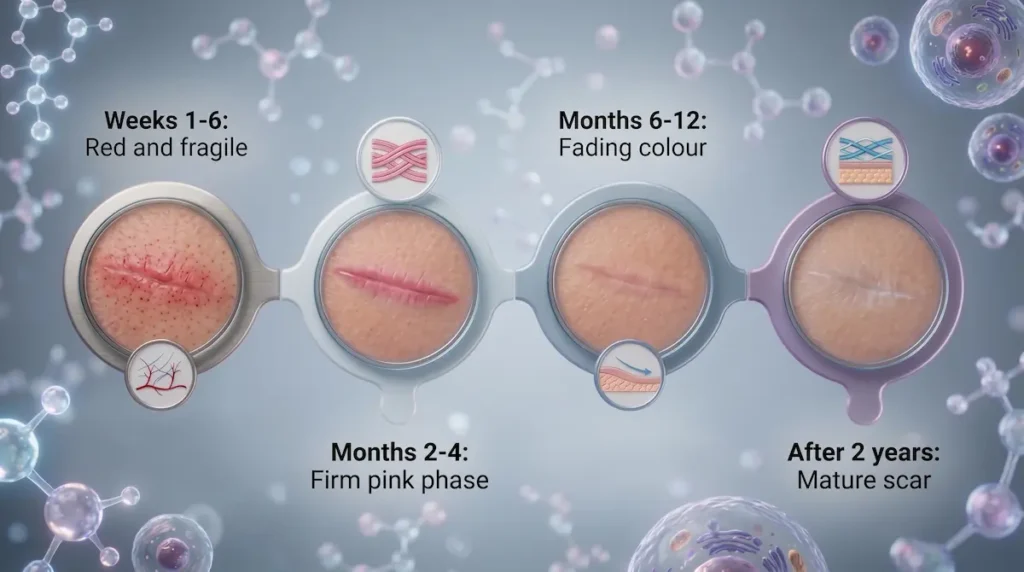
Weeks 1–6: red, raised, tight and fragile
In the first six weeks, the incision is still vulnerable. It may look red, dark pink, purple-toned or slightly raised. The surrounding inner thigh can feel swollen, numb, bruised or tight.
This is not the time to judge the final scar. The body is closing the wound, building early collagen and coping with movement in a difficult area. Walking, sitting, standing up and using stairs all place small repeated stresses on the inner thigh.
Some crusting, mild itching and uneven colour can be expected. Sharp pain, spreading redness, pus, a bad smell, fever or an opening wound should be raised with your surgical team promptly.
Months 2–4: the firm pink phase
Months two to four can feel frustrating. Swelling may be improving, but the scar can look more obvious. It may become firmer, thicker, pinker or slightly rope-like as collagen builds strength across the incision.
This is often the stage when patients search for thigh lift scars after 1 year because they want reassurance that the scar will not stay this visible. In many cases, it will not. The scar is still biologically active.
It is also the stage when friction matters. Tight clothing, sweating, repeated rubbing and early over-stretching can irritate the scar. Sensible scar care matters, but over-treating the area can also cause irritation.
Months 6–12: flattening, fading and softening
Between six and twelve months, most scars become less angry in colour and more comfortable. The line may flatten. It may lose its shine. It may feel softer when you run a finger across it.
For groin-crease scars, the main question at this stage is usually position: has the scar stayed high in the crease, or has it widened or moved lower than planned? For vertical scars, the question is usually visibility: is the line becoming pale and flat enough to feel acceptable in daily life?
This is where a one-year comparison becomes useful. If you want to see how scars from a related skin-removal procedure mature, our guide to arm lift scars offers a useful comparison.
After 2 years: final scar maturity
Thigh lift scars after 2 years are usually closer to their final appearance. The scar may still be visible, but it is often paler, flatter and less reactive than it was at 12 months.
This does not mean every scar becomes faint. Some remain wider, darker, lighter than surrounding skin, or slightly raised. Patients with a history of hypertrophic scars, keloids or post-inflammatory pigmentation may need a more cautious expectation from the start.
If a scar is still changing at one year, many surgeons prefer continued observation before revision. If the scar is stable, widened, uncomfortable or badly positioned after maturity, revision can be discussed more realistically.
| Healing phase | Typical scar appearance | Usually normal? | Supportive care |
|---|---|---|---|
| Weeks 1–6 | Red or pink, raised, tight, fragile, sometimes crusted | Often normal if there is no spreading redness, pus, fever or wound opening | Follow wound-care instructions, avoid tension, keep the area clean and dry |
| Months 2–4 | Firmer, pinker, thicker or more noticeable than expected | Common scar-building phase | Use silicone only when cleared, reduce friction, avoid early over-stretching |
| Months 6–12 | Flatter, softer, paler, but still visible | Expected maturation phase | Continue scar care, protect from sun exposure, review widening or migration |
| 2 years and beyond | More mature line; may be pale, silvery, brown, flat or widened | Often close to final appearance | Consider revision only if the scar is stable and genuinely problematic |
Discover If a Thigh Lift (Thighplasty) Is Right for You
Share your photos and medical history to receive a personalised assessment from our European Board-certified facial surgery team.
Why Some Thigh Lift Scars Widen or Migrate
Scar widening and scar migration are not always caused by poor aftercare. The inner thigh is simply a demanding place to heal. It moves constantly, holds moisture easily and is exposed to friction from walking, underwear and clothing.
That does not mean scar changes are unavoidable. It means planning matters. The incision pattern, deep fixation, closure technique and early movement restrictions all influence whether the scar stays narrow and stable.
High tension, movement and moisture in the groin
The groin crease is convenient for concealment, but it is not a quiet healing zone. Each step creates movement. Sitting bends the area. Sweat and warmth can soften dressings and irritate new scar tissue.
When a healing incision is exposed to repeated pull, the scar may widen. This can turn a fine line into a broader band. On lighter skin, that band may look pale or pink; on deeper skin tones, it may become darker or lighter than surrounding skin.
Good closure distributes tension away from the skin surface as much as possible. Aftercare then protects that closure while the scar gains strength. The first eight weeks are especially important because the scar has not yet reached mature strength.
Downward drift and thigh lift scar migration
Thigh lift scar migration means the scar does not stay as high or as hidden as intended. In medial thigh lifts, this can appear as a groin scar that widens, drops lower or pulls on nearby tissues.
One feared version is downward pull near the vulval area. In some patients, this can create visible distortion or discomfort. This is why the deep anchoring of the lifted tissue matters, not only the surface stitching.
Medical literature on medial thigh lift complications describes wound-healing problems such as dehiscence and seroma, and it also discusses the importance of technique in reducing scar-related problems. For a broader clinical overview, see a literature review of medial thigh lift complications.
How anchoring helps keep the scar stable
In a well-planned medial thigh lift, deeper tissues may be anchored to stronger structures so the pull of the thigh does not sit entirely on the skin closure. This is especially relevant in the groin crease.
You may hear surgeons discuss fixation to deeper fascial support. The principle is simple: the skin should not be asked to carry all the weight of the lift. If the lift is supported deeper, the surface scar has a better chance of staying narrow and better positioned.
This is one reason incision planning should be individual. A patient with mild upper-thigh laxity, strong tissue and stable weight may need a different strategy from someone with significant loose skin after weight loss.
Wound separation and its effect on the final scar
Wound separation, also called dehiscence, can affect the final scar. A small superficial opening may heal with local care and leave only a slightly wider patch. A larger opening can lead to a broader, more irregular or more pigmented scar.
This is why early warning signs should not be ignored. If an incision opens, drains heavily, smells unpleasant or becomes increasingly painful, it needs medical review. Waiting too long can allow a minor wound issue to become a more visible long-term scar problem.
Patients with lipoedema or heavy inner-thigh tissue sometimes research thigh contouring for a different reason from cosmetic loose skin. That is a separate pathway, so we cover liposuction for lipoedema as a different route in its own article.
Caring for Scars — and When Revision Is Worth It
Scar care cannot erase a thigh lift scar, but it can support a calmer, flatter line. The aim is to reduce irritation, protect the scar while collagen remodels and avoid unnecessary tension during the months when the incision is still gaining strength.
Good scar care starts with the operation itself: incision choice, anchoring, closure and aftercare instructions. After that, your role is consistency. Small habits matter more than dramatic treatments.
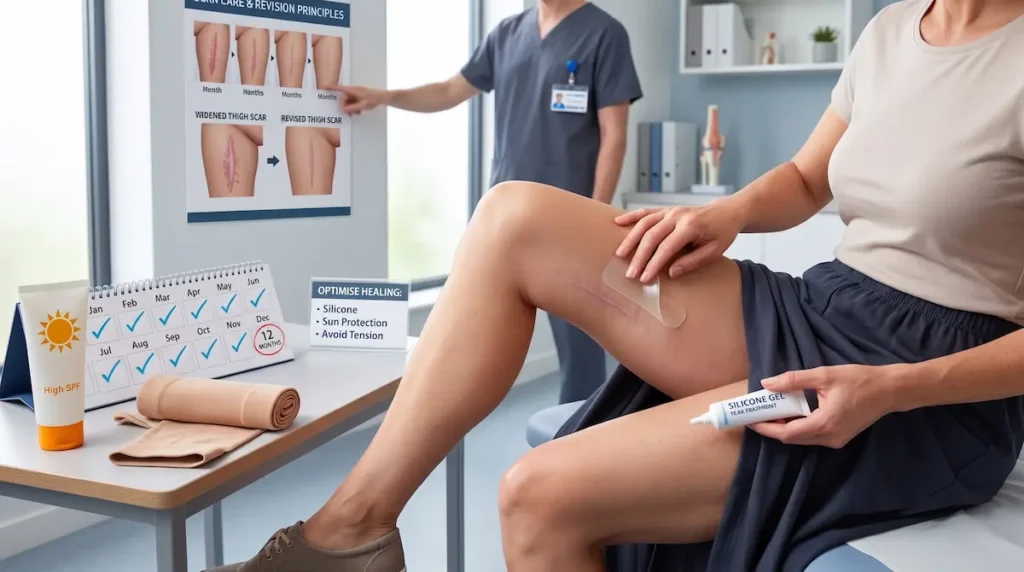
Silicone, scar massage and timing
Silicone gel or silicone sheets are often used once the incision is fully closed and your surgeon has cleared you to begin. They are not applied to an open wound. Used too early, they can trap moisture or irritate fragile skin.
Once the scar is sealed, silicone may help manage thickness, redness and texture. It works best when used regularly over weeks or months, not for a few days. Patience is part of the treatment.
Scar massage may also be recommended later in healing, usually after the incision has closed and tenderness has reduced. The purpose is not to “break” the scar, but to soften firmness and improve comfort. Always follow your surgeon’s timing, especially in the groin crease.
Sun protection and colour change
New scars can darken with sun exposure. This is especially relevant during holidays, swimming or warmer months when the upper thigh may be exposed. Even if the scar sits under underwear, indirect exposure and friction can still irritate healing skin.
For UK patients travelling abroad for surgery, sun protection needs to be discussed before the trip. You may feel well before the scar is mature. That does not mean the scar is ready for heat, swimming, tanning or prolonged friction.
Once your surgeon allows topical products, a high-SPF sunscreen on exposed scars is sensible. Covered scars still need protection from rubbing, sweat and tight seams.
Avoiding tension in the first 8 weeks
The first eight weeks are important because the scar is still building strength. Sudden stretching, deep squats, long walks too early, heavy exercise or sitting with the thighs pulled apart can place avoidable stress on the closure.
This does not mean you should stay immobile. Movement is part of recovery. The point is controlled movement: short walks, careful sitting, no aggressive stretching and no return to strenuous training until your surgical team clears it.
Compression garments may be part of your plan. They should support the area without digging into the incision line. If a garment rubs the groin crease or presses directly into a vertical scar, it should be checked rather than tolerated.
UK planning note: Before travelling, ask how your scar will be reviewed after you return home, what photos the team will need, which symptoms require urgent local medical attention, and when you can restart work, gym activity and swimming. Use the same level of scrutiny you would apply in a UK private consultation: clear credentials, a written aftercare plan and no promise of invisible scarring.
When a widened scar can be revised
Scar revision is usually considered only after the scar has matured. For many patients, that means waiting at least 12 months. Sometimes longer is better, particularly if the scar is still changing in colour, thickness or firmness.
A revision may remove a widened section and close it again with better tension control. It may help a scar that has spread, become uncomfortable or healed in an awkward position. It cannot remove the need for a scar altogether.
Not every visible scar needs revision. If the line is flat, comfortable and well hidden in clothing, further surgery may not be worth the trade-off. If the scar is painful, tethered, thick, very wide or has migrated downward, a surgeon-led review is more reasonable.
Setting expectations before surgery
The best time to discuss scars is before the operation. Ask where the incision will sit, what it may look like at 3 months, 12 months and 2 years, and how your skin type or weight-loss history could affect the result.
You should also ask what happens if the scar widens or a wound opens. A calm plan is better than a vague reassurance. This is particularly important for patients choosing surgery abroad, because early wound concerns need clear instructions from the operating team and sensible escalation at home if needed.
Costs are a separate decision topic, so this article does not open a price table. For that, use AKM’s dedicated guide to thigh lift pricing for UK patients.
Ask AKM how your thigh lift incision would be planned to keep the scar hidden and stable. The consultation should cover incision length, expected scar position, anchoring, aftercare and the realistic trade-off between skin removal and scar visibility.
Frequently Asked Questions: Thigh Lift Scars
These questions focus on scar appearance only. If your concern is the full operation, travel schedule or general recovery, those are better discussed in the main thigh lift consultation pathway.
What do thigh lift scars look like after 1 year?
The scar should not look like a fresh wound at this stage. It may still be pink, brown, pale or silvery depending on skin tone. Mild firmness can remain, but increasing redness, pain or discharge is not something to ignore.
Do thigh lift scars go away?
The realistic goal is a scar that is well placed, stable, comfortable and proportionate to the amount of loose skin removed. A hidden groin scar may be difficult to see in underwear, but it is still a scar.
Why is my thigh lift scar widening?
Some widening can happen even with careful surgery. Significant widening, discomfort or a scar that drops lower than expected should be reviewed. Early wound openings can also lead to a wider final scar.
Can thigh lift scars migrate?
This is one reason deep anchoring matters. If the lift depends too much on the skin closure, the scar may carry more tension than it should. Good surgical planning aims to reduce that risk, although it cannot remove it completely.
What do thigh lift scars look like after 2 years?
A scar can still be visible after 2 years. It may be lighter or darker than the surrounding skin, especially in patients prone to pigmentation changes. A raised or thick scar may need separate assessment for hypertrophic scarring or keloid tendency.
Can a bad thigh lift scar be fixed?
Revision is usually considered after the scar has matured, often at 12 months or later. The aim is improvement, not erasure. A surgeon should first identify why the scar healed poorly, otherwise the same problem may recur.
Are vertical thigh lift scars worse than groin scars?
The better question is whether the scar matches the anatomy. A shorter scar that leaves loose skin behind may be less satisfying than a longer scar that properly treats the problem.
When should I worry about a thigh lift scar?
For long-term concerns, raise scars that are thick, itchy, painful, tethered, rapidly widening or pulling on nearby tissues. Do not wait silently if the scar changes in a way that feels wrong.
Final Thoughts on Thigh Lift Scars After 1 Year
Thigh lift scars after one year are usually much calmer than they were in the early months. They tend to be flatter, paler and more comfortable, but they are not invisible. That distinction matters.
The most discreet scar is not created by wishful wording. It comes from matching the incision to the anatomy, reducing tension, anchoring the tissues properly and following scar care long enough for the line to mature.
If your concern is scar visibility, ask for a specific incision plan rather than a generic reassurance. Where will the scar sit? How long might it be? What happens if it widens? When would revision be considered? Those questions create a more realistic decision than searching for a scar-free promise.
Have Specific Questions About Thigh Lift (Thighplasty)?
Speak directly with our dedicated patient coordinators regarding Thigh Lift (Thighplasty). Receive instant guidance and personalised support.
Medical disclaimer: This article is for educational purposes only and does not replace personalised medical advice. Scar healing varies between patients. If you have increasing pain, wound opening, discharge, fever, spreading redness or concern about your scar, contact your surgical team or seek local medical care promptly.
Related Treatments

Awake High-Definition Liposuction
Awake high-definition liposuction in Istanbul for UK patients: 4D Vaser sculpting with tumescent local anaesthesia + conscious sedation, HBOT/LLLT recovery and GBP fees.

Liposuction in Turkey
UK-focused guide to liposuction in Istanbul: techniques, candidacy, awake/twilight anaesthesia options, recovery timeline, and our HBOT + LLLT protocol.

J-Plasma Skin Tightening in Turkey
J Plasma Skin Tightening (Renuvion) explained: candidacy, areas, recovery, cost, and safety. UK-focused guidance and structured aftercare in Istanbul.

Upper Back Lift in Turkey
Upper Back Lift (bra-line back lift) for UK patients: techniques, scar placement, recovery timeline, anaesthesia choices, and our HBOT+LLLT protocol.
Ready to Begin Your Own Transformation Journey?
Join the 2,000+ patients who have trusted Dr Akif Mehmetoğlu and the AKM Clinic team. Your journey to a more confident, naturally restored you begins with a simple, no-obligation conversation. Contact us today from the UK for your free virtual consultation.
#1: Get Your Free Personalised Quote
Start with a free, no-obligation online consultation. Share your photos, and our surgical team will provide a fully personalised treatment plan and a transparent, all-inclusive price package. There are no hidden fees.
#2: Secure Your Date & VIP Booking
Once you are ready, our dedicated patient coordinators will help you secure your procedure date. We will handle all your bookings, including your 5-star hotel accommodation and private VIP airport transfers.
#3: Arrive in Istanbul & Meet Your Surgeon
Arrive at Istanbul Airport (IST) and be greeted by your private driver. Settle into your hotel and prepare for your in-person consultation, where you will meet your specialist surgeon to finalise the details for your "natural, subtle, and restored" new look.