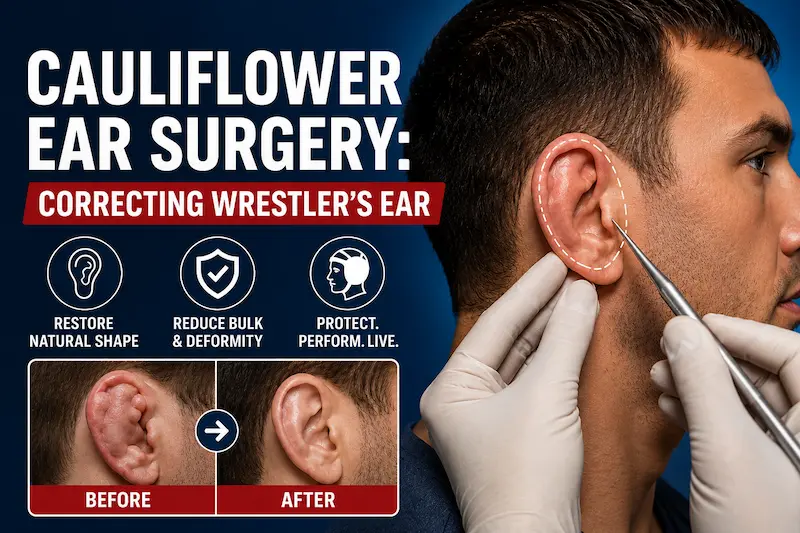
Cauliflower ear surgery corrects the hard, lumpy ear deformity that can develop after repeated trauma in wrestling, boxing, MMA, Brazilian jiu-jitsu, or rugby. The deformity starts with an auricular hematoma — a trapped blood collection around the ear cartilage — and becomes harder to correct once scar-like cartilage forms.
Quick answer: Cauliflower ear forms when repeated blows cause a blood clot, called an auricular hematoma, that disrupts the ear cartilage and hardens into a raised, irregular deformity. Surgery corrects it by removing excess fibrous cartilage and reshaping the ear contour. This is more complex than standard cosmetic otoplasty.
For many athletes, the question is not only cosmetic. A severe cauliflower ear can make helmets, earbuds, or glasses uncomfortable. It can also narrow parts of the outer ear contour. That is why this guide separates early hematoma care from chronic deformity repair, then explains how correction differs from how prominent-ear otoplasty is performed.
This article focuses only on cauliflower ear correction. It does not cover general ear pinning in depth, and it does not open a full cost breakdown. Those topics are handled on their own pages so the medical decision stays clear.
Table of Contents
What Cauliflower Ear Actually Is?
Cauliflower ear is not simply a swollen ear. It is a structural deformity of the outer ear cartilage. The condition usually begins after blunt trauma separates the cartilage from its blood supply, allowing blood or fluid to collect in the space around it. If that collection is not treated promptly, the ear can heal in a thickened, folded, uneven shape.
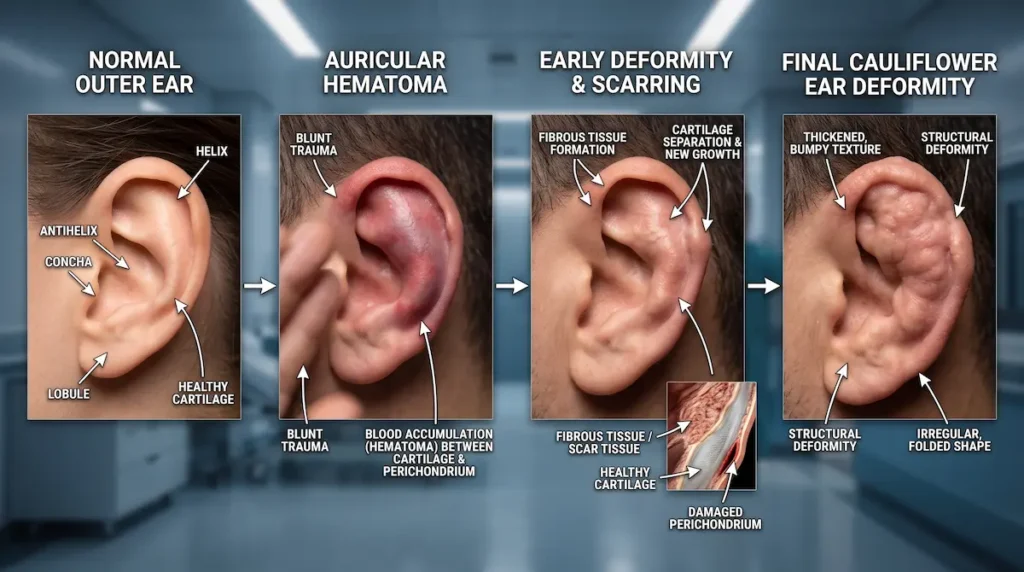
Blunt trauma, auricular hematoma, and cartilage damage
The outer ear is built around flexible cartilage covered by a thin tissue layer called the perichondrium. This layer helps nourish the cartilage. In contact sports, a shearing blow can lift the perichondrium away from the cartilage and create an auricular hematoma.
That hematoma acts like a barrier. The cartilage is no longer receiving normal support from the surrounding tissue. Over time, inflammation, clot organization, and abnormal healing can reshape the ear from the inside out.
Medical reviews describe cauliflower ear as a deformity that follows untreated or recurrent auricular hematoma, especially in athletes exposed to repeated ear trauma. For a clinical overview, see how cauliflower ear forms and is repaired.
Why fibrous cartilage overgrows into a “cauliflower” shape
Once the ear begins repairing itself after repeated hematomas, the new tissue does not always rebuild the original curved anatomy. Instead, the body may lay down thick fibrocartilage and scar-like tissue. This can create the classic raised, bumpy, folded surface that gives cauliflower ear its name.
The deformity may involve the upper ear, the antihelix, the concha, or a wider part of the auricle. Some patients have one small ridge. Others have a collapsed, thickened ear with less visible definition.
That range matters. A mild case may need limited contour refinement. A long-standing, rigid deformity may need more careful cartilage sculpting and soft-tissue management. The surgical plan depends on the shape, thickness, firmness, skin condition, and whether the ear canal or surrounding structures are affected.
How cauliflower ear differs from prominent ears
Prominent ears are usually a shape or projection issue. The ear may stand out from the side of the head because the natural antihelical fold is underdeveloped or the conchal bowl projects too far. The cartilage is usually healthy and flexible enough to reshape with planned sutures or scoring.
Cauliflower ear is different. The ear has been injured. The anatomy may be distorted by old blood collections, fibrous cartilage, scar tissue, and thickened contour. That makes correction less predictable than routine ear pinning.
In simple terms: prominent-ear otoplasty reshapes an ear that developed in a protruding position. Cauliflower ear surgery reconstructs an ear that has been damaged and healed in a deformed position.
Surgeon perspective: “With cauliflower ear, timing changes everything. Early hematoma drainage can prevent the deformity. Once the cartilage has hardened, correction becomes a reconstructive reshaping procedure, not just a cosmetic ear-pinning surgery.”
Why It Happens — And Why Prompt Care Matters?
Cauliflower ear is strongly linked to repeated ear trauma. The highest-risk patients are athletes whose ears are repeatedly compressed, twisted, or struck. A single untreated hematoma can be enough, but recurrent small injuries are often the reason wrestler’s ear becomes fixed over time.
Wrestling, boxing, MMA, BJJ, and repeated ear trauma
The condition is common in wrestling because the ear is constantly pressed against mats, arms, shoulders, and headgear. Boxing, MMA, Brazilian jiu-jitsu, judo, rugby, and other contact sports can create the same problem.
The injury mechanism is usually not a clean direct hit. It is often a rubbing or shearing force. The outer skin shifts while the cartilage stays behind, and the tissue layer that feeds the cartilage separates. That separation allows blood to pool.
At first, the ear may feel soft, warm, tender, or swollen. Athletes sometimes ignore it because it looks like ordinary swelling after training. That is the risky moment. A soft hematoma can become a firm deformity if it is not evaluated and treated.
The untreated hematoma cascade
An untreated auricular hematoma can trigger a predictable sequence. First, blood collects. Then the cartilage loses normal support. Inflammation follows. The body starts replacing the collection with fibrous tissue and new cartilage. As that tissue matures, the ear becomes thicker, harder, and more irregular.
That is why early treatment is different from chronic correction. In the early stage, the main goal is to remove the blood collection and prevent it from reaccumulating. In chronic cauliflower ear, the goal shifts to removing excess fibrous cartilage and rebuilding a more natural contour.
A PubMed-indexed review on auricular hematoma and cauliflower ear management explains that the deformity results from untreated hematoma and later neocartilage deposition and fibrosis. For the evidence review, see a review of cauliflower ear management.
Why early drainage can prevent a fixed deformity
Early drainage is the prevention step. It removes the blood or fluid before it organizes into thicker tissue. After drainage, the ear usually needs a pressure dressing, bolster, or compression method so the space does not refill.
This is where many athletes run into trouble. They drain the ear informally, return to training too soon, or skip compression. The hematoma comes back. Repeated cycles of swelling and partial healing make the final deformity harder to correct.
If the ear is newly swollen after trauma, it should be assessed urgently by a qualified clinician. A fresh auricular hematoma is not the same problem as an old, hardened cauliflower ear. The earlier case is a prevention problem. The later case is a reconstructive surgery problem.
For AKM patients, that distinction shapes the consultation. The team first determines whether the ear is still in an acute hematoma stage or whether it has become a stable cartilage deformity. Only then can the right plan be made.
How Cauliflower Ear Surgery Corrects It?
Once cauliflower ear has hardened, the problem is no longer just swelling. The ear has developed thickened, distorted cartilage and scar-like tissue. Surgery aims to reduce that bulk, restore clearer ear folds, and create a smoother outer contour while protecting the skin and remaining cartilage.
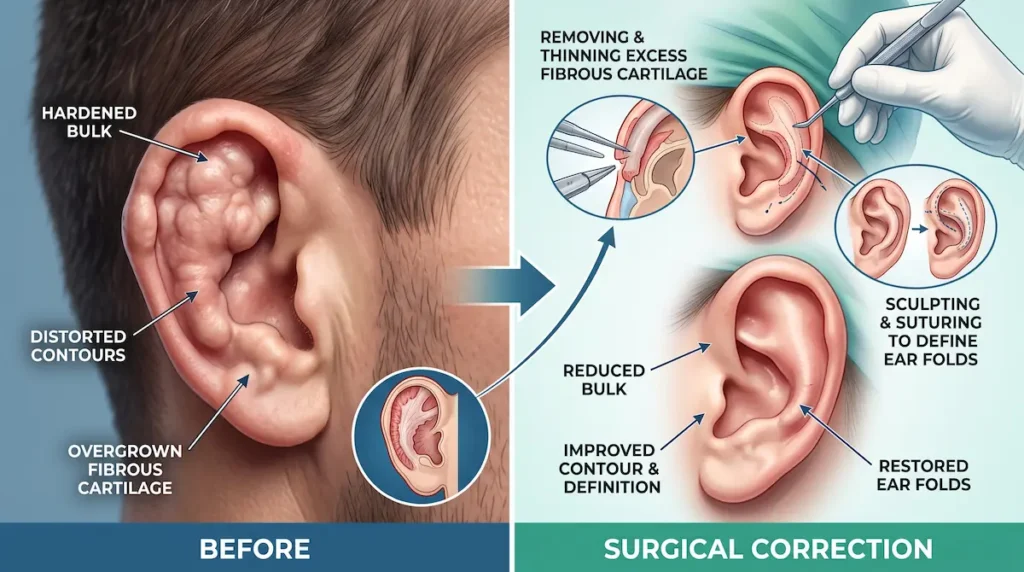
Removing overgrown fibrous cartilage
In chronic cauliflower ear, the surgeon first identifies where the ear has become thick, raised, or blocked by abnormal fibrocartilage. The exact incision depends on the deformity. In many cases, the incision is planned so that access is possible while visible scarring is minimized.
The goal is not to “shave everything flat.” That would risk creating a stiff, unnatural, or irregular ear. Instead, the surgeon removes or thins the excess tissue in a controlled way, preserving enough support for the ear to keep its shape.
This is why correction requires a different mindset from a simple cosmetic adjustment. A wrestler’s ear has often lost some of its normal landmarks. The surgeon must work with the cartilage that remains, the tissue that has overgrown, and the skin envelope that still needs to redrape over the reshaped framework.
Reshaping the ear contour
After excess fibrous cartilage is reduced, the ear contour is sculpted. The aim is to make the auricle look more defined and less bulky, especially around the antihelix, conchal bowl, and upper ear where deformity is often most obvious.
In some cases, the surgeon may use sutures to help hold the reshaped cartilage in a better position. In others, careful cartilage trimming, scoring, or contour refinement is the main step. The plan is customized because cauliflower ear does not follow one predictable pattern.
A mild upper-ear deformity is different from a thick, folded conchal deformity. A flexible ear is different from a rigid one. A patient who has stopped contact sports is different from a patient who plans to return to wrestling or MMA. Those details shape the surgical plan.
Why this repair is harder than standard otoplasty
Standard prominent-ear otoplasty starts with relatively normal cartilage anatomy. The ear may project too far, but the natural folds and skin quality are usually intact. Cauliflower ear surgery starts with injured anatomy.
That makes the outcome less exact. Surgery can significantly improve the contour, reduce bulk, and make the ear look less distorted. It may not make a severely damaged ear look identical to an uninjured ear. Good planning depends on that honesty.
Patients should also understand recurrence risk. If the ear is hit repeatedly after surgery, new hematomas can form. That can damage the result. For active combat-sport athletes, prevention after repair matters almost as much as the surgery itself.
| Factor | Cauliflower Ear Surgery | Prominent-Ear Otoplasty |
|---|---|---|
| Main problem | Trauma-related thickening, cartilage deformity, scar-like overgrowth | Ear projection or underdeveloped natural folds |
| Typical patient goal | Reduce bulk, restore contour, make the ear look less distorted | Set prominent ears closer to the head and improve symmetry |
| Surgical challenge | Distorted cartilage and unpredictable tissue thickness | More predictable reshaping of relatively normal cartilage |
| Result expectation | Improvement, not always a perfectly “untouched” ear | More standardized cosmetic reshaping |
| Recurrence risk | Higher if contact trauma continues | Mostly related to healing, suture behavior, or cartilage memory |
How It Differs From Prominent-Ear Otoplasty?
Both procedures fall under ear surgery, but they solve different problems. This distinction matters because a patient searching for cauliflower ear correction may not be a good candidate for a standard ear-pinning plan. The consultation needs to ask what happened to the ear, how long the deformity has been present, and whether the patient still plays contact sports.
Deformity repair versus cosmetic ear pinning
Prominent-ear otoplasty is usually chosen when the ears stick out more than the patient wants. The cartilage folds may be weak, or the conchal bowl may project too far. The ear itself is not usually injured.
Cauliflower ear repair is reconstructive in nature. It deals with a damaged ear. The surgeon may need to remove thickened cartilage, improve the contour of the outer ear, and recreate some definition that was lost after repeated hematomas.
That does not mean cauliflower ear surgery is not cosmetic. The main goal is often appearance. But the surgical pathway is closer to deformity correction than routine ear pinning.
Incision and technique differences
In prominent-ear otoplasty, incisions are often placed behind the ear so the surgeon can reshape cartilage and set the ear back. In cauliflower ear surgery, the incision strategy depends on where the deformity is. If the thickened tissue is concentrated in the upper ear, the plan differs from a deformity that blocks the conchal bowl.
The surgeon may need direct access to the abnormal cartilage. This can make incision planning more individualized. A well-hidden incision is still preferred, but access and safety come first.
Because the ear skin may be stretched or scarred, the surgeon must also think about how it will settle after the cartilage is reduced. Removing too much support can create contour irregularity. Removing too little may leave the ear bulky. The balance is delicate.
Realistic result expectations
The most important expectation is improvement, not perfection. A mild cauliflower ear may be smoothed and reshaped very well. A severe, long-standing deformity may improve substantially but still have some asymmetry, stiffness, or residual irregularity.
That is not a failure of planning. It is the reality of damaged cartilage. A European Board-Certified surgical team, using an ABPS-equivalent standard of assessment, should explain the likely improvement before surgery rather than promising a perfectly untouched-looking ear.
At AKM Clinic, the consultation looks at the ear from multiple angles: front, side, oblique, and close-up. The team assesses thickness, fold loss, skin flexibility, previous drainage attempts, scar quality, and the patient’s plan for returning to sports. That is how the difference between standard otoplasty and true wrestler’s ear repair becomes clear.
Recovery, Results & Preventing Recurrence
Recovery after cauliflower ear surgery depends on how much cartilage reshaping was needed. A limited contour repair usually heals faster than a severe reconstructive case, but nearly every patient needs swelling control, pressure support, and strict protection from new trauma during the early healing window.
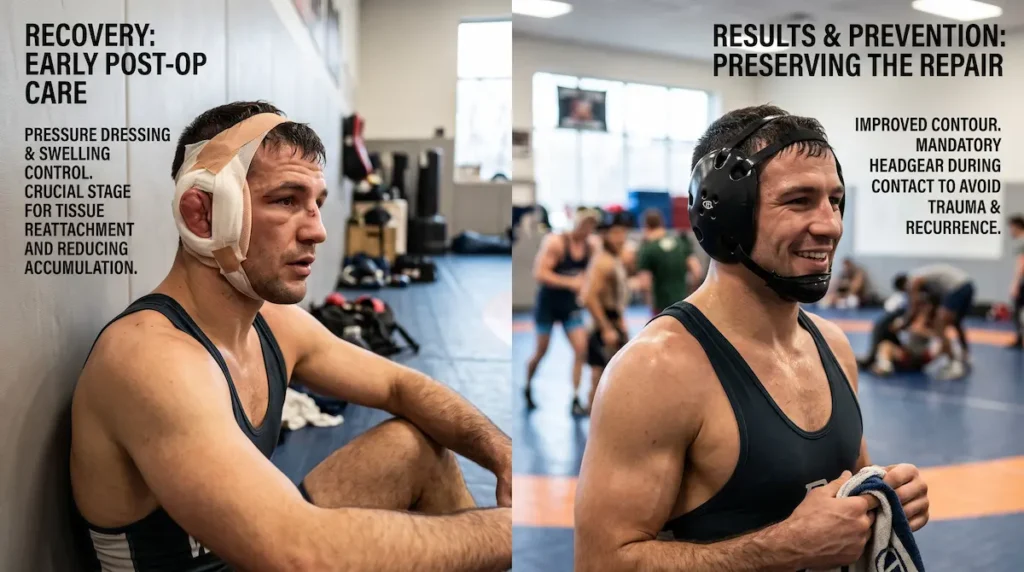
Pressure dressing, downtime, and swelling
After surgery, the ear is usually supported with a dressing, bolster, or compression method. The purpose is simple: keep the reshaped tissue in contact with the cartilage framework and reduce the chance of fluid collecting again.
Swelling, bruising, tightness, and tenderness are expected in the first phase. The ear may look more swollen before it looks better. That does not automatically mean the result is failing. It means the tissue is reacting to surgery.
Patients should follow the surgeon’s dressing instructions closely. Removing pressure too early, sleeping directly on the ear, or returning to contact drills before clearance can increase the risk of fluid collection, distortion, or recurrence.
Some principles overlap with general ear surgery recovery. For more detail on external support after ear reshaping, see our guide to wearing the otoplasty recovery headband.
Protecting the ear with headgear
Protection is the long-term issue. A patient who has retired from wrestling or MMA usually has a lower recurrence risk than an athlete who returns to daily grappling. New trauma can restart the hematoma cycle even after a successful repair.
For active wrestlers, BJJ athletes, boxers, and MMA fighters, protective headgear is not optional advice. It is part of preserving the result. The ear needs time to heal before any pressure, rubbing, or impact is reintroduced.
Patients should ask three practical questions before returning to sport:
- When can I safely resume non-contact conditioning?
- When can drilling start without direct ear pressure?
- When is full sparring, rolling, or wrestling allowed?
The answer is individual. It depends on the operation, healing quality, swelling, skin condition, and whether any fluid has reaccumulated. The safest return-to-sport plan is staged, not rushed.
What the final contour can realistically look like
Final results should be judged after swelling has settled and the tissue has softened. In mild or moderate cases, surgery can make the ear look much smoother and more defined. In severe long-standing cases, the goal may be meaningful improvement rather than a perfectly untouched ear.
The final contour depends on several factors: how much cartilage was distorted, how thick the fibrous tissue became, how flexible the skin remains, and whether the athlete continues contact sports. A careful surgeon will show where improvement is likely and where small irregularities may remain.
Scars are also part of planning, although most ear incisions are placed as discreetly as possible. If you are comparing healing in other nearby areas, our guide on healing timelines for head-and-neck scars explains why scar maturation can take months, not days.
For patients comparing facial or upper-head procedures, it may also help to understand how surgical scars in the head area heal. The exact incision is different, but the principle is similar: early redness and firmness are not the final scar.
Cost is not the focus of this article because cauliflower ear surgery varies by deformity severity. Patients who want the pricing framework can review the cost of ear surgery separately without turning this medical guide into a price table.
Frequently Asked Questions: Cauliflower Ear Surgery
These questions cover the practical issues most patients ask before deciding on cauliflower ear correction: whether surgery can fix it, how it compares with otoplasty, whether it can return, and what to expect during recovery.
Can cauliflower ear be fixed with surgery?
Yes. Chronic cauliflower ear can usually be improved with surgery that removes excess fibrous cartilage and reshapes the ear contour. The degree of correction depends on how severe the deformity is, how long it has been present, and how much healthy cartilage and flexible skin remain.
Is cauliflower ear surgery the same as otoplasty?
It is related, but not the same. Standard otoplasty usually corrects prominent ears by reshaping relatively normal cartilage. Cauliflower ear surgery corrects cartilage that has been damaged by trauma and has healed in a thickened, irregular shape.
Does cauliflower ear come back after surgery?
It can come back if the ear is injured again and a new hematoma forms. This is especially relevant for wrestlers, MMA athletes, BJJ practitioners, and boxers. Protective headgear, staged return to training, and prompt treatment of any new swelling help reduce recurrence risk.
How long is recovery after cauliflower ear surgery?
Early swelling and tenderness usually improve gradually over the first weeks, but the final contour takes longer to settle. Contact sports should only resume after the surgeon clears the ear. Returning too early can damage the repair.
Can early cauliflower ear be treated without surgery?
Early auricular hematoma may be treated with drainage and compression before a fixed deformity develops. Once the cartilage has hardened into chronic cauliflower ear, massage, draining, or home remedies will not reliably restore the original contour. At that stage, surgical reshaping is usually needed.
Is the surgery painful?
The procedure is performed with appropriate anesthesia, so patients should not feel the surgical work itself. Afterward, soreness, pressure, swelling, and tenderness are expected. Pain levels vary, and the care team will provide individualized medication and aftercare instructions.
Will my ear look completely normal again?
Sometimes the improvement is dramatic, especially in mild to moderate cases. In severe, long-standing cauliflower ear, the goal is usually a smoother, less bulky, more natural-looking contour rather than a guarantee of a perfectly uninjured ear.
Who is a good candidate for cauliflower ear surgery?
A good candidate has a stable cauliflower ear deformity, realistic expectations, and a clear plan to protect the ear after surgery. Active contact-sport athletes may still be candidates, but they need a strict recurrence-prevention plan before returning to training.
Final Takeaway
Cauliflower ear surgery is not a simple ear-pinning procedure. It is a reconstructive contour repair for cartilage that has been damaged by trauma, hematoma, and abnormal healing. The earlier a fresh hematoma is treated, the more preventable the deformity becomes. Once the ear has hardened, surgery can still improve the shape, reduce bulk, and restore a cleaner contour.
At AKM Clinic, the planning starts with anatomy, not a template. The surgical team evaluates the deformity, skin quality, cartilage thickness, sport history, and recurrence risk before recommending a correction plan. For US patients comparing options abroad, the key questions are safety, realistic correction, and long-term protection.
Medical disclaimer: This article is for educational purposes only and is not personal medical advice. Results vary by anatomy, trauma history, healing pattern, and aftercare. Always consult a qualified surgeon or medical professional for diagnosis and individualized treatment planning.