A breast lift after weight loss is usually best suited to someone whose weight has been stable for at least six to twelve months, who is close to their goal weight, does not smoke, and understands the main goal: lifting and reshaping the breast, not automatically restoring lost volume.
Major weight loss can change the breasts in a way that ordinary ageing or pregnancy alone does not. The skin may be thinner. The upper breast may look empty. The nipple may sit lower than before, and the breast tissue can shift towards the side of the chest.
That is why a post-weight-loss breast lift is not just a standard uplift with a different story behind it. It needs careful planning around skin quality, scar pattern, nipple position, volume loss and future weight stability. At AKM Clinic, post-weight-loss breast uplift planning is assessed around anatomy first, then goals.
This guide explains what makes someone a good candidate, when it may be too early, and how to think about implants, scars and timing without rushing the decision.
Table of Contents
Why Breasts Change After Major Weight Loss
After major weight loss, the breasts often change because the internal volume shrinks faster than the skin can contract. This creates the familiar “deflated” look: less fullness at the top, more loose skin at the bottom, and nipples that may point downwards rather than forwards.
This is the reason saggy breasts after weight loss are treated differently from mild breast droop. The issue is rarely one single thing. It is usually a combination of lost fat, stretched skin, weakened support, lower nipple position and a wider breast footprint across the chest.
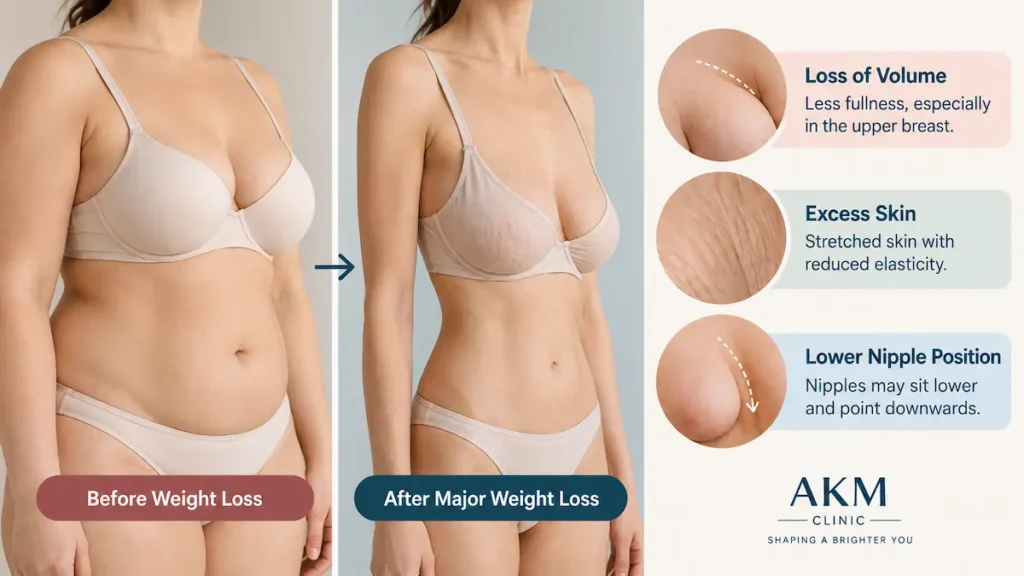
Volume loss and excess skin: why breasts look deflated
Breasts contain a mixture of glandular tissue, fat and supporting structures. When body fat reduces significantly, the breast can lose a large part of its soft volume. The skin envelope, however, may remain stretched.
That mismatch creates deflated breasts after weight loss: breasts that may look flatter, longer or emptier than expected. Some patients describe them as sitting “lower on the body”. Others notice that bras fit differently even if the cup size has not changed dramatically.
A breast lift can remove excess skin and raise the breast mound. It can also reposition the nipple and areola. What it cannot do by itself is recreate all of the fullness lost through weight reduction.
Loss of elasticity, stretch marks and skin quality
Skin quality matters. A lot.
After a large change in weight, the skin may have less elasticity. Stretch marks are one clue, although they are not the only sign. Thin skin, crepey texture, poor recoil and a tendency for the breast to fold over itself all affect the surgical plan.
This does not mean you are automatically a poor candidate. It means the lift has to be honest. If the skin cannot hold a small, neat incision pattern, a surgeon may recommend a stronger lift pattern with more skin removal and a longer scar.
For many post-weight-loss patients, this is where the real trade-off begins: a shorter scar may not give enough lift, while a longer scar may create a more stable shape.
Nipple position and lateral chest folds after weight loss
Nipple position is one of the clearest signs used in assessment. If the nipple sits below the breast crease, points downwards, or rests near the lowest part of the breast, a lift is usually more relevant than a non-surgical treatment.
Major weight loss can also leave extra tissue towards the outer chest, close to the armpit. This lateral fullness can make the breast look wider, even after the central breast has lost volume.
A good consultation does not look at the nipple alone. It looks at the whole breast footprint: front view, side view, skin stretch, breast fold, lateral tissue and where the final scar would need to sit.
“After major weight loss, the aim is not simply to lift the nipple. The breast mound, skin envelope and side-chest tissue all need to be assessed together, because shape and position matter as much as cup size.”
— AKM Clinic board-certified plastic surgery team
The Candidate Checklist for a Breast Lift After Weight Loss
A good candidate is not defined by one number on the scale. The more useful question is whether your body is ready for surgery and whether your goals match what a lift can realistically achieve.
For UK patients considering a breast uplift after weight loss, this usually means looking at weight stability, bariatric surgery timing if relevant, nutrition, smoking status, medical history and expectations. The ASPS criteria for body contouring after weight loss highlight stable weight, good general health, non-smoking status and realistic goals as key candidate factors after major weight loss.
| Candidate criterion | Why it matters | How it is assessed |
|---|---|---|
| Stable weight for 6–12+ months | Ongoing weight loss can loosen the skin again and shorten the life of the result. | Weight history, current BMI range, recent fluctuations and goal-weight plan. |
| Close to goal weight | A lift done too early may need revision if more weight is lost later. | Discussion of remaining planned weight loss in stone/kg. |
| Good nutrition and protein intake | Healing depends on adequate nutrition, especially after bariatric surgery. | Medical history, blood tests where appropriate, diet stability and supplement routine. |
| Non-smoker or able to stop safely before surgery | Smoking can reduce blood flow and increase wound-healing risk. | Smoking history, nicotine use and pre-operative stop plan. |
| Realistic expectations | A lift improves shape and position; it does not guarantee upper-pole fullness without volume planning. | Photo review, examination and discussion of implant or no-implant options. |
Stable weight for 6–12+ months and close to goal weight
Weight stability is one of the strongest signs that your result is likely to hold. If your weight is still changing, the breast skin and tissue may continue to shift after surgery.
Most patients are advised to wait until their weight has been steady for at least six to twelve months. For some, longer is better, especially after very large losses or bariatric surgery.
This is where the phrase breast lift weight stable becomes practical rather than technical. It means your body has settled into its new size, your eating pattern is consistent, and you are not planning another major drop in weight.
If you still want to lose another one to two stone, it may be wiser to wait. If your weight has been steady and the breast shape has not improved on its own, a lift assessment becomes more useful.
Timing after bariatric surgery: usually 12–18 months, with nutrition stable
Mastopexy after bariatric surgery needs extra timing discipline. The body may still be adapting for many months after gastric sleeve, gastric bypass or another weight-loss operation.
Many patients are not ready for body contouring until roughly twelve to eighteen months after bariatric surgery. This varies. The more important point is that weight, nutrition and general health should be stable before an elective breast operation is planned.
Protein intake matters because wound healing is demanding. Vitamin and mineral deficiencies can also affect recovery, so a responsible assessment may include blood tests and a review of supplements before surgery is confirmed.
For UK patients, NHS pathways for post-bariatric body contouring are not automatic and are often restricted. That does not change the medical criteria for private surgery: your body still needs to be ready, and your expectations still need to be clear.
No smoking, no uncontrolled healing issues, realistic goals
Smoking and nicotine use are major concerns in breast lift surgery because they can affect blood flow to the skin and nipple. This matters even more when the skin has already been stretched and thinned by major weight loss.
Uncontrolled diabetes, anaemia, poor nutrition, active infection or unstable medical conditions may also delay surgery. A careful clinic will not treat these as minor details.
Realistic goals are just as important. A lift can raise a low nipple, tighten loose skin and improve breast shape. It can make the breast sit higher and look more balanced with your new body.
It does not turn stretched skin back into untouched skin. It does not promise a specific cup size. It does not prevent future ageing, pregnancy or weight fluctuation from changing the breasts again.
UK planning note: If you are comparing private options from the UK, ask the same questions you would ask in a GMC-regulated consultation: who assesses your medical readiness, who performs the operation, how the incision pattern is chosen, and what happens if healing is slower than expected after you return home.
Skin Quality and What It Means for Your Scars
Skin quality is one of the biggest differences between a routine breast lift and a breast lift after major weight loss. After significant weight reduction, the breast skin may be thinner, more stretched and less elastic. That changes both the lift pattern and the healing conversation.
This is not meant to scare you. It is meant to help you make a better decision. A good candidate understands that stronger reshaping often requires a stronger incision pattern, especially when there is a large amount of loose skin.
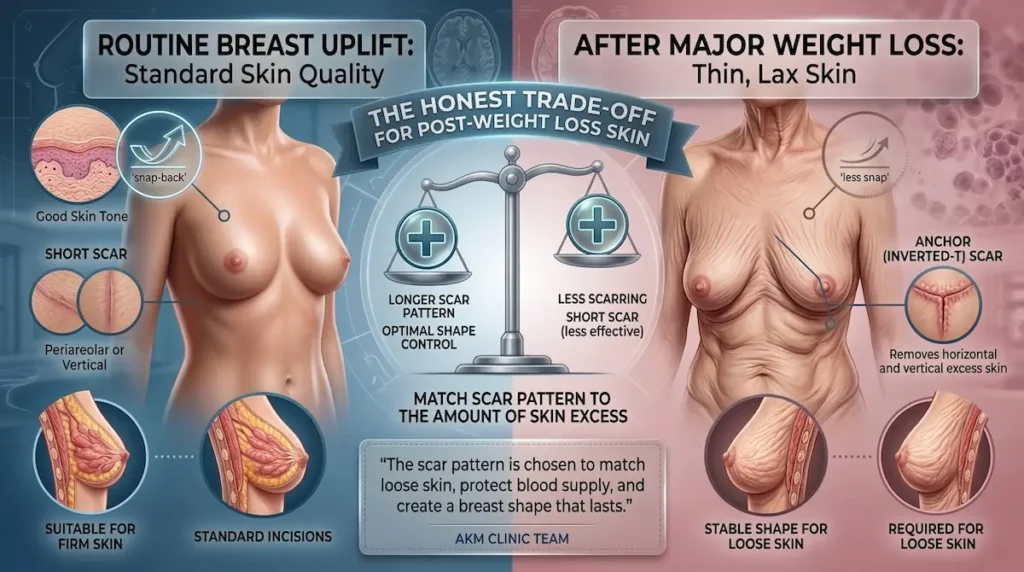
Why post-weight-loss skin often needs an anchor or inverted-T pattern
In mild breast droop, a periareolar or vertical lift may be enough. After major weight loss, that is not always realistic. The skin envelope can be too loose in both directions: vertically from nipple to fold, and horizontally across the lower breast.
An anchor, or inverted-T, pattern gives the surgeon more control. It allows excess skin to be removed around the areola, down the lower breast and along the breast fold. That can be especially useful when the nipple is low and the breast has widened after weight loss.
A PubMed-indexed review of post-weight-loss mastopexy describes why planning can be more complex after massive weight loss, especially when skin laxity, volume loss and breast shape need to be considered together. For the clinical background, see an algorithmic review of mastopexy after massive weight loss.
The trade-off is a longer scar. For some patients, that scar pattern is what makes a stable shape possible.
Longer scar vs better breast shape: the honest trade-off
Many patients hope for the shortest possible scar. That is understandable. Still, a short-scar approach can be disappointing if the breast needs more skin removal than the incision allows.
After major weight loss, forcing a smaller pattern may leave too much loose skin behind. It can also flatten the breast or fail to correct the lower-pole heaviness properly. In some cases, a longer incision gives a cleaner shape because it matches the actual amount of skin excess.
This is why scar planning should be discussed before surgery, not treated as a surprise afterwards. If you want to understand how scars usually mature, read our guide to how breast lift scars mature after surgery.
A scar is part of the exchange. The goal is to place it carefully, close it with low tension, and support it through the healing period.
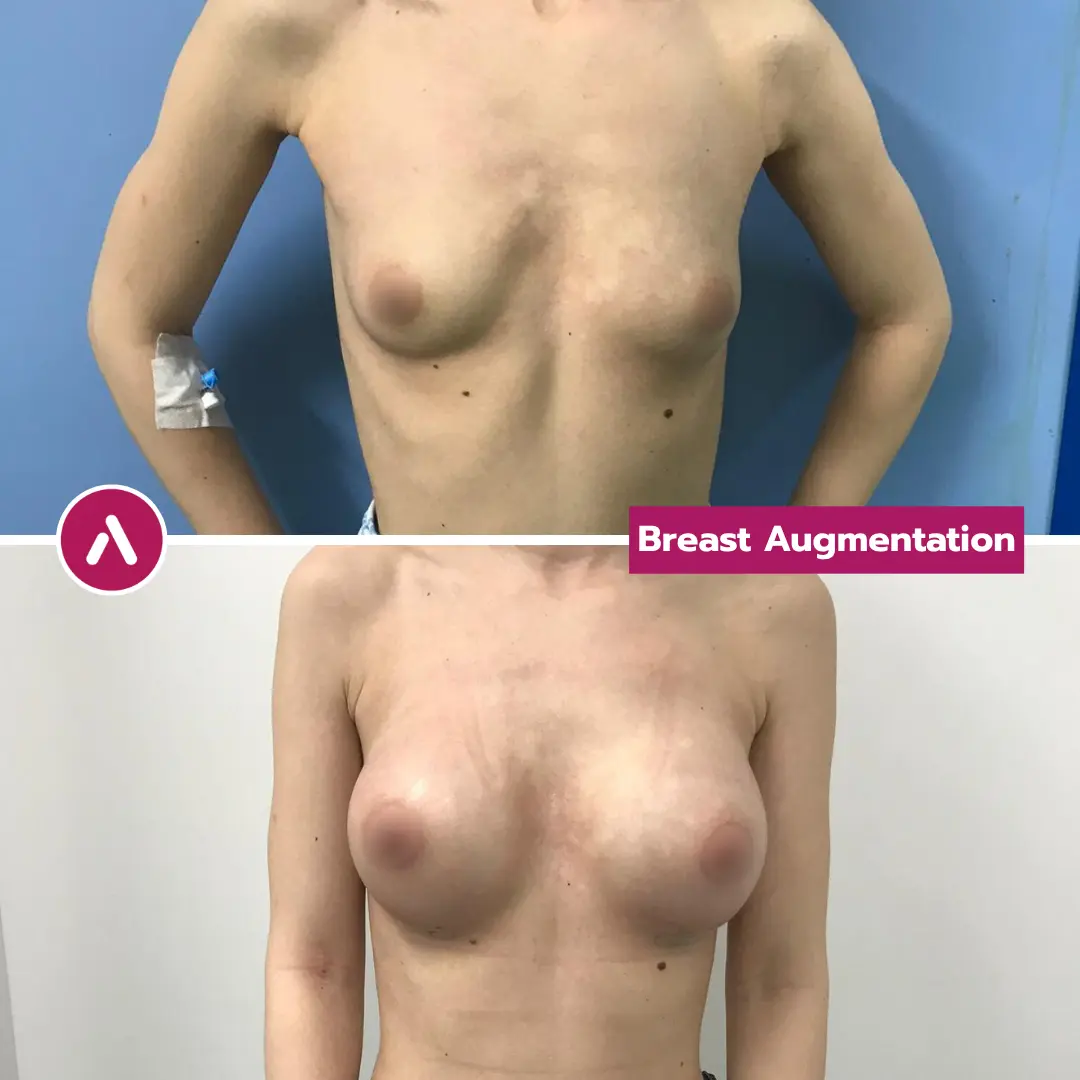
Thin, stretched skin and healing risk
Thin or stretched skin can still heal well, but it requires respect. The surgeon must consider blood supply, nipple movement, incision tension and the patient’s overall health. Smoking, poor nutrition or unstable weight can make these risks more serious.
Warning signs after surgery are not the main subject of this article, but they matter. Darkening skin, severe increasing pain, spreading redness, discharge with a bad smell or a nipple that looks dusky should be reviewed urgently. You can read more about warning signs in thin or stretched breast skin.
Before you book, ask how your skin quality affects the incision plan. A responsible answer should be specific to your photos, weight history and medical background.
“In post-weight-loss breast surgery, the scar pattern is not chosen for marketing. It is chosen to match the amount of loose skin, protect blood supply and create a breast shape that can hold over time.”
— AKM Clinic board-certified plastic surgery team
Implant or No Implant? Restoring Volume After Weight Loss
A breast lift raises and reshapes the breast. It does not automatically replace the volume lost during weight loss. This is why the implant discussion is common in post-weight-loss consultations.
Some patients need only a lift. Others may benefit from an implant. A third group may be better suited to auto-augmentation, where the patient’s own breast tissue is rearranged to improve shape without adding an implant.
Auto-augmentation: using your own tissue for upper-pole shape
Auto-augmentation is a surgical planning concept, not a magic volume replacement. It uses existing lower breast tissue and repositions it to create a more lifted shape. For patients who still have enough tissue, it can soften the “empty upper breast” look without an implant.
This can be a good option when the patient wants a natural feel, wants to avoid implants, and accepts that upper-pole fullness will be moderate rather than dramatic.
It is also useful for patients whose main concern is shape and position. If you want to explore this route in more detail, our guide to reshaping the breast without implants explains the no-implant decision more fully.
When an implant may make sense
An implant may make sense when there is too little remaining breast tissue to create the desired fullness. This often happens after very large weight loss, especially when the breast has become flat at the top and loose at the bottom.
The implant decision should be conservative. Heavy implants can place extra strain on already stretched skin. That can affect scar tension, long-term support and the risk of the breast dropping again.
For this reason, post-weight-loss patients are often better served by proportionate planning rather than simply choosing the largest size they think they want. The aim is balance with the new body, not a breast that overwhelms the frame.
Some patients need a separate treatment discussion for combined lift and implant surgery. You can read about when implants are added to a breast lift if your main question is volume restoration.
Shape and position first; cup size expectations second
Cup size is an imprecise way to plan surgery. Bra sizing varies between brands, and the same cup letter can look different on different body frames.
After major weight loss, it is safer to focus first on breast position, nipple height, symmetry, skin removal and whether the breast mound can be shaped well. Cup size comes later.
A good consultation should include a clear conversation about what you want your breasts to look like in clothing and out of clothing. It should also explain the limits: a lift improves position and contour, while an implant or auto-augmentation addresses volume in different ways.
This is where the right candidate shows realistic expectations. You can want a meaningful change. You should not be promised a precise cup size.
Realistic Results and Timing Your Surgery
The right timing can improve your chance of a stable result. Surgery done too early, before your weight and nutrition have settled, may create a result that changes quickly. Surgery done after your body has stabilised is usually easier to plan.
For UK patients travelling for surgery, timing also includes practical recovery planning. You need enough time away from work, support at home and a clear aftercare plan for the weeks after you return.

What a lift can and cannot do after major weight loss
A breast lift can raise low nipples, remove loose skin, reshape the breast mound and create a firmer, higher breast contour. It can make your breast shape better match your new body.
It cannot remove every stretch mark. It cannot make poor-quality skin behave like untouched skin. It cannot guarantee that the breast will never drop again.
Good results after weight loss are often about proportion rather than perfection. The breast should sit better on the chest, look less deflated and feel easier to support in bras and clothing.
That is a realistic goal. It is also a meaningful one.
Why future weight changes can affect longevity
Future weight gain or loss can stretch the skin again. Pregnancy, ageing and hormonal change can also alter breast shape over time.
This is why the best time for surgery is usually when your weight has settled and your life plans are clear enough for a long-term decision. You do not need to be at the lowest possible weight. You do need to be at a weight you can maintain.
If your weight is still moving every month, waiting may protect your result. If your weight has been stable, your nutrition is strong and your breast shape has stopped changing, you may be ready for assessment.
Planning, sequencing and cost without turning this into a cost article
Some post-weight-loss patients need more than one procedure. A breast lift may be planned alone, or it may sit within a wider body-contouring plan. The order matters.
For example, if loose abdominal skin, arm skin or back folds are also concerns, your surgeon may discuss staging. That does not mean doing everything at once. It means deciding what is safest, what matters most, and what recovery you can realistically manage.
Cost also matters, but this article is not a price guide. For UK-specific planning, use our page on breast uplift cost planning in Turkey rather than trying to estimate from generic figures.
Future breastfeeding may also affect the timing of any breast operation. If this is relevant to you, read about future breastfeeding considerations after breast surgery and raise the topic during consultation.
UK travel and safety note: AKM Clinic operates in Istanbul, and its reviews are publicly visible on Trustpilot. For breast and body surgery, your assessment should remain surgeon-led: weight history, blood tests where needed, anaesthesia planning, incision choice and aftercare after travelling home should all be discussed before you commit.
The best candidate is not the person who rushes. It is the person whose body is ready, whose goals are clear, and whose plan respects both shape and safety.
Frequently Asked Questions: Breast Lift After Weight Loss
These questions focus on candidate suitability after major weight loss. They do not replace a personal assessment, but they can help you prepare for a more precise consultation.
What makes you a good candidate for a breast lift after major weight loss?
You should also understand the trade-off. A breast lift after weight loss can improve breast position and shape, but it may require longer scars and may not restore lost volume unless auto-augmentation or implants are part of the plan.
How long should my weight be stable before a breast lift?
The goal is not simply to reach a certain number. The goal is to operate when your body has settled and the result is less likely to change quickly.
Do I need implants after weight loss?
The safest answer depends on your tissue thickness, skin stretch, breast width, nipple position and preferred look. After major weight loss, bigger is not always better; heavy implants can place extra strain on stretched skin.
Is breast lift with or without implants after weight loss better?
The decision should be based on your skin quality, tissue thickness, chest width and long-term support. A conservative plan is often safer for stretched post-weight-loss skin.
Will my skin be too thin for a lift?
If the skin is very thin, stretched or damaged by smoking, poor nutrition or medical issues, surgery may need to be delayed until risk factors are improved.
How long after bariatric surgery can I have a breast lift?
If you are still losing weight, struggling with nutrition or planning another major body change, waiting is usually the safer choice.
Will the lift restore my breast size?
If you want more upper-breast fullness after weight loss, your consultation should include a discussion of auto-augmentation, implants, or accepting a smaller but lifted breast. A realistic plan starts with the tissue you have, not just the cup size you want.
Is a breast lift after weight loss available on the NHS?
If you are in the UK, it is reasonable to ask your GP or local NHS service about local criteria if you have functional symptoms such as recurrent rashes, skin infections or significant discomfort. Private surgery still requires the same medical readiness: stable weight, safe healing factors and realistic expectations.
Final Thoughts: Are You Ready for a Post-Weight-Loss Breast Lift?
A good candidate for a post-weight-loss breast lift is not simply someone who dislikes sagging. It is someone whose weight is stable, whose skin and health can support healing, and whose expectations match what surgery can truly do.
The right operation may be a lift alone. It may involve auto-augmentation. It may include implants. In some cases, it may be better to wait.
Ask AKM whether your weight stability, skin quality and breast volume make you a candidate for a breast lift after weight loss. A careful assessment should explain your incision pattern, volume options, scar expectations and recovery plan before you make a decision.
Medical Disclaimer: This article is for general educational purposes only and does not replace a personal consultation with a qualified medical professional. Suitability for surgery, risks, recovery and results vary between patients. If you have symptoms, complications or concerns after surgery, contact your surgeon or seek appropriate medical care.