A breast lift after weight loss can be a strong option if your weight is stable, your breasts have sagged because of loose skin, and your main goal is a better shape rather than a larger cup size. The right candidate has realistic expectations, good general health, and enough tissue quality for safe healing.
Major weight loss changes the breast in a different way than aging or pregnancy alone. The skin envelope stretches, fat volume decreases, and the nipple often sits lower than it used to. Many women describe the result as “empty,” “flat,” or “folded,” even after reaching a healthier body weight.
That is why this decision is not only about whether you want lifted breasts. It is about timing, skin quality, volume, scar trade-offs, and whether a lift alone can create the shape you have in mind. At AKM Clinic, post-weight-loss breast surgery is planned by a board-certified plastic surgery team experienced in breast lift options, with the goal of improving proportion while keeping the result natural.
This guide focuses on candidacy after major weight loss. It does not replace a medical consultation, but it will help you understand the questions your surgeon will ask before recommending a mastopexy, a breast lift with implants, or a different approach.
Table of Contents
Why Breasts Change After Major Weight Loss
Before you can judge whether you are a good candidate, you need to understand what weight loss actually does to the breast. After a large drop in body weight, the breast often loses fat volume faster than the stretched skin can tighten. The result is not just smaller breasts. It is a mismatch between the remaining breast tissue and the loose skin around it.
Many patients search for help with saggy breasts after weight loss, but the visible problem usually has several layers. The breast may sit lower on the chest. The nipple may point downward. The upper breast may look hollow. Skin folds can appear at the side of the chest, near the bra line, especially after bariatric surgery or rapid medical weight loss.
That “deflated” appearance is common. In surgical language, deflated breasts after weight loss usually means the skin envelope is too large for the remaining volume. A breast lift removes extra skin, reshapes the breast mound, and moves the nipple-areola complex to a higher position. It does not create major new volume by itself.
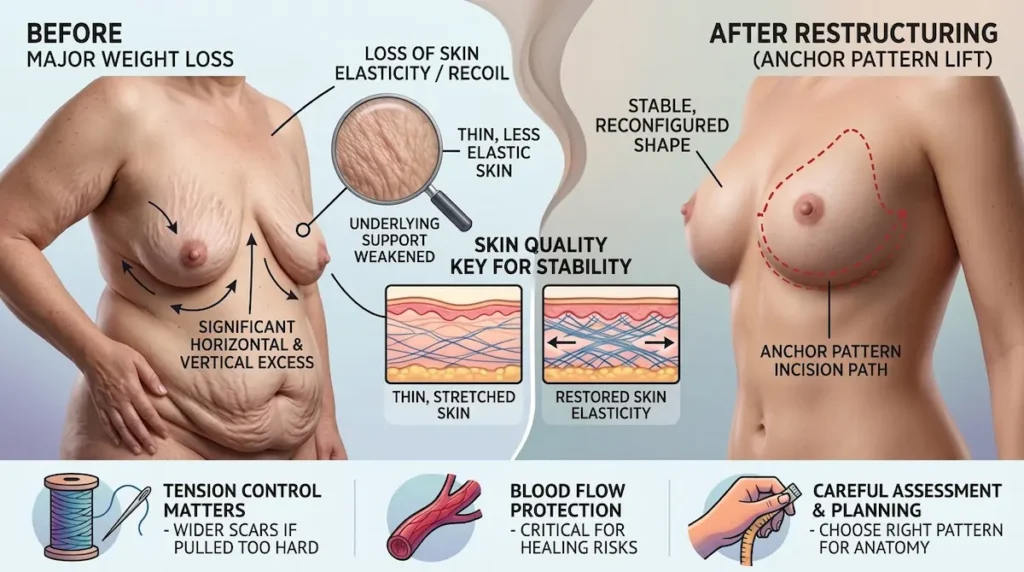
Skin quality matters as much as cup size. If the skin is thin, stretched, or marked by deep stretch marks, it may not hold a compact shape as firmly as thicker, more elastic skin. This does not automatically rule you out. It does mean your surgeon may recommend a more supportive incision pattern, such as a vertical or anchor lift, instead of a smaller scar pattern that would not correct enough looseness.
There is also a side-chest component after major weight loss. Some patients expect a breast lift to fix everything from the armpit to the upper abdomen. A lift improves the breast position, but it does not fully treat back rolls, lateral chest folds, or upper abdominal skin. Those areas may need separate body-contouring planning.
That distinction protects you from disappointment. A breast lift can make the breast look higher, rounder, and better centered on the chest. It cannot make post-weight-loss skin behave like skin that was never stretched. A good plan respects that difference.

Volume loss is different from sagging
Sagging means the breast and nipple have dropped. Volume loss means the breast has become smaller or flatter. You can have one without the other, but after major weight loss, many patients have both.
This is why a surgeon will not only ask what cup size you want. They will examine nipple position, skin excess, the fold under the breast, the amount of remaining breast tissue, and how much upper-pole fullness you expect. A lift is mainly a shape and position operation. Implant decisions come later, after the tissue exam.
The nipple position is a major candidacy clue
One simple sign is the nipple’s relationship to the inframammary fold, which is the crease under the breast. If the nipple sits at or below that fold, a lift is more likely to be relevant. If the nipple points downward, the need becomes clearer.
That said, self-checks are not a diagnosis. Breast shape varies widely after weight loss. Two patients can lose the same number of pounds and need different surgical plans because their skin, tissue thickness, and chest width are different.
Loose skin can limit what a small-scar lift can do
Patients often hope for the shortest possible scar. That is understandable. But after major weight loss, a small incision may not remove enough skin to reshape the breast well.
A peri-areolar lift may help mild looseness, but it can flatten the breast if used beyond its limits. A vertical lift can reshape more tissue. An anchor lift can remove more lower-pole and horizontal skin. The right scar is the one that gives enough control over the stretched skin envelope.
Breast Lift After Weight Loss: The Candidate Checklist
A good candidate for a breast lift after weight loss is not defined by one number on the scale. Your surgeon is looking for stability, safety, tissue quality, and goals that match what the operation can realistically achieve. This checklist gives you the main criteria used during a consultation.
| Candidate Criterion | Why It Matters | How It Is Assessed |
|---|---|---|
| Stable weight | Weight changes after surgery can stretch the skin again and alter the result. | Your current weight, recent weight trend, and whether you are near your goal weight. |
| Good general health | Safe healing depends on nutrition, circulation, and controlled medical conditions. | Medical history, lab work, medications, and surgical clearance when needed. |
| No nicotine use | Nicotine can reduce blood flow and raise wound-healing risks. | Smoking, vaping, nicotine patches, and timing of cessation before surgery. |
| Enough skin excess to justify a lift | A lift is most useful when loose skin and nipple descent are the main problems. | Breast measurements, nipple position, skin quality, and fold location. |
| Realistic shape goals | A lift improves position and contour, but it does not create unlimited upper fullness. | Photo review, physical exam, implant discussion, and expectation setting. |
Your weight should be stable, not still rapidly changing
The phrase breast lift weight stable matters because timing affects the durability of your result. If you are still losing weight quickly, your breast tissue and skin may keep changing after surgery. That can create new looseness, smaller volume, or asymmetry.
Many surgeons prefer several months of stable weight before body-contouring or breast reshaping. After bariatric surgery, the waiting period may be longer because your body needs time to settle and your nutrition must be reliable. The exact window depends on your health history, your weight-loss method, and your surgeon’s assessment.
A stable weight does not mean your weight never moves by a pound or two. It means you are not in an active major-loss phase. You should be close to a weight you can realistically maintain.
Mastopexy after bariatric surgery needs extra timing discipline
Mastopexy after bariatric surgery is common, but it should not be rushed. Bariatric patients may have nutritional deficiencies, anemia, protein issues, or medication considerations that affect wound healing. A breast lift involves skin removal, nipple repositioning, and internal reshaping, so healing capacity matters.
Your surgeon may ask about your bariatric procedure, current supplements, weight trend, lab results, and whether your bariatric team has cleared you for elective surgery. This is not a formality. It is part of safe planning.
Patients who lost weight with GLP-1 medications also need careful timing. The method of weight loss is less important than the current state of your body: Are you stable? Are you eating enough protein? Are you medically cleared? Has your breast shape stopped changing?
You should be healthy enough for elective surgery and anesthesia
A breast lift is elective, but it is still surgery. Good candidates have controlled blood pressure, stable chronic conditions, and no active infection. They also understand the anesthesia plan and recovery requirements before traveling.
Tell your surgeon about diabetes, clotting history, autoimmune disease, prior breast surgery, breast imaging, medications, supplements, and any wound-healing issues. These details do not always prevent surgery. They guide safer planning.
Nicotine use can make you a poor candidate for now
Nicotine is one of the biggest avoidable risks in breast lift healing. It can narrow blood vessels and reduce oxygen delivery to healing tissue. That is especially relevant after major weight loss, where skin may already be thinner or more stretched.
This includes cigarettes, vaping, nicotine gum, nicotine patches, and some smokeless products. If you use nicotine, your surgeon may delay surgery until you have stopped for a safe period. That delay is not a punishment. It is risk reduction.
Your goal should be better shape, not another weight-loss result
A breast lift does not help you lose weight. It does not treat the abdomen, arms, thighs, or back. It improves the breast envelope by removing excess skin, reshaping the remaining tissue, and lifting the nipple to a more balanced position.
The best candidates understand that trade-off. They are not chasing a completely scar-free or gravity-proof result. They want a breast shape that fits their new body more comfortably and they are willing to accept the scars needed to get there.
“After major weight loss, the main question is not simply whether the breast is smaller. We look at skin stretch, nipple position, remaining tissue, and weight stability. A lift can restore shape and position, but volume decisions must be made honestly from the patient’s own anatomy.” — AKM Clinic board-certified plastic surgery team
Skin Quality and What It Means for Your Scars
After major weight loss, skin quality often determines how much correction is possible and which incision pattern is safest. This section matters because the best breast shape is not created by pulling harder. It is created by choosing a lift pattern that removes enough loose skin while protecting blood flow, nipple position, and long-term support.
Weight-loss skin is often different from skin affected by aging alone. It may be thinner, less elastic, and more stretched across the lower breast. Stretch marks can be a clue that the deeper dermal support has weakened. If the skin has lost much of its recoil, a small-scar lift may not hold the breast mound in a reliable shape.
This is where candidacy becomes more precise. A patient with mild sagging and good skin may be able to have a shorter-scar lift. A patient with severe lower-pole looseness, side folds, and a low nipple position may need a vertical or anchor pattern. That does not mean the result will look unnatural. It means the surgical plan must match the amount of skin that needs to be removed.
For a deeper look at scar maturation after mastopexy, AKM’s guide to what anchor-pattern scars look like over a year explains how breast lift scars usually change from early redness to flatter, softer lines. This article will not repeat that full timeline, but scars should be part of your decision before surgery.
Why anchor scars are common after major weight loss
An anchor or inverted-T lift is often used when the breast has both vertical and horizontal skin excess. That pattern allows the surgeon to tighten the breast from more than one direction. It can also help reshape a flattened lower breast and move the nipple to a more balanced position.
Patients sometimes feel discouraged when they hear the word “anchor.” That reaction is understandable. The scar is longer than a donut or lollipop pattern. But in major weight loss cases, the shorter pattern may not remove enough skin to correct the problem.
The trade-off is control. A longer incision may allow a more stable shape, better nipple placement, and less bunching of loose skin. The goal is not the shortest scar at any cost. The goal is the right scar for the anatomy.
Thin, stretched skin needs conservative planning
Thin skin can heal well, but it needs respect. If too much tension is placed on the closure, the scar may widen. If the nipple-areola complex is moved too aggressively, blood supply can become a concern. Those risks are why a careful physical exam matters.
Healing risk is not the same for every patient. Nicotine use, uncontrolled diabetes, poor nutrition, anemia, and very recent rapid weight loss can all affect tissue repair. Patients who have lost weight through bariatric surgery may also need lab checks before elective surgery.
AKM’s separate guide on why thin, stretched skin raises healing risks explains the warning signs that require urgent medical review after a lift. This article stays focused on candidacy, but a responsible candidate understands the risk discussion before signing a surgical plan.
Good scars start before the first incision
Scar quality is partly genetic, but planning still matters. Your surgeon will look at breast weight, skin tension, fold position, areola size, and the likely direction of pull after closure. They will also ask about prior scars elsewhere on your body.
If your body tends to form raised or thick scars, that does not always prevent surgery. It may change the counseling, the incision choice, and the aftercare plan. Silicone gel, sun protection, tape support, and tension control can all be discussed during recovery, once the incision has safely closed.
Patients with darker skin tones may also ask about pigmentation changes. That is a valid question. Scars can remain darker, lighter, or more visible for longer in some skin types. A good consultation should address this directly, without promising that scars will disappear.
Scar expectations should match the amount of lift needed
A small degree of sagging may need a smaller lift. Major deflation usually needs more skin removal. The more the nipple must move and the more loose skin must be removed, the more likely a vertical or anchor scar becomes.
This is why before-and-after photos can be misleading if you only compare the final breast shape. You also need to compare the starting anatomy. A patient with mild postpartum sagging is not the same as a patient who has lost 90 pounds and has severe skin laxity.
Good candidates are not scar-free candidates. They are patients who understand the trade-off: a lifted, reshaped breast in exchange for scars that mature over time. If that trade-off feels unacceptable, it may be better to wait rather than rush into surgery.
US planning note: The ASPS criteria for body contouring after weight loss emphasize stable health, realistic expectations, and being near a stable weight before surgery. Those same principles are useful when judging whether breast reshaping is well timed after major weight loss.
Implant or No Implant? Restoring Volume After Weight Loss
Many patients assume a breast lift and breast implant solve the same problem. They do not. A lift raises and reshapes the breast. An implant adds volume. After major weight loss, the right choice depends on how much natural breast tissue remains, how much upper-pole fullness you want, and whether your skin can safely support an implant.
The key question is breast lift with or without implants after weight loss. Some patients are excellent candidates for a lift alone because they have enough tissue to reshape. Others need an implant because the breast has lost too much volume to create the desired fullness. A third group may be better served by avoiding implants because the skin is too thin or the breast envelope cannot support extra weight well.
This decision should be made from anatomy, not from a cup-size wish list. Cup sizes vary across bra brands. Photos can be edited. Social media often favors upper fullness that may not fit every chest or tissue type. A safer plan starts with your skin, tissue, chest width, and long-term goals.
What a lift alone can do
A lift alone can move the nipple higher, remove loose skin, tighten the lower breast, and reshape the existing breast tissue. If you still have enough natural volume, this may create a rounder and better-positioned breast without an implant.
Some patients prefer this route because they want a lighter, more natural feel. Others choose it because they do not want implant maintenance in the future. A lift without implants can be a strong option when the main issue is sagging, not severe volume loss.
AKM’s dedicated article on restoring shape without an implant covers that decision in more detail. In this post-weight-loss guide, the main point is simple: a lift alone can improve shape, but it cannot create the same upper fullness as an implant.
What an implant can add
An implant can restore volume that weight loss removed, especially in the upper breast. This may help patients who feel their breasts look flat, empty, or too small after reaching their goal weight. It can also improve cleavage in selected cases.
But an implant also adds weight. In stretched post-weight-loss skin, that weight matters. If the skin envelope is weak, a larger implant may increase the chance of recurrent sagging, bottoming out, widened scars, or a result that ages faster than expected.
For some patients, a modest implant works well. For others, a large implant would fight against the goal of a stable lift. The safest recommendation may not be the largest size you can technically fit.
Auto-augmentation may be an option in selected patients
Auto-augmentation means reshaping your own lower breast tissue to create more fullness in the upper breast. It does not add foreign volume. Instead, the surgeon repositions existing tissue during the lift.
This can help patients who want a natural result and have enough remaining breast tissue to work with. It is not suitable for everyone. If the breast is very empty after weight loss, there may not be enough tissue to rearrange.
The benefit is that auto-augmentation avoids implant-related maintenance. The limitation is that it cannot create the same volume increase as an implant. It is a reshaping tool, not an enlargement tool.
How surgeons decide between lift alone and lift with implants
A surgeon will examine your breast base width, tissue thickness, nipple position, skin stretch, and desired upper fullness. They may also review your weight history and ask whether you plan future weight changes or pregnancy. These details shape the recommendation.
If your breasts are low but still have enough volume, a lift alone may be enough. If your breasts are both low and very empty, an implant may be discussed. If your skin is very thin and lax, the team may recommend a conservative implant size or a staged approach.
You can read more about a breast lift combined with implants on the treatment page. This article will not turn into a full implant guide because the focus is candidacy after major weight loss.
Future pregnancy and breastfeeding should be part of the conversation
Breast lift surgery can affect nipple position, glandular tissue, and the breast ducts. Many patients still breastfeed after breast surgery, but no surgeon can promise it. If you are planning pregnancy soon, delaying surgery may protect your result and avoid another cycle of stretching.
This is especially relevant after major weight loss because your skin has already been through a large change. Pregnancy and breastfeeding can add another major shift in breast size and shape. That does not mean you cannot have surgery before children, but the decision should be made with that possibility in mind.
For related context, AKM’s article on how breast surgery can affect future breastfeeding explains why duct preservation, nipple sensation, and surgical pattern matter. Breast reduction is a different procedure, but the breastfeeding questions overlap.
Research note: A major-weight-loss breast is not a standard cosmetic mastopexy case. Published surgical reviews, including an algorithmic review of mastopexy after massive weight loss, describe the need to match technique to skin excess, tissue quality, and volume loss rather than using one routine lift pattern for every patient.
Realistic Results and Timing Your Surgery
A breast lift after major weight loss works best when the timing is right and the goal is realistic. This section helps you decide whether your body is ready now, whether waiting would protect your result, and what a post-weight-loss lift can and cannot change.
The most satisfied patients usually understand one thing early: a lift improves breast shape, position, and proportion. It does not stop aging, prevent future weight changes, or guarantee permanent upper fullness. Your body will still respond to gravity, hormones, pregnancy, and weight fluctuation over time.
That does not make the surgery less valuable. It makes planning more important. If your weight is stable, your health is optimized, and your goals are clear, a breast lift can help your breasts fit your new body more naturally after major weight loss.
Wait if your weight is still changing
If you are still losing weight quickly, surgery may be premature. Further weight loss can reduce breast volume again, loosen the skin envelope, and change nipple position. That may weaken the result or create the need for revision sooner than expected.
Most patients should be close to their goal weight before surgery. A small amount of future weight change is normal. A major planned loss is different. If you expect to lose another 20, 40, or 60 pounds, your surgeon may recommend waiting.
Waiting can be frustrating after you have already worked hard to lose weight. But in many cases, it gives the surgeon a more stable canvas and gives you a result that is easier to maintain.
Plan around nutrition, not just the scale
The number on the scale is only one part of readiness. After bariatric surgery, calorie intake, protein absorption, iron, B vitamins, and overall nutrition can affect wound healing. A patient can be at goal weight but still not be ready for elective surgery if their labs are unstable.
Tell your surgical team about bariatric procedures, GLP-1 medications, supplements, food tolerance, recent blood work, and any history of anemia. These details help the team decide whether your body is ready to heal safely.
This is also why crash dieting before surgery is a poor strategy. You want your body in a strong healing state, not a depleted one.
Understand what the lift will not fix
A breast lift will not tighten the entire torso. It will not remove back rolls, upper abdominal looseness, or extra skin near the armpit. It also will not make the breast immune to future sagging.
Some patients need a separate plan for the arms, abdomen, back, or lateral chest. That does not mean everything should be done at once. It means the consultation should look at your body as a whole while keeping each operation within a safe scope.
If cost becomes part of the planning conversation, keep it separate from candidacy. This article is not a price guide, but AKM’s page on breast lift pricing after weight loss explains the cost side without turning this medical decision into a numbers-only comparison.
Good candidates accept the scar-for-shape trade-off
After major weight loss, the best shape often requires enough skin removal to control the lower breast. That may mean a vertical or anchor pattern. If you are only willing to accept a tiny scar, you may not be ready for the correction your anatomy actually needs.
Scars usually fade over time, but they do not disappear. A good candidate understands that the scar is part of the reshaping plan. The question is not “Can I avoid scars completely?” It is “Which scar pattern gives the safest and most stable result for my skin?”
AKM’s post-weight-loss evaluation is surgeon-led
At AKM Clinic, post-weight-loss breast lift planning is based on anatomy, not a one-size-fits-all template. The board-certified plastic surgery team evaluates weight stability, breast tissue, skin stretch, nipple position, scar risk, and whether a lift alone or a lift with implants is more appropriate.
AKM Clinic has treated international patients since 2013 and uses surgical facilities in Istanbul. Patients are supported through a structured journey that includes virtual consultation, in-person assessment, surgery planning, hotel and transfer coordination, and follow-up after returning home.
Patient satisfaction signals matter, but they should never replace medical judgment. AKM Clinic’s reviews are publicly visible on Trustpilot, and the clinic’s philosophy remains natural-first: rejuvenation and proportion, not an overdone or operated-on look.
US patient planning note: Ask your surgeon to explain three things before booking: whether your weight has been stable long enough, whether your skin quality can support the planned lift, and whether your desired upper fullness requires an implant or can be achieved with your own tissue.
Frequently Asked Questions: Breast Lift After Weight Loss
These answers address the most common candidate questions patients ask before choosing a breast lift after major weight loss. They are general educational answers and do not replace a personal surgical evaluation.
What makes you a good candidate for a breast lift after major weight loss?
How long should my weight be stable before a breast lift?
Do I need implants after weight loss?
Will my skin be too thin for a lift?
How long after bariatric surgery can I have a breast lift?
Will the lift restore my breast size?
Can I combine a breast lift with other post-weight-loss procedures?
What if I plan to lose more weight later?
Final Thoughts: Are You Ready for a Post-Weight-Loss Breast Lift?
A strong candidate for a breast lift after weight loss has stable weight, good health, no nicotine use, realistic goals, and breast changes that match what a lift can correct. The decision is not only about sagging. It is about whether your skin, tissue, timing, and expectations support a safe, natural-looking result.
If your breasts feel deflated, low, or out of proportion after major weight loss, a consultation can help you separate what a lift can fix from what may require implants, staged body contouring, or more time before surgery. That honesty is what protects the result.
Ask AKM whether your weight stability and skin quality make you a candidate for a post-weight-loss lift.
Medical disclaimer: This article is for educational purposes only and is not a substitute for medical advice, diagnosis, or treatment. Surgical candidacy must be determined through a consultation with a qualified plastic surgery team. Results vary from patient to patient.