




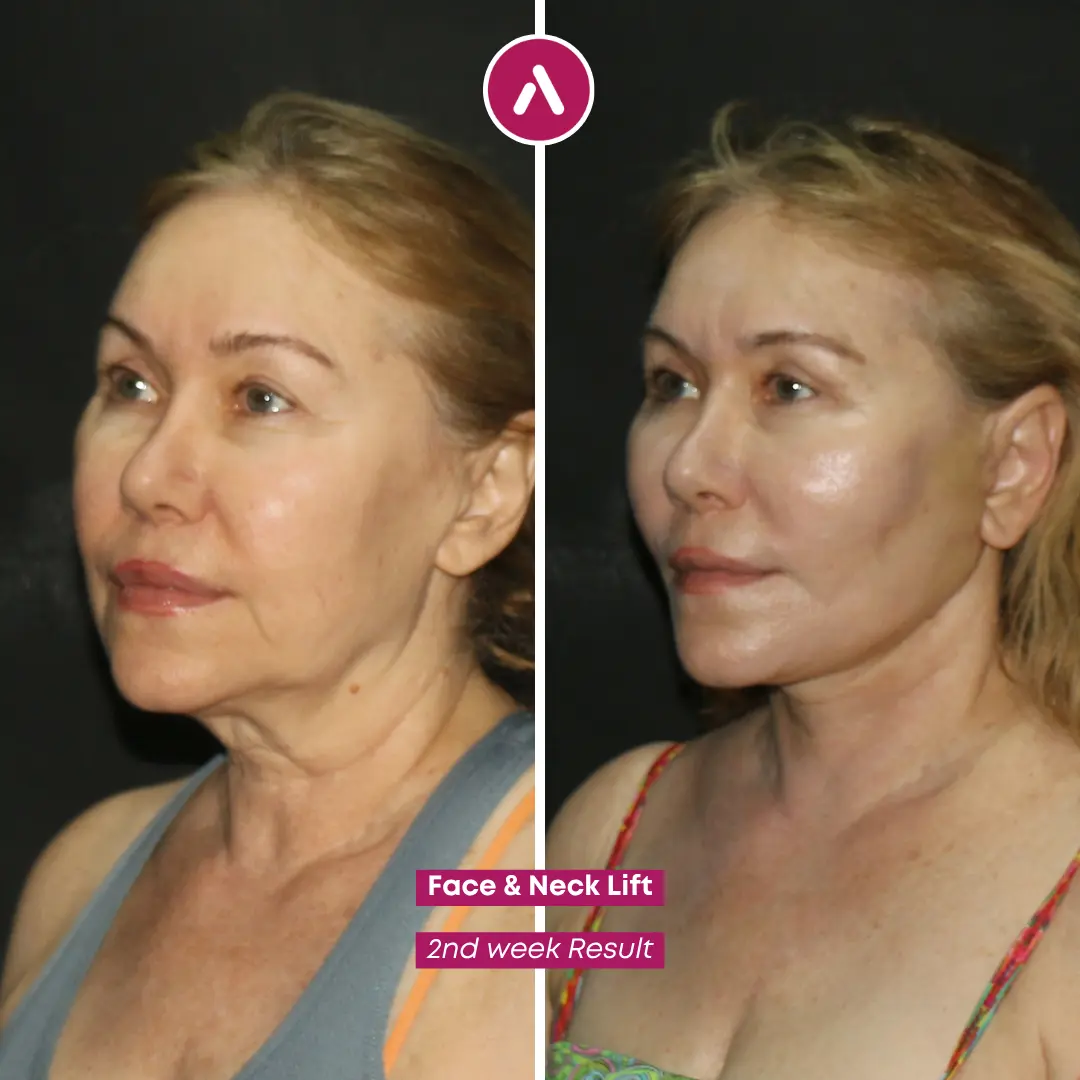
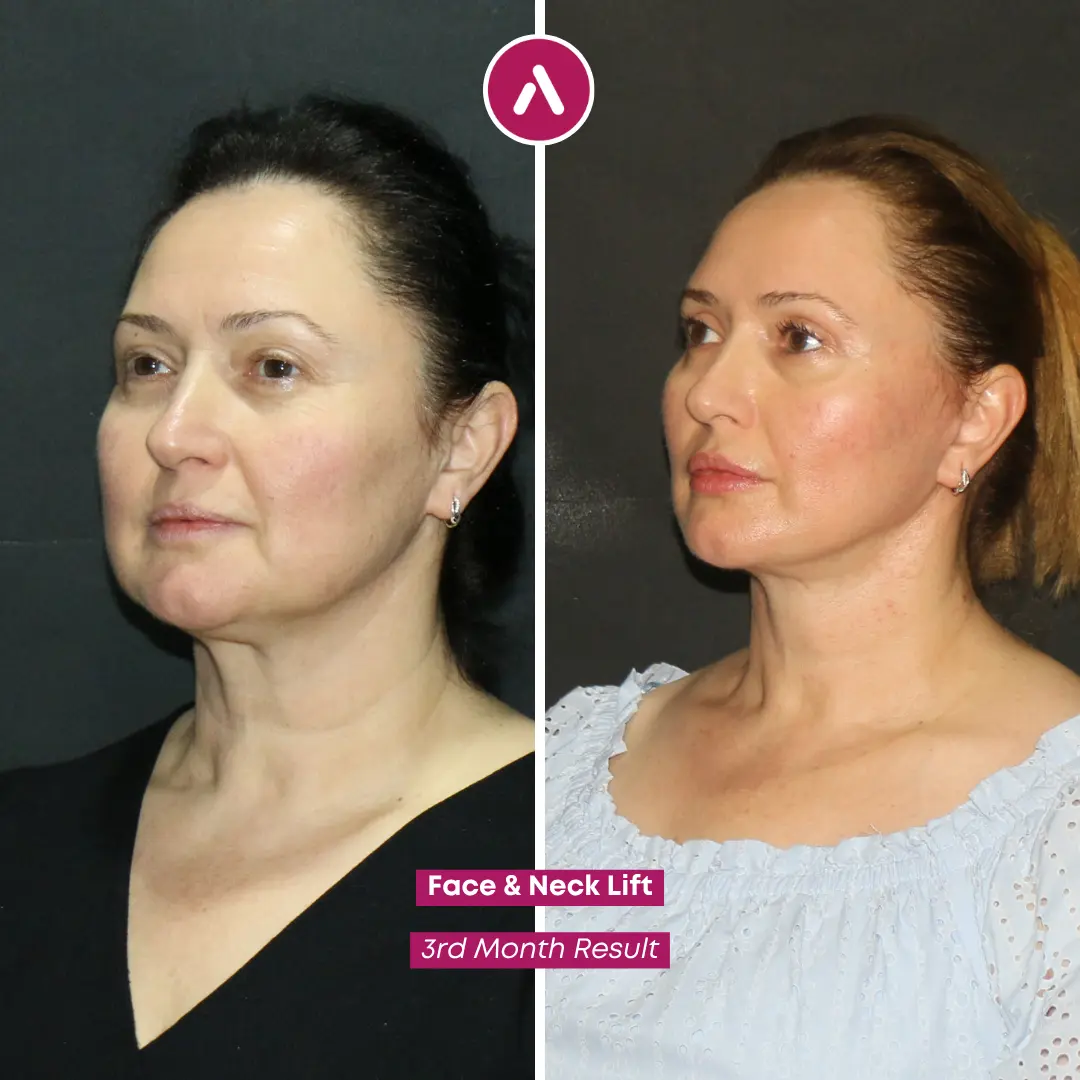
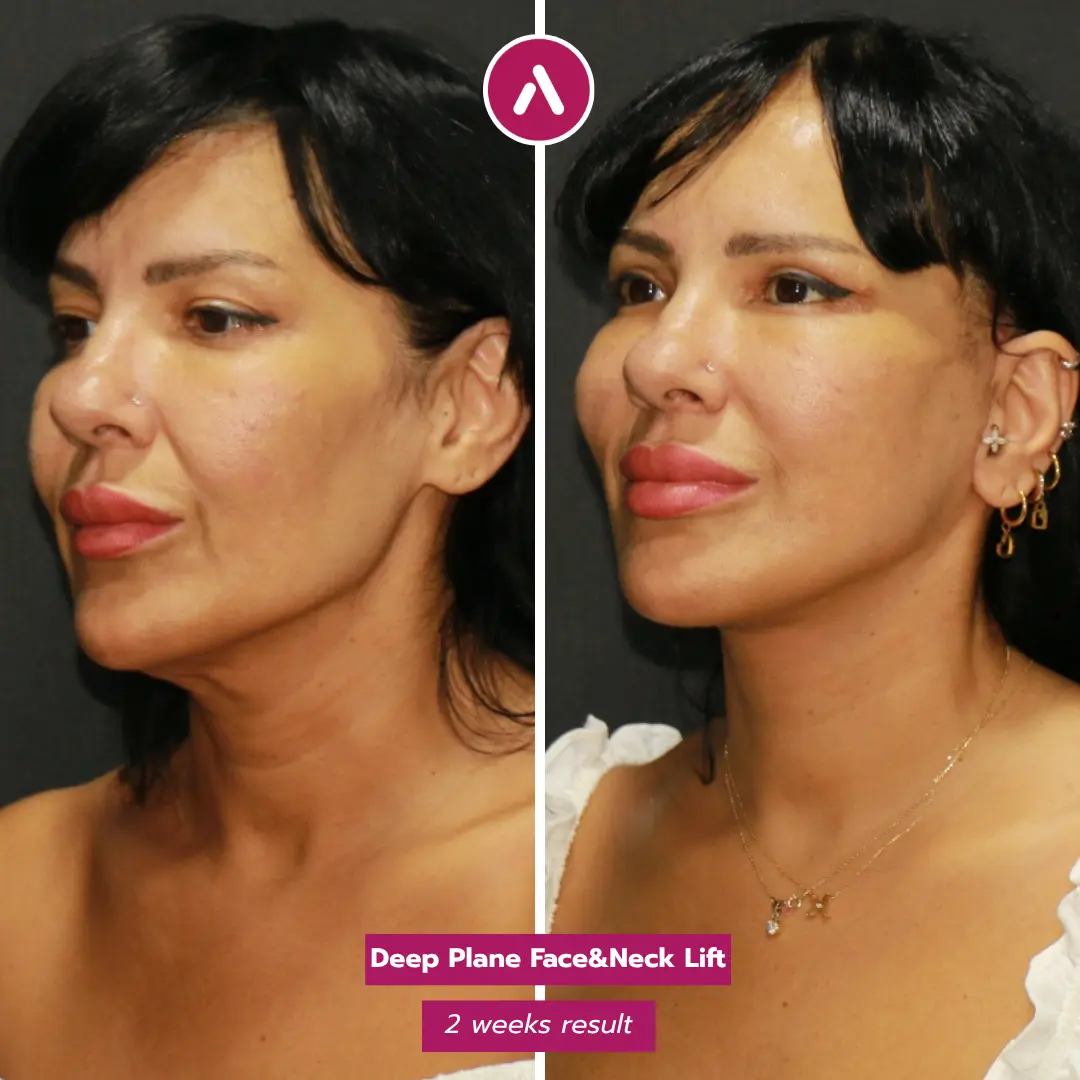
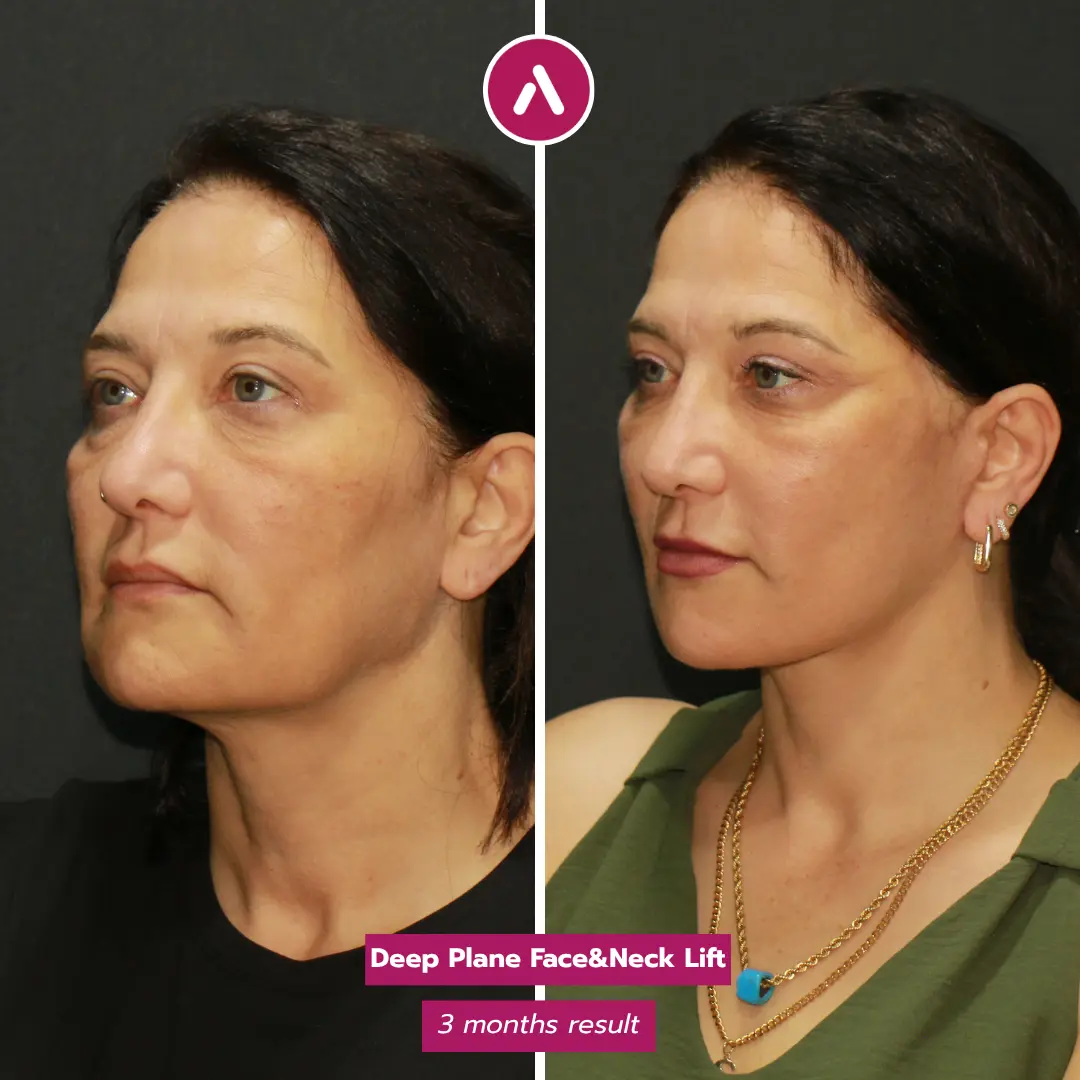
Canadian patients considering a deep plane facelift often face a difficult comparison: private clinic quotes in Toronto, Vancouver, and Montreal can reach CAD $30,000–$45,000 before anesthesia, facility, and follow-up costs are fully itemized. This guide explains how the deep plane technique works, why it differs from SMAS and skin-only facelift methods, and how our Istanbul programme is structured for patients travelling from Canada. We focus on the questions Canadian patients ask before making an informed decision: safety, surgeon credentials, recovery, cost, and fit-to-fly planning.
Table of Contents
What Is a Deep Plane Facelift?
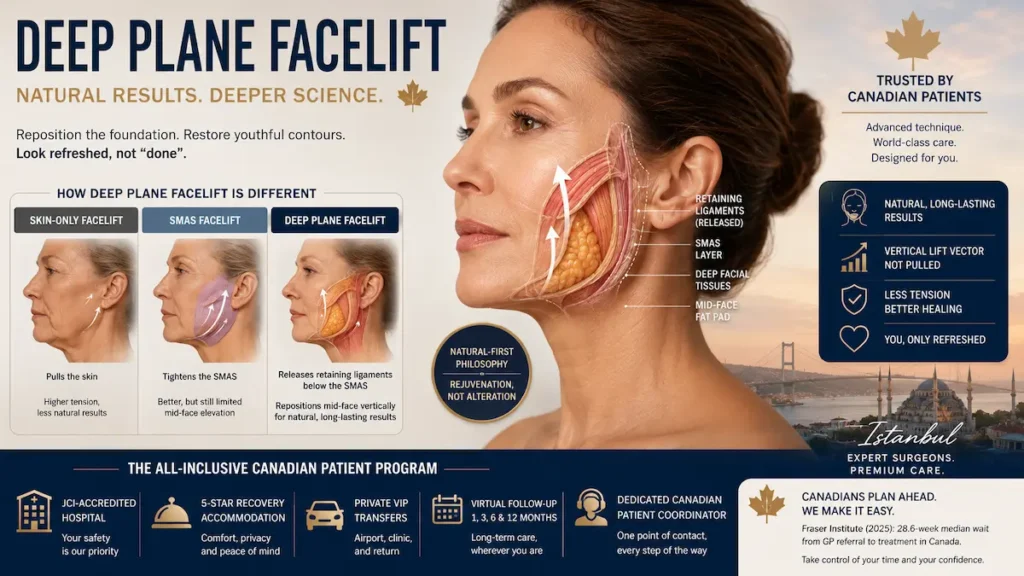
A deep plane facelift is an advanced facial rejuvenation technique that releases retaining ligaments beneath the SMAS layer, allowing the surgeon to reposition mid-face tissues in a vertical lift vector. This restores youthful contours without the tight or “pulled” appearance associated with older skin-only facelift methods.
In practical terms, deep plane facelift surgery works below the surface skin. Instead of stretching the skin to create lift, our European Board-Certified Surgeons reposition the deeper facial support system that has descended with age. This distinction matters for Canadian patients who want visible rejuvenation without looking as though they have had surgery.
The Canadian Society of Plastic Surgeons describes modern facelift surgery as repositioning the mid-face and lifting the sagging cheek fat pad together with underlying muscles. That principle aligns with our Natural-First philosophy: rejuvenation, not alteration. We aim to restore the face’s original balance rather than impose a different identity.
The medical definition: releasing retaining ligaments beneath the SMAS layer
The SMAS layer, or superficial musculoaponeurotic system, is the fibrous support layer that connects facial muscles, fat compartments, and skin. In a deep plane facelift, we work beneath this layer and release selected retaining ligaments that tether descended tissues in place. Once these ligaments are released, the cheek, jawline, and lower face can be lifted as a more unified structure.
This is why deep plane facelift natural results often look softer than older facelift styles. The skin is not forced to carry the lift. The deeper tissues do the structural work, and the skin is closed with less surface tension.
For patients comparing techniques before booking, this anatomy is central. A true deep plane facelift is not simply a tighter SMAS facelift under a new name. It is a deeper release pattern that allows mid-face repositioning in a more vertical direction.
How a deep plane facelift differs from skin-only and SMAS approaches
Older skin-only facelifts relied mainly on pulling and trimming excess skin. They could improve looseness, but they often placed too much tension on the incision lines and did not fully correct deeper cheek descent or jowling. This is the source of the “wind-swept” look many Canadian patients want to avoid.
A SMAS facelift improves on that method by tightening or repositioning the SMAS layer. For many patients, it remains a valid option. The difference is that deep plane surgery goes beneath the SMAS and releases the retaining ligaments, which can create a more natural vertical lift vector.
Patients comparing SMAS vs deep plane facelift often ask which technique is “better.” The honest answer is that anatomy decides. Deep plane is usually preferred when mid-face descent, jowls, and lower-face heaviness need structural correction rather than skin tightening alone.
Why Canadian patients search “deep plane facelift turkey”
Canadian patients usually begin locally. They compare facelift options in Toronto, Vancouver, Montreal, Calgary, or Ottawa, then discover two realities: deep plane expertise is limited to a smaller group of surgeons, and private clinic pricing can be difficult to predict once anesthesia, facility, and follow-up costs are added.
Canada’s broader health care environment also shapes patient expectations. The Fraser Institute reported a 28.6-week median wait from general practitioner referral to treatment in 2025 for medically necessary care. Although cosmetic facelift surgery is private-pay and not handled like medically necessary care, Canadian patients are already used to planning around access, timing, and specialist availability.
Our programme in Istanbul is designed for that informed Canadian patient. It combines surgeon-led planning, JCI-accredited hospital care, 5-star recovery accommodation, private VIP transfers, and long-term virtual follow-up at 1, 3, 6, and 12 months. For a full overview of the broader category, see our facelift in Turkey guide for Canadian patients.
Benefits of a Deep Plane Facelift
The main benefit of a deep plane facelift is structural rejuvenation. Rather than tightening the surface skin, we reposition the deeper facial support system that has shifted with age. This approach can improve jowls, cheek descent, jawline softness, and lower-face heaviness in one operation. The result should look rested, not re-shaped.
For Canadian patients, the appeal is often practical as much as aesthetic. A deep plane facelift can provide a longer-lasting correction than less extensive approaches, which may reduce the need for repeat surgery. It also suits patients who want a natural result that fits professional and social settings in Canada, where subtlety is often preferred over obvious cosmetic change.
Vertical lift vector: restoring youthful jawline and mid-face contour
Facial ageing is not purely a skin problem. Over time, the cheek fat pads descend, the jawline loses definition, and folds around the mouth deepen. A deep plane facelift addresses this by lifting the deeper tissue layer in a more vertical direction, rather than pulling the face sideways.
This vertical lift vector is especially valuable for patients with mid-face repositioning needs. It can restore cheek support, soften the nasolabial region, and improve early jowl formation without creating an artificial tightness around the mouth. For many patients, this is the difference between looking “done” and looking quietly refreshed.
Tension-free closure and flatter scar behaviour
Deep plane surgery allows the deeper tissues to carry the lift. The skin is then re-draped more gently over the corrected structure. This can reduce tension along the incision lines around the ear and temporal hairline.
Lower skin tension matters for scar behaviour. Scars can still be visible during early healing, and every patient heals differently, but tension-free closure helps reduce the risk of widened or pulled-looking scars. In our planning, we place incisions within natural creases and hairline transitions wherever anatomy allows.
Canadian patients often ask what scars look like at one week. At that stage, they are usually pink or slightly raised, with swelling still present. A detailed visual timeline is covered in our deep plane facelift recovery day-by-day photos guide.
10–15 year longevity advantage
Our deep plane facelift technique is designed for long-term structural improvement. Because the lift is placed in the deeper support layer rather than the skin, results typically last 10–15 years. Ageing continues, but the face usually ages from a more supported baseline.
This longevity is one reason Canadian patients compare deep plane facelift cost turkey against domestic quotes rather than looking only at the initial fee. The more useful question is cost per year of visible benefit. A technique that lasts longer may represent stronger value than a shorter-lived lift that requires revision sooner.
For a deeper discussion of longevity, including how skin quality, smoking, weight changes, and sun exposure affect outcomes, see our guide on how long a deep plane facelift lasts.
Natural movement preservation without a wind-swept appearance
A successful facelift should still move like your face. Smiling, speaking, and turning your head should not reveal an obvious surgical pattern. Deep plane technique supports this goal because the lift follows the deeper anatomy rather than relying on skin tension.
Our Natural-First approach is simple: rejuvenation, not alteration. We do not pursue the “pulled,” “wind-swept,” or “operated-on” aesthetic. For examples of this philosophy in practice, our deep plane facelift natural results feature explains what subtle, identity-preserving outcomes look like.
Am I a Good Candidate for a Deep Plane Facelift?
A good candidate for a deep plane facelift has visible descent in the mid-face, jawline, or lower face, but still has enough skin quality to heal predictably. The procedure is usually best suited to patients who want meaningful correction rather than small surface tightening. Medical fitness matters as much as facial anatomy. Before travelling from Canada, we encourage patients to speak with their family physician and share relevant health history during their virtual consultation.
Why the 40s can be an optimal age window
Many patients searching deep plane facelift 40s are not looking for a dramatic transformation. They are noticing early jowls, cheek descent, and loss of jawline clarity that non-surgical treatments no longer correct. In this age range, the skin often still has enough elasticity to re-drape smoothly after deeper tissue repositioning.
That said, age alone does not decide candidacy. A 48-year-old with strong tissue descent may benefit more than a 58-year-old with mild laxity. During assessment, we look at facial structure, ligament laxity, skin thickness, previous fillers, smoking history, and recovery goals.
Skin laxity markers and ligament integrity
Deep plane facelift is most useful when the deeper support system has descended. Common signs include heaviness around the nasolabial folds, early marionette lines, jowls, and loss of cheek projection. These signs suggest that surface treatments may not be enough.
We also assess whether the patient’s tissue can safely tolerate deep release. Patients with very thin skin, heavy smoking history, uncontrolled diabetes, or poor wound healing may require a modified plan. A tailored clinical protocol is safer than forcing every patient into the same technique.
Health prerequisites before travelling from Canada
International surgery requires careful screening. We review BMI, blood pressure, cardiovascular history, medications, smoking status, clotting history, and previous anesthesia reactions. Patients may be asked to complete blood work or receive clearance before travel.
Canadian patients should also consider timing. You need enough recovery time before flying home, and you should avoid booking surgery immediately before major work deadlines or family responsibilities. A safe result depends on the surgery and the recovery environment.
When a deep plane facelift is not recommended
Deep plane facelift may not be appropriate for patients with very mild ageing, active smoking, unstable medical conditions, or unrealistic expectations. It is also not the best answer for patients whose main concern is skin texture alone. In those cases, laser resurfacing, fat transfer, eyelid surgery, or a less extensive facelift may be more suitable.
We would rather decline or modify a case than recommend surgery that does not fit the patient’s anatomy. That honesty is part of our safety culture. The right operation is the one that matches your face, your health, and your recovery capacity.
Deep Plane Facelift Techniques Compared: Standard vs Extended vs Mini
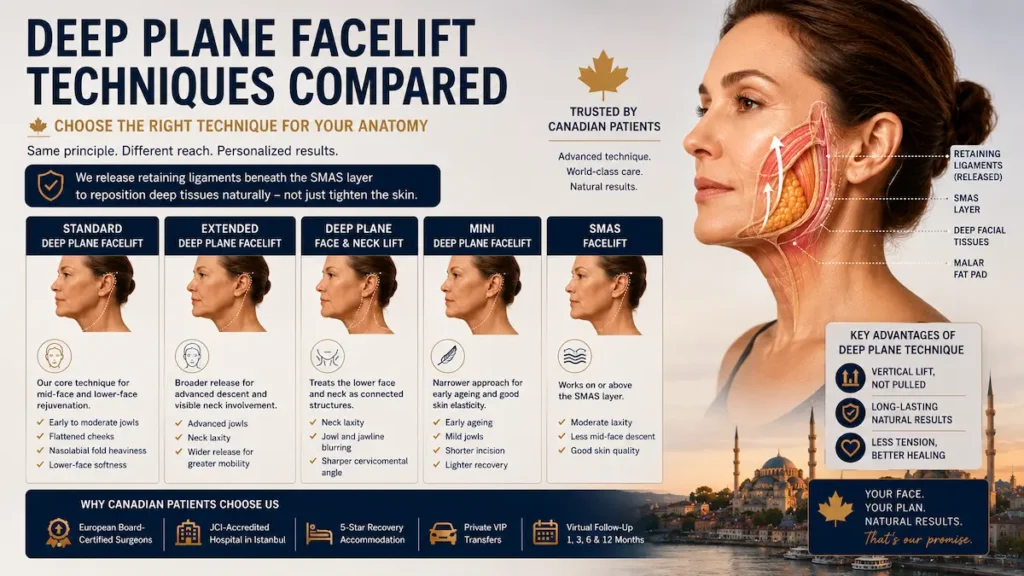
Deep plane facelift is not one fixed operation. It is a surgical family built around the same principle: releasing key retaining ligaments beneath the SMAS layer so descended tissues can be repositioned with less skin tension. The exact version we recommend depends on your ageing pattern, neck involvement, skin quality, and recovery goals.
Canadian patients often compare deep plane vs SMAS facelift, mini facelift, ponytail facelift, and traditional facelift before booking a consultation. That research is useful. The key is to match the technique to your anatomy, not to choose the most popular name on social media.
Peer-reviewed surgical descriptions of extended deep plane technique emphasize the release of key facial and neck retaining ligaments before repositioning the deeper tissue complex. That is the technical foundation behind our approach at AKM Clinic. We explain the options below so you can understand what each version can and cannot do.
Standard deep plane facelift
The standard deep plane facelift is our core structural technique for patients with mid-face descent, early jowls, and lower-face laxity. It works beneath the SMAS layer and releases selected retaining ligaments so the cheek and lower face can be repositioned in a natural direction. This is the version most Canadian patients mean when they ask about a deep plane facelift turkey programme.
At AKM Clinic, the Standard Deep Plane technique is listed at CAD $6,800 in our treatment pricing reference. It is best suited to patients who need meaningful lower-face and mid-face improvement but do not require a full extended neck release.
This option may be appropriate if your main concerns include:
- Early or moderate jowls
- Flattened cheek support
- Nasolabial fold heaviness
- Lower-face softness without severe neck banding
Extended deep plane facelift
An extended deep plane facelift carries the release farther into the lower face and neck-supporting structures. It is designed for patients with more advanced facial descent, heavier jowling, or visible neck involvement. The release pattern is broader, so the surgeon has more mobility to reposition the deep tissue complex.
Our Extended Deep Plane Facelift is listed at CAD $8,200. The higher fee reflects the wider dissection, longer operating time, and greater technical complexity. This is not automatically “better” for every patient. It is better only when the anatomy requires it.
We consider this option when the face and neck age together. If the cheek is lifted but the neck remains loose, the result can look incomplete. Extended deep plane planning helps avoid that mismatch.
Deep plane face and neck lift
A deep plane face and neck lift focuses on continuity. It treats the lower face and neck as connected structures rather than separate zones. This matters because jowls, platysmal laxity, and jawline blurring often develop together.
Our Deep Plane Face & Neck Lift is listed at CAD $7,500. For patients with visible neck laxity, a deep plane neck lift can sharpen the cervicomental angle and improve the transition from chin to neck. The goal is a cleaner jawline without an obvious pulled effect.
Patients with strong vertical neck bands may also need platysmaplasty. We assess this during consultation by reviewing front, side, and oblique photos, then confirming the plan in person in Istanbul.
Mini deep plane facelift
A mini deep plane facelift is a narrower operation. It may suit patients with early ageing, limited jowling, and good skin elasticity. The incision pattern is usually shorter, and the recovery may be lighter than a full deep plane operation.
The limitation is reach. A mini deep plane facelift cannot correct advanced neck laxity, severe jowls, or heavy mid-face descent in the same way a full or extended approach can. We avoid recommending a smaller operation if it would leave the patient under-corrected.
Some Canadian patients request a mini option because they want discretion or a shorter recovery. That is reasonable. The safer question is whether the mini technique can achieve the result you expect. If not, a more complete plan is usually more honest.
SMAS vs deep plane facelift
A SMAS facelift tightens, folds, or repositions the SMAS layer. A deep plane facelift works below that layer and releases key retaining ligaments. Both can be effective. They are not interchangeable.
SMAS techniques can work well for patients with moderate lower-face laxity and less mid-face descent. Deep plane technique is often stronger when cheek descent, jowling, and deeper ligament restriction are the main concerns. For a detailed comparison, see our SMAS vs Deep Plane Facelift guide for Canadian patients.
We also offer a dedicated SMAS facelift in Turkey page for patients whose anatomy fits that technique better. The right choice is not about trend. It is about tissue behaviour, safety, and long-term facial harmony.
Deep plane facelift vs traditional facelift
A traditional facelift often describes older methods that tighten the skin and, in some cases, the superficial support layer. These techniques can still improve laxity, but they may not fully correct deeper cheek descent or ligament-related heaviness. The risk is a result that looks tighter rather than younger.
A deep plane facelift vs traditional facelift comparison starts with the plane of surgery. Deep plane technique works beneath the SMAS layer and releases the retaining ligaments that limit tissue movement. This allows the surgeon to lift the cheek and lower face as a more mobile structural unit.
Medical summaries of deep plane technique describe a composite flap raised beneath the SMAS, with release of key facial retaining ligaments and repositioning of malar fat pads. This is the anatomy behind the softer result patients often associate with the method. You can review the surgical background in the NCBI Bookshelf deep plane facelift summary.
Ponytail facelift vs deep plane facelift
The ponytail facelift is often marketed as a discreet, vertical-lift option with smaller incisions. Some versions use endoscopic access and hairline-based incisions. It may suit selected younger patients with early upper-face or mid-face laxity.
The limitation is scope. A ponytail facelift vs deep plane facelift comparison is not simply about scar length. The question is whether the technique can correct jowls, lower-face descent, and neck laxity with enough structural support.
For patients with meaningful jawline blurring or mid-face descent, a deep plane facelift usually provides more direct access to the ligament release needed for long-term correction. For patients with early laxity and minimal neck involvement, less extensive approaches may be reasonable. We decide this during consultation after reviewing your face from the front, side, and oblique views.
Comparison table: technique, scarring, longevity, candidate, and CAD price
The table below summarizes how we frame technique selection during consultation. Prices reflect AKM Clinic’s treatment-level pricing references and are shown in CAD first for Canadian patients.
| Technique | Best suited for | Main correction | Scar profile | Typical longevity | AKM pricing |
|---|---|---|---|---|---|
| Standard Deep Plane Facelift | Moderate mid-face descent and early jowls | Cheek support, jawline, lower face | Hidden around ear and hairline transitions | 10–15 years | CAD $6,800 |
| Extended Deep Plane Facelift | More advanced facial and neck ageing | Lower face, mid-face, and extended neck support | Similar pattern, wider internal release | 10–15 years | CAD $8,200 |
| Deep Plane Face & Neck Lift | Jawline blurring with neck laxity | Face-neck continuity and cervicomental angle | Around ear with neck-focused planning | 10–15 years | CAD $7,500 |
| Mini Deep Plane Facelift | Early laxity and limited jowling | Smaller lower-face correction | Shorter incision pattern in selected patients | Varies by skin quality and ageing pattern | Quoted after assessment |
| SMAS Facelift | Moderate lower-face laxity with less mid-face descent | SMAS tightening or repositioning | Traditional facelift incision pattern | Often shorter than deep plane in heavy descent cases | See SMAS pricing |
This comparison is a starting point, not a surgical prescription. We may recommend a mini facelift in Turkey, SMAS facelift, standard deep plane, or extended deep plane depending on tissue behaviour. The most natural result comes from choosing the technique your anatomy actually needs.
Combined Procedures: One Trip from Canada
Many Canadian patients choose a deep plane facelift as the central procedure in a broader facial rejuvenation plan. This does not mean every patient needs multiple surgeries. It means we assess the face as a whole: cheeks, jawline, neck, eyelids, temples, skin quality, and facial balance.
Combining procedures can reduce duplicate anesthesia exposure, duplicate recovery time, and duplicate international travel. It can also create a more balanced result. A lifted lower face may look incomplete if heavy eyelids, neck laxity, or skin texture concerns remain untreated.
Deep plane facelift + neck lift
The most common combination is deep plane facelift with neck lift. This pairing is useful when jowls, jawline blurring, and neck laxity appear together. Treating only the face can leave the neck looking older than the jawline.
Our deep plane facelift + neck lift planning focuses on continuity. The goal is a cleaner lower-face transition, not a sharp or artificial neck angle. For selected patients, platysmaplasty may be included to address visible vertical neck bands.
Canadian patients who want a more complete lower-face correction often consider the Deep Plane Facelift, Neck Lift, and Eyelid Surgery all-inclusive pathway, especially when eyelid heaviness is also present.
Deep plane facelift + lower eyelid surgery
Lower eyelid surgery can support deep plane results by improving under-eye bags, puffiness, and tired-looking lower lids. The deep plane facelift lifts the cheek and lower face. Lower blepharoplasty refines the transition between the eyelid and cheek.
This combination is often recommended when a patient’s lower face improves on simulation, but the eyes still make the face appear tired. It can be subtle. The purpose is not to change the eyes, but to restore a rested expression.
Our package reference lists Deep Plane Facelift + Lower Eyelid Surgery at CAD $7,900, with a 4-night hotel stay. Final candidacy depends on eyelid tone, skin thickness, and whether fat repositioning is needed.
Deep plane facelift + upper and lower eyelid surgery
Some patients have both upper eyelid hooding and lower eyelid puffiness. In those cases, combining upper and lower blepharoplasty with a deep plane facelift may create a more complete facial refresh. It can also prevent a mismatch where the lower face looks rejuvenated while the eyelids still look heavy.
Our Deep Plane Facelift + Neck Lift + Upper and Lower Eyelid package is listed at CAD $9,150, including 4 nights. This is a strong option for patients who want one anesthesia event and one recovery period.
We remain conservative around the eyes. Over-resection can hollow the face and make the result look older. Our preference is structural support, careful fat management, and natural eyelid contour.
Deep plane facelift + temporal lift
A temporal lift can improve outer brow descent and upper-face heaviness. It does not replace a deep plane facelift. It complements it when the outer brow and temple region contribute to a tired or downward facial expression.
The Deep Plane Facelift + Temporal Lift package is listed at CAD $8,600. For patients who also need neck correction, the Deep Plane Face, Neck, and Temporal Lift pathway is listed at CAD $9,550.
This pairing is most useful when the upper and lower face have aged together. If the brow position is already balanced, adding a temporal lift may not be necessary.
Deep plane facelift + fractional laser
A deep plane facelift repositions structure. It does not erase sun damage, fine surface lines, or pigmentation. Fractional laser can improve skin texture while the facelift improves facial support.
This combination is particularly relevant for Canadian patients with years of UV exposure, outdoor sports history, or uneven skin texture. The Deep Plane Facelift + Fractional Laser package is listed at CAD $7,350. The Deep Plane Facelift + Neck Lift + Fractional Laser package is listed at CAD $7,900.
We do not recommend aggressive resurfacing for every patient. Skin type, pigmentation risk, healing history, and travel timeline all matter.
Mommy makeover + deep plane facelift
Some patients want facial rejuvenation and body restoration in one carefully planned trip. Our Mommy Makeover + Deep Plane Facelift pathway is listed at CAD $13,600, with a 4-night hotel stay.
This is not appropriate for everyone. Combined surgery increases recovery load and requires strict medical screening. We consider anesthesia time, hemoglobin levels, cardiovascular fitness, BMI, and the patient’s support system at home in Canada.
For patients who are good candidates, this can reduce repeated long-haul travel and create one organized recovery window. For others, staging procedures is safer. We explain both options during consultation.
Anesthesia: General, Twilight, or Awake Deep Plane?
Anesthesia planning is part of surgical safety, not a secondary detail. For deep plane facelift patients travelling from Canada, we consider procedure length, medical history, anxiety profile, airway safety, medication use, and post-operative flight timing. The Canadian Anesthesiologists’ Society notes that before surgery, the anesthesiologist reviews medical history, recent tests, the anesthesia process, and patient questions.
At AKM Clinic, our anesthesia plan is tailored to the patient rather than selected from a fixed menu. Some patients are best suited to twilight sedation. Others need general anesthesia for comfort, airway protection, or procedural scope. A smaller group may qualify for the awake deep plane pathway.
Why twilight sedation is typically recommended
Twilight sedation combines intravenous sedative medication with local anesthetic placed into the surgical field. The goal is comfort, stability, and controlled recovery. Patients are deeply relaxed, but the anesthesia profile can be lighter than full general anesthesia in selected cases.
For many standard deep plane patients, twilight sedation offers a balanced approach. It supports a calm surgical experience while avoiding unnecessary depth of anesthesia. It can also reduce post-operative grogginess compared with full general anesthesia, although every patient responds differently.
We decide this after reviewing your medical history, medications, prior anesthesia experiences, and procedure plan. A face-only standard deep plane may be suitable for twilight sedation. A broader combined operation may require a different approach.
When general anesthesia may be appropriate
General anesthesia may be recommended when the operation is longer, more complex, or combined with other procedures. It may also be safer for patients who are very anxious, have difficulty lying still, or require a broader neck release. Comfort and airway control matter.
Canadian patients sometimes ask whether avoiding general anesthesia is always safer. The answer is no. The safest option is the one that matches your anatomy, health profile, and surgical plan. A carefully monitored general anesthetic can be safer than forcing a patient into a lighter anesthesia model that does not fit the procedure.
We follow structured pre-operative assessment, intra-operative monitoring, and recovery-room observation. Our goal is predictable anesthesia, stable surgery, and clear discharge criteria before you return to your hotel or hospital room.
The awake deep plane alternative
Awake deep plane facelift is available for a narrower group of patients. It uses local anesthesia with light IV sedation rather than full general anesthesia. The surgical technique remains deep plane, but the patient selection criteria are stricter.
This option may suit patients who have strong reasons to avoid general anesthesia and who can tolerate the experience calmly. It is not ideal for patients with high anxiety, panic history, or a surgical plan requiring extensive combined procedures.
Because the awake pathway has its own candidacy rules, recovery pattern, and anesthesia logic, we cover it separately. For that focused discussion, see our Awake Deep Plane Facelift in Turkey guide. For a broader comparison of anesthesia options, our Local vs General Anesthesia for Facelift article explains the decision framework Canadian patients often use before consultation.
Step-by-Step: What Happens During Deep Plane Facelift Surgery?
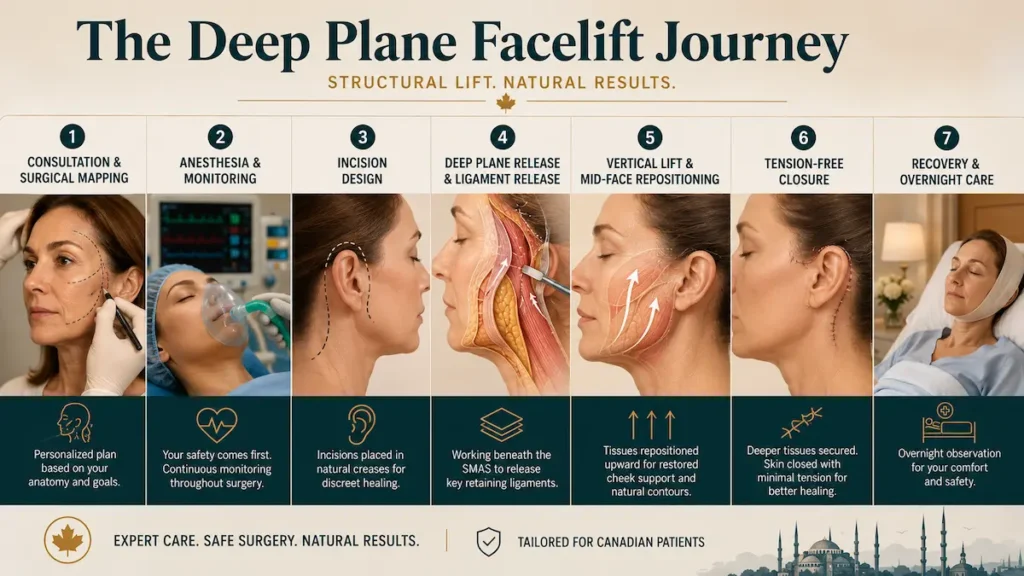
Deep plane facelift surgery follows a structured sequence, but the plan is never copied from one patient to another. Before surgery, we map the cheek position, jawline, neck contour, incision placement, and degree of ligament release needed. This planning is especially important for Canadian patients who have already compared several techniques and want to understand what will happen in the operating theatre. The goal is predictable structural lifting with conservative skin handling.
Pre-operative consultation, surgical mapping, and anatomy review
Your surgical plan begins before you travel. During the virtual consultation, we review your photos, health history, medication list, previous facial procedures, and goals. We also ask about smoking, blood thinners, prior fillers, anesthesia history, and any concerns your Canadian family physician has raised.
After you arrive in Istanbul, we repeat the assessment in person. This step matters. Photos are useful, but in-person examination lets us assess skin thickness, tissue mobility, asymmetry, scar risk, and neck involvement more accurately.
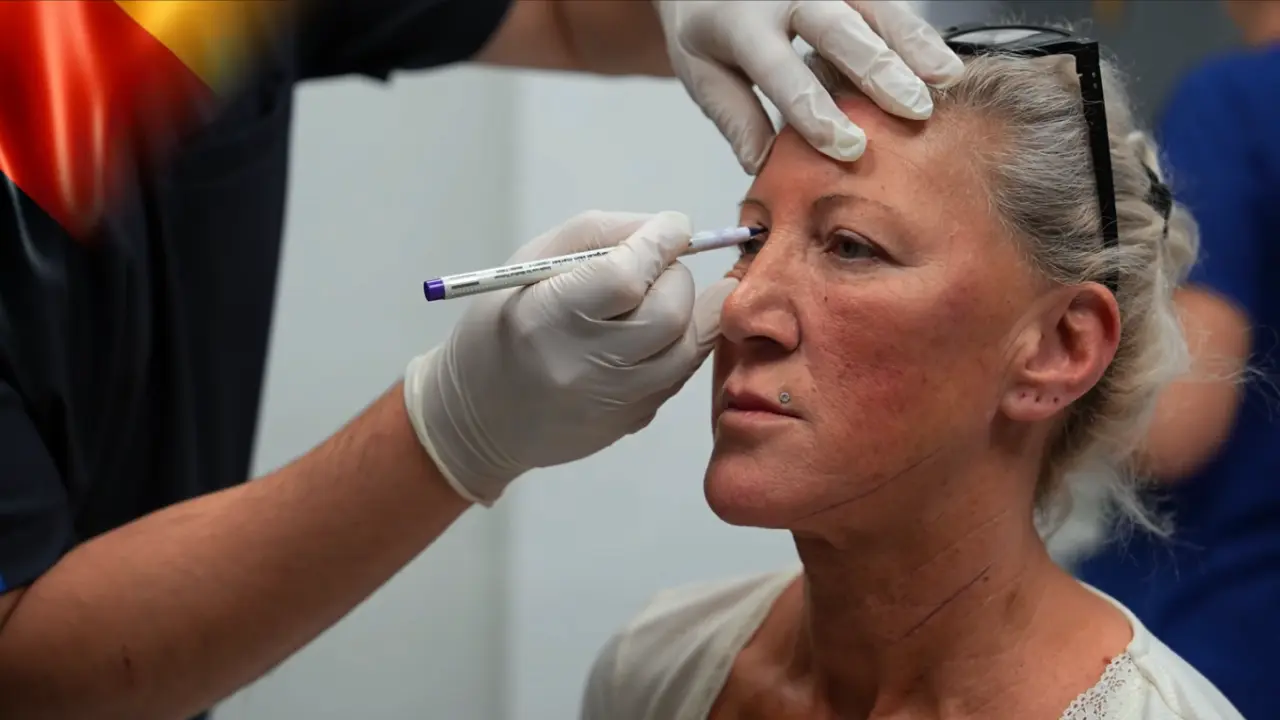
We mark the face while you are upright because gravity changes the position of the cheeks, jowls, and neck. These markings guide incision placement, vector direction, and the degree of release required during surgery.
Anesthesia administration and monitoring
Before surgery begins, the anesthesia team confirms your medical status and reviews the planned anesthesia model. Most standard deep plane facelift patients receive twilight sedation or general anesthesia depending on complexity. Monitoring continues throughout the procedure.
We track oxygenation, blood pressure, heart rhythm, temperature, and comfort level. This is part of the safety system that allows the surgeon to work carefully in the deeper facial plane. Stable anesthesia also helps reduce unnecessary movement and bleeding risk.
Canadian patients who are comparing local and international surgery should ask every clinic how anesthesia is managed, who monitors it, and what emergency protocols exist. These are practical safety questions, not formalities.
Incision design
Deep plane facelift incisions are typically placed around the ear, within natural creases, and into hairline transitions when needed. The exact pattern depends on hairline shape, sideburn position, ear anatomy, previous scars, and whether neck correction is included.
We design incisions to protect the ear shape and avoid visible tension. A well-planned incision should support healing without creating a pulled earlobe or distorted hairline. This is one reason deep plane surgery relies on deeper structural lifting rather than skin traction.
Scar planning is also individualized. Patients with thicker skin, previous keloid history, darker Fitzpatrick skin types, or prior surgery may need additional scar management planning.
SMAS dissection and retaining ligament release
The defining step is the deep release beneath the SMAS layer. In this stage, the surgeon carefully enters the deep plane and releases selected retaining ligaments that hold descended cheek and lower-face tissues in place. This creates mobility without relying on skin pull.
The release must be precise. Too little release may limit the lift. Too aggressive a release can increase risk. This is why deep plane facelift is a surgeon-dependent procedure and why portfolio review matters before booking.
The technical principle is described in medical literature as working beneath the SMAS with release of key facial retaining ligaments and repositioning of deeper facial tissues. For Canadian patients who want to understand the anatomy, the NCBI Bookshelf deep plane facelift overview provides a useful clinical summary.
Vertical lift vector and mid-face repositioning
After the release is complete, the deeper tissue complex is repositioned in a more vertical lift vector. This is different from pulling the skin backward. The aim is to restore cheek support, soften lower-face heaviness, and improve the jawline while preserving facial expression.
Mid-face repositioning is where many patients see the difference between deep plane and older facelift methods. The cheek can return to a more youthful location without excessive surface tightness. The lower face then appears cleaner because the support structure has been restored.
We adjust the vector to the individual face. A narrow face, heavy lower face, strong jawline, or short neck each requires different planning.
Tension-free SMAS suturing and skin closure
Once the deeper tissues are repositioned, they are secured internally. The skin is then re-draped over the new support position and trimmed only where needed. The skin should not carry the main lift.
This tension-free approach helps protect the incision lines. It also supports the Natural-First result our Canadian patients usually request: refreshed, rested, and recognizably themselves. Closure is performed in layers to support scar quality.
Dressings are placed at the end of the operation. Depending on the plan, small drains may be used to reduce fluid accumulation during early healing.
Immediate post-operative observation and one-night hospital stay
After surgery, you are monitored during the immediate recovery period. Our team checks bleeding, blood pressure, comfort, drain output, and early facial movement. This is a quiet but important stage of the safety process.
Standard deep plane facelift patients commonly stay one night under clinical observation. This gives us time to manage the first swelling phase, confirm stability, and prepare you for hotel-based recovery. Before discharge, we review medications, sleeping position, incision care, and warning signs.
Your coordinator remains available after you leave the hospital. For Canadian patients recovering far from home, this continuity helps reduce uncertainty during the first few days.
Deep Plane Facelift Recovery Time: Day-by-Day Timeline for Canadian Patients
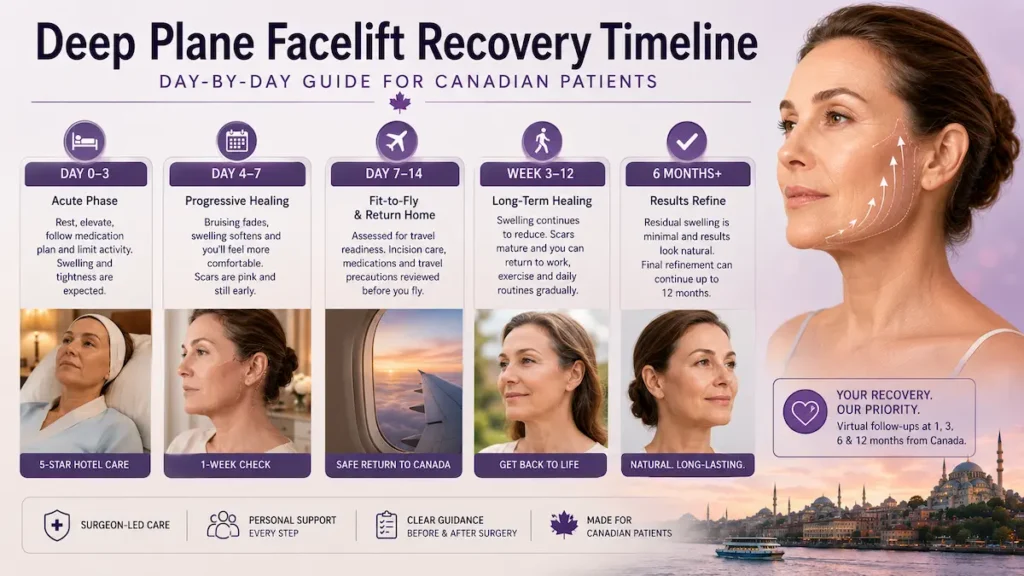
Deep plane facelift recovery time depends on surgical scope, skin quality, age, smoking status, medication use, and how closely aftercare instructions are followed. Most Canadian patients plan to stay near our clinic for the first week, then fly home only after in-person clearance. This is not a rushed process. The safest recovery plan gives swelling, bruising, incision care, and travel readiness enough time to stabilize.
Day 0–3: Acute phase at the 5-star hotel
The first 72 hours are the most important for swelling control and bleeding prevention. You will rest with your head elevated, avoid bending, follow your medication plan, and limit activity to short assisted walks. Swelling and tightness are expected during this stage.
Some patients have small drains, depending on the surgical plan. These help reduce fluid accumulation and are monitored by our clinical team. Drain removal timing varies, but we do not approve return travel until your surgeon confirms that early healing is stable.
During this phase, our patient hosts remain available for practical support. Aleyna, Emine, or Khadija may help coordinate appointments, transfer timing, medication questions, and communication with the clinical team. The goal is calm recovery, not sightseeing.
Day 4–7: Progressive resolution and one-week scar appearance
By days 4–7, bruising usually begins to change colour and swelling starts to soften. Patients often feel more comfortable walking inside the hotel and attending clinic visits. You may still feel tightness around the ears, jawline, and neck.
Canadian patients often search for 1 week post op deep plane facelift scars because they want to know what is normal before flying home. At one week, scars are usually pink, slightly raised, and hidden along the ear and hairline transitions. They are not final scars.
Scar appearance changes significantly over the following months. Redness fades, firmness softens, and incision lines flatten as collagen remodels. For a visual reference, our deep plane facelift recovery day-by-day photos guide shows how swelling and incision visibility evolve.
Our HBOT/LLLT Recovery Protocol
We utilize Hyperbaric Oxygen Therapy (HBOT) and Low-Level Laser Therapy (LLLT) to support recovery after deep plane facelift surgery. HBOT increases oxygen availability to healing tissues, which may help reduce inflammation and support tissue repair. LLLT uses 424 medical-grade semiconductor laser diodes at 650 nm to stimulate cellular ATP production without heat.
This matters for Canadian patients because the return flight is long. A 10- to 12-hour travel day can increase swelling and fatigue if the patient is not ready. Our recovery technology is designed to reduce inflammation, support incision healing, and improve comfort before fit-to-fly clearance.
HBOT and LLLT do not replace good surgery or careful aftercare. They support the healing environment. For the cellular mechanism and protocol details, see our Deep Plane Facelift Recovery with HBOT and LLLT guide and our technology and safety standards page.
Day 7–14: Fit-to-fly clearance and return journey
Most deep plane facelift patients are assessed for fit-to-fly clearance between days 7 and 10, depending on swelling, drain status, blood pressure, bruising, and overall stability. We do not recommend booking the earliest possible flight simply because the schedule looks convenient. Your face and body need time.
Before you leave Istanbul, we review incision care, medication timing, warning signs, sleeping position, and travel precautions. You receive English-language documentation that can be shared with your Canadian family physician if needed. This helps reduce uncertainty after you return home.
For the flight itself, we usually recommend hydration, gentle walking during the flight when safe, avoiding alcohol, and keeping your head elevated when possible. If you are unsure about airline timing, our guide to flying after a facelift answers common questions Canadian patients ask before booking tickets.
Week 3–12: Long-term healing
By week 3, many patients feel comfortable with light social activity, depending on bruising and swelling. Makeup may be possible once incisions are sufficiently healed and your surgeon approves. Numbness, firmness, and tightness can continue.
Weeks 6–12 are when the face begins to look more settled. The jawline becomes cleaner, cheek swelling decreases, and incision lines mature. This is also when patients usually feel more confident returning to work, events, and normal routines in Canada.
Exercise should be resumed gradually. Heavy lifting, high-intensity workouts, sauna use, and activities that raise blood pressure may need to wait until clearance. Recovery is not a race.
Six-month swelling resolution
Deep plane facelift results continue to refine for months. At 3 months, most patients look presentable and natural in daily life. At 6 months, residual swelling is usually much lower, and the jawline and mid-face support appear more defined.
Some tightness or subtle numbness may last longer. This is common after deeper facial surgery because tissue planes and small sensory nerves need time to recover. Final refinement can continue up to 12 months.
Your long-term follow-up continues after you return to Canada. Our virtual check-ins at 1, 3, 6, and 12 months allow us to monitor healing, answer questions, and guide scar care from a distance.
Safety & Risks: An Honest Discussion
Every deep plane facelift carries risk, even when performed by an experienced surgical team. Canadian patients are right to ask detailed questions before travelling for surgery. We prefer that discussion to happen early, before flights are booked, because safety depends on patient selection, surgical planning, anesthesia, facility standards, and follow-up. Our role is to explain both the benefits and the limits of the procedure clearly.
Common short-term effects
Bruising, swelling, tightness, and temporary numbness are expected after deep plane facelift surgery. These effects are usually most noticeable during the first week, then improve gradually over the following weeks. Some patients feel firmness along the jawline or around the ears as deeper tissues settle.
Temporary sensory changes can occur because small skin nerves are affected during lifting and closure. This is different from motor facial nerve injury. Sensory numbness usually improves with time, although the timeline varies by patient.
We manage early effects with head elevation, medication planning, incision checks, limited activity, and follow-up visits before travel. HBOT and LLLT may support inflammation control and tissue healing, but they do not remove the need for careful recovery behaviour.
Rare but serious complications
Less common complications include hematoma, infection, delayed wound healing, skin compromise, asymmetry, visible scarring, and facial nerve weakness. Hematoma is one of the most significant early risks after facelift surgery because blood can collect beneath the skin and create pressure. If it occurs, it may require urgent treatment.
Facial nerve injury is the complication many patients fear most. Deep plane surgery works near facial nerve branches, which is why experience and anatomical precision matter. Clinical summaries report that facial nerve injury is uncommon in deep plane facelift surgery, with permanent injury described as very rare.
Risk can never be reduced to zero. It can be reduced through careful candidate selection, blood pressure control, avoidance of smoking, medication review, meticulous dissection, and early response to warning signs.
Why facial nerve safety is the key surgeon-skill question
The face is dynamic. A successful deep plane facelift must improve structure while preserving expression. That is why facial nerve safety is central to surgeon selection.
Canadian patients should ask whether the surgeon can explain the deep plane release pattern, how they protect facial nerve branches, and how many deep plane cases they perform regularly. A vague answer is not enough. The surgeon should be able to explain the anatomy in plain language.
At AKM Clinic, we treat deep plane facelift as a specialist procedure rather than a generic facelift label. We plan the release, vector, and closure according to the patient’s anatomy. This reduces unnecessary dissection and helps preserve natural facial movement.
How we reduce risk through screening and intra-operative monitoring
Risk reduction begins before surgery. We review medical history, smoking status, blood pressure, medications, prior facial surgery, filler history, and anesthesia tolerance. Patients with uncontrolled health issues may be asked to delay surgery or obtain medical clearance before travelling.
During surgery, we operate in a JCI-accredited hospital environment with structured anesthesia monitoring and sterile protocols. We also provide English-language discharge documentation so patients can share details with their Canadian family physician after returning home.
After surgery, our team monitors swelling, bleeding, incision status, drain output when used, and overall recovery. We do not approve fit-to-fly clearance until your surgeon confirms that early healing is stable. Safety continues after you leave the operating theatre.
Is It Safe to Get a Deep Plane Facelift in Turkey? A Canadian’s Honest Look
Safety depends on the surgeon, the hospital, the anesthesia team, the recovery protocol, and the follow-up system. Turkey is not automatically safe or unsafe. The same is true of Canada. A well-run clinic with strong credentialing can deliver excellent care, while a poorly screened clinic in any country can create avoidable risk.
Canadian patients should evaluate an international surgical programme with the same rigour they would apply to a private clinic in Toronto, Vancouver, or Montreal. Ask who performs the surgery, where it takes place, how complications are managed, and what documentation you receive before flying home. We welcome those questions.
Canadian-standard safety expectations: hospital, materials, and credentialing
Our deep plane facelift procedures are performed through a JCI-accredited hospital partner. JCI accreditation is relevant for Canadian patients because it confirms that the facility follows international standards for patient safety, infection prevention, medication management, and surgical systems. It does not replace surgeon judgment, but it gives the clinical environment an external safety framework.
We use FDA-approved materials where applicable and follow structured sterilization protocols. For Canadian patients, FDA approval is not identical to Health Canada approval, but both are serious regulatory systems used to assess medical devices and materials. The broader principle is traceability, quality control, and regulated sourcing.
Credentialing also matters. In Canada, patients often look for RCPSC-certified specialists. At AKM Clinic, our surgeons hold European board-level credentials and international fellowship training that provide a comparable framework for evaluating training, continuing education, and surgical discipline.
What Government of Canada travel health guidance means for surgery abroad
The Government of Canada guidance on medical care outside Canada advises patients to consider infection risk, continuity of care, medical records, travel insurance limits, and legal differences before seeking treatment abroad. We agree with that caution. It is a responsible starting point.
Our response is not to dismiss those concerns. We build them into the patient pathway. Before surgery, we review medical history and suitability. During your stay, you receive structured clinical follow-up. Before you fly home, we provide English-language documentation that can be shared with your Canadian family physician.
Patients should also understand insurance limitations. Many Canadian travel insurance plans exclude elective cosmetic surgery and related complications. We encourage patients to review their policy in writing before travel and avoid assuming coverage applies.
Antibiotic-resistant infection prevention
Infection prevention begins with facility standards. We use sterile operating protocols, controlled surgical environments, autoclaved instruments, and post-operative wound-care instructions. Patients also receive clear guidance on showering, incision care, medication timing, and warning signs.
Antibiotic-resistant infection is a concern in global health care, including Canada. The practical question is how a clinic reduces exposure and detects problems early. We address this through pre-operative screening, sterile technique, monitored early recovery, and direct communication after discharge.
Your role matters too. Smoking, poor glucose control, touching incisions, skipping medication instructions, or flying too early can increase risk. Safe surgery is a shared process.
Coordinating follow-up with your Canadian family physician
We encourage Canadian patients to involve their family physician where possible. Your physician may not manage cosmetic surgery directly, but they can help review general health, medications, blood pressure, clotting history, and any chronic conditions before travel. This is especially helpful for patients over 45 or those with cardiovascular risk factors.
After you return to Canada, your family physician may also help assess general concerns such as fever, blood pressure, medication reactions, or wound changes. For procedure-specific questions, our surgical team remains available through scheduled virtual follow-ups.
Our long-term follow-up programme includes virtual check-ins at 1, 3, 6, and 12 months. This helps close the distance between Istanbul and Canada, especially during scar maturation and swelling resolution.
English-language discharge summaries and medical record portability
Before leaving Istanbul, you receive English-language documentation summarizing the procedure, medication plan, incision care, and follow-up instructions. This matters because Canadian clinicians need clear information if you seek assessment after returning home.
Medical record portability is one of the issues Canadian patients worry about most. We treat it as part of safe international care. Your records should not stay trapped in another language or another system.
We also document relevant details such as anesthesia type, drain use when applicable, medication instructions, and fit-to-fly clearance. Clear records reduce uncertainty if you need local support in Canada.
Travel insurance and complication planning
Travel insurance should be reviewed before you book. Some plans cover unexpected illness or injury abroad but exclude elective surgery and related complications. Do not rely on verbal assumptions. Ask for written confirmation.
We also discuss contingency planning during consultation. That includes how long you should stay, when you can fly, what warning signs require urgent contact, and what to do if symptoms appear after returning home. A safe plan includes the “what if” questions.
For clinic-selection due diligence, our Best Deep Plane Facelift Clinic in Turkey checklist explains how Canadian patients can verify facility standards, surgeon involvement, follow-up structure, and safety documentation before making a decision.
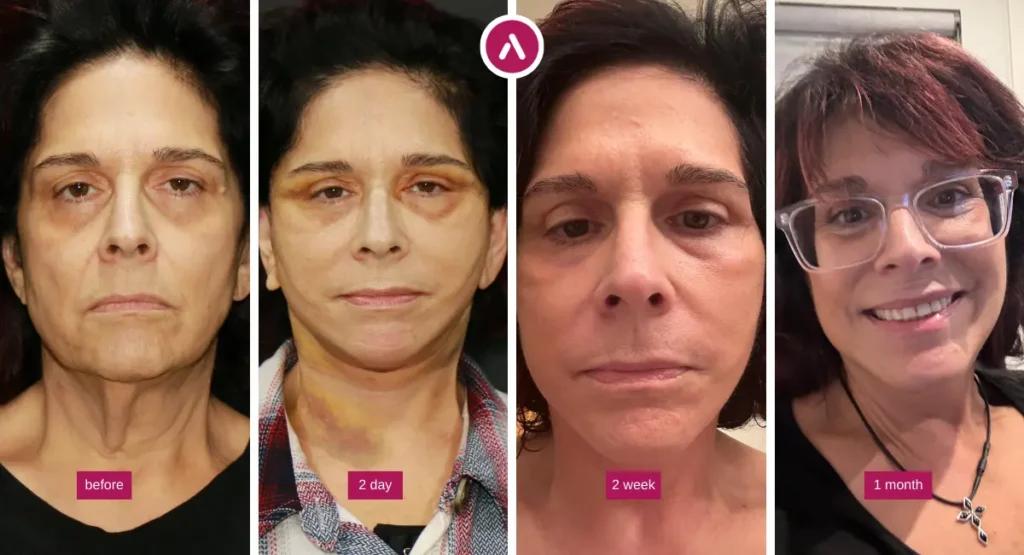
Deep Plane Facelift Before and After: Our Natural-First Philosophy
A deep plane facelift can create meaningful rejuvenation, but it should not make you look like a different person. Our philosophy is Natural-First: rejuvenation, not alteration. We aim to restore support, soften heaviness, and improve facial balance while preserving the expressions and features that make your face recognizable.
Canadian patients often tell us they want a result that looks appropriate in professional, family, and social settings. They do not want friends asking what surgery they had. They want to hear that they look rested, healthier, or more like themselves.
What deep plane facelift natural results look like
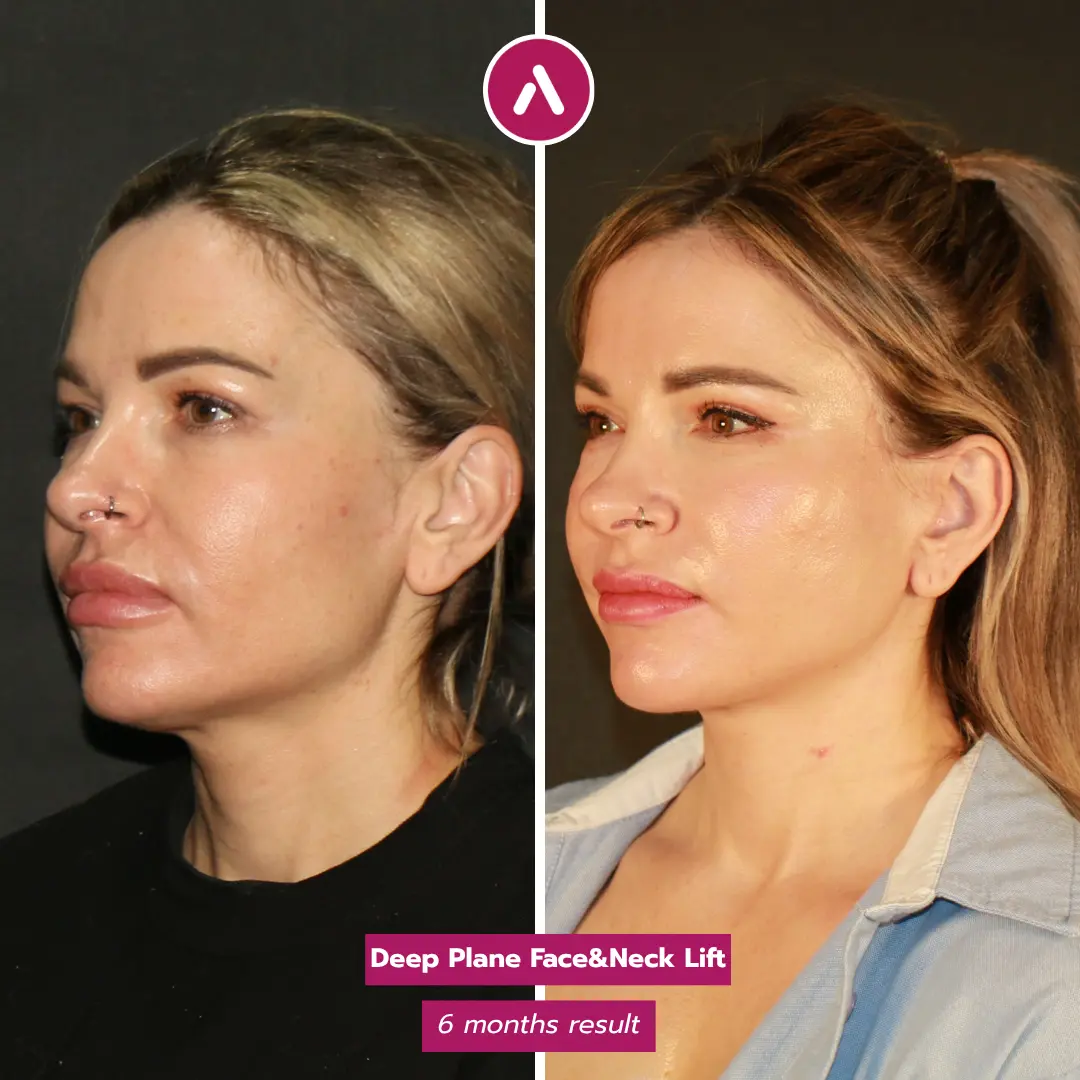
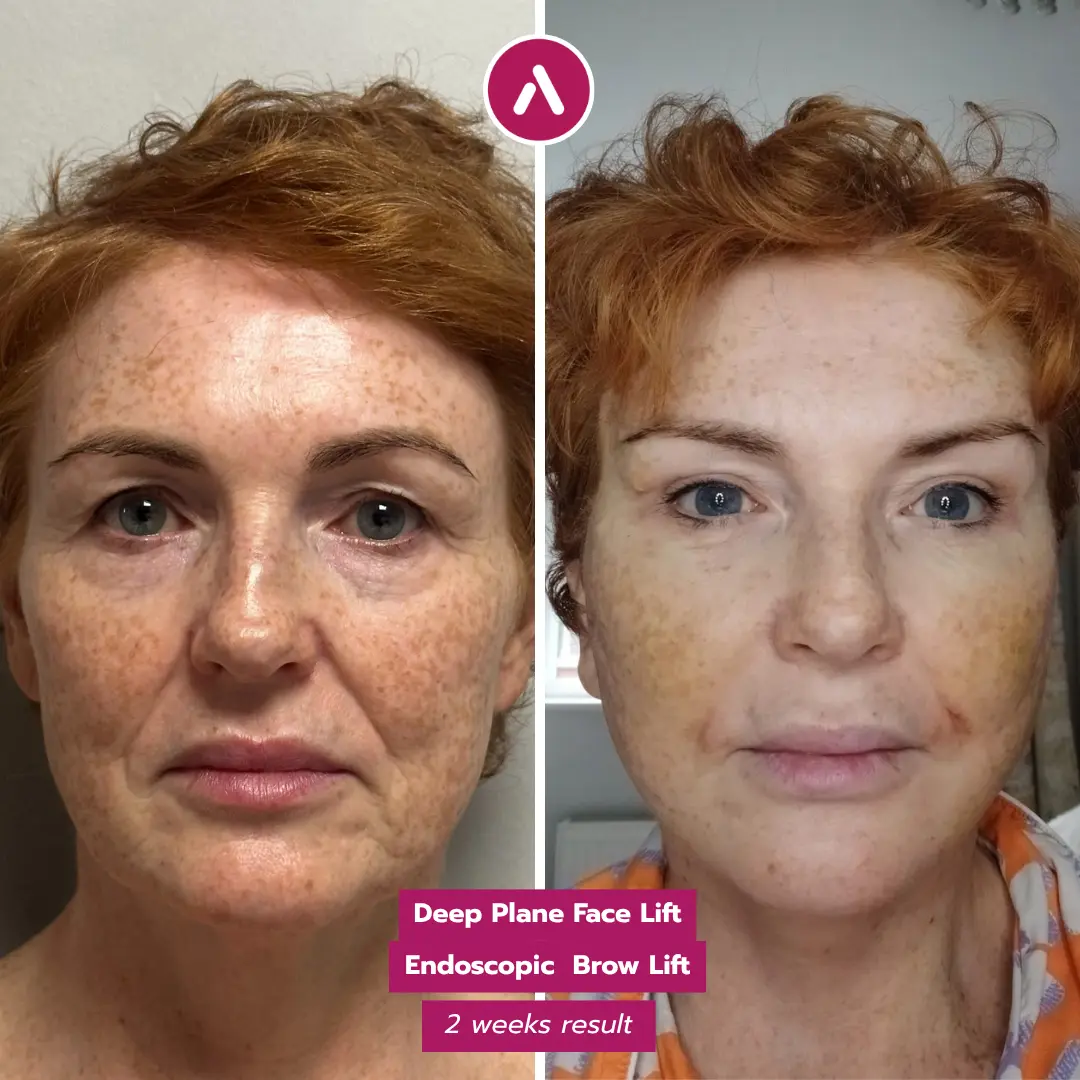
Deep plane facelift natural results come from structural correction rather than surface tension. The cheek is repositioned, the jawline becomes clearer, and the lower face looks less heavy. The skin should not appear stretched.
A natural result also respects age, bone structure, and facial proportions. A patient in their late 40s should not be planned as though they are trying to look 25. A patient in their 60s may want refinement, not an exaggerated reversal of time.
For deeper visual context, our Deep Plane Facelift Natural Results guide explains how we define subtle, identity-preserving outcomes. You can also review our deep plane facelift before and after gallery to see how results vary by age, skin quality, and starting anatomy.
The deep plane facelift transformation timeline: 3 weeks, 3 months, and 1 year
A deep plane facelift transformation does not appear all at once. At 3 weeks, swelling has improved, but the face may still feel firm or tight. Some patients look socially presentable by this stage, while others need more time before returning to photos or events.
At 3 months, the result usually looks more natural. The jawline is cleaner, the mid-face has settled, and incision visibility is lower. This is often when patients begin to feel that the result belongs to their face rather than looking like “surgery recovery.”
At 1 year, scar maturation and deep tissue settling are much more complete. This is the better milestone for judging final refinement. For a patient-style narrative, our Barbara Deep Plane Facelift Review documents how recovery and confidence can evolve over months rather than days.
Why deep plane can last 10–15 years
Canadian patients often ask: how long does a deep plane facelift last? Our answer is typically 10–15 years, depending on skin quality, genetics, weight stability, sun exposure, smoking history, and aftercare. The procedure does not stop ageing. It resets the facial support structure to a more youthful position.
The longevity advantage comes from lifting the deeper tissue system, not simply tightening the skin. Once the retaining ligaments are released and the deeper layer is repositioned, the face tends to age from a more supported baseline.
For the long-term evidence and cost-per-year logic many Canadian patients consider, see our guide to deep plane facelift longevity.
Vertical lift vector outcomes: cheek volume, jawline, and no pulled look
The vertical lift vector is one of the reasons deep plane results can look natural. Instead of pulling the face backward, we reposition tissues upward toward where they used to sit. This supports the cheek and softens the lower face without distorting the mouth or ear region.
Mid-face repositioning can restore cheek support and reduce the heaviness that contributes to nasolabial folds and jowls. The jawline often appears cleaner because the descended tissue has been lifted structurally rather than tightened from the skin surface.
No surgery can make every face perfectly symmetrical, and no ethical clinic should promise that. The goal is balanced rejuvenation, predictable healing, and a result that respects your original facial identity.
Deep Plane Facelift Cost 2026: Turkey vs Canada
Canadian patients researching deep plane facelift cost canada often discover that domestic private clinic quotes vary widely and may not include every required fee. The key comparison is not only the surgical fee. It is what the quote includes: anesthesia, hospital facility, follow-up, recovery support, and travel coordination.
At AKM Clinic, our Standard Deep Plane Facelift is listed at CAD $6,800. The Extended Deep Plane Facelift is listed at CAD $8,200 for patients who require broader lower-face and neck release. Our most requested Canadian option is the all-inclusive Deep Plane Facelift package at CAD $7,500, including 4 nights at our 5-star partner hotel.
Patients comparing deep plane facelift cost Toronto, deep plane facelift Vancouver, and deep plane facelift Montreal providers frequently see totals in the CAD $30,000–$45,000 range once anesthesia, facility, and follow-up costs are considered. This is why deep plane facelift cost Turkey searches usually focus on full pathway value, not only the operation itself.
For the full Canadian dollar breakdown, including technique-level pricing, bundled options, and a more detailed comparison of commonly missed fee categories, see our deep plane facelift cost guide for Canadian patients.
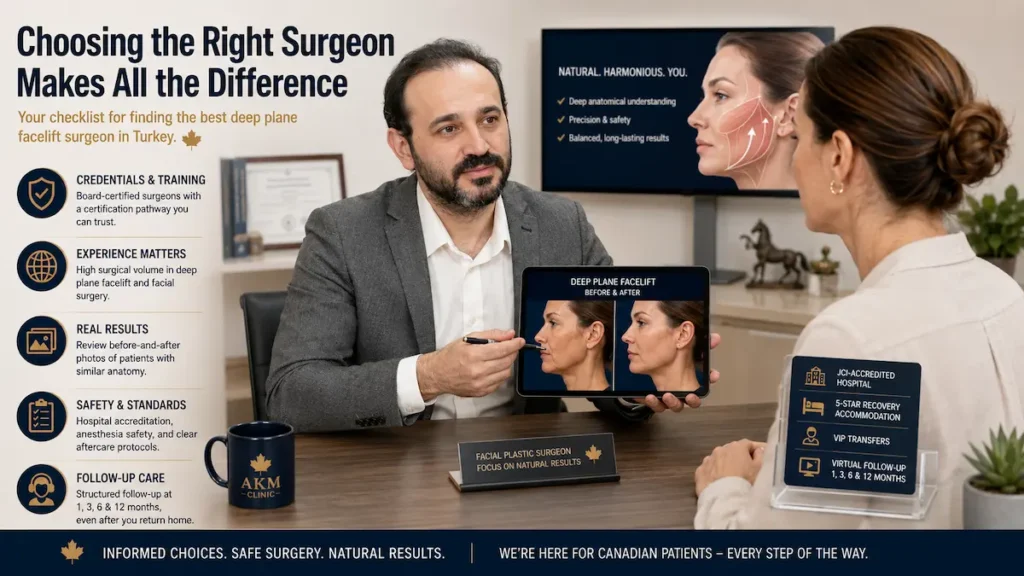
How to Find the Best Deep Plane Facelift Surgeon in Turkey: A Canadian Patient’s Checklist
Canadian patients often begin by comparing domestic options in Toronto, Vancouver, or Montreal before expanding their search internationally. Once they search for the best deep plane facelift surgeon in Turkey, the decision should not be based on price or marketing language. It should be based on training, surgical volume, hospital standards, before-and-after evidence, and follow-up structure.
Deep plane facelift is a technically demanding procedure. The surgeon must understand facial nerve anatomy, retaining ligament release, SMAS mobility, scar placement, and natural vector control. A good consultation should make these concepts clearer, not more confusing.
EBOPRAS and RCPSC-equivalency framework
In Canada, patients are familiar with the Royal College of Physicians and Surgeons of Canada (RCPSC) as the standard for specialist medical certification. When evaluating surgeons abroad, the question is not whether the credential is identical. The question is whether there is a comparable framework for board-level training, examination, specialization, and continuing education.
At AKM Clinic, our European Board-Certified Surgeons work within a credentialing structure Canadian patients can reasonably compare to RCPSC-style specialist verification. This does not mean they are licensed to practise in Canada. It means their training pathway can be assessed against the same principles Canadian patients already understand: documented specialty training, professional accountability, and procedure-specific competence.
Before booking, review surgeon qualifications through official sources where possible. The Royal College of Physicians and Surgeons of Canada provides a useful reference point for understanding how specialist certification is viewed in Canada.
ISAPS membership and continuing education
Membership in international professional societies is not a substitute for surgical skill, but it can support a broader pattern of accountability. Patients should look for ongoing participation in aesthetic surgery education, congresses, and procedure-specific training rather than one-time certificates.
Deep plane facelift technique continues to evolve. A surgeon who performs this procedure should be able to discuss modern release patterns, scar placement, nerve safety, and recovery planning in plain language. They should also be able to explain why deep plane is or is not right for your face.
Canadian patients should be cautious when a clinic uses vague claims such as “celebrity technique” or “scarless lift” without anatomical explanation. Specifics matter.
Deep plane surgical volume as a quality marker
Deep plane facelift experience matters because the procedure is anatomy-dependent. A surgeon who performs occasional facelifts may not have the same pattern recognition as a surgeon who regularly handles mid-face descent, jowls, neck laxity, revision anatomy, and complex asymmetry.
AKM Clinic has performed over 2,000 successful facial surgeries since 2013. That facial surgery volume supports our ability to evaluate different ageing patterns and recommend the right version of the procedure: standard deep plane, extended deep plane, deep plane face and neck lift, SMAS facelift, or another approach.
Surgical volume should always be paired with result quality. Ask to see before-and-after examples that match your age range, skin type, facial structure, and degree of laxity.
How to verify a surgeon’s portfolio before booking from Canada
Before travelling, request a virtual consultation and ask direct questions. Who is the surgeon of record? Will that surgeon perform the deep plane release? Where will the operation take place? What happens if a complication occurs before you fly home?
You should also ask to review deep plane facelift before and after examples from patients with similar anatomy. Look for natural jawline improvement, cheek support, balanced neck transition, preserved ear shape, and scars that do not pull the earlobe downward.
For a deeper decision framework, our Best Deep Plane Facelift Surgeon in Turkey guide walks Canadian patients through credential verification, consultation questions, and portfolio review.
Red flags in international deep plane facelift offers
Be cautious if a clinic cannot name the surgeon before payment, avoids discussing facial nerve safety, offers the same plan to every patient, or promises a dramatic result without explaining risk. These are warning signs.
Pricing that seems unusually low should also prompt questions. Deep plane facelift requires specialist surgical time, hospital resources, anesthesia support, and structured aftercare. A fee that appears far below the standard range may mean corners are being cut somewhere.
Our recommendation is simple: verify first, then decide. Review credentials through our AKM Clinic surgeon and standards overview, compare portfolio evidence, and ask every safety question before committing to travel.
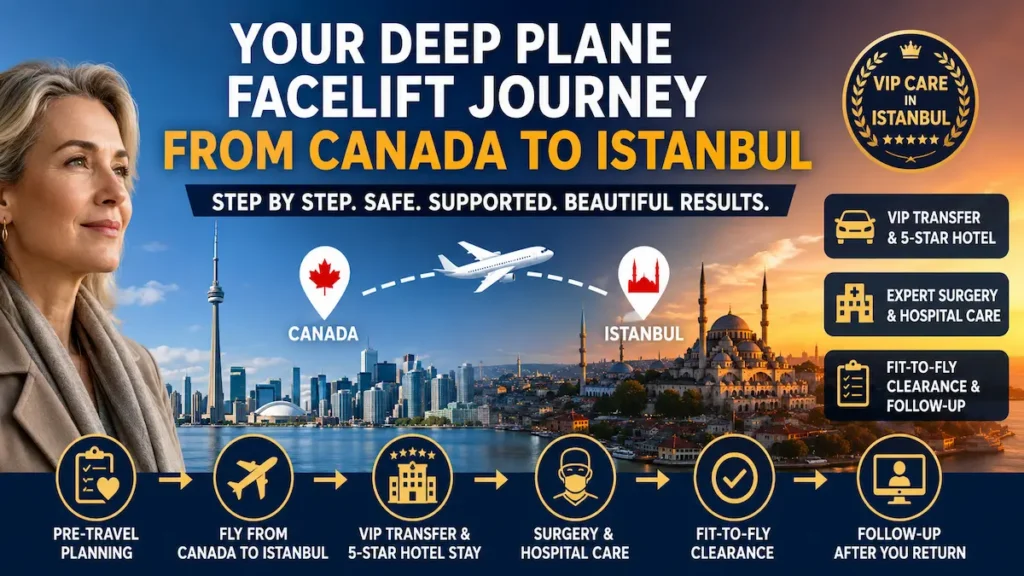
Your Deep Plane Facelift Journey from Canada: From YYZ to Istanbul, Step by Step
Planning surgery abroad requires more than choosing a date. Canadian patients need a clear sequence for flights, entry rules, hotel recovery, pre-operative testing, surgery day, fit-to-fly clearance, and follow-up after returning home. We structure this pathway so you know what happens before you leave Canada, during your stay in Istanbul, and after you land back in Toronto, Vancouver, Montreal, Calgary, or Ottawa.
Flight options from YYZ, YVR, YUL, YYC, and YOW to Istanbul
Most Canadian patients fly into Istanbul Airport (IST), usually through Toronto Pearson (YYZ), Vancouver (YVR), Montreal (YUL), Calgary (YYC), or Ottawa (YOW). Direct and connecting options vary by season, airline, and booking date. We recommend checking current schedules directly with the airline before booking your surgical date.
When choosing flights, avoid the shortest possible itinerary if it creates stress. A reasonable connection window, aisle access, and enough time to reach your hotel calmly are more valuable than saving one hour on paper. Your body will heal better when the travel day is controlled.
Our coordinators help you align your arrival time with consultation, testing, and surgery scheduling. For a broader timeline of the full trip, our Deep Plane Facelift Journey in Turkey guide walks through the experience Canadian patients usually follow.
90-day visa-free entry for Canadian citizens
Canadian ordinary passport holders are currently exempt from a Turkish visa for stays up to 90 days within a 180-day period. This is usually more than enough time for consultation, surgery, early recovery, and fit-to-fly clearance. Official passport holders may have different requirements.
Entry rules can change, so patients should confirm requirements before travel through the Republic of Türkiye Ministry of Foreign Affairs visa information page and the Government of Canada Türkiye travel advice. Your passport should also remain valid beyond your travel dates.
If you are a dual citizen, permanent resident, or travelling on a non-Canadian passport, do not assume the same rule applies. Check based on the passport you will use to enter Türkiye.
VIP transfer and 5-star hotel accommodation
After you arrive at IST, our private transfer team takes you to your hotel. Deep Plane Facelift all-inclusive care includes 4 nights at our 5-star partner hotel, The Point Barbaros, in the Levent district. This location keeps you close to our clinic and hospital pathway.
Hotel-based recovery should be quiet and practical. You will need rest, head elevation, medication timing, hydration, and short walks. The first days after surgery are not designed for tourism.
For more detail on accommodation, transfer timing, and support during your stay, see our hotels and VIP transfers page and our Canadian patient journey overview.
Pre-flight health verification and family physician coordination
Before travelling, we review your health history, medication list, smoking status, blood pressure, prior surgeries, and anesthesia history. Canadian patients over 45, or those with cardiac, clotting, diabetes, or blood pressure concerns, may benefit from speaking with their family physician before booking flights.
Your family physician does not need to approve cosmetic surgery abroad, but they can help identify general medical risks. They may review medication interactions, anticoagulant use, blood pressure control, and whether any pre-travel testing is sensible.
We also ask patients to share relevant medical documents before arrival. This helps us avoid surprises in Istanbul and allows the surgical plan to be adjusted if safety requires it.
Day-of-surgery and one-night hospital stay protocol
On surgery day, you arrive at the hospital for final checks, anesthesia preparation, and surgical marking. Our team confirms your plan, reviews consent, and answers last-minute questions. Surgery then proceeds according to your agreed technique: standard deep plane, extended deep plane, or deep plane face and neck lift.
Standard deep plane facelift patients commonly stay one night under observation. This allows us to monitor swelling, bleeding, blood pressure, comfort, drain output when used, and early healing. It also gives you a safer transition into hotel-based recovery.
Our Istanbul clinic and surgical environment page explains how the in-person consultation, hospital coordination, and recovery checks fit together.
Return flight timing, drains removed, and fit-to-fly clearance
Most Canadian deep plane facelift patients plan return travel around day 7–10, depending on swelling, drain status, bruising, blood pressure, and surgeon clearance. We do not recommend flying home with unresolved early concerns. Safety comes before itinerary convenience.
Before departure, we provide English-language instructions for incision care, medication timing, activity limits, and warning signs. We also confirm the virtual follow-up schedule for 1, 3, 6, and 12 months after surgery.
For flight-specific planning, our When Can You Fly After a Facelift? guide covers return-flight timing, swelling control, hydration, movement during long-haul travel, and what to discuss with your airline before booking.
Deep Plane Facelift Frequently Asked Questions (FAQ):
Canadian patients usually arrive at consultation with practical, detailed questions. That is a good sign. Deep plane facelift is a significant surgical decision, and travelling internationally adds extra planning around health records, flight timing, recovery support, and follow-up. The answers below address the questions we hear most often from patients in Ontario, British Columbia, Alberta, Quebec, and other provinces.
Does OHIP, MSP, RAMQ, or AHCIP cover deep plane facelift surgery?
No. Provincial health plans such as OHIP in Ontario, MSP in British Columbia, RAMQ in Quebec, and AHCIP in Alberta do not cover cosmetic deep plane facelift surgery. A facelift is considered an elective aesthetic procedure unless it is part of a medically necessary reconstructive plan, which is uncommon.
This is why Canadian patients usually compare private clinic quotes with international care pathways. Before assuming any reimbursement applies, ask your provincial plan directly and keep written documentation.
How does AKM’s deep plane technique compare to what is offered in Toronto or Vancouver?
The surgical principles are comparable to what informed Canadian patients expect from a high-level private clinic: deep anatomical planning, structured anesthesia, sterile hospital conditions, and long-term follow-up. The difference is the care model. We combine the procedure, JCI-accredited hospital pathway, 5-star hotel stay, VIP transfers, patient advocacy, and 1-year virtual follow-up in one organized programme.
Technique still matters more than location. Whether the clinic is in Toronto, Vancouver, or Istanbul, you should ask who performs the retaining ligament release, how many deep plane cases they perform, and whether the before-and-after examples match your anatomy.
How do I arrange follow-up care when I return to Canada?
Before you leave Istanbul, we provide English-language discharge instructions, medication details, incision care guidance, and warning signs. You can share these documents with your Canadian family physician if needed. We also schedule virtual follow-ups at 1, 3, 6, and 12 months.
If you have a concern after returning home, contact our team first unless it is an emergency. For urgent symptoms such as sudden swelling, breathing difficulty, severe pain, fever, or active bleeding, seek local medical care immediately and then update us with the findings.
Are our surgeons’ credentials recognized by Canadian boards?
Our surgeons are not licensed to practise medicine in Canada, so their credentials are not “Canadian licences.” The better question is whether their training can be evaluated against a comparable specialist framework. Our European Board-Certified Surgeons work within international credentialing systems that Canadian patients can compare with RCPSC-style expectations: documented specialty training, board-level evaluation, continuing education, and procedure-specific experience.
We encourage patients to verify credentials, review portfolio evidence, and ask direct questions during consultation. Credential comparison should be transparent, not vague.
What if I have complications after returning home?
Complication planning starts before surgery. We screen patients carefully, monitor early recovery in Istanbul, provide fit-to-fly clearance only when appropriate, and maintain long-term virtual follow-up. These steps reduce risk, but they cannot remove it completely.
If a concern appears after you return to Canada, contact our team with photos, symptoms, timing, and any local medical notes. We will guide you on whether virtual review is appropriate or whether you should seek in-person assessment from a Canadian clinician. Emergency symptoms should always be handled locally first.
How long until I can return to work after a deep plane facelift?
Many patients return to remote work within 2–3 weeks, depending on swelling, bruising, fatigue, and job demands. In-person professional roles may require 3–4 weeks, especially if you are frequently in meetings or public-facing settings.
Patients with physically demanding work, frequent travel, or high-stress schedules may need more time. We recommend building recovery space into your calendar rather than planning surgery immediately before a major work deadline.
How long do deep plane facelift results last?
Deep plane facelift results typically last 10–15 years, depending on skin quality, genetics, smoking status, weight stability, sun exposure, and aftercare. The procedure does not stop ageing. It restores deeper facial support so the face ages from a more lifted baseline.
Patients with stable weight, good skin care habits, and no smoking history often maintain results longer. Significant weight changes, heavy sun exposure, and poor scar care can shorten the visible benefit.
Will my result look natural?
That is our goal. Our Natural-First philosophy is based on rejuvenation, not alteration. We do not pursue a tight, wind-swept, or operated-on look.
Natural results depend on technique selection, vector control, conservative skin handling, and respect for your original facial identity. A deep plane facelift should make you look rested and supported, not like someone else.
Can I combine deep plane facelift with other procedures?
Yes, if your health profile and recovery capacity allow it. Common combinations include neck lift, upper eyelid surgery, lower eyelid surgery, temporal lift, fractional laser, and fat transfer to the face.
Combination planning should be medically sensible. We consider anesthesia time, swelling load, healing demands, and your return flight to Canada. Sometimes one well-planned combined procedure is efficient. Sometimes staging is safer.
What is the difference between SMAS and deep plane facelift?
A SMAS facelift tightens, folds, or repositions the SMAS layer. A deep plane facelift works beneath that layer and releases key retaining ligaments before repositioning the deeper tissue complex.
SMAS facelift may be suitable for moderate lower-face laxity. Deep plane is often preferred when mid-face descent, jowls, and deeper ligament restriction are more prominent. The best choice depends on your anatomy, not the procedure name.
Is deep plane facelift more painful than traditional facelift?
Most patients describe pressure, tightness, and swelling rather than sharp pain. Pain levels vary by patient, surgical scope, anesthesia type, and personal sensitivity. We provide a medication plan and monitor comfort closely during early recovery.
Deep plane surgery is more anatomically advanced than older skin-only methods, but that does not automatically mean recovery is more painful. Because the skin is not carrying the main lift, some patients find the tightness more tolerable than expected.
At what age should I consider a deep plane facelift?
There is no single ideal age. Many patients consider deep plane facelift in their 40s or 50s when fillers, threads, and skin treatments no longer address jowls, cheek descent, or lower-face heaviness. Some patients benefit later, depending on skin quality and anatomy.
The better question is whether your ageing pattern matches the technique. If the main issue is deep tissue descent, deep plane may be appropriate. If the issue is early skin texture or mild laxity, a less extensive approach may be more suitable.
How do I start the process from Canada?
The process begins with a virtual consultation. You share photos, medical history, goals, medication details, and travel timing preferences. Our team reviews your candidacy and prepares a written quote before you commit to flights.
You can also review our professional plastic surgery reviews and patient FAQs before deciding. When you are ready, our coordinators can help align your surgical date, hotel stay, VIP transfers, and follow-up schedule.
Medical Disclaimer: The information on this page is provided for educational purposes only and does not replace a consultation with a qualified medical professional. Deep plane facelift surgery is an elective cosmetic procedure, and individual suitability, recovery, risks, and results vary from patient to patient. All surgical decisions should be made after a private medical assessment, review of your health history, and discussion of your expectations with a qualified surgeon. Canadian patients are encouraged to consult their family physician or relevant health care provider before travelling abroad for surgery, especially if they have medical conditions, take regular medication, or have concerns about anesthesia, flying, or post-operative care.