
Quick Summary: Most Canadian facelift patients are assessed for fit-to-fly clearance between post-op days 7 and 10, depending on procedure scope, swelling, bruising, blood pressure stability, and the surgeon’s final examination. A direct Istanbul-to-Toronto or Istanbul-to-Montréal flight is usually easier to plan than a longer Vancouver itinerary with connections, so your return flight should be coordinated before you book surgery.
The practical answer to when can you fly after a facelift is: not immediately, not based on airline convenience, and not without surgeon clearance. AKM Clinic builds flight planning into the recovery week so Canadian patients can return home with a safer, calmer plan.
Canadian patients often focus on the surgery itself first: technique, surgeon, price, hotel, and recovery photos. Flight timing deserves the same level of planning. A facelift is performed on highly vascular facial tissues, and the early healing phase is sensitive to swelling, bruising, fatigue, hydration, and long-haul immobility.
That matters for Canadians because returning from Istanbul is not a short regional flight. Toronto Pearson (YYZ), Montréal-Trudeau (YUL), Vancouver International (YVR), Calgary (YYC), Ottawa (YOW), and smaller Canadian airports all require either a long direct flight or a connection-heavy route. The safest plan starts with the procedure schedule, then works backward to the flight.
For readers still comparing treatment options, start with AKM Clinic’s facelift options overview. This guide focuses only on travel timing after facelift surgery, especially the first flight home to Canada.
This article is educational and does not replace medical clearance from your surgeon. Always follow your surgical team’s specific fit-to-fly instructions.
Table of Contents
Why Cabin Pressure Matters After a Facelift?
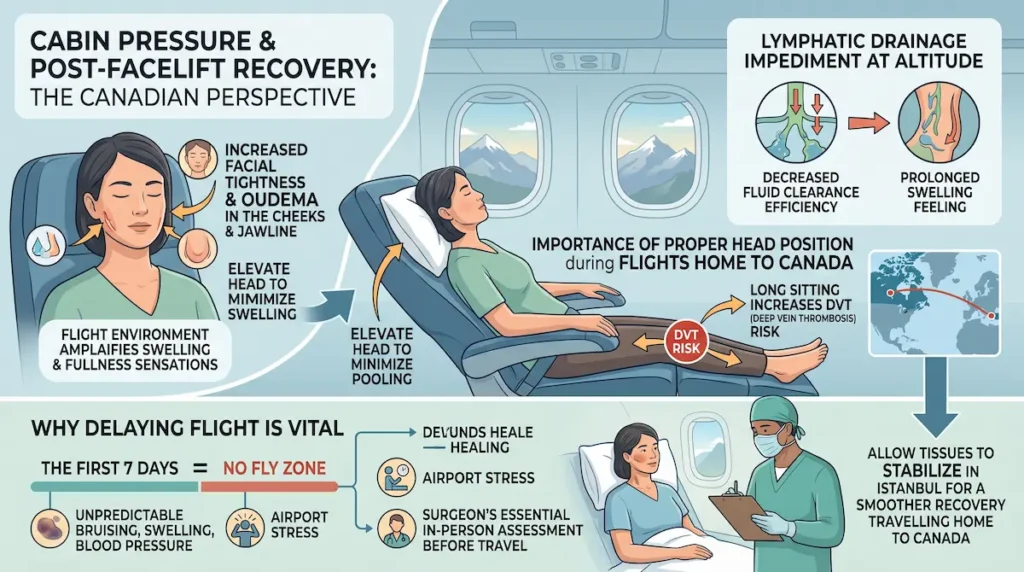
Cabin pressure is not dangerous for every post-op patient, but it does change how your body feels during the early healing period. Commercial aircraft cabins are pressurized, yet they still simulate a higher-altitude environment than sea level. For a recent facelift patient, that can amplify tightness, facial fullness, and fatigue.
The issue is not only pressure. It is the combination of swelling, long sitting time, lower cabin humidity, sleep disruption, and the stress of airport movement. For Canadian patients flying 10 or more hours home, these details affect comfort and risk management.
How pressurized cabin altitude affects post-surgical swelling
Facelift swelling is part of normal tissue repair. The body sends inflammatory cells and fluid into the surgical area, then gradually clears that fluid through lymphatic drainage. During the first week, this process is active and visible.
A pressurized aircraft cabin can make swelling feel more noticeable because tissue fluid balance changes during flight. You may feel increased facial tightness, heaviness near the jawline, or pressure around the ears and cheeks. These sensations are usually temporary, but they are harder to manage if you fly too early.
Head position also matters. If you sleep folded forward in an economy seat, swelling can pool around the lower face and neck. A better plan is to keep the head supported and slightly elevated throughout the flight.
The DVT risk profile during long-haul flights
Deep vein thrombosis, or DVT, is a blood clot that can form in the deep veins, most often in the legs. Long-haul flights increase risk because passengers sit for extended periods with reduced calf-muscle movement. Surgery can also temporarily increase clotting tendency.
A facelift is not the same clot-risk category as major lower-body surgery, but the Istanbul-to-Canada flight still deserves respect. Patients who are older, smoke, take hormone therapy, have a personal clotting history, or need a connecting itinerary should discuss these factors before travel.
For general post-operative flight timing across different procedures, see our procedure-bracket guide to post-op flight safety. This article stays focused on facelift-specific planning.
Why the first 7 days post-op are not safe for flying
The first week is when bruising, swelling, blood pressure changes, and incision sensitivity are most unpredictable. Day 2 to Day 5 can look and feel worse than Day 1. That is normal, but it is not ideal for airport queues, luggage handling, cabin dryness, or missed connections.
Flying before the Day 7 check-up also removes the surgeon’s opportunity to assess healing in person. A video call from Canada cannot replace seeing the incisions, checking swelling symmetry, reviewing blood pressure stability, and confirming that no early complication is developing.
For this reason, most Canadian facelift patients should treat the first 7 days as a protected recovery window in Istanbul. The goal is not to rush home. The goal is to leave when the surgical team can reasonably say the flight is appropriate.
AKM Clinic’s Fit-to-Fly Clearance Protocol
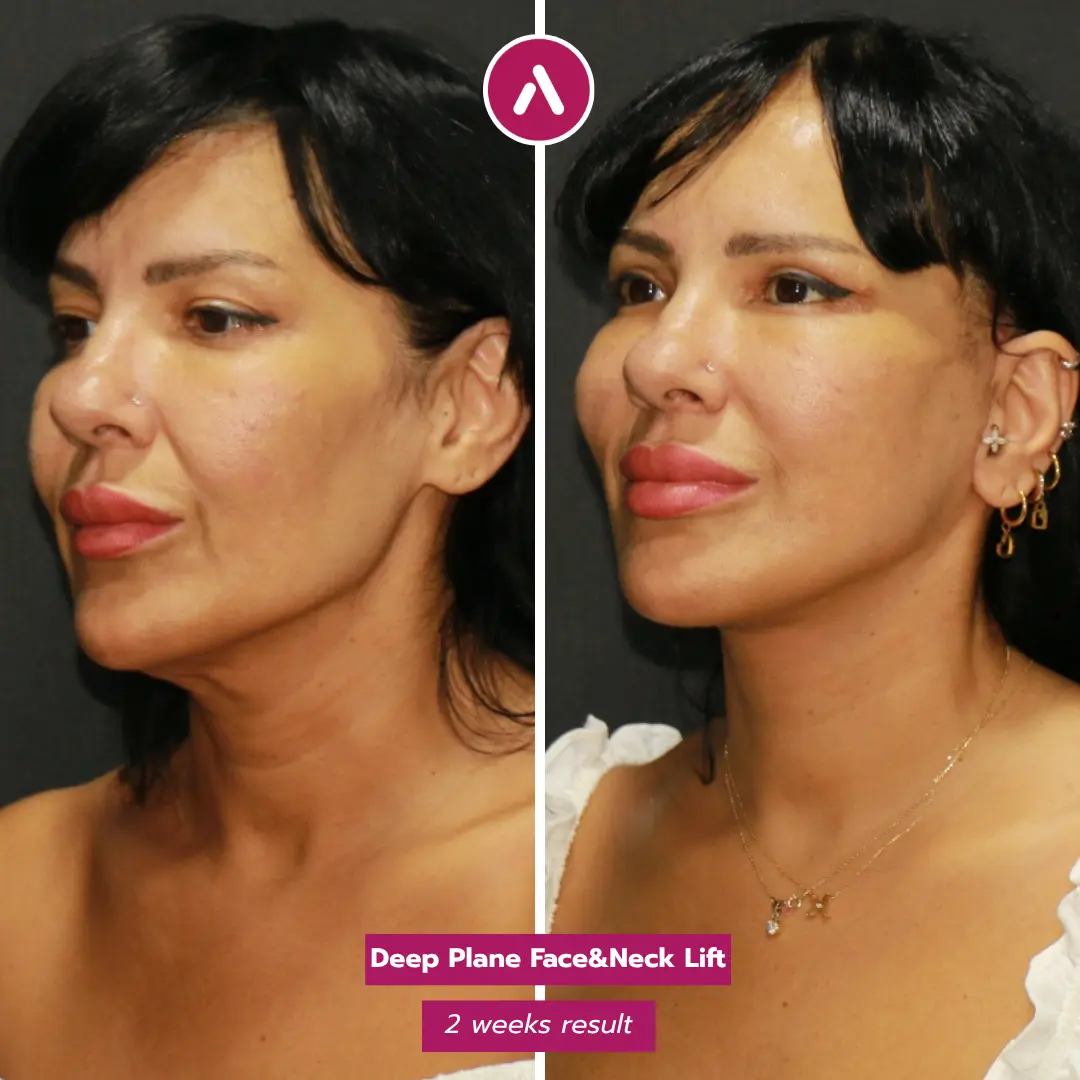
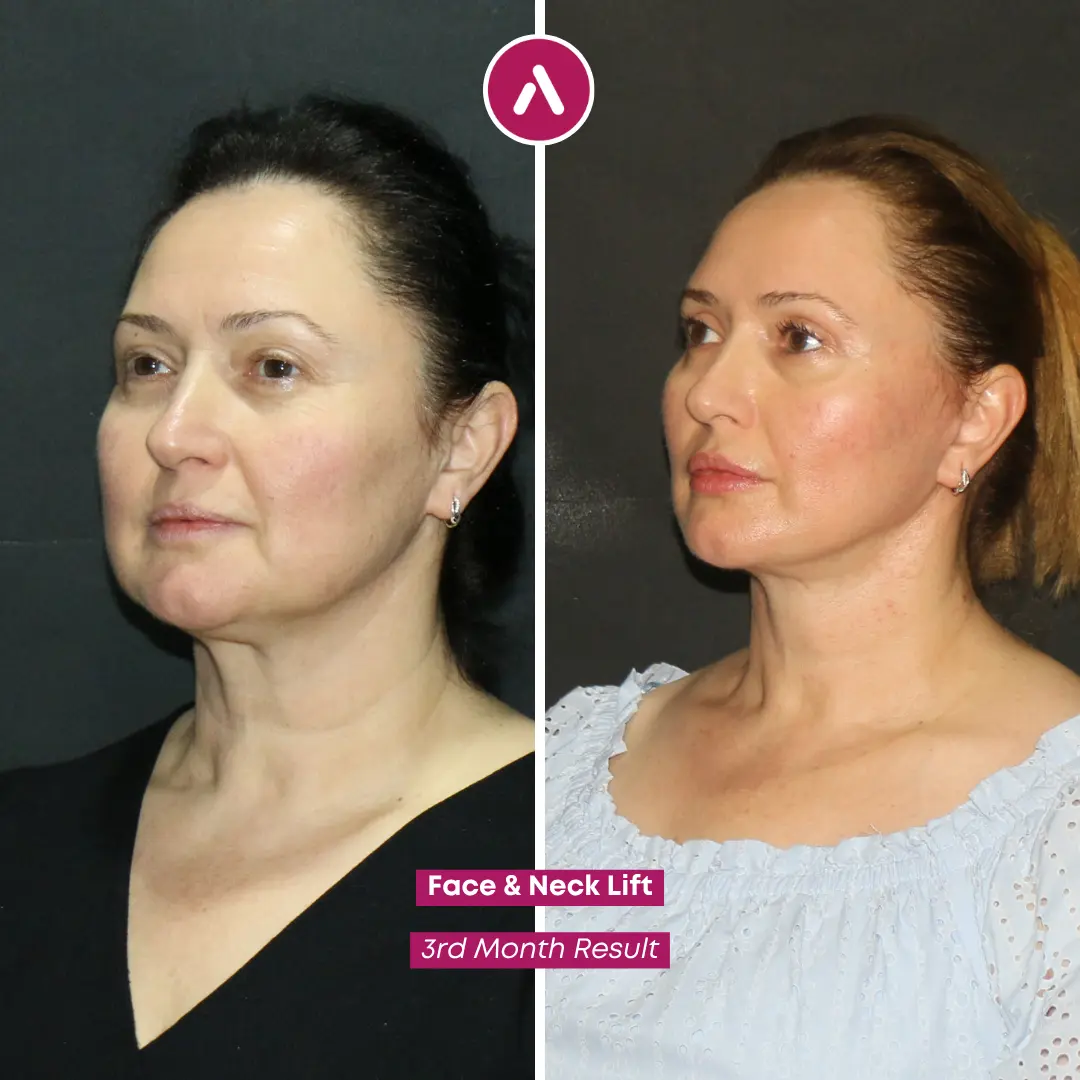
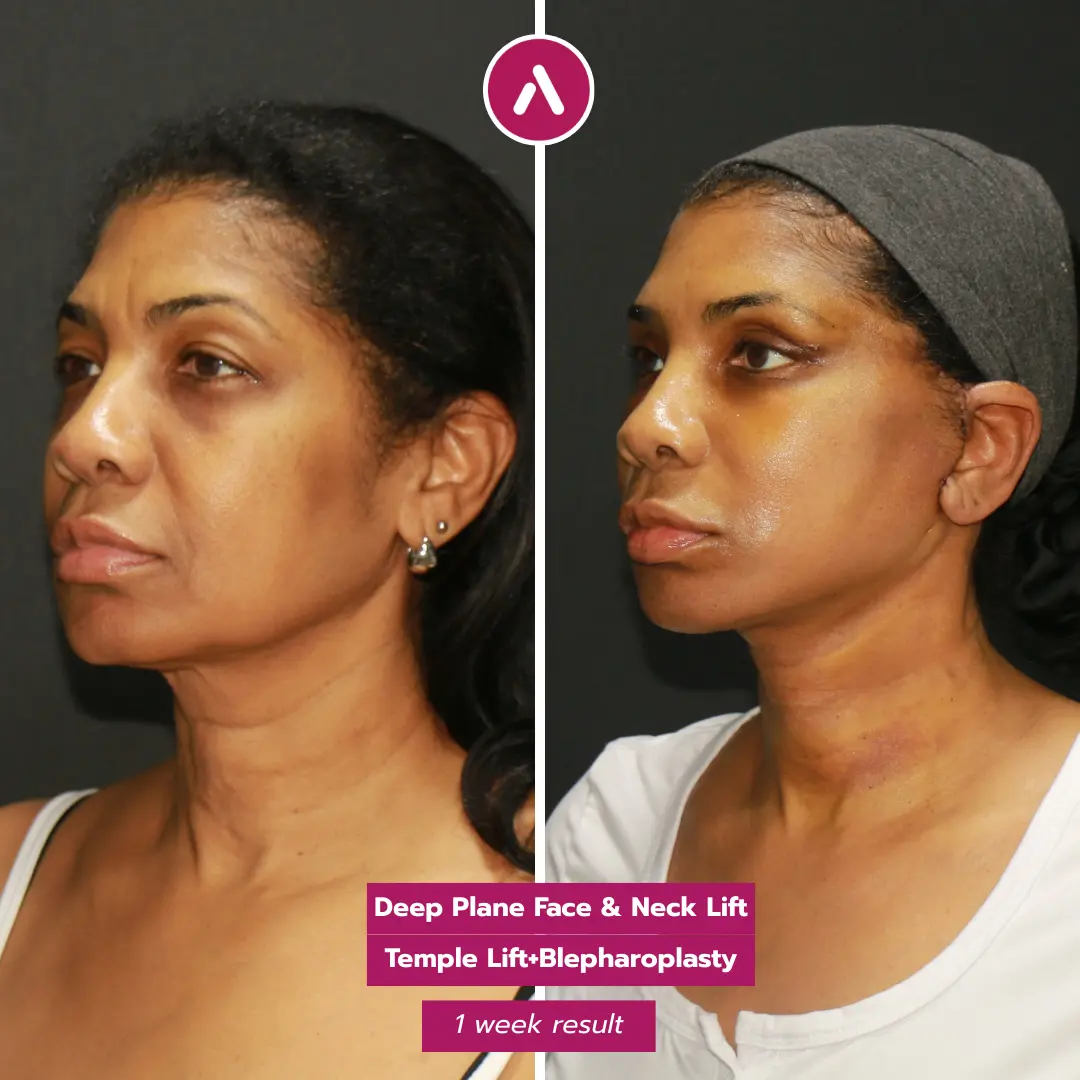
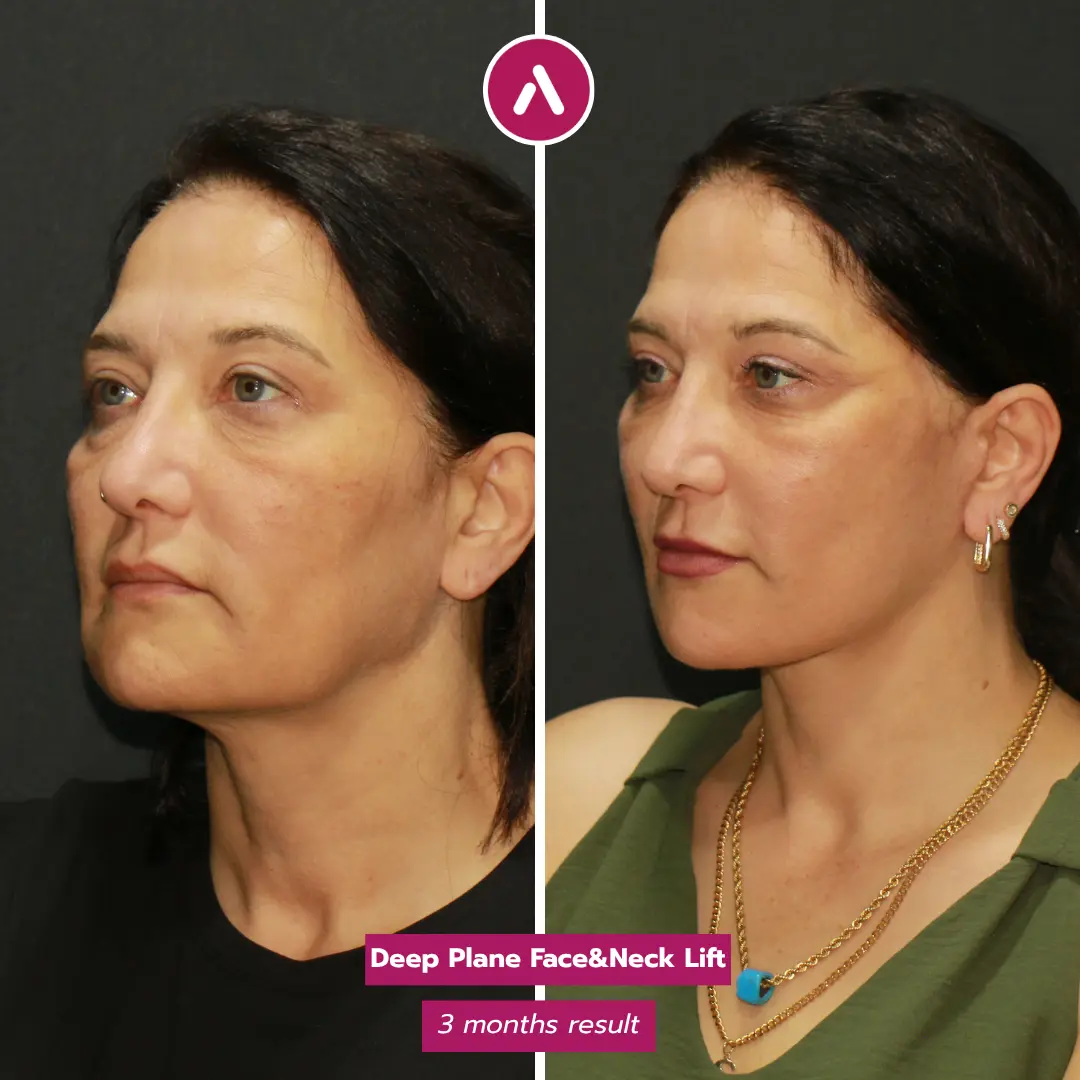
AKM Clinic’s clearance process is built around the patient’s actual healing state, not the date printed on the airline ticket. The usual planning window is Day 7 to Day 10, but that is a clinical assessment window rather than a guarantee. A smaller procedure may clear earlier. A deep plane facelift with neck work may need more time.
The clinic’s travel planning fits into the broader full Canadian patient journey, which covers arrival, hotel recovery, surgical check-ups, and the return flight. For flight timing, the final in-person review is the key decision point.
The Day 7 in-person final check-up
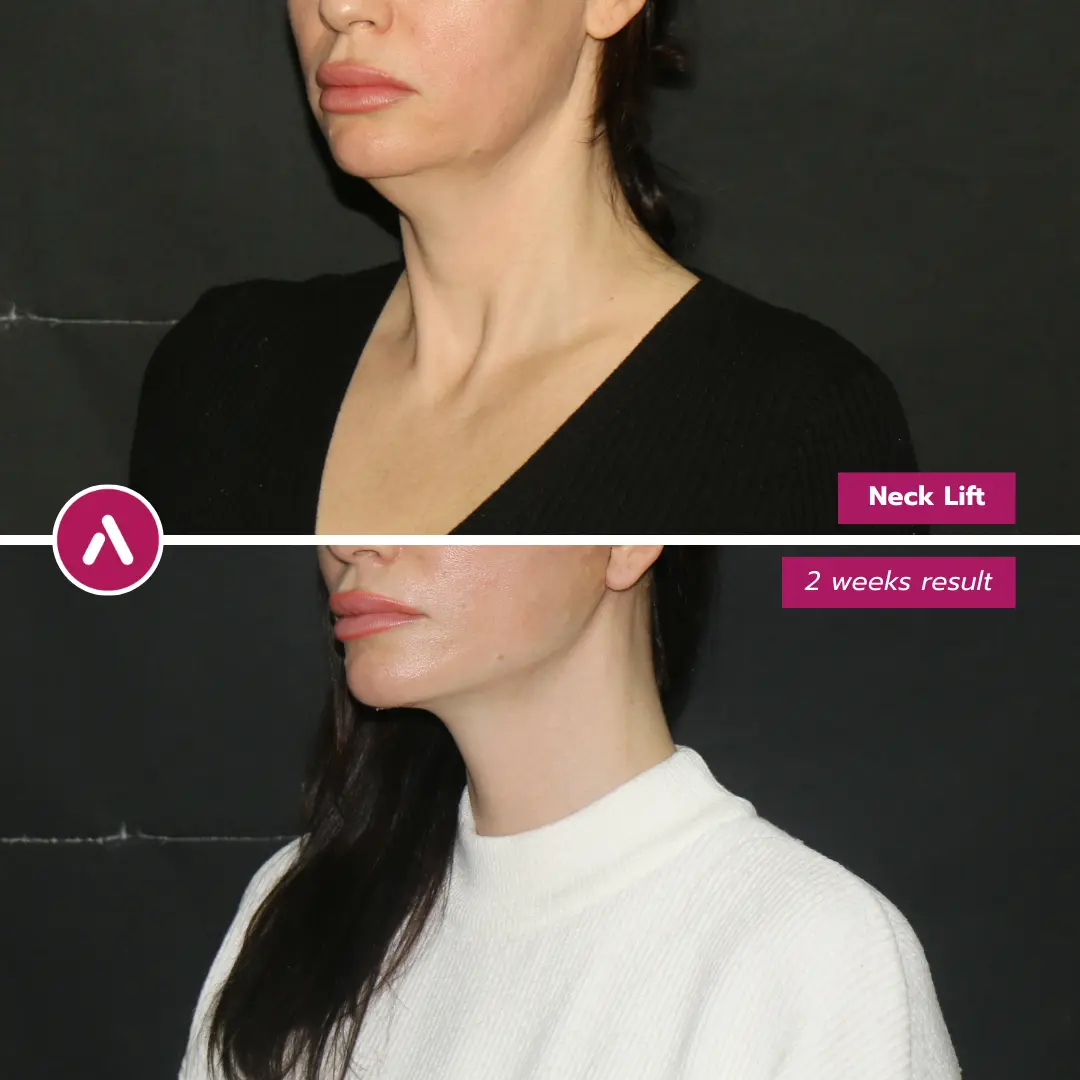
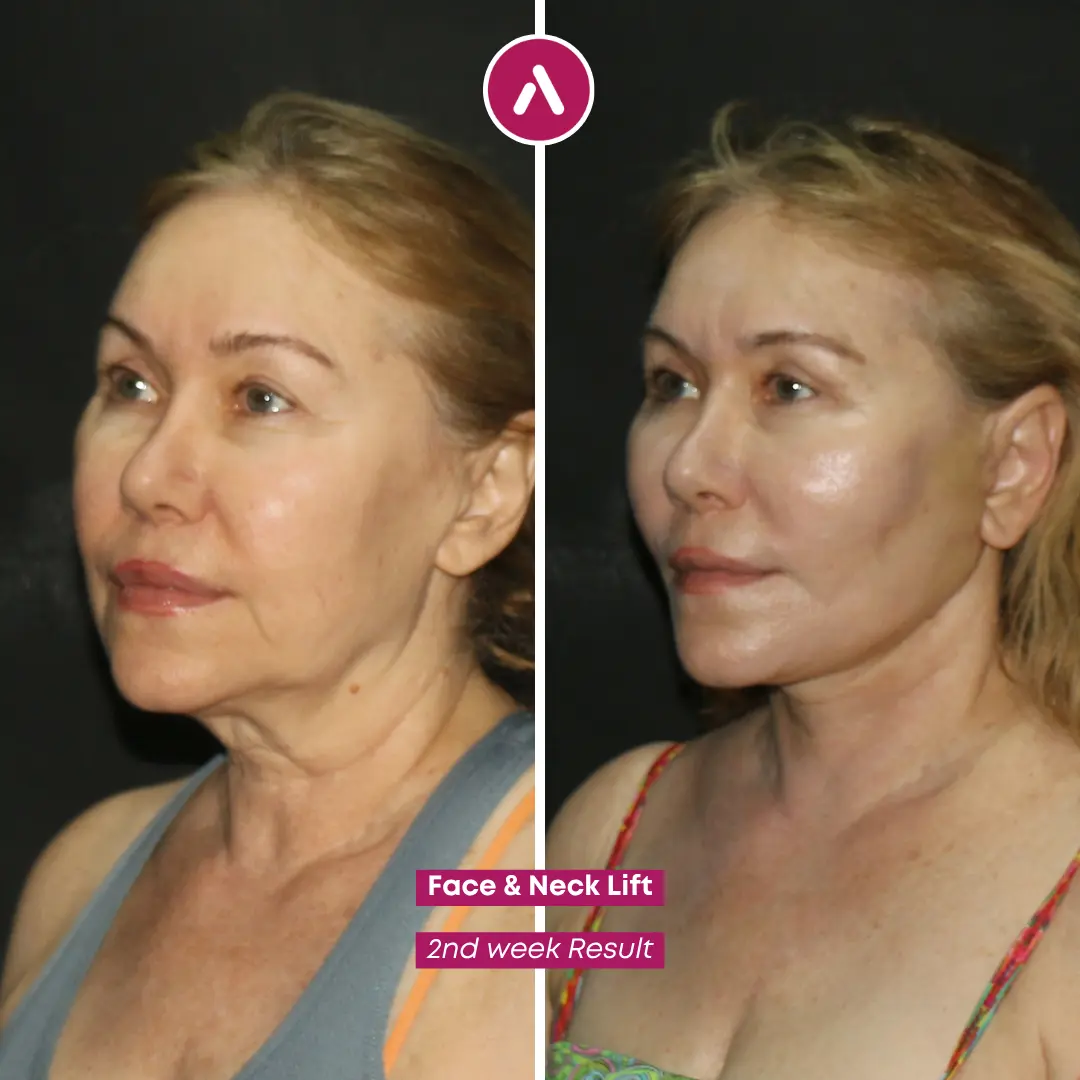
Day 7 is often the first realistic point for a flight-readiness conversation. At this visit, the surgeon or clinical team reviews the healing pattern and compares it with what is expected for the procedure performed. This matters because a mini facelift, SMAS facelift, deep plane facelift, and facelift with neck lift do not create identical swelling patterns.
The final check-up also gives the patient time to ask practical travel questions. These may include whether to wear compression, how to sleep on the plane, when to take prescribed medication, and what symptoms require urgent attention after arrival in Canada.
AKM Clinic’s medical safety approach is part of AKM’s clinical safety protocols, including surgeon-led planning, 24/7 patient advocacy, and long-term virtual follow-up after the patient returns home.
What the surgeon assesses before signing off
Fit-to-fly clearance is not a single checkbox. It is a clinical judgement based on several small details. A patient may feel emotionally ready to leave, but the surgeon still has to confirm the body is ready for a long flight.
- Swelling pattern: whether swelling is typical, stable, and not rapidly increasing.
- Bruising pattern: whether bruising is resolving in the expected direction.
- Incision status: whether the incision lines look clean, dry, and calm.
- Blood pressure stability: especially important before long-haul travel.
- Pain control: whether discomfort is controlled with the prescribed plan.
- Mobility: whether the patient can walk comfortably through the airport and cabin.
- Medication plan: whether the patient understands what to take during travel and after landing.
Recovery technology can support this process. AKM Clinic uses Hyperbaric Oxygen Therapy (HBOT) to support oxygen delivery and reduce inflammation during recovery. For the science behind this approach, see HBOT’s role in pre-flight recovery acceleration.
When clearance is delayed and why
A delayed flight home is frustrating, but it can be the safest decision. Delays usually happen when swelling remains high, bruising is still spreading, blood pressure is unstable, pain medication needs adjustment, or the surgeon wants another in-person look before the patient boards a long flight.
Some patients also underestimate fatigue. A person may feel well in the hotel lobby but become exhausted after packing, vehicle transfer, airport check-in, passport control, boarding, and a 10-hour flight. Vancouver and smaller-market patients face an added challenge because connecting itineraries can stretch the travel day far beyond the direct flight time.
| Procedure scope | Earliest typical fit-to-fly planning window | Canadian flight planning note |
|---|---|---|
| Mini facelift | Day 5-7, only if healing is calm and surgeon clears travel | Better suited to direct YYZ or YUL routes than multi-stop travel |
| Traditional facelift | Day 7-10 after in-person review | Plan at least one buffer day before a long Canada-bound flight |
| Deep plane facelift | Day 7-10, depending on swelling and procedure extent | YYZ and YUL direct routes are easier than YVR connections |
| Facelift with neck lift | Day 10-14 for many patients, especially with heavier swelling | Consider extra nights in Istanbul before returning to Canada |
This table is a planning guide, not a clearance certificate. The final decision comes from the surgeon after examining the patient in person.
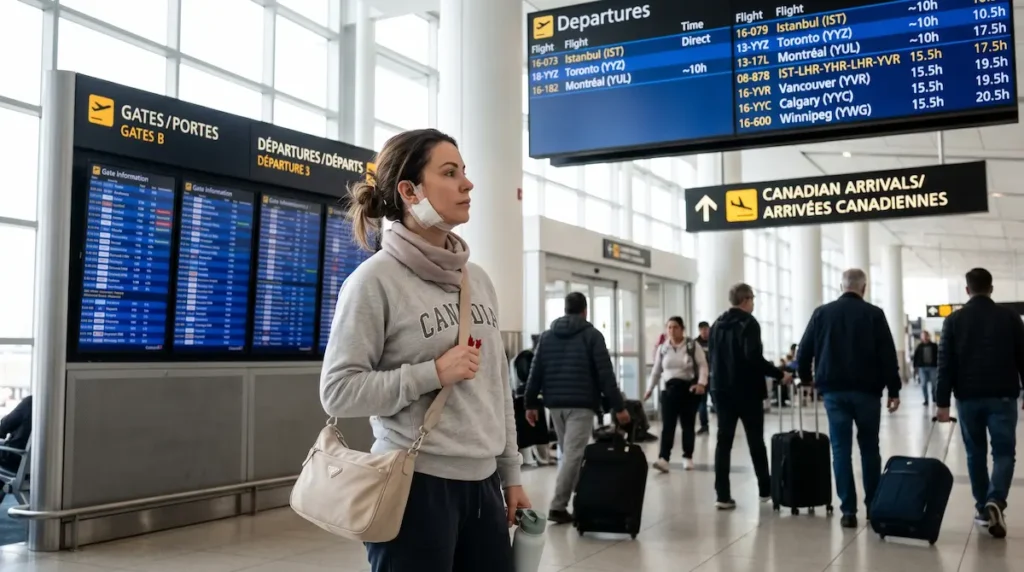
Flight Duration from Istanbul to Canadian Airports
Flight duration shapes the recovery plan more than many patients expect. A patient returning to Toronto or Montréal may have a single long flight, while a patient returning to Vancouver, Calgary, Ottawa, Halifax, or Winnipeg may face a longer travel day with a connection. The body experiences those itineraries differently.
For facelift patients, the best itinerary is usually the simplest one. Fewer airport transfers mean less walking, fewer boarding queues, fewer chances of delay, and less need to lift bags or reposition yourself repeatedly. Comfort matters here. So does predictability.
Direct: IST to YYZ and IST to YUL timing
Toronto Pearson (YYZ) is often the most straightforward Canadian return route for AKM Clinic patients because direct Istanbul-to-Toronto flights are commonly available. The scheduled flight time is usually around 10.5 hours, though exact duration can vary by date, aircraft, wind direction, and airline schedule.
Montréal-Trudeau (YUL) can also be practical for patients in Quebec, eastern Ontario, Atlantic Canada, or French-speaking households that prefer to reconnect through Montréal. The Istanbul-to-Montréal flight is usually close to 10 hours. Again, the exact time depends on the live schedule.
A direct flight is still a long-haul recovery environment. You should plan it as a medical travel day, not a normal vacation flight. That means wearing comfortable clothing, keeping medication accessible, avoiding heavy cabin bags, and arranging help after landing.
Connecting: IST to YVR and longer total travel fatigue
Vancouver patients should think beyond the airborne time. Even when a direct Istanbul-to-Vancouver option is available on some schedules, western Canadian patients often encounter longer total travel days because of timing, airport transfers, or onward connections into British Columbia. A connection through Europe or eastern Canada can easily stretch the door-to-door day.
That fatigue matters after a facelift. A patient may tolerate a 10-hour direct flight reasonably well but struggle with a 16-hour itinerary that includes a rushed connection, a second boarding process, and several extra hours sitting upright. The issue is cumulative stress.
If you are returning to Vancouver, Victoria, Kelowna, Edmonton, Calgary, Regina, Saskatoon, or Winnipeg, discuss the entire itinerary with your coordinator. Do not look only at the longest flight segment. Look at airport arrival time, layover length, walking distance, baggage handling, and your ride home.
Smaller Canadian markets connecting through YYZ or YUL
Patients returning to Ottawa, Halifax, Québec City, St. John’s, Winnipeg, Regina, Saskatoon, or smaller regional airports usually need a domestic connection after landing in Canada. That second flight can feel harder than the international segment because the patient is already tired.
Where possible, build in margin. A tight connection may be efficient on paper, but it can force you to rush through customs, stand longer than expected, and manage carry-on items while swollen and tired. A longer connection can be more comfortable if it gives you time to walk slowly, drink water, use the washroom, and reset.
Some patients choose to overnight in Toronto or Montréal before continuing home. This is especially reasonable for solo travellers or patients whose final destination is several hours away from a major hub. A calm 24-hour pause can be safer than turning the return day into an endurance test.
“I originally looked at a cheaper route with a European connection, but my coordinator encouraged me to think like a recovery patient, not a tourist. I chose the direct YYZ flight home, and I was grateful I did. One boarding process was enough.”— Composite Canadian patient reflection based on common AKM travel-planning patterns
Airline Policies for Post-Surgical Passengers
Airline rules can affect your return flight even when your surgeon feels your recovery is progressing well. Some carriers may ask for documentation if a passenger has had recent surgery, has visible dressings, needs assistance, or appears medically unstable at the airport. It is better to carry paperwork and not need it than to need it and not have it.
Policies also change. Before your travel dates are finalized, confirm requirements directly with the airline operating your flight. Your AKM coordinator can help you prepare the right documents, but the airline makes the boarding decision.
Turkish Airlines medical clearance requirements
Turkish Airlines advises that passengers requiring medical clearance should provide a doctor’s report for a safe and comfortable journey. The report should be in Turkish or English, issued within the airline’s stated validity period, and include language confirming there is no objection to travelling by plane.
For facelift patients, this usually means carrying a surgeon’s fit-to-fly note after the final check-up. The note should be simple, clear, and practical. It should identify the patient, confirm the procedure date, state that the patient has been assessed, and say the patient is fit for commercial air travel if that is the surgeon’s decision.
Visible swelling or light dressings do not automatically mean a patient cannot fly. They may, however, invite questions at check-in or boarding. A clear medical note helps reduce uncertainty.
Air Canada’s post-surgery passenger guidelines
Air Canada states that medical approval may be required for recent illness, recent surgery, unstable health conditions, or when the airline requests review. This is relevant for Canadian patients who return on Air Canada-operated segments after landing in Canada or who book a codeshare itinerary.
If your itinerary includes Air Canada, review its medical approval guidance for accessible travel before departure. Some cases may require forms or advance communication with the airline’s medical desk.
Do not assume the international carrier’s approval automatically covers a domestic Canadian segment. If different airlines operate different legs, check each airline separately. Codeshare bookings can be confusing, so verify the operating carrier, not only the airline logo on the ticket.
Documentation to carry: surgeon’s letter and medication list
Your return-flight document folder should be easy to access. Keep it in your personal item, not in checked baggage. You may need it at check-in, security, boarding, customs, or during a medical question in transit.
- Fit-to-fly letter: written in English, with surgeon identification and date of issue.
- Procedure summary: simple description of facelift type and surgery date.
- Medication list: names, doses, schedule, and purpose of each medication.
- Prescription copies: especially for pain medication, antibiotics, or other controlled items.
- Clinic contact details: AKM Clinic Turkey line and North American support line.
- Emergency instructions: symptoms that require medical attention after landing.
- Travel insurance documents: including policy number and emergency contact details.
For practical packing details, including medication organization and recovery items for the flight, see what to pack for your return journey. This is one of the easiest parts of the trip to prepare well.
Canadian Callout: Airline Medical Clearance Checklist
Before leaving Istanbul, confirm three things: your surgeon has cleared you to fly, your airline documentation matches the operating carrier’s requirements, and all medication is packed in your carry-on with labels intact. For Canadian patients with a domestic connection, check both the international and Canadian airline segments.
In-Flight Comfort Strategies
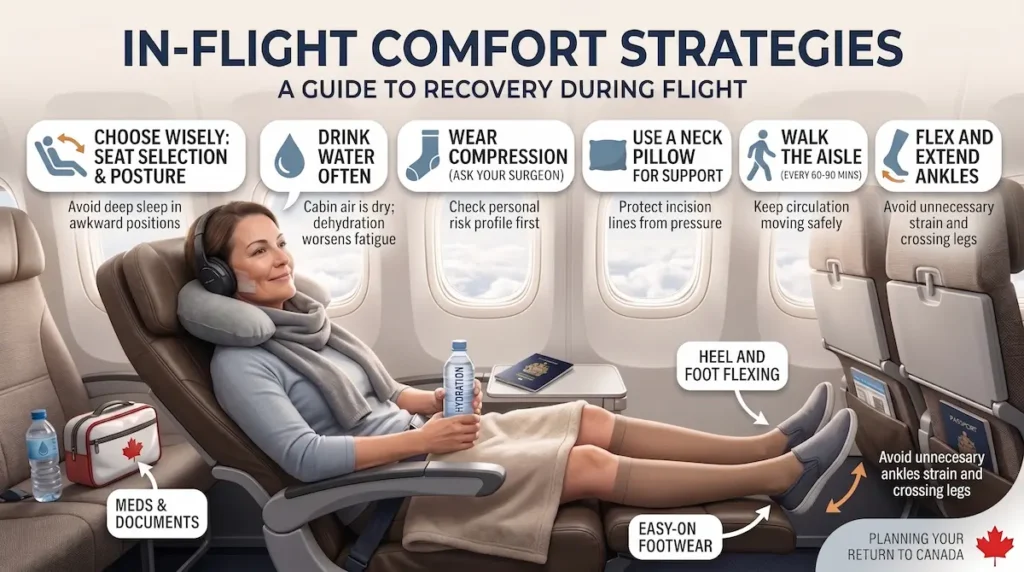
The return flight should be planned as part of recovery, not as the end of recovery. Even with fit-to-fly clearance, you are still healing. The goal is to reduce swelling, protect the incision area, avoid unnecessary strain, and keep circulation moving during a long seated period.
Small decisions make the flight easier. Seat choice, hydration, walking schedule, medication timing, and head support all affect how you feel when you land in Canada.
Compression and hydration on long-haul flights
Ask your surgeon whether compression stockings are appropriate for your personal risk profile. Some patients benefit from below-knee travel compression, especially if they have a long itinerary, a clotting history, hormone therapy, or multiple DVT risk factors. Others may not need them.
Hydration is simpler. Drink water regularly and avoid arriving at the airport already dehydrated. Cabin air is dry, and dehydration can worsen fatigue, headache, constipation, and the heavy facial sensation some patients feel after surgery.
Do not start aspirin, anticoagulants, or herbal blood thinners just because you are flying. Medication decisions should come from your surgical team or your Canadian physician. This is especially important if you are already taking prescription medication for blood pressure, clotting risk, or hormone therapy.
Sleeping position and head elevation
Sleeping flat or folded forward can increase facial fullness. Try to keep your head supported in a neutral, slightly elevated position. A soft neck pillow can help, but avoid anything that presses against incision lines behind the ear or under the chin.
If you book a seat with more recline, use it for support rather than deep sleep in an awkward position. Many patients do better with short rest periods instead of trying to sleep through the full flight. Settle your head carefully each time.
Noise-cancelling headphones, an eye mask, and a light scarf can make the cabin feel more private. That matters for Canadian patients who feel self-conscious about residual swelling or bruising during the first flight home.
Cabin walking and DVT prevention
Movement is one of the simplest DVT-prevention strategies during long flights. Walk the aisle when the seatbelt sign is off. While seated, flex and extend your ankles, gently contract your calf muscles, and avoid crossing your legs for long periods.
Plan movement before you feel stiff. A reasonable rhythm is to move every 60-90 minutes when safe, but follow your surgeon’s instructions if they give you a different schedule. Do not overdo it. The aim is circulation, not exercise.
Choose footwear that is easy to remove and put back on. Feet can swell during long flights, especially after surgery and reduced activity. Tight shoes can make the final hours of the flight uncomfortable.
- Keep medication, water, and documents under the seat in front of you.
- Avoid lifting heavy overhead baggage.
- Stand slowly after long sitting periods.
- Walk during quieter cabin periods rather than during meal service.
- Ask for help if you feel dizzy, faint, short of breath, or unusually unwell.
Arrival Day Logistics in Canada
Landing in Canada is not the moment to return to normal life. The first arrival day should be quiet, structured, and practical. You may have crossed several time zones, slept poorly, and sat upright for many hours while still in the inflammatory phase of healing.
Before leaving Istanbul, confirm the first 48 hours at home. Who is picking you up? Where are your medications? What will you eat? Who will stay nearby if you are travelling solo? These details prevent avoidable stress.
Customs and clearance with sutures, dressings, or medication
Most facelift patients do not have issues at Canadian customs because of visible swelling or small dressings. The more important concern is medication documentation. Keep prescription medication in original labelled packaging whenever possible, and carry a medication list with dose instructions.
CATSA allows prescription and essential non-prescription medications through security checkpoints, including medically required items. For Canadian screening details, review CATSA’s guidance on medication and medical items before you travel.
If you are carrying controlled medication, declare it if required and keep the prescription information accessible. Do not combine loose tablets into unlabelled containers for the return trip. A pill organizer may be convenient at the hotel, but original packaging is clearer for travel.
Canadian Callout: Airport Customs and Medication
Keep your fit-to-fly letter, prescription labels, and medication list together in your carry-on. Canadian travellers should be prepared to explain that the medication is for personal post-operative use after surgery abroad.
Airport-to-home transport: avoiding public transit
Arrange a private ride home from the airport. This is not the best day for the UP Express plus a subway transfer, a SkyTrain connection with luggage, or a long wait for a regional bus. You will likely be tired, swollen, and sensitive to crowds.
If you land at YYZ, YUL, YVR, or YYC, ask your driver to meet you as close to the arrivals area as possible. Avoid carrying heavy bags. If you are travelling alone, consider paid airport assistance or a pre-booked porter where available.
The same principle applies to the Istanbul side of care. AKM Clinic’s travel coordination is described in the AKM patient journey, including private transfers and support during the medical travel process.
First 48 hours back: medication continuity and rest
The first two days back in Canada should be simple. Prioritize sleep, hydration, protein-rich meals, short walks at home, and medication timing. Do not schedule work calls, errands, family events, or social visits immediately after landing.
Time-zone changes can disrupt medication routines. Before leaving Istanbul, ask the AKM team how to shift your medication schedule onto your local Canadian time zone. Write it down. Post-flight fatigue makes memory unreliable.
For the broader recovery plan after landing, including when to contact AKM versus a Canadian provider, see our guide to post-op care once you’re back in Canada. The flight is only one part of the recovery handoff.
Canadian Callout: Your First 48 Hours Home
Plan your arrival as if you are still a medical patient, because you are. Have groceries ready, avoid lifting luggage, keep your head elevated when resting, and make sure one trusted person knows you have arrived home safely.
Frequently Asked Questions: When Can You Fly After a Facelift?
Flight timing after a facelift is not the same for every patient. The safest answer depends on procedure scope, healing speed, airline requirements, and the length of the Canadian return itinerary. Use these answers as planning guidance, then confirm your personal clearance with your surgeon.
When can you fly after a facelift if you are returning to Canada?
Most Canadian patients should plan for fit-to-fly assessment between Day 7 and Day 10 after a facelift. Some patients need longer, especially after deep plane work, neck lift, heavier swelling, or a complicated travel route home.
The surgeon’s clearance is the deciding factor. Do not book a return flight that leaves no room for a delayed check-up or an extra night in Istanbul.
Is it safe to fly 7 days after a facelift?
It can be safe for selected patients, but only after an in-person medical review. Day 7 is a common assessment point, not an automatic permission date.
If swelling is stable, incisions are calm, blood pressure is controlled, and you can move comfortably, the surgeon may clear travel. If any of those factors are not ready, flying at Day 7 may be too early.
Can I fly home directly after the procedure?
No. Flying home directly after a facelift is not appropriate. The first several days carry the highest risk of swelling changes, bruising progression, blood pressure fluctuation, and fatigue.
Canadian patients should plan to recover in Istanbul through the first week. This protects the early healing phase and gives the AKM team time to assess you before long-haul travel.
Does compression help during the flight?
Compression stockings may help some long-haul travellers reduce leg swelling and support circulation, but they are not required for everyone. Ask your surgeon whether they are appropriate for your medical history.
Do not use facial compression unless your surgeon specifically instructs you to do so. Facial dressings and compression plans vary by technique and healing stage.
What if I have a complication mid-flight?
Tell the cabin crew immediately if you experience shortness of breath, chest pain, fainting, sudden one-sided leg swelling, uncontrolled bleeding, severe headache, or rapidly worsening facial swelling. These symptoms should not be ignored.
Before departure, keep AKM Clinic’s contact details and your travel insurance emergency number in your personal item. After landing in Canada, seek urgent medical care if symptoms continue or worsen.
Can the airline deny boarding for a recent facelift?
An airline may question boarding if a passenger appears medically unstable, has visible post-surgical dressings, lacks required medical documentation, or triggers a medical review. This is why paperwork matters.
Carry your fit-to-fly letter, medication list, and procedure summary. If your airline requires medical approval in advance, complete that step before leaving for the airport.
Should I book business class for the return flight?
Business class can make the return flight easier, but it is not medically required for every patient. The main advantages are more recline, easier aisle access, more privacy, and less need to sit upright for the full flight.
If business class is not realistic, choose an aisle seat when possible, avoid tight layovers, ask for help with baggage, and keep your head supported. A simple itinerary is often more valuable than a luxurious one.
What documents should I carry through Canadian customs?
Carry your fit-to-fly letter, procedure summary, prescription labels, medication list, travel insurance details, and clinic contact information. Keep everything in your carry-on, not checked luggage.
If you are carrying medication, original packaging is ideal. A clear medication list helps Canadian screening and customs officers understand that your medication is for personal post-operative care.
Does deep plane facelift require a longer flight delay than a mini facelift?
Often, yes. A mini facelift may involve less swelling and a shorter recovery window, while a deep plane facelift can involve deeper tissue work and more visible early swelling. Procedure scope matters.
If you are considering deeper structural rejuvenation, review the deep plane facelift technique at AKM Clinic before planning flights. A stronger procedure may still be the better choice, but it deserves a more realistic travel schedule.
Plan your flight schedule with AKM’s coordinator before booking. The best return itinerary is usually the one that gives your face, your body, and your travel day enough margin. For Canadian patients, that means coordinating the surgery date, final check-up, airline requirements, and arrival-day support before the ticket is purchased.
Medical Disclaimer: This page is provided for general educational purposes only and does not replace an in-person medical consultation, diagnosis, or personalized treatment plan. All surgery carries risks, and outcomes vary between individuals. Suitability for plastic surgery, procedure selection, and anesthesia choice can only be determined after a full clinical assessment by a qualified surgeon. Always follow your clinician’s instructions and seek urgent medical attention if you develop concerning symptoms during recovery.