




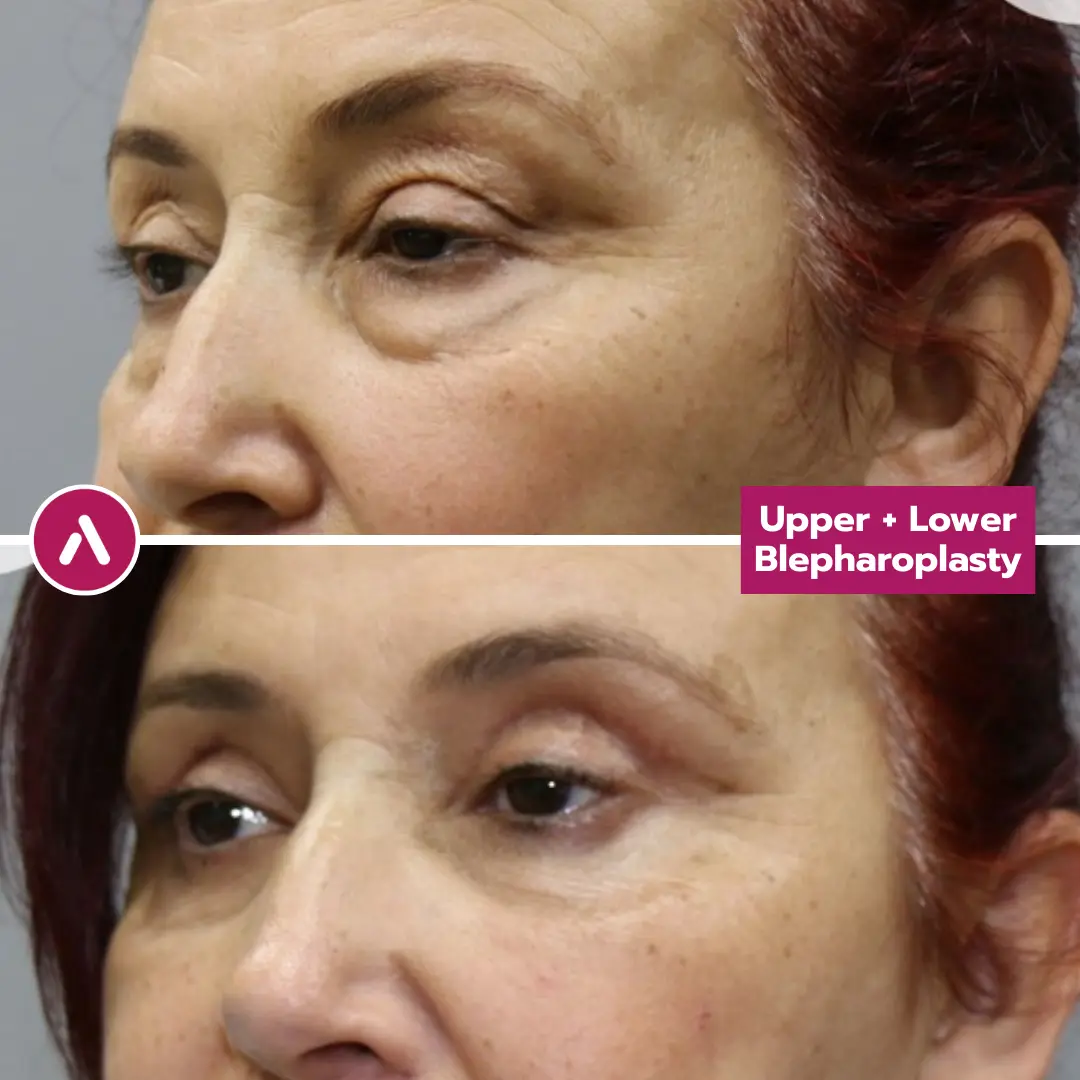
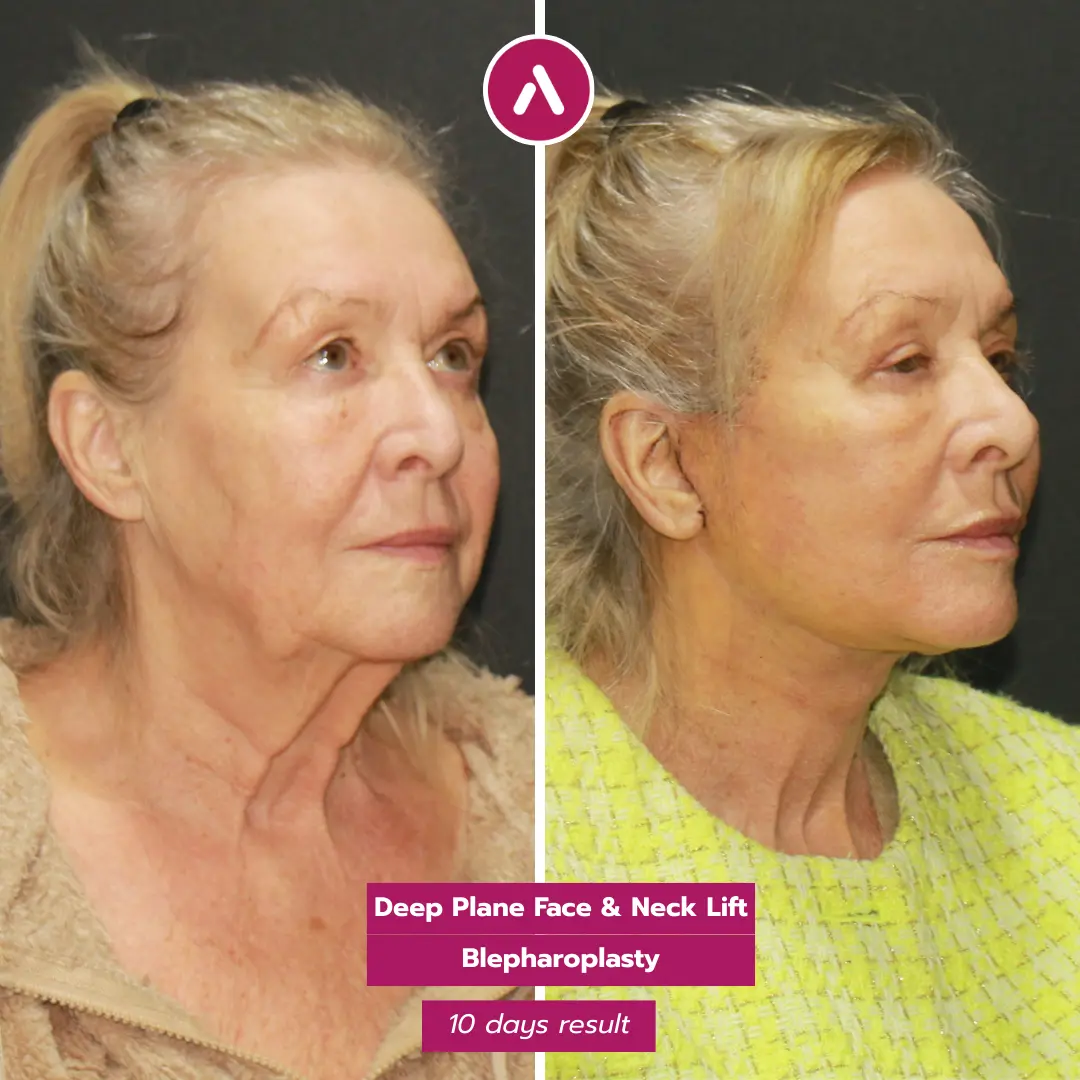
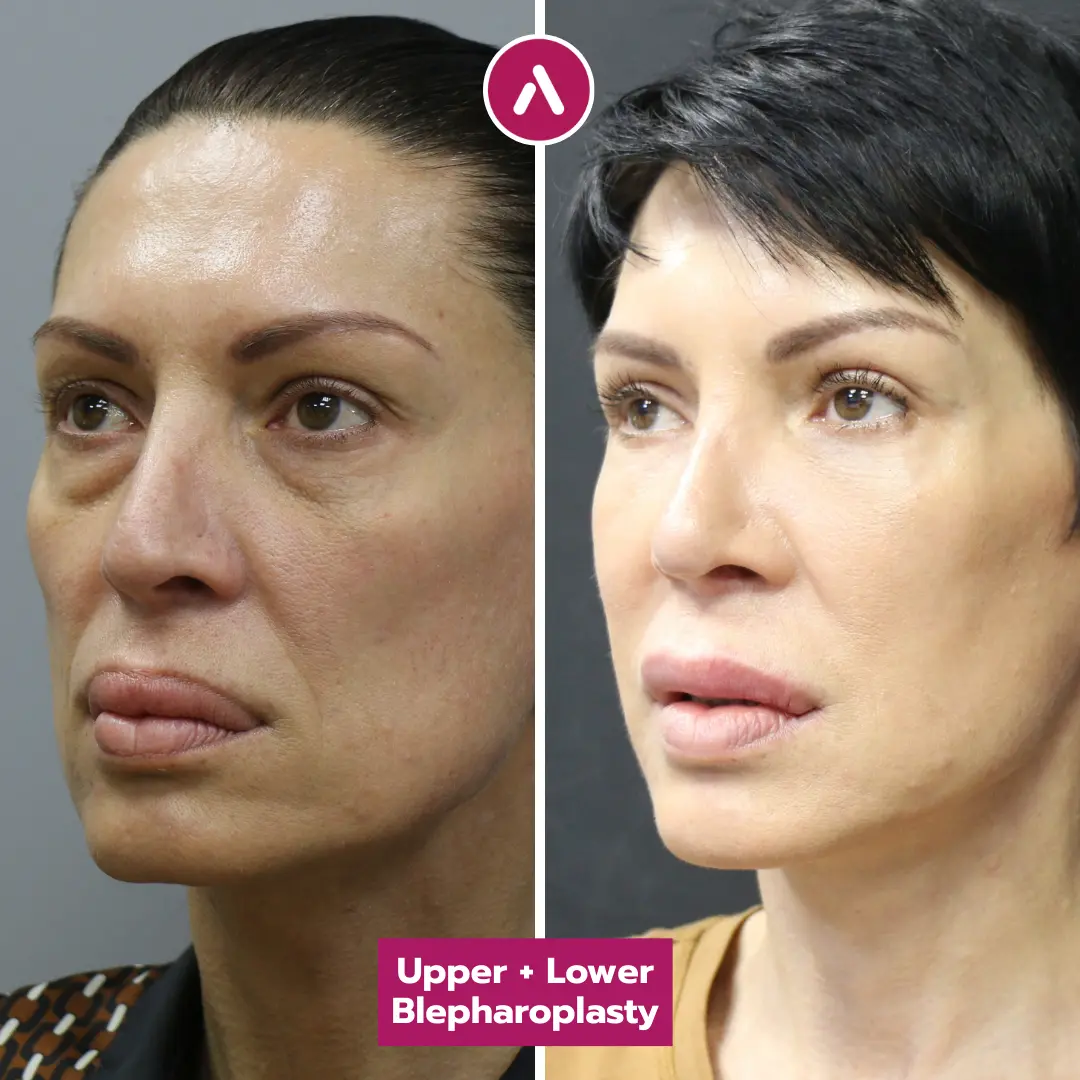
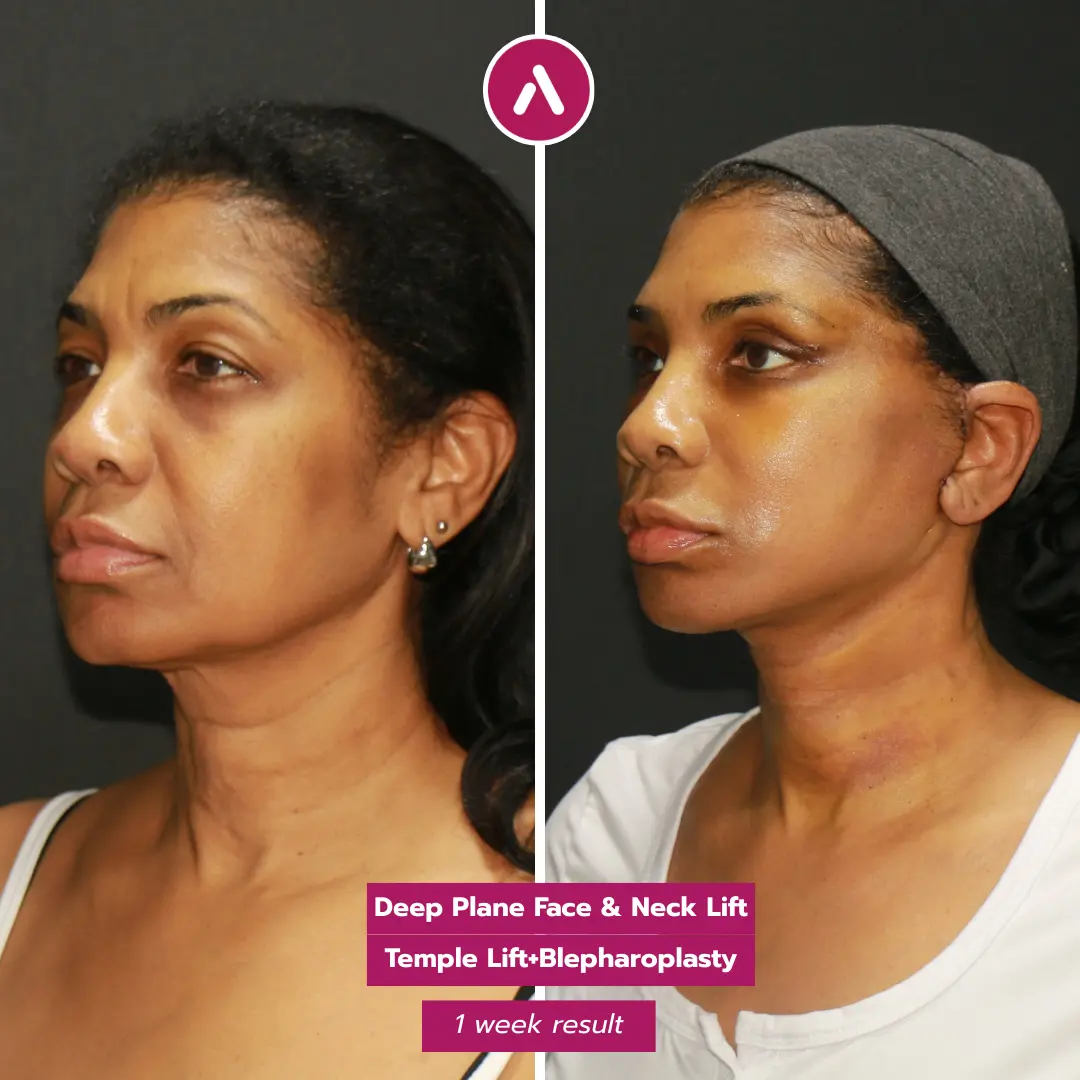
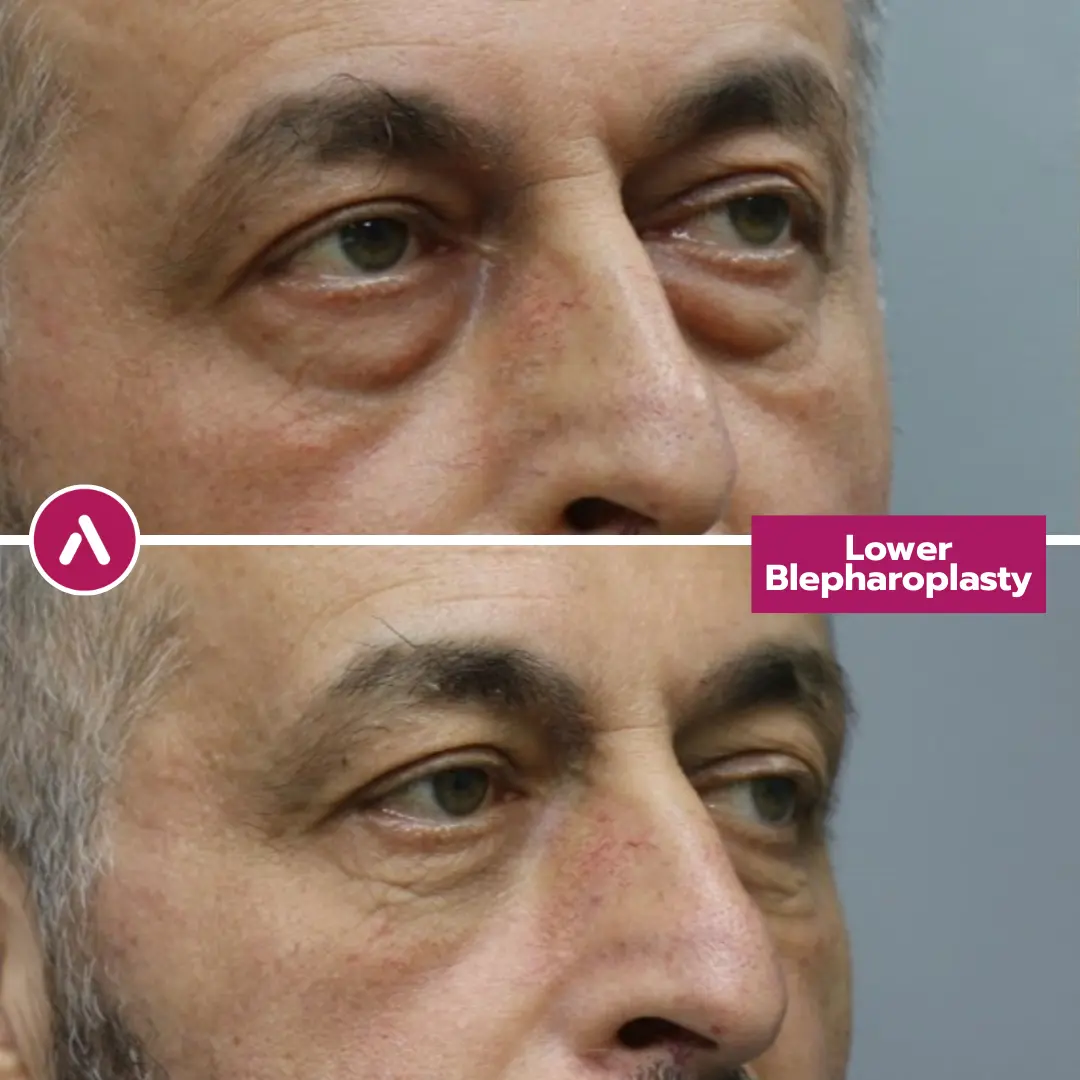
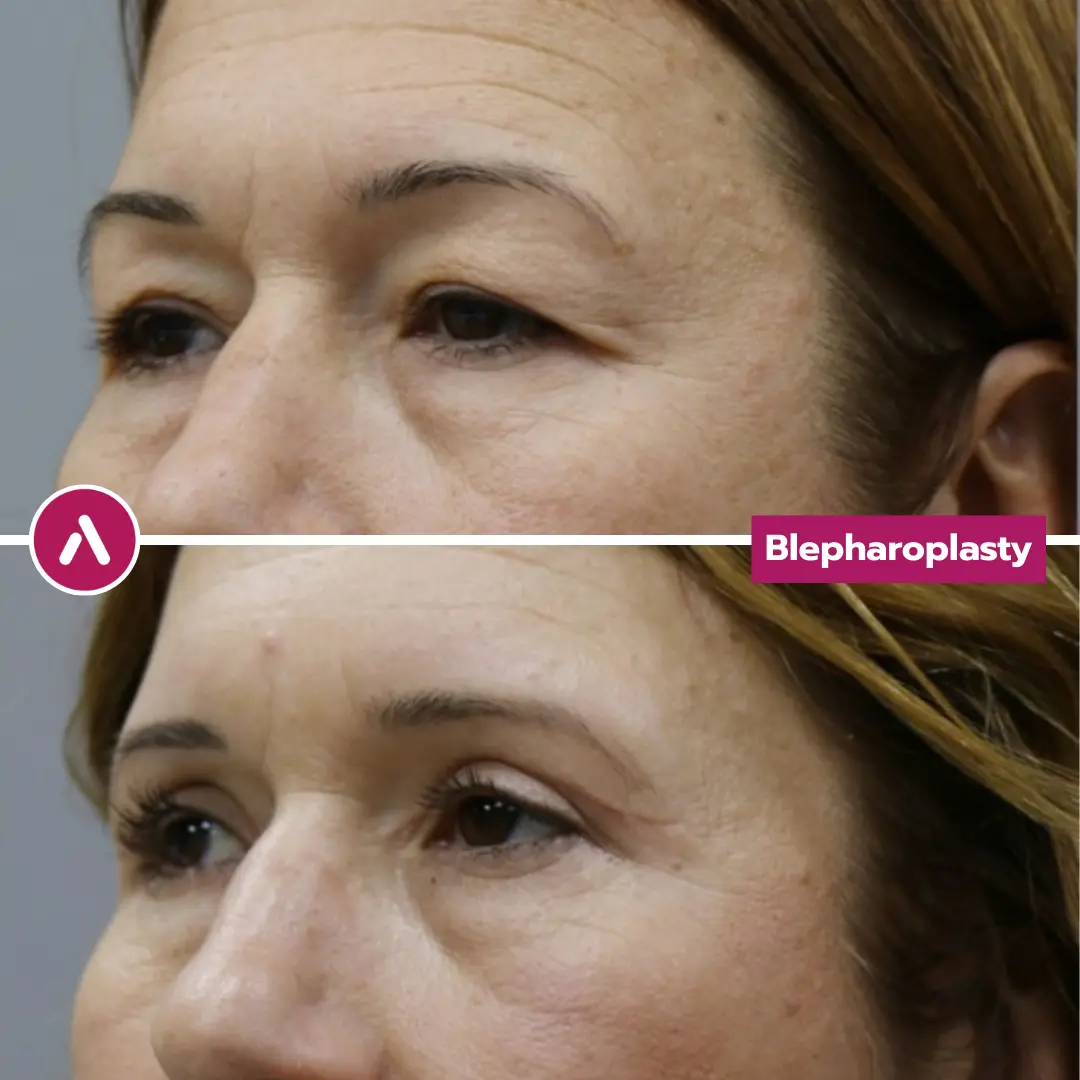
Canadian women and men considering eyelid surgery face a specific set of questions: whether their concern is cosmetic or functional, whether upper or lower blepharoplasty is the right procedure, and whether the result will look rested rather than “done.” For Asian-Canadian patients in Toronto, Markham, Richmond Hill, Vancouver, and Richmond, double eyelid surgery also requires cultural and anatomical sensitivity. This guide explains the procedure, recovery, cost, safety standards, and why many Canadian patients evaluate Istanbul as a high-value surgical destination for eyelid surgery.
Table of Contents
What Is Blepharoplasty? Eyelid Surgery Explained
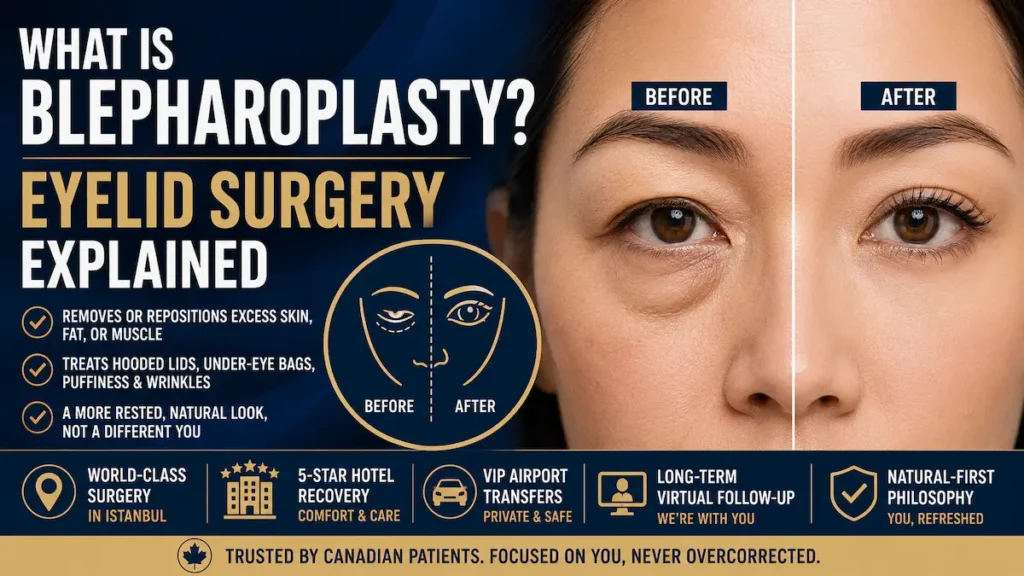
Blepharoplasty, also called eyelid surgery, removes or repositions excess skin, fat, or muscle from the upper and/or lower eyelids. Upper blepharoplasty treats hooded or droopy eyelids; lower blepharoplasty addresses under-eye bags, puffiness, and wrinkles for a more rested appearance.
The goal is not to change the identity of your eyes. At AKM Clinic, our Natural-First philosophy means we plan eyelid surgery around your existing anatomy, brow position, cheek support, and ethnic features. A good blepharoplasty should make you look less tired, not surgically altered.
For Canadian patients, this distinction matters. Many people arrive at consultation after comparing Toronto, Vancouver, or Calgary private-clinic quotes and wondering whether travelling to Istanbul means sacrificing surgical judgement. Our answer is direct: the procedure must be planned with the same clinical rigour you would expect from a Canadian facial plastic surgery setting, with clear anatomy-based reasoning and no pressure toward overcorrection.
For broader international context, the International Society of Aesthetic Plastic Surgery provides global aesthetic surgery resources that can help patients understand how surgical standards are discussed across countries.
How Eyelid Surgery Works: Skin, Muscle, and Fat Repositioning
Eyelid aging is rarely caused by skin alone. In many patients, the eyelid changes because several layers shift at once: thin eyelid skin stretches, the orbicularis oculi muscle weakens, and fat pads begin to bulge forward. Blepharoplasty corrects those layers selectively.
In upper blepharoplasty, the surgeon removes a precise ellipse of excess skin from the upper lid crease. In some cases, a small amount of muscle or fat is also adjusted. The incision is hidden in the natural eyelid fold, which is why healed upper blepharoplasty scars are usually difficult to see during normal conversation.
Lower blepharoplasty is different. It focuses on the under-eye area, where fat bulges, fine wrinkles, and hollowing can make the face look tired. Depending on your anatomy, our surgeons may remove fat, reposition fat into the tear trough, tighten loose skin, or combine these steps with a conservative skin pinch.
Upper vs Lower Eyelid Anatomy
The upper eyelid and lower eyelid age in different ways. The upper lid often becomes heavy, folded, or hooded. Some patients feel they need to raise their eyebrows to apply makeup, read comfortably, or keep their eyes looking open in photos.
The lower lid usually creates a different concern: puffiness, bags, shadows, or crepey skin. A patient may say, “I look exhausted even when I sleep well.” This is often due to protruding orbital fat, weakened lower eyelid support, or volume loss along the tear trough.
This is why upper and lower blepharoplasty should not be treated as interchangeable procedures. Upper eyelid surgery is mainly about removing heaviness and restoring lid definition. Lower eyelid surgery is about smoothing the transition between the eyelid and cheek while protecting the shape of the eye.
Cosmetic vs Functional Blepharoplasty
Some blepharoplasty patients are seeking cosmetic refinement. Others have functional symptoms, such as upper lid skin that blocks peripheral vision. In Canada, this distinction matters because provincial health plans may cover functional eyelid surgery only when strict medical criteria are met.
Cosmetic blepharoplasty improves appearance but is not usually covered by OHIP, MSP, AHCIP, RAMQ, or other provincial plans. Functional eyelid surgery, often involving ptosis repair or severe dermatochalasis, may require visual field testing, physician documentation, and specialist assessment before approval.
Many Canadian patients fall between these categories. Their eyelids feel heavy and make them look tired, but they do not meet the functional threshold for provincial coverage. For these patients, private treatment in Canada can be costly, while AKM Clinic offers a structured international surgical programme with transparent pricing, 5-star hotel recovery, VIP transfers, and long-term virtual follow-up.
Where Asian Double Eyelid Surgery Fits
Asian blepharoplasty, often called double eyelid surgery, is not simply upper blepharoplasty on an Asian patient. It is a distinct procedure that creates or refines a supratarsal crease while respecting monolid anatomy, epicanthal folds, eyelid thickness, and cultural preferences.
For Asian-Canadian patients, especially those from the Greater Toronto Area and Greater Vancouver, the goal is often subtle definition rather than Westernization. The crease height, symmetry, and fold depth must be planned conservatively. Too high a crease can look artificial; too low a crease may not create the desired definition.
Our approach is identity-preserving. We do not erase ethnic features. We design the eyelid crease around your natural anatomy, your family resemblance, and your preferred degree of visibility with eyes open and closed.
Benefits of Blepharoplasty: Functional and Cosmetic
Blepharoplasty can improve the way the eyes look, but its value is not limited to appearance. For many Canadian patients, eyelid surgery addresses a daily sense of heaviness, visual fatigue, or looking more tired than they feel. The best results are subtle. Your eyes should look clearer, not redesigned.
Our approach begins with a conservative question: what is the smallest surgical change that can create a fresher, more open look while protecting eyelid function? That question guides every upper, lower, and combined blepharoplasty plan at AKM Clinic.
A More Rested, Less Tired Appearance
The most common reason patients ask about blepharoplasty is simple: their eyes make them look tired. Upper eyelid hooding can hide the natural lid crease, while lower eyelid bags can create shadows that remain visible even after sleep, skin care, or makeup.
Upper blepharoplasty can restore a cleaner eyelid fold by removing carefully measured excess skin. Lower blepharoplasty can soften puffiness and create a smoother transition between the lower eyelid and upper cheek. Together, these changes can make the face look more awake without changing its character.
This is where restraint matters. Removing too much upper lid skin can create a hollow or surprised look. Overcorrecting the lower eyelid can distort eye shape. Our goal is not maximum removal; it is balanced rejuvenation.
Improved Visual Field in Severe Ptosis or Hooding Cases
Some patients have more than a cosmetic concern. When upper eyelid skin folds over the lash line, it can narrow the upper or outer visual field. Patients may notice this when reading, driving, working on a computer, or looking upward.
In Canada, functional eyelid surgery may be considered by provincial health plans when documented visual obstruction is present. This usually requires assessment by an eye specialist, visual field testing, and medical documentation. Mild hooding or appearance-related heaviness usually does not qualify.
For Canadian patients who do not meet provincial criteria but still feel daily heaviness, private options become relevant. We explain this distinction honestly during consultation so you understand whether your concern is functional, cosmetic, or both.
Better Eye Definition in Photos and Daily Life
Hooded eyelids can make the eyes appear smaller in photos. Lower eyelid bags can create shadows that are difficult to correct with concealer. This can become frustrating for patients who feel their facial expression no longer reflects their energy.
Blepharoplasty can restore definition around the eyes by reducing excess folds, smoothing puffiness, and improving the visible eyelid contour. Patients often describe the result as looking “less tired,” “more alert,” or “more like myself again.”
We avoid aggressive shaping trends. A natural blepharoplasty should not create an exaggerated cat-eye, hollow upper lid, or round lower eyelid. It should support your existing eye shape.
Reduced Hooding, Heaviness, and Upper Lid Shadowing
Upper eyelid hooding can create a shadow across the eye, especially in overhead lighting. Some patients also feel a physical weight on the lid, even if the eyelid does not fully block vision.
Upper blepharoplasty reduces this heaviness by removing the extra skin that folds over the mobile eyelid. The result can make makeup application easier and reduce the need to constantly lift the brows to keep the eyes open.
For patients whose brow has dropped, blepharoplasty alone may not be enough. In those cases, we may discuss a brow lift or temporal lift as a more anatomically complete option. Treating the eyelid when the true issue is brow descent can lead to an underwhelming result.
“A good eyelid result depends on diagnosis. If the problem is eyelid skin, blepharoplasty may be enough. If the brow has descended, removing eyelid skin alone can create the wrong correction.”
Am I a Good Candidate for Blepharoplasty?
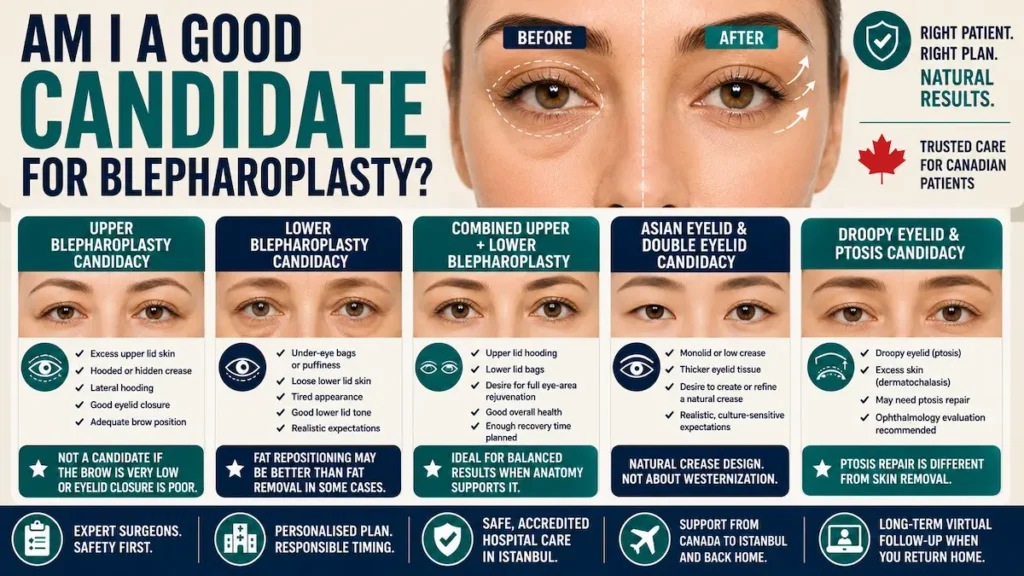
A good blepharoplasty candidate has a clear anatomical concern and realistic expectations. The procedure works well for excess upper eyelid skin, lower eyelid bags, selected under-eye wrinkles, and double eyelid crease creation. It does not replace a brow lift, facelift, skin resurfacing, or treatment for active eye disease.
During your virtual consultation, we review your photos from several angles, ask about dry eye symptoms, previous eye procedures, medications, smoking status, and any history of thyroid or ophthalmologic disease. Canadian patients are also encouraged to speak with their family physician or eye specialist before international surgery when medical eye symptoms are present.
Canadian patients with dry eye, glaucoma, visual field symptoms, thyroid eye disease, or previous eye surgery should consider assessment by an eye-care professional before booking. The Canadian Ophthalmological Society is a useful reference point for understanding ophthalmology standards in Canada.
Upper Blepharoplasty Candidacy
You may be a candidate for upper blepharoplasty if you have excess skin folding over the upper eyelid, a hidden lid crease, or lateral hooding near the outer corner of the eye. Some patients also have small fat bulges near the inner upper eyelid.
The best candidates still have healthy eyelid closure and adequate brow position. If the brow sits very low, removing upper lid skin may not correct the true problem. In that case, a temporal brow lift or endoscopic brow lift may be discussed instead of, or alongside, blepharoplasty.
We also assess how much skin can be safely removed. The eyelids must still close fully after surgery. This protects the cornea and reduces the risk of dryness, irritation, and exposure symptoms.
Lower Blepharoplasty Candidacy
Lower blepharoplasty may be appropriate if you have under-eye bags, puffiness, loose lower eyelid skin, or a tired appearance caused by protruding orbital fat. The lower eyelid is delicate, so patient selection is especially important.
Some patients need fat repositioning rather than fat removal. Removing too much fat can create hollowing and make the under-eye area look older. If the concern is mainly tear trough hollowing without fat bags, fat transfer to the face or filler may be more appropriate than lower eyelid surgery.
Lower eyelid tone also matters. If the lid is loose, a canthopexy or additional lid-support step may be needed to reduce the risk of lower lid pulling, rounding, or ectropion.
Combined Upper and Lower Blepharoplasty Candidacy
Combined blepharoplasty can be a strong option when upper lid hooding and lower lid bags appear together. Treating both areas in one surgical session creates a more balanced rejuvenation and avoids the mismatch of refreshed upper lids with untreated under-eye puffiness.
This approach is often chosen by patients in their 40s, 50s, and early 60s who want a complete eye-area refresh without a full facelift. It can also be combined with facial fat transfer, brow lift, or facelift when broader facial aging is present.
Combination surgery requires careful planning. More procedures do not automatically mean a better result. We only recommend a combined plan when the anatomy supports it and the recovery timeline is appropriate for your return to Canada.
Asian Eyelid and Double Eyelid Candidacy
Asian double eyelid surgery is appropriate for patients who want to create, define, or adjust an upper eyelid crease. It may be considered by patients with a monolid, low crease, asymmetrical crease, or eyelid heaviness related to thicker upper lid tissue.
The ideal candidate understands that the goal is not to Westernize the eye. Crease height, fold depth, and inner corner shape should respect Asian eyelid anatomy. A natural result often depends on conservative planning, especially in patients with thicker eyelid skin or a prominent epicanthal fold.
Asian-Canadian patients should review a surgeon’s double eyelid portfolio carefully. The technique and aesthetic judgment are different from standard upper blepharoplasty.
Droopy Eyelid and Ptosis: Functional vs Cosmetic
A droopy eyelid may be caused by excess skin, true ptosis, or both. Excess skin is called dermatochalasis. True ptosis occurs when the eyelid margin itself sits too low because the lifting mechanism is weak or stretched.
This distinction changes the surgical plan. Standard upper blepharoplasty removes excess skin. Ptosis repair adjusts the levator muscle or related lifting structures. A patient with true ptosis may not improve enough with skin removal alone.
If you suspect ptosis, we may recommend an ophthalmologic assessment before booking surgery. Canadian patients seeking provincial coverage also need documentation, because functional ptosis cases are assessed differently from cosmetic eyelid surgery.
When Blepharoplasty Is Not Recommended
Blepharoplasty may not be recommended if you have severe dry eye, uncontrolled thyroid eye disease, active eye infection, unrealistic expectations, or a history of poor wound healing. Smoking also increases healing risks and should be stopped before surgery according to your surgeon’s instructions.
Patients who want dramatic eye shape change may need a different procedure. Blepharoplasty can refresh the eyelids, but it cannot replace brow repositioning, midface support, or skin resurfacing when those are the main issues.
A safe plan sometimes means saying no. If your anatomy does not support eyelid surgery, we will explain why and discuss alternatives that better match your goals.
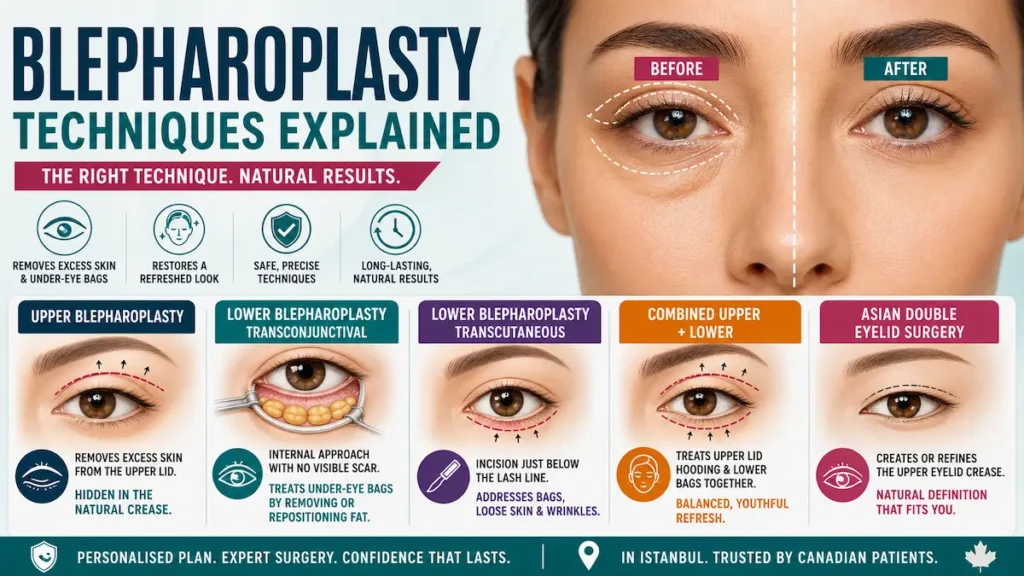
Blepharoplasty Techniques: Upper, Lower, Combined, and Variants
Blepharoplasty is not one single technique. The right approach depends on where the problem sits: upper lid skin, lower lid fat, lower lid looseness, Asian eyelid crease anatomy, or true ptosis. A safe plan starts with diagnosis, not with a standard template.
At AKM Clinic, we assess the eyelids together with the brow, cheek, and orbital support. This prevents a common mistake: treating the eyelid alone when the real concern comes from brow descent, midface hollowing, or lower lid laxity. The most natural results come from correcting the correct layer.
| Technique | Anatomy Addressed | Typical Approach | Scar Profile | Best Candidate | Recovery / Visibility |
|---|---|---|---|---|---|
| Upper Blepharoplasty | Upper lid excess skin, mild fat bulge | Incision hidden in upper eyelid crease | Usually concealed in the natural fold | Hooded upper lids, heavy eyelid skin | Bruising usually improves within 1–2 weeks |
| Lower Blepharoplasty | Under-eye bags, puffiness, loose lower skin | Transconjunctival or transcutaneous | Internal scar or fine lash-line scar | Lower eyelid bags, tired under-eye appearance | Swelling may last longer than upper lid surgery |
| Combined Upper + Lower | Upper hooding and lower bags together | Both upper and lower eyelids treated in one session | Upper crease scar plus internal or lower lash-line scar | Patients needing full eye-area rejuvenation | More bruising than upper-only surgery |
| Asian Double Eyelid Surgery | Monolid or low crease anatomy | Incisional or non-incisional crease creation | Hidden in the designed crease | Asian-Canadian patients seeking natural crease definition | Crease definition evolves as swelling settles |
The Technique Decision Framework
The first decision is anatomical. If the upper lid is heavy, upper blepharoplasty may be appropriate. If the concern is under-eye bags, lower blepharoplasty is more relevant. If both are present, combined surgery may produce better balance.
The second decision is functional. A droopy eyelid may require ptosis repair rather than simple skin removal. A low brow may require brow lift support. A hollow under-eye area may need fat repositioning or facial fat transfer instead of aggressive fat removal.
The third decision is aesthetic. Some patients want a barely noticeable refresh. Others want visible crease creation, especially in double eyelid surgery. We define the goal before choosing the technique.
Upper Blepharoplasty
Upper blepharoplasty removes a measured amount of excess skin from the upper eyelid. The incision is placed in the natural crease, which helps the scar remain discreet once healed. This procedure can restore lid definition and reduce hooding.
Fat may be adjusted if there is fullness near the inner upper eyelid. We avoid excessive fat removal because it can create a hollow, older appearance. The goal is a cleaner lid, not a skeletonized lid.
Upper eyelid surgery is often suitable for patients who feel their eyes look heavy in photos, who struggle with makeup transfer, or who notice skin folding over the mobile lid. If the brow is low, we assess whether a brow lift would give a more anatomically accurate correction.
Lower Blepharoplasty: Transcutaneous Approach
Transcutaneous lower blepharoplasty uses a fine incision just below the lower lashes. This approach allows the surgeon to address loose lower eyelid skin, muscle laxity, and fat bulges through an external incision.
It can be useful for patients with lower eyelid wrinkles or skin excess in addition to under-eye bags. The key is conservative skin removal. Removing too much skin can pull the lower eyelid downward and change the shape of the eye.
Lower eyelid support is carefully assessed before surgery. Some patients may need a canthopexy or other stabilizing step to reduce the risk of lower lid malposition. This is especially important in patients with loose lower lids or prominent eyes.
Lower Blepharoplasty: Transconjunctival Approach
Transconjunctival lower blepharoplasty uses an incision inside the lower eyelid. There is no external skin incision. This technique is often preferred when the main concern is fat bulging rather than loose skin.
Through the internal approach, fat can be removed or repositioned. Fat repositioning can soften the tear trough and reduce the hollow shadow between the eyelid and cheek. This is often more natural than simply removing fat.
This technique is not ideal for every patient. If you have significant loose skin or crepey texture, a skin pinch, laser resurfacing, or another skin-focused treatment may be discussed. The plan depends on skin quality, lid tone, and cheek support.
Combined Upper and Lower Blepharoplasty
Combined upper and lower blepharoplasty treats the full eye area in one surgical session. This can be helpful when upper lid hooding and lower lid bags both contribute to a tired appearance. It also means one anesthesia plan and one recovery period.
Canadian patients often choose this option when they are already travelling internationally and want to avoid returning for a second procedure. Even so, we do not recommend combination surgery just for convenience. It must be anatomically justified.
Combined surgery usually creates more bruising and swelling than upper-only surgery. The early recovery period may look more dramatic, but it can still fit within a carefully planned Istanbul stay and return-to-Canada timeline when the patient is healthy and properly screened.
Laser Blepharoplasty
Laser blepharoplasty usually refers to using a CO2 laser or similar energy device to assist with incision or skin resurfacing. In some patients, laser energy may reduce bleeding or improve fine skin texture around the lower eyelid.
Laser is not automatically better. It is a tool, not a guarantee. The result still depends on diagnosis, tissue handling, eyelid support, and conservative planning.
For patients with fine wrinkles, crepey lower eyelid skin, or mild texture changes, laser resurfacing may be considered as an adjunct. It does not replace surgery when the primary concern is excess skin or protruding fat.
Asian and Double Eyelid Surgery Techniques
Asian double eyelid surgery creates or refines an upper eyelid crease. The two main approaches are incisional and non-incisional. Incisional surgery is usually more durable and allows more control over thick skin or fat. Non-incisional surgery uses sutures to create a crease with less tissue removal.
The best technique depends on eyelid thickness, fat volume, existing crease pattern, and the desired crease height. For some Asian-Canadian patients, the goal is a subtle crease that appears only when the eyes are open. For others, the goal is a more defined fold that supports makeup application.
We plan these procedures conservatively. A crease that is too high can look artificial. A crease that ignores the epicanthal fold can look disconnected from the rest of the eye.
Ptosis Repair vs Cosmetic Blepharoplasty
Ptosis repair and cosmetic blepharoplasty are often confused. In cosmetic upper blepharoplasty, excess skin is removed. In ptosis repair, the eyelid-lifting mechanism is adjusted because the eyelid margin itself sits too low.
If true ptosis is present, removing skin alone may not open the eye enough. The patient may still look asymmetrical or sleepy after surgery. This is why pre-operative measurement is essential.
Canadian patients asking how to qualify for eyelid surgery under provincial coverage should understand this distinction. Functional ptosis or severe visual obstruction may be evaluated differently than cosmetic hooding, but coverage rules vary by province and require medical documentation.
“The most important blepharoplasty decision is not how much skin to remove. It is whether the problem is skin, fat, muscle, brow position, eyelid support, or ptosis.”
Asian Blepharoplasty: Double Eyelid Surgery for Canadian Patients
Asian blepharoplasty, often called double eyelid surgery, deserves its own section because it is not the same procedure as standard upper blepharoplasty. The purpose is not simply to remove loose skin. It is to create or refine an upper eyelid crease in a way that respects Asian eyelid anatomy.
For Asian-Canadian patients from Toronto, Markham, Richmond Hill, Vancouver, Richmond, and other multicultural communities, the goal is often subtle definition. Many patients want eyes that look brighter while still looking like themselves. That balance depends on crease height, fold depth, eyelid thickness, and cultural preference.
Asian Eyelid Anatomy: Monolid, Epicanthal Fold, and Crease Height
Asian eyelid anatomy often includes a lower or absent supratarsal crease, thicker upper lid skin, a fuller preseptal area, and sometimes a more prominent epicanthal fold. These features are normal anatomical variations. They should not be treated as problems to erase.
In double eyelid surgery, the surgeon creates a crease by forming a connection between eyelid skin and deeper lifting structures. The planned crease must match the patient’s natural eye shape. A crease that is too high can look artificial, especially when the eyes are closed.
We evaluate the eyelid with eyes open and closed. This helps us plan a crease that looks natural in conversation, not just in a still photograph.
Double Eyelid Surgery Goals
Patients choose double eyelid surgery for different reasons. Some want a visible crease for makeup application. Others want more symmetry between the two eyes. Some want the upper lid to look less heavy without changing their ethnic identity.
The goal should be defined before surgery. A low, natural crease creates subtle definition. A medium crease may create more visible lid show. A high crease can look dramatic, but it also carries a higher risk of appearing unnatural in patients whose anatomy does not support it.
Our Natural-First approach applies strongly here. We do not design eyelids around trends. We design them around anatomy, family resemblance, and the patient’s preferred level of change.
Incisional Double Eyelid Surgery
Incisional double eyelid surgery uses a fine incision along the planned crease. It allows the surgeon to remove or adjust small amounts of skin, muscle, or fat while creating a durable fold. This option is often preferred when the eyelid is thicker or when the patient wants a more stable long-term crease.
The incision becomes part of the new crease line. Early redness and swelling are normal. Over time, the scar usually fades into the fold, though healing varies by skin type and individual biology.
This technique offers more control, but it also requires careful planning. Over-removal of tissue can create hollowing. A crease placed too high can look surgically obvious. We favour conservative crease design unless the patient’s anatomy clearly supports more visible definition.
Non-Incisional or Suture Technique Double Eyelid Surgery
Non-incisional double eyelid surgery uses buried sutures to create a crease without a full skin incision. It can be appropriate for patients with thinner eyelids, minimal excess skin, and a desire for a lighter change.
The recovery is often shorter than incisional surgery. There is usually less swelling and no full-length crease incision. The trade-off is durability. In some patients, the crease may loosen over time or become less defined.
This option is not ideal for thick eyelids, significant skin excess, or heavy fat pads. In those cases, an incisional technique usually provides better control and longer-lasting structure.
Asian-Canadian Demographic Context
In Canada, double eyelid surgery interest is especially visible in communities with large East Asian and Southeast Asian populations. Many patients from the Greater Toronto Area and Greater Vancouver have already researched clinics in Korea, Japan, Taiwan, or local Canadian private practices before speaking with us.
Travelling to Istanbul is often considered when patients want an experienced surgical setting, transparent pricing, and a broader facial aesthetic programme in one trip. Some patients combine double eyelid surgery with rhinoplasty, facial fat transfer, or skin resurfacing when the anatomy supports it.
We discuss these decisions carefully. Ethnic-specific surgery requires trust. The goal is refinement, not replacement of identity.
Cultural Sensitivity and Identity Preservation
Asian blepharoplasty should never be framed as “making the eyes look Western.” That language is medically imprecise and culturally insensitive. The correct goal is crease definition that fits the patient’s own anatomy.
During consultation, we ask what the patient wants to preserve, not only what they want to change. Some patients prefer a tapered crease that blends into the inner corner. Others prefer a parallel crease with more visible lid show. Both can be appropriate in the right anatomy.
We also explain limits. Surgery cannot make every desired crease shape safe or natural. A responsible surgeon will say no to a plan that risks distortion, hollowing, or long-term dissatisfaction.
“In Asian eyelid surgery, millimetres matter. A small difference in crease height can decide whether the result looks natural, visible, or overdone.”
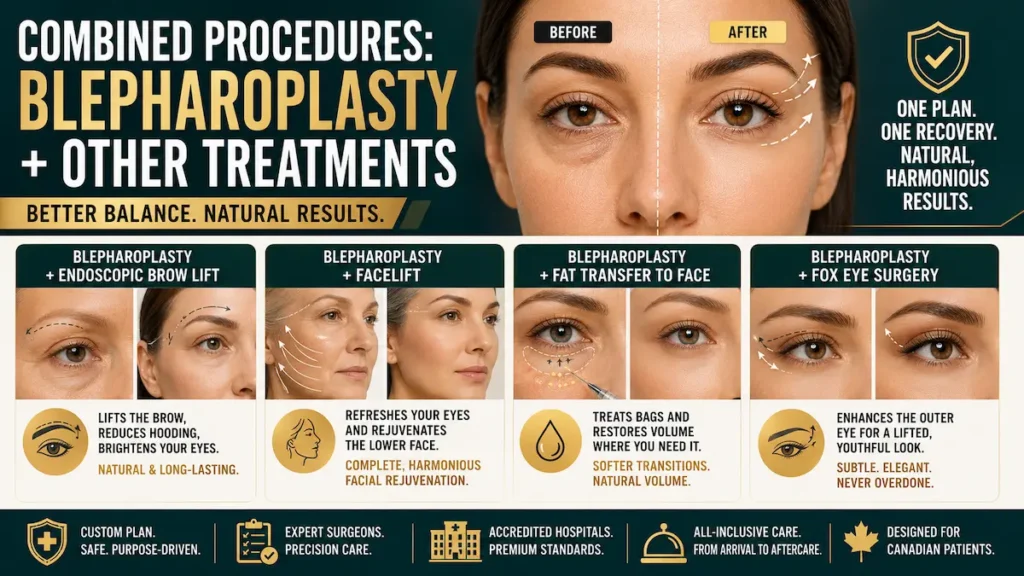
Combined Procedures: Blepharoplasty + Other Treatments
Blepharoplasty can be performed alone or combined with other facial procedures when the anatomy supports it. Combining procedures may create better balance, especially when eyelid aging is connected to brow descent, midface hollowing, or broader facial laxity.
We do not recommend combination surgery just because a patient is travelling from Canada. Each added procedure must have a clear purpose, a safe anesthesia plan, and a recovery timeline that still allows a responsible return flight.
Blepharoplasty + Endoscopic Brow Lift
Some patients think they need upper blepharoplasty when the main problem is actually brow descent. If the brow has dropped, it can push extra skin into the upper eyelid and create heaviness. Removing eyelid skin alone may not solve that problem.
An endoscopic temporal brow lift or lateral brow lift can elevate the outer brow and reduce hooding at the outer upper eyelid. In selected patients, combining brow lift with conservative upper blepharoplasty creates a more natural correction than eyelid surgery alone.
This combination is especially useful when the outer third of the brow has descended and the patient wants brighter eyes without a hollow upper lid. We assess brow position during consultation before recommending any upper eyelid plan.
Blepharoplasty + Facelift
Blepharoplasty treats the eyelids. It does not lift the jowls, neck, cheeks, or lower face. Patients with broader facial aging may benefit from combining eyelid surgery with a facelift or deep plane facelift, depending on their anatomy.
This can create a more complete facial refresh. The eyelids look rested, while the lower face and jawline are repositioned. The goal is harmony, not a collection of separate surgical changes.
Combined facial surgery usually requires more recovery planning than eyelid surgery alone. Canadian patients should allow enough time in Istanbul for early swelling checks and safe fit-to-fly assessment.
Blepharoplasty + Fat Transfer to Face
Under-eye bags and under-eye hollows are not the same problem. Some patients have both. Lower blepharoplasty can address protruding fat, while fat transfer to the face can restore volume in the tear trough, cheek, or midface.
Fat transfer may be useful when the lower eyelid blends into a hollow cheek. In these patients, removing fat alone could make the hollowing worse. Repositioning or adding volume may create a softer result.
We use conservative planning. Too much volume near the eyes can look puffy. Too little support can leave the patient still looking tired. The right approach depends on the eyelid-cheek transition.
Blepharoplasty + Fox Eye Surgery
Fox eye surgery and blepharoplasty are often confused online. Blepharoplasty removes or repositions eyelid tissue. Fox eye or cat-eye procedures aim to lift or change the outer eye angle, often through brow, temple, or canthal support techniques.
Some patients may combine eyelid surgery with lateral brow or temporal lifting when the goal is a more elevated outer eye. This must be planned carefully. Over-lifting can create a stretched or trend-driven look.
Our philosophy remains Natural-First. For patients comparing these options, our fox eye surgery in Turkey guide explains how cat-eye and temporal lift techniques differ from standard blepharoplasty.
Anesthesia for Blepharoplasty: Local and Sedation Options
Blepharoplasty is often performed with local anesthesia and light IV sedation. This approach allows the eyelid area to be numb while the patient remains comfortable and closely monitored. General anesthesia is not always necessary for eyelid surgery, especially for upper blepharoplasty or selected combined cases.
For Canadian patients, this can be reassuring. A lighter anesthesia plan may reduce grogginess, nausea, and recovery burden compared with longer operations under general anesthesia. The final decision depends on the procedure scope, patient anxiety level, medical history, and surgeon-anesthesiologist assessment.
Why Blepharoplasty Usually Does Not Require General Anesthesia
The eyelid is a small, highly localized surgical area. Because the target tissues can be numbed directly, many eyelid procedures can be performed without full general anesthesia. This is common for upper blepharoplasty and selected lower eyelid surgery.
A local-and-sedation approach can support faster early recovery. Patients usually wake with less systemic fatigue than after general anesthesia. This matters for international patients who need to walk, eat, attend follow-up visits, and prepare for a long-haul return flight.
General anesthesia may still be appropriate for longer combined procedures, highly anxious patients, or cases paired with facelift, rhinoplasty, or other larger surgeries. We match the anesthesia plan to the surgical plan.
Local Anesthesia and IV Sedation Protocol
Local anesthesia numbs the eyelid tissues. IV sedation helps reduce anxiety and keeps the patient comfortable. Patients are monitored throughout the procedure, including breathing, oxygen level, heart rhythm, and blood pressure.
The eyelid injection may create temporary pressure or stinging before the area becomes numb. After that, patients should not feel sharp pain. They may feel movement, pressure, or touch. These sensations are expected and manageable.
The anesthesia team adjusts sedation carefully. The aim is comfort, not unnecessary depth. This is especially useful in procedures where the surgeon may need to assess eyelid symmetry during the operation.
What the Awake-Twilight Experience Feels Like
Patients often ask whether they will be fully aware during blepharoplasty. With light sedation, many patients feel relaxed or drowsy and remember little of the procedure. Others remain more aware but comfortable.
You should not feel cutting pain. You may sense cleaning, pressure, or gentle movement. The surgical team communicates clearly and checks comfort throughout the procedure.
Patients with high anxiety should discuss this honestly before booking. A safe experience depends on matching the anesthesia plan to the patient’s emotional and medical profile. If local anesthesia with sedation is not suitable, a different anesthesia plan may be recommended.
Corneal Shields and Eye Protection
Protecting the eye surface is a central part of blepharoplasty safety. Depending on the technique, the surgical team may use lubricating drops, protective ointment, or corneal shields. These measures help protect the cornea during surgery.
After surgery, temporary dryness, watering, or light sensitivity can occur. Patients may be given eye drops or ointment as part of the post-operative instructions. Contact lenses are usually paused during early recovery.
If you already have dry eye, previous LASIK, thyroid eye disease, or a history of corneal problems, tell us before surgery. These details can change the plan and may require ophthalmologic clearance before travelling.
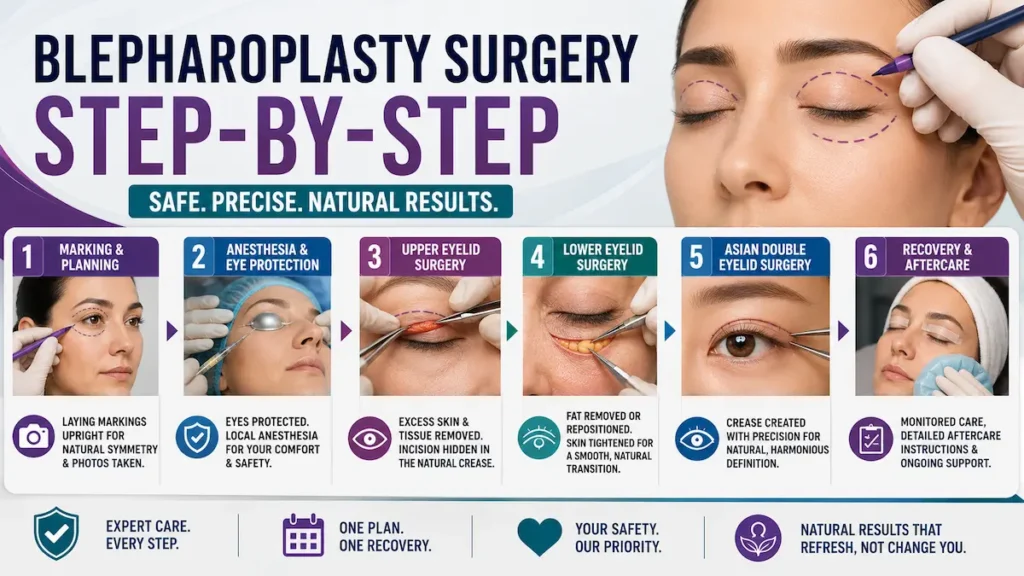
Step-by-Step: What Happens During Blepharoplasty Surgery?
Blepharoplasty is a delicate procedure, but the patient pathway should feel structured and predictable. Before surgery, we confirm the treatment plan, review your medical history, mark the eyelids, and explain what will happen in the operating room. You should never feel unsure about which eyelid areas are being treated.
The sequence changes depending on whether you are having upper blepharoplasty, lower blepharoplasty, combined surgery, or Asian double eyelid surgery. The principle is the same: precise planning, conservative tissue handling, and careful closure. Small differences matter around the eyes.
Pre-Operative Marking and Photographic Documentation
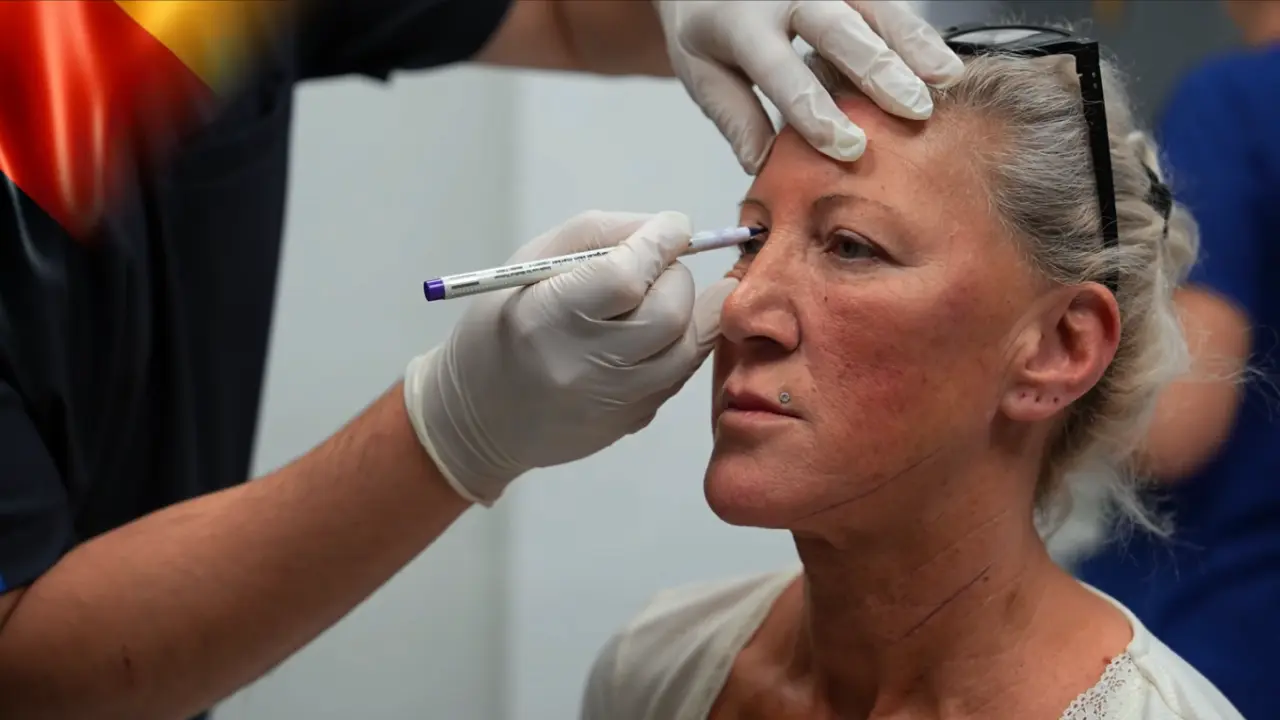
Before surgery, your surgeon marks the eyelids while you are upright. This is important because the eyelids, brows, and under-eye tissues shift when you lie down. Marking in a sitting position helps preserve natural symmetry and prevents over-removal.
For upper blepharoplasty, the surgeon marks the new or existing eyelid crease and the amount of skin that can be safely removed. For lower blepharoplasty, the markings may include fat bulges, tear trough hollowing, and areas of skin laxity. For Asian double eyelid surgery, crease height and shape are planned with extra precision.
Photographs are taken for medical documentation. These images help confirm the treatment plan, track healing, and compare results over time. We use this step as part of a transparent surgical record.
Eye Protection and Local Anesthesia Infiltration
Once you are in the operating room, the eyelid area is cleaned and prepared. The surgical team protects the eyes with lubricating drops, ointment, shields, or other measures depending on the technique. Safety around the cornea is non-negotiable.
Local anesthesia is then injected into the eyelid tissues. You may feel a short sting or pressure during this step. Once the anesthetic takes effect, the area becomes numb, and the procedure can begin comfortably.
Patients receiving IV sedation are monitored throughout the surgery. The anesthesia team checks breathing, oxygen saturation, blood pressure, and heart rhythm. The goal is calm comfort with safe, controlled monitoring.
Upper Blepharoplasty Procedural Steps
In upper blepharoplasty, the incision is made along the marked upper eyelid crease. The surgeon removes a measured amount of excess skin. In selected cases, a small amount of muscle or fat is adjusted to improve contour.
Conservative planning is essential. The upper eyelid must still close fully after surgery. Removing too much skin can create dryness, irritation, or an unnatural hollow appearance. We prioritize function as much as shape.
After the tissue adjustment is complete, the incision is closed with fine sutures. The scar sits within the natural crease, which helps it fade discreetly as healing progresses.
Lower Blepharoplasty Procedural Steps
Lower blepharoplasty may be performed through an internal transconjunctival incision or an external transcutaneous incision below the lash line. The choice depends on whether the main issue is fat bulging, skin laxity, or both.
If the concern is under-eye bags, fat may be removed conservatively or repositioned into the tear trough. Fat repositioning can create a smoother eyelid-cheek transition and reduce the hollow shadow that makes the under-eye area look tired.
If loose skin is present, the surgeon may remove a small skin pinch or tighten the lower lid support. Lower eyelid stability is critical. The aim is to refresh the under-eye area without pulling the lid down or changing the eye shape.
Asian Double Eyelid Procedural Steps
In incisional double eyelid surgery, the surgeon makes an incision along the planned crease. Small adjustments may be made to skin, muscle, or fat before the crease is fixed. The incision is then closed so the scar becomes part of the new fold.
In non-incisional double eyelid surgery, sutures are placed through small access points to create a crease without a full incision. This is less invasive, but it may not be suitable for thicker eyelids or significant excess tissue.
Crease design is checked carefully. The surgeon evaluates symmetry, fold height, and how the crease will appear when the eyes are open. Natural Asian blepharoplasty depends on subtle millimetre-level decisions.
Procedure Length and Immediate Observation
Upper blepharoplasty alone may take about 45 to 90 minutes. Lower blepharoplasty or combined upper and lower surgery usually takes longer, often around two to three hours depending on complexity. Asian double eyelid surgery varies by technique.
After surgery, you are monitored during early recovery. The team checks swelling, comfort, vision symptoms, blood pressure, and general stability. Cold compresses and head elevation usually begin early.
Before returning to the hotel, you receive written aftercare instructions. These include eye drop use, sleeping position, activity limits, contact lens restrictions, and warning signs that should be reported immediately.
“Blepharoplasty is measured in millimetres. The safest plan removes enough tissue to refresh the eye, but never so much that closure, moisture, or eye shape are compromised.”
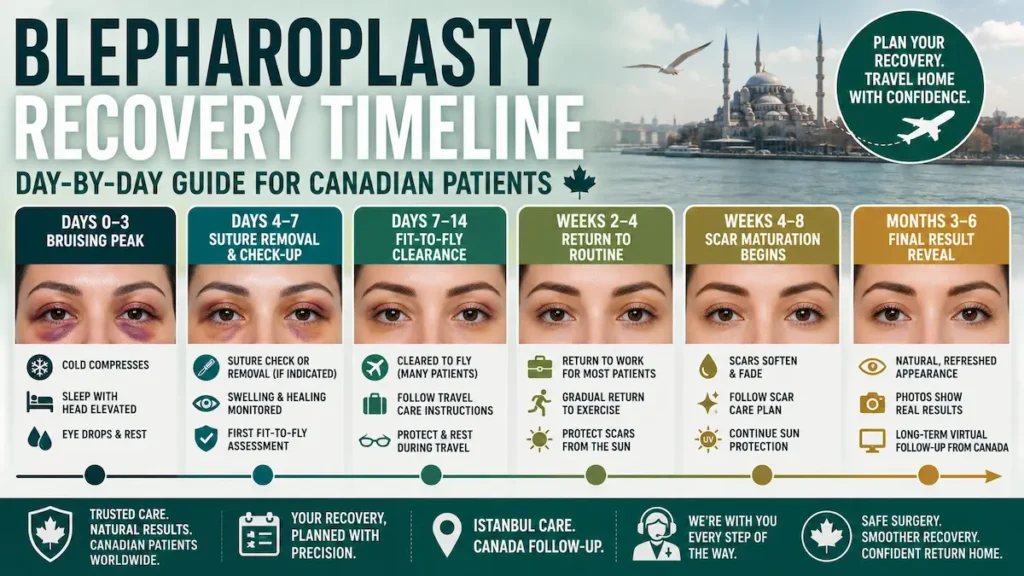
Blepharoplasty Recovery Time: Day-by-Day Timeline for Canadian Patients
Blepharoplasty recovery is usually shorter than larger facial procedures, but the early bruising can look more dramatic than patients expect. The eyelid skin is thin, so swelling and colour changes are visible. This does not mean something is wrong.
For Canadian patients, recovery planning must include two timelines: the medical healing timeline and the travel timeline. We plan your Istanbul stay around suture removal, swelling checks, medication instructions, and fit-to-fly clearance before you return home.
| Recovery Stage | What You May Notice | Care Focus | Travel Relevance |
|---|---|---|---|
| Days 0–3 | Bruising, swelling, tightness, watery eyes | Cold compresses, head elevation, eye drops | Remain near the clinic for early monitoring |
| Days 4–7 | Bruising begins to change colour; swelling still visible | Suture check or removal if indicated | First meaningful fit-to-fly assessment |
| Days 7–14 | Most patients look socially presentable with glasses | Protect scars, avoid strain, continue drops | Many Canadian patients return home in this window |
| Weeks 3–4 | Bruising largely resolved; mild swelling remains | Gradual return to normal routines | Virtual follow-up from Canada begins |
| Months 3–6 | Scars soften; final eyelid definition emerges | Scar maturation and long-term review | Ongoing virtual check-ins as needed |
Days 0–3: Bruising Peak, Cold Compress, and Sleeping Position
The first three days are usually the most swollen. Bruising may appear purple, red, or dark blue. Some patients also experience watery eyes, mild dryness, tightness, or temporary blurred vision from ointment.
Cold compresses are commonly used during early recovery, according to your surgeon’s instructions. Head elevation helps reduce swelling. You should avoid bending forward, heavy lifting, alcohol, smoking, and unnecessary screen strain.
Most patients stay close to the clinic during this period. For international patients, this matters. Early recovery should not happen alone in a rushed travel setting.
Days 4–7: Suture Removal and First Follow-Up
By days four to seven, swelling often begins to soften. Bruising may shift colour as it resolves. Some patients look more swollen on one side than the other; mild asymmetry is common during early healing.
Upper eyelid sutures may be removed during this stage if your surgeon recommends it. Lower eyelid aftercare depends on the technique. Transconjunctival lower blepharoplasty may not have visible external sutures.
This visit is important for Canadian patients because it helps determine whether you are healing normally before your flight. We check eyelid closure, incision condition, swelling, and any dryness or irritation symptoms.
Our HBOT and LLLT Recovery Protocol
We use advanced recovery technologies to support healing after surgical procedures. Hyperbaric Oxygen Therapy, or HBOT, increases oxygen delivery to healing tissues. Low-Level Laser Therapy, or LLLT, uses 424 medical-grade semiconductor laser diodes at 650 nm to stimulate cellular ATP production.
For eyelid surgery, LLLT may be especially helpful because incision quality and scar maturation are important aesthetic details. HBOT can support tissue oxygenation and reduce inflammation, which matters when patients must prepare for long-haul travel back to Canada.
These technologies do not replace careful surgery. They support recovery after careful surgery. Patients who want to understand the science in more depth can review our technology and recovery standards page, along with our guides on LLLT for scar minimization and HBOT recovery benefits.
Day 7–14: Fit-to-Fly Clearance for Canadian Return Travel
Many Canadian patients return home between days seven and fourteen, depending on procedure scope and healing. Upper-only surgery may clear sooner than combined upper and lower blepharoplasty. Lower eyelid work can remain swollen longer.
Before you fly, we assess vision symptoms, eyelid closure, swelling, incision healing, and general comfort. We also review eye drop use, hand hygiene, compression or cold-care instructions, and what to avoid during the flight.
Long-haul travel requires simple planning. Keep eye drops in your carry-on. Avoid rubbing the eyes. Walk periodically during the flight. Wear glasses instead of contact lenses until your surgeon clears you.
For a broader post-surgery travel checklist, patients can review our flight safety after surgery guide.
Photos One Week After Eyelid Surgery: What Is Normal?
One week after eyelid surgery, most patients still have visible bruising. The colour may be yellow, green, purple, or brown depending on skin tone and healing stage. Swelling may also make the eyelids look uneven.
This is normal. One-week photos should not be judged as final results. The eyelids are still settling, and scar lines may look pink or firm. Makeup is usually restricted until your surgeon confirms the incisions are ready.
Patients often feel more comfortable wearing sunglasses or clear glasses during this stage. This provides privacy and protects the eyes from wind, dust, and irritation while walking around Istanbul or returning through the airport.
Week 2–4: Bruising Resolution and Return to Work
By the second to fourth week, most bruising has improved significantly. Some swelling may remain, especially in lower blepharoplasty patients. Upper lid scars may still look pink but are usually easier to conceal once cleared for makeup.
Many patients return to desk work within one to two weeks, depending on their role and comfort being seen on video calls. Patients in public-facing roles may prefer a longer social downtime window.
Exercise should restart gradually. Heavy lifting, intense cardio, hot yoga, and activities that increase facial pressure should wait until your surgeon gives clearance.
Week 4–8: Scar Maturation Begins
During weeks four to eight, scars begin to soften. The eyelids usually feel less tight. Mild swelling may appear worse in the morning and improve during the day.
Scar care depends on the incision type and skin response. We may recommend sun protection, gentle massage only when cleared, and avoiding irritation from harsh skin care products. LLLT may be used to support scar maturation when appropriate.
Canadian winter dryness can irritate healing eyelids. Patients returning to Toronto, Calgary, Winnipeg, or Edmonton during colder months should use approved lubricating drops and avoid direct dry heat exposure when possible.
Month 3–6: Final Result Reveal
Most patients see a meaningful result by three months. The eyelids look more open, the under-eye area appears smoother, and scars are less noticeable. Final refinement continues for several more months.
Lower eyelid swelling can take longer than upper eyelid swelling. Asian double eyelid creases also evolve as swelling decreases and the fold settles into its mature position.
Our long-term virtual follow-up programme includes structured check-ins after you return home. This helps us monitor healing from Canada and answer questions as the result settles.
Safety and Risks of Blepharoplasty
Blepharoplasty is usually a well-tolerated procedure when it is planned conservatively and performed by an experienced eyelid surgeon. Still, the eyelids are delicate. A small surgical error can affect comfort, symmetry, dryness, or eye shape.
We discuss risks directly because Canadian patients deserve clear information before travelling for surgery. A strong consultation should explain what can go wrong, why it happens, how we reduce the risk, and what follow-up looks like after you return home.
Common Side Effects: Bruising, Swelling, Temporary Dry Eye, and Light Sensitivity
Bruising and swelling are expected after blepharoplasty. The eyelid skin is thin, so even a small amount of tissue trauma can create visible colour change. This is usually most noticeable during the first week.
Temporary dry eye, watering, mild irritation, and light sensitivity can also occur. These symptoms often improve as swelling settles and the eyelids regain normal movement. Lubricating drops or ointment may be recommended during early recovery.
Some asymmetry is also normal in the first weeks. One side may swell more than the other. We do not judge the final result during the early healing phase.
Botched Upper Eyelid Surgery: Why It Happens
Botched upper eyelid surgery often comes from over-resection. This means too much skin, muscle, or fat has been removed. The result can be a hollow upper lid, difficulty closing the eye, visible asymmetry, or a surprised appearance.
Over-resection is especially risky when the surgeon treats every patient with the same “skin removal” mindset. A patient with brow descent may look hooded because the brow has dropped, not because the eyelid has too much skin. Removing more eyelid skin does not correct that problem.
Prevention starts with anatomy. We assess brow position, eyelid closure, crease height, skin excess, and fat volume before deciding how much tissue can safely be removed. Conservative planning protects the eye and improves the chance of a natural result.
Botched Lower Blepharoplasty: Ectropion and Round Eye Syndrome
Lower blepharoplasty requires extra caution because the lower eyelid must remain stable against the eye. If too much skin is removed or the lid is not supported properly, the lower lid may pull downward. This is called ectropion.
Another possible problem is round eye syndrome. The eye can look unnaturally rounded or pulled, especially at the outer corner. This usually happens when lower eyelid support, skin tension, or cheek anatomy has been underestimated.
To reduce these risks, we evaluate lid tone before surgery. Some patients may need a canthopexy or another support technique. Others may be better suited to transconjunctival lower blepharoplasty, fat repositioning, or a non-skin-removal approach.
Asymmetric Healing and Revision Reality
Human eyelids are not perfectly symmetrical before surgery. They also do not heal at the same speed. Mild asymmetry during recovery is common and often improves as swelling decreases.
Revision may be considered when asymmetry is structural, persistent, and visible after healing is mature. This is not usually decided early. Eyelids can continue to settle for several months.
We document the pre-operative eyelid position carefully so patients understand their starting anatomy. This helps separate surgical asymmetry from natural pre-existing asymmetry that becomes more noticeable after swelling changes.
Lagophthalmos: Incomplete Eyelid Closure
Lagophthalmos means the eyelids do not close fully. It can cause dryness, irritation, tearing, and corneal exposure symptoms. It is uncommon, but it is one of the reasons upper eyelid skin removal must be conservative.
The risk increases when too much upper eyelid skin is removed, when the patient already has dry eye, or when previous eye surgery has affected closure. Patients with thyroid eye disease or prominent eyes need special caution.
During assessment, we check eyelid closure and ask about dryness, contact lens tolerance, previous LASIK, and eye disease history. If closure risk is high, surgery may be modified, delayed, or declined.
Dry Eye Persistence vs Resolution
Some patients have dry eye before surgery. Others develop temporary dryness after eyelid swelling or ointment use. The key question is whether dryness is mild and temporary or part of a more serious baseline eye condition.
Blepharoplasty can sometimes make pre-existing dry eye more noticeable. This is why we ask about artificial tear use, contact lens comfort, screen-related dryness, and previous ophthalmologic diagnoses.
If the dry eye history is significant, we may request an eye specialist assessment before surgery. A careful pre-op screening is safer than trying to manage an avoidable dryness problem later.
How AKM Reduces Risk
Risk reduction begins before the operating room. We use photo analysis, medical history review, medication screening, smoking guidance, and anatomy-based consultation to decide whether blepharoplasty is appropriate.
Our surgical planning is conservative. We do not remove the maximum amount of tissue. We remove the correct amount. Around the eyes, restraint is often the difference between refreshed and overdone.
We also support recovery with structured aftercare, English-language instructions, 24/7 patient coordination, and virtual follow-up after you return to Canada. Patients can also review our broader guide on safety standards for plastic surgery in Turkey before booking.
“The safest blepharoplasty is not the most aggressive one. It is the plan that protects eye closure, tear function, eyelid support, and the patient’s natural expression.”
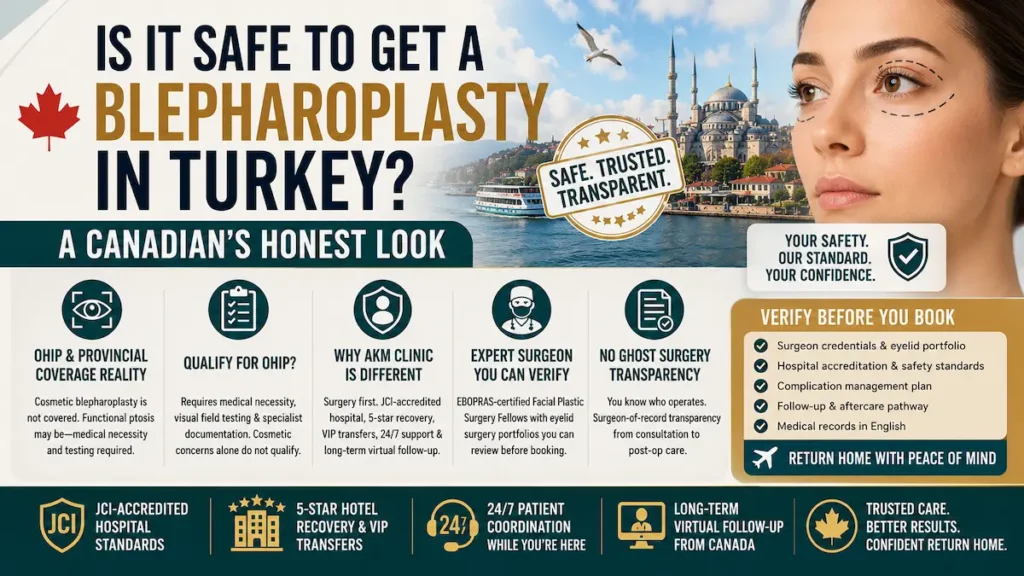
Is It Safe to Get a Blepharoplasty in Turkey? A Canadian’s Honest Look
Canadian patients are right to ask this question. Surgery abroad requires more due diligence than booking a local private clinic. You need to verify who performs the procedure, where it is performed, what standards the facility follows, and how follow-up is handled after you fly home.
Turkey has excellent surgical centres and also high-volume providers that Canadian patients should avoid. The safest choice is not “Turkey” in general; it is a specific clinic, a specific surgeon, a specific hospital environment, and a specific aftercare pathway.
OHIP and Provincial Coverage Reality: Functional Ptosis Only
In Canada, cosmetic blepharoplasty is generally not covered by provincial health plans. OHIP, MSP, AHCIP, RAMQ, and other plans usually consider appearance-only eyelid surgery private-pay care.
Functional eyelid surgery may be considered when the eyelid blocks vision or when true ptosis affects visual function. This usually requires documentation, visual field testing, and specialist assessment. Cosmetic heaviness alone is not enough.
This creates a gap for many Canadian patients. Their eyelids may feel heavy, aged, or visually distracting, but they may not meet the threshold for public coverage. These patients often compare Canadian private fees with international options.
How to Qualify for Eyelid Surgery Under OHIP
OHIP qualification depends on medical necessity, not cosmetic preference. In functional cases, patients may need an ophthalmologist or specialist to document visual obstruction. Visual field testing may be required to show that the upper eyelid blocks sight.
Ptosis measurements may also matter. If the eyelid margin sits too low and affects vision, ptosis repair may be evaluated differently from standard cosmetic upper blepharoplasty.
Patients considering public coverage should speak with their Canadian family physician or eye specialist first. If they do not qualify, private care in Canada or abroad becomes the relevant comparison.
For Ontario patients, functional eyelid surgery coverage depends on medical necessity and documentation. Patients should review current provincial guidance through the Ontario Ministry of Health and speak with their family physician or eye specialist before assuming OHIP eligibility.
Why Most Canadian Cosmetic Candidates Do Not Qualify
Most blepharoplasty patients want to look less tired, reduce hooding, smooth under-eye bags, or define the eyelid crease. These are valid goals, but they are usually cosmetic rather than medically necessary.
That means provincial plans typically do not cover the procedure. A patient may have real frustration and daily self-consciousness but still not meet the functional criteria required for public coverage.
This is one reason Canadian patients research blepharoplasty in Turkey. They are not bypassing medically necessary care. They are often seeking private cosmetic care at a more transparent total cost.
The Turkey Plastic Surgery Concern: How AKM Differs
Many Canadian patients have read negative stories about surgery abroad. The concern is understandable. The most common red flags include unclear surgeon identity, rushed consultation, no hospital accreditation, poor English communication, vague aftercare, and package-first selling.
Our model is different. We build the surgical plan around medical assessment, not volume. Your care pathway includes pre-operative screening, a named clinical team, JCI-accredited hospital infrastructure, 5-star hotel recovery, VIP transfers, 24/7 patient coordination, and long-term virtual follow-up.
We do not present international surgery as casual travel. It is surgery first. The travel support exists to make recovery safer and more organized.
EBOPRAS-Certified Facial Plastic Surgeon Verification
Canadian patients are used to checking credentials through provincial colleges and the Royal College framework. International care requires a different verification process. You should ask what board certifications, fellowships, hospital privileges, and procedural experience the surgeon holds.
At AKM Clinic, our surgical leadership includes European Board-Certified specialists and Facial Plastic Surgery Fellows. We explain how these credentials compare with Canadian expectations, including RCPSC-style structured training and surgical accountability.
Before booking, ask to see the surgeon’s eyelid surgery portfolio. Upper blepharoplasty, lower blepharoplasty, and Asian double eyelid surgery require different judgement. A general aesthetic portfolio is not enough.
Ghost Surgery in Turkey Eyelid Procedures: How to Avoid It
Ghost surgery means the patient believes one surgeon will operate, but another person performs key parts of the procedure. This is a serious concern in international surgery and should be addressed before payment.
Canadian patients should ask direct questions: Who performs the incision? Who removes or repositions the fat? Who closes the eyelid? Who is responsible if a complication occurs? A reputable clinic should answer clearly.
We support surgeon-of-record transparency. The patient should know who is responsible for the operation and how the team is structured. For more detail, see our guide on ghost surgery in Turkey and how to avoid it.
JCI-Aligned Standards and Real-Time Procedure Documentation
Facility quality matters as much as surgeon skill. Eyelid surgery may be shorter than a facelift, but sterile technique, anesthesia monitoring, medication safety, and emergency readiness still matter.
Our procedures are performed within a JCI-accredited hospital environment or aligned clinical pathway, depending on the procedure plan. This gives Canadian patients a recognizable international standard for safety, documentation, and hospital-level processes.
We also provide post-operative instructions and medical records in English. This supports continuity if your Canadian family physician or eye specialist needs to understand what was done.
What Canadian Patients Should Verify Before Booking
Before booking blepharoplasty abroad, verify five things. First, confirm the surgeon’s credentials and eyelid-specific portfolio. Second, confirm where the procedure is performed. Third, ask how complications are managed. Fourth, confirm your follow-up schedule. Fifth, ask what records you receive before returning to Canada.
You should also ask about travel insurance exclusions. Canadian travel insurance often excludes elective cosmetic surgery complications. This does not mean you cannot travel for surgery, but it means you should understand your coverage before departure.
A safe decision is not based on price alone. It is based on surgeon skill, facility standards, transparent communication, aftercare, and a recovery plan that fits your return to Canada.
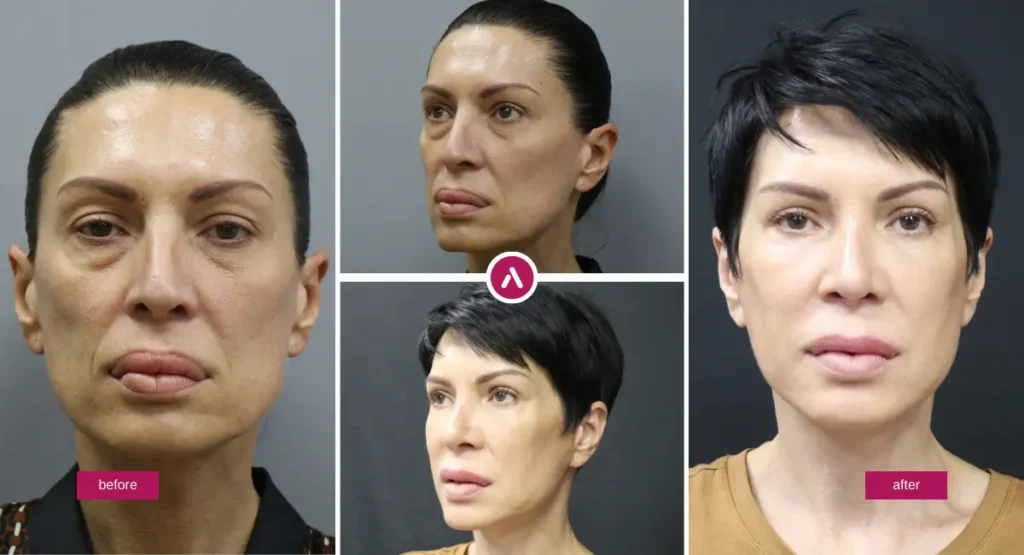
Blepharoplasty Before and After: Realistic Expectations and Results
Blepharoplasty can make the eyes look clearer, lighter, and more rested. It cannot create a completely different face. The best result should look like a refreshed version of you, with eyelids that match your brow, cheek, and natural eye shape.
Results also depend on the type of eyelid surgery performed. Upper blepharoplasty usually changes lid heaviness and crease visibility. Lower blepharoplasty focuses on bags, puffiness, and the eyelid-cheek transition. Asian double eyelid surgery creates or refines a crease, so the result is judged differently.
Upper Blepharoplasty Before and After
Upper blepharoplasty results are usually most noticeable when the eyes are open. Patients often see more visible lid space, less hooding, and a cleaner crease. The eyes may appear brighter because excess upper lid skin no longer casts the same shadow.
Early before-and-after comparisons should be interpreted carefully. At one week, bruising and swelling can make the eyelids look uneven. At one month, the result is clearer. At three to six months, the crease and scar usually look more settled.
A natural upper blepharoplasty does not remove every trace of aging. Some upper lid fullness is normal and youthful. Over-removal can make the eye look hollow or older.
Lower Blepharoplasty Before and After
Lower blepharoplasty results are judged by the smoothness of the under-eye area and the shape of the lower eyelid. A good result softens bags without pulling the eyelid down or creating a rounded appearance.
Patients with fat bulging may see a strong improvement after fat repositioning or conservative fat reduction. Patients with skin texture concerns may need adjunct treatments, such as laser resurfacing, because surgery alone does not erase all fine wrinkles.
The lower eyelid can take longer to settle than the upper eyelid. Swelling may persist for several weeks, especially after combined lower lid support or fat repositioning.
Combined Upper and Lower Before and After
Combined upper and lower blepharoplasty can create a more complete eye-area refresh. This is often a good option when the upper lid looks heavy and the lower eyelid has bags or puffiness. Treating only one area may leave the other looking out of balance.
The trade-off is a more visible early recovery. Bruising can appear above and below the eyes. Patients travelling from Canada should plan enough recovery time in Istanbul before returning home.
Combined results should look balanced, not dramatic. We aim to preserve the natural shape of the eyes while reducing the features that make the face look tired.
Asian Double Eyelid Before and After
Asian double eyelid results are evaluated by crease height, symmetry, fold depth, and how the crease looks with the eyes open and closed. The goal is not simply “bigger eyes.” It is a crease that fits the patient’s anatomy.
Swelling can make the crease look higher in the early weeks. This is common. The crease usually settles lower and softer as inflammation improves. Final judgement should wait until the tissues have matured.
Patients should review before-and-after examples that match their anatomy. A result on a thin eyelid may not predict the result on a thicker eyelid. Ethnic-specific portfolio review is important before booking.
Longevity: How Long Do Blepharoplasty Results Last?
Upper blepharoplasty results often last many years, commonly 8 to 15 years depending on skin quality, brow position, genetics, sun exposure, and aging pattern. If the brow continues to descend over time, upper lid heaviness can gradually return.
Lower blepharoplasty can be longer-lasting when fat bags are corrected appropriately. Fat that has been repositioned or reduced does not usually return in the same way, but the skin and cheek continue to age.
Asian double eyelid longevity depends on technique. Incisional surgery is generally more durable. Non-incisional suture techniques may loosen over time in some patients.
Scar Maturation Timeline
Blepharoplasty scars usually look most visible in the first few weeks. They may appear pink, firm, or slightly raised. This is part of normal healing.
Upper eyelid scars are typically hidden in the crease. Lower transconjunctival scars are internal. Lower transcutaneous scars sit near the lash line and usually fade with time when healing is normal.
Scar maturation continues for months. Sun protection, avoiding irritation, and following your surgeon’s skin care instructions can help. Patients who want to understand scar-support technology can review our LLLT scar minimization guide.
Before and After Gallery
Before-and-after photos help patients understand realistic change. They should be used carefully. The most useful galleries show similar age, skin type, eyelid anatomy, ethnicity, and procedure type.
When reviewing eyelid surgery photos, look for natural eye shape, complete closure, good symmetry, and absence of over-hollowing. For lower eyelid cases, look for a smooth eyelid-cheek transition without downward lid pull.
You can review relevant visual examples through our eyelid surgery before-and-after gallery. During consultation, we will also discuss which examples match your anatomy most closely.
Blepharoplasty Cost 2026: Turkey vs Canada
Canadian patients researching blepharoplasty cost often compare Toronto, Vancouver, Calgary, and Istanbul pricing. In Canada, upper eyelid surgery is usually private-pay unless strict functional criteria are met. Lower blepharoplasty and Asian double eyelid surgery are typically cosmetic and not covered by provincial health plans.
At AKM Clinic, upper blepharoplasty starts at CAD $2,750. Lower blepharoplasty starts at CAD $3,850. The combined upper and lower eyelid surgery package is CAD $5,250, including a 3-night hotel stay in the current package reference.
Canadian private-clinic quotes vary by city, surgeon, facility fees, anesthesia, and whether the case is upper-only, lower-only, or combined. Many patients find that an initial quote does not include every line item. Our pricing is designed to be transparent, with surgical fees, hospital/facility fees, pre-operative tests, 5-star hotel accommodation, VIP transfers, medications, and 24/7 patient advocacy included when quoted as an all-inclusive clinical pathway.
For the complete breakdown, see our blepharoplasty cost guide for Canadian patients. You can also review the upper eyelid surgery package, lower eyelid surgery package, and combined upper and lower eyelid package.
| Location / Programme | Upper Blepharoplasty | Lower Blepharoplasty | Combined Upper + Lower | Typical Inclusions |
|---|---|---|---|---|
| Toronto private clinic | Often CAD $4,000–$7,000 | Often CAD $6,000–$10,000 | Often CAD $9,000–$15,000+ | Usually surgery fee; anesthesia/facility may be separate |
| Vancouver private clinic | Often CAD $4,500–$7,500 | Often CAD $6,500–$11,000 | Often CAD $10,000–$16,000+ | Varies by surgeon and facility |
| Calgary / Edmonton private clinic | Often CAD $3,800–$6,500 | Often CAD $6,000–$9,500 | Often CAD $8,500–$14,000+ | Consultation, anesthesia, and follow-up may vary |
| AKM Clinic Istanbul | CAD $2,750 | CAD $3,850 | CAD $5,250 | All-inclusive clinical pathway when quoted as package |
Canadian city ranges are presented for comparison context. Final domestic quotes vary by surgeon, facility, anesthesia plan, and follow-up structure.
How to Find the Best Blepharoplasty Surgeon in Turkey: A Canadian Patient’s Checklist
Choosing a blepharoplasty surgeon is not the same as choosing a general cosmetic provider. Eyelid surgery requires precision, conservative judgement, and experience with upper lids, lower lids, eyelid support, and ethnic-specific anatomy. A small technical error can affect both appearance and comfort.
Canadian patients often begin by searching for the best blepharoplasty surgeon in Toronto or Vancouver. That is a reasonable starting point. The next step is comparing credentials, procedural focus, facility standards, and total care structure against reputable international options in Istanbul.
The Canadian Society of Plastic Surgeons’ guidance on choosing a surgeon is a useful reference for understanding how Canadian patients evaluate training, scope of practice, and procedure-specific experience.
| Credential / Standard | What It Means | Canadian Reference Point | Why It Matters for Blepharoplasty |
|---|---|---|---|
| EBOPRAS / European Board Certification | Structured specialist training and examination in plastic, reconstructive, or aesthetic surgery | Comparable in purpose to RCPSC-style specialist verification | Shows the surgeon has formal specialist-level training, not only cosmetic branding |
| Facial Plastic Surgery Fellowship | Advanced training focused on face, eyelids, nose, and neck | Comparable to focused facial aesthetic fellowship pathways | Important because eyelids require face-specific anatomical judgement |
| JCI-Accredited Facility | International hospital safety and quality benchmark | Similar patient-safety expectation to accredited Canadian surgical facilities | Supports sterile technique, monitoring, emergency readiness, and documentation |
| Procedure-Specific Portfolio | Before-and-after examples for upper, lower, combined, and Asian eyelid cases | Similar to reviewing a Canadian surgeon’s case gallery | Blepharoplasty outcomes depend heavily on anatomical pattern matching |
EBOPRAS vs RCPSC: Understanding Credential Equivalency
Canadian patients are familiar with RCPSC certification because it is part of the specialist framework in Canada. In Europe and Turkey, the names differ, so the key is to understand equivalency rather than expecting identical acronyms.
European Board Certification, EBOPRAS-related training pathways, and facial plastic surgery fellowships can provide a structured specialist benchmark. They do not replace your own due diligence, but they help separate medically trained specialists from marketing-led cosmetic providers.
Canadian patients can compare international surgical credentials against the specialist certification framework of the Royal College of Physicians and Surgeons of Canada.
When reviewing a clinic, ask for the surgeon’s full name, specialty, board pathway, hospital privileges, and eyelid surgery experience. Avoid vague phrases such as “expert doctor” without credential detail. Our plastic surgeon board certification guide explains the verification framework Canadian patients can use.
Facial Plastic Surgery Sub-Specialization
Blepharoplasty sits at the intersection of cosmetic surgery, facial anatomy, and eye function. A surgeon who performs body contouring well is not automatically the best choice for eyelids. The eyelid margin, tear function, and lower lid support require a different level of precision.
Look for surgeons with focused experience in facial aesthetic surgery. Upper blepharoplasty, lower transconjunctival blepharoplasty, lower transcutaneous blepharoplasty, and Asian double eyelid surgery each require different planning.
At AKM Clinic, our eyelid surgery planning is led by European Board-Certified specialists and facial plastic surgery expertise. We use a Natural-First approach: restore clarity around the eyes without creating a hollow, tight, or operated-on appearance.
Upper vs Lower Portfolio Review
Before booking, review upper and lower eyelid cases separately. A strong upper blepharoplasty result should show a cleaner crease, reduced hooding, and full eyelid closure. It should not show hollowing or an over-exposed upper lid.
A strong lower blepharoplasty result should show smoother under-eye contour while preserving the natural almond shape of the eye. Watch for round eye, lower lid pulling, or unnatural tightness in before-and-after galleries.
Ask whether the surgeon performs fat repositioning, not only fat removal. This matters because under-eye hollowing can worsen if fat is removed too aggressively.
Asian Double Eyelid Portfolio Review
Asian double eyelid surgery should be reviewed with ethnic-specific examples. A standard upper blepharoplasty portfolio does not prove expertise in crease creation for Asian eyelid anatomy.
Look at crease height, symmetry, fold shape, inner corner transition, and whether the result still respects the patient’s ethnic features. A natural double eyelid result should look intentional but not imposed.
During consultation, ask how the surgeon chooses between incisional and non-incisional techniques. The answer should mention eyelid thickness, skin excess, fat volume, crease stability, and the patient’s preferred aesthetic.
Reviews, Documentation, and Canadian Patient Confidence
Patient reviews are useful, but they should not replace medical verification. Look for comments about communication, follow-up, post-operative support, and whether the clinic explained risks clearly. A strong review pattern should describe care, not only compliments.
Our clinic maintains a strong international patient support structure, including 24/7 patient coordination, English-language communication, and long-term virtual follow-up. Canadian patients also have access to our North American support line.
Before booking, ask for written instructions, a clear itinerary, emergency contact details, and medical records in English. A reputable international surgical programme should make these documents routine, not optional.
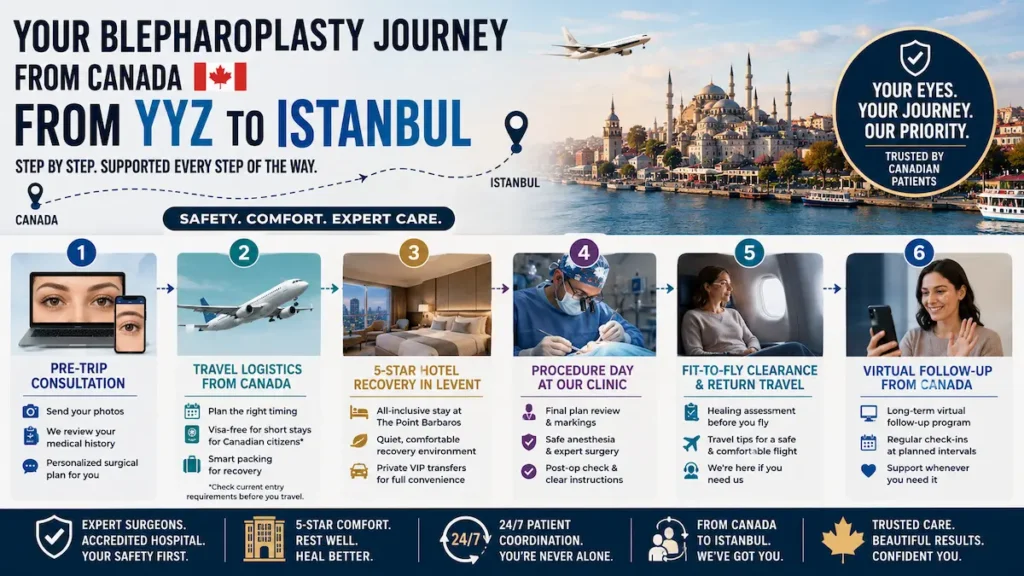
Your Blepharoplasty Journey from Canada: From YYZ to Istanbul, Step by Step
Travelling from Canada for eyelid surgery requires planning, but it should not feel chaotic. The safest pathway is structured before you leave home: virtual consultation, medical screening, surgical plan, travel timing, recovery schedule, and fit-to-fly review.
Our team supports Canadian patients from the first online assessment through the final virtual follow-up. The goal is to reduce logistical stress so you can focus on healing.
Pre-Trip Consultation
Your journey begins with a virtual assessment. You send clear photos of your eyes from the front, side, eyes open, eyes closed, and upward gaze if requested. These help us evaluate upper lid skin, lower lid bags, brow position, under-eye hollowing, and eyelid symmetry.
We also review medical history. Tell us about dry eye, contact lens use, LASIK, thyroid disease, glaucoma, previous eyelid surgery, blood thinners, smoking, allergies, and any ophthalmology diagnoses.
After assessment, we explain whether upper blepharoplasty, lower blepharoplasty, combined surgery, Asian double eyelid surgery, ptosis evaluation, or a non-surgical alternative may be more appropriate.
Travel Logistics: Toronto, Vancouver, Montreal, and Calgary to Istanbul
Canadian citizens can usually enter Turkey visa-free for short stays, but travellers should check current official entry requirements before booking. Flight schedules can change, especially during seasonal travel periods.
Toronto and Montreal often have the most direct Istanbul options. Vancouver and Calgary patients may use one-stop routes depending on airline schedules. We recommend choosing flights that allow enough recovery time in Istanbul before the return trip.
Patients should pack sunglasses, approved lubricating eye drops, a clean hat, button-front clothing, and printed medical documents. Avoid packing contact lenses as your early recovery plan. Glasses are safer until your surgeon clears contact lens use.
5-Star Hotel Recovery Stay in Levent
After arrival, your recovery is organized around comfort and proximity to clinical care. Our all-inclusive clinical pathway may include accommodation at The Point Barbaros, our 5-star partner hotel in the Levent district, depending on the package quoted.
For eyelid surgery patients, hotel recovery should be quiet and simple. You will need a clean environment, head elevation, easy access to cold compress instructions, and the ability to rest without unnecessary activity.
Private VIP transfers help reduce friction between airport, hotel, clinic, and follow-up visits. You should not need to navigate Istanbul alone while swollen or tired after surgery. Our patient journey and hotel and VIP transfers pages explain the support structure in detail.
Procedure Day at Our Istanbul Clinic
On procedure day, you meet the clinical team, review the treatment plan, and complete final markings. If anything has changed since the virtual consultation, the surgeon discusses it before surgery begins.
The procedure may be performed under local anesthesia with sedation or another anesthesia plan, depending on your case. Upper-only eyelid surgery is usually shorter. Combined or lower eyelid work may require more time.
After surgery, the team checks your comfort, vision symptoms, swelling, and early healing. You receive written instructions before returning to the hotel with your coordinator’s support.
Fit-to-Fly Clearance and Return Travel
Before you fly back to Canada, we assess your healing. We check incision condition, swelling, bruising, eyelid closure, dryness symptoms, and your ability to manage aftercare independently during travel.
Most patients should avoid rushing home immediately after surgery. The first follow-up matters. Canadian return travel is long, and you need to be stable enough to manage eye drops, avoid rubbing, and rest during the flight.
During the flight, keep medications and drops in your carry-on, wear glasses, avoid alcohol, stay hydrated, and walk periodically. Once home, your virtual follow-up programme continues at planned intervals, with guidance for any concerns that arise.
Frequently Asked Questions (FAQ):
These are the questions Canadian patients most often ask before blepharoplasty in Turkey. The answers below are general educational guidance. Your final plan depends on your anatomy, medical history, eye health, and surgeon assessment.
How long does blepharoplasty surgery take?
Upper blepharoplasty alone often takes about 45 to 90 minutes. Lower blepharoplasty or combined upper and lower eyelid surgery may take two to three hours depending on technique, fat repositioning, and eyelid support needs.
Will I have visible scars after eyelid surgery?
Upper blepharoplasty scars usually sit in the natural eyelid crease. Lower transconjunctival blepharoplasty has an internal incision, so there is no external scar. Lower transcutaneous incisions sit near the lash line and usually fade with time.
How long until I can go back to work?
Many patients return to desk work within one to two weeks. Public-facing work may require more downtime because bruising can remain visible. Remote work is often easier during early recovery, especially for Canadian patients returning home after fit-to-fly clearance.
Can I drive home after the procedure?
No. You should not drive immediately after blepharoplasty, especially if sedation was used or your vision is temporarily blurred from swelling or ointment. At AKM Clinic, private transfers are arranged as part of the all-inclusive clinical pathway when quoted as a package.
Does OHIP, MSP, AHCIP, or RAMQ cover blepharoplasty?
Cosmetic blepharoplasty is usually not covered by Canadian provincial health plans. Functional eyelid surgery may be considered if visual obstruction or true ptosis is documented. Patients seeking coverage should speak with their Canadian family physician or eye specialist before pursuing private treatment.
How much does blepharoplasty cost in Toronto vs Istanbul?
Toronto private-clinic pricing often starts around CAD $4,000–$7,000 for upper blepharoplasty and can rise significantly for lower or combined surgery. At AKM Clinic, upper blepharoplasty starts at CAD $2,750, lower blepharoplasty starts at CAD $3,850, and combined upper and lower eyelid surgery is CAD $5,250 in the current package reference.
Does Canadian travel insurance cover complications from elective eyelid surgery in Turkey?
Many Canadian travel insurance policies exclude elective cosmetic surgery and related complications. You should review your policy before travelling. We also recommend discussing your plan with your family physician and keeping English-language medical records available for continuity of care.
What is the difference between upper and lower blepharoplasty?
Upper blepharoplasty treats excess upper eyelid skin, hooding, and selected fat bulges. Lower blepharoplasty treats under-eye bags, puffiness, and lower eyelid contour. The two procedures address different anatomy and should be planned separately.
Can I get Asian double eyelid surgery as an adult Asian-Canadian?
Yes, adult Asian-Canadian patients may be candidates for double eyelid surgery if their eyelid anatomy supports it and expectations are realistic. The key is culturally sensitive crease design that respects ethnic identity rather than creating an unnatural or Westernized appearance.
How long will my results last?
Upper blepharoplasty results often last 8 to 15 years, depending on skin quality, genetics, brow position, and aging. Lower blepharoplasty can be longer-lasting when fat bags are corrected properly. Aging continues, so results evolve over time.
What happens if my eyelid surgery is botched?
Revision eyelid surgery may be possible, but it should not be rushed. Swelling must settle before the true problem can be assessed. If you are worried about a previous surgery, we review photos, operative history, eyelid closure, dryness symptoms, and lower lid position before giving advice.
Can I combine blepharoplasty with a brow lift or facelift in the same trip?
Yes, some patients combine blepharoplasty with a brow lift, facelift, fat transfer, or skin resurfacing. Combination surgery is recommended only when it improves anatomical balance and remains safe for your health, recovery timeline, and return travel to Canada.
Medical disclaimer: This page is for educational purposes only and does not replace medical advice from a qualified physician. Surgical results, risks, recovery timelines, and candidacy vary by patient. Final recommendations require a direct medical assessment.