




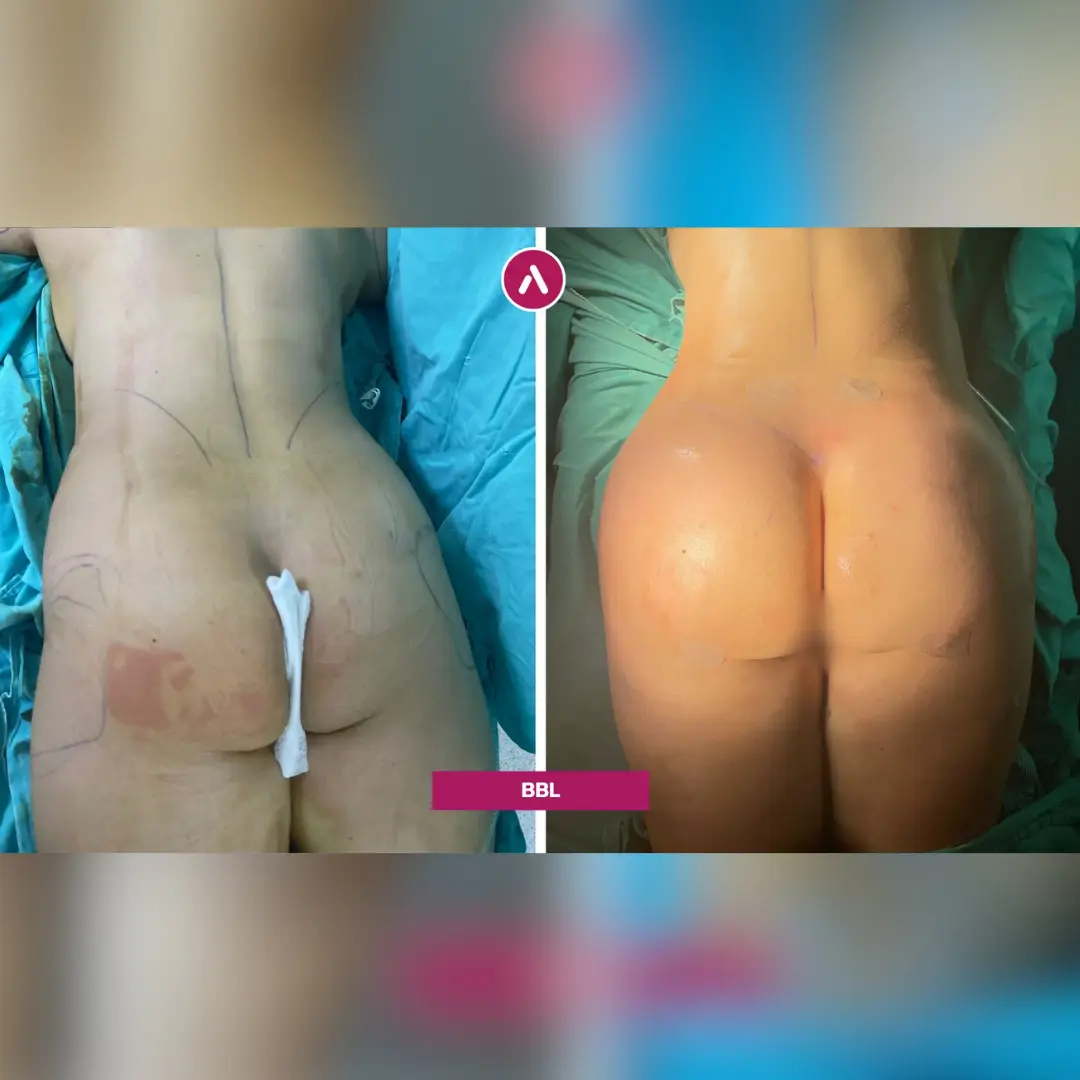
If you want a fuller, shapelier backside but do not have enough body fat for a Brazilian Butt Lift (BBL), butt implants may be the better option. Also called gluteal implants or buttock implants, they use solid silicone implants to add permanent, predictable volume that fat transfer cannot always deliver.
The honest trade-off is important. Butt implants carry different risks than a BBL, including implant shifting, flipping, capsular contracture, infection, and a higher revision risk because the buttocks carry sitting pressure every day.
At AKM Clinic in Istanbul, we help Canadian patients compare butt implants and BBL honestly before recommending either option. Our goal is not to push one technique. It is to choose the safest, most anatomically suitable pathway for your body, your fat availability, and your long-term expectations.
Table of Contents
What Are Butt Implants (Gluteal Implants)?
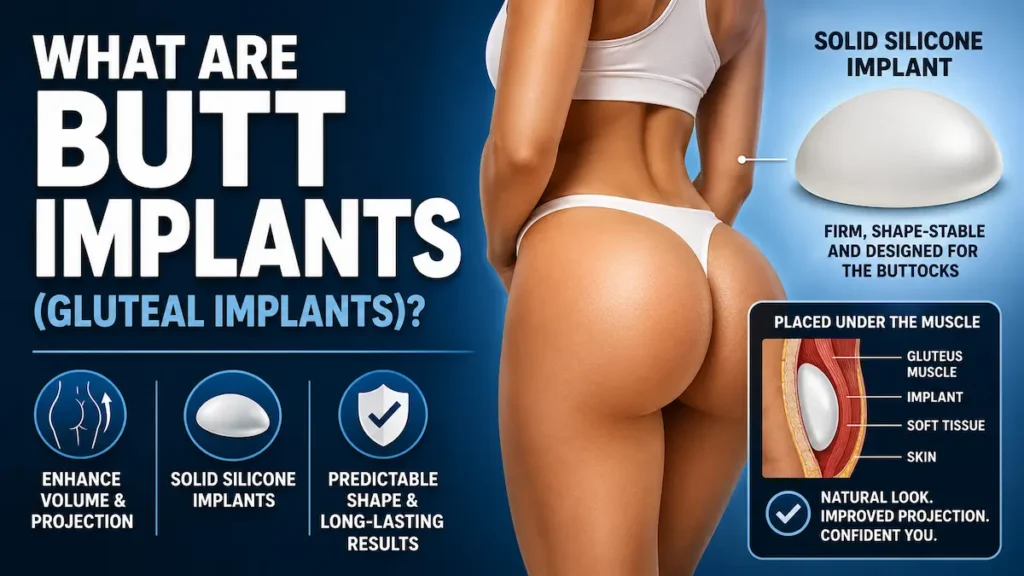
Butt implants are solid silicone implants placed inside the buttock area to increase volume, projection, and shape. They are most often recommended for patients who want gluteal augmentation but do not have enough donor fat for a BBL. Implants create more predictable volume, but they also carry implant-specific risks such as rotation and revision.
How Butt Implants Work
Butt implants work by adding structure rather than transferring fat. During surgery, our surgeon creates a carefully measured pocket in the buttock tissue and places a solid silicone implant to improve projection.
The implant does not rely on fat survival. That is the main difference from a BBL, where some transferred fat naturally reabsorbs after surgery.
For slim or athletic patients, this can be a major advantage. If there is not enough fat on the abdomen, flanks, thighs, or back to harvest safely, implants may provide the volume that fat transfer cannot.
Butt Implants vs Buttock Implants vs Gluteal Implants
Patients often see several names during research:
- Butt implants is the common patient-facing term.
- Buttock implants is a more clinical variation.
- Gluteal implants is the anatomical medical term.
- Gluteal augmentation can refer to implants, fat transfer, or a hybrid approach.
In this guide, we use these terms naturally, but they refer to the same core concept: surgical enhancement of the buttocks using a solid silicone implant.
What Are Butt Implants Made Of?
Butt implants are made from solid silicone. This is different from the cohesive gel used in most modern breast implants.
Solid silicone matters because the buttocks experience pressure from sitting, walking, bending, and exercise. The material must be firm enough to hold shape while still feeling compatible with the surrounding tissues.
Because butt implants are not filled with liquid or gel, they do not “leak” in the way patients sometimes imagine. The main concerns are different: position, pocket stability, infection risk, capsular contracture, and long-term comfort.
Health Canada classifies implants and prosthetics as medical devices and provides safety information for devices placed in or on the body. This is why implant traceability, documentation, and post-operative monitoring matter for Canadian patients reviewing elective implant surgery abroad: Health Canada medical device safety information.
What Do Butt Implants Look and Feel Like?
A well-planned butt implant result should look fuller, balanced, and proportional to your frame. It should not look like a separate object sitting under the skin.
Feel depends on several factors:
- implant size and shape
- implant placement
- soft-tissue coverage
- skin thickness
- whether fat grafting is added around the implant
Patients with very low body fat may feel the implant edges more easily if the implant is too large or placed poorly. This is why we prioritize conservative sizing, pocket control, and proportion planning over oversized volume.
Benefits of Butt Implants
Butt implants are not the right choice for everyone. For the right candidate, they offer advantages that fat transfer cannot always match.
Permanent, Predictable Volume
The biggest benefit is predictability. A solid implant does not reabsorb like transferred fat.
With a BBL, part of the transferred fat survives and part of it naturally disappears during healing. With implants, the volume is more stable because the implant itself remains in place.
This makes butt implants appealing for patients who want a clear, measurable increase in projection.
The Option When You Lack Body Fat for a BBL
Many Canadian patients first ask for a BBL. Then they learn they do not have enough donor fat to create the result they want.
This happens often in slim, athletic, or naturally lean patients. It can also affect patients who have already had liposuction elsewhere.
For these patients, butt implants may be the better anatomical match. They do not require large-volume fat harvesting.
Consistent Shape and Projection
Implants can create defined projection in the central buttock area. This is especially useful when the buttocks are naturally flat, under-projected, or square in shape.
We still plan conservatively. A natural-looking result depends on matching the implant to the pelvis, waist, hips, muscle coverage, and skin quality.
Less Dependent on Weight Fluctuation
Transferred fat behaves like fat elsewhere in the body. It can shrink with weight loss and enlarge with weight gain.
Butt implants are less dependent on weight fluctuation. The surrounding tissue can still change, but the implant volume itself remains stable.
This gives some patients more confidence in the long-term shape.
Can Be Combined with Fat Grafting
Some patients benefit from a hybrid approach. In these cases, the implant provides core projection while small-volume fat grafting softens the edges or improves hip contour.
This can be useful when implants alone would improve projection but not hip dips or lateral contour.
Hybrid planning must be done carefully. It should never be used as an excuse to overfill or overcorrect.
Am I a Good Candidate for Butt Implants?
You may be a good candidate for butt implants if you want more buttock volume but do not have enough donor fat for a Brazilian Butt Lift. This is the most common reason we recommend implants instead of fat transfer.
Good candidacy is not only about wanting a larger shape. It is about whether your anatomy can support an implant safely and whether your expectations match what implants can realistically achieve.
Insufficient Body Fat for a BBL
A BBL requires enough donor fat to harvest through liposuction. The abdomen, waist, flanks, thighs, and back are common donor areas.
If those areas are already lean, a BBL may not create the projection you want. Harvesting too aggressively can also create contour irregularities.
Butt implants solve this problem differently. The implant provides the volume, so the result does not depend on how much fat can be collected.
“The clearest implant candidate is often the patient who wants a BBL but simply does not have enough safe donor fat. In that case, pushing fat transfer can create disappointment. A solid silicone implant may be the more honest option.”
Wanting Permanent, Predictable Volume
Some patients prefer implants because they want a more predictable increase in size. Fat transfer is biological, which means the final result depends on fat survival.
Butt implants are not absorbed by the body. The implant volume remains stable, although your surrounding tissue can still change with weight gain, weight loss, aging, and fitness habits.
This makes implants a stronger option for patients who want more certainty in projection.
Slim or Athletic Builds
Slim and athletic patients often research “skinny BBL” first. That can work when there is enough donor fat and the goal is subtle contouring.
But if the goal is visible volume, a skinny BBL may not be enough. A low-body-fat patient can sometimes achieve better projection with implants.
We still plan carefully. Leaner patients often have less soft-tissue coverage, so implant size, placement, and edge visibility become more important.
Male Candidates and Gluteal Definition
Men can be candidates for butt implants too. The goal is usually different from the feminine hourglass contour many women request.
Male patients often want stronger gluteal projection, better athletic proportion, or correction of a flat lower-body profile. Implant choice and placement must reflect that.
For male body-contouring patients who are also comparing liposuction, our male liposuction guide explains how torso and lower-body contouring can be planned together.
Realistic Expectation Framework
Butt implants can add projection and volume. They cannot fix every lower-body concern on their own.
You may still need fat grafting, liposuction, or skin tightening if you have:
- hip dips that need soft blending
- waist or flank fullness that affects silhouette
- loose skin after major weight loss
- significant asymmetry
- cellulite or skin texture concerns
We assess the whole body contour before recommending implants. A larger implant is not always the better implant.
When a BBL Is Better Instead
A BBL may be better if you have enough donor fat and want a softer, more natural-feeling result. It can also improve the waist, back, and flanks through liposuction at the same time.
Patients with good fat availability and a preference for body-wide sculpting should read our Brazilian Butt Lift in Turkey guide before deciding.
The key point is simple: implants and BBL are not competing trends. They are different tools for different bodies.
Disqualifying Conditions
Butt implants may not be appropriate if your medical risk is too high or if your anatomy cannot support safe placement.
We may recommend delaying or avoiding surgery if you have:
- uncontrolled diabetes
- active infection
- poor wound-healing history
- significant smoking or nicotine use
- unrealistic size expectations
- unstable weight
- insufficient tissue coverage for the desired implant size
Safety comes first. If implants are not right for your body, we will explain why and discuss safer alternatives.
Butt Implants vs BBL: Which Is Right for You?
The most important decision is not “Which procedure is better?” It is “Which procedure fits your anatomy?”
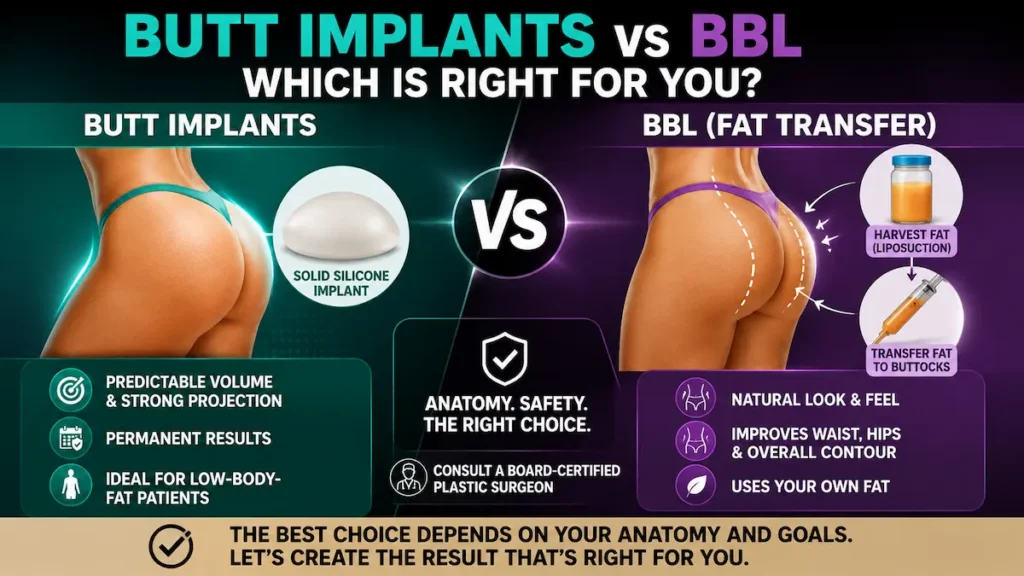
Butt implants use a solid silicone implant. A BBL uses your own fat. Both can improve buttock shape, but they solve different problems.
The Core Difference: Solid Implant vs Your Own Fat
Butt implants add structure. They are best for patients who need volume that their own fat cannot provide.
A BBL reshapes the body by removing fat from one area and transferring it to the buttocks. It is best for patients who have enough donor fat and want contour improvement around the waist and hips.
This is why a consultation must include fat availability, skin quality, pelvic shape, implant safety, and long-term expectations.
When Butt Implants Are the Better Choice
Butt implants may be the better option when you have low body fat, want stronger projection, or have already been told you are not an ideal BBL candidate.
They may also be preferred when you want more predictable volume. A BBL depends on fat survival, while implants provide a fixed volume from the start.
That predictability is the main reason slim Canadian patients often ask about butt implants in Turkey after being told their BBL options are limited at home.
When a BBL Is the Better Choice
A BBL may be better if you have enough fat to harvest and want a softer, more natural tissue feel. It can also refine the waist, flanks, and abdomen through liposuction.
For some patients, the buttock improvement is only half of the result. The waist-to-hip contour matters just as much.
In those cases, fat transfer may produce a more complete silhouette than an implant alone.
Butt Implants vs Fat Transfer: Permanence and Predictability
Implants are more predictable in volume. Fat transfer is more biological and less exact.
After a BBL, some transferred fat survives and some reabsorbs. The final result appears after swelling resolves and the surviving fat stabilizes.
With butt implants, the implant remains in place. The result still changes as swelling settles, but the core volume is not reabsorbed.
Are Buttock Implants Safer Than BBL?
There is no universal answer. The risk profiles are different.
BBL safety discussions often focus on fat embolism risk and the importance of safe fat placement. Butt implant safety focuses on infection, implant rotation, capsular contracture, wound stress, and revision risk.
The American Society of Plastic Surgeons describes buttock enhancement options as including implant-based augmentation and fat grafting, which reinforces the need to compare the methods rather than treat them as the same procedure: ASPS buttock enhancement overview.
A safer choice depends on your anatomy, surgeon experience, facility standards, and whether the clinic recommends the right procedure instead of forcing every patient into the same option.
Hybrid Buttock Augmentation: Implant + Fat Grafting
Some patients benefit from a hybrid approach. The implant creates central projection while fat grafting softens edges, fills hip dips, or improves side contour.
This approach is not for everyone. It still requires enough donor fat for the grafting portion.
When used correctly, hybrid planning can make an implant result look more natural. When overused, it can increase swelling, complexity, and recovery demands.
For a focused decision tree, our BBL implants vs fat transfer guide explains when each option makes more sense.
Decision Table: Butt Implants vs BBL
| Factor | Butt Implants | BBL / Fat Transfer |
|---|---|---|
| Method | Solid silicone implant placed in the buttock area | Liposuction harvests fat, then transfers it to the buttocks |
| Best For | Low-body-fat patients who need predictable volume | Patients with enough donor fat who want natural tissue enhancement |
| Material | Solid silicone implant | Your own fat |
| Permanence | Permanent implant volume, though revision may be needed later | Long-lasting surviving fat, with some early reabsorption |
| Risk Profile | Rotation, flipping, capsule, infection, wound stress, revision | Fat embolism risk, fat loss, asymmetry, contour irregularity |
| AKM Position | Recommended when anatomy supports implant-based augmentation | Recommended when donor fat and safety criteria support fat transfer |
Our recommendation is always anatomy-led. We do not push implants when a BBL is safer, and we do not push BBL when there is not enough donor fat to create the result you want.
What Butt Implants Address
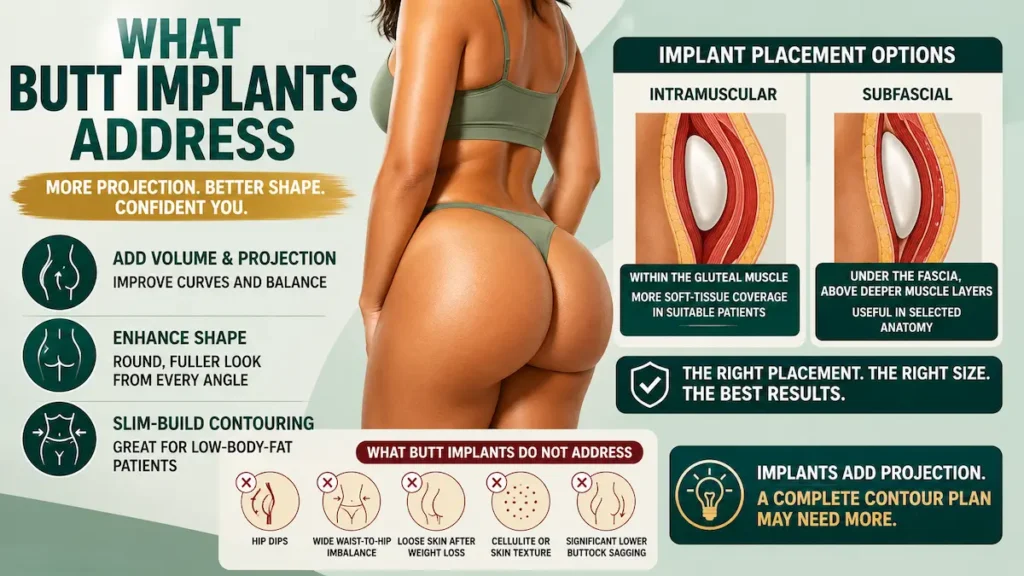
Butt implants primarily address lack of buttock volume and projection. They are not a full lower-body reshaping procedure on their own.
This distinction matters. If you want a fuller buttock but also need waist sculpting, hip-dip blending, or skin tightening, your plan may need more than implants alone.
Lack of Buttock Volume and Projection
The strongest indication for butt implants is under-projection. This means the buttocks look flat from the side or lack the forward-backward volume needed for balance.
Implants can increase central projection in a way that fat transfer may not achieve in low-body-fat patients. This is why they are often considered when a patient has already been told a BBL would be limited.
Projection must still match your frame. Oversized implants can feel less natural and may raise the risk of edge visibility, shifting, discomfort, or revision.
Flat or Square Buttock Shape
Some patients have enough overall body weight but still have a flat or square buttock shape. In these cases, the issue is not only size. It is the distribution of volume.
Butt implants can improve roundness and projection in the central buttock area. They can make the silhouette appear fuller from the side and more balanced from the back.
For some patients, liposuction around the waist or flanks improves the result by making the buttock enhancement look more proportional. That type of contouring is discussed briefly in our liposuction in Turkey guide.
Slim-Build Contouring
Slim patients often need a different strategy. They may not have enough fat for a meaningful BBL, yet they may still want a visible increase in lower-body shape.
For these patients, implants can create the projection that fat grafting cannot. The challenge is tissue coverage.
When body fat is low, the surgeon must be especially careful with implant size and placement. A conservative implant often looks better than an oversized one.
Implant Size and Placement: Intramuscular vs Subfascial
Implant placement affects how the result looks, feels, and ages. It also affects the risk of implant movement.
The two placement concepts Canadian patients most often ask about are:
- Intramuscular placement: the implant is positioned within the gluteal muscle. This can provide more tissue coverage and may reduce visible edges in suitable candidates.
- Subfascial placement: the implant is placed beneath the fascia but above the deeper muscle plane. It may be suitable for selected patients, depending on tissue thickness and surgeon preference.
There is no one placement that is automatically best for everyone. We choose placement based on muscle anatomy, tissue coverage, implant size, desired projection, and safety.
“Implant rotation prevention starts before surgery. The pocket must match the implant, the implant must match the patient, and the size must respect the tissue coverage. Bigger is not safer or better.”
| Placement | Where the Implant Sits | Potential Advantage | Key Consideration |
|---|---|---|---|
| Intramuscular | Within the gluteal muscle | More soft-tissue coverage in suitable patients | Requires precise pocket control and anatomy knowledge |
| Subfascial | Under the fascia, above deeper muscle layers | Can be useful in selected anatomy | May require careful sizing to reduce visibility or movement |
What Implants Do Not Address
Butt implants are not designed to correct every contour concern. They add projection, but they do not automatically create a full hourglass shape.
They may not fully correct:
- hip dips
- wide waist-to-hip imbalance
- loose skin after major weight loss
- cellulite or skin texture changes
- significant lower-buttock sagging
Hip dips often need fat grafting for soft blending. Loose skin may require a lifting or body-contouring procedure instead of, or in addition to, implants.
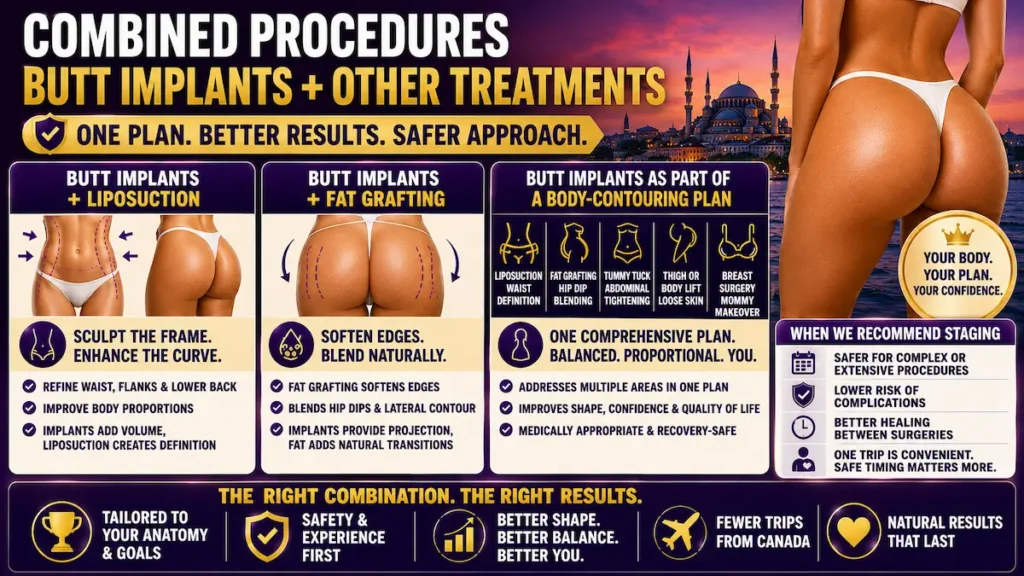
Combined Procedures: Butt Implants + Other Treatments
Butt implants can be performed alone, but some patients need a broader lower-body contouring plan. The best combination depends on your donor fat, waist shape, hip contour, skin quality, and recovery capacity.
Combining procedures can reduce the number of separate trips from Canada. It can also increase surgical time, swelling, and recovery demands, so we only recommend it when the added procedure improves the final plan safely.
Butt Implants + Liposuction
Liposuction can improve the waist, flanks, lower back, or abdomen so the buttock result looks more balanced. This is especially useful when the buttocks need projection and the waist needs definition.
Implants add volume. Liposuction refines the surrounding frame.
This combination can be helpful for patients who do not have enough fat for a full BBL but still have enough localized fat to sculpt the waistline. Our liposuction in Turkey guide explains how body contouring can improve proportion beyond simple fat removal.
Butt Implants + Fat Grafting
Fat grafting can be added around the implant to soften edges, blend hip dips, or improve lateral contour. This is often called hybrid buttock augmentation.
The implant provides the main projection. Fat grafting provides subtle contour blending.
This approach still requires donor fat, so it is not available to every low-body-fat patient. When used appropriately, it can create a softer transition between the implant and surrounding tissue.
Patients comparing this option should also review our BBL in Turkey guide, because the same fat-transfer principles apply.
Butt Implants as Part of a Body-Contouring Plan
Some patients consider butt implants after pregnancy, weight change, or previous body surgery. In these cases, implants may be one part of a wider plan.
A broader body-contouring plan may include:
- liposuction for waist definition
- fat grafting for hip-dip blending
- tummy tuck for abdominal laxity
- thigh or body lift for loose skin
- breast surgery as part of a mommy makeover
A mommy makeover can include body-contouring elements, but butt implants are not automatically included. The combination must be medically appropriate and recovery-safe.
For post-pregnancy planning, our mommy makeover in Turkey guide explains how multiple body zones can be evaluated together.
When We Recommend Staging Instead
Staging means performing procedures in separate operations rather than combining everything in one trip. This can be safer when the total surgery time, swelling, or recovery burden would be too high.
We may recommend staging if you need major liposuction, loose-skin surgery, or a complex revision plan. A staged approach can protect healing and make recovery more manageable.
One trip is convenient. Safe timing matters more.
Anesthesia for Butt Implants: General Anesthesia
Butt implant surgery is performed under general anesthesia. This is not an awake procedure.
The reason is practical and safety-based. The surgery requires controlled positioning, careful pocket creation, sterile implant handling, and a stable operating environment.
Why Butt Implants Require General Anesthesia
Butt implant surgery is usually performed with the patient in a prone position. That means you are lying on your front while the surgeon works on the buttock area.
General anesthesia keeps you still, comfortable, and safely monitored throughout the operation. It also allows the surgical team to work with precision while protecting the sterile field.
For implant-based procedures, movement can affect pocket creation and symmetry. A stable surgical environment matters.
The Canadian Anesthesiologists’ Society explains that general anesthesia involves medications that put the patient into a deep sleep while breathing, heart rate, and other vital signs are monitored throughout surgery. You can review their public explanation here: Canadian Anesthesiologists’ Society: What Is Anesthesia?.
Pre-Anesthesia Assessment for Canadian Patients
Before surgery, we review your health history, medications, allergies, smoking status, previous surgeries, and any anesthesia concerns. You will also complete pre-operative tests.
Canadian patients should disclose:
- heart or lung conditions
- history of blood clots
- sleep apnea
- diabetes or immune conditions
- blood thinners or hormone therapy
- nicotine use, including vaping
We may ask you to coordinate with your Canadian family physician before travel if there are medical concerns. This is especially important if you have a clotting history or chronic disease.
Our Anesthesia and Monitoring Standards
Our surgical planning includes anesthesia safety from the beginning. We do not treat it as a separate afterthought.
During surgery, your anesthesia team monitors vital signs, oxygenation, fluid balance, and recovery readiness. This is part of the reason we use a structured hospital-based protocol rather than a casual procedure-room model.
Our broader safety standards, including sterile protocols and recovery technology, are detailed on our technology and standards page.
Post-Anesthesia Observation Before Hotel Recovery
After surgery, you do not go straight back to the hotel. You are monitored first while the anesthesia wears off and your immediate recovery is assessed.
Our team checks pain control, mobility, wound dressing status, and early signs of nausea or dizziness. You receive instructions before the next stage of recovery.
For international patients, this observation period is important. You need a stable start before returning to a hotel recovery environment.
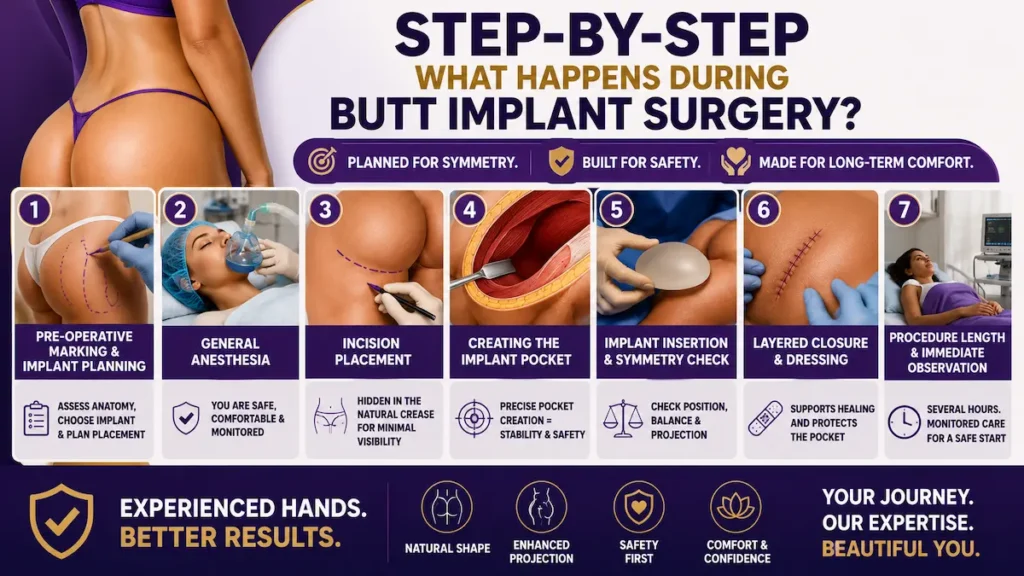
Step-by-Step: What Happens During Butt Implant Surgery?
Butt implant surgery is planned around symmetry, pocket control, implant safety, and long-term comfort. The steps below describe the typical surgical flow.
Your exact technique may vary based on implant size, tissue thickness, and whether liposuction or fat grafting is combined.
Pre-Operative Marking and Implant Planning
Before surgery, our surgeon marks your anatomy while you are standing. This helps assess natural asymmetry, buttock height, crease position, and projection goals.
We review the implant size, placement plan, incision location, and expected shape. This is also the final opportunity to confirm that your goal is proportionate rather than oversized.
Pre-operative photographs are taken for medical planning and documentation.
General Anesthesia
Once you are in the operating room, the anesthesia team prepares you for general anesthesia. Monitoring is started before surgery begins.
You are positioned carefully to protect pressure points. Because butt implant surgery involves the buttock area, positioning must allow surgical access while maintaining safety.
Incision Placement
The incision is usually planned in a hidden area near the natural crease between the buttocks. The goal is to reduce visible scarring while allowing safe implant placement.
Incision planning must balance discretion with sterile access. For implant surgery, a clean operative field is essential.
We avoid making promises that scars will be invisible. The goal is a well-placed, well-healed scar that becomes less noticeable over time.
Creating the Implant Pocket
This is one of the most important steps. The pocket must be the right size and position for the chosen implant.
If the pocket is too loose, the implant may shift. If it is too tight or poorly positioned, the result may feel uncomfortable or look unnatural.
Careful pocket creation also helps reduce rotation risk. This is why butt implant surgery should only be performed by a surgeon experienced in gluteal implant anatomy.
Implant Insertion and Symmetry Check
The implant is inserted using sterile handling protocols. Once placed, the surgeon checks position, symmetry, and projection.
Small differences between the left and right sides are normal in human anatomy. The surgical goal is balanced improvement, not artificial mathematical symmetry.
If fat grafting is part of a hybrid plan, it may be used to soften edges or improve contour transitions.
Layered Closure and Dressing
After the implant position is confirmed, the incision is closed in layers. Layered closure supports healing and helps protect the implant pocket.
A dressing is applied, and you may be placed in a compression garment depending on the surgical plan.
You receive positioning instructions before leaving the monitored recovery area. These instructions matter because early sitting pressure can affect comfort and healing.
Procedure Length and Immediate Observation
Butt implant surgery commonly takes several hours, depending on complexity and whether other procedures are added. Hybrid cases take longer than implant-only cases.
After surgery, you are monitored before returning to hotel recovery. Our team reviews pain control, mobility, wound care, and your first-night instructions.
We do not rush this stage. The first hours after surgery set the tone for a safer recovery.
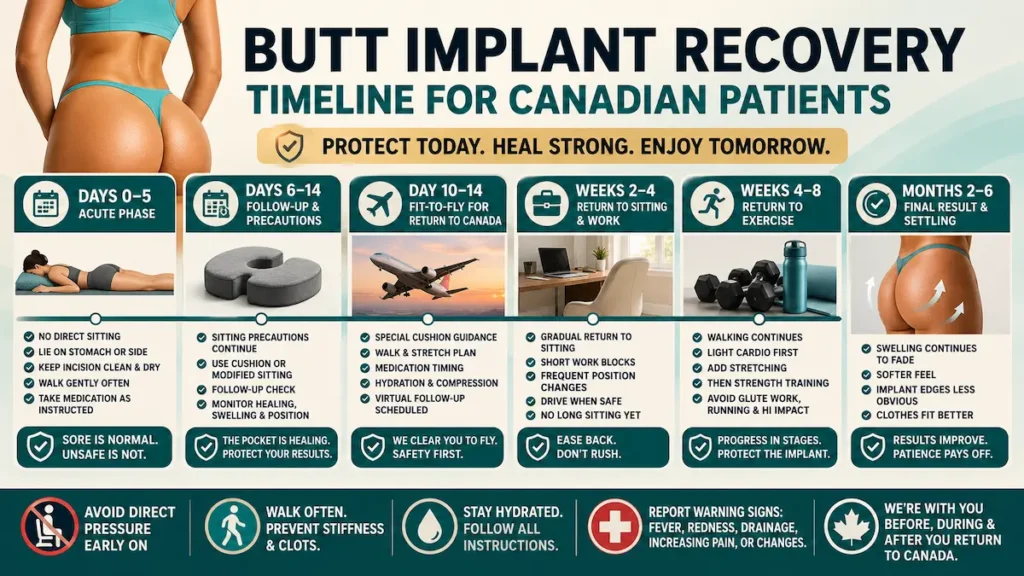
Butt Implant Recovery: Timeline for Canadian Patients
Butt implant recovery is different from many other body procedures because the surgical area is also a sitting area. This affects sleep, travel, work, hygiene, and comfort.
The most important early rule is simple: avoid direct pressure on the implants while the pocket and incision are healing. Your recovery plan will include specific positioning instructions based on your surgery.
Days 0–5: Acute Phase
The first five days are the most restrictive. Swelling, tightness, soreness, and difficulty finding a comfortable position are expected.
You should not sit directly on the buttocks unless your surgeon gives a specific exception. Most patients spend this phase lying on the stomach or side, with short supported walks to reduce stiffness and clot risk.
Your early goals are:
- protect the implant pocket
- avoid direct sitting pressure
- keep the incision clean and dry
- walk gently several times per day
- take medication exactly as instructed
- report unusual pain, fever, drainage, or sudden swelling
Pain management is planned before you leave the monitored recovery area. You should feel sore, not unsafe.
Days 6–14: First Follow-Up and Sitting Precautions Continue
By the second week, many patients feel more mobile. This does not mean the implant pocket is fully stable.
Sitting precautions usually continue. You may be instructed to use special positioning, a cushion, or modified sitting that shifts pressure away from the implant area.
Your first follow-up focuses on:
- incision healing
- swelling level
- implant position
- pain control
- mobility
- fit-to-fly readiness
This is also when many Canadian patients start thinking about the return flight. We do not clear you to fly based only on the calendar. We assess your healing, mobility, pain control, and travel setup.
Our HBOT/LLLT Recovery Protocol
We use recovery support to reduce inflammation, assist tissue healing, and help patients prepare for long-haul travel. For butt implants, incision healing in the gluteal crease is especially important because the area is exposed to movement, moisture, and pressure.
Hyperbaric Oxygen Therapy (HBOT) exposes the body to concentrated oxygen under pressure. This supports oxygen delivery to healing tissues and may help reduce swelling.
Low-Level Laser Therapy (LLLT) uses light energy to support cellular repair. In our broader recovery protocol, LLLT is used to support incision maturation and inflammation control.
Canadian patients who want the full science behind this protocol can read our HBOT recovery guide. Our clinical standards and technology framework are also explained on our technology and standards page.
“Recovery after butt implants is not only about swelling. It is about protecting the implant pocket, protecting the incision, and preparing the patient for safe movement before long-haul travel.”
Day 10–14: Fit-to-Fly Clearance for Canadian Return Travel
Most Canadian patients must plan for a long return flight. Toronto, Montreal, Vancouver, and Calgary routes can involve prolonged sitting, airport walking, and luggage handling.
For butt implant patients, this creates a special challenge. The area that needs protection is the area most affected by the flight seat.
Your fit-to-fly clearance may include:
- special cushion or modified seating guidance
- walking plan during airport transfers
- medication timing for the travel day
- hydration and compression instructions
- clear warning signs to monitor after arrival home
- virtual follow-up scheduling after return to Canada
We also encourage patients to review our flight safety after surgery guide before booking return travel. Flight timing should support your recovery, not compress it.
Weeks 2–4: Gradual Return to Sitting and Sedentary Work
Weeks two to four are usually when patients begin easing back into desk-based life. The return must be gradual.
You may still need modified sitting, frequent position changes, and short walking breaks. Sitting too long too early can increase discomfort and may stress the healing pocket.
If you work remotely in Canada, plan your first week back with flexibility. Shorter work blocks are often easier than a full workday at a desk.
Driving may also be delayed until you can sit safely, react quickly, and no longer need medication that affects alertness.
Weeks 4–8: Gradual Return to Exercise
Exercise returns in stages. Walking is usually encouraged early, but glute-focused workouts, heavy lifting, squats, cycling, running, and high-impact training must wait.
The goal is not to “test” the implant. The goal is to let the pocket mature.
Your surgeon will guide when to resume:
- longer walks
- light cardio
- lower-body stretching
- resistance training
- cycling or spin classes
- glute-focused gym work
Returning too aggressively can increase swelling, discomfort, or implant movement risk. A staged return is safer.
Months 2–6: Final Result and Implant Settling
By months two to six, swelling continues to fade and the implants feel more integrated with surrounding tissue. The result usually looks more settled and less tight.
Patients often notice three changes during this period:
- the buttocks feel softer
- the implant edges feel less obvious
- clothing fit becomes easier to judge
Final settling takes time. Early tightness does not always predict the final feel.
You should still monitor for late concerns, including increasing pain, shifting sensation, new asymmetry, persistent redness, or drainage. Any new change should be discussed with our team promptly.
Safety, Risks, Scars, and Revision Reality
Butt implant surgery can be safe in the right candidate, with the right implant size, the right pocket, and the right surgical environment. It is still an implant-based operation in a high-pressure body area.
That means risk discussion must be direct. We would rather help you understand the trade-offs before surgery than let you discover them after.
Common Side Effects
Common short-term effects include swelling, bruising, tightness, soreness, and difficulty sitting comfortably. These are expected in the early recovery phase.
You may also feel pressure, firmness, or an unfamiliar sensation in the buttocks while the tissues adjust around the implant. This usually improves as swelling decreases.
Temporary numbness or altered sensation can occur near the incision or surrounding tissues. Persistent or worsening symptoms should always be reported.
Implant Rotation or Flipping
Implant rotation or flipping happens when the implant moves inside its pocket. This can affect shape, symmetry, comfort, and confidence in the result.
The risk is reduced through careful pocket creation, conservative implant sizing, and strict early recovery instructions. It cannot be reduced to zero.
This is one reason we do not recommend oversized implants. A pocket under too much pressure is more likely to create problems.
Capsular Contracture
Capsular contracture occurs when scar tissue around an implant tightens more than expected. It can make the buttock feel firm, uncomfortable, or distorted.
This complication is better known in breast implant surgery, but any implant in the body can develop a capsule. The buttock area has its own added challenges because of sitting pressure and movement.
If capsular contracture becomes significant, revision surgery may be needed.
Infection and Wound-Healing Risk
Infection is a serious risk in any implant surgery. It matters even more with butt implants because an infected implant may need to be removed.
The incision location, moisture, friction, and pressure around the gluteal area make hygiene and wound care especially important. Your recovery instructions are not optional.
At AKM Clinic, we use structured sterile protocols, controlled implant handling, and hospital-based surgical standards. You can review our broader safety framework on our technology and standards page.
Sitting-Area Stress and Higher Revision Reality
Butt implants sit in a body area that is constantly used. You sit, walk, climb stairs, bend, sleep, exercise, and travel using the gluteal region.
This daily pressure is why butt implants have a more demanding recovery than many patients expect. It is also why revision risk must be discussed honestly.
Revision may be needed for implant movement, asymmetry, capsule formation, infection, discomfort, size change, or dissatisfaction with shape. A good surgeon reduces risk, but no surgeon can remove it completely.
Butt Implant Scars
The incision is usually placed in a discreet area near the natural crease between the buttocks. This location helps hide the scar when healed.
Hidden does not mean invisible. Scars mature over months and may remain more noticeable in some patients depending on skin type, healing biology, tension, and aftercare.
We support scar healing with careful closure, wound-care guidance, and recovery technology when appropriate. Our HBOT recovery guide explains how oxygen-based support fits into post-operative healing.
Implant Risks vs BBL Risks
Patients often ask whether butt implants are safer than a BBL. The better answer is that they carry different risks.
BBL safety focuses on fat placement technique and avoiding dangerous fat injection planes. Butt implant safety focuses on implant pocket stability, infection prevention, capsular contracture, wound healing, and revision risk.
| Procedure | Main Safety Concerns | What Can Go Wrong | How Risk Is Reduced |
|---|---|---|---|
| Butt Implants | Implant position, infection, capsule, wound stress | Rotation, flipping, capsular contracture, discomfort, revision | Correct pocket creation, conservative sizing, sterile implant handling, sitting precautions |
| BBL / Fat Transfer | Fat placement, fat survival, donor-area contour | Fat embolism risk, fat loss, asymmetry, contour irregularity | Safe fat-plane technique, ultrasound-guided protocols where used, conservative transfer volume, careful liposuction |
| Hybrid Implant + Fat Grafting | Both implant and fat-transfer variables | Swelling, contour irregularity, implant visibility, revision complexity | Careful patient selection, modest grafting, implant-edge blending, staged planning when needed |
We do not frame one procedure as universally safer. We choose based on anatomy, risk profile, and realistic goals.
How We Reduce Risk Through Planning, Placement, and Sterile Protocol
Risk reduction begins before the operating room. We assess your body fat, tissue coverage, pelvic proportions, implant size options, health history, and return-travel plan.
During surgery, risk reduction depends on sterile implant handling, precise pocket creation, and controlled placement. After surgery, it depends on positioning, wound care, walking, and follow-up.
Our team also addresses international-patient safety with structured aftercare. That includes fit-to-fly assessment, 24/7 coordinator access, and virtual follow-up after you return to Canada.
“A safe butt implant result is not only about the implant. It is about the pocket, the tissue coverage, the recovery behaviour, and the surgeon’s willingness to say no when the requested size is not safe.”
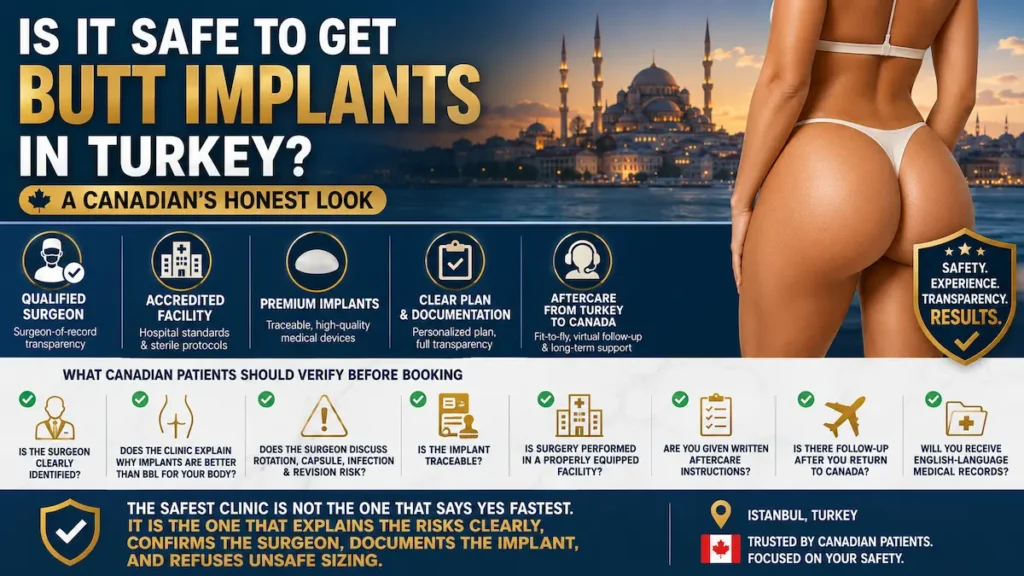
Is It Safe to Get Butt Implants in Turkey? A Canadian’s Honest Look
It can be safe to get butt implants in Turkey if the clinic is properly licensed, the surgeon is qualified, the implant is traceable, and the facility follows strict sterile protocols. The country alone does not make surgery safe or unsafe.
The real question is more specific: who is operating, where the surgery is performed, what implant is used, how your recovery is monitored, and what happens after you return to Canada.
The Turkey Cosmetic Surgery Reality: Why Clinic Selection Matters
Turkey has both highly qualified surgical centres and lower-standard operators. Canadian patients should not treat every clinic as equal.
The risk often comes from poor screening, unclear surgeon identity, high-volume assembly-line care, weak aftercare, or procedures performed in facilities that do not match the complexity of implant surgery.
At AKM Clinic, we position butt implants as a selective procedure, not a routine add-on. If your anatomy is better suited to a BBL, staged body contouring, or no surgery, we will explain that directly.
For a broader safety framework, our plastic surgery in Turkey safety guide explains what Canadian patients should verify before travelling.
Why Surgeon-of-Record Transparency Matters
One of the most important safety questions is simple: who is actually performing your surgery?
In a surgeon-led model, the surgeon who assesses you, plans your operation, and takes responsibility for the result is clearly identified. This matters for butt implants because pocket creation, implant sizing, and placement are surgeon-dependent steps.
Canadian patients are used to provincial accountability through bodies such as CPSO, CPSBC, CPSA, or CMQ. International surgery works differently, so you need clear documentation before you travel.
You should ask for:
- the surgeon’s full name and credentials
- the surgical facility name
- implant details and traceability
- your written surgical plan
- aftercare contact protocol
- what happens if a concern appears after you return home
Our ghost surgery in Turkey guide covers this topic in more detail. It is one of the most important due-diligence steps for international patients.
Implant Brand, Traceability, and Documentation
Butt implants are medical devices. You should know what is being placed in your body.
Before surgery, you should receive clear information about implant type, size, material, and documentation. After surgery, those details should be part of your medical record.
Traceability matters if you ever need future imaging, revision, replacement, or care in Canada. A vague promise is not enough.
We document implant details as part of your surgical record. We also provide English-language medical information so you can share it with your Canadian family physician if needed.
Facility Standards and Sterile Implant Handling
Butt implant surgery should not be treated like a small cosmetic procedure. It is implant surgery in a pressure-bearing area of the body.
The operating environment must support sterile technique, safe anesthesia, controlled implant handling, and proper post-operative monitoring. Small shortcuts can create large consequences.
Our surgery is planned through a hospital-based pathway with structured monitoring and sterile protocols. Our Istanbul clinic page explains the clinical environment, and our technology and standards page outlines our safety systems.
Aftercare From Istanbul to Canada
Aftercare is where many international patients feel most vulnerable. That concern is reasonable.
Butt implant patients need clear guidance on sitting, wound care, walking, travel, warning signs, and follow-up. You also need a way to reach the team after you land in Canada.
Our patient journey includes coordinator support, fit-to-fly assessment, and long-term virtual follow-up at 1, 3, 6, and 12 months. Your follow-up plan is not finished when you leave Istanbul.
You can review the structure of the travel and aftercare process on our patient journey page.
What Canadian Patients Should Verify Before Booking
Before booking butt implant surgery abroad, verify the details instead of relying on social media, influencer photos, or low-friction WhatsApp quotes.
Your checklist should include:
- Is the surgeon clearly identified?
- Does the clinic explain why implants are better than BBL for your body?
- Does the surgeon discuss implant rotation, capsular contracture, infection, and revision risk?
- Is the implant traceable?
- Is surgery performed in a properly equipped facility?
- Are you given written aftercare instructions?
- Is there follow-up after you return to Canada?
- Will you receive English-language medical records?
A trustworthy clinic does not rush these questions. It welcomes them.
“For Canadian patients, the safest clinic is not the one that says yes fastest. It is the one that explains the risks clearly, confirms the surgeon, documents the implant, and refuses unsafe sizing.”
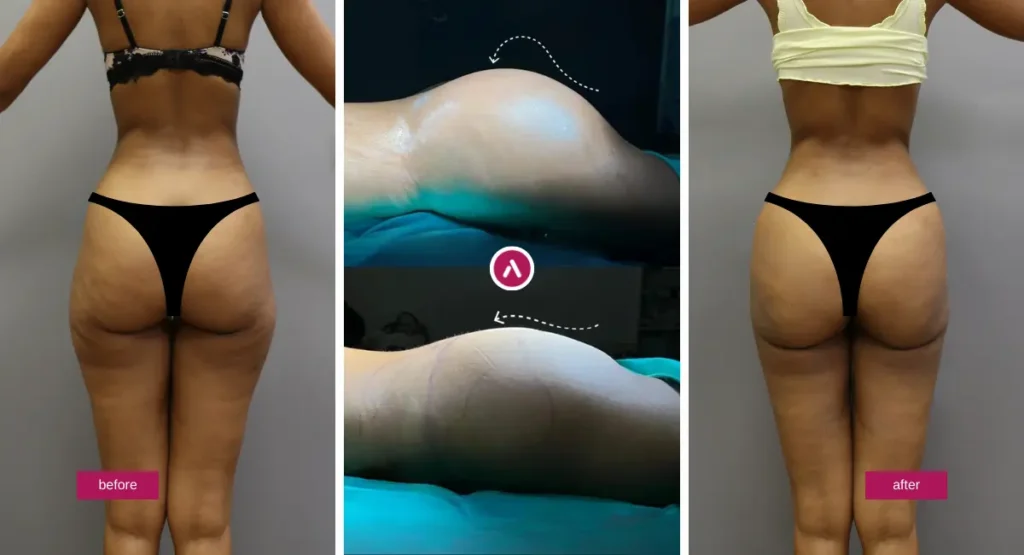
Butt Implants Before and After: Realistic Expectations and Results
Butt implants can create a fuller and more projected buttock shape. The best results look proportionate to your waist, hips, thighs, and overall frame.
The goal is not simply to make the implant as large as possible. It is to create a shape that looks balanced, feels comfortable, and remains manageable in daily life.
Butt Implants Before and After: Realistic Outcomes
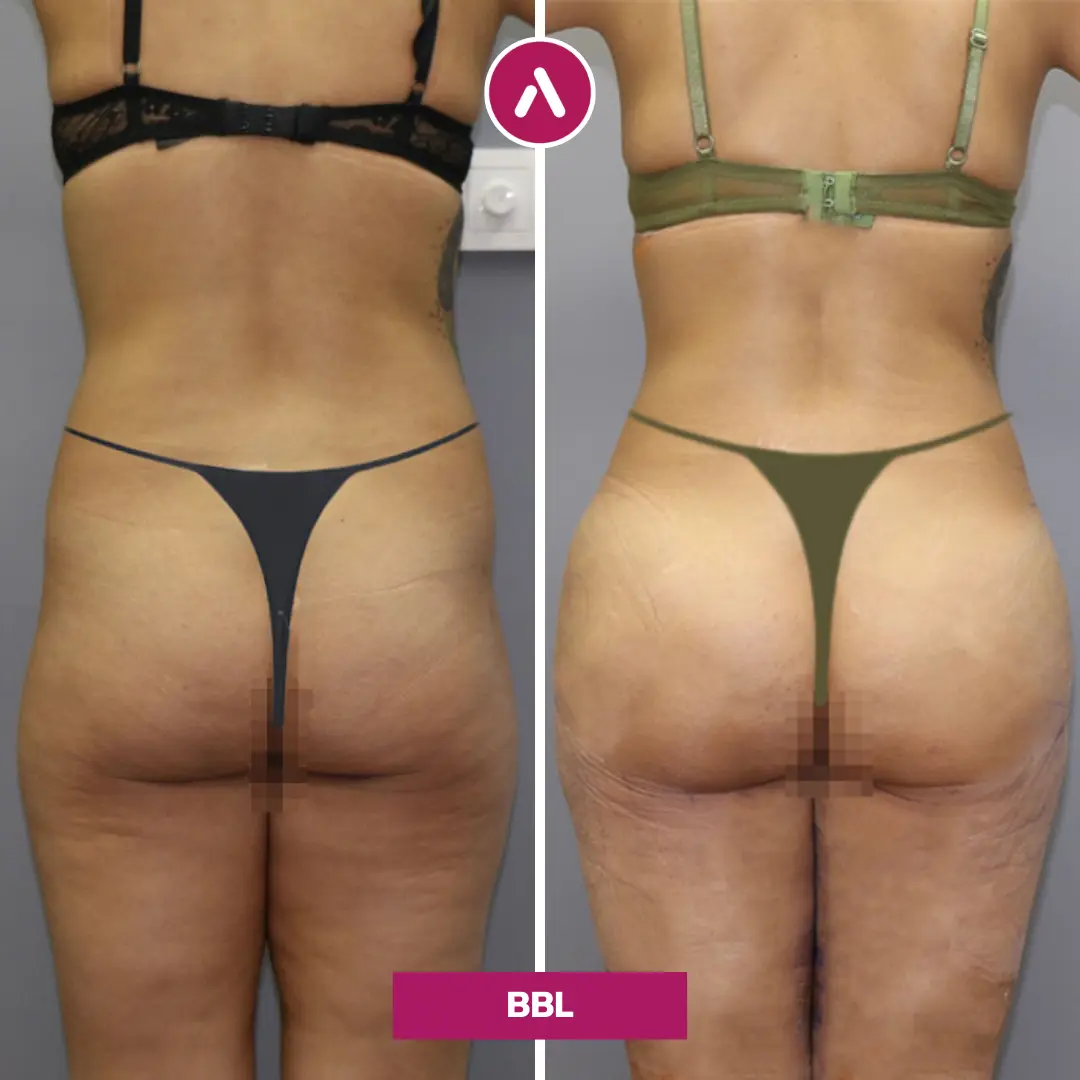
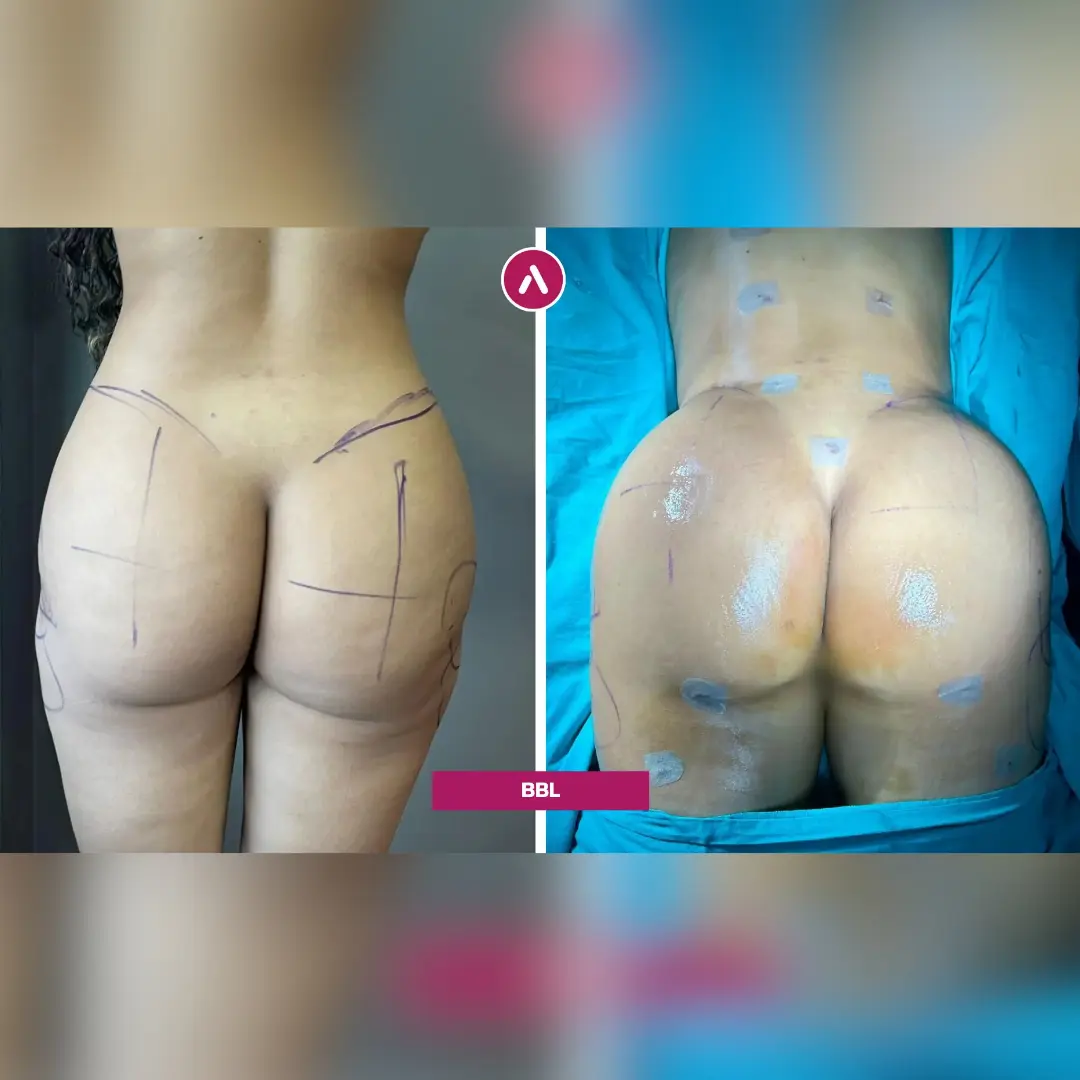
Before and after results usually show improved projection, roundness, and upper-to-mid buttock fullness. Patients with flatter buttocks often notice the biggest change from the side view.
The back view may also look rounder, especially when the implant is matched properly to the pelvis and soft-tissue coverage. If hip dips are a major concern, a hybrid plan with fat grafting may be needed for smoother side contour.
You can review our outcome style through the before and after gallery. During consultation, we use photos to explain what is realistic for your body type.
Implant vs BBL Results: Different Look and Feel
Implants and BBL do not produce the same result. Implants provide structured projection. A BBL provides softer tissue volume using your own fat.
Implants may create more reliable fullness in a slim patient. A BBL may feel more natural in a patient with enough donor fat.
This is why we compare the two options during consultation instead of treating them as interchangeable.
Male vs Female Results
Male and female butt implant goals are often different. Many women request roundness, hip balance, and a fuller silhouette.
Male patients often want gluteal definition, athletic projection, or lower-body proportion. Implant shape and size should reflect that difference.
A masculine result usually avoids excessive lateral roundness. A feminine result may focus more on curve and waist-to-hip balance.
Is It Permanent?
Butt implants create permanent volume because the implant does not reabsorb. That does not mean the result is maintenance-free forever.
Over time, some patients may need revision, replacement, size change, or adjustment. Reasons can include discomfort, implant movement, capsule formation, aging tissue, weight changes, or changing preferences.
Think of butt implants as long-term structural augmentation, not a one-time guarantee that nothing will ever change.
How Implants Settle Over Time
Early results can look tight, swollen, and high. This is normal.
As swelling decreases and tissues relax, the implants usually feel more integrated. Clothing fit becomes easier to judge after the first few months.
Most patients notice meaningful settling between months two and six. Final feel and contour can continue refining beyond that point.
What Implants Cannot Promise
Butt implants cannot promise a specific celebrity body, a perfectly symmetrical shape, or a risk-free result. They also cannot remove loose skin, cellulite, or major waist fullness on their own.
If your goal requires waist narrowing, hip-dip blending, or lower-body skin tightening, we may recommend a combined plan instead of implant-only surgery.
Our role is to tell you what the implant can do and what it cannot do. That honesty protects your result.
Butt Implant Cost 2026: Turkey vs Canada
Canadian patients researching how much butt implants cost often discover two issues at the same time: the procedure is less commonly offered in Canada than BBL, and private quotes can vary widely because gluteal implants require surgeon experience, implant planning, anesthesia, and facility support.
At AKM Clinic in Istanbul, butt implants or gluteal implants are typically quoted at CAD $4,500–$6,500, depending on implant planning, surgical complexity, and whether any contouring is added. A butt implants + liposuction contouring plan may range from CAD $5,800–$8,000, while hybrid implant + fat grafting may range from CAD $6,500–$9,000.
| Location | Typical Butt Implant Cost | Availability Note |
|---|---|---|
| Toronto | CAD $15,000–$18,000 | Limited availability; BBL is more common |
| Vancouver | CAD $16,000–$19,000 | Limited availability; higher private-clinic pricing |
| Montreal | Varies by surgeon and facility | Fewer providers than breast or facial surgery |
| Calgary | Varies by surgeon and facility | Often requires specialist consultation |
| AKM Clinic Istanbul | CAD $7,800–$8,200 | All-inclusive clinical pathway available |
For the full Canadian dollar breakdown, see our butt implants cost guide. You can also review broader procedure combinations through our plastic surgery packages hub.
Canadian-dollar pricing shown for planning clarity; your coordinator will confirm the final payment details before booking.
How to Find the Best Butt Implant Surgeon in Turkey: A Canadian Patient’s Checklist
Finding the right butt implant surgeon is not about choosing the most dramatic before-and-after photo. It is about verifying training, implant experience, safety systems, and honest decision-making.
For Canadian patients, this checklist should feel familiar. It mirrors the way you would assess a surgeon at home, while adapting the questions for international care.
EBOPRAS Certification and RCPSC Equivalency
In Canada, patients often look for Royal College certification or provincial registration through bodies such as CPSO, CPSBC, CPSA, or CMQ. In Turkey and Europe, the credential framework is different.
EBOPRAS certification is one of the European markers Canadian patients can use when comparing training depth. It does not replace Canadian provincial registration, but it helps you understand whether the surgeon has passed structured European plastic surgery standards.
The Royal College of Physicians and Surgeons of Canada explains that FRCSC is the official Fellow designation for surgical specialists in Canada. Canadian patients can use that framework as a familiar benchmark when comparing international credential systems: Royal College official designations.
For a detailed comparison of international credential systems, our plastic surgeon board certification guide explains what Canadian patients should ask before booking abroad.
| Credential | Region | What It Signals | Why Canadian Patients Should Ask |
|---|---|---|---|
| RCPSC | Canada | Canadian specialist certification pathway | Useful benchmark for understanding surgeon training expectations |
| EBOPRAS | Europe | European plastic surgery board-level assessment | Helps compare international surgical qualifications |
| ABPS | United States | American plastic surgery board certification | Another familiar North American comparison point |
Buttock Augmentation Sub-Specialization
“Plastic surgeon” alone is not enough. Butt implants require specific experience with gluteal anatomy, implant pockets, sitting-area recovery, and implant-related complications.
You should ask how often the surgeon performs buttock augmentation, how they choose between BBL and implants, and how they manage revision risk.
Experience matters because the hardest part of butt implant surgery is not inserting an implant. It is creating a stable, safe, well-positioned pocket that respects your tissue coverage.
Honest Implant-vs-BBL Recommendation
A strong surgeon should not push one option for every patient. Some bodies are better suited to BBL. Others are better suited to implants.
During consultation, listen for individualized reasoning. The surgeon should explain:
- whether you have enough donor fat for BBL
- why implants may or may not fit your anatomy
- how implant size affects risk
- whether fat grafting is needed for soft blending
- what result is realistic for your frame
If every patient receives the same recommendation, that is a red flag.
“The best buttock augmentation plan is not implant-first or BBL-first. It is anatomy-first. The safest recommendation is sometimes the one that tells the patient not to choose the procedure they first asked for.”
Implant Brand and Traceability
Butt implants are medical devices. You should receive documentation of what is used in your body.
Ask about implant material, size, shape, manufacturer, and traceability. This information matters if you ever need imaging, revision, or medical review in Canada.
We provide implant documentation as part of your medical record. We also prepare English-language records that you can share with your Canadian family physician or specialist when needed.
Real Patient Reviews and Before-and-After Documentation
Before-and-after photos help, but they should not be your only proof. Look for consistency, natural proportions, and a range of body types.
The Canadian Society of Plastic Surgeons advises patients to verify whether a physician is certified in plastic surgery when choosing a surgeon. That due-diligence principle applies even more when the surgery is performed outside Canada: CSPS tips for choosing a plastic surgeon.
Reviews should speak about communication, recovery support, expectation-setting, and aftercare. These are especially important when you are travelling from Canada.
You can review patient feedback through our professional plastic surgery reviews. During consultation, we also discuss result examples that match your body type and goal range.
Aftercare Continuity from Istanbul to Canada
Aftercare should continue after you board the return flight. This is especially true for butt implant patients because sitting restrictions, incision checks, and implant-position concerns continue beyond the first week.
At AKM Clinic, our patient support includes 24/7 coordinator access and planned virtual follow-up after you return home. You are not left to interpret symptoms alone.
Our North American support line also helps Canadian patients communicate across time zones. You can read more about our care model on our About AKM Clinic page.
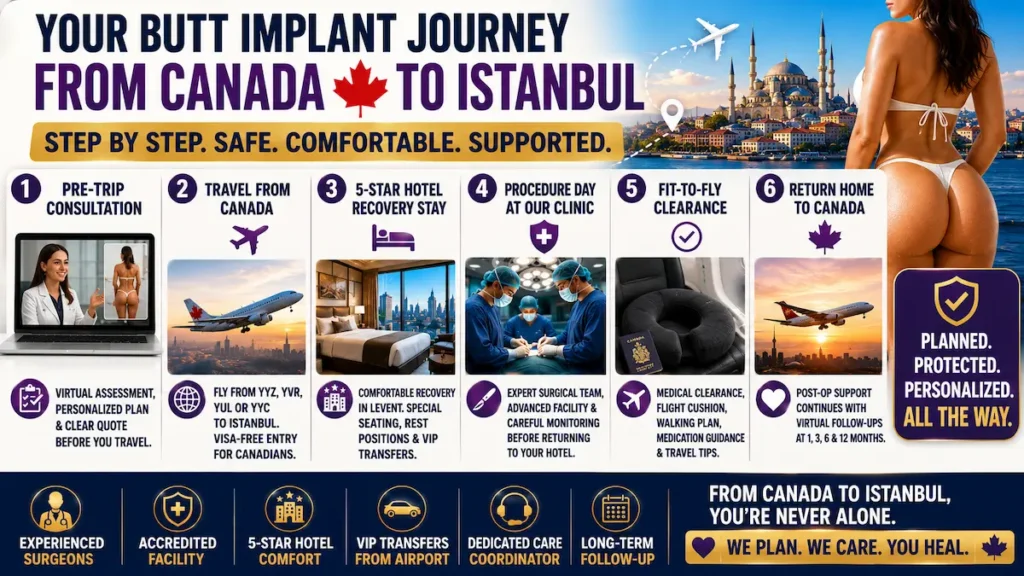
Your Butt Implant Journey from Canada: From YYZ to Istanbul, Step by Step
Travelling from Canada for butt implant surgery requires more planning than many other procedures. The return flight involves sitting precautions, cushioning, mobility planning, and fit-to-fly clearance.
We design the process so you understand each stage before you leave home.
Pre-Trip Consultation
Your first step is a remote consultation. You send photos, medical history, and your goals through a secure communication channel.
We assess your body fat, buttock shape, hip contour, tissue coverage, and whether implants or BBL make more sense. We also ask about prior liposuction, weight changes, and fitness habits.
You receive a tailored clinical recommendation and a clear quote before booking travel. The goal is to reduce uncertainty before you commit to surgery.
Travel Logistics from Toronto, Vancouver, Montreal, and Calgary
Most Canadian patients fly into Istanbul Airport from major hubs such as Toronto, Vancouver, Montreal, or Calgary. Flight routes change, so you should confirm current schedules before booking.
Canadian citizens can typically enter Türkiye visa-free for short stays, but passport validity and airline requirements should always be checked before travel.
Our patient journey page explains how we coordinate airport arrival, clinic scheduling, hotel check-in, and your return timeline.
5-Star Hotel Recovery Stay in Levent
After arrival, you stay in our 5-star partner hotel environment in the Levent district. Comfort matters after butt implant surgery because positioning is part of the recovery plan.
You may need special seating support, modified rest positions, and extra time when moving between the hotel, clinic, and airport.
Our hotels and VIP transfers page explains how private transfers reduce unnecessary walking, stress, and navigation during recovery.
Procedure Day at Our Istanbul Clinic
On procedure day, your surgical markings, implant plan, and anesthesia assessment are reviewed before surgery begins. You meet the team and confirm the final plan.
After surgery, you are monitored before returning to the hotel. We review pain control, dressing care, walking instructions, and sitting restrictions.
You can learn more about the clinical environment on our Istanbul clinic page.
Fit-to-Fly Clearance and Return Travel
Fit-to-fly clearance is not automatic. We assess your incision, swelling, pain control, mobility, and ability to manage the flight safely.
Your return plan may include a special cushion, aisle-seat strategy, walking breaks, hydration, compression guidance, and medication timing.
For butt implant patients, the flight home is part of the medical plan. It should not be treated like an ordinary vacation return.
You can review broader all-inclusive care options through our plastic surgery packages hub, including surgery, hotel coordination, VIP transfers, post-operative support, and follow-up structure.
Butt Implants Frequently Asked Questions (FAQ):
Should I get butt implants or a BBL?
Choose based on anatomy, not trend. Butt implants are often better for low-body-fat patients who want predictable projection. A BBL is often better for patients with enough donor fat who want softer fat-transfer enhancement and waist contouring.
Why would I need implants instead of fat transfer?
You may need implants if you do not have enough safe donor fat for a meaningful BBL. Implants provide volume without relying on fat harvest or fat survival.
Are butt implants safe? Can they flip or move?
Butt implants can be safe in the right candidate, but they can move, rotate, or flip if the pocket, size, tissue coverage, or recovery behaviour creates problems. Careful sizing and precise pocket creation reduce this risk, but no surgery is risk-free.
How long do butt implants last?
Butt implants provide long-term structural volume, but they are not lifetime-guaranteed devices. Revision or replacement may be needed later because of discomfort, implant movement, capsule formation, infection, aging tissue, or personal preference.
Does OHIP, MSP, AHCIP, or RAMQ cover butt implants?
No. Canadian provincial health plans generally do not cover elective cosmetic butt implant surgery. Coverage is usually limited to medically necessary reconstructive care, and buttock augmentation for aesthetic volume is considered private-pay.
Why are butt implants hard to find in Canada?
Butt implants are less commonly offered than BBL in Canada because the procedure requires implant-specific experience, careful pocket control, and management of a more demanding recovery. Some Canadian patients find that few private surgeons in their city offer gluteal implants routinely.
How much do butt implants cost in Canada vs Istanbul?
Toronto private quotes may range from CAD $15,000–$18,000, while Vancouver private quotes may range from CAD $16,000–$19,000. At AKM Clinic in Istanbul, butt implants are typically quoted at CAD $7,800–$8,200, depending on surgical complexity and whether additional contouring is included.
Does Canadian travel insurance cover complications from elective butt implants in Turkey?
Many Canadian travel insurance policies exclude elective cosmetic surgery and complications related to it. You should review your policy carefully before booking and ask the insurer direct written questions.
To reduce this concern, AKM Clinic provides complimentary complication insurance for all patients. This is separate from standard Canadian travel insurance and is designed to add an extra layer of protection around your surgical care. Your coordinator will explain the coverage terms, limits, and required documentation before you confirm your booking.
What are butt implants made of?
Butt implants are made of solid silicone. They are different from gel-filled breast implants and are designed to hold shape under the pressure of the gluteal area.
How long before I can sit normally?
Sitting restrictions vary by patient and surgical plan. Many patients need modified sitting for several weeks, with gradual return based on comfort, incision healing, and surgeon clearance.
Can men get butt implants?
Yes. Male butt implant planning usually focuses on athletic projection and gluteal definition rather than an hourglass silhouette. Implant size, shape, and placement should match masculine body proportions.
Are implants safer than a BBL?
Not universally. Butt implants and BBL carry different risks. Implants involve rotation, flipping, capsule, infection, and revision risk. BBL involves fat-transfer safety, fat survival, and donor-area contour risk. The safer choice depends on your anatomy and surgeon expertise.
Can I combine butt implants with liposuction or fat grafting?
Yes, in selected patients. Liposuction can refine the waist and flanks, while fat grafting can soften implant edges or improve hip contour. Combination surgery must be planned carefully because it increases recovery demands.
Medical Disclaimer: This page is for educational purposes only and does not replace a consultation with a qualified physician or surgeon. Butt implant candidacy, surgical risk, recovery timing, and travel readiness vary by patient. Canadian patients should consider speaking with their family physician before international surgery, especially if they have chronic medical conditions, a clotting history, medication concerns, or prior surgical complications.