
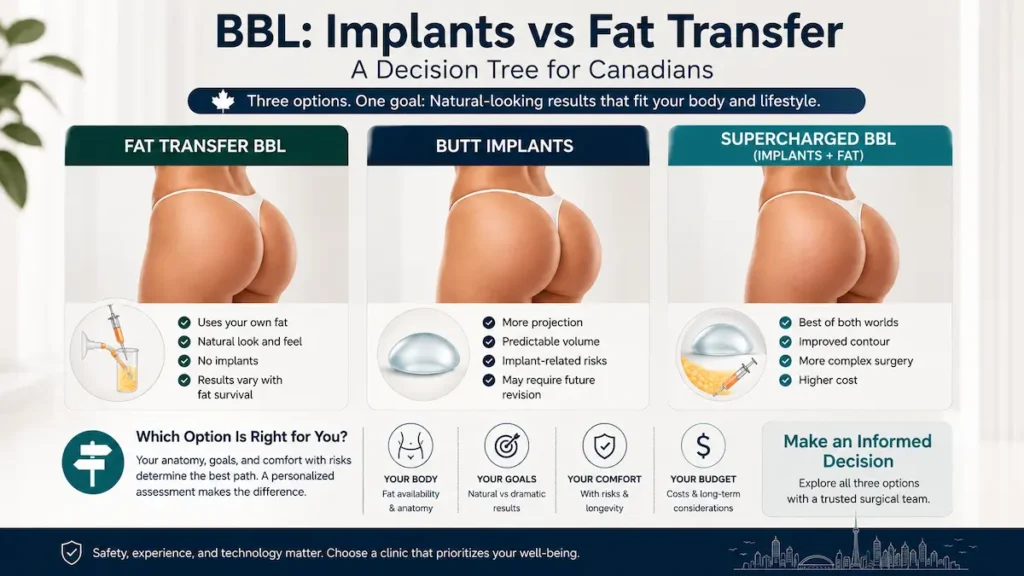
For Canadian patients comparing buttock enhancement options, BBL implants vs fat transfer is usually the first serious decision point. Both can create a fuller, more balanced silhouette, but they solve different anatomical problems. A fat transfer BBL uses your own fat. Butt implants use solid silicone implants. A Supercharged BBL combines both.
The right answer is not based on which procedure sounds more popular. It depends on donor fat availability, skin elasticity, desired projection, long-term maintenance expectations, and your comfort with implant-specific risks. This guide is designed as a practical decision tree for Canadians evaluating BBL procedure overview at AKM Clinic before travelling to Istanbul.
Quick summary: Fat transfer BBL is usually best for patients who have enough donor fat and want a softer, more natural feel. Butt implants may suit leaner patients who want stronger projection but do not have enough fat for transfer. Supercharged BBL is considered when a patient needs implant-supported volume plus fat grafting to soften the edges and refine the hip-to-buttock transition.
Table of Contents
The Three BBL Approaches
Modern buttock augmentation is not a single procedure. Canadian patients usually compare three options: fat transfer, implants, and a combined approach. Each option changes shape in a different way, and each carries its own recovery pattern.
This section defines the three approaches before moving into candidacy. For safety-specific questions, including subcutaneous fat placement and ultrasound guidance, see our BBL safety overview. This article stays focused on the implant-versus-fat decision itself.
Fat Transfer BBL (autologous)
A fat transfer BBL uses your own fat to enhance the buttocks. The surgeon removes fat through liposuction, usually from the abdomen, waist, flanks, lower back, or thighs. That fat is then processed and transferred into the buttock area to improve volume, contour, and hip-to-buttock shape.
Because the material comes from your own body, the final result often feels softer than an implant-based result. This is why many Canadian patients who want a natural, understated outcome begin with fat transfer as their preferred option. It can also improve the waistline because liposuction is part of the procedure.
The limitation is simple. You need enough donor fat. A very lean patient from Toronto, Vancouver, or Calgary may not have enough usable fat to achieve the projection they want. In those cases, implants or a Supercharged BBL may enter the discussion.
Butt Implants (silicone)
Butt implants use solid silicone implants to create gluteal projection. Unlike fat transfer, they do not require large donor-fat reserves. That makes them relevant for lean patients who want a more defined increase in buttock volume.
Implants can create projection that fat alone cannot always achieve. This is especially true when the patient has narrow hips, limited donor areas, or a naturally flat gluteal profile. For a deeper explanation of implant-only surgery, see AKM Clinic’s butt implant procedure detail.
The trade-off is that implants introduce a permanent medical device. That means the patient must think about implant position, long-term monitoring, possible revision, and implant-specific risks. For many Canadians, this is the deciding factor.
Supercharged BBL (combined)
A Supercharged BBL combines butt implants with fat transfer. The implant provides structural projection. Fat grafting then softens the contour, improves transitions, and can help reduce the visible or palpable edge that some implant-only results may create.
This approach is not automatically “better.” It is more complex. It may suit patients who want stronger projection than fat can provide but still care about a soft, natural-looking outline. It is also an option for patients who have some donor fat, but not enough to reach their goals with fat transfer alone.
For Canadians, the combined approach requires a more careful planning conversation. You are not only choosing a shape. You are choosing a recovery pathway, a long-term maintenance profile, and a revision strategy that may matter over the next decade.
Fat Transfer BBL — Pros and Limitations
Fat transfer is often the first option Canadian patients ask about because it feels intuitive: use fat from one area to enhance another. It can be a strong choice. It is not the right fit for every body type.
The main appeal is natural feel. The main limitation is supply. The surgeon must confirm that enough high-quality donor fat exists to create the desired change without over-harvesting or compromising body contour.
Why autologous fat looks and feels natural
Autologous means the tissue comes from your own body. In BBL surgery, that usually means fat harvested through liposuction and transferred into the buttock area. Once the surviving fat establishes blood supply, it becomes part of the patient’s living tissue.
This is why fat transfer can feel more natural than implants. It moves with the body. It does not create the same firm boundary that an implant can create in some patients. The result is often softer in everyday movement, sitting, and clothing.
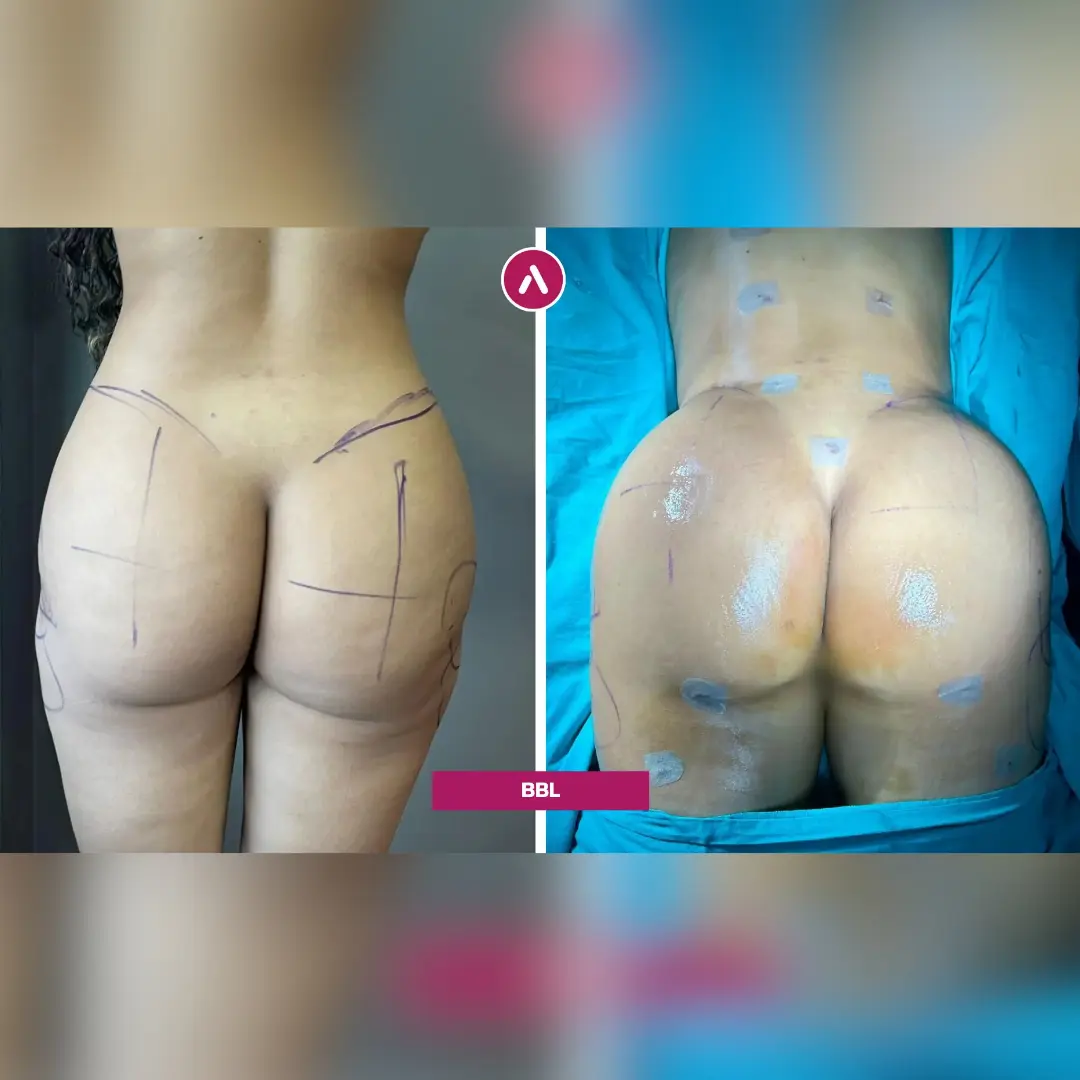
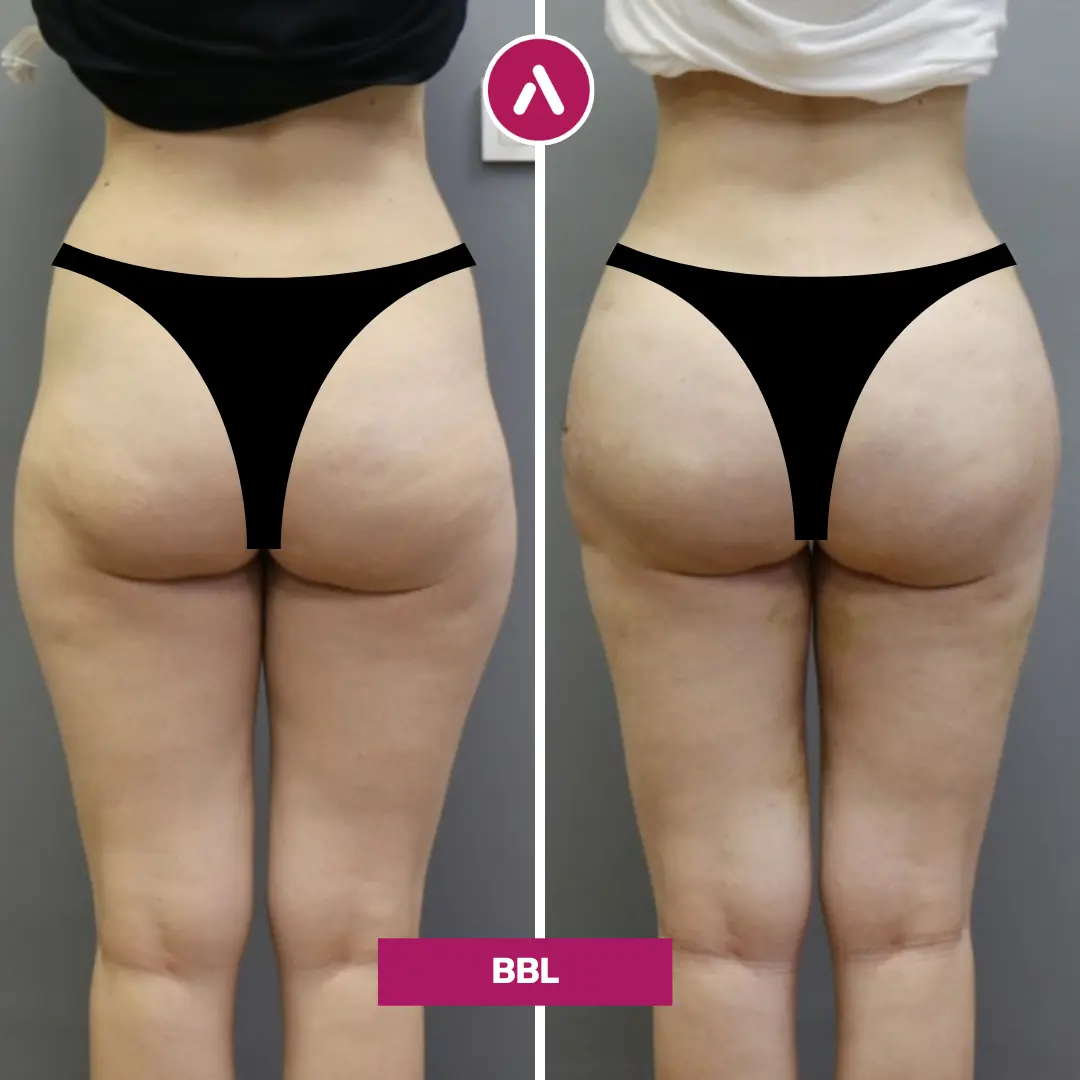
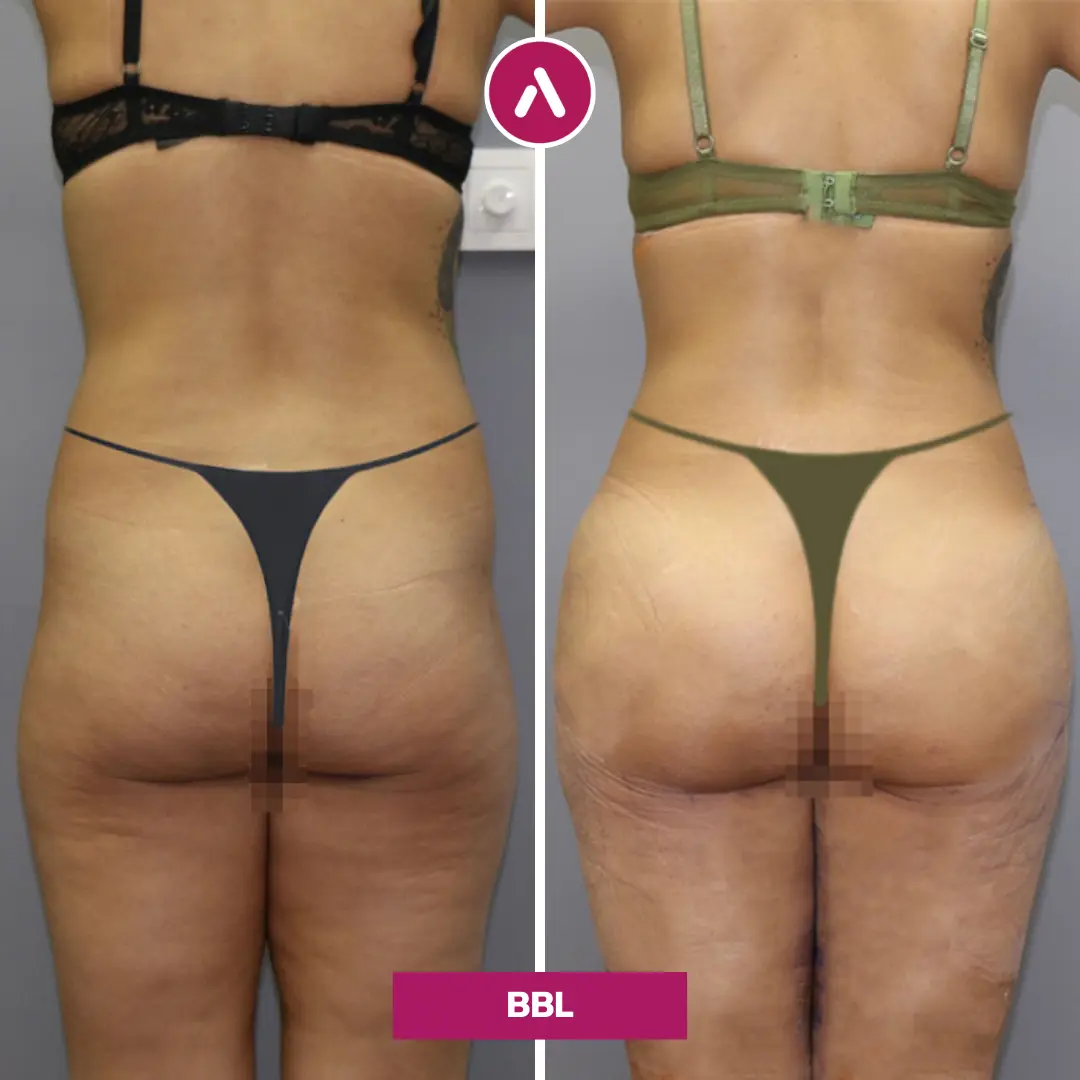
For Canadian patients who prefer a “quiet luxury” aesthetic, this matters. Many do not want an obvious surgical look. They want proportion, waist-to-hip balance, and a buttock shape that still fits their frame. For the outcome-focused side of this conversation, see our natural-looking awake BBL results discussion.
Body fat requirement
Fat transfer BBL requires donor fat. The most common donor areas include the abdomen, flanks, waist, back, thighs, and sometimes the arms. The surgeon must evaluate both quantity and quality.
A patient with moderate fat around the waist and lower back may be an excellent candidate. A very lean patient may not be. This is not a value judgement about body type. It is an anatomical constraint.
There is also a balance to protect. Removing too much fat from a donor area can create contour irregularity. Transferring too much fat can reduce survival and increase swelling. A careful BBL plan considers both the donor site and the recipient site as one integrated body-contouring procedure.
Fat survival rates and longevity
Not every transferred fat cell survives. Some swelling resolves, and some transferred fat is naturally reabsorbed during healing. The fat that survives the early healing period tends to behave like living fat in the body.
This is why the first few months matter. Patients are usually advised to avoid direct pressure on the buttocks, follow garment instructions, maintain stable nutrition, and avoid major weight fluctuation. The goal is to protect the transferred fat while it develops blood supply.
Long term, fat transfer results can last for years when weight is stable. Significant weight gain or loss can change the result. That is important for Canadian patients planning surgery after pregnancy, major weight loss, or a new fitness routine. For patients interested in how fat transfer works in other body areas, see our guide to fat transfer applications across the body.
Butt Implants — Pros and Limitations
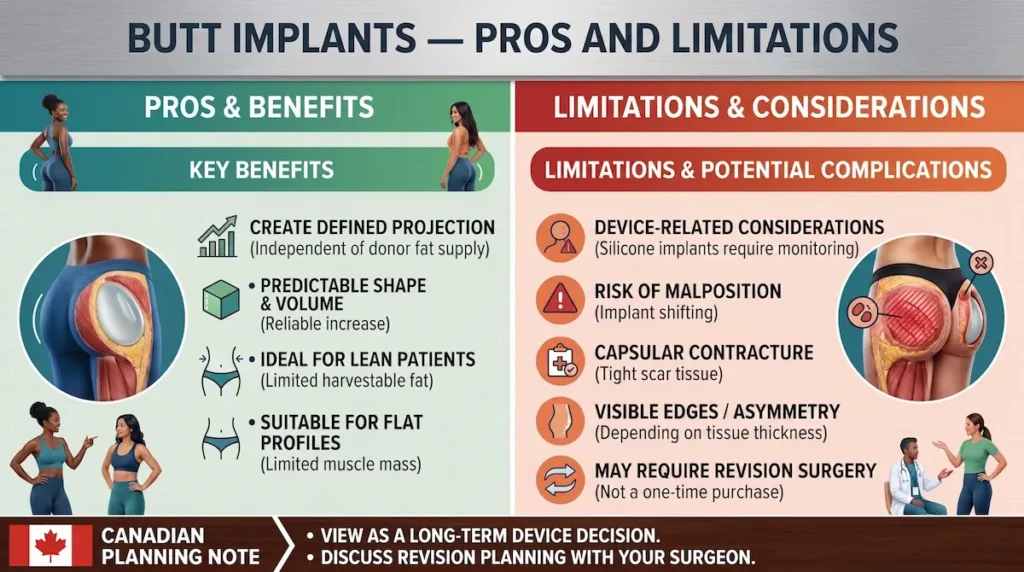
Butt implants are designed for patients who need reliable projection that fat transfer cannot provide. They are especially relevant when donor fat is limited, when the gluteal structure is naturally flat, or when the patient wants a more dramatic increase in volume.
For Canadian patients, this choice requires a practical mindset. A silicone implant can create shape predictably, but it also introduces device-related considerations. Health Canada provides broader public guidance on medical device safety, which is relevant for any patient evaluating long-term implant use: Health Canada medical device information.
When implants offer projection that fat cannot
Fat transfer depends on available donor fat and fat survival. Implants do not. That is their main advantage.
A lean patient may want rounder buttock projection but have very little harvestable fat around the waist, abdomen, or thighs. In that situation, fat transfer alone may create only a modest change. An implant can offer a more defined increase because the volume is not limited by donor fat supply.
Implants can also help patients with a naturally flat gluteal profile. This includes people who have limited lower-body muscle mass, narrow hips, or a buttock shape that does not respond dramatically to training. The implant provides the projection; the surrounding tissues determine how natural the final contour appears.
Implant placement options: intramuscular, subfascial, submuscular
Butt implant placement is not a small detail. The pocket determines how the implant sits, how it feels, how visible the edges may be, and how revision would be managed later.
- Intramuscular placement: The implant is placed within the gluteal muscle. This can help protect the implant and create better soft-tissue coverage.
- Subfascial placement: The implant sits above the muscle but under the fascia. This may allow a less invasive pocket, but patient selection is critical.
- Submuscular placement: The implant is positioned beneath the gluteus maximus muscle layer. This can offer strong coverage but may involve a different recovery profile.
The best placement depends on tissue thickness, desired projection, muscle anatomy, and the surgeon’s assessment. A patient with thin soft tissue may need a placement strategy that reduces edge visibility. A patient with stronger gluteal muscle coverage may have more options.
Implant-specific complications: rupture, malposition, capsular contracture
Butt implants use solid silicone, so they are different from liquid-filled breast implants. Still, implant surgery carries implant-specific risks that fat transfer does not.
Malposition means the implant shifts or sits in an undesirable position. Capsular contracture occurs when scar tissue around an implant tightens. Visible edges, asymmetry, infection, and long-term discomfort are also possible. These risks do not mean implants are a poor option. They mean the patient must choose them with full awareness.
This is where Canadian patients often pause. Fat transfer has its own risks, but it does not require long-term device monitoring. Implants can create stronger projection, but they may also require revision planning over time. A careful consultation should make that trade-off clear before any booking decision is made.
Canadian planning note: Butt implants should be viewed as a long-term device decision, not a one-time cosmetic purchase. Patients from Toronto, Vancouver, Montreal, and Calgary should ask how revision would be handled if implant position, comfort, or shape changes years later.
Supercharged BBL — The Combined Approach
Supercharged BBL combines implants and fat transfer in one surgical plan. It is built for patients who need the projection of an implant but want the softer contour that fat grafting can provide around the edges.
This approach is more complex than choosing one method. It may give the right candidate a better balance of projection and natural transition, but it also combines the recovery demands and risk considerations of both techniques. It should not be chosen casually.
When combining offers the best of both
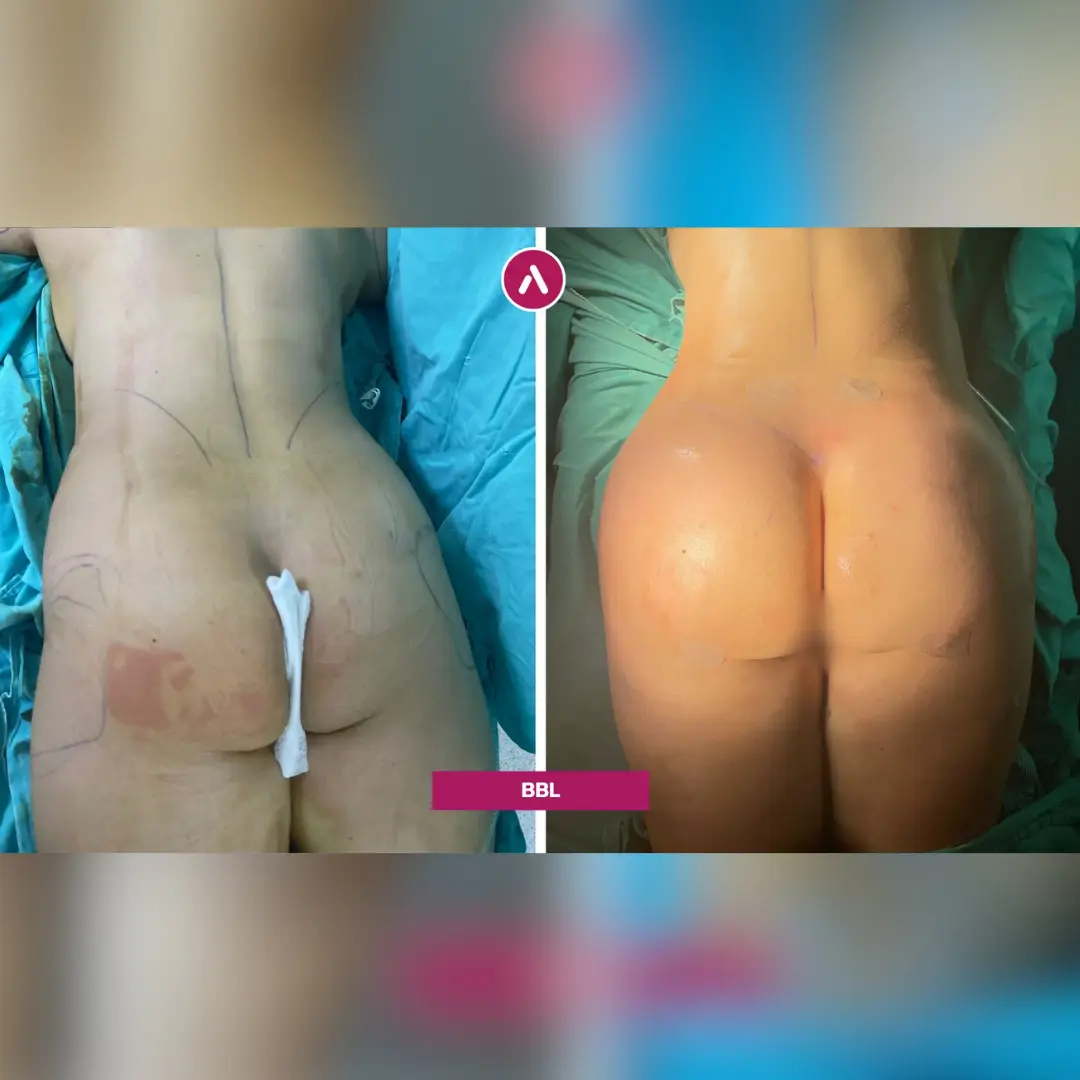
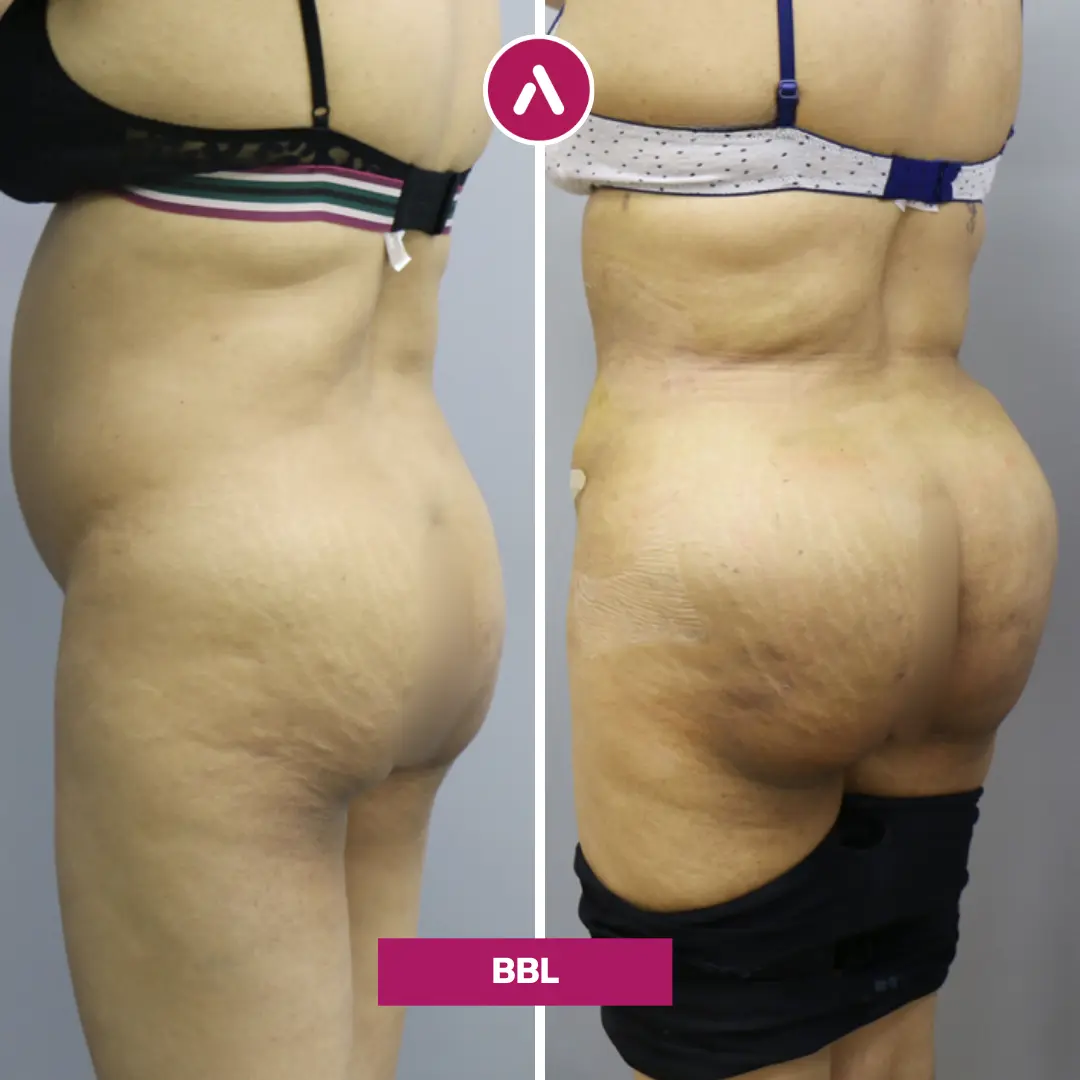
Supercharged BBL is often considered when fat alone will not create enough projection, but implants alone may look too firm or too sharply defined. The implant gives structure. The fat transfer refines the surrounding silhouette.
This can be useful for patients with some donor fat, but not enough for a full fat-only BBL. The transferred fat may be placed around the hips, upper buttock, or transition zones to soften the implant outline and improve proportion.
The goal is not simply “bigger.” A well-planned combined procedure considers waist narrowing, hip balance, buttock projection, and how the result will look in normal clothing. For many Canadian patients, the best result is noticeable in shape but not obvious as surgery.
Procedure complexity and surgical time
Supercharged BBL requires more planning than a single-modality procedure. The surgeon must complete liposuction, process and transfer fat, create implant pockets, position the implants, and manage symmetry across both sides.
That means the surgical plan must account for more variables. Donor areas must be chosen carefully. Implant size must suit the patient’s frame. Fat placement must support the final contour without overfilling. Small decisions compound quickly in this procedure.
Recovery is also more demanding. Patients must protect the implant pocket while also protecting transferred fat. Sitting restrictions, garment use, sleeping position, swelling, and follow-up timing all need to be discussed before surgery. A patient travelling from Canada should understand these logistics in detail.
Cost vs single-modality approaches
Supercharged BBL costs more than a standard fat transfer BBL or many implant-only approaches because it combines two surgical strategies. That price difference reflects complexity, not just volume.
The value question is whether the combined plan solves a problem that one method cannot solve alone. If fat transfer can create the patient’s desired result, implants may be unnecessary. If implants alone can create the desired projection with acceptable softness, fat grafting may be optional. If neither single method fully addresses the anatomy and goals, the combined approach may be reasonable.
Canadian patients should compare cost by outcome fit, not by procedure label. A lower-priced procedure that cannot meet the goal is not better value. A more expensive combined procedure should be justified by anatomy, not by marketing language.
“The best BBL method is not the one the surgeon prefers. It is the one that matches the patient’s fat availability, tissue quality, projection goal, and willingness to accept long-term maintenance. The anatomy should make the decision.”
The International Society of Aesthetic Plastic Surgery offers global patient-safety education for aesthetic surgery, which can help patients understand why technique selection and surgeon experience matter: ISAPS patient safety resources.
Decision Framework for Canadian Patients
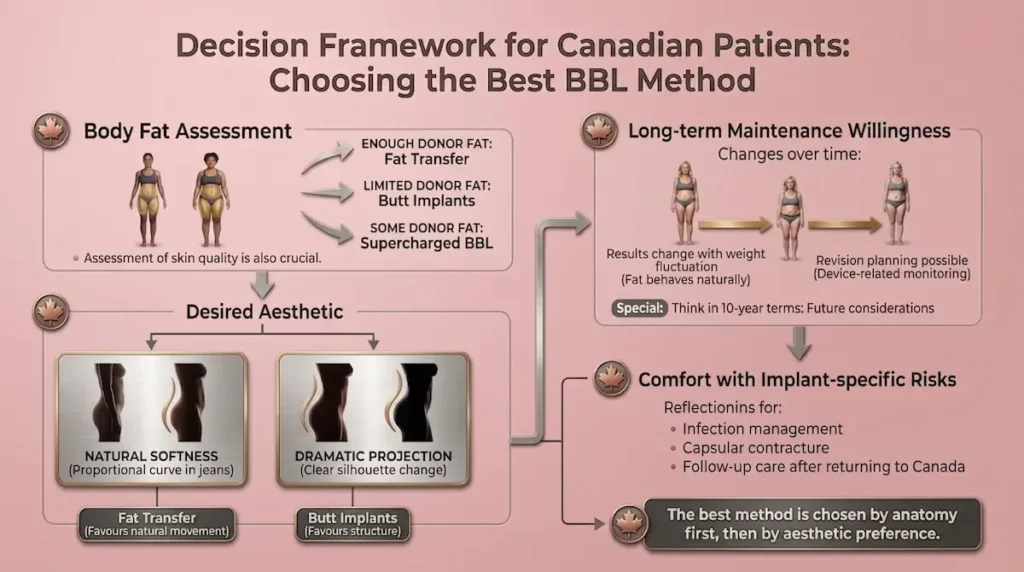
The best BBL method is chosen by anatomy first, then by aesthetic preference. A patient may want the softness of fat transfer, but the body may not provide enough donor fat. Another patient may want strong implant projection, but their comfort with long-term implant maintenance may change the recommendation.
Canadian patients often approach this decision with more caution than hype. That is appropriate. The goal is to choose the method that fits your body, travel plan, recovery tolerance, and long-term expectations. AKM’s consultation process is built around this kind of patient-specific assessment; you can review AKM’s patient-specific surgical planning process before submitting photos.
Body fat assessment
Body fat assessment is the first major branch in the decision tree. If you have enough donor fat around the abdomen, flanks, waist, lower back, or thighs, fat transfer may be feasible. If you do not, implants may become more relevant.
This is not only about weight. A patient may have a normal BMI and still have enough donor fat for a moderate BBL. Another patient may have a higher BMI but poor donor distribution or skin quality. The pattern matters.
- Enough donor fat: Fat transfer BBL may be the first option.
- Limited donor fat: Butt implants may be considered.
- Some donor fat, but not enough for the goal: Supercharged BBL may be discussed.
- Poor skin elasticity: The surgeon may recommend adjusting expectations or combining contouring strategies.
For Canadian patients, photo assessment is usually the first step. Front, side, back, and oblique photos help the surgical team evaluate donor zones and buttock shape before a video consultation.
Desired aesthetic: natural softness vs dramatic projection
The second decision point is aesthetic direction. Some patients want a soft, athletic curve that looks proportional in jeans, swimwear, and work clothing. Others want a more dramatic projection that changes their silhouette clearly.
Fat transfer usually favours softness and natural movement. Implants favour projection and structure. Supercharged BBL tries to combine projection with softer contouring around the implant.
A Canadian patient who wants subtle body balancing may be better served by fat transfer if anatomy allows it. A lean patient who wants a clear volume increase may need to discuss implants honestly. A patient who wants both stronger projection and smoother hip transitions may be a candidate for a combined plan.
Long-term maintenance willingness
Long-term thinking is essential. Fat transfer results can change with weight fluctuation because the surviving fat behaves like body fat. Implants are more structurally stable in volume, but they introduce device-related monitoring and possible revision planning.
This matters over a decade. A patient planning pregnancy, major weight loss, or intensive fitness changes should discuss timing before choosing fat transfer. A patient choosing implants should understand that future revision is possible even after a technically successful surgery.
Canadian planning note: Think in 10-year terms. If you live in Toronto, Vancouver, Montreal, or Calgary, ask whether you would be comfortable returning to Istanbul for revision if an implant issue develops years later. If that answer is no, fat transfer may feel more aligned with your long-term comfort.
Comfort with implant-specific risks
Implants are not automatically unsafe. They are also not risk-free. The question is whether the patient understands the trade-off and still prefers implant-supported projection.
Some patients accept the possibility of revision because implants can create a result fat alone cannot deliver. Others strongly prefer to avoid a long-term device. Both positions are reasonable.
Before choosing implants, ask about pocket placement, implant size, infection management, capsular contracture, malposition, and what follow-up looks like after returning to Canada. For broader patient experience signals, review AKM’s broader patient outcome reviews.
AKM Clinic’s CAD Pricing for Each Option
Pricing should clarify the decision, not pressure it. The correct method should still be based on anatomy and goals. A lower price is not better value if the procedure cannot create the desired result.
The figures below are displayed in Canadian dollars only, following AKM Clinic’s Canadian pricing policy. They are based on the AKM Clinic Treatment Techniques cost reference and should be confirmed during consultation because final recommendations depend on anatomy, surgical scope, and whether procedures are combined.
| Option | Best suited for | Feel and projection | Recovery and long-term considerations | AKM CAD pricing |
|---|---|---|---|---|
| Standard BBL (Subcutaneous) | Patients with enough donor fat who want natural contour improvement | Softest feel; moderate to strong projection depending on donor fat | Requires fat survival protection and stable weight | CAD $7,500 |
| Ultrasound-Guided BBL | Patients prioritizing real-time placement verification and safety-focused technique | Natural fat-transfer feel; projection depends on fat availability | Requires pressure avoidance during early healing | CAD $7,900 |
| Drainless BBL | Patients who are candidates for a no-drain recovery protocol | Natural fat-transfer feel | Recovery planning focuses on swelling control and garment discipline | CAD $7,500 |
| V-Shape to Heart-Shape BBL | Patients seeking pelvis and hip-transition reshaping with fat transfer | Soft feel with stronger emphasis on silhouette correction | Depends on donor fat and contouring strategy | CAD $7,900 |
| Subfascial Butt Implants | Lean patients who need projection without enough donor fat | More structured feel; projection is implant-driven | Implant monitoring and possible future revision should be considered | CAD $7,800 |
| Submuscular Butt Implants | Patients needing deeper implant coverage | Structured projection with more muscle coverage | Recovery may involve more implant-pocket protection | CAD $8,200 |
| Intramuscular Butt Implants | Patients whose anatomy favours implant placement within the gluteal muscle | Structured projection with soft-tissue coverage from muscle | Requires precise pocket planning and long-term follow-up | CAD $8,200 |
| Solid Silicone Implants | Patients choosing implant-based augmentation with stable device volume | More predictable projection; less natural than fat alone in some patients | Device-related risks and revision planning apply | CAD $7,800 |
| Supercharged BBL (Implants + Fat) | Patients needing implant projection plus fat-based contour refinement | Strong projection with softer transition zones | Combines fat-transfer recovery and implant-maintenance considerations | CAD $8,850 |
Fat transfer BBL pricing tiers
Fat transfer options at AKM Clinic range from CAD $7,500 to CAD $7,900, depending on the technique. Standard BBL and Drainless BBL are listed at CAD $7,500. Ultrasound-Guided BBL and V-Shape to Heart-Shape BBL are listed at CAD $7,900.
Patients comparing fat-transfer options should ask what each tier changes in the surgical plan. The difference may involve imaging guidance, contouring strategy, drain protocol, or silhouette-specific planning. For detailed procedure pricing, use the BBL fat transfer pricing in CAD page.
Butt implants pricing tiers
Butt implant options at AKM Clinic range from CAD $7,800 to CAD $8,200. Subfascial Placement and Solid Silicone Implants are listed at CAD $7,800. Submuscular and Intramuscular Placement are listed at CAD $8,200.
The price difference reflects technical approach and placement complexity. It should not be interpreted as one placement being universally better. The correct pocket depends on tissue thickness, gluteal anatomy, desired projection, and risk profile.
For implant-specific figures, see butt implant pricing in CAD.
Supercharged pricing
Supercharged BBL is listed at CAD $8,850. This is higher than either many fat-only or implant-only options because the procedure combines liposuction, fat processing, fat transfer, implant pocket creation, and implant placement.
The decision should be justified by anatomy. If fat transfer alone can meet the goal, the combined option may add unnecessary complexity. If implants alone can achieve the goal with acceptable contour, fat transfer may not be required. If both are needed to balance projection and softness, the higher cost may be clinically logical.
Cost-per-year thinking: Canadian patients should compare value by outcome fit and revision likelihood, not by the first listed price. A result that lasts, fits your body, and avoids preventable revision may offer better long-term value than the least expensive procedure on paper.
Canadian metro private clinic comparison
Canadian private cosmetic surgery pricing is often fragmented. A quote may separate surgeon fee, anesthesia, facility charges, garments, lymphatic drainage, follow-up appointments, and implant materials. This can make the first consultation estimate hard to compare with an international package.
Patients from Toronto, Vancouver, Montreal, and Calgary should ask for a written scope of inclusions before comparing options. The same procedure label can hide very different levels of care. A fat transfer BBL quote that excludes compression garments, post-op massage, or revision policy is not directly comparable to a quote that includes structured aftercare.
The practical question is not “Which is cheaper?” It is “Which plan solves my anatomy with the least avoidable risk, the clearest recovery plan, and the most transparent long-term expectations?” That is the decision tree Canadian patients should use.
Frequently Asked Questions: BBL Implants vs Fat Transfer
These are the questions Canadian patients most often ask when comparing fat transfer BBL, butt implants, and Supercharged BBL. The answers below are general decision guidance, not a substitute for a consultation.
Which option lasts longer?
Each option lasts in a different way. Fat transfer BBL can last for years when transferred fat survives and the patient maintains stable weight. The result can change with weight gain, weight loss, pregnancy, or major fitness changes.
Butt implants provide more stable device volume, but they carry implant-specific maintenance considerations. The implant does not disappear, yet its position, comfort, surrounding scar tissue, or aesthetic fit may change over time. Some patients need revision years later.
Supercharged BBL combines both realities. The implant provides projection, while the fat transfer component can still respond to body-weight changes. Longevity should be discussed as a 10-year plan, not just a one-year result.
Are silicone implants safer than fat transfer?
Neither option is automatically safer for every patient. They have different risk profiles.
Fat transfer BBL avoids a long-term device, but it requires safe fat placement, careful donor-site planning, and strict post-operative pressure avoidance. Butt implants avoid donor-fat limitations, but they introduce risks such as infection, malposition, capsular contracture, discomfort, and possible future revision.
The safer choice depends on your anatomy, BMI, cardiovascular profile, tissue thickness, donor fat supply, and surgeon’s technique. A cautious consultation should compare your personal risks rather than speak in absolutes.
Can I have both options if my surgeon recommends?
Yes, this is the Supercharged BBL category. It combines implants with fat transfer.
The implant creates projection. Fat grafting improves the surrounding contour, especially around the hips, upper buttock, and implant edges. This can help the result appear softer and less device-defined in selected patients.
That said, combined surgery should be chosen only when anatomy supports it. If fat transfer alone can achieve your goal, adding an implant may be unnecessary. If implants alone can meet your projection goal with acceptable contour, fat grafting may not be needed.
How long is the recovery for each option?
Fat transfer BBL recovery focuses on protecting the transferred fat. Patients usually avoid direct sitting pressure for the early healing period, follow garment instructions, and sleep in positions that protect the grafted area.
Butt implant recovery focuses on protecting the implant pocket. Sitting, bending, exercise, and gluteal muscle activation may be restricted while tissues stabilize around the implant.
Supercharged BBL recovery requires both precautions. You must protect fat survival and the implant pocket at the same time. For Canadians travelling home after surgery, this means return-flight planning should be discussed before booking flights.
Does Canadian provincial insurance cover any portion?
For elective cosmetic buttock augmentation, provincial plans such as OHIP, MSP, RAMQ, and AHCIP generally do not provide coverage. BBL, butt implants, and Supercharged BBL are cosmetic body-contouring procedures.
Coverage conversations may differ in rare reconstructive contexts, such as trauma, congenital deformity, or medically documented reconstruction. Those scenarios require individual medical documentation and are not the same as elective aesthetic surgery.
Canadian patients should plan for private payment and ask for a written quote that clearly separates surgery, facility, anesthesia, garments, medications, aftercare, and follow-up. Transparent scope matters.
What happens if implants need replacement?
Butt implants may not need routine replacement at a fixed date, but revision can become necessary if there is malposition, discomfort, infection, capsular contracture, visible contour issues, or a change in aesthetic goals.
This is why implant patients should think beyond the first procedure. Ask what revision would involve, whether the same pocket can be used, how scar tissue is handled, and whether implant removal would require fat grafting or lifting later.
For Canadians, the travel factor matters. If you choose implants in Istanbul, ask how AKM Clinic supports long-term follow-up once you are back in Canada and what happens if a future in-person assessment is needed.
How do I know my body has enough fat for transfer?
The most reliable answer comes from photo assessment and consultation. The surgeon reviews your abdomen, waist, flanks, lower back, thighs, and overall skin quality to estimate whether enough usable fat can be harvested safely.
A bathroom scale cannot answer this question. BMI gives limited context. Fat distribution, skin elasticity, previous liposuction, muscle mass, and body proportions all matter.
As a general decision tree, patients with enough donor fat usually begin with a fat-transfer discussion. Patients with limited donor fat may need implants. Patients with partial donor fat and stronger projection goals may be evaluated for Supercharged BBL.
Ready to compare your options? Send your photos for a virtual assessment and determine whether fat transfer BBL, butt implants, or Supercharged BBL best fits your anatomy, goals, and Canadian travel plan.
Medical Disclaimer: This page is provided for general educational purposes only and does not replace an in-person medical consultation, diagnosis, or personalized treatment plan. All surgery carries risks, and outcomes vary between individuals. Suitability for Brazilian Butt Lift (BBL) surgery, procedure selection, and anesthesia choice can only be determined after a full clinical assessment by a qualified surgeon. Always follow your clinician’s instructions and seek urgent medical attention if you develop concerning symptoms during recovery.