




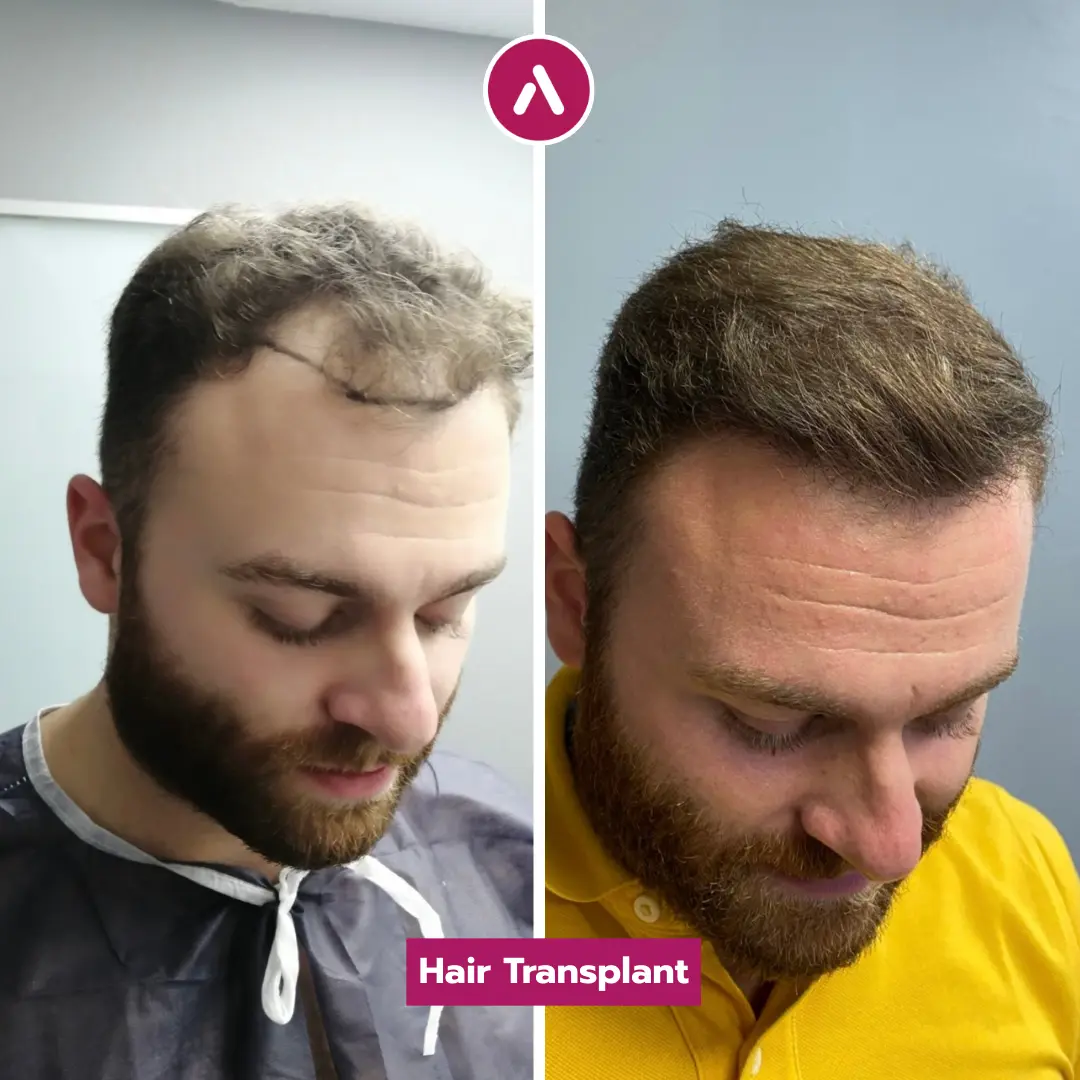
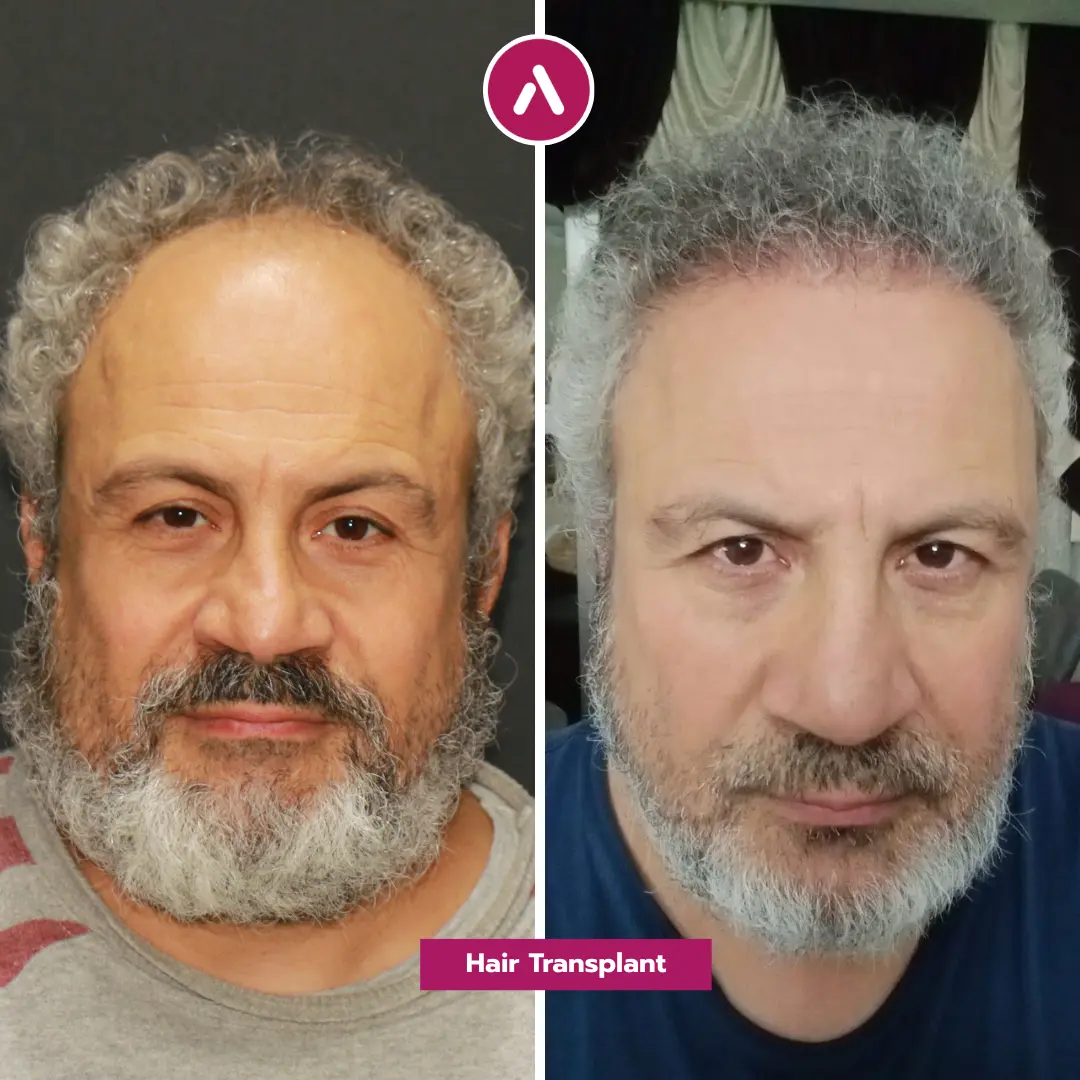
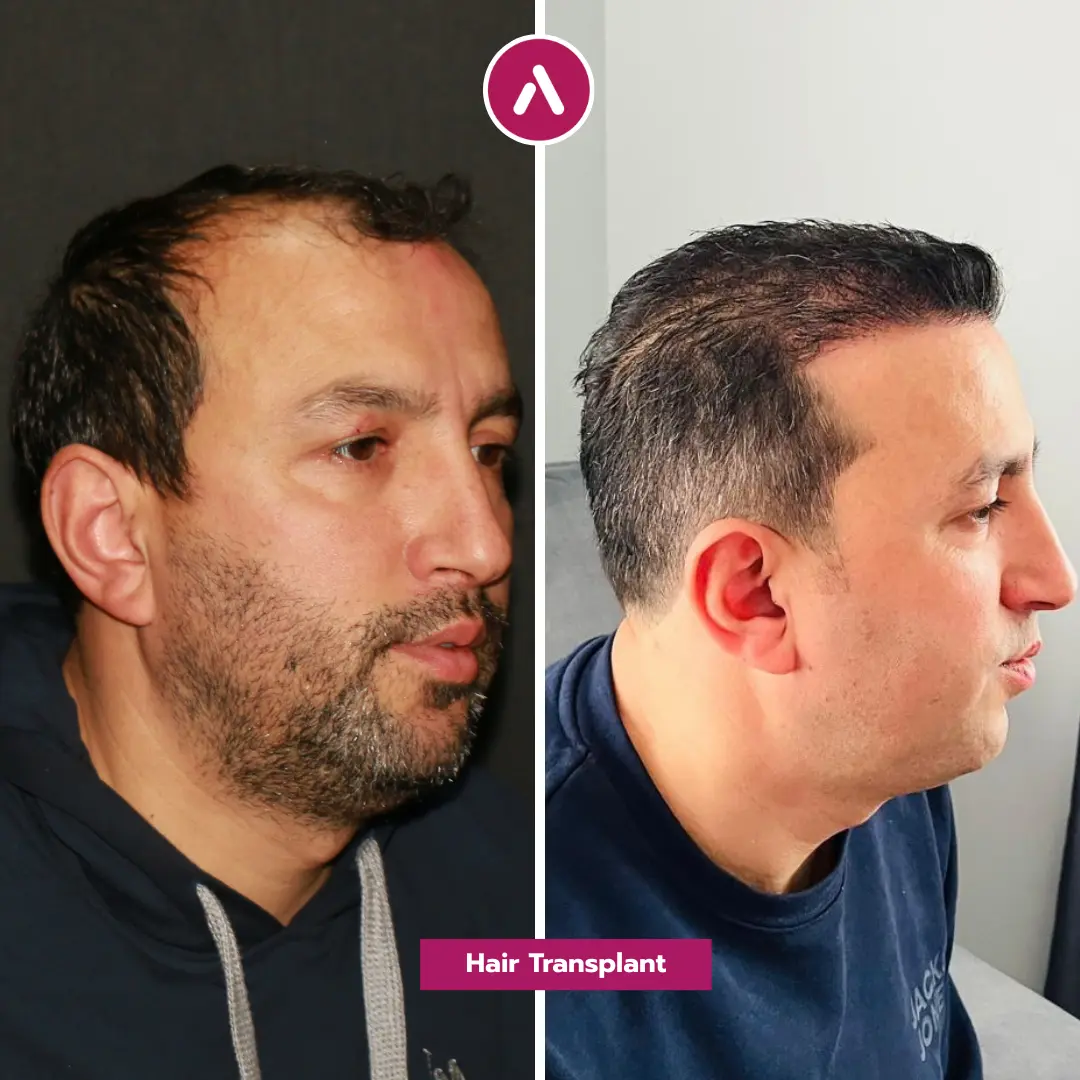
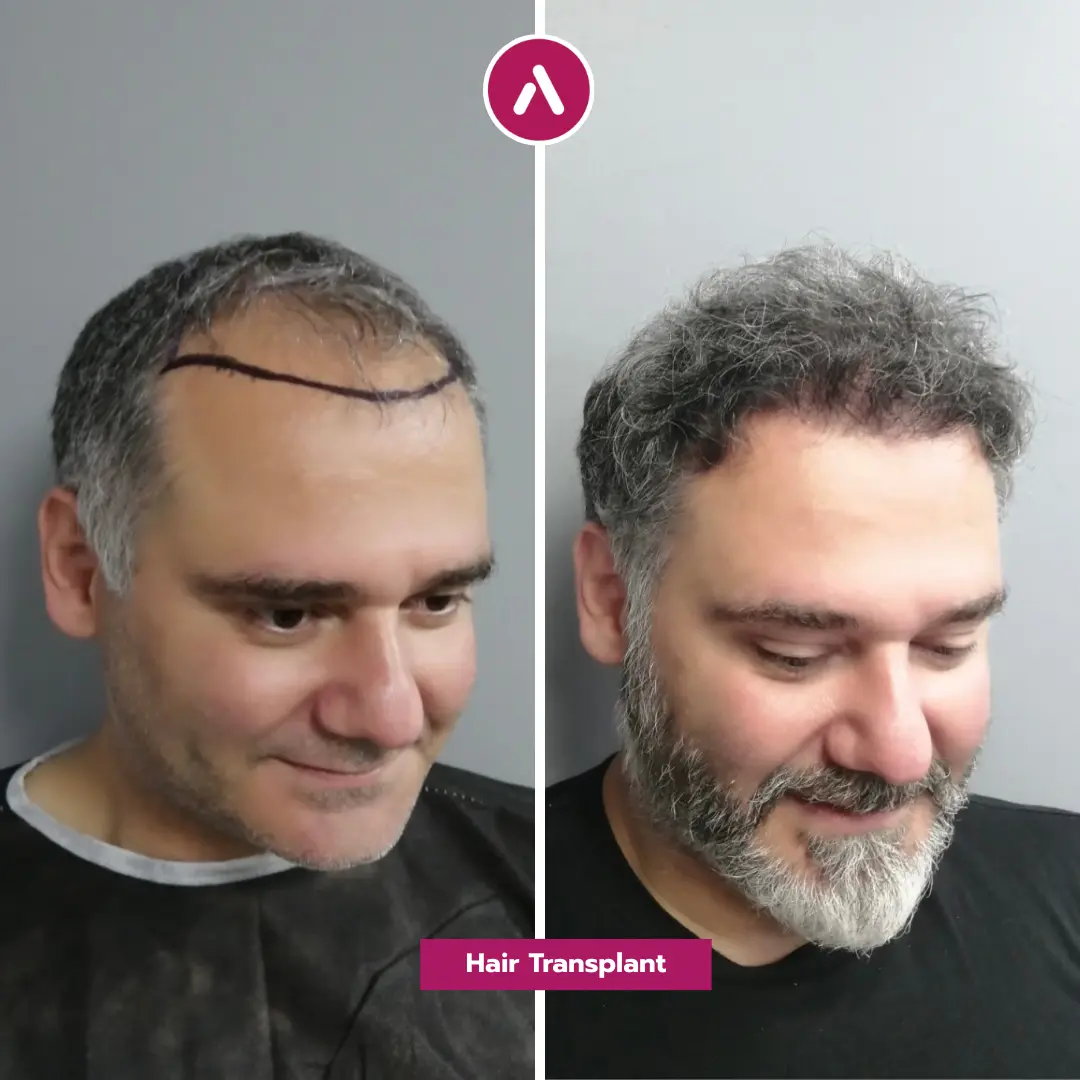
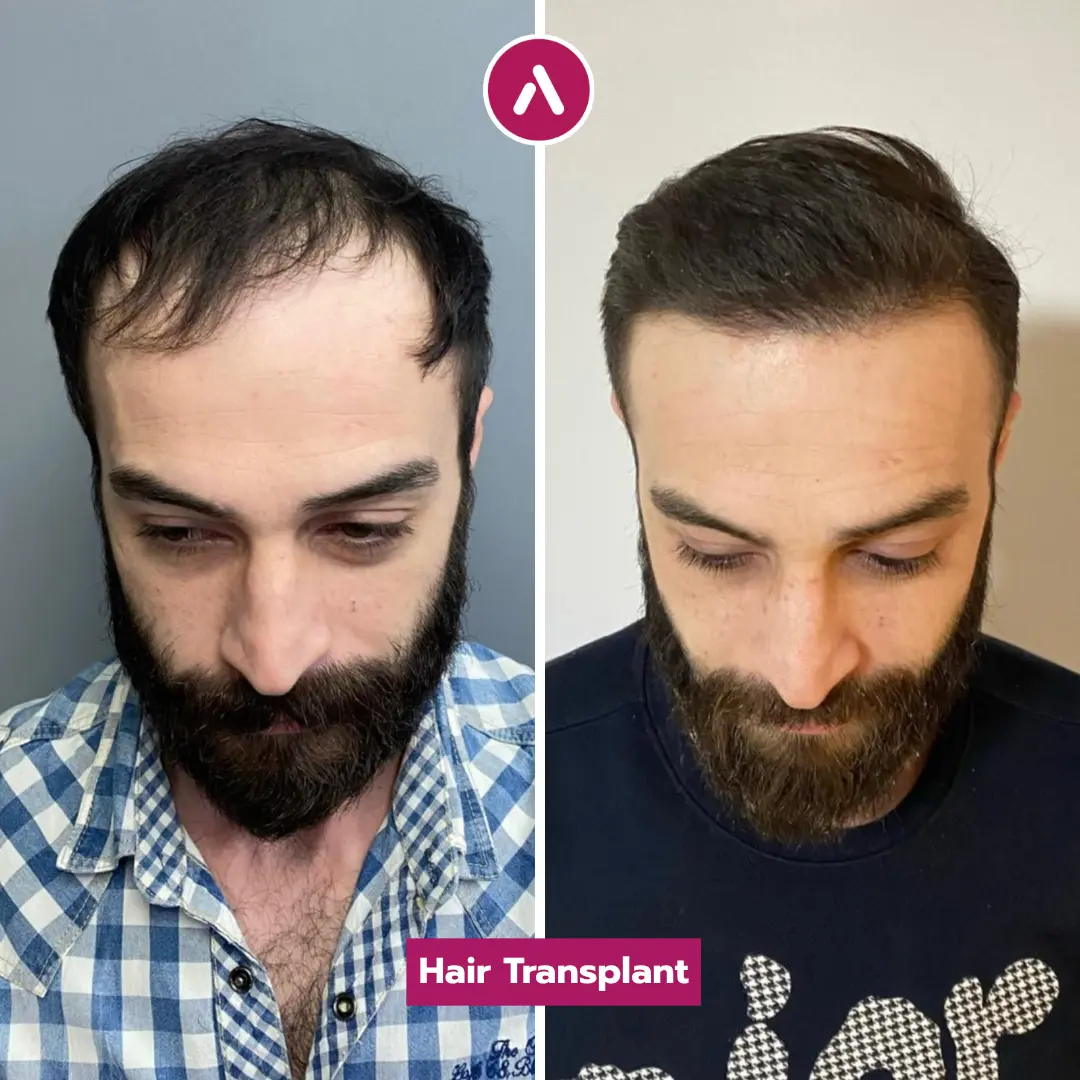
If you have researched hair transplants in Turkey, you have likely seen three terms repeated everywhere: FUE, DHI, and Sapphire FUE. Here is the clarity many clinics skip: Sapphire FUE is not a completely different procedure. It is standard FUE performed with a sapphire crystal blade instead of a steel blade.
That finer blade creates cleaner recipient channels, which may mean less tissue trauma, denser packing, and faster early healing. But Sapphire FUE is not automatically “the best” for every patient. At AKM Clinic in Istanbul, we offer FUE, DHI, and Sapphire FUE, then recommend the technique that fits your donor area, hair calibre, density goals, and travel timeline.
Table of Contents
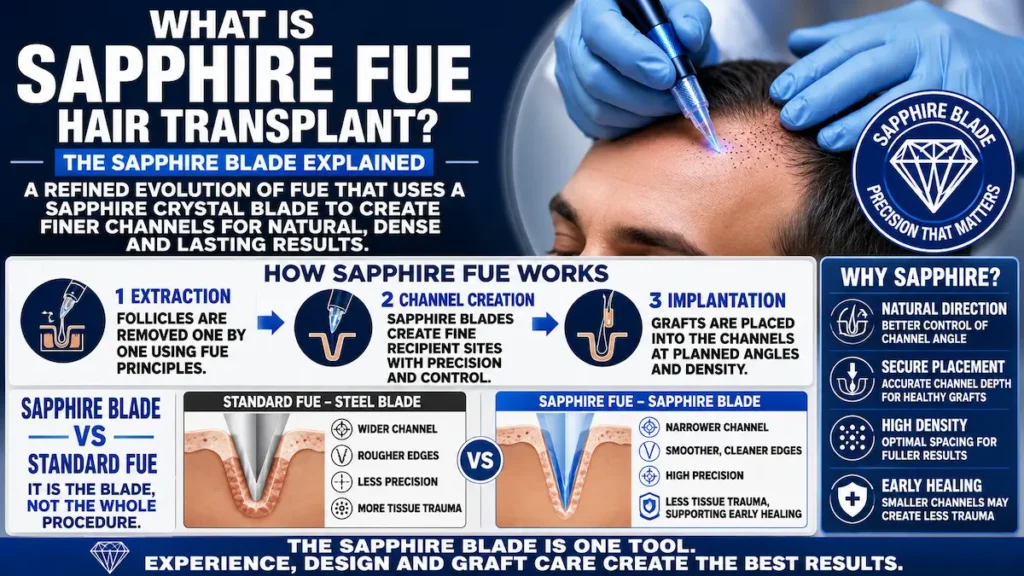
What Is Sapphire FUE Hair Transplant? The Sapphire Blade Explained
Sapphire FUE is a hair transplant technique that uses a sapphire crystal blade instead of steel to create recipient channels. The smoother, finer blade can reduce tissue trauma, support denser graft placement, and help early healing. It is an evolution of standard FUE, not a separate procedure.
How Sapphire FUE Works
Sapphire FUE begins the same way as a standard hair transplant. We extract healthy follicular units from the donor area, usually the back or sides of the scalp, then implant them into thinning or balding areas.
The difference happens during recipient site creation. Instead of using a traditional steel slit blade, we use a sapphire crystal blade to open tiny channels where the grafts will be placed.
- Extraction: Follicles are removed one by one using FUE principles.
- Channel creation: Sapphire blades create fine recipient sites.
- Implantation: Grafts are placed into those channels at planned angles and density.
Sapphire FUE vs Standard FUE: It Is the Blade, Not the Whole Procedure
This distinction matters. Many patients believe Sapphire FUE is a completely different surgery from FUE. It is more accurate to call it a refined FUE channel-opening method.
In standard FUE, the recipient channels are typically created with steel blades. In Sapphire FUE, we use a sapphire crystal blade for this stage. The goal is finer control over channel depth, direction, and density.
The donor extraction step remains rooted in FUE. This is why we explain Sapphire FUE alongside standard FUE, rather than treating it as an unrelated option.
The Sapphire Method Terminology
You may see several names online: sapphire hair transplant, Sapphire FUE, sapphire blade hair transplant, or sapphire method hair transplant. These phrases usually refer to the same concept.
Some clinics also mention “Ice Sapphire” or graft-cooling protocols. Cooling can help preserve grafts while they wait outside the body, but the sapphire part still refers to the blade used to create recipient channels.
Why Sapphire? Smoothness, Sharpness, and Precision
Sapphire is used because it can be shaped into a very fine, smooth blade. A smoother blade can create cleaner micro-channels than a standard steel slit in selected patients.
That precision helps us control:
- channel angle, so the hair grows in a natural direction;
- channel depth, so follicles sit securely without being compressed;
- channel spacing, so density looks full without overloading the scalp;
- early healing, because smaller channels may create less local trauma.
“The sapphire blade is useful when density and channel refinement matter, but it is still only one part of the result. Hairline design, donor management, and careful graft handling remain more important than the tool alone.”
Sapphire Blade Diagram Callout: Channel Geometry
Design note for CMS: Add a simple visual comparing a traditional steel blade channel with a sapphire crystal blade channel. Show the sapphire channel as a finer, smoother V-shaped opening with controlled angle and depth. Avoid exaggerated claims; the diagram should explain precision, not promise a guaranteed result.
Benefits of the Sapphire Blade
The sapphire blade is used to create refined recipient channels during Sapphire FUE. For the right candidate, this may support cleaner channel geometry, natural hair direction, dense-looking placement, and a smoother early recovery experience.
Finer, Smoother Recipient Channels
The main benefit of Sapphire FUE is channel quality. Smaller, smoother incisions may create less surface disruption in the recipient area. That can support a cleaner early recovery.
For Canadian patients returning to Toronto, Vancouver, Calgary, or Montreal after surgery, early scalp comfort matters. Less crusting and swelling can make the first week easier to manage.
Denser Graft Packing Potential
Sapphire blades can help us place channels closer together in appropriate candidates. This does not mean we ignore donor limits. We never recommend aggressive density that risks poor blood supply or donor over-harvesting.
Density must look natural. A conservative, well-planned hairline usually ages better than an overly dense, artificial one.
Faster Early Healing and Reduced Scabbing
Because sapphire channels can be finer, some patients notice less scabbing and redness during the first recovery phase. This varies by scalp thickness, graft count, washing discipline, and smoking status.
We still give every patient a detailed washing protocol and follow-up schedule. Technique helps. Aftercare protects the result.
Better Control for Natural Direction
Hair transplant results depend on angle, direction, and density. The sapphire blade gives our surgical team fine control over where each graft will sit.
This is especially important in the frontal hairline, where unnatural direction is easy to see. Our goal is a hairline that looks grown, not placed.
Am I a Good Candidate for Sapphire FUE?
Sapphire FUE candidacy depends on donor strength, hair loss pattern, scalp condition, hair calibre, and realistic density goals. We assess each patient individually because Sapphire FUE can be excellent for some cases, while DHI or standard FUE may be more appropriate for others.
Most FUE Candidates Are Also Sapphire Candidates
Most patients who qualify for FUE can also be considered for Sapphire FUE. The core requirement is the same: you need a stable donor area with enough healthy follicles to support the planned graft count.
Sapphire FUE may be especially useful when you want refined channel work in the frontal hairline or dense-looking coverage in visible areas. We still assess your case medically first. The blade never replaces proper planning.
Norwood Staging and Donor Area Assessment
For men, we usually evaluate hair loss using the Norwood scale. A patient with early recession has different needs than a patient with advanced crown and mid-scalp thinning.
For women, we assess thinning pattern, part-line widening, hair calibre, hormonal history, and donor density. If your hair loss is diffuse across the scalp, we may recommend medical treatment first or suggest a more conservative surgical plan.
Medical diagnosis matters before transplant planning. The Canadian Dermatology Association describes alopecia as hair loss affecting the scalp or body, which is why a clinical assessment should come before surgical planning.
| Assessment Area | Why It Matters | What We Look For |
|---|---|---|
| Donor density | Determines safe graft availability | Stable follicles at the back and sides of the scalp |
| Hair calibre | Affects visual density | Thicker strands create more coverage per graft |
| Recipient area | Guides graft distribution | Hairline, temples, mid-scalp, or crown priority |
| Loss stability | Protects long-term planning | No aggressive active shedding without diagnosis |
When Sapphire Adds the Most Value
Sapphire FUE is most useful when recipient-site precision is a major priority. This often includes patients who need a natural hairline, high-density frontal work, or refined temple transitions.
It may also help patients who want a smoother early recovery. Smaller channels can support less visible crusting, although individual healing still depends on your biology and aftercare discipline.
When DHI Might Suit You Better
DHI may be a better fit when we need to implant between existing hairs with minimal channel pre-creation. This can matter for patients with diffuse thinning or patients who want unshaven implantation in selected areas.
That is why we do not push Sapphire FUE on every patient. Our consultation compares DHI, FUE, and Sapphire FUE before we recommend one technique.
“Sapphire FUE is an excellent option for many patients, but no tool should be sold as universally superior. The right technique depends on donor strength, hair loss pattern, existing density, and the patient’s long-term plan.”
Who Should Wait or Reconsider
Surgery may not be appropriate if you have active untreated hair loss, severe donor weakness, uncontrolled medical conditions, or unrealistic density expectations. We may also delay treatment if your photos suggest a temporary shedding condition rather than permanent pattern loss.
We prefer a smaller, safer plan over an aggressive graft count that compromises future options. Good hair restoration should still look natural in 10 years.
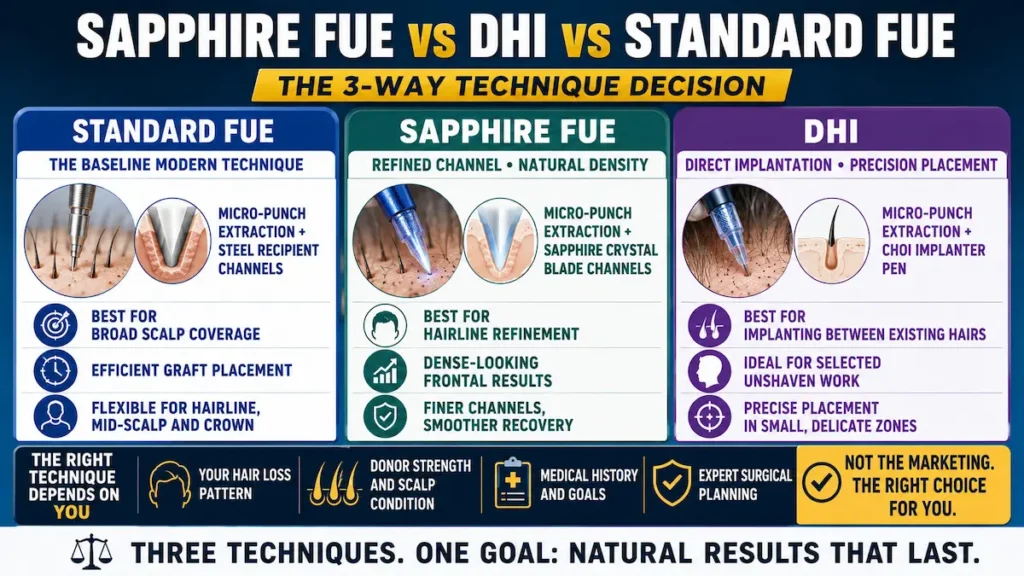
Sapphire FUE vs DHI vs Standard FUE: The 3-Way Technique Decision
Sapphire FUE, DHI, and standard FUE are all modern hair transplant techniques, but they solve different clinical problems. The best choice depends on your donor area, existing hair density, graft count, hairline goals, and whether the procedure requires channel creation or direct implantation.
The Three-Technique Framework
Canadian patients often ask one question: “Which is better, Sapphire FUE or DHI?” The more useful question is different: “Which technique fits my hair loss pattern?”
At our Istanbul clinic, we compare all three modern approaches. Standard FUE uses traditional recipient channels. Sapphire FUE uses sapphire blade channels. DHI uses a Choi implanter pen to place grafts directly.
| Technique | Tool | Best For | Key Limitation |
|---|---|---|---|
| Standard FUE | Micro-punch extraction + steel recipient channels | Broad scalp coverage and efficient graft placement | Channel quality depends heavily on blade control |
| Sapphire FUE | Micro-punch extraction + sapphire crystal blade channels | Refined hairline work and dense-looking placement | Not always necessary for every pattern |
| DHI | Micro-punch extraction + Choi implanter pen | Implanting between existing hairs and selected unshaven cases | Can take longer and may not suit every graft count |
Standard FUE: The Baseline Modern Technique
Standard FUE remains a strong option for many patients. It avoids the linear scar associated with older FUT strip surgery and allows individual follicular unit extraction.
Its strength is flexibility. It can treat the hairline, mid-scalp, and crown in one session, depending on graft availability.
Sapphire FUE: A Refined Channel-Opening Method
Sapphire FUE builds on standard FUE. The extraction process stays similar, but recipient channels are created with sapphire blades rather than traditional steel blades.
This can support finer channel design, especially where angle and density are highly visible. It is why many patients choose Sapphire FUE for frontal hairline refinement.
DHI: Direct Implantation With the Choi Pen
DHI uses a Choi implanter pen to place grafts directly into the recipient area. Unlike Sapphire FUE, it does not require the same pre-made channel step.
This can be useful when we need precise placement between existing hairs. It may also suit patients who want selected unshaven work, especially when the treatment zone is smaller.
DHI is not always better than Sapphire FUE. It can be slower, more labour-intensive, and less efficient for very large graft counts. The right choice depends on your scalp, not the marketing label.
Sapphire FUE vs DHI
Sapphire FUE and DHI both aim for natural density, but they reach that goal differently. Sapphire FUE separates channel creation from implantation. DHI combines channel creation and placement through the implanter pen.
For a broad hairline and mid-scalp restoration, Sapphire FUE can be efficient and precise. For implanting among existing hairs, DHI may be safer in selected cases because it reduces the need for pre-made channels between native follicles.
| Decision Point | Sapphire FUE | DHI |
|---|---|---|
| Recipient site method | Sapphire blade channels created first | Choi pen implants grafts directly |
| Best use | Hairline, frontal density, broad coverage | Existing hair density, selected unshaven work |
| Speed | Often more efficient for larger sessions | Can take longer |
| Density control | Strong when channel planning is meticulous | Strong in small, precise zones |
| Ideal patient | Needs refined channels and larger visible coverage | Needs careful work between existing hairs |
For a deeper breakdown of technique selection, our DHI vs FUE hair transplant guide explains how implantation tools, graft handling, and patient anatomy change the recommendation.
Sapphire FUE vs Standard FUE
The difference between Sapphire FUE and standard FUE is most visible in the channel-opening stage. Standard FUE uses steel blades. Sapphire FUE uses sapphire crystal blades.
Both can produce natural results in skilled hands. Sapphire FUE may offer a smoother early recovery and finer recipient channels, but poor planning can still produce an unnatural hairline. Technique never replaces surgical judgement.
| Feature | Standard FUE | Sapphire FUE |
|---|---|---|
| Channel blade | Steel | Sapphire crystal |
| Channel size | Small, depends on blade and technique | Often finer and smoother |
| Early scabbing | Usually mild to moderate | May be reduced in selected patients |
| Density potential | Good | Potentially higher when safe blood supply allows |
| Best for | Reliable broad restoration | Hairline refinement and dense-looking frontal work |
The Honest Truth: Sapphire Is Not Automatically Best
We do not recommend Sapphire FUE simply because it sounds more advanced. A patient with diffuse thinning may benefit more from DHI. A patient needing broad coverage may do well with standard FUE or Sapphire FUE, depending on donor strength and scalp condition.
That is why our consultation starts with diagnosis. We review your photos, hair calibre, donor density, loss pattern, medical history, and goals before suggesting the technique.
“A clinic that offers only one technique will often present that technique as the answer for everyone. We offer FUE, DHI, and Sapphire FUE, so our recommendation can be based on your anatomy rather than our equipment limitations.”
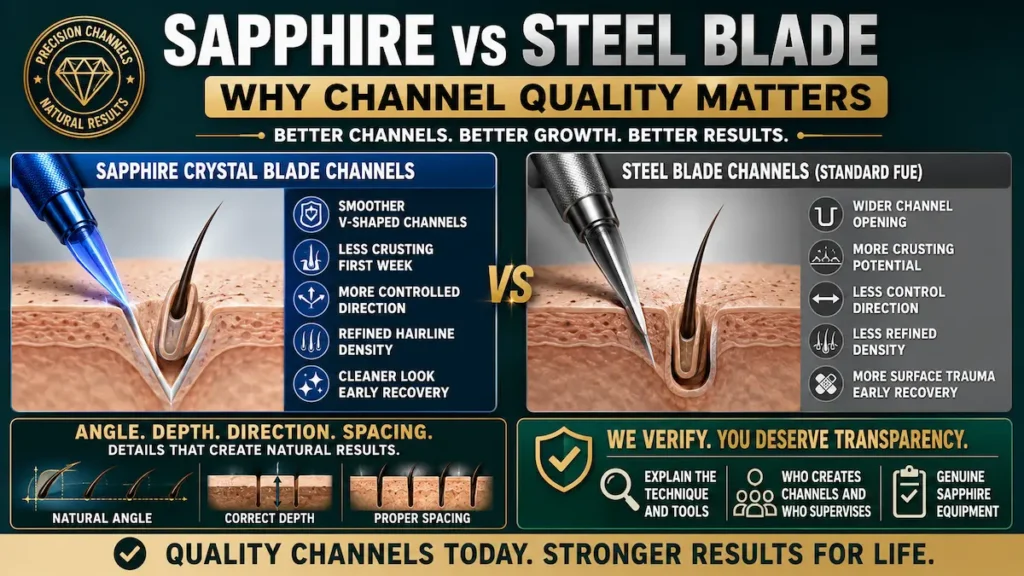
Sapphire vs Steel Blade: Why Channel Quality Matters
Recipient channel quality directly affects how transplanted grafts sit in the scalp. Angle, depth, direction, and spacing all influence the final hairline, which is why the difference between sapphire and steel blade channel creation matters in carefully selected patients.
What Recipient Channels Do
Recipient channels are the tiny openings where transplanted grafts are placed. Their angle, depth, direction, and spacing shape the final result.
A natural hair transplant depends on these details. If channels are too upright, the hairline can look artificial. If they are too deep or too tight, graft survival may suffer.
Steel Blade Channels in Standard FUE
Steel blades can create excellent channels when handled by an experienced team. Standard FUE is still a reliable, modern technique.
The limitation is not that steel is “bad.” The difference is that sapphire blades may allow finer and smoother incisions in selected patients. That can help with dense packing and early healing.
Sapphire Crystal Blade Channels
Sapphire blades are hard, smooth, and shaped for precision. In Sapphire FUE, they create small V-shaped channels that can hold grafts securely while minimizing unnecessary surface trauma.
For the patient, this may translate into:
- less crusting during the first week;
- more controlled graft direction;
- more refined hairline density;
- a cleaner-looking recipient area during early recovery.
Channel Angle, Depth, and Direction
Hair grows at different angles across the scalp. The frontal hairline lies flatter. The crown follows a whorl. The temples require a softer transition.
We design the channel pattern around these natural changes. Sapphire blades help us execute that design with precision, but the design itself comes from surgical planning.
How We Verify Genuine Sapphire Equipment
Canadian patients are right to ask whether a clinic is truly using sapphire blades. Some clinics use the term loosely because it sounds premium.
During consultation, we explain the technique, equipment, and surgical sequence. You should always feel comfortable asking what tool will be used, who will create the channels, and who will supervise graft placement.
“If a clinic cannot clearly explain the difference between steel channels, sapphire channels, and DHI implantation, that is a warning sign. Patients deserve transparency before they travel.”
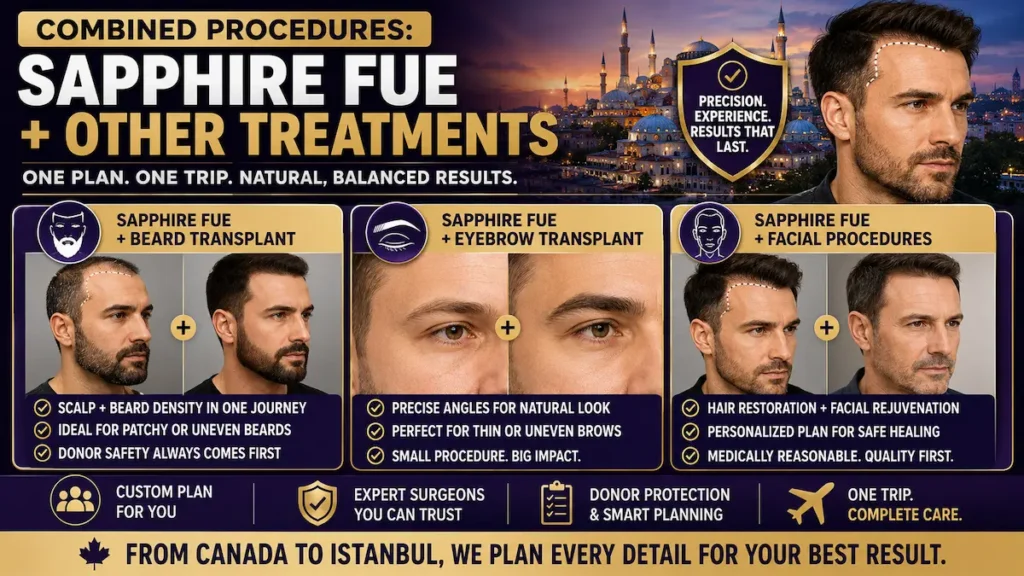
Combined Procedures: Sapphire FUE + Other Treatments
Some patients want to combine Sapphire FUE with beard, eyebrow, or selected facial procedures during one trip. Combination planning must protect donor supply, manage recovery safely, and prioritize the treatment that will create the strongest long-term result.
Sapphire FUE + Beard Transplant
Some patients combine scalp restoration with beard density work. This may be useful for patchy beard growth, weak cheek density, or moustache gaps.
Combination treatment depends on donor supply. We do not use grafts for facial hair if doing so would compromise scalp coverage or future needs.
Sapphire FUE + Eyebrow Transplant
Eyebrow transplant requires precise angle and direction control. It is a smaller procedure, but it is technically demanding because eyebrow hairs lie flatter than scalp hairs.
For selected patients, scalp and eyebrow restoration can be planned in one trip. We assess whether the donor area can support both safely.
Sapphire FUE + Facial Procedures
Some Canadian patients ask whether they can combine hair restoration with facial procedures such as a facelift or mini facelift. This depends on age, anatomy, healing capacity, and surgical priorities.
We only recommend combination planning when it is medically reasonable. More procedures in one trip are not always better.
Anesthesia for Sapphire FUE: Local Only
Sapphire FUE is performed under local anesthesia, which means the scalp is numbed while you remain awake and comfortable. This approach avoids the recovery burden of general anesthesia and is well suited to international patients travelling from Canada.
Why Sapphire FUE Does Not Require General Anesthesia
Sapphire FUE is performed under local anesthesia. You remain awake, but the donor and recipient areas are numbed for comfort.
This is one reason hair transplantation is easier to combine with international travel than larger surgical procedures. You avoid the recovery burden of general anesthesia.
Local Anesthesia in the Donor and Recipient Areas
We numb the donor area before extraction. We then numb the recipient zone before channel creation and implantation.
You may feel pressure or movement, but you should not feel sharp pain during the surgical work. Our team checks comfort throughout the procedure.
Comfort During a Long Procedure
A Sapphire FUE session can take several hours. Larger graft counts require patience, careful hydration, and scheduled breaks.
We plan the day around safety, not speed. Rushing graft handling can compromise results, especially in high-density cases.
Why “Awake Sapphire FUE” Is Not a Separate Category
Some marketing pages describe “awake hair transplant” as if it is a special technique. In reality, hair transplants are already local-anesthesia procedures.
The meaningful distinction is not whether you are awake. It is whether your follicles are extracted safely, channels are designed naturally, and grafts are handled with care.
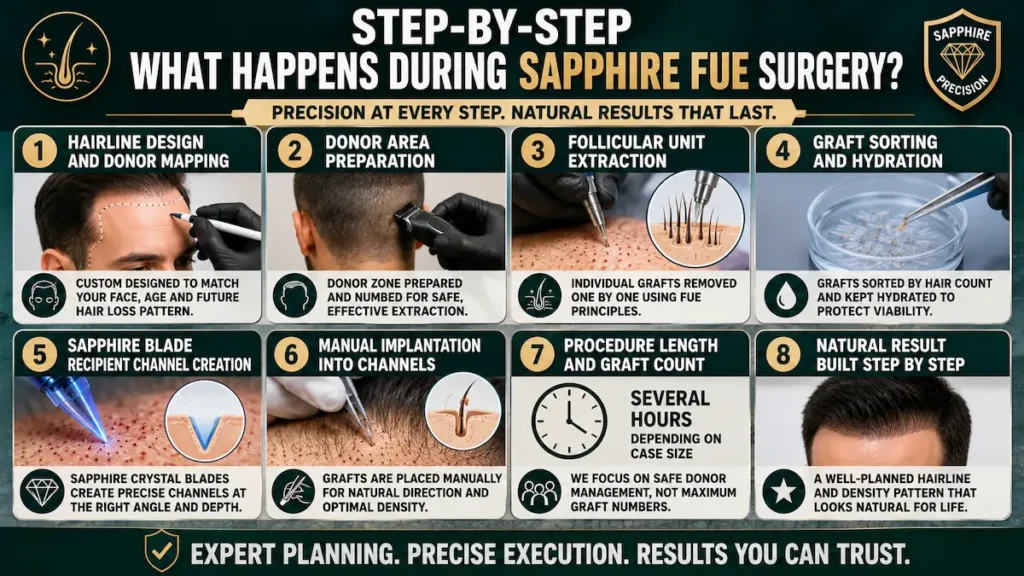
Step-by-Step: What Happens During Sapphire FUE Surgery?
A Sapphire FUE procedure follows a structured clinical sequence: hairline design, donor preparation, follicular unit extraction, graft sorting, sapphire blade channel creation, and manual implantation. Each step protects graft viability and helps create a natural-looking result.
Hairline Design and Donor Mapping
Your Sapphire FUE plan begins before surgery day. We review your photos, hair loss pattern, donor density, facial proportions, and long-term risk of future thinning.
Hairline design is not just drawing a line. It must match your age, facial shape, hair calibre, and likely future hair loss. A conservative design often looks more natural over time.
Donor Area Preparation
The donor area is usually the back and sides of the scalp. These follicles are more resistant to pattern hair loss, which is why they are selected for transplantation.
We trim the donor zone as needed, clean the scalp, and apply local anesthesia. Your donor density determines how many grafts can be extracted safely.
Follicular Unit Extraction
During extraction, individual follicular units are removed using FUE principles. Each graft may contain one, two, three, or more hairs.
Single-hair grafts are usually reserved for the front hairline. Multi-hair grafts are placed behind them to create visual density without making the hairline look heavy.
Graft Sorting and Hydration
Once removed, grafts are sorted and kept hydrated. This step protects follicle viability while the recipient area is prepared.
Graft handling matters. A technically advanced blade cannot compensate for poor graft storage, crushing, drying, or rushed placement.
Sapphire Blade Recipient Channel Creation
This is the stage that defines Sapphire FUE. We use sapphire crystal blades to create the recipient channels according to your planned density, direction, and angle.
The frontal hairline requires softer, flatter angles. The mid-scalp needs density without crowding. The crown requires careful direction planning because of the natural whorl pattern.
Manual Implantation Into Sapphire-Created Channels
After the channels are created, grafts are placed manually into the prepared sites. This stage requires steady technique and repeated quality checks.
We distribute grafts by hair count and location. The goal is not simply to use every graft. The goal is to create a hairline and density pattern that looks natural from conversational distance.
Procedure Length and Graft Count Expectations
Most Sapphire FUE sessions take several hours. A smaller hairline case may be shorter, while a large graft session can require most of the day.
We do not promise a maximum graft count before assessing your donor area. Safe harvesting protects your future options and prevents a thin, over-extracted donor zone.
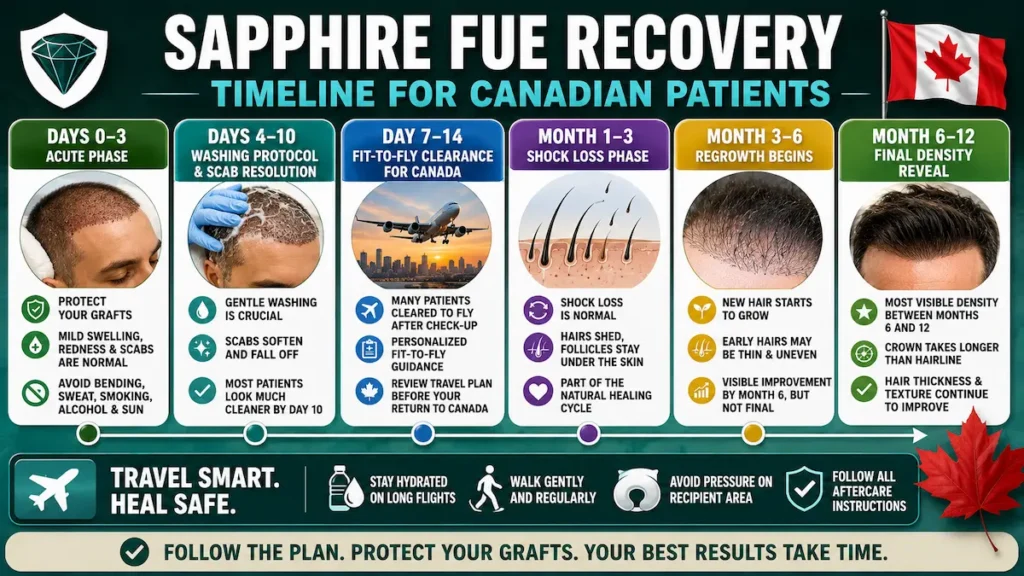
Sapphire FUE Recovery: Timeline for Canadian Patients
Sapphire FUE recovery happens in stages, not overnight. Canadian patients should plan for early graft protection, careful washing, fit-to-fly clearance, temporary shock loss, gradual regrowth, and final density development over 6–12 months.
Days 0–3: Acute Phase
The first three days focus on protecting the grafts. You will sleep with your head elevated, avoid touching the recipient area, and follow your medication instructions carefully.
Mild swelling, tightness, redness, and small scabs are expected. You should avoid bending forward, sweating heavily, smoking, alcohol, and direct sun exposure.
Days 4–10: Washing Protocol and Scab Resolution
Washing is one of the most important parts of early recovery. We show you exactly how to soften scabs, rinse gently, and avoid dislodging grafts.
By day 10, many patients look much cleaner, with most crusting reduced. For a detailed aftercare explanation, our washing hair after transplant guide walks through the day-by-day protocol.
Our HBOT/LLLT Recovery Protocol
We use advanced recovery support to help international patients heal with less stress. Hyperbaric Oxygen Therapy may reduce inflammation and support tissue repair, while Low-Level Laser Therapy helps stimulate cellular energy in the scalp.
Our LLLT system uses 424 medical-grade semiconductor laser diodes at 650nm to support scalp microcirculation and follicle health. This is especially relevant for hair restoration patients who want to protect graft success during the early healing window.
You can read more about our recovery technology on our technology and standards page, and the science is expanded in our HBOT benefits guide.
Day 7–14: Fit-to-Fly Clearance for Canada
Many Canadian patients are cleared to fly home after the early check-up period, depending on swelling, graft stability, and overall health. We provide individualized fit-to-fly guidance before your return flight.
Before travelling for elective care, Canadian patients should review the Government of Canada’s guidance on receiving medical care outside Canada and discuss travel plans with their health care provider.
For long-haul travel to Canada, hydration, gentle walking, and avoiding pressure on the recipient area matter. Our team reviews your flight timing before you leave Istanbul.
Month 1–3: Shock Loss Phase
Shock loss is normal. Many transplanted hairs shed during the first few weeks, which can feel discouraging if you are not prepared for it.
The follicle remains under the skin. The visible hair shaft sheds, then the follicle enters a resting phase before new growth begins.
“Shock loss is one of the most misunderstood parts of hair transplant recovery. It does not mean the transplant failed. It usually means the follicles are moving through the normal healing cycle.”
Month 3–6: Regrowth Begins
New growth often begins around month three or four. Early hairs may look thin, soft, or uneven. This is expected.
By month six, many patients see meaningful coverage, but the result is not final. Hair thickness and texture continue to improve.
Month 6–12: Final Density Reveal
Most visible density appears between months six and twelve. Crown work may take longer than frontal hairline work because circulation and growth patterns differ by scalp zone.
For a visual overview of this process, our hair transplant growth timeline explains what patients commonly see at month 1, month 3, month 6, and month 12.
Safety & Risks of Sapphire FUE
Sapphire FUE is a minimally invasive hair transplant technique, but it is still a medical procedure. Understanding swelling, scabbing, shock loss, infection risk, donor over-harvesting, and aftercare responsibilities helps patients make safer, more informed decisions.
Common Side Effects
Sapphire FUE is usually well tolerated, but it is still a surgical procedure. Common short-term effects include redness, swelling, scabbing, itching, tightness, and temporary numbness.
These effects usually improve with time and proper aftercare. We give each patient written instructions, medication guidance, washing steps, and direct follow-up access.
Shock Loss Reality
Shock loss can affect transplanted hairs and sometimes nearby native hairs. It is usually temporary, but it must be discussed before surgery so you do not panic when shedding begins.
If you still have significant native hair, we may discuss medical maintenance options before or after surgery. A transplant restores lost density; it does not stop future genetic hair loss by itself.
Infection, Folliculitis, and Poor Healing
Infection is uncommon when sterile protocols and aftercare are followed, but it remains possible. Folliculitis can also occur when follicles become inflamed during early growth.
You should contact us if you notice increasing pain, spreading redness, pus, fever, or unusual swelling. Early communication protects the result.
Over-Harvesting the Donor Area
The donor area is limited. Removing too many grafts can leave the back of the scalp thin or patchy.
This is one reason we avoid unrealistic graft promises. A clinic that advertises extreme graft counts without donor analysis may be putting short-term sales ahead of long-term appearance.
Genuine Sapphire vs Marketed-as-Sapphire
Some clinics use the word “sapphire” as a marketing label without explaining the surgical sequence. That should make you cautious.
Before booking, ask:
- Will sapphire blades be used for recipient channel creation?
- Who creates the channels?
- Who extracts the grafts?
- Who supervises implantation?
- How is graft survival protected during the session?
How Our Sterile Protocol and JCI-Aligned Standards Reduce Risk
We operate through a structured clinical pathway that includes pre-operative testing, sterile instrumentation, surgeon-led planning, and documented aftercare. Safety is not a slogan. It is a process.
Our hospital partner is JCI-accredited, and our team follows strict hygiene and patient-safety protocols. For international patients, this reduces avoidable risk before the long flight home.
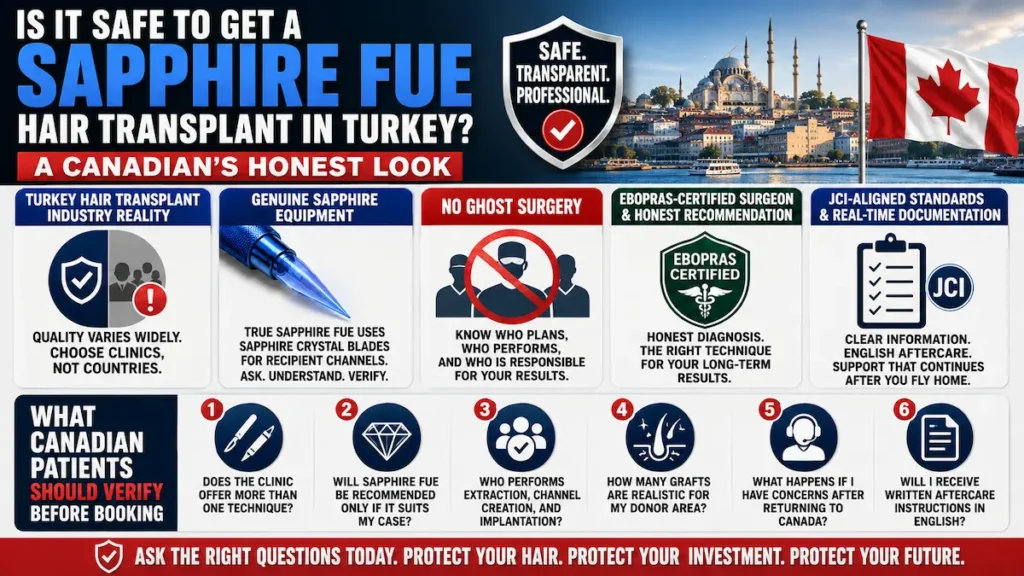
Is It Safe to Get a Sapphire FUE Hair Transplant in Turkey? A Canadian’s Honest Look
Turkey has deep experience in hair transplantation, but clinic quality varies. For Canadian patients, safety depends less on the country and more on surgeon oversight, sterile protocols, genuine technique use, aftercare continuity, and clear documentation before and after travel.
The Turkey Hair Transplant Industry Reality
Turkey is a global centre for hair transplantation, but quality varies widely. Some clinics are surgeon-led and clinically rigorous. Others run high-volume, technician-driven models with limited physician involvement.
Canadian patients should not judge by country alone. A safer question is: who plans the procedure, who performs the critical steps, and what happens after you fly home?
Our Turkey surgery safety guide explains how to compare facilities, accreditation, surgeon credentials, and aftercare before making a decision.
Verifying Genuine Sapphire Equipment
A true Sapphire FUE procedure uses sapphire crystal blades to create recipient channels. If a clinic cannot explain that step clearly, you should pause.
During your consultation, we explain whether Sapphire FUE, standard FUE, or DHI best fits your case. We also explain why. You should never feel pushed into a premium-sounding option without a clinical reason.
Ghost Surgery in Turkey Hair Procedures
“Ghost surgery” means the patient believes one clinician will perform the procedure, but someone else does the critical work. This is a real concern in international care.
We address this by clearly documenting your plan, your surgical pathway, and the roles of the team. You should always know who is responsible for medical decision-making.
For a deeper checklist, our ghost surgery in Turkey guide explains what to ask before booking.
EBOPRAS-Certified Surgeon and Honest Technique Recommendation
A safer Sapphire FUE plan starts with honest diagnosis. If your donor area is weak, if DHI suits your pattern better, or if medical therapy should come first, we will explain that before you travel.
Our approach is not to sell one technique to every patient. We compare your case against FUE, DHI, and Sapphire FUE, then recommend the safest option for your long-term result.
JCI-Aligned Standards and Real-Time Documentation
For Canadian patients, documentation matters. You should receive clear information about your procedure, medication plan, washing steps, and follow-up schedule.
We provide English-language guidance and keep communication open after you return home. Your care does not end at the airport.
What Canadian Patients Should Verify Before Booking
Before booking any Sapphire FUE procedure abroad, ask direct questions. A trustworthy clinic should answer clearly, without pressure.
- Does the clinic offer more than one technique?
- Will Sapphire FUE be recommended only if it suits my case?
- Who performs extraction, channel creation, and implantation?
- How many grafts are realistic for my donor area?
- What happens if I have concerns after returning to Canada?
- Will I receive written aftercare instructions in English?
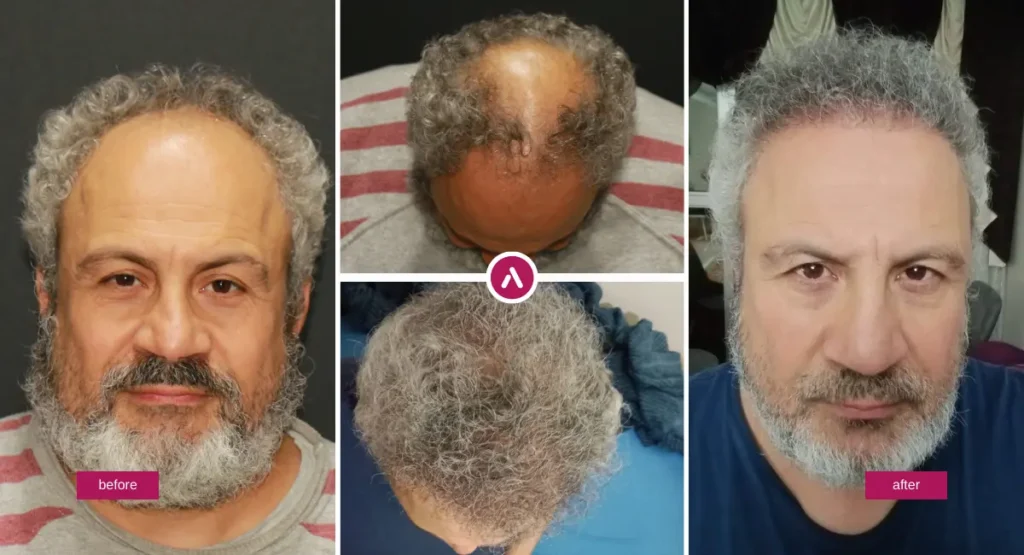
Sapphire FUE Before and After: Realistic Expectations & Results
Sapphire FUE can improve hairline definition, frontal density, and overall coverage when donor supply is strong enough. Results develop gradually, and the final outcome depends on graft survival, native hair stability, donor quality, hair calibre, and long-term planning.
Sapphire FUE Before and After: What Changes Realistically
Sapphire FUE can restore a receding hairline, improve frontal density, soften temple recession, and support crown coverage when donor supply allows. It cannot create unlimited density.
Your final result depends on donor strength, hair thickness, graft survival, hairline design, and future hair loss. We plan for today and for the years ahead.
You can review broader hair restoration outcomes through our hair transplant before-and-after gallery.
Density Expectations
Good density is not just about graft count. A 3,000-graft plan can look stronger than a poorly planned 4,500-graft session if the hairline design, graft distribution, and donor management are better.
We place single-hair grafts in the front, then use thicker grafts behind them. This creates a softer hairline and stronger visual coverage.
Is Sapphire FUE Permanent?
Transplanted follicles are usually taken from areas resistant to androgenetic hair loss. Once they establish blood supply, they are expected to grow long term.
That said, your native hair can continue thinning. Some patients need medical maintenance, a second procedure years later, or a conservative first plan that protects donor reserves.
Sapphire vs Standard FUE: Will People See the Difference?
The visible difference between Sapphire FUE and standard FUE is often subtle. Friends and colleagues are more likely to notice that your hairline looks fuller, not that a sapphire blade was used.
The main advantages are technical: channel refinement, early healing, and dense-looking placement in the right patient. We avoid exaggerated promises because the best transplant should look natural, not obvious.
Sapphire FUE Cost 2026: Turkey vs Canada
Canadian patients researching Sapphire FUE cost often compare Toronto, Vancouver, Calgary, and Montreal clinics before looking at Istanbul. The difference is usually not only the procedure fee. Canadian quotes may separate consultation, graft pricing, facility costs, medication, aftercare, and taxes.
At AKM Clinic, Sapphire FUE is priced through a graft-count-based all-inclusive clinical pathway. Sapphire FUE up to 2,500 grafts is typically CAD $2,500–$2,800. A 2,500–4,000 graft plan is typically CAD $2,800–$3,000, while a 4,000–5,000 graft mega-session is typically CAD $3,000–$3,500.
| Location | Typical Sapphire FUE Cost | What Patients Should Check |
|---|---|---|
| Toronto | CAD $12,000–$18,000 | Whether pricing is per graft and whether aftercare is included |
| Vancouver | CAD $13,000–$18,000 | Whether Sapphire FUE is truly available or only marketed |
| Calgary | Clinic-dependent | Whether the surgeon offers FUE, DHI, and Sapphire FUE |
| Montreal | Clinic-dependent | Whether quote includes medication, follow-up, and taxes |
| AKM Clinic Istanbul | CAD $3,000–$3,500 depending on graft count | All-inclusive clinical pathway with coordinated logistics |
For the detailed cost breakdown, see our Sapphire FUE hair transplant cost guide. You can also review the Sapphire Hair Transplant package for what is included.
Canadian-dollar pricing shown for planning clarity; your coordinator will confirm the final payment details before booking.
How to Find the Best Sapphire FUE Surgeon in Turkey: A Canadian Patient’s Checklist
Choosing a Sapphire FUE surgeon should involve more than reviewing before-and-after photos. Canadian patients should verify credentials, ask who performs each surgical step, confirm genuine sapphire blade use, and make sure the clinic offers more than one technique.
EBOPRAS Certification and RCPSC Equivalency
Canadian patients are used to checking credentials through Canadian specialist frameworks such as the Royal College of Physicians and Surgeons of Canada’s certification routes.
In Turkey, you should look for recognized surgical training, international society involvement, documented hair restoration experience, and clear surgeon accountability. Our team includes European Board-Certified Surgeons, and our clinical standards are explained on our About AKM Clinic page.
| Credential Signal | What It Means | Why Canadian Patients Ask About It |
|---|---|---|
| RCPSC | Canadian specialist certification framework | Familiar benchmark for Canadian patients |
| EBOPRAS / European Board pathway | Structured European specialist credentialing | Helps compare international training standards |
| ISHRS awareness | Hair restoration-focused educational standard | Shows knowledge of transplant-specific best practices |
| Documented before-and-after cases | Real outcome evidence | Shows consistency beyond marketing language |
For hair-restoration-specific education, the International Society of Hair Restoration Surgery is a global medical association focused on hair loss treatment and restoration.
Genuine Sapphire Equipment Verification
If you are paying for Sapphire FUE, you deserve to know what that means. Ask whether sapphire blades are used for recipient channel creation, not just mentioned in the package name.
You should also ask who creates the channels. This is one of the most important artistic and technical steps in the procedure.
Multi-Technique Capability
A strong hair transplant clinic should not force every patient into the same technique. If a clinic offers only one method, every consultation may begin to sound the same.
We offer FUE, Sapphire FUE, DHI, hair transplant for women, eyebrow transplant, and beard and moustache transplant. This allows us to recommend based on anatomy, not a one-technique sales model.
Honest Recommendation: Does the Surgeon Push Sapphire on Everyone?
Sapphire FUE is valuable, but it is not universal. You should be cautious if a clinic presents it as the best answer before reviewing your photos, donor area, and hair loss pattern.
An honest recommendation should explain why Sapphire FUE fits your case, or why standard FUE or DHI might be better.
“A strong consultation should include a reasoned recommendation, not a script. If Sapphire FUE is right, we explain why. If it is not, we say that clearly.”
Real Patient Reviews and Before-and-After Documentation
Reviews should speak to more than friendliness. Look for comments about communication, aftercare, natural-looking results, and whether the clinic stayed responsive after the patient returned home.
Our professional reviews page includes verified patient experiences from international patients, including Canadians who travelled to Istanbul for treatment.
Aftercare Continuity From Istanbul to Canada
Aftercare is especially important for Canadian travellers because you may be 8,000 km away after your return flight. You should know who to contact if you have swelling, redness, shedding anxiety, or washing questions.
Our long-term virtual follow-up programme includes structured check-ins after you return home. You also receive direct support from our patient coordination team.

Your Sapphire FUE Journey From Canada: From YYZ to Istanbul, Step by Step
Travelling from Canada for Sapphire FUE requires clear planning before you fly. We guide patients through photo assessment, treatment selection, arrival in Istanbul, procedure-day preparation, early recovery, fit-to-fly clearance, and long-term virtual follow-up after returning home.
Pre-Trip Photo Assessment
Your journey starts with a photo assessment. We review your hairline, crown, donor area, scalp visibility, and previous treatment history.
We may ask for photos from several angles in natural light. Clear photos help us estimate whether Sapphire FUE, standard FUE, or DHI is the most appropriate technique.
Travel Logistics From Toronto, Vancouver, Calgary, and Montreal
Most Canadian patients arrive through Istanbul Airport. Flight schedules change, so we recommend checking current airline routes before booking.
Canadian passport holders can typically enter Turkey visa-free for short stays, but you should confirm current entry requirements before travel. Your passport should also have enough validity for international travel.
Our patient journey guide explains the consultation, arrival, procedure, recovery, and return-home process in more detail.
5-Star Hotel Recovery Stay
Recovery is easier when logistics are organized before you land. Our all-inclusive clinical pathway includes 5-star hotel accommodation, private transfers, and patient support.
After arrival, your driver takes you from the airport to your hotel or clinic schedule. This helps reduce stress, especially if it is your first time in Istanbul.
Procedure Day at Our Istanbul Clinic
On procedure day, we confirm your plan, review hairline design, complete preparation, and begin local anesthesia. The day is structured, but not rushed.
You can learn more about the treatment environment on our Istanbul clinic page.
Fit-to-Fly Clearance and Return Travel
Before you fly home, we check your grafts, donor area, swelling, and overall comfort. We also review flight precautions.
For long-haul travel, we recommend hydration, gentle walking, loose clothing, and avoiding pressure on the recipient area. You should keep your aftercare instructions accessible during the trip.
Sapphire FUE Hair Transplant Frequently Asked Questions (FAQ):
These questions address the concerns Canadian patients raise most often before choosing Sapphire FUE in Turkey, including technique selection, cost, recovery, travel insurance, provincial coverage, final results, and how to verify that sapphire blades are genuinely used.
What is the difference between Sapphire FUE and regular FUE?
Both use FUE extraction. The difference is recipient channel creation. Regular FUE usually uses steel blades, while Sapphire FUE uses sapphire crystal blades to create finer channels.
Is Sapphire FUE better than DHI?
Not always. Sapphire FUE may suit larger frontal density cases, while DHI may suit implanting between existing hairs or selected unshaven cases. The right choice depends on your scalp and goals.
Is Sapphire FUE worth the extra cost?
It can be worth it when refined channel work, frontal density, and smoother early healing are priorities. It is less useful if your case would benefit more from DHI or conservative medical management.
How long does a Sapphire FUE procedure take?
Most sessions take several hours. The exact time depends on graft count, donor extraction, recipient area size, and how much density is planned.
Does OHIP, MSP, AHCIP, or RAMQ cover Sapphire FUE?
Hair transplantation for pattern hair loss is generally considered elective and cosmetic. Canadian provincial health plans such as OHIP, MSP, AHCIP, and RAMQ usually do not cover it.
How much does Sapphire FUE cost in Toronto vs Istanbul?
Toronto and Vancouver private clinics often price hair transplants by graft count or premium technique tier. At AKM Clinic, Sapphire FUE is typically CAD $3,000–$3,500 depending on graft count.
Does Canadian travel insurance cover complications from elective Sapphire FUE in Turkey?
Many Canadian travel insurance policies exclude elective cosmetic surgery and complications related to it. You should review your policy carefully before booking and ask the insurer direct written questions.
To reduce this concern, AKM Clinic provides complimentary complication insurance for all patients. This is separate from standard Canadian travel insurance and is designed to add an extra layer of protection around your surgical care. Your coordinator will explain the coverage terms, limits, and required documentation before you confirm your booking.
How do I know I am getting a genuine sapphire blade?
Ask how recipient channels are created, who creates them, and whether the clinic can explain the difference between steel blades, sapphire blades, and DHI pens. Clear answers matter.
When will I see final results?
Early shedding is common in the first month. New growth usually begins around month three or four, with most density visible between months six and twelve.
Is Sapphire FUE permanent?
Transplanted donor follicles are generally resistant to pattern hair loss and can grow long term. Native hair may still thin, so long-term planning remains important.
Should I choose Sapphire FUE or DHI?
Choose based on diagnosis, not trend. Sapphire FUE may be better for broad frontal density. DHI may be better for careful implantation among existing hairs.
Can I combine Sapphire FUE with a beard or eyebrow transplant?
Yes, in selected cases. We first check donor capacity and treatment priorities. Scalp restoration should not be compromised for combination planning.
Medical Disclaimer
This page is for educational purposes only and does not replace a consultation with a qualified medical professional. Hair transplant candidacy depends on donor density, hair loss stability, medical history, scalp condition, and realistic expectations.
If you live in Canada, we encourage you to speak with your family physician or dermatologist before travelling for elective surgery. You should also review travel insurance exclusions, medication safety, and follow-up planning before booking.
Results vary from patient to patient. No clinic can guarantee a specific density, growth percentage, or timeline. Our role is to assess your case honestly and recommend a safe, tailored clinical protocol.