




Hair loss affects women differently than men. While male hair loss often follows a predictable receding pattern, female hair loss may appear as diffuse thinning across the scalp, frontal hairline recession, traction-related loss, postpartum shedding, or menopause-related density change. This is why the most important question for any Canadian woman considering a hair transplant is not simply “Where should I go?” It is, “Am I actually a good candidate?”
At AKM Clinic in Istanbul, we assess women using female-specific criteria: Ludwig staging, donor-area stability, loss pattern, scalp health, and the privacy needs that matter during recovery. We offer no-shave FUE and DHI techniques for women who qualify, while honestly advising medical treatment first when diffuse thinning makes surgery unsafe or unlikely to deliver a natural result.
Table of Contents

What Is a Hair Transplant for Women? And How It Differs from Men’s
A hair transplant for women uses FUE or DHI to restore hair in cases of female pattern hair loss, traction alopecia, or a high frontal hairline. Unlike men, women often have diffuse loss affecting the donor area too, so candidacy assessment through Ludwig staging is critical. No-shave techniques can preserve existing hair during recovery.
How Hair Transplant Works for Women
A women’s hair transplant relocates healthy follicles from a stable donor area, usually the back or sides of the scalp, into thinning or recessed areas. The transplanted follicles are placed one by one, following the natural angle, curl, and direction of your existing hair.
The procedure does not create new follicles. It redistributes your own permanent hair into areas where density has been lost. This makes donor-area quality the foundation of a safe result.
For women, we most often treat:
- Frontal hairline recession
- Temple thinning
- Traction alopecia from tight hairstyles
- High forehead concerns where hairline lowering is appropriate
- Localized scarring or trauma, when the condition is stable
For a broader explanation of how transplant techniques work across all candidates, our hair transplant in Turkey guide explains the FUE, DHI, and Sapphire FUE pathways in more detail.
Why Women’s Hair Transplants Differ from Men’s
Male pattern hair loss usually leaves a stable donor zone at the back of the scalp. Female pattern hair loss is different. Many women thin across the entire scalp, including the area surgeons would normally use for graft harvesting.
This changes the surgical decision. A woman with strong donor density and localized loss may be an excellent candidate. A woman with active diffuse thinning may need medical stabilization first.
That honest distinction protects you. Operating on weak donor hair can move fragile follicles from one thinning area to another, creating disappointment rather than density.
The Donor Area Challenge in Female Pattern Hair Loss
The donor area is the “bank” of a hair transplant. If that bank is stable, we can plan density, graft count, and technique with confidence. If it is thinning, surgery becomes more complex.
During your assessment, we review:
- Donor density at the back and sides of the scalp
- Miniaturization patterns under magnification
- Whether thinning is localized or diffuse
- Whether the loss is stable, improving, or still progressing
- Medical causes such as postpartum shedding, thyroid imbalance, iron deficiency, or hormonal change
This is why a responsible clinic should sometimes say “not yet” or “not surgery first.” A hair transplant is powerful when the biology is right. It is the wrong tool when the root cause is active, untreated shedding.
Hair Transplant vs Medical Treatment for Women
Some women need surgery. Others need dermatology-led treatment first. Many need both, but in the correct order.
A transplant may be appropriate when hair loss is localized, stable, and supported by a strong donor area. Medical treatment may come first when the thinning is diffuse, recent, hormonal, or still changing.
The Canadian Dermatology Association explains that female pattern hair loss often involves thinning on the top or crown of the scalp. You can review its patient resource on alopecia and female pattern hair loss before your consultation.
We do not treat every hair-loss pattern with surgery. That restraint is part of our Natural-First approach. The goal is not to perform the most procedures; it is to recommend the right clinical pathway for long-term density.
Benefits of a Hair Transplant for Women — When You’re the Right Candidate
A women’s hair transplant can restore density in areas that styling, fibres, extensions, or topical products can no longer disguise. The benefits are strongest when the patient has stable donor hair and a defined recipient zone.
Permanent Restoration of the Frontal Hairline
The frontal hairline shapes the face. Even mild recession can change how you look in photos, under bright office lighting, or with your hair pulled back.
For qualified women, transplanting single follicular units along the frontal border can soften recession and rebuild a more natural frame. The design must be conservative. A female hairline should not look low, dense, or abrupt in the way some male hairline repairs do.
Traction Alopecia Reversal
Traction alopecia is common in women who have worn tight ponytails, braids, buns, extensions, or weaves for years. It often affects the temples and frontal edges first.
If the traction has stopped and the skin remains healthy, a transplant can restore density to these localized areas. This is one of the clearest female transplant indications because the donor area is often stronger than the damaged front or temples.
Hairline Lowering for a High Forehead
Some women do not have progressive hair loss. They have a naturally high forehead or a hairline that feels out of proportion with their facial features.
Hair transplantation can lower or reshape the hairline without a forehead-reduction incision. This approach requires careful planning, especially around density gradients and temple transitions. The goal is a soft, believable hairline that moves naturally with your face.
No-Shave Options Preserve Privacy
Privacy matters. Many women delay treatment because they fear a visibly shaved donor area, an obvious recovery period, or questions from co-workers.
No-shave FUE and no-shave DHI can reduce that concern. Instead of shaving the full scalp, our team selectively prepares small donor zones that existing hair can often cover. This technique is slower and more demanding, but it can make recovery far more discreet.
Natural Density Restoration with Existing Hair Concealment
Women often have existing hair in the recipient area. That creates both an advantage and a responsibility.
The advantage is concealment. Existing hair can help cover early redness, scabbing, or shock loss. The responsibility is surgical precision: grafts must be placed without damaging surrounding follicles.
When planned correctly, a women’s hair transplant does not create a “pluggy” or artificial line. It adds density in a way that blends with the hair you already have.
Am I a Candidate? Female Pattern Hair Loss and Ludwig Staging
The best female hair transplant results begin with a careful decision: should we transplant, treat medically first, or wait? This question matters more for women than for men because female pattern hair loss often affects the donor area as well as the visible thinning zone.
At AKM Clinic, we use Ludwig staging, donor-density assessment, and loss-pattern analysis before recommending surgery. We do not believe every woman with thinning hair should be offered a transplant. That honesty protects your donor area and your long-term result.
Ludwig Staging Explained: Stage I, II, and III
Ludwig staging classifies female pattern hair loss by the degree of thinning across the central scalp. It helps us understand whether your hair loss is early, moderate, or advanced. It also tells us whether the donor area may be strong enough for surgery.
| Ludwig Stage | Description | Donor Status | Transplant Candidate? | Recommended Approach |
|---|---|---|---|---|
| Stage I | Mild thinning, often along the part line or frontal zone | Usually stronger, but must be checked | Possible, if loss is stable and localized | Medical stabilization first, then selective transplant if needed |
| Stage II | Moderate thinning across the top or crown | Variable; donor miniaturization is common | Case-by-case | Detailed scalp analysis, conservative graft planning, medical support |
| Stage III | Advanced diffuse thinning with visible scalp exposure | Often weakened | Usually poor candidate | Medical treatment, camouflage strategies, or non-surgical planning first |
This table is a guide, not a diagnosis. Two women at the same Ludwig stage may have very different donor density. That is why photo review alone is useful, but magnified scalp evaluation is stronger.
Good Candidates: Stable Donor Hair and Localized Loss
The best candidates usually have a clear recipient area and a strong donor area. In these cases, we can move grafts without weakening the back of the scalp or creating visible thinning elsewhere.
You may be a good candidate if you have:
- A receding frontal hairline with strong donor density
- Temple thinning from traction alopecia
- A naturally high forehead suited to hairline lowering
- Stable scarring from trauma or previous surgery
- Localized patches surrounded by healthy hair
Traction alopecia is one of the clearest female indications when the pulling habit has stopped. Tight braids, ponytails, buns, weaves, or extensions can damage the frontal edges and temples. If the scalp is healthy and the donor area is stable, transplanted follicles can restore density in those zones.
The Canadian Dermatology Association notes that tight hairstyles can contribute to traction alopecia. Its hair care guidance is a useful background resource for patients with edge or temple loss related to styling tension.
Caution Candidates: Diffuse Loss and Donor Area Weakness
Diffuse female pattern hair loss requires caution. If thinning affects the entire scalp, including the donor area, transplanting may move vulnerable follicles from one weak zone to another. That does not solve the problem.
We look for signs of donor miniaturization before planning surgery. Miniaturized donor hair may survive poorly, grow thin, or fail to create meaningful density. It can also leave the donor area looking depleted.
This is why we are careful with crown thinning in women. Crown density can sometimes improve with medical treatment. In other cases, the loss is too diffuse for a safe surgical plan.
“A responsible women’s hair transplant assessment is sometimes a decision not to operate yet. If the donor area is unstable, the safest plan is to stabilize the biology first.”
When Medical Treatment Comes First
Some hair loss patterns need medical evaluation before surgery. A transplant can restore lost density in selected areas, but it cannot stop an active shedding process.
Medical treatment may come first when we see:
- Active female pattern hair loss that is still progressing
- Postpartum telogen effluvium, which is often temporary
- Menopause-related shedding linked to hormonal change
- Iron deficiency, thyroid imbalance, or inflammatory scalp disease
- Sudden shedding after illness, stress, medication change, or weight loss
Postpartum shedding is a common example. Many women lose hair several months after delivery, then recover as the hair cycle normalizes. Surgery during that window is usually premature.
We may recommend that you see a dermatologist, family physician, or hair-loss specialist in Canada before committing to surgery. That is not a delay tactic. It is a safety step.
The Honest Truth: Not Every Woman Is a Transplant Candidate
A high-quality clinic should be willing to decline poor candidates. This is especially true for women with diffuse thinning, weak donor density, or active medical hair loss.
If a clinic promises a transplant without discussing donor strength, Ludwig stage, or ongoing medical causes, be cautious. Women’s hair restoration is not the same as placing grafts into a male hairline. The biology is different.
| Candidate Type | Typical Pattern | Risk Level | AKM Clinic Approach |
|---|---|---|---|
| Good Candidate | Localized frontal or temple loss with stable donor hair | Lower | Proceed with tailored FUE or DHI planning |
| Caution Candidate | Moderate thinning with possible donor miniaturization | Medium | Assess closely, plan conservatively, consider medical support |
| Medical-First Candidate | Active diffuse shedding, postpartum loss, thyroid or iron-related thinning | High for surgery | Stabilize the underlying cause before considering transplant |
This is the difference between ethical planning and volume-based surgery. We would rather protect your donor area than offer a procedure that cannot meet your expectations.
Age and Realistic Expectations
Age alone does not decide candidacy. A woman in her 30s with traction alopecia may be a strong candidate. A woman in her 55s with stable frontal recession may also qualify. A younger woman with fast-moving diffuse loss may need treatment first.
The better question is stability. Has the hair loss changed quickly? Is the donor area strong? Can transplanted grafts blend with surrounding hair? Will future thinning require medical maintenance?
A transplant can improve density, restore a hairline, and reduce the need for camouflage. It cannot recreate teenage density or stop future female pattern hair loss. We plan for a result that looks natural now and still makes sense years later.
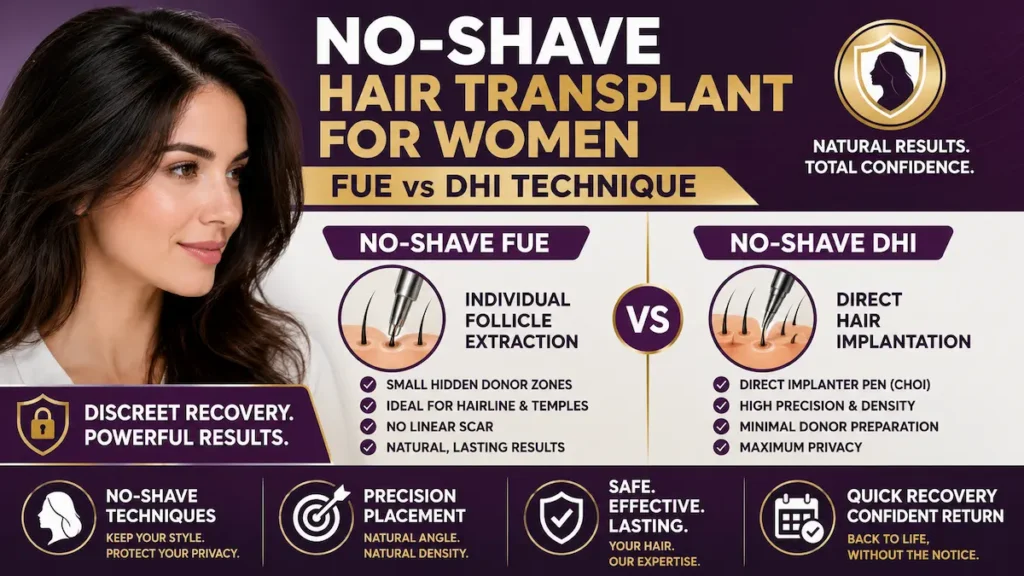
No-Shave Hair Transplant for Women: FUE vs DHI Technique
No-shave hair transplant is one of the most important technique choices for women. It protects privacy, preserves your current hairstyle, and allows many patients to return to daily life without an obvious shaved donor patch.
At AKM Clinic, we offer both no-shave FUE and no-shave DHI for qualified women. The right choice depends on your donor density, recipient area, graft count, hair length, and how much concealment you need during recovery.
Why No-Shave Matters for Women
Many Canadian women considering hair restoration are working professionals, parents, or caregivers. They may not want colleagues, clients, or family members to know they had surgery.
A full shave can create unnecessary emotional stress. No-shave planning reduces that burden by preserving enough existing hair to cover donor preparation and early healing.
No-shave technique is especially valuable for:
- Women with long enough hair to conceal small donor zones
- Patients treating the frontal hairline or temples
- Traction alopecia cases with localized loss
- Professionals who need a discreet recovery
- Patients who want to avoid a dramatic hairstyle change
No-shave does not mean “no preparation at all.” It means we prepare only what is needed, in a way that existing hair can usually hide.
No-Shave FUE for Women
In no-shave FUE, we extract individual follicular units from carefully selected donor areas. Instead of shaving the entire back of the scalp, we trim narrow strips or small hidden zones beneath the surrounding hair.
This technique works well when the graft count is moderate and the donor area is strong. It can be ideal for temple restoration, frontal hairline softening, or traction alopecia.
FUE gives the surgeon direct control over donor extraction. It also avoids the linear scar associated with older strip techniques. For a deeper explanation of the FUE method, see our FUE hair transplant in Turkey guide.
No-Shave DHI for Women
DHI uses a Choi implanter pen to place follicles directly into the recipient area. This can be useful when we are working between existing hairs and need precise control of angle, depth, and direction.
No-shave DHI may be preferred when density is the main goal and the recipient area still has surrounding hair. It allows careful placement without creating wide recipient channels first.
DHI is not automatically “better” than FUE. It is better for certain cases. Our role is to match the method to your anatomy, not force every woman into the most marketable technique.
For a more detailed technical breakdown, our DHI hair transplant in Turkey guide explains how Choi implanter placement works.
When Partial Shaving Is Unavoidable
No-shave is not always the safest choice. If a patient needs a high graft count, has short hair, or requires broader donor-area access, partial shaving may produce a better clinical result.
We explain this before surgery. A hidden partial shave can still be discreet, especially when planned under longer surrounding hair.
We may recommend partial shaving when:
- The graft count is too high for fully unshaven extraction
- Donor hair is dense and difficult to separate safely
- Existing hair blocks clear visualization
- We need to reduce graft handling time
- Safety and graft survival would be better with more access
Privacy matters. Graft survival matters more. We balance both.
Hairline Design for Women
A female hairline is not just a lower version of a male hairline. It usually has softer temple transitions, finer single-hair grafts at the front, and a different curve across the forehead.
Women also tend to notice density gaps under different conditions: tied-back hair, overhead lighting, side-part styling, and close-up photos. We design with those real-life situations in mind.
A natural female hairline should:
- Use single follicular units at the leading edge
- Follow a soft, irregular border
- Avoid a harsh straight line
- Blend into temples and sideburns
- Respect facial proportions and forehead height
Hairline planning is a topic many patients want to study before committing. Our natural hairline design guide explains why angle, density, and irregularity matter as much as graft count.
Which Technique Fits Which Female Candidate?
The best technique depends on the clinical problem. A woman with traction alopecia at the temples may need a different approach than a woman seeking hairline lowering or frontal density.
| Technique | Shaving | Density Control | Best For | AKM Clinic Position |
|---|---|---|---|---|
| No-Shave FUE | Small hidden donor zones or selective trimming | Strong, with surgeon-created recipient planning | Frontal hairline, temples, traction alopecia, moderate graft counts | Excellent option when donor access and concealment can both be protected |
| No-Shave DHI | Minimal donor preparation with direct implantation | High precision between existing hairs | Density refinement, frontal gaps, patients with existing recipient hair | Preferred when direct placement offers better angle control and privacy |
“For women, the most discreet technique is not always the safest technique. We choose no-shave FUE or DHI only when it protects both privacy and graft survival.”
Some women are candidates for either method. Others clearly benefit from one. During your consultation, we explain the trade-offs in plain language: visibility, graft count, density, procedure time, and recovery privacy.
Some women also ask about sapphire technique because it is often marketed alongside FUE and DHI. Sapphire FUE can be useful in selected cases, but it is not automatically better for every woman. For the full blade-technology comparison, see our Sapphire FUE hair transplant in Turkey guide.
That decision should never be rushed. The technique must serve the result.
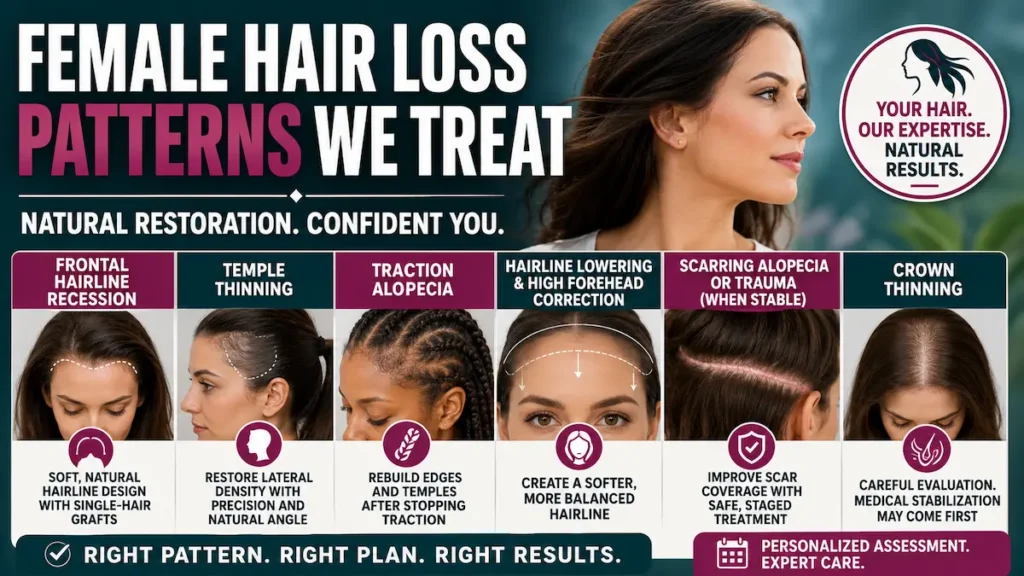
Female Hair Loss Patterns We Treat
Women do not all lose hair in the same pattern. Some have a widening part line. Others lose density at the temples, frontal hairline, or edges from years of traction. A safe treatment plan starts by identifying the pattern before choosing a technique.
At AKM Clinic, we separate transplant-friendly patterns from medical-first patterns. This prevents over-treatment and protects the donor area.
Frontal Hairline Recession
Frontal recession can make the forehead appear taller, change facial balance, or create gaps that become visible when the hair is pulled back. In women, this area must be designed with softness.
We use single-hair grafts at the front edge and gradually increase density behind them. The goal is not a dense, straight line. It is a natural transition that blends with your existing hair.
Frontal hairline restoration may be appropriate when:
- The donor area is stable and dense enough
- The recession is localized rather than diffuse
- The patient understands realistic density limits
- The surrounding hair can support a natural blend
Temple Thinning
Temple thinning can affect how the face looks from the front and side. It often becomes noticeable in ponytails, buns, or side-part styling.
Temple restoration is delicate. Hair direction changes quickly in this area, and grafts must be placed at a shallow angle. Poorly angled grafts can look obvious, especially when the hair is tied back.
For women with stable temple loss, FUE or DHI can rebuild softer lateral density. We plan conservatively because overfilling the temples can look less natural than mild recession.
Traction Alopecia from Tight Hairstyles
Traction alopecia is caused by repeated pulling on the hair follicles. Tight braids, extensions, weaves, buns, ponytails, and certain protective styles can gradually damage the frontal edges and temples.
This pattern is often transplant-friendly if the traction has stopped and the scalp is not scarred beyond recovery. The key is stability. Continuing the same pulling habits after surgery can damage both existing and transplanted hair.
We usually assess traction alopecia by asking:
- How long the pulling hairstyle was worn
- Whether the patient has stopped or reduced traction
- Whether the skin is smooth, scarred, inflamed, or shiny
- Whether there is still fine hair in the affected zone
- Whether the donor area is strong enough for extraction
When the biology is right, traction alopecia restoration can be one of the most satisfying female hair transplant indications.
Hairline Lowering and High Forehead Correction
Some women seek a transplant because they have a naturally high forehead rather than progressive hair loss. In these cases, the purpose is hairline lowering, not hair-loss treatment.
Hairline lowering with grafts can be useful when the patient wants a softer, less surgical alternative to forehead reduction surgery. It avoids a long incision at the hairline, but it takes patience because growth develops gradually over months.
The design must respect facial proportions. Lowering the hairline too much can look artificial and may require more grafts than the donor area should safely provide.
Scarring Alopecia or Trauma: When Stable
Hair can sometimes be transplanted into scars from trauma, burns, previous surgery, or stable inflammatory conditions. These cases require caution because scar tissue has different blood supply than normal scalp.
We only consider scar-area transplantation when the condition is inactive. If inflammation is ongoing, surgery should wait.
Scar cases often need conservative grafting. Density may be improved, but coverage can be more gradual than in healthy scalp tissue. In some cases, staged treatment is safer.
Crown Thinning: Why We Assess Carefully
Crown thinning in women is often part of diffuse female pattern hair loss. This makes it less predictable for transplant than a localized frontal or traction-related area.
We evaluate the crown carefully because it can require many grafts, yet still look thin if surrounding hair continues to miniaturize. A transplant may help some selected women. It is not the default answer.
When crown thinning is active or diffuse, medical stabilization usually comes first. This is where a Canadian dermatologist or family physician may play an important role before surgery is considered.
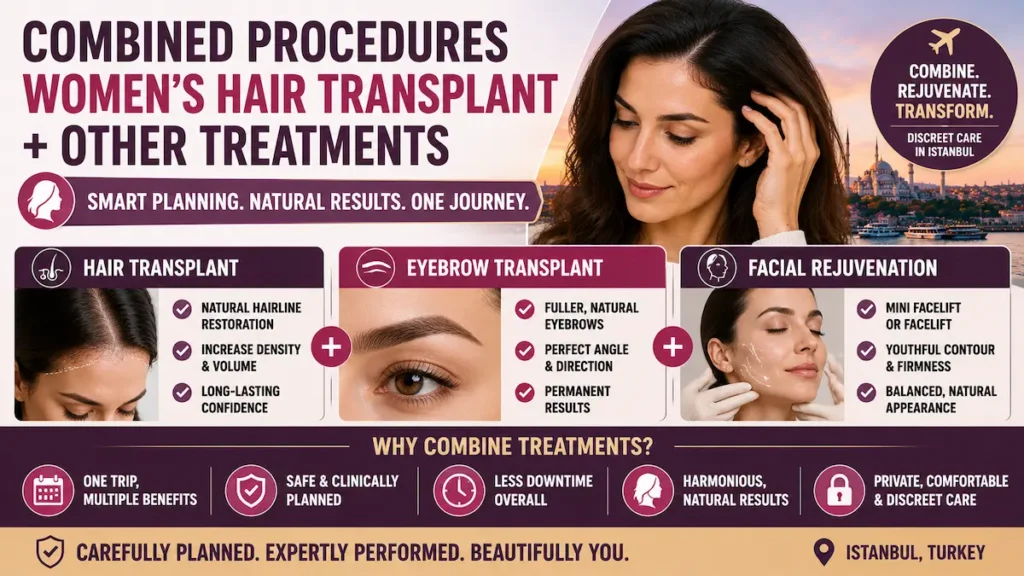
Combined Procedures: Women’s Hair Transplant + Other Treatments
Some women travel to Istanbul for one focused procedure. Others use the trip to address related concerns, such as eyebrow thinning or facial aging. Combined treatment should be planned carefully, especially when recovery instructions overlap.
We only recommend combination treatment when it is clinically reasonable, safe for travel, and aligned with your main goal. More treatment is not always better.
Hair Transplant + Eyebrow Transplant
Women who have thinning scalp hair may also have sparse eyebrows from over-plucking, genetics, thyroid-related changes, trauma, or previous cosmetic tattooing. In selected patients, eyebrow transplant can be planned during the same trip.
Eyebrow transplantation requires different angle control than scalp hair. Brow hairs must lie flatter, follow a precise direction, and create a soft border rather than a dense block.
If you are considering both, our team will assess donor availability carefully. Scalp and eyebrow restoration both draw from the same donor supply, so graft allocation must be conservative.
You can learn more through our eyebrow transplant in Turkey guide.
Hair Transplant + Facial Procedures
Some women combine hair restoration with facial rejuvenation, especially when the hairline and face shape affect the same overall frame. This may include procedures such as mini facelift, facelift, or facial skin treatments.
Combination planning requires careful sequencing. We must protect the scalp grafts, avoid unnecessary swelling overlap, and make sure your return flight timeline is safe.
For patients exploring broader facial rejuvenation, our facelift in Turkey guide and mini facelift in Turkey guide explain the surgical options in more detail.
Hairline Lowering + Forehead Proportion Planning
Hairline lowering with grafts can improve forehead balance without a hairline incision. This is different from surgical forehead reduction, which removes skin to lower the hairline more immediately.
For many women, graft-based hairline lowering is more gradual and less visibly surgical. It can be a strong option when the patient has enough donor hair and realistic expectations about density.
The design should never over-lower the hairline. A natural result respects facial proportions, temple transitions, and long-term donor supply.
Anesthesia for Women’s Hair Transplant: Local Only
A women’s hair transplant does not require general anesthesia. The procedure is performed under local anesthesia, sometimes with mild sedation for comfort. You are awake, breathing on your own, and able to rest during the graft extraction and implantation phases.
This local-only approach is one reason hair transplant recovery is usually more predictable than major surgery. It also matters for Canadian patients planning long-haul travel home.
Why General Anesthesia Is Not Needed
Hair transplantation works in the skin and superficial scalp tissues. We do not need to place you under general anesthesia to extract or implant follicles safely.
Local anesthesia numbs the donor and recipient areas. This allows our team to work precisely while avoiding intubation, deeper anesthesia recovery, and the grogginess that can follow general anesthesia.
For most women, the experience is long rather than painful. You may feel pressure, movement, or vibration during parts of the procedure, but the treated areas should remain numb.
Local Anesthesia in the Donor Area
The donor area is numbed first. We use local anesthetic to make follicle extraction comfortable, then prepare only the zones required for your technique.
For no-shave cases, this may involve small hidden sections under longer hair. For higher graft counts, selective trimming may be safer. The anesthesia plan follows the surgical plan.
During extraction, you may lie face down or in a supported position. Our team checks comfort throughout the process.
Comfort During a Long Procedure
A women’s hair transplant can take several hours. Comfort planning matters because you need to stay relaxed while we protect graft quality and placement accuracy.
We support comfort through:
- Local anesthesia before extraction and implantation
- Breaks when clinically appropriate
- Positioning support for the neck and shoulders
- Hydration and monitoring during the day
- Clear communication from the clinical team
Some patients listen to music or rest quietly. Others prefer to stay lightly engaged. We adapt the environment so the procedure feels controlled and calm.
Why “Awake Hair Transplant” Is Not a Separate Procedure
You may see the phrase “awake hair transplant” online. For hair restoration, that wording is usually marketing rather than a separate technique.
FUE and DHI hair transplants are already performed under local anesthesia. That means you are awake by design. The true technique differences are graft extraction, recipient site creation, direct implantation, shaving strategy, and density planning.
For women, the more useful question is not whether the procedure is awake. It is whether the technique protects your privacy, donor area, and long-term density.
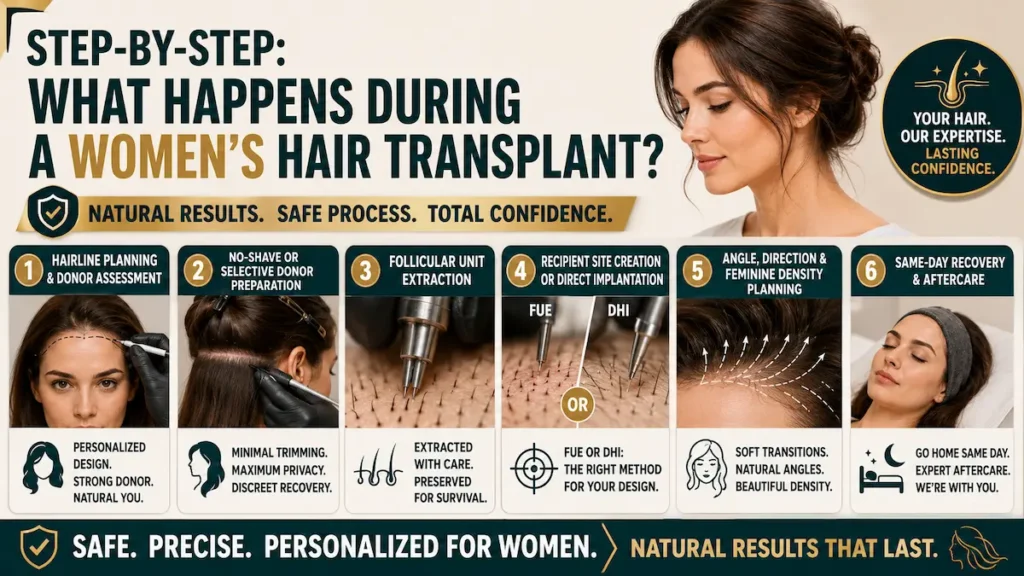
Step-by-Step: What Happens During a Women’s Hair Transplant?
A women’s hair transplant is planned more conservatively than a standard male hairline procedure. We protect the existing hair, confirm donor stability, and design the recipient area so the new grafts blend with your natural density.
The procedure usually takes several hours. The exact timing depends on graft count, technique, hair length, and whether we use no-shave FUE or no-shave DHI.
Female Hairline Planning and Donor Assessment
Your surgical plan begins before you arrive in Istanbul. During your virtual consultation, we review photos from multiple angles and ask about your hair-loss history, family pattern, medical conditions, medications, pregnancy history, and previous treatments.
Once you arrive, we confirm the plan in person. This includes donor-area evaluation and recipient-zone mapping.
We assess:
- The strength of the donor area at the back and sides of the scalp
- The degree of miniaturization in thinning zones
- Whether hair loss is localized or diffuse
- Hair calibre, curl, colour contrast, and density
- How your hair is usually styled in daily life
For women, styling habits matter. A hairline that looks natural with loose hair must also look believable in a ponytail, bun, side part, or under bright lighting.
No-Shave or Selective Donor Preparation
If you are a good candidate for a no-shave approach, we prepare only the necessary donor zones. These are usually small sections hidden under longer surrounding hair.
Selective trimming helps us extract grafts safely while preserving privacy. It also allows many women to cover the donor area during early recovery.
In some cases, partial shaving is safer. This may be recommended when the graft count is higher, the donor hair is very dense, or clear visibility is needed to protect graft quality. We discuss this before surgery, not on the day of the procedure.
Follicular Unit Extraction
During FUE-based extraction, individual follicular units are removed from the donor area with a micro-punch. Each graft may contain one, two, three, or sometimes four hairs.
The extraction pattern is carefully spread across the donor zone. We avoid over-harvesting because donor hair is limited. This is especially important for women, where diffuse thinning can make the donor area more vulnerable.
After extraction, grafts are sorted and protected in a controlled solution. They must stay hydrated and handled gently. Graft care affects survival.
Recipient Site Creation or Direct Implantation
This is where FUE and DHI differ. With FUE, recipient sites are created first, then grafts are placed manually into those openings. With DHI, grafts are loaded into a Choi implanter pen and placed directly into the scalp.
Both methods can work well for women. The right choice depends on recipient density, surrounding hair, graft count, and design goals.
DHI may be useful when we need precise placement between existing hairs. FUE may be preferred when broader planning and controlled recipient-site creation serve the design better.
Angle, Direction, and Feminine Density Planning
Female hairline work requires soft transitions. The front row should use fine single-hair grafts, placed at natural angles. Behind that, density gradually increases.
We plan graft direction according to your natural growth pattern. Temple hairs grow differently from frontal hairline hairs. Crown hairs have a different swirl. These details decide whether the result looks natural once the hair grows long.
Good density is not created by placing grafts too close together. It comes from correct distribution, safe spacing, and respect for existing follicles.
“Women’s hair restoration is not only about adding grafts. It is about protecting the hair that is already there while placing new follicles in a pattern that will still look natural years later.”
Procedure Length and Same-Day Recovery
A women’s hair transplant usually takes 6 to 8 hours, depending on graft count and technique. Smaller traction alopecia or temple cases may be shorter. No-shave procedures can take longer because extraction is more delicate.
After the procedure, we review the first-night care instructions with you. You receive guidance on sleeping position, washing timing, swelling control, medication use, and how to protect the grafts.
Most patients return to the hotel the same day with their coordinator’s support. Our team remains available during your recovery stay, so you are not left to interpret symptoms or instructions alone.
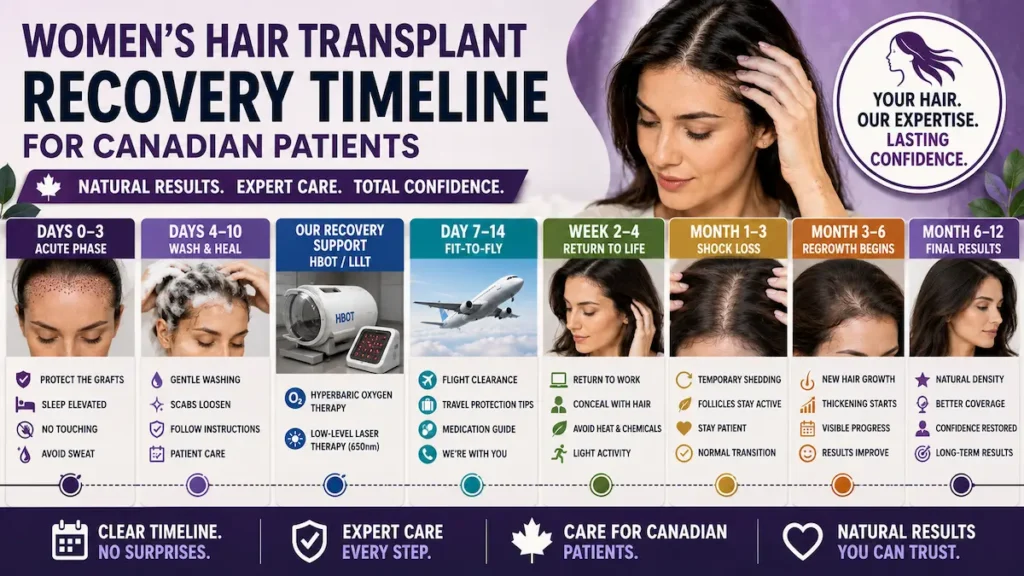
Women’s Hair Transplant Recovery: Timeline for Canadian Patients
Women’s hair transplant recovery is usually discreet, but it still follows a clear biological timeline. The first 10 days protect the grafts. The first three months test your patience. The final density usually appears between months 6 and 12.
For Canadian patients, recovery planning also includes the return flight. We time your wash, follow-up, and fit-to-fly clearance so you can travel with clear instructions, not guesswork.
Days 0-3: Acute Phase, Scab Formation, and No Touching
The first three days are about graft protection. Tiny scabs form around the implanted follicles, and mild swelling can appear near the forehead or recipient area.
You should avoid touching, scratching, rubbing, or styling the transplant zone. Even light pressure can disturb new grafts before they anchor.
During this phase, we usually recommend:
- Sleeping with the head elevated
- Avoiding tight hats, scarves, or headbands
- Using prescribed sprays or medications exactly as instructed
- Avoiding sweating, bending, and heavy activity
- Keeping existing hair away from the grafts without pulling
Women with no-shave procedures may be able to conceal the donor area with surrounding hair. The recipient area still needs protection. Styling should wait until your surgeon clears it.
Days 4-10: Washing Protocol and Scab Resolution
Washing begins only when the clinic instructs you to start. The first washes are gentle, slow, and technique-specific. The goal is to soften scabs without pulling grafts.
By day 10, most scabs have loosened or fallen away. Some redness may remain, especially in lighter skin tones or dense recipient zones.
Our team gives you step-by-step wash guidance before you leave Istanbul. For a detailed post-op routine, see our washing hair after transplant guide.
Do not rush this stage. Aggressive washing, fingernail scratching, or brushing the recipient area too early can compromise grafts.
Our HBOT/LLLT Recovery Protocol
We use recovery support to reduce inflammation, improve tissue oxygenation, and help patients return home with more confidence. HBOT and LLLT are part of our advanced recovery framework when clinically appropriate.
Hyperbaric Oxygen Therapy helps deliver oxygen-rich plasma to healing tissues. This can support inflammation control and tissue repair, which matters for patients preparing for long-haul travel. Low-Level Laser Therapy uses 424 medical-grade semiconductor laser diodes at 650nm to support cellular ATP activity.
For hair restoration, LLLT is especially relevant because scalp microcirculation and follicle recovery matter during early healing. It is not a substitute for good surgical technique. It supports the healing environment around the grafts.
For a deeper science-focused explanation, see our hyperbaric oxygen therapy benefits guide.
Day 7-14: Fit-to-Fly Clearance for Canadian Return Travel
Most hair transplant patients are fit to fly within the first week, but clearance depends on your healing, swelling, comfort, and procedure size. We check your scalp before travel and confirm your return instructions.
For flights from Istanbul to Toronto, Vancouver, Montreal, or Calgary, comfort planning matters. You should avoid bumping the grafts, sweating under heavy headwear, or sleeping with pressure on the recipient area.
Before the flight, we review:
- How to protect the grafts during boarding and sleep
- When to wash after arrival in Canada
- Which medications or sprays continue at home
- What symptoms are normal versus concerning
- How to contact us through your recovery period
For broader travel guidance, our flight safety after surgery guide explains what Canadian patients should consider before flying home.
Week 2-4: Return to Work with Existing Hair Concealment
By week two, many women can return to desk work or remote work. If the transplant was no-shave, surrounding hair may help conceal the donor and recipient zones.
You may still see redness, flaking, or temporary dryness. This is common. Avoid colouring, chemical treatments, tight hairstyles, or heat styling until your surgeon clears them.
Exercise usually returns gradually. Walking is encouraged early, but sweating-heavy workouts should wait. The scalp needs time to calm down before high-heat or high-friction activity.
Month 1-3: Shock Loss
Shock loss is the stage that worries many women most. Transplanted hairs often shed before regrowing. Some surrounding native hairs can also shed temporarily because the scalp has been stressed.
This can feel emotionally difficult, especially if you chose surgery to stop hiding thinning areas. We prepare you for this stage before surgery so it does not feel like failure.
“Shock loss is usually a transition phase, not the final result. The follicle remains under the skin, then begins producing new hair as the growth cycle restarts.”
Women with existing hair in the recipient area should be especially patient. Early density can fluctuate before growth stabilizes.
Month 3-6: Regrowth Begins
New growth often begins around month three or four. The first hairs may be fine, soft, or uneven. They gradually thicken over time.
This is not the final density. It is the start of visible progress.
Some patients notice one side growing earlier than the other. This can be normal. Hair follicles do not all restart on the same schedule.
Month 6-12: Final Density Reveal
By month six, most patients see meaningful improvement. By month 12, the result is usually much clearer, with improved coverage, shape, and density.
For female hair restoration, final satisfaction depends on both the transplanted grafts and the health of the surrounding native hair. Ongoing medical support may still be needed if female pattern hair loss continues.
Our hair transplant growth timeline guide walks through the month-by-month changes patients should expect after surgery.
Recovery is not a straight line. Good planning helps you understand each stage before it happens.
Safety and Risks of Women’s Hair Transplant
A women’s hair transplant is performed under local anesthesia and is generally less physically demanding than major surgery. That does not make it risk-free. The main safety issue is choosing the right candidate and protecting the donor area.
For women, poor planning can cause more harm than the procedure itself. A transplant should never be offered without assessing donor strength, active shedding, and the long-term pattern of female hair loss.
Common Side Effects
Most side effects are temporary. They usually occur in the donor or recipient areas during the first days and weeks after surgery.
Common short-term effects include:
- Mild swelling around the forehead or scalp
- Redness in the recipient area
- Small scabs around transplanted grafts
- Itching during healing
- Tenderness in the donor area
- Temporary numbness or altered sensation
These changes should improve gradually. We explain what is expected before you leave Istanbul, so you know which symptoms are normal and which need attention.
Shock Loss in Existing and Transplanted Hair
Shock loss can affect both transplanted hairs and nearby existing hairs. It is usually temporary, but it can be emotionally stressful for women who already feel sensitive about thinning.
Transplanted hairs often shed in the first few weeks. The follicle remains under the skin and begins producing new hair later in the growth cycle.
Existing hairs can also shed when the scalp reacts to surgery. This is why careful placement matters. We work between native hairs with attention to angle, density, and spacing to reduce unnecessary trauma.
Donor Area Depletion Risk
The donor area is limited. Once grafts are removed, they cannot be replaced. Over-harvesting can create visible thinning at the back of the scalp, especially in women with diffuse hair loss.
This is one of the biggest risks in female hair restoration. A clinic that focuses only on graft count may ignore the long-term appearance of the donor area.
Our planning is conservative. We would rather achieve a natural, stable improvement than push the donor area beyond what it can safely provide.
Why Operating on Poor Candidates Fails
A hair transplant fails when the biology is wrong. This can happen when diffuse loss is active, the donor area is weak, or the underlying cause has not been treated.
In poor candidates, transplanted hair may grow thinly, native hair may continue to shed, and the result may look underwhelming even if the grafts technically survive.
This is why our consultation may include a medical-first recommendation. If thyroid imbalance, iron deficiency, postpartum shedding, inflammatory scalp disease, or hormonal change is driving the loss, surgery should not be the first step.
“The safest women’s hair transplant is the one we recommend only after confirming that the donor area can support the plan. If the biology is unstable, surgery should wait.”
How Our Sterile Protocol and JCI-Aligned Standards Reduce Risk
Infection is uncommon after hair transplant, but sterile technique still matters. We use strict instrument handling, controlled clinical protocols, and a JCI-accredited hospital partner for surgical care standards.
Our safety culture also includes documentation. You should know who is responsible for your procedure, what technique is being used, and how to contact the team after you return to Canada.
For broader clinic standards, our technology and standards page explains the hygiene, recovery, and clinical protocols we use for international patients.
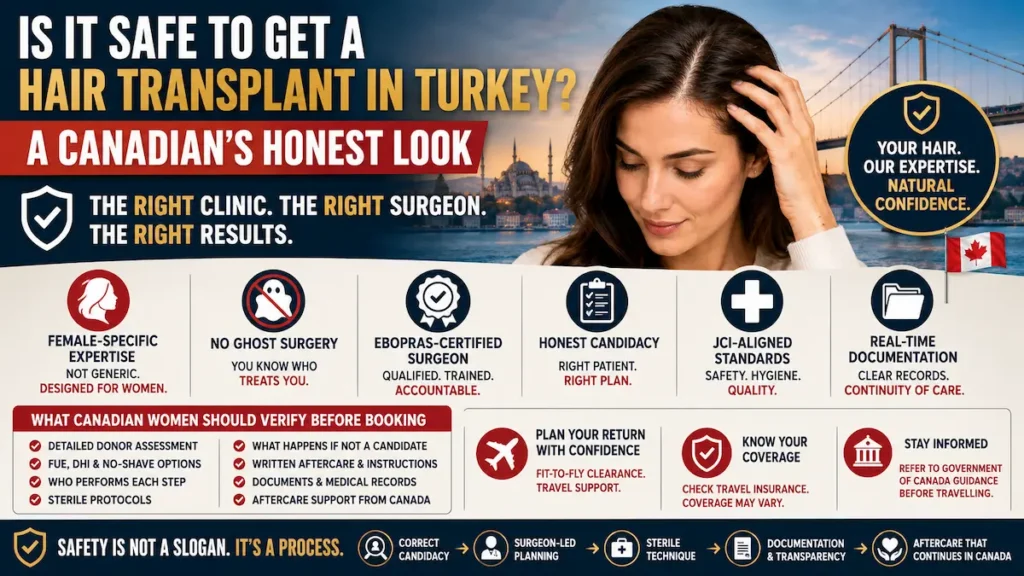
Is It Safe to Get a Hair Transplant in Turkey? A Canadian’s Honest Look
Turkey is one of the world’s best-known destinations for hair restoration. That reputation attracts excellent clinics, but it also attracts high-volume operations that treat patients like numbers. Canadian patients are right to be cautious.
The safer question is not “Is Turkey safe?” It is “Is this specific clinic surgeon-led, properly documented, transparent, and equipped to support me after I fly home?”
The Turkey Hair Transplant Industry Reality
Turkey’s hair transplant industry is large. Some clinics are clinically rigorous. Others compete on volume, aggressive graft counts, and unrealistic marketing.
Canadian patients should be especially cautious with clinics that promise maximum grafts, instant density, or one-size-fits-all packages without a proper donor assessment. Those shortcuts are risky for women.
For a wider safety framework, our guide to plastic surgery safety in Turkey explains how to evaluate accreditation, surgeon identity, and follow-up before booking.
Female-Specific Expertise vs Generic Hair Mills
Women’s hair transplant planning is more complex than generic graft placement. The surgeon must understand female pattern hair loss, diffuse thinning, traction alopecia, no-shave extraction, and conservative hairline design.
A high-volume hair mill may treat female patients with the same template used for male hairlines. That can lead to unnatural density, poor donor management, or disappointment when ongoing female pattern hair loss continues.
At AKM Clinic, we assess the patient first, then choose the technique. FUE, DHI, and no-shave variations are tools. They are not substitutes for clinical judgement.
Ghost Surgery in Turkey Hair Procedures
“Ghost surgery” means the patient believes one surgeon is responsible, but another person performs key parts of the procedure without clear consent. This concern is valid in international care.
You should ask who designs the hairline, who performs or supervises extraction, who controls implantation planning, and who is responsible for follow-up. Vague answers are a warning sign.
Our ghost surgery in Turkey guide outlines the questions Canadian patients should ask before committing to any clinic.
EBOPRAS-Certified Surgeon and Honest Candidacy
Credentials matter, but so does restraint. A qualified team should be able to explain why you are a candidate, or why you should wait.
For Canadian patients, EBOPRAS certification can be understood as part of a European board-based framework that helps signal structured surgical training. It is not the same administrative system as RCPSC, but it gives patients a way to compare credential pathways.
A trustworthy women’s hair transplant consultation should include:
- Ludwig-stage discussion
- Donor-area strength assessment
- Clear explanation of FUE vs DHI
- Honest discussion of diffuse-loss limitations
- Written aftercare instructions
- Long-term follow-up access from Canada
If a clinic avoids these topics, keep looking.
JCI-Aligned Standards and Real-Time Documentation
International patients need evidence, not reassurance alone. Documentation helps close the distance between Istanbul and Canada.
We provide clinical planning, procedural documentation, and aftercare guidance so patients know what was done and what to monitor. This matters if you later speak with your Canadian family physician or dermatologist.
Our goal is continuity. You should not return home with vague instructions, missing records, or no clear contact pathway.
What Canadian Women Should Verify Before Booking
Before booking a women’s hair transplant abroad, verify the clinic as if you were interviewing a private clinic in Toronto or Vancouver. Polite skepticism is healthy.
Ask these questions before you pay a deposit:
- Who assesses my female hair-loss pattern?
- Will you evaluate donor miniaturization?
- Do you offer no-shave FUE and no-shave DHI, or only one technique?
- What happens if I am not a good candidate?
- Who performs the surgical steps?
- What sterile protocols are used?
- What written records will I receive?
- How do I contact the team after returning to Canada?
You should also review the Government of Canada’s guidance on travelling outside Canada to receive medical care. It outlines practical issues such as follow-up, records, infection risk, and travel planning for procedures abroad.
Health Canada also provides general consumer safety information for cosmetic products and related reporting pathways through its cosmetic safety resource. For surgery, your most important safeguard is still choosing a qualified surgical team, a documented care pathway, and clear aftercare.
You should review your travel insurance carefully. Many Canadian travel insurance policies do not cover elective procedure complications abroad. Speak with your insurer before booking flights.
Safety is not a slogan. It is a process: correct candidacy, surgeon-led planning, sterile technique, documentation, and aftercare that continues after you land back in Canada.
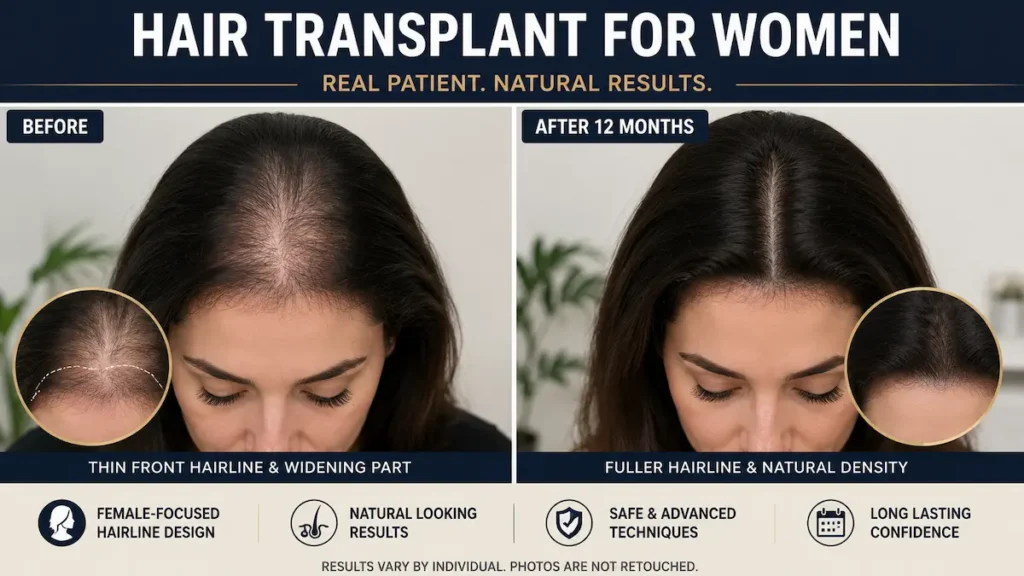
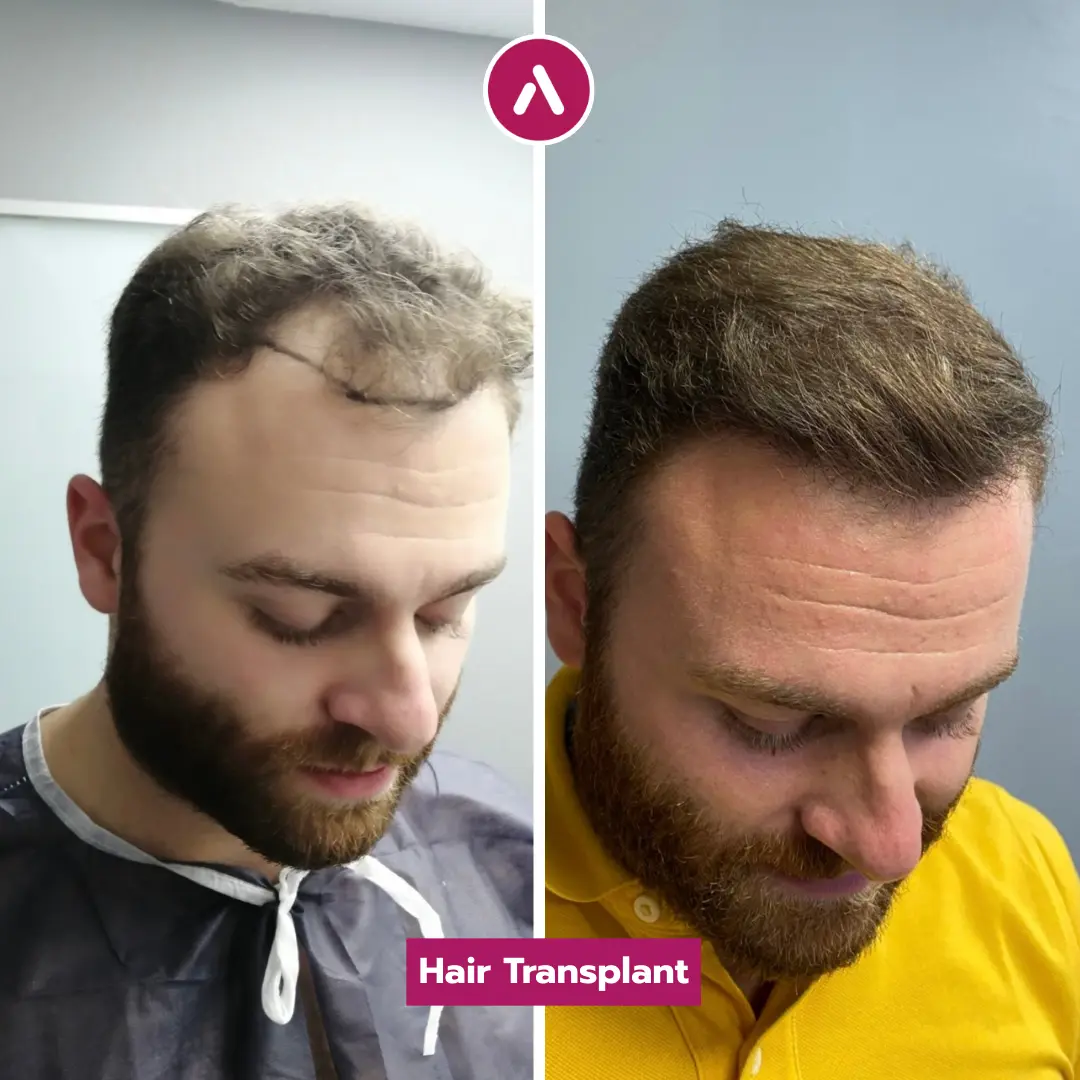
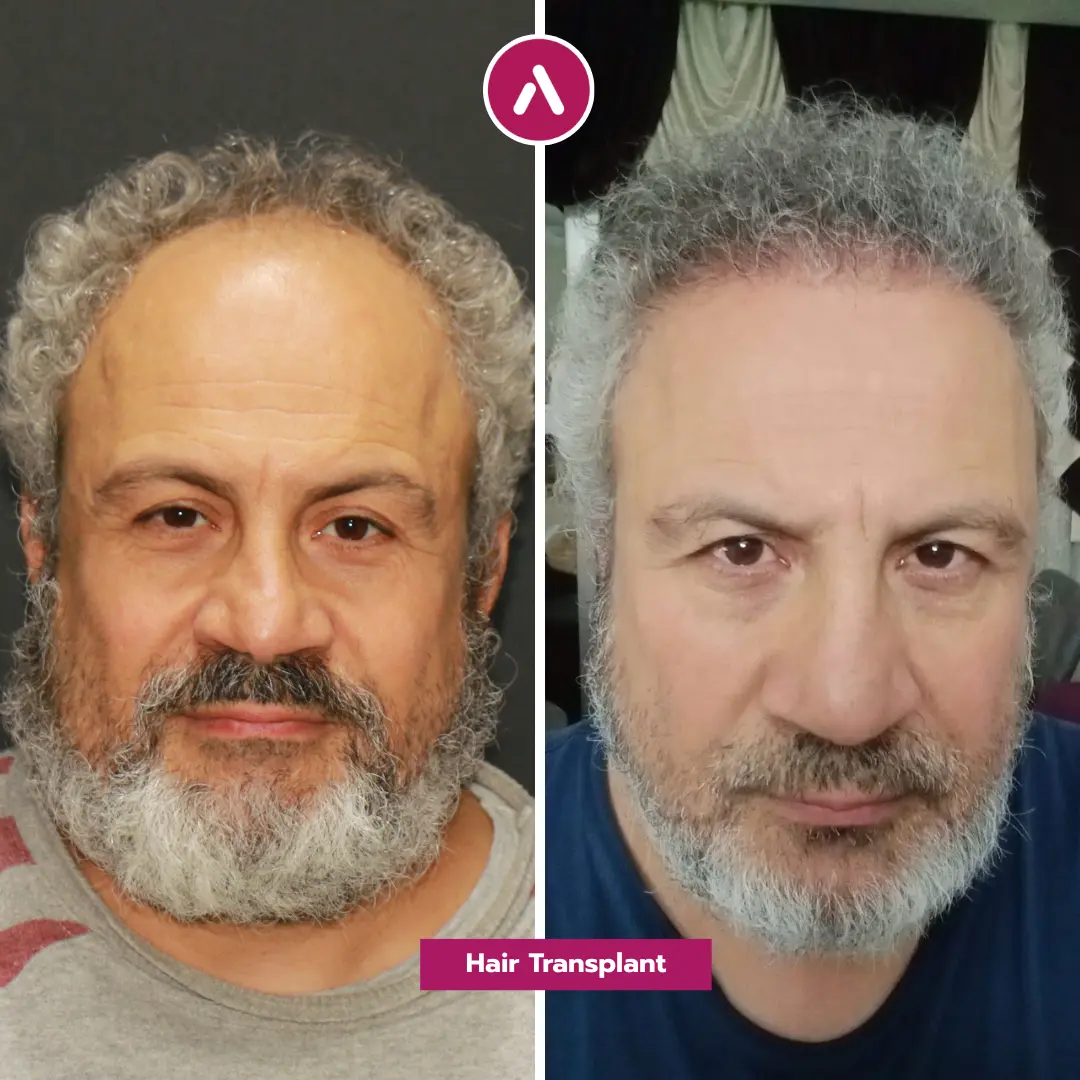
Female Hair Transplant Before and After: Realistic Expectations and Results
A women’s hair transplant can improve density, restore a softened hairline, and reduce visible thinning in selected areas. It is not a cure for every form of female hair loss. The most natural results come from matching the surgical plan to the biology of your hair loss.
We explain expected density, growth timing, and long-term maintenance before surgery. Clear expectations protect both your emotional experience and your final satisfaction.
Hair Transplant Women Before and After: Realistic Outcomes
Before-and-after results should be judged by the starting pattern. A woman with traction alopecia at the temples may see a more dramatic change than a woman with moderate diffuse thinning across the crown.
For women, successful results often look subtle rather than dramatic. The hairline appears softer. The temples look less exposed. The part line may look less wide. Styling becomes easier.
Realistic improvement may include:
- A softer frontal hairline
- Improved temple density
- Better coverage in localized thinning zones
- Reduced reliance on fibres, powders, or strategic parting
- More confidence wearing hair pulled back
Our before-and-after review focuses on patients with similar patterns to yours. A traction alopecia case should not be compared to a diffuse female pattern case. The biology is different.
Female Pattern Hair Loss Success Stories: When Candidacy Is Right
The strongest female hair transplant success stories usually share three features: stable loss, healthy donor density, and a defined recipient area. This combination allows grafts to create visible change without exhausting the donor zone.
Traction alopecia and frontal hairline recession can respond especially well when the surrounding scalp is healthy. High-forehead hairline lowering can also produce a meaningful facial-framing change when designed conservatively.
Diffuse female pattern hair loss is less predictable. Some women can still benefit, but only after careful assessment and often with ongoing medical support.
Density Expectations: Coverage vs Full Restoration Reality
Density is not unlimited. Every graft comes from your donor area, and that donor supply must last for life. This is why we plan coverage, not fantasy density.
A transplant can make an area look fuller, but it may not recreate the density you had as a teenager. That is especially true when surrounding native hair is also thinning.
Good planning prioritizes:
- Natural framing over aggressive lowering
- Safe donor use over maximum graft count
- Soft transitions over harsh hairline edges
- Long-term maintainability over short-term density promises
If a clinic promises “maximum density” without discussing donor limits, be cautious. Women’s hair restoration requires restraint.
Is It Permanent? Transplanted Follicles and Existing Hair Behaviour
Transplanted follicles are usually taken from areas genetically more resistant to hair loss. Once they grow, they are intended to behave like donor hair in their new location.
The surrounding native hair is different. If you have female pattern hair loss, the existing hair around the transplant may continue to thin over time. That can change the overall appearance even if the transplanted grafts survive.
This is why long-term planning matters. We do not only ask, “Can we add grafts here?” We ask, “Will this design still look natural if your native hair changes later?”
Why Ongoing Medical Treatment May Still Be Needed
A transplant replaces hair in selected areas. It does not treat the underlying tendency toward female pattern hair loss, hormonal shedding, or inflammatory scalp disease.
Some women benefit from medical support before and after surgery. This may involve a Canadian dermatologist, family physician, or hair-loss specialist, depending on the cause.
We do not prescribe a one-size-fits-all plan in the article because treatment depends on medical history and diagnosis. The important point is simple: if your native hair is still at risk, ongoing care may be part of protecting your result.
“A successful women’s hair transplant should look natural on day one of growth and still make sense years later. That requires donor restraint, realistic density planning, and honest discussion of future thinning.”
Before and After Gallery
Before-and-after photos are useful when they show the same pattern, similar lighting, and enough time for growth. Early photos can be misleading because women often experience shock loss before regrowth begins.
When reviewing results, compare cases by diagnosis. Traction alopecia, hairline lowering, and diffuse female pattern hair loss should be evaluated separately.
You can review relevant patient examples through our hair transplant before-and-after gallery. During consultation, we can also discuss which examples most closely match your hair-loss pattern.
Women’s Hair Transplant Cost 2026: Turkey vs Canada
Canadian women researching hair transplant for women cost often find that private clinics in Toronto and Vancouver charge significantly more than Istanbul, especially for no-shave or female-specific work. The difference is not only the procedure fee. Canadian quotes may separate consultation, facility fees, post-op products, PRP, or follow-up.
At AKM Clinic, women’s hair transplant pricing is planned around graft count, technique, and no-shave complexity. Our all-inclusive women’s hair transplant pathway is typically CAD $3,000-$3,400, depending on whether the case involves up to 2,000 grafts, 2,000-3,500 grafts, or a no-shave DHI premium. Hairline lowering cases are commonly quoted in the CAD $3,000-$3,400 range. By comparison, Toronto private women’s hair transplant pricing is commonly listed at CAD $12,000-$15,000, while Vancouver private ranges often sit around CAD $13,000-$16,000.
| Location | Typical Women’s Hair Transplant Pricing | What to Check |
|---|---|---|
| Toronto | CAD $12,000-$15,000 | Whether no-shave work, follow-up, and products are included |
| Vancouver | CAD $13,000-$16,000 | Whether female-specific assessment is included |
| Montreal | Varies by graft count and clinic model | Ask whether female-specific assessment and no-shave planning are included |
| Calgary | Varies by graft count and clinic model | Confirm whether follow-up and post-op products are included |
| AKM Clinic Istanbul | CAD $3,000-$3,400 typical range | Includes coordinated clinical pathway, hotel, transfers, and support |
For a detailed graft-count breakdown, see our women’s hair transplant cost guide. You can also review the all-inclusive FUE hair transplant package or the all-inclusive DHI hair transplant package for what is included in the Istanbul pathway.
Canadian-dollar pricing shown for planning clarity; your coordinator will confirm the final payment details before booking.
How to Find the Best Women’s Hair Transplant Surgeon in Turkey: A Canadian Patient’s Checklist
Finding the right clinic for a women’s hair transplant is different from comparing standard graft prices. Female hair restoration requires accurate diagnosis, donor-area caution, and experience with no-shave techniques.
Canadian patients often start by searching locally in Toronto, Vancouver, Montreal, or Calgary. That is a reasonable first step. The next step is comparing clinical depth, transparency, and aftercare across borders.
EBOPRAS Certification and RCPSC Equivalency
Canadian patients are familiar with structured medical oversight through bodies such as the Royal College of Physicians and Surgeons of Canada. International credentials use different systems, so the question is not whether the names match. The question is whether the training pathway is structured, verifiable, and relevant to the procedure.
The Royal College publishes official Canadian designations such as FRCPC, FRCSC, and DRCPSC, and explains that physicians may be assessed against Royal College standards through defined eligibility and examination pathways. You can review the official Royal College qualifications and designations and eligibility and exams resources as a Canadian reference point.
At AKM Clinic, our surgical team works within a European board-certified framework. We explain credentials clearly so Canadian patients can compare them with the standards they expect at home.
| Credential Framework | What It Signals | Why It Matters for Canadian Patients |
|---|---|---|
| EBOPRAS / European Board Certification | Structured European surgical training and examination pathway | Helps Canadian patients compare international training to familiar board-based standards |
| RCPSC | Canadian specialist certification and designation framework | Provides the Canadian reference point for evaluating structured specialty training |
| ABHRS | Hair-restoration-specific credential framework | Useful when comparing clinics focused specifically on hair transplant surgery |
For broader clinic context, you can review our AKM Clinic profile, where we explain our clinical philosophy, surgeon-led planning, and Natural-First approach.
Female-Specific Case Volume
A surgeon who performs many male hairline cases is not automatically the right choice for women. Female hair restoration has different patterns, design goals, and candidacy risks.
Ask whether the clinic regularly treats:
- Female frontal hairline recession
- Traction alopecia in the temples and edges
- High forehead hairline lowering
- Diffuse female pattern hair loss assessments
- No-shave FUE and no-shave DHI cases
Female case volume matters because the surgeon must know when to operate and when not to. That restraint is a core safety marker.
Honest Candidacy Assessment
The best women’s hair transplant surgeon is not the one who says yes the fastest. It is the one who evaluates the biology first.
Your consultation should include Ludwig staging, donor-density review, medication history, shedding timeline, styling habits, and medical causes of hair loss. If your hair loss is active or diffuse, the clinic should discuss medical stabilization before surgery.
The International Society of Hair Restoration Surgery offers patient education on hair transplantation in women, including why female candidates require careful diagnosis. This can help you prepare better questions before choosing a clinic.
Be cautious if a clinic:
- Quotes a graft count without assessing donor strength
- Promises dense coverage for diffuse thinning
- Avoids discussing shock loss
- Does not ask about postpartum shedding or hormonal changes
- Treats women and men with the same hairline template
A careful “not yet” can be better medicine than a rushed “yes.”
“The best surgeon for a women’s hair transplant is the one who can explain why surgery is appropriate, and who is equally willing to say when medical treatment should come first.”
No-Shave Capability Verification
No-shave hair transplant is technically more demanding than a fully shaved case. It can take longer, requires better visualization, and is not suitable for every graft count.
Before choosing a clinic, ask how they handle no-shave planning. Do they offer both no-shave FUE and no-shave DHI? Will they explain when selective trimming is safer? Can they show examples of discreet donor preparation?
No-shave should never be used as a sales promise. It should be a clinical option chosen only when it protects privacy and graft survival.
Real Female Patient Reviews and Before-and-After Documentation
Before-and-after documentation should match your pattern. A male Norwood hairline case does not tell you much about female traction alopecia, temple thinning, or hairline lowering.
When reviewing results, look for:
- Photos taken at comparable angles and lighting
- Final results at 9 to 12 months, not just early healing
- Female cases with similar hair-loss patterns
- Natural temple transitions
- Donor-area appearance after healing
You can also review patient feedback through our professional plastic surgery reviews. During consultation, our team can help you compare examples that are relevant to your case.
Aftercare Continuity from Istanbul to Canada
Aftercare should not end when you board the return flight. Women’s hair transplant recovery includes washing support, shock-loss reassurance, growth monitoring, and questions about colouring, styling, exercise, and scalp care.
Our aftercare structure includes long-term virtual follow-up at 1, 3, 6, and 12 months. This matters because the final hair transplant result is not visible in the first few weeks.
| Checklist Item | Why It Matters for Women | What to Ask |
|---|---|---|
| Ludwig staging | Confirms whether thinning is localized or diffuse | “What stage am I, and how does it affect candidacy?” |
| Donor-area assessment | Protects against over-harvesting | “Is my donor area stable enough for surgery?” |
| No-shave capability | Supports privacy during recovery | “Can I qualify for no-shave FUE or DHI?” |
| Female case documentation | Shows pattern-specific experience | “Can I see cases similar to mine?” |
| Canadian aftercare | Supports recovery after returning home | “How do I contact you after I fly back?” |
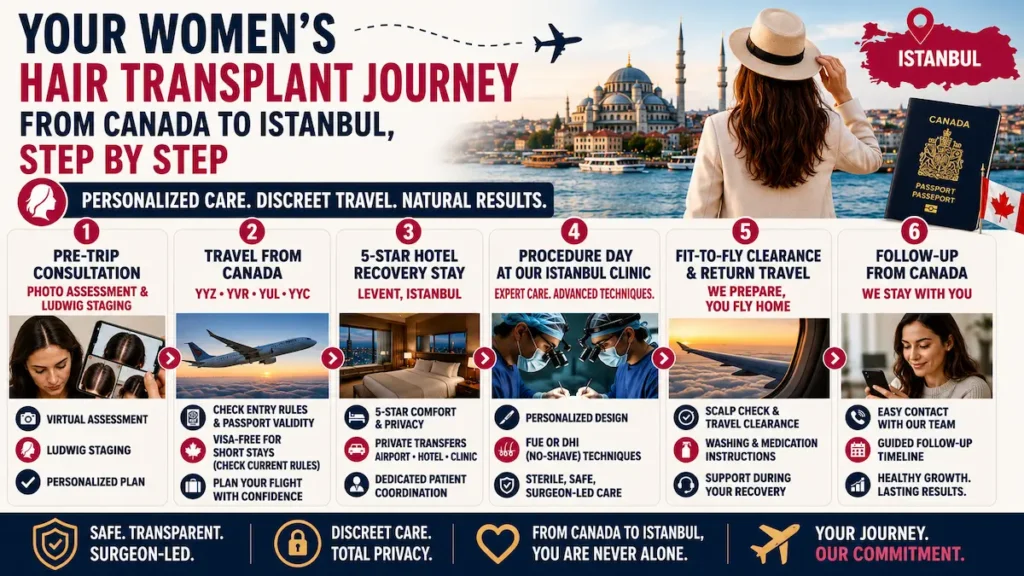
Your Women’s Hair Transplant Journey from Canada: From YYZ to Istanbul, Step by Step
Travelling from Canada for a women’s hair transplant requires more than booking surgery. You need a clear clinical plan, discreet logistics, fit-to-fly timing, and support after you return home.
Our international surgical programme is designed to reduce uncertainty. You manage your flight. We coordinate the clinical schedule, hotel, transfers, procedure day, and recovery instructions.
Pre-Trip Consultation: Photo Assessment and Ludwig Staging
The first step is a virtual assessment. You send clear photos of your hairline, temples, crown, part line, donor area, and usual hairstyle. We also ask about your hair-loss timeline and previous treatments.
We may ask questions about:
- Pregnancy or postpartum shedding
- Menopause or hormonal changes
- Thyroid, iron, or vitamin issues
- Family history of female hair loss
- Past dermatology diagnosis
- Use of extensions, weaves, tight ponytails, or braids
If the photos suggest diffuse active thinning, we may recommend medical evaluation before surgery. If the pattern appears suitable, we build a tailored clinical protocol for Istanbul.
Travel Logistics from Toronto, Vancouver, Montreal, and Calgary
Many Canadian patients travel through Toronto Pearson, Vancouver, Montreal, or Calgary. Flight schedules change, so you should always verify current routes directly with the airline before booking.
Canadian passport holders can generally enter Turkey visa-free for short stays, but you should check current entry rules before travelling. Your passport should also have adequate validity beyond your travel dates.
For a full overview of the travel process, our Canadian patient journey guide explains how consultation, arrival, surgery, recovery, and follow-up are coordinated.
5-Star Hotel Recovery Stay in Levent
After arrival, you recover in a 5-star hotel environment selected for comfort, privacy, and access to the clinic. This matters for women who want a low-stress setting during the first days after surgery.
Our patient coordination team arranges private transfers between the airport, hotel, clinic, and hospital when required. You are not expected to navigate Istanbul post-procedure on your own.
For details on accommodation and transport, see our hotels and VIP transfers page.
Procedure Day at Our Istanbul Clinic
On procedure day, we confirm your plan in person. This includes donor-area review, hairline marking, shaving strategy, anesthesia planning, and technique confirmation.
The day may be long, but each phase has a purpose:
- Final surgical design
- Local anesthesia
- Donor preparation
- Follicle extraction
- Graft sorting and protection
- Recipient planning or direct implantation
- First-night instructions
You can learn more about the clinical environment through our Istanbul clinic page.
Fit-to-Fly Clearance and Return Travel
Before you return to Canada, we check your scalp, review washing instructions, and confirm what to do during the flight. Hair transplant patients usually travel earlier than major surgery patients, but your clearance depends on swelling, comfort, and healing.
For the flight, avoid anything that presses on the grafts. Do not use tight hats, headbands, or scarves unless your team clears them. Keep your head protected from accidental contact during boarding, sleeping, and baggage handling.
You receive clear instructions for the first wash after arrival, medication continuation, and how to contact us if you notice swelling, redness, itching, or concern about shock loss.
Returning home should feel organized. That is why we plan your recovery in Istanbul and your follow-up in Canada as one continuous process.
Women’s Hair Transplant Frequently Asked Questions (FAQ):
Can women get hair transplants, or is it only for men?
Yes, women can get hair transplants. The key difference is candidacy. Women often have diffuse thinning, so we must confirm that the donor area is strong enough before surgery.
Am I a candidate if I have diffuse thinning all over?
Maybe, but many diffuse-loss cases need medical treatment first. If your donor area is also thinning, surgery may not be safe or effective. We assess Ludwig stage and donor miniaturization before recommending a transplant.
Do I need to shave my head for a women’s hair transplant?
Not always. Many women qualify for no-shave FUE or no-shave DHI. In some cases, selective trimming or partial shaving is safer for graft survival. We explain this before surgery.
Should I try minoxidil or other treatments before a transplant?
Some women should. If hair loss is active, diffuse, hormonal, postpartum, thyroid-related, or linked to iron deficiency, medical evaluation may come first. A transplant cannot stop ongoing shedding.
Does OHIP, MSP, AHCIP, or RAMQ cover a hair transplant for women?
Provincial health plans in Canada typically do not cover elective cosmetic hair transplants. Coverage may differ for rare reconstructive circumstances, but most female hair transplant patients pay privately.
How much does a women’s hair transplant cost in Toronto vs Istanbul?
Toronto private women’s hair transplant pricing commonly ranges from CAD $12,000-$15,000, depending on graft count and clinic model. At AKM Clinic, the typical women’s hair transplant pathway is CAD $3,000-$3,500, depending on technique and case complexity.
Does Canadian travel insurance cover complications from an elective hair transplant in Turkey?
Many Canadian travel insurance policies exclude elective cosmetic surgery and complications related to it. You should review your policy carefully before booking and ask the insurer direct written questions.
To reduce this concern, AKM Clinic provides complimentary complication insurance for all patients. This is separate from standard Canadian travel insurance and is designed to add an extra layer of protection around your surgical care. Your coordinator will explain the coverage terms, limits, and required documentation before you confirm your booking.
Will my postpartum hair loss need a transplant?
Usually not immediately. Postpartum shedding often improves as the hair cycle normalizes. If thinning persists or reveals an underlying pattern, we may recommend medical evaluation before considering transplant.
How long until I see results?
Most patients begin seeing early growth around month three or four. Meaningful density often appears around month six. Final results usually develop by 12 months.
Is the transplant permanent if I have female pattern hair loss?
Transplanted follicles are intended to behave like donor hair. The surrounding native hair may still thin if female pattern hair loss continues. Ongoing medical support may be needed to protect the overall result.
Can a transplant lower my high forehead or hairline?
Yes, if you have enough donor hair and the design is realistic. Hairline lowering with grafts can soften forehead proportions, but over-lowering can look artificial and consume too many grafts.
Can I combine a hair transplant with an eyebrow transplant in one trip?
Often, yes. The decision depends on donor supply, graft priorities, and recovery planning. We assess scalp and eyebrow goals together so the donor area is not overused.
Medical Disclaimer: This page is for educational purposes only and does not replace medical advice from a qualified physician, dermatologist, or surgeon. Hair loss in women can be linked to hormonal changes, thyroid disease, iron deficiency, inflammatory scalp conditions, medication changes, postpartum shedding, or other medical causes. Before choosing surgery, you should receive an individualized assessment. Canadian patients may wish to speak with their family physician, dermatologist, or local hair-loss specialist before travelling for treatment.