



Considering a Hair Transplant For Women but want medical-first clarity before you commit? This guide explains how female hair restoration works, who qualifies, and what natural, discreet results should look like—without hype.
Explore FUE, DHI, Sapphire and long-hair options, learn the recovery timeline, and compare UK vs Turkey costs. If you’re weighing risk, privacy and value, keep reading for the questions to ask, red flags to avoid, and how to request a personalised plan in GBP.
Table of Contents
What is a Hair Transplant For Women?
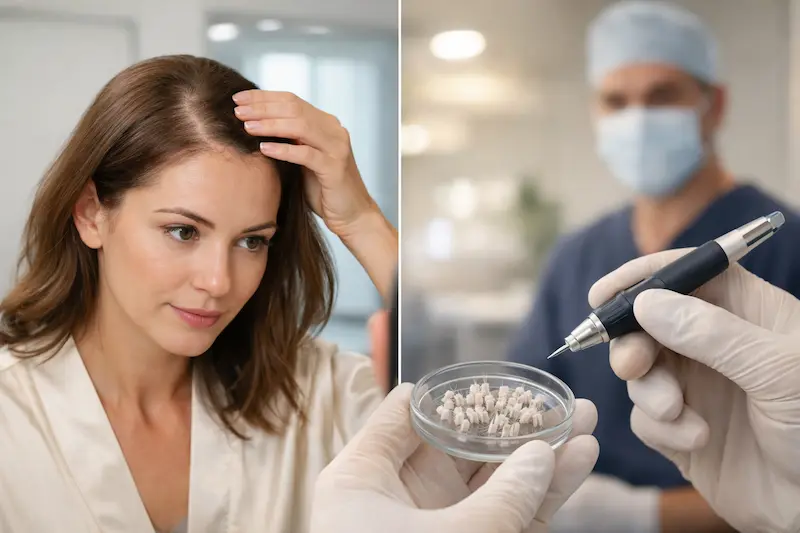
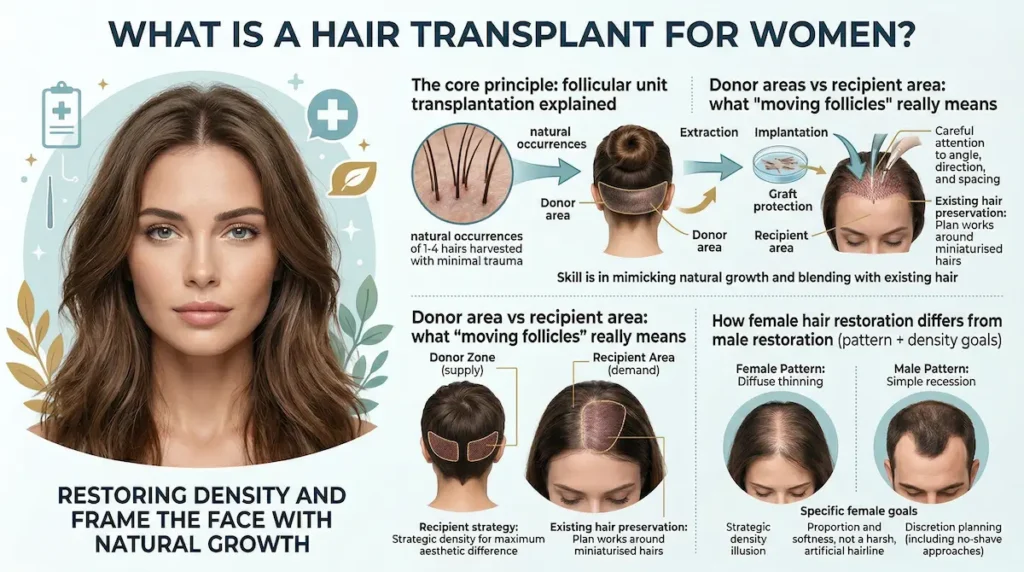
Hair Transplant For Women is a microsurgical procedure that redistributes healthy hair follicles from a donor area (usually the back or sides of the scalp) to areas affected by thinning or recession. The aim is to restore density and frame the face with hair that grows naturally over time.
Done well, it should look unremarkable in the best way. Our approach is guided by a simple principle: rejuvenation, not alteration.
That means a plan that respects your existing hair, your hairline anatomy, and your day-to-day life.
The core principle: follicular unit transplantation explained
Modern hair restoration is built around follicular units. These are naturally occurring groupings of hair (often 1–4 hairs) that we relocate with minimal trauma.
- Extraction: We harvest follicular units from the donor zone using precise, controlled techniques.
- Graft protection: The follicles are kept in conditions designed to preserve viability.
- Implantation: We place follicles into the recipient area with careful attention to angle, direction, and spacing.
The skill is not just in “moving hair”. It is in creating a distribution that mimics natural growth and blends with what you already have.
Donor area vs recipient area: what “moving follicles” really means
The donor area is your supply. The recipient area is the demand. In women, balancing the two is often more nuanced than it first appears.
- Donor assessment: We evaluate whether the donor zone is stable and dense enough to donate without creating visible thinning.
- Recipient strategy: We map where density will make the biggest aesthetic difference, rather than chasing an unrealistic “full coverage” promise.
- Existing hair preservation: Many women still have miniaturised hairs in the thinning zone, so the plan must work around them.
This is why consultation matters. Your pattern, hair calibre, and long-term stability determine what is sensible.
How female hair restoration differs from male restoration (pattern + density goals)
Women often present with diffuse thinning rather than a simple recession pattern. The surgical design has to respect that reality.
- Density illusion: We focus on strategic density where it will read as “fuller” in real life, especially under overhead light.
- Hairline detail: In hairline refinement, the goal is proportion and softness, not a harsh, artificial line.
- Discretion planning: Many patients ask about techniques that minimise visible disruption to their routine (including discussions around no-shave approaches where appropriate).
Our job is to create a result that looks like you on a good day. Not a different person.
Why Do Women Experience Hair Loss?
Female hair loss is not one diagnosis. It is a symptom pattern with multiple potential drivers, which is why two women with “thinning” can require very different treatment plans.
Some causes are stable and predictable. Others are temporary, inflammatory, or medically reversible.
Before we talk about graft numbers or technique, we organise the decision around one question: what is the mechanism behind your hair change?
Female pattern hair loss (androgenetic alopecia): typical presentation
female pattern baldness typically shows as widening of the central parting, diffuse thinning over the crown, or reduced volume through the top while the frontal hairline remains largely intact.
A hair transplant may be an option when the pattern is stable and the donor area is strong enough. It is not the right first step if the thinning is actively progressing without a clear stability plan.
Thinning vs shedding: what your symptoms often suggest
hair transplant for thinning hair women is a common search, but thinning and shedding are not the same thing. The distinction changes everything.
- Thinning: hair shafts gradually become finer and less dense over months to years.
- Shedding: you notice more hair fall than usual, often with a trigger (stress, illness, hormonal shifts, nutritional factors).
If you are mainly shedding, surgery can be premature. If you are mainly thinning, we can assess whether redistribution will create a meaningful density gain.
When a hair transplant is not the first-line answer (investigation first)
does hair transplant work for women depends on diagnosis, not optimism. There are scenarios where we advise investigation and stabilisation first.
- Active inflammatory or scarring alopecia: follicles may be under ongoing attack, making graft survival less predictable.
- Unstable loss patterns: if the thinning is still accelerating, timing becomes a safety issue, not a scheduling issue.
- Medical contributors: we may recommend you speak with your GP or specialist to address endocrine, iron, or other systemic factors first.
In these cases, transplantation can still be considered later. The sequence matters.
Benefits: What Can a Hair Transplant For Women Realistically Improve?
A well-planned transplant can restore confidence and visual balance, but it is not a “one-size-fits-all” fix. Results depend on diagnosis, donor strength, and how stable the hair loss is.
Our benchmark is simple: the change should look natural in daylight, under overhead office lighting, and on camera. Quietly better. Not obvious.
Density restoration for thinning hair
Many women search for hair transplant for thinning hair women because their main concern is overall volume loss rather than a receding hairline. In these cases, the goal is usually a strategic density increase, not blanket coverage across every thin area.
- Visual density: we place grafts where they create the biggest impact, often along part-lines and the zones that read as “see-through”.
- Blending with existing hair: many women still have miniaturised hairs, so we design implantation to integrate rather than replace.
- Long-term thinking: if the thinning pattern is evolving, we plan in stages and prioritise donor safety over short-term density.
Hairline refinement and “hairline lowering” considerations
Hairline work in women is about proportion and softness. When patients ask about a hairline lowering hair transplant, we first look at facial balance, forehead height, and the natural direction of hair growth.
- Soft, irregular hairline: we avoid a straight, “drawn-on” line by designing natural micro-variations.
- Temple harmony: temples and corners matter. They often determine whether the result looks genuinely feminine.
- Expectation control: aggressive lowering is not always safe or realistic, especially if donor supply is limited.
In trans patients exploring hairline feminisation, the same principles apply: proportion, angle, and a result that blends seamlessly with your existing style.
Discretion: achieving change without an obvious “procedure” look
Discretion is not a luxury. For many professionals, it is the deciding factor.
We can consider techniques that reduce visible disruption, including planning around longer hair styles and discussing no shave hair transplant women approaches when appropriate for your pattern and graft requirement.
- Style-aware planning: we consider your parting, fringe, and typical up-do routines when mapping recipient zones.
- Social downtime management: we plan for realistic short-term signs (redness, scabbing, swelling) and how to minimise them.
- Natural-first philosophy: the best compliment is “You look well,” not “Did you do something?”
Am I a Suitable Candidate for a Hair Transplant For Women?
Suitability is not just “Do you have hair loss?” It is about diagnosis, stability, and whether the donor area can safely supply grafts without creating new thinning.
We assess candidacy with a medical-first lens, then match technique to your hair type and lifestyle. Conservative planning wins.
Donor adequacy: how we assess safe graft availability
Your donor zone is a finite resource. Once we use grafts, we cannot “top it up” later.
- Density and calibre: finer hair behaves differently from coarse hair. That changes how many grafts you may need for a visible improvement.
- Donor stability: we look for signs that the donor region is not actively miniaturising.
- Scar planning: we choose extraction and distribution patterns designed to keep the donor area discreet, even with shorter styles.
Scalp health and stability: when timing matters more than speed
A transplant works best when the condition driving your hair loss is understood and stable. If the hair loss is still accelerating, rushing can lead to uneven density and future “catch-up” needs.
Patients searching does hair transplant work for women often have mixed patterns, including diffuse thinning, hormonal shifts, or inflammatory components. In those scenarios, we may advise stabilisation and medical optimisation before surgery.
- Diffuse thinning: graft placement must protect existing hairs and avoid excessive trauma.
- Inflammation/scarring risk: some alopecia hair transplant women queries relate to scarring alopecias, where transplantation may be unpredictable without specialist guidance.
- Styling habits: traction patterns (tight ponytails, extensions) matter. We factor them into planning and long-term advice.
Contraindications and “pause points” (medical screening, red flags)
There are moments where the safest decision is to pause. That does not mean “never”. It means “not yet” or “not with surgery as the first step”.
- Unclear diagnosis: if the pattern does not fit a stable, transplantable profile, we recommend investigation first (often via your GP or a specialist).
- Active scalp disease: ongoing inflammation, infection, or poorly controlled skin conditions should be treated before any graft work.
- Unrealistic expectations: we will be direct if the donor supply cannot match the coverage goal. It protects you.
Our role is not to “fit you into a procedure”. It is to design a plan that remains sensible a year from now and five years from now.
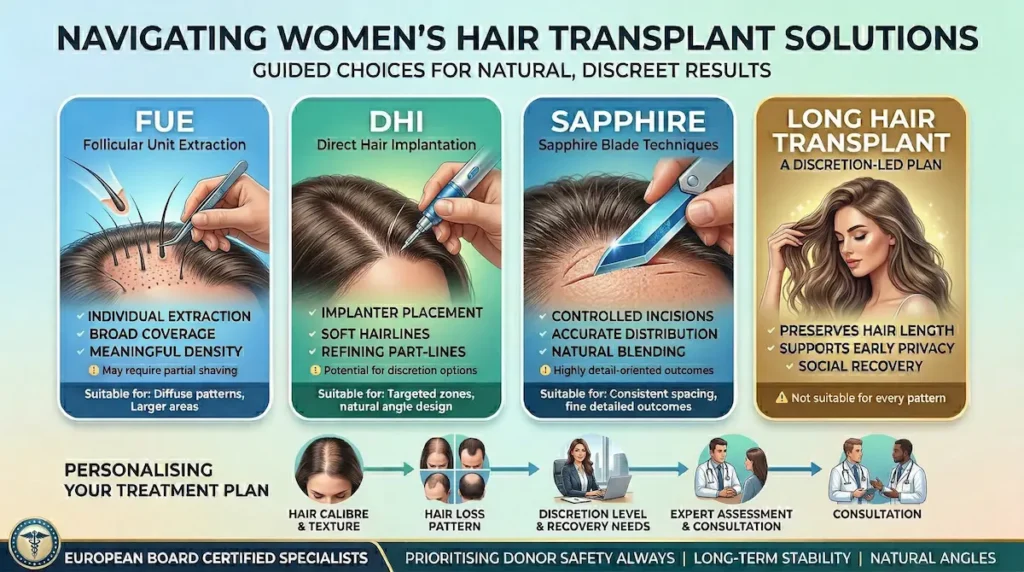
Hair Transplant for Women Options We Use: FUE, DHI, Sapphire
Technique matters, but it is never the whole story. In women, the “right” method depends on your hair-loss pattern, how much native hair you still have in the recipient area, and how discreet you need the process to be. We look at donor safety first. Always.
From there, we match the technique to the clinical goal: rebuilding density for diffuse thinning, refining a hairline, or supporting a privacy-first return to normal life. Our European Board Certified Specialists plan each case around natural angles, distribution, and long-term stability. That is where results are made.
| Technique | What it is (in practice) | Often suits | Discretion considerations | Key trade-off |
|---|---|---|---|---|
| FUE | Follicles are extracted individually from the donor area, then implanted into the recipient zone. | Larger areas, diffuse density work, patients prioritising donor efficiency. | Usually involves some shaving (full or partial), depending on the plan. | Great versatility, but visibility in the short term can be higher if shaving is required. |
| DHI | Follicles are implanted with high placement control, often using an implanter-based approach. | Precision placement, density design, refined hairline work. | Can be planned for more discreet approaches in selected cases. | Precision-focused planning can mean longer theatre time for some patterns. |
| Sapphire | Recipient sites are created with a sapphire blade, then follicles are placed into those sites. | Patients where incision control and distribution detail are prioritised. | Short-term visibility depends on shaving strategy and styling. | Highly detail-oriented; outcomes rely on design discipline, not marketing claims. |
| Long Hair Transplant | A planning approach that preserves hair length in key areas to support discretion. | Patients who need minimal visible change during early healing. | Designed specifically for privacy, when clinically suitable. | Not suitable for every graft requirement or hair-loss pattern. |
FUE Hair Transplant: who it tends to suit
FUE remains a workhorse technique in hair restoration. For many women, it is a practical choice when the priority is meaningful density improvement across a broader zone.
- Diffuse thinning patterns where we need controlled coverage across the top.
- Patients with strong donor density who can safely donate without creating new visibility.
- Those comfortable with partial shaving if it improves efficiency and graft handling.
We plan extraction to protect the donor area’s long-term appearance. That planning is not optional.
DHI Hair Transplant: placement control and density planning
DHI is often chosen when placement precision is the priority. In women, that can be particularly relevant around part-lines, hairline refinement, and areas where we must work carefully around existing miniaturised hairs.
- Placement control helps us fine-tune angle and direction for a softer, more natural look.
- Density planning becomes more predictable in targeted zones.
- Discretion options may be possible for some patients, depending on graft number and pattern.
It is not “better” by default. It is better when it fits the case.
Sapphire Hair Transplant: incision precision positioning
Sapphire techniques focus attention on recipient-site creation. The aim is controlled incision work so we can map distribution closely and keep the design clean.
- Hairline work where micro-irregularity and softness are essential.
- Density zones where spacing must be consistent to protect native hairs.
- Natural blending when the patient’s styling and parting are very specific.
As with every method, the design philosophy drives the result: rejuvenation, not alteration.
Long Hair Transplant
A long hair transplant is best understood as a discretion-led plan rather than a separate category of surgery. The goal is to preserve visible hair length in selected areas so early healing is easier to manage socially.
- Ideal for privacy-focused patients who cannot take extended time away from work or public-facing roles.
- Useful in targeted areas where existing hair can help camouflage early post-op signs.
- Not suitable for everyone, particularly when graft requirements are very high or the pattern is complex.
We will be direct about whether it fits your case. False reassurance helps nobody.
How we choose the technique (hair type, pattern, lifestyle)
If you search best hair transplant technique for women, you will see confident answers online. Real life is more nuanced. We choose the method that protects your donor area, respects your native hair, and matches your lifestyle constraints.
- Hair calibre and texture: fine hair needs different density strategy than coarse hair.
- Pattern type: diffuse thinning is planned differently from hairline recession or traction patterns.
- Discretion level: we plan shaving strategy (full, partial, or minimal where feasible) based on your work and social needs.
- Recovery priorities: some patients can take time off; others need a low-visibility plan.
We confirm the plan in consultation, with a clear explanation of why that option makes sense for your specific scalp and goals.
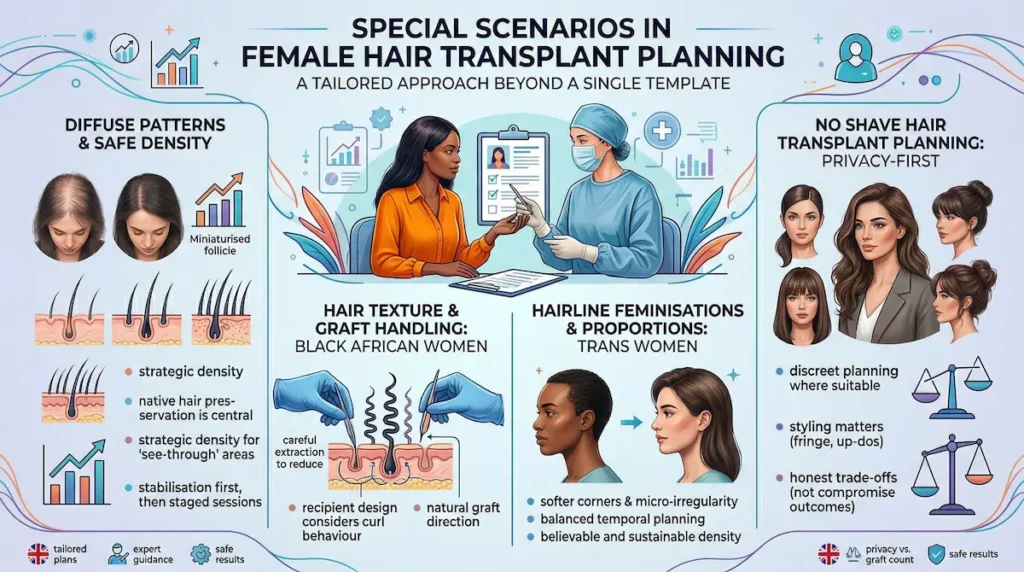
Special Scenarios in Female Hair Transplant Planning
Women’s hair restoration is not a single template. Patterns vary widely, and the planning changes again when hair texture, hormonal stability, or hairline feminisation goals are involved. This is where “expert patient” research becomes useful.
We encourage you to bring your questions. The best decisions happen when you understand the trade-offs. Our role is to translate the surgical detail into a plan that is safe, realistic, and tailored.
Hair transplant for thinning hair women: “diffuse” patterns and safe density
Diffuse thinning is common. It also demands restraint.
- Native hair preservation is central, because many follicles are miniaturised rather than absent.
- Strategic density focuses on the areas that read as “see-through”, not every centimetre.
- Staging may be safer than trying to do everything in one session.
When needed, we advise investigation and stabilisation first, then transplant at the right time.
Hair transplant for black African women: hair texture and graft handling
hair transplant for black african women requires careful extraction planning because curl patterns start below the skin surface. The objective is the same—healthy grafts and natural direction—but the technique must respect the anatomy.
- Extraction control is planned to reduce follicle trauma.
- Recipient-site design considers curl behaviour and how density reads on the scalp.
- Aftercare discipline supports graft healing and reduces avoidable irritation.
Hair transplant for trans women: hairline feminisation and proportions
hair transplant for trans women is often about hairline shape as much as density. A feminine hairline typically requires softer corners, balanced temples, and a design that harmonises with facial proportions.
- Hairline architecture: softness, micro-irregularity, and natural transition density.
- Temporal planning: temple points can influence the overall feminine frame.
- Realistic density: we prioritise a believable, sustainable plan over dramatic lowering.
No shave hair transplant women: privacy-first planning
For some women, shaving is the main barrier. Where clinically suitable, we can discuss minimal-shave or discreet planning strategies, balancing privacy with donor safety and graft quality.
- Not every case qualifies, particularly with higher graft counts.
- Styling matters: parting, fringe, and routine up-dos influence the plan.
- Honest trade-offs: discretion is valuable, but we do not compromise outcomes to achieve it.
Combined Procedures with Female Hair Transplant
Some patients ask whether a Hair Transplant For Women can be planned alongside other aesthetic procedures to consolidate travel and recovery time. The right approach depends on medical suitability, anaesthesia considerations, and whether combining treatments would compromise graft survival or your comfort. Our planning principle stays the same: donor safety first, natural results, and a recovery pathway that fits real life.
Common combinations patients enquire about
Requests may include an eyebrow transplant to refine facial framing, or facial procedures such as rhinoplasty or a facelift. Body contouring requests, including liposuction, also come up—particularly for patients aiming for a single, well-organised medical journey.
How we plan combinations safely
- We assess which procedure should lead and whether staging is safer than same-trip treatment.
- We consider total procedure time, swelling patterns, and aftercare needs that could affect scalp healing.
- We align expectations on downtime, discretion, and follow-up once you return to the UK.
If you are considering combined procedures, we recommend a consultation first so we can advise a personalised, safety-led plan.
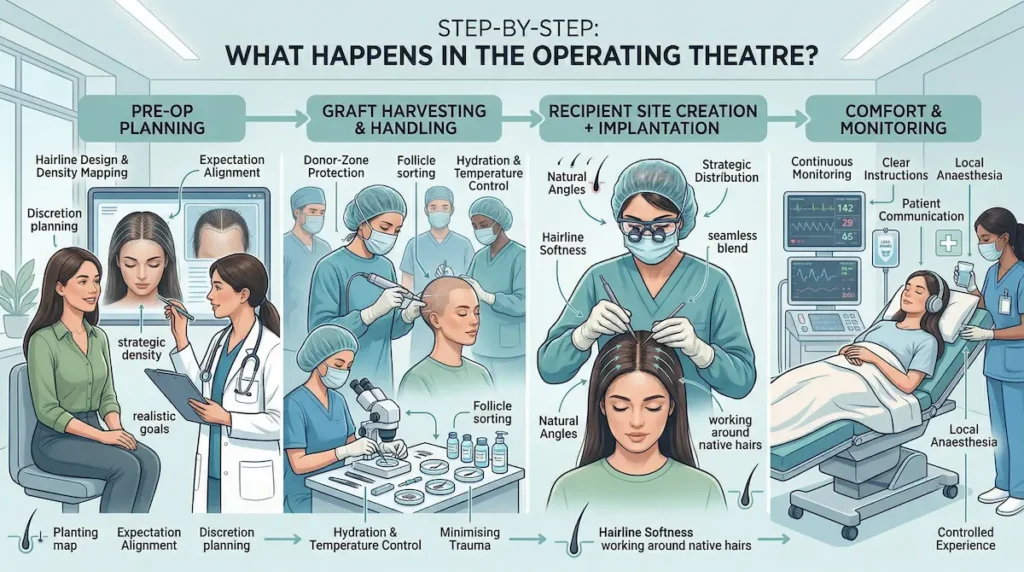
Female Hair Transplant Step-by-Step: What Happens in the Operating Theatre?
For many women, the most stressful part is the unknown. We reduce that uncertainty by walking you through the day in plain, clinical terms. Your plan is confirmed before we start, then we follow a structured sequence designed to protect graft viability and minimise trauma. Throughout the procedure, we monitor you carefully and keep the experience calm and controlled.
Pre-op planning: hairline design, density map, and expectations
Everything begins with design. We confirm what we are treating, what we are not treating, and why. In women, that often means prioritising strategic density rather than chasing blanket coverage. It also means planning around your existing hairs.
- Hairline and parting design: we map the zones that affect your “see-through” areas most.
- Density planning: we set realistic distribution goals based on donor strength and hair calibre.
- Discretion planning: we confirm shaving strategy (full, partial, or minimal where clinically appropriate).
- Expectations: we align on what “natural” looks like for you, not a template.
Graft harvesting and handling: minimising trauma
Graft quality is everything. Extraction is performed with controlled technique and deliberate pacing. We then protect the follicles carefully until implantation. Small details matter here.
- Donor-zone protection: extraction is planned to avoid creating patchiness.
- Graft sorting: follicles are organised so we can place the right graft in the right zone.
- Hydration and temperature control: we keep grafts in conditions designed to preserve viability.
Recipient site creation + implantation: angle, direction, distribution
This is where natural results are made. We focus on angle and direction first, then spacing and density. In women, we often work around native hairs, so gentleness is part of the technique. The aim is a seamless blend.
- Angle and direction: we mimic how your hair naturally lies, especially around part-lines and the frontal zone.
- Distribution: we place grafts strategically to create the strongest visual density.
- Hairline softness: we avoid harsh, straight borders by designing micro-irregularity.
Comfort & monitoring: what patients typically feel during the day
Comfort is planned, not improvised. Depending on your case and medical suitability, we may discuss awake-style approaches and monitored sedation options, always prioritising safety. During the day, you should expect periods of stillness and steady progress. Our team monitors vital signs and keeps communication clear.
- Local anaesthesia: you may feel pressure, but sharp pain should be controlled.
- Breaks: we build in breaks to support comfort and hydration.
- Clear instructions: we explain what is happening as we go, without overwhelming you.
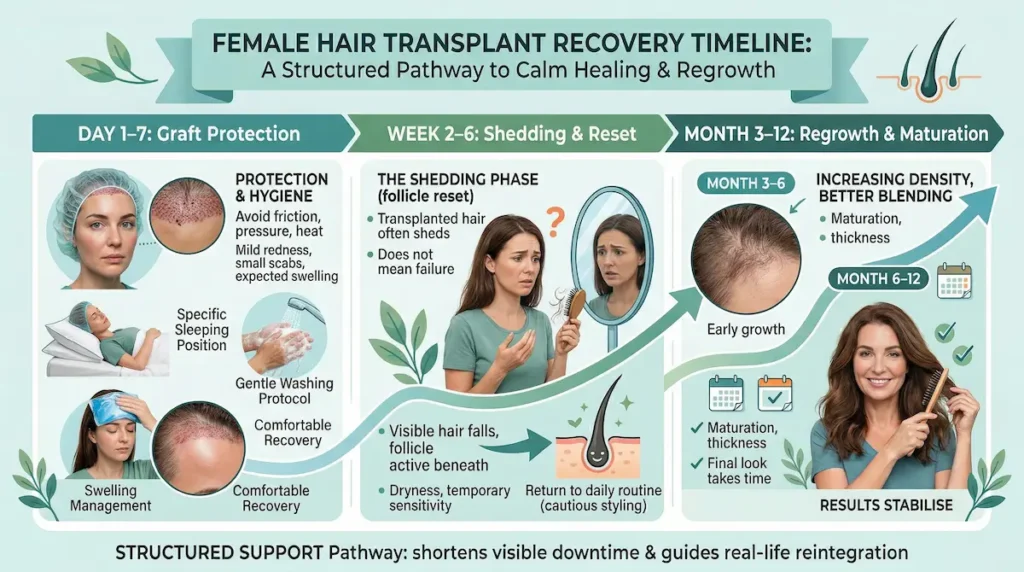
Recovery & Aftercare: Female Hair Transplant Recovery Timeline
Recovery is a process, not an event. The first goal is graft protection, then calm healing, then patience through the shedding phase. Most women feel physically “fine” before they look “socially normal”, so we plan aftercare around real life, not just biology. We also use a structured support pathway designed to shorten visible downtime where possible.
Day 1–7: graft protection, washing, swelling management
Week one is about protection and hygiene. You will have mild redness, small scabs, and some swelling in many cases. This is expected. The key is to avoid friction, pressure, and unnecessary heat.
- Sleeping position: keep the treated area protected and avoid rubbing against pillows.
- Washing: we guide you through gentle washing so scabs lift naturally over time.
- Swelling management: we give practical steps to reduce swelling and keep you comfortable.
Week 2–6: shedding phase and what “normal” looks like
This phase surprises people. Transplanted hairs often shed as follicles reset under the skin. That does not mean the transplant “failed”. It is a typical part of the cycle.
- Shedding: the visible hair may fall, while the follicle remains active beneath the scalp.
- Texture changes: you may see dryness or temporary sensitivity.
- Discretion: many women return to routine activities, but we still advise cautious styling.
Month 3–12: regrowth milestones and when results stabilise
Regrowth is gradual. You will usually notice early growth in months 3–4, then improving density as hairs mature. The “final” look takes time because hair calibre and length need time. We plan follow-up around these milestones.
- Months 3–6: early growth and directional settling.
- Months 6–9: increasing density and better blending.
- Months 9–12: maturation, thickness, and more predictable styling options.
Our Rapid Recovery & Safety Protocol: HBOT + LLLT
For women who prioritise minimal social downtime, we integrate a structured protocol focused on healing quality and risk reduction. We utilise Hyperbaric Oxygen Therapy (HBOT) to support tissue recovery in the early period, then complement it with Low-Level Laser Therapy (LLLT) for targeted cellular support. This is not marketing. It is a practical recovery tool. The goal is calmer healing and a smoother return to normal life.
- HBOT: delivered in a pressurised environment with high oxygen exposure, designed to support healing mechanisms and reduce inflammation.
- LLLT: a “soft laser” approach designed to support microcirculation, graft healing, and the transition into active growth.
- Why it matters: fewer “visible days” can be the difference between hiding at home and returning to routine with confidence.
Safety & Risks: Is a Hair Transplant for Women Dangerous?
No procedure is risk-free. A hair transplant is generally low-risk when the patient is properly screened, the theatre environment is controlled, and graft handling is meticulous. Problems tend to arise when any of those basics are rushed.
We prefer a straightforward approach. We explain the real risks, how we reduce them, and what to do if something does not feel right after you return to the UK.
Real risks: infection, poor growth, shock loss, scarring
Most concerns fall into a small set of predictable issues. Knowing them upfront helps you make a calmer decision.
- Infection: uncommon, but possible if aftercare is inconsistent or the scalp is irritated.
- Poor growth: usually linked to graft trauma, compromised blood supply, or unrealistic density planning.
- Shock loss: temporary shedding of existing hairs around the treated area, more relevant in diffuse thinning patterns.
- Scarring: FUE leaves tiny dot scars; visibility depends on extraction pattern, hair calibre, and styling choices.
- Folliculitis: small inflammatory bumps during regrowth phases, usually manageable with guidance.
How we reduce risk: screening, sterile standards, monitoring
Risk reduction is not a slogan. It is a system. We start with candidacy and continue through theatre discipline and structured aftercare.
- Strict pre-operative screening: we check suitability before we ever discuss “graft targets”.
- Controlled theatre standards: sterile protocols and consistent workflow reduce avoidable complications.
- Vitals monitoring: we monitor you throughout the day to keep the experience stable and safe.
- Graft handling discipline: hydration, timing, and gentle implantation protect follicle viability.
“Our benchmark is simple: a natural result built on safe decisions. We plan for longevity, not drama.”
When to call us: warning signs and escalation plan
Most patients experience mild redness, tightness, and sensitivity early on. That is expected. Certain signs deserve quick contact.
- Increasing pain that does not settle with the plan we give you.
- Spreading redness, warmth, or discharge from the recipient or donor area.
- Fever or feeling unwell rather than simply tired.
- Sudden swelling that worsens after the first few days.
If you are back in the UK and you are concerned, we guide you clearly. If we believe you need in-person assessment, we will tell you to contact your GP or urgent care without delay.
Is a Hair Transplant for Women Safe in Turkey for UK Patients?
Safety is not a country. It is standards, accountability, and clinical process. The UK patient question is valid, especially if you have read mixed stories online or searched female hair transplant reviews uk as part of your research.
We position the decision in practical terms: who is responsible for your care, what protocols are in place, and what happens after you fly home. If those answers are clear, the geography becomes less relevant.
Standards and environment: what “British standards” means in practice
We operate within a structured medical environment designed for international patients who expect clarity and consistency. That includes strict screening, monitored procedures, and a controlled clinical setting.
- Pre-op tests and candidacy checks: we do not treat “everyone”. Suitability comes first.
- Monitoring and safety protocols: patient vitals monitoring is part of our theatre routine.
- Clear aftercare instructions: we provide guidance that is written, practical, and easy to follow.
Privacy and data confidentiality as a clinical promise
For many women, discretion is part of safety. It is about privacy, professional life, and peace of mind. We treat confidentiality as a non-negotiable standard, not an optional extra.
- Private, appointment-led care: we aim to keep your experience calm and contained.
- Data protection discipline: we maintain strict confidentiality practices for international patients.
- Discretion planning: where suitable, we discuss approaches that reduce visible signs of treatment.
“The best work looks unforced. Our goal is to help you look like yourself on a better day—rejuvenated, not altered.”
The “expert patient” lens: what you should verify before booking
If you are comparing options after searching female hair transplant uk cost vs turkey, focus on clinical proof, not promises. The right questions are consistent.
- Who performs the critical steps? Ask what is surgeon-led versus delegated.
- What is the diagnostic logic? You should hear a clear explanation of your pattern and plan.
- What does follow-up look like after you return? Long-distance aftercare should be structured, not vague.
- Are risks discussed openly? A clinic that only sells certainty is not being honest.
We welcome these questions. UK patients should expect clear answers, in plain language.
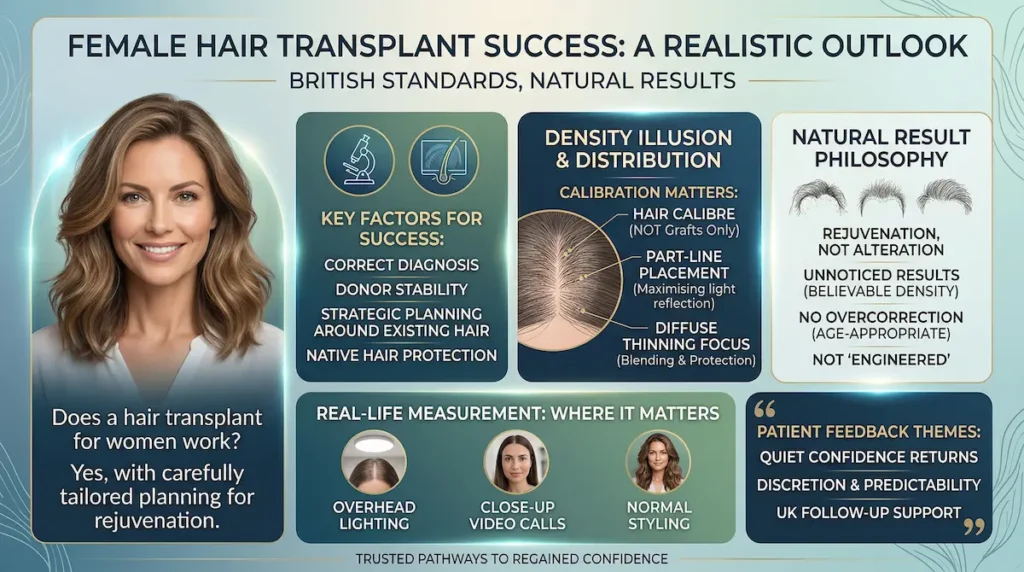
Results & Expectations: Does a Hair Transplant For Women Work?
Yes, it can. But the outcome depends on diagnosis, donor stability, and how carefully we plan around existing hair. Women often present with diffuse thinning, which means we prioritise blending and protection of native follicles. Realistic expectations are a safety feature, not a mood-killer. When the plan is right, the change is subtle and credible.
We measure success by how it looks in daily life: overhead lighting, close-up video calls, and normal styling habits. The goal remains the same. Rejuvenation, not alteration.
What “success” means in women: density illusion + distribution
Many patients search female hair transplant success rate expecting a single number. In reality, success in women is more about distribution strategy than raw graft counts.
- Strategic density: we place grafts where they change the way light hits the scalp, especially along part-lines.
- Calibration: hair calibre matters. Fine hair needs a different density plan than coarse hair.
- Native hair protection: in diffuse patterns, we work carefully around miniaturised hairs to reduce avoidable shock loss.
Natural result philosophy: rejuvenation, not alteration
Natural work has a specific feel. The hairline should not look “engineered”, and the direction should follow your existing growth. Density should also be believable for your age and hair type. Overcorrection is rarely flattering.
“We plan for a result that goes unnoticed. People should see you looking well, not a procedure.”
Typical patient feedback themes (without marketing noise)
Across hair restoration journeys, the most consistent positive feedback is not about dramatic change. It is about confidence returning quietly.
- Discretion: patients value a plan that respects work and social life.
- Predictability: clear milestones make the shedding phase less stressful.
- Support: structured follow-up reduces the “What now?” anxiety once you are back in the UK.
“The best plans feel calm. Clear steps. Clear trade-offs. No surprises.”
Cost / Fees: Female Hair Transplant Cost 2026 UK vs Turkey
Cost is rarely the first question for UK patients. It is usually the second. The first is safety and accountability. Once that box is ticked, the question becomes value: what you receive for the fee, and how predictable the experience is from consultation to long-term follow-up.
We use transparent, all-inclusive quotations after assessment, because graft requirements and technique choice vary. We also avoid false precision. What matters is what is included, what is not, and what standards sit behind the price.
| Cost Factor | Typical UK Private Pathway | Our Istanbul Model | Why it matters |
|---|---|---|---|
| Clinic overheads | High operational costs (staff, rent, insurance) | Lower national operational costs | Helps explain price differences without implying lower standards. |
| Logistics | Usually separate and self-managed | All-inclusive support options (hotel, transfers, host) | Reduces friction and decision fatigue for international patients. |
| Aftercare structure | Varies by provider; often local follow-ups | Long-term virtual follow-up milestones | Addresses the common fear of being “on your own” after you fly home. |
| Transparency | Itemised pricing is common, extras can add up | Clear inclusions and exclusions | Supports budget certainty and trust. |
Why costs differ: operational factors, not “quality compromise”
International patients often assume a lower fee must mean lower quality. That assumption is understandable, but not always correct. The price differential is largely driven by macroeconomic and operational factors, including exchange rates and national cost structures. This is why comparing “headline price” alone can be misleading.
- Overheads: staffing and facility costs differ substantially between markets.
- Exchange rates: currency dynamics change what a UK patient pays in GBP.
- Scope: an all-inclusive model bundles elements that are often separate elsewhere.
What’s included in our package (and what is not)
We use an all-inclusive model designed to remove hidden costs and reduce travel stress. Your exact plan depends on your case, but our package structure is designed around clarity.
- Included: procedure fee, anaesthesia and operating theatre fees, pre-operative tests, 5-star hotel accommodation, VIP airport and clinic transfers, a dedicated patient host, post-operative medications and garments, first post-op meal, and long-term virtual follow-up care.
- Not included: international flights, personal travel insurance, personal expenses (such as meals beyond the provided first post-op meal), additional hotel nights if you extend, and visa fees if applicable.
UK decision logic: risk minimisation first, then value
If you are comparing options after searching female hair transplant uk cost vs turkey, focus on what reduces risk: screening, who takes responsibility for key clinical steps, and how follow-up works once you are back home. Value is the outcome of that structure. Not the other way around.
If you want, we can outline your likely graft range and technique options during a virtual consultation, then issue a transparent quotation in GBP.
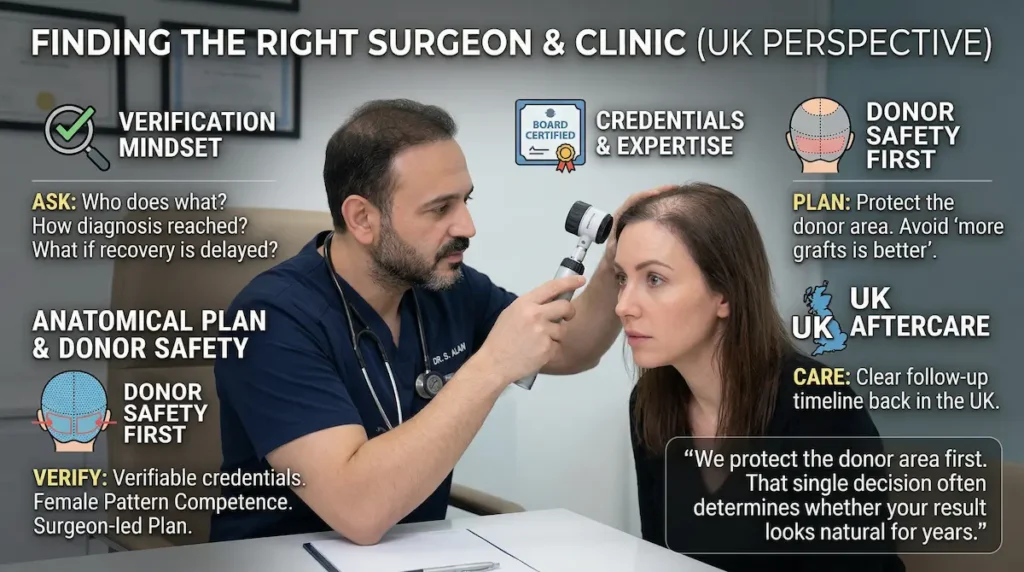
Finding the Right Surgeon & Clinic (UK Perspective)
When you are researching hair restoration, it is easy to get distracted by galleries, slogans, and price anchors. UK patients tend to decide differently. You want clinical accountability, a plan that makes anatomical sense, and an aftercare pathway that still exists when you are back home.
We encourage a “verification” mindset. Ask who does what, how your diagnosis was reached, and what the clinic will do if your recovery does not follow the expected timeline. A clinic worth trusting will not rush those answers.
Why board certification and experience matter
If you have searched best hair transplant surgeon turkey for female, you will have seen plenty of confident claims. We recommend a more practical filter: credentials you can verify, experience relevant to women’s patterns, and a surgeon-led plan that prioritises donor safety.
- Verifiable credentials: look for surgeons registered with international medical boards and clear professional accountability.
- Female pattern competence: diffuse thinning, traction patterns, and hairline refinement require different design logic than typical male recession.
- Conservative donor planning: a “more grafts is better” approach can create long-term problems in women.
“We protect the donor area first. That single decision often determines whether your result looks natural for years.”
Questions to ask in consultation (and what good answers sound like)
Whether you are comparing local options (for example hair transplant birmingham women or hair transplant manchester women) or considering Istanbul, the questions are the same. The best clinics answer clearly, without defensiveness.
- What is my diagnosis? You should hear a specific explanation (not just “thinning”) and how it affects suitability.
- What technique fits my pattern? The explanation should link to hair type, graft requirement, and discretion needs.
- How do you protect native hair? This matters in diffuse thinning and reduces avoidable shock loss.
- Who performs the critical steps? A serious clinic is transparent about surgeon-led responsibilities.
- What does follow-up look like? You should get a timeline and a clear contact route once you are back in the UK.
Red flags: unrealistic promises, overbooking, vague medical accountability
Some warning signs are consistent across the industry. If you see them, pause. The cost of a poor decision is not just financial. It is donor depletion and avoidable stress.
- Guaranteed outcomes or dismissing risks when you ask direct questions.
- No discussion of diagnosis, stability, or medical contributors before quoting a plan.
- Overemphasis on speed (“quick turnaround” without structured aftercare).
- Unclear accountability about who you contact if you develop concerns after travel.
We prefer transparency over persuasion. If a transplant is not the right first step, we will tell you.
Your AKM Medical Journey: What to Expect (Arrival to Departure)
Travelling for surgery can feel like a leap. We reduce that friction by running the journey as a structured medical pathway, not a travel arrangement with a procedure attached. You will know what happens, when it happens, and who is responsible at each step.
UK patients often worry about two things: “Will I be looked after properly?” and “What happens when I’m home?” Our model is designed around those concerns. We organise the logistics, keep communication simple, and maintain continuity of care after you return.
Free virtual consultation and personalised plan
We begin with a remote consultation to assess suitability and outline a realistic pathway. This is where we confirm pattern type, donor adequacy, and whether your hair loss appears stable enough for surgery now.
- Case assessment: photos, medical history, and your main priorities (density, hairline, discretion).
- Technique discussion: FUE, DHI, Sapphire, and discretion-led planning where clinically suitable.
- Clear next steps: what to do before travel, and what we need from you to finalise planning.
VIP logistics: 5-star hotel and private transfers
We keep travel days straightforward. Our team coordinates airport transfers and accommodation so you are not navigating Istanbul alone during a medically important window.
- Airport-to-hotel-to-clinic transfers organised by our team.
- Accommodation support designed to keep you comfortable and rested.
- Time efficiency: we structure appointments so the process is calm and predictable.
Procedure day and early checks
On the day, we confirm the plan, then proceed in a controlled operating theatre workflow. Comfort is planned. Safety is monitored. We keep communication clear throughout.
- Pre-op checks: suitability confirmation and final design mapping.
- Anaesthesia planning: we prioritise approaches that support comfort while maintaining a safety-first framework.
- Early post-op review: we check graft integrity and donor comfort before you leave the clinic.
Long-term virtual follow-up and UK-friendly support
Your care does not end at the airport. We provide structured follow-up milestones and responsive communication once you are back in the UK.
- Virtual check-ins: guided reviews through early healing, shedding, and regrowth phases.
- Practical escalation advice: if something concerns you, we advise clearly whether to contact your GP or A&E.
- Discretion support: styling and routine guidance tailored to professional life.
If you are the kind of patient who reads everything twice, you will fit right in here. We built this journey for the expert patient.
Hair Transplant For Women Frequently Asked Questions (FAQ):
Women’s hair restoration is rarely a single yes/no decision. Most questions are really about suitability, discretion, and what “normal” looks like at each stage of recovery. We answer these in a practical way, with the same logic we use in consultation. Clear trade-offs. Clear next steps.
Can women with female pattern baldness have a hair transplant?
Diagnosis first: we confirm whether the pattern fits female pattern hair loss versus shedding or inflammatory conditions.
Donor stability: the donor zone must be strong enough to donate safely without creating visible thinning.
Density strategy: we plan strategic density where it makes the biggest visual difference, not unrealistic blanket coverage.
Does a hair transplant work for women with thinning hair?
Native hair protection: we design implantation to minimise trauma around existing miniaturised hairs.
Realistic density: improvement is often “more hair where it matters”, not “full density everywhere”.
Staged planning: for some patterns, a conservative staged approach is safer than doing everything at once.
What is the recovery timeline and when can I return to work?
Days 1–7: visible healing signs are most noticeable; you follow washing and protection guidance closely.
Weeks 2–6: shedding is common; it can look like “going backwards” before regrowth begins.
Months 3–12: gradual regrowth and maturation; styling becomes easier as calibre improves.
If your job is public-facing, we can plan around discretion and discuss flight-ready recovery protocols so your return to routine feels organised rather than improvised.
Which technique is best: FUE vs DHI vs Sapphire?
FUE: often suits broader density work and efficient graft harvesting when shaving strategy is acceptable.
DHI: often suits precision placement and density planning in targeted zones, especially around part-lines and refined hairline work.
Sapphire: focuses on controlled recipient-site creation for clean distribution and natural blending.
We confirm the method after assessment, then explain the reasoning in plain language.
Do you offer a no-shave or discreet option for women?
Suitable cases: smaller to moderate treatment zones where existing hair can help camouflage early healing.
Trade-off: higher graft numbers may require a more practical shaving strategy to protect graft quality and theatre efficiency.
Honesty matters: we will not recommend a “discreet” approach if it risks outcomes.
How do you handle Afro-textured hair in women’s hair transplants?
Extraction control: planned to reduce follicle trauma.
Recipient design: considers how curl behaviour affects the appearance of density.
Aftercare discipline: helps reduce irritation and supports calmer healing.
Is it safe to travel back to the UK after the procedure?
Protection: avoid pressure or friction on the treated areas during travel.
Hydration and routine: keep it simple and consistent.
If you feel unwell: we advise you clearly. If we suspect you need in-person assessment, we will tell you to contact your GP or attend A&E without delay.
How do I book, and what do you need from me?
Next step: book female hair transplant turkey starts with sharing photos and a brief medical history.
Planning: we confirm dates, organise transfers and hotel options, and outline your day-by-day schedule.
Clarity: you receive a written plan and a transparent outline of what is included in your turkey hair transplant package women.
Medical Disclaimer: This page is provided for general informational purposes only and does not constitute medical advice, diagnosis, or treatment. A hair transplant is a medical procedure and suitability must be assessed individually by qualified clinicians. Outcomes vary between patients and no specific result can be guaranteed. Always seek personalised medical advice from a qualified healthcare professional, and contact your GP or emergency services if you develop urgent symptoms.