


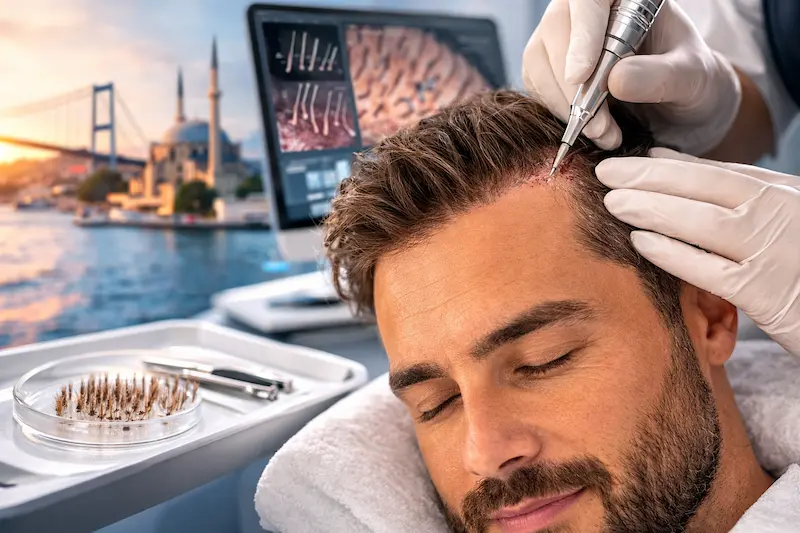
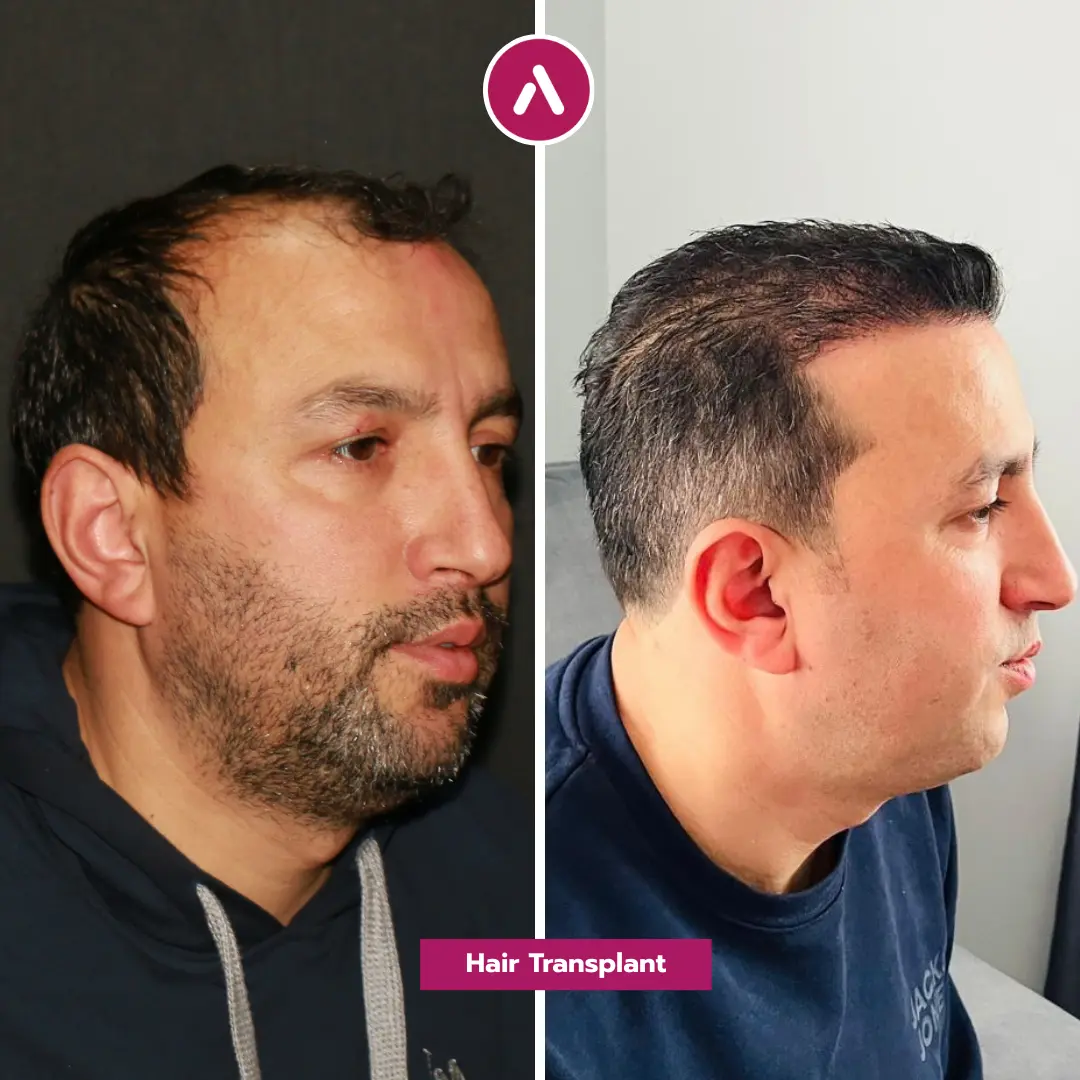
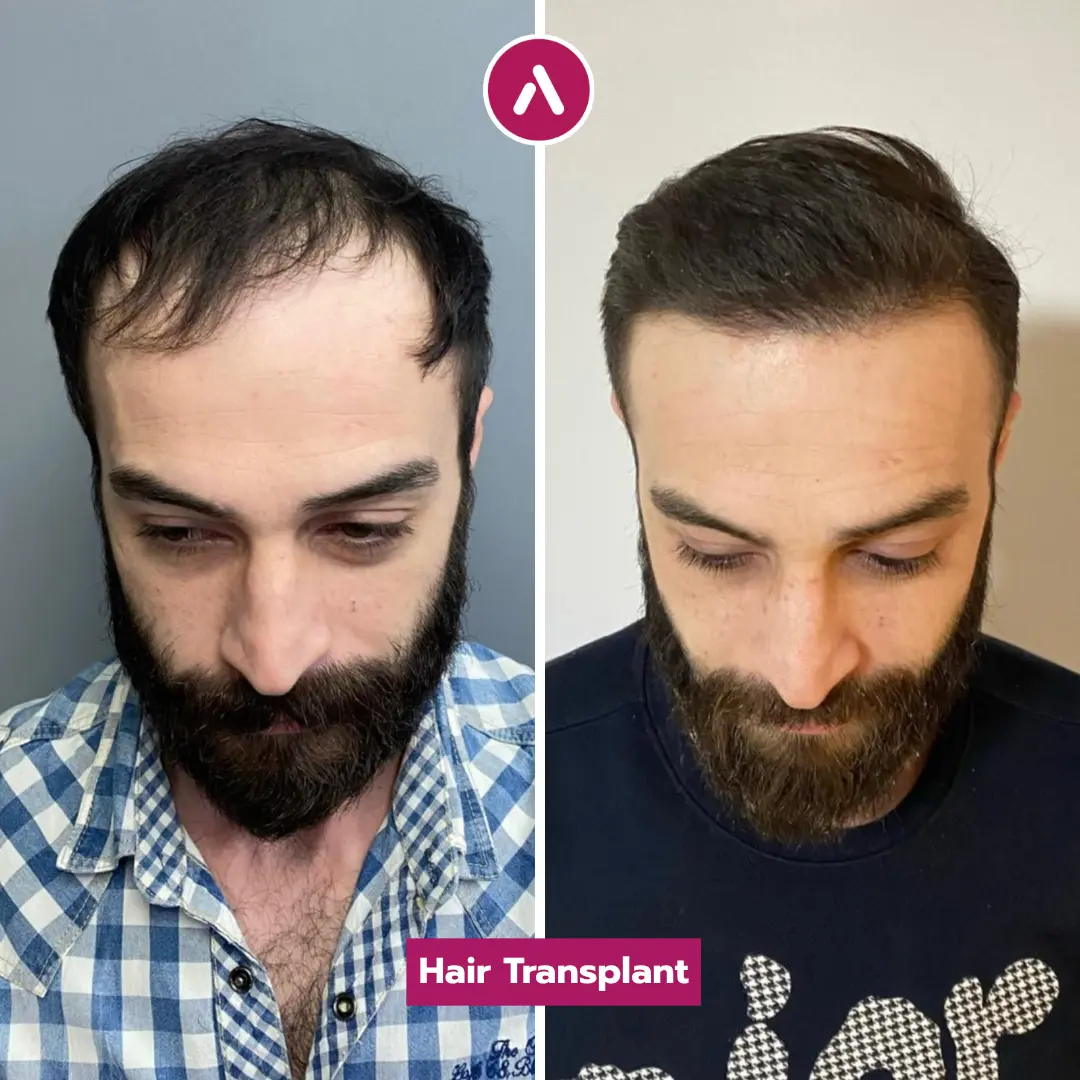
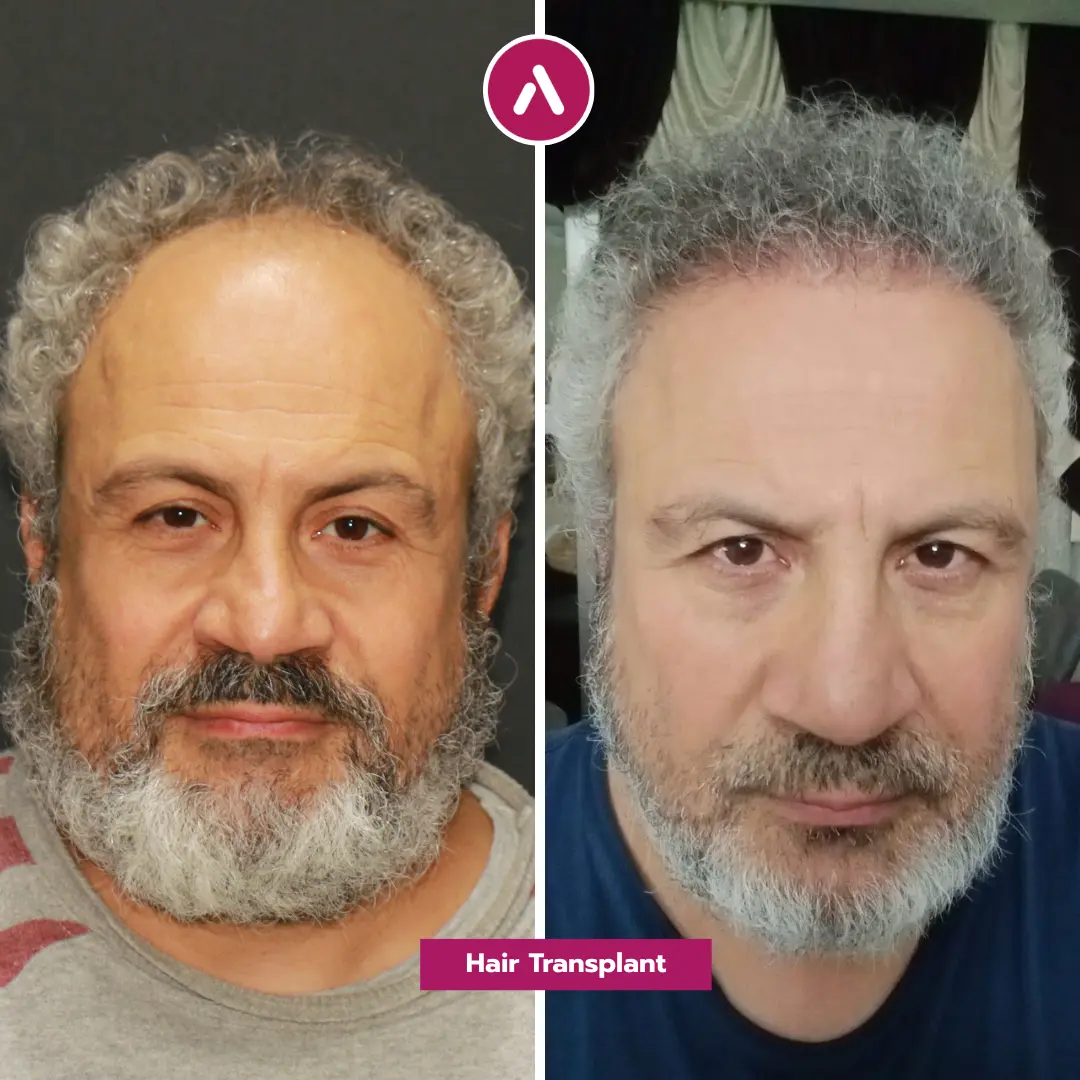
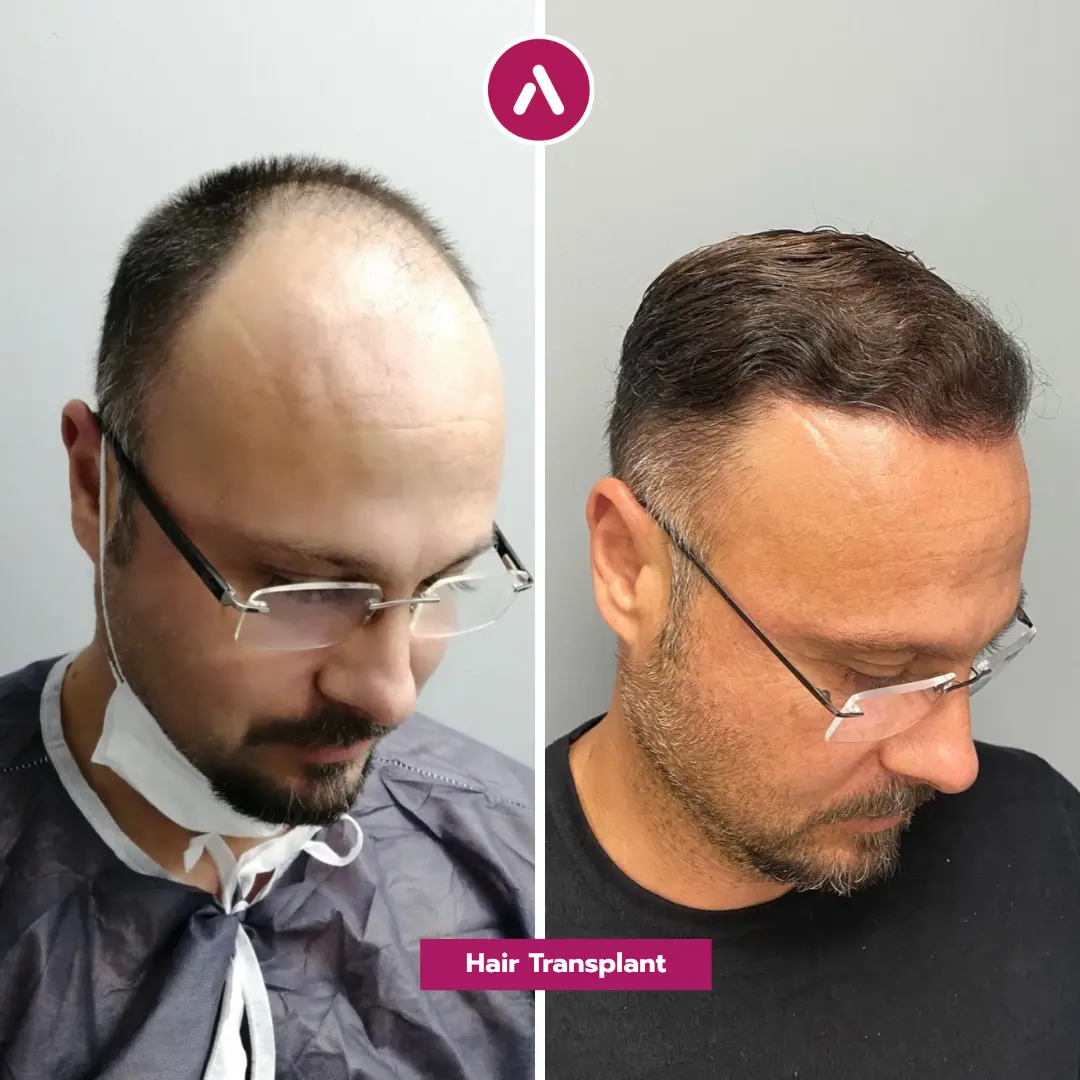
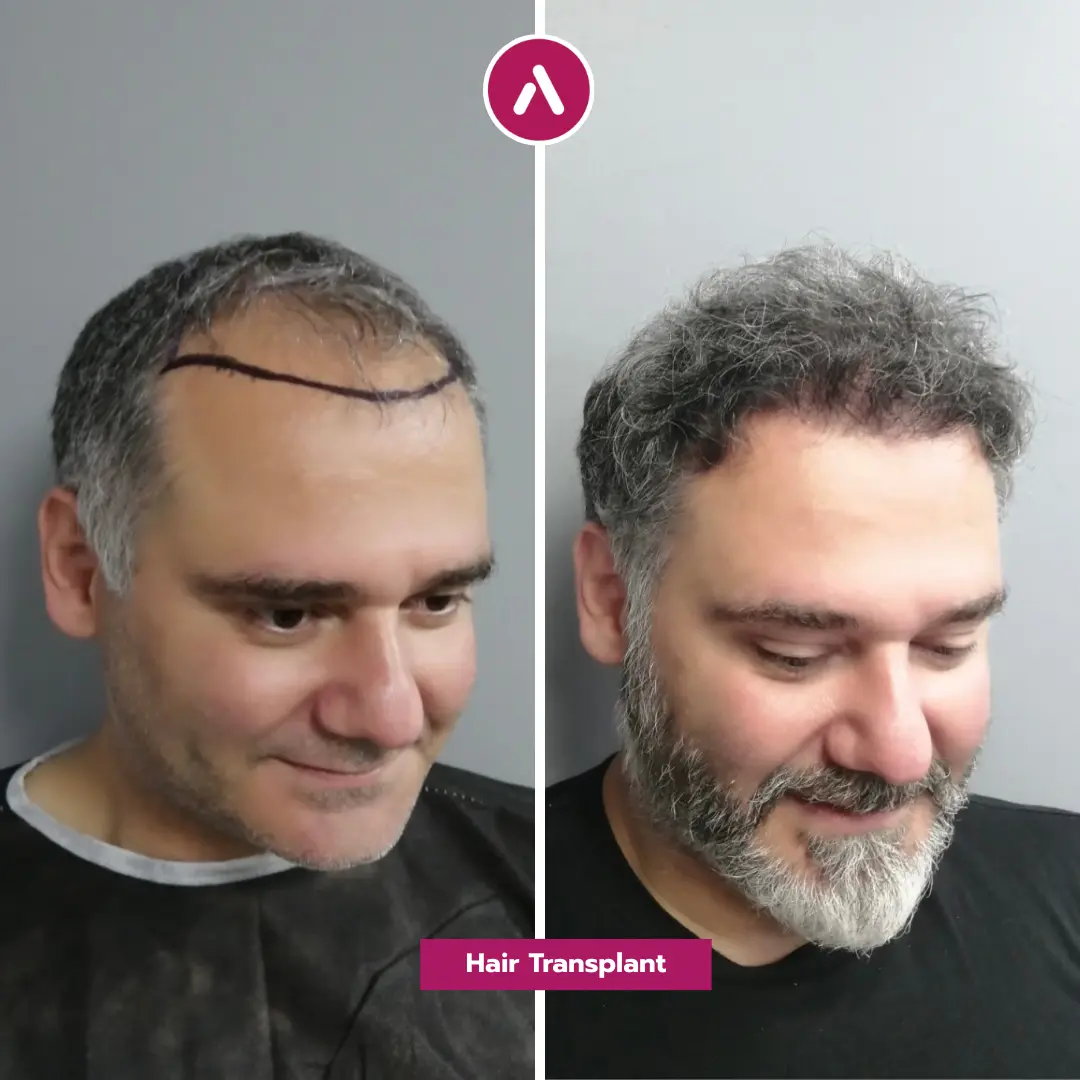
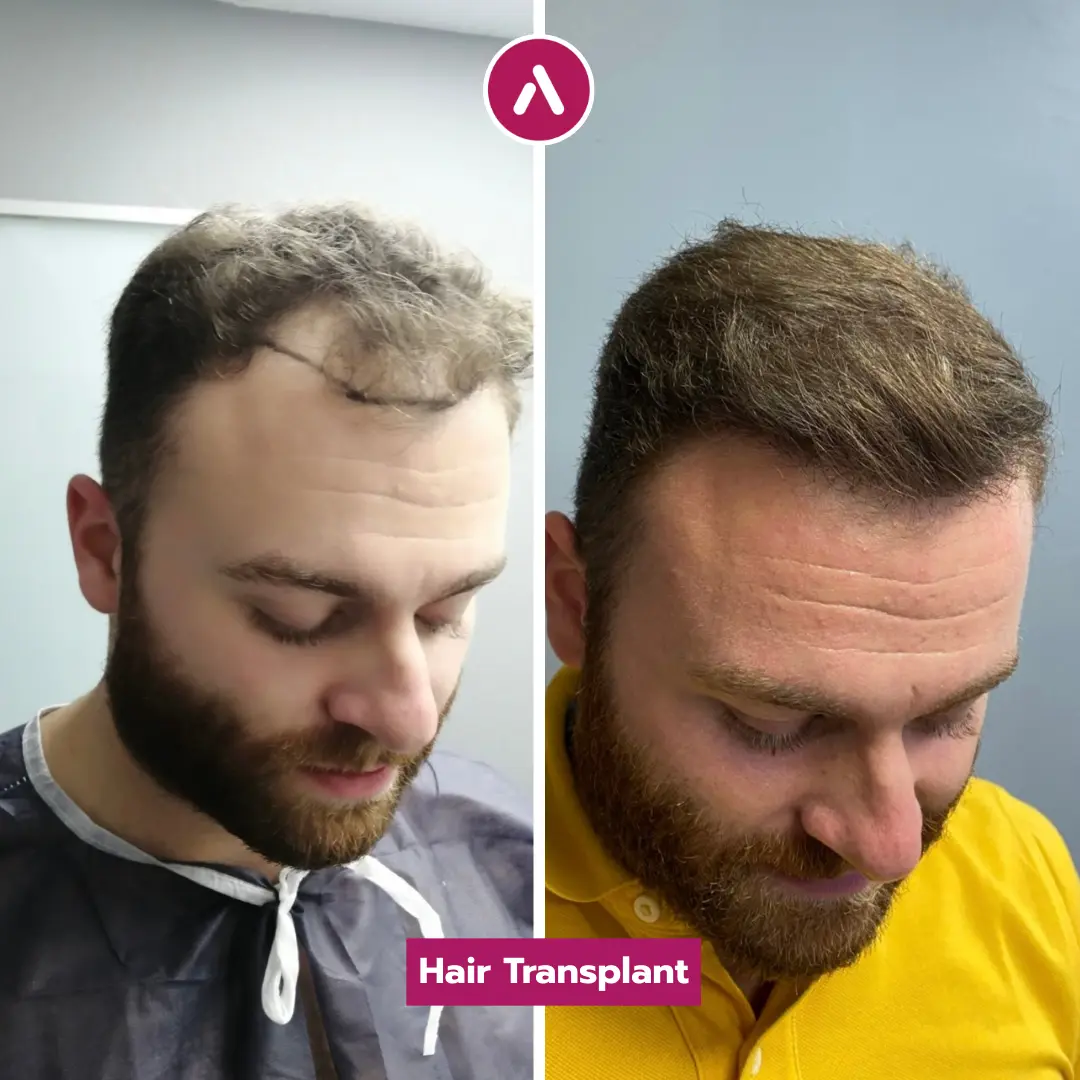
Considering a DHI Hair Transplant in Turkey? This guide breaks down how Direct Hair Implantation works, who it suits, and what to expect on the day—so you can compare clinics with confidence and plan a natural-looking hairline.
We cover recovery milestones, safety checks, and a clear UK vs Turkey cost framework, including what all-inclusive packages typically include. Keep reading for practical questions to ask, realistic results month by month, and the next step towards a surgeon-led quote.
Table of Contents
What is a DHI Hair Transplant?
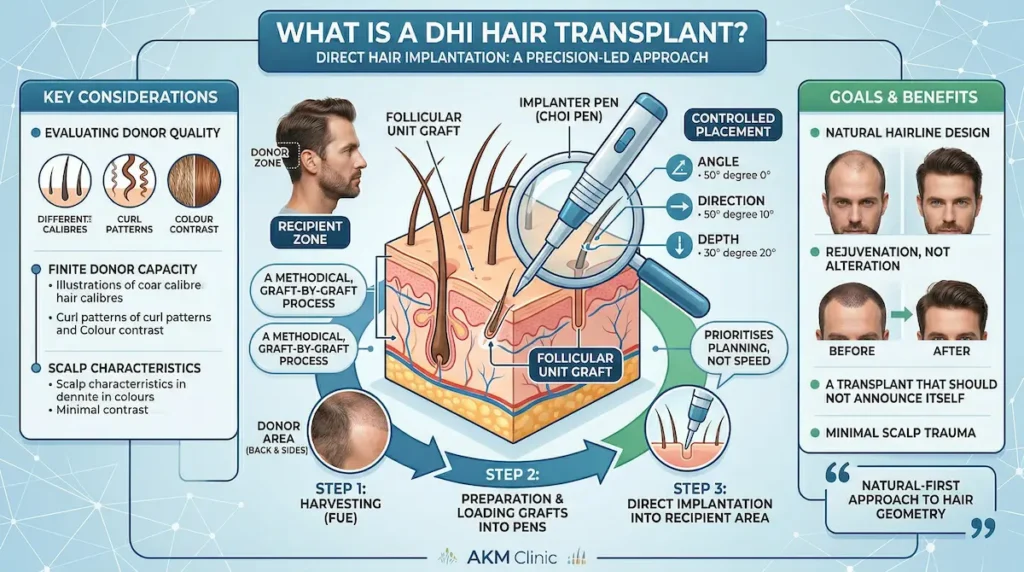
A DHI Hair Transplant (also known as Direct Hair Implantation (DHI)) is a hair restoration method where follicular units are harvested from a donor area and placed into thinning scalp using a pen-like implantation tool. The aim is controlled placement of each graft’s angle, direction, and depth, without relying on wide incisions.
For many UK patients, the question is not “Can hair be moved?” but “Can it be placed with discipline?” DHI is often discussed as a precision-led approach because implantation is done graft by graft. That said, results still depend on diagnosis, donor capacity, and realistic density planning.
At AKM Clinic, we frame hair restoration with the same principle that guides all our aesthetic work: rejuvenation, not alteration. That matters most at the hairline. A good transplant should not announce itself.
Direct Hair Implantation (DHI): the core idea
Most modern hair transplantation relies on moving follicular units from a genetically stable donor zone to areas affected by thinning. DHI focuses heavily on the implantation phase. Instead of placing grafts into a large, pre-made grid, the clinician places each graft in a controlled sequence.
- Harvesting is typically performed using a follicular unit extraction approach (grafts are taken one by one).
- Implantation is then performed directly into the recipient area using an implantation device.
- The work is methodical. It prioritises planning, not speed.
Understanding the donor area and the recipient area
The donor area is usually at the back and sides of the scalp, where follicles are more resistant to common patterns of androgen-related hair loss. The recipient area is where thinning is visible: hairline recession, temples, mid-scalp, or crown. A DHI plan must respect both zones, because the donor is finite.
In a proper consultation, we evaluate donor quality, hair calibre, curl, colour contrast, and the degree of miniaturisation in the recipient area. This is where “how many grafts” becomes a clinical question, not a sales number.
- Donor capacity influences achievable coverage.
- Hairline design influences how natural the result looks at conversational distance.
- Scalp characteristics influence the recovery experience (redness, sensitivity, dryness).
The role of the Choi / implanter pen
DHI is closely associated with an implantation device commonly referred to as a Choi pen or implanter pen. The principle is simple: the graft is loaded into the pen, and the clinician implants it with controlled depth and direction. This can be particularly relevant in areas where angle matters, such as the frontal hairline and temple transitions.
It is also the reason DHI is often described as “detail-heavy”. The technique rewards careful team workflow, consistent handling of grafts, and a conservative approach to hairline geometry. This is where “natural-first” stops being a slogan and becomes a design rule.
Benefits of a DHI Hair Transplant
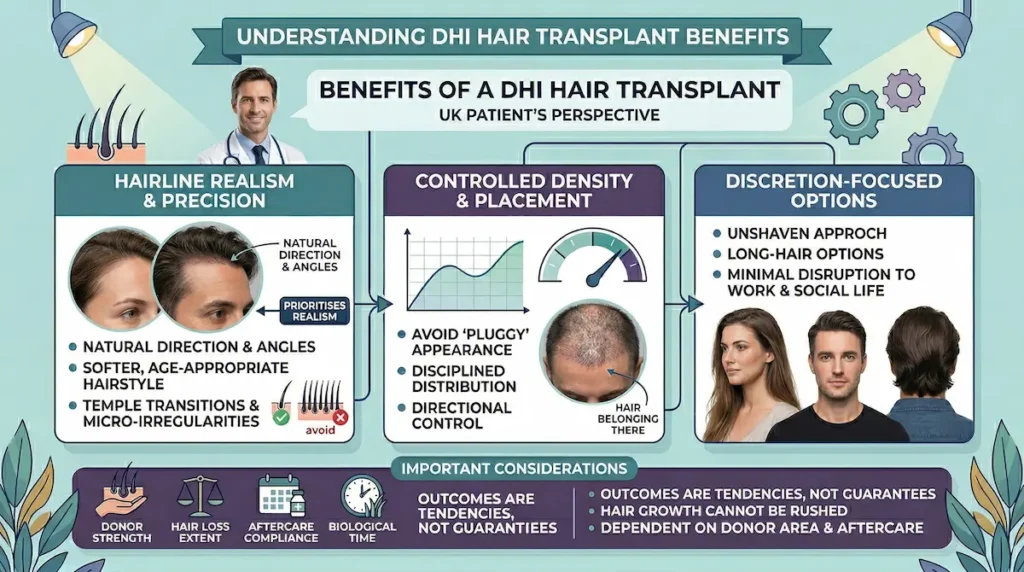
DHI is not automatically “better” for every patient. It is better described as a specific toolset for specific problems. For the UK “expert patient”, the value is in how the method prioritises controlled placement and hairline realism, rather than promising a dramatic overnight change.
The benefits below are best understood as tendencies, not guarantees. Your outcome will be shaped by donor strength, the extent of hair loss, aftercare compliance, and time. Hair growth is biological. It cannot be rushed.
When DHI is chosen for the right indications, it can support a more disciplined approach to density distribution and direction control. This is often the difference between “transplanted hair” and “hair that looks like it always belonged there”.
Precision at the hairline: natural-looking direction and angle
The hairline is where results are judged most harshly. If angles are off, it shows. DHI’s implantation approach can be useful for controlled placement in the frontal zone, where micro-irregularities (the small imperfections found in natural hairlines) create authenticity.
- A softer, age-appropriate hairline usually looks more believable than an overly low, straight line.
- Temple transitions require careful directional changes, not uniform rows.
- Density should be engineered so the hairline does not look “pluggy” or abrupt.
Discretion-focused options: unshaven and long-hair approaches
Some patients prioritise privacy and minimal disruption to work and social life. In those cases, clinicians may discuss a unshaven DHI hair transplant approach, where shaving is limited or avoided in visible zones. Similarly, some patients explore “long-hair” options to maintain immediate camouflage.
These options are not suitable for everyone. They depend on donor characteristics, the required graft count, and how much time can be allocated to careful implantation. We address this transparently during planning, so expectations stay realistic.
Recovery support: why aftercare is part of the treatment, not an afterthought
The transplant day is only one part of the journey. Aftercare influences comfort, complication risk, and how calmly you move through the first two weeks. This is also where technology can support biology.
In our clinic ecosystem, we use recovery-focused systems as part of a structured protocol. For hair restoration specifically, Low-Level Laser Therapy can be used to support scalp recovery and help stimulate the environment around transplanted follicles.
- Clear washing instructions and timing reduce avoidable irritation.
- Planned follow-up reduces the common fear of being “left alone” after returning home.
- Supportive therapies are considered where clinically appropriate, not as gimmicks.
Am I a Suitable Candidate for DHI Hair Transplant?
A good result starts before the theatre day. Candidacy is not just about wanting more hair. It is about pattern, donor capacity, scalp health, and expectations that match biology.
In consultation, we focus on what can be achieved without overharvesting. That is where long-term planning matters. A conservative plan now often protects your options later.
Our aim is simple: results that look like you, just with stronger hair density where it matters.
1) Hair loss pattern, stability, and timing
DHI can be considered for frontal recession, mid-scalp thinning, and selected crown work. The key is whether your hair loss pattern is predictable enough to design a stable strategy.
If hair loss is actively progressing, we may recommend stabilising first, then transplanting. This avoids chasing a moving target.
- Diffuse thinning can be suitable, but it needs careful planning to protect native hair.
- Advanced patterns may require a staged approach rather than trying to “fill everything” in one session.
- Younger patients need extra restraint. A low, dense hairline today can become unnatural later.
2) Donor area quality: the non-negotiable factor
Your donor area is your resource. It determines how many grafts we can safely take and how natural the final coverage can look. Thickness, curl, and colour contrast all influence the visual density you can achieve.
We assess donor density and scalp characteristics to avoid overharvesting and patchiness. This is also where “how many grafts” becomes a clinical decision, not a marketing promise.
- Hair calibre (fine vs coarse) affects the perceived density.
- Donor density and safe extraction zones set the upper limits.
- Scalp laxity and sensitivity influence healing and comfort.
3) Medical suitability and who should delay (or avoid) surgery
Most healthy adults can be considered for hair transplantation. Still, certain medical situations need extra caution. Some conditions mean we delay, optimise, or sometimes advise against surgery.
If you have ongoing scalp inflammation, uncontrolled chronic illness, or you smoke heavily, the plan may change. Your GP’s input can be helpful if you take prescription medication or have complex health history.
- Active scalp disease (such as severe dermatitis or folliculitis) should be treated first.
- Bleeding risks and certain medications may require a tailored plan and timing.
- Unrealistic expectations are a red flag. A transplant restores hair. It does not recreate teenage density.
If you are unsure, we keep it straightforward: we review photos, ask the right medical questions, and explain what is realistic for your hair type and pattern.
Contextual next step: If you want a plan you can trust, we recommend starting with a surgeon-led assessment and a donor-first graft strategy.
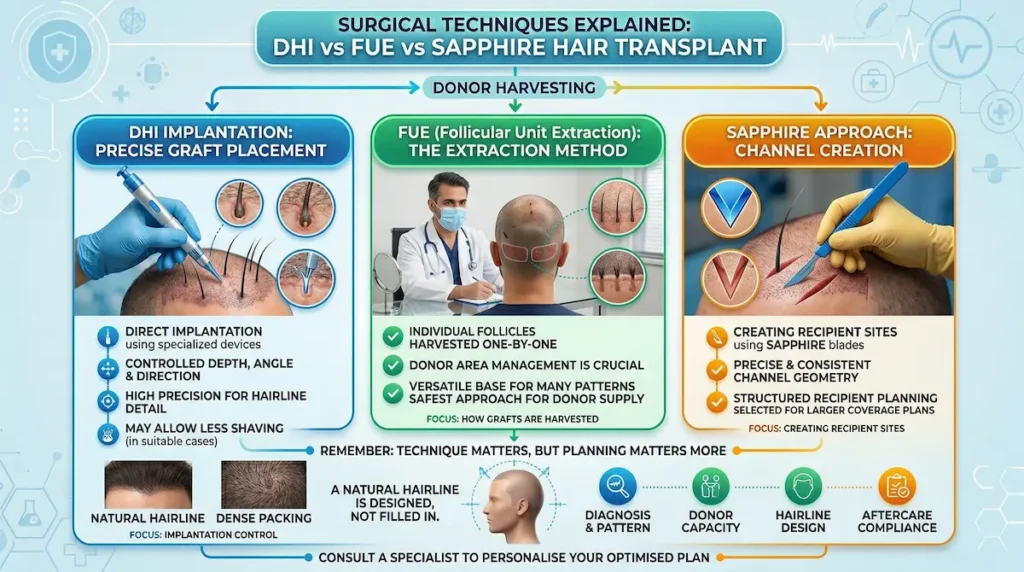
Surgical Techniques Explained: DHI vs FUE and the Sapphire Hair Transplant approach
This is where many clinics oversimplify. “DHI” and “FUE” are often treated as competing procedures, but they describe different parts of the workflow. In most modern hair restoration, grafts are extracted with an FUE method, then implanted using a chosen approach.
What changes is how recipient sites are created and how grafts are placed. That affects speed, handling, and how precisely we can control angle and direction at the hairline. The best choice depends on your pattern, hair characteristics, and whether discretion (such as unshaven options) is part of the brief.
Technique matters, but planning matters more. A natural hairline is designed, not “filled in”.
DHI implantation: controlled placement, graft by graft
DHI refers to a direct implantation method using an implanter device. The graft is loaded and placed with attention to depth, direction, and angle. This can be particularly useful in high-visibility zones like the frontal hairline and temple transitions.
DHI can also suit patients who prioritise discretion, where limited shaving may be considered. Not everyone is suitable, but for the right patient profile, it can reduce social disruption.
- Strong for hairline artistry and directional control.
- Supports disciplined density planning in the frontal zone.
- Requires careful team workflow and consistent graft handling.
FUE workflow: extraction method + implantation choice
FUE describes how grafts are harvested from the donor area, usually one by one. After extraction, implantation can be done with different techniques, including pens or forceps-based placement depending on the plan.
In practice, the conversation should be: “Which extraction method is safest for my donor?” and “Which implantation approach best suits my recipient area?”
- Widely used and versatile across patterns and graft counts.
- Donor management is crucial to avoid overharvesting.
- Implantation approach should match the hairline and density goals.
Sapphire approach: recipient site creation with sapphire blades
The Sapphire method is commonly discussed in relation to how recipient channels are created. Sapphire blades are used for making incisions with a focus on consistency and fine control. This can be paired with FUE harvesting as part of the overall plan.
For some patients, it can be a sensible option when we want a specific type of channel geometry or when graft distribution requires a particular incision strategy.
- Often selected to support precise channel creation.
- Can be useful in larger coverage plans with structured recipient design.
- Still depends on graft quality, placement discipline, and aftercare.
| Feature | DHI implantation | FUE (workflow focus) | Sapphire approach |
|---|---|---|---|
| Main focus | Implantation control with an implanter device | How grafts are harvested from the donor area | How recipient sites/channels are created |
| Best suited for | Hairline detail, angle/direction control | Most patterns; donor-first planning | Structured recipient design for selected plans |
| Key clinical variables | Team workflow, graft handling, placement discipline | Safe extraction zones, donor management | Incision strategy, spacing, recipient planning |
| What still decides the outcome | Diagnosis, donor capacity, hairline design, and aftercare compliance | ||
Combined Treatments (Synergy): Maximising Your Results
Some patients arrive with a single question: “Can we do more than one thing while I’m in Istanbul?” It is a fair question. Travel takes effort, and your time matters. Still, synergy only works when it protects results, not when it chases efficiency. Our job is to plan a sequence that respects donor limits, healing biology, and your long-term options.
In hair restoration, the safest approach is usually to keep the focus on one primary objective. Then we add supportive elements that reduce stress on the scalp and improve recovery comfort. When a patient asks about adding a second transplant area, we look at donor capacity first. Always.
1) Scalp + facial hair restoration: what is realistic?
Our menu includes specialised hair restoration options beyond the scalp, such as a Beard & Mustache Transplant, an Eyebrow Transplant, and a Women’s Hair Transplant. Some patients explore these as part of one overall “hair design” plan. The key variable is donor supply. It is finite.
If two areas are planned in a single trip, we design it as a controlled allocation problem. The highest-visibility zone takes priority. That is typically the frontal hairline and mid-scalp. Secondary zones are then considered only if the donor can support it without compromise.
- Best fit: stable donor, clear priorities, and realistic density targets.
- Common limitation: donor capacity cannot cover “everything” at high density.
- Planning rule: we preserve future options rather than overreaching in one session.
2) Supportive therapies: recovery is part of the treatment
A transplant day is technical. The recovery is biological. This is where we integrate our Rapid Recovery & Safety Protocol using technology that supports healing rather than simply “selling extras”.
For selected patients, we utilise Hyperbaric Oxygen Therapy (HBOT) to support oxygenation and the body’s own healing response after surgical stress. We also use Low-Level Laser Therapy (LLLT) to support the scalp environment and help guide follicles through the early recovery phase. In our technology portfolio, LLLT is a 650nm “soft laser” system designed for cellular stimulation without heat damage.
- We use supportive therapies where clinically appropriate, not as a blanket promise.
- We plan aftercare like a schedule, not a vague suggestion.
- We prioritise comfort, risk reduction, and steady progress.
3) Combining hair restoration with other procedures: when to separate
AKM Clinic covers a broad range of aesthetic procedures. That scope can be helpful for patients who want a long-term plan, not a one-off intervention. Still, combining major procedures in a single operating theatre day is not always sensible. Hair restoration benefits from a calm, controlled environment and careful handling of grafts.
When patients ask about pairing hair transplantation with another operation, we discuss timing. Often, the most rational choice is staging: one procedure, then a full recovery window, then the next. It is slower. It is also safer and more predictable.
- Good synergy: supportive recovery therapies and structured follow-up.
- Risky synergy: overloading the body with multiple major procedures at once.
- Our bias: protect outcomes first, optimise convenience second.
Anaesthesia: Why We Prefer Awake / Twilight Approaches
For many UK patients, anaesthesia is the most emotional part of the decision. Not the technique. Not the graft count. Anaesthesia. Some people are simply anxious about being fully “put under”. Others have had a previous unpleasant experience and want more control.
Hair transplantation is commonly performed as a day-case procedure with local anaesthesia. Where appropriate, we can add a calm, supervised sedation approach to reduce anxiety and help you remain comfortable in the operating theatre. The goal is a steady, controlled experience with clear safety boundaries.
1) Local anaesthesia for hair transplantation: what it means in practice
Local anaesthesia means we numb the scalp so the procedure can be performed without pain. You remain awake. You can speak. You can take breaks. For many patients, that sense of control is reassuring.
We also plan practical comfort. Positioning matters over hours. Small details matter too. A well-managed day feels calm, not chaotic.
- Local anaesthetic targets comfort while keeping recovery straightforward.
- Being awake allows real-time communication if you need it.
- Most patients return to their accommodation the same day.
2) What is twilight sedation (and what it is not)?
Twilight sedation is a lighter form of sedation used to reduce anxiety and help time pass more easily. You are still breathing on your own. You are not in full general anaesthesia. Many patients describe it as feeling relaxed and less aware of the length of the day.
It is not a “one-size-fits-all” choice. Some patients prefer to stay fully alert. Others benefit from a measured sedation plan. We decide based on medical suitability and comfort needs.
- Can help: anxiety, restlessness, fear of medical settings.
- Not suitable for everyone: suitability depends on health history and assessment.
- Safety focus: the plan should be predictable, not aggressive.
3) Safety in the operating theatre: monitoring and pre-op screening
Good anaesthesia is not just about medication. It is about screening, monitoring, and clear standards. Before treatment, we use structured pre-operative checks to confirm suitability. During the procedure, we monitor vital signs as standard practice.
This is also where professional discipline shows. Sterile theatres matter. Consistent protocols matter. If a patient needs adjustments during the day, we make them calmly and methodically.
- Pre-op screening supports safer decision-making.
- Continuous monitoring supports safer care during sedation.
- A structured team workflow reduces avoidable stress for patients.
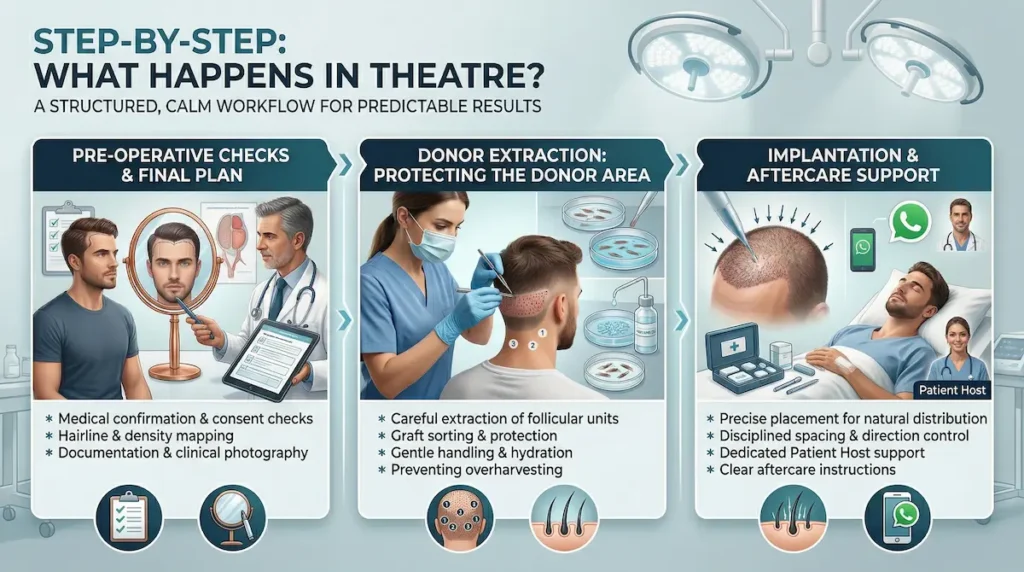
DHI Hair Transplant Step-by-Step: What Happens in Theatre?
Most anxiety comes from the unknown. So we keep the day structured, predictable, and calm.
Your procedure is planned around donor protection, clean graft handling, and precise implantation. We do not rush the parts that matter. We measure, confirm, and then begin.
In UK terms, this is a sterile operating theatre workflow: clear steps, documented checks, and a team that knows the rhythm.
“The most convincing work is the work nobody notices. Our job is to design a hairline that belongs to your face, not a template.”
1) Pre-operative checks and the final plan
Before we enter theatre, we confirm your medical details and the surgical plan. This is where your hairline design becomes a clinical blueprint, not a sketch. If anything feels unclear, we slow down and clarify it. That is the point of the final review.
- Pre-op screening and consent checks (including medication and allergy review).
- Hairline and density mapping with final confirmation in the mirror.
- Photography and documentation for your follow-up programme.
If you are a discretion-focused patient, this is also where we confirm whether a limited-shave approach is suitable. Not everyone is a good match. We stay honest.
2) Donor extraction: protecting the donor area
Donor management is where long-term quality begins. We extract grafts carefully from safe donor zones, aiming to preserve a natural look at the back and sides of the scalp. Overharvesting is not a “brave” plan. It is a permanent compromise.
- Grafts are extracted one by one (follicular units), then sorted and protected.
- We prioritise gentle handling and hydration to reduce graft stress.
- Extraction patterns are planned to avoid visible thinning in the donor.
Some patients fixate on graft numbers. We focus on graft strategy. It is the only approach that respects biology.
3) Implantation and immediate post-op care
Implantation is the detail phase. This is where direction, angle, and density distribution decide whether your result looks natural at conversational distance. We place grafts with careful attention to the frontal zone, temple transitions, and the blend into existing hair.
- Recipient area design is followed with disciplined spacing and direction control.
- We keep the process consistent to avoid patchy density patterns.
- We finish with clear aftercare instructions and a plan for your first wash.
After the procedure, you are monitored by our team. Then you return to your hotel with support in place. Your Patient Host remains available via WhatsApp for practical questions and reassurance.
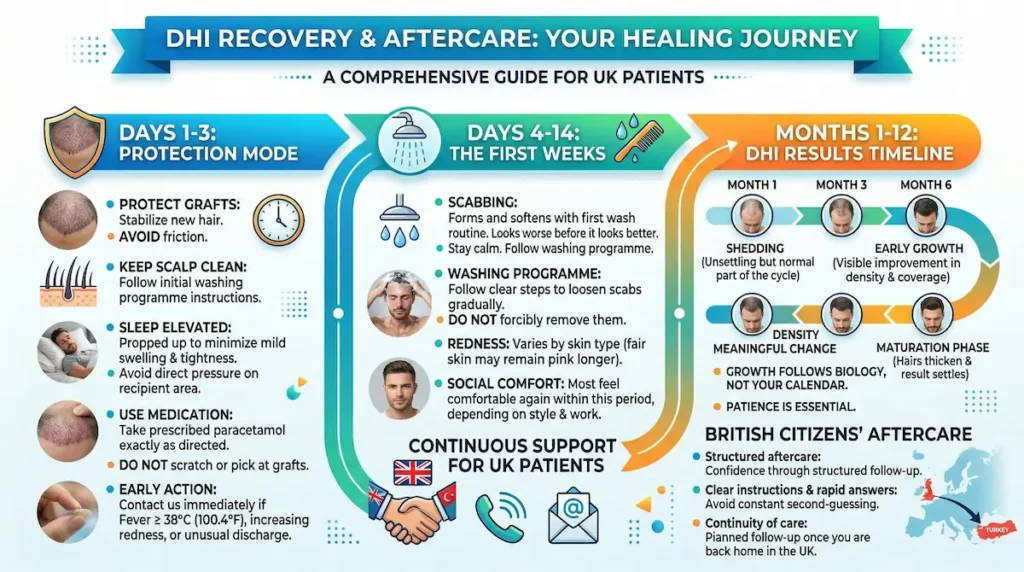
DHI Hair Transplant Recovery & Aftercare: How Long Does Healing Take?
Recovery has phases. The first two weeks are about protecting grafts and keeping inflammation under control. The following months are about patience, because growth follows biology, not your calendar.
Expect visible changes early (scabbing, redness, mild swelling), then a quiet period. Many patients experience shedding before regrowth begins. This is normal.
To support reassurance, we keep your aftercare structured and your follow-up schedule clear. For many UK patients, that continuity is the difference between confidence and constant second-guessing.
Days 1–3: protection mode
The first 72 hours are about stability. You protect the grafts, avoid friction, and keep the scalp clean as instructed. Mild swelling can happen. So can tightness.
- Sleep with your head elevated and avoid direct pressure on the recipient area.
- Do not scratch or pick at the grafts, even if itching starts.
- Use medication exactly as prescribed (we commonly use UK-friendly terms like paracetamol when appropriate).
If you develop a fever of 38°C (100.4°F) or above, increasing redness, or unusual discharge, contact us immediately. Early action matters.
Days 4–14: scabs, redness, and the first wash routine
Scabbing usually forms and then softens with washing. This phase can look worse before it looks better. Stay calm. Follow the washing programme.
- Scabs should loosen gradually, not be forcibly removed.
- Redness varies by skin type; fair skin can remain pink for longer.
- Most people feel socially comfortable again within this window, depending on hairstyle and work demands.
For UK travellers, this is where post-op care in Turkey for British citizens becomes more than a phrase. It is practical: clear instructions, rapid answers, and planned follow-up once you are home.
Months 1–12: DHI hair transplant results month by month
Month 1 often brings shedding. It can be unsettling, but it is a common part of the cycle. Month 3 is usually when early growth becomes noticeable. Month 6 often shows a meaningful change in density.
- 1–3 months: shedding and early growth; patience is essential.
- 4–6 months: visible improvement in coverage and texture.
- 9–12 months: maturation phase; hairs thicken and the result settles.
If you are prone to anxiety, we recommend taking progress photos monthly under the same lighting. Small gains add up.
Our Rapid Recovery & Safety Protocol: HBOT + LLLT
We integrate supportive technologies to reduce risk and help recovery stay smoother. Our protocol combines Hyperbaric Oxygen Therapy (HBOT) and Low-Level Laser Therapy (LLLT) as part of a structured aftercare ecosystem.
- HBOT is designed to support tissue recovery by increasing oxygen availability in a pressurised environment.
- LLLT uses a clinically defined “soft laser” wavelength (650nm) with high-density medical-grade laser diodes to stimulate cellular activity without heat damage.
- For hair restoration, we use LLLT to support scalp microcirculation and help guide follicles through recovery.
We do not present this as magic. We present it as risk-aware support. The foundations are still technique, donor quality, and aftercare discipline.
Safety & Risks: Is DHI Hair Transplant Dangerous?
Every surgical procedure has risks. Hair transplantation is generally low-risk in healthy candidates, but “low-risk” is not “no-risk”. We talk through the predictable side effects, the rarer complications, and the steps we use to reduce them. Calm planning beats false reassurance.
If you are comparing clinics, focus less on big claims and more on protocols. Screening, sterile workflow, and aftercare access are what protect outcomes.
1) Common side effects: what is normal
Most early issues are temporary and manageable. The most common DHI hair transplant side effects relate to inflammation and normal wound healing. They can look dramatic in the mirror, but they usually settle with time and correct aftercare.
- Swelling around the forehead (typically early and short-lived).
- Redness in the recipient area (often longer in fairer skin types).
- Itching as scabs soften and shed.
- Tightness or mild soreness in the donor area.
We give clear guidance on washing, positioning, and when to resume normal activity. Small habits make a big difference.
2) Potential complications: what we watch for
Complications are uncommon, but they matter. We want you to recognise warning signs early and contact us quickly. Time is your ally when you act early.
- Infection: increasing redness, heat, discharge, or fever (38°C or above).
- Folliculitis: inflamed follicles that can appear as small tender bumps.
- Shock loss: temporary shedding of native hair around the recipient area.
- Numbness: temporary altered sensation, usually improving over weeks.
We do not frame these as “scare stories”. We frame them as a shared responsibility. You follow the programme. We stay responsive.
3) Risk reduction: what we do differently
Risk reduction is rarely one magical step. It is a system. We structure the day to reduce graft stress and we structure the aftercare to reduce avoidable inflammation and irritation.
- Strict pre-operative screening to confirm candidacy and reduce medical risk.
- Sterile theatre discipline and consistent graft handling to protect follicle viability.
- Continuous monitoring where sedation is used, with comfort kept under control.
- Technology-led aftercare using our HBOT + LLLT ecosystem where appropriate.
Our principle is simple: protect the grafts, protect the donor, and design for a natural look that still makes sense in five years.
Is DHI Hair Transplant Safe in Turkey for UK Patients?
This is the question UK patients ask when they are being sensible. Safety is not about geography. It is about standards. We have designed our workflow around international expectations: screening, monitoring, sterilisation, confidentiality, and a clear line of support after you fly home.
If you want “Harley Street thinking” with Istanbul efficiency, you need proof of systems, not slogans. That is what we focus on.
1) Standards, screening, and sterile workflow
We treat safety as non-negotiable. That starts with candidacy screening and continues through theatre protocols. You should never feel rushed into surgery.
- Structured health screening before treatment and on arrival.
- Vitals monitoring throughout the procedure.
- Rigorous sterilisation standards and controlled theatre workflow.
We also keep the plan conservative when needed. A smaller, well-designed session can be safer than an aggressive “one-day transformation”.
2) Surgeon-led accountability (without sales language)
In hair restoration, the “who” matters as much as the “how”. We position your plan as a medical decision made by European Board Certified specialists, not a package chosen from a menu. That is how we protect the hairline and preserve donor options.
- We prioritise donor-first planning to avoid overharvesting.
- We design hairlines to be age-appropriate, not artificially low.
- We explain what we cannot do, as clearly as what we can.
This is how we align with the UK “expert patient” mindset: evidence, logic, and restraint.
3) Aftercare for UK travellers: continuity after you fly home
International patients often worry about being abandoned once they leave Turkey. We build against that. Our model includes a 24/7 Patient Host during your stay and long-term virtual follow-up after you return home.
- Post-op care in Turkey for British citizens is structured around written instructions, daily priorities, and rapid response.
- We provide a clear schedule for washing, activity, and scalp protection.
- We discuss “flight-ready” practicalities, including hydration, movement, and pressure avoidance on the grafts.
Hair growth still follows biology. But your confidence improves when your support is organised.
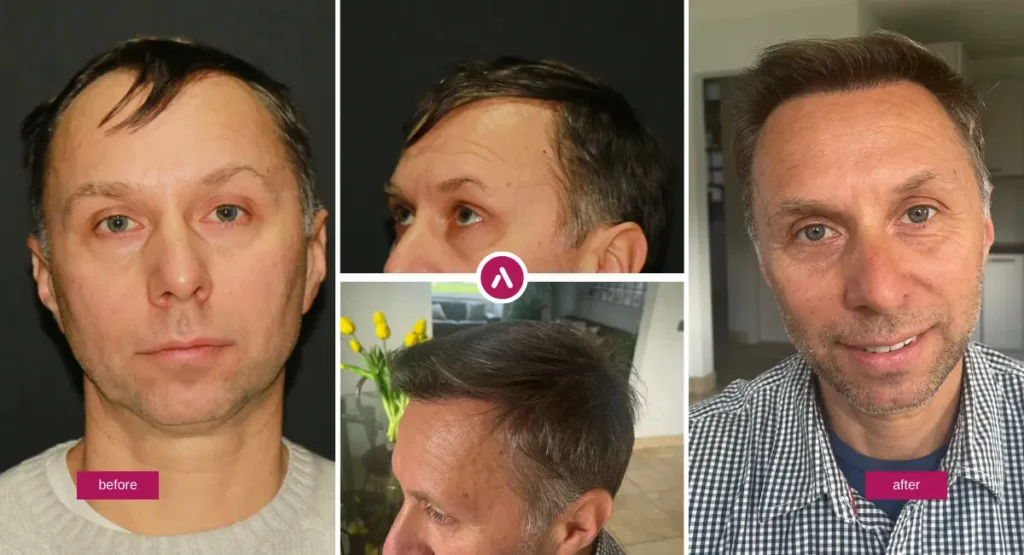
DHI Hair Transplant Before and After: Realistic Expectations & Results
The most common disappointment after hair transplantation is not a “bad transplant” — it is a timing misunderstanding. Hair growth follows biology. Even with excellent technique, your result develops in phases. Some phases look worse before they look better.
We recommend setting expectations in two layers:
- What you will see (appearance changes week by week).
- What is actually happening (follicle recovery and cycling under the skin).
Below is a realistic guide for DHI hair transplant results month by month. Your timeline can vary depending on your skin type, hair calibre, crown involvement, and whether you have ongoing native hair thinning.
Weeks 1–2: visible healing
This is the “obvious” stage: scabs soften and shed, redness reduces gradually, and the donor area starts to feel normal again. You are protecting grafts, keeping washing consistent, and avoiding friction.
- Scabbing is expected and should release gradually with washing.
- Redness can last longer in fairer skin types.
- Mild numbness or tightness can occur and usually improves over time.
Weeks 3–6: the shedding phase (often misunderstood)
Many patients experience shedding of the transplanted hairs. This can feel alarming, but it is commonly part of the cycle. The follicles are recovering beneath the surface, preparing for new growth. This is not “the transplant failing” — it is the process resetting.
- Shedding may be patchy and uneven. That is normal.
- Native hair near the recipient area can also shed temporarily (shock loss).
- Do not judge the result at this stage.
Months 2–3: early signs of growth
Early hairs may appear thin, soft, and inconsistent. Coverage can look uneven. This is the first “green shoots” stage, not the final outcome. If you are an anxious checker, we recommend monthly photos under the same lighting rather than daily mirror scrutiny.
- Early hairs may look lighter or finer than expected.
- Texture can be wiry at first and then normalise.
- Some areas (especially the crown) can be slower to show change.
Months 4–6: visible improvement
This is often when patients start to feel the decision was worth it. Density looks more coherent, styling becomes easier, and the hairline begins to “belong” to the face. For many patients, this is the first meaningful milestone.
- Coverage improves and the hairline looks less “see-through”.
- Hairs start to thicken gradually.
- Confidence usually rises sharply in this window.
Months 7–9: maturation and refinement
Hair continues to thicken and gain strength. Direction and flow begin to look more natural as the hair length increases. This is where a well-designed hairline becomes more convincing with each haircut.
- Thickness improves, especially in the frontal zone.
- Texture becomes more consistent.
- Most patients feel comfortable with “normal life” styling.
Months 10–12 (and sometimes beyond): final settling
For many, the 12-month mark is the benchmark for “final” results. However, some patients — particularly those with crown work or slower biological growth — may continue improving up to 15–18 months. We plan follow-up with that reality in mind.
- The hairline and frontal density usually look mature by 12 months.
- The crown can keep improving beyond 12 months.
- We discuss long-term maintenance if ongoing thinning is present.
Important: A transplant relocates follicles; it does not stop future hair loss in non-transplanted areas. If you have active thinning, we discuss a long-term plan so the result stays coherent over time.
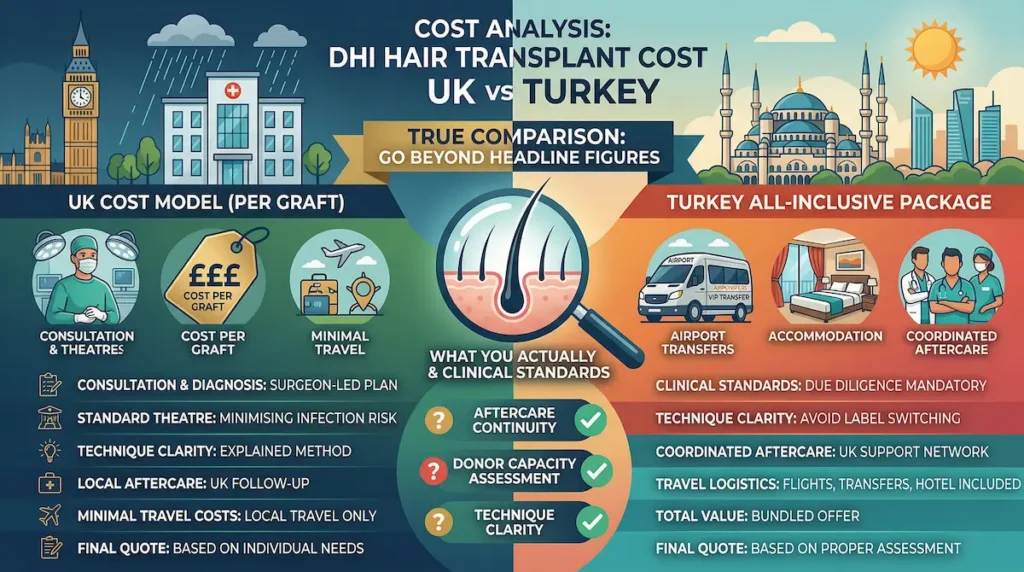
Cost Analysis: DHI Hair Transplant Cost 2026 UK vs Turkey
UK patients often search for a single number: “How much does DHI cost?” The more useful question is: “What is the cost model — and what does it include?”
In the UK, pricing is commonly structured around a cost per graft framework. In Turkey, many clinics present all-inclusive packages. These are not just different prices — they are different ways of packaging risk, logistics, and follow-up.
Do not compare a headline figure to a headline figure. Compare what you actually receive and who is accountable for your plan.
1) Why costs look different: “per graft” vs “all-inclusive packages”
UK cost structure is often driven by local operating overheads, clinic time, and graft-based pricing. Patients may pay more per graft, but travel costs are minimal. Turkey package structure often bundles the procedure with accommodation, transfers, and coordinated aftercare, which can create a stronger “total value” picture for the international patient.
- UK clinics: typically price per graft, with add-ons billed separately.
- Turkey clinics: often offer packages that include logistics and scheduled follow-up support.
- True comparison: total cost + clinical standards + aftercare continuity.
2) What to compare (and what patients often miss)
When patients compare DHI hair transplant cost UK vs Turkey, we suggest comparing the exact same line items. Otherwise, you can accidentally compare a premium plan with a stripped-back plan.
| Comparison item | Questions to ask | Why it matters |
|---|---|---|
| Consultation & diagnosis | Is the plan surgeon-led? Is donor capacity assessed properly? | Prevents overharvesting and unrealistic hairline design. |
| Theatre standards | Is it a sterile operating theatre workflow? What are the protocols? | Reduces avoidable infection and graft stress. |
| Technique clarity | What is DHI referring to in your plan (implantation method)? | Avoids confusion and marketing-led “label switching”. |
| Aftercare & follow-up | Who supports you once you’re back in the UK? What is the schedule? | Continuity reduces anxiety and helps detect issues early. |
| Supportive therapies | Are HBOT / LLLT offered where appropriate? Is it protocol-based? | Can support comfort and recovery when used responsibly. |
| Travel logistics | Hotel, transfers, and timing: what is included? | Hidden costs add up quickly for international patients. |
3) UK city comparisons: London, Manchester, Leeds, Glasgow, Birmingham
Patients often search by city — and understandably. The UK private market can vary by region, and cities like London often reflect higher clinic overheads. The key is not “which city is cheapest”, but “which plan is safest and most complete for your situation”.
- London vs Istanbul cost comparisons often highlight overhead differences and package structure.
- Manchester, Leeds, Glasgow, Birmingham may vary in pricing model and availability, but standards and surgeon accountability should remain your primary filter.
- If you are choosing Turkey, your due diligence should be stricter, not looser.
4) What influences your final quote (without guesswork)
We avoid making number promises without a proper assessment. Your final cost is shaped by medical variables and planning choices, including:
- The extent of hair loss and priority zones (hairline vs crown vs diffuse thinning).
- Donor density and safe extraction limits.
- Whether discretion options (unshaven/long-hair approaches) are clinically suitable.
- Aftercare intensity and whether supportive therapies are appropriate for you.
If you want a transparent answer, we recommend a surgeon-led photo assessment first. That is the fastest way to avoid generic “from-to” pricing that does not fit your case.
Finding the Best DHI Hair Transplant Surgeon & Clinic
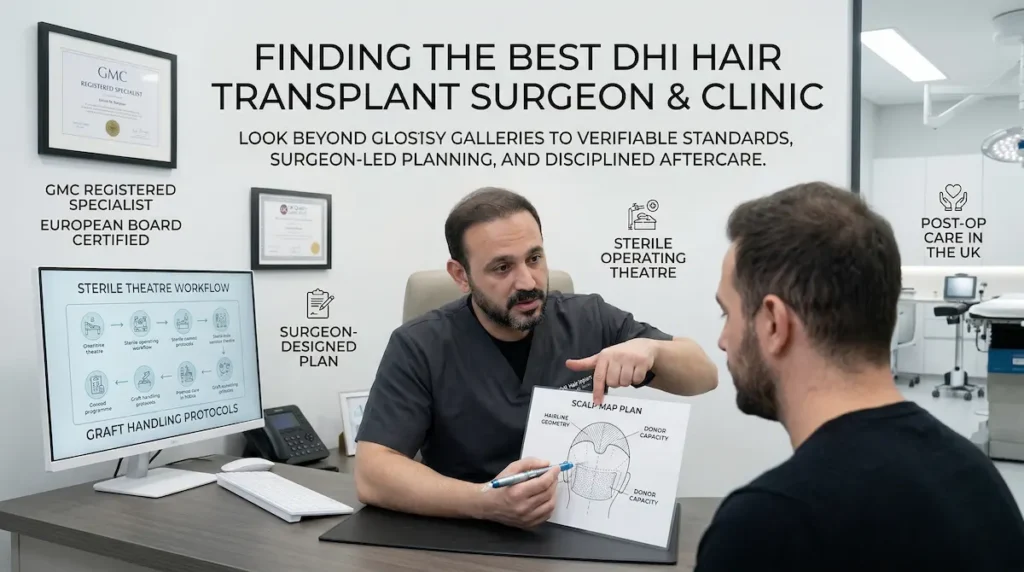
When people search for the “best clinic”, they often compare glossy galleries and headline promises. We encourage a different filter. Look for verifiable standards, surgeon-led planning, and clear aftercare. These are the boring details that protect results.
A DHI plan is not just “implantation with a pen”. It is donor management, hairline geometry, and disciplined execution. You want a team that explains limits as clearly as benefits. That is how natural results are built.
1) Credentials and accountability (not marketing titles)
Start with the basics: who is medically accountable for your plan? In serious clinics, surgeons are not “behind the scenes”. They are part of the diagnostic process and they own the decisions that shape your outcome.
- Ask whether your plan is designed by European Board Certified Surgeons and specialists registered with international medical boards.
- Ask who designs the hairline and who verifies donor limits before extraction.
- Ask what medical screening is done to confirm candidacy and reduce risk.
If the answers are vague, that is a signal. Hair transplantation is elective, but it is still medical treatment.
2) Safety systems you can trust: screening, sterile theatres, and monitoring
High-quality outcomes usually come from repeatable systems. We operate with strict pre-operative screening, modern vitals monitoring, and international sterilisation standards. Those protocols reduce the avoidable risks: infection, poor healing, and unnecessary graft stress.
- Pre-op checks that are structured, not rushed.
- Sterile operating theatres and consistent graft-handling workflow.
- Clear escalation pathway if you need urgent advice after you return home.
This is the “Expert Patient” mindset in action: evidence over reassurance.
3) How to read before-and-after results without being misled
Photos can educate you or manipulate you. The difference is consistency. When you look at results, focus on hairline realism, density distribution, and whether the look suits the patient’s age and facial structure.
- Check for consistent lighting and angles, not “best-case” framing.
- Look at the temple transition and the softness of the frontal hairline.
- Ask whether results include month-by-month progression, not just final shots.
“The most successful aesthetic work is the work that goes unnoticed. Our goal is rejuvenation, not alteration.”
4) The consultation questions that separate serious clinics from sales desks
If you want a robust plan, ask questions that force clinical thinking. Numbers matter, but strategy matters more. A clinic that answers these clearly is usually a clinic that plans carefully.
- What is my donor capacity and what are my long-term options if hair loss progresses?
- How will you prioritise zones (hairline vs mid-scalp vs crown) for natural density?
- What aftercare support do I have once I am back in the UK?
Your Medical Journey: UK to Istanbul (Arrival to Departure)
Travelling for treatment is not just about the procedure day. It is logistics, pacing, and support when you feel tired and out of routine. We structure the journey so you are not problem-solving in a foreign city while recovering.
Our model is simple: you manage your international flights, and we manage the rest. That means hotel planning, transfers, and a clear schedule. It also means continuity after you return home, with planned virtual follow-ups.
1) Before you travel: remote planning that reduces uncertainty
Your journey typically starts with a remote consultation. We review your photos, discuss goals, and outline a donor-first graft strategy. If something looks unsuitable, we say so early.
- Photo assessment and a surgeon-led treatment plan.
- Travel timing guidance around work, social downtime, and recovery phases.
- A clear list of what to bring (comfortable clothing, a clean travel pillow, and your existing medications).
2) Arrival in Istanbul: a calm start matters
On arrival at Istanbul Airport (IST or SAW), our private driver meets you at the arrivals gate. You are transferred to your hotel in a private vehicle. You settle, rest, and arrive at the clinic the next day with energy, not stress.
- Airport meet-and-greet and private transfer to your hotel.
- 5-star hotel accommodation arranged from our partner list.
- 24/7 access to your dedicated Patient Host via WhatsApp during your stay.
3) Consultation and procedure day: structured, not rushed
On the day, your Patient Host coordinates your transfer to the clinic. You have a final in-person review with the surgical team to confirm the plan. Pre-operative tests are completed before we begin.
- Final hairline and density plan confirmation in person.
- Pre-operative tests and documented safety checks.
- Post-op monitoring, then return to hotel with written aftercare instructions.
4) Flying home and long-term follow-up: the part most clinics neglect
Before you depart, we do a final in-person check-up and confirm you are cleared to fly. After you return to the UK, follow-up continues virtually at defined milestones. This reduces the common fear of “being left alone” once you leave Turkey.
- Final check-up before departure and practical flight-ready guidance.
- Virtual follow-ups scheduled at 1, 3, 6, and 12 months post-procedure.
- A clear route to clinical advice if you have concerns during healing.
“We design for a natural look. The goal is rejuvenation, not alteration.”
DHI Hair Transplant Frequently Asked Questions (FAQ):
You have done the reading. We respect that. These questions are the ones we hear most from UK patients who want clarity, not reassurance. Our answers stay clinical. They also stay honest. That is how you make a safe decision.
Is DHI better than FUE?
DHI can be useful when we want controlled placement, especially at the hairline.
FUE focuses on safe extraction and donor management.
The best plan depends on your donor, pattern, and density goals.
Can I have an unshaven DHI hair transplant?
We confirm suitability during planning. If the case needs a larger graft count, shaving may still be the safer, cleaner option.
What is a Choi pen / implanter pen?
This is why DHI can be detail-heavy. It rewards discipline. It also rewards good planning.
How many grafts do I need?
Hair calibre and colour contrast change “visual density”.
Hairline work is not the same as crown coverage.
A conservative plan protects future options if hair loss progresses.
Is DHI suitable for the crown (vertex)?
For many patients, we prioritise the frontal zone first. It frames the face. It delivers the strongest visual impact.
When will I see results?
Weeks 1–2: scabs and redness settle.
Weeks 3–6: shedding can happen. This is common.
Months 4–6: visible improvement for many patients.
Months 10–12: the result typically matures.
What does post-op care in Turkey for British citizens look like?
Before you depart, we do a final in-person check-up and confirm you are cleared to fly. Follow-up then continues virtually at 1, 3, 6, and 12 months.
When can I fly home?
We also give practical, flight-ready guidance so you are not improvising at the airport.
Do you use HBOT and LLLT after a DHI hair transplant?
HBOT uses 100% oxygen in a pressurised environment to support recovery and reduce inflammation.
LLLT uses a precise 650nm “soft laser” wavelength delivered via medical-grade laser diodes to stimulate cellular activity.
For hair restoration, we use LLLT to support scalp microcirculation and graft healing.
What is included in DHI hair transplant Turkey packages?
Your international flight is typically the only element you manage yourself.
How do you match “British standards” in Istanbul?
We also protect privacy. We maintain UK-standard confidentiality and data security protocols for international patients.
What are red flags after surgery?
Fever at or above 38°C (100.4°F).
Increasing redness, heat, swelling, or discharge.
Sudden worsening pain or feeling unwell.
If you are worried, contact us. Early action matters.
Medical Disclaimer: This page is for general information only and does not replace a personalised medical consultation, diagnosis, or treatment plan. Every patient’s anatomy, hair loss pattern, healing response, and outcome can vary. All surgical and non-surgical procedures carry potential risks and side effects. A final treatment recommendation can only be made after an individual assessment by our Specialists registered with international medical boards. If you have urgent symptoms or a medical emergency, seek immediate medical care through your local healthcare provider.