
Quick Summary: Thick skin rhinoplasty requires a different surgical plan than rhinoplasty for thin or medium nasal skin. Sebaceous, oily skin tends to hold swelling longer and can hide delicate structural refinements, especially around the nasal tip.
For Canadian patients, the goal is not to make thick skin thinner in an unsafe way. The goal is to build a stronger, better-supported nasal framework so the skin can settle over a clearer shape during the 6 to 18 month healing period.
Patients researching thick skin rhinoplasty often discover the same frustration: the nose may be reshaped beautifully underneath, yet the skin does not reveal every millimetre of refinement. This is especially true around the tip, where thick sebaceous skin can soften definition and prolong swelling.
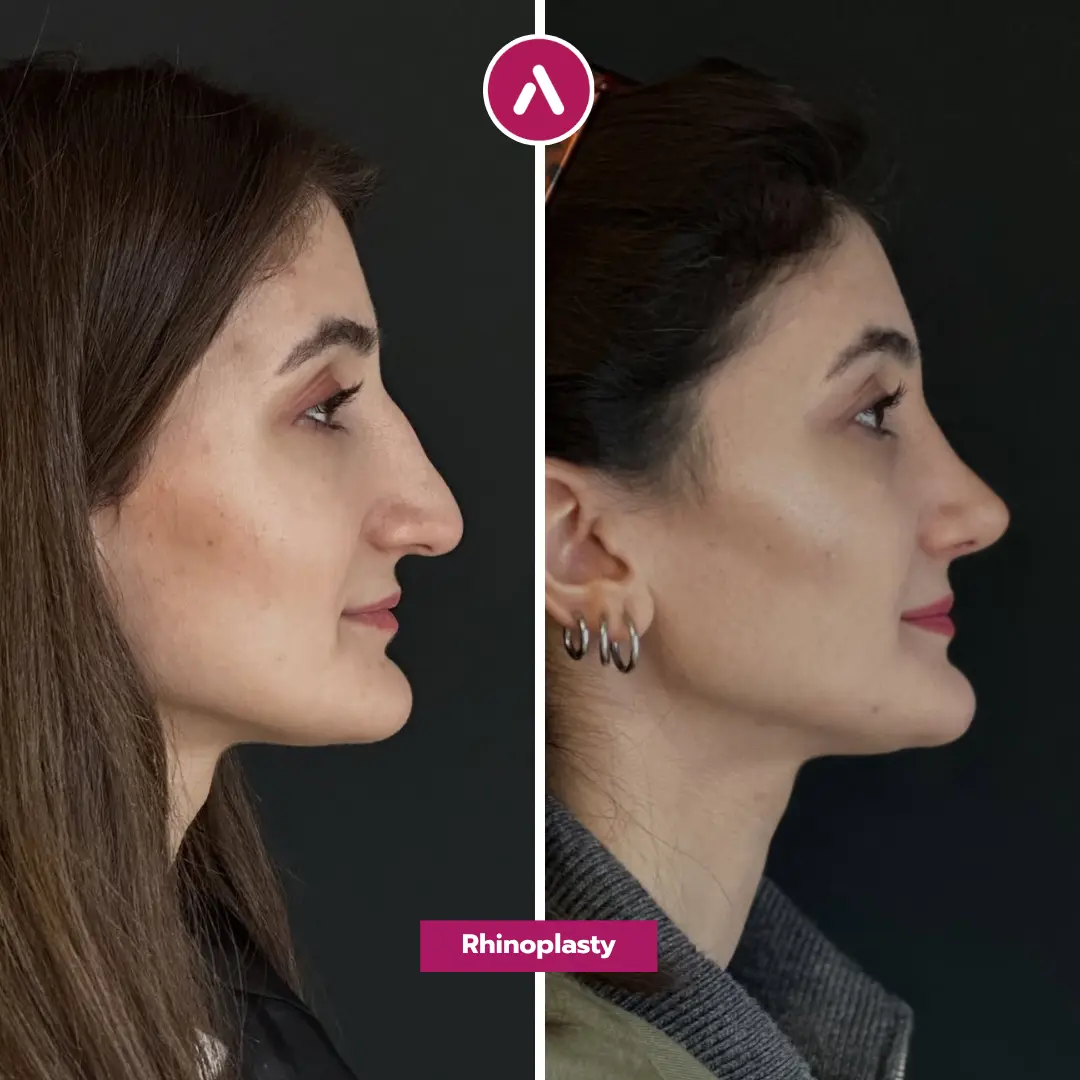
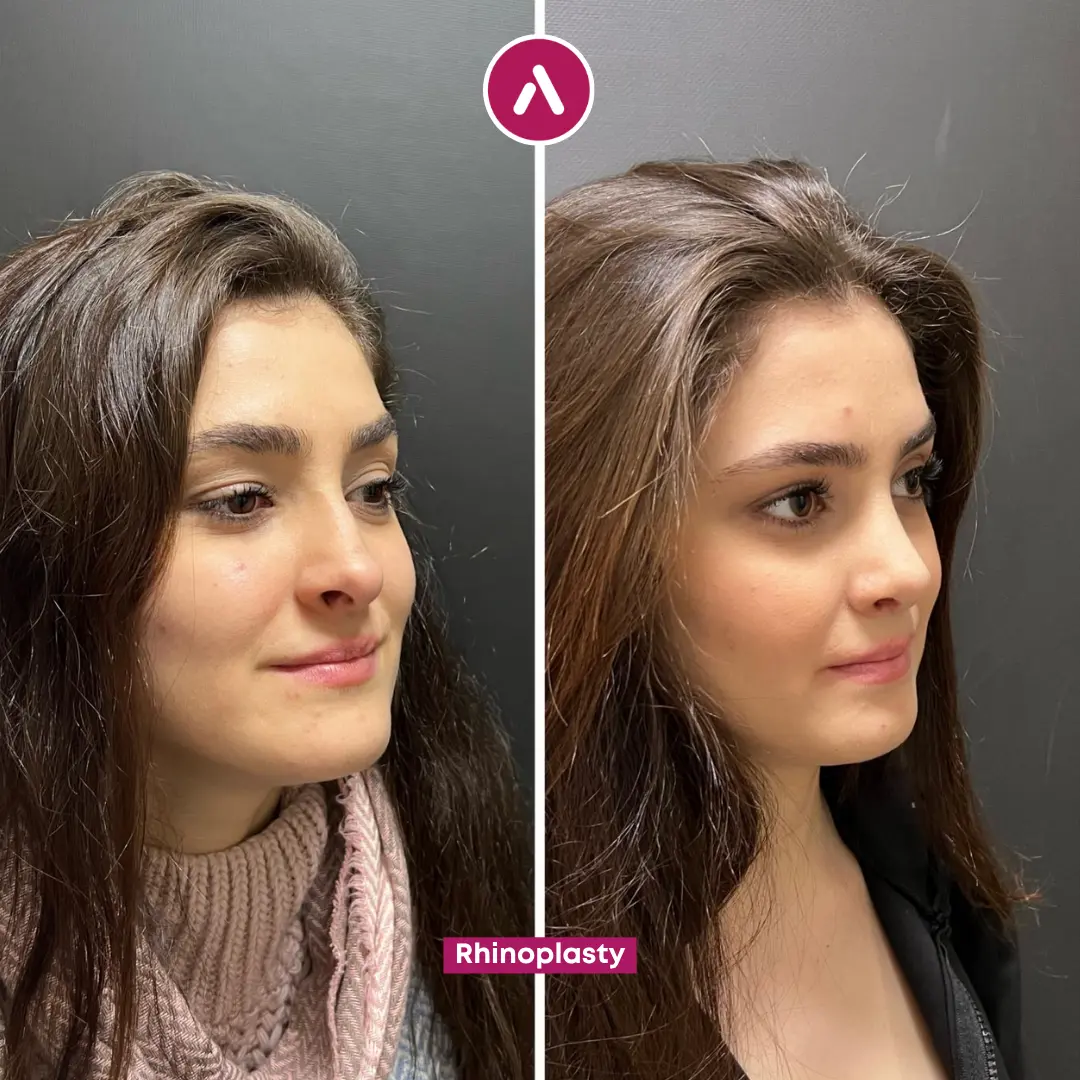
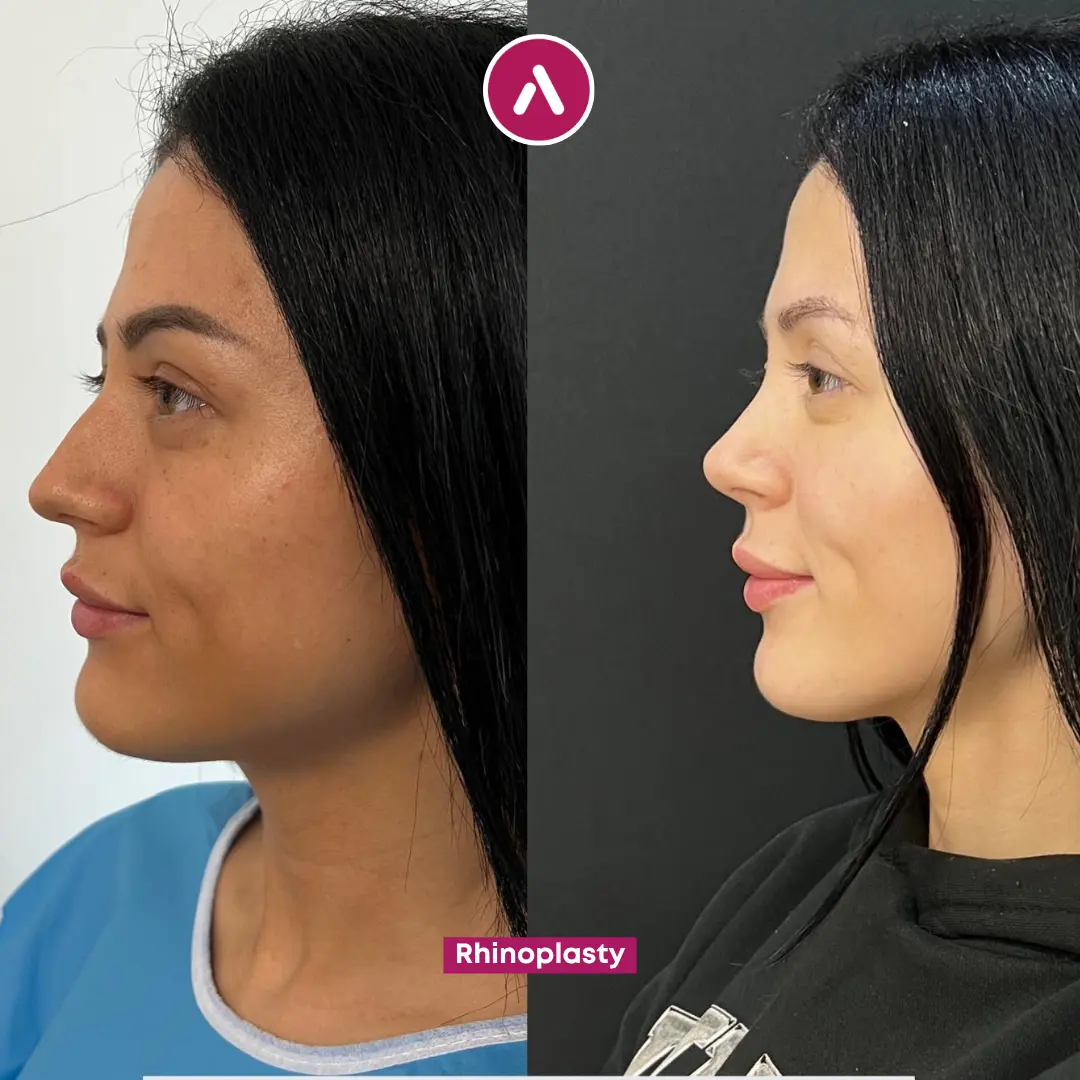
At AKM Clinic, thick skin is treated as a planning variable, not a barrier to surgery. Patients comparing rhinoplasty techniques at AKM Clinic should understand that skin thickness affects the surgical strategy, the recovery timeline, and the level of tip definition that can realistically be achieved.
This guide is written for Canadian patients who want a technical explanation before booking a consultation. It focuses only on thick nasal skin. Ethnic anatomy, Piezo technique, isolated tip plasty, and functional breathing correction are separate topics, and they should be evaluated with their own criteria.
Table of Contents
Why Skin Thickness Changes the Rhinoplasty Plan?
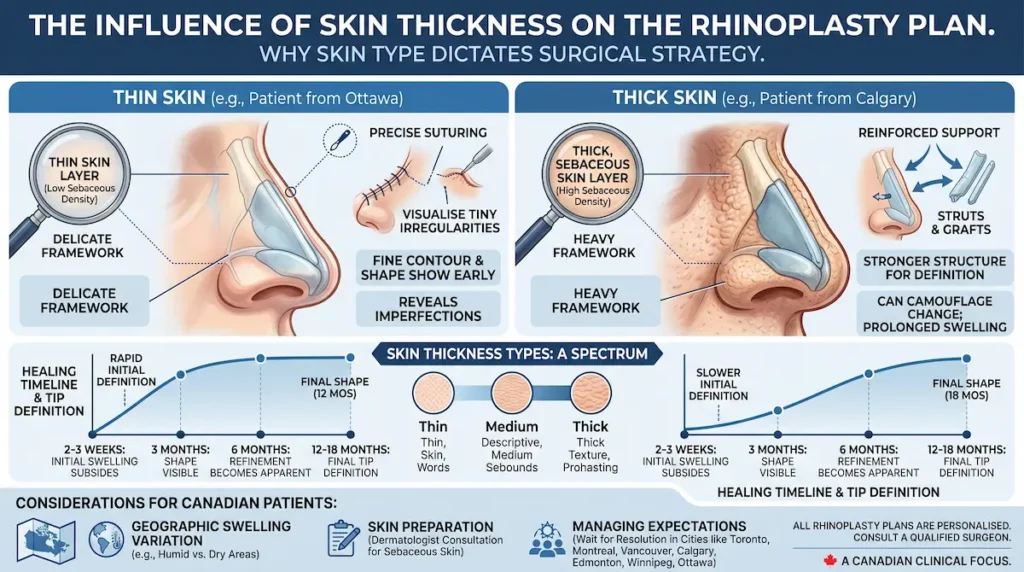
Skin thickness changes rhinoplasty because the skin acts like the envelope over the nasal framework. Thin skin reveals tiny irregularities, while thick skin can hide even well-executed contour changes. Neither type is automatically better. Each one requires a different surgical mindset.
In thick-skinned patients, the surgeon must prioritize structure. A weak cartilage framework under heavy skin can collapse, blur, or fail to project enough after swelling settles. A strong framework gives the skin a clearer shape to contract around over time.
“With thick nasal skin, the solution is rarely aggressive skin reduction. The safer principle is structural emphasis: stronger cartilage support, controlled projection, and realistic healing guidance.”
Sebaceous gland density and how it affects tip definition
Thick nasal skin is often associated with higher sebaceous gland density. This means the skin may appear oilier, heavier, and more textured, particularly over the lower third of the nose. The nasal tip is usually the area where this matters most.
A refined tip depends on the relationship between cartilage shape and skin behaviour. If the skin envelope is thick, delicate cartilage suturing alone may not show through. The surgeon may need to strengthen the lower lateral cartilages, use tip grafts, or increase projection slightly so the final result does not disappear under swelling.
This does not mean the nose should be over-projected. It means the plan must account for what the skin can reveal. Canadian patients seeking a very tiny, sharply carved nasal tip should be counselled carefully if their skin is thick and sebaceous.
Patients with oily or acne-prone skin may also benefit from pre-operative skin optimization. A Canadian dermatologist can help manage active inflammation before surgery, especially for patients already using prescription acne treatments. General skin health resources from the Canadian Dermatology Association can also help patients understand sebaceous skin care in a medical context.
Healing variability across skin thickness types
Thick skin usually holds swelling longer than thin skin. This is one of the most important expectations to set before surgery. A thin-skinned patient may see definition earlier, while a thick-skinned patient may still look swollen at the tip several months later.
The early result can be misleading. At 3 months, a thick-skinned nose may still appear rounded, firm, or under-defined. At 12 months, the same nose can show a much clearer contour as the skin envelope contracts and edema continues to resolve.
For patients travelling back to Toronto, Vancouver, Montreal, Calgary, or Ottawa, this matters psychologically. You may be socially presentable within 10 to 14 days, but final definition is not a two-week outcome. Thick skin demands patience.
Why thick skin is not a contraindication: it is a planning variable
Thick skin does not mean rhinoplasty is impossible. It means the surgeon must avoid a thin-skin strategy. The plan should be built around support, definition, and conservative reshaping.
A good thick-skin rhinoplasty plan usually avoids excessive reduction. Removing too much bridge height or weakening the tip framework can leave the skin without enough support. Over time, that can create a soft, amorphous result rather than a refined one.
This is also why thick skin overlaps with certain dorsal hump and aquiline nose cases. Patients with a prominent bridge and thick skin may need careful structural preservation rather than aggressive removal. For that specific pattern, see the aquiline nose surgical strategy with thick skin.
| Skin thickness type | Technique and recovery planning |
|---|---|
| Thin nasal skin | Shows fine detail early but also reveals small irregularities. The surgeon must smooth the framework carefully and avoid visible contour edges. |
| Medium nasal skin | Usually offers the most predictable balance. It can show refinement while still camouflaging minor texture differences during healing. |
| Thick nasal skin | Requires stronger cartilage support, controlled tip projection, and a longer swelling timeline. Final definition may take 12 to 18 months. |
Diagnosing Skin Thickness Pre-Operatively
Skin thickness should be evaluated before the surgical plan is finalized. A surgeon cannot accurately plan tip refinement, dorsal reduction, or grafting needs without understanding the skin envelope. Photos help, but they do not replace a proper clinical assessment.
For Canadian patients planning surgery abroad, this diagnosis starts during the virtual consultation. High-quality photographs, video assessment, and a detailed history of skin behaviour can give the surgeon useful early information before the in-person examination in Istanbul.
Pinch test and pre-op assessment
The pinch test is a simple clinical method. The surgeon gently pinches the nasal skin, often around the tip and supratip area, to estimate thickness and mobility. Thick skin usually feels heavier, less mobile, and more resistant.
The assessment also looks at sebaceous activity. Enlarged pores, oily texture, acne scarring, and redness can all influence post-operative swelling and skin care planning. These features do not exclude surgery, but they can change the recovery protocol.
A careful pre-operative assessment should also examine cartilage strength. Thick skin over weak cartilage is one of the most difficult combinations. In that situation, the surgeon may recommend cartilage grafting to prevent a soft or poorly defined result.
Photograph-based evaluation
Virtual planning relies heavily on standardized photos. Canadian patients should submit front, side, three-quarter, base, and smiling views in clear lighting. Shadows can exaggerate or hide nasal contour, so consistency matters.
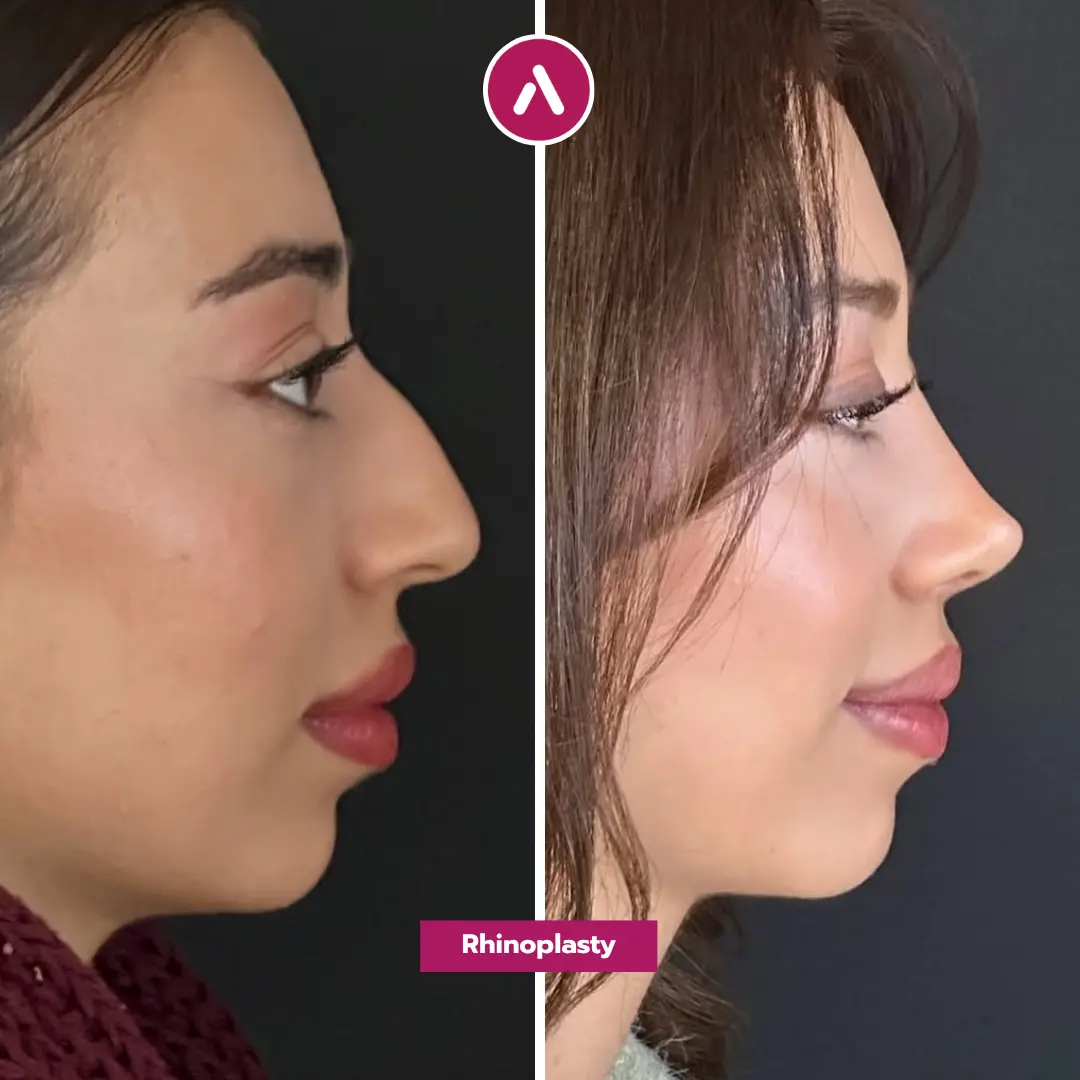
Photos can reveal signs of thick skin: a rounded tip, soft supratip fullness, limited tip definition, and heavy skin texture. However, photo-based diagnosis has limits. The final decision about grafting, defatting, or steroid use is usually confirmed during the in-person consultation.
Patients should avoid filtered images. Beauty filters change skin texture and distort tip definition. A surgeon needs the real anatomy, not a softened version of it.
Common Canadian patient skin patterns: Eastern European, Mediterranean, South Asian, Middle Eastern
Canada’s patient population is highly multicultural, so thick skin appears across many backgrounds. AKM Clinic commonly evaluates patients of Eastern European, Mediterranean, South Asian, and Middle Eastern heritage who have thicker nasal skin or stronger sebaceous features.
This does not mean skin thickness is the same as ethnicity. It is not. Two patients from the same background can have very different nasal skin, cartilage strength, and healing behaviour.
Ethnic anatomy deserves its own analysis because it includes bridge height, nostril shape, cartilage strength, facial proportions, and identity-preserving goals. For that broader discussion, for ethnic-specific anatomy considerations, see our ethnic rhinoplasty guide.
Canadian Patient Callout: Multicultural assessment matters
A thick-skinned rhinoplasty plan for a patient from Toronto may differ from a plan for a patient from Vancouver or Montreal, not because of the city, but because Canadian clinics see a wide range of skin types and facial anatomies. The safest approach is individual diagnosis rather than assumption based on heritage.
Surgical Strategy Adjustments
A thick-skin rhinoplasty plan should focus on what the skin can realistically show. The surgeon is not sculpting the skin directly. The surgeon is reshaping and reinforcing the cartilage and bone underneath, then guiding the skin through a longer settling period.
This is why thick-skinned patients need a structural strategy rather than a purely reductive one. Small, delicate manoeuvres may be technically correct, but they can disappear under a heavy skin envelope. The plan must be strong enough to remain visible after swelling resolves.
Cartilage grafting for structural definition
Cartilage grafting is often central to rhinoplasty for thick skin. Grafts can strengthen the nasal tip, sharpen the transition between nasal subunits, and prevent the lower third of the nose from looking soft after healing.
Common grafting choices include columellar strut grafts, septal extension grafts, shield grafts, and alar rim grafts. The exact choice depends on the patient’s anatomy. A patient with weak tip cartilage may need more support than a patient whose cartilage is already firm but hidden under thick skin.
This is where surgeon specialization matters. AKM Clinic’s rhinoplasty specialist evaluates both cosmetic and functional nasal structure, particularly when cartilage support and airway preservation must be balanced in the same plan.
The goal is not to make the nose look stiff. It is to create enough definition that the skin can settle into a refined shape. A natural result still needs movement, proportion, and facial harmony.
Tip projection emphasis over rotation
In thick-skinned noses, projection often matters more than aggressive rotation. Rotation changes the upward angle of the tip. Projection determines how far the tip extends from the face and how clearly the nasal tip separates from the bridge and upper lip.
If a surgeon rotates a thick-skinned tip too much without adequate support, the result may look rounded rather than refined. The skin may also settle unpredictably over the supratip area. That can create fullness above the tip, sometimes called a supratip break or pollybeak tendency.
A better plan often uses controlled projection to define the tip while keeping the profile natural. Patients who are mainly concerned about the lower third of the nose should also review the tip plasty technique-specific approach, because isolated tip work may be suitable only when the bridge and nasal bones do not need meaningful change.
For many thick-skinned patients, tip plasty alone is not enough. If the skin envelope is heavy, the nasal framework may need more comprehensive support than a limited procedure can provide.
Conservative dorsal reduction while preserving framework
Reducing the bridge too aggressively can be risky in thick-skin rhinoplasty. If the framework becomes too low or weak, the skin may not contract cleanly. The result can look wide, undefined, or heavy, even if the hump was removed successfully.
A conservative dorsal reduction respects the strength of the nasal framework. The surgeon reduces what is excessive while preserving enough support for the skin envelope. This approach is especially important for patients who want refinement rather than a dramatic change.
Some patients benefit from ultrasonic bone work when the bony bridge needs controlled reshaping. For cases where bone precision and reduced soft-tissue trauma are priorities, review the ultrasonic Piezo technique often suited to thick-skinned patients.
International standards for rhinoplasty technique continue to emphasize anatomy-specific planning rather than a single universal method. Canadian patients who want a broader professional context can review patient-safety and surgeon-education resources through ISAPS.
Canadian Patient Callout: A subtle result still needs strong structure
Many Canadian patients ask for a quiet, natural rhinoplasty result. In thick skin, “natural” does not mean minimal support. It often means stronger hidden support, conservative bridge work, and a longer wait before judging the final shape.
Intra-Operative Techniques That Help
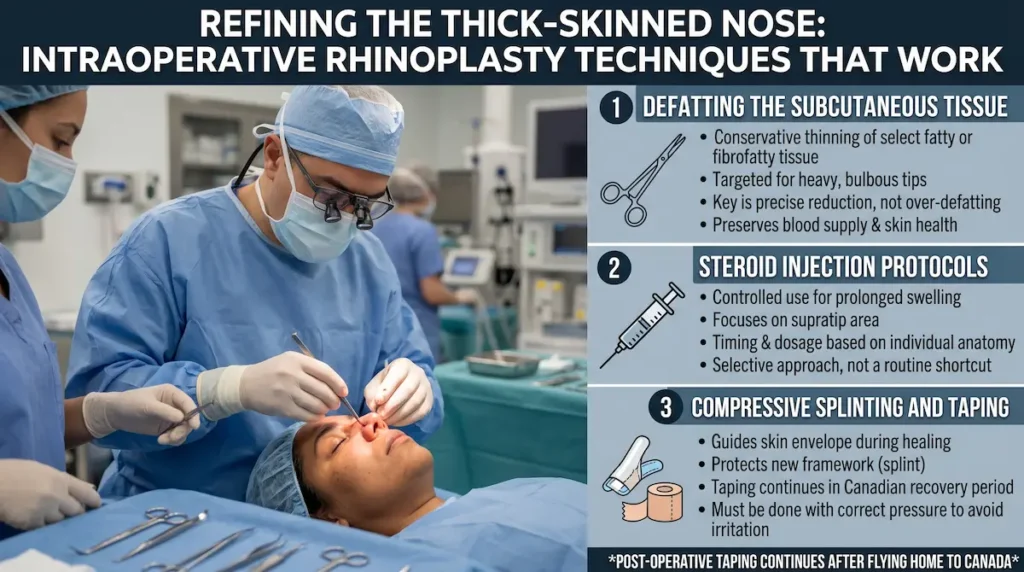
During surgery, the surgeon can use several techniques to improve definition in thick-skinned noses. These techniques must be used carefully. Too little intervention may leave the nose under-defined, while too much can affect circulation, healing, or long-term contour.
The safest approach combines precise framework construction with controlled soft-tissue management. This is also where clinic protocols matter, because recovery support affects how swelling, bruising, and skin behaviour are managed after the operation.
Defatting the subcutaneous tissue
Subcutaneous defatting refers to conservative thinning of selected soft tissue under the nasal skin. It is not the same as removing skin. It is a controlled reduction of excess fatty or fibrofatty tissue in carefully chosen areas.
This technique can help some patients with a heavy, bulbous tip. The key word is conservative. Over-defatting can damage blood supply, create scar tissue, or make the skin heal unpredictably.
Not every thick-skinned patient needs defatting. Some patients need cartilage support more than soft-tissue reduction. Others need both, but in measured amounts.
Steroid injection protocols
Steroid injections may be used during or after rhinoplasty to help control prolonged swelling, especially in the supratip area. They are not a shortcut to instant definition. They are a medical tool used selectively.
For thick-skinned patients, steroid timing and dosage matter. Too much steroid can thin tissue excessively or create contour problems. Too little may not help swelling that is becoming firm or persistent.
A careful surgeon monitors the nose over time before deciding whether post-operative steroid injections are needed. Canadian patients should avoid clinics that promise routine aggressive steroid use for every thick-skinned case. Individual anatomy should guide the decision.
Compressive splinting and taping
Splinting and taping help guide the skin envelope during early healing. A nasal splint protects the new structure in the first week. Taping may continue longer, especially in thick-skinned patients who hold swelling around the tip and supratip.
Manual taping is simple, but it must be done correctly. Incorrect pressure can irritate the skin or create uneven compression. AKM Clinic provides post-operative instructions so patients can continue the protocol once they return to Canada.
Recovery technology and clinical standards also support the healing process. Patients can review AKM Clinic’s surgical standards and recovery protocols to understand how post-operative monitoring, sterile technique, and recovery support fit into the broader patient journey.
Canadian Patient Callout: Taping continues after you fly home
A patient returning to Toronto, Vancouver, Montreal, or Calgary may still need nightly taping after the Istanbul recovery period. Your coordinator should confirm the taping schedule before departure, and you should keep written instructions for your first weeks back in Canada.
Post-Operative Skin Care for Thick Skin
Post-operative care is especially important for thick-skinned patients because swelling can persist longer and the skin may react more strongly to oil, congestion, or inflammation. The surgical result depends on the operation, but the visible refinement also depends on how well the skin heals over the framework.
This phase requires consistency. Thick skin often improves slowly rather than dramatically, so the patient must follow taping, cleansing, sun protection, and follow-up instructions even when the nose looks stable from the outside.
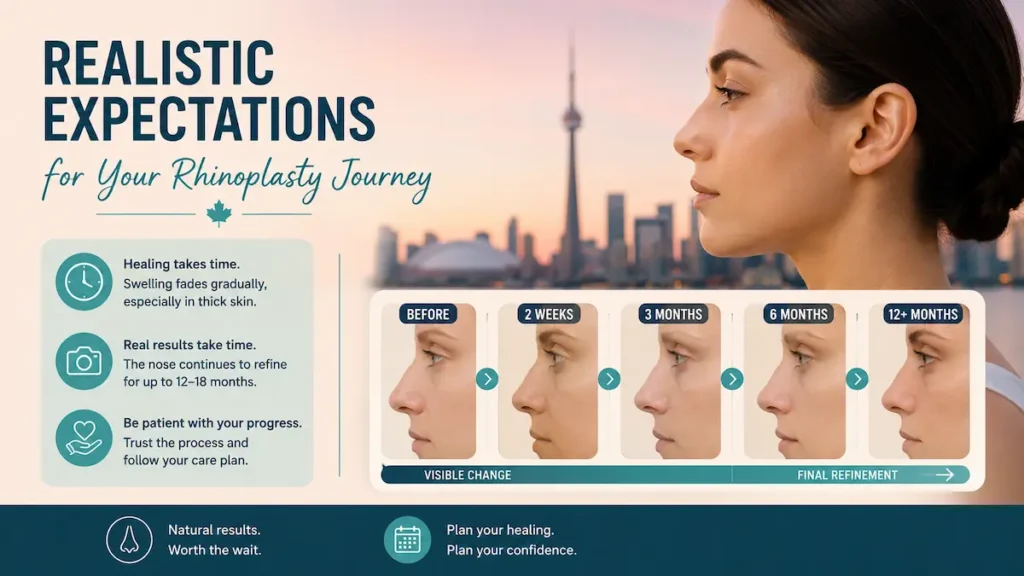
Extended swelling timeline: 6 to 18 months typical
Thick-skinned noses usually need more time to show their final shape. Swelling may improve quickly across the bridge, while the tip and supratip area remain firm, rounded, or full for many months.
A typical thick-skin healing pattern may look like this:
- Week 1: splint removal, visible swelling, early bruising resolution.
- Weeks 2 to 6: social recovery improves, but tip definition is still limited.
- Months 3 to 6: swelling decreases, yet the tip may still look broader than expected.
- Months 9 to 12: definition becomes more visible, especially in photographs.
- Months 12 to 18: final refinement continues in thicker or sebaceous skin types.
Canadian patients should not judge the outcome too early. A nose that looks slightly rounded at month 3 may still be healing normally. The 12-month mark is far more useful for evaluating thick-skin definition.
Manual taping protocol
Nasal taping can help control swelling and encourage the skin envelope to settle. It is most often used at night after splint removal, although the exact schedule depends on the surgeon’s instructions.
For thick-skinned patients, taping may continue longer than it would for thin-skinned patients. The purpose is not to force the nose into shape. It is to apply gentle, consistent compression while swelling resolves.
Patients returning to Canada should plan ahead. Keep medical-grade tape in your recovery bag, take photos of the demonstrated taping method, and ask your coordinator to clarify when taping should stop. This is especially useful for patients flying home to smaller cities where rhinoplasty-specific aftercare may be harder to access.
Topical care to control sebum during healing
Oily skin can become more congested after rhinoplasty because taping, splinting, and temporary changes in washing routines can block pores. This does not mean the surgery has gone wrong. It means the skin barrier needs careful support.
Patients should avoid harsh exfoliants, aggressive scrubs, or strong acne products unless the surgeon approves them. Early healing skin can become irritated easily. Gentle cleansing is usually safer in the first weeks.
If a patient already uses prescription retinoids, acne medication, or medicated cleansers in Canada, those products should be discussed before surgery. Some may need to be paused around the operation. A dermatologist can help restart them safely once the nasal skin has healed enough.
Canadian Patient Callout: Winter and summer change the skin-care plan
Canadian winters can dry the skin barrier, while summer UV exposure can affect healing and pigmentation. Thick-skinned patients should follow sun protection carefully, especially if they return home during June, July, or August. A hat and SPF are not optional during early recovery.
Realistic Expectations for Canadian Patients
Thick-skin rhinoplasty can produce meaningful improvement, but the result is usually refined rather than sharply sculpted. The best candidates understand that skin biology sets limits. Surgery can improve structure, balance, projection, and proportion, but it cannot make thick sebaceous skin behave like thin skin.
This expectation-setting step is central for Canadian patients travelling for surgery. You may return home before the final result is visible, so your follow-up plan should include milestone photos and virtual check-ins rather than early self-judgement.
When to expect visible refinement
Most patients see early changes as soon as the splint is removed. The bridge may look straighter, the hump may be reduced, and the nose may appear more balanced from the side. Tip definition, however, is slower in thick skin.
By weeks 2 to 4, patients are usually more comfortable socially, but the tip often remains swollen. By months 3 to 6, the nose starts to look more settled in everyday life. The finer definition may not appear until month 9 or later.
This delayed refinement can be emotionally difficult. Patients may worry the surgery was too conservative. In many cases, the skin is simply still healing.
The 1-year photo milestone
The 1-year photo milestone is especially important for thick-skinned rhinoplasty. It gives the surgeon and patient a fairer view of the final structure. Earlier photos can document progress, but they should not be treated as the final result.
AKM Clinic’s long-term follow-up programme includes virtual check-ins after patients return home. This matters for Canadians because most of the visible refinement happens after the Istanbul recovery period. Your surgeon needs to see how the skin is settling over time.
Patients should take photos in consistent lighting and angles. Front, side, three-quarter, and base views are the most useful. Avoid selfies taken too close to the face, because they distort nasal proportions.
How this fits Canadian return-to-work timelines
Most thick-skin rhinoplasty patients can plan for social recovery before final aesthetic recovery. These are not the same. You may be ready for video meetings before the nasal tip looks refined.
For office-based work in Toronto, Vancouver, Montreal, Calgary, or Ottawa, many patients plan 10 to 14 days away from public-facing duties. Remote work may resume sooner if bruising is mild and energy is stable. Jobs involving physical labour, masks, helmets, or heavy lifting need a more cautious schedule.
Pricing should be discussed in the correct context. According to AKM Clinic’s Treatment Techniques reference, Open Rhinoplasty is listed at CAD $4,100, while Closed, Preservation, and Piezo Rhinoplasty are each listed at CAD $4,800. Thick-skin cases requiring extensive grafting or complex correction may be evaluated at a higher revision tier, listed at CAD $6,150. For current details, review rhinoplasty pricing in CAD.
Canadian Patient Callout: Do not book major events too early
If you are planning a wedding, graduation, professional photoshoot, or major presentation in Canada, avoid scheduling it in the first few months after thick-skin rhinoplasty. You may look presentable, but the nose will still be changing.
Thick skin requires patience, but patience should not mean uncertainty. A good surgical plan includes a clear explanation of what will change, what may not change, and when each milestone should be assessed. That is the difference between vague reassurance and informed consent.
If your main concern is skin thickness, tip definition, or a rounded nasal shape, the next step is a virtual assessment. AKM Clinic can review your photographs, discuss your skin type, and determine whether thick-skin planning should be part of your rhinoplasty strategy.
Frequently Asked Questions: Thick Skin Rhinoplasty
Thick nasal skin raises different questions than standard rhinoplasty. Most concerns involve definition, swelling, steroid use, revision risk, and whether the final result will look refined enough. These answers are designed for Canadian patients comparing surgery options before a virtual consultation.
Can thick skin produce a refined tip?
Yes, thick skin can produce a refined tip, but the refinement is usually softer than what a thin-skinned patient may achieve. The surgeon must build enough cartilage support for the skin to settle over a clearer shape.
The most important point is expectation. A thick-skinned nose can look balanced, elegant, and natural. It may not show a sharply carved tip, especially if the skin is very sebaceous or the cartilage is weak.
How long does thick-skin swelling last?
Thick-skin swelling often lasts longer than standard rhinoplasty swelling. Many patients see social improvement within 2 weeks, but tip definition may continue improving for 12 to 18 months.
The bridge usually settles earlier than the tip. This is why patients should not judge the final result too soon. Progress photos at 3, 6, 9, and 12 months give a more accurate picture.
Are steroid injections safe?
Steroid injections can be safe when used selectively and conservatively by an experienced surgeon. They are commonly considered when swelling becomes firm or persistent, especially in the supratip region.
They are not appropriate for every patient. Excessive steroid use can thin tissue too much or create uneven contour. The decision should be based on healing behaviour, not routine marketing promises.
Will my Canadian dermatologist need to know about post-op care?
Your Canadian dermatologist does not always need to manage your rhinoplasty recovery, but they should know if you use prescription acne medication, retinoids, medicated cleansers, or treatments that affect skin healing. These products may need to be paused or restarted carefully.
This is especially relevant for patients with oily, acne-prone, or rosacea-prone skin. Coordinating skin care between AKM Clinic and your Canadian provider can help protect the nasal skin while swelling resolves.
Does thick skin mean a higher revision rate?
Thick skin can increase the risk of dissatisfaction if expectations are unrealistic or the original surgical plan underestimates the need for support. It does not automatically mean revision will be needed.
Revision risk is lower when the first operation accounts for skin thickness, cartilage strength, and healing speed. A strong framework, conservative reduction, and clear long-term follow-up plan are more important than trying to force a thin-skin result.
Is Preservation Rhinoplasty good for thick skin?
Preservation Rhinoplasty may be useful for some thick-skinned patients because it maintains more of the natural nasal framework. This can be helpful when over-reduction would leave the skin without enough support.
It is not the best option for every case. Patients with severe deviation, weak tip support, previous surgery, or major structural problems may need a different approach. The technique should follow the anatomy, not the other way around.
How do I know if my skin is thick?
Common signs include an oily nasal surface, enlarged pores, a rounded or bulbous tip, limited tip definition, and swelling that tends to linger after skin irritation or minor trauma. These signs can suggest thick skin, but they are not a formal diagnosis.
A surgeon can assess your skin through photographs, video consultation, and in-person examination. The pinch test, tip texture, sebaceous activity, and cartilage strength all help determine whether you need a thick-skin rhinoplasty strategy.
What if I also have breathing problems?
If breathing is also a concern, thick-skin planning should be combined with functional assessment. A deviated septum, valve weakness, or post-traumatic obstruction can change the surgical plan.
For that specific pathway, review functional nasal correction when breathing is also a concern. Septorhinoplasty evaluates the internal airway and external nasal shape together.
Is thick skin rhinoplasty more expensive?
Not always. The price depends on the technique required, not skin thickness alone. If the case can be handled as primary open, closed, preservation, or Piezo rhinoplasty, it may remain within those standard pricing categories.
If the nose requires extensive grafting, complex structural correction, or revision-level planning, the quote may be higher. Canadian patients should request a case-specific assessment rather than assuming that thick skin automatically changes the price.
What is the best next step if I think I have thick nasal skin?
The best next step is a virtual consultation with clear photographs. Submit front, profile, three-quarter, base, and smiling views. Avoid filters and heavy makeup around the nose.
During the assessment, ask three direct questions: whether your skin is thick, whether your cartilage is strong enough, and whether your desired level of definition is realistic. Those answers will shape the safest plan.
To determine your skin thickness candidacy, schedule a virtual consultation with AKM Clinic and ask for a rhinoplasty plan that addresses skin type, cartilage support, swelling timeline, and long-term follow-up from Canada.
Medical Disclaimer: This page is provided for general educational purposes only and does not replace an in-person medical consultation, diagnosis, or personalized treatment plan. All surgery carries risks, and outcomes vary between individuals. Suitability for rhinoplasty (nose job) surgery, procedure selection, and anesthesia choice can only be determined after a full clinical assessment by a qualified surgeon. Always follow your clinician’s instructions and seek urgent medical attention if you develop concerning symptoms during recovery.