

Ankle liposuction can refine “cankles” when the fullness is caused by localized fat around the ankle, not swelling, bone structure, or muscle. Because the ankle has thin fat layers, visible tendons, and limited room for error, the goal is a smoother calf-to-ankle taper rather than dramatic size reduction. A careful consultation should rule out edema and lipedema first.
“Cankles” is not a medical diagnosis. It is a visual description people use when the lower calf seems to flow straight into the ankle without a defined narrowing point. For some patients, that look comes from small fat pockets around the inner ankle, above the ankle bones, or beside the Achilles tendon.
For others, it comes from swelling, genetics, muscular calf shape, lipedema, or the natural width of the ankle bones. That difference matters. Liposuction removes fat. It does not drain fluid, shrink bone, tighten loose skin like an excisional lift, or reshape the calf muscle.
This article focuses only on the ankle zone. For the broader procedure, incision planning, anesthesia options, and body-contouring overview, see how AKM approaches liposuction of small zones.
Table of Contents
What “Cankles” Are and What Ankle Liposuction Can Change
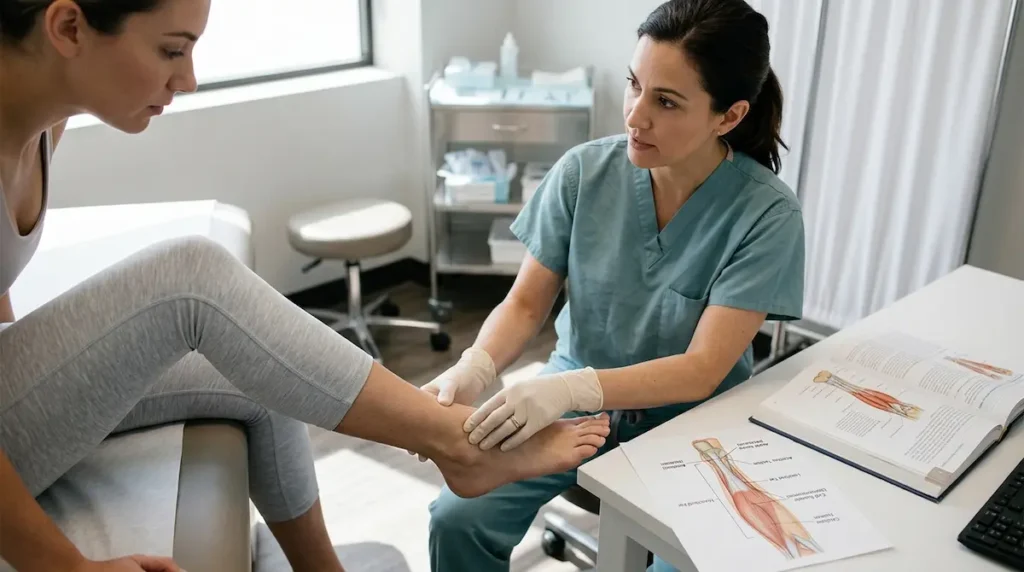
This section explains the actual anatomy behind the “cankles” concern. The purpose is to separate a cosmetic ankle-fat issue from swelling, bone width, or calf muscle shape before anyone assumes surgery is the answer.
What the word “cankles” really means
“Cankles” describes a lower leg without a visible taper between the calf and the ankle. Instead of seeing a narrower ankle below the calf, the leg may look straight, column-like, or heavy from the lower calf down to the foot.
The term can feel blunt. Still, the visual concern is real for patients who feel that their ankles make their legs look heavier than their overall body shape. In a surgical consultation, the word “cankles” is only a starting point. The more useful question is what tissue is creating the fullness.
The calf-to-ankle taper
A natural lower-leg silhouette depends on several landmarks. The calf muscle creates the upper curve. The Achilles tendon creates a vertical groove at the back of the ankle. The inner and outer ankle bones, called the malleoli, create structure on each side. A soft but visible narrowing between those points creates the taper many patients want.
Localized fat can blur that taper. Small fat pads may sit above the inner ankle, around the lower calf, or along the sides of the Achilles tendon. When those fat pads are present and the skin has enough elasticity, cankle liposuction may make the transition look cleaner.
What ankle liposuction can and cannot change
Ankle liposuction can reduce pinchable fat around the ankle and lower calf. It may improve definition around the ankle bones, create a smoother curve beside the Achilles tendon, and help the lower leg look less straight from calf to foot.
It cannot change the ankle bones. If your malleoli are naturally wide or your skeletal frame is broad, liposuction may soften fullness around the area but will not make the bone structure smaller.
It also cannot treat fluid retention. If your ankles are slim in the morning but swollen by evening, the issue may be edema rather than fat. Liposuction cannot fix that. Surgery on a swollen, medically unexplained ankle can increase risk and disappoint the patient because the real cause was not fat.
“Around the ankle, small and smooth fat removal often looks better than aggressive reduction. The goal is a softer calf-to-ankle taper while protecting the surface, tendons, and natural anatomy.”
Fat, Swelling, or Bone? Who Actually Benefits?
This section helps patients understand whether ankle fullness is likely to respond to liposuction. It is not a substitute for medical diagnosis, but it gives a practical framework for deciding whether ankle contouring is worth discussing with a surgical team.
Localized ankle fat: the best-case scenario
The best candidate has a stable lower-leg shape, good skin tone, and a clear pocket of pinchable fat around the ankle or lower calf. The fullness is usually present all day, not only after standing, flying, eating salty food, or exercising. It feels soft rather than tight or shiny.
In this situation, ankle liposuction can be a reasonable contouring option. The patient is usually near a stable weight, does not smoke, has realistic expectations, and understands that the ankle is a fine-detail zone. The desired outcome is refinement, not a completely different leg.
Swollen ankles: when liposuction is not the answer
Swelling behaves differently from fat. It may worsen through the day, improve with elevation, feel tight, or leave a temporary indentation when pressed. The skin may look stretched or shiny. Some patients also feel heaviness in the legs.
If your ankle size changes noticeably from morning to night, ankle liposuction should not be the first step. A medical evaluation may be needed to check circulation, veins, lymphatic flow, medications, heart or kidney factors, or other causes of edema.
One-sided swelling, calf pain, chest pain, shortness of breath, or swelling that does not improve after long travel should be treated as a medical issue, not a cosmetic concern. Safety comes first.
Bone, tendon, muscle, and lipedema
Some ankles look thick because of the frame itself. The inner and outer ankle bones may be prominent, the Achilles area may be naturally broad, or the foot and ankle may have a strong athletic structure. Liposuction cannot narrow bone.
Some patients searching for cankles surgery are actually describing a pattern closer to lipedema: disproportionate fat in the legs, tenderness, easy bruising, heaviness, or swelling that affects both legs while sparing the feet. Lipedema is a medical condition and needs a different evaluation from cosmetic ankle fat.
| Cause of ankle fullness | How it often behaves | Can ankle liposuction help? | Better next step |
|---|---|---|---|
| Localized fat | Soft, pinchable fullness that stays similar through the day | Yes, if skin quality and anatomy are suitable | Surgical consultation for ankle contouring |
| Swelling or edema | Tight, shiny, heavy, or pitting; often worse by evening | No. Liposuction removes fat, not fluid | Medical evaluation before any cosmetic plan |
| Bone or tendon structure | Firm framework; width does not change with weight or elevation | Only if extra fat is also present | Realistic expectation-setting during consultation |
| Muscular lower leg | Strong calf shape with little pinchable fat near the ankle | Limited benefit from ankle-only liposuction | Assess the full calf-to-ankle silhouette |
| Possible lipedema | Disproportionate leg fullness, tenderness, bruising, heaviness | Not as a simple cosmetic “cankle” fix | Medical assessment and condition-specific planning |
Who may not be a good candidate?
Ankle liposuction may not be right for patients with mostly fluid retention, very little pinchable fat, poor circulation, uncontrolled medical issues, active smoking, or unrealistic goals. It may also be a poor choice for patients expecting thin, model-like ankles from a naturally broad lower-leg frame.
The most honest answer is sometimes “no.” That answer can save a patient from a procedure that would not address the real cause of the concern.
Why the Ankle Is a Precision Zone
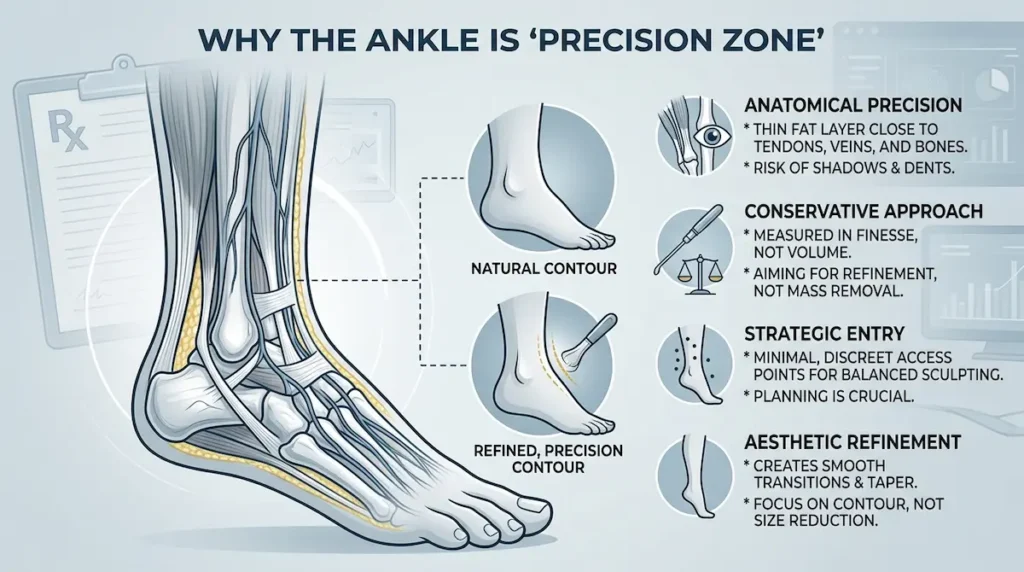
This section explains why ankle liposuction is not treated like liposuction of larger areas such as the abdomen, flanks, or thighs. The ankle has less fat, thinner soft tissue, and more visible surface anatomy, so conservative planning matters more than volume removal.
The fat layer is thin
The ankle does not usually hold a thick, forgiving fat layer. In many patients, the concern comes from a small amount of fat sitting in exactly the wrong place: above the inner ankle bone, around the lower calf, or along the sides of the Achilles tendon. Removing that fat can help. Removing too much can look worse.
This is why ankle contouring is measured in finesse, not bulk. The surgeon is not chasing a high-volume fat removal number. The goal is to create a cleaner transition between calf and ankle while leaving enough soft tissue to keep the leg natural in motion.
Tendons, veins, and surface landmarks are close
The ankle is full of visible landmarks. The Achilles tendon, malleoli, small veins, and natural grooves all sit close to the surface. If the fat layer is reduced unevenly, shadows and dents may show more easily than they would on a larger body area.
That does not mean ankle liposuction is unsafe for the right candidate. It means the area should be approached with restraint. Fine cannulas, careful mapping, and a gradual transition into the lower calf help reduce the risk of contour irregularities.
For patients comparing different lower-leg zones, the ankle is similar to the knee as another precision zone: small changes can be visible, but aggressive fat removal can create unevenness. The surgeon has to respect the anatomy.
Small access points still need planning
Liposuction uses small access points for the cannula. Around the ankle, these entry points are usually tiny, but their placement still matters because the lower leg is visible in sandals, shorts, dresses, and swimwear. The aim is to place access points where they are discreet and where the cannula can reach the fat layer evenly.
Patients often worry about scarring in such a visible area. This article does not turn into a full scar guide, but it is worth knowing that access points are usually small compared with excisional surgery. For a broader explanation, read about the tiny access points liposuction leaves.
Uneven removal is the main aesthetic risk
With ankle liposuction, the main cosmetic risk is not usually “too little fat removed.” It is irregular removal. A slightly fuller ankle can still look natural. A hollowed ankle, step-off, dent, or asymmetric groove can draw the eye every time the patient stands.
Published discussions of below-the-knee liposuction describe the importance of careful patient selection and the possibility of unwanted outcomes in this region. For patients who want the technical background, one useful review discusses documented pitfalls of liposuction below the knee.
Why conservative fat removal often looks better
A refined ankle does not need to look thin from every angle. It needs to look balanced with the calf, foot, and overall body. In many cases, the most natural result comes from removing a modest amount of fat from the ankle and lower calf transition rather than trying to make the ankle as small as possible.
Think of it as soft editing. The surgeon is reducing visual heaviness and improving the taper, not erasing the patient’s natural leg shape. That approach usually ages better and avoids the overdone look that can happen when delicate zones are treated too aggressively.
What Realistic Results Look Like
This section sets expectations for the kind of change ankle liposuction can create. The best results usually look natural and proportionate: a smoother taper, less ankle heaviness, and better lower-leg balance rather than a dramatic transformation.
A smoother taper, not a completely different leg
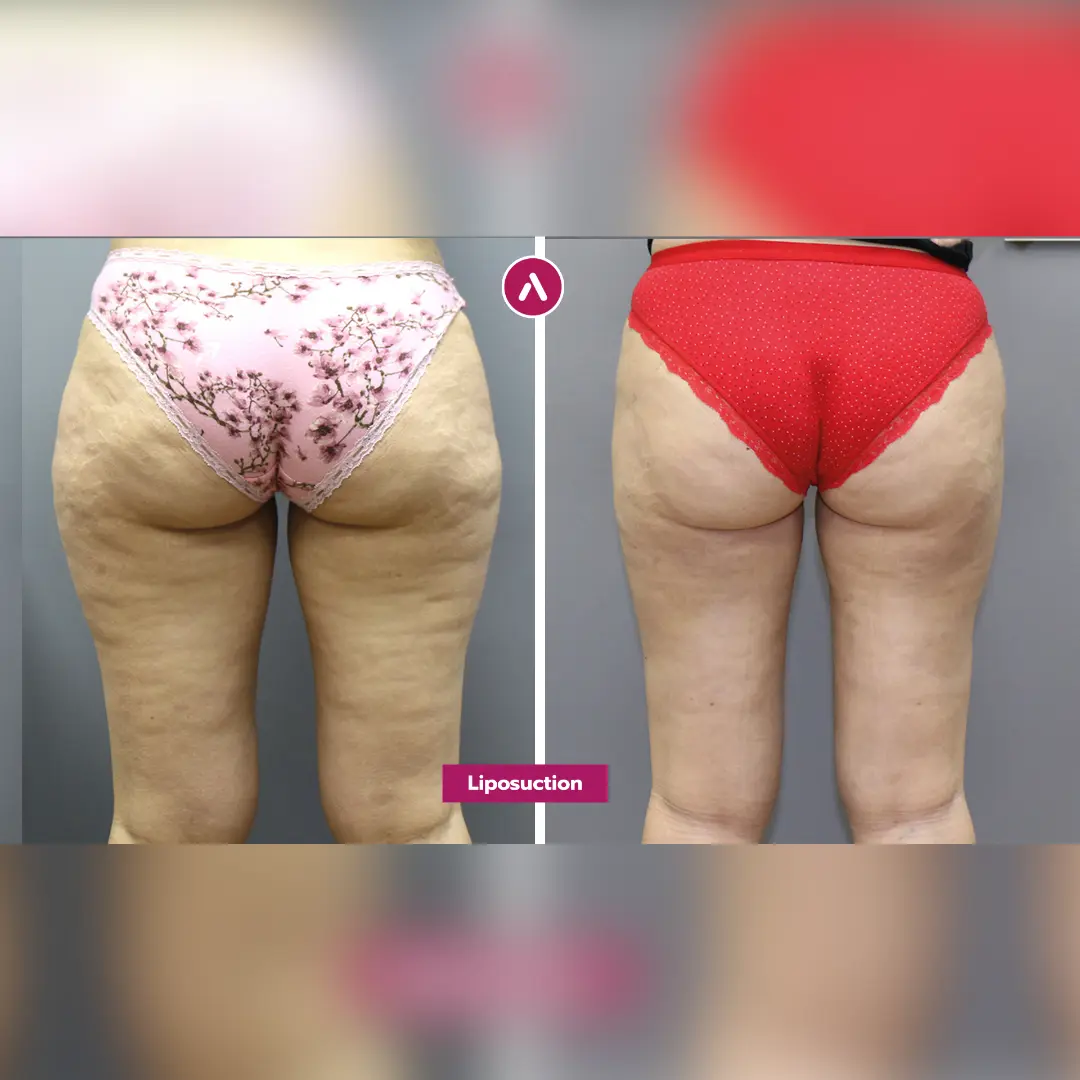
Realistic ankle liposuction results are subtle but meaningful. The lower leg may look less column-like. The ankle bones may appear more defined. The Achilles area may look cleaner from the side. Shoes, sandals, and cropped clothing may feel more flattering.
Still, the operation does not create a new skeleton or a new calf muscle. A patient with naturally strong calves will still have strong calves. A patient with wide ankle bones will still have that bone structure. The change comes from refining the fat layer around the existing anatomy.
Why the calf and ankle may be planned together
Many “cankles” are not only an ankle issue. The visual heaviness can start in the lower calf and continue into the ankle. If the surgeon treats only the ankle, the lower calf may still look bulky. If the surgeon treats only the calf, the ankle may still look heavy.
That is where ankle and calf liposuction can make sense for selected patients. The goal is continuity. The calf should narrow gradually into the ankle, with no sudden shelf, dent, or ring-like transition.
For patients whose concern extends above the ankle, AKM may assess reshaping the calves together with the ankles. That does not mean every patient needs both areas treated. It means the silhouette should be evaluated as one connected line.
What cankle liposuction can improve
Patients often notice cankle liposuction results most in three views: the front view, the side view, and the three-quarter angle. From the front, the ankle may look more separated from the lower calf. From the side, the Achilles area may have more definition. At a three-quarter angle, the lower leg may look less heavy near the shoe line.
These are small visual changes, but they can affect how clothing fits and how the patient feels about their legs. The result should not scream “surgery.” It should look like the ankle finally matches the rest of the leg.
Why final results take months
The ankle sits below the heart, so swelling tends to collect there when you stand, walk, or travel. This is called dependent swelling. After ankle liposuction, that swelling can blur the early result and make patients worry that nothing has changed.
Early swelling is not the final shape. The ankle may look puffy for weeks, then gradually sharpen as the tissues settle. Some patients see steady improvement in the first few months, while fine definition can continue to mature longer.
Lower-leg contouring is a specialized area because calf and ankle shape must be planned together. A published approach to calf and ankle liposculpture reinforces the same practical lesson: technique, patient selection, and proportion matter in this region.
Signs of a good result
A good ankle liposuction result is smooth, symmetric, and believable. The calf-to-ankle taper looks cleaner. There is no obvious hollowing around the malleoli. The Achilles region looks more defined but not stripped. The ankle still looks like it belongs to the patient’s natural body frame.
The best compliment is usually quiet: “Your legs look slimmer,” not “What did you have done?”
Recovery Below the Knee: What’s Different?
This section explains why recovery after ankle liposuction can feel slower than patients expect. The lower leg is affected by gravity, walking, and daily standing, so swelling management is a major part of the result.

Swelling can last longer around the ankle
After liposuction, swelling is normal. Around the ankle, it can be more noticeable because fluid naturally moves downward when you stand, sit with your legs down, or travel. This is why the ankle may look puffy even after the treated fat has been reduced.
Some patients feel discouraged during the first weeks because the ankle looks swollen rather than refined. That reaction is understandable. Still, early fullness is usually not the final outcome. The lower leg often needs time, compression, elevation, and walking to settle.
Swelling should gradually improve, not worsen sharply. If one leg becomes much more swollen than the other, or if swelling is paired with calf pain, warmth, chest pain, or shortness of breath, contact a medical professional right away.
Compression stockings matter
Compression is especially important below the knee. A well-fitted compression garment or stocking helps control swelling, supports the treated tissue, and encourages a smoother contour as the ankle heals. The exact garment and timing should come from your surgical team.
Compression should feel supportive, not painfully tight. If a stocking creates numbness, skin color changes, or pressure marks that do not fade, it needs to be checked. More compression is not always better. Correct compression is the goal.
Elevation and walking work together
Elevation helps fluid move out of the ankle area. Walking helps circulation. The balance is important: too much standing may increase swelling, while too much bed rest can slow circulation. Most patients are encouraged to take gentle walks as directed by their care team.
For the first phase, think in short, frequent movement. Walk a little. Rest with your legs elevated. Repeat. This rhythm supports healing without overloading the lower leg.
Travel planning after ankle liposuction
Patients traveling for ankle liposuction need a practical return-home plan. The ankle is involved every time you stand, walk through an airport, climb stairs, or sit on a flight. Your timeline should account for swelling, compression, and safe mobility.
At AKM Clinic, international patients are guided through surgery planning, hotel recovery, VIP transfers, and virtual follow-up after returning home. The procedure is performed in Istanbul, and post-op planning should include how to manage swelling during travel.
For lower-body healing context, you may also find healing of surgical scars on the lower body useful. The procedure is different, but the shared lesson is that lower-body healing depends on pressure, movement, and patience.
Cost questions should stay secondary
Patients often ask whether ankle liposuction costs less because the area is small. The answer is not that simple. Pricing depends on the treatment plan, whether the calf is included, anesthesia, facility needs, and whether other areas are treated at the same time.
This article is not a cost guide. For current procedure pricing, see ankle and calf liposuction pricing. AKM’s liposuction reference starts at $3,800, but a real quote should be based on your anatomy and surgical plan.
How AKM plans a safer lower-leg recovery
AKM’s European Board-Certified Surgeons use an ABPS-equivalent framework when evaluating small-zone liposuction candidates. For ankle contouring, that means checking the cause of fullness, the lower-leg silhouette, skin quality, circulation history, and the patient’s ability to follow compression and movement instructions after surgery.
The goal is not to rush the result. It is to protect the contour while swelling settles. Stable weight also matters. Liposuction removes treated fat cells, but remaining fat cells can still enlarge with weight gain.
Frequently Asked Questions: Ankle Liposuction
This section answers the most common questions patients ask before choosing ankle liposuction. Each answer stays focused on the ankle zone so the topic does not drift into general liposuction, calf surgery, or full recovery planning.
Does ankle liposuction work for cankles?
It does not work well when the issue is swelling, bone width, muscle, or untreated lipedema. The consultation should identify the cause before surgery is recommended.
How do I know if my cankles are fat or swelling?
A simple clue is timing. If your ankles are slimmer in the morning and much fuller at night, fluid may be part of the picture. That should be medically evaluated before cosmetic ankle contouring.
Is cankles surgery the same as ankle liposuction?
That is why “cankles surgery” should not be treated as a one-size-fits-all procedure. The right plan depends on the cause of the ankle fullness.
How much fat can be removed from the ankles?
The better goal is controlled refinement. A small, smooth reduction can look more natural than aggressive removal.
How long is swelling after ankle liposuction?
Your surgeon should explain what swelling pattern is expected and which signs are not normal. Persistent one-sided swelling, severe pain, redness, or shortness of breath needs medical attention.
Can I get calf and ankle liposuction together?
It is not right for everyone. If the calf fullness is mostly muscle or the ankle fullness is swelling, combining areas may not solve the concern. The whole lower-leg silhouette should be assessed first.
Does ankle liposuction leave scars?
Scar appearance varies by skin tone, genetics, healing, sun exposure, and aftercare. Access-point planning should be discussed before surgery.
Can ankle contouring fix thick ankles caused by bone structure?
If fat is present over a broad structure, refinement may still help. But the result will be limited by the patient’s natural anatomy.
Is ankle liposuction right for you?
The procedure is not a shortcut for every thick-ankle concern. If the issue is edema, lipedema, bone width, or calf muscle shape, liposuction may be limited or inappropriate. The first step is not choosing a surgery date. It is identifying what tissue is actually creating the fullness.
Ask AKM whether your ankles are a fat zone that liposuction can refine. Bring clear photos from the front, side, and back, and note whether your ankle size changes during the day. That information helps the team separate fat from swelling and build a safer plan.
Medical disclaimer: This article is for educational purposes only and does not replace a medical consultation. Ankle swelling can have medical causes that require evaluation. Surgical suitability, risks, recovery, and results vary by patient.