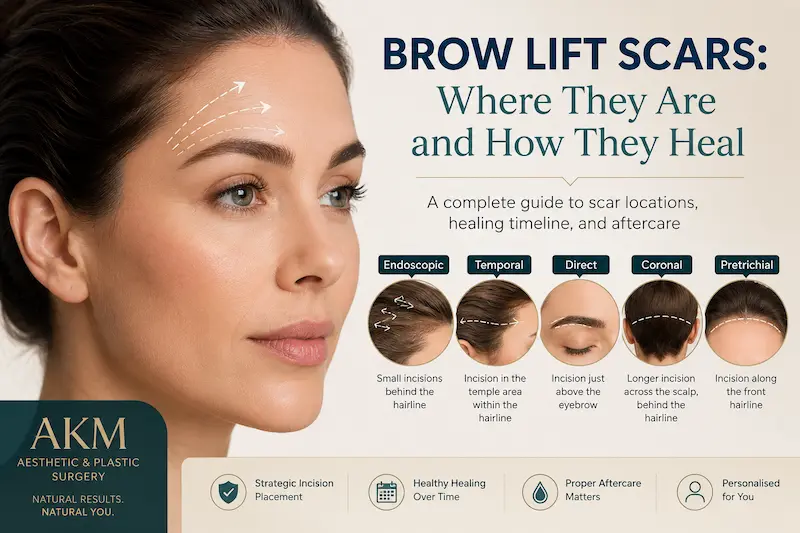
Answer-first: Brow lift scars vary by technique. Endoscopic and temporal brow lifts usually hide small incisions inside or just behind the hairline, while direct, coronal, and pretrichial approaches place scars closer to the brow, scalp, or hairline. Visibility depends on your hairline, skin healing, incision tension, and the technique chosen for your anatomy.
For Canadian patients researching surgery abroad, the scar question is not superficial. It is practical. You want to know where the incision will sit, whether your hairstyle can hide it, what happens if your hairline changes with age, and how follow-up will work once you return home.
This guide focuses only on scar placement and healing after brow lift surgery. It does not compare every brow lift technique in depth, and it does not cover pricing. For the full procedure overview, you can review AKM’s endoscopic temporal brow lift approach. Here, we will stay with the scar question: where marks are placed, how they fade, and what makes some more visible than others.
Table of Contents
Do Brow Lifts Leave Visible Scars?
Every surgical brow lift creates an incision, so every surgical brow lift can leave a scar. The more useful question is not “scar or no scar?” but “where is the scar, how well is it hidden, and how is it expected to heal?”
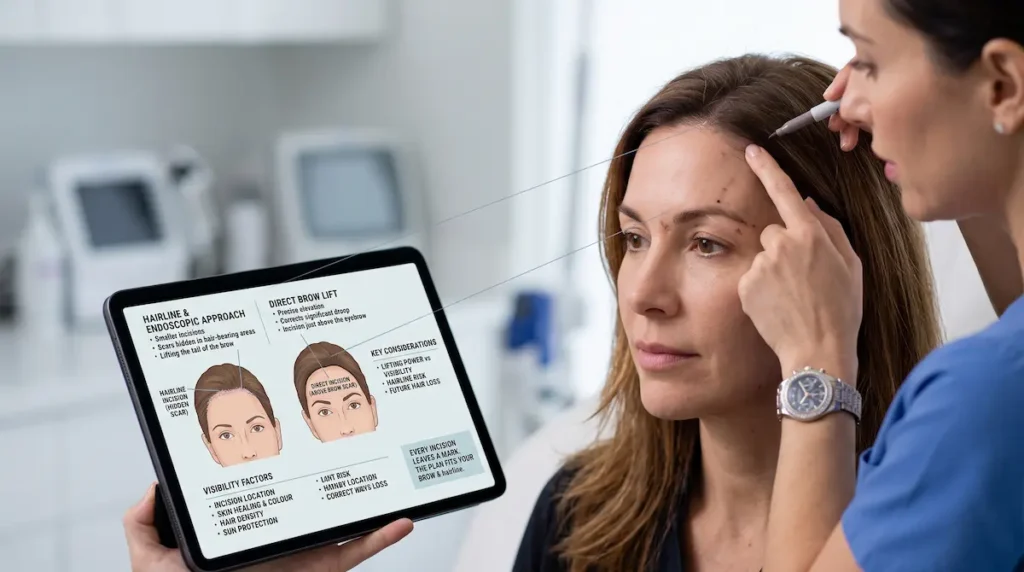
In many modern brow lift plans, the scar is designed to be difficult to notice in everyday life. Endoscopic and temporal techniques use smaller incisions placed in hair-bearing areas, which makes them easier to camouflage. A direct brow lift is different. It places the incision just above the eyebrow, so the trade-off is more direct lifting power with a potentially more visible scar.
That trade-off matters. A scar hidden in the scalp may be less visible, but it may not be the right answer for every pattern of brow descent. A scar above the brow may be more visible, but in selected patients it can give precise control. The best plan is not the smallest incision on paper. It is the incision that fits your brow position, hairline, forehead shape, and healing risk.
Why every surgical technique leaves some mark
A brow lift works by releasing and repositioning tissue. To do that safely, the surgeon needs access. That access point becomes the incision line, and the incision line becomes the scar as the skin heals.
The body closes a surgical incision by producing collagen. Early collagen is firm, pink, and sometimes raised. Over time, it reorganizes. The scar softens, flattens, and usually fades in colour. That maturation process is slow; for many facial scars, the difference between three months and twelve months can be substantial.
Even when the final scar is very fine, it does not vanish in a biological sense. It becomes less noticeable because it is well placed, low-tension, protected from sun, and allowed to mature without irritation.
The trade-off: hidden incision versus lifting power
Scar placement is part of surgical strategy. A hidden incision is attractive, but it still has to deliver the right lift. If the outer brow is the main issue, a temporal or lateral approach may keep the scar in the hairline while addressing the tail of the brow. If the whole upper forehead and brow need repositioning, an endoscopic or broader approach may be considered.
A direct brow lift places the incision close to the brow itself. That can be useful when precise elevation is needed, particularly in patients with significant brow droop or asymmetry. It is also the technique where scar discussion must be especially direct. The incision is not hidden in the scalp, so skin texture, brow hair density, and closure technique become critical.
This is why a scar consultation should include your hairline, not just your brow. It should also include future hairline risk. A scar that is hidden today can become easier to see if hair thins over time. That question is especially relevant for patients with a high forehead, recession, or family history of hair loss.
What “visible” really means
Visibility is not all-or-nothing. A scar can be invisible in conversation but visible if someone parts the hair. It can be hidden in most lighting but more noticeable when the skin is flushed. It can look pink at six weeks and much softer at one year.
For brow lift scars, visibility usually depends on five factors: incision location, skin colour and healing tendency, tension on the closure, hair density around the scar, and aftercare. The same incision can heal very differently in two people.
For a Canadian patient planning surgery in Istanbul, the key is documentation. Before you travel home, you should understand where your incisions are, what normal healing looks like, what photos to send during follow-up, and when a change should be reviewed by the surgical team.
Where the Scar Sits by Technique?
Brow lift scars sit in different places because each technique reaches the brow from a different direction. Endoscopic and temporal lifts usually favour concealment within the hair-bearing scalp. Direct lifts place the scar at the brow. Coronal and pretrichial approaches use longer incisions across or near the hairline.
The table below gives a scar-focused comparison. It is not a full technique comparison. The goal is to show where the incision usually sits and what that means for healing and camouflage.
| Technique | Typical scar location | Visibility pattern | Typical healing note |
|---|---|---|---|
| Endoscopic brow lift | Several small incisions inside or just behind the hairline | Usually well hidden by hair; may show if hair is very thin or closely shaved | Small scalp scars often fade well, but numbness or sensitivity around incision points can take time to settle |
| Temporal or lateral brow lift | Temple-area incision within the hairline | Usually hidden by temple hair; more visible with temple recession | Healing depends on hair density, closure tension, and whether the incision sits in a stable hair-bearing zone |
| Direct brow lift | Just above the eyebrow, following the upper brow margin | More visible than scalp-based techniques; brow hair and skin texture may help camouflage it | Requires careful patient selection because brow skin is thicker and can be more prone to noticeable scarring |
| Coronal brow lift | Longer incision across the scalp, usually behind the hairline | Hidden by hair when hair density is good; less ideal if hair thinning is likely | Longer scar, but placed in the scalp; may affect sensation around the incision |
| Pretrichial brow lift | Along the front hairline | Can be visible at the hairline if healing is raised, widened, or colour-mismatched | Can be useful when forehead length is part of the plan, but scar quality at the hairline must be discussed carefully |
Endoscopic brow lift scars
Endoscopic brow lift scars are usually the easiest to hide because the incisions are small and placed in hair-bearing areas. Clinical descriptions of the endoscopic technique commonly describe small incisions behind the hairline, including central, paramedian, and temporal access points. You can read a medical overview of this approach in the NIH/StatPearls overview of endoscopic brow lift surgery.
For the patient, this usually means the scars are not on the forehead itself. They are placed in the scalp. Once healed, they may look like short, pale lines or small incision marks hidden by hair.
The limitation is hair coverage. If your hairline is high, thin, or likely to recede, the surgeon should discuss whether a scalp-based incision will remain hidden over time. A scar that depends on hair for camouflage should be planned with long-term hair patterns in mind.
Temporal and lateral brow lift scars
A temporal or lateral brow lift focuses on the outer brow. The incision is usually placed in the temple hairline, which makes it useful for patients whose main concern is heaviness at the brow tail rather than the central forehead.
The scar is generally short and well concealed when temple hair is dense. It can be more noticeable in people with recession at the temples, very fine hair, or hairstyles that pull the temple area tightly back.
This is why the consultation should include your usual hairstyle. If you often wear your hair pulled back, the incision plan may need to be more conservative or placed with that visibility in mind. For a deeper discussion of this outer-brow approach, the related guide on the lateral brow lift technique is the better next step.
Direct, coronal, and pretrichial scars
A direct brow lift places the incision just above the eyebrow. It can be powerful and precise, but it is also the approach where scar visibility must be discussed most honestly. The scar is on the face, not hidden in the scalp.
The brow area has thicker, oilier skin than the upper eyelid. StatPearls notes that highly sebaceous brow skin can be more prone to scarring, which is one reason surgeons avoid certain direct brow incision zones when possible. For medical background, see the NIH/StatPearls overview of direct brow lift surgery.
Coronal and pretrichial approaches use longer incisions. A coronal scar sits across the scalp, usually behind the hairline. A pretrichial scar sits along the frontal hairline. These techniques can be appropriate for selected anatomy, but from a scar perspective they require a careful conversation about hairline position, hair density, forehead height, and future hair thinning.
Direct techniques also have their own dedicated planning issues, including brow-hair camouflage and incision design. For that scar-specific decision path, see the related guide on where a direct brow lift incision sits.
Why Some Brow Lift Scars Show More?
Some brow lift scars heal as fine, pale lines. Others stay pink longer, widen slightly, or become easier to see when the hair is parted. The difference is not only the surgeon’s incision. It is also your skin biology, hairline pattern, closure tension, aftercare, and whether the chosen technique suits your anatomy.
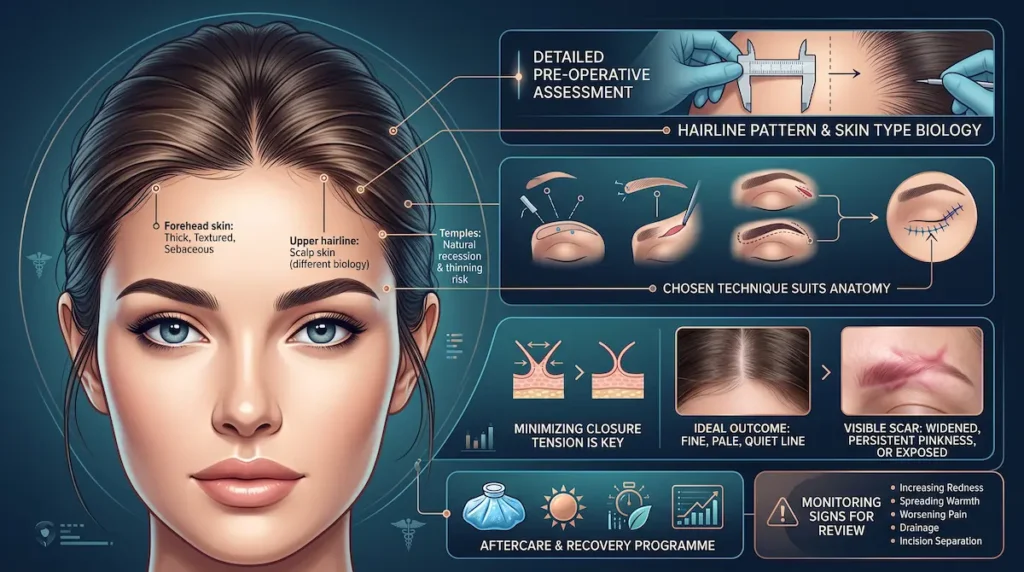
This is where a careful pre-operative assessment matters. A patient with dense hair and a stable hairline may hide an endoscopic or temporal scar easily. A patient with temple recession, fine hair, or a high forehead needs a different conversation. The scar may still heal well, but the camouflage plan has to be realistic.
Sebaceous brow skin and direct brow lift scars
The skin above the eyebrow is not the same as the skin inside the scalp. It is thicker, more textured, and more sebaceous. That can make direct brow lift scars more noticeable in some patients, especially if the incision is placed under tension or if the skin tends to heal with raised or widened scars.
This does not mean direct brow lift scars are always poor. In the right candidate, the incision can be placed along the upper brow margin and softened by brow hair. The important point is selection. A direct brow lift should not be chosen casually for someone whose main priority is the least visible scar possible.
It may be a strong option when precise brow elevation matters more than maximum scar concealment. It may be less appealing for patients with sparse brow hair, a strong history of hypertrophic scars, or a low tolerance for any visible facial scar. Expert patient-style research pays off here: the “best” technique is the one whose trade-offs you fully understand.
Hairline position and hair loss risk
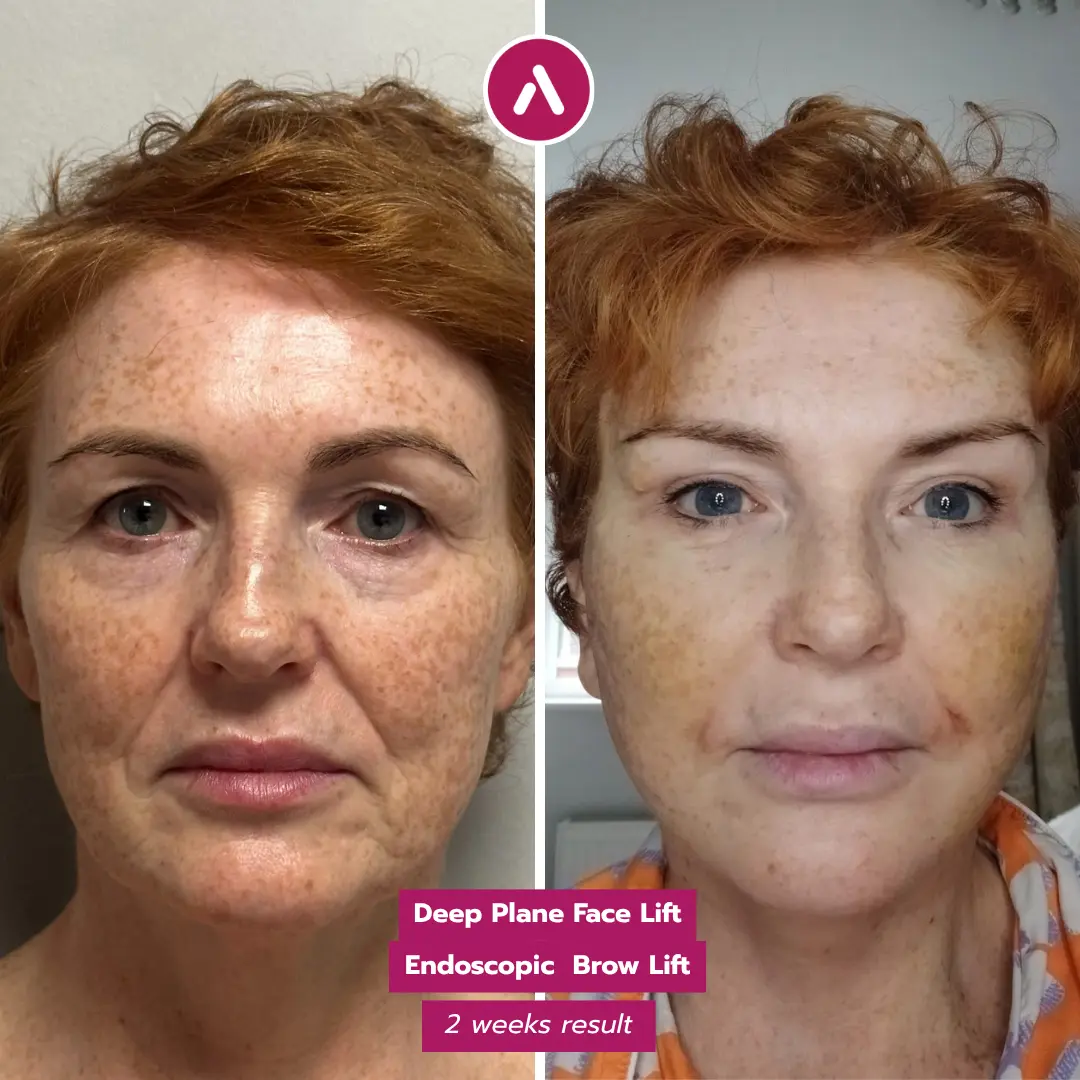
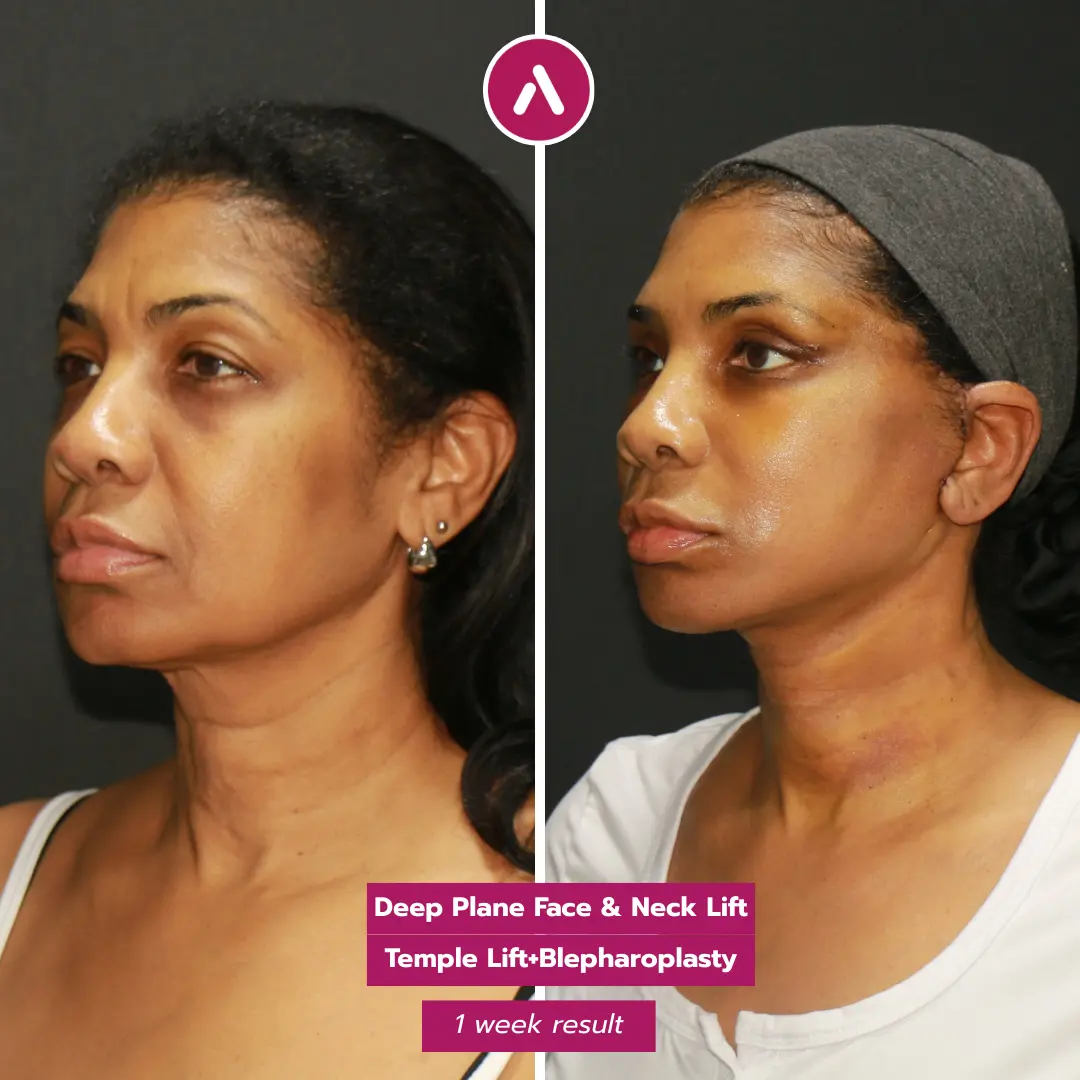
Scalp-based brow lift scars depend on hair for camouflage. That sounds simple, but the hairline is not fixed forever. Temple recession, thinning density, traction from tight hairstyles, and age-related changes can all reveal an incision that was once well hidden.
For Canadian patients, this should be part of the pre-travel consultation. Ask where the incision will sit if your hair is wet, parted, pulled back, or shorter than usual. Ask what happens if the temple hair thins later. A good answer should be specific, not generic.
Endoscopic and temporal scars are often discreet because they sit in hair-bearing areas. Still, a patient with a high forehead or thinning temples may need a modified plan. In some cases, a non-surgical option may be discussed instead, especially when the lift needed is mild. For that comparison, the related guide on Botox brow lift versus surgical brow lift explains the non-surgical boundary more clearly.
Suture marks, widening, and incision tension
Scar quality is strongly affected by tension. If the skin edges are pulled tightly, the scar may widen as it matures. If sutures irritate the skin, small “railroad track” marks can sometimes form beside the incision. These are more likely when closure is under stress or when aftercare is not followed carefully.
Swelling can also create temporary firmness around the incision. Early firmness is not automatically a bad sign. A scar can feel raised at first and still flatten well over time. What matters is the trend: softening, fading, and becoming less tender are reassuring signs.
Changes that deserve review include increasing redness, spreading warmth, worsening pain, drainage, an opening incision, or a scar that becomes progressively thicker rather than calmer. These are not reasons to panic, but they are reasons to send photos and contact the surgical team rather than waiting.
“A brow lift scar is planned before the first incision. The location, hairline, closure tension, and aftercare all decide whether the mark becomes a quiet line or a visible reminder. The goal is not only to lift the brow; it is to choose the access point your skin and hairline can live with long term.”
How Brow Lift Scars Heal Over Time?
Brow lift scar healing is gradual. The incision may look more obvious in the early weeks before it becomes less noticeable. This is normal. Scar tissue is active during the first months, and the final result should not be judged too early.
Most scars move through a predictable pattern: fresh and pink, then firmer, then flatter and paler. Hair-bearing scalp scars often hide during this process, while direct brow scars may be easier to monitor because they sit on visible skin.
Weeks 1–2: fresh incision and early redness
During the first one to two weeks, the incision is still early in the healing process. It may look pink, slightly raised, or firm. Small scabs can form. Mild tenderness or itching can also happen as the skin closes.
At this stage, the scar is not mature. It is a healing incision. The priority is keeping it clean, avoiding unnecessary friction, and following your surgeon’s instructions on washing, ointment, dressing, and activity.
For scalp incisions, patients often worry because they cannot see the area well. That is where clear photo instructions help. Before returning to Canada, ask which angles to photograph, how often to send updates, and which changes should trigger a message to the clinic.
Weeks 3–8: pink, firm, or slightly raised
Many scars look more noticeable before they look better. Around weeks three to eight, the scar can be pinker, firmer, or slightly raised because collagen is being actively produced. This is a common phase in scar maturation.
For direct brow scars, this phase can feel emotionally harder because the incision is visible in the mirror. Makeup may be allowed only after the skin is fully closed and your surgeon clears it. Do not cover an open or irritated incision with cosmetics.
For endoscopic or temporal scars, this phase is usually less visible because hair covers the area. Still, the scalp may feel tight, numb, itchy, or sensitive. Those sensations usually settle gradually, but persistent or worsening symptoms should be reviewed.
Months 3–6: softening and fading
Between three and six months, many brow lift scars begin to soften. Redness often reduces. Firmness becomes less noticeable. A direct brow scar may start blending better with the surrounding skin, while a scalp scar may become harder to find under the hair.
This is also when scar care becomes more relevant if the incision has fully closed. Silicone gel or sheets may be recommended by your surgeon. Sun protection is important for visible facial scars because ultraviolet exposure can darken or prolong discolouration.
Canadian patients returning through different climates should be practical. Winter glare, summer sun, and travel exposure can all affect a healing scar. Use the aftercare plan you are given, not random scar products from online forums.
Months 6–12 and beyond: scar maturation
By six to twelve months, most brow lift scars are much calmer. They may be pale, flatter, and softer. Some continue refining after the one-year mark, especially if the skin had a stronger inflammatory response early on.
A mature scar is not always invisible. It may still be detectable if you look closely, part the hair, or examine the brow under bright light. But in a well-planned case, it should not be the first thing someone notices in normal conversation.
If a scar remains thick, widened, itchy, painful, or poorly matched in colour after full maturation, scar revision may be discussed. Revision is not usually an early decision. The scar needs time to declare how it truly heals.
| Healing stage | Common scar appearance | Usually normal? | Supportive action |
|---|---|---|---|
| Weeks 1–2 | Pink, fresh, slightly tender, small scabs | Yes, if improving | Keep clean, avoid friction, follow dressing and washing instructions |
| Weeks 3–8 | Firmer, pinker, mildly raised or itchy | Often yes | Do not pick scabs; ask when silicone or makeup is safe |
| Months 3–6 | Softening, fading, less sensitive | Yes | Use approved scar care and sun protection if the skin is closed |
| Months 6–12+ | Flatter, paler, more mature | Yes, if stable | Review persistent thickening, widening, discomfort, or colour mismatch |
Minimizing and Camouflaging Brow Lift Scars
The best scar strategy starts before surgery. Aftercare helps, but it cannot fully compensate for a poor incision choice. A scar is easiest to camouflage when the technique is matched to the patient’s hairline, brow position, skin quality, and long-term expectations.
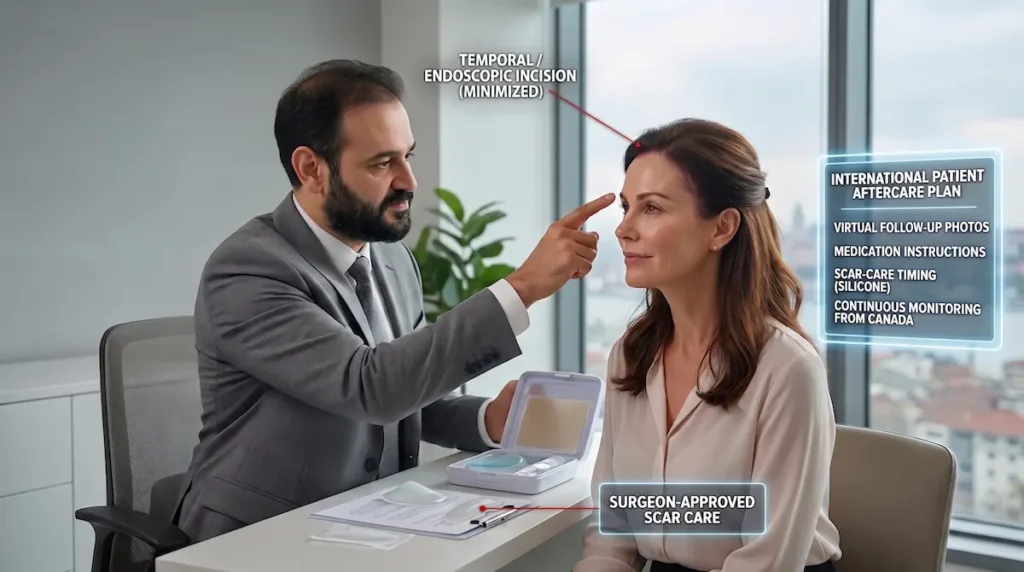
For a Canadian patient considering surgery in Turkey, scar planning should also include follow-up logistics. You should know what scar-care products are recommended, when to begin them, what photos to send, and how long virtual follow-up continues after you return home.
Choose the technique around your hairline, not only your brow
A brow lift plan should consider the whole upper face. The brow position matters, but so do forehead height, temple density, part line, hairstyle, and future hair loss risk. If your scar will rely on hair for camouflage, hair coverage must be realistic.
Patients with dense hair may be excellent candidates for hidden endoscopic or temporal incisions. Patients with a high or unstable hairline may need a more nuanced discussion. A pretrichial incision may help selected patients with a long forehead, but it places the scar at the hairline, so scar quality becomes central.
AKM’s Natural-First philosophy is based on rejuvenation rather than an operated-on look. For brow lift scars, that means the incision plan should not create a new problem while correcting brow heaviness. A discreet scar and a natural brow position are part of the same goal.
Use scar care only when the incision is ready
Scar care is timing-sensitive. Silicone gel, silicone sheets, massage, and makeup may be useful at the right stage, but they should not be applied too early unless your surgeon instructs you. A product that is harmless on closed skin can irritate a healing incision.
Sun protection is especially important for visible scars. Ultraviolet exposure can make scars stay darker or more noticeable. If the scar is near the brow or hairline, physical coverage, shade, and approved sunscreen after closure can help protect the maturing line.
Do not over-treat the scar. More products do not mean better healing. Consistency, low irritation, and surgeon-approved timing matter more than an aggressive routine.
When camouflage or revision may help
Most brow lift scars improve without revision. Still, some scars remain visible because of widening, hairline exposure, colour mismatch, or raised texture. The solution depends on the problem.
A scalp scar that becomes visible because of hair thinning may be improved with hairstyle changes, careful hair density planning, or sometimes scalp micropigmentation. A widened facial scar may be reviewed for scar revision, laser, steroid treatment, or other specialist options. These are case-by-case decisions.
It is also important to separate normal scar maturation from a poor outcome. Early redness is not the same as a bad scar. If you are worried about healing quality or tissue behaviour after any facial procedure, the broader guide on how other facial procedures can heal poorly may help you understand when a concern deserves review.
Cost questions should stay separate from scar-healing advice. Brow lift pricing depends on technique and surgical plan, so this scar-focused article will not open a pricing table. For that specific topic, use AKM’s dedicated page on brow lift cost in CAD.
CA planning note: Before leaving Canada for elective surgery, ask for a written aftercare plan, incision-location notes, medication instructions, scar-care timing, and a photo follow-up schedule. Choose a European Board-Certified surgical team in an RCPSC-equivalent framework, and make sure you understand who reviews your healing once you are home.
Frequently Asked Questions: Brow Lift Scars
These questions focus on scar location, visibility, and healing after a brow lift. They are written for patients comparing techniques carefully, especially those planning surgery outside Canada and wanting a clear follow-up plan before travelling home.
Are endoscopic brow lift scars visible?
Endoscopic brow lift scars are usually difficult to see because the incisions are small and placed inside or just behind the hairline. They may become visible if the hair is very thin, shaved closely, parted directly over the incision, or if future hair loss exposes the area.
The best way to assess visibility is to ask your surgeon to mark the planned incision sites during consultation. Then consider your real hairstyle, not an ideal one. If you wear your hair pulled back, have temple recession, or expect future thinning, this should be part of the surgical plan.
Where are direct brow lift scars?
Direct brow lift scars sit just above the eyebrow, usually following the upper border of the brow hair. This placement allows precise brow elevation, but it also means the scar is on visible facial skin rather than hidden in the scalp.
In selected patients, brow hair and natural skin texture can help camouflage the scar. Still, the direct approach requires a more honest scar discussion than an endoscopic or temporal technique. It may be appropriate when control and function matter more than maximum concealment.
Do brow lift scars fade?
Yes, brow lift scars usually fade as they mature. Early scars may look pink, firm, or slightly raised. Over several months, they typically soften, flatten, and become lighter in colour.
Full maturation can take a year or longer. A scar that looks noticeable at six weeks may be much calmer at six months. That said, scars do not biologically disappear; they become less visible when they are well placed, low-tension, protected from sun, and supported with appropriate aftercare.
Will hair loss expose a brow lift scar?
It can. Any scar placed inside the scalp or temple hairline depends on hair coverage. If the hairline recedes or hair density thins, a previously hidden scar may become easier to see.
This does not mean scalp-based brow lifts are unsafe or unsuitable. It means hairline stability should be discussed before surgery. Patients with a high forehead, temple recession, fine hair, or a strong family history of hair loss need a scar plan that accounts for the future, not only the current hairline.
How long until brow lift scars settle?
Most brow lift scars look calmer by three to six months, with further refinement by twelve months. In the first weeks, the scar may be pink, firm, itchy, or slightly raised. That can be normal if the trend is improving.
Contact your surgical team if redness spreads, pain worsens, drainage appears, the incision opens, or the scar becomes progressively thicker rather than softer. A clear photo follow-up schedule is especially important if you are recovering back in Canada after surgery in Turkey.
Can brow lift scars be revised?
Some brow lift scars can be improved, but revision is usually considered only after the scar has had time to mature. Options may include scar revision, laser treatment, steroid injections, scalp micropigmentation, or hair-density strategies, depending on the scar type and location.
Revision is not the first step for every visible scar. Early redness, firmness, or colour mismatch often improves with time. A surgeon should first decide whether the scar is still maturing, widened from tension, raised from excess collagen, or visible because hair coverage has changed.
Planning Brow Lift Scar Care as a Canadian Patient
A brow lift scar plan should not end when the stitches are removed. For Canadian patients travelling for surgery, the practical details matter: what to do before flying home, how to send healing photos, what symptoms require urgent review, and what documentation you should keep for your local records.
Before surgery, ask where each incision will sit, how it will be closed, when scar care begins, and which products are recommended. Before returning to Canada, ask for written post-operative instructions, a medication list, incision photos or diagrams, and a virtual follow-up schedule. This is part of safe medical travel planning, not a luxury detail.
AKM Clinic performs surgery in Istanbul in a JCI-accredited setting and uses a Natural-First philosophy: rejuvenation over alteration. For brow lift scars, that means the goal is not just a lifted brow. It is a brow position and incision plan that still looks discreet as the scar matures.
If you are comparing brow lift options, request a personalised assessment of your brow position, forehead height, hairline stability, and scar risk. A virtual consultation can help determine whether an endoscopic, temporal, direct, or other approach best fits your anatomy and your tolerance for visible scarring.
Medical disclaimer: This article is for general educational information only and is not medical advice, diagnosis, or a substitute for an in-person assessment by a qualified physician. Healing patterns vary. If you notice spreading redness, worsening pain, discharge, fever, an opening incision, or any urgent concern after surgery, contact your surgeon or seek appropriate medical care promptly.