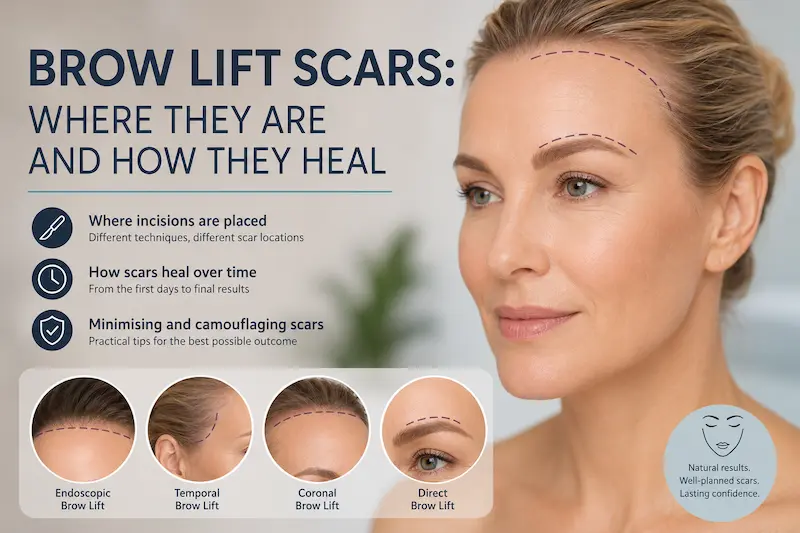
Answer first: Brow lift scars vary by technique. Endoscopic and temporal brow lift scars are usually hidden within or just behind the hairline, while direct brow lift scars sit above the eyebrow and coronal scars lie across the scalp. Visibility depends on incision placement, hairline position, skin healing, tension, and aftercare.
Brow lift scars are not one-size-fits-all. The scar from a small endoscopic lift can be very different from the scar after a direct brow lift, and the right choice depends on your hairline, brow position, forehead height, skin quality, and how much lift is needed.
At AKM Clinic, planning starts with the facial anatomy rather than a fixed technique. In an endoscopic temporal brow lift in Turkey, the goal is to place incisions where they are naturally concealed, usually in hair-bearing areas or along lines that already break up the skin visually.
This guide explains where brow lift scars sit, why some are more visible than others, how they usually heal, and what can be done to minimise or camouflage them. It does not compare every brow lift method in depth or discuss pricing in detail; those are separate decisions best reviewed during consultation.
Table of Contents
Do Brow Lifts Leave Visible Scars?
Yes, every surgical brow lift creates an incision, and every incision heals with some form of scar. The practical question is not whether a scar exists, but where it sits, how much it shows in daily life, and whether the scar trade-off is appropriate for the amount of lift you need.
Why every brow lift technique leaves a mark
A brow lift changes the position of the brow by releasing, lifting, or removing tissue. To do that safely, the surgeon needs access through the skin. Even with endoscopic surgery, where the incisions are much smaller than traditional open approaches, the skin still heals through the same biological process: inflammation, closure, collagen formation, softening, and gradual fading.
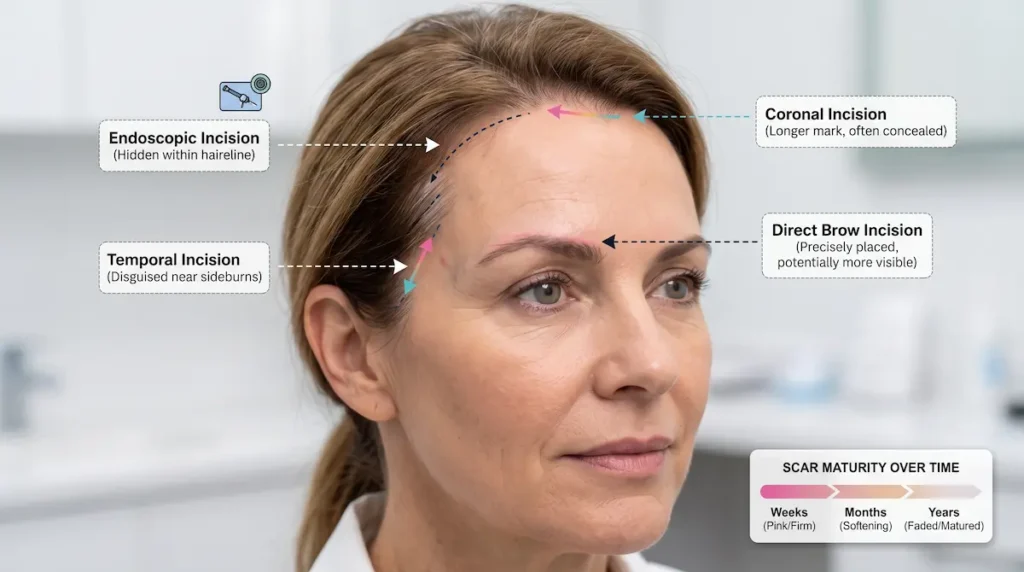
In the first weeks, a scar may look pink, firm, slightly raised, or darker than the surrounding skin. That early look is not the final result. Most fine-line scars flatten and fade over time, and NHS guidance on scars notes that many scars continue changing for up to two years or more. Scar maturity takes patience.
The trade-off: hidden incision versus lifting power
Different brow lift techniques solve different problems. A small endoscopic or temporal lift may hide scars well in the hairline, but it may not give enough correction for every brow shape or every degree of heaviness. A direct brow lift can offer precise lifting, especially for asymmetry or heavy brows, but the scar sits closer to the eyebrow and can be more visible.
This is why scar planning is part of surgical planning, not a separate cosmetic detail. The best scar is not simply the shortest one. It is the incision that gives enough correction while sitting in the least distracting location for your face and hair pattern.
What “visible” really means
Visible does not always mean obvious. A scar may be technically visible if the hair is lifted, the skin is examined closely, or the lighting is harsh. But it may be very difficult to notice in normal conversation, especially when it sits inside the hairline or follows a natural crease.
For some patients, the concern is not the scar itself but whether it will limit hairstyles, be exposed by future hair thinning, or look different from the surrounding skin. These are exactly the details to discuss before surgery. A good consultation should include the planned incision position, the expected scar behaviour, and the options if healing does not follow the usual path.
“The scar is planned before the lift is performed. A well-selected brow lift technique balances the amount of correction needed with the patient’s hairline, skin quality, brow thickness, and tolerance for a visible incision.”
Where the Scar Sits by Technique?
Brow lift scar placement changes significantly from one technique to another. Some scars are hidden in the scalp, some sit at or just in front of the hairline, and some are placed directly above the eyebrow. Understanding that map helps you compare techniques more realistically.
Endoscopic brow lift scars
Endoscopic brow lift scars are usually small and placed within or just behind the hairline. Clinical guidance on endoscopic brow lift incision placement describes typical planning as involving small frontal hairline incisions and temporal incisions placed parallel and posterior to the temporal hairline. In practical terms, the scars are designed to be covered by hair once healed.
This approach often suits patients who want a less visible scar pattern and have enough hair density to conceal the incision points. It can be especially useful when the concern is brow descent, lateral hooding, or tired-looking upper eyes caused partly by brow position.
The limitation is the hairline. If the hairline is already high, receding, or likely to thin further, hidden scalp scars may not stay hidden forever. Hair follicles also need careful protection; endoscopic brow lift technique guidance highlights incision orientation, tension-free closure, and limited cautery in hair-bearing areas to reduce the risk of alopecia around incision sites.
Temporal or lateral brow lift scars
A temporal or lateral brow lift usually focuses on the outer third of the brow. The incision is commonly placed in the temple hair-bearing area, which means the scar is usually concealed by the hair rather than sitting directly on the forehead.
This technique is often discussed for patients whose main concern is outer brow heaviness rather than the whole forehead. It may also be relevant when the upper eyelids look hooded because the brow tail has descended. For that reason, patients comparing techniques may also want to read about the lateral brow lift approach.
The scar risk is similar to other hairline-based techniques: hair density, hair direction, skin tension, and healing quality matter. A patient who often wears the hair pulled tightly back should ask exactly where the temporal incision would sit and whether it could show from the side.
Direct brow lift scars
A direct brow lift places the incision just above the eyebrow, usually along the upper border of the brow hair. This makes it powerful for precise correction, especially when one brow sits lower than the other, but it also means the scar is on the face rather than hidden in the scalp.
Clinical guidance on direct brow lift surgery notes that this approach may be favoured in situations such as receding hairline, baldness, heavy eyebrows, prior eyebrow scars, or unilateral facial paralysis. The same source also lists unwillingness to accept a potentially visible facial scar as a contraindication to the direct approach.
That is the key trade-off. A direct brow lift can be very effective, but the patient must be comfortable with the scar position. Brow thickness helps camouflage it. Thin brows, very smooth skin, or a strong tendency to raised scarring can make the scar more noticeable.
Patients researching this method in detail should review where a direct brow lift incision sits before choosing it over a hairline-based technique.
Coronal and pretrichial brow lift scars
A coronal brow lift uses a longer incision across the scalp, usually several centimetres behind the hairline. Because it is hidden within the hair, the scar may be well concealed in patients with stable, dense hair. It is less suitable for patients with baldness or a receding hairline, because the scar can become exposed.
A pretrichial or hairline brow lift places the incision at or just in front of the hairline. This can be useful when the forehead is long and the surgeon wants to avoid moving the hairline further back. The scar, however, sits closer to a visible facial boundary, so careful closure and realistic counselling are essential.
| Technique | Typical scar location | Usual visibility | Typical healing pattern |
|---|---|---|---|
| Endoscopic brow lift | Small incisions within or just behind the hairline | Usually low if hair density is good | Small scalp scars soften and fade over months |
| Temporal / lateral brow lift | Temple hair-bearing area | Usually hidden by hair, but hairstyle matters | Fine scars settle gradually; hairline planning is important |
| Direct brow lift | Immediately above the eyebrow | Potentially visible, especially with thin brows | Can heal well, but requires careful patient selection and closure |
| Pretrichial / hairline brow lift | At or just in front of the hairline | Depends on hairline shape, skin colour match, and styling | May fade well but can remain noticeable if widened or under tension |
| Coronal brow lift | Across the scalp, behind the hairline | Hidden in dense hair; risky if hair thins | Longer scalp scar; future hair loss can expose it |
The scar map is only one part of the decision. Some patients are better suited to a non-surgical option, especially if the lift needed is mild and temporary results are acceptable. In that situation, it may be useful to compare the non-surgical brow lift alternative before committing to an incision-based procedure.
Why Some Brow Lift Scars Show More?
Some brow lift scars heal as fine, pale lines; others stay pink, raised, wide, or easier to notice. The difference is usually not one single factor. It comes from incision choice, skin behaviour, tension, hairline coverage, sun exposure, and how carefully the wound is supported while it matures.
Sebaceous brow skin and direct brow lift scars
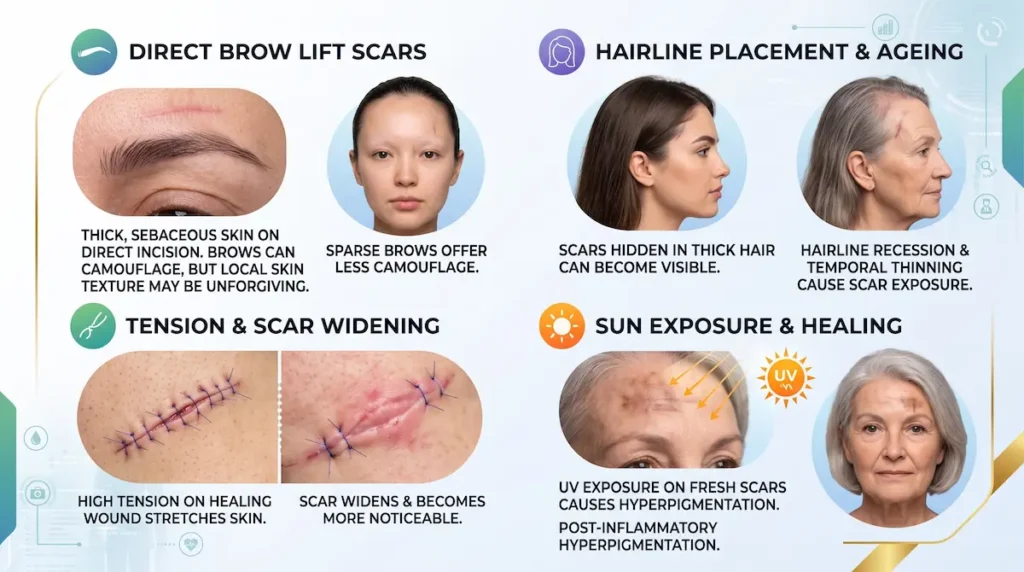
The skin above the eyebrow is thicker and more sebaceous than the scalp or upper forehead. That matters because direct brow lift scars sit in this exact area. The eyebrow can help conceal the incision, but the local skin texture can also make scarring less forgiving than a small incision hidden in the hair.
Clinical guidance on direct brow lifting notes that the technique can be valuable for selected patients, but visible scarring must be discussed carefully before surgery. That is why a direct brow lift is rarely chosen just because it is powerful. It is chosen when its benefits outweigh the scar trade-off for that individual patient.
Patients with dense, coarse brows may camouflage the line better than patients with sparse brows. People who regularly shape, thin, or tint their eyebrows should also think practically. A scar that blends well with a fuller brow may show more if the brow is kept very thin.
Hairline position, thinning hair, and future exposure
Hairline-based techniques rely on hair coverage. That sounds simple, but it needs careful planning. A scar hidden inside thick hair at age 45 may become easier to see if the hairline recedes or the temporal hair thins later.
This is especially relevant for coronal, endoscopic, and temporal approaches. These scars may be well hidden after healing, but their visibility depends on hair density and hairstyle. A patient who wears the hair swept back, tied tightly, or very short should ask whether the planned incision could become visible from the front or side.
For patients with a high forehead, a receding hairline, or previous hair transplant history, incision planning becomes more nuanced. A pretrichial hairline incision may sometimes be considered to avoid moving the hairline further back, but it creates a scar at a more visible facial boundary. There is no universal answer. There is only the right trade-off for the right anatomy.
Tension, sutures, and scar widening
Scars tend to widen when the healing skin is under too much tension. In brow lift surgery, tension can come from the amount of lift, the direction of pull, swelling, movement, or closure technique. A scar that begins as a fine line can stretch if the skin edges are pulled apart during early healing.
Suture technique also matters. Sutures that are too tight, left in too long, or placed in a way that irritates the skin may leave small track marks. Good closure aims to bring the skin together gently and support deeper tissues so the surface scar is not carrying all the tension.
Healing biology still varies. Some patients naturally form thicker or darker scars. Others develop post-inflammatory pigmentation, especially if healing skin is exposed to sunlight. This is one reason scar care is not cosmetic fussiness; it is part of protecting the result.
Poor healing after other facial procedures
Brow lift scars are usually predictable, but any facial procedure can heal poorly if the incision is under tension, the blood supply is compromised, infection develops, or aftercare is not followed. If you are comparing multiple facial procedures, it may help to understand how other facial procedures can heal poorly so you can separate normal healing from warning signs.
That does not mean you should expect a bad scar. It means you should know what normal healing looks like, what increases risk, and when to ask your surgical team for review.
How Brow Lift Scars Heal Over Time?
Brow lift scars do not fade in a straight line. They often look more noticeable before they look better. Early redness, firmness, or itching can be normal, especially while collagen is being laid down. The final scar is judged in months, not days.
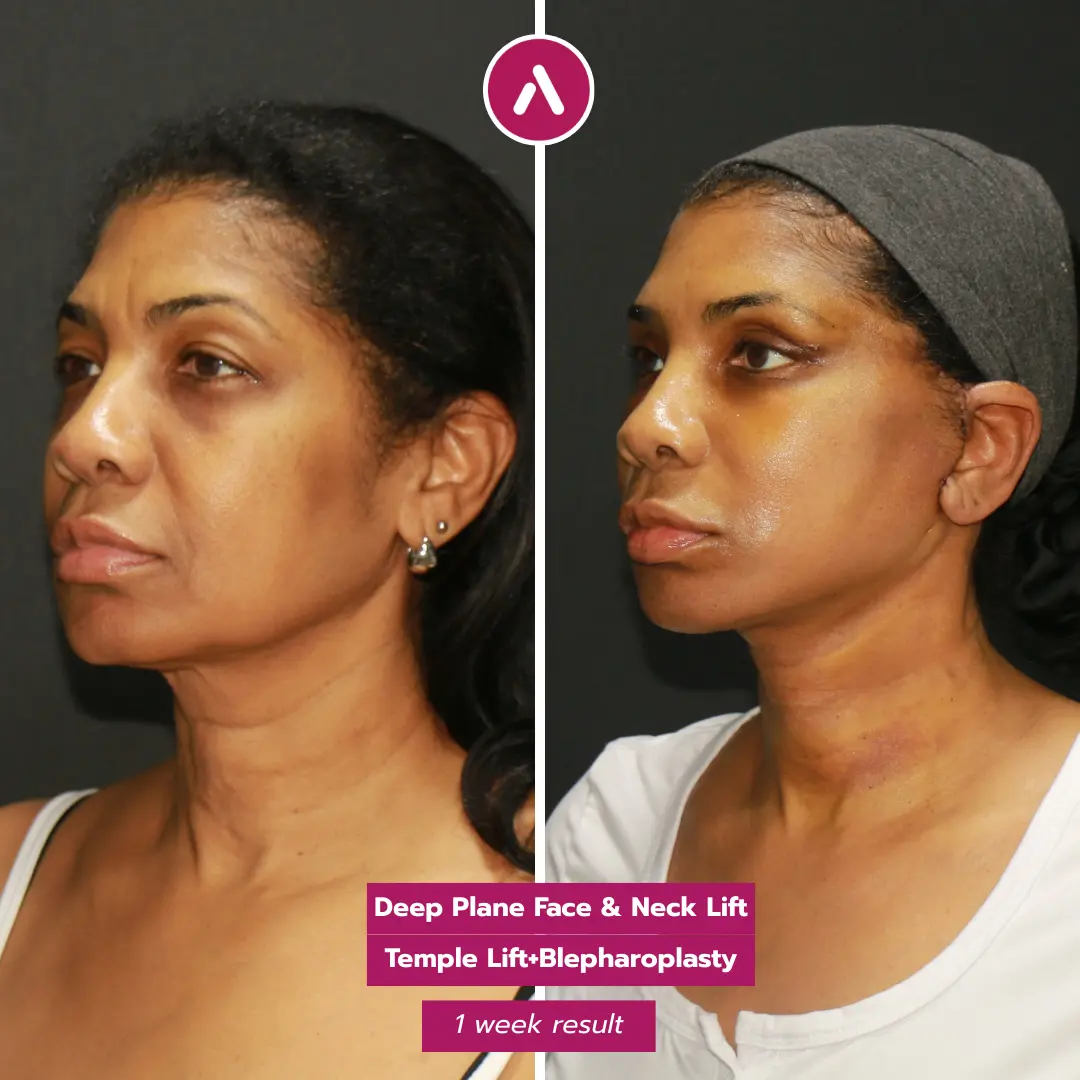
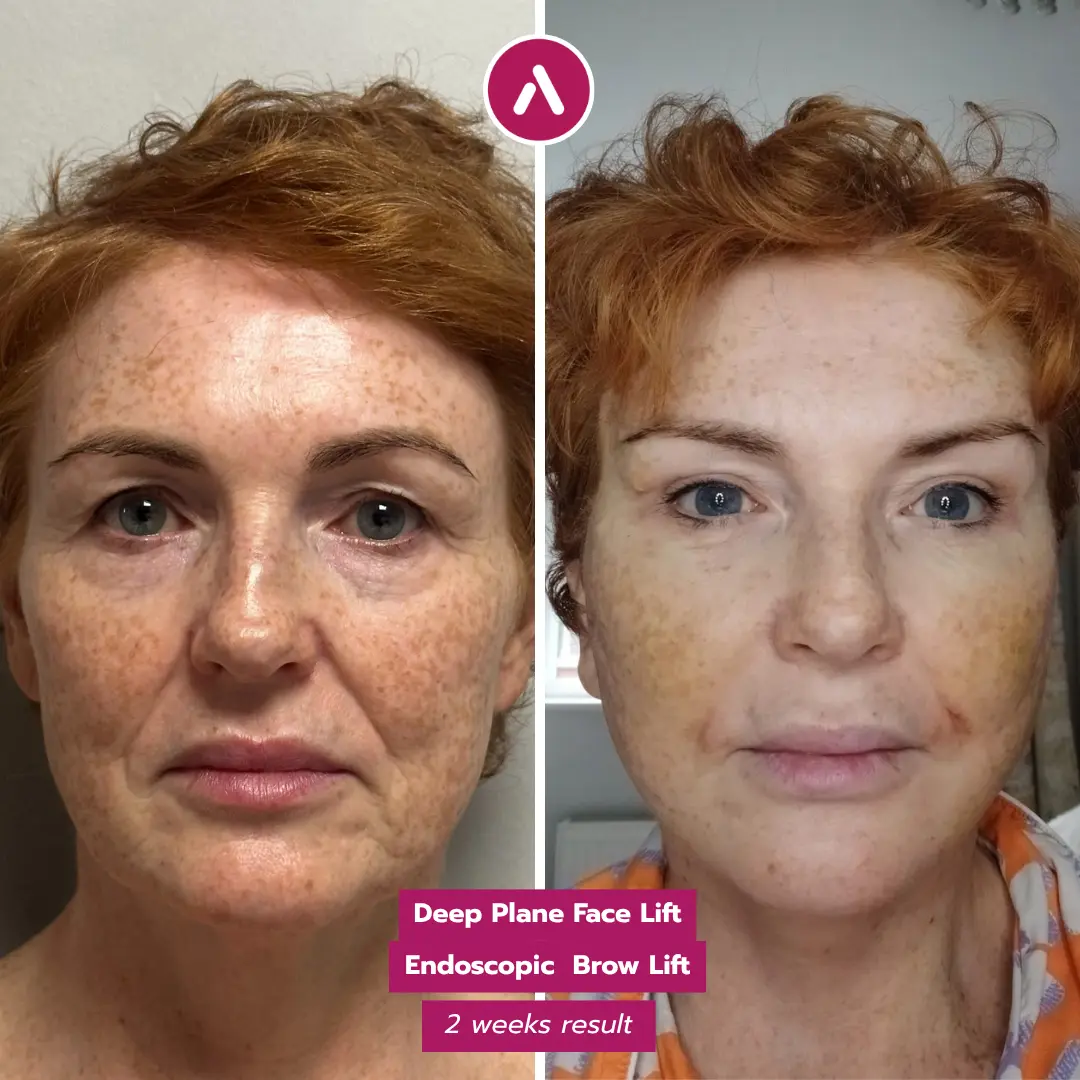
The first two weeks: closure, swelling, and early redness
During the first fortnight, the priority is wound closure. The incision may look pink or red, feel tight, and sit slightly raised. Scalp incisions may be hidden by the hair, but you may feel tenderness, numbness, or small crusts along the incision line.
Direct brow lift scars are easier to inspect because they sit above the eyebrow. That can be reassuring, but it can also make patients overanalyse every change. Mild redness, tightness, and firmness are common early on. Increasing pain, spreading redness, discharge, or a wound that opens should be reviewed promptly.
Weeks three to eight: the scar can look more obvious
Many surgical scars become more visible during the early collagen phase. The line may look pinker, firmer, or slightly raised. This is not automatically a poor result. It is often the point at which patients worry most, because the incision is closed but not yet mature.
For hairline incisions, the scar may be less visible but the scalp can remain sensitive. Some patients notice temporary shedding or thinning around incision points. Endoscopic brow lift guidance discusses the importance of protecting follicles and using careful incision planning to reduce alopecia risk around hair-bearing incisions.
Months three to six: softening and colour change
By three to six months, most scars feel softer and sit flatter. Pinkness may begin to fade. The line may still be visible in bright light or under close inspection, especially if it is above the brow or at the hairline, but it usually becomes less distracting.
This is also the stage where scar-care habits matter. Sun exposure can darken a healing scar and make colour mismatch last longer. Consistent sun protection is especially important for facial scars because the forehead and brow are exposed daily, even in cooler UK weather.
Six to twelve months and beyond: scar maturation
By six to twelve months, many brow lift scars have matured into finer, paler lines. Some continue improving beyond one year. Scar maturation can continue for two years or longer, so a scar that is still subtly pink at six months may not be finished healing.
Direct brow lift scars may remain more visible than endoscopic or temporal scars because of their location. That does not necessarily mean they are abnormal. It reflects the technique’s design. The question is whether the scar sits neatly, follows the brow border, and matches the patient’s expectations from the consent process.
| Healing stage | Typical scar appearance | Usually normal? | Helpful action |
|---|---|---|---|
| Days 1–14 | Pink, tender, slightly raised, with mild crusting | Yes, if improving steadily | Follow wound-care instructions; avoid picking or friction |
| Weeks 3–8 | Firmer, redder, or more noticeable than expected | Often yes | Keep the area protected; ask before starting silicone |
| Months 3–6 | Flatter, softer, gradually lighter | Yes | Use sun protection; continue approved scar care |
| Months 6–12+ | Fine line, paler, less firm | Usually | Review any raised, widening, painful, or darkening scar |
Normal healing versus warning signs
Normal healing should trend in the right direction, even if slowly. The scar should gradually become less tender, less angry-looking, and more settled. Temporary itch, tightness, and firmness can be normal.
Warning signs are different. Contact your surgical team if you notice spreading redness, increasing heat, pus, unpleasant odour, worsening pain, fever, wound separation, or sudden darkening of the skin around the incision. These signs need medical judgement, not guesswork.
Minimising and Camouflaging Scars
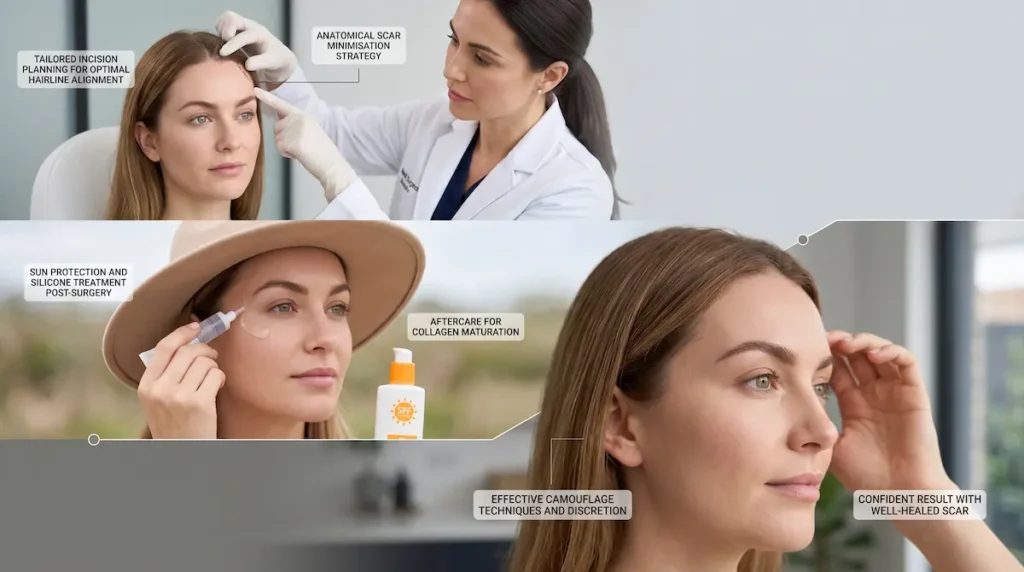
Scar minimisation starts before the first incision is made. Technique selection, incision placement, closure method, aftercare, and long-term hairline planning all affect how visible a brow lift scar may be. After surgery, your role is to protect the healing skin while collagen matures.
Choose the technique around your hairline, not just the lift
A good scar plan is anatomical. If your hairline is low and dense, endoscopic or temporal scars may be well hidden. If your hairline is high, thinning, or likely to recede, the surgeon may need to adjust the incision plan. If you are bald or have very sparse hair, hiding an incision in the scalp may not be realistic.
This is where consultation quality matters. In the UK, a GMC-registered surgeon would be expected to discuss reasonable options, benefits, and material risks as part of informed consent. For surgery abroad, the same standard of clarity should apply. AKM frames its surgical leadership as European Board-Certified, GMC-equivalent, rather than claiming UK registration.
Ask direct questions: Where exactly would my scar sit? Could it show if my hairline changes? What happens if I wear my hair back? Would a direct brow lift scar be acceptable for my brow thickness and skin type?
Scar care: silicone, sun protection, and patience
Once the incision is fully closed and your surgeon approves it, silicone gel or silicone sheeting may be recommended. Do not apply products to an open wound unless your surgical team specifically tells you to. Timing matters.
Sun protection is essential. Fresh scars can darken when exposed to ultraviolet light, making colour mismatch last longer. A hat, careful SPF use, and avoiding strong sun during early healing can make a visible difference. This applies even on cloudy days, because UV exposure still reaches the skin.
Patience is part of scar care. It is tempting to judge a brow lift scar at four or six weeks, but the scar is still biologically active. Most sensible decisions about scar revision are made after maturation, unless there is a medical issue that needs early review.
When camouflage can help
Camouflage depends on scar location. Hairline scars may be hidden with hairstyle changes while they mature. Direct brow lift scars may be softened visually with brow grooming, tinting, or make-up once the incision is fully healed and your surgeon agrees.
Some patients consider medical tattooing, scalp micropigmentation, laser treatment, steroid injection, or scar revision if a scar remains raised, pale, wide, or exposed by hair thinning. These are not first-line decisions in the early weeks. They are usually considered after the scar has declared how it wants to heal.
Revision and cost questions
If a scar heals poorly, revision may be possible, but the best approach depends on the problem. A widened scar, raised scar, hairline scar, and direct brow scar are treated differently. Sometimes the issue is not the scar itself but alopecia around the incision, pigment change, or the scar sitting in a visible direction.
Cost is a separate topic and should not drive the scar plan. For readers comparing options, the safest next step is to review the cost of a brow lift only after you understand which technique is suitable for your hairline and scar tolerance.
For UK patients, the most useful consultation is not one that promises “no scar”. It is one that shows you the likely incision, explains the scar trade-off, and gives you a clear aftercare plan for the first year of healing.
CTA: Ask AKM which brow lift technique keeps scars hidden for your hairline and how your scar-care plan would be managed after you return home.
Frequently Asked Questions: Brow Lift Scars
These are the questions patients most often ask when they are comparing brow lift techniques and trying to understand scar visibility. The answers below are general guidance; your own scar position and healing pattern depend on the technique used, your hairline, your skin, and your surgeon’s closure plan.
Are endoscopic brow lift scars visible?
Endoscopic brow lift scars are usually difficult to see once healed because the incisions are small and placed within or just behind the hairline. They may be visible if the hair is very thin, wet, shaved, pulled tightly back, or if future hair loss exposes the area.
For many patients, this is the main advantage of an endoscopic or temporal approach: the scar is planned in a concealed area rather than on the visible forehead. The trade-off is that the technique must still provide enough lift for your anatomy.
Where are direct brow lift scars?
Direct brow lift scars sit immediately above the eyebrow, usually following the upper border of the brow hair. This position allows precise brow lifting but creates a facial scar rather than a hidden scalp scar.
The scar may blend well if the eyebrow is thick and the incision is carefully placed, but it can be more noticeable in patients with thin brows, smooth skin, or a strong tendency to raised scarring. A direct brow lift should only be chosen when the scar trade-off is clearly understood.
Do brow lift scars fade?
Yes, most brow lift scars fade gradually. Early scars can look pink, firm, or raised, then usually soften and become paler over several months. Some continue maturing for a year or longer.
They do not usually disappear completely. The realistic goal is a fine, well-placed scar that is hard to notice in normal daily life, especially when hidden by hair, brow shape, or natural skin lines.
Will baldness expose the scar?
It can. Scalp and hairline scars depend on hair coverage. If your hairline recedes, your temple hair thins, or you develop baldness later, a scar that was once hidden may become easier to see.
This is why hairline assessment is essential before surgery. Patients with thinning hair, a high forehead, a family history of hair loss, or previous hair transplant planning should discuss future exposure risk before choosing an endoscopic, temporal, coronal, or pretrichial incision.
How long until brow lift scars settle?
Most brow lift scars look noticeably calmer by three to six months, but final maturation often takes twelve months or longer. Some scars continue to soften and fade beyond the first year.
The first few weeks are not a reliable preview of the final scar. A scar can look redder or firmer around weeks three to eight before it improves. What matters is the overall trend: less tenderness, less redness, softer texture, and no signs of infection or wound separation.
Can brow lift scars be revised?
Sometimes. Scar revision may help if a scar is wide, raised, poorly positioned, or exposed by hair loss, but the right treatment depends on the cause. Options may include surgical revision, steroid treatment for raised scars, laser treatment, medical tattooing, or scalp micropigmentation for selected hair-bearing scars.
Revision is usually considered only after the scar has matured, unless there is a medical problem that needs early care. A careful surgeon will first ask why the scar healed poorly before recommending a solution.
Are brow lift scars worse than eyelid surgery scars?
They are different, not automatically worse. Upper eyelid surgery scars usually sit in the eyelid crease, while brow lift scars may sit in the hairline, scalp, temple, or above the eyebrow depending on the technique.
Brow lift scars can often be hidden by hair, but direct brow lift scars are more exposed. Eyelid scars can hide well in the crease, but they are on thinner, highly visible skin. The better comparison is not “which is worse?” but “which incision suits the real cause of the heaviness around your eyes?”
What can I do to help brow lift scars heal well?
Follow your surgeon’s wound-care instructions closely. Avoid picking crusts, protect the scar from sun, do not apply silicone or scar creams until the incision is fully closed and approved, and attend follow-up appointments.
Long-term, sun protection and patience matter. A scar that is still slightly pink at a few months may continue improving. If it becomes raised, painful, widening, darkening, or itchy in a persistent way, ask your surgical team to review it rather than treating it yourself.
Final Thoughts: The Best Brow Lift Scar Is Planned Before Surgery
A brow lift scar is not just a healing issue. It is a planning issue. The most discreet scar usually comes from choosing the right technique for your brow position, hairline, skin quality, future hair-loss risk, and tolerance for visible incisions.
Endoscopic and temporal brow lift scars are often the easiest to conceal, but they rely on hair coverage. Direct brow lift scars offer precision but sit above the brow. Coronal and pretrichial scars can be useful in selected patients, but hairline position must be considered carefully.
The safest consultation is one that shows you the incision plan clearly, explains the scar trade-off honestly, and gives you a realistic healing timeline. If a clinic promises “no scars”, be cautious. Surgery means incisions. The aim is not magic; it is thoughtful placement, clean closure, and supported healing.
Medical disclaimer: This article is for educational purposes only and is not a diagnosis, treatment plan, or substitute for medical advice. Surgical results and scar healing vary between patients. If you have symptoms such as spreading redness, discharge, fever, wound opening, worsening pain, or sudden skin darkening after surgery, contact your surgeon or seek urgent medical care.