
Inner thigh liposuction can slim a stubborn area that often resists diet and exercise, but it is not a skin-tightening procedure. It works best when the concern is local fat and the skin still has enough elasticity to retract smoothly. If the inner thigh has significant looseness, crepey texture, or hanging skin, liposuction alone may make the area look softer or more deflated rather than firmer.
That distinction matters. Many patients from Canada start by asking, “Can lipo give me smoother inner thighs?” The more useful question is: “Is my problem fat, loose skin, or both?” At AKM Clinic, how liposuction is performed is assessed through body proportions, skin quality, tissue thickness, and recovery planning—not just the size of the area.
This guide is written for realistic decision-making. It explains why the inner thigh is difficult to change, who tends to get a clean result, when a thigh lift may be more honest, and what recovery actually looks like for this delicate zone.
Table of Contents
Why the Inner Thigh Is Such a Common Problem Area?
The inner thigh is one of those areas where a small amount of fat can feel visually loud. It can soften the line between the legs, create rubbing in fitted clothing, or make the lower body look heavier than it feels. For many people, it also changes less predictably than the waist, hips, or arms during weight loss.
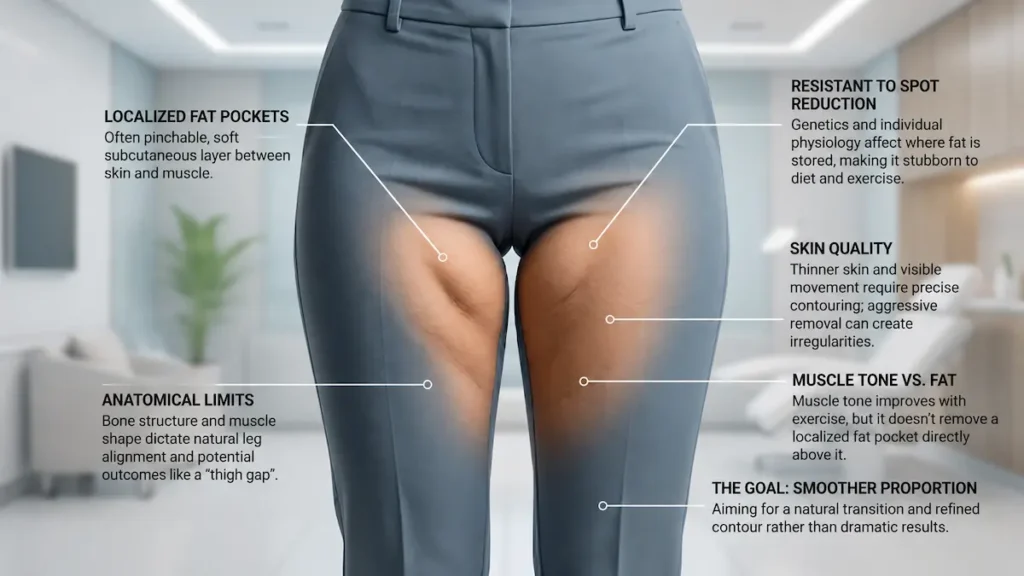
That does not mean the inner thigh is “bad” or abnormal. It means the area has a mix of anatomy, genetics, skin behaviour, and friction that makes it stubborn. Liposuction can help when the fullness is caused by a defined pocket of subcutaneous fat. It cannot rewrite bone structure, muscle shape, or skin elasticity.
Where inner-thigh fat sits
The fat treated with liposuction sits under the skin and above the deeper muscle layer. On the inner thigh, this layer may feel soft and pinchable, especially toward the upper inner leg. In the right candidate, removing part of this layer can create a smoother transition from the groin crease down toward the knee.
This is also why the assessment must be careful. The inner thigh is not a thick, forgiving area like the abdomen in some patients. It has thinner skin, visible movement, and less room for aggressive fat removal. A conservative plan often looks better than a dramatic one.
For patients with lipedema-type heaviness or tenderness, the conversation is different. That concern may involve pain, swelling, bruising tendency, and disproportionate lower-body volume. If that sounds familiar, read more about liposuction used for lipedema rather than treating the issue as simple cosmetic inner-thigh fat.
Why diet and exercise may not change it much
Diet and training reduce overall body fat, but they do not let you choose exactly where fat leaves first. Someone can be active, at a stable weight, and still carry a small inner-thigh pad because that is where their body prefers to store fat. That is one reason the area can feel frustrating.
Exercise can improve muscle tone in the adductors, glutes, and legs. It can also improve posture and the way the lower body moves. But muscle tone does not directly remove a localized fat pocket sitting above the muscle.
That is where liposuction may fit. It is a contouring tool, not a weight-loss method. The best results usually come from treating a specific, pinchable fat deposit on an otherwise stable body.
What liposuction can actually do here
Inner thigh liposuction can reduce localized fullness, improve the way the thighs sit in clothing, and create a cleaner line through the upper leg. For some patients, it also reduces mild friction between the thighs. The change is usually refined rather than dramatic.
It should not be sold as a guaranteed “thigh gap” procedure. A visible gap depends on pelvis width, femur angle, muscle shape, fat distribution, and how the legs naturally stand. Some excellent results still do not produce a gap, and chasing one too aggressively can create contour problems.
A better goal is smoother proportion. The question is not, “Can every bit of fat be removed?” It is, “How much can be removed while keeping the skin smooth, the contour natural, and the result stable?”
Are You a Good Candidate? The Skin-Laxity Threshold
The key issue with inner thigh liposuction is not just fat. It is skin response. If the skin can contract after fat removal, the result can look smooth and lighter. If the skin cannot contract, the treated area may look looser, wrinkled, or uneven after the volume underneath has been reduced.
This is the skin-laxity threshold: the point where removing fat no longer improves the appearance because the skin envelope has lost too much support. It is one of the most important parts of the consultation. ASPS patient guidance also frames skin quality as a major driver of liposuction outcomes, especially when skin tightening or lifting may be needed in addition to fat removal: why skin quality drives liposuction results.
The skin elasticity “pinch test”
A simple at-home check can help you understand the issue, although it does not replace a surgeon’s exam. Gently pinch the upper inner thigh while standing. If what you feel is mainly soft thickness under the skin and the skin itself feels springy, liposuction may be reasonable to discuss.
If the pinch feels mostly thin, loose, or crepey, the issue may be skin more than fat. If the skin hangs in a fold when you lift or move the leg, liposuction alone is less likely to give a clean result. It may reduce bulk, but it will not remove the extra skin envelope.
The pinch test is only a clue. A proper assessment also looks at weight stability, prior weight loss, age-related skin change, stretch marks, cellulite pattern, and how the skin behaves when you sit, stand, and walk.
| Assessment sign | More likely liposuction candidate | More limited candidate | Why it matters |
|---|---|---|---|
| Pinch thickness | Soft, localized fat pad | Thin, loose skin fold | Liposuction removes fat, not excess skin |
| Skin recoil | Skin springs back after pinching | Skin stays creased or wrinkled | Poor recoil can lead to sagging after fat removal |
| Surface texture | Mostly smooth skin | Crepey texture or marked cellulite | Texture may become more visible once volume is reduced |
| Weight history | Stable weight, modest fat pocket | Major weight loss with hanging skin | Skin excess often needs excision rather than suction |
| Realistic solution | Inner thigh liposuction may be suitable | Thigh lift may need discussion | The best procedure is the one that matches the tissue problem |
When lipo alone can give a smoother result
Liposuction alone is most likely to look smooth when the patient has a localized fat pocket, good skin tone, and no major hanging fold. The fat should feel pinchable and superficial rather than deep, hard, or purely structural. A stable weight also matters because future weight gain can soften the result.
In that setting, conservative fat removal can reduce rubbing and refine the line of the inner thigh. The goal is not to hollow the leg. It is to make the transition look lighter and more proportionate.
For Canadian patients travelling for surgery, this candidate selection step is especially important. A good result is not only about the operation day. It also depends on swelling control, compression, safe movement during recovery, and follow-up once you are home.
When loose skin can turn lipo into a disappointment
If the inner thigh already has looseness, liposuction can remove the remaining support under the skin. The area may become smaller, but not necessarily better shaped. This is the classic mismatch: the patient wants tightness, but the procedure only removes fat.
Loose skin does not always mean surgery is impossible. It means the plan may need to change. In some patients, a small amount of liposuction can still help contour the fat layer, but the main correction may require skin removal rather than suction alone.
This is where a careful, RCPSC-equivalent surgical discussion matters. The honest answer may be that inner thigh liposuction is enough, that it should be combined with another strategy, or that a lift is the more predictable route.
When Liposuction Isn’t Enough?
Inner thigh liposuction has a clear limit: it can remove fat, but it cannot cut away excess skin. That sounds simple, yet it is the reason some patients love their results and others feel underwhelmed. The procedure must match the tissue problem.
If the inner thigh looks full because of fat, liposuction may be a good contouring option. If the area looks heavy because loose skin hangs from the upper inner thigh, suction alone is unlikely to create a tighter leg. In that case, the more honest discussion may involve when a thigh lift is the better option.
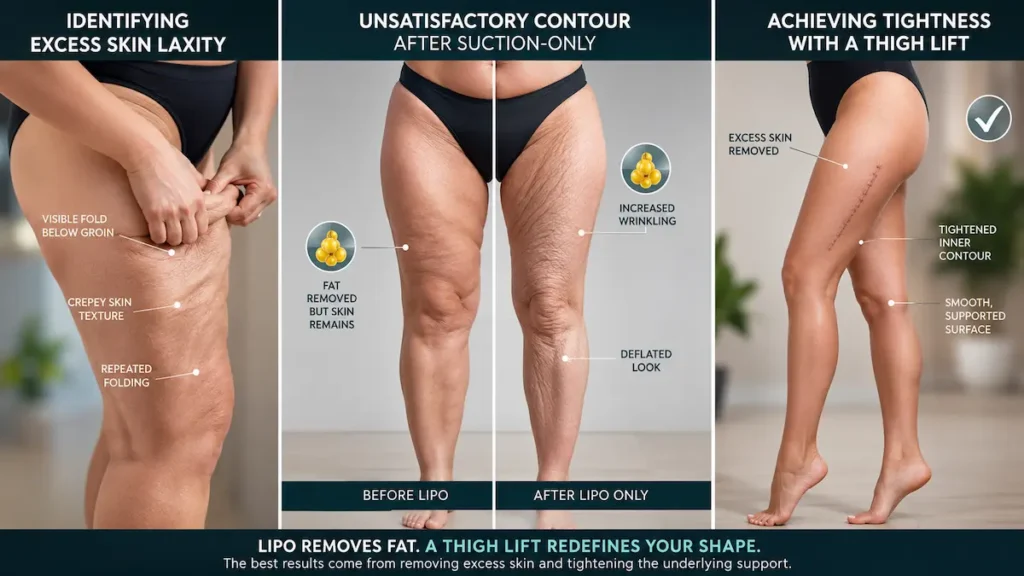
Signs that skin removal may be needed
Skin removal becomes more relevant when the upper inner thigh has a visible fold, especially after major weight loss. The fold may appear near the groin crease, extend downward, or become more obvious when standing with the legs slightly apart. This is different from a soft, pinchable fat pad.
Stretch marks can also be a clue. They do not automatically rule out liposuction, but they may suggest the skin has been stretched beyond its ability to recoil fully. Crepey skin, repeated folding, and a hanging edge are stronger warning signs.
The final decision should come from an in-person or virtual surgical evaluation, not a mirror test alone. Photos taken standing, sitting, and gently lifting the skin can help the surgical team judge whether fat removal, skin excision, or a staged plan is more reasonable.
The lipo-only “deflated” risk
One of the main risks of doing liposuction on loose inner-thigh skin is the deflated look. The treated area may become smaller, but the surface can look less supported. That can mean more wrinkling, more folding, or an uneven contour that was less noticeable before the fat was removed.
This is why aggressive suction is not automatically better. The inner thigh is a movement area. It stretches when you walk, sit, cross your legs, and exercise. Removing too much fat can make the skin and texture more visible, especially if elasticity is borderline.
Peer-reviewed liposuction literature also flags residual skin laxity and contour irregularity as important issues when candidate selection or tissue response is not ideal: documented liposuction outcomes and skin-laxity issues.
Why honesty in consultation matters
A good consultation should not simply confirm what you hoped to hear. It should explain what inner thigh liposuction can do, what it cannot do, and what trade-offs come with each option. That is especially important when you are travelling from Canada and need a plan that still makes sense after you return home.
If the surgeon believes lipo alone is likely to disappoint, that is not a negative answer. It is useful information. It may prevent you from choosing a smaller procedure that cannot solve the main problem.
Surgeon-led perspective: Liposuction removes fat; it does not tighten loose skin. When skin laxity is the dominant issue, the honest recommendation may be a thigh lift rather than more aggressive suction.
There is also a safety reason to be conservative. Over-treatment in a thin, high-movement area can create dimpling, waviness, or an unnatural transition. If you are comparing liposuction with skin-excision body surgery, it may help to understand how skin-excision body surgery works in broader body-contouring planning.
What Realistic Results Look Like?
Realistic inner thigh liposuction results are usually about contour refinement, not total transformation. The best outcomes often look like a smoother upper-leg line, less fullness in fitted clothing, and a lighter transition between the thighs. The change should look natural when you stand, walk, and sit.
The result also develops gradually. Early swelling can blur the contour, and the inner thigh may feel firm, tender, or uneven while the tissues settle. Final shape is not judged in the first few weeks.
Contour change versus the “thigh gap” myth
A thigh gap is not a reliable or healthy surgical goal. It depends on pelvic width, hip angle, femur position, muscle bulk, and natural stance—not just fat. Some patients can have excellent inner thigh liposuction results without ever having a visible gap.
Trying to create a gap by removing too much fat can be risky. It may leave the leg looking hollow, uneven, or older than expected. In many cases, a subtle, smooth contour is more attractive and more stable than an over-reduced inner thigh.
A better benchmark is proportion. Do the thighs look more balanced with the hips, knees, and lower legs? Does clothing fit more comfortably? Does the treated area still look soft and natural in motion? Those are more useful questions than whether there is space between the legs in a posed photo.
How results settle over weeks and months
In the first one to two weeks, swelling can make the result difficult to read. The area may look puffy, bruised, or uneven. That is not the final contour. Compression, gentle movement, and time all matter during this stage.
By six weeks, many patients can see a clearer outline, although swelling may still come and go. The inner thigh can hold fluid longer than expected because of gravity, lymphatic drainage, and daily movement. This is normal when it is gradually improving.
By three to six months, the contour is usually much more reliable. Some subtle refinement can continue beyond that, especially where the skin is slow to retract. Patients who expect an immediate “final” result often worry too early.
How to maintain the result
Liposuction permanently removes treated fat cells, but it does not prevent future weight gain. Remaining fat cells can still enlarge if weight increases. That means stable habits are part of protecting the result.
Strength training can help the legs look more balanced, even though it does not replace fat removal. Walking, lower-body conditioning, hydration, and stable weight all support long-term contour. None of this has to be extreme.
It is also worth protecting the skin itself. Sun exposure, smoking, repeated weight cycling, and poor nutrition can affect skin quality. Since skin elasticity is central to inner-thigh results, aftercare is not just about swelling; it is also about maintaining the tissue that shapes the final contour.
If you are worried about poor contour, visible irregularity, or over-treatment, review what over-aggressive liposuction can cause before choosing a plan. It can help you ask sharper consultation questions.
Recovery & Protecting Your Result
Recovery after inner thigh liposuction is usually manageable, but the area deserves respect. The inner thighs move constantly when you walk, sit, climb stairs, or get in and out of a car. Swelling can also settle lower in the legs because of gravity.
The goal during recovery is simple: reduce swelling, protect the contour, and avoid rushing activity before the tissues have stabilized. For patients travelling from Canada, this also means planning the return trip around comfort, mobility, compression, and follow-up instructions.

Compression and swelling
A compression garment is usually worn to support the treated area and help control swelling. It does not “shape” the final result by force, but it can reduce fluid build-up and make early movement more comfortable. The garment should feel supportive, not painfully tight.
Swelling is expected. Bruising, firmness, mild numbness, and uneven puffiness can also occur in the first weeks. What matters is the trend: the area should gradually improve, even if swelling fluctuates from day to day.
If the garment digs into the groin crease or creates pressure marks, it should be reviewed by the care team. Poorly fitting compression can irritate the skin, especially in a high-friction area like the inner thigh.
Activity timeline
Most patients are encouraged to walk gently soon after surgery because movement supports circulation. That does not mean returning to full training right away. Long walks, lower-body workouts, cycling, and high-friction activity usually need to wait until the surgeon clears them.
Desk-based work may be possible within several days, depending on bruising, swelling, and whether other areas were treated. More physical work may require longer. The inner thigh can feel tight or tender when taking longer strides, so recovery should be paced.
Flying home requires planning. Patients should follow their surgeon’s fit-to-fly instructions, keep walking during travel when safe, hydrate, and avoid sitting still for long stretches. A written recovery plan is especially helpful once you are back in Canada and communicating virtually.
When the final shape becomes clear
The first visible improvement may appear once early swelling starts to settle, but final judgment should wait. Many patients see a clearer contour around six weeks, with more refinement over three to six months. Some subtle tissue softening can continue beyond that.
If skin elasticity is good, the area usually becomes smoother as swelling decreases. If skin elasticity is borderline, the result may take longer to interpret because the skin needs time to retract as much as it can. Patience helps.
Questions about device-assisted options often come up here. Laser-assisted techniques may help liquefy fat and may provide some tightening effect in selected cases, but they do not replace a lift when skin laxity is significant. For that distinction, see whether laser lipo tightens skin.
Cost is a separate decision factor, but it should not lead the medical choice. Since this article is about realistic results rather than pricing, the full breakdown belongs on the dedicated page for liposuction cost in CAD.
Planning note for Canadian patients: Ask how compression, swelling checks, virtual follow-up, and return-to-Canada aftercare will be handled before you book. A good contour plan should include recovery logistics, not just the surgical technique.
Frequently Asked Questions: Inner Thigh Liposuction
These are the questions most patients ask when they are trying to decide whether inner thigh liposuction is enough or whether loose skin changes the plan. The answers below are general; your own recommendation depends on skin quality, fat thickness, medical history, and examination.
Will inner thigh lipo leave loose skin?
It can if the skin is already loose or has poor elasticity. Liposuction removes fat from under the skin; it does not remove extra skin. If your skin is firm and springy, it may retract well. If it is crepey, hanging, or stretched from major weight loss, lipo alone can make looseness more noticeable.
Does inner thigh liposuction create a thigh gap?
Not reliably. A thigh gap depends on bone structure, pelvis width, muscle shape, natural stance, and fat distribution. Inner thigh liposuction may slim the area, but promising a gap is not medically responsible. A smoother contour is a better goal.
How long is inner thigh lipo recovery?
Many patients return to light daily activity within several days, but swelling and tenderness can last for weeks. Exercise and high-friction activity usually resume only after the surgeon clears them. A clearer contour often appears around six weeks, with further refinement over three to six months.
Can liposuction cause dimpling on the inner thigh?
Yes, especially if too much fat is removed, the skin has poor elasticity, or there is pre-existing cellulite. The inner thigh is a delicate area, so conservative technique is important. Removing less fat evenly often looks better than removing too much aggressively.
Do I need a thigh lift instead?
You may need a thigh lift if the main issue is loose, hanging skin rather than fat. Signs include a visible upper-inner-thigh fold, crepey skin, poor recoil after pinching, or major weight-loss skin excess. Some patients need liposuction only; others need skin excision; some need a combined or staged plan.
Are inner thigh liposuction results permanent?
The treated fat cells are removed permanently, but remaining fat cells can still enlarge with weight gain. Results last best when your weight is stable and your skin quality remains healthy. Pregnancy, major weight changes, ageing, and skin laxity can all affect the long-term appearance.
Final Thoughts
Inner thigh liposuction can be a strong option for the right patient, but the “right patient” is not simply someone who dislikes their thighs. The best candidate has a localized fat pocket, stable weight, realistic goals, and skin that can retract after fat removal.
If the main concern is skin laxity, liposuction alone may not deliver the result you want. That is not failure. It is a sign that the treatment plan should be adjusted to the tissue problem. The most natural results come from matching the procedure to the anatomy, not forcing one procedure to solve every concern.
For Canadian patients comparing surgery abroad, look for a plan that covers candidacy, conservative contouring, compression, travel timing, and long-term virtual follow-up. The safest choice is the one that explains the limits as clearly as the benefits.
Medical disclaimer: This article is for educational purposes only and is not medical advice, diagnosis, or a substitute for consultation with a qualified physician or surgeon. Results, recovery, and risks vary by patient. If you have pain, sudden swelling, fever, skin colour changes, shortness of breath, or any urgent concern after surgery, contact your surgical team or seek medical care promptly.