Inner thigh liposuction can slim a stubborn area that often resists diet and exercise, but it works best when the skin still has good elasticity. If the inner thigh has significant loose skin, liposuction alone may leave the area looking deflated or more creased, and a thigh lift may be the more honest option.
The inner thighs are a common frustration because they affect more than appearance. They influence how trousers fit, how the legs rub when walking, and how balanced the lower body looks from the front. Many patients hope liposuction will create a smoother line between the groin, upper thigh and knee.
That can happen in the right candidate. But the word “right” matters.
At AKM Clinic, liposuction in Turkey is planned as a contouring procedure, not a weight-loss shortcut. The goal is to remove resistant fat with controlled, conservative shaping while protecting skin quality, symmetry and long-term smoothness.
This guide focuses only on the inner thigh: what liposuction can realistically improve, who is likely to get a smooth result, when skin laxity changes the plan, and what recovery usually looks like.
Table of Contents
Why the Inner Thigh Is Such a Common Problem Area?
The inner thigh is one of those areas where even a small amount of fat can change the whole leg line. It sits near a natural crease, moves constantly when you walk, and often holds fat differently from the front or outer thigh. That is why two people at the same weight can have very different inner-thigh contours.
For some patients, the issue is a clear pocket of soft fat. For others, it is a mixture of fat, skin looseness, mild cellulite, muscle shape and natural pelvic structure. Liposuction can help with one part of that picture: fat. It cannot change bone width, muscle shape, or the natural way your thighs meet.
Why inner-thigh fat can be difficult to shift
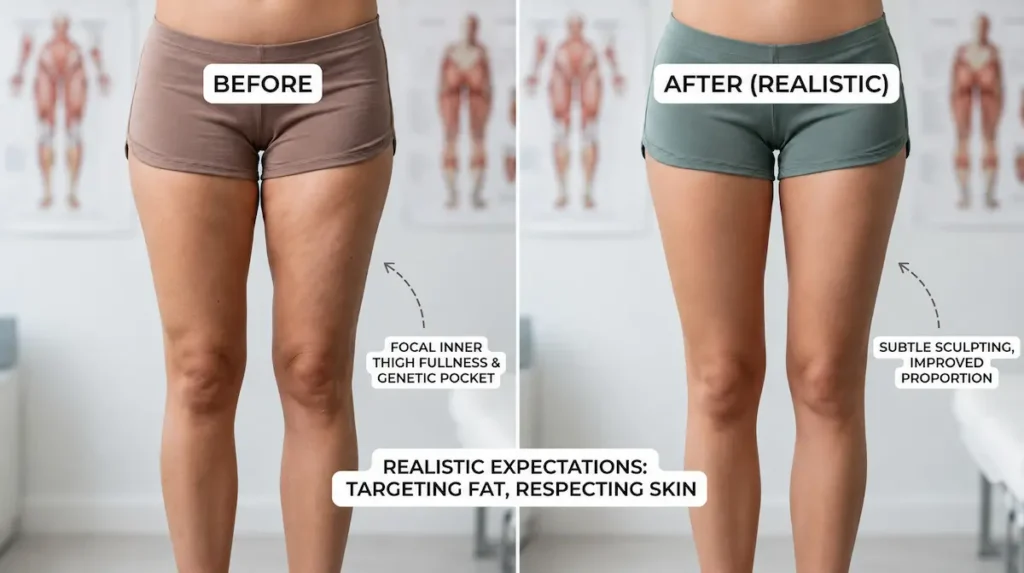
Inner-thigh fat is often genetically influenced. You may lose weight from the waist, face or upper body first, while the upper inner thighs change slowly. Exercise can strengthen the adductors and improve tone, but it does not allow you to “spot reduce” one precise fat pad.
This is why a patient can be active, healthy and close to their ideal weight yet still feel the inner thighs look heavy or rub together. In that setting, liposuction may be useful because it targets a localised deposit rather than asking the whole body to lose more weight.
There is a second reason the area is difficult: the skin is relatively delicate. The inner thigh does not behave like the flank or upper back. If too much fat is removed, or if the skin cannot contract well, the result may look uneven rather than refined.
What liposuction can actually do here
Inner thigh liposuction removes selected fat beneath the skin through small cannula entry points. A skilled surgeon does not simply “empty” the area. The work is more like soft sculpting: reducing fullness while leaving enough support for the skin to settle smoothly.
The most realistic improvements include:
- a slimmer upper inner-thigh line;
- less rubbing in patients whose rubbing is caused by fat fullness;
- a smoother transition from the groin crease towards the mid-thigh;
- better proportion between the inner thigh, knee and lower leg;
- more comfortable fit in close-cut clothing.
These changes are usually subtle to moderate. Inner thigh liposuction is not designed to create a dramatic leg transformation or a guaranteed “thigh gap”. A natural result often looks like the same body, just with a cleaner and lighter inner-leg contour.
When inner-thigh fullness may not be fat alone
Not every inner-thigh concern is a liposuction concern. Some patients are seeing skin laxity after weight loss. Others have soft tissue descent, cellulite, swelling, or a naturally wider upper-leg structure. Treating all of these as “fat” can lead to a poor recommendation.
This is also where lipedema must be separated from cosmetic inner-thigh fullness. Lipedema can create painful, disproportionate fat build-up in the legs and needs a different medical assessment. If your thigh fullness is painful, bruises easily, feels nodular, or affects both legs in a disproportionate pattern, read more about liposuction used for lipedema before assuming this is a purely cosmetic contouring issue.
For straightforward cosmetic inner-thigh fat, the main question is not “Can fat be removed?” It usually can. The better question is: will the skin behave well after the fat is removed?
Are You a Good Candidate? The Skin-Laxity Threshold
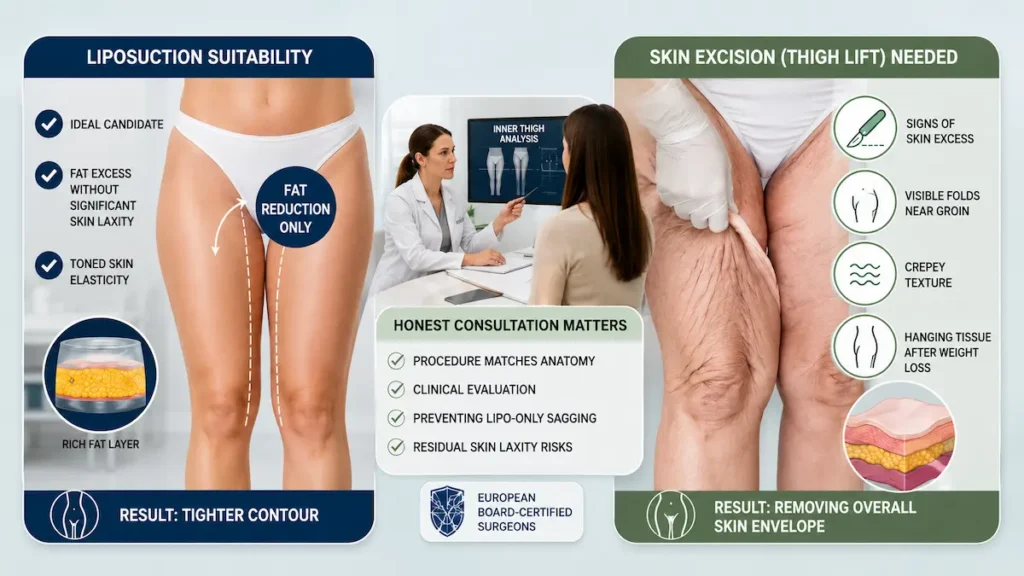
The best inner-thigh liposuction candidates usually have a defined pocket of fat and skin that still has enough spring to contract after surgery. This balance matters because removing fat reduces volume. Skin then has to adapt to the smaller shape underneath.
If the skin is firm and elastic, it can often redrape smoothly. If the skin is already loose, crepey, stretched or hanging, removing the underlying fat may reveal the looseness more clearly. This is the key threshold: liposuction can slim, but it does not lift loose skin.
The simple “pinch test” idea
A proper assessment needs a surgeon’s hands-on examination, but the basic idea is easy to understand. If you pinch the upper inner-thigh skin and it feels thick because there is soft fat under it, and the skin springs back, liposuction may be suitable. If the pinch feels mostly like loose, thin skin that folds or hangs, lipo alone may be limited.
Surgeons also look at how the skin behaves while standing, not only lying down. The inner thigh may look smoother on a treatment bed because gravity is reduced. Standing shows the real picture: folds, laxity, asymmetry and the way the upper thigh meets the groin.
| Assessment sign | What it usually suggests | Likely direction |
|---|---|---|
| Soft, localised fat with good skin recoil | The skin may contract well after fat removal | Inner thigh liposuction may be suitable |
| Thin, crepey skin with little fat underneath | The main issue is skin laxity, not fat | Liposuction alone may disappoint |
| Loose folds after major weight loss | Skin excess may need excision | Thigh lift assessment may be more appropriate |
| Fullness with pain, bruising or disproportionate leg shape | A medical fat-distribution condition may be involved | Further diagnostic assessment is needed |
When liposuction alone can give a smooth result
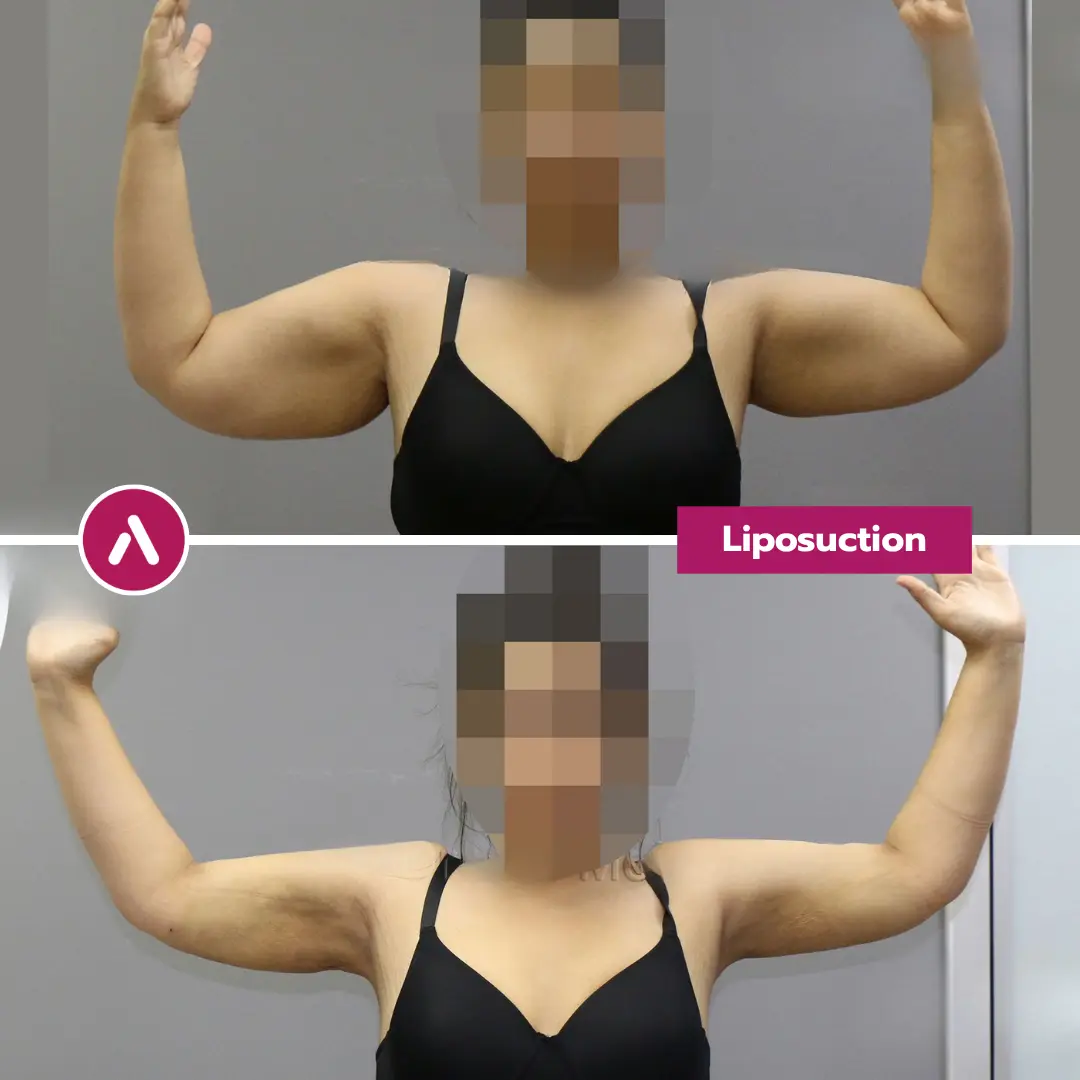
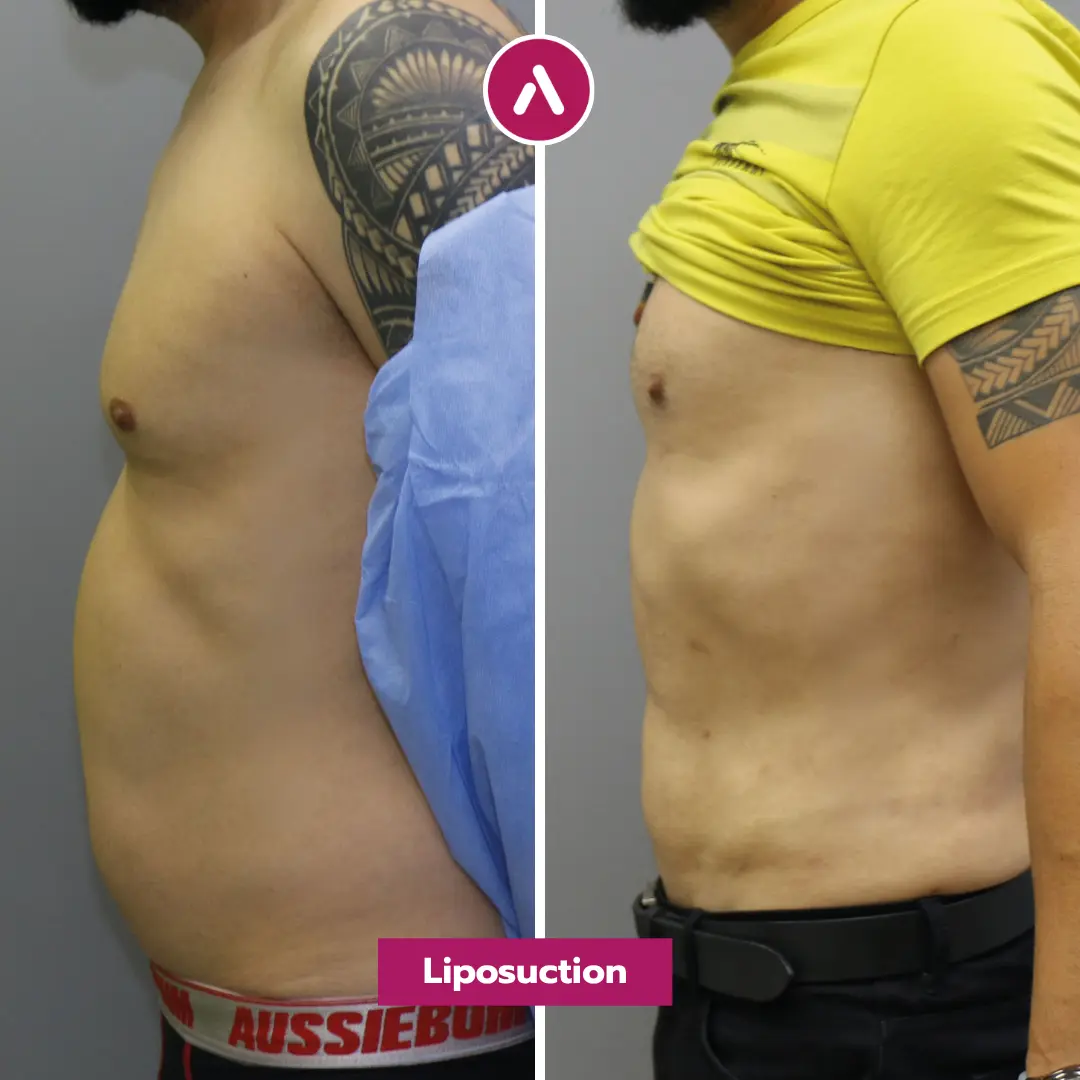
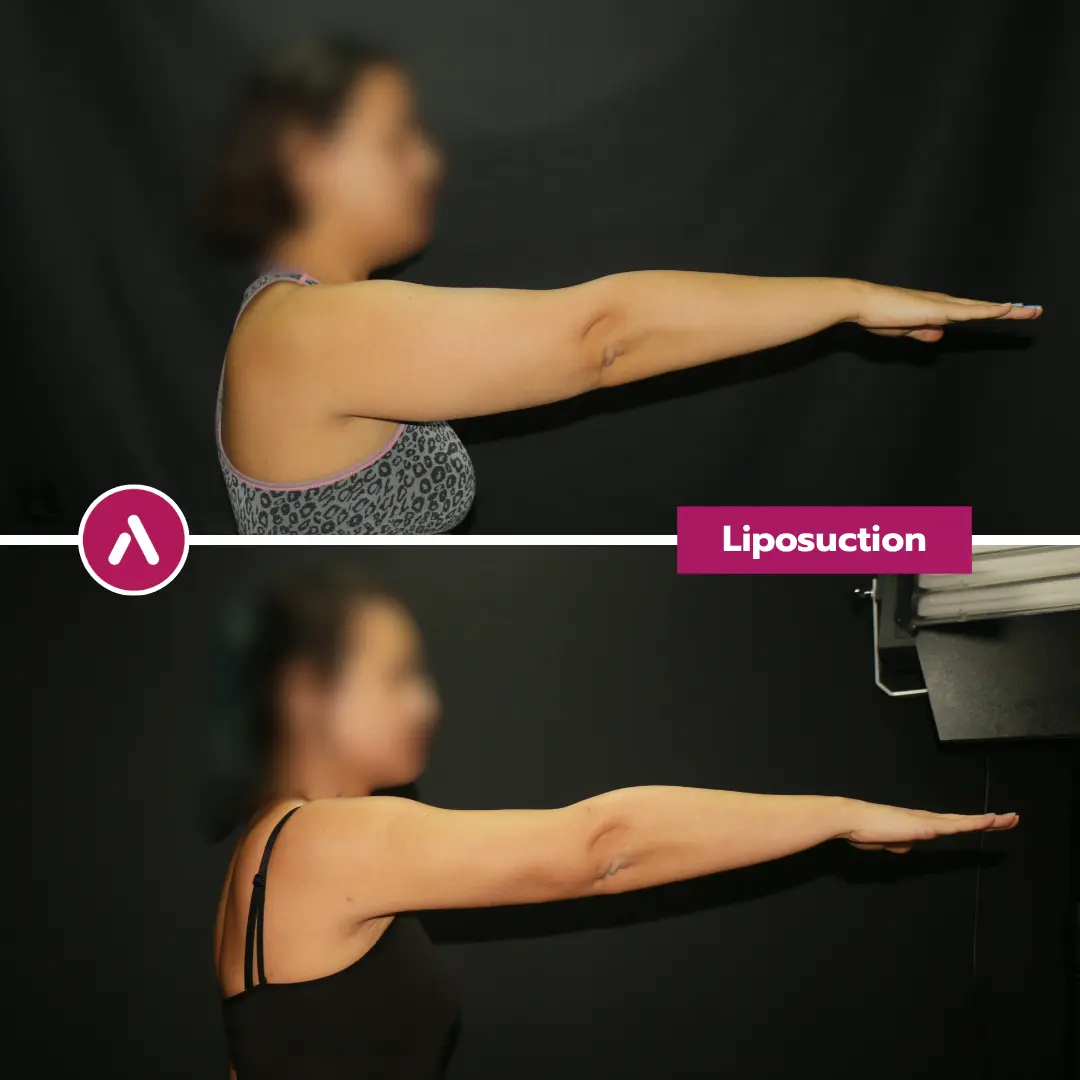
Liposuction works best when the concern is volume rather than looseness. A good candidate may say, “My inner thighs have always been fuller than the rest of me,” rather than “My skin hangs since weight loss.” They may be close to a stable weight and have no major skin folds.
Age matters less than skin behaviour. A younger patient can have poor elasticity after large weight changes. An older patient can still have firm skin if their weight has been stable and their tissue quality is good.
In a good candidate, the surgeon can remove fat conservatively, feather the edges, and avoid creating a sharp hollow next to untreated areas. This is how the result stays soft rather than carved out.
When loose skin can turn lipo into a disappointment
Loose skin changes the equation. If the surgeon removes fat from beneath lax skin, the skin has less internal support. Instead of tightening, it may wrinkle, fold or look deflated. This is the common mismatch behind many unhappy thigh-lipo results.
This does not mean every patient with mild laxity needs a lift. It means the surgeon has to be honest about the trade-off. A small amount of looseness may still be acceptable if the patient wants a modest improvement and understands the limits. Significant laxity is different.
Energy-assisted options are sometimes discussed for skin support, but they are not a substitute for removing true excess skin. If your main concern is loose skin, it is worth reading about whether laser lipo tightens skin before assuming a device can do the work of a lift.
“Liposuction removes fat; it does not turn loose skin into tight skin. On the inner thigh, the safest plan is often the most conservative one: remove enough fat to improve the contour, but not so much that the skin loses support.”
When Liposuction Isn’t Enough?
Inner thigh liposuction becomes the wrong tool when the main problem is loose skin rather than fat. This is where honest consultation matters. A patient may still want a slimmer inner thigh, but if the tissue has lost support, removing more fat can make the area look softer, emptier or more wrinkled.
The aim is not to talk every patient into a larger operation. It is to choose the procedure that matches the anatomy. For one patient, a careful liposuction plan is enough. For another, the better result may require removing skin, not just reducing fat.
Signs that skin excision may be needed
Skin excision becomes more relevant when the inner thigh has visible folds, hanging tissue or a “deflated” look after weight loss. These signs suggest that the skin envelope is larger than the tissue underneath it. Liposuction can reduce bulk, but it cannot shorten that skin envelope.
Common signs include:
- skin that folds over itself near the groin crease;
- thin, crepey texture rather than soft fat fullness;
- loose tissue that moves or hangs when standing;
- inner-thigh laxity after major weight loss;
- rubbing caused mainly by hanging skin, not fat volume.
In these cases, the discussion may shift towards when a thigh lift is the better option. That does not mean liposuction has failed. It means the problem is different from simple fat excess.
The “lipo-only” sagging risk
The inner thigh is unforgiving because the skin is thin and mobile. Over-aggressive liposuction can remove the fat that was helping support the skin. The result may be a smaller thigh, but not necessarily a smoother one.
This is why conservative contouring is so important. The surgeon has to decide not only how much fat can be removed, but how much should be left behind to preserve a soft transition. The most natural results often come from restraint.
Published liposuction research also recognises residual skin laxity and contour irregularity as issues that can affect outcomes, especially when patient selection is poor or tissue quality is overestimated. For a deeper clinical discussion, see documented liposuction outcomes and skin-laxity issues.
Why consultation honesty matters
A good consultation should not simply confirm what you already hope to hear. It should test the plan against your skin quality, weight history, scar tolerance and expectations. This is especially important for UK patients travelling abroad, because the operation is only one part of the decision. Aftercare, fit-to-fly timing and remote follow-up also matter.
AKM’s surgical planning is built around European Board-Certified Surgeons, framed for UK patients as a GMC-equivalent credential rather than a UK registration claim. The practical point is straightforward: the surgeon should be able to explain why liposuction is suitable, why it is not, or why a lift may be safer and more predictable.
If skin excision is part of the conversation, it may help to understand the wider body-contouring principle behind procedures such as how skin-excision body surgery works. The anatomy is different, but the concept is similar: when skin is truly excessive, it usually has to be removed to create a tighter shape.
What Realistic Results Look Like?
Realistic inner-thigh liposuction results are usually measured in shape, proportion and smoothness rather than a dramatic before-and-after change. The goal is a refined inner-leg line that fits your body, not a forced gap or an over-sculpted hollow.
This distinction is important. A good result should still look like your legs. Just less heavy through the inner thigh.
Contour change versus the “thigh gap” myth
Many patients ask whether inner thigh liposuction creates a thigh gap. Sometimes, if the patient already has the right pelvic structure, leg alignment and fat distribution, the thighs may separate more after swelling settles. But a thigh gap cannot be promised.
Whether the thighs touch depends on several factors: pelvis width, femur angle, muscle bulk, natural stance, soft-tissue distribution and skin laxity. Liposuction can reduce fat. It cannot change the skeleton or guarantee a specific space between the legs.
A better goal is improved proportion. That might mean less rubbing, a smoother line in fitted clothing, or a more balanced transition between the upper thigh and knee. These outcomes are more realistic than chasing a social-media leg shape that may not match your anatomy.
How results settle over weeks and months
Early results can be misleading. The inner thighs often swell, bruise and feel firm after liposuction. One side may look slightly different from the other. The skin can also look a little uneven while inflammation and fluid shift through the tissue.
Most patients see an early change within the first few weeks, but the cleaner contour develops gradually. Swelling commonly improves over several weeks, while final refinement can take a few months. This is normal, especially in an area that moves and rubs during walking.
During this period, compression and careful activity matter. They do not “create” the result, but they help the tissue settle in a controlled way.
What a natural result should and should not look like
A natural inner-thigh result should look smooth, not scooped out. It should blend into the groin, mid-thigh and knee without a sudden hollow. The best outcomes rarely look dramatic from every angle; they look balanced.
Over-treatment can create problems: grooves, waviness, dimpling or a deflated appearance. These concerns sit closer to the territory of poor planning, poor technique or unrealistic fat removal. If you want to understand the risk side more clearly, read about what over-aggressive liposuction can cause.
| Expectation | Realistic? | Better way to frame it |
|---|---|---|
| “I want my inner thighs to look slimmer in clothing.” | Often realistic | Focus on contour and proportion. |
| “I want a guaranteed thigh gap.” | Not predictable | Pelvic structure and leg alignment also matter. |
| “I want loose skin tightened without scars.” | Limited | Liposuction does not remove excess skin. |
| “I want smoother inner thighs after weight loss.” | Depends on laxity | A lift may be needed if skin folds are significant. |
How to protect the result long term
Liposuction removes fat cells from the treated area, but it does not prevent future weight gain. If your weight rises after surgery, remaining fat cells can enlarge. The inner thighs may still stay more proportionate than before, but the result can soften.
Stable weight is the best long-term protection. Strength training can improve muscle tone and posture, but it will not “maintain” liposuction by itself. The result lasts best when the operation is treated as contour refinement, not a substitute for healthy habits.
Skin quality also continues to change with ageing. A result that looks smooth at six months may slowly soften over the years as collagen, weight and hormones change. That is normal. Good planning simply gives the tissue the best chance to age gracefully.
Recovery & Protecting Your Result
Recovery after inner thigh liposuction is usually manageable, but the area can feel more sensitive than patients expect because the thighs move constantly. Walking, sitting, sleeping and clothing all involve the treated region. A thoughtful recovery plan helps protect both comfort and contour.
This section gives a realistic overview, not personal medical instructions. Your own timeline depends on the amount of fat removed, whether other areas were treated, your general health, and your surgeon’s aftercare protocol.

Compression and swelling
Compression garments are usually used after thigh liposuction to support the tissue while swelling settles. They should feel firm but not painfully tight. Poorly fitted compression can dig into the groin or create pressure marks, so garment fit needs to be checked carefully.
Swelling often shifts downwards with gravity. This can make the lower thighs or knees feel puffy even if they were not the main treatment area. That does not automatically mean something is wrong. It is part of the fluid movement that happens after lower-body surgery.
ASPS also highlights the importance of skin quality when liposuction is combined with tightening strategies. For a broader explanation of why skin behaviour shapes the outcome, see why skin quality drives liposuction results.
Activity timeline
Most patients are encouraged to walk gently early, because light movement supports circulation. Strenuous exercise, running, lower-body strength work and stretching the inner thighs too aggressively usually need to wait until the surgeon clears them.
A typical pattern may look like this:
- First few days: rest, short walks, swelling and bruising management.
- Week 1: light daily activity, depending on comfort and the extent of treatment.
- Weeks 2–3: swelling starts to reduce, but firmness and tenderness may remain.
- Weeks 4–6: many patients gradually return to more active exercise if cleared.
- Months 2–6: contour continues to refine as swelling and tissue firmness settle.
Do not rush the inner thighs because they feel “nearly fine”. The area can be irritated by friction, long walks, tight clothing and gym movements that open the hips. Pushing too soon can prolong swelling.
When the final shape becomes clear
The final contour is not visible immediately. Early swelling may hide the slimming effect, and temporary firmness can make the area feel uneven. It is common for one side to settle a little faster than the other.
By several weeks, the outline is usually clearer. By a few months, the result is closer to its stable shape. Very subtle refinement can continue beyond that, especially if the inner thighs were treated along with nearby areas.
This is why before-and-after judgement should not happen too early. A result that looks puffy at two weeks may be perfectly normal. A result that looks slightly firm at six weeks may still soften.
Planning travel and aftercare from the UK
For UK patients travelling to Istanbul, recovery planning should be discussed before booking. You should understand how many days you are expected to remain locally, when your post-op check is scheduled, what fit-to-fly criteria are used, and how virtual follow-up works after returning home.
AKM Clinic’s all-inclusive care model includes surgery planning, hospital coordination, hotel stay, private transfers, post-operative medication, compression support and long-term virtual follow-up at 1, 3, 6 and 12 months. The surgery itself is performed in Istanbul at a JCI-accredited facility, with recovery support structured around international patients.
Because this article is not a pricing guide, it does not list procedure fees. If you are comparing overall planning and inclusions, use the dedicated page for the cost of liposuction rather than relying on estimates inside a results-focused article.
Frequently Asked Questions: Inner Thigh Liposuction
These questions cover the concerns patients most often raise when they are deciding whether inner thigh liposuction is the right procedure. The answers stay focused on the inner thigh only, because general liposuction technique, full-body contouring and pricing need separate consultation-level planning.
Will inner thigh lipo leave loose skin?
It can if the skin is already loose before surgery. Inner thigh liposuction removes fat; it does not remove excess skin. If your skin has good elasticity, it may retract smoothly after fat reduction. If the skin is thin, crepey or folded, liposuction alone may make looseness more visible.
Does inner thigh liposuction create a thigh gap?
Not reliably. Liposuction can reduce inner-thigh fullness, but a thigh gap also depends on pelvis width, leg alignment, muscle shape and natural stance. A realistic goal is smoother contour and better proportion, not a guaranteed space between the thighs.
How long is inner thigh lipo recovery?
Most patients can walk gently early and return to light daily activity within the first week, depending on the extent of treatment. Swelling, tenderness and firmness can last for several weeks. The final contour usually becomes clearer over a few months as the tissue settles.
Can liposuction cause dimpling on the inner thigh?
Yes, dimpling or unevenness can happen if too much fat is removed, if the skin has poor elasticity, or if the treated layer heals irregularly. This is why conservative fat removal and careful candidate selection are especially important in the inner thigh.
Do I need a thigh lift instead?
You may need a thigh lift assessment if your main concern is hanging skin, folds after weight loss, or lax tissue rather than a localised fat pocket. Liposuction may still play a role in some combined plans, but true skin excess usually requires skin removal to improve shape.
Are inner thigh liposuction results permanent?
The removed fat cells do not grow back in the same way, but remaining fat cells can enlarge if you gain weight. Results last best when your weight is stable and the procedure is used for contour refinement rather than weight loss.
Is inner thigh liposuction painful?
Most patients describe soreness, tightness, bruising and tenderness rather than sharp pain. The inner thighs can feel sensitive because the area moves when you walk, sit and sleep. Your surgeon should explain pain control, compression and movement guidance before surgery.
Can both inner thighs be treated evenly?
Symmetry is always the goal, but the two thighs may not be identical before surgery. Differences in fat distribution, skin quality and natural anatomy can affect the final result. A good plan aims for balanced contours rather than mathematically identical thighs.
Medical Disclaimer: This article is for educational purposes only and is not a diagnosis, medical advice, or a substitute for an in-person consultation with a qualified surgeon. Suitability for inner thigh liposuction depends on your anatomy, skin quality, medical history and surgical risk profile. Results vary between patients. If you have pain, swelling, skin changes or concerns after surgery, contact your surgeon or seek appropriate medical care promptly.
To understand whether your inner thighs are better suited to liposuction, a thigh lift, or a more conservative plan, book a free virtual consultation with AKM Clinic and request a personalised assessment.