
For many Canadian patients, the concern is not the entire nose. The bridge may already suit the face. Breathing may be normal. The concern may be the nasal tip: too round, too droopy, too wide, or not defined enough in photos.
That is where tip plasty Turkey becomes a focused search. Tip plasty is a narrower form of nasal surgery that reshapes the cartilage of the nasal tip without changing the bony bridge or performing a full rhinoplasty. For patients comparing rhinoplasty options at AKM Clinic, the key question is simple: can the tip be refined on its own, or does the whole nose need a broader surgical plan?
The answer depends on anatomy. Tip plasty can be a strong option when the bridge is balanced and the concern is isolated to the lower third of the nose. It is not a shortcut for every patient.
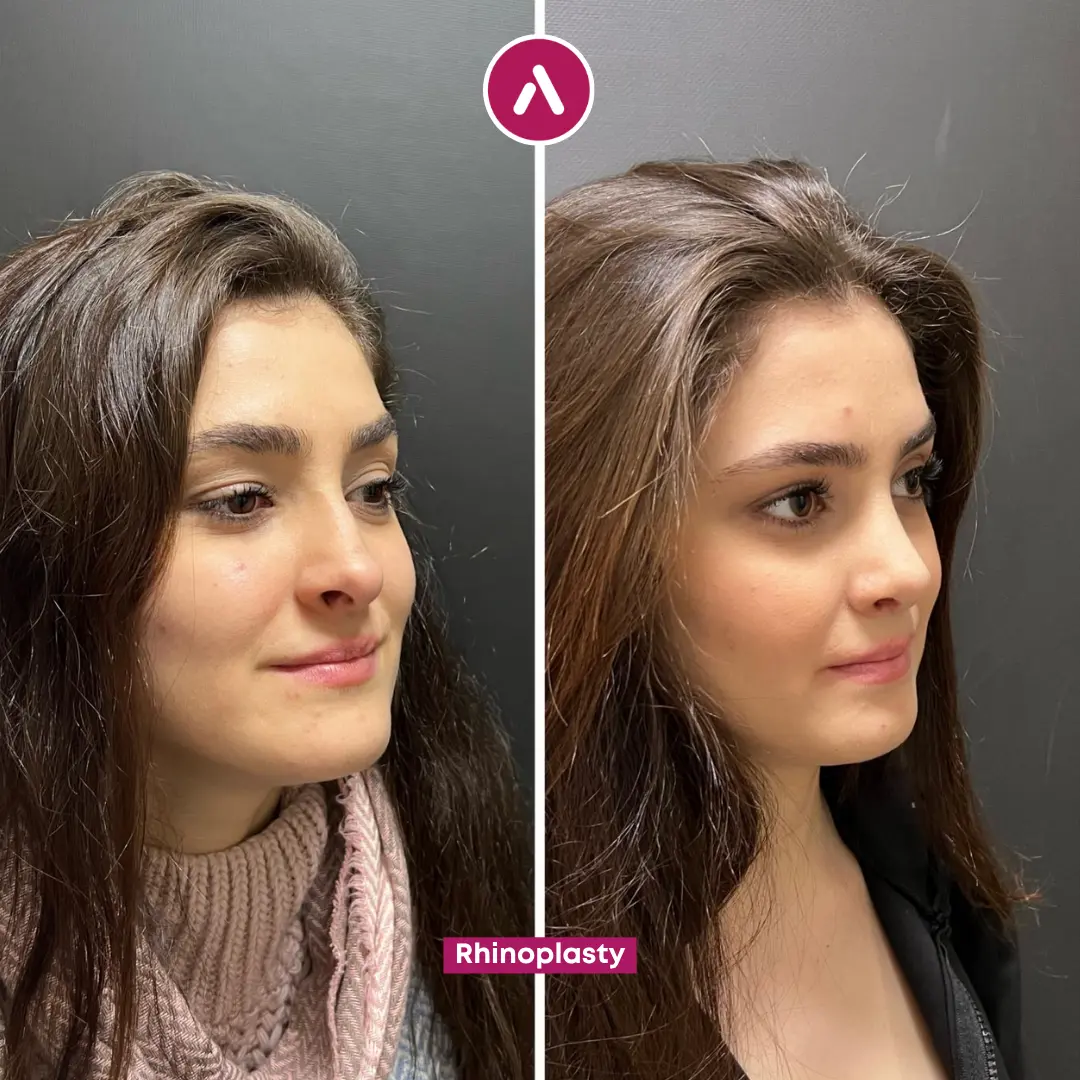
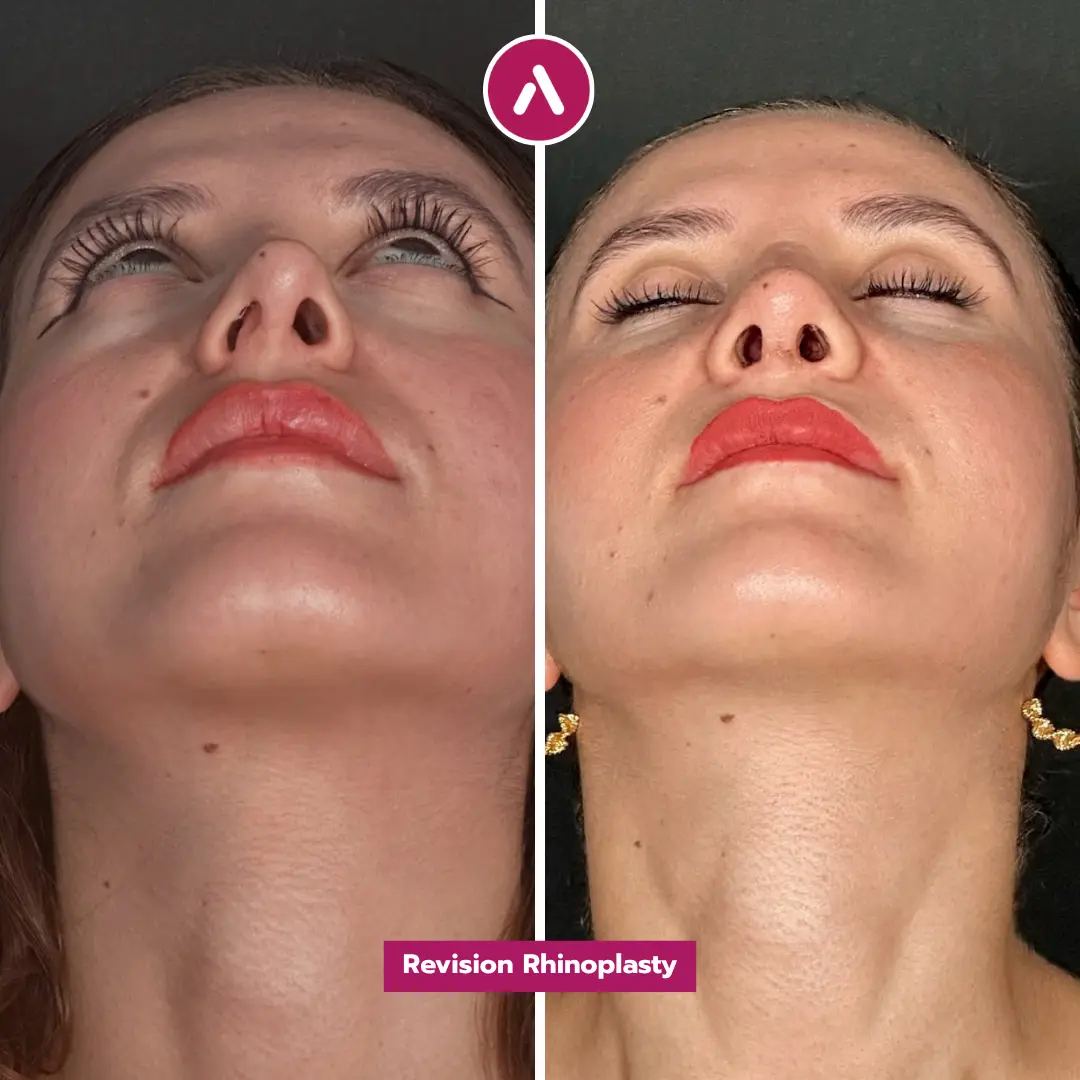
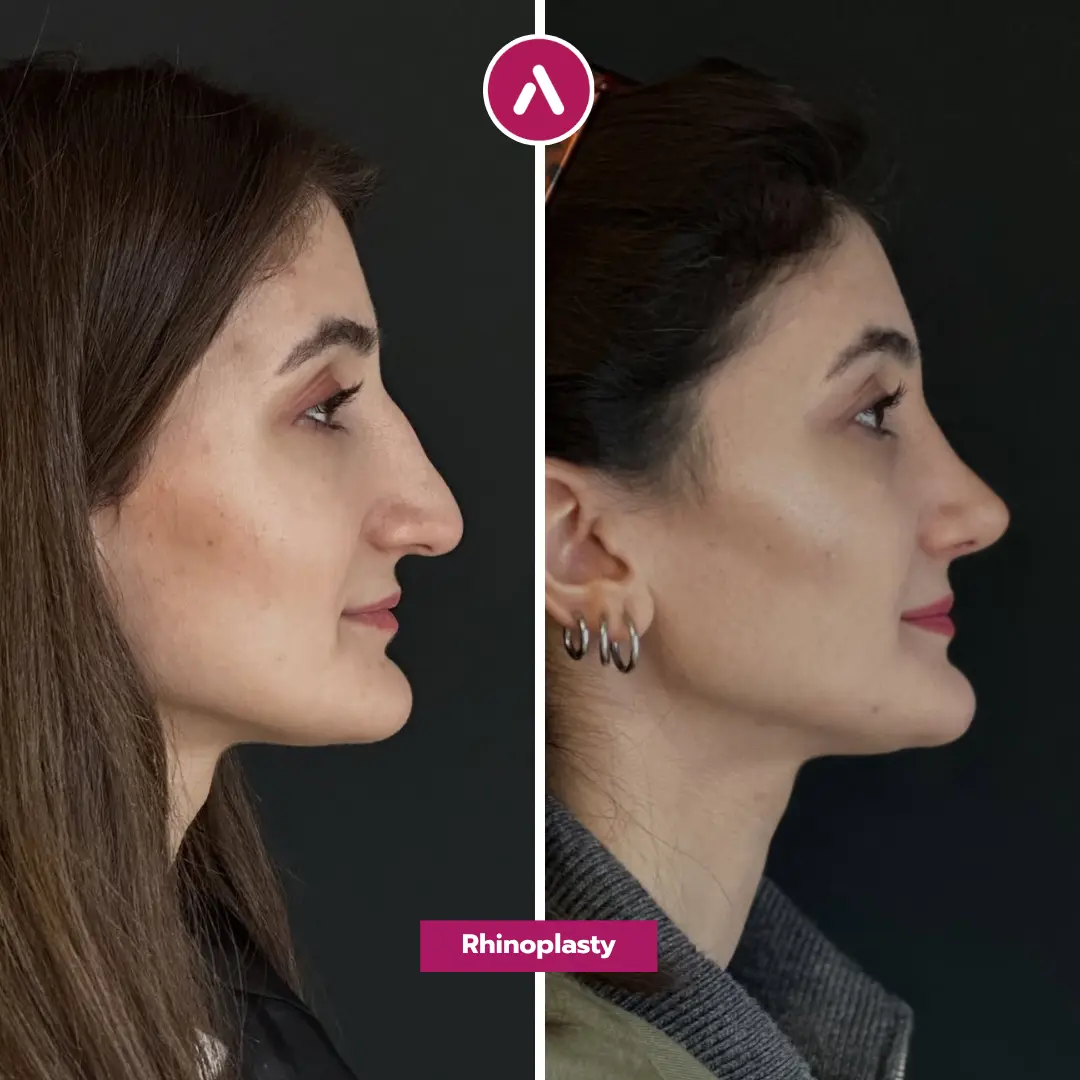
Quick Summary: Tip plasty is a focused rhinoplasty procedure that refines only the nasal tip, without altering the bridge or bony framework. It suits Canadian patients whose dorsum is satisfactory but whose tip is bulbous, drooping, boxy, or under-projected.
Because the procedure is limited to the nasal tip, recovery is usually shorter than full rhinoplasty. It is also more accessible in cost, provided the patient is a true candidate for tip-only correction.
Table of Contents
What Tip Plasty Is — And Is Not?
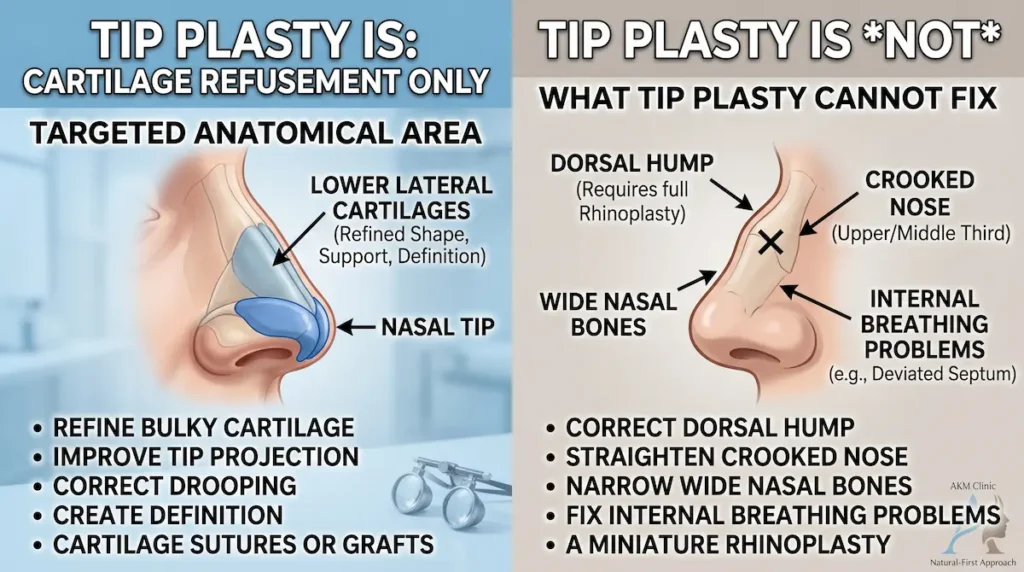
Tip plasty is best understood as a cartilage-focused nasal refinement procedure. It targets the shape, support, projection, and rotation of the nasal tip, while leaving the upper bridge and nasal bones untouched. That limited scope is the reason patients often see it as a more conservative option.
Still, conservative does not mean simple. The nasal tip is one of the most technically demanding areas in facial plastic surgery because millimetres matter. A small change in cartilage shape can alter the whole facial impression.
Anatomical Scope: Tip Cartilages Only
The nasal tip is mainly shaped by the lower lateral cartilages. These paired structures form the rounded lower part of the nose and influence tip width, definition, projection, and rotation. In tip plasty, the surgeon works on these cartilages rather than the nasal bones.
Depending on the patient’s anatomy, tip plasty may involve:
- Refining bulky or rounded lower lateral cartilages
- Improving tip projection so the tip has better support
- Correcting a drooping tip that falls downward when smiling
- Creating more definition in a boxy or wide nasal tip
- Using cartilage sutures or grafts to improve shape and stability
This is why a proper assessment matters. A patient may describe the concern as “my nose is too large,” but the surgeon must determine whether the issue truly comes from the tip, the bridge, the nostril base, or the overall nasal proportions.
What Tip Plasty Cannot Fix
Tip plasty does not correct every nasal concern. If the bridge has a visible hump, the nose is crooked through the upper or middle third, or the nasal bones are too wide, tip-only surgery will not solve the problem. It may even make the imbalance more noticeable.
For example, a patient with a strong dorsal hump and a drooping tip may need full rhinoplasty because both the bridge and the tip contribute to the profile. If only the tip is lifted, the hump may appear stronger. For patients with a high bridge or aquiline shape, the better starting point may be understanding aquiline nose considerations when only the tip is the concern.
Tip plasty also does not correct internal breathing problems caused by a deviated septum. That falls into functional nasal surgery, which requires a different surgical plan.
Why Isolated Tip Work Is Technically Distinct
Tip plasty requires restraint. A full rhinoplasty allows the surgeon to balance the tip against changes in the bridge, radix, and nasal bones. Tip-only work leaves most of the nose unchanged, so the tip must be refined without creating a mismatch.
This is especially relevant for Canadian patients seeking natural results. A narrow, overly sculpted tip can look out of place if the bridge, cheeks, and chin have softer natural proportions. AKM Clinic’s “Natural-First” approach is designed to avoid that type of over-correction.
Tip plasty is therefore not a miniature version of rhinoplasty. It is a separate decision with its own anatomical rules.
Who Is a Tip Plasty Candidate?
The best candidates for tip plasty have one shared feature: the rest of the nose is already reasonably balanced. Their bridge does not need meaningful reduction, the nasal bones do not require narrowing, and the main concern sits in the lower third of the nose.
A virtual consultation can often identify whether tip plasty is realistic, although the final decision depends on in-person examination. Skin thickness, cartilage strength, facial balance, and smile movement all influence the plan.
Bulbous Tip With Acceptable Bridge
A bulbous tip is one of the most common reasons patients ask about tip plasty. The tip may look round, soft, or poorly defined, especially in front-facing photos. Some patients feel their nose photographs larger than it looks in the mirror.
If the bridge is already straight and proportional, the surgeon may be able to refine the lower lateral cartilages without touching the upper nose. This can create a cleaner tip shape while preserving the patient’s natural profile.
Skin thickness matters here. A patient with thick, sebaceous skin may need structural support rather than aggressive cartilage reduction. For this reason, patients should understand thick skin considerations for tip refinement before assuming a bulbous tip can always become sharply defined.
Drooping Tip on Smile
Some patients like their nose at rest but dislike how the tip moves when they smile. The tip may rotate downward, making the nose look longer or heavier in candid photos. This can be caused by cartilage position, ligament support, muscle pull, or a combination of factors.
Tip plasty may improve this pattern by adjusting tip support and rotation. The goal is not to create an upturned or artificial tip. For most Canadian patients, the goal is a tip that stays balanced during normal expression.
Dynamic assessment is essential. The surgeon should evaluate the nose at rest, during smiling, and from multiple angles. A still photo does not always tell the full story.
Under-Projected or Boxy Tip
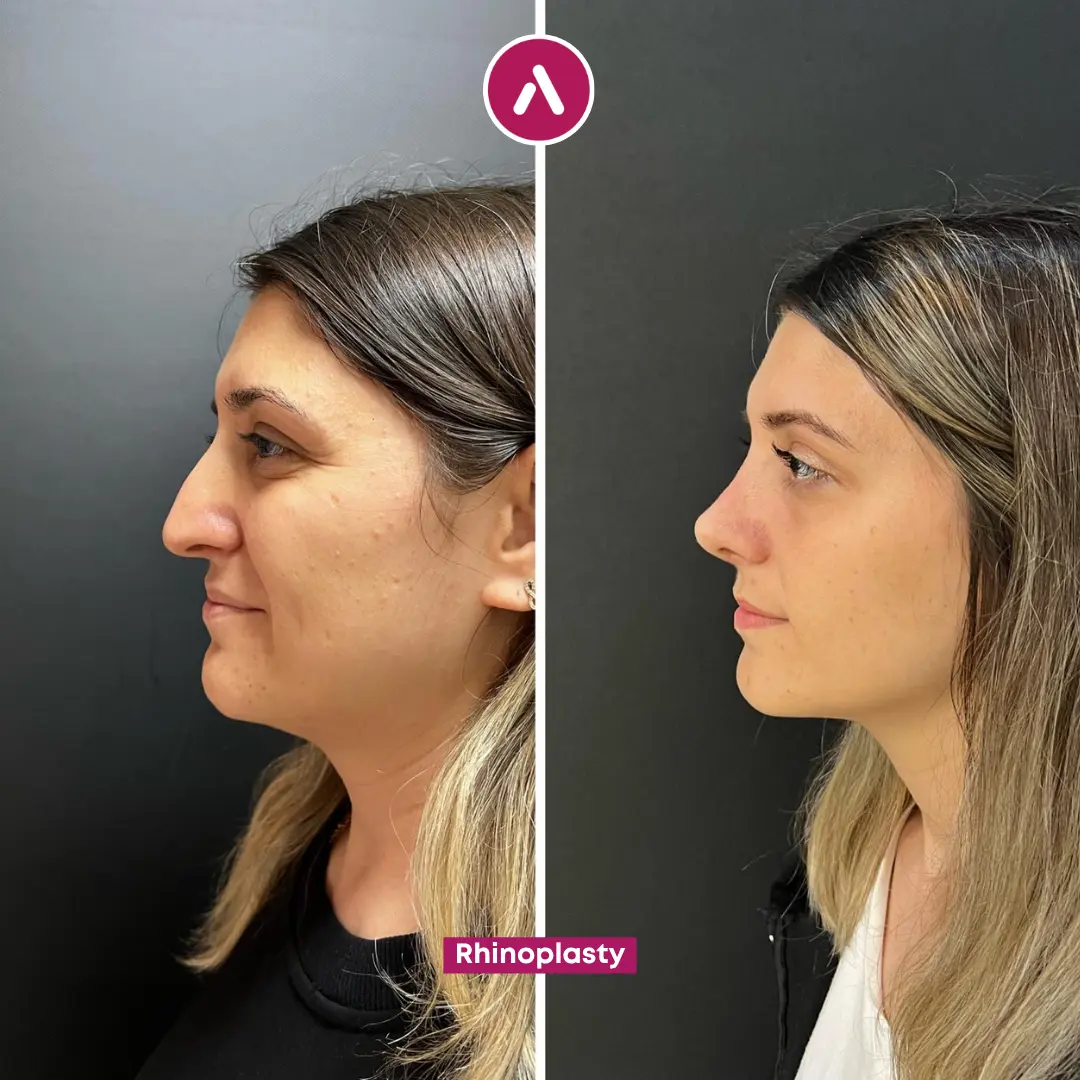
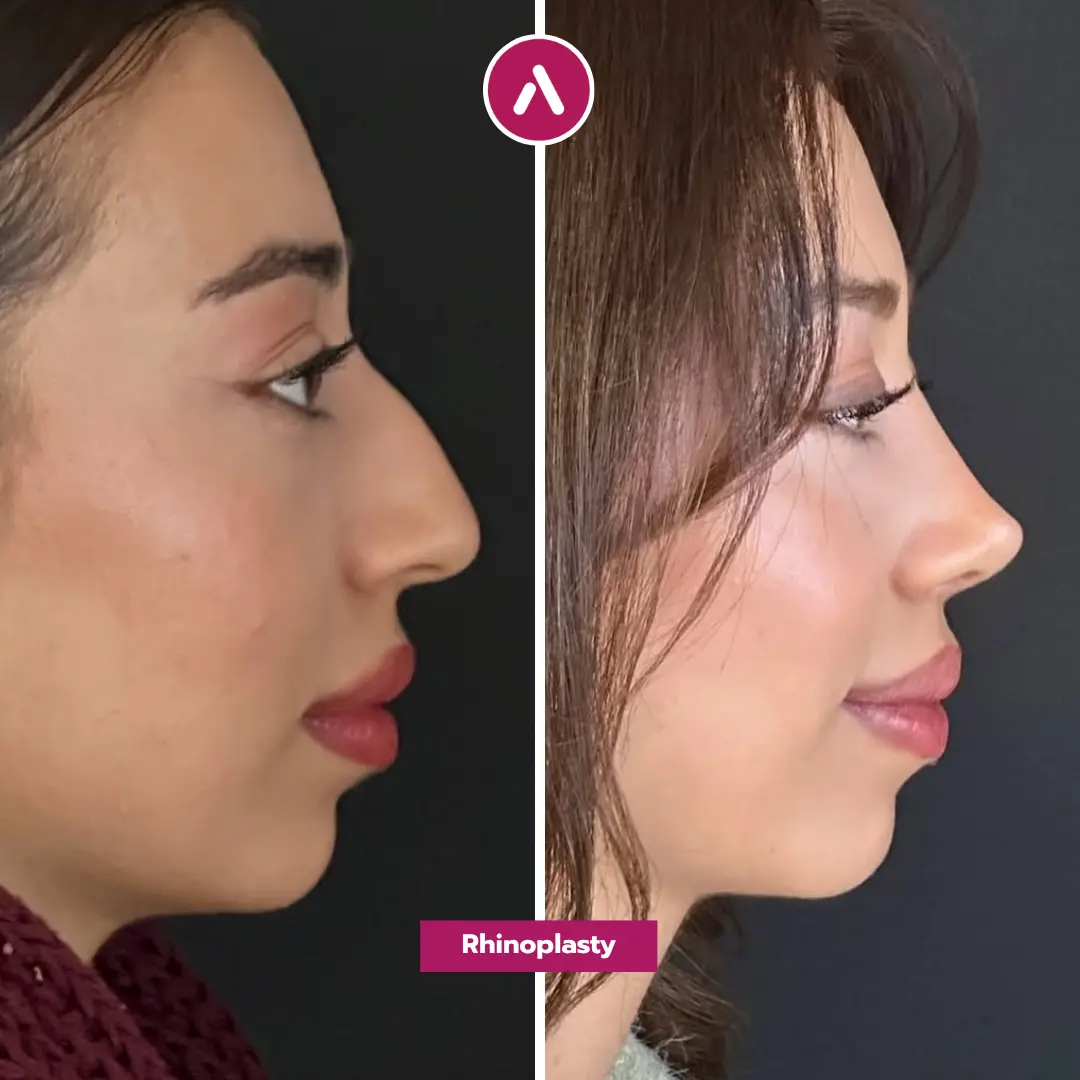
An under-projected tip sits too close to the face, making the nose look flatter or less defined. A boxy tip has a squared-off appearance, often due to cartilage shape or spacing. Both concerns may be suitable for tip plasty if the bridge does not require correction.
In these cases, the surgeon may use cartilage suturing, repositioning, or small grafts to create better support. The aim is stable definition, not a pinched look. A pinched tip can age poorly and may affect airflow if support is weakened too much.
For patients from multicultural Canadian communities, tip projection must be handled carefully. Nasal anatomy varies across ethnic backgrounds, and refinement should not erase identity. Patients considering this type of planning may also benefit from reviewing ethnic rhinoplasty anatomy considerations.
When Full Rhinoplasty Is the Better Choice
Tip plasty is not the right procedure when the nasal bridge, bones, septum, or overall proportions also need correction. In those cases, tip-only refinement may create partial improvement but leave the patient dissatisfied.
Full rhinoplasty may be more appropriate when the patient has:
- A dorsal hump or high bridge that affects the profile
- A crooked nose or visible deviation
- Wide nasal bones requiring narrowing
- Functional breathing concerns linked to the septum
- Previous rhinoplasty requiring revision planning
- Tip concerns that cannot be solved without balancing the bridge
This is where honest diagnosis matters. A good surgeon does not simply agree to the smaller procedure because it sounds easier or more affordable. The right plan should solve the actual anatomical problem.
Canadian Patient Note: When Tip Plasty Makes Practical Sense
Tip plasty can be a practical option for Canadian patients from Toronto, Vancouver, Montreal, Calgary, or Ottawa who want a shorter surgical trip and a narrower correction. It makes the most sense when the bridge already fits the face and the patient wants refinement rather than full nasal reshaping.
If the concern involves both the bridge and the tip, choosing tip plasty only to reduce downtime may lead to an incomplete result. The more conservative procedure is only valuable when it is anatomically correct.
The Surgical Technique
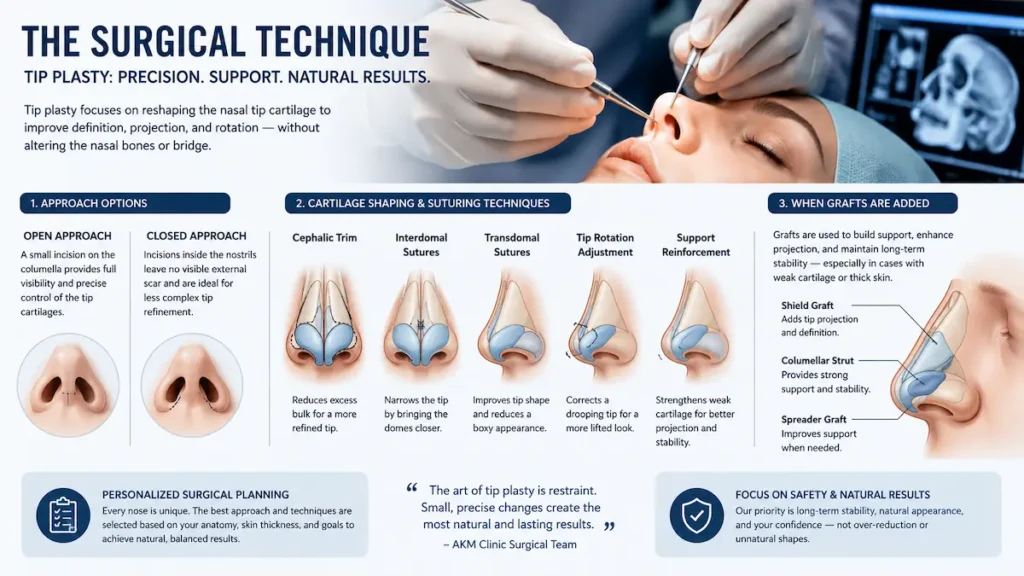
Tip plasty is a precise cartilage operation, not a surface-level cosmetic adjustment. The surgeon reshapes the lower nasal framework so the tip looks more refined while still fitting the patient’s face. Small changes matter here.
The technique depends on the patient’s skin thickness, cartilage strength, tip position, and nostril shape. At AKM Clinic, the planning process is led by facial anatomy rather than a fixed “standard nose” template.
Open vs Closed Access for Tip Plasty
Tip plasty can be performed through either an open or closed approach. The best choice depends on how much visibility and control the surgeon needs. Neither method is automatically superior.
In a closed tip plasty, incisions are made inside the nostrils. There is no external columellar incision, which appeals to patients who want scar concealment. This approach may suit patients needing subtle cartilage refinement with relatively straightforward anatomy.
In an open tip plasty, a small incision is made across the columella, the tissue between the nostrils. This gives the surgeon direct visibility of the lower lateral cartilages. It is often preferred when the tip needs more detailed reshaping, grafting, or correction of asymmetry.
For Canadian patients, the question is not “Which approach heals faster?” The better question is “Which approach gives the surgeon enough control to create a stable, natural result?” A slightly more involved approach may be worth it if the anatomy demands precision.
Cartilage Shaping and Suturing Techniques
The nasal tip is shaped by cartilage. During tip plasty, the surgeon may refine cartilage size, reposition cartilage angles, or use sutures to narrow and define the tip. The goal is controlled structure.
Common cartilage techniques may include:
- Cephalic trim to reduce excessive cartilage bulk when appropriate
- Interdomal sutures to narrow the distance between the tip-defining points
- Transdomal sutures to refine a rounded or boxy cartilage shape
- Tip rotation adjustment when the tip droops downward
- Support reinforcement when the tip lacks projection or stability
Over-resection is one of the main risks in poor tip surgery. Removing too much cartilage can create a pinched, collapsed, or unnatural appearance. In modern tip plasty, preservation and support are often more important than reduction.
“The central question in tip plasty is whether the tip can be improved without disturbing the rest of the nose. If the bridge already suits the face, we refine the tip with restraint. If the bridge and tip are both contributing to the imbalance, a full rhinoplasty discussion is more honest.”
This is also where surgeon training matters. Patients should feel comfortable asking who performs the nasal surgery, what type of cases the surgeon commonly treats, and how technique is selected. Canadian readers can use the Royal College of Physicians and Surgeons of Canada as a familiar reference point for understanding specialist-level credential expectations, while also reviewing AKM’s rhinoplasty specialist team.
When Grafts Are Added
Some tip plasty cases need cartilage grafts. A graft is not always a sign that the surgery is more aggressive. Often, grafts are used to create better support and prevent the tip from weakening over time.
Tip grafting may be recommended when the patient has:
- Weak lower lateral cartilages
- Under-projection of the tip
- Thick skin that needs a stronger framework
- Tip asymmetry that requires structural support
- A drooping tip that needs long-term stabilization
Cartilage may come from the septum when available. In more complex nasal surgery, other donor sites may be considered, but that usually moves the case closer to full rhinoplasty or revision rhinoplasty rather than simple tip plasty.
For patients comparing instrument-based approaches, it is important to keep scope clear. Piezo technology mainly applies to bony work, not the soft cartilage-only part of most tip plasty cases. For a different technique discussion, see the Piezo ultrasonic technique applied to tip work.
International rhinoplasty guidance from organizations such as ISAPS can help patients understand why technique selection should be individualized rather than trend-led.
Recovery Timeline — Shorter Than Full Rhinoplasty
Tip plasty recovery is usually shorter than full rhinoplasty because the nasal bones are not fractured or reshaped. There is typically less bruising around the eyes, less swelling in the upper nose, and a faster early social recovery. The tip itself, however, still takes time to settle.
Patients should separate “ready to be seen” from “fully healed.” Many people look socially presentable within a few weeks. Final tip definition can take several months, especially when skin is thicker.
Day 0-7 Immediate Recovery
The first week focuses on swelling control, incision care, and protecting the nasal tip. Patients may have a small splint, tape, or internal support depending on the technique used. Discomfort is usually manageable.
Common early recovery experiences include:
- Tip swelling and tightness
- Mild bruising, usually less than full rhinoplasty
- Temporary congestion
- Tenderness around the nostrils or columella
- Restricted exercise and careful sleeping position
Most Canadian patients should plan their Istanbul stay around the surgeon’s clearance schedule, not around the shortest possible flight itinerary. A focused procedure still requires safe post-operative monitoring before travelling back to YYZ, YUL, YVR, or another Canadian airport.
Week 2-4 Social Return
By weeks two to four, swelling usually starts to look more acceptable in everyday settings. The nose may still feel firm or puffy, especially at the tip. Photos may show improvement before the patient feels fully adjusted to the change.
Many patients can return to remote work earlier than in-person work, depending on bruising, swelling, and confidence. In Canada, this can be useful for professionals in Toronto, Ottawa, Calgary, or Montreal who can schedule a quieter return before going back to office meetings.
Canadian Patient Note: Short-Trip Recovery Planning
Tip plasty may fit a shorter medical travel schedule than full rhinoplasty, but it should not be treated like a weekend procedure. Patients still need pre-operative assessment, surgery, early follow-up, and fit-to-fly review before the return journey to Canada.
Travellers from Vancouver or smaller Canadian cities should also account for connecting flights. A longer route can increase fatigue during the early healing period.
6-12 Month Final Settle
The nasal tip is often the last part of the nose to settle. Even when early recovery looks smooth, final definition can take six to twelve months. This is normal.
Thicker skin usually takes longer to reveal definition. Thin skin may show refinement earlier, but it can also reveal tiny irregularities more easily. This is why the surgical plan must match the skin envelope.
Patients should avoid judging the final result too early. At one month, the tip may still look rounder than expected. At three months, definition often improves. At six to twelve months, the final contour becomes more reliable.
| Recovery Stage | What Canadian Patients Typically Notice | Practical Guidance |
|---|---|---|
| Day 0-7 | Tip swelling, mild tenderness, possible tape or splint | Rest, avoid pressure on the nose, attend all AKM follow-ups |
| Week 2-4 | Improved social comfort, residual tip puffiness | Return to light work if cleared; avoid strenuous exercise |
| Month 2-3 | Better definition, but tip still firm | Continue photo follow-ups and avoid judging final result too soon |
| Month 6-12 | Final tip shape becomes clearer | Assess outcome with the surgical team during long-term follow-up |
Combining Tip Plasty with Other Procedures
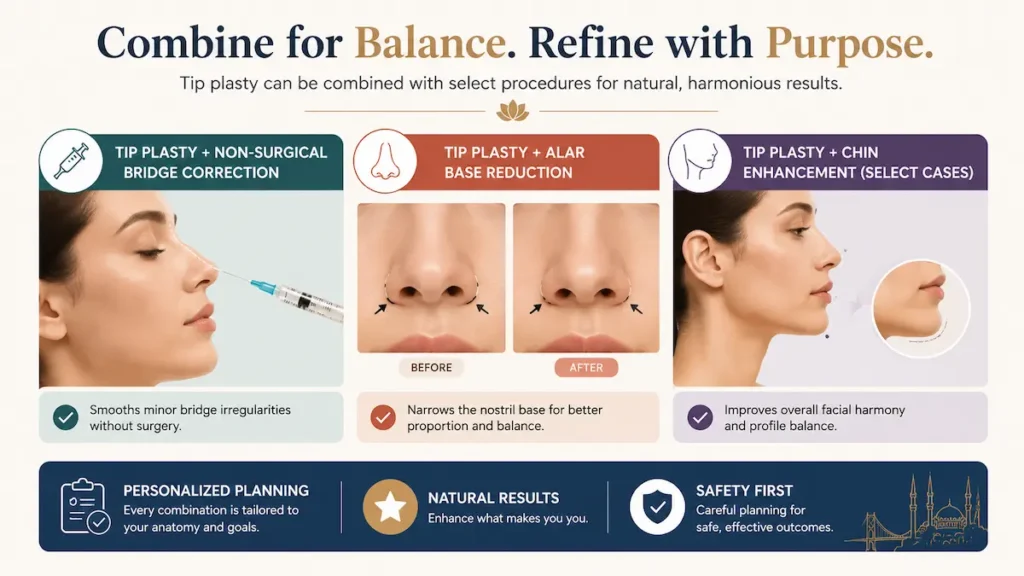
Tip plasty can be performed on its own, but some patients benefit from a carefully selected combination. The key is to avoid turning a focused correction into unnecessary surgery. Every added procedure should solve a specific anatomical issue.
Combination planning is especially useful for Canadian patients travelling to Istanbul because it may reduce the need for separate trips. Still, convenience should never drive the surgical plan. Anatomy should.
Tip Plasty + Non-Surgical Bridge Correction
Some patients have a well-balanced bridge but a minor contour shadow that bothers them in photos. In selected cases, non-surgical bridge correction with dermal filler may be discussed separately from tip refinement. This is not a replacement for structural rhinoplasty.
This approach is only appropriate when the bridge does not need bone or cartilage surgery. If the bridge has a true hump, asymmetry, or significant height issue, filler can mask rather than solve the problem. That may not be wise long term.
Patients should also understand that filler in the nose carries specific vascular risks. It should only be performed by an experienced medical professional who understands nasal anatomy. Tip plasty and filler planning should never be treated as casual cosmetic add-ons.
Tip Plasty + Alar Base Reduction
Alar base reduction narrows the nostril base by removing small wedges of tissue near the nostril crease. It can be useful when the nasal tip is wide and the nostril base also spreads outward. The goal is proportion, not over-narrowing.
Tip plasty and alar base reduction may be combined when the lower nose needs refinement in more than one zone. For example, a patient may have a bulbous tip and wide nostril flare, while the bridge remains balanced. In that case, full rhinoplasty may not be necessary.
The surgeon must be conservative. Over-reduction at the nostril base can create visible scarring, unnatural nostril shape, or a narrowed appearance that does not match the patient’s face. This is especially relevant in ethnic rhinoplasty planning, where nostril width may be part of natural facial identity.
When Tip Plasty Becomes Full Rhinoplasty Mid-Trip
Sometimes a patient asks for tip plasty during the virtual consultation, but the in-person examination shows a broader structural issue. This does not mean the original request was wrong. It means the anatomy is more complex than photos suggested.
A case may shift from tip plasty to full rhinoplasty when the surgeon finds:
- A dorsal hump that would look stronger after tip rotation
- Middle vault asymmetry affecting the overall nasal line
- A deviated septum contributing to both shape and breathing concerns
- Weak cartilage that requires more extensive support
- Nasal bone width that would remain disproportionate after tip refinement
This possibility should be discussed before the patient travels. A responsible clinic will explain both pathways: what can be achieved with tip plasty alone, and what would require full rhinoplasty. Surprises on surgery day are not ideal.
Canadian Patient Note: Combining Procedures in One Istanbul Trip
Canadian patients often ask whether they can combine procedures to make the travel more efficient. That can be reasonable when the combination is anatomically justified and medically safe.
For tip plasty, the most logical combinations are usually lower-nose refinements, such as alar base reduction. Broader nasal changes may require full rhinoplasty instead of a tip-only plan.
Cost Comparison — Why Tip Plasty Is Accessible?
Tip plasty is generally more accessible than full rhinoplasty because the surgical scope is narrower. The surgeon is working on the nasal tip rather than reshaping the entire nasal framework. That difference affects operative time, recovery, and price.
Cost should still be interpreted carefully. A lower price is valuable only when tip plasty is the correct procedure. If a patient needs full rhinoplasty, choosing tip plasty for price alone may lead to an incomplete result and future revision costs.
AKM Clinic Tip Plasty Pricing in CAD
According to the AKM Clinic Treatment Techniques Cost Schedule, Tip Plasty is CAD $2,750. This is a single-technique surgical fee reference, not a broad package quote. Patients should confirm what is included in their personalized treatment plan during consultation.
For direct context, AKM Clinic lists Open Rhinoplasty at CAD $4,100 and Closed Rhinoplasty at CAD $4,800. These figures show why tip plasty can be more accessible when the bridge and bony framework do not need correction.
Patients can review tip plasty pricing in Canadian dollars when comparing the procedure against full rhinoplasty options.
| Procedure | Primary Scope | AKM Clinic CAD Price | Typical Downtime Pattern | Best Candidate |
|---|---|---|---|---|
| Tip Plasty | Nasal tip cartilage refinement only | CAD $2,750 | Shorter early recovery; tip swelling can persist | Balanced bridge with isolated tip concern |
| Open Rhinoplasty | Full nasal reshaping with external access | CAD $4,100 | Longer recovery; bridge and tip swelling | Patients needing broad structural correction |
| Closed Rhinoplasty | Full nasal reshaping through internal incisions | CAD $4,800 | Varies by scope; no external columellar incision | Selected full rhinoplasty candidates |
These prices should not be rounded or converted. For Canadian content, CAD is the only displayed currency. That keeps the comparison clear.
Canadian Metro Tip Plasty Pricing Context
In Canadian private cosmetic surgery, quotes may be structured differently from clinic to clinic. A patient in Toronto, Vancouver, Montreal, or Calgary may receive separate line items for surgeon fees, facility fees, anesthesia, medications, or follow-up visits. This can make comparison difficult.
Tip plasty in Istanbul may appear more straightforward, but patients should still ask for a written quote. The quote should clarify what is included, what is not included, and whether the plan is truly tip-only or closer to full rhinoplasty.
Canadian provincial healthcare plans such as OHIP, MSP, RAMQ, and AHCIP do not cover purely cosmetic nasal tip refinement. Functional nasal surgery may be different, but that is not the focus of tip plasty. Tip-only refinement is typically elective cosmetic surgery.
Why the Lower Cost Reflects Scope, Not Skill Compromise
The lower cost of tip plasty comes from limited surgical scope. The surgeon is not performing nasal bone work, major bridge reshaping, or broad septal reconstruction. That does not mean the procedure requires less judgement.
In fact, tip plasty can be unforgiving because the surgeon has less room to balance the rest of the nose. The tip must improve without making the bridge, nostrils, or facial proportions look mismatched. This is why patient selection is central.
Value comes from matching the correct procedure to the correct anatomy. For the right candidate, tip plasty can offer focused improvement with less downtime and lower cost. For the wrong candidate, it is an under-treatment.
Canadian Patient Note: Value Is Not the Same as the Smallest Procedure
A smaller procedure is not automatically the smarter choice. Canadian patients comparing cost should first ask whether tip plasty alone will meet their goals.
If the bridge, septum, or nasal bones also need work, full rhinoplasty may provide better long-term value despite the higher procedure cost.
Frequently Asked Questions: Tip Plasty Turkey
Tip plasty raises different questions from full rhinoplasty because the procedure is intentionally limited. Patients often want to know whether a smaller operation can still create a visible improvement, how long the swelling lasts, and whether the cost difference reflects a meaningful clinical difference. The answers depend on anatomy.
The following questions address the most common concerns Canadian patients raise during consultation planning.
Is tip plasty cheaper than full rhinoplasty?
Yes. At AKM Clinic, Tip Plasty is CAD $2,750, while Open Rhinoplasty is listed at CAD $4,100 and Closed Rhinoplasty at CAD $4,800. The lower price reflects the narrower surgical scope, not a lower standard of care.
The important point is candidacy. Tip plasty is only a better value when the concern is truly limited to the nasal tip. If the bridge, septum, or nasal bones also need correction, full rhinoplasty may be the more appropriate investment.
How long is the recovery?
Most patients find early tip plasty recovery easier than full rhinoplasty because the nasal bones are not reshaped. The first week usually involves swelling, tenderness, taping or splinting, and reduced activity. Bruising is often milder than full rhinoplasty, although this varies by patient.
Many patients feel socially comfortable within two to four weeks. Final tip definition can take six to twelve months, especially in patients with thicker nasal skin.
Will my profile look unchanged?
Your bridge profile should remain mostly unchanged if the procedure is truly tip-only. The lower third of the nose may look more lifted, refined, or supported, which can still influence the overall facial impression.
This is why pre-operative planning must include profile photos. A small change in tip rotation or projection can alter how the bridge appears, even if the bridge itself is not surgically changed.
Can tip plasty be combined with chin work?
In selected cases, yes. Chin projection affects how the nose is perceived from the side. A patient with a balanced nasal bridge and a drooping tip may also have a recessed chin that makes the nose appear more dominant.
That does not mean chin work is always needed. It should only be considered if facial proportion analysis shows that the lower face is contributing to the patient’s profile concern.
Is tip plasty less risky than full rhinoplasty?
Tip plasty is usually less invasive than full rhinoplasty because it avoids nasal bone reshaping. That may reduce certain early recovery issues, such as extensive bruising or swelling around the upper nose.
However, it is still surgery. Risks may include swelling, asymmetry, infection, visible scarring in open approaches, tip stiffness, over-refinement, under-correction, or the need for revision. A smaller operation still requires careful planning.
Can tip plasty fix a deviated tip?
Sometimes. A mildly deviated tip caused by cartilage asymmetry may be improved with tip plasty techniques. The surgeon may use sutures, cartilage repositioning, or grafts to create better alignment.
If the deviation comes from the septum, middle vault, or nasal bones, tip plasty alone may not be enough. In that situation, functional or full rhinoplasty planning may be more appropriate.
How long do tip plasty results last?
Tip plasty results are designed to be long-lasting because the cartilage framework is surgically reshaped. Once healing is complete, the new tip structure should remain stable for many years.
Natural ageing still continues. Skin quality, cartilage strength, and tissue laxity can change gradually over time. Strong support techniques help the result age more predictably.
Determine Whether Tip Plasty Alone Solves Your Concern
Tip plasty can be an excellent option for Canadian patients who want focused nasal tip refinement without full rhinoplasty. The key is confirming that the bridge, septum, and nasal bones do not also require correction.
During a virtual consultation, AKM Clinic’s surgical team can review your photos, assess whether your concern is truly tip-only, and explain whether tip plasty or a broader rhinoplasty plan fits your anatomy better.
Request a consultation to determine whether tip plasty is the right procedure for your nose, your recovery timeline, and your goals.
Medical Disclaimer: This page is provided for general educational purposes only and does not replace an in-person medical consultation, diagnosis, or personalized treatment plan. All surgery carries risks, and outcomes vary between individuals. Suitability for rhinoplasty (nose job) surgery, procedure selection, and anesthesia choice can only be determined after a full clinical assessment by a qualified surgeon. Always follow your clinician’s instructions and seek urgent medical attention if you develop concerning symptoms during recovery.