



For many Canadian men, a full beard is not achievable through genetics alone. Patchy growth, alopecia barbae, scarring, or naturally sparse facial hair can leave gaps that no serum, waiting period, or grooming routine will fill. A beard and moustache transplant moves your own healthy follicles into the beard, moustache, sideburn, or goatee area to create permanent facial hair density.
At AKM Clinic in Istanbul, our facial-hair restoration planning focuses on natural direction, single-hair graft selection, and conservative density building. Toronto and Vancouver clinics can be limited by cost, technique availability, or long consultation timelines. Our all-inclusive clinical pathway gives Canadian patients access to FUE and DHI facial-hair restoration with transparent pricing, 5-star recovery support, and long-term virtual follow-up after returning home.
Table of Contents
What Is a Beard & Moustache Transplant? Facial Hair Restoration Explained
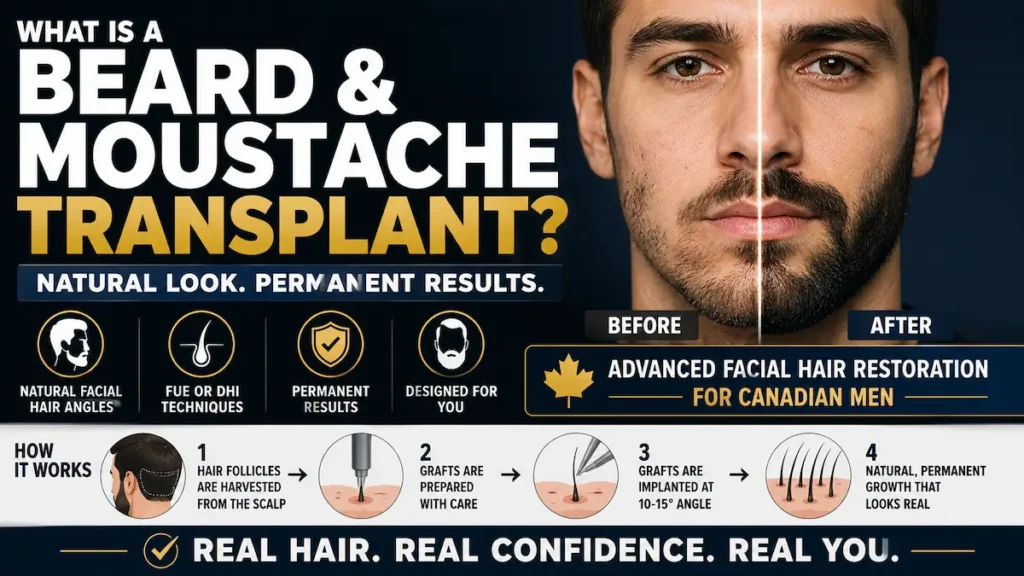
A beard and moustache transplant uses FUE or DHI to move scalp hair follicles into the beard, moustache, sideburn, or goatee area. Single-hair grafts are implanted at a flat 10-15° angle to match natural facial-hair direction. Once healed, transplanted follicles grow permanently.
How a Beard Transplant Works
A beard transplant relocates healthy hair follicles from the donor area, usually the back or sides of the scalp, into areas of sparse facial hair. These follicles are chosen because they are genetically stable and able to continue growing after transplantation.
The process is different from simply filling a bald scalp area. Facial hair has a lower exit angle, tighter direction control, and stronger visual patterning. A misplaced graft on the cheek is more noticeable than a misplaced graft in the scalp. That is why beard restoration requires facial-hair planning, not just general hair-transplant experience.
Beard vs Scalp Transplant: Why Facial Hair Angles Differ
Scalp hair usually exits the skin at a steeper angle. Beard hair lies flatter against the face, often at about 10-15° depending on the cheek, jawline, chin, or moustache area. The direction also changes by zone.
- Cheeks: grafts usually angle downward and slightly inward.
- Jawline: grafts follow the natural line of the mandible.
- Chin: density must be stronger, but not block-like.
- Moustache: grafts require very fine direction control near the lip.
- Sideburns: grafts must connect naturally to scalp hair.
Our goal is not simply to place more hair. Our goal is to create a beard that looks like it grew there naturally.
Facial Hair Transplant Terminology
Canadian patients often use several search terms for the same procedure. A beard transplant may refer to full lower-face restoration, patchy beard correction, goatee enhancement, or sideburn reconstruction. A moustache transplant focuses on the upper lip area. Facial hair transplant is the broader umbrella term.
We use these terms carefully during consultation because each area has different density, angle, and graft requirements. A full beard may require thousands of grafts. A moustache or sideburn correction may require far fewer, but the precision requirement is higher.
Can You Get a Beard Transplant?
You may be a candidate if your facial hair is patchy, sparse, scarred, or uneven despite full adult development. Most candidates are healthy adults with stable expectations and adequate scalp donor hair.
We also assess whether your facial hair loss is active. For example, alopecia barbae can be unpredictable. If inflammation is still active, surgery may need to wait until the condition is medically stable. This is one reason we recommend that Canadian patients speak with their family physician or dermatologist before travelling for facial-hair restoration.
Benefits of a Beard & Moustache Transplant
Permanent Density in Patchy Areas
The biggest benefit is permanence. Once transplanted follicles establish blood supply and complete the early shedding phase, they begin growing again as living hair. You can trim, shave, and style the new beard hair like natural facial hair.
This makes a beard transplant different from cosmetic camouflage products. Fibres, pencils, and dyes can help temporarily, but they do not create real density.
Full Beard Styling Freedom
Patchy facial hair often limits styling options. Many men keep a short stubble look because longer beard growth reveals gaps. A transplant can create enough continuity for more grooming choices.
- Full beard
- Defined jawline beard
- Goatee
- Moustache
- Connected sideburns
- Scar-camouflage beard coverage
We design the shape before implantation. The goal is balanced density, not an artificial outline.
Scar Camouflage
Facial scars from acne, burns, trauma, or previous surgery may interrupt beard growth. In selected cases, transplanted follicles can be placed into scar tissue to soften the contrast between scarred and non-scarred skin.
Scar tissue has different blood supply than normal skin. That means graft survival can be less predictable. During consultation, we review the scar quality, thickness, colour, and location before recommending a treatment plan.
Facial Masculinization and Identity Alignment
For some patients, facial hair is not only a grooming goal. It is part of identity, age perception, or gender expression. This can be especially important for transmasculine patients who want facial-hair development as part of a broader gender-affirming plan.
We approach these consultations with respect and clinical clarity. We assess donor availability, hormone history when relevant, and the pattern that will look natural long-term.
Better Facial Balance
A well-designed beard can strengthen the visual frame of the lower face. It can improve jawline definition, balance the chin, and create smoother transitions between the sideburn, cheek, and neck areas.
The result should still look like you. Our Natural-First approach applies to hair restoration as much as facial surgery: we build density and structure without creating an exaggerated or overdrawn beard line.
Am I a Good Candidate for a Beard Transplant?
You may be a good candidate for a beard transplant if your facial hair is patchy, genetically sparse, scarred, or uneven after full adult development. The best candidates have realistic density goals and enough healthy donor hair at the back or sides of the scalp.
We assess candidacy through photos, medical history, donor density, and beard-design goals. This is not a one-size procedure. A dense chin, a connected sideburn, and a subtle moustache correction all require different planning.
Patchy or Sparse Beard Growth
Genetic patchiness is the most common reason Canadian men request a beard transplant. Some men can grow strong chin hair but have weak cheek density. Others have a moustache that never connects to the beard.
A transplant can fill these gaps using your own follicles. We usually recommend a natural density gradient rather than a harsh line. Real beards are not perfectly uniform, and that slight variation is part of what makes the result believable.
Alopecia Barbae
Alopecia barbae is a form of localized facial-hair loss. It can create round or irregular bald patches in the beard. A transplant may help selected patients, but only when the condition is stable.
If hair loss is still active, transplanted follicles may be placed into an unstable area. We may recommend dermatology clearance before surgery. Your long-term result matters more than rushing the procedure.
If you have alopecia barbae, scarring, or active inflammatory skin disease, a Canadian dermatologist can help confirm stability before travel. The Canadian Dermatology Association’s guidance on alopecia is a useful starting point for patient education.
Scarring, Burns, or Trauma Beard Reconstruction
Scars can interrupt beard growth and draw attention to a specific part of the face. In selected cases, beard grafts can camouflage acne scars, surgical scars, burn scars, or trauma-related gaps.
Scar tissue behaves differently from normal skin. Blood supply may be reduced, and graft survival can be less predictable. During assessment, we look at scar thickness, colour, flexibility, and location before confirming whether transplantation is appropriate.
FTM Facial Masculinization
Facial hair can be an important part of gender expression for transmasculine patients. A beard or moustache transplant can support facial masculinization when hormone therapy alone does not create the desired pattern.
We plan these cases with sensitivity. The goal may be a soft moustache, a defined chin beard, stronger sideburns, or a full beard pattern. We consider hormone history, donor availability, face shape, and long-term grooming goals.
Transmasculine patients planning facial-hair restoration may also review gender-affirming care resources through the Canadian Professional Association for Transgender Health before consultation.
Scalp Donor Availability
Most beard transplants use scalp hair from the back or sides of the head. This donor area must be healthy enough to provide single-hair grafts without creating visible thinning.
Donor planning is especially important if you also have male-pattern hair loss. If you may want a scalp hair transplant later, we avoid using too much donor supply for the beard. A good plan protects future options.
Realistic Density Expectations
A beard transplant can improve coverage, shape, and symmetry. It cannot create unlimited density if donor supply is limited. We explain graft numbers clearly before you travel.
Some patients need a conservative first session. Others may benefit from staged density building. A natural-looking beard is usually better than an overly dense, artificial outline.
When a Beard Transplant Is Not Recommended
We may advise waiting or choosing another treatment if there is active alopecia, poor donor density, uncontrolled medical conditions, or unrealistic expectations. Active skin infections, uncontrolled diabetes, and heavy smoking can also interfere with healing.
A careful “no” is sometimes the safest answer. Our consultation process is designed to protect the patient, not just approve every request.
| Candidate Profile | Typical Concern | Best Approach | Candidacy Verdict |
|---|---|---|---|
| Patchy beard growth | Gaps in cheeks, chin, or jawline | FUE or DHI using single-hair grafts | Usually strong candidate |
| Alopecia barbae | Round or irregular bald patches | Only after medical stability | Case-dependent |
| Facial scar | Hairless scar crossing beard zone | Scar-tissue grafting with conservative density | Case-dependent |
| FTM facial masculinization | Limited facial hair despite hormone therapy | Custom beard or moustache design | Often appropriate after assessment |
Beard Transplant Technique: FUE & DHI for Facial Hair
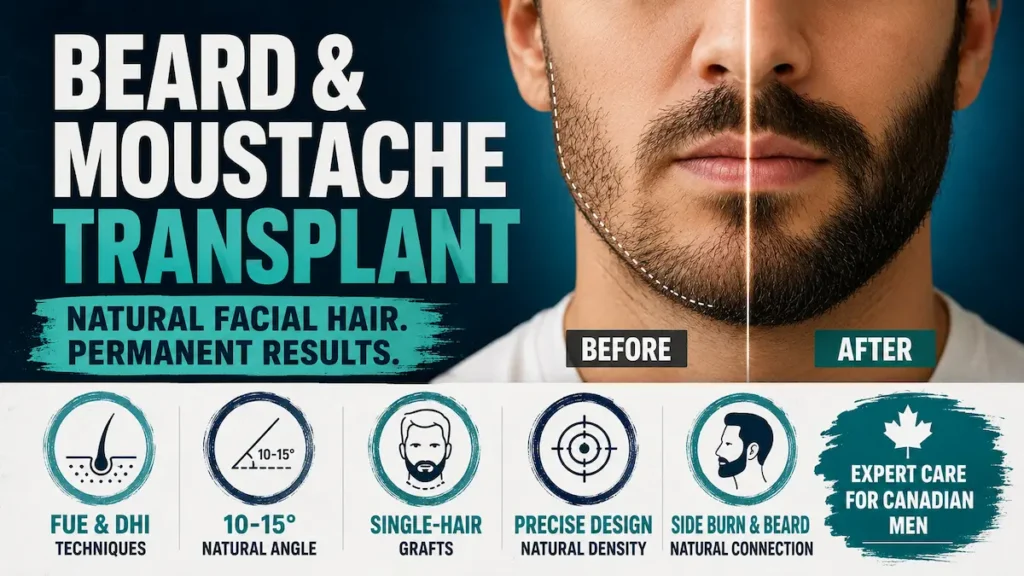
At AKM Clinic, facial-hair transplantation can be performed using FUE or DHI, depending on the design goal, graft count, skin characteristics, and required density. Both techniques can produce natural results when the surgeon controls graft angle, direction, and spacing.
The technique matters. The design matters more. A beard transplant can look unnatural if multi-hair grafts are placed in the wrong direction, or if the outline is drawn too sharply.
FUE Beard Transplant
FUE stands for Follicular Unit Extraction. In a beard transplant, individual follicular units are extracted from the donor area, then prepared for placement in the facial-hair zone.
For beard work, we select mostly single-hair grafts. This is different from scalp restoration, where two- or three-hair follicular units may be useful for density. In the beard, multi-hair grafts can create a pluggy texture.
Patients who want a broader beard area, cheek filling, or scar camouflage may be good FUE candidates. For a full technical explanation of FUE on the scalp, see our FUE hair transplant guide.
DHI Beard Transplant
DHI uses a Choi implanter pen to place follicles directly into the recipient area. It can be useful for facial-hair zones that need precise control, such as the moustache, sideburns, or small patch corrections.
The Choi pen can help control depth and direction when used by an experienced team. It is not automatically better for every patient. The best technique depends on the beard goal and the number of grafts required.
For scalp-focused DHI details, our DHI hair transplant guide explains the Choi implanter pen and direct implantation process.
Why Single-Hair Grafts Matter
Natural beard hair usually emerges as individual hairs, especially along the cheeks, moustache border, and jawline. This is why we separate and select single-hair grafts for facial-hair placement.
Using large grafts in the beard can create visible clusters. That is one of the most common reasons beard transplants look artificial. We avoid that by matching graft type to facial anatomy.
“In beard restoration, the smallest technical choices are visible. A single-hair graft placed at the correct angle looks natural. A multi-hair graft placed too upright can look obvious every time the patient shaves.”
Beard Angle Mastery: The 10-15° Rule
Beard hair grows flatter than scalp hair. In many facial zones, the exit angle is approximately 10-15° from the skin surface. This flat angle is essential for a natural beard.
Angle also changes across the face. Cheek grafts may point downward. Moustache grafts follow the upper lip. Jawline grafts must flow with the lower facial contour. We map these directions before placing follicles.
| Area | Typical Direction | Planning Priority |
|---|---|---|
| Cheek beard | Downward and slightly inward | Soft density gradient |
| Jawline | Along mandibular contour | Natural lower-face framing |
| Chin | Forward and downward variation | Density without blockiness |
| Moustache | Downward toward lip line | Fine angle control |
| Sideburn | Transition from scalp into beard | Connection and symmetry |
Beard Design: Density, Line, and Sideburn Connection
Beard design is not just drawing a border. We plan density zones, transition areas, and facial balance. The cheek line should not look painted on. The sideburn should connect smoothly to both scalp hair and beard hair.
We apply the same design logic used in natural hairline planning, adjusted for facial anatomy. Our natural hairline design guide explains why irregularity, density gradients, and direction control matter for believable hair restoration.
FUE Beard vs DHI Beard Transplant
| Technique | Extraction | Implantation | Best For | AKM Offers |
|---|---|---|---|---|
| FUE Beard Transplant | Individual follicular units extracted from scalp donor area | Placed into pre-planned facial recipient sites | Larger beard zones, cheeks, jawline, scar camouflage | Yes |
| DHI Beard Transplant | Individual follicles extracted and prepared | Placed directly with Choi implanter pen | Moustache, sideburns, smaller precision zones | Yes |
Beard as Recipient and Donor: The Bidirectional Approach
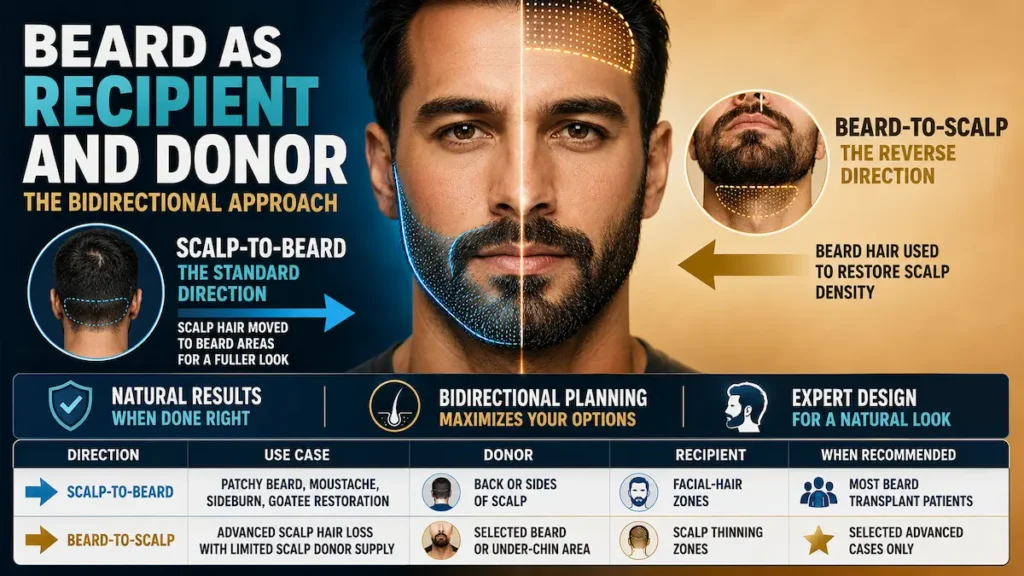
The beard can be both a recipient area and, in selected advanced hair-loss cases, a donor area. This bidirectional planning is one of the reasons facial-hair restoration should be treated as a subspecialized hair-transplant procedure.
Most beard transplants move scalp hair into the beard. Some scalp restorations may use beard hair as an additional donor source when scalp donor supply is limited.
Scalp-to-Beard: The Standard Direction
The standard beard transplant uses scalp donor follicles, usually from the back or sides of the head. These follicles are stable and can adapt well to facial placement when selected and implanted correctly.
After transplantation, scalp-derived follicles in the beard area continue growing like hair. Many patients trim or shave them regularly to match the surrounding facial hair. Texture may soften over time, but this varies by patient.
Beard-to-Scalp Reverse Donor
In some patients with advanced scalp hair loss, beard hair may be used as a supplemental donor source for scalp restoration. This is not the same as a beard transplant. It is the reverse direction: beard donor to scalp recipient.
Beard-to-scalp transplantation can help when scalp donor supply is limited. It requires careful matching because beard hair is often thicker, coarser, and different in curl or texture.
When Beard-to-Scalp Makes Sense
Beard-to-scalp donor use may be considered when a patient has advanced hair loss, previous hair transplants, or depleted scalp donor supply. It is usually not the first option for younger patients with healthy scalp donor areas.
We plan it conservatively. Removing too much beard donor hair can thin the face. The donor area must still look natural after harvesting.
Beard Donor Area Capacity
The beard donor area is not unlimited. Density varies across the neck, under-chin area, jawline, and cheek. We assess which areas can safely donate without creating visible thinning.
Patients who want both a beard transplant and a scalp transplant need a long-term donor strategy. We protect the scalp donor and facial donor zones so future options remain possible.
Beard-to-Scalp Before and After Reality
Beard hair can add useful density to selected scalp zones, but it does not behave exactly like scalp hair. It may be thicker, stronger, or more textured. This can be helpful in the mid-scalp or crown, but it may look too coarse at the frontal hairline.
That is why beard-to-scalp grafting is usually blended with scalp donor hair. The goal is coverage that looks natural in motion, under light, and after normal styling.
Moustache, Sideburn, and Goatee-Specific Approaches
A moustache transplant uses fewer grafts than a full beard, but the precision requirement is higher. The upper lip is a high-visibility zone. Direction errors are easy to notice.
Sideburn reconstruction focuses on connection. A strong sideburn must transition naturally from scalp hair into the beard. Goatee restoration focuses on the chin and upper-lip relationship, so density must be balanced on both sides of the mouth.
| Direction | Use Case | Donor | Recipient | When Recommended |
|---|---|---|---|---|
| Scalp-to-Beard | Patchy beard, moustache, sideburn, goatee restoration | Back or sides of scalp | Facial-hair zones | Most beard transplant patients |
| Beard-to-Scalp | Advanced scalp hair loss with limited scalp donor supply | Selected beard or under-chin area | Scalp thinning zones | Selected advanced cases only |
Combined Procedures: Beard Transplant + Other Treatments
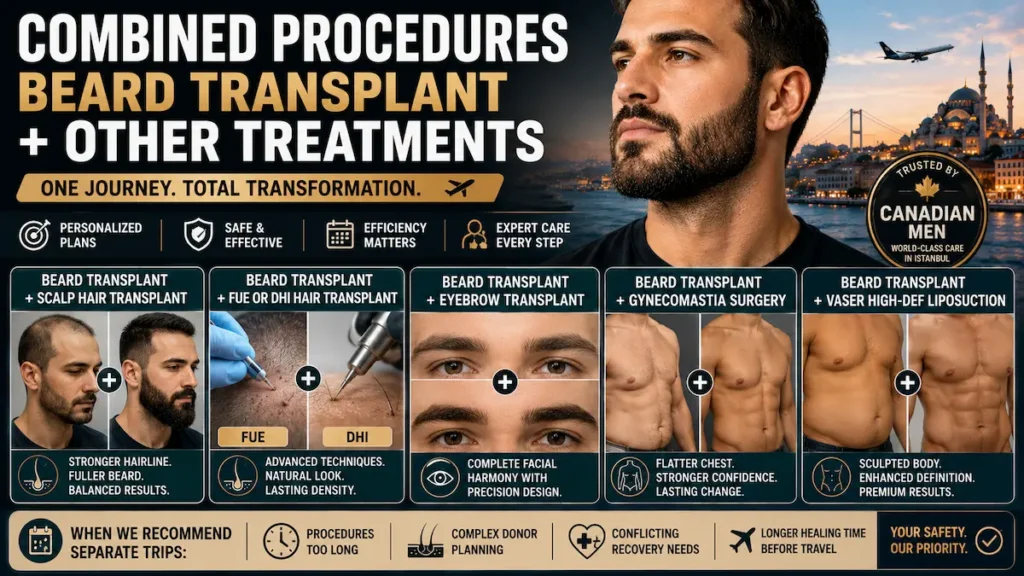
Some Canadian patients combine beard restoration with other treatments during one Istanbul trip. This can be efficient, but only when the procedures make medical and recovery sense together.
We do not recommend combining treatments simply to fill a schedule. The right combination depends on procedure length, anesthesia needs, healing demands, and safe travel timing.
Beard Transplant + Scalp Hair Transplant
Beard and scalp hair restoration can sometimes be planned together, especially if the patient wants both a stronger hairline and a fuller beard. Donor management becomes the central issue.
We must protect the scalp donor area. If too many grafts are taken for the beard, future scalp options may be limited. Our hair transplant in Turkey guide explains the broader donor-planning logic for Canadian patients.
Beard Transplant + FUE or DHI Hair Transplant
FUE and DHI can both be relevant when a patient wants scalp and facial-hair restoration. FUE may be better for larger extraction needs, while DHI may help with precise implantation in selected zones.
For technique-specific comparisons, review our FUE hair transplant guide and DHI hair transplant guide. The beard plan should never be separated from the scalp donor strategy.
Beard Transplant + Eyebrow Transplant
Some patients want a broader facial-hair restoration plan, including beard and eyebrow density. This can be appropriate when donor supply is strong and the patient understands the healing timeline for each area.
Eyebrow transplantation requires even finer angle control than beard work. If this is part of your goal, our eyebrow transplant guide explains the specialized planning involved.
Beard Transplant + Gynecomastia or VASER High-Def Liposuction
Some male patients combine facial-hair restoration with body-contouring procedures such as gynecomastia surgery or VASER High-Def liposuction. This is more common among men seeking a broader confidence reset.
These combinations require careful scheduling because body procedures have different recovery demands. Compression garments, swelling, and mobility need to be considered before return flights. You can review related options in our gynecomastia surgery guide and VASER High-Def liposuction guide.
When We Recommend Separate Trips
Separate trips may be safer when the combined procedure time is too long, donor planning is complex, or recovery instructions conflict. For example, a patient undergoing a large body procedure may not want the added facial-care demands of a beard transplant during the same week.
We will tell you when combining treatments is not ideal. A safe plan is better than an overloaded itinerary.
Anesthesia for Beard Transplant: Local Only
A beard transplant does not require general anesthesia. We perform facial-hair transplantation under local anesthesia, sometimes with mild oral or IV relaxation support depending on the patient’s comfort level and the procedure length.
This matters for Canadian patients travelling internationally. Avoiding general anesthesia means no intubation, less post-procedure grogginess, and a faster return to light walking after treatment. You remain awake, but the donor and recipient areas are numbed before extraction and implantation begin.
Why Beard Transplant Uses Local Anesthesia
Hair transplantation works in the skin and superficial soft tissue. It does not require deep surgical access. For this reason, local anesthesia is the standard approach for beard, moustache, eyebrow, and scalp hair transplant procedures.
Local anesthesia allows us to numb the scalp donor zone and facial recipient zone while keeping your breathing, circulation, and neurological status easy to monitor. You can communicate with the team during the procedure. Many patients listen to music, rest, or take short breaks as needed.
Patient Comfort During the Procedure
The first injections can feel like brief stinging or pressure. After the area is numb, most patients describe the procedure as pressure-based rather than painful. The face can feel unusual during implantation because the skin is numb and slightly swollen from local fluid.
We plan longer cases with comfort breaks. This is important for full beard restoration, which may take several hours. Smaller moustache or sideburn procedures are usually shorter.
- Small patch correction: usually shorter and lighter recovery.
- Moustache transplant: high precision, moderate procedure time.
- Full beard transplant: larger graft count, longer sitting time.
- Scar camouflage: timing depends on scar size and tissue quality.
Pre-Procedure Assessment
Before treatment, we review your medical history, medications, allergies, smoking status, and previous procedures. We also ask about fainting episodes, anxiety with needles, and past reactions to local anesthetic.
Canadian patients should bring a medication list and disclose supplements. Blood thinners, certain anti-inflammatory medications, and some herbal supplements may need to be paused before surgery, but only under medical guidance.
Step-by-Step: What Happens During a Beard Transplant?
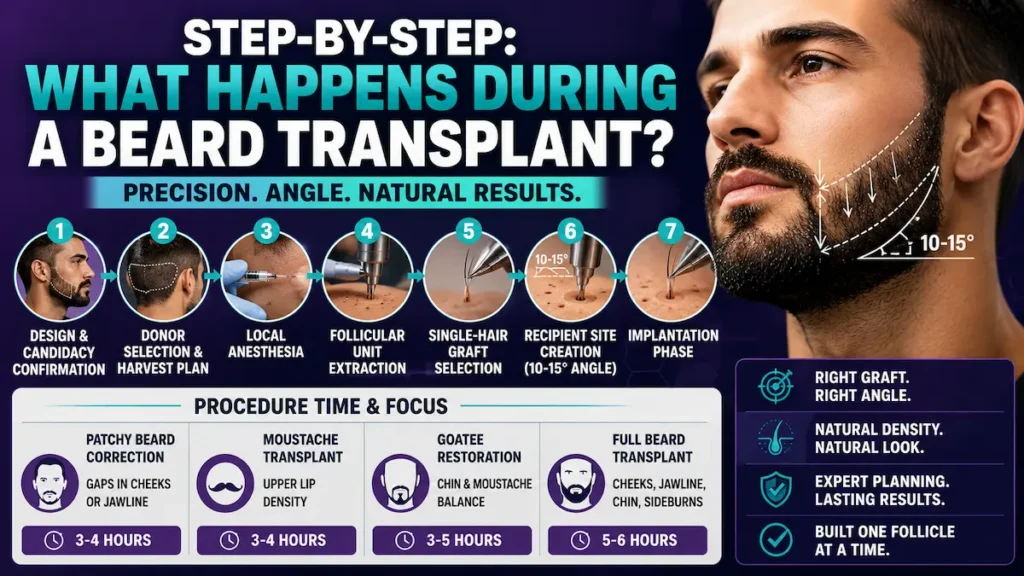
A beard transplant follows a structured sequence: design, donor planning, local anesthesia, follicle extraction, graft selection, recipient-site creation, and implantation. Each step affects the final result.
The technical goal is simple to explain but difficult to execute: place the right graft, at the right angle, in the right density pattern.
Pre-Operative Beard Design and Candidacy Confirmation
Your procedure begins with a final in-person design review. We examine your beard growth in natural light, confirm the areas to restore, and mark the planned cheek line, jawline, chin, moustache, or sideburn borders.
We avoid overly sharp or artificial lines. A natural beard has soft transitions. The density should be strongest in key visual zones, then fade into surrounding hair.
Scalp Donor Selection and Harvesting Plan
Most beard transplants use donor hair from the back or sides of the scalp. These areas usually provide stable follicles with good long-term growth.
We also consider texture. If scalp hair is very fine and beard hair is naturally coarse, the plan may need gradual density building. If scalp hair is wavy, we account for that in direction control and trimming expectations.
Local Anesthesia
We numb the donor area first. Once the donor zone is comfortable, the extraction phase begins. The recipient area is numbed before facial implantation.
The local anesthesia fluid can create temporary swelling. This is expected. It helps comfort and tissue handling during the procedure.
Follicular Unit Extraction
During FUE-based beard restoration, individual follicular units are extracted from the donor zone using micro-punch tools. If DHI is selected, the follicle preparation and implantation sequence differs, but the donor harvesting still requires precision.
We protect donor-area spacing. Over-harvesting can create visible thinning. A good facial-hair result should never sacrifice the long-term appearance of the scalp donor area.
Single-Hair Graft Selection
Facial hair requires single-hair graft discipline. Two- or three-hair grafts may be useful for scalp density, but they can look clustered in the beard.
We select grafts based on hair count, calibre, and suitability for each zone. Cheeks and moustache borders require finer, more delicate placement. Chin and jawline zones can tolerate slightly stronger density.
“A natural beard transplant is built one follicle at a time. The face does not hide technical shortcuts. Single-hair graft selection is what prevents a pluggy or artificial beard texture.”
Recipient Site Creation: The 10-15° Flat Beard Angle
The recipient sites guide the future direction of growth. For beard hair, the angle must stay low and flat, often around 10-15° from the skin surface. This is one of the most important technical differences between scalp and beard transplantation.
If the angle is too upright, the beard can stick out unnaturally. If direction is inconsistent, the result can look messy even when graft survival is strong. We map direction by zone before placing grafts.
Implantation Phase
Implantation places the prepared grafts into the designed facial zones. The team works carefully to protect graft hydration, minimize handling trauma, and maintain the planned density pattern.
Some patients need gradual density rather than maximum density in one session. This is especially true for scar camouflage, alopecia barbae history, or limited donor supply.
Procedure Length
A small moustache or patch correction may take about three hours. A full beard transplant can take five to six hours, depending on graft count and complexity.
We do not rush graft placement. A shorter procedure is not automatically better. For facial hair, precision usually matters more than speed.
| Procedure Type | Typical Focus | Approximate Time | Precision Priority |
|---|---|---|---|
| Patchy beard correction | Small gaps in cheeks or jawline | 3-4 hours | Blending with existing hair |
| Moustache transplant | Upper lip density | 3-4 hours | Fine angle control |
| Goatee restoration | Chin and moustache balance | 3-5 hours | Symmetry and density |
| Full beard transplant | Cheeks, jawline, chin, sideburns | 5-6 hours | Design continuity |
Beard Transplant Recovery: Timeline for Canadian Patients
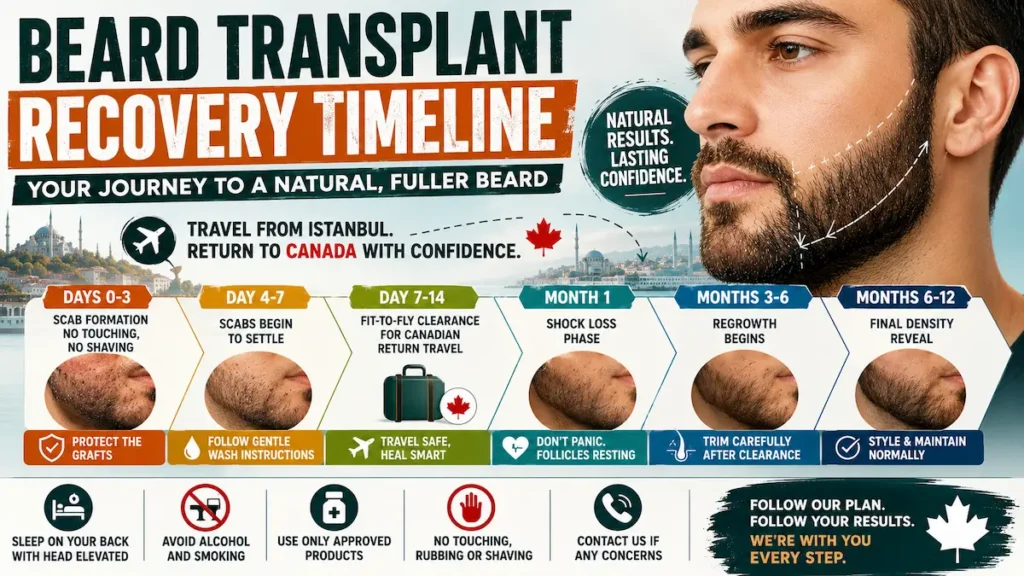
Recovery after a beard transplant is usually manageable, but the first ten days require discipline. The grafts are visible during the scab phase. You must avoid touching, scratching, shaving, or rubbing the new beard area until we clear you.
Most Canadian patients plan their Istanbul stay around the early healing period, then return home after in-person review. We provide aftercare instructions before departure and continue virtual follow-up after you return to Canada.
Days 0-3: Scab Formation, No Touching, No Shaving
The first three days are the most delicate. Tiny scabs form around transplanted follicles. Mild swelling, redness, tightness, and pinpoint crusting are expected.
You must avoid touching the beard area. Do not shave. Do not sleep face-down. Avoid scarves, masks, tight collars, helmet straps, or anything that rubs the grafts.
- Sleep on your back with your head slightly elevated.
- Avoid alcohol and smoking.
- Use only the products we provide or approve.
- Do not apply beard oils, balms, dyes, or styling products.
- Contact us if swelling, pain, or drainage feels unusual.
Beard Transplant After 1 Week
By one week, many scabs begin to loosen. The beard area may still look red or textured. This is normal, especially in lighter skin tones where redness is more visible.
Washing must be gentle. You should not scrub the grafts. For a deeper explanation of post-transplant cleansing principles, our washing after hair transplant guide explains the early care sequence we adapt for facial hair.
Our HBOT/LLLT Recovery Protocol
We use recovery technologies to support tissue healing and graft comfort. Low-Level Laser Therapy can support cellular activity and microcirculation in the treated area. Hyperbaric Oxygen Therapy may help reduce inflammation and support oxygen delivery during the early healing window.
These technologies do not replace surgical technique. They support the healing environment. For Canadian patients preparing for a long return flight, reducing swelling and inflammation can make the recovery period more comfortable.
Our technology standards are described in detail on our technology and clinical standards page. For a science-focused overview, see our HBOT benefits guide.
Day 7-14: Fit-to-Fly Clearance for Canadian Return Travel
Most beard-transplant patients can return to Canada once early healing is stable and we have reviewed the grafts. The exact timing depends on swelling, scab status, comfort, and any combined procedures.
Flights from Istanbul to Toronto, Montreal, Vancouver, or Calgary are long. We provide travel instructions for hydration, movement, and avoiding pressure on the face. Our flight safety after surgery guide covers the broader travel-readiness framework for Canadian patients.
Beard Transplant After 1 Month: Shock Loss Phase
At about one month, many transplanted hairs shed. This can feel discouraging if you were not expecting it. The follicle is usually still alive under the skin.
This shedding phase is called shock loss. It is part of normal hair-transplant biology. New growth begins later, once the follicle re-enters the active growth cycle.
When You Can First Shave or Trim
Shaving too early can disturb healing. We usually recommend waiting until the grafts are secure and the skin has settled before trimming. Full shaving guidance depends on your healing progress and the technique used.
Many patients begin with careful trimming before a close shave. Razors, clippers, and beard products should be reintroduced gradually after clearance.
Months 3-6: Regrowth Begins
Early regrowth often starts between months three and six. At first, the new hairs may look thin, uneven, or slower than expected. This is normal.
Density improves gradually. You may see some zones grow earlier than others. The moustache and cheek regions can mature at different speeds.
Months 6-12: Final Density Reveal
Most patients see meaningful density by six to nine months. Final maturation can take up to twelve months. Hair texture may also settle over time as the transplanted follicles adapt to the facial environment.
Our hair transplant growth timeline guide explains the month-by-month biology behind shedding, regrowth, and final density. We use the same core follicle-growth principles when monitoring beard-transplant patients.
| Timeline | What You May Notice | What To Do |
|---|---|---|
| Days 0-3 | Redness, swelling, tiny scabs | No touching, shaving, rubbing, or beard products |
| Day 4-7 | Scabs begin to settle | Follow gentle washing instructions only |
| Day 7-14 | Early healing review and travel readiness | Return to Canada after clearance |
| Month 1 | Shock loss may begin | Do not panic; follicles are usually resting |
| Month 3-6 | New growth starts | Trim carefully after clearance |
| Month 6-12 | Density and texture mature | Style and maintain as normal beard hair |
Safety, Risks & When Beard Transplants Go Wrong
A beard transplant is usually a low-risk procedure when it is performed with correct planning, sterile technique, and facial-hair-specific graft placement. Still, it is not risk-free. Canadian patients deserve a clear explanation of what can happen, what is normal, and what should raise concern.
The most common issues are temporary: redness, swelling, scabbing, itching, and short-term numbness. The more serious aesthetic problems usually come from poor planning rather than poor healing. Wrong angle, wrong graft type, and poor density design are the main reasons a beard transplant can look unnatural.
Canadian patients can review general cosmetic procedure safety principles through Health Canada, especially when comparing elective procedures performed inside and outside Canada.
Common Side Effects
Most side effects are expected during the first days of healing. The beard area may look red, dotted, crusted, or slightly swollen. The donor area at the back of the scalp may feel tender or itchy.
These changes usually improve as the scabs release and the skin calms. Temporary numbness or tightness can happen in both the donor and recipient zones. We explain the normal range before you leave Istanbul so you are not surprised when healing changes day by day.
- Redness: usually most visible in the first one to two weeks.
- Swelling: can affect the cheeks, jawline, or upper lip depending on the treated area.
- Scabbing: expected around each graft during early healing.
- Itching: common as the skin repairs itself.
- Temporary shedding: expected during the shock-loss phase.
Beard Transplant Gone Wrong: Why It Happens
A beard transplant usually goes wrong for one of four reasons: wrong angle, wrong density, wrong graft type, or wrong direction. These are preventable planning and execution problems.
The beard is unforgiving. A scalp transplant can hide minor irregularities inside surrounding hair. The face is different. Every graft sits in a visible zone, especially along the cheek line, moustache border, and sideburn transition.
| Problem | What It Looks Like | Why It Happens | How We Prevent It |
|---|---|---|---|
| Wrong angle | Hairs stick outward instead of lying flat | Recipient sites placed too upright | Flat 10-15° angle planning by facial zone |
| Density miscalculation | Too sparse, too dense, or block-like coverage | No density gradient or poor graft distribution | Zone-based beard design before implantation |
| Multi-hair graft use | Pluggy or clustered beard texture | Scalp-style graft selection used on the face | Single-hair graft discipline for facial hair |
| Direction inconsistency | Hairs grow in conflicting directions | Same angle used across different facial zones | Cheek, jawline, chin, moustache, and sideburn mapping |
Failed Beard Transplant: Poor Graft Survival Causes
A failed beard transplant may mean that too many grafts did not survive, or that the final density is much lower than planned. Poor graft survival can happen when follicles are damaged during extraction, allowed to dry out, handled roughly, or implanted into unhealthy skin.
Patient factors matter too. Smoking, uncontrolled diabetes, active skin disease, infection, and poor aftercare can interfere with healing. We reduce these risks through pre-operative screening, graft-hydration discipline, sterile handling, and careful follow-up.
Botched Beard Transplant: When Revision Is Needed
A botched beard transplant is different from normal shock loss or slow regrowth. Revision may be needed when hair direction is visibly wrong, the cheek line looks artificial, multi-hair grafts create a pluggy texture, or density is uneven in a way that does not improve over time.
Revision planning is slower than primary treatment. The surgeon must assess what was done, how many grafts survived, whether removal is needed, and whether additional grafting can improve the design. We usually recommend waiting until the final growth phase has declared itself before judging the full result.
Beard Transplant Side Effects: Folliculitis and Ingrown Hairs
Folliculitis means inflammation around hair follicles. It can look like small pimples or tender bumps in the beard area. Ingrown hairs can also occur as new hairs emerge through healing skin.
Mild cases often settle with hygiene changes and medical guidance. Persistent, painful, or spreading inflammation should be reported. We give Canadian patients direct contact instructions so concerns can be reviewed quickly after they return home.
Why Facial-Hair Specialization Reduces Risk
Beard transplantation should not be treated like a simple variation of scalp hair transplantation. The face has different angles, density expectations, and aesthetic consequences. A good result depends on design judgement as much as follicle survival.
“A beard transplant fails visually when the surgeon treats the face like the scalp. The face needs flatter angles, single-hair grafts, and a softer design. That is where facial-hair specialization matters.”
Our approach is conservative. We would rather build a natural beard gradually than overpack the cheeks in one session and create an artificial look.
How Our Sterile Protocol Reduces Risk
We use a JCI-aligned surgical environment, sterile instruments, controlled graft handling, and documented protocols for international patients. Our clinical standards include multi-stage sterilization, careful field preparation, and post-operative instructions written for patients returning abroad.
Hair restoration at AKM includes FUE, DHI, and Sapphire techniques for hair, beard, and eyebrow transplant procedures. We also use LLLT as part of our recovery-support framework for hair restoration patients.
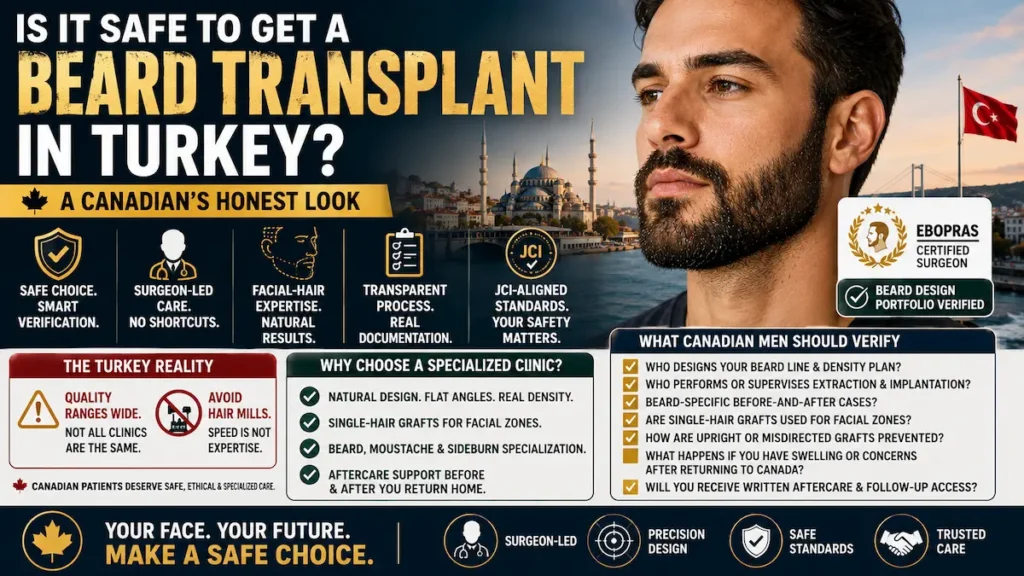
Is It Safe to Get a Beard Transplant in Turkey? A Canadian’s Honest Look
Turkey has an international reputation for hair transplantation, but the quality range is wide. Some clinics are surgeon-led, clinically structured, and transparent. Others operate as high-volume hair mills where speed matters more than design or aftercare.
For Canadian patients, the safe question is not simply “Is Turkey safe?” The better question is: “Is this clinic safe, regulated, specialized in facial hair, and clear about who performs each step?”
The Turkey Hair Transplant Industry Reality
Turkey became a global hair-transplant centre because of procedure volume, specialized teams, and cost-effective clinical access. That strength also created a crowded market. Not every clinic operates at the same standard.
Some providers advertise a low headline price, then rush high graft counts with limited doctor involvement. This can be especially risky for beard work because facial-hair design cannot be reduced to a graft number.
For a broader safety framework, our plastic surgery safety in Turkey guide explains how Canadian patients can separate regulated, surgeon-led care from high-risk providers.
Facial-Hair Specialization vs Generic Hair Mills
A generic hair mill may perform many scalp procedures each day. That does not prove facial-hair expertise. Beard, moustache, and sideburn restoration require a different design eye.
Ask to see beard-specific work, not just scalp hairline cases. Look for natural cheek gradients, smooth sideburn transitions, flat graft angles, and realistic density. If every before-and-after result shows a harsh cheek line, be cautious.
Ghost Surgery in Turkey Hair Procedures
Ghost surgery means the patient believes one surgeon will perform or supervise the procedure, but someone else does the key steps without clear consent. Canadian patients are right to ask about this before booking.
At AKM Clinic, we emphasize surgeon-led planning, documented treatment protocols, and clear communication before treatment. You should know who designs your beard, who supervises the procedure, and how your aftercare will be handled.
Our ghost surgery in Turkey guide gives patients a practical verification checklist before committing to any international surgical programme.
EBOPRAS-Certified Surgeon and Beard Design Portfolio Verification
Credential verification matters. Canadian patients are used to checking provincial college listings, RCPSC training pathways, and clinic reviews at home. International care requires a similar discipline.
When assessing a beard transplant provider, review both credentials and portfolio relevance. A clinic may be strong in scalp transplantation but weak in moustache or beard angle control. Ask for facial-hair examples that match your goal.
JCI-Aligned Standards and Real-Time Documentation
Our clinical pathway is built around external accountability, sterile technique, and documentation. We provide instructions before and after treatment so patients understand what happened, what to expect, and when to contact us.
This is important after you return to Canada. If you need to speak with your family physician or dermatologist, clear documentation helps bridge the geographic gap.
What Canadian Men Should Verify Before Booking
- Who designs the beard line and density plan?
- Who performs or supervises extraction and implantation?
- Does the clinic show beard-specific before-and-after cases?
- Are single-hair grafts used for facial zones?
- How does the clinic prevent upright or misdirected grafts?
- What happens if you have swelling, folliculitis, or concern after returning to Canada?
- Will you receive written aftercare instructions and follow-up contact access?
If a clinic avoids these questions, that is a red flag. A strong provider should welcome verification.
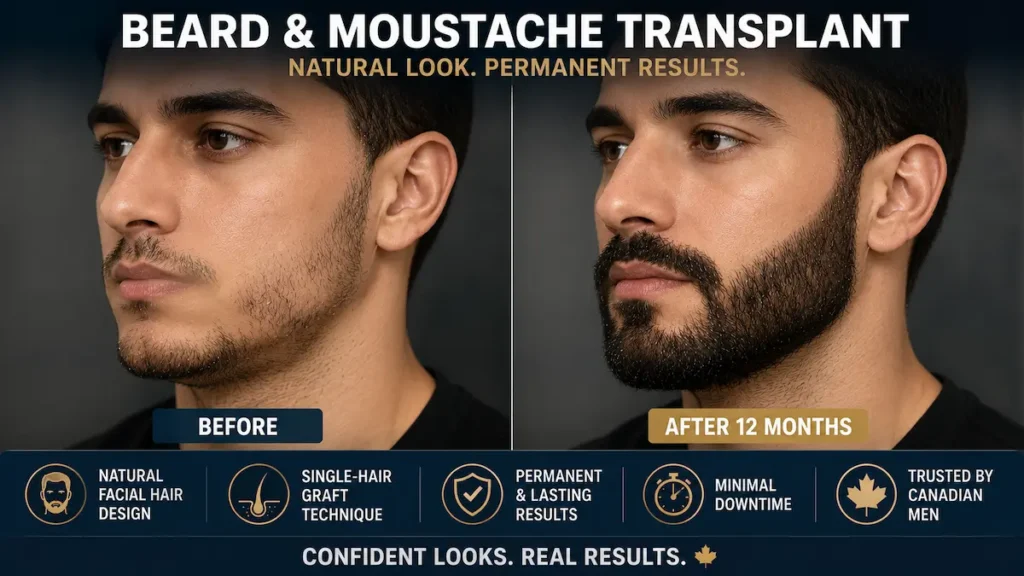
Beard Transplant Before After: Realistic Expectations & Results
A beard transplant can create permanent facial-hair density, but results develop gradually. The final outcome depends on graft survival, donor supply, beard design, skin healing, and how your transplanted follicles mature over twelve months.
Realistic expectations protect satisfaction. A natural beard is not a painted-on border. It has density variation, direction changes, and subtle transitions.
Beard Transplant Before and After: Realistic Outcomes
Before-and-after photos should show more than density. They should show angle, direction, cheek-line softness, sideburn connection, and natural integration with existing facial hair.
A good result should look believable both freshly trimmed and grown out. Harsh lines can look impressive in a single photo, but they often look artificial in daily life.
Beard-to-Scalp Before and After: Reverse Donor Reality
Beard-to-scalp transplantation can be helpful in selected patients with limited scalp donor supply. It is not a universal solution. Beard hair is often thicker than scalp hair, which means it must be used carefully.
It can add coverage to the crown or mid-scalp, but it may be too coarse for the frontal hairline. Blending is the key. We assess donor texture, facial density, and long-term styling goals before recommending this approach.
Density Expectations and Graft Math
Patients often ask for a “full beard,” but that phrase can mean very different things. One patient may need cheek patch filling. Another may need chin, jawline, sideburn, and moustache restoration.
Graft count depends on the area size, existing hair, desired density, and donor supply. Overpromising density is one of the most common mistakes in beard transplantation. We explain what one session can realistically achieve before you travel.
“The safest beard design is not always the densest design. The right density is the one that looks natural on the patient’s face, protects the donor area, and still allows future options.”
Is a Beard Transplant Permanent?
Yes, transplanted follicles are intended to be permanent once they vascularize and complete the early healing cycle. They continue to grow because they come from a genetically stable donor area.
Permanent does not mean instant. The visible hairs may shed during the first month, then regrow later. Final density usually appears between six and twelve months.
Long-Term Beard Maintenance
Transplanted beard hair grows like hair. You can trim, shave, and style it. Some scalp-derived follicles may grow faster than native beard hair, so grooming may require adjustment.
Many patients prefer regular trimming rather than long growth at first. Over time, they learn how the new hair behaves and choose a grooming routine that suits their face.
Before & After Gallery
Visual review matters. Before booking, Canadian patients should look for cases that show natural beard direction, balanced density, and realistic facial framing. A good gallery should include different beard goals, not only dramatic full-beard transformations.
You can review related results through our hair transplant before-and-after gallery. During consultation, we also discuss which examples are closest to your facial-hair pattern and donor capacity.
Beard Transplant Cost 2026: Turkey vs Canada
Beard transplant cost varies by graft count, beard area, technique, and whether the plan includes moustache, sideburn, scar camouflage, or full lower-face restoration. Canadian patients comparing Toronto, Vancouver, Calgary, Edmonton, and Montreal often find that domestic quotes are substantially higher once consultation, facility, aftercare, and graft-count pricing are included.
At AKM Clinic, beard transplant pricing starts from CAD $3,000-$3,200 for up to 1,500 grafts. Larger beard cases in the 1,500-2,500 graft range are typically CAD $3,200-$3,500. A moustache transplant is generally CAD $2,500-$2,800, depending on density and design requirements.
By comparison, Toronto private beard transplant quotes commonly sit around CAD $6,000-$8,000, while Vancouver private clinics may quote CAD $6,500-$8,500. Those Canadian estimates may not include the same travel coordination, hotel stay, VIP transfers, medications, or long-term virtual follow-up structure.
For the full Canadian dollar cost breakdown, including graft-count pricing and common hidden fees, see our detailed beard transplant cost guide for Canadian patients.
For patients combining beard and moustache restoration, our beard and moustache transplant package provides a more structured all-inclusive pathway. Canadian-dollar pricing shown for planning clarity; your coordinator will confirm the final payment details before booking.
| Location / Option | Typical Beard Transplant Cost | Notes |
|---|---|---|
| AKM Istanbul — up to 1,500 grafts | CAD $3,000-$3,200 | For smaller beard, cheek, jawline, or patch correction cases |
| AKM Istanbul — 1,500-2,500 grafts | CAD $3,200-$3,500 | For larger beard-density plans |
| AKM Istanbul — moustache transplant | CAD $2,500-$2,800 | For upper-lip density or scar correction |
| Toronto private clinics | CAD $6,000-$8,000 | Often quoted by graft count or session scope |
| Vancouver private clinics | CAD $6,500-$8,500 | Higher private-clinic overhead may affect total estimate |
| Calgary / Edmonton / Montreal | Varies by clinic availability | Some patients are referred to larger metro centres |
Cost should never be the only deciding factor. A beard transplant is highly visible. Paying less for poor angle control, multi-hair grafts, or weak aftercare can become more expensive if revision is needed later.
How to Find the Best Beard Transplant Surgeon in Turkey: A Canadian Patient’s Checklist
Many Canadian patients begin by searching for beard transplant Toronto, facial hair transplant Toronto, or beard transplant near me. That is a reasonable starting point. The next step is comparing technique, safety, facial-hair portfolio, and total cost across providers.
The best beard transplant surgeon for you is not simply the person who performs the most scalp hair transplants. Facial hair has its own rules. You need a team that understands single-hair grafting, flat beard angles, density gradients, sideburn connection, and long-term donor strategy.
Check Formal Surgical Credentials
Canadian patients are used to looking for RCPSC certification or provincial college registration when choosing care at home. In Turkey, you should look for internationally comparable credentialing and verifiable surgical training.
At AKM Clinic, our surgical leadership includes European Board-Certified expertise and international facial plastic surgery training. We explain credential equivalency in plain language so Canadian patients can understand how our standards compare with the Canadian framework. Canadian patients can also review domestic specialist standards through the Royal College of Physicians and Surgeons of Canada’s specialist certification framework.
| Credential / Body | What It Signals | Why Canadian Patients Ask About It |
|---|---|---|
| RCPSC | Canadian specialist training and fellowship pathway | Recognized domestic benchmark for medical specialist standards |
| EBOPRAS / European Board Framework | Structured European board-level surgical credentialing | Useful international comparison point for Canadians |
| ISHRS / Hair Restoration Societies | Hair-restoration-specific education and standards | Relevant for transplant technique and ethical practice |
| Clinic accreditation and hospital standards | Facility safety, sterilization, and documentation discipline | Important for patients travelling outside provincial oversight |
Ask for Beard-Specific Before-and-After Cases
Do not judge a beard transplant provider only by scalp hairline photos. A natural scalp hairline does not prove natural beard work. Facial hair requires different angle control and graft selection.
Ask for cases showing cheek restoration, moustache work, sideburn connection, and patch correction. Look carefully at the direction of growth. The best results should look believable, not just dense.
Confirm Single-Hair Graft Discipline
Single-hair grafts are essential for facial hair. Multi-hair grafts can create a plug-like appearance, especially along the cheek line and moustache border. This is one of the most important questions to ask before booking.
A strong clinic should be able to explain how grafts are selected, separated, hydrated, and assigned to each facial zone. Vague answers are not enough.
Verify Beard Angle Planning
Angle is the technical detail that patients often forget to ask about. It is also one of the easiest problems to notice after a poor result.
Ask how the clinic recreates the flat 10-15° beard angle. Ask whether direction is mapped separately for cheeks, chin, jawline, sideburns, and moustache. One angle cannot suit the whole face.
“A beard transplant is not only about graft survival. It is about whether the hair exits the skin in the right direction. If the angle is wrong, even a high survival rate can produce an unnatural result.”
Clarify Who Performs the Key Steps
Before travelling, ask who designs your beard, who extracts grafts, who creates recipient sites, and who implants follicles. The answer should be clear before you pay a deposit or book flights.
This is especially important in international care, where some clinics use sales teams to make promises the medical team does not directly control. We recommend asking direct questions and saving written answers.
Assess Aftercare Continuity
Good beard transplant care does not end when you leave Istanbul. You need instructions for washing, shaving, shock loss, redness, folliculitis, and regrowth. You also need a contact pathway if a concern appears after you return home.
Our patient journey includes follow-up support after you return to Canada. You can learn how we structure the process on our Canadian patient journey page.
Review Patient Support and Clinic Transparency
International patients need logistical clarity. Airport pickup, hotel recovery, clinic transfers, medication instructions, and follow-up scheduling should be organized before arrival.
Our patient hosts help coordinate the clinical pathway so you are not managing every detail alone in a foreign city. For more background on our clinic model, visit our About AKM Clinic page. You can also review patient feedback through our professional plastic surgery reviews.
Red Flags to Avoid
- Only scalp hair transplant photos, with no beard-specific examples.
- No clear answer about who performs extraction and implantation.
- Very high graft promises without donor-area assessment.
- No discussion of single-hair graft selection.
- Harsh, perfectly drawn beard lines in every example.
- No written aftercare plan for patients returning to Canada.
- Pressure to book immediately before medical review.
A trustworthy provider should give you time to compare options. Facial-hair restoration is permanent. It deserves careful planning.
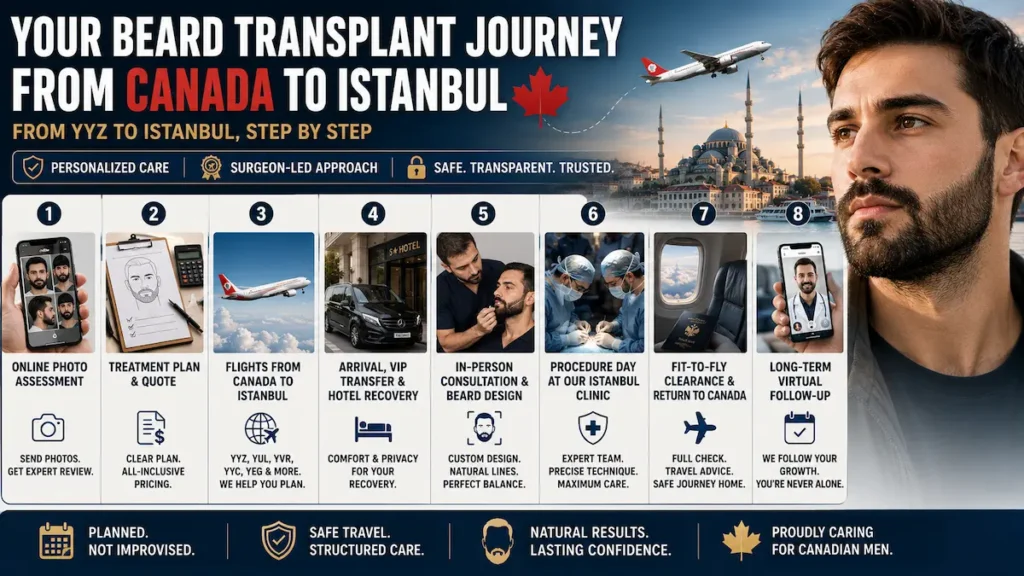
Your Beard Transplant Journey from Canada: From YYZ to Istanbul, Step by Step
Travelling from Canada for a beard transplant should feel structured, not improvised. Our process is designed to reduce uncertainty before you leave home, during your stay in Istanbul, and after you return to Canada.
Most patients begin with online photo assessment. From there, we confirm candidacy, estimate graft range, explain the most suitable technique, and build a travel plan around your procedure and early healing needs.
Step 1: Online Photo Assessment
Your first step is a secure photo review. We ask for clear images of your face from the front, both sides, jawline, chin, moustache area, and donor scalp. If you have scarring or alopecia patches, we review close-up photos as well.
We then assess your existing facial hair, donor supply, beard design goals, and whether your expectations match what surgery can safely achieve. If we need medical clearance, we will tell you before you book travel.
Step 2: Treatment Plan and Quote
Your treatment plan includes the proposed graft range, target zones, technique recommendation, and recovery expectations. We also explain whether you are better suited for patch correction, moustache restoration, sideburn reconstruction, goatee enhancement, or full beard restoration.
Cost is discussed clearly before booking. Our all-inclusive clinical pathway may include the procedure, hotel accommodation, VIP transfers, medications, and patient support depending on the selected package. You will know what is included before you travel.
Step 3: Flights from Canada to Istanbul
Canadian patients commonly travel from Toronto Pearson (YYZ), Montreal (YUL), Vancouver (YVR), Calgary (YYC), Edmonton (YEG), or Ottawa (YOW). Flight schedules change, so you should confirm current options with your airline before booking.
Toronto and Montreal often provide the most direct Istanbul access. Western Canada may require a connection depending on season and airline schedule. We help you plan arrival timing around consultation, procedure day, and early recovery.
Step 4: Arrival, VIP Transfer, and Hotel Recovery
After you arrive in Istanbul, your private transfer takes you to your hotel or clinic appointment depending on the schedule. We aim to remove the stress of navigating a new city while preparing for treatment.
Our 5-star hotel pathway supports quiet recovery after the procedure. Facial-hair patients need comfort, privacy, and easy access to clinic support during the scab phase. You can learn more through our hotels and VIP transfers page.
Step 5: In-Person Consultation and Beard Design
Your in-person consultation finalizes the beard design. We review your natural growth pattern, confirm donor supply, and mark the planned cheek line, jawline, moustache, sideburn, or goatee zones.
This step is critical. Small design changes can make a major difference on the face. We take time to avoid over-sharp lines, unnatural symmetry, or excessive density that does not match your features.
Step 6: Procedure Day at Our Istanbul Clinic
On procedure day, the donor and recipient areas are prepared, local anesthesia is applied, and the transplant begins. Our team monitors comfort, graft handling, hydration, and placement throughout the procedure.
Our clinic is located in Levent, one of Istanbul’s central medical and business districts. You can review our facility approach on our Istanbul clinic page.
Step 7: Fit-to-Fly Clearance and Return to Canada
Before you return home, we review your grafts, donor area, swelling, and aftercare understanding. You will receive instructions for flying, washing, sleeping, shaving timeline, and what to report after you land.
For long flights back to Canada, hydration and movement matter. Avoid rubbing the beard area with masks, scarves, travel pillows, or tight collars. Keep your face protected and follow the instructions given at your final check.
Step 8: Long-Term Virtual Follow-Up
Beard growth takes months. We follow your healing through the shedding phase, early regrowth, and final density maturation. Virtual follow-ups help us monitor progress even after you are back in Toronto, Vancouver, Calgary, Edmonton, Montreal, Ottawa, Winnipeg, or Halifax.
Our standard follow-up rhythm includes check-ins around key milestones. If something looks unusual, you can contact us earlier. You do not need to guess alone.
Beard Transplant Frequently Asked Questions (FAQ):
Am I a good candidate for a beard transplant?
You may be a good candidate if you have patchy, sparse, scarred, or uneven facial hair and enough healthy scalp donor supply. We also review your skin health, age, hair-loss history, and expectations before recommending surgery.
Is FUE or DHI better for facial hair?
Neither technique is automatically better for every patient. FUE can work well for larger beard zones. DHI can be useful for smaller precision areas such as the moustache or sideburns. The best choice depends on graft count, density goal, and facial design.
When can I shave after a beard transplant?
You should not shave during the early graft-healing phase. We usually recommend waiting until the grafts are secure and the skin has settled. Trimming often returns before close shaving, but timing depends on your healing progress.
Is a beard transplant permanent?
Yes. Transplanted follicles are intended to grow permanently once they establish blood supply. The visible hairs often shed during the first month, then begin regrowing later. Final density usually develops between six and twelve months.
Does OHIP, MSP, RAMQ, or AHCIP cover a beard transplant?
Provincial health plans generally do not cover cosmetic beard transplantation. Coverage may differ only in unusual reconstructive circumstances, such as medically documented trauma or burn reconstruction. You should confirm with your provincial plan and family physician if your case is reconstructive.
How much does a beard transplant cost in Toronto vs Istanbul?
Toronto private beard transplant quotes commonly range from CAD $6,000-$8,000. AKM Clinic beard transplant pricing typically starts around CAD $3,000-$3,200 for smaller cases and CAD $3,200-$3,500 for larger beard plans. Final pricing depends on graft count and technique.
Does Canadian travel insurance cover complications from an elective beard transplant abroad?
Many Canadian travel insurance policies exclude elective cosmetic surgery and complications related to it. You should review your policy carefully before booking and ask the insurer direct written questions.
To reduce this concern, AKM Clinic provides complimentary complication insurance for all patients. This is separate from standard Canadian travel insurance and is designed to add an extra layer of protection around your surgical care. Your coordinator will explain the coverage terms, limits, and required documentation before you confirm your booking.
Can beard hair be used for a scalp hair transplant?
Yes, in selected advanced cases. Beard hair can sometimes serve as a supplemental donor source for scalp restoration when scalp donor supply is limited. It must be used carefully because beard hair is often thicker and coarser than scalp hair.
What causes a beard transplant to look unnatural?
The most common causes are upright graft angles, multi-hair grafts, harsh cheek lines, poor direction control, and excessive density in the wrong zones. Facial-hair planning must be different from scalp hairline planning.
Can alopecia barbae be treated with a beard transplant?
Sometimes, but only when the condition is stable. If alopecia barbae is active, transplanted follicles may be at risk. We may recommend dermatology clearance before proceeding.
Will transplanted beard hair grow like normal beard hair?
Transplanted scalp follicles will grow in the beard area, but they may retain some scalp-hair characteristics. Many patients trim regularly to blend texture and length with native facial hair.
Can I combine a beard transplant with a scalp or eyebrow transplant?
Yes, selected patients can combine beard restoration with scalp or eyebrow transplantation. Donor supply is the key limiting factor. We plan carefully so one goal does not compromise another.
How do I verify a beard transplant surgeon in Turkey?
Ask for credentials, beard-specific before-and-after cases, clear surgeon-of-record information, and a written aftercare plan. You can also review international hair-restoration standards through organizations such as the International Society of Hair Restoration Surgery.
Should I speak with a Canadian doctor before travelling?
Yes. We recommend discussing travel, medications, chronic conditions, and any skin disease history with your Canadian family physician or dermatologist before booking international care. This is especially important if you have alopecia barbae, scarring, diabetes, bleeding disorders, or active skin inflammation.
Medical Disclaimer: This page is for educational purposes only and does not replace medical advice, diagnosis, or treatment from a qualified health care professional. Beard and moustache transplant results vary by donor supply, skin quality, graft survival, aftercare, and individual healing biology. Before travelling for treatment, Canadian patients should consult their family physician, dermatologist, or another qualified clinician, especially if they have alopecia barbae, scarring, diabetes, bleeding disorders, immune conditions, or active skin disease. Elective procedures abroad may not be covered by provincial health plans or standard travel insurance.