



Canadian women and men with sparse, over-plucked, or absent eyebrows face a decision triangle: microblading delivers semi-permanent pigment for 1-3 years at CAD $400-$800 per session, permanent makeup tattoos last 5-7 years but may fade unevenly, and surgical eyebrow transplant creates permanent live hair growth once the follicles vascularize. Toronto and Vancouver private clinics commonly charge CAD $6,000-$8,000 for eyebrow transplant, while AKM Clinic in Istanbul offers FUE and DHI eyebrow restoration through a surgeon-led international clinical pathway. This guide explains how eyebrow transplant works, who is a strong candidate, and why brow angle, single-hair graft selection, and long-term maintenance matter more than simple density.
Table of Contents
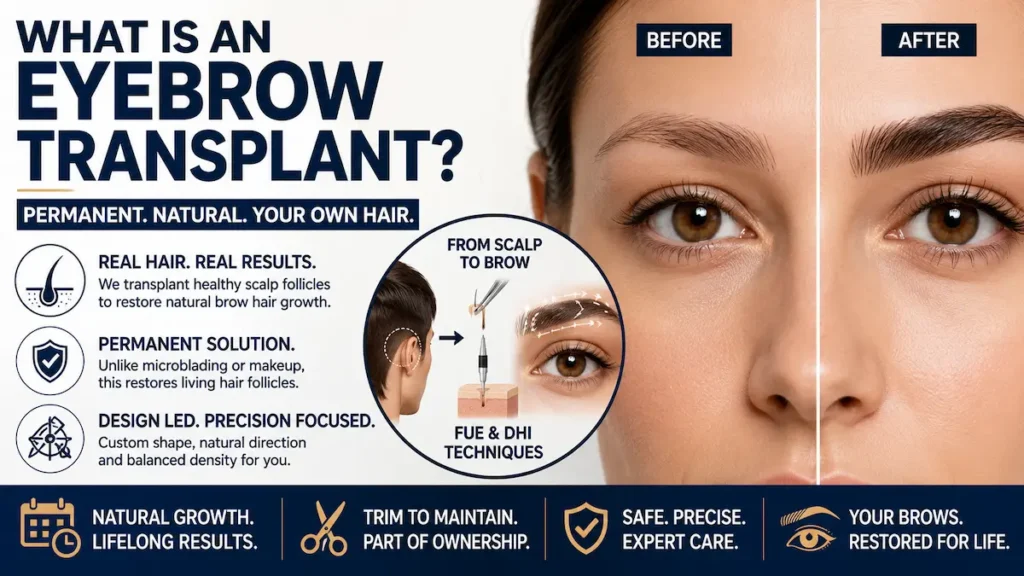
What Is an Eyebrow Transplant? FUE & DHI Technique for Brow Restoration
An eyebrow transplant is a permanent restoration procedure that uses FUE or DHI technique to move scalp hair follicles into the eyebrow area, restoring natural growth in over-plucked, over-tweezed, alopecia-affected, or scarred brows. Results are permanent, unlike microblading or permanent makeup tattoos.
Unlike pigment-based options, eyebrow hair transplant restores living follicles. Once those follicles establish blood supply in the brow area, they grow hair naturally. That is the main reason Canadian patients compare this procedure with microblading, permanent makeup, and semi-permanent brow tint before choosing surgery.
At AKM Clinic, our approach is conservative and design-led. We do not treat eyebrows as a miniature scalp transplant. Brow restoration requires a flatter angle, softer density, and careful direction control.
How Eyebrow Transplant Works: Scalp Donor Follicles to Eyebrow Recipient Sites
During an eyebrow hair transplant, we extract healthy follicles from a discreet donor area, usually from the scalp behind the ear. These follicles are then refined into single-hair grafts and placed into the brow in a planned pattern. The goal is not simply to add hair.
The goal is to rebuild the architecture of the brow.
That means we plan:
- the brow head, where the eyebrow begins near the nose;
- the arch, where shape and expression are defined;
- the tail, which is often lost after years of over-plucking;
- density, so the result does not look too sparse or too bushy;
- hair direction, so transplanted hairs lie naturally against the skin.
For many Canadian patients, the donor hair comes from the scalp because it is reliable, available, and permanent. After transplantation, it keeps some scalp-hair behaviour. That means the new brow hair must be trimmed regularly.
That maintenance is not a complication. It is part of realistic eyebrow transplant ownership.
Eyebrow Transplant vs Scalp Hair Transplant: Why Brow Anatomy Is Different
A scalp hair transplant focuses on density, coverage, and hairline transition. An eyebrow transplant focuses on direction, softness, and facial balance. The same FUE and DHI families of technique may be used, but the surgical judgement is different.
Scalp hair usually exits the skin at a steeper angle. Eyebrow hair lies flatter. If grafts are placed too upright, the result can look unnatural, even when graft survival is good.
This is why eyebrow transplant is not a procedure we reduce to graft count. A technically successful graft can still be aesthetically wrong if the direction is poor. For eyebrow restoration, single-hair graft discipline is non-negotiable.
Patients who want the broader scalp-restoration overview can review our hair transplant in Turkey guide for Canadians, but eyebrow transplant has its own design logic. The brow is a facial feature first, and a hair restoration site second.
Eyebrow Hair Transplant Terminology: FUE Eyebrow, DHI Eyebrow, Brow Restoration
Most patients see several terms during research. Some clinics use them loosely, which creates confusion. Here is the practical distinction.
- FUE eyebrow transplant means follicular units are extracted individually, then placed into eyebrow recipient sites.
- DHI eyebrow transplant uses a Choi-style implanter pen for direct placement, allowing precise control in selected cases.
- Partial eyebrow restoration fills sparse zones, commonly the tail or arch.
- Full eyebrow restoration rebuilds most or all of the brow shape.
- Scar camouflage eyebrow transplant places follicles through scarred brow tissue where safe and clinically appropriate.
FUE and DHI are not competing marketing labels. They are tools. Our surgical team decides which method fits your anatomy, density goal, donor hair, and skin quality.
For patients who want a deeper technique comparison, our dedicated FUE hair transplant and DHI hair transplant pages explain the broader scalp applications. This page focuses only on how those methods behave in eyebrow anatomy.
From Thin 90s Brows to Modern Brow Restoration
A large share of eyebrow transplant patients are not dealing with sudden hair loss. They are dealing with history. Many over-plucked or over-tweezed their brows in the 1990s or early 2000s, then found that the follicles never fully recovered.
That pattern is common.
Modern brow aesthetics are softer and fuller than the ultra-thin styles of that era. Microblading can add the appearance of shape, but it cannot revive a follicle. An eyebrow transplant can restore live hair where donor supply and skin conditions are favourable.
Our philosophy is not to create a trend brow. We design a brow that suits your face, age, hair colour, and long-term maintenance habits. The best result should look like your own brow returned, not like a template placed on your face.
Benefits of Eyebrow Transplant
Eyebrow transplant is best understood as a permanent hair restoration procedure, not a makeup substitute. It can reduce the daily effort of drawing or filling brows, but it also comes with surgical planning and long-term grooming responsibility.
The right candidate values both sides.
Permanent Live Hair Growth Instead of Pigment
Microblading and permanent makeup deposit pigment. Eyebrow transplant moves living follicles. That distinction matters because pigment fades, changes colour, or requires repeat sessions over time.
Transplanted brow hairs grow because they are real hair.
Once the grafts take, they continue to grow in the eyebrow area. You can trim, shape, and maintain them like natural brows. This permanence is a major reason Canadian patients who are tired of repeated brow appointments consider surgery.
Natural Texture, Direction, and Density When Designed Correctly
A strong eyebrow transplant result depends on subtlety. More grafts do not always mean a better result. In the eyebrow, density must be placed in layers, with different directions in the brow head, body, arch, and tail.
We design the brow before the procedure begins. That plan guides extraction, graft selection, and placement.
Natural-looking density requires:
- single-hair grafts rather than multi-hair grafts;
- flat recipient angles that mimic natural brow growth;
- soft transition at the brow head;
- gradual density through the arch and tail;
- symmetry that respects natural facial asymmetry.
We aim for a brow that frames the eyes without dominating the face.
Restoring Over-Plucked or Over-Tweezed Brows
Over-plucked brows are one of the strongest indications for eyebrow transplant. In these patients, the original shape may still be visible, but the follicle density is weak. The tail is often the most affected area.
An eyebrow transplant can rebuild sparse sections with your own hair.
This is different from covering the gap with pigment. The transplanted hair grows through the skin, giving texture and dimension. For patients who have spent years filling the same missing area every morning, that difference can be meaningful.
Scar, Burn, or Trauma Camouflage
Some patients have eyebrow gaps from childhood injuries, burns, piercings, surgery, or other trauma. When scar tissue has adequate blood supply and thickness, carefully placed grafts may help camouflage the area.
Scar tissue is not the same as normal skin.
It may accept grafts differently. It may need conservative density. In some cases, a staged approach is safer than trying to create full density in one session.
During consultation, we assess the scar surface, colour, thickness, and vascularity before recommending eyebrow transplant. If a scar is not ready for grafting, we tell you directly.
Confidence Without Daily Brow Makeup
Many patients do not want dramatic change. They want to stop managing the same gap every day. They want to swim, exercise, travel, or wake up without checking whether brow makeup has moved.
That is a practical benefit.
Eyebrow transplant can reduce dependence on daily brow pencils, powders, gels, or tint. It does not remove maintenance completely, because transplanted hairs still need trimming and shaping. It does change the baseline.
Instead of creating a brow from makeup, you maintain a brow that has live hair.
Am I a Good Candidate for an Eyebrow Transplant?
A good eyebrow transplant candidate has a clear reason for hair loss, realistic expectations, adequate donor hair, and the willingness to maintain transplanted brow hair long term. We also look for emotional readiness. Eyebrow design is personal, and small changes can affect facial expression.
Before surgery, we may recommend evaluation by a dermatologist if hair loss appears active, inflammatory, autoimmune, or medically unexplained. The Canadian Dermatology Association describes alopecia as hair loss affecting the body and scalp, and medical causes should be understood before surgical planning. The Canadian Hair Loss Council also provides education and support for people living with hair and scalp concerns. Canadian Dermatology Association Canadian Hair Loss Council
Over-Plucked or Over-Tweezed Brows from the 90s and 2000s
This is one of the most common candidacy groups. The patient usually has stable loss, enough donor hair, and a clear aesthetic goal. The brow may still have some native hair, but the tail, arch, or lower border looks sparse.
These patients often respond well to partial eyebrow restoration.
The goal is not to erase the face’s natural expression. We usually rebuild density where follicles were damaged by repeated tweezing, then blend the new grafts into existing brow hair.
Alopecia Areata and Universalis: When Eyebrow Restoration May Help
Alopecia-related eyebrow loss requires caution. If the condition is active or unpredictable, transplanted follicles may be at risk. Surgery should not be the first step when inflammation is uncontrolled.
Stability matters.
Patients with alopecia areata, totalis, or universalis should usually have dermatology input before considering eyebrow transplant. If the disease has been stable for a long period and the donor area is suitable, surgery may be discussed carefully.
We do not promise graft survival in active autoimmune hair loss. That would be misleading. Our role is to assess the risk and help you decide whether surgery is reasonable now, later, or not at all.
Scar, Burn, and Trauma Reconstruction
Eyebrow transplant may help patients with brow gaps caused by scars, burns, or trauma. These cases are partly reconstructive because the goal is to restore continuity across a damaged area.
The tissue must be suitable.
We examine whether the scar is soft, mature, and vascular enough to support graft growth. Thick, tight, or poorly vascularized scars may need a conservative plan. Some patients need fewer grafts than they expect because too much density can stress scar tissue.
Trichotillomania: When Surgery Should Wait
Trichotillomania is a hair-pulling disorder that can affect brows, lashes, and scalp hair. Eyebrow transplant can fail if pulling behaviour is still active. The transplanted hair can be pulled out just like native hair.
We handle this topic without judgement.
Patients should have a stable period before surgery. Support from a mental health professional may be appropriate. Once the behaviour is controlled and expectations are realistic, eyebrow transplant may become a safer option.
Female Pattern Eyebrow Thinning
Some women notice eyebrow thinning with age, hormonal shifts, thyroid conditions, medication changes, or broader hair density changes. Eyebrow transplant can help selected patients, but the cause should be assessed first.
Not every thinning brow is surgical.
If the loss is part of a wider hair or skin condition, medical evaluation may be more useful before surgery. Patients with scalp thinning can also read our hair transplant for women in Turkey guide for a broader explanation of female-pattern candidacy.
Eyebrow Transplant for Men
Men may choose eyebrow transplant for sparse genetic brows, facial scarring, alopecia, or asymmetry. The design approach is different from female brow restoration. Male brows usually need a flatter, heavier, less arched shape.
We do not feminize the brow unless that is the patient’s explicit goal.
For men, the priority is often density and balance rather than a sculpted arch. The design must match the forehead, eyes, beard density, and overall facial structure.
Age, Donor Availability, and Maintenance Commitment
Eyebrow transplant is usually considered for adults with stable goals and stable hair loss. Age alone does not determine candidacy. Donor hair quality, skin health, and maintenance commitment matter more.
The maintenance point is important.
Because scalp hair keeps growing after transplantation, transplanted eyebrow hairs need trimming. Some patients see this as a small tradeoff for permanent hair. Others prefer the lower-maintenance feel of pigment-based options.
We discuss this before surgery, not after.
When Eyebrow Transplant Is Not Recommended
We may advise against eyebrow transplant when the risk is higher than the likely benefit. A responsible “no” protects your result.
Eyebrow transplant may not be recommended if you have:
- active alopecia areata flare or unstable autoimmune hair loss;
- insufficient donor hair;
- uncontrolled trichotillomania;
- active skin infection or inflammatory skin disease in the brow area;
- unrealistic density expectations;
- unwillingness to trim and maintain transplanted brow hair;
- significant body dysmorphic concerns that make surgery unlikely to satisfy the underlying distress.
Our consultation is designed to identify these issues early. The best eyebrow transplant is not the one with the highest graft count. It is the one that fits your anatomy, your donor supply, and your long-term expectations.
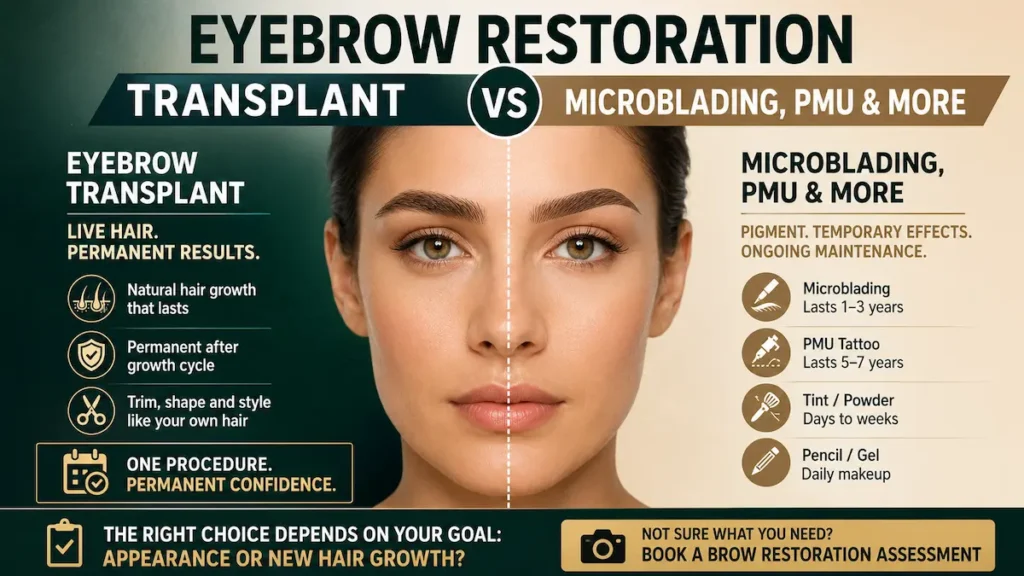
Eyebrow Transplant vs Microblading vs PMU vs Semi-Permanent: The Decision Framework
Most Canadian patients reach eyebrow transplant after trying, researching, or pricing pigment-based brow options first. That is reasonable. Microblading, powder brows, permanent makeup, brow tint, and pencil can all help the eyebrow look fuller without surgery.
They do not do the same job.
An eyebrow transplant restores live hair. Microblading and PMU create the visual effect of hair or shading through pigment. Semi-permanent tint, powder, and pencil sit closer to makeup than medical restoration.
The right choice depends on whether your concern is mild cosmetic definition or true eyebrow hair loss.
The Five-Strategy Decision Framework
We usually frame the decision around five options. Each one has a different level of permanence, maintenance, and realism.
| Method | What It Adds | Typical Duration | Best For | Main Limitation | AKM Position |
|---|---|---|---|---|---|
| Eyebrow Transplant | Live transplanted hair | Permanent after growth cycle | True brow hair loss, scars, over-plucked brows | Requires surgery and ongoing trimming | Best when the goal is permanent hair restoration |
| Microblading | Semi-permanent pigment strokes | Usually 1-3 years | Mild sparseness and shape enhancement | Fades and may need repeated touch-ups | Useful for selected patients, but not live hair |
| PMU Tattoo | Longer-lasting pigment | Often 5-7 years | Patients who prefer pigment over hair growth | Colour drift and shape changes can occur | Acceptable for some, but less natural in texture |
| Semi-Permanent Tint or Powder | Colour on existing hair or skin | Days to weeks | Patients with enough native brow hair | Does not restore missing follicles | Good for maintenance, not reconstruction |
| Eyebrow Pencil or Gel | Daily makeup definition | Until removed | Flexible styling and temporary correction | Daily effort and smudging risk | Lowest commitment, but not a medical solution |
The key question is simple: do you want the appearance of a fuller brow, or do you want new hair growing from the brow skin?
If you still have enough brow hair and mainly want sharper shape, pigment or makeup may be enough. If you have bare skin, scar gaps, or years of over-plucking that never recovered, eyebrow transplant becomes more relevant.
“The biggest mistake in eyebrow restoration is treating every sparse brow as a density problem. Some patients need shape. Some need scar camouflage. Some need only the tail rebuilt. The surgical plan should match the actual missing anatomy.”
Eyebrow Transplant Technique Variants: FUE vs DHI
At AKM Clinic, eyebrow restoration can be performed with FUE or DHI-based technique, depending on the case. Both begin with donor follicle extraction. The difference is how the grafts are placed into the brow.
FUE eyebrow transplant uses individually harvested follicles, followed by manual placement into tiny recipient sites. DHI eyebrow transplant uses a pen-style implanter to place follicles directly in selected cases.
Neither method is automatically “best” for everyone.
| Technique | How It Works | Best Use | Angle Control | Density Control | AKM Offers |
|---|---|---|---|---|---|
| FUE Eyebrow Transplant | Follicles are extracted individually, then placed manually into brow sites | Full or partial brow restoration with flexible design | High, when recipient sites are planned carefully | Good for layered density | Yes |
| DHI Eyebrow Transplant | Follicles are implanted with a pen-style tool in selected cases | Precise placement in fine brow zones | High, when used by an experienced team | Strong for controlled placement | Yes |
The technique decision is based on your brow design, skin thickness, scar tissue, native hair, and donor quality. A clinic that offers only one method may push every patient toward that method. We prefer a dual-technique approach because eyebrow anatomy varies.
Patients comparing the broader scalp-hair applications of these methods can read our DHI vs FUE hair transplant guide. For this page, the important point is narrower: in the eyebrow, angle and direction matter more than raw graft count.
Eyebrow Transplant vs Microblading
Microblading creates fine pigment strokes in the skin. It can look natural in the right patient, especially when some native brow hair is already present. It is also less invasive than surgery.
That makes it a reasonable option for mild cosmetic enhancement.
Microblading becomes less satisfying when the brow has true hair absence. Pigment can create a line or shadow, but it does not create texture. It also fades, which means repeated appointments are part of the plan.
For some patients, that cycle works well. For others, it becomes frustrating.
- Microblading may be enough if you want light definition and have decent native brow hair.
- Eyebrow transplant may fit better if you have missing tails, scar gaps, or bare skin from over-plucking.
- Combination may help in selected cases, where surgery restores hair and later pigment refines soft shading.
We do not present microblading as “bad.” It has a place. We simply separate pigment enhancement from follicle restoration.
Eyebrow Transplant vs Permanent Makeup (PMU) Tattoo
Permanent makeup, often called PMU, deposits pigment deeper or in a way designed to last longer than microblading. It may appeal to patients who want a low-maintenance brow look without surgery.
Longevity is both the benefit and the risk.
PMU can fade unevenly, shift colour, or become less aligned with your face as brow trends and facial aging change. A brow shape that feels ideal at 32 may feel too harsh at 45.
An eyebrow transplant ages differently because it uses live hair. The hair can be shaped, trimmed, and adjusted over time. The underlying graft placement is still permanent, so design must be conservative from the beginning.
This is why we avoid overly sharp or fashion-driven brow shapes. Our philosophy is Natural-First. The brow should frame the eyes, not overpower them.
Eyebrow Transplant vs Semi-Permanent Tint, Filler, or Powder
Brow tint, powder, filler, pencil, and gel can improve colour and daily definition. They are helpful when native brow hair exists but looks too light or inconsistent. They are not solutions for missing follicles.
These options are flexible.
You can change colour, thickness, and shape as your style changes. The tradeoff is daily or frequent maintenance. They can also smudge, fade, or require repeated salon visits.
For patients who like changing their brow style, makeup-based options may be preferable. For patients who are tired of drawing the same missing tail every morning, surgery may be more practical.
A good consultation should not pressure you into surgery if a non-surgical option fits your goals. We make that distinction clearly.
8-Year Cost Math: Microblading Cycles vs One Eyebrow Transplant
Cost comparisons can be misleading if they only compare one microblading session with one eyebrow transplant. Microblading is lower per visit, but it usually needs touch-ups. Eyebrow transplant has a higher upfront cost but is intended as a permanent restoration.
The long-term math matters.
| Option | Typical Canadian Cost | Maintenance Pattern | Estimated 8-Year Cost | What You Get |
|---|---|---|---|---|
| Microblading | CAD $400-$800 per session | Refresh every 1-3 years | CAD $2,400-$4,800+ | Pigment strokes, not hair |
| PMU Tattoo | CAD $600-$1,200 per session | Longer interval, possible colour correction | CAD $1,200-$3,000+ | Longer-lasting pigment |
| Semi-Permanent Tint or Brow Styling | CAD $30-$150 per visit | Frequent salon or home maintenance | Highly variable | Colour or styling, not restoration |
| Eyebrow Transplant at AKM Clinic | FUE from CAD $2,750; DHI from CAD $3,000 | Trimming and grooming after growth | One surgical procedure for most patients | Permanent live hair growth |
For Canadians, the decision is not only financial. It is practical. Some patients prefer lower upfront cost and no surgery. Others prefer a permanent baseline that reduces repeat brow appointments.
Both choices can be rational.
Our role is to help you understand which option fits your anatomy and long-term expectations. If your brow only needs soft colour, microblading may be enough. If the follicle is gone, pigment can only simulate what surgery can restore.
“Eyebrow transplant should not chase a social media brow. We design for your face now and for how that brow will look as you age. Conservative architecture is the safest way to avoid regret.”
Not Sure Whether You Need Microblading or Eyebrow Transplant?
Our team can review your photos and tell you whether pigment-based enhancement is enough, or whether live follicle restoration is more appropriate for your brow loss pattern.Ask for a Brow Restoration Assessment
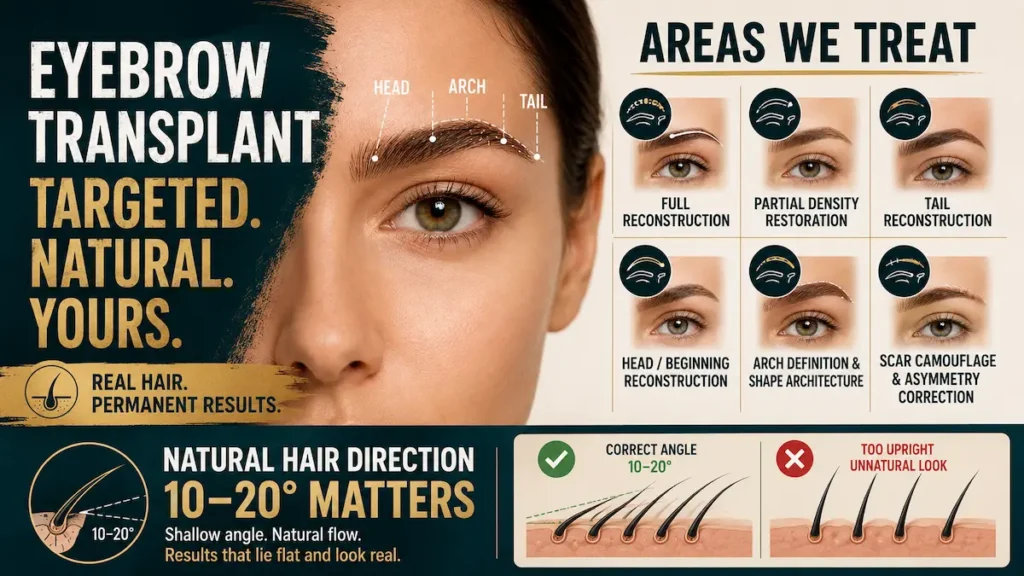
Areas Treated by Eyebrow Transplant
Eyebrow transplant is not one uniform procedure. Some patients need both brows rebuilt almost entirely. Others only need a tail, scar gap, or thin inner brow corrected. The surgical plan should match the missing area, not a standard graft package.
That is why we begin with brow mapping.
We assess existing hair, skin quality, facial symmetry, donor texture, and the way each brow moves with expression. Small design decisions matter. A few millimetres can change whether a brow looks soft, lifted, stern, or artificial.
Full Eyebrow Reconstruction
Full eyebrow reconstruction is used when most of the brow is absent. This can happen after severe over-plucking, alopecia, burns, trauma, or previous cosmetic work that left little usable native brow hair.
The plan is built from the face outward.
We first define the brow head, arch, body, and tail. Then we create a density gradient so the brow does not look stamped onto the skin. The inner brow usually needs softer, more feathered placement. The arch and tail can carry more definition.
Full reconstruction may require more grafts than partial work, but restraint still matters. Too much density can look heavy, especially in fair-skinned patients or patients with coarse donor hair.
Partial Density Restoration
Partial density restoration fills sparse zones inside an existing eyebrow. This is common in patients who still have a reasonable brow outline but lack fullness in certain sections.
It is often the most natural-looking category.
Existing brow hair gives the transplant a built-in guide. We place new single-hair grafts between native hairs to improve density without changing the patient’s identity. In these cases, the surgical goal is blending rather than rebuilding.
Partial work is especially useful for patients who like their current shape but are tired of filling the same thin areas with pencil or powder.
Tail Reconstruction: The Outer-Third Brow
The outer third of the brow is one of the most common restoration zones. Many patients lose the tail first, either through over-plucking, aging, thyroid-related thinning, or repeated waxing.
A missing tail changes facial expression.
It can make the eye area look shorter or less defined. Restoring the tail can lengthen the brow line, soften asymmetry, and reduce dependence on daily brow makeup. We design the tail carefully because an overly long or sharply angled tail can age the face.
For Canadian patients who work in professional settings, subtle tail restoration is often preferred over a dramatic high-arch design.
Head or Beginning Reconstruction
The brow head is the inner section closest to the nose. It requires the softest placement and the most restraint. If grafts are too dense or too vertical here, the brow can look blocky.
This area is unforgiving.
Natural brow heads usually have a feathered pattern, with hairs changing direction as they move into the body of the brow. We use single-hair grafts and conservative density to avoid a square or overly dark appearance.
Some patients only need a few grafts in this zone. More is not always better.
Arch Definition and Shape Architecture
The arch is where brow restoration becomes facial design. A strong arch can open the eye area. An exaggerated arch can look surprised, harsh, or mismatched to the face.
We design the arch around your anatomy.
That includes the orbital rim, eyelid shape, forehead proportions, brow bone, and natural asymmetry. We do not copy a celebrity brow or a social media filter. The brow must work when your face is moving, not just when it is photographed from the front.
Patients considering eye-region procedures may also compare this with blepharoplasty in Turkey, because eyelid heaviness and brow sparseness can overlap visually. The treatments solve different problems.
Scar Camouflage Through Existing Brow Scars
Eyebrow scars can come from childhood injuries, burns, piercings, accidents, or previous surgery. When the scar is mature and well vascularized, transplanted follicles can sometimes grow through it and reduce contrast.
Scar work needs caution.
Scarred skin may not accept grafts as predictably as normal skin. We may recommend lower density, staged grafting, or a more conservative design. If the scar is tight, pale, raised, or poorly vascularized, we may advise waiting or using another scar-management strategy first.
The aim is camouflage, not erasure. A responsible plan should improve visual continuity without pretending scar tissue behaves like untouched skin.
Asymmetry Correction
Almost every face has natural asymmetry. Eyebrow transplant can soften visible imbalance when one brow is thinner, shorter, or missing a tail compared with the other side.
We do not chase mathematical perfection.
Instead, we aim for facial harmony. One brow may need more grafts than the other. One arch may need a softer design because the eyelid or brow bone sits differently. This is normal.
Good asymmetry correction respects the patient’s natural expression. A perfectly mirrored brow can look artificial on a face that is not perfectly mirrored.
Eyebrow Hair Direction: Why the 10-20° Angle Matters
Natural eyebrow hair lies close to the skin. In many zones, grafts must be placed at a very shallow angle, often around 10-20° to the skin surface, while also changing direction from the brow head to the tail. If grafts are placed too upright, the hair may stand out instead of lying flat.
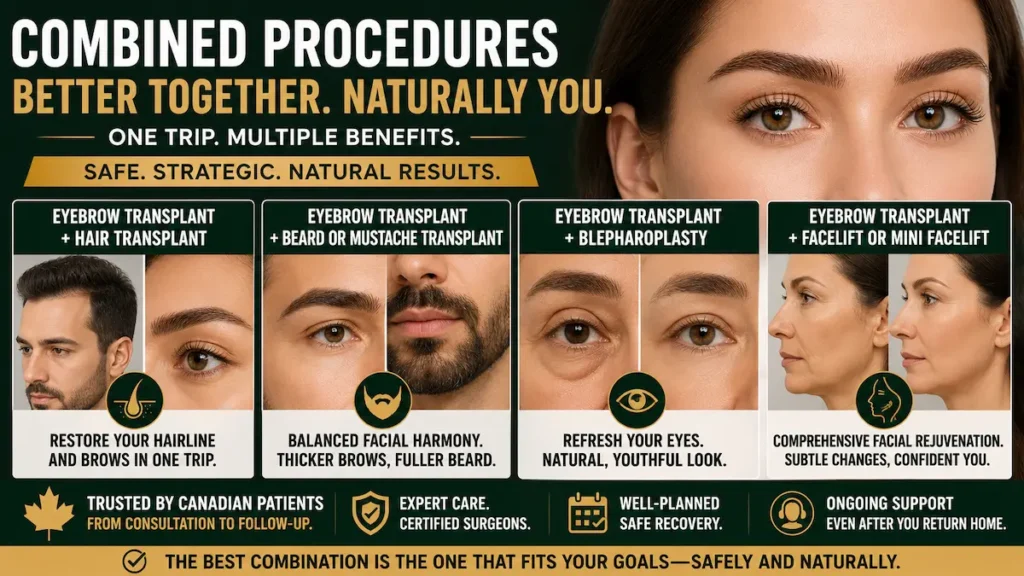
Combined Procedures: Eyebrow Transplant + Other Treatments
Eyebrow transplant can be performed alone or combined with selected procedures when the recovery plan remains safe. Combined treatment is not about doing as much as possible in one trip. It is about choosing procedures that work together without compromising healing.
We plan conservatively.
For eyebrow transplant, the most logical combinations are other hair restoration procedures or eye-region treatments that fit the same travel window.
Eyebrow Transplant + Hair Transplant
Eyebrow transplant can be combined with scalp hair transplant when donor planning is strong and the patient can manage aftercare for both areas. This is often useful for patients who want to address hairline, crown, and brows in one international trip.
Donor management becomes important.
We must protect the donor area and avoid over-harvesting. The brow requires finer single-hair grafts, while scalp restoration may require different density planning. These are related procedures, but they do not use the same design logic.
Patients considering a broader restoration plan can review our hair transplant in Turkey guide, along with our FUE and DHI technique pages.
Eyebrow Transplant + Beard or Mustache Transplant
Eyebrow transplant may also be combined with beard or moustache restoration in selected patients. This is most common for men who want facial hair density, brow balance, or scar camouflage in one trip.
The face must still look natural.
Eyebrows and beard hair have different angles, density patterns, and aesthetic goals. A strong beard plan does not replace a careful brow plan. Each facial zone needs its own architecture.
For facial hair restoration details, see our beard and moustache transplant guide.
Eyebrow Transplant + Blepharoplasty
Some patients consider eyebrow transplant because their eye area looks tired. In some cases, the real issue is sparse brows. In others, upper eyelid skin, under-eye bags, or eyelid heaviness also contribute.
These are different problems.
Eyebrow transplant adds brow hair. Blepharoplasty removes or repositions eyelid tissue. When both issues exist, combining them may improve the overall eye-region frame.
We only recommend this combination when healing logistics make sense. Patients can compare the eye-region procedure on our blepharoplasty in Turkey page.
Eyebrow Transplant + Facelift or Mini Facelift
Eyebrow transplant can be considered alongside facial rejuvenation for patients who want a broader refresh. For example, a patient may have facial laxity, thinner brows, and eye-region aging at the same time.
The plan must stay balanced.
A facelift or mini facelift changes facial support and contour. Eyebrow transplant changes brow density and frame. Combining them should never create an overdone look. Our Natural-First approach favours subtle coordination.
Patients exploring this path can review our facelift in Turkey guide, mini facelift guide, and our article on combining hair transplant with facelift procedures.
“The safest combined plan is not the longest list of procedures. It is the plan where each treatment supports the same facial goal without making recovery harder than it needs to be.”
Anesthesia for Eyebrow Transplant: Local Only
Eyebrow transplant is performed under local anesthesia. This is one of the reasons the procedure is usually easier to plan for international patients than operations requiring general anesthesia. You remain awake, but the donor and brow areas are numbed.
There is no separate “awake eyebrow transplant” category.
The procedure is inherently awake because it follows the same local-anesthesia pattern used in modern hair restoration. This also means there is no awake-pair sibling page for eyebrow transplant.
Why Eyebrow Transplant Does Not Require General Anesthesia
General anesthesia is not needed because eyebrow transplant is a surface-level follicular procedure. We are not operating inside a body cavity, altering bone, or lifting deep tissue planes.
Local anesthesia is enough for most patients.
This matters for Canadian travellers because it avoids the grogginess, nausea, and longer monitoring often associated with general anesthesia. It also allows a shorter clinical recovery period before returning to the hotel.
Patients still need medical screening. Local anesthesia is simpler than general anesthesia, but it is still medical care.
Tumescent Local Anesthesia at Donor and Recipient Sites
We numb both the donor area and the brow recipient area. The donor area is usually a small, discreet scalp zone behind the ear or in another location selected for hair texture and concealment.
The brow area is then numbed carefully.
Comfort is important, but so is precision. Too much tissue swelling in the brow can distort the design. We use local anesthesia in a controlled way so the surgical plan remains visible during placement.
Patients may feel pressure, touch, or vibration, but they should not feel sharp pain during extraction or implantation. We check comfort throughout the procedure.
Patient Comfort During a 2-4 Hour Procedure
Most eyebrow transplant procedures take about 2-4 hours, depending on density, scar work, and whether one or both brows are treated. This is shorter than many scalp hair transplant sessions.
You are awake but supported.
We position you carefully, explain each stage, and take short pauses when needed. Patients who feel anxious can discuss comfort options during consultation. The goal is a calm, controlled session, not a rushed graft-count race.
Because the procedure is local-only, most patients leave the clinic the same day with clear written aftercare instructions.
Why No Awake-Pair Variant Exists
Some AKM treatment pages have awake-pair versions because the same surgery may be performed under general anesthesia or local anesthesia. Eyebrow transplant is different. It is already local-only by design.
Calling it “awake eyebrow transplant” would add confusion.
The more useful distinction is technique-based: FUE eyebrow transplant versus DHI eyebrow transplant. That distinction affects extraction, placement workflow, and design control more than anesthesia choice.
For broader context on local-only hair restoration, our DHI hair transplant and FUE hair transplant pages explain how local anesthesia fits into scalp procedures. Eyebrow transplant uses a smaller, more design-sensitive version of that principle.
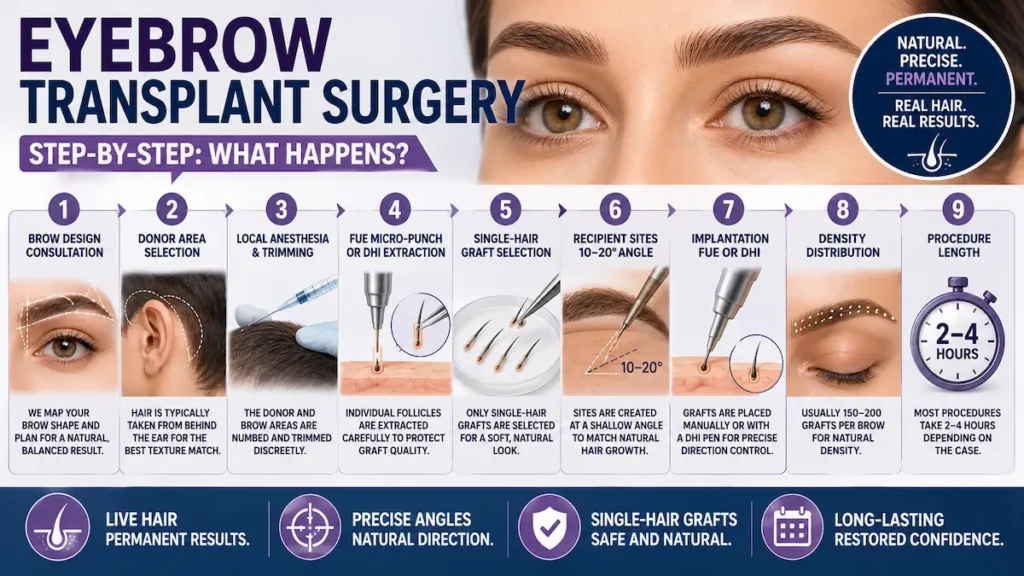
Step-by-Step: What Happens During Eyebrow Transplant Surgery?
Eyebrow transplant surgery is precise because the treated area is small and highly visible. A natural result depends on planning before extraction begins. The procedure is not just “putting hair into the brow.”
It is architectural work.
Every step must protect three priorities: single-hair graft selection, shallow angle placement, and natural direction change across the brow.
Pre-Operative Brow Design Consultation
The process begins with brow design. We review your photos, existing brow pattern, makeup habits, and goals. If you normally draw your brows, we may ask to see how you shape them, but we do not automatically copy that shape.
Makeup can reveal preference. Anatomy sets the limits.
We assess the forehead, eyelids, eye spacing, brow bone, facial proportions, and natural asymmetry. The design should be age-appropriate and stable enough to look natural years later.
For patients who want a broader understanding of hairline and facial framing principles, our natural hairline design guide explains why surgical design must respect facial anatomy rather than trends.
Donor Area Selection Behind the Ear
Donor hair is usually taken from a discreet scalp area, often behind the ear. This region may provide finer hair than other scalp zones, which can help the transplanted brow look softer.
Texture match matters.
Coarse donor hair can make a brow look too heavy. Very curly hair may need extra planning because it can be harder to control in a flat brow angle. We choose the donor area based on hair calibre, colour, growth behaviour, and concealment.
The donor area is trimmed only as much as needed. Most patients can hide the area with surrounding hair.
Local Anesthesia and Discreet Donor Trimming
After final brow markings are confirmed, we numb the donor area. A small patch may be trimmed to allow safe extraction. We keep this as discreet as possible.
Then the brow area is numbed.
Before graft placement begins, we re-check the design. This is important because tissue swelling can slightly change visual landmarks. We make adjustments before recipient sites are created or direct implantation begins.
FUE Micro-Punch or DHI Pen-Based Extraction
In FUE-based eyebrow transplant, we use a micro-punch to extract individual follicular units from the donor area. In DHI-based eyebrow transplant, extraction is still performed at the follicle level, but placement uses a pen-style implantation workflow.
The tool is only part of the result.
The more important factor is graft quality and placement judgement. A technically advanced tool cannot compensate for poor brow design or wrong angle control.
Our team selects the method after reviewing the brow plan, donor quality, and density goal.
Single-Hair Graft Selection
Single-hair grafts are essential for eyebrow transplant. Multi-hair grafts can look pluggy, bushy, or obviously transplanted. They may work in scalp density work, but they do not belong in most eyebrow recipient zones.
This is a strict rule.
Each graft is checked and refined before placement. We prioritize follicles that match the intended brow softness. Even when a patient wants a fuller brow, natural density is built through careful distribution, not by inserting thick multi-hair grafts.
“For eyebrow restoration, single-hair grafts are not a preference. They are a safety rule for natural-looking design. A brow can become unnatural very quickly when multi-hair grafts are used in a visible facial zone.”
Recipient Site Creation at a 10-20° Angle
Recipient site creation is one of the most important parts of eyebrow transplant. Brow hair should lie flat, so the site angle is usually very shallow. In many areas, the angle is planned around 10-20° to the skin.
Direction also changes by zone.
The brow head may have a more vertical or feathered direction. The body of the brow shifts laterally. The tail lies flatter and tapers. A surgeon must understand this pattern before placing a single graft.
Wrong angle is one of the main reasons patients regret eyebrow transplant. Hair that stands up from the brow can survive biologically but fail aesthetically.
Implantation: FUE Manual Placement or DHI Direct Pen
In FUE manual placement, grafts are inserted into pre-created recipient sites. This allows careful planning of angle and spacing. In DHI direct placement, a pen-style implanter can place grafts in a controlled way without the same pre-made site workflow.
Both can be appropriate.
We choose based on brow zone, skin, density, and the surgeon’s plan. Some cases need the flexibility of manual site creation. Others may benefit from DHI-style placement control in selected areas.
The patient’s final result depends more on design discipline than the name of the tool.
Density Distribution: Usually 150-200 Grafts per Brow
Many eyebrow transplant cases use approximately 150-200 grafts per brow, though the exact number depends on the missing area, native hair, and desired density. Partial tail restoration may require fewer. Full reconstruction may require more.
Graft count is not a contest.
Too few grafts may look under-corrected. Too many can look dense, heavy, or artificial. We plan density by brow zone so the result has a natural transition from the head to the arch and tail.
In eyebrow restoration, precision beats volume.
Procedure Length: 2-4 Hours
Most eyebrow transplant procedures take 2-4 hours. Smaller tail or scar cases can be shorter. Full reconstruction may take longer because every graft must be aligned carefully.
We do not rush this procedure.
The brow is one of the most visible parts of the face. A few misplaced grafts can affect the whole expression. Careful pacing protects graft handling and allows repeated checks of angle, density, and symmetry during the session.
After the procedure, you receive written aftercare instructions and a recovery plan. The next stage is simple but important: protect the grafts while they anchor, scab, shed, and regrow.
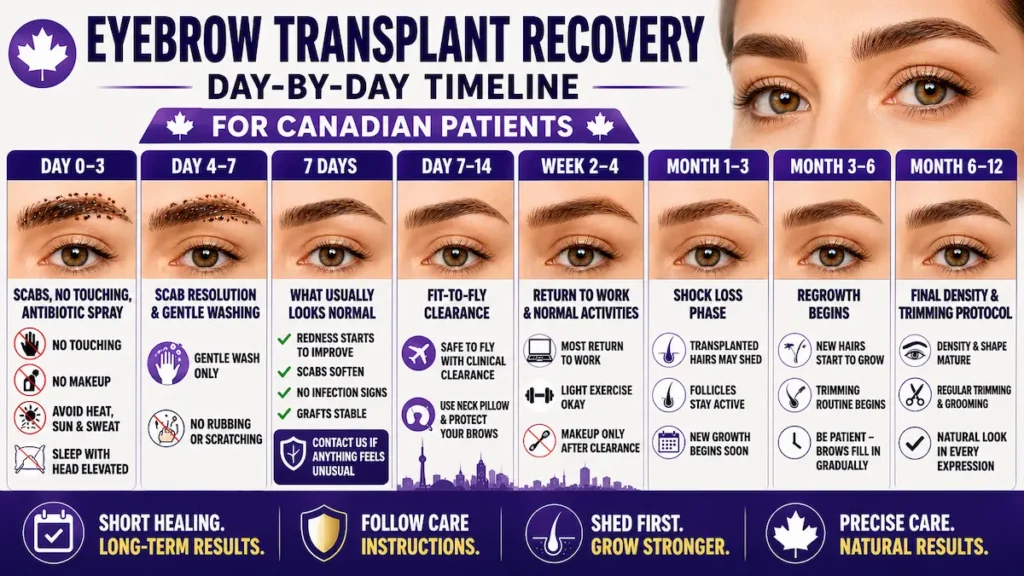
Eyebrow Transplant Recovery: Day-by-Day Timeline for Canadian Patients
Eyebrow transplant recovery is usually easier than larger surgical procedures, but the first 10 days require discipline. The grafts are visible, delicate, and easy to disturb. Your job is simple: keep the area clean, avoid touching, and follow the washing plan exactly.
The visible recovery is short. The growth timeline is longer.
Most patients can return to light daily activities quickly, but final eyebrow density takes months. The transplanted hairs usually shed first, then regrow through the normal follicle cycle.
Day 0-3: Scabs, No Touching, Antibiotic Spray
The first three days are the most protective phase. Tiny scabs form around the implanted grafts. Mild redness, swelling, tightness, and tenderness are expected.
Do not pick the scabs.
You will receive detailed aftercare instructions before leaving the clinic. These usually include sleeping with your head elevated, avoiding direct pressure on the brows, and using prescribed spray or medication as directed.
- Do not rub the eyebrow area.
- Do not apply makeup on the grafts.
- Do not sleep face-down.
- Do not expose the brows to direct sun, sauna, steam, or heavy sweating.
- Do not wear tight hats or anything that may brush the brows.
This early phase is not about looking healed. It is about protecting graft anchoring.
Day 4-7: Scab Resolution and Gentle Washing
By day 4, swelling often starts to settle. The scabs may look darker or more noticeable before they loosen. This can make patients anxious, especially because the brows are in the centre of the face.
That reaction is normal.
Gentle washing begins only according to your instructions. The technique is different from normal face washing. You should avoid rubbing, scratching, exfoliating, or using active skincare ingredients near the brow area.
Our general washing after hair transplant guide explains the logic of early graft protection. For eyebrow transplant, the same principle applies in a smaller and more visible area.
7 Days After Eyebrow Transplant: What Usually Looks Normal
At around one week, many patients still have visible redness, small scabs, and uneven-looking density. The brow may look darker than expected because scabs and early crusting exaggerate the outline.
This is not the final shape.
Some patients worry that the brows look too strong at this stage. Others worry that the result looks patchy. Both impressions can be misleading because the grafts have not entered the shedding and regrowth cycle yet.
At this point, we look for signs of healthy healing:
- reduced swelling compared with day 1 or 2;
- scabs beginning to soften or lift naturally;
- no spreading redness;
- no increasing pain;
- no discharge or foul odour;
- stable graft position.
If anything feels unusual, you contact our team. Early questions are better than silent worry.
Our HBOT/LLLT Recovery Protocol
For selected patients, we may use recovery-support technologies such as HBOT and LLLT. These are not substitutes for surgical technique. They support the healing environment around the grafts and skin.
HBOT stands for Hyperbaric Oxygen Therapy. It increases oxygen availability in tissues, which can help with inflammation control and recovery support after procedures. LLLT stands for Low-Level Laser Therapy. It uses low-intensity light energy to support cellular activity.
At AKM Clinic, our LLLT system uses 424 medical-grade semiconductor laser diodes at 650nm. The goal is to support cellular repair without heat injury. Patients who want the full technology explanation can read our technology and standards page.
For eyebrow transplant patients, the biggest recovery principle remains gentle handling. Technology can support healing. It cannot rescue grafts that are scratched, rubbed, or exposed to poor aftercare.
Day 7-14: Fit-to-Fly Clearance for Canadian Return Travel
Many Canadian patients plan to fly home during the early recovery window. Eyebrow transplant is usually more travel-friendly than large body or facial surgeries, but timing still needs clinical clearance.
Long-haul flights require planning.
Toronto, Montreal, Vancouver, Calgary, and Edmonton patients should protect the brows from accidental rubbing during sleep on the plane. A neck pillow helps keep the face away from the seat, window, and clothing.
Our flight safety after surgery guide explains broader travel precautions for Canadian patients. Eyebrow transplant usually carries lower mobility risk than body surgery, but hydration, hygiene, and graft protection still matter.
Week 2-4: Return to Work and Normal Activities
By weeks 2-4, most visible scabbing has resolved. Mild redness or pinkness may persist, especially in fair skin. Some patients return to remote work within a few days and public-facing work once scabbing settles.
Makeup should wait until you are cleared.
Exercise also returns gradually. Light walking is usually fine early, but heavy sweating, intense workouts, hot yoga, sauna, and steam should wait until your surgeon confirms the grafts are stable enough.
If you work in a public-facing role in Toronto, Vancouver, or Montreal, plan a conservative social downtime window. Eyebrow transplant is small, but it is visible.
Month 1-3: Shock Loss Phase
Shock loss is one of the most misunderstood parts of eyebrow transplant recovery. The transplanted hairs often shed after the early healing phase. This can feel alarming because the brows may appear to “lose” the result.
This is usually expected.
The follicle remains under the skin while the visible hair shaft sheds. New growth begins later as the follicle re-enters its growth phase. Our hair transplant growth timeline guide explains this cycle in more detail for hair restoration patients.
Shock loss does not mean the procedure failed. Sudden swelling, pain, infection signs, or complete non-growth later in the timeline should be discussed with the clinic, but early shedding alone is not unusual.
“Patients often judge an eyebrow transplant too early. The first month is not the result. It is the healing and shedding phase. Real judgement begins only after regrowth starts to appear.”
Month 3-6: Regrowth Begins
New eyebrow growth often begins gradually between months 3 and 6. Early hairs may be fine, uneven, or irregular. That is normal. Growth does not appear in a perfectly synchronized line.
The brow fills in over time.
During this stage, patients may begin to understand the new maintenance pattern. Because transplanted hair often behaves like scalp hair, trimming becomes part of routine care.
Do not over-pluck early growth. The first regrowth phase is when patience matters most.
Month 6-12: Final Density and Trimming Protocol
By months 6-12, the brow is usually much closer to its mature result. Density becomes easier to assess. Direction, texture, and blending are more visible.
This is when grooming habits settle.
Most patients trim transplanted brow hairs regularly. Some use clear brow gel, careful brushing, or occasional professional shaping. These are maintenance steps, not signs that something went wrong.
Final density should be judged with the face at rest and in expression. The brow must look natural when you speak, smile, frown, and move your forehead. Static photos do not tell the full story.
Safety, Risks & Regret: Why Some Patients Regret Eyebrow Transplants
Eyebrow transplant is a small procedure, but it is performed in a high-visibility area. That makes design errors more noticeable than they might be on the scalp. A safe result depends on medical screening, conservative design, precise graft direction, and honest expectation-setting.
Regret is usually preventable.
Most regret does not come from the idea of eyebrow transplant itself. It comes from poor design, wrong angle, excessive density, texture mismatch, or a patient not understanding long-term trimming.
Common Side Effects: Bruising, Swelling, Redness, Crust Formation
Short-term effects are expected after eyebrow transplant. You may see mild bruising around the brow or upper eyelid area, redness at recipient sites, crusting, and tenderness in the donor zone.
These effects usually improve gradually.
Temporary numbness or sensitivity can occur. Itching may appear as scabs heal. You should avoid scratching because that can disturb grafts or irritate the skin.
Contact us if symptoms worsen instead of improving, or if you notice increasing pain, spreading redness, pus, fever, or unusual swelling.
Shock Loss Reality: Why Hair Falls Before It Regrows
Shock loss is often mistaken for failure. After transplantation, the visible hair shafts may shed while the follicles remain alive under the skin. This is part of the normal growth cycle for many patients.
The timing varies.
Some shedding may begin within the first few weeks. Regrowth commonly starts months later. The final result is not visible during the shedding phase, so early panic can lead to unnecessary stress.
We explain shock loss before surgery because informed patients cope better with the waiting period.
Eyebrow Transplant Regret: Why It Happens
Patients may regret eyebrow transplant when the final brow does not match their expectations or face. The most common causes are usually design-related rather than medical emergencies.
The brow is expressive. That raises the stakes.
Regret may happen because of:
- wrong graft angle, causing hairs to stand upright;
- too much density, making the brow look heavy;
- poor shape selection, especially overly trendy arches;
- texture mismatch between scalp donor hair and native brow hair;
- weak communication between patient and clinic before design;
- unexpected maintenance, especially trimming transplanted hairs;
- active hair loss condition that was not stabilized first.
Our consultation process is designed to catch these risks early. Sometimes the safest plan is fewer grafts, a softer arch, or no surgery yet.
Botched Eyebrow Transplant: Common Surgical Errors
A botched eyebrow transplant usually refers to an outcome that looks unnatural, asymmetrical, poorly angled, or visibly pluggy. It can also mean scarring, poor growth, or donor-site problems.
Not every imperfect result is “botched.”
Some concerns are part of normal healing, especially during the first few months. True surgical errors usually become clearer after the growth cycle has had time to mature.
Common technical errors include:
- using multi-hair grafts in the brow;
- placing grafts at too steep an angle;
- creating a brow shape that ignores the patient’s facial proportions;
- overfilling the brow head;
- building a tail that is too long or sharply downward;
- implanting too densely in scarred tissue;
- using a technician-led workflow without adequate surgeon planning.
These risks are why eyebrow restoration should be planned by a team that understands facial aesthetics, not only hair grafting.
When Revision Is Possible
Revision may be possible if an eyebrow transplant heals with poor angle, uneven density, excessive heaviness, or shape mismatch. The right solution depends on the problem.
There is no single revision method.
Options may include selective graft removal, laser hair removal for misplaced hairs, camouflage grafting, density balancing, or shape softening. Some patients need time before any revision is safe.
We usually prefer to evaluate a mature result rather than operate too early. Acting during the shock loss or early regrowth phase can create new problems.
How Our Surgeon-Led Design Consultation Reduces Regret Risk
Regret prevention starts before the procedure. We map the brow, discuss your preferred shape, review donor hair, and explain maintenance. We also identify when microblading or makeup might be more appropriate than surgery.
Honesty protects the result.
Our surgeons avoid aggressive density in the brow head and avoid shapes that depend on current trends. We favour a Natural-First plan that can age with your face.
We also document the plan before surgery. That reduces misunderstanding and keeps the procedure aligned with the agreed design.
How to Avoid Regret: A Pre-Op Checklist
Before booking eyebrow transplant, ask practical questions. A confident clinic should answer clearly.
- Will single-hair grafts be used in the brow?
- Who designs the brow shape?
- Who performs the critical steps of the procedure?
- How is graft angle controlled?
- How many grafts are planned per brow?
- What donor area will be used?
- Will the transplanted hair need trimming?
- What happens if shock loss occurs?
- How are concerns handled after I return to Canada?
Patients who want more general due-diligence guidance can review our patient FAQs. The eyebrow-specific version is more exact: design, angle, and single-hair graft selection are the core safety questions.
How Sterile Protocols and JCI-Aligned Standards Reduce Risk
Infection is uncommon when sterile protocols are followed, but it is still a real medical risk. The brow area is visible, delicate, and close to the eyes, so cleanliness and post-op handling matter.
We operate through a controlled clinical workflow.
Our hospital partner is JCI-accredited, and our sterilization standards are designed to reduce preventable infection risk. Patients receive aftercare instructions, medication guidance, and access to follow-up support after they return home.
Safety is not one feature. It is the combination of screening, surgical judgement, sterile technique, documentation, and aftercare continuity.
Worried About Eyebrow Transplant Regret?
We focus on conservative design, single-hair grafts, shallow angle placement, and realistic density planning to reduce the risks that make brow transplants look unnatural.Discuss Your Brow Design with Our Team
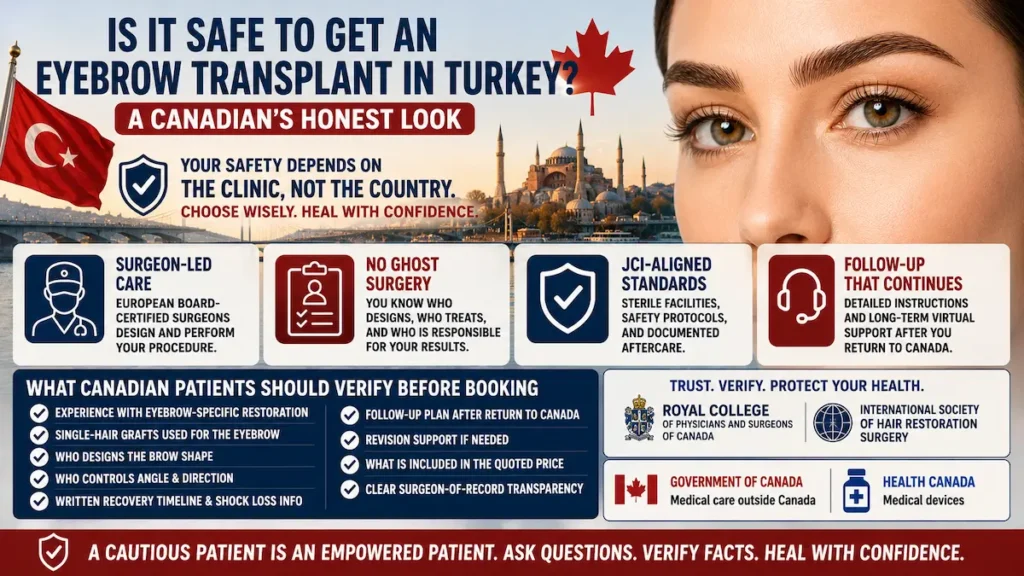
Is It Safe to Get an Eyebrow Transplant in Turkey? A Canadian’s Honest Look
Turkey is one of the world’s most active destinations for hair restoration. That experience can be an advantage, but it also means clinic quality varies widely. The question is not whether Turkey is safe or unsafe as a whole.
The real question is which clinic is treating you.
For eyebrow transplant, clinic selection matters even more because the procedure is small, visible, and design-sensitive. A scalp hair transplant error may be hidden partly by surrounding hair. A brow angle error sits in the centre of the face.
The Turkey Hair Restoration Reality: Clinic Selection Matters
Canadian patients often read mixed stories about Turkey. Some patients report excellent results and organized care. Others describe rushed consultations, technician-led procedures, weak aftercare, or unclear surgeon involvement.
Both realities can exist.
That is why we do not ask patients to trust a country. We ask them to verify a clinic. The safest decision is based on credentials, facility standards, surgeon involvement, documentation, and follow-up structure.
Our approach is surgeon-led and design-led. We do not treat eyebrow transplant as a quick add-on to a hair package. Brow restoration requires facial planning, single-hair graft handling, and very shallow angle control.
For broader context, our safety guide for Canadians considering surgery in Turkey explains how to evaluate international clinical standards without relying on marketing claims.
Technician-Led vs Surgeon-Led Eyebrow Transplant
Technicians may assist in hair restoration, but eyebrow transplant should not be planned or delegated casually. The design must be medically and aesthetically supervised. The person responsible for your result should be clear before you book.
Ask who designs the brow.
Ask who creates recipient sites or controls implantation angle. Ask who decides graft count and distribution. Ask who will review you if the early shape, redness, or shedding worries you after you return to Canada.
These are not impolite questions. They are responsible questions.
At AKM Clinic, our European Board-Certified Surgeons oversee the clinical plan. Our team provides documented instructions and long-term virtual follow-up, so patients are not left interpreting healing alone from Toronto, Vancouver, Montreal, Calgary, or Edmonton.
Ghost Surgery Concerns and Surgeon-of-Record Transparency
“Ghost surgery” means the patient believes one surgeon will perform or supervise a procedure, but another person completes key steps without transparent consent. This fear is common among Canadian patients researching international clinics.
It should be addressed directly.
For eyebrow transplant, the highest-risk steps are not only extraction. Brow design, recipient angle, direction, density, and single-hair graft placement define the final expression. Patients should know who is responsible for these decisions.
Our ghost surgery in Turkey guide explains the questions Canadians should ask before paying a deposit. For eyebrow transplant, add one more: “Who controls the angle and direction of each brow graft?”
JCI-Aligned Standards, EBOPRAS Surgeons, and Procedure Documentation
Safety is not only about the surgeon’s hands. It is also about the clinical setting, sterilization, pre-operative screening, and aftercare documentation. These systems reduce avoidable risk.
We work through a regulated clinical pathway.
AKM Clinic operates with JCI-accredited hospital partners, sterile protocols, and documented post-operative instructions. Our team provides English-language guidance so Canadian patients can understand what was done, what to expect, and when to ask for help.
Canadian patients should understand how international credentials compare with the Canadian specialist framework. The Royal College of Physicians and Surgeons of Canada’s specialist certification framework is the national reference point for specialist medical training standards in Canada. International hair-restoration education can also be cross-checked through professional organizations such as the International Society of Hair Restoration Surgery.
What Canadian Patients Should Verify Before Booking
Before travelling for eyebrow transplant, verify the essentials. Do not rely only on before-and-after photos or low advertised pricing. Brow restoration is too visible for shortcuts.
- Confirm the clinic has experience with eyebrow-specific restoration, not only scalp hair transplants.
- Ask whether single-hair grafts are used for the eyebrow.
- Ask who designs the brow shape and who approves final markings.
- Ask who controls graft angle and direction.
- Request a written recovery timeline, including shock loss expectations.
- Confirm how follow-up works after you return to Canada.
- Ask whether revision support is available if a concern develops.
- Confirm what is included in the quoted price.
Canadian patients should also review Government of Canada travel health information before any elective procedure abroad. Travel advisories do not replace a surgical consultation, but they help you plan medication, insurance, documentation, and emergency contingencies. Government of Canada: Medical care outside Canada
Health Canada also provides safety information related to health products and medical devices, which can help Canadian patients understand how regulatory frameworks differ between domestic and international care. Health Canada: Medical devices
We welcome careful patients. A cautious patient usually heals better because they follow instructions, ask early questions, and understand the difference between normal recovery and warning signs.
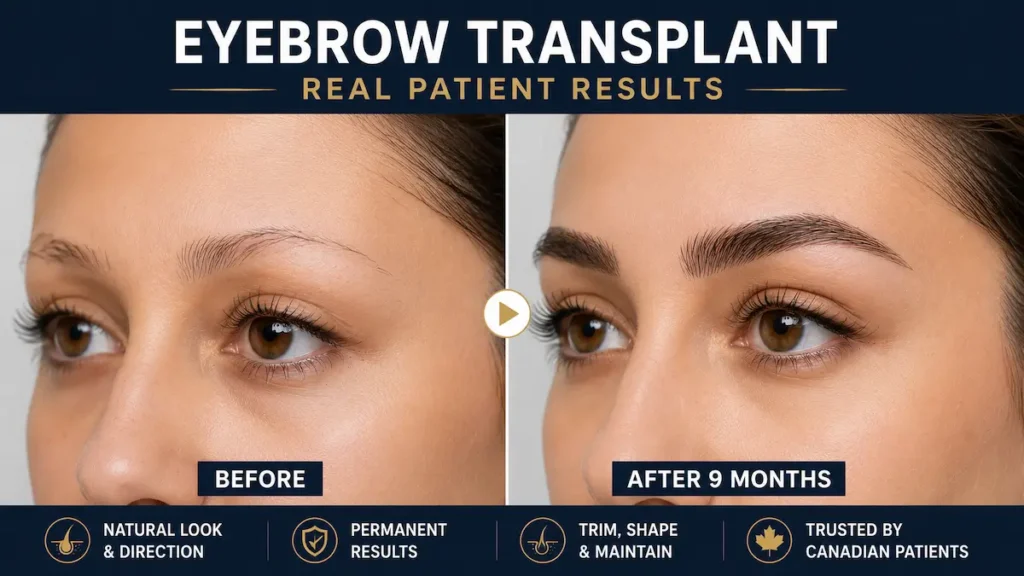
Eyebrow Transplant Before and After: Realistic Expectations & Results
Eyebrow transplant can create a permanent improvement in brow density, shape, and continuity. It cannot make transplanted hair behave exactly like native eyebrow hair in every way. The most satisfied patients understand both parts before surgery.
Realistic expectations protect satisfaction.
We design for natural facial framing, not maximum density. A brow that is slightly softer often ages better than one that is overfilled.
Eyebrow Transplant Before and After: What Actually Changes
Before surgery, patients may have sparse tails, patchy arches, scar gaps, or very thin brows after years of over-plucking. After a mature result, the brow can show improved continuity, fuller shape, and less dependence on makeup.
The change should still look like you.
A strong before-and-after result is not always the darkest or thickest brow. It is the brow that balances the eyes, forehead, and face. For some patients, that means full reconstruction. For others, it means a subtle tail or scar correction.
You can review outcome examples through our hair transplant before-and-after gallery. During consultation, we discuss which result patterns are realistic for your donor hair and skin.
Why Transplanted Brow Hair Must Be Trimmed
Transplanted eyebrow hair usually comes from the scalp. That means it may continue growing longer than native eyebrow hair. This is expected.
You will need to trim it.
Most patients learn a simple routine: brush the brow upward, trim longer hairs conservatively, and avoid aggressive plucking. Some use clear brow gel to guide the direction. Some prefer professional brow grooming after the result matures.
This maintenance is part of the tradeoff for permanent live hair growth. Patients who want no trimming at all may prefer pigment-based options instead.
Texture Match: Scalp Hair vs Native Brow Hair
Scalp hair and eyebrow hair are not identical. Scalp hair may be thicker, longer-growing, or slightly different in texture. We reduce mismatch risk by selecting a donor area with finer calibre hair when possible.
Behind-the-ear donor hair is often useful.
Still, texture cannot be changed completely. If a patient has very coarse, curly, or wiry donor hair, the surgical plan must be conservative. Too much graft density with coarse hair can make the brow look heavy.
This is why we discuss donor texture during consultation. The safest plan may use fewer grafts than a patient first expects.
Density: Why Too Much Can Look Less Natural
Density is one of the most common misunderstanding points in eyebrow transplant. Patients often assume more grafts equal better results. In the brow, that is not always true.
Too much density can look artificial.
The brow head should usually be softer. The arch and tail can be more defined, but still need direction control. If the brow is packed too densely, the result may look dark, heavy, or block-like.
We build density gradually across the brow. A natural brow has variation. It is not a solid stripe.
Month-by-Month Result Timeline
The eyebrow transplant timeline is slower than the early scabs suggest. You see the procedure immediately, but you do not see the result immediately.
| Timeline | What You May See | How to Interpret It |
|---|---|---|
| Days 0-7 | Scabs, redness, darker-looking brow outline | Early healing, not final density |
| Weeks 2-4 | Scabs gone, possible shedding begins | Normal transition phase |
| Month 1-3 | Shock loss, thinner appearance | Often expected; follicles are resting |
| Month 3-6 | Early regrowth, uneven new hairs | Growth is beginning but not mature |
| Month 6-12 | Improved density, better blending, trimming routine | Mature result becomes clearer |
Most patients need patience between month 1 and month 4. That period can feel emotionally difficult because the brows may look less impressive than they did during the first week. This is why pre-operative education matters.
Before & After Gallery
Before-and-after photos help, but they should be read carefully. Lighting, makeup, facial expression, brow grooming, and healing stage can all change how results appear.
Look for consistency.
When reviewing eyebrow transplant photos, focus on:
- whether the brow head looks soft rather than blocky;
- whether hairs lie flat instead of sticking upright;
- whether the tail tapers naturally;
- whether density suits the patient’s face;
- whether scars or gaps are camouflaged without overfilling;
- whether the result still looks natural in three-quarter view.
Our results philosophy is “Rejuvenation, not alteration.” Even in eyebrow restoration, that principle applies. The best brow transplant should make the eyes look better framed, not make the brows look newly manufactured.
Eyebrow Transplant Cost 2026: Turkey vs Canada
Canadian patients researching eyebrow transplant cost usually compare three different options: pigment-based brow treatments, Canadian private surgical clinics, and international surgical care in Turkey. These are not identical services. Microblading and PMU add pigment to the skin, while eyebrow transplant restores live hair follicles that grow over time.
At AKM Clinic, technique-level eyebrow transplant pricing starts at CAD $2,750 for FUE eyebrow transplant and CAD $3,000 for DHI eyebrow transplant. Partial eyebrow restoration is listed at CAD $2,050, full eyebrow restoration at CAD $3,000, and scar camouflage eyebrow restoration at CAD $2,050. Canadian-dollar pricing shown for planning clarity; your coordinator will confirm the final payment details before booking.
By comparison, private eyebrow transplant quotes in Toronto and Vancouver commonly sit around CAD $6,000-$8,500, depending on surgeon, facility, graft count, and follow-up structure. Microblading is lower per session, often CAD $400-$800, but repeated touch-ups over several years can narrow the long-term cost difference.
For the detailed breakdown, including FUE vs DHI pricing, partial vs full restoration, scar camouflage, Canadian city comparisons, and what is included in the clinical pathway, see our eyebrow transplant cost guide for Canadian patients. Patients planning travel can also review the eyebrow transplant all-inclusive clinical pathway.
Get a CAD-First Eyebrow Transplant Quote
Receive a tailored quote based on whether you need partial restoration, full eyebrow reconstruction, FUE, DHI, or scar camouflage.View Eyebrow Transplant Cost Detailsw Transplant Cost Details
How to Find the Best Eyebrow Transplant Surgeon in Turkey: A Canadian Patient’s Checklist
Many Canadians begin with searches like “eyebrow transplant near me” or “eyebrow transplant Toronto.” That is a sensible starting point. Local options can be convenient. The next step is comparing surgeon experience, eyebrow-specific design, technique range, and follow-up structure.
Eyebrow transplant is not a generic grafting procedure.
The best surgeon for scalp hair restoration is not automatically the best surgeon for eyebrow restoration. Brows require facial design judgement, shallow angle control, single-hair graft discipline, and an understanding of expression.
EBOPRAS Certification and RCPSC Equivalency
Canadian patients are used to a system where specialist credentials can be checked through provincial colleges and the Royal College framework. International care requires a different verification process.
At AKM Clinic, our surgeons hold European Board-level credentials. EBOPRAS certification is not the same body as the RCPSC, but it signals structured European specialist training and assessment. Canadian patients should use it as part of a broader verification checklist, not as a single trust shortcut.
| Credential | Region | What It Helps Verify | How Canadian Patients Should Use It |
|---|---|---|---|
| RCPSC | Canada | Canadian specialist training and fellowship framework | Use as the Canadian comparison standard |
| EBOPRAS | Europe | European plastic surgery board-level assessment | Use as an international credential signal |
| ABHRS | United States / International hair restoration | Hair restoration knowledge and examination pathway | Useful for hair-specific context, not a replacement for surgical training |
| ISHRS Membership or Education | International | Hair restoration continuing education and professional community | Helpful supporting signal for technique awareness |
Patients can learn more about our clinic structure and surgical philosophy on our About AKM Clinic page. For credential due diligence, our plastic surgeon board certification guide explains how Canadians can compare systems without assuming every country uses the same titles.
Eyebrow Transplant Sub-Specialization
Ask how many eyebrow transplant cases the clinic performs, not only how many scalp hair transplants. Brow restoration is a sub-specialized area. The recipient site is smaller, the angle is flatter, and the aesthetic tolerance for error is lower.
This is a key filter.
A clinic that performs thousands of scalp grafts may still have limited eyebrow experience. You want proof that the team understands brow head softness, tail tapering, arch balance, and single-hair graft selection.
Ask to see eyebrow-specific cases, not only scalp before-and-after images.
Architectural Design Portfolio Verification
Good eyebrow transplant planning should include an architectural design discussion. The surgeon should be able to explain why your brow head, arch, and tail are drawn in a specific way.
A template is not enough.
Ask whether the clinic reviews your facial proportions, eyelid shape, brow bone, forehead height, and natural asymmetry. Ask whether the design is conservative enough to age well.
Before-and-after photos should show more than density. Look for angle, softness, facial fit, and expression. A brow that looks dramatic in one front-facing photo may not look natural in daily life.
“The best eyebrow transplant design is the one that still looks appropriate years later. We would rather create a softer brow that ages well than a fashionable brow that becomes difficult to live with.”
Dual-Technique Capability: FUE and DHI for Eyebrows
Some clinics only offer one method. That does not automatically make them unsafe, but it can limit the treatment plan. Eyebrow cases vary. Scar tissue, skin thickness, donor hair, and desired density can change the ideal workflow.
Dual-technique capability gives flexibility.
FUE may be ideal for one patient. DHI may be preferable in another. What matters is not the marketing label, but whether the surgeon can explain why a technique fits your brow anatomy.
If every patient receives the same answer, ask more questions.
Real Patient Reviews and Multi-Year Follow-Up
Eyebrow transplant results mature over months, not days. Reviews taken one week after surgery may describe service quality, but they cannot prove final brow growth.
Look for longer follow-up.
Useful reviews mention recovery, shock loss, regrowth, trimming, and how concerns were handled after the patient returned home. For Canadian patients, follow-up access is especially important because you are not driving across town for a quick check.
Our patient support structure includes virtual follow-up and communication after you return to Canada. Reviews are only meaningful when the aftercare system continues beyond the clinic visit.
Aftercare Continuity From Istanbul to Canada
Aftercare is a central part of choosing an international clinic. You should know who to contact if swelling seems unusual, if shock loss worries you, or if you have questions about trimming, makeup, or exercise.
Distance should not mean silence.
AKM Clinic provides coordinator support and long-term virtual follow-up. Our North American support line also helps Canadian patients communicate within a more familiar time-zone structure.
Before booking, ask each clinic:
- Will I receive written aftercare instructions in English?
- Who reviews my healing photos?
- How fast can I reach the team after returning to Canada?
- What happens if I have shock loss concerns?
- How are revision concerns evaluated?
These questions protect your result. A technically careful eyebrow transplant still needs careful recovery guidance.
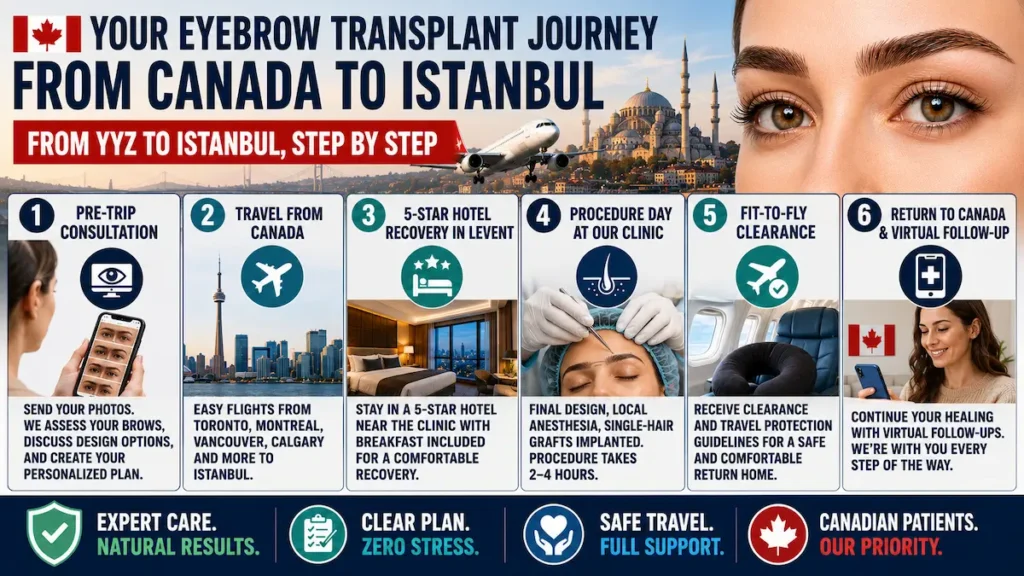
Your Eyebrow Transplant Journey from Canada: From YYZ to Istanbul, Step by Step
For most Canadian patients, the procedure is only one part of the decision. The larger concern is planning: consultation, flights, hotel recovery, procedure timing, and how follow-up works after returning home.
We structure the process before you travel.
Eyebrow transplant is usually a lighter procedure than a major facial surgery, but it still deserves medical planning. The brows are visible, delicate, and central to expression. Your journey should protect both the grafts and your peace of mind.
Pre-Trip Consultation: Photo Assessment and Brow Design Discussion
Your first step is a remote consultation. You share photos of your brows at rest, with your normal expression, and from multiple angles. If you usually draw your brows, we may ask for one photo with makeup and one without.
That helps us separate preference from anatomy.
We assess native brow hair, missing zones, scar tissue, donor quality, skin type, and your desired shape. We also ask about previous microblading, permanent makeup, brow tattooing, alopecia, trichotillomania, thyroid history, medications, and past skin conditions.
If your hair loss looks medically active, we may recommend dermatology input before surgery. A stable diagnosis protects the result.
Send your eyebrow photos for a confidential assessment. Our team will review your brow shape, donor hair, and whether FUE, DHI, microblading, or a non-surgical option fits your goals best.Request a Free Virtual Consultation
Travel Logistics From Toronto, Montreal, Vancouver, or Calgary
Canadian citizens can generally travel to Turkey for short stays without a tourist visa, but passport validity and airline rules should be checked before booking. Flight schedules change, so patients should confirm current routes with the airline rather than relying on old travel information.
Most Canadian patients route through Istanbul Airport.
Toronto and Montreal often offer the most direct Istanbul access. Vancouver, Calgary, Edmonton, Ottawa, and other cities may involve a connection depending on season and airline schedule. We help you plan timing around the procedure, first check, and fit-to-fly guidance.
Patients who want a full overview of arrival, transfer, and clinic steps can review our patient journey from Canada to Istanbul.
5-Star Hotel Recovery Stay in Levent
After arrival, you recover in the Levent area, close to our clinic. This matters because early visits should be easy. You should not be navigating an unfamiliar city while worrying about fresh brow grafts.
Comfort reduces stress.
Our clinical pathway may include 5-star hotel accommodation with breakfast, depending on the selected package. The hotel environment is chosen for privacy, convenience, and access to the clinic team.
For practical details about accommodation and transfers, see our hotels and VIP transfers page.
Procedure Day at Our Istanbul Clinic
On procedure day, we confirm the brow design in person. This is the final opportunity to adjust shape, density goals, and symmetry before extraction begins. We do not skip this step.
Design comes first.
After local anesthesia, donor follicles are extracted, refined into single-hair grafts, and implanted into the brow according to the agreed plan. The session usually takes 2-4 hours. You leave with written instructions and a clear recovery timeline.
You can learn more about the clinic environment on our Istanbul clinic page.
Fit-to-Fly Clearance and Brow Protection on the Return Flight
Eyebrow transplant patients often travel home sooner than patients undergoing larger surgical procedures. Still, you need fit-to-fly clearance and practical brow protection. Fresh grafts can be disturbed by rubbing, sleep position, clothing, or careless face washing.
The flight is not the main issue. Contact is.
On the return trip, use a neck pillow, avoid sleeping face-down, keep hands away from the brow area, and avoid applying makeup before clearance. Hydrate well and keep your aftercare instructions accessible.
Once you return to Canada, you continue virtual follow-up. You can send healing photos and questions through the support pathway rather than guessing whether scabs, shedding, or redness are normal.
Eyebrow Transplant Frequently Asked Questions (FAQ):
How long does eyebrow transplant surgery take?
Most eyebrow transplant procedures take about 2-4 hours. Partial restoration, such as tail filling or scar camouflage, may be shorter. Full reconstruction may take longer because every graft must be placed at the correct angle and direction.
The procedure is usually performed under local anesthesia.
Is eyebrow transplant permanent or does it fade like microblading?
Eyebrow transplant is designed to be permanent once the follicles vascularize and grow. Microblading and PMU rely on pigment, which fades or changes over time. Transplanted follicles produce live hair.
The tradeoff is maintenance. You will need to trim transplanted brow hair.
When will my final eyebrow results show?
Final results usually develop over 6-12 months. The first week shows scabs and early placement, not final density. Many transplanted hairs shed during the first 1-3 months, then regrow gradually.
Month 6 is often when the result becomes easier to judge. Month 12 gives a more mature view.
When can I return to work after eyebrow transplant?
Many patients return to remote or desk work within a few days. Public-facing work may require more planning because scabs and redness can be visible during the first week.
If your job involves heavy sweating, dust, helmets, facial PPE, or physical contact, ask for a tailored return-to-work plan.
Does OHIP, MSP, AHCIP, or RAMQ cover eyebrow transplant?
Most provincial health plans do not cover elective cosmetic eyebrow transplant. This includes typical cases of over-plucked brows or aesthetic density restoration.
Reconstructive cases may be different.
If eyebrow loss follows burns, cancer surgery, trauma, or a medically documented condition, limited coverage or specialist referral may be possible in Canada. Coverage rules vary by province, so patients should confirm directly with their provincial plan and physician.
How much does eyebrow transplant cost in Toronto vs Istanbul?
Toronto private eyebrow transplant pricing commonly falls around CAD $6,000-$8,000, depending on clinic, surgeon, graft count, and inclusions. AKM technique-level pricing starts at CAD $2,750 for FUE eyebrow transplant and CAD $3,000 for DHI eyebrow transplant.
The full comparison belongs on the cost page, but the key difference is transparency. Ask every clinic what is included before comparing prices.
Does Canadian travel insurance cover complications from elective eyebrow transplant in Turkey?
Many Canadian travel insurance policies exclude elective cosmetic surgery and complications related to it. You should review your policy carefully before booking and ask the insurer direct written questions.
To reduce this concern, AKM Clinic provides complimentary complication insurance for all patients. This is separate from standard Canadian travel insurance and is designed to add an extra layer of protection around your surgical care. Your coordinator will explain the coverage terms, limits, and required documentation before you confirm your booking.
Is eyebrow transplant better than microblading or permanent makeup?
It depends on the problem. Eyebrow transplant is better when the goal is permanent live hair restoration in areas with true follicle loss. Microblading or PMU may be better when you want temporary or pigment-based enhancement without surgery.
We do not treat one option as universally superior. We match the method to the patient.
Why do some people regret their eyebrow transplant?
Regret usually happens because of poor graft angle, too much density, texture mismatch, unrealistic design, or underestimated maintenance. Some patients also judge the result too early during shock loss.
We reduce regret risk through conservative design, single-hair graft selection, shallow angle planning, and clear recovery education.
How long does shock loss last before my brows grow back?
Shock loss often occurs during the first 1-3 months. The visible transplanted hairs may shed, while the follicles remain under the skin. Regrowth usually begins gradually between months 3 and 6.
Final density often takes 6-12 months.
Will I need to trim my transplanted eyebrows?
Yes. Because donor hair usually comes from the scalp, transplanted eyebrow hairs can grow longer than native eyebrow hair and require regular trimming.
This is normal and should be discussed before surgery. Patients who do not want trimming may prefer pigment-based options.
Can I combine eyebrow transplant with hair transplant or blepharoplasty in one trip?
Yes, selected patients can combine eyebrow transplant with scalp hair transplant, beard or moustache transplant, blepharoplasty, facelift, or mini facelift. The decision depends on donor supply, recovery logistics, medical screening, and whether the combined plan remains safe.
We recommend combinations only when they support the same clinical and aesthetic goal.
Medical Disclaimer: This page is for educational purposes only and does not replace a medical consultation. Eyebrow transplant suitability depends on donor hair quality, skin condition, hair-loss stability, medical history, medications, and realistic expectations. Before travelling for elective treatment, Canadian patients should consult a qualified health professional, review travel insurance terms, and confirm whether any medical hair-loss condition needs diagnosis or treatment before surgery. Surgical results vary, and no clinic can guarantee a specific density, growth percentage, or aesthetic outcome.