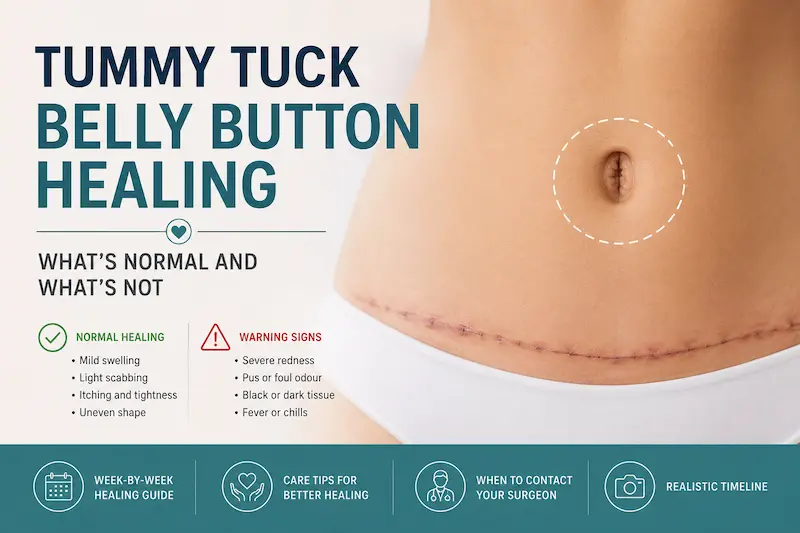

Tummy tuck recovery tips work best when they are practical, repeatable, and matched to your surgeon’s instructions. After an abdominoplasty, your body needs protection, circulation, protein, hydration, compression, and patience. No single trick speeds recovery. Small daily decisions do.
For Canadian patients travelling to Istanbul for surgery, recovery planning starts before the flight home. A patient from Toronto, Vancouver, Montreal, Calgary, or Ottawa needs to think beyond the operation itself: hotel recovery, safe walking, garment use, sleep setup, long-haul flight timing, and follow-up once back in Canada all matter.
This guide focuses on general recovery optimisation after tummy tuck surgery. For a broader procedure overview, see AKM Clinic’s tummy tuck procedure overview. Scar-specific care, drainless technique details, and post-flight recovery are linked where relevant so this article stays focused on healing habits.
Quick Summary: Tummy tuck recovery is shaped by what you do consistently during the first 6 to 8 weeks: wearing your compression garment properly, walking early without overexertion, sleeping in a flexed position, eating enough protein, staying hydrated, and introducing lymphatic drainage at the right time.
Most patients feel meaningfully better by Week 2, but “feeling better” does not mean the abdominal repair is fully healed. Smarter recovery means respecting tissue biology, not rushing back to normal life too soon.
Table of Contents
The First 72 Hours — Foundation of Recovery
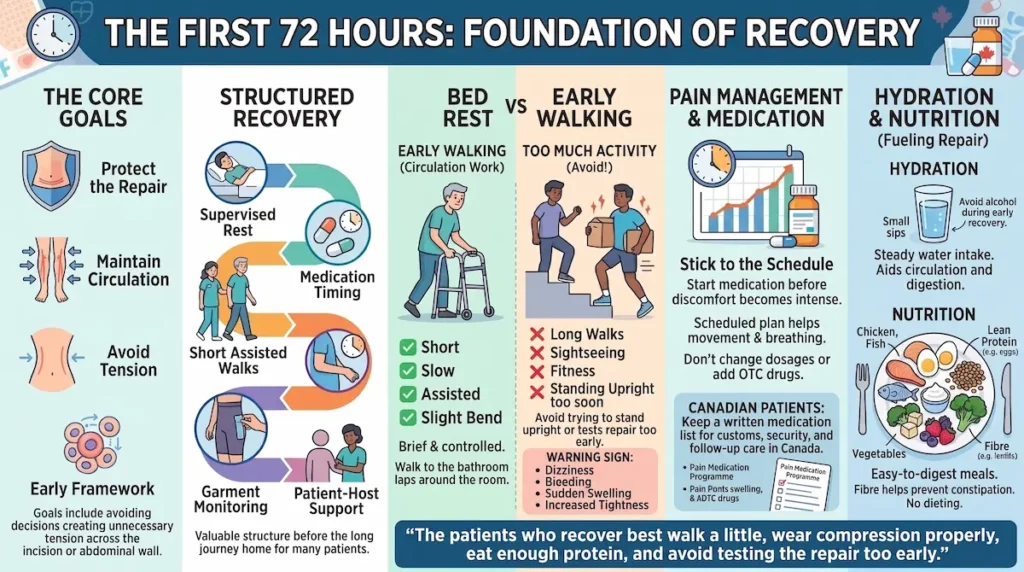
The first 72 hours set the tone for the rest of your recovery. This is when swelling begins, discomfort is most noticeable, and your body starts building the early framework of wound healing. Your goal is simple: protect the repair, keep circulation moving, and avoid decisions that create unnecessary tension across the incision or abdominal wall.
At AKM Clinic, your first days are structured around supervised rest, medication timing, short assisted walks, garment monitoring, and patient-host support. For Canadian patients, this early structure is especially valuable because it happens before the long return journey home.
Bed rest discipline vs early walking
After a tummy tuck, complete bed rest is not the goal. Too much stillness can slow circulation and increase stiffness. Gentle walking supports blood flow and helps reduce the risk of post-operative complications, but the walking must be brief and controlled.
Think of early walking as circulation work, not exercise. On Day 1, this may mean walking to the bathroom with help or taking several slow laps around your hotel room. You should remain slightly bent at the waist to avoid pulling on the incision.
- Good early walking: short, slow, assisted, slightly bent posture.
- Too much activity: long hall walks, sightseeing, stairs for fitness, or standing upright before your body is ready.
- Warning sign: increased tightness, new bleeding, dizziness, or sudden swelling after activity.
Patients who have a drainless or “tube” technique may notice some differences in fluid management, but the recovery principles still depend on surgeon guidance. For technique-specific recovery differences, see our guide to the drainless technique impact on recovery.
Pain medication schedule
Pain after a tummy tuck is usually described as tightness, pressure, soreness, and difficulty standing straight. Sharp or escalating pain should always be reported. The first mistake many patients make is waiting until discomfort becomes intense before taking prescribed medication.
A scheduled medication plan helps keep discomfort controlled. It also makes walking, sleeping, and deep breathing easier. Do not change dosage, skip antibiotics, add over-the-counter anti-inflammatories, or combine medications unless your surgical team approves it.
Canadian patients should also keep a written medication list for the flight home. This is useful for customs, airport security, and any Canadian physician or pharmacist who may review your care after you return.
Hydration and nutrition basics
The first days after surgery are not the time for dieting. Your body is repairing tissue, managing inflammation, and adjusting to reduced movement. It needs fluid and steady nutrition.
Hydration helps circulation, bowel function, and energy. Protein supports tissue repair. Fibre helps reduce constipation, which matters because straining can increase abdominal pressure. Keep meals simple and easy to digest, especially during the first few days.
- Choose lean protein such as eggs, fish, chicken, lentils, Greek yogurt, or tofu.
- Include fibre from oats, vegetables, berries, legumes, or whole grains if tolerated.
- Drink water steadily rather than consuming a large amount all at once.
- Avoid alcohol during early recovery unless your surgeon explicitly clears it.
“The patients who recover best are rarely the ones looking for dramatic shortcuts. They are the ones who walk a little, wear compression properly, eat enough protein, and avoid testing the repair too early.”
Compression Garment Use
Your compression garment is one of the most important recovery tools after tummy tuck surgery. It helps support the abdominal tissues, limits fluid accumulation, and gives patients a protected feeling during movement. It must fit correctly. Too loose is ineffective; too tight can create pressure problems.
Compression is not a substitute for rest, hydration, and follow-up care. It works as part of the recovery system. Your surgical team should confirm when to wear it, when to remove it for hygiene, and when to move into a lighter stage garment.
Why compression matters
After surgery, the body naturally sends fluid to the healing area. Compression helps manage that swelling and supports the newly contoured abdominal shape while tissues settle. It can also reduce the pulling sensation that many patients feel when standing or walking.
The garment should feel snug, even, and supportive. It should not create sharp folds, numb patches, skin breakdown, or difficulty breathing. If the garment digs into one area, the fit needs to be checked.
- Support: helps protect the abdominal wall repair during early movement.
- Swelling control: applies gentle pressure to reduce fluid build-up.
- Comfort: gives many patients a more secure feeling when walking.
- Shape maintenance: supports tissues while the contour settles.
When to wear and remove
Most patients wear compression nearly full-time during the early recovery period, removing it only for approved hygiene, garment changes, or clinical checks. Your exact schedule depends on your surgeon’s protocol, the extent of your procedure, and your skin response.
Do not remove compression for long periods because you “feel fine.” Swelling often increases later in the day, especially after walking or sitting upright. Many Canadian patients notice this during the first week back home when daily movement increases.
If you feel new pain, skin pinching, shortness of breath, coldness, or persistent numbness under the garment, contact your care team. A garment should support recovery, not compromise circulation or skin integrity.
Garment progression over 6-8 weeks
Compression usually changes as swelling decreases. The first garment may feel firm and medical. Later garments may be lighter, easier to wear under clothing, and better suited to work-from-home or office routines.
Progression is not based only on the calendar. It depends on swelling, incision healing, comfort, and your surgeon’s assessment. Some patients move into a second-stage garment around Week 4. Others need longer in stronger support.
Scar-specific care begins on a different timeline and should not be confused with garment use. For silicone sheets, scar massage timing, sun protection, and incision refinement, see our separate guide: for scar-specific care, see our scar treatment guide.
Walking and Activity Schedule
Walking after a tummy tuck is necessary, but it must be measured. The purpose is to encourage circulation, reduce stiffness, and support safe recovery without stressing the abdominal repair. More activity is not always better.
Canadian patients often ask when they can return to regular errands, office work, child care, driving, or gym routines. The answer depends on procedure scope, pain control, swelling, posture, and whether muscle repair was performed. Your surgeon’s instructions should always override general timelines.
Walking goals Day 1, Day 7, Day 14
Walking starts early, but the first walks are short. On Day 1, your goal is to move safely with assistance. You are not trying to stand perfectly straight or complete a step target.
By Day 7, most patients can take several brief walks per day. You may still move slowly and slightly bent at the waist. By Day 14, walking usually feels more natural, but swelling may increase if you stay upright too long.
| Recovery Point | Walking Goal | Garment Use | Sleeping Position | Social Readiness |
|---|---|---|---|---|
| Day 0 | Assisted bathroom walks only | As directed by surgical team | Flexed, supported position | Not social-ready |
| Day 3 | Short room or hallway walks | Nearly full-time | Beach chair position | Private recovery only |
| Week 1 | Several brief walks daily | Consistent daily wear | Still flexed and supported | Light hotel movement |
| Week 2 | Gentle walks indoors or outdoors | Usually still daily wear | Partially reclined | Limited low-energy social activity |
| Week 4 | Longer casual walks | Often transitioning by surgeon approval | More comfortable but still supported if needed | Many patients return to desk-based routines |
| Week 6 | Normal daily walking | Reduced use if cleared | Often close to normal | More confident in professional settings |
| Week 8 | Gradual return to fuller activity | Usually minimal or discontinued if cleared | Normal for many patients | Most social routines feel manageable |
This schedule is a general framework. Patients with extended tummy tuck, major muscle repair, or combined procedures may need a slower progression.
When to resume light cardio
Light cardio should not begin just because you are bored, restless, or eager to feel normal. The abdominal wall needs time to regain strength. Swelling can also worsen if your heart rate rises too early.
For many patients, gentle outdoor walking becomes more comfortable around Weeks 3 to 4. Stationary bike, treadmill walking, and low-impact movement may be considered later if your surgeon clears you. If you want structured mobility guidance after returning home, a licensed Canadian physiotherapist can help you progress safely; the Canadian Physiotherapy Association is a useful national reference point for Canadian patients. Running, high-incline walking, and intense cycling are usually delayed longer.
Canadian climate can affect this timeline. In winter, icy sidewalks in Toronto, Montreal, Calgary, or Ottawa can make even a short walk risky. Indoor mall walking or a flat hallway may be safer than walking outside in snow or freezing rain.
Canadian Recovery Callout: Return-to-Work Planning
Desk-based Canadian professionals often plan 2 to 3 weeks away from office duties, with remote work sometimes starting earlier if pain is controlled and fatigue is manageable. Jobs involving standing, lifting, commuting, or patient-facing physical work may require a longer pause.
When to resume strength training
Strength training requires more caution than walking. Even upper-body exercise can increase abdominal pressure if you brace, twist, or hold your breath. Core exercises are especially sensitive after muscle repair.
Most patients should avoid lifting, planks, crunches, heavy resistance training, and high-intensity classes until cleared. A gradual return often begins around Week 6 or later, depending on healing. Some patients need 8 to 12 weeks before full training feels appropriate.
Use this rule: if an activity makes you brace your abdomen, it is probably too early. Recovery is not lost because you delayed the gym by a few extra weeks. It can be harmed by forcing the repair before it is ready.
Sleeping Position and Bedroom Setup
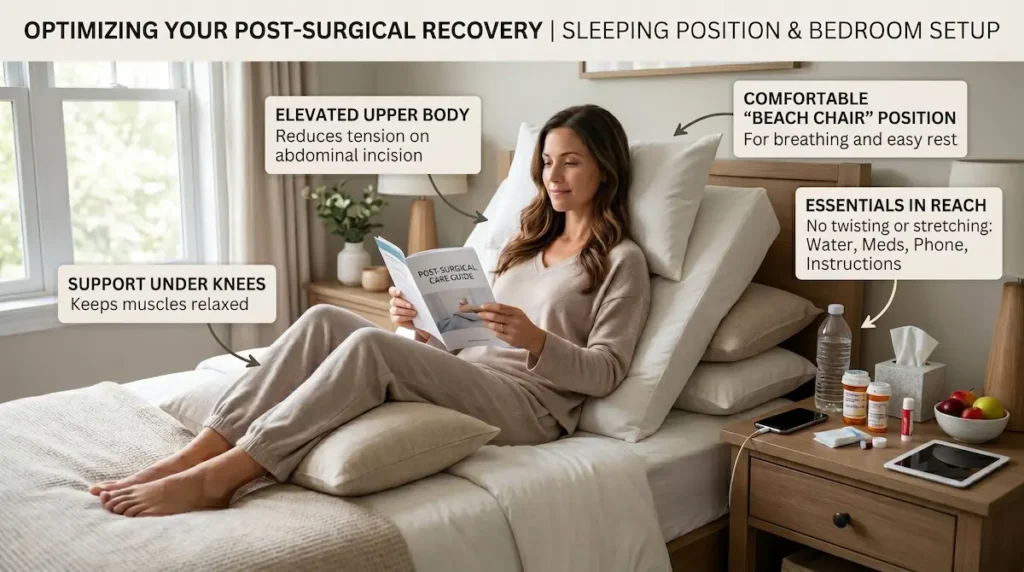
Sleep position matters because the abdominal incision and muscle repair need reduced tension. A flat, stretched posture can pull across the lower abdomen too early. A supported, flexed position helps your body rest without stressing the surgical area.
Before surgery, set up your recovery space. This is useful whether you are recovering at The Point Barbaros in Istanbul or preparing your home in Canada. The right setup reduces unnecessary twisting, reaching, and getting in and out of bed repeatedly.
Beach chair position rationale
The “beach chair” position means your upper body is elevated and your knees are slightly bent. This keeps the abdomen relaxed. It also makes it easier to breathe, rest, and get up with less strain.
You can create this position with an adjustable bed, a recliner, or pillows. The goal is not to be folded tightly. The goal is gentle flexion that protects the incision and reduces pulling.
- Keep your upper body elevated.
- Place support under your knees.
- Avoid lying flat during early recovery unless your surgeon clears it.
- Use your arms and legs carefully when changing position.
Pillow arrangement for 4-6 weeks
Most patients need a structured pillow arrangement for several weeks. A wedge pillow behind the back and a pillow under the knees can help maintain the correct position. Side pillows can stop you from rolling accidentally during sleep.
Place essentials within easy reach: water, medications, phone charger, tissues, lip balm, light snacks, and your care instructions. You should not need to twist across a bedside table or stretch to reach basic items.
If you are travelling home to Canada after surgery, recreate the same setup before you leave. Ask a friend, family member, or companion to prepare your bed before your flight if possible. The first night back home should not involve rearranging furniture.
When you can sleep flat again
Sleeping flat usually returns gradually. Some patients can lower their upper body a little after the first few weeks, while others need a flexed position longer. Swelling, tightness, incision tension, and muscle repair all influence the timeline.
Do not test sleeping flat by forcing yourself into a stretched posture. Try small changes, then reassess how you feel the next morning. If tightness increases or swelling worsens, return to a more supported position.
Side sleeping and stomach sleeping usually require more time. Stomach sleeping should wait until your surgeon confirms that abdominal pressure is safe. Comfort alone is not enough; the repair must be ready.
Nutrition and Hydration Discipline
Nutrition is not a side issue during tummy tuck recovery. Your body needs enough energy, protein, vitamins, minerals, and fluid to repair tissue and support immune function. Under-eating can slow healing, increase fatigue, and make early walking feel harder than it should.
This does not mean you need a complicated post-surgery diet. It means you need consistent meals, enough protein, and steady hydration. Patients who arrive in Istanbul focused on “eating light” often need to rethink that approach during recovery.
Protein needs for healing
Protein supports tissue repair, immune function, and muscle maintenance. After surgery, your body has a higher healing demand than usual. A small appetite is common, so protein should appear in every meal and snack when possible.
HealthLink BC lists high-protein foods such as lean meat, poultry, fish, eggs, dairy products, soy foods, beans, nuts, and seeds as useful options for wound healing. Canadian patients can use this same framework once they return home, adjusting for dietary preferences and allergies.
Good post-tummy tuck protein options include:
- eggs or Greek yogurt at breakfast;
- fish, chicken, turkey, tofu, or lentils at lunch or dinner;
- cottage cheese, hummus, protein smoothies, or soy-based snacks;
- beans, chickpeas, nuts, and seeds if your digestion tolerates them.
For Canadian patients who want a practical food reference, see HealthLink BC’s high-protein foods for wound healing. Use it as general nutrition guidance, not as a replacement for your surgeon’s or dietitian’s instructions.
Foods that reduce swelling
No food can erase swelling overnight. Swelling after abdominoplasty is a normal biological response. That said, certain food choices can make recovery feel smoother by supporting hydration, digestion, and stable energy.
Focus on simple, low-irritation meals. Choose foods that help you avoid constipation, reduce unnecessary sodium load, and maintain regular intake. Constipation matters because straining increases abdominal pressure.
- Helpful choices: berries, leafy greens, oats, salmon, eggs, lentils, yogurt, olive oil, and soups with lean protein.
- Limit early: highly salty packaged foods, alcohol, heavy fried meals, and large portions that cause bloating.
- Watch digestion: beans, cruciferous vegetables, and dairy may be healthy but can cause gas in some patients.
If your appetite is low, smaller meals may work better than three large ones. A smoothie with yogurt, fruit, and protein can be easier than a full plate of food during the first week.
Hydration targets and Canadian climate considerations
Hydration supports circulation, skin health, digestion, and energy. During early recovery, dehydration can worsen dizziness, constipation, and fatigue. Drink steadily throughout the day rather than trying to catch up at night.
There is no single water target for every patient. Body size, medications, sweating, hotel-room heating, flight timing, and medical history all affect your needs. Patients with kidney, heart, or fluid-restriction conditions should follow medical instructions rather than generic hydration advice.
Canadian Recovery Callout: Winter Dryness and Hydration
Patients returning to Canada between November and March may notice dry indoor air, especially in heated homes in Ontario, Quebec, Alberta, and the Prairies. Keep water nearby, use lip balm, and watch for constipation. Cold weather does not eliminate swelling; it simply changes how comfortable you feel during recovery.
A practical approach is to pair hydration with your medication schedule and short walks. Each time you take approved medication or complete a short walk, have a small glass of water unless your care team has restricted fluids.
Lymphatic Drainage Massage Integration
Lymphatic drainage massage can be useful after body-contouring surgery when introduced at the right time and performed gently by someone trained in post-operative care. It is not the same as deep tissue massage. Pressure that is too aggressive can irritate healing tissues.
For tummy tuck recovery, lymphatic drainage is mainly used to support swelling reduction and comfort once the surgeon confirms the tissues are ready. It should fit into your recovery plan, not replace compression, walking, hydration, or follow-up.
When to start, typically Week 2
Many patients begin post-operative lymphatic drainage around Week 2, but timing is not universal. Your surgeon must consider incision healing, tenderness, bruising, drainage status, swelling pattern, and whether other procedures were performed.
Starting too early can be uncomfortable or counterproductive. Waiting until the appropriate moment helps ensure the massage supports recovery rather than disrupting it. Patients should avoid booking independent sessions in Canada before receiving clearance.
If you are returning to Toronto, Vancouver, Montreal, Calgary, or Ottawa, plan ahead. Post-operative lymphatic drainage providers can have limited appointment availability. Ask about experience with surgical patients, not just wellness massage.
Why it accelerates swelling resolution
The lymphatic system helps move fluid through the body. Surgery temporarily disrupts normal fluid movement, which contributes to swelling and heaviness. Gentle lymphatic drainage aims to guide fluid toward functioning lymphatic pathways.
Patients often describe the benefit as feeling lighter or less tight after a session. Results vary. Some notice a clear difference, while others experience a slower cumulative effect over several weeks.
For the deeper lipo-specific explanation of swelling, fibrosis, and massage timing, see our guide to lymphatic drainage massage essentials. That article covers liposuction recovery in more detail, while this guide keeps the focus on tummy tuck healing.
AKM’s in-clinic protocol and home continuation
AKM Clinic’s recovery planning combines supervised aftercare with technology-supported healing where appropriate. HBOT and LLLT are part of AKM’s broader recovery infrastructure, and the team helps patients understand which recovery tools apply to their case.
To understand the clinic’s recovery environment in more detail, review AKM’s recovery technology including lymphatic drainage. Canadian patients should also ask how to continue safe swelling management once they return home.
Canadian Recovery Callout: Finding Lymphatic Drainage at Home
Look for a registered massage therapist, physiotherapist, or post-operative therapist with specific experience in manual lymphatic drainage after cosmetic surgery. Ask whether they use gentle superficial technique, whether they avoid incision pressure, and whether they are comfortable coordinating with your surgical instructions from AKM Clinic.
Do not allow deep kneading over the abdomen during early recovery. Do not use aggressive massage devices on the surgical area. Self-massage should be limited to techniques your surgeon or therapist has cleared.
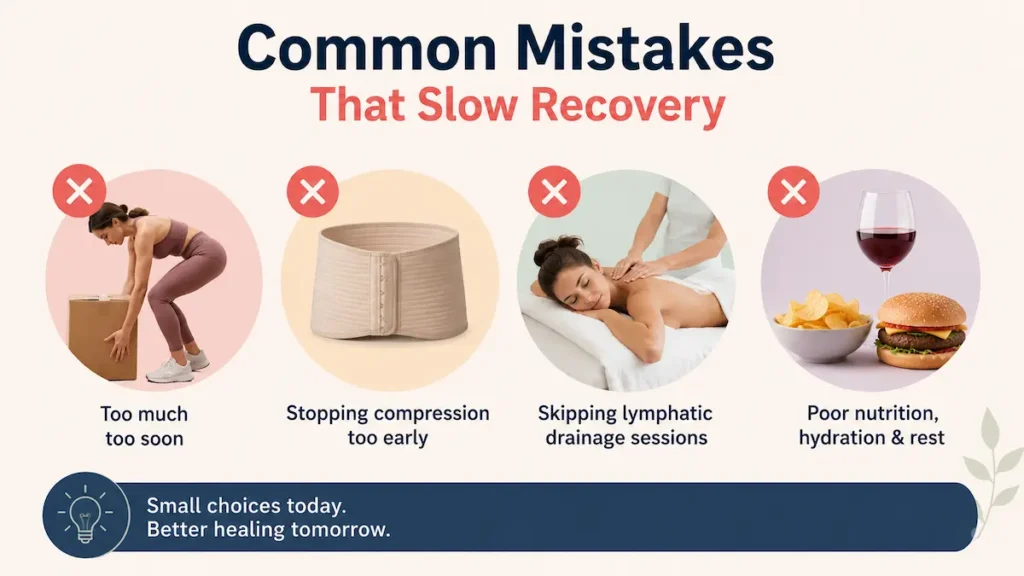
Common Mistakes That Slow Recovery
Most tummy tuck recovery setbacks are not caused by one dramatic error. They usually come from small repeated mistakes: doing too much too soon, removing compression early, skipping follow-up instructions, or assuming that reduced pain means full internal healing. Recovery is quieter than that.
This final section focuses on preventable issues. Canadian patients should also plan the first week back home carefully, especially after a long-haul flight. For a separate guide to remote follow-up, medication continuity, and local provider coordination, see post-op care once you’re back in Canada.
Over-doing activity too soon
Feeling better is a good sign. It is not clearance for normal activity. Many patients slow their recovery by treating Week 2 as the finish line instead of the start of a more active healing phase.
Common examples include carrying luggage, lifting children, cleaning the house, taking long shopping trips, or returning to gym movements that require bracing. These activities increase abdominal pressure and may worsen swelling or discomfort.
- Avoid lifting until your surgeon clears it.
- Do not carry heavy groceries, suitcases, laundry baskets, or toddlers.
- Keep walks short and frequent instead of long and tiring.
- Use fatigue and swelling as feedback, not as something to push through.
If swelling increases after a specific activity, reduce the intensity and tell your care team if it persists. The goal is steady progress, not proving endurance.
Discontinuing compression early
Compression can feel inconvenient once pain improves. That is why some patients stop too early. The problem is that swelling often continues long after the early discomfort fades.
Removing compression before your surgeon approves may increase fluid build-up, discomfort, and uneven swelling. It may also make daily movement feel less supported. If the garment bothers you, ask for a fit check rather than abandoning it.
Garment irritation should be managed. It should not be ignored. Pressure marks, skin breakdown, numbness, or sharp folding may mean the garment needs adjustment.
Skipping lymphatic drainage sessions
Lymphatic drainage is not mandatory for every patient in the same way, but skipping recommended sessions can prolong swelling. It may also make the abdomen feel firm or heavy for longer than necessary.
The key is proper technique. Deep, aggressive massage is not appropriate during early healing. Choose a provider with post-operative experience and share your surgical instructions before the first appointment.
For Canadian patients returning to Toronto, Vancouver, Montreal, Calgary, or Ottawa, it is wise to identify a qualified provider before travel. Booking after you land may create a gap in care.
Frequently Asked Questions: Tummy Tuck Recovery Tips
These questions address the practical concerns Canadian patients raise most often during tummy tuck recovery planning. The answers are general and should be adapted to your surgeon’s instructions, procedure scope, medical history, and travel timeline.
When can I drive after a tummy tuck?
Most patients should not drive while taking prescription pain medication or while movement is restricted. You must be able to brake quickly, turn safely, wear a seatbelt comfortably, and get in and out of the car without straining.
Many patients wait at least 2 weeks, but the exact timing varies. Canadian patients should also consider winter driving conditions. Ice, heavy coats, and long commutes can make driving harder than expected.
How long do I wear the compression garment?
Many patients wear compression for 6 to 8 weeks, often with progression from a firmer first-stage garment to a lighter second-stage garment. Your surgeon will adjust this based on swelling, incision healing, and comfort.
Do not stop compression simply because you feel better. If the garment is uncomfortable, ask whether the fit, size, or stage should be changed.
When can I have lymphatic drainage massage in Canada?
Many patients begin around Week 2, but only after surgical clearance. Timing depends on incision healing, swelling, tenderness, bruising, and whether liposuction or another procedure was combined with your tummy tuck.
Before booking a session in Canada, ask the provider whether they have post-operative manual lymphatic drainage experience. Gentle technique is essential.
When can I lift my children?
Lifting children is one of the most important recovery planning issues for parents. Even a small child can create significant abdominal strain if lifted from the floor, crib, stroller, or car seat.
Many patients need help with lifting for several weeks. If you have young children, arrange support before surgery. This is especially important for Canadian parents returning home without extended family nearby.
How long until I can return to work in Canada?
esk-based or remote work may be possible after 2 to 3 weeks for some patients, especially if fatigue and pain are controlled. Physical work requires more time.
Teachers, nurses, dental professionals, retail workers, hospitality staff, and anyone who stands, bends, or lifts during the day should plan a longer recovery window. A gradual return is safer than a sudden full schedule.
Can I exercise during recovery?
Yes, but only in stages. Early walking is part of recovery. Gym training, running, core work, and lifting are different categories and usually require later clearance.
Most patients avoid strenuous exercise for at least 6 weeks. Full return may take longer, especially after muscle repair. Do not restart planks, crunches, or heavy lifting without approval.
What does “fully recovered” actually mean?
Fully recovered does not mean the same thing as “back to work” or “able to walk normally.” You may feel functional within weeks, while swelling, firmness, numbness, and scar maturation continue for months.
A practical timeline is this: early mobility improves in the first 2 weeks, daily comfort improves by Weeks 4 to 6, exercise returns gradually after clearance, and final contour refinement may continue for several months.
How much does a tummy tuck cost at AKM Clinic?
This recovery guide is not a cost article, but patients often ask for context when planning time away from work. According to AKM Clinic’s treatment pricing reference, Full Tummy Tuck is listed at CAD $6,550.
For procedure-specific fee details, review the tummy tuck pricing context in CAD. Package inclusions, hotel nights, and combined-procedure plans should be confirmed during consultation.
What is the safest way to plan my recovery?
The safest plan is specific to your anatomy, procedure scope, travel schedule, and home support. A patient flying back to Vancouver with a connection may need different planning than someone returning directly to Toronto.
Use general recovery timelines as a framework, then personalize them with your surgical team. The best recovery plan is not the fastest one. It is the one you can follow consistently.
Plan Your Personal Recovery Strategy
Every tummy tuck recovery is different. Your activity limits, garment schedule, lymphatic drainage timing, flight plan, and return-to-work date should match your surgical plan, not a generic online timeline.
Discuss your personal recovery plan in a consultation with AKM Clinic and ask how your timeline should be adapted for travel from Canada.
Medical Disclaimer: This page is provided for general educational purposes only and does not replace an in-person medical consultation, diagnosis, or personalized treatment plan. All surgery carries risks, and outcomes vary between individuals. Suitability for a tummy tuck surgery, procedure selection, and anesthesia choice can only be determined after a full clinical assessment by a qualified surgeon. Always follow your clinician’s instructions and seek urgent medical attention if you develop concerning symptoms during recovery.