
Quick summary: Breast implant revision is not one fixed surgery. It may involve upsizing, downsizing, implant replacement, explant surgery, a breast lift, or fat transfer after implant removal.
For Canadian patients considering breast implant revision Turkey, the right choice depends on why the implants are being revised, how the breast tissue has changed, and whether the long-term goal is more volume, less volume, or an implant-free result.
Breast implants are not always a lifelong decision in the same form. Some patients love their original augmentation for years, then decide their implants no longer match their body, lifestyle, or aesthetic preferences.
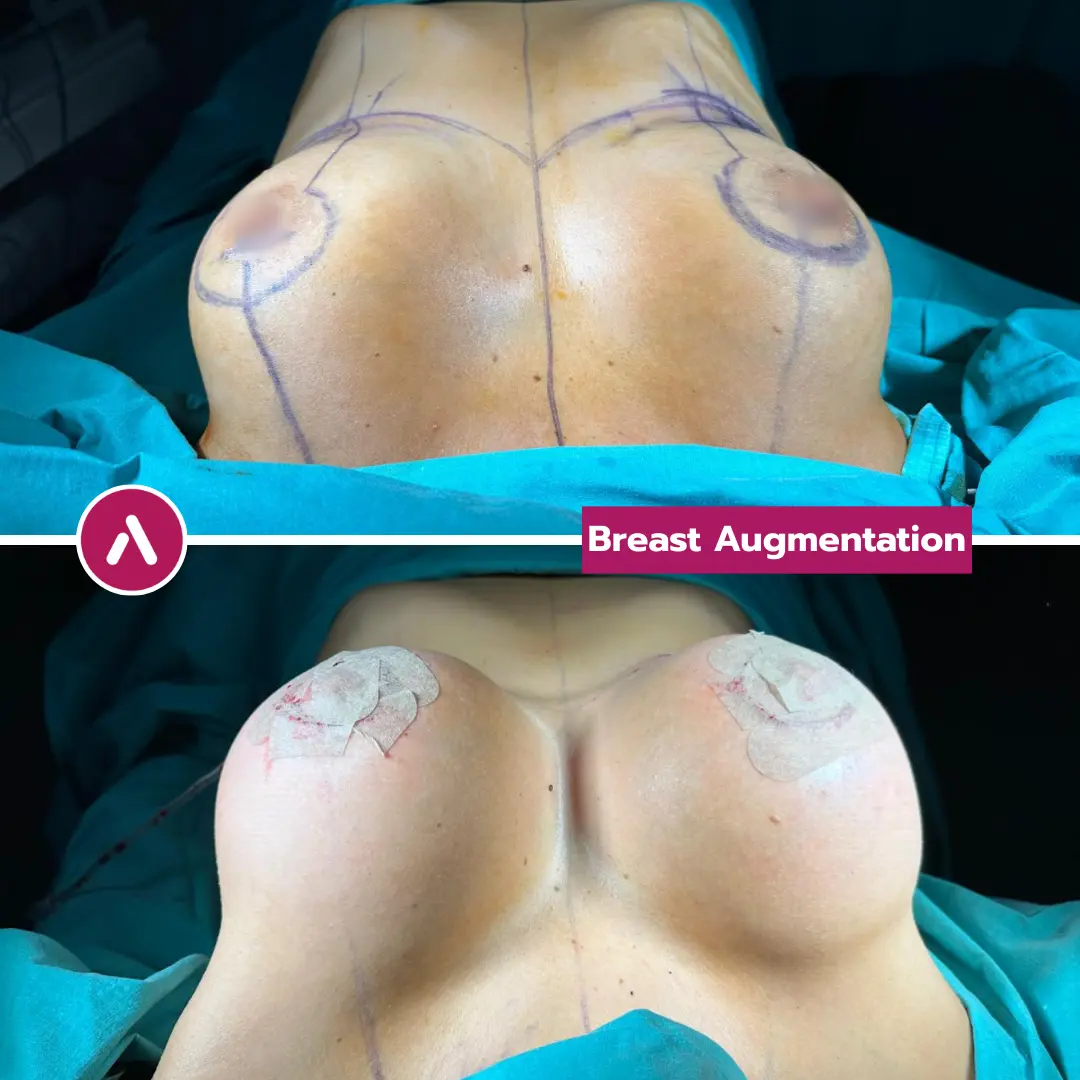
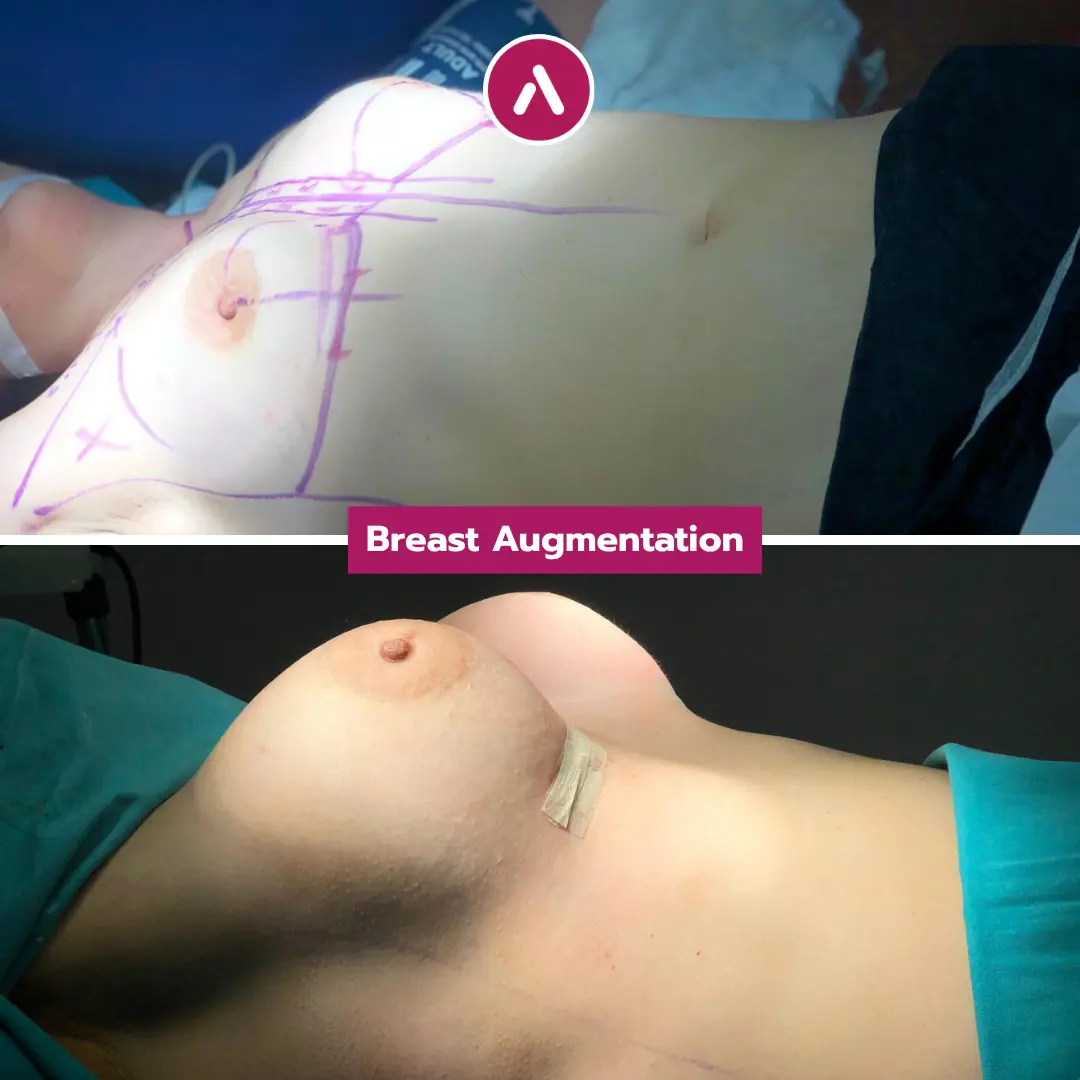
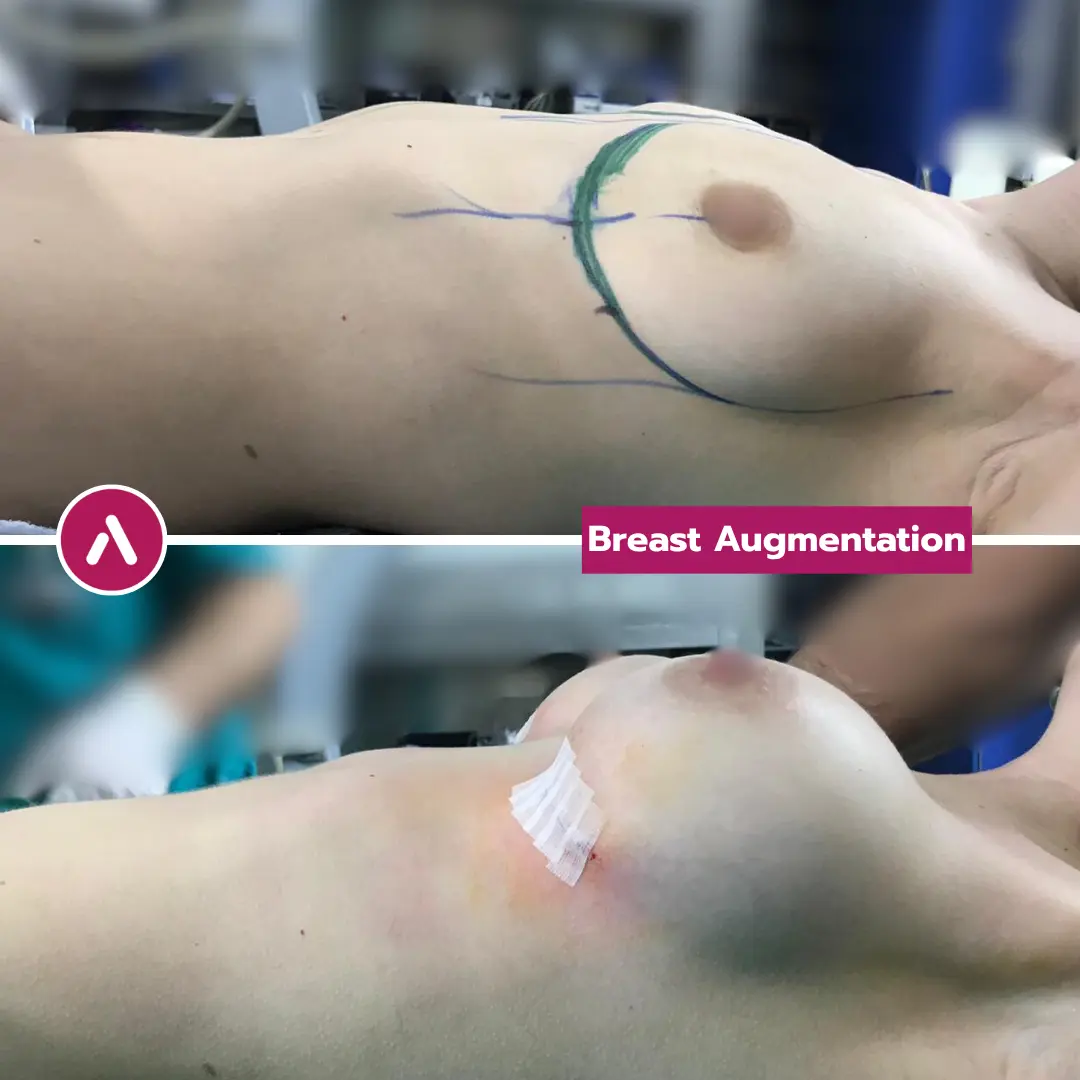
Others need revision because of firmness, rupture, asymmetry, implant malposition, or capsular contracture. The goal is not simply to “redo” the original surgery. It is to correct the problem while planning for the next decade of breast shape, comfort, and proportion.
At AKM Clinic, patients comparing breast augmentation options at AKM Clinic can also discuss revision pathways during a virtual consultation. This is especially useful for Canadians who had their first surgery in Toronto, Vancouver, Montreal, Calgary, or another Canadian city and now want a more refined or natural result.
“The best revision procedure is not determined by the implant itself. It is determined by why the patient wants a change and what they want their breasts to look and feel like ten years from now.”
Table of Contents
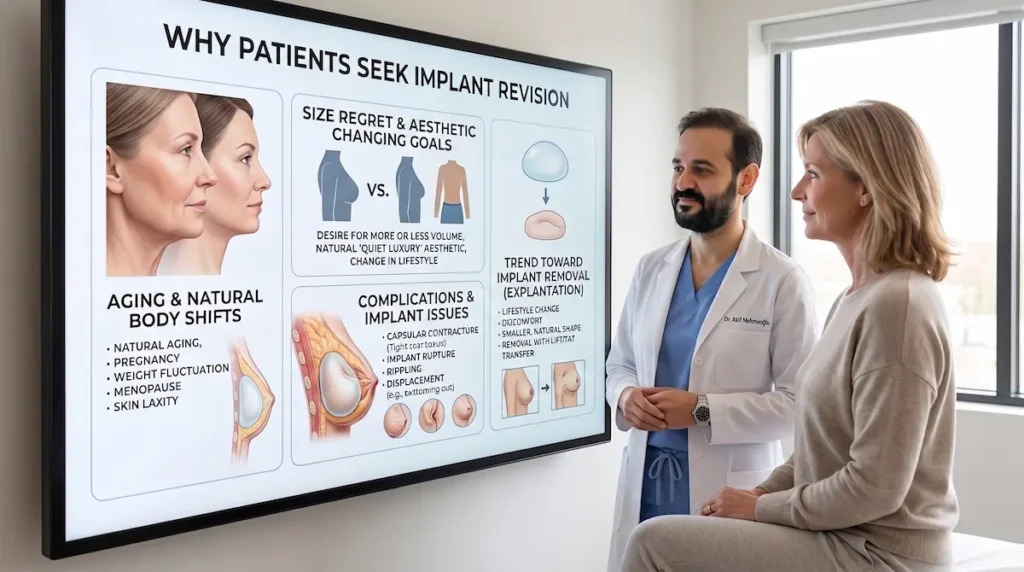
Why Patients Seek Implant Revision?
Breast implant revision begins with one question: why are you revising? The answer shapes every surgical decision that follows, including implant size, pocket correction, lift planning, capsule removal, or fat transfer.
Some patients want a visible change. Others simply want their breasts to feel softer, sit better, or look more natural in clothing. Both goals are valid.
The reality of aging breast implants
Modern implants are durable, but they are not permanent devices. Many patients begin reassessing their implants after 10 to 15 years, especially if they notice changes in shape, firmness, symmetry, or comfort.
This does not mean every implant must be replaced at the 10-year mark. It means long-term monitoring matters. If your implants still feel soft, sit well, and show no signs of rupture or distortion, your surgeon may recommend observation rather than immediate surgery.
Revision becomes more relevant when the breast has changed around the implant. Pregnancy, weight fluctuation, menopause, and natural skin laxity can all alter the result, even when the implant itself is intact.
Size regret — when implants feel too large or too small
Size regret is one of the most common non-medical reasons for revision. Some patients feel their original implants were too conservative and now want more upper-pole fullness or cleavage.
Others feel the opposite. Implants that once felt proportional may now feel heavy, artificial, or out of step with a more understated lifestyle.
Canadian patients often describe this as a shift toward “quiet luxury” aesthetics. They do not want an obviously augmented look. They want balance, softness, and comfort.
Capsular contracture and implant-related complications
Capsular contracture occurs when the scar capsule around an implant tightens. Mild cases may only feel slightly firm. More advanced cases can cause distortion, discomfort, and visible asymmetry.
Other revision triggers include implant rupture, implant rippling, bottoming out, lateral displacement, or implants sitting too high. These issues usually require more than a simple size change.
Revision surgery is technically different from primary augmentation because the surgeon is working through scar tissue and altered anatomy. For a broader explanation of revision principles, see our guide to how revision surgery differs from primary surgery.
The growing trend toward implant removal
Some patients no longer want breast implants at all. Their reasons vary: lifestyle changes, discomfort, concern about long-term monitoring, or a preference for a smaller and more natural breast shape.
Explant surgery can be performed alone, but many patients benefit from a breast lift or fat transfer at the same time. This helps manage loosened skin and restore a softer contour after implant removal.
The important point is that removal does not mean “doing nothing.” It is a planned aesthetic decision with its own technique, recovery, and long-term trade-offs.
Upsizing and Downsizing Your Implants
Changing implant size sounds simple, but revision sizing is more complex than first-time augmentation. The existing skin envelope, capsule, implant pocket, and breast tissue all influence what is safe and attractive.
A good revision plan respects anatomy first. Size comes second.
When upsizing makes sense
Upsizing may suit patients who want more projection, more cleavage, or better balance after weight change, pregnancy, or implant settling. It can also help patients who feel their original implants were too modest.
Still, bigger is not always better. The breast skin and soft tissue must be able to support the new implant without stretching too far.
If the implant is too large for the tissue, risks increase. These may include thinning skin, visible implant edges, bottoming out, and a more artificial shape over time.
When downsizing creates a more balanced result
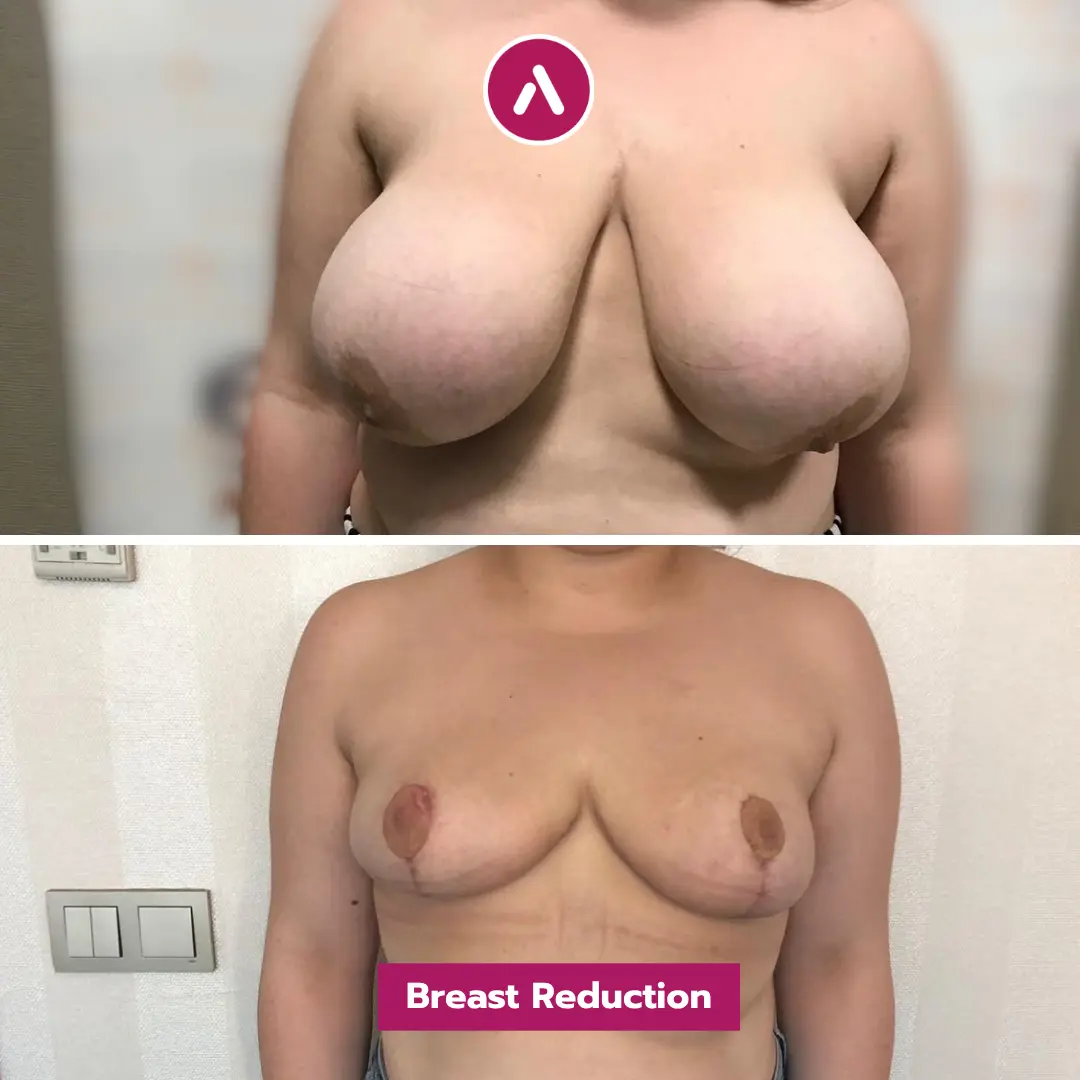
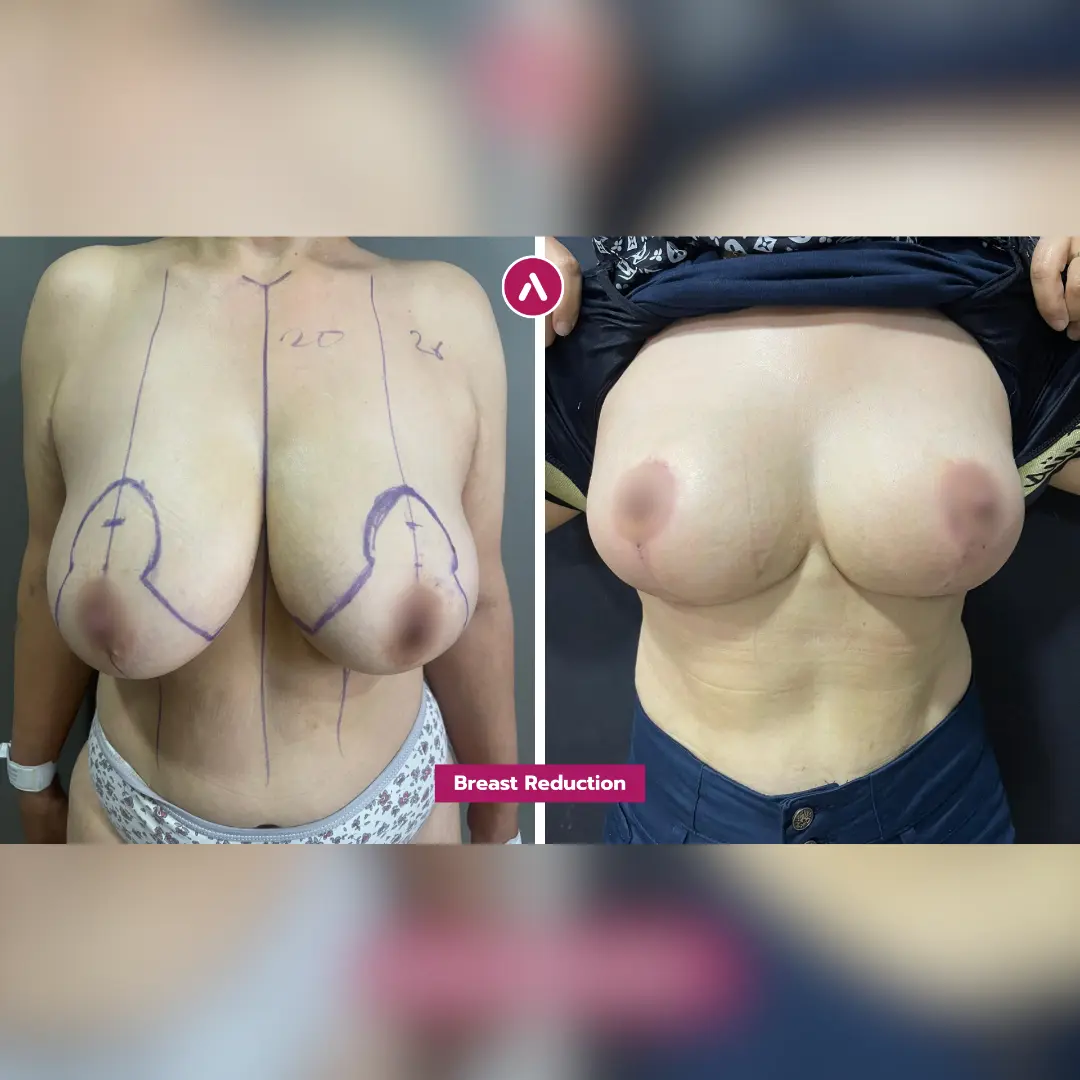
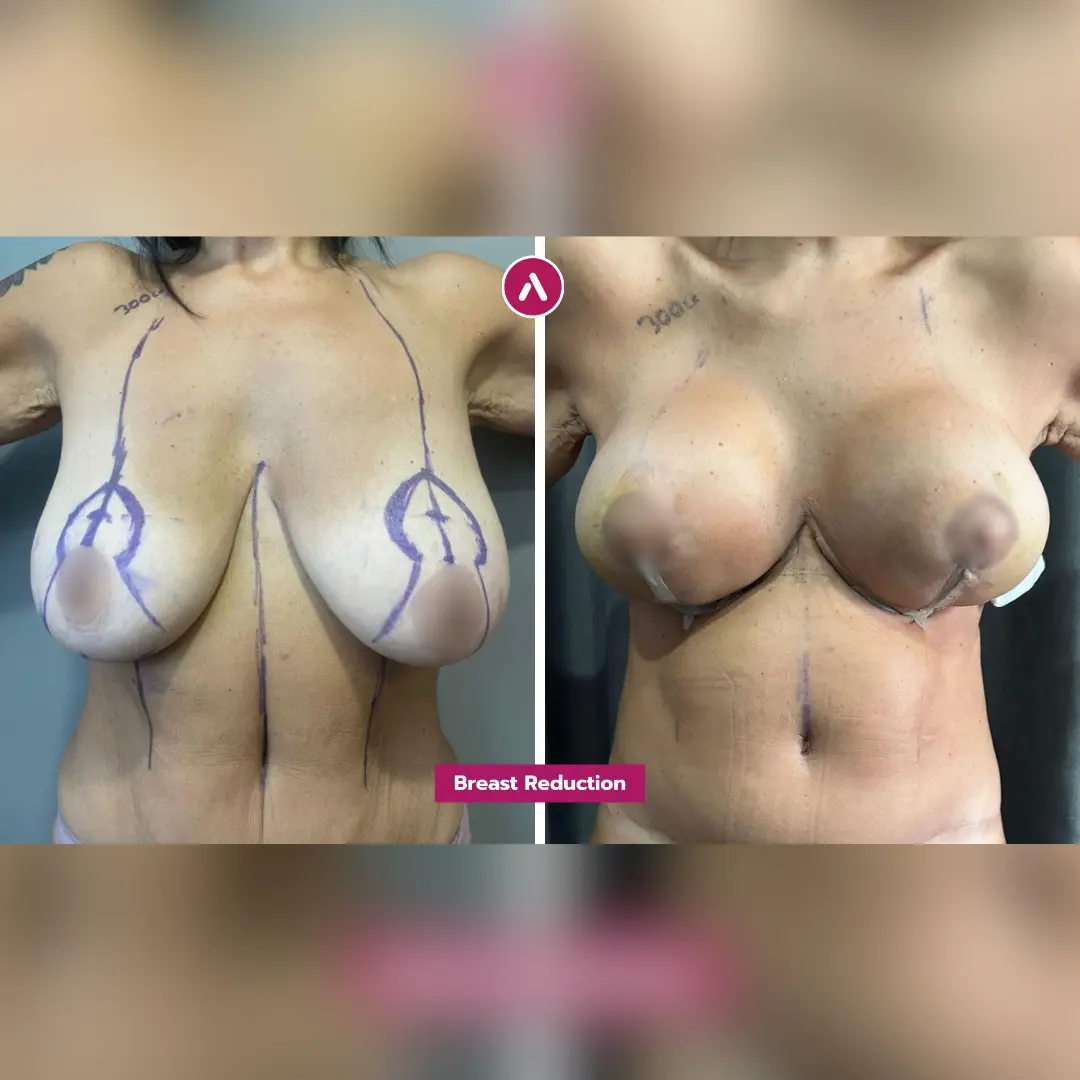
Downsizing is often chosen by patients who feel their implants are too heavy, too round, or too noticeable. It can create a more elegant silhouette, especially for patients who want their breasts to suit a slimmer frame or professional lifestyle.
Downsizing may also reduce strain on the skin and breast fold. For some patients, this improves comfort during exercise and daily movement.
However, smaller implants do not automatically tighten the breast. If the skin has stretched, downsizing alone may leave looseness or drooping.
Skin elasticity, tissue quality, and the need for a lift
The most important factor in downsizing is skin quality. If the skin envelope is loose, the nipple sits low, or the breast has dropped over the implant, a lift may be needed.
That is why many downsizing patients consider a breast lift with implants after downsizing. This combination reduces implant volume while reshaping the breast and repositioning the nipple.
For Canadians travelling from cities such as Ottawa, Edmonton, Winnipeg, or Halifax, combining the needed steps in one surgical trip may be more practical than staging multiple procedures. The trade-off is a more involved recovery, which must be planned carefully before the return flight.
Implant Replacement Surgery
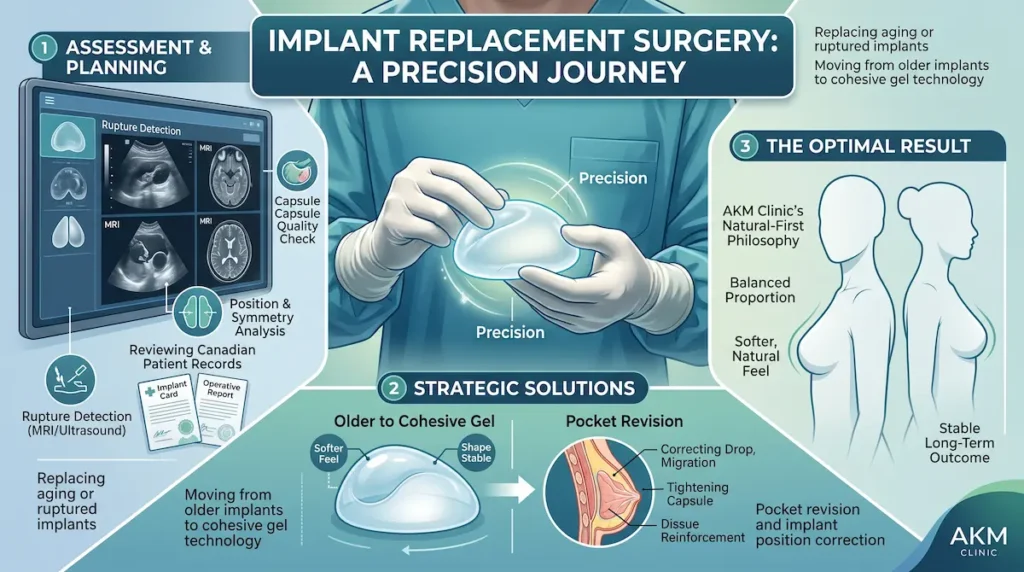
Implant replacement is the most direct revision pathway when the patient still wants implants but needs a safer, softer, or more proportional result. It may involve changing implant size, implant type, implant pocket, or all three.
This is not the same as repeating the original operation. The surgeon must assess the old capsule, tissue thickness, implant position, and any asymmetry before choosing the next step.
Replacing aging or ruptured implants
If an implant has ruptured, shifted, hardened, or become uncomfortable, replacement may be appropriate. In some cases, imaging from Canada can help the surgeon understand the implant condition before travel.
Canadian patients should bring implant cards, operative reports, ultrasound reports, MRI results, and any notes from the original surgeon. This is especially useful when the original procedure was performed years ago.
Having these records helps the revision surgeon identify implant size, brand, surface type, placement plane, and whether the first surgery involved any lift or pocket adjustment.
Moving from older implants to cohesive gel technology
Many revision patients want to replace older implants with newer cohesive gel implants. These are often chosen for a softer feel and more stable shape.
The right implant still depends on the patient’s anatomy. Width, projection, chest wall shape, skin thickness, and lifestyle all matter.
At AKM Clinic, implant material planning follows the clinic’s Natural-First philosophy. The aim is not simply more volume. It is a breast shape that looks balanced on the patient’s frame.
Pocket revision and implant position correction
Implant pocket revision corrects where the implant sits. It may be needed if the implant has dropped too low, shifted outward, moved inward, or remained too high.
Pocket correction may involve tightening the capsule, releasing scar tissue, changing the implant plane, or reinforcing weak tissue. This is one reason revision surgery requires careful planning.
A patient may think the problem is size, when the real issue is position. A skilled revision assessment separates those two concerns.
Implant Removal (Explant) Options
Explant surgery is chosen by patients who no longer want implants or who need removal because of complications. The best explant plan depends on skin quality, breast tissue volume, nipple position, and the patient’s tolerance for a smaller result.
Some patients are satisfied with removal alone. Others prefer a lift or fat transfer to improve shape after the implants are gone.
Explant surgery alone
Removal alone may suit patients with smaller implants, good skin elasticity, and enough natural breast tissue to maintain shape. It is usually the simplest explant pathway.
The limitation is predictable. If implants have stretched the skin or breast tissue over many years, removal alone may leave deflation, drooping, or upper-pole emptiness.
This does not mean removal alone is wrong. It means the patient should know what the breast is likely to look like after volume is removed.
Explant with mastopexy (breast lift)
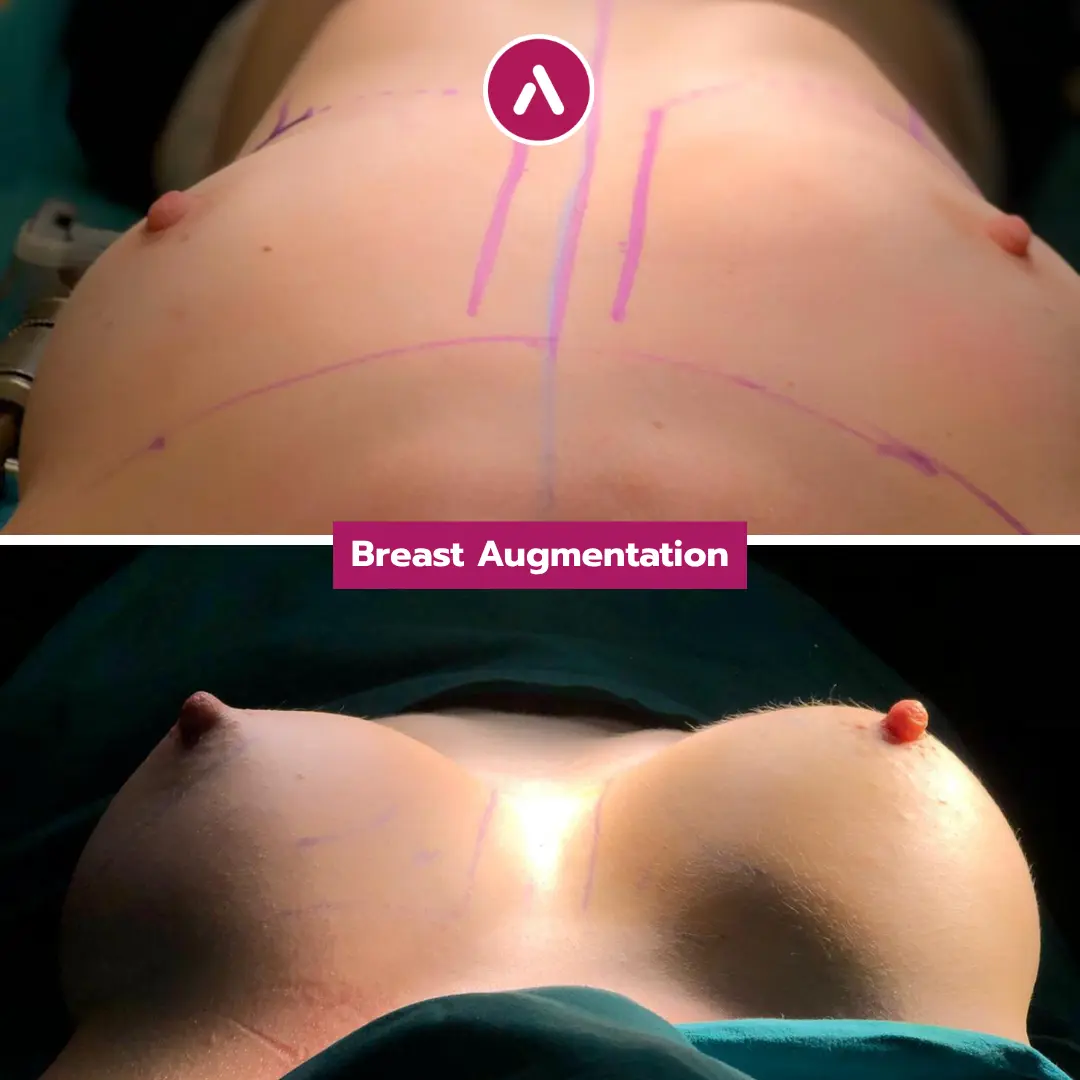
Mastopexy, or breast lift, reshapes the breast after implant removal. It removes excess skin, lifts the nipple, and creates a tighter breast envelope.
This is often appropriate for patients who are downsizing significantly or removing implants after many years. It can also help when pregnancy, breastfeeding, or weight change has lowered the breast position.
For patients who want a smaller, lifted, implant-free result, mastopexy may be the most balanced choice.
Implant removal with fat transfer for a natural result
Some patients want implant removal but do not want to lose all volume. In those cases, fat transfer breast enhancement without implants may be considered.
This approach uses liposuctioned fat from another area of the body and transfers it to the breast. The result is typically modest, soft, and natural-feeling.
For a deeper look at this pathway, our article on implant-to-fat-transfer conversion strategy explains candidacy, fat survival, and size expectations.
| Explant pathway | Best suited for | Main benefit | Main limitation |
|---|---|---|---|
| Removal alone | Good skin elasticity and enough natural tissue | Simplest implant-free option | May look deflated if skin is stretched |
| Removal with breast lift | Loose skin, low nipple position, larger implants | Improves shape and nipple position | More scars than removal alone |
| Removal with fat transfer | Patients wanting natural volume without implants | Soft, implant-free enhancement | Requires enough donor fat |
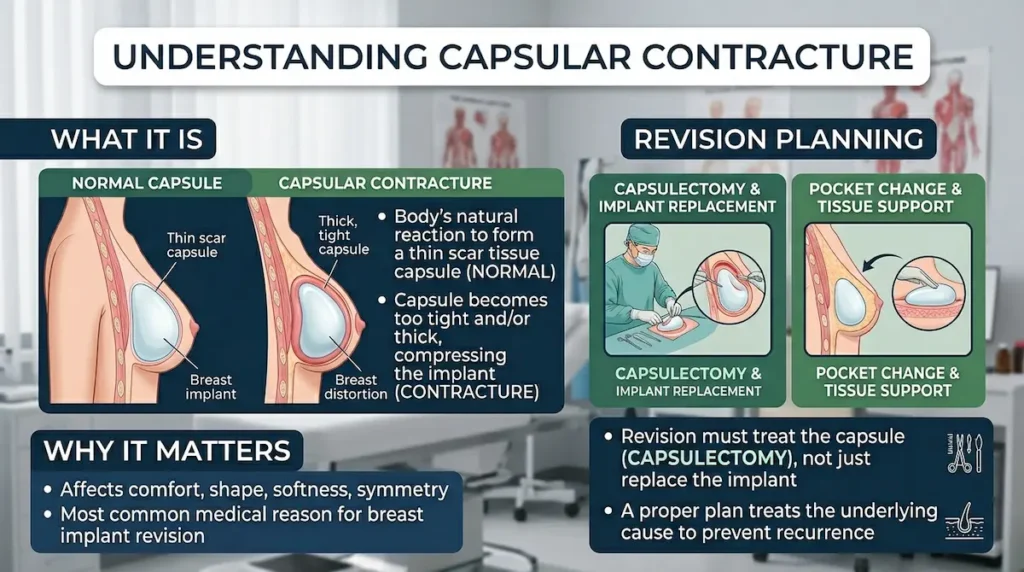
Understanding Capsular Contracture
Capsular contracture is one of the most important medical reasons for breast implant revision. It can affect comfort, shape, softness, and symmetry.
A proper revision plan must treat the capsule, not just replace the implant. Otherwise, the same problem may return.
What capsular contracture actually is
After any breast implant surgery, the body naturally forms a thin scar capsule around the implant. This is normal.
Capsular contracture happens when that capsule becomes too tight or thick. The breast may feel firm, look rounder than before, sit too high, or become painful.
Severity varies. Mild contracture may only be noticeable to the patient. Advanced contracture can distort the breast visibly.
Capsulectomy and revision techniques
Capsulectomy means removing part or all of the scar capsule around the implant. It may be combined with implant replacement, pocket change, lift, or explant surgery.
The exact technique depends on capsule thickness, implant position, tissue quality, and patient preference. A complete plan cannot be made from photos alone, although photos are useful for the first assessment.
During consultation, patients should ask who performs the capsule work, what type of capsulectomy is recommended, and how recurrence risk will be reduced. Our guide to questions to ask during a revision consultation can help you prepare.
Reducing the risk of recurrence
No surgeon can promise capsular contracture will never recur. However, careful technique can reduce risk.
Important factors include sterile handling, appropriate implant selection, pocket planning, and management of old scar tissue. The surgeon may also recommend changing implant position or downsizing if tissue stress contributed to the problem.
Revision is most successful when it corrects the underlying cause rather than simply replacing the implant. The importance of individualized revision planning is also reflected in guidance published by the International Society of Aesthetic Plastic Surgery (ISAPS), which emphasizes surgeon-led assessment and procedure-specific treatment strategies.
Upsize vs Removal — A Decision Framework for Canadians
The upsize-versus-removal decision is rarely about volume alone. It is about how you want your breasts to look, feel, age, and fit into your life in the years ahead.
For Canadian patients, the decision also has a travel-planning layer. A clear plan before leaving Canada helps avoid uncertainty once you arrive in Istanbul.
Matching the procedure to your goals
If your implants feel too small but still look soft and well positioned, upsizing may be reasonable. If your implants feel heavy, artificial, or uncomfortable, downsizing or removal may better match your goals.
If the concern is firmness, distortion, or pain, the priority is not size. The capsule, pocket, and implant condition must be assessed first.
Patients who want an implant-free result should be prepared for a different type of breast shape. Natural breast tissue and fat transfer behave differently than implants.
| Reason for revision | Likely revision pathway | Key planning issue | CAD pricing context |
|---|---|---|---|
| Implants feel too small | Implant upsizing | Skin and tissue support | Breast augmentation replacement context: CAD $7,350 |
| Implants feel too large | Downsizing, often with lift | Loose skin after volume reduction | Breast lift with implants: CAD $7,650 |
| Desire to remove implants | Explant with or without mastopexy | Breast shape after implant removal | Breast lift / mastopexy: CAD $6,150 |
| Want natural volume after explant | Explant plus fat transfer | Enough donor fat and modest size expectations | Autologous fat transfer: CAD $6,150 |
| Want implant softness with better edges | Composite augmentation | Implant plus fat blending | Composite augmentation: CAD $8,200 |
| Capsular contracture | Capsulectomy with replacement or removal | Scar capsule management | Case-specific CAD quote required |
CAD pricing comparison by revision pathway
AKM Clinic pricing references list breast augmentation in a replacement context at CAD $7,350, breast lift with implants at CAD $7,650, breast lift alone at CAD $6,150, autologous fat transfer at CAD $6,150, and composite augmentation at CAD $8,200.
Complex revision cases require individualized pricing because capsulectomy, pocket repair, implant exchange, lift, and fat transfer may be combined. This is why a photo review and implant-history review matter before a quote is finalized.
For procedure-specific cost context, review breast augmentation and revision pricing in CAD.
Comparing revision costs in Toronto, Vancouver, and Montreal
Private cosmetic revision surgery in Canada is usually billed in separate parts. Surgeon fees, facility fees, anesthesia, implants, garments, and follow-up appointments may be itemized separately.
In Toronto and Vancouver, revision cases can be particularly costly because they often require longer operating time. Montreal and Calgary may vary, but revision surgery is still typically more expensive than primary augmentation.
AKM Clinic’s all-inclusive approach is designed to reduce that uncertainty. It also aligns with AKM Clinic’s Natural-First philosophy, where revision planning focuses on proportion rather than simply increasing size.
Safety Considerations: Implant Illness, Rupture & BIA-ALCL
Breast implant revision should include a serious safety conversation. Patients deserve clear information about rupture, Breast Implant Illness concerns, and BIA-ALCL without fear-based messaging.
A careful surgeon will not dismiss these concerns. They will separate evidence, symptoms, risk factors, and the patient’s personal goals.
Understanding implant rupture
Implant rupture means the outer shell of the implant has failed. Saline implant rupture is usually obvious because the implant deflates. Silicone implant rupture can be quieter and may require imaging.
If rupture is suspected, patients should arrange appropriate assessment before travel where possible. A Canadian family physician or specialist may recommend ultrasound or MRI depending on symptoms and implant type.
Bring any imaging reports to your AKM consultation. They help the revision team plan safely.
What patients should know about Breast Implant Illness (BII)
Breast Implant Illness, often called BII, refers to a group of symptoms some patients associate with breast implants. These may include fatigue, joint pain, brain fog, rashes, or general inflammation-like symptoms.
BII remains medically complex. Some patients report improvement after explant surgery, while research is still evolving.
The key is respectful assessment. If a patient wants removal because symptoms feel connected to implants, the consultation should explore explant options, capsule management, and realistic expectations.
BIA-ALCL and why proper assessment matters
BIA-ALCL stands for breast implant-associated anaplastic large cell lymphoma. It is rare, but it is a recognized implant-associated cancer, most often linked to textured implants.
Symptoms can include late swelling, fluid around the implant, breast asymmetry, pain, or a mass. These symptoms require medical assessment, not cosmetic guesswork.
Health Canada provides patient information on breast implant safety, including BIA-ALCL, implant monitoring recommendations, and regulatory updates. Canadian patients should review this information and bring any implant records to consultation.
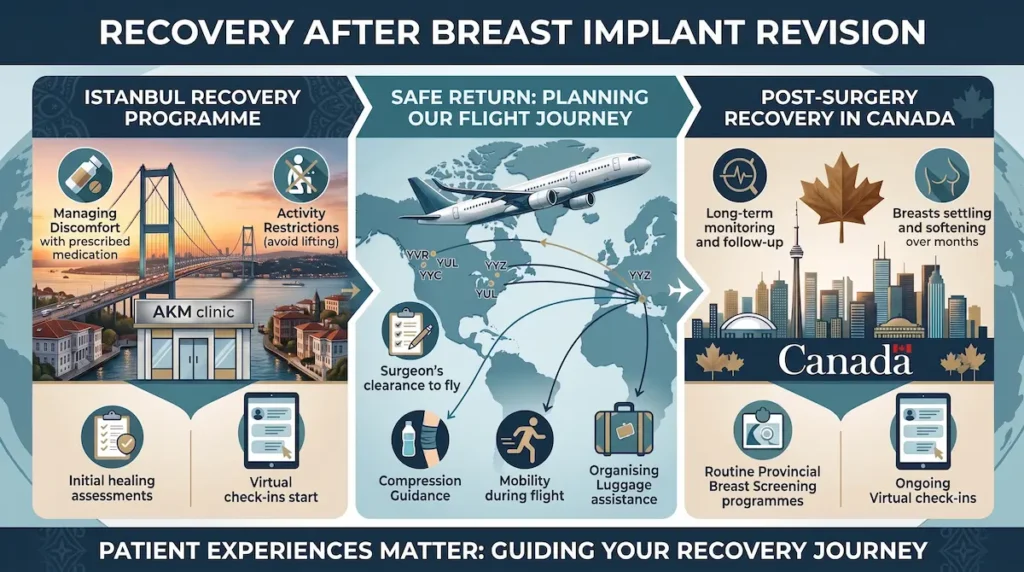
Recovery After Breast Implant Revision
Recovery after revision depends on the complexity of the operation. Simple implant exchange usually heals faster than capsulectomy, lift, fat transfer, or combined revision.
For Canadian patients, the recovery plan must include both Istanbul recovery and safe return-home planning.
Typical healing timeline
Most patients can expect swelling, tightness, bruising, and limited upper-body movement in the first week. Discomfort is usually managed with prescribed medication and careful activity restriction.
If a lift, capsulectomy, or fat transfer is added, healing may take longer. The breast shape also continues settling over several months.
Patients should avoid judging the final result too early. Revision breasts often need more time to soften and relax than primary augmentation results.
Flying back to Canada after revision surgery
Flight timing must be individualized. The surgeon should assess your incisions, swelling, mobility, pain control, and general stability before clearing you to fly.
A long-haul return to YYZ, YVR, YUL, or YYC requires planning. Hydration, walking during the flight, compression guidance, and luggage assistance can all matter.
For broader logistics, see the complete patient journey from Canada, which explains the Istanbul-to-home pathway.
Long-term follow-up and monitoring
Revision care does not end when you leave Turkey. AKM’s follow-up model includes virtual check-ins so progress can be reviewed after you return to Canada.
Patients should continue routine breast screening in Canada according to provincial recommendations. If implants remain, long-term monitoring still matters.
Reading verified patient revision experiences can also help you understand how support, communication, and recovery guidance shape the overall patient experience.
Frequently Asked Questions: Breast Implant Revision Turkey
Breast implant revision decisions are highly personal. These answers give Canadian patients a practical starting point before a surgeon reviews their implant history, photos, tissue quality, and goals.
How long do breast implants last?
Many implants last 10 to 15 years or longer, but there is no fixed expiry date. Revision is usually considered when there is rupture, firmness, malposition, discomfort, cosmetic change, or personal preference.
Do all implants need replacement after 10 years?
No. If your implants feel soft, look stable, and show no signs of rupture or complication, your surgeon may recommend monitoring rather than replacement.
Can I remove implants and switch to fat transfer?
Yes, for selected patients. You need enough donor fat and realistic expectations, because fat transfer usually creates a modest, natural increase rather than implant-like projection.
What is capsular contracture?
Capsular contracture is tightening of the scar capsule around an implant. It can make the breast feel firm, look distorted, sit too high, or become uncomfortable.
Is revision surgery more complex than primary augmentation?
Usually, yes. Revision surgery may involve scar tissue, capsule work, implant pocket repair, lift planning, or correcting problems from the first surgery.
What is BIA-ALCL?
BIA-ALCL is a rare implant-associated lymphoma. It is most commonly linked to textured implants and should be assessed medically if symptoms such as late swelling, pain, fluid, or a mass appear.
How much does breast implant revision cost in CAD?
Pricing depends on the revision pathway. AKM references include breast augmentation at CAD $7,350, breast lift with implants at CAD $7,650, mastopexy at CAD $6,150, fat transfer at CAD $6,150, and composite augmentation at CAD $8,200. Complex capsulectomy is quoted case by case.
Can I downsize and have a lift at the same time?
Yes. Downsizing and breast lift are commonly combined when the skin has stretched or the nipple position has dropped after years with larger implants.
How long should I stay in Istanbul after revision surgery?
Your stay depends on the procedure’s complexity. Implant exchange may require less recovery time than capsulectomy, lift, or fat transfer. Your surgeon should provide fit-to-fly clearance before you return to Canada.
Can AKM assess my implant records before I travel?
Yes. Patients should submit implant cards, operative reports, imaging, photos, and current concerns before travelling. This helps the team create a safer and more accurate revision plan.
Next step: Submit your implant history, current photos, and revision goals for a personalized breast implant revision assessment.
Medical Disclaimer: This page is provided for general educational purposes only and does not replace an in-person medical consultation, diagnosis, or personalized treatment plan. All surgery carries risks, and outcomes vary between individuals. Suitability for a breast lift with implants surgery, procedure selection, and anesthesia choice can only be determined after a full clinical assessment by a qualified surgeon. Always follow your clinician’s instructions and seek urgent medical attention if you develop concerning symptoms during recovery.