
Asymmetrical eyebrow correction starts with one question: why are the brows uneven in the first place? A higher right brow, a lower left tail, or one brow that lifts more strongly during expression can all look similar in a mirror, but they may come from very different anatomical causes.
For Canadian patients researching treatment from Toronto, Vancouver, Montreal, Calgary, or Ottawa, the safest plan is not to choose “Botox” or “brow lift” first. The better approach is diagnosis first, treatment second. At AKM Clinic, brow lift surgical options are planned around facial balance, not a one-size-fits-all brow height.
Quick Summary: Eyebrow asymmetry can be caused by muscle imbalance, age-related brow descent, facial volume loss, trauma, nerve weakness, or previous surgery. The right correction may be non-surgical, such as neuromodulator treatment or filler, or surgical, such as selective temporal or endoscopic brow lifting.
The key is matching the cause to the treatment. Dynamic muscle asymmetry often responds to injection-based correction, while fixed structural asymmetry usually needs surgical repositioning or fat grafting for a longer-lasting result.
Table of Contents
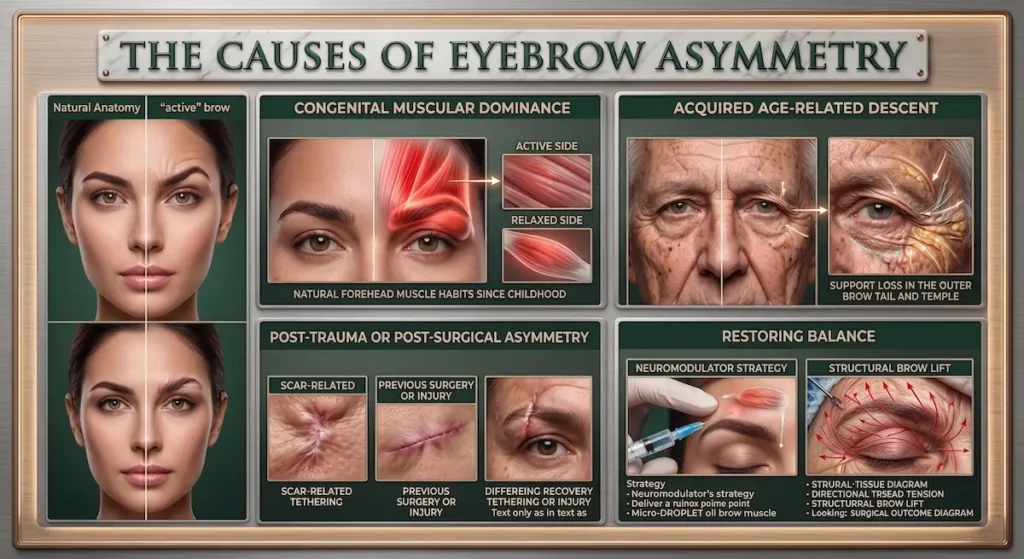
The Causes of Eyebrow Asymmetry
Eyebrow asymmetry is common. Perfect facial symmetry is rare, and a small difference between brows usually looks natural. Treatment becomes relevant when the imbalance makes one eye look heavier, changes facial expression, interferes with eyelid appearance, or makes the face look tired on one side.
The first step is separating normal variation from a correctable pattern. A skilled facial surgeon looks at brow height, brow tail position, forehead muscle activity, eyelid skin, temple volume, and previous injury or surgery history. This matters because a treatment that helps one patient can worsen another if the diagnosis is wrong.
ISAPS describes brow lifting as a procedure that can reposition depressed brow elements, with different approaches depending on whether the whole brow or only the outer brow needs support. That distinction is important for asymmetry, because uneven brows rarely need identical treatment on both sides. ISAPS brow lift patient information
Congenital Muscular Dominance
Congenital muscular dominance means one side of the forehead naturally works harder than the other. Some patients have lived with this since childhood. They may notice one brow arches more strongly in photos, especially when smiling, speaking, or raising the forehead.
This type of asymmetry is often dynamic. The brow may look almost even at rest, then separate during expression. In these cases, surgery may not be the first choice. A carefully planned neuromodulator strategy can sometimes soften the overactive side and allow the brows to sit more evenly.
Canadian patients often notice this pattern in professional photos or video calls. A teacher in Ottawa, a lawyer in Toronto, or a healthcare worker in Calgary may only become bothered by the asymmetry after seeing their face repeatedly on camera. That does not make the concern superficial. It simply means the pattern has become easier to observe.
Acquired Age-Related Descent
Age-related brow descent develops gradually as the forehead, temple, and upper eyelid tissues lose support. The outer brow tail is often affected first. One side may descend faster because of sleeping habits, sun exposure, facial dominance, or natural anatomical variation.
This pattern is usually more structural than muscular. The brow looks low even when the face is relaxed. The upper eyelid on the lower side may also look heavier, which can make patients assume they need blepharoplasty when the true issue is brow position.
In Canada, this concern is common among patients in their 40s, 50s, and 60s who want a rested look without appearing “done.” AKM Clinic’s Natural-First philosophy is especially relevant here: the goal is balance, not an artificially high arch.
Post-Trauma or Post-Surgical Asymmetry
Post-trauma asymmetry may follow facial injury, nerve irritation, scarring, or tissue tethering. A previous brow lift, eyelid surgery, facelift, or injectable treatment can also leave one brow sitting differently from the other. These cases need more caution.
The surgeon must assess whether the asymmetry comes from skin, muscle, nerve function, scar tissue, or volume loss. A patient with mild post-injection imbalance may need only a small correction. A patient with scar-related descent after surgery may need structural release and repositioning.
For Canadian patients, this category also raises an insurance question. Purely cosmetic eyebrow asymmetry is usually not covered by provincial plans such as OHIP, MSP, RAMQ, or AHCIP. Trauma-related or function-affecting cases may be assessed differently, especially if eyelid obstruction or nerve injury is documented. A local physician or specialist should confirm eligibility before assuming coverage.
“The first mistake in eyebrow asymmetry is treating both brows as if they have the same problem. One side may need relaxation, the other may need support, and a third issue may be volume loss around the temple. Diagnosis decides the plan.”
Diagnosing Your Specific Asymmetry Pattern
Diagnosis is the centre of effective eyebrow correction. A surgeon should not judge the brows from one selfie. The assessment should include relaxed photos, expression photos, side views, eyelid position, forehead movement, and the patient’s history of injectables, trauma, or surgery.
Virtual consultation is useful for the first stage, especially for Canadian patients planning from a distance. Clear photographs can show whether the asymmetry is mainly muscular, structural, volume-related, or mixed. Final planning still depends on an in-person examination, because brow motion and tissue resistance are easier to judge face to face.
Static Versus Dynamic Asymmetry
Static asymmetry is visible when the face is fully relaxed. One brow sits lower, the tail droops more, or one upper eyelid looks heavier even without expression. This often points toward structural descent, volume difference, or previous tissue change.
Dynamic asymmetry appears or worsens during movement. The brows may look balanced at rest but become uneven when raising the forehead, smiling, or speaking. This often points toward muscle dominance, especially involving the frontalis and brow depressor muscles.
The distinction matters. Dynamic asymmetry may respond well to neuromodulator treatment. Static asymmetry is less likely to be corrected fully by injections alone, especially when the brow tail has physically descended.
Muscle Versus Structural Cause
A muscle-driven asymmetry behaves differently from a structural one. In a muscle-driven pattern, one brow is being pulled or lifted more strongly. In a structural pattern, the brow support system itself has changed.
Muscle causes may involve the frontalis, which lifts the brows, or the muscles that pull the brow inward and downward. Structural causes may involve the forehead soft tissues, temple support, eyelid skin, ligaments, or scar tissue.
This is why “a little Botox” is not always the answer. If the low brow is already under-supported, relaxing the wrong muscle can make it drop further. If the high brow is compensating for eyelid heaviness, lowering it without addressing the eyelid can make the eye look more tired.
What Photographs Reveal
Photographs are not just for before-and-after comparison. They are diagnostic tools. A good photo set shows brow height, brow tail shape, eyelid fold, temple hollowing, forehead line depth, and facial expression patterns.
For a virtual assessment, patients should usually provide front-facing relaxed photos, front-facing smiling photos, raised-forehead photos, three-quarter views, and side views. Hair should be pulled away from the forehead and temples. Lighting should be even, with no heavy makeup over the brows.
Canadian patients often send photos taken in bathroom lighting or from a laptop camera. Those images can distort brow height. A more reliable set is taken at eye level, in natural indoor light, with the phone held straight rather than angled downward.
| Asymmetry pattern | Most likely cause | Typical first-line option | When surgery becomes relevant |
|---|---|---|---|
| Brow uneven only during expression | Muscle dominance | Neuromodulator planning | If muscle relaxation cannot balance the brow safely |
| Outer brow tail lower on one side at rest | Structural descent | Selective temporal lift assessment | When the brow tail needs durable repositioning |
| One temple looks flatter or more hollow | Volume asymmetry | Filler or fat grafting assessment | If volume loss is severe or combined with tissue descent |
| Asymmetry after injury or previous surgery | Scar, nerve, or tissue-plane change | Specialist surgical evaluation | When scar release or structural correction is needed |
This diagnostic matrix is a starting point, not a prescription. A safe plan for asymmetrical eyebrow correction should be individualized after medical review, especially when there is nerve weakness, prior surgery, or trauma history.
Botox for Muscular Asymmetry
Neuromodulator treatment is often the least invasive option for eyebrow imbalance caused by muscle activity. Many patients call this “Botox,” although other botulinum toxin products may be used depending on the clinic, country, and product availability.
The principle is simple. If one muscle is pulling harder than the other, selective relaxation can reduce that pull and allow the brow to sit in a more balanced position. This works best when the asymmetry is dynamic, mild to moderate, and clearly linked to expression.
Health Canada describes Botox Cosmetic as a botulinum toxin product used for cosmetic purposes, where small injected doses reduce the ability of targeted facial muscles to contract. Canadian patients should also verify that any injectable product used in Canada is authorized and has appropriate product identification. Health Canada cosmetic injection guidance
When Neuromodulator Alone Solves the Problem
A neuromodulator can be enough when the eyebrow asymmetry is mainly caused by uneven muscle pull. This is common in patients who raise one brow more strongly, squint more on one side, or use one side of the forehead more during speech.
The best candidates usually have good brow structure at rest. Their brow height may look acceptable in a neutral expression, then shift during smiling, concentration, or forehead lifting. In this pattern, a small adjustment can make a visible difference without surgery.
It is less effective when the brow is physically low because the tissue has descended. A low outer brow caused by aging, laxity, or scar tissue cannot be lifted reliably by weakening muscles alone. In that case, the injection may soften expression, but it will not rebuild structural support.
For patients comparing options, our guide to non-surgical injection-based corrections explains how neuromodulators and fillers fit into broader facial rejuvenation planning.
Frontalis Selective Relaxation Strategy
The frontalis is the main forehead muscle that lifts the brows. If one side is overactive, it may pull that brow higher and create an uneven arch. Selective relaxation can reduce the height difference.
This must be planned carefully. Over-relaxing the frontalis can drop the brow and make the upper eyelid look heavier. That risk matters more in patients who already have eyelid hooding, brow descent, or a history of upper blepharoplasty.
A conservative plan often works best. The injector may treat the stronger side lightly, preserve enough lifting function, and reassess the result after the product settles. Small refinements are safer than an aggressive first session.
Canadian Callout: Botox Access and Pricing Differences
In Canada, botulinum toxin treatment is widely available through dermatology, plastic surgery, and medical aesthetic clinics, but cosmetic treatment is privately paid. Pricing models vary by province and provider, and AKM Clinic’s reference cost schedule does not list Botox pricing for this article. Patients should request a confirmed quote before including neuromodulator treatment in a travel plan.
Maintenance Schedule and Longevity
Neuromodulator correction is temporary. The effect usually appears gradually, then fades as muscle activity returns. For patients who rely on this approach for eyebrow balance, maintenance is part of the plan.
That temporary nature can be helpful. It allows a patient to test whether muscle modulation improves the asymmetry before considering a longer-lasting procedure. It also allows careful adjustment over time as the face ages.
The limitation is durability. A patient seeking a long-term correction for structural brow descent may find repeated injections frustrating. In those cases, surgical repositioning or fat grafting may become more appropriate after proper assessment.
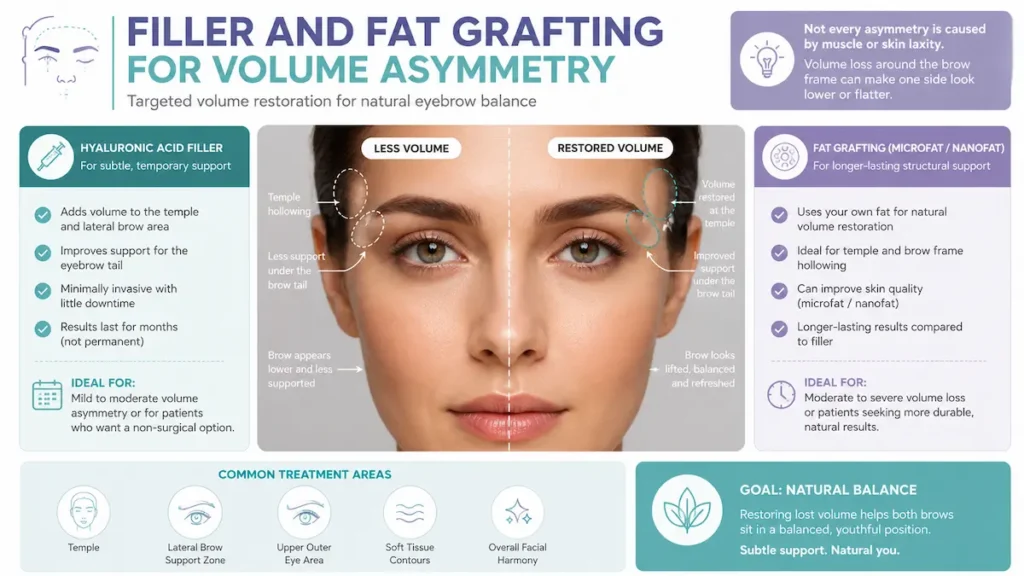
Filler and Fat Grafting for Volume Asymmetry
Not all eyebrow asymmetry comes from brow position. Sometimes the brows look uneven because one temple, upper eyelid, or lateral brow support zone has less volume. The brow may not be dramatically lower, but the surrounding frame makes one side appear flatter, heavier, or more hollow.
Volume-based asymmetry needs a different solution. Instead of relaxing muscle or lifting tissue, the treatment restores support around the brow. This may involve hyaluronic acid filler for temporary refinement or fat grafting for a longer-term structural approach.
When Asymmetry Is Volume-Based
Volume asymmetry is often visible around the temple and upper outer eye. One side may look more sunken. The brow tail may appear unsupported, even if the measured brow height is similar on both sides.
This pattern can be congenital, age-related, or related to weight change. It can also follow previous filler placement, filler migration, or surgical tissue changes. A careful assessment should look beyond the brow hairs and include the surrounding soft tissue.
For Canadian patients, this is often the moment when a virtual consultation becomes useful. Photos taken from the front and three-quarter angles can show whether one temple has lost more contour. The surgeon may then decide whether volume restoration, lifting, or a combined plan is more logical.
Hyaluronic Acid Filler Approach
Hyaluronic acid filler can help mild volume-related asymmetry when the goal is subtle contour support. It may be placed in the temple, lateral brow support zone, or adjacent hollow areas depending on anatomy.
The benefit is adjustability. Filler is non-surgical, has limited downtime, and can be refined gradually. For patients who are unsure about surgery, this can be a practical first step.
The drawback is that filler is temporary and technique-sensitive. Overfilling the temple or placing product too superficially can distort the brow frame. In patients with previous filler migration, the surgeon may recommend dissolving old product before adding anything new.
AKM Clinic’s Treatment Techniques Cost schedule lists Liquid Facelift at CAD $3,150. That figure applies to the listed liquid facelift category, not every possible filler plan. A personalized consultation is still needed for asymmetry-specific treatment.
Fat Grafting: Microfat or Nanofat for Structural Correction
Fat grafting uses the patient’s own fat to restore soft-tissue support. Small amounts are harvested, processed, and placed into selected facial areas. For eyebrow asymmetry, the goal is not to create a larger face. The goal is to rebuild missing support around the brow and temple.
Microfat may help when structural volume is needed. Nanofat is more often discussed for skin quality, fine lines, and regenerative support. For patients comparing the two, AKM’s guide to fat grafting for facial volume restoration explains how facial fat transfer is planned by layer and indication.
For skin-level asymmetry, scar-related irregularity, or fine texture differences around the brow, nanofat grafting for asymmetry correction may be considered as part of a broader plan. It should not be presented as a replacement for brow lifting when the true problem is tissue descent.
AKM Clinic’s Treatment Techniques Cost schedule lists Microfat Grafting, Nanofat Grafting, and SNIF at CAD $3,400 each. These are technique-level prices, not automatic all-inclusive packages, and the exact plan depends on whether the patient is having fat grafting alone or combined with brow surgery.
Canadian Callout: Filler Versus Fat Grafting for Travelling Patients
For patients flying from YYZ, YVR, or YUL, filler may be easier to schedule as a short treatment, but fat grafting may make more sense when combined with another surgical procedure in Istanbul. The deciding factor is not travel convenience alone. It is whether the asymmetry is temporary, structural, or part of wider facial aging.
Fat grafting has a different recovery profile than filler. There may be swelling at both the donor and recipient areas. Not all transferred fat survives, so the final result can take time to settle. The benefit is that stable surviving fat can provide longer-lasting support than temporary filler.
Surgical Correction for Structural Asymmetry
Surgery becomes relevant when eyebrow asymmetry is fixed, structural, or caused by tissue descent rather than muscle activity alone. This does not always mean a full brow lift. In many cases, the correction is selective and deliberately conservative.
The purpose of surgical correction is not to create identical brows. Human brows are sisters, not twins. The aim is to restore balance around the eyes while preserving the patient’s natural expression.
Selective Unilateral or Asymmetric Lifting
Selective brow lifting means the surgeon treats one side differently from the other. One brow may need more release, more elevation, or a different vector. The opposite side may need little or no lift.
This approach is especially useful when one outer brow tail has descended more than the other. A lateral or temporal approach can support the brow tail without changing the entire forehead. For the technique comparison between temporal and full brow lift, see our dedicated comparison: temporal lift vs brow lift.
Selective surgery requires restraint. Overcorrecting the lower brow can create a surprised or artificial look. Under-correcting it may leave the patient feeling that the asymmetry was not addressed. The surgical plan should account for swelling, tissue memory, and how the brows move after healing.
Endoscopic Correction for Forehead-Driven Asymmetry
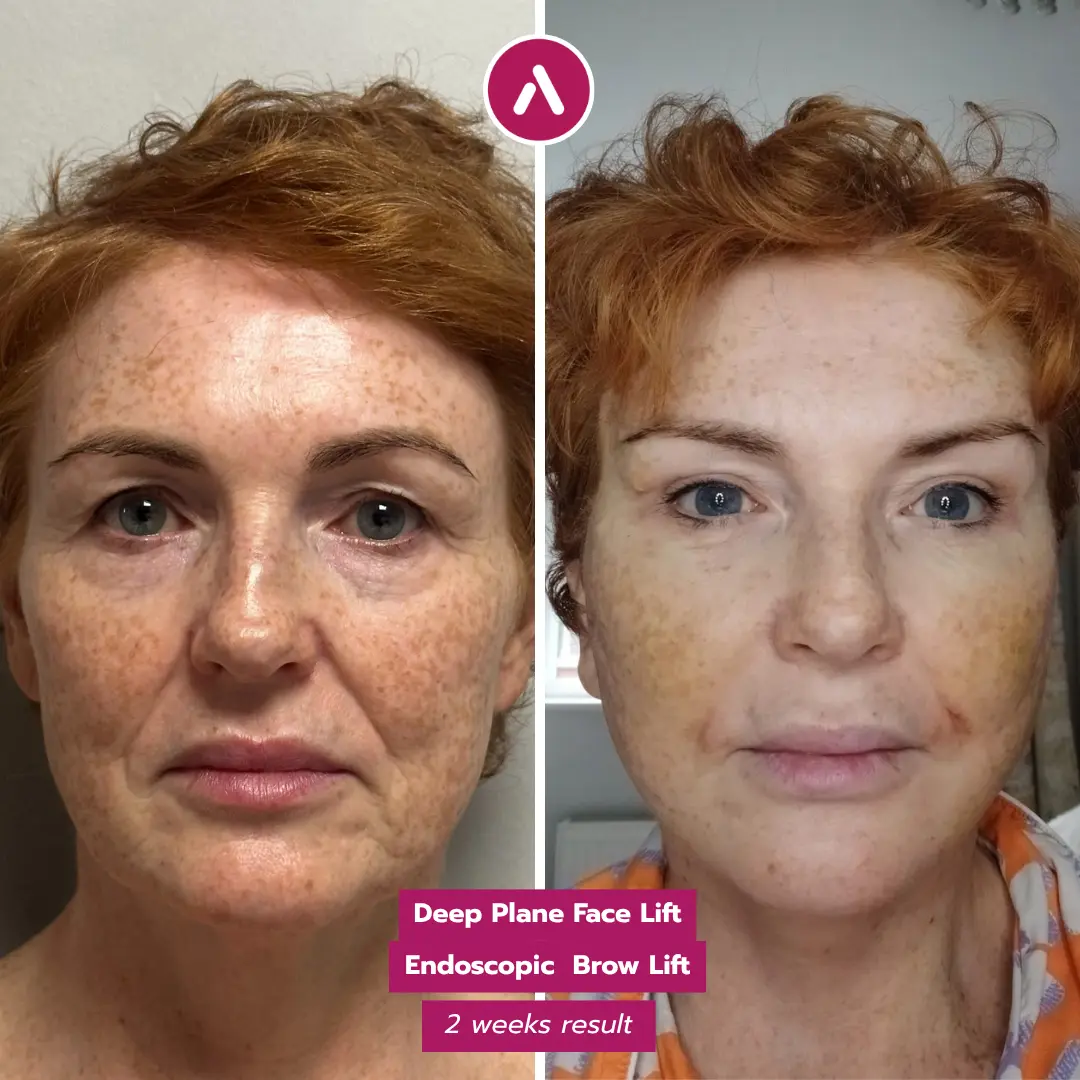
An endoscopic brow lift uses small scalp incisions and a camera-assisted approach to elevate forehead and brow tissues. It can be useful when the asymmetry comes from the forehead support system rather than only the outer brow tail.
This option may be appropriate when one whole brow sits lower, forehead lines are uneven, or the central brow contributes to a tired expression. It can also help when upper eyelid heaviness is partly caused by brow descent.
AKM Clinic’s Treatment Techniques Cost schedule lists Endoscopic Full Brow Lift at CAD $6,150 and Temporal Brow Lift at CAD $4,800. These figures are technique-level prices. The final recommendation depends on anatomy, whether the procedure is combined with eyelid surgery, and whether asymmetry is unilateral or bilateral.
Some patients ask about a more lifted, almond-shaped eye appearance. That is a separate aesthetic goal. For cat-eye or lateral canthal reshaping, see our guide to the specialty fox eye surgery technique.
When Surgery Is the Only Durable Answer
Surgery is usually the most durable option when the brow has physically descended. This can happen with aging, previous surgery, tissue laxity, or trauma-related support loss. In these cases, injections may camouflage the problem but rarely correct the underlying structure.
Surgical correction may also be needed when asymmetry affects eyelid function. A low brow can make upper eyelid skin look heavier and may contribute to visual-field complaints. In Canada, functional cases may require assessment by a local ophthalmologist, plastic surgeon, or family physician before provincial coverage is discussed.
A durable answer should still look natural. AKM Clinic’s facial surgery philosophy focuses on “Rejuvenation over alteration,” using correction that supports the patient’s existing facial identity rather than replacing it. This is especially important for Canadian patients who prefer subtle, professional-looking outcomes.
Canadian Callout: Provincial Insurance and Functional Brow Concerns
Most cosmetic brow asymmetry correction is privately paid in Canada. If asymmetry follows trauma, nerve injury, or causes functional eyelid obstruction, patients should document symptoms and seek local medical assessment through their provincial system. OHIP, MSP, RAMQ, and AHCIP decisions depend on medical necessity, not aesthetic preference.
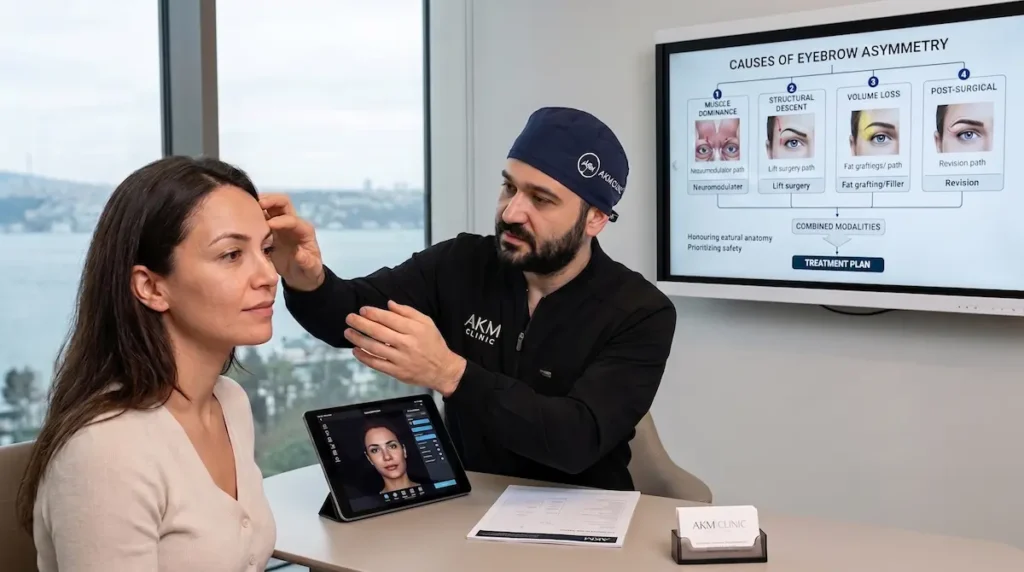
Decision Pathway — Cause to Treatment
The safest plan follows the cause. A patient with muscle dominance should not be pushed into surgery. A patient with structural descent should not be promised a complete correction from injections. The decision pathway protects both safety and result quality.
AKM Clinic evaluates eyebrow asymmetry through facial balance, brow movement, eyelid relationship, tissue support, and the patient’s desired level of change. The assessment also considers travel logistics for Canadian patients, since combining procedures may reduce repeated long-haul recovery periods.
The Diagnostic Conversation with Your Surgeon
The consultation should begin with history. The surgeon will ask when the asymmetry began, whether it is changing, whether there was trauma or surgery, and whether the patient has had Botox, filler, blepharoplasty, facelift, or brow lift before.
The next step is movement analysis. Patients may be asked to relax, raise the brows, smile, squint, and close the eyes. These expressions reveal whether the brow imbalance is static, dynamic, or mixed.
AKM’s Natural-First facial assessment process considers the full upper-face frame rather than brow height alone. You can read more about AKM’s Natural-First facial assessment process and the clinic’s preference for subtle, identity-preserving results.
Combining Modalities for Complex Cases
Many cases need more than one tool. A patient may have muscle dominance on one side, volume loss at one temple, and structural descent of the brow tail. Treating only one layer may improve the asymmetry but not resolve it fully.
A combined plan might include conservative neuromodulator treatment first, then fat grafting or selective lift once the true structural imbalance is clearer. Another patient may need temporal lifting with small-volume fat grafting to support the lateral brow frame.
For Canadian patients, combination planning can be practical. A patient travelling from Vancouver or Halifax may prefer one well-planned Istanbul trip instead of multiple fragmented treatments. Still, combining procedures should be based on anatomy and safety, not convenience alone.
- Muscle-dominant asymmetry: neuromodulator-first strategy.
- Volume-dominant asymmetry: filler or fat grafting assessment.
- Structural brow descent: temporal or endoscopic lift evaluation.
- Mixed asymmetry: staged or combined treatment plan.
- Post-surgical asymmetry: revision-focused facial surgery review.
When to Seek Revision After Primary Brow Surgery
Revision should not be rushed. Early swelling can make brows look uneven for weeks or months after surgery. A surgeon usually needs to see the settled result before deciding whether asymmetry is temporary or structural.
Patients should seek revision evaluation sooner if they have severe imbalance, new weakness, unusual pain, wound problems, or rapidly changing brow position. Those concerns require medical review, not cosmetic waiting.
For milder asymmetry after previous brow surgery, documentation helps. Bring pre-op photos, post-op photos, operative notes if available, and a timeline of healing. A careful review can show whether the issue is scar tethering, under-correction, over-correction, muscle imbalance, or volume loss.
Have Your Asymmetry Diagnosed Before Choosing a Treatment
Eyebrow asymmetry correction is safest when the treatment matches the cause. A virtual consultation can help determine whether your pattern is muscular, structural, volume-based, or mixed before you commit to injections or surgery.
Request a brow-focused assessment with AKM Clinic and receive a personalized plan for your facial anatomy.
Frequently Asked Questions: Asymmetrical Eyebrow Correction
Eyebrow asymmetry correction depends on the cause, the patient’s anatomy, and how much change is appropriate. These answers summarize the most common questions Canadian patients ask when comparing surgical and non-surgical options.
Can asymmetry be fixed without surgery?
Yes, some eyebrow asymmetry can be improved without surgery. This is most likely when the imbalance is caused by muscle activity, mild volume loss, or previous injectable placement rather than fixed tissue descent.
Neuromodulators may help if one brow lifts more strongly during expression. Filler or fat grafting may help when one temple or lateral brow area has less support. If the brow is structurally low at rest, non-surgical treatment may only camouflage the problem.
How long does Botox correction last?
Botulinum toxin correction is temporary. The effect gradually appears after treatment, then fades as muscle movement returns. Maintenance is usually required if the patient wants to keep the brows balanced with injections.
That temporary nature can be useful. It allows patients to test whether muscle modulation improves their asymmetry before considering surgery. It is less suitable for patients who want a durable correction for brow descent.
Is fat grafting permanent?
Fat grafting can provide long-lasting support, but not every transferred fat cell survives. The portion that establishes a blood supply can remain stable, while early swelling and non-surviving fat gradually resolve.
For eyebrow asymmetry, fat grafting is most useful when the brow frame lacks volume, especially around the temple or lateral upper eyelid area. It should not be treated as a lifting substitute when the real issue is structural descent.
Does Canadian provincial insurance cover trauma-related correction?
Purely cosmetic eyebrow asymmetry correction is usually privately paid in Canada. Provincial plans such as OHIP, MSP, RAMQ, and AHCIP generally focus on medical necessity rather than aesthetic preference.
Trauma-related asymmetry, nerve injury, or brow descent that contributes to functional visual obstruction may be reviewed differently. Patients should document symptoms, obtain local medical assessment, and clarify coverage before assuming eligibility.
How long is recovery from surgical asymmetry correction?
Recovery depends on the procedure. A selective temporal lift may have a shorter visible recovery than a full endoscopic brow lift. Swelling, bruising, scalp tightness, and temporary numbness can occur after surgical repositioning.
Most patients need to plan social and work downtime, especially if they are flying back to Canada. AKM Clinic reviews fit-to-fly timing during the post-operative assessment, and patients travelling from YVR or smaller Canadian airports should consider connection fatigue when planning return dates.
Will my asymmetry come back over time?
Some degree of aging continues after every treatment. Neuromodulator correction fades because muscle activity returns. Filler gradually resorbs. Fat grafting and surgical lifting can last longer, but the surrounding tissues still age naturally.
The best long-term plan is not necessarily the most aggressive one. It is the plan that corrects the dominant cause while preserving natural expression. This is why AKM’s Natural-First approach avoids pushing the brow higher than the face can support comfortably.
Can asymmetry be addressed during a facelift?
Yes, eyebrow asymmetry can sometimes be addressed during a broader facial rejuvenation plan. The surgeon may combine brow correction with facelift, eyelid surgery, fat grafting, or injectable refinement depending on the anatomy.
This should be planned carefully. A facelift primarily addresses lower-face and neck aging, while brow asymmetry belongs to the upper face. If brow surgery is being considered, review brow surgical pricing in CAD and confirm whether the correction is best performed alone or as part of a combined plan.
Medical Disclaimer: This page is provided for general educational purposes only and does not replace an in-person medical consultation, diagnosis, or personalized treatment plan. All surgery carries risks, and outcomes vary between individuals. Suitability for endoscopic temporal vs brow lift surgery, procedure selection, and anesthesia choice can only be determined after a full clinical assessment by a qualified surgeon. Always follow your clinician’s instructions and seek urgent medical attention if you develop concerning symptoms during recovery.