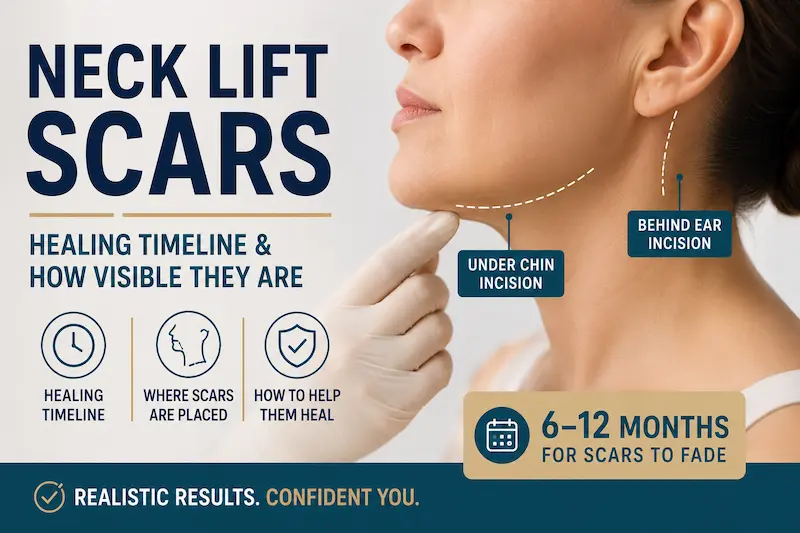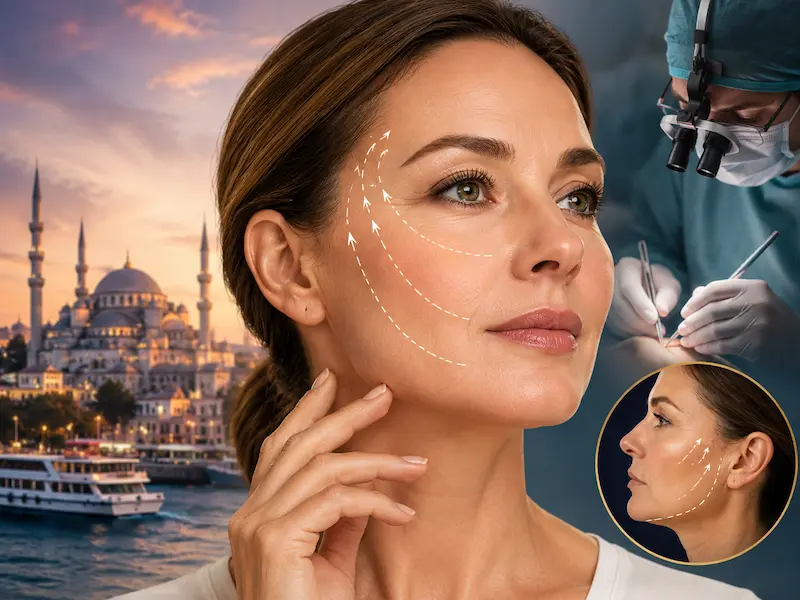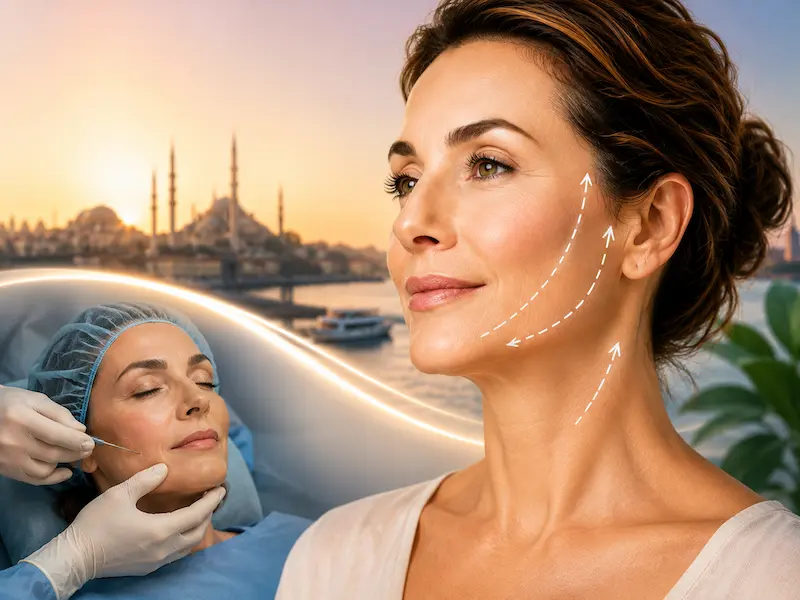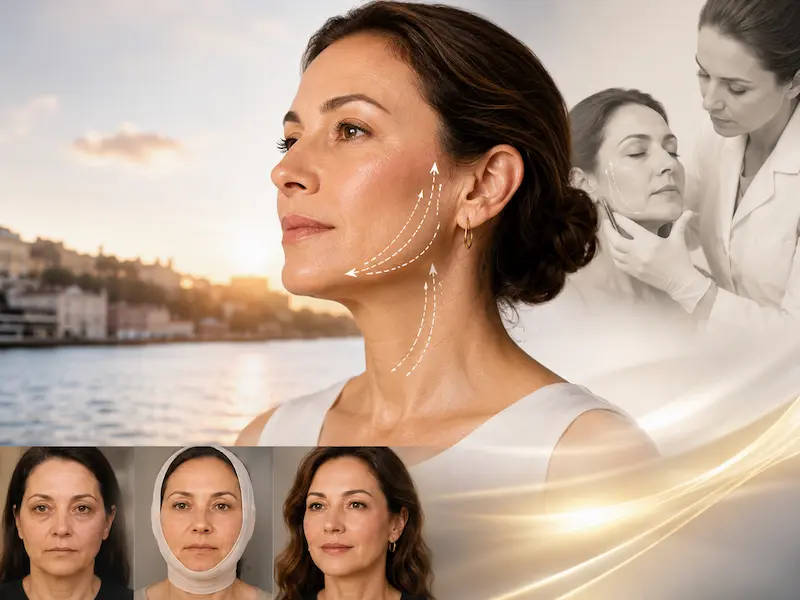

Quick Summary: A hair transplant and facelift combo can be planned in one Istanbul trip for selected Canadian patients, especially when facial aging and hairline recession are part of the same overall concern. The strategy depends on sequencing, donor-area protection, incision planning, and a realistic recovery calendar.
The main decision is same-trip versus staged treatment. A same-trip plan can reduce travel duplication, but it must protect new hair grafts, facelift incisions, and the patient’s fit-to-fly timeline.
A hair transplant and facelift combo is not simply two procedures booked beside each other. It is a coordinated plan for the scalp, hairline, temples, sideburn region, face, and neck. For Canadian patients travelling to Istanbul, that coordination matters as much as the procedures themselves.
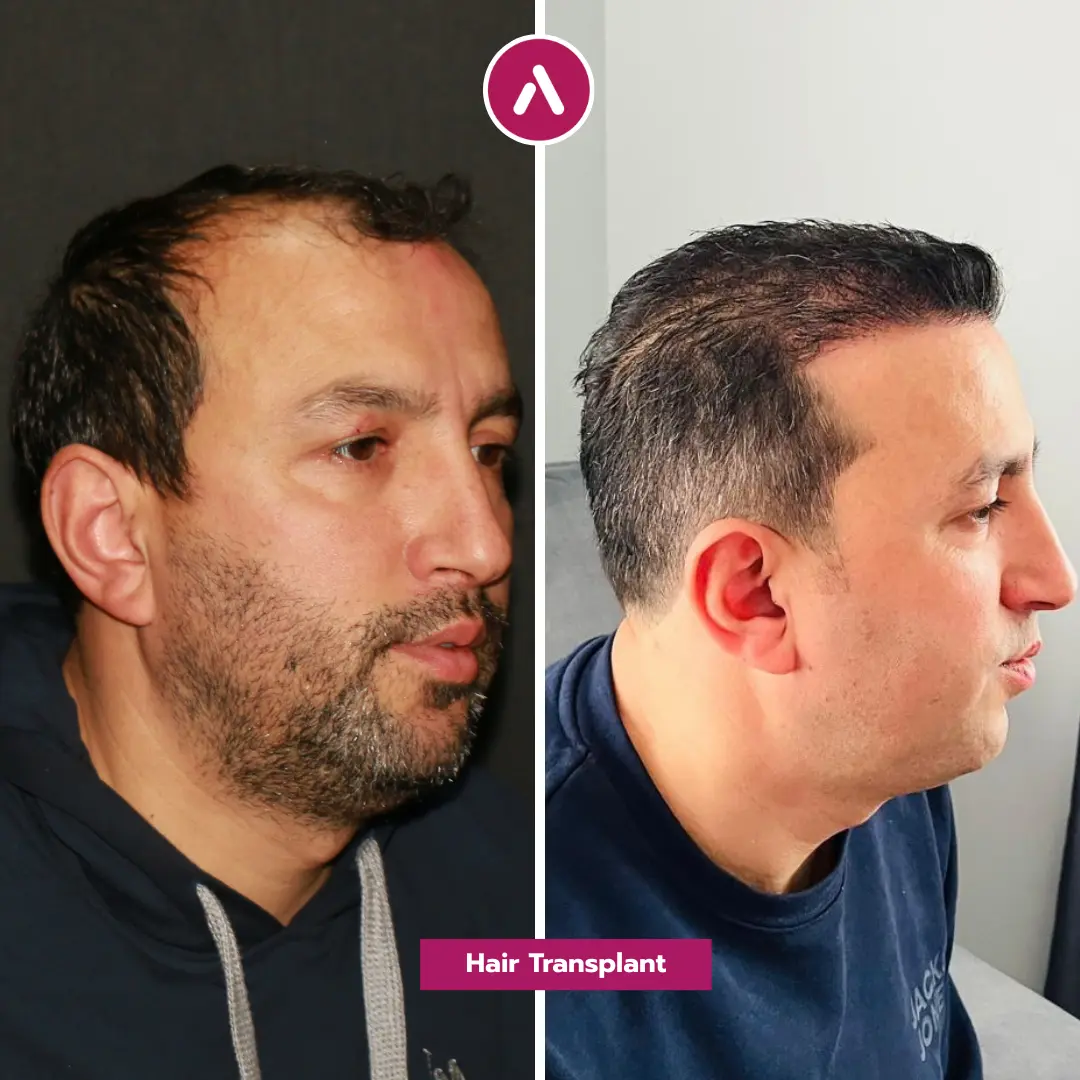
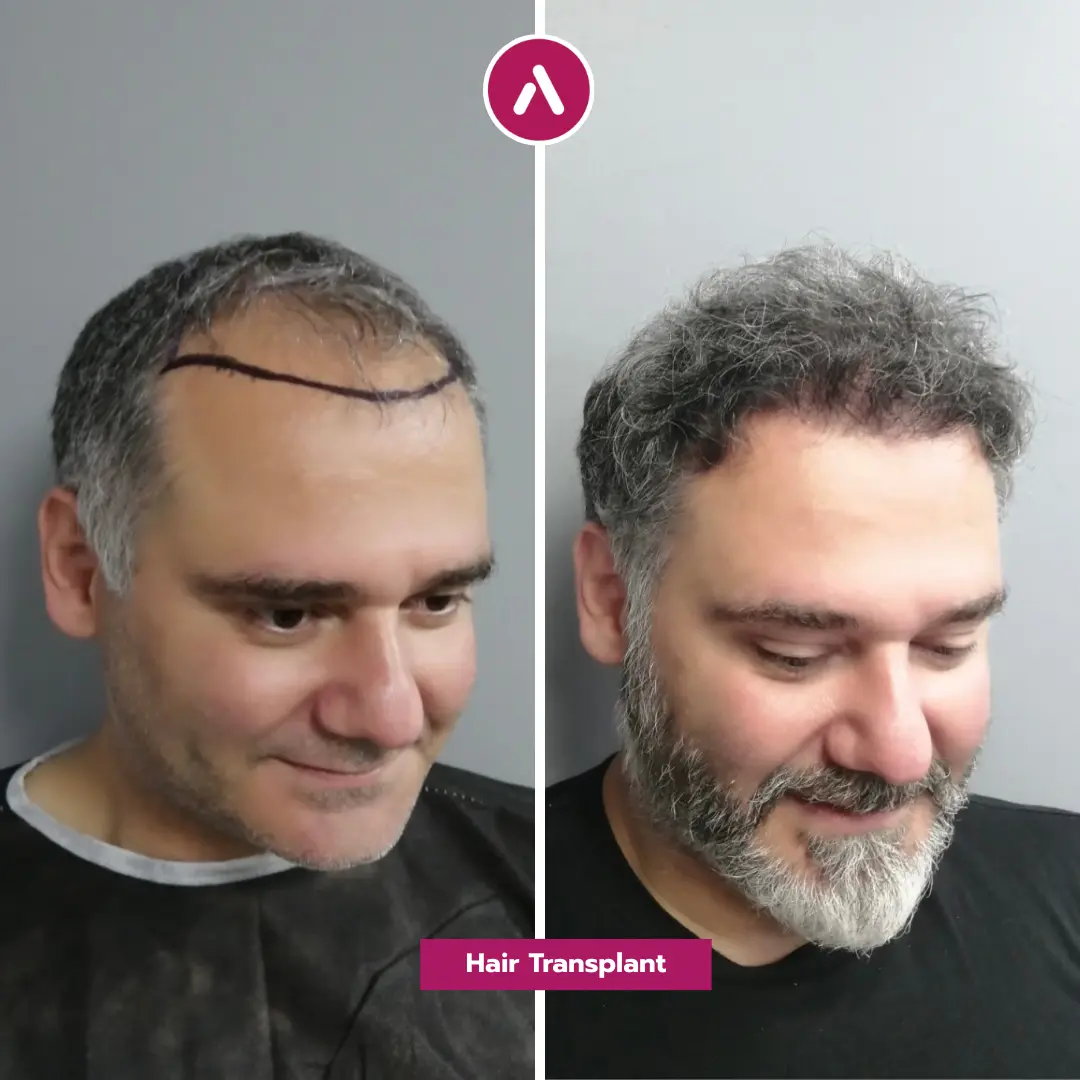
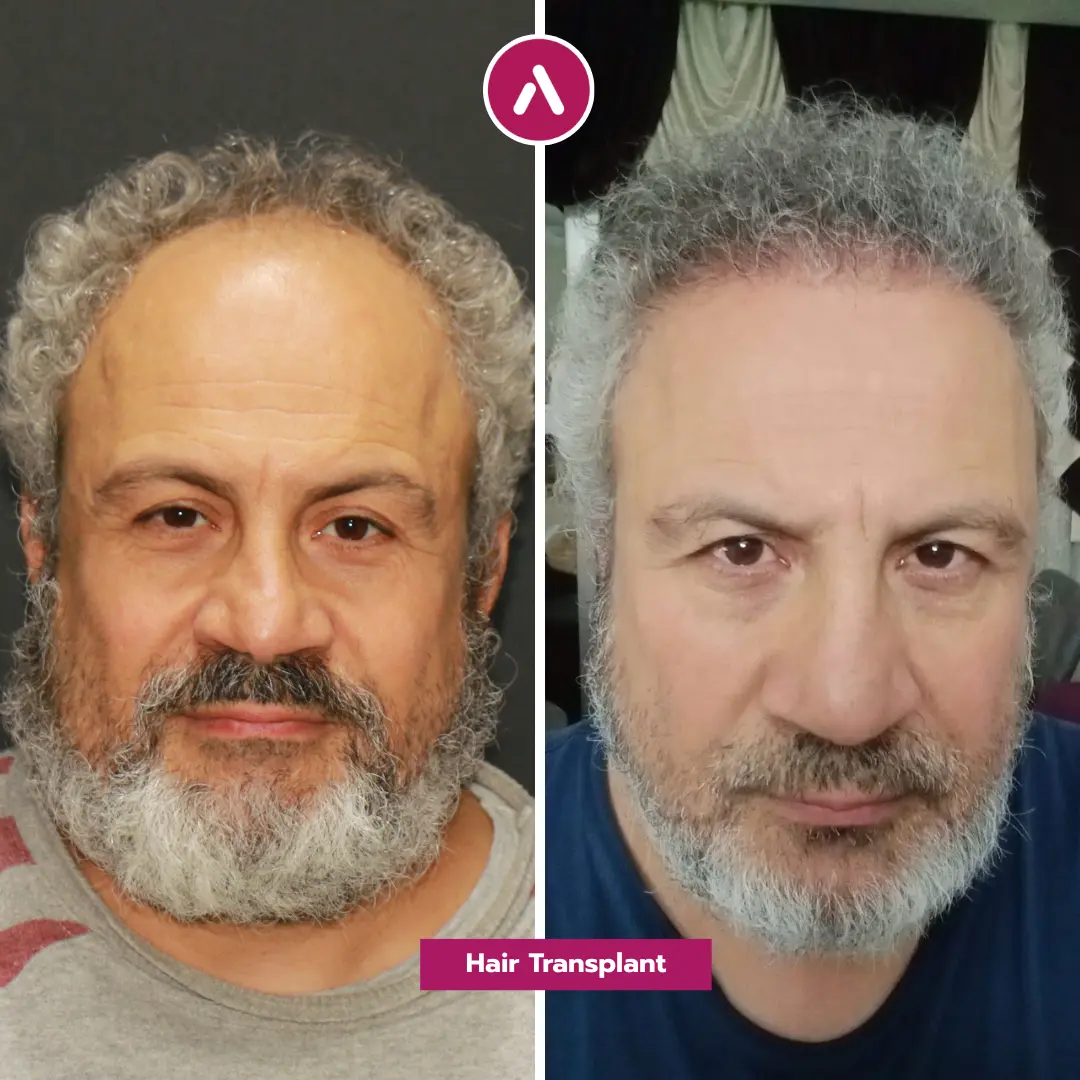
The appeal is clear. One trip can address a receding hairline, thinning frontal density, jawline laxity, jowls, and neck aging in a single medical travel window. Still, the head has limited healing space. The donor area, graft recipient zone, facelift incision line, and hair-bearing sideburn area must all be protected.
This guide explains how AKM Clinic approaches same-trip planning for Canadian patients comparing FUE hair transplant at AKM Clinic with a facial rejuvenation procedure. It is designed for patients who want the efficiency of one trip without treating recovery as an afterthought.
Table of Contents

Why Combine Hair Transplant and Facelift?
Combining hair restoration with facial rejuvenation can make sense when the signs of aging are visually connected. A strong jawline can look less balanced if the hairline remains thin. A dense frontal hairline can also look mismatched if the lower face and neck show significant laxity.
Comprehensive facial rejuvenation logic
Hair and facial aging often progress together. A patient may notice temple recession, thinning at the frontal hairline, lower-face heaviness, jowls, and neck laxity within the same decade. Treating only one concern can help, but the untouched area may still draw attention.
A coordinated plan allows the surgeon to evaluate the face as a whole. The goal is not aggressive change. At AKM Clinic, the guiding principle is “Rejuvenation over alteration,” which means improving balance while preserving identity.
Patients considering a lift can review the facelift procedure overview before deciding whether the hair component should be added in the same trip. That page owns the broader facelift explanation; this article focuses on the combination strategy.
The Canadian male patient profile
This combination is especially common among men in their 40s, 50s, and early 60s. They may have a stable career in Toronto, Vancouver, Calgary, Ottawa, or Montreal and want a result that looks rested rather than obvious.
Male patients also need careful sideburn and beard-area planning. A facelift can shift tissue near the ear and sideburn. A hair transplant can rebuild the hairline or temples. If those plans are not coordinated, the result may look technically successful but visually disconnected.
For the male-specific facial anatomy angle, see male facelift techniques for the most common combo profile. That article covers beard position, sideburn integrity, and masculine facial vectors in more detail.
Single-trip efficiency for international patients
Canadian medical travel is not a casual weekend errand. Patients must plan flights, hotel time, time off work, recovery support, and follow-up once they return home.
A same-trip plan may reduce duplicated travel and duplicated downtime. One coordinated stay can be easier than returning to Istanbul twice, especially for patients travelling through YYZ, YVR, YUL, or YYC.
The efficiency benefit only works when the clinical plan supports it. Some patients are excellent same-trip candidates. Others should stage the procedures for safer healing.
Canadian Planning Callout: One Trip Is a Logistics Decision, Not Just a Cost Decision
For Canadians, the cost of travel is only one factor. Vacation days, sick leave, family support, winter weather, and return-to-work expectations all affect the decision. A same-trip plan should be built around recovery capacity, not convenience alone.
Surgical Feasibility and Sequencing
Same-trip hair transplant and facelift can be compatible in selected patients, but feasibility depends on the surgical map. The key questions are where grafts will be placed, where donor follicles will be harvested, where facelift incisions will sit, and how swelling will be managed.
Can both be done in one operation?
In some cases, yes. The procedures may be performed within the same surgical period or during the same Istanbul stay. The exact structure depends on anesthesia planning, total procedure length, scalp access, and the facelift technique selected.
A smaller FUE case with lower-face rejuvenation may be easier to combine than a very large hair restoration session with an extended deep plane facelift. A patient’s age, blood pressure, medication profile, smoking status, and healing history also matter.
AKM’s team evaluates surgical burden before recommending a combined plan. Same-trip surgery should reduce logistical friction without increasing avoidable recovery risk.
Why sequencing within the trip matters
Sequencing protects anatomy. If the hair transplant is performed too close to facelift incision planning, the team must avoid disturbing new grafts, donor harvest points, or temple design.
The reverse can also be true. If the facelift is performed first, swelling and dressings may influence scalp access for the hair restoration portion. A coordinated surgical team can decide the safest order after reviewing the patient’s hairline, donor density, sideburn position, and lift vector.
External guidance matters here. ISHRS patient education recognizes surgical hair transplantation as a medical procedure requiring proper evaluation and technique selection, while ISAPS emphasizes accredited settings and patient safety in aesthetic surgery abroad.
Patients can review the official ISHRS surgical hair transplant resource and the ISAPS safety considerations for aesthetic surgery for broader context.
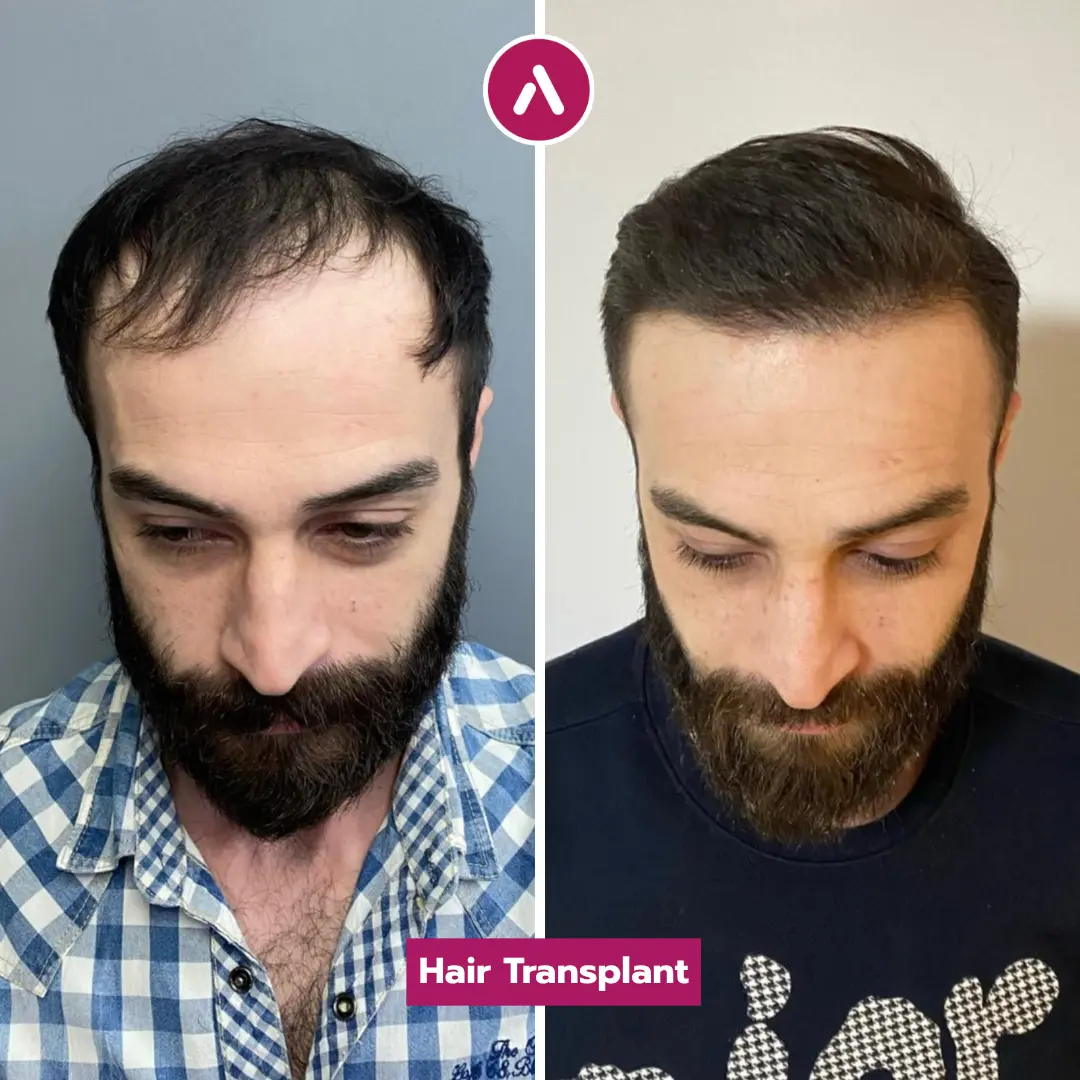
How AKM coordinates the two procedures
AKM Clinic’s coordination starts before travel. Photos and medical history are reviewed virtually, then the in-person consultation confirms the surgical map. The team must align hairline goals with incision placement.
Patient hosts such as Hande, Emine, and Khadija help organize the non-surgical pieces of the trip. This matters for combined procedures because the patient needs clear timing for pre-op testing, hotel recovery, dressing checks, first hair wash guidance, and final clearance.
A combined plan should never feel improvised on arrival. The best version is mapped before the patient leaves Canada, then adjusted after the surgeon examines the scalp and facial tissues in person.
“A hair transplant and facelift can work well together when the plan protects the donor area, the hairline, and the facelift incision pattern. The decision is not about doing more in one trip. It is about sequencing the right procedures without compromising either result.”
Recovery Overlap Management
Recovery overlap is the main reason this combination requires planning. The patient is healing in two nearby regions at once: the scalp and the face. That can be manageable, but the recovery instructions must be precise.
Compatible recovery profiles
Hair transplant recovery focuses on graft anchoring, donor-area healing, swelling control, gentle washing, and avoiding friction. Facelift recovery focuses on incision protection, edema control, bruising reduction, head elevation, and avoiding tension.
These instructions are not identical, but they can be compatible. Both usually favour head elevation, low activity, controlled hygiene, and careful sleep positioning in the early period.
Conflict arises when the patient rubs the scalp, wears tight headwear, sleeps on the side, or handles dressings without guidance. That is why a written combined aftercare plan is essential.
Managing two healing areas on the head
A combined recovery plan must tell the patient exactly what can touch the scalp, what can touch the face, and when washing can begin. Vague instructions are not enough.
The hair transplant recipient area should be protected from pressure and scratching. The facelift incision areas need clean wound care and low tension. Glasses, hats, neck pillows, and clothing choices may need temporary adjustment.
AKM’s recovery technologies, including HBOT and LLLT where appropriate, may support tissue recovery. These do not replace careful behaviour. They support a plan that still depends on patient discipline.
The combined fit-to-fly timeline
Fit-to-fly timing is individualized. A hair transplant alone may involve a shorter stay than a facelift. A facelift usually determines the longer clearance window because swelling, bruising, blood pressure stability, and incision condition matter before a long-haul return.
For a combined trip, patients should plan around the more conservative recovery requirement. That usually means building in extra days rather than trying to leave at the earliest possible moment.
Canadian patients should also consider the first 48 hours after landing. A safe return plan includes home support, light meals, medication continuity, and a low-stress schedule.
Donor Area and Incision Coordination
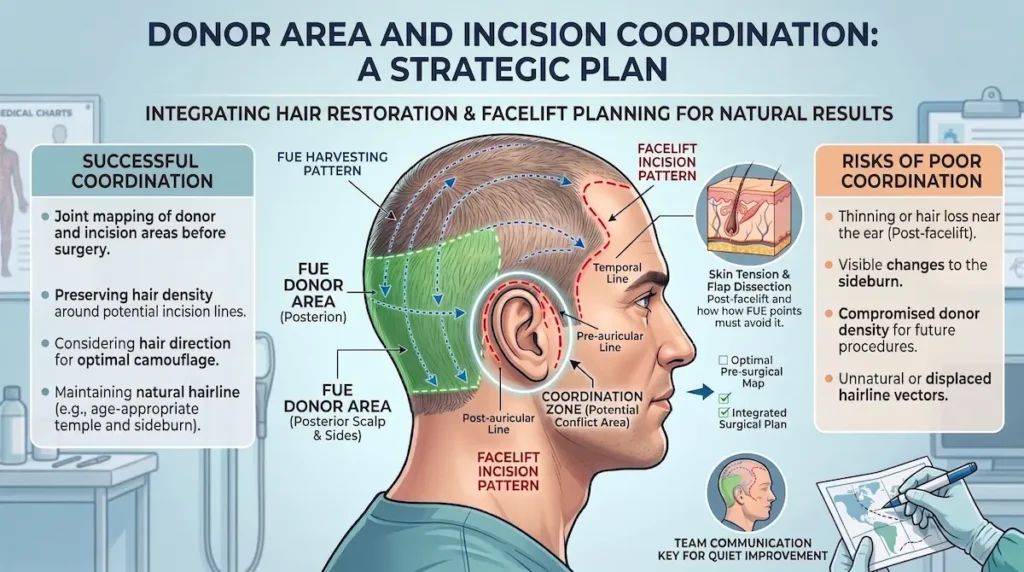
The donor area and facelift incision planning are the technical centre of this combination. FUE usually harvests follicular units from the back or sides of the scalp. Facelift incisions commonly sit around the ear and hairline. These zones can be close.
Avoiding conflict between facelift incisions and donor harvest
FUE harvesting must preserve donor density and avoid compromising skin that may be affected by facelift dissection or tension. The surgeon must also consider how hair will camouflage facelift incisions.
Poor coordination may create thin areas around the ears or visible changes at the sideburn. That is especially important for men who wear short hair.
A safe plan starts by marking the facelift incision pattern and the donor zone together. The two maps should support each other.
Why surgeon coordination is essential
Combined hair restoration and facelift planning require different skill sets. Hair transplant planning focuses on follicular direction, density, graft survival, and donor management. Facelift planning focuses on deep tissue repositioning, incision placement, skin tension, and natural vectors.
The combination works best when the same clinical team communicates before either procedure begins. This reduces the chance of a hairline that conflicts with the lift or a lift that compromises future hair styling.
For the hair component technique decision, see DHI vs FUE planning for the hair restoration portion. That guide owns the method comparison, while this article focuses on combination sequencing.
Hairline preservation during facelift
Hairline preservation is especially important around the temples and sideburns. A facelift should not create a displaced or unnatural sideburn. Hair restoration should not create a hairline that ignores the patient’s facial age.
The most natural plan respects both realities. A 55-year-old patient usually needs an age-appropriate hairline, not a teenage hairline. A facelift should also preserve masculine or feminine identity.
For many patients, the aim is quiet improvement. Friends may notice that the person looks healthier or less tired, but they should not immediately identify surgery.
The Single-Trip CAD Advantage
A same-trip combination can offer practical CAD value, mainly by reducing duplicated flights, duplicated hotel days, duplicated time off work, and duplicated recovery planning. Pricing should still be presented carefully. A combined surgical plan must be quoted case by case.
Cost of combining vs two separate trips
According to AKM’s Treatment Techniques pricing reference, Micro FUE is listed at CAD $3,000 and Manual FUE at CAD $3,850. Standard Deep Plane Facelift is listed at CAD $6,800, and Traditional Facelift is also listed at CAD $6,800.
A simple Micro FUE plus Standard Deep Plane surgical-fee reference is CAD $9,800. This is not a combined package quote. It is a planning reference before the coordinator confirms the patient’s exact treatment plan.
Patients comparing the separate components can review FUE pricing in CAD for the hair component and facelift pricing in CAD for the facial procedure.
Flight, hotel, and time savings
Two separate trips mean two travel windows, two recovery starts, and two periods of work disruption. For a patient in Canada, that can be the biggest hidden cost.
A combined trip may reduce duplicated expenses, but it may also require a longer single stay. The question becomes practical: is one longer recovery window easier than two shorter ones?
For a self-employed patient in Toronto, that answer may differ from a public-sector employee in Ottawa or a consultant in Vancouver. The best plan is individualized.
Total CAD comparison
The table below shows the planning logic. It does not replace a personalized quote. It helps Canadian patients understand where the CAD advantage usually appears.
| Planning Factor | Same-Trip Combo | Two Separate Trips |
|---|---|---|
| Procedure pricing reference | Micro FUE + Standard Deep Plane reference: CAD $9,800 | Same procedure pricing reference, but booked in separate treatment windows |
| Flights | One return flight plan | Two return flight plans |
| Hotel and recovery stay | One extended stay, confirmed by coordinator | Two separate stays, with duplicated arrival and discharge logistics |
| Time away from work | One longer recovery calendar | Two separate recovery calendars |
| Recovery overlap | Scalp and face heal during the same overall window | Each procedure restarts a new healing period |
| Best suited for | Patients cleared for combined planning and able to stay longer in Istanbul | Patients with higher medical risk, complex anatomy, or limited recovery capacity |
Canadian Planning Callout: The Savings Are Often in Duplication Avoidance
The CAD advantage is not only the procedure fee. It is avoiding two flight plans, two hotel recoveries, two periods of family support, and two separate work disruptions. That is why the coordinator should build the quote and itinerary together.
Planning Your Combined Trip from Canada
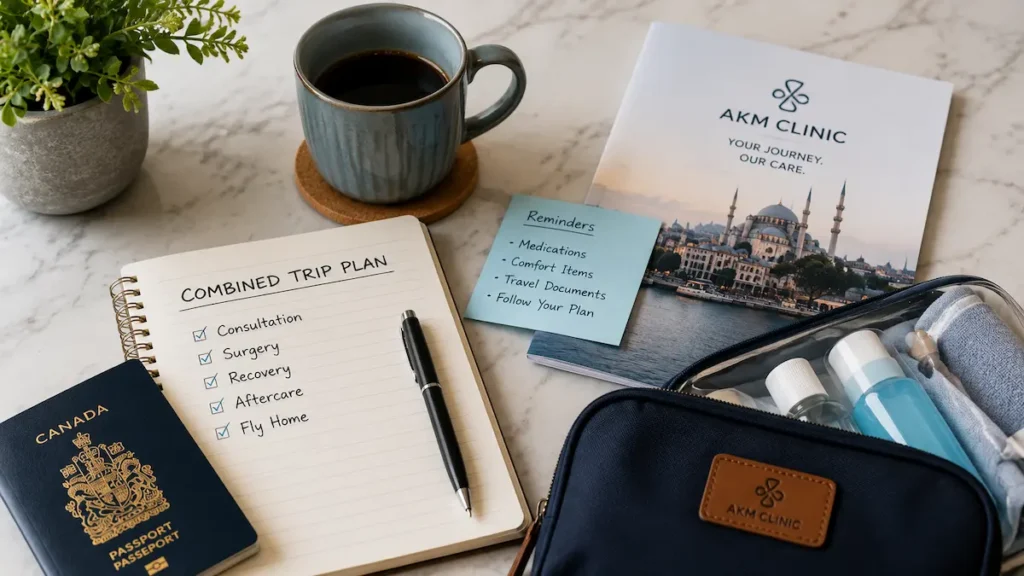
A combined trip should be planned like a medical itinerary, not a vacation with surgery added. Travel Planner Emily’s priority is simple: reduce friction before the patient lands, then protect recovery after the final check-up.
Extended stay requirements
A combined hair transplant and facelift plan usually needs a longer stay than a hair transplant alone. The facelift component normally controls the clearance window.
Patients should avoid booking the tightest possible return date. Flexible travel planning gives the surgeon room to delay clearance if swelling, blood pressure, wound healing, or fatigue requires more time.
For the broader travel flow, see the full Canadian patient journey for facial surgery logistics. That guide covers arrival, hotel, clinic flow, and return planning in more depth.
Pre-trip preparation
Pre-trip preparation starts with medical history, photos, medication review, and expectations. Patients should disclose blood thinners, smoking, diabetes, hypertension, previous scalp surgery, previous facelift, and any history of poor wound healing.
Packing also matters. Button-front tops, loose collars, a clean travel pillow, prescription medications, and easy-access documents can make recovery easier.
For the physical suitcase list, see what to pack for an extended combined-procedure trip. That article owns the item-by-item packing details.
Return journey considerations
The return journey should be calm. Patients should avoid heavy luggage, tight hats, crowded rushing, and unnecessary walking through airports.
Aisle access can help with gentle movement during a long flight. Hydration, light walking, and following the surgeon’s medication instructions are part of the plan.
Once back in Canada, patients should continue virtual follow-up and send progress photos as instructed. A local family physician can be looped in if wound concerns, infection signs, or medication questions arise.
Frequently Asked Questions: Hair Transplant and Facelift Combo
These questions address the practical issues Canadian patients usually raise before committing to a combined plan. Final suitability still depends on a virtual consultation and in-person surgical assessment.
Can I have a hair transplant and facelift at the same time?
Some patients can. The decision depends on anatomy, health history, procedure scope, donor density, incision planning, and total surgical burden. A combined plan should be approved only after the surgeon confirms that neither result is compromised.
Will the facelift affect my donor area?
It can if planning is poor. That is why FUE donor harvesting and facelift incision placement must be mapped together. The goal is to preserve donor density, sideburn position, and incision camouflage.
How long is the combined recovery?
The facelift usually determines the longer recovery window. Hair transplant graft protection is most delicate early on, while facial swelling and bruising may guide the fit-to-fly decision. Your coordinator will provide a timeline based on your surgical scope.
How much do I save combining in one trip?
The main CAD advantage is avoiding duplicated travel, hotel, and downtime. The procedure pricing still needs a personalized quote. As a surgical-fee reference, Micro FUE plus Standard Deep Plane Facelift is CAD $9,800 before case-specific planning.
Is it safe to operate on two head areas?
It can be safe for selected patients in an appropriate surgical setting. The team must manage operative time, anesthesia, sterile technique, blood pressure, swelling, and aftercare instructions. Some patients are better staged.
How long should I plan to stay in Istanbul?
Plan for a longer stay than a standalone hair transplant. The exact number of days depends on the facelift scope and the surgeon’s clearance protocol. Do not book a narrow return window without coordinator approval.
Which procedure is done first?
There is no universal order. The team decides after evaluating the hairline, donor area, sideburns, facelift incision plan, and anesthesia strategy. The correct order is the one that protects both the grafts and the lift.
Plan Your Combined Hair and Facelift Trip with AKM
A same-trip strategy can be efficient, but it should never feel rushed. AKM Clinic can review your photos, medical history, hairline goals, facial aging pattern, and travel dates before recommending same-trip or staged planning.
Request a virtual consultation to discuss whether a hair transplant and facelift combo fits your anatomy, recovery capacity, and Canadian travel schedule.
This article is for educational purposes only and does not replace medical advice. Candidacy, procedure sequencing, recovery timelines, and pricing must be confirmed during consultation.
Medical Disclaimer: This page is provided for general educational purposes only and does not replace an in-person medical consultation, diagnosis, or personalized treatment plan. All surgery carries risks, and outcomes vary between individuals. Suitability for a hair transplant or facelift surgery, procedure selection, and anesthesia choice can only be determined after a full clinical assessment by a qualified surgeon. Always follow your clinician’s instructions and seek urgent medical attention if you develop concerning symptoms during recovery.