
Tummy tuck revision Turkey is usually considered when a previous abdominoplasty has left visible dog ears, a widened scar, uneven contour, or persistent abdominal muscle separation. For Canadian tummy tuck revision patients, revision surgery is not failed tummy tuck correction simply a second tummy tuck. It is a diagnostic procedure first, then a corrective operation.
If you are still comparing primary surgery options, start with the tummy tuck overview at AKM Clinic. This article is for Canadian tummy tuck revision patients who have already had surgery somewhere else and now need a careful second assessment.
Revision cases require more restraint than primary surgery. The surgeon must work through scar tissue, protect blood supply, and decide whether the problem can be fixed with a small correction or requires a more complete revision. A good plan avoids turning a manageable concern into a bigger surgical burden.
Quick Summary: A tummy tuck revision in Turkey can correct four common post-abdominoplasty concerns: tummy tuck dog ears at the ends of the incision, wide or hypertrophic scar revision, contour asymmetry, and residual diastasis recti. The best approach depends on what went wrong during the first operation, how much healthy tissue remains, and whether the patient’s expectations are realistic before travelling from Canada to Istanbul.
| Post-Tummy Tuck Concern | Typical Cause | Revision Method | Expected Outcome |
|---|---|---|---|
| Dog ears | Excess skin or tissue bunching at the incision ends | Small lateral scar extension and tissue reshaping | Smoother transition at the hip or flank |
| Wide or raised scar | High incision tension, poor healing, or scar biology | Scar excision, layered closure, and post-revision scar support | Narrower, flatter scar with better placement when feasible |
| Contour asymmetry | Uneven fat removal, uneven skin tension, or tissue settling | Targeted liposuction, fat refinement, or surgical recontouring | More balanced abdominal and flank contour |
| Residual diastasis recti | Incomplete or failed muscle repair | Re-plication of abdominal muscles | Improved core support and flatter abdominal profile |
Table of Contents
Why Tummy Tuck Revision Is Surgically Different?
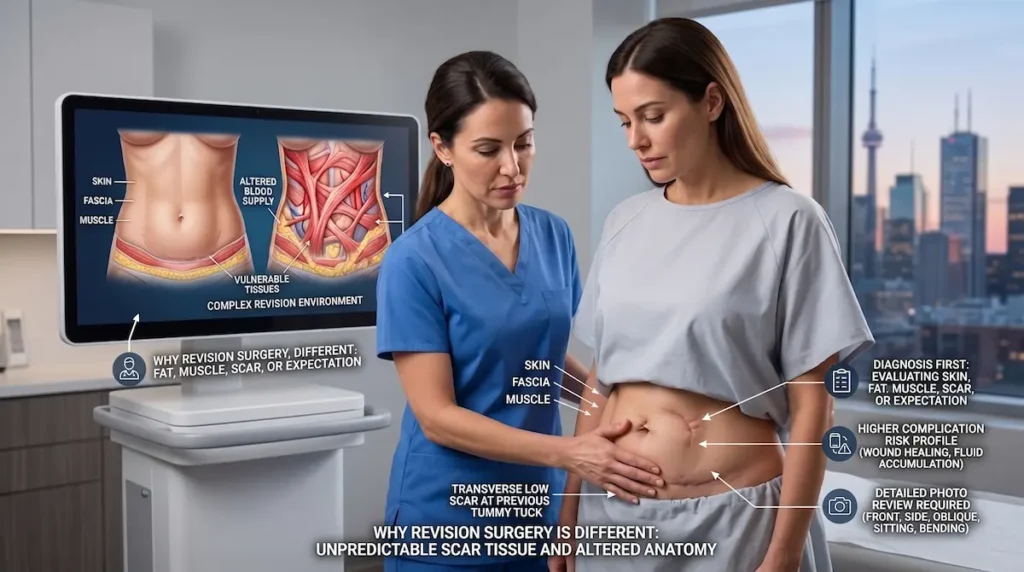
A revision tummy tuck is not the same operation repeated. The first surgery changes the tissue planes, scar pattern, blood supply, and tension across the lower abdomen. That makes the second procedure more complex, even when the visible problem looks small.
Canadian patients often contact AKM Clinic after receiving a domestic opinion that says “wait longer” or “nothing can be done.” Sometimes that advice is correct. Other times, the issue is correctable, but only after a detailed review of the first surgery and current anatomy.
Because revision abdominoplasty involves scarred tissue, altered blood supply, and higher planning complexity, patients should evaluate international clinics against recognized patient-safety principles rather than marketing claims. The ISAPS patient safety guidance library offers a useful benchmark for understanding how aesthetic surgery safety standards are discussed at an international level.
For a broader framework on what makes any revision procedure different from a primary operation, see the broader revision specialist evaluation principle. The same logic applies to body contouring: revision surgery needs experience with scarred tissue, not just confidence with first-time cases.
“Revision surgery starts with diagnosis. Before discussing technique, the surgeon has to identify whether the problem is skin, scar, fat, muscle, or expectation. If that step is skipped, the revision can repeat the original mistake.”
Scar tissue from primary surgery
Scar tissue is the biggest technical difference between primary and revision abdominoplasty. After the first operation, the body forms internal adhesions between the skin flap, fascia, and deeper tissues. These adhesions can make dissection slower and less predictable.
This matters because scar tissue does not behave like untouched tissue. It may be firmer, less elastic, and more vulnerable to blood-supply compromise. A surgeon cannot simply pull the abdominal skin tighter and expect a better result.
In some cases, the revision is minor: a short dog-ear correction or scar excision under local anesthesia. In others, the scarred flap must be released more broadly to correct asymmetry or tension. The safer choice depends on the patient’s tissue quality, not on how dramatic the complaint feels.
Distorted anatomy
A primary tummy tuck rearranges the abdominal anatomy. Skin is removed, the belly button may be repositioned, muscle repair may be performed, and the lower abdominal scar becomes a permanent landmark. If any of these elements heal unevenly, the anatomy can become distorted.
Distortion may show as a pulled belly button, uneven lower abdominal tension, a step-off near the scar, or one hip looking tighter than the other. Patients often describe this as “asymmetry,” but the cause may involve several layers.
This is why revision assessment usually requires front, side, oblique, sitting, and bending photos. A standing photo alone can miss the problem. Canadian patients travelling from Toronto, Vancouver, Montreal, Calgary, or Ottawa should expect a photo-based review before any serious treatment plan is discussed.
Higher complication risk profile
Revision surgery carries a higher risk profile than primary surgery because the tissue has already been operated on. The risks may include delayed wound healing, fluid accumulation, widened scar recurrence, or limited ability to tighten the abdomen further.
This does not mean revision is unsafe for the right candidate. It means the plan must be conservative where the anatomy demands caution. A smaller, targeted correction can be better than an aggressive revision that creates new tension.
Patients who smoke, have uncontrolled diabetes, had wound-healing problems after the first surgery, or have significant weight fluctuations need extra screening. Revision timing also matters. Operating too early can interrupt scar maturation and worsen the final scar.
Dog Ears — Diagnosis and Correction
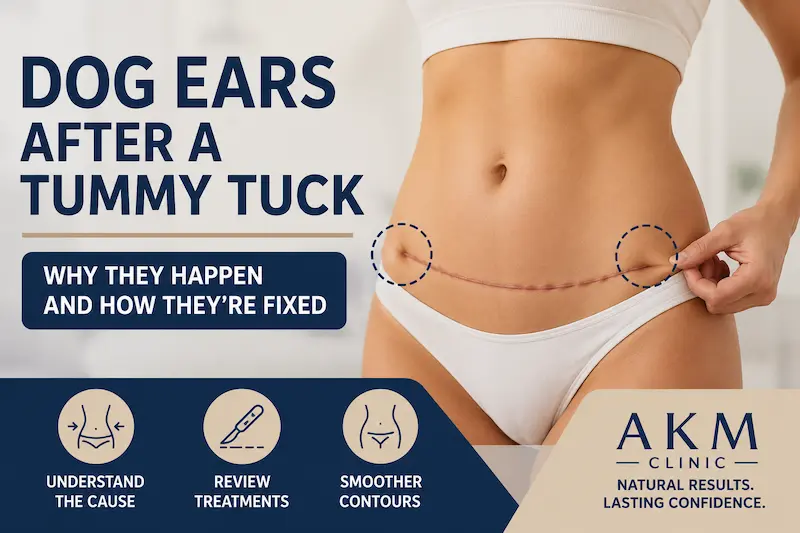
Dog ears are one of the most common reasons patients seek tummy tuck revision. They appear as small puckers, folds, or bulges at the outer ends of the abdominoplasty scar. Some are mild and improve as swelling settles. Others remain visible in underwear, swimwear, or fitted clothing.
The key question is whether the dog ear is caused by excess skin, excess fat, scar tension, or a mismatch between the incision length and the amount of tissue removed. The correction should match the cause. A small dog ear does not always need a major revision.
What dog ears are
A dog ear is a cone-shaped bunching of tissue at the end of a surgical incision. In tummy tuck patients, it usually appears near the hip or outer lower abdomen. It can look like a small raised corner, a folded edge, or a pocket of fullness beside the scar.
The term sounds informal, but the anatomy is specific. When a long incision closes a curved area of skin, the ends can gather if there is too much remaining tissue. This is more likely when the surgeon keeps the scar short to avoid extending it toward the flank.
For some Canadian patients, dog ears are most visible in fitted leggings, swimwear, or work clothing. The issue may be small in medical terms, but it can feel frustrating when the original goal was a smoother abdominal contour.
Why they form
Dog ears often form when the primary incision was not long enough to remove the full amount of loose skin. This is a common trade-off. A shorter scar may sound appealing before surgery, but it can leave extra tissue at the edges.
They can also appear when there is residual fat at the flank, uneven skin elasticity, or tension pulling the scar in one direction. Post-operative swelling can exaggerate the problem during the first few months, so timing matters.
Most surgeons prefer waiting until the tissues settle before correcting tummy tuck dog ears. For many patients, that means waiting at least six months after the original tummy tuck. Some cases need closer to 12 months, especially if the scar is still red, raised, or firm.
Surgical correction technique
Dog-ear correction is usually done by extending the existing scar slightly and removing the extra skin or fatty tissue. The goal is a smoother transition from abdomen to hip, not a tighter abdomen overall.
In mild cases, the correction may be short and localised. In more visible cases, the surgeon may combine skin excision with small-volume liposuction to soften the contour around the scar end. This is especially useful when the dog ear includes both loose skin and flank fullness.
The trade-off is simple: a slightly longer scar may create a flatter contour. For most patients, that is a worthwhile exchange. The incision should still be placed as low and discreetly as possible, with the patient’s underwear or swimwear preferences considered during planning.
Wide and Hypertrophic Scars — Surgical Revision
A wide or raised tummy tuck scar can be physically uncomfortable and emotionally discouraging. Some scars widen because the incision healed under too much tension. Others become thick because of the patient’s scar biology, skin type, or post-operative wound stress.
This section focuses on surgical scar revision, not routine scar care. For prevention, silicone use, massage timing, and sun protection after a primary abdominoplasty, see for primary scar prevention and care, see our scar treatment guide.
In revision planning, the surgeon must decide whether the scar can be improved by excising and re-closing it, whether the scar position can be lowered, and whether the surrounding tissue wide tummy tuck scar has enough mobility for a cleaner closure. The answer is not always yes. Honest assessment matters.
When scars cannot be improved with topical care alone
Topical care can improve colour, texture, and mild thickening. It cannot remove a scar that is wide because the skin edges pulled apart during healing. It also cannot reposition a scar that sits too high on the abdomen.
A scar may need surgical revision when it remains raised, widened, painful, tethered, or visibly misplaced after full maturation. In most patients, scar maturation takes 12 months or longer. Earlier revision may be considered only if there is a specific medical reason.
Canadian patients often ask whether a dermatologist at home can fix the scar without surgery. Sometimes laser, steroid injection, or silicone therapy can help. If the scar is mechanically wide or poorly positioned, surgical revision is usually the more direct correction.
Scar excision and re-closure technique
Scar excision removes the old scar and allows the surgeon to close healthier tissue edges in layers. The goal is to reduce tension across the skin surface. A good closure supports the deeper tissues first, then aligns the skin with less pull.
This is delicate work. Removing too much skin can create new tension and widen the next scar. Removing too little may leave the patient disappointed because the scar improves only slightly.
When the original scar sits too high, the surgeon may assess whether it can be lowered. This depends on remaining skin laxity. Not every scar can be moved into a lower swimsuit line without creating unsafe tension.
For cross-procedure context, AKM Clinic’s broader discussion of cross-procedural scar revision options explains how revision principles differ across the face, breast, abdomen, and limbs.
LLLT and silicone integration post-revision
Tummy tuck scar revision does not end when the incision is closed. Post-revision support helps the new scar mature more predictably. At AKM Clinic, recovery planning may include Low-Level Laser Therapy, careful dressing protocols, and a structured scar-support plan.
Low-Level Laser Therapy (LLLT) is used to support cellular repair and scar maturation. It does not erase scars. It helps the healing environment behave more favourably when paired with careful closure and tension control.
Silicone sheets or gels may be introduced once the incision is sealed and the surgeon confirms it is safe. Timing is important. Starting too early can irritate the wound, while starting too late may miss the most active scar-modelling window.
Canadian patients returning home should ask for clear written instructions before departure. Climate matters. In summer, UV exposure can darken a new abdominal scar; in winter, dry indoor heating can irritate healing skin. For AKM’s broader recovery infrastructure, see HBOT and LLLT recovery support.
Contour Asymmetry
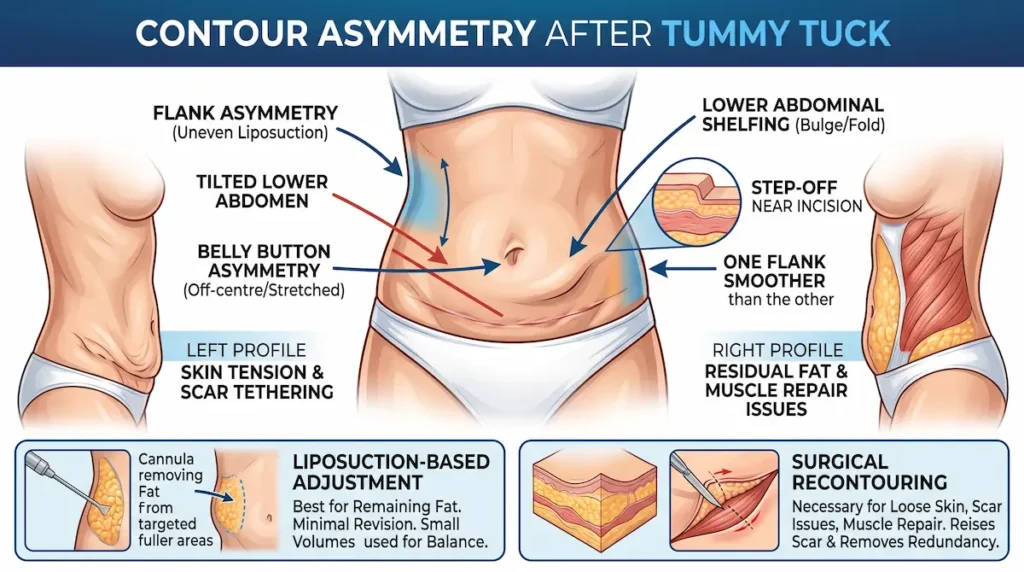
Contour asymmetry after a tummy tuck can appear as uneven fullness, a step-off near the incision, a tilted lower abdomen, or one flank looking smoother than the other. The cause may involve fat, skin tension, muscle repair, or swelling that never settled evenly.
Patients often describe asymmetry as “one side is bigger.” A revision surgeon has to be more precise. Is one side fuller because fat remains there, or is the opposite side over-resected? Is the scar pulling one side upward? Is the muscle repair uneven?
The treatment depends on the layer causing the imbalance. Liposuction can help fat-related asymmetry. Surgical recontouring may be needed when skin, scar, or deeper tissue is the source.
Common asymmetry patterns
One common pattern is flank asymmetry. The abdomen may look reasonably flat from the front, but one side transitions poorly into the hip. This can happen when liposuction was uneven or when the incision ended at different points on each side.
Another pattern is lower abdominal shelfing. The area above the scar may protrude or fold, creating a ledge effect. This can result from residual fat, scar tethering, or an incision placed under excessive tension.
Belly button asymmetry is also possible. The umbilicus may sit off-centre, look stretched, or appear too round after the first surgery. Belly button revision requires caution because blood supply and scar tissue are already altered.
Liposuction-based contour adjustment
When asymmetry is caused mainly by remaining fat, targeted liposuction may be enough. The surgeon can refine fullness around the flanks, upper abdomen, or areas near the incision without fully reopening the tummy tuck flap.
This approach is usually less invasive than full revision. It can be appropriate when the skin is elastic enough to contract and the scar position is acceptable. It is not ideal when loose skin or scar tethering is the main problem.
Small-volume liposuction is often used to blend the abdomen into the waist. The aim is balance, not aggressive fat removal. Over-correction can create dents, waviness, or a new asymmetry.
Surgical recontouring when needed
Surgical recontouring is considered when contour asymmetry is caused by skin redundancy, scar tethering, uneven closure, or deeper structural problems. This may involve releasing scar tissue, removing extra skin, revising the incision, or combining these steps with liposuction.
More surgery is not always better. A targeted revision can deliver a cleaner result with less risk when the problem is localised. A broader revision may be needed only when the first operation left several connected issues.
For Canadian patients, the practical question is whether the improvement justifies international travel, recovery time, and cost. A proper virtual assessment should clarify the expected gain before you book flights. Photos should be reviewed in multiple positions, not only standing straight.
Canadian patient note: If your primary surgeon is in Canada, request operative notes, pre-op photos, and post-op records before your revision tummy tuck consultation. These documents can help the AKM team understand what was done during the first surgery and where the revision plan should be more conservative.
Residual Diastasis Recti
Residual diastasis recti after a tummy tuck means the abdominal muscles were not fully repaired, the repair stretched out, or the original diagnosis missed the extent of separation. Patients may still see a central bulge even when loose skin has been removed.
This is one of the most frustrating revision concerns because it can feel like the “tummy tuck failed,” even when the skin removal healed well. The correction requires structural assessment, not just visual judgement.
For a full explanation of muscle separation, diagnosis, and surgical repair, see our guide to diastasis recti repair fundamentals. This section focuses only on the revision scenario after a previous abdominoplasty.
When primary muscle repair failed or was incomplete
Diastasis recti repair usually involves suturing the separated rectus muscles back toward the midline. If that repair was too limited, too loose, or placed under excessive tension, the abdomen may still protrude after healing.
Sometimes the first surgery did not include muscle repair at all. This can happen when a patient had a mini tummy tuck but actually needed a full abdominoplasty. A mini procedure usually cannot address separation above the belly button.
Other times, the repair was performed but later stretched due to weight fluctuation, heavy lifting too early, pregnancy after surgery, or tissue weakness. A revision consultation should identify which situation applies before any surgical plan is discussed.
Re-plication surgical technique
Re-plication means the surgeon re-tightens the abdominal wall by placing a new layer of sutures along the weakened midline. In revision cases, this may require reopening part or all of the previous tummy tuck incision.
The surgeon must separate scarred tissues carefully to reach the muscle layer. This is slower than primary repair because the tissue planes may no longer be clean. Good visibility and careful tension control matter.
Abdominal muscle re-plication can improve abdominal support and flatten the central contour, but it does not replace weight management, physiotherapy, or healthy core rebuilding after surgery. Patients should expect a structured recovery plan before returning to exercise.
Why this often combines with other revisions
Residual diastasis rarely appears alone. A patient may also have a high scar, loose lower skin, dog ears, or uneven fat distribution. Correcting only the muscle can leave the surface contour unchanged.
That is why revision planning often combines muscle repair with scar revision, selective skin removal, or limited liposuction. The combination should be based on anatomy, not on a desire to “fix everything” in one aggressive operation.
Canadian patients with children at home need a practical lifting plan. After muscle repair revision, lifting toddlers, carrying groceries, shovelling snow, and returning to gym training must be delayed until the surgeon clears progressive activity.
Canadian patient note: If your residual bulge worsens with sit-ups, coughing, or standing after meals, document that pattern during your consultation. It helps distinguish muscle separation from fat, swelling, or scar tethering.
AKM Clinic’s Revision Approach
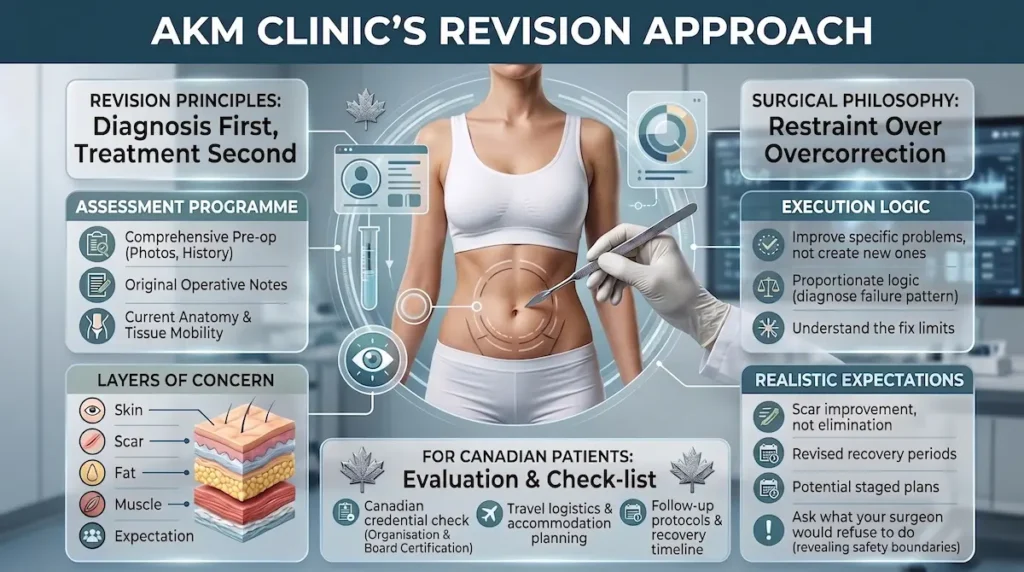
AKM Clinic approaches tummy tuck revision through diagnosis first, treatment second. That means the team reviews the original concern, current anatomy, scar quality, tissue mobility, and medical history before recommending a correction.
The clinic’s wider surgical philosophy is “Rejuvenation over alteration,” but the revision equivalent is restraint over overcorrection. A revision should improve the specific problem without creating a new one.
Patients evaluating revision surgery can read more about AKM’s revision surgical experience and clinical structure before submitting photos. This is especially useful for Canadians who want to understand the team, the patient hosts, and the clinic process before travelling.
Canadian patients are used to checking specialist credentials through formal systems. As a local reference point, the Royal College of Physicians and Surgeons of Canada specialist directory shows how Canadian specialist verification works. When evaluating a surgeon abroad, ask for equivalent documentation, including board certification, revision case experience, hospital privileges, and follow-up protocols.
Comprehensive pre-op assessment
A good revision assessment starts before the patient arrives in Istanbul. Canadian patients are usually asked to provide clear photos, a description of the original surgery, the date of surgery, current weight stability, medical history, and any complications from the first operation.
Useful photos include front, side, oblique, seated, and bent-forward views. If the concern is asymmetry, equal lighting and a neutral standing posture are important. If the concern is a high scar, photos in preferred underwear or swimwear can help with scar-placement planning.
When available, operative notes from the first surgeon are valuable. They may show whether muscle repair was performed, whether liposuction was included, and how much skin was removed. If the Canadian surgeon will not release records, the AKM team can still assess the case, but the plan may need more caution.
- Original surgery date and procedure name
- Any wound-healing problems or infections
- Whether drains were used
- Whether muscle repair was performed
- Current weight and recent weight changes
- Photos from before and after the first tummy tuck
Surgical philosophy for revision cases
Revision surgery should be proportionate. A small dog ear should not be treated like a full redo. A wide scar should not be excised if the new closure will be under the same tension that caused the first scar to widen.
AKM’s planning process separates the concern into layers: skin, scar, fat, muscle, and expectation. This makes the recommendation more precise. It also helps patients understand why a minor correction may be enough, or why a broader revision is necessary.
Some revision logic applies across procedures. For example, how revision decision-making differs across procedures shows why secondary surgery needs a clearer plan than primary surgery. The same principle applies to tummy tuck revision: diagnose the failure pattern before choosing the fix.
Realistic expectation setting
Revision can improve a poor result, but it cannot always create the same canvas as an excellent primary tummy tuck. Scar tissue, blood supply, and skin availability set limits. Those limits should be discussed early.
Patients should also understand that scar revision creates a new scar. The goal is a better-positioned, flatter, narrower, or less visible scar, not scar elimination. Dog-ear correction may lengthen the incision. Muscle re-plication may require a recovery period similar to primary surgery.
For Canadians travelling long-haul, expectation setting includes logistics. You may need extra hotel nights, a slower return to activity, or a staged plan if the tissue is not safe for a large single-stage correction. A cautious recommendation is often the safer recommendation.
Canadian patient note: Ask your revision surgeon what they would refuse to do in your case. That answer is often more useful than a list of possible techniques because it reveals how they think about safety boundaries.
Cost in CAD and Canadian Considerations
Cost matters in revision surgery, but it should not be the first decision point. A tummy tuck revision can range from a small scar-end correction to a more involved operation that includes scar revision, liposuction, and muscle re-plication. The correct price depends on the correction required.
For Canadian patients, AKM Clinic uses CAD-only pricing in Canadian content so the comparison is easier to understand. The key is to separate primary tummy tuck context from revision-specific planning. Revision cases are assessed individually because scar tissue, tissue mobility, and previous surgical choices vary widely.
If you are comparing baseline surgical fees, review the tummy tuck pricing context in CAD. A revision consultation will clarify whether your case fits a limited correction or a more extensive revision tier.
| Procedure Context | CAD Pricing Reference | How It Applies to Revision |
|---|---|---|
| Full Tummy Tuck | CAD $6,550 | Useful as primary surgery context, especially when comparing original procedure scope |
| Extended Tummy Tuck | CAD $7,500 | May be relevant when revision requires wider skin correction or flank extension |
| Drainless Tummy Tuck | CAD $7,500 | May be relevant when internal tension-reduction technique is part of the plan |
| Revision Tummy Tuck | Case-specific | Quoted after photo review, medical history, and assessment of prior surgical changes |
Revision pricing tier at AKM
Revision pricing depends on the size and complexity of the correction. A small dog-ear revision may not require the same operative scope as a case involving wide scar excision, abdominal wall repair, and contour correction.
AKM Clinic’s team reviews the patient’s photos and history before giving a case-specific recommendation. The quote should reflect the actual surgical plan, not a generic revision label.
Patients should also ask what is included. A revision-specific plan may include surgeon fees, anesthesia planning, pre-operative testing, VIP transfers, post-operative support, and follow-up coordination. International flights and personal spending are separate.
Compared with Canadian metro revision pricing
In Toronto, Vancouver, Montreal, and Calgary, revision cosmetic surgery is often quoted after an in-person consultation and may involve separate line items. Surgeon fees, facility fees, anesthesia, garments, massage, and follow-up visits may not always be presented together at the first appointment.
This fragmented pricing can make comparison difficult. A lower initial quote in Canada may not include the full recovery pathway. A higher quote may reflect a more complex case or a surgeon with strong revision experience.
The most useful comparison is not “Turkey versus Canada” as a slogan. It is a scope-to-scope comparison. Ask what will actually be corrected, whether anesthesia and facility costs are included, and what happens if extra follow-up is needed.
Cost-value when initial procedure was elsewhere
Many revision patients feel frustrated because they already paid for the first surgery. That frustration is understandable. Still, the second decision should not be rushed simply to “recover value” from the first one.
The goal is to choose the least aggressive correction that can realistically improve the concern. For a small dog ear, that may be a focused scar-end revision. For residual diastasis with skin laxity, it may require a more complete secondary abdominoplasty.
Canadian patients should also calculate time away from work, childcare support, return-flight timing, and recovery help at home. These practical costs matter. A good revision plan is both medically sound and logistically realistic.
Frequently Asked Questions: Tummy Tuck Revision Turkey
Revision surgery creates more questions than primary tummy tuck surgery because patients already have a disappointing experience behind them. The answers below address the concerns Canadian patients most often raise before submitting photos for assessment.
Can my failed Canadian tummy tuck be corrected?
Many unsatisfactory tummy tuck results can be improved, but not all can be fully corrected. Tummy tuck dog ears, wide scars, localised asymmetry, and residual fat are often treatable. Severe tissue shortage, poor blood supply, or unrealistic expectations may limit what revision can safely achieve.
The first step is a structured photo assessment. AKM Clinic reviews your current anatomy, the first surgery date, healing history, and the specific concern before recommending a plan.
How long should I wait between primary and revision?
Most patients should wait at least six months before minor revision and closer to 12 months before larger scar or contour revision. The scar needs time to mature, swelling needs to resolve, and tissue tension needs to stabilize.
There are exceptions. A painful scar, wound complication, or functional concern may require earlier review. Cosmetic refinement, however, is usually safer after the tissues have settled.
Is revision more expensive than primary?
It can be. Revision surgery may take longer because the surgeon is working through scar tissue and altered anatomy. It also requires more diagnostic planning than a straightforward primary tummy tuck.
A small dog-ear correction may cost less than a full primary procedure. A complex revision involving scar excision, liposuction, and muscle re-plication may align more closely with an extended correction tier.
Can scars from primary surgery be fully eliminated?
No. Scar revision can improve a scar, but it cannot erase it. The realistic goal is a flatter, narrower, better-positioned scar that blends more naturally over time.
Patients prone to hypertrophic or keloid scarring may need extra support after revision. That may include silicone, LLLT, steroid guidance, or dermatologist coordination once back in Canada.
What if my Canadian surgeon won’t share records?
You can still request a revision assessment without operative records, but records are helpful. They show whether muscle repair was performed, how the original incision was planned, and whether there were complications.
If records are unavailable, provide clear photos, the date of surgery, the exact procedure name if known, and a written description of your healing process. The revision plan may need to be more cautious when prior details are unknown.
How do I know I’m a revision candidate?
You may be a candidate if your weight is stable, you are medically fit for surgery, the original tissues have healed, and the concern is anatomically correctable. Good candidates can also accept trade-offs, such as a longer scar to remove a dog ear.
You may not be ready if you are still healing, planning pregnancy, actively losing weight, smoking, or hoping revision will create a perfect abdomen. Revision improves anatomy; it does not reset the body to a pre-surgery state.
Will revision results match a good primary outcome?
Sometimes, but not always. A well-planned revision can create meaningful improvement, especially for dog ears, scar placement, and selected contour concerns. Scar tissue and reduced skin availability may limit the final result.
This is why expectation setting is central to revision surgery. The best revision plan is honest about what can improve, what cannot, and what trade-offs are required.
Ready to assess your case? Submit your photos, prior surgery details, and current concerns for a revision-specific consultation. AKM Clinic’s team can help determine whether your dog ears, wide scar, asymmetry, or residual diastasis recti can be safely improved.
Medical Disclaimer: This page is provided for general educational purposes only and does not replace an in-person medical consultation, diagnosis, or personalized treatment plan. All surgery carries risks, and outcomes vary between individuals. Suitability for a tummy tuck surgery, procedure selection, and anesthesia choice can only be determined after a full clinical assessment by a qualified surgeon. Always follow your clinician’s instructions and seek urgent medical attention if you develop concerning symptoms during recovery.