
Tummy Tuck Revision in Turkey: Fixing Dog Ears, Wide Scars & Asymmetry

If you’re researching tummy tuck revision, you’re probably not looking for perfection—you’re looking for fixable answers: Why do dog ears happen, why does a scar look worse than expected, and what can be done safely (without making things riskier)? This guide is written for the expert patient who wants surgeon-level clarity, realistic “before and after” expectations, and a plan that respects both aesthetics and medical science.
A revision conversation only makes sense once the primary procedure is properly anchored — what was done, how it heals, and where the realistic boundaries sit. Patients comparing revision plans without that foundation often end up evaluating the wrong variables.
For the procedural baseline underneath the revision-specific decisions in this article, the primary abdominoplasty procedure overview covers technique families, candidacy ranges, incision design philosophy, recovery profiles, and the structural decisions during primary surgery that determine which revision pathways are even relevant later.
Most "revision questions" turn out to be primary-procedure questions in disguise.
Key takeaway: Most “dog ears” and many problematic scars can be improved—often significantly—when the revision is timed correctly, planned strategically, and paired with structured scar-care and recovery support.
Table of Contents
What Is a Tummy Tuck Revision and When Is It Needed?
A revision tummy tuck (also called scar revision tummy tuck when the main concern is scarring) is a secondary procedure designed to correct issues that remain after the first surgery—such as dog ear tummy tuck revision, contour irregularities, or a scar that healed wide, raised, or uneven. A revision can be minor (small excision of excess tissue near the ends of the incision) or more involved (re-contouring, re-tightening, or scar re-closure). The right approach depends on anatomy, tissue quality, and what exactly is causing the visible concern.
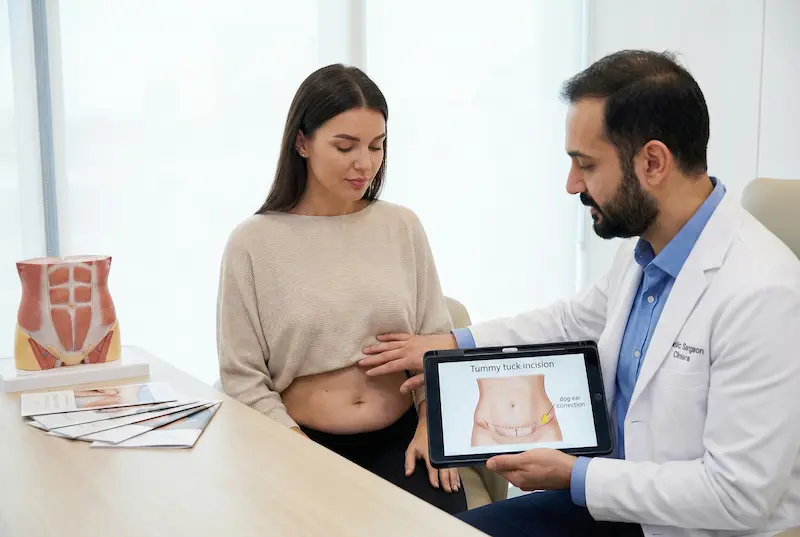
Revision vs. “Touch-Up”: What counts as a true revision?
A “touch-up” is often limited in scope—think a small correction under local anesthesia. A true revision may involve deeper contour work, addressing tension lines, or adjusting scar position/shape. Clinically, the distinction matters because it affects safety planning, anesthesia needs, and recovery time.
- Minor revision: small dog ear excision, small scar refinement, or limited liposuction for a focal bulge.
- Moderate revision: longer excisions, rebalancing asymmetry, refining the lower abdomen contour.
- Major revision: re-doing significant portions of the abdominoplasty plan (less common, higher complexity).
The most common reasons patients seek a second procedure
- Dog ears: puckering or “wings” at one or both ends of the incision line.
- Scar concerns: wide scars, raised scars, uneven scars, or pigment changes—often leading to searches like tummy tuck scar revision and tummy tuck scar revision before and after.
- Contour issues: localized fullness, asymmetry, or a “step-off” where tissue transitions.
- Position concerns: scar sitting higher than expected or not well hidden in underwear/swimwear.
- Mini tummy tuck revision: when the first procedure was limited but the final shape/scar doesn’t match expectations.
What a revision can realistically improve (and what it can’t)
In most patients, revision can improve:
- Incision-end bunching (dog ears) by removing small excess tissue and smoothing the contour.
- Scar quality and appearance through surgical refinement plus structured scar optimization.
- Symmetry by rebalancing tension and contour on both sides.
Revision may not fully erase:
- The fact that a scar exists—scar revision aims for less visible, not “invisible.”
- Skin quality limitations (thin skin, stretch marks, or significant laxity), though outcomes can still improve.
- Issues driven by ongoing weight fluctuations or untreated medical factors (e.g., smoking, uncontrolled diabetes).
Dog Ears After a Tummy Tuck: Why They Happen
“Dog ears” are small protrusions or bunching of skin and soft tissue at the ends of a surgical incision. After abdominoplasty, they typically appear near the hips. Importantly, dog ears are not always a “mistake”—they can be influenced by natural anatomy, tissue thickness, and how skin redistributes during healing. Understanding the root cause is the first step in planning a dog ear tummy tuck revision with the least disruption and the best aesthetic outcome.
What “dog ears” actually are (skin/tissue bunching at incision ends)
When a long incision is closed, the central portion often lies flat while the ends can collect extra tissue—especially in patients with thicker lateral tissue, uneven fat distribution, or lower skin elasticity. In “before and after” photos, dog ears can look like a small wing, bump, or fold at one end (or both). Searches like tummy tuck dog ears revision before and after usually reflect the desire to see how much these edges can be flattened—often the improvement is dramatic with a targeted correction.
Key causes: incision design, skin elasticity, weight changes, anatomy
- Natural anatomy: wider hips, thicker flank tissue, or uneven fat distribution can predispose to dog ears.
- Skin elasticity: less elastic skin doesn’t drape as smoothly during closure.
- Incision geometry: the length and direction of the incision influences how tissue “gathers” at the ends.
- Healing dynamics: swelling can temporarily exaggerate an incision-end bump early on.
- Weight changes: gaining/losing weight after surgery can change contour and highlight lateral fullness.
Dog ears vs. swelling/seroma: how to tell the difference
Not every bump near the incision is a dog ear. Differentiating a true dog ear from swelling or fluid matters because the timing and treatment can be completely different. The table below is a practical, patient-friendly framework—use it to guide what you report to your surgeon.
| What you’re seeing | Common feel/behavior | Typical timing | What it usually needs |
|---|---|---|---|
| True dog ear (incision-end bunching) | Consistent “fold” or protrusion; doesn’t fluctuate much day-to-day | More obvious after swelling decreases (often weeks to months) | Often a small excision (dog ear tummy tuck revision) once tissues stabilize |
| Post-op swelling | Puffy/soft; may change throughout the day | Most common in the first 2–8 weeks | Compression, time, walking, surgeon-guided aftercare |
| Seroma (fluid collection) | Can feel like a “water balloon” or shifting fluid; may increase suddenly | Often weeks 1–6 but can occur later | Surgeon evaluation; sometimes aspiration or drainage |
| Localized fat fullness | Soft fullness; may be bilateral; less tied to incision ends | Becomes clearer as swelling resolves | Sometimes targeted liposuction; sometimes no surgery needed |
Why this matters (science note): In wound healing and scar formation, tissue oxygenation, inflammation control, and collagen remodeling are central principles in surgical care. That’s why revision planning often includes not only surgical technique, but also a structured recovery pathway that supports healthier healing conditions.
Practical rule: If a bump is growing, painful, hot, or associated with fever or drainage, treat it as a medical issue—not a cosmetic “dog ear”—and contact your surgical team promptly.
How Dog Ears Are Corrected: Options and Surgeon Decision-Making
Correcting dog ears is usually one of the most predictable parts of tummy tuck revision. The goal is not to “chase perfection,” but to restore a smooth contour with the smallest effective intervention—while protecting scar placement and minimizing new tension on the incision line. If you’re searching for tummy tuck dog ears revision before and after, pay attention to symmetry, scar length, and whether the result looks naturally blended into the hip contour (not “cut out”).
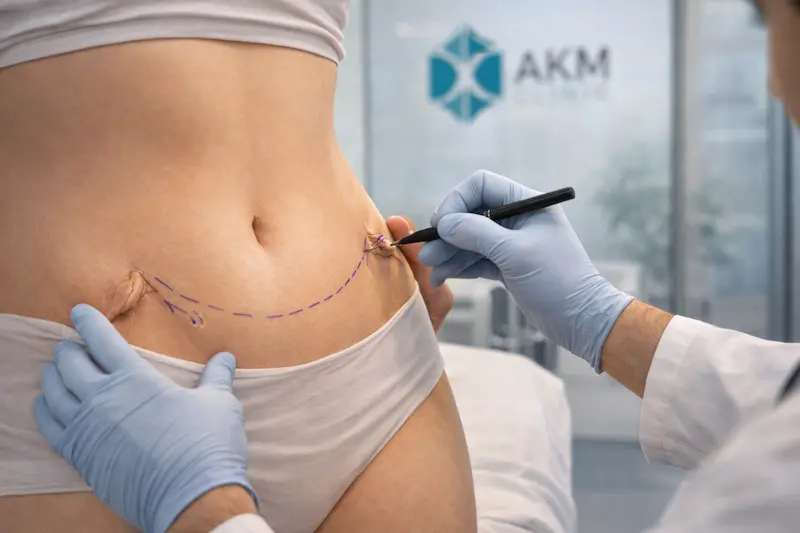
Minor in-office excision vs. operating-room revision: who needs what?
Many dog ears can be addressed with a short procedure under local anesthesia—especially when they are small, stable, and clearly defined after swelling has resolved. More complex cases may require the operating room (OR), particularly if the correction needs additional contouring, longer excision, or simultaneous scar revision.
| Approach | Best for | Anesthesia | Downtime (typical) | Trade-off |
|---|---|---|---|---|
| In-office dog ear excision | Small, localized dog ear; tissues stable | Local | Often a few days of “take it easy” | Limited correction scope |
| OR-based dog ear revision | Larger dog ears, asymmetry, need for contour balancing | Local + sedation or general (case-dependent) | Usually 1–2+ weeks depending on extent | More planning and recovery |
| Combined correction (dog ears + scar refinement) | Dog ear + visible/wide scar concerns | Case-dependent | Depends on combined scope | Can improve shape and scar together |
Liposuction vs. skin excision: choosing the right technique for your tissue
Not all dog ears are “just skin.” Some are driven by localized fat fullness or uneven tissue thickness. A careful exam helps determine whether the correction should remove skin, reduce fat, or both.
- Skin excision is typically preferred when there’s true tissue bunching at the incision end.
- Liposuction may be useful if fullness is fat-dominant and the skin is likely to re-drape.
- Combination may be considered when both fat and excess skin contribute to the contour irregularity.
Important: Over-aggressive liposuction near the scar can compromise tissue quality. A conservative, anatomy-led approach generally produces more natural “before and after” outcomes.
Preventing asymmetry: how surgeons plan incision extensions and contour balance
Sometimes the cleanest correction requires a small extension of the incision to “flatten the curve” of the dog ear. This is a trade-off: slightly longer scar, but a smoother silhouette and better symmetry. In planning dog ear correction, surgeons consider:
- How noticeable the dog ear is in clothing vs. swimsuit/underwear
- Whether one side is more dominant (common)
- Where the scar sits relative to typical garment lines
- Your skin quality and how you scarred the first time
Tummy Tuck Scars: What’s Normal, What’s Not
Scars are unavoidable in abdominoplasty—but “normal” scars still go through phases that can look alarming if you don’t know the timeline. Patients often start researching tummy tuck scar revision too early, when their scar is still in its active remodeling stage. Understanding what’s expected (and what is truly atypical) prevents premature decisions and helps you time any scar revision before-and-after plan appropriately.
Scar maturation timeline: what to expect at 6 weeks, 3 months, 12 months
- 0–6 weeks: redness, firmness, itchiness, and swelling around the incision can be normal.
- 6 weeks–3 months: the scar may look darker or more “angry” as collagen activity peaks; mild thickening can happen.
- 3–12 months: gradual softening, flattening, and fading (the most important phase for final appearance).
If you’re considering scar revision tummy tuck, many surgeons prefer waiting until the scar has matured—unless there is a functional or medical reason to intervene sooner.
Wide scars, hypertrophic scars, and keloids: the practical differences
Scar widening and hypertrophic patterns are not random — they trace back to mechanical principles that surgical choices can influence. Tension at the closure line, the duration over which that tension is maintained, and the suture material carrying that tension all interact across the months that scar maturation actually unfolds.
For the evidence layer underneath that principle, 2025 Aesthetic Plastic Surgery prospective split-scar study of three suture types and scar suppression efficiency (Zheng et al., Springer Nature) — comparing polyglactin acid (1-month tension maintenance), polydioxanone (3-month), and nonabsorbable polyester sutures within a single hypogastric incision divided into three segments and evaluated at 1, 3, and 6 months — reported that prolonged tension reduction is what drives scar suppression, and that suture-material selection meaningfully shifts which scars widen and which mature cleanly.
Patients evaluating "Why did my scar widen?" are often asking a surgical-technique question without realizing it — and revision plans that don't address tension and suture strategy tend to reproduce the original outcome.
- Wide scar: scar spreads beyond the initial line (often from tension, movement, or individual healing response).
- Hypertrophic scar: raised and thick but stays within the original incision boundary; can improve over time.
- Keloid: grows beyond the incision boundary; higher recurrence risk and often needs a specialized, multi-step plan.
Why it matters: each scar type requires a different strategy. A wide scar may respond well to surgical refinement, while hypertrophic scars may benefit from structured scar therapies. Keloid-prone patients need careful risk counseling before any revision incision is made.
Red flags (infection, delayed healing, wound separation) and why they matter
Some scar issues are not “cosmetic.” They can reflect healing problems that increase revision complexity. Contact your surgical team if you notice:
- Increasing redness, warmth, or pain after initial improvement
- Drainage with odor, fever, or chills
- Wound separation or areas that won’t close
- Sudden swelling that suggests fluid collection
From a clinical-evidence perspective, early wound complications can alter collagen remodeling and scar quality long-term—so addressing medical issues promptly can protect both safety and the final aesthetic outcome.
Scar Revision in Tummy Tuck: When and How
Patients comparing tummy tuck scar revision options are usually looking at two angles: surgical refinement when a mature scar still doesn't meet realistic expectations, and surface-level adjuncts that support healing during the active remodeling phase. Both layers have a role — but they answer different questions.
Surgical re-closure for wide or hypertrophic scars
Surgical scar revision typically involves removing the old scar and re-closing the incision in a way that reduces tension and optimizes alignment. The principle is consistent: scars widen when tension is high or closure is unstable. A revision plan may include:
- Re-excision of the widened scar
- Layered closure to support the skin from underneath
- Strategic tension distribution to reduce "pull" on the surface line
For the broader treatment of scar revision techniques across procedure categories (facelift, breast, body — including Z-plasty and W-plasty selection logic, geometric broken line closure, and the keloid versus hypertrophic decision tree), the cross-procedural scar revision guide covers the principles that the tummy tuck-specific patterns sit inside.
Laser, silicone, and surface improvement
Surface treatments (silicone gel/sheets, sun protection discipline, fractional laser refinement) sit alongside surgical revision rather than replacing it. They shape how a scar matures and how surgical refinements integrate during recovery.
For the full post-op scar care protocol — including silicone timing, when massage is appropriate versus premature, and the sun-protection strategy that determines twelve-month color outcomes — the scar-care optimization protocol covers the daily habits that determine whether a scar becomes a revision candidate in the first place.
"Care" and "revision" are different conversations with different timing. Most scars that get great revision outcomes had great scar care underneath them.
Safety, Timing, and Candidacy: When Is It Safe to Revise?
Timing is one of the biggest determinants of a safe, successful tummy tuck revision. Many problems that look “permanent” at 4–8 weeks improve as swelling drops and tissues remodel. From a medical science standpoint, collagen remodeling and scar maturation take months—not days—so revising too early can create unnecessary risk and sometimes worsen scarring.
How long you should wait after the first tummy tuck (and why timing matters)
While every case is individual, most surgeons prefer that tissues stabilize before revision—especially for scar-focused concerns like tummy tuck scar revision. The reason is simple: swelling, internal firmness, and scar activity can mimic (or exaggerate) the very issues patients want to correct.
| Concern | Often best evaluated | Common revision timing logic |
|---|---|---|
| Dog ears (incision-end bunching) | After swelling has clearly settled | Often considered once the contour is stable; many surgeons wait several months |
| Wide/uneven scar | After scar maturation begins | Frequently delayed until later in the healing timeline to avoid “revising an evolving scar” |
| Hypertrophic scar (raised but within incision) | After conservative scar care is tried | Often managed with non-surgical strategies first; revision only if persistent |
| Functional/medical issues (wound separation, infection) | Immediately | These require prompt medical evaluation; cosmetic plans come second |
If you are specifically researching tummy tuck scar revision before and after, the most trustworthy transformations typically reflect a mature scar that was revised at the right time—then allowed to heal with disciplined aftercare.
The impact of scar tissue, blood supply, and smoking on revision risk
Revision risk is not a single number — it's a stack of factors that interact differently for each patient. Tissue biology, prior surgical changes, comorbidities, and the procedure plan all combine into a personalized risk profile that any honest surgeon will quantify rather than wave away.
For one layer of the evidence base, 2025 Annals of Plastic Surgery systematic review of fascial plication and venous thromboembolism risk in abdominoplasty (Swanson E, Wolters Kluwer) — reviewing the published literature on whether fascial plication during abdominoplasty (including revision cases) elevates thromboembolic risk — provides one of the more recent structured assessments of an underdiscussed revision variable that affects how plication is planned alongside dog ear correction or scar refinement.
Patients researching revision risk should expect their surgeon to discuss thromboembolic precautions, not skip them — and to explain the planning differences when plication is integrated with revision work.
Revision surgery is performed in a field with existing scar tissue, which can alter blood supply and increase unpredictability. That doesn’t mean revision is unsafe—it means your surgeon must plan around tissue biology. The biggest preventable risk factor remains nicotine exposure (including vaping and nicotine replacement products), which can reduce microcirculation and compromise healing.
- Scar tissue: can increase firmness and reduce tissue “give,” affecting closure tension.
- Blood supply: prior undermining and healing patterns influence how tissues tolerate a second procedure.
- Smoking/nicotine: significantly increases risk of delayed healing and problematic scarring.
- Medical conditions: uncontrolled diabetes, anemia, and nutritional deficiencies can weaken healing.
"Tissue biology" in revision conversations isn't only about scar tissue — it's also about whether the underlying muscle wall is doing its share of the structural work. When diastasis recti was undertreated in the primary surgery, the skin closure ends up doing the work the muscle layer should be doing, and revision plans need to account for that mechanical reality.
For the muscle-layer side of abdominal contour decisions, the abdominal muscle separation reference covers diastasis evaluation, when muscle repair is integrated with abdominoplasty in primary or revision surgery, the tension profile changes across the scar line, and why some revisions need to address the muscle wall — not the scar surface — to actually hold the new result.
Revision in the abdomen sometimes turns out to be a structural conversation in disguise.
The consultation checklist: what photos, history, and goals your surgeon needs
"Revision specialist" is one of those phrases that means specific things or means nothing at all, depending on who's using it. The version that matters is the one where the surgeon can demonstrate documented revision volume, has the dermatosurgical training that scar-quality work specifically benefits from, and is willing to be explicit about which revision pathways they routinely handle.
For the full credentials picture relevant to revision work, Dr. Akif's revision experience profile covers training history, the dermatosurgical specialty fellowship that informs scar-aware closure design, society memberships, and the dual-specialty background that the abdominoplasty revision conversation in this article relies on.
Revision work is one of the procedure categories where the dermatosurgeon credential changes the outcome equation — not just the consultation experience.
A safe revision plan starts with a high-quality consultation. To get the most accurate plan (and the most honest “before and after” expectation), be ready to share:
- Timeline: when the original tummy tuck was performed and how healing progressed
- Complications: any infection, seroma, wound separation, or prolonged drainage
- Weight stability: fluctuations before/after surgery and current stability
- Smoking/nicotine: current and recent use (including vaping)
- Primary priorities: dog ears, scar position, scar quality, asymmetry, contour fullness
- Clear photos: front/side/oblique in consistent lighting (useful for remote evaluation)
Note on mini-procedure revision: it often focuses on a smaller zone below the navel. That can make the scar easier to manage—but it can also limit how much contour change is achievable. The key is aligning the revision plan with what a “mini” approach can realistically improve.
Mini tummy tuck revision is a meaningfully different planning problem from full tummy tuck revision. The smaller original procedure means a smaller revision canvas — fewer levers to pull, less tissue to redistribute, and a narrower set of realistic outcomes.
For the structural differences between mini and full as primary procedures, the mini-versus-full procedure comparison covers candidacy criteria, scar length and placement differences, what muscle repair adds (or doesn't) in each version, and the upper-abdomen versus lower-abdomen scope distinction that determines which revision pathways are even available.
The right revision plan starts with honest clarity about which primary procedure produced the current result.
Recovery After Dog Ear or Scar Revision: What the Timeline Looks Like
Recovery after tummy tuck revision depends on scope. A small dog ear excision may be surprisingly simple; a combined scar revision plus contour correction can feel closer to a “mini surgery.” The most important recovery principle is consistent: protect the incision, control swelling, and support scar maturation with a structured plan.
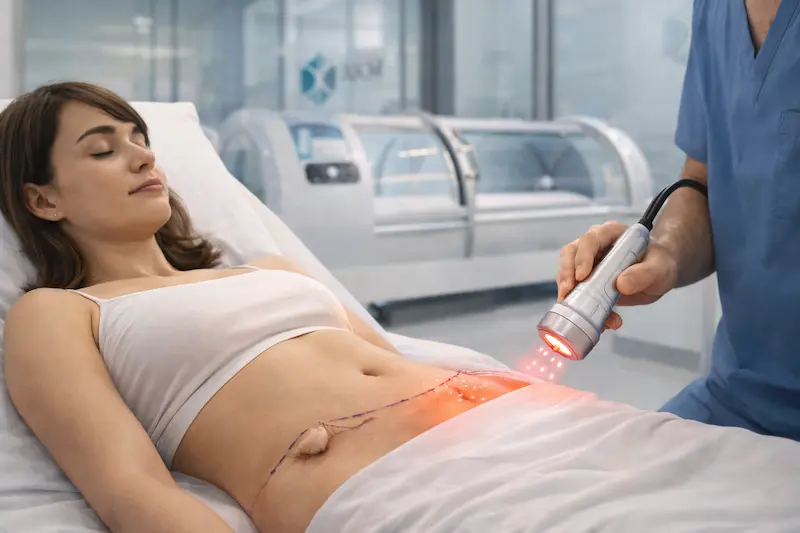
Downtime expectations: work, exercise, standing upright, and compression
Below is a practical recovery framework. Your surgeon’s protocol always overrides general guidance—especially if you’re combining procedures.
| Revision type | Typical downtime | Activity guidance | What patients often feel |
|---|---|---|---|
| Dog ear tummy tuck revision (small excision) | Often a few days to 1 week | Light walking encouraged; avoid strain on incision ends | Tenderness and mild swelling at incision end |
| Scar revision tummy tuck (focused scar re-closure) | Often 1–2 weeks | Protect closure tension; gradual return to activity | Tightness along the revised segment |
| Combined revision tummy tuck (scar + contour) | Often 2+ weeks (variable) | More structured restrictions; compression may be extended | More swelling; slower return to full exercise |
Revision recovery overlaps meaningfully with primary recovery — the principles are the same even when the scope is smaller. Compression discipline, mobility timing, nutrition, sleep position, and nicotine avoidance all carry the same weight in a revision recovery as they did the first time.
For the daily-discipline side that this section condenses, the abdominoplasty recovery framework covers the week-by-week timeline, garment protocols, the sleep position progression most patients underestimate, return-to-activity pacing, and the nutrition and movement habits that meaningfully shift scar quality at twelve months.
Patients who skip primary recovery discipline rarely improve their habits during revision recovery — and the second result usually reflects that.
Swelling control and scar support: where HBOT & LLLT may help in recovery
Healing quality is influenced by oxygenation, inflammation control, and disciplined scar care — concepts grounded in plastic surgery clinical evidence. AKM Clinic highlights supportive recovery technologies such as HBOT and LLLT within its patient care standards. Your surgeon can advise whether these adjuncts fit your specific revision scope and healing profile.
- Compression: can help swelling and support tissue settling (used as surgeon-directed).
- Scar care: silicone-based protocols and sun protection are common foundations.
- Adjuncts: HBOT/LLLT may be considered within a broader recovery plan, when appropriate.
Follow-up for international patients: remote check-ins, safety monitoring, and contingency planning
If you’re traveling for tummy tuck scar revision or dog ear tummy tuck revision, the follow-up plan matters as much as the procedure itself. A safe program should include:
- Scheduled check-ins: in-person early follow-ups plus remote monitoring once you return home
- Clear warning signs list: swelling patterns, drainage, fever, wound separation
- Documentation: written instructions for scar care, activity, compression, and medications
- Contingency plan: what to do if a concern arises after travel (who to contact, what to send)
Expert patient tip: When reviewing “before and after” images, also ask: “What was the follow-up schedule and aftercare protocol?” Outcomes are often built in recovery.
Combined Revision: Dog Ear Correction + Scar Revision + Liposuction in One Procedure
Many patients ask whether multiple revision concerns can be addressed in a single procedure rather than staged across several sessions. The honest answer: usually yes, when the patient's anatomy and healing biology support it — and when the surgical team is set up to plan a multi-component case from a single anesthesia event.
When combining revisions makes sense
Combined revision is typically considered when:
- Dog ears coexist with scar widening or hypertrophy that needs surgical refinement
- Localized contour fullness sits next to an irregular scar (where liposuction plus excision is more efficient than two separate procedures)
- Asymmetry between the two sides of the original closure needs unified rebalancing rather than piecemeal correction
- The patient's recovery capacity (work flexibility, support system, healing profile) accommodates a slightly longer single recovery rather than two separate downtime windows
Anesthesia and recovery considerations
Combined cases generally require sedation or general anesthesia rather than purely local — the OR time is longer, the dissection scope is wider, and patient comfort matters across the whole case. Recovery is closer to a "mini surgery" than a small office procedure: expect 2+ weeks of structured restrictions, extended compression, and slower return to full exercise.
Cost efficiency versus staged approach
Combined revision often costs meaningfully less than the sum of two separately staged procedures — fewer OR fees, one anesthesia event, one recovery window, one set of follow-up appointments. The trade-off is concentrated recovery: more swelling, more discipline required in the first two weeks, and a slightly higher complication coordination load if anything unexpected appears.
The decision should be made by the surgeon based on tissue biology, scar maturation status, and your healing history — not by cost framing alone. A staged approach is the right choice when tissue stability isn't yet adequate to support combined work safely.
Cost and Value: What Drives Tummy Tuck Revision Pricing in Istanbul
Revision pricing is not "one-size-fits-all." Scope can range from a small in-office dog ear correction to a more involved combined revision with scar refinement and contour work. Generally, revision pricing tracks 70–120% of primary tummy tuck pricing in Istanbul — sometimes lower for limited scope, sometimes higher when scar tissue complexity adds OR time.
The cost-question that actually matters
The best "cost" question is not only "How much is it?" but also "What does this plan include to protect my outcome?" Watch for vague surgical plans, unclear anesthesia details, or no defined follow-up pathway. Ask directly who performs the surgery, where it's performed, and what aftercare is included.
For the primary cost architecture that revision pricing sits on top of (line-item structure, what's verifiably included versus billed separately, the all-inclusive package methodology, and the comparison approach for evaluating quotes across geographies on like-for-like terms), the procedure-specific cost breakdown covers the framework that revision quotes get compared against.
The fastest way to be misled on revision cost is to compare a clean revision quote against a stripped-down primary quote — different procedures, different baselines, different inclusions.
Facility standards as a hidden cost factor
"Facility standards" is one of the cost factors hardest to verify from marketing pages — it has to be documented separately. Revision especially benefits from a higher facility standard, because the operating field already has scar tissue, altered blood supply, and reduced healing predictability.
For the facility documentation that sits underneath the cost framework above, the Istanbul clinic infrastructure overview covers operating room standards, sterilization protocols, hospital partnerships for inpatient revision cases, and licensing oversight.
Before and After Expectations: How to Evaluate Results for Dog Ears and Scar Revision
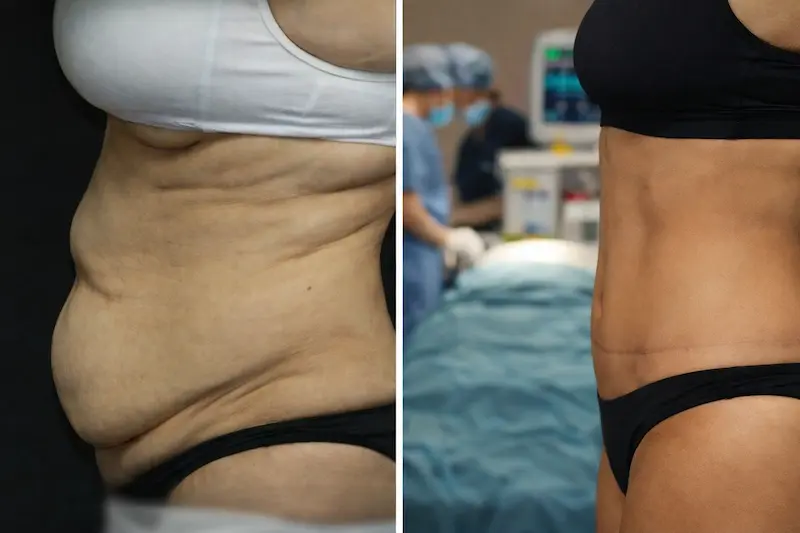
When patients search tummy tuck scar revision before and after or tummy tuck dog ears revision before and after, they’re usually trying to answer one core question: “Is the change meaningful in real life—not just in perfect lighting?” The most reliable way to evaluate revision outcomes is to look beyond a single photo and assess consistency across angles, scar maturity, and how the contour behaves in normal posture. This is where an expert-patient mindset (and a bit of medical science literacy) helps you interpret what you’re actually seeing.
What “good” dog ear correction typically looks like
For dog ear tummy tuck revision, the “win” is usually a smoother transition at the incision ends—so the hip contour looks continuous rather than pinched or puckered.
- Contour blending: the incision end no longer “catches” the eye as a bump or wing.
- Symmetry: both sides look balanced in oblique views (front angles can hide issues).
- Natural shape: not overly flattened or “scooped out,” which can look unnatural.
What to watch for in photos: Lighting and pose can hide dog ears. Ideally, compare standing photos taken from front, side, and oblique angles with consistent posture and similar lighting.
What “good” scar revision typically looks like (and what it can’t promise)
A successful tummy tuck scar revision generally means the scar becomes flatter, more even, and less visually dominant over time. But revision does not erase a scar—rather it improves how the scar matures and how well it sits within natural lines and clothing coverage.
- Flatness: reduced thickness and “rope-like” texture.
- Evenness: fewer irregular edges and less patchy widening.
- Color blending: gradual fading (usually months, not weeks).
- Placement: improved concealability when feasible, without increasing tension.
Why timing matters when interpreting “before and after” images
Scar appearance changes dramatically throughout the first year. In scientific research and medical science, scar remodeling is understood as a long process involving collagen reorganization. That’s why early “after” photos can be misleading: a scar at 6–10 weeks can look worse than it will at 9–12 months. When assessing tummy tuck scar revision before and after examples, look for:
- Timestamp clarity: How many months post-op is the “after” photo?
- Consistency: Same camera distance, lighting, and posture.
- Multiple angles: front + side + oblique tells the truth.
Photo evaluation for revision cases is harder than photo evaluation for primary cases — because the "before" image is already a surgical result, not a baseline, and the "after" needs to be read against the difference between two surgical outcomes rather than between unaltered anatomy and surgery.
For the procedure-specific photo archive that lets you calibrate consistently across angles and timing, the tummy tuck before-and-after archive covers primary tummy tuck case sets with documented timing, multi-angle documentation across recovery phases, and the consistency standards (lighting, distance, posture) that the photo-evaluation checklist above describes — applied across the practice's archive rather than curated for marketing.
Reading an archive teaches photo calibration in a way that reading one or two showcase photos never does.
Frequently Asked Questions (FAQ): Tummy Tuck Revision
Below are concise, structured patient FAQs addressing the most common concerns around tummy tuck revision, including scar revision tummy tuck, mini tummy tuck revision, and cost-related questions such as tummy tuck revision cost.
How soon after my tummy tuck can I fix dog ears?
Can dog ears be corrected without surgery?
Will scar revision remove my scar completely?
Is tummy tuck revision more painful than the first surgery?
Can I combine a revision with liposuction?
What are the biggest risks of revision surgery?
How do I choose a safe revision specialist in Turkey?
Related Treatments
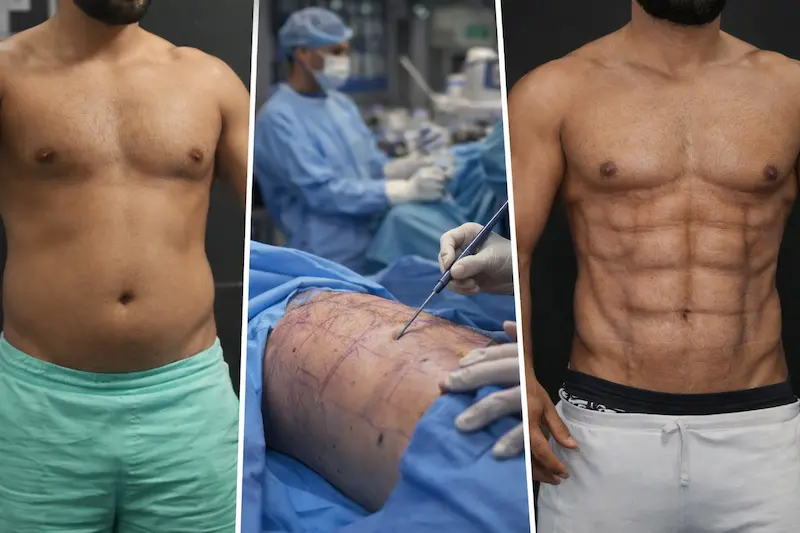

Ready to Start Your Own Transformation Journey?
Join the 2,000+ patients who trusted Dr. Akif Mehmetoğlu and the AKM Clinic team. Your journey to a more confident, revitalized you begins with a simple, no-obligation conversation. Contact us today from the USA for your free virtual consultation.
#1: Get Your Free Personalised Quote
Start with a free, no-obligation online consultation. Share your photos, and our surgical team will provide a fully personalised treatment plan and a transparent, all-inclusive price package. No hidden fees.
#2: Secure Your Date & VIP Booking
Once you're ready, our dedicated patient coordinators will help you secure your procedure date. We'll handle all your bookings, including your 5-star hotel and private VIP airport transfers.
#3: Arrive in Istanbul & Meet Your Surgeon
Arrive at Istanbul Airport (IST) and be greeted by your private driver. Settle into your hotel and prepare for your in-person consultation, where you'll meet your specialist surgeon to finalise the details for your "natural, subtle, and revitalized" new look.