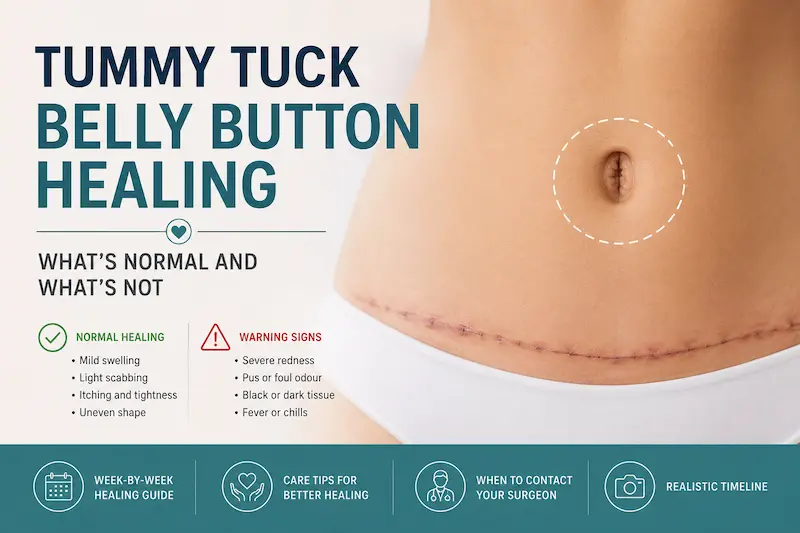

A tube tummy tuck, more accurately described as a drainless tummy tuck, is an abdominoplasty technique designed to remove the need for post-operative drain tubes. For Canadian patients travelling to Istanbul, that detail matters. No drain bulbs to empty. No tubing to hide under clothing. No anxiety about managing surgical fluid during the hotel recovery week or the return flight home.
At AKM Clinic, the drainless approach is part of a broader body contouring philosophy: reduce avoidable friction during recovery while maintaining surgical safety. If you are still comparing the broader tummy tuck procedure at AKM Clinic, this article focuses on one specific technical question: how can a tummy tuck heal safely without drains?
The answer is not marketing language. It is anatomy. A drainless tummy tuck uses progressive tension sutures to close the internal space where fluid would normally collect after surgery. When that space is closed properly, the body has less room to produce a fluid pocket, and the patient has a cleaner, simpler recovery experience.
Quick Summary: A drainless, or “tube,” tummy tuck eliminates the post-operative drains traditionally placed under the abdominal skin to remove fluid. The technique uses progressive tension sutures to close the internal dead space, improving comfort and simplifying recovery for Canadian patients travelling internationally.
Drainless does not mean less serious surgery. It means the surgeon uses a more meticulous internal closure method so that fluid management happens through technique rather than external tubing.
Table of Contents
What “Drainless” Actually Means?
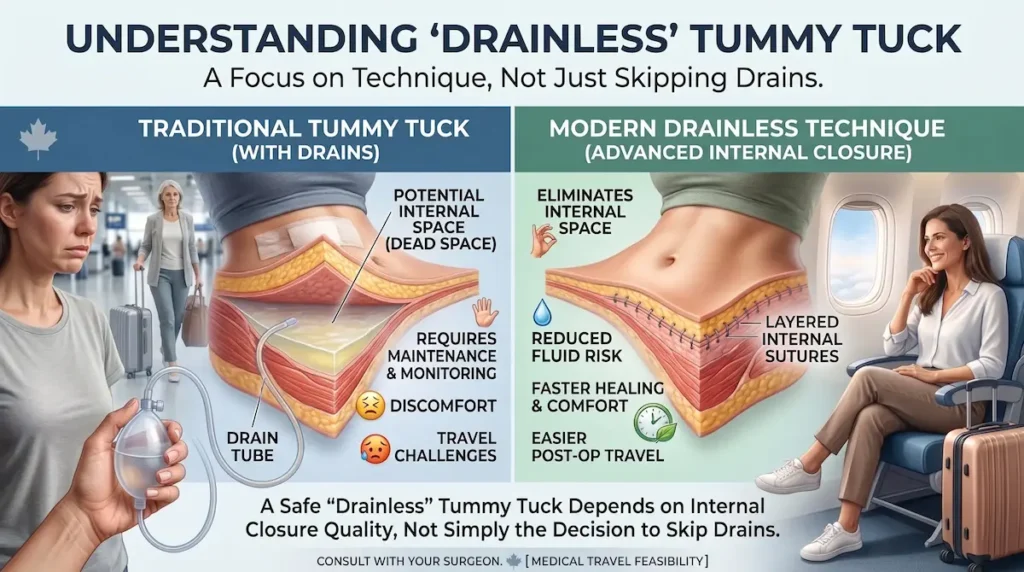
“Drainless” does not mean that fluid magically disappears after surgery. It means the surgical technique is designed to reduce the open internal space where fluid would normally accumulate. That distinction is important. A safe drainless tummy tuck depends on internal closure quality, not simply on the decision to skip drains.
Traditional Drains and What They Do
In a traditional tummy tuck, the surgeon removes excess abdominal skin and fat, lifts the tissue layer, repairs the abdominal wall if needed, and then closes the incision. This creates a temporary internal space between the abdominal flap and the deeper tissue layer.
That space is often called dead space. It is not dangerous by itself, but the body may fill it with fluid during early healing. Traditional drains are small tubes placed under the skin to collect that fluid into external bulbs.
Patients are usually asked to measure the drainage, empty the bulbs, protect the tube openings, and avoid accidentally pulling the drains. For someone recovering close to home, this can be inconvenient. For a Canadian patient recovering in a hotel before a long-haul flight, it can feel like an extra medical task layered onto an already sensitive week.
Why Drains Historically Were Considered Necessary
Drains became common because seroma, or fluid collection, is one of the most recognized early concerns after abdominoplasty. Surgeons used drains to reduce that risk while the internal tissues began to reattach.
The logic was straightforward: if the body produces fluid, give it a path out. That helped many patients, but it also introduced practical burdens. Drain sites can be uncomfortable. They need regular monitoring. They may delay showering. They can create anxiety for patients who are not comfortable handling post-operative devices.
For international patients, drains also complicate travel planning. A patient flying back to Toronto, Vancouver, Montreal, Calgary, or Ottawa does not want to manage external tubing through airport security, hotel transfers, or a crowded aircraft cabin.
Canadian Patient Note: Why Drain Management Feels Different Abroad
At home in Canada, a patient may have family support, familiar pharmacies, and local follow-up options. In Istanbul, AKM Clinic provides 24/7 patient advocacy, but drain management can still add stress. Drainless technique reduces one of the most practical recovery concerns during the hotel phase and the IST-to-Canada return journey.
Why Drainless Is Technically Possible
Drainless tummy tuck became possible because surgeons refined the way the abdominal flap is secured internally. Instead of leaving a broad potential space and placing drains to manage it, the surgeon uses layered internal sutures to attach the lifted tissue back down to the abdominal wall.
These sutures distribute tension gradually. They also reduce shearing movement between tissue layers. Less movement and less space mean less opportunity for fluid to collect.
This is why the word “drainless” can be misleading if it is presented as a shortcut. It is not a shortcut. It is usually more meticulous. The visible incision may look similar, but the internal work is different.
Progressive Tension Suture Technique
Progressive tension sutures are the core of the drainless tummy tuck. They are placed internally, usually from the deeper surface of the abdominal flap to the underlying fascia, advancing the tissue downward in a controlled pattern. Their purpose is simple: close the space, distribute tension, and protect the incision line.
How the Sutures Close Dead Space
After the abdominal skin and fat layer is lifted, a gap exists between the flap and the abdominal wall. In a traditional approach, drains manage fluid within that gap. In a drainless approach, progressive tension sutures reduce the gap itself.
Think of the technique as internal quilting. The surgeon places a sequence of sutures across the elevated tissue, attaching it back to the stable layer beneath. Each suture closes a small section of space. Together, they reduce the broad internal pocket that would otherwise remain after flap elevation.
This concept is supported by surgical literature showing that progressive tension sutures can reduce seroma risk and may reduce the need for drains when performed properly. For patients, the practical result is easier to understand: fewer external devices and a recovery process that feels less medicalised.
Anatomical Layer-by-Layer Closure
A drainless tummy tuck is not only about placing extra stitches. It is about respecting the abdominal anatomy layer by layer. The surgeon must understand the mobility of the abdominal flap, the direction of tension, the location of muscle repair, and the safest closure pattern for the patient’s tissue quality.
The deeper fascial layer provides a stable anchor. The abdominal flap is advanced and secured progressively. The final skin closure then carries less tension because the deeper layers have already absorbed much of the pulling force.
This matters for comfort. It also matters for scar quality. A skin incision under high tension is more likely to widen, become irritated, or heal unpredictably. Progressive tension sutures help shift some of that load away from the skin.
Why Technique Skill Matters More Than Instrumentation
There is no machine that makes a tummy tuck drainless. The result depends on judgement, tissue handling, suture placement, and knowing when the patient’s anatomy is suitable for the technique.
External professional guidance on abdominoplasty, including patient information from ISAPS abdominoplasty resources, consistently frames tummy tuck surgery as a major body contouring operation that should be performed by appropriately trained surgeons. Drainless technique does not change that. It raises the importance of technical precision.
“A drainless tummy tuck is not simply a tummy tuck without drains. The safety comes from closing the internal space properly, distributing tension across the flap, and choosing the right patient for the technique.”
For Canadian patients, this is the point to remember during consultation: ask how the surgeon prevents fluid collection, not only whether drains are used. The technique should be explained clearly before surgery. If the answer sounds vague, keep asking.
Patient Experience Differences
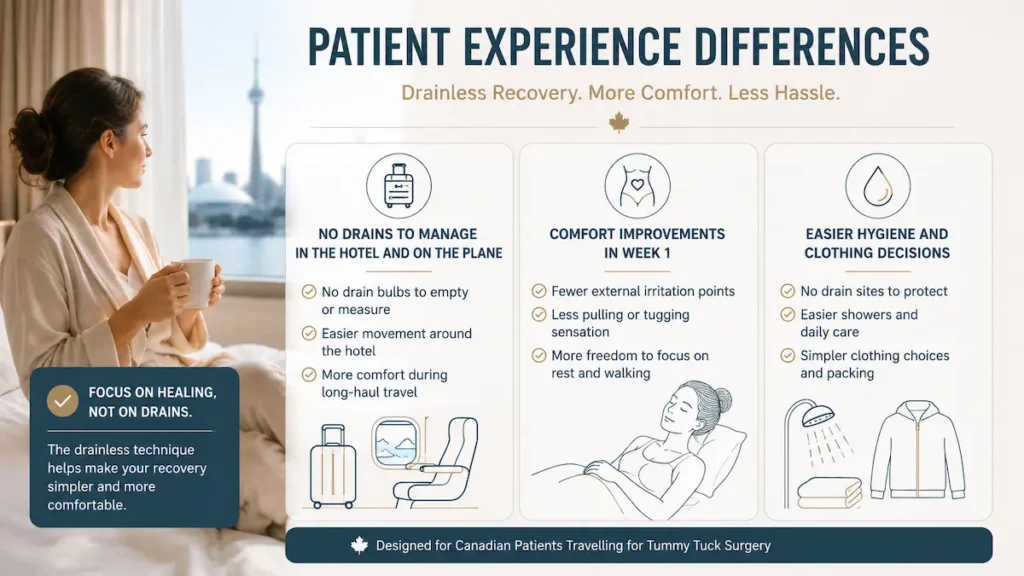
The main advantage of a drainless tummy tuck is not that the surgery becomes minor. It does not. The advantage is that the first recovery week becomes easier to manage because the patient is not caring for external tubes while also dealing with swelling, tightness, compression garments, and limited mobility.
No Drains to Manage in the Hotel and on the Plane
Traditional drains require daily attention. Patients may need to empty bulbs, record output, keep tubing secure, and avoid accidental pulling when changing clothes or getting out of bed. That can feel awkward even in a familiar home.
In a hotel recovery setting, it can feel more stressful. A Canadian patient may be staying at The Point Barbaros, coordinating post-op visits, resting between check-ins, and preparing for the long trip back to Canada. Removing drain care from that list simplifies the week.
It also makes the return journey more discreet. Patients flying from Istanbul to Toronto, Montreal, Vancouver, Calgary, or Ottawa often worry about comfort in airport lounges, aircraft washrooms, and connecting gates. Without drains, there are fewer devices to protect during movement.
Canadian Travel Callout: Why Drainless Helps on Long-Haul Flights
The Istanbul-to-Canada return trip is long, even when the route is direct. Drainless recovery reduces the practical worry of securing tubing under compression garments, emptying drain bulbs before boarding, or explaining external medical devices during travel. It does not remove the need for medical clearance, but it can make the logistics feel more manageable.
Comfort Improvements in Week 1
Most tummy tuck patients describe early recovery as tight, stiff, and protective rather than sharply painful. Drains can add a separate point of irritation because the tubing exits through the skin. Some patients feel pulling or tenderness around the drain site.
Without drains, the patient usually has fewer external discomfort points. Compression garment use still matters. Walking still needs to be gradual. Sleeping position still requires planning. The difference is that the patient is not constantly aware of tubes moving with each step.
This is especially helpful during the first few assisted walks. After abdominal surgery, standing upright takes time. Many patients walk slightly bent for several days. Removing drain management from those short walks helps patients focus on breathing, posture, and safe movement.
Easier Hygiene and Clothing Decisions
Drain-free recovery can make hygiene easier because there are no tube openings to protect. Shower timing still depends on the surgeon’s instructions, wound condition, and dressing plan, but the process is generally less complicated when external drains are not present.
Clothing choices are also simpler. Loose trousers, oversized shirts, zip-front tops, and soft waistbands are still recommended, but there is no need to conceal or secure drain bulbs. This matters more than many patients expect.
For Canadian travellers, packing becomes more straightforward. You still need compression garments, comfortable shoes, and easy layers for flight temperature changes. You do not need to plan around drain clips, tube positioning, or spare bulb protection during the hotel phase.
Are You a Drainless Candidate?
Not every tummy tuck patient should automatically have a drainless procedure. Candidacy depends on tissue quality, surgical scope, healing risk, and the surgeon’s intra-operative judgement. A responsible surgeon should be willing to use drains if that is safer for the patient’s anatomy.
BMI and Tissue Laxity Considerations
Body mass index is not the only factor in tummy tuck planning, but it matters. Patients with higher BMI, thicker abdominal tissue, or larger surgical dissection areas may have a higher risk of fluid collection. In these cases, the surgeon may still recommend drains.
Tissue laxity also matters. A patient with moderate lower abdominal looseness may be a strong candidate for drainless closure. A patient with extensive skin laxity after major weight loss may need a wider dissection and more individualized fluid-control planning.
This is one reason the consultation must separate procedure type from technique type. First, the surgeon determines whether the patient needs a mini, full, extended, or fleur-de-lis tummy tuck. For the scope comparison specifically, see the mini vs full tummy tuck decision guide.
Smoking and Healing Factors
Smoking and nicotine use are major concerns in tummy tuck surgery. Nicotine reduces blood flow, weakens healing, and increases the risk of wound problems. This applies to cigarettes, vaping, nicotine gum, and patches.
For drainless surgery, tissue health is especially important because the technique relies on secure internal healing. If the body cannot heal predictably, the benefit of closing dead space may be undermined by poor wound biology.
Other healing factors include diabetes control, previous abdominal surgery, medication use, nutrition, and history of seroma or wound complications. Canadian patients should disclose all medical details during the virtual consultation, even if they seem minor.
- Current or recent nicotine use
- Diabetes or insulin resistance
- Previous C-section or abdominal surgery
- History of poor scarring or delayed healing
- Blood-thinning medication use
- Large post-weight-loss skin excess
When Traditional Drains Are Still Appropriate
Drains are not a failure. They are a tool. If the surgeon sees higher fluid risk during surgery, adding drains may be the safer choice. A patient should never choose a clinic solely because it promises “no drains” for every case.
Traditional drains may be appropriate when the dissection area is broad, the tissue is heavy, the patient has higher seroma risk, or the surgeon needs extra fluid-control support. Safety should always override convenience.
The best consultation question is not, “Will I definitely have no drains?” A better question is, “What factors would make you decide to add drains for my safety?” That answer tells you more about the surgeon’s judgement.
“The goal is not to avoid drains at all costs. The goal is to prevent fluid collection safely. For many patients, progressive tension sutures do that well. For others, drains remain the right medical decision.”
AKM Clinic’s Drainless Approach
AKM Clinic’s drainless tummy tuck approach is built around careful tissue handling, progressive tension sutures, and individualized judgement. The technique is not treated as a universal promise. It is used when the patient’s anatomy, healing profile, and surgical scope make drain-free recovery appropriate.
Why AKM Offers Drainless as the Standard Option
For many tummy tuck patients, the first week after surgery is shaped by practical details. Getting out of bed. Walking slowly. Wearing compression. Eating enough protein. Avoiding unnecessary strain. Drains can make each of those tasks feel more complicated.
AKM Clinic’s surgical planning aims to reduce avoidable recovery burdens while preserving safety. When progressive tension sutures can reliably control internal space, a drainless plan can make recovery more comfortable and easier to manage.
This is particularly relevant for Canadian patients who are not recovering in their own homes. A patient travelling from Toronto, Vancouver, Montreal, Calgary, or Ottawa has to think about hotel mobility, post-op visits, airport timing, and the flight home. A drain-free recovery removes one recurring source of friction.
Surgeon Experience With the Technique
Drainless tummy tuck requires confidence with internal closure. The surgeon must control the abdominal flap, assess tension, and decide how much tissue advancement is safe. That judgement comes from experience, not from a device.
AKM Clinic’s broader surgical model emphasizes surgeon-led planning, natural proportions, and structured aftercare. Patients can review AKM’s surgical team experience with drainless technique before consultation, while Canadian readers can also use the Canadian Society of Plastic Surgeons as a reference point for evaluating surgeon training, credentials, and safe surgical planning.
During consultation, the patient should expect a candid discussion. A good candidate may be told that drainless is appropriate. A higher-risk patient may be told that drains are safer. Both answers can be medically responsible.
When the Surgeon Recommends Adding Drains
Even when a drainless plan is preferred, the final decision may be made during surgery. If the surgeon finds more tissue separation, fluid risk, or bleeding than expected, drains may be added. This should not be viewed as a complication by itself.
It means the surgeon adjusted the plan to protect the patient. A rigid promise of “no drains under any circumstances” is less reassuring than a flexible safety-based decision framework.
The best pre-op discussion includes this possibility. Canadian patients should know before travelling that the surgeon may choose drains if the anatomy demands it. Transparency lowers anxiety and supports better decision-making.
| Factor | Drainless Tummy Tuck | Traditional Drain Tummy Tuck |
|---|---|---|
| Fluid control method | Progressive tension sutures close internal dead space | External drains remove fluid after surgery |
| Hotel recovery | No drain bulbs to empty or secure | Drain output must be monitored and managed |
| Comfort in week 1 | Fewer external irritation points | Drain sites may feel tender or awkward |
| Travel logistics | Simpler clothing, hygiene, and airport movement | Requires planning around tubing and bulb placement |
| AKM CAD pricing | CAD $7,500 | Full tummy tuck starts at CAD $6,550 |
Recovery Timeline Without Drains
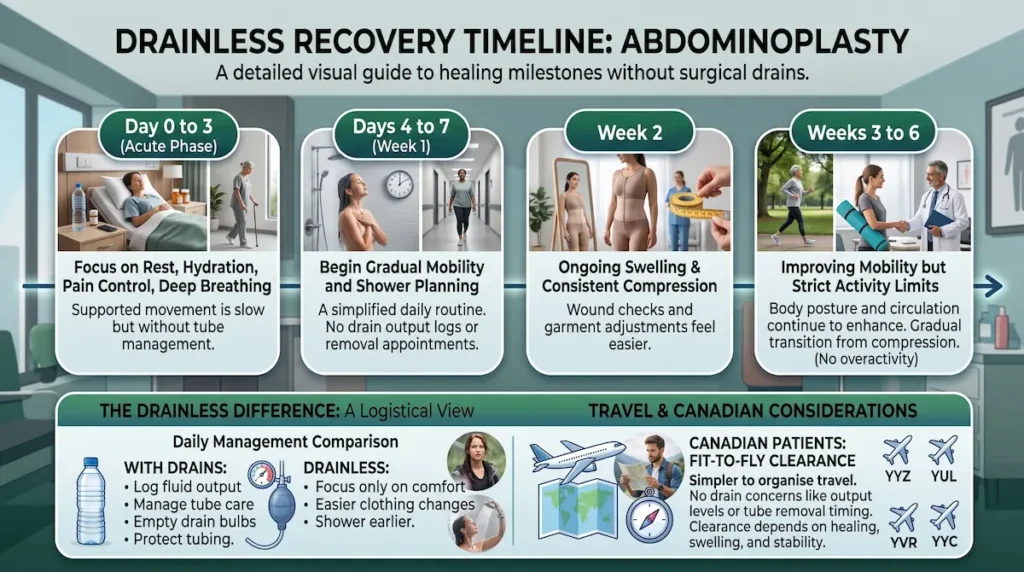
Drainless recovery still follows the biology of abdominoplasty healing. Swelling, tightness, bruising, and fatigue are expected. The difference is that the patient’s early routine is not organized around drain care, drain output, or drain removal timing.
Day 0 to Day 3 Acute Phase
The first 72 hours are the most protective phase. Patients usually move slowly, sleep in a flexed position, and rely on help for standing, sitting, and short walks. Compression is worn as instructed.
Without drains, the abdomen may feel tight and compressed, but there are no external tubes exiting the skin. This can make supported walking feel less intimidating. Patients can focus on circulation, breathing, hydration, and safe posture.
Pain control is still important. So is nutrition. A drain-free technique does not remove the need for discipline in the early recovery period. It simply removes one layer of mechanical management.
Week 1 — The Difference Patients Notice Most
Week 1 is where drainless patients often notice the biggest practical difference. Traditional drain patients may still be recording fluid output, protecting tubing, and waiting for output levels to drop before removal. Drainless patients avoid that step.
This does not mean they are “fully recovered.” It means their daily routine is less interrupted. Short walks, shower planning, garment adjustments, and clinic visits can be easier without drain bulbs.
For general recovery routines beyond the drain question, patients should review the tummy tuck recovery tips overview. That guide covers sleeping position, compression, walking progression, nutrition, and activity limits in more detail.
Fit-to-Fly Clearance — Easier Without Drain Considerations
Canadian patients need surgeon clearance before flying home. Drainless technique may simplify the decision because there is no need to consider whether drains are still producing fluid or whether tube sites have healed enough for travel.
Clearance still depends on the full clinical picture. The surgeon will assess swelling, wound condition, mobility, pain control, and overall stability. A patient who is drain-free but not healing well should not fly early.
For patients who also undergo liposuction or body contouring, swelling management may include manual lymphatic drainage. For that specific recovery angle, see the guide to lymphatic drainage massage relevance during drainless recovery.
Canadian Logistics Callout: Hotel Recovery Without Drain Tasks
Without drains, the hotel week is easier to organize. Patients have fewer supplies to manage, fewer garment adjustments, and fewer concerns about tubing during transfers. This can be especially helpful for solo Canadian travellers or patients connecting through YYZ, YUL, YVR, or YYC on the way home.
| Recovery Stage | Typical Drainless Experience | Patient Priority |
|---|---|---|
| Day 0 | Tightness, compression, assisted movement | Rest, hydration, pain control |
| Days 1-3 | Slow walking without drain tubing | Circulation and safe posture |
| Days 4-7 | Less logistical burden during hotel recovery | Clinic check-ins and gradual mobility |
| Week 2 | Ongoing swelling but simpler hygiene and clothing | Compression consistency |
| Weeks 3-6 | Improving mobility and reduced tightness | Avoiding overactivity |
For Canadian patients comparing surgeon standards before travelling, the Canadian Society of Plastic Surgeons is a useful reference point for understanding why credentials, training, and transparent surgical planning matter. International surgery should still be evaluated with the same level of caution you would apply in Toronto, Vancouver, Montreal, Calgary, or Ottawa.
Frequently Asked Questions: Tube Tummy Tuck
Drainless tummy tuck questions are usually practical. Patients want to know whether recovery is safer, easier, faster, or more comfortable without drains. The answers depend on anatomy, technique, and surgeon judgement rather than on the label alone.
Is drainless safer than a traditional drain tummy tuck?
Drainless can be safe for the right candidate when progressive tension sutures are used properly. It may reduce drain-site irritation and simplify recovery, but it is not automatically safer for every patient.
Traditional drains may still be safer when a patient has higher fluid-collection risk, extensive tissue dissection, higher BMI, or complex revision anatomy. The safest option is the one matched to the patient’s tissue and healing profile.
Does it cost more at AKM?
Does it cost more at AKM?
Yes, the drainless technique sits in a higher pricing tier because it involves more meticulous internal closure. AKM Clinic lists Drainless Tummy Tuck at CAD $7,500. Full Tummy Tuck starts at CAD $6,550.
For current pricing context, review drainless tummy tuck pricing in CAD. Pricing should always be confirmed during consultation because the final surgical plan depends on anatomy, scope, and whether procedures are combined.
What if my surgeon needs to add drains mid-procedure?
If drains are added, it usually means the surgeon decided they were medically appropriate. That is not a failure of the plan. It is a safety decision.
Patients should ask before surgery what factors would lead the surgeon to add drains. A clear answer shows that the clinic is prioritizing judgment over a rigid marketing promise.
How does drainless affect my recovery week?
Drainless recovery removes the need to empty bulbs, track fluid output, protect tubing, and wait for drain removal. That can make the hotel recovery week feel cleaner and more manageable.
You still need compression, rest, short walks, good nutrition, and careful movement. Drainless technique simplifies recovery. It does not eliminate recovery.
Can I fly back to Canada earlier?
Not automatically. Drainless recovery may simplify fit-to-fly clearance because there are no tubes or drain sites to consider, but your surgeon still needs to assess wound healing, swelling, mobility, pain control, and general stability.
Most Canadian patients should plan their return flight based on medical clearance, not convenience. The route home can be demanding, especially for patients connecting through large airports such as YYZ, YUL, YVR, or YYC.
Does drainless have a higher seroma risk?
Seroma risk depends on technique and patient factors. Progressive tension sutures are specifically designed to reduce the internal space where fluid can collect. When performed properly, they may reduce the need for drains without increasing fluid risk.
However, higher-risk patients may still need drains. This is why candidacy matters. Drainless should be recommended because your anatomy fits the technique, not because it sounds easier.
Will my scar be different with drainless?
The external scar may look similar because the incision placement is usually based on the tummy tuck type rather than drain use. The potential scar benefit comes from reduced skin tension when progressive tension sutures distribute force internally.
Scar outcome still depends on incision placement, wound care, genetics, sun protection, and compression discipline. For scar-specific guidance, see tummy tuck scar treatment considerations.
Determine Your Drainless Candidacy
A tube tummy tuck can make recovery more comfortable for the right patient, but it should never be chosen by label alone. The key question is whether your tissue quality, surgical scope, healing profile, and travel timeline make drainless closure appropriate.
Schedule a virtual consultation with AKM Clinic to review your anatomy, discuss progressive tension sutures, and receive a personalized tummy tuck plan in CAD.
Medical Disclaimer: This page is provided for general educational purposes only and does not replace an in-person medical consultation, diagnosis, or personalized treatment plan. All surgery carries risks, and outcomes vary between individuals. Suitability for a tummy tuck surgery, procedure selection, and anesthesia choice can only be determined after a full clinical assessment by a qualified surgeon. Always follow your clinician’s instructions and seek urgent medical attention if you develop concerning symptoms during recovery.