
Choosing between a mini vs full tummy tuck is less about personal preference and more about anatomy. A mini tummy tuck treats a smaller area below the belly button. A full tummy tuck treats the entire abdomen, usually including muscle repair and belly button repositioning.
For Canadian patients comparing options in Toronto, Vancouver, Montreal, or Calgary, this distinction matters. The procedure you choose affects scar length, recovery time, cost in CAD, and the final contour you can realistically expect. If you are still early in your research, start with AKM Clinic’s tummy tuck procedure overview for the full treatment context.
The most common mistake is assuming that a mini tummy tuck is simply a smaller, easier version of the same operation. It is not. It solves a narrower problem.
Quick Summary: A mini tummy tuck addresses skin and limited muscle laxity below the belly button, without repositioning the umbilicus. A full tummy tuck addresses the entire abdomen, usually includes diastasis recti repair, and repositions the belly button for a natural-looking abdominal contour.
The right choice is anatomical, not preferential. Many patients who hope for a mini tummy tuck actually need a full tummy tuck to achieve their goals safely and predictably.
Table of Contents
The Anatomical Difference
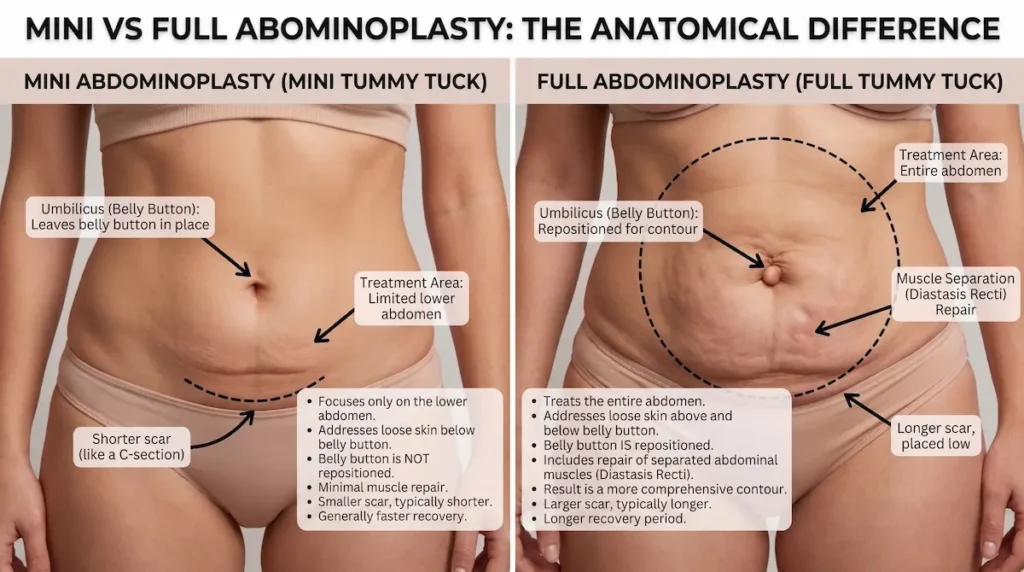
The main difference between mini and full tummy tuck surgery is the treatment zone. A mini tummy tuck focuses only on the lower abdomen. A full tummy tuck treats the abdomen as one connected unit: upper skin, lower skin, abdominal wall, and belly button position.
This is why consultation matters. Photos can help, but a surgical assessment looks at skin laxity, muscle separation, fat distribution, scar placement, and how the belly button will sit after tightening. For international patient-safety context, ISAPS describes abdominoplasty as a procedure that removes excess abdominal skin and fat while tightening the abdominal wall; Canadian readers can review the ISAPS abdominoplasty patient information. For the separate decision between skin-removal surgery and fat-removal surgery, see our guide for the different decision axis of tummy tuck vs liposuction.
Mini scope — below the belly button only
A mini tummy tuck treats the area between the pubic line and the belly button. It is designed for patients who have mild lower-abdominal looseness, usually after pregnancy, weight change, or a previous C-section scar.
The belly button is usually left in place. The incision is typically shorter than a full tummy tuck incision, although the exact length still depends on how much skin needs to be removed.
A mini tummy tuck may be appropriate when the concern is very specific:
- Loose skin sits mainly below the belly button.
- The upper abdomen is already firm and flat.
- There is no meaningful muscle separation above the belly button.
- The patient accepts a more limited result.
It is a focused procedure. It cannot flatten the entire abdomen if the upper abdominal wall is also loose.
Full scope — entire abdomen, including umbilical repositioning
A full tummy tuck treats loose skin and abdominal wall laxity across the full abdomen. It usually includes removal of excess lower abdominal skin, tightening of the abdominal wall, and repositioning of the belly button.
This is the procedure most patients imagine when they think of a dramatic post-pregnancy or post-weight-loss abdominal change. It is also the better option when looseness extends above the belly button.
Full tummy tuck surgery can address several problems in one operation:
- Loose skin above and below the belly button.
- Stretch-marked lower abdominal skin that can be removed with the excision.
- Separated abdominal muscles that require repair.
- A belly button that would look too low or distorted after tightening.
The result is broader because the procedure is broader. The trade-off is a longer incision and a more involved recovery.
Why the difference is structural, not cosmetic
The mini vs full decision is not about wanting a smaller scar or a faster recovery. Those are understandable goals, but they should not drive the surgical plan. The body’s structure should.
If the upper abdomen is loose, a mini tummy tuck will not correct it. If the belly button needs repositioning, mini surgery cannot deliver the right contour. If the abdominal muscles are separated above the belly button, a limited lower-abdominal repair may leave the main problem unresolved.
This is also where procedure variants can create confusion. For the technique-specific question of drains and progressive tension sutures, see the drainless technique variation. For incision care and scar visibility, read our guide to scar placement and minimization considerations.
| Factor | Mini Tummy Tuck | Full Tummy Tuck |
|---|---|---|
| Treatment area | Lower abdomen only, below the belly button | Upper and lower abdomen |
| Belly button | Usually not repositioned | Repositioned for proportional abdominal contour |
| Muscle repair | Limited, lower-abdominal repair only in selected cases | Commonly includes full diastasis recti repair when needed |
| Scar length | Shorter, usually similar to an extended C-section-style line | Longer, placed low so it can sit within underwear or swimwear lines |
| Recovery | Typically faster and less restrictive | Longer because more tissue and muscle work are involved |
| AKM Clinic CAD pricing | CAD $4,800 | CAD $6,550 |
Pricing source: AKM Clinic Treatment Techniques Cost reference. CAD figures are shown for Canadian patients only.
Canadian Patient Note: A shorter scar is not always the better choice
Patients travelling from Canada often want the smallest possible procedure because the trip, recovery planning, and time away from work already feel significant. That is reasonable. But a shorter scar is only a benefit when the underlying anatomy matches the smaller procedure.
If the wrong scope is chosen, the patient may return to Canada with persistent upper-abdominal bulging, untreated muscle separation, or a belly button that looks pulled downward. A precise scar is better than an incomplete correction.
Mini Tummy Tuck — Who’s a Candidate?
A mini tummy tuck is best for a narrow patient profile. The ideal candidate has a small pouch of loose skin below the belly button, stable weight, good upper-abdominal tone, and no significant diastasis recti above the umbilicus.
Many patients ask about mini surgery because it sounds easier. The real question is different: will it correct the problem you actually have? If the answer is no, choosing mini may simply postpone the full correction.
Limited lower-abdomen laxity only
The best mini tummy tuck candidate has a lower-abdominal skin fold or mild looseness that does not extend upward. This can happen after pregnancy, weight fluctuation, or a C-section, especially when the skin above the belly button remains tight.
The lower abdomen is the focus. The upper abdomen is mostly left alone.
This makes mini tummy tuck a good fit for patients who say things like:
- “My upper stomach is flat, but the lower pouch bothers me.”
- “The skin above my belly button looks normal.”
- “My concern is mostly around my C-section area.”
- “I do not have a rounded upper abdomen when I stand sideways.”
If the concern is limited and the tissue quality is favourable, a mini procedure can produce a clean, natural result.
No diastasis recti above the belly button
Diastasis recti is separation of the rectus abdominal muscles. It often occurs after pregnancy, although weight change and genetics can also contribute. If the separation extends above the belly button, a mini tummy tuck is usually not enough.
A limited lower repair may tighten the lower abdomen, but the upper abdomen can still bulge. This is why a surgeon must assess the abdominal wall, not just the skin.
Canadian patients who have been told by a physiotherapist that they have abdominal separation should mention this during consultation. Photos help, but functional history matters as well.
Realistic outcomes
A mini tummy tuck can improve a lower-abdominal pouch. It can remove a limited amount of loose skin and refine the lower contour. It can also revise or incorporate certain lower abdominal scars.
It cannot create a full-abdominal transformation. It will not correct upper-abdominal looseness, significant stretch-marked skin above the belly button, or major muscle separation.
The best mini tummy tuck result looks subtle. That is a strength when the anatomy fits.
Why fewer than 15% of tummy tuck consultations are mini candidates
Mini candidates are a minority because abdominal laxity often involves more than the lower skin. After pregnancy or major weight change, the skin, muscle wall, and belly button position usually change together.
That does not mean mini surgery is ineffective. It means it is selective.
A careful surgeon should be willing to say no to a mini tummy tuck when the anatomy requires full correction. That conversation can feel disappointing at first, but it protects the final result.
“The honest question is not, ‘Can we make the surgery smaller?’ It is, ‘Will the smaller operation solve the patient’s actual anatomy?’ If the answer is no, a mini tummy tuck becomes a compromise, not a conservative choice.”— Composite AKM Clinic surgeon perspective
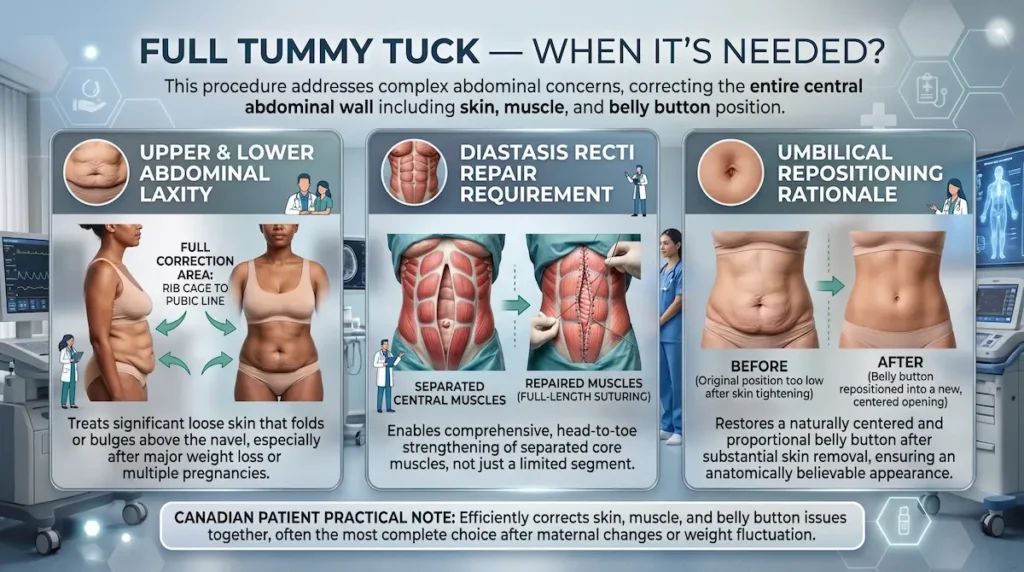
Full Tummy Tuck — When It’s Needed?
A full tummy tuck is needed when the abdominal concern extends beyond the lower belly. This includes loose skin above the belly button, muscle separation through the central abdominal wall, or a belly button position that would look unnatural after tightening.
The full procedure gives the surgeon access to the entire abdominal field. That wider access allows a more complete correction. It also means a longer recovery and a longer scar, which should be discussed honestly before surgery.
Upper and lower abdominal laxity
Upper-abdominal laxity is one of the clearest reasons a patient needs a full tummy tuck. If the skin above the belly button folds, creases, or bulges when standing, a mini tummy tuck will usually leave that concern behind.
This often happens after pregnancy or major weight change. The lower abdomen may look worse, but the upper abdomen is still part of the same structural problem.
A full tummy tuck lets the surgeon tighten the abdominal skin from the ribcage area down toward the pubic line. That broader movement creates a smoother contour across the whole abdomen, rather than flattening only the bottom section.
Patients often notice this most in side-profile photos. A mini tummy tuck may improve the lower pouch, yet the upper abdomen can still project forward. Full correction is more consistent when both zones are involved.
Diastasis recti repair requirement
Diastasis recti repair is a major reason a full tummy tuck becomes the better surgical choice. Diastasis recti means the abdominal muscles have separated along the midline. In moderate or severe cases, the abdomen can look rounded even when the patient has little fat.
Mini tummy tuck surgery can sometimes tighten a limited lower segment. It does not give the same access for full-length repair above and below the belly button. For the muscle-repair-specific discussion, see diastasis recti repair as the deciding factor.
This matters for Canadian mothers who have completed pregnancy and tried physiotherapy but still have a persistent bulge. A full tummy tuck can combine skin removal with abdominal wall repair in one surgical plan.
It also matters for patients who are not mothers. Weight fluctuation and genetics can contribute to abdominal wall laxity as well.
Umbilical repositioning rationale
The belly button is central to how natural a tummy tuck result looks. If a large amount of skin is removed from the abdomen, leaving the belly button in its original position can make it look too low, stretched, or distorted.
A full tummy tuck usually creates a new opening for the belly button after the abdominal skin has been tightened. The belly button itself remains attached to the abdominal wall underneath. The surrounding skin is repositioned around it.
This step is one of the reasons full tummy tuck surgery can look more complete. It restores proportion. The goal is not just a flatter abdomen, but an abdomen that looks anatomically believable.
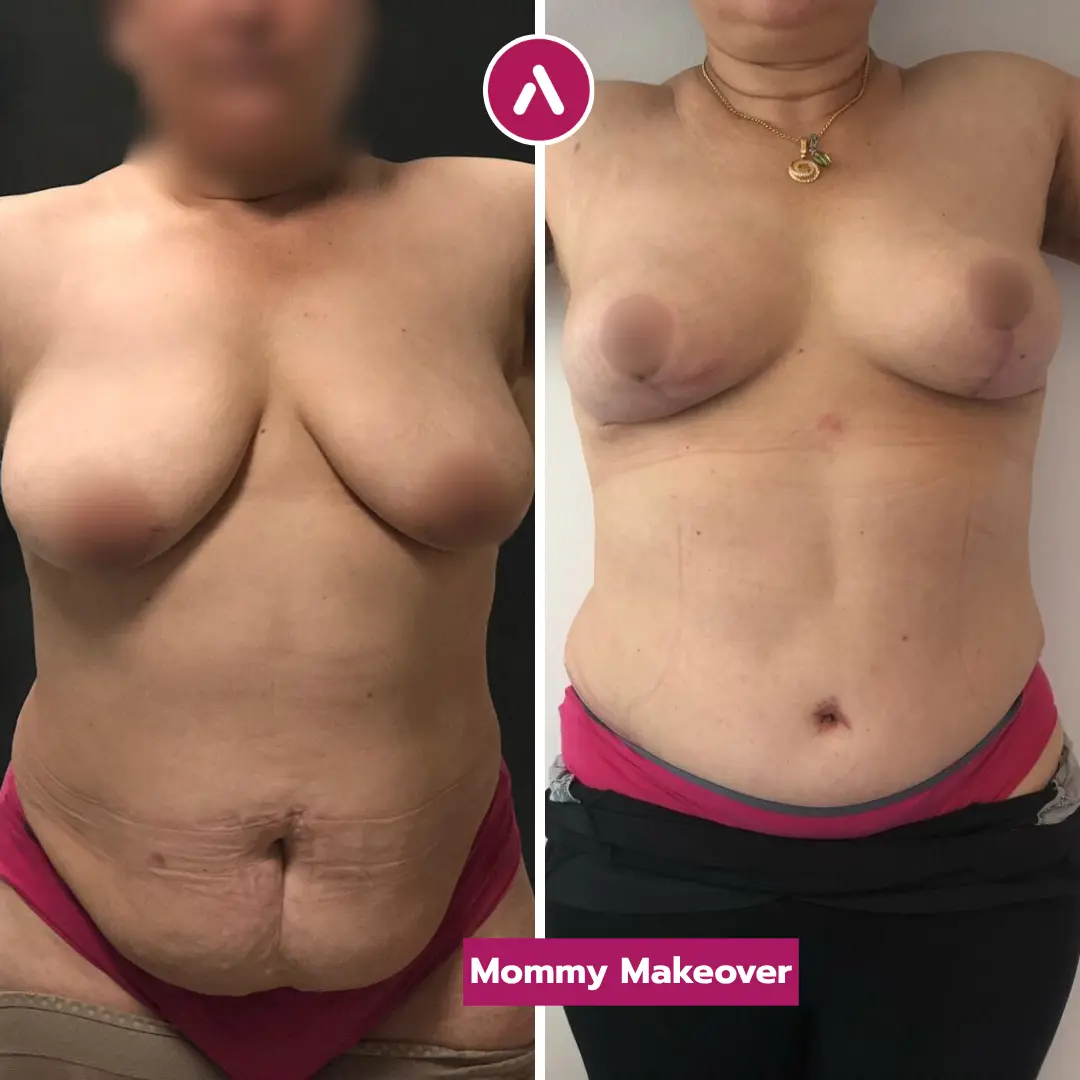
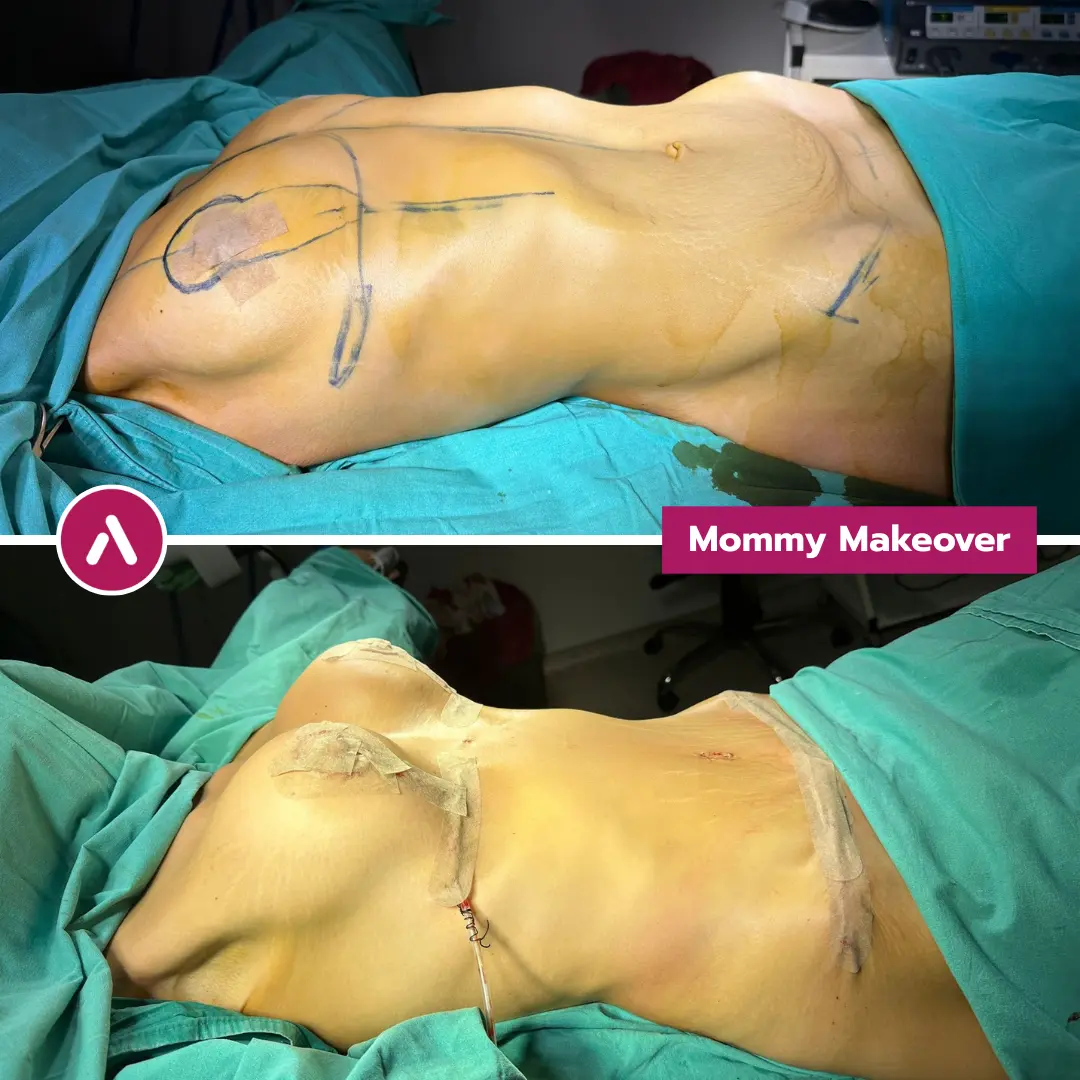
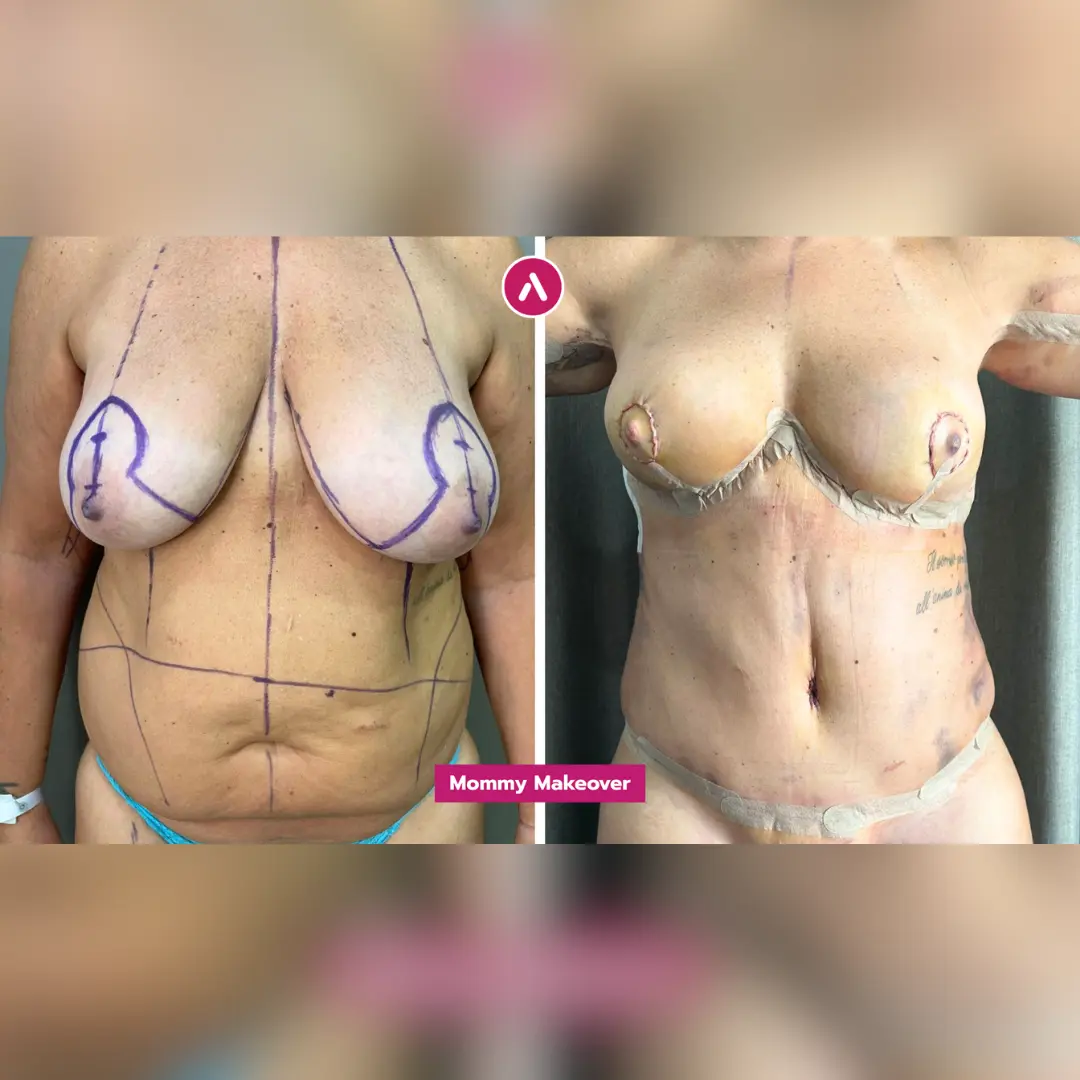
For patients considering tummy tuck as part of a broader post-pregnancy plan, the procedure may also be evaluated within mommy makeover procedure planning. That context can help when breast surgery, liposuction, or abdominal repair are being considered together.
Canadian Patient Note: Full tummy tuck is often the practical choice after pregnancy
Patients from Ontario, British Columbia, Quebec, and Alberta often begin consultations hoping for the shortest recovery possible. That is understandable, especially when childcare, work leave, and long-haul travel are involved.
However, post-pregnancy abdominal change commonly affects skin, muscle, and belly button position together. A full tummy tuck may be the more practical choice because it corrects the whole pattern in one procedure rather than treating only the most visible lower pouch.
Recovery Differences
Recovery is one of the biggest practical differences between mini and full tummy tuck surgery. Mini tummy tuck recovery is usually shorter because the treated area is smaller. Full tummy tuck recovery is more involved because it often includes broader skin tightening and abdominal muscle repair.
That does not mean full tummy tuck recovery is unmanageable. It means the patient must plan more carefully. For a broader recovery checklist, see our guide to practical tummy tuck recovery planning.
Mini tummy tuck recovery timeline — faster
Mini tummy tuck recovery is typically easier because the incision is shorter and the abdominal wall work is limited. Patients may feel tightness, swelling, and lower-abdominal soreness, but mobility often returns more quickly than after a full procedure.
Many patients can walk gently within the first day. Light daily activities usually resume earlier, although lifting, core training, and strenuous exercise still need medical clearance.
A general mini recovery pattern may look like this:
- Days 1-3: Tightness, swelling, and careful walking.
- Week 1: Improved mobility, continued compression garment use.
- Weeks 2-3: Return to desk-based work may be possible for selected patients.
- Weeks 4-6: Gradual return to more normal activity, based on surgeon approval.
These timelines vary. A patient having mini tummy tuck with added liposuction may need more recovery time than a patient having skin-only lower-abdominal correction.
Full tummy tuck recovery timeline
Full tummy tuck recovery is more demanding because the operation usually treats more tissue and may include full abdominal muscle repair. Patients often walk slightly bent forward at first to avoid tension on the incision.
The first week is the most restrictive. Swelling, tightness, and fatigue are expected. Compression garments, careful walking, hydration, and sleep positioning all matter.
A typical full tummy tuck recovery pattern may look like this:
- Days 1-3: Assisted walking, tightness, swelling, and limited standing posture.
- Week 1: Gradual increase in walking, continued rest, and close post-op monitoring.
- Weeks 2-3: Many desk-based patients can begin remote or modified work.
- Weeks 4-6: Activity increases, but core strain and heavy lifting remain restricted.
- Weeks 8-12: More normal movement patterns return for many patients, depending on healing.
Canadian patients should plan recovery around their real life, not the fastest possible scenario. A teacher in Ottawa, a healthcare worker in Vancouver, and a parent in suburban Toronto may all need different time-off strategies.
Fit-to-fly clearance for Canadian return journey
Flying back to Canada after tummy tuck surgery requires more planning than returning after a smaller facial procedure. The return journey from Istanbul to Toronto, Montreal, Vancouver, or Calgary can involve long flight times, airport walking, and extended sitting.
Mini tummy tuck patients may receive fit-to-fly clearance sooner than full tummy tuck patients, but clearance depends on the surgeon’s assessment. The incision must be stable. Swelling, mobility, and clot-risk factors must also be considered.
Full tummy tuck patients should plan for a longer Istanbul stay when possible. This gives the surgical team time to monitor early healing and address concerns before the return flight.
During the return trip, patients should expect to:
- Walk gently during airport waiting periods and during the flight when safe.
- Wear compression garments exactly as instructed.
- Avoid lifting luggage into overhead bins.
- Arrange private transport from the Canadian airport to home.
- Continue medication and wound-care instructions without interruption.
Canadian Return-to-Work Planning
For office-based roles, mini tummy tuck patients may be able to return to modified work sooner than full tummy tuck patients. Full tummy tuck patients often need a more conservative leave plan, especially when muscle repair is performed.
Patients in nursing, childcare, teaching, retail, hospitality, construction, or fitness-related jobs should plan around lifting and standing limits. Canadian winter also adds practical challenges, including heavier coats, slippery sidewalks, and snow-clearing tasks that should be avoided during early recovery.
Cost Comparison in CAD
Cost matters, but it should not be the first deciding factor between mini and full tummy tuck surgery. The lower price of a mini tummy tuck only represents value when the smaller operation can actually correct the anatomy.
At AKM Clinic, pricing is presented in Canadian dollars for Canadian patients. The figures below come from the AKM Clinic Treatment Techniques Cost reference and should be read as procedure-specific pricing, not a substitute for a personal surgical quote.
Mini tummy tuck pricing
The mini tummy tuck price at AKM Clinic is CAD $4,800. This reflects the smaller surgical field, shorter incision, and more limited tissue correction compared with a full tummy tuck.
For the right candidate, this can be an efficient option. The patient receives focused lower-abdominal tightening without paying for a broader procedure they do not need.
The key phrase is “right candidate.” A mini tummy tuck is not automatically the best value because it is less expensive. It is only the best value when the lower abdomen is the only meaningful concern.
Full tummy tuck pricing
The full tummy tuck price at AKM Clinic is CAD $6,550. This reflects the wider treatment area, the possibility of abdominal wall repair, and belly button repositioning.
Patients comparing this with mini tummy tuck pricing should focus on what the procedure includes anatomically. A full tummy tuck treats more than loose lower skin. It can address the central abdominal wall and upper-abdominal laxity that mini surgery cannot correct.
For a Canadian patient who needs full correction, paying less for a mini procedure may not be strategic. It can lead to persistent concerns and future revision planning.
For a detailed procedure-level breakdown, review mini and full tummy tuck pricing in CAD.
Why the difference reflects scope, not value
The cost difference between mini and full tummy tuck surgery is not a quality difference. It is a scope difference. More tissue work, muscle repair, and umbilical repositioning require more surgical planning and recovery support.
A mini tummy tuck may be the better value for a patient with isolated lower-abdominal laxity. A full tummy tuck may be the better value for a patient with whole-abdomen looseness or muscle separation.
The wrong procedure can become the more expensive choice over time. If a mini tummy tuck leaves untreated upper laxity, the patient may later need a second operation, more time away from work, and another recovery period.
| Cost Factor | Mini Tummy Tuck | Full Tummy Tuck |
|---|---|---|
| AKM Clinic CAD pricing | CAD $4,800 | CAD $6,550 |
| Primary value | Focused lower-abdominal correction | Full-abdominal correction with broader structural repair |
| Best suited for | Small lower-abdominal pouch with good upper-abdominal tone | Loose skin above and below the belly button, often with muscle separation |
| Common hidden risk | Choosing it when the anatomy requires full correction | Longer recovery and a longer scar than the patient initially expected |
| Value question | “Is my problem truly limited to the lower abdomen?” | “Do I need a complete structural correction?” |
Canadian Patient Note: When the cost difference matters less than the result difference
For many Canadian patients, the practical cost is not only the surgical fee. It also includes time away from work, help at home, childcare, travel planning, and the emotional cost of going through recovery.
If full correction is needed, choosing a smaller operation to reduce the upfront price can create poor value. A complete result from the right procedure is usually more efficient than a limited result followed by revision discussions.
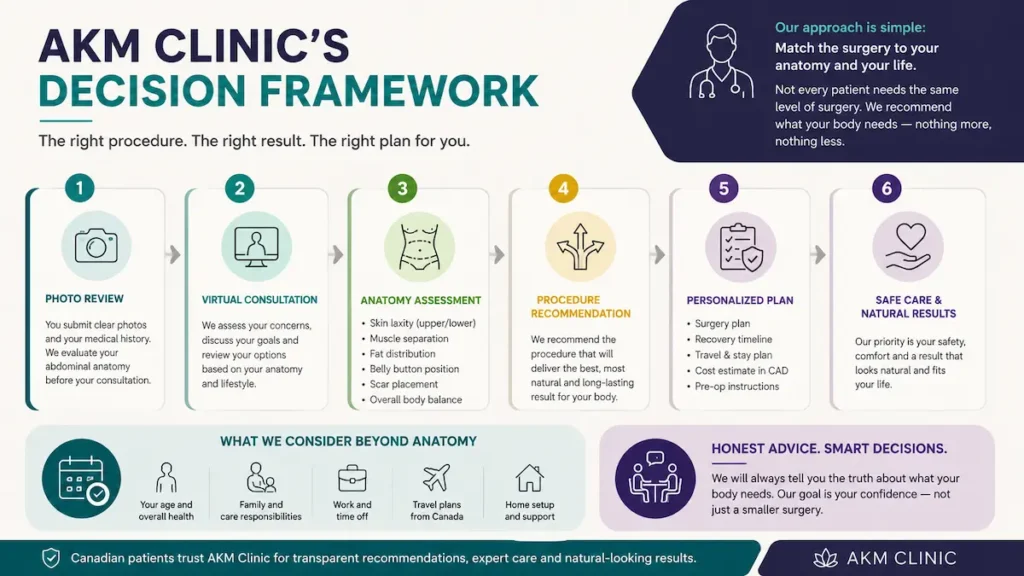
AKM Clinic’s Decision Framework
AKM Clinic’s approach is built around matching the procedure to the patient’s anatomy. That means the consultation is diagnostic first. The surgeon evaluates what is loose, what is separated, what can be safely removed, and what cannot be corrected through a smaller incision.
This fits AKM Clinic’s “Natural-First” philosophy. A good tummy tuck should not look over-tightened or mismatched. It should look proportional to the patient’s body, posture, and natural waistline.
How the surgeon evaluates anatomy at consultation
The evaluation begins with photos and medical history. Canadian patients usually submit front, side, and angled photos before a virtual consultation. Pregnancy history, weight changes, C-section scars, hernia history, and previous abdominal surgery are all relevant.
The surgeon looks for several anatomical markers:
- Where the loose skin begins and ends.
- Whether the upper abdomen bulges or folds.
- Whether the belly button sits naturally or appears stretched.
- Whether diastasis recti is likely.
- How much skin can be removed without excessive tension.
- Whether liposuction should be added for contour refinement.
This process helps determine whether mini, full, extended, or combined surgery is appropriate. It also prevents the common mistake of choosing based on scar length alone.
Canadian patients should also evaluate any surgical recommendation against familiar Canadian credentialing expectations. The Canadian Society of Plastic Surgeons explains that plastic surgeons in Canada complete a minimum of 5 years of plastic surgery training and pass Royal College certification examinations; that standard is a useful benchmark when comparing care abroad. You can review the Canadian Society of Plastic Surgeons credentialing context, and read more about the clinic’s overall assessment philosophy in AKM Clinic’s diagnostic methodology.
When patients want mini but need full — and vice versa
Many patients ask for mini tummy tuck because they want less scarring, lower cost, and faster recovery. Those are valid priorities. They cannot override anatomy.
A patient may want mini but need full when the upper abdomen is loose, the belly button would look displaced, or muscle separation extends above the umbilicus. In that situation, mini surgery may improve the lower pouch but leave the main structural issue untreated.
The reverse can also happen. A patient may assume they need full surgery because they dislike the lower abdomen, yet the upper abdomen is firm and the muscle wall is intact. In those cases, a mini tummy tuck may be enough.
The consultation should clarify this without pressure. The right recommendation should make anatomical sense.
The honest conversation principle
An honest tummy tuck consultation should sometimes be disappointing in the short term. A patient may arrive hoping for the smaller operation and learn that full correction is needed. That is not a sales tactic. It is a safeguard against under-treatment.
The opposite also matters. If a patient is a true mini candidate, recommending full surgery would create unnecessary scarring and recovery. The goal is the correct scope, not the largest scope.
AKM Clinic’s decision process is designed around three questions:
- What anatomical problem is present?
- Which procedure corrects that problem completely?
- What recovery plan is realistic for the patient’s Canadian life?
This is especially important for patients travelling from Canada. The surgical plan must work medically, aesthetically, and logistically.
Canadian Patient Note: Plan around your real recovery environment
A patient returning to a condo in downtown Toronto, a detached home in Calgary, or a walk-up apartment in Montreal may face very different recovery challenges. Stairs, childcare, winter weather, and commuting all affect the practical plan.
During consultation, discuss your job, home setup, caregiving duties, and travel route. A good recommendation should consider the body you have and the recovery environment you will return to.
If you are comparing mini and full tummy tuck options, the most useful next step is a photo-based virtual consultation. AKM Clinic can evaluate your abdominal skin, muscle pattern, belly button position, and travel timeline before you commit to a surgical plan.
Before choosing any abdominal contouring procedure, Canadian patients should confirm that the recommendation comes from a qualified surgical team and aligns with accepted plastic surgery principles. The Canadian Society of Plastic Surgeons provides useful patient-safety context for evaluating plastic surgeons in Canada, while ISAPS offers international context for aesthetic surgery standards.
The right tummy tuck plan should be clear before travel is booked. At AKM Clinic, that planning begins with photos, medical history, and a virtual consultation focused on candidacy rather than procedure preference.
Frequently Asked Questions: Mini vs Full Tummy Tuck:
These questions address the most common concerns Canadian patients raise when comparing mini and full tummy tuck surgery. The answers are general educational guidance and do not replace a personal consultation.
How do I know which I need?
You likely need a mini tummy tuck only if your concern is limited to loose skin below the belly button. Your upper abdomen should already be firm, and there should be no significant muscle separation above the umbilicus.
You may need a full tummy tuck if looseness extends above the belly button, your abdomen bulges from muscle separation, or your belly button would need repositioning after skin tightening. A virtual consultation can usually identify the likely direction before you travel.
Can mini tummy tuck become full mid-procedure?
The goal is to avoid that uncertainty through proper pre-operative planning. Your surgeon should identify the correct scope before surgery, based on photos, examination, and your abdominal wall assessment.
In some cases, final decisions are confirmed during the in-person consultation in Istanbul. That is different from improvising mid-procedure. The safest plan is one that is understood before you enter the operating room.
Is mini tummy tuck always cheaper?
Mini tummy tuck has a lower listed price at AKM Clinic: CAD $4,800, compared with CAD $6,550 for full tummy tuck. That does not automatically make it the better financial choice.
If your anatomy requires full correction, a mini tummy tuck may leave you under-corrected. In that case, the lower upfront cost could create poor long-term value because revision or additional surgery may be needed later.
Does mini have less scarring?
Usually, yes. A mini tummy tuck typically uses a shorter lower-abdominal incision because less skin is removed. The belly button usually does not need a new opening.
However, scar length should not decide the procedure. If a longer scar allows complete correction and a natural abdominal contour, it may be the better trade-off. Scar placement and aftercare also matter greatly.
Can I have mini if I have diastasis recti?
It depends on the location and severity of the diastasis. If the separation is mild and limited to the lower abdomen, a mini tummy tuck may be considered in select cases.
If the diastasis extends above the belly button, a full tummy tuck is usually the more appropriate option. Full surgery gives the surgeon access to repair the abdominal wall more completely.
Will mini tummy tuck give me the same result?
No. Mini and full tummy tuck surgery do not produce the same result because they do not treat the same anatomy.
A mini tummy tuck can improve the lower abdomen. A full tummy tuck can reshape the entire abdomen, repair muscle separation when needed, and reposition the belly button. If your concern is full-abdominal looseness, mini surgery cannot create a full tummy tuck result.
How long is each recovery in Canadian return-to-work context?
Mini tummy tuck recovery is usually shorter. Some desk-based patients may return to modified work within a couple of weeks, depending on healing and surgeon clearance.
Full tummy tuck recovery typically requires more planning. Patients with muscle repair, physically demanding jobs, childcare duties, or long commutes may need a longer modified-work period. Canadian winter conditions can also affect recovery safety, especially if snow, ice, heavy coats, or stairs are part of daily life.
Which option is better after pregnancy?
Many post-pregnancy patients need a full tummy tuck because pregnancy often affects skin, muscles, and belly button position together. This is especially true when there is diastasis recti or skin looseness above the belly button.
A mini tummy tuck may be suitable after pregnancy only when the upper abdomen remains firm and the lower pouch is the only concern. A surgeon should confirm this through assessment rather than assumption.
Can liposuction be added to either procedure?
Yes, liposuction can sometimes be added to refine the waist, flanks, or upper abdomen. It should be used strategically.
Liposuction removes fat. It does not tighten loose skin or repair muscle separation. For some patients, combining liposuction with tummy tuck surgery gives a better contour than either procedure alone.
What is the best next step if I am unsure?
The best next step is a photo-based virtual consultation. Submit clear front, side, and angled photos, along with pregnancy history, weight-change history, previous abdominal surgeries, and your recovery constraints in Canada.
AKM Clinic can then explain whether mini tummy tuck, full tummy tuck, or another body-contouring plan fits your anatomy. The goal is not the smallest surgery. The goal is the right surgery.
Determine your candidacy in a virtual consultation
If you are comparing mini vs full tummy tuck surgery, AKM Clinic can review your photos and help determine which option matches your anatomy, recovery timeline, and travel plan from Canada.
Request a consultation to receive a personalized surgical recommendation and CAD-based pricing guidance before booking your Istanbul trip.
Medical Disclaimer: This page is provided for general educational purposes only and does not replace an in-person medical consultation, diagnosis, or personalized treatment plan. All surgery carries risks, and outcomes vary between individuals. Suitability for a tummy tuck surgery, procedure selection, and anesthesia choice can only be determined after a full clinical assessment by a qualified surgeon. Always follow your clinician’s instructions and seek urgent medical attention if you develop concerning symptoms during recovery.