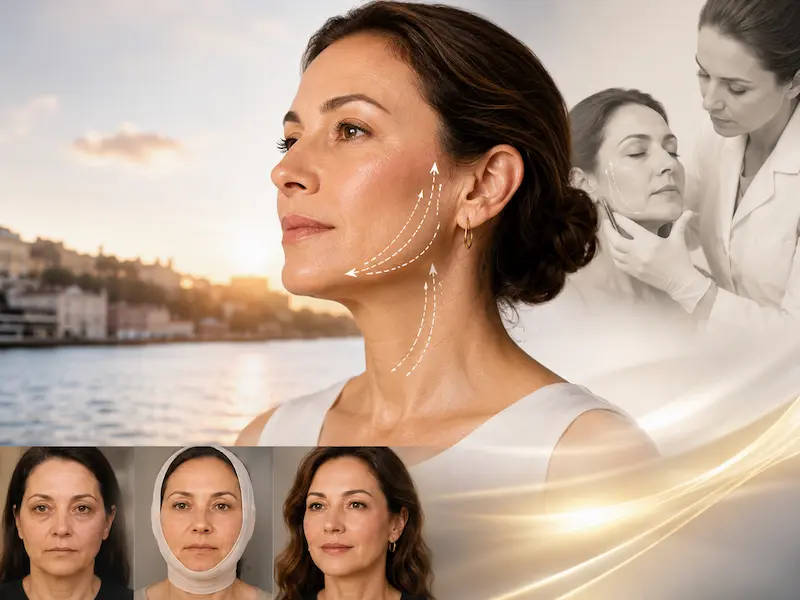
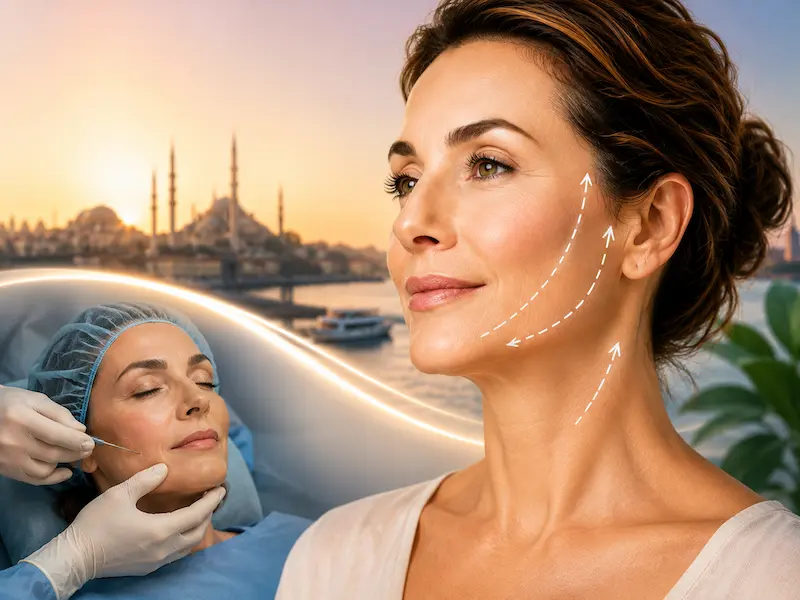
Quick Summary: Awake deep plane facelift can create structural before-and-after changes similar to traditional facelift, while avoiding general anesthesia for suitable patients. This guide explains what Canadian patients should look for in awake facelift before and after photos, including mid-face lift, jawline definition, neck improvement, and natural facial expression.
For many Canadian patients, awake facelift before and after photos are the deciding factor. They want to see whether local anesthesia limits the result, whether the face still looks natural, and whether the improvement is strong enough to justify travelling to Istanbul.
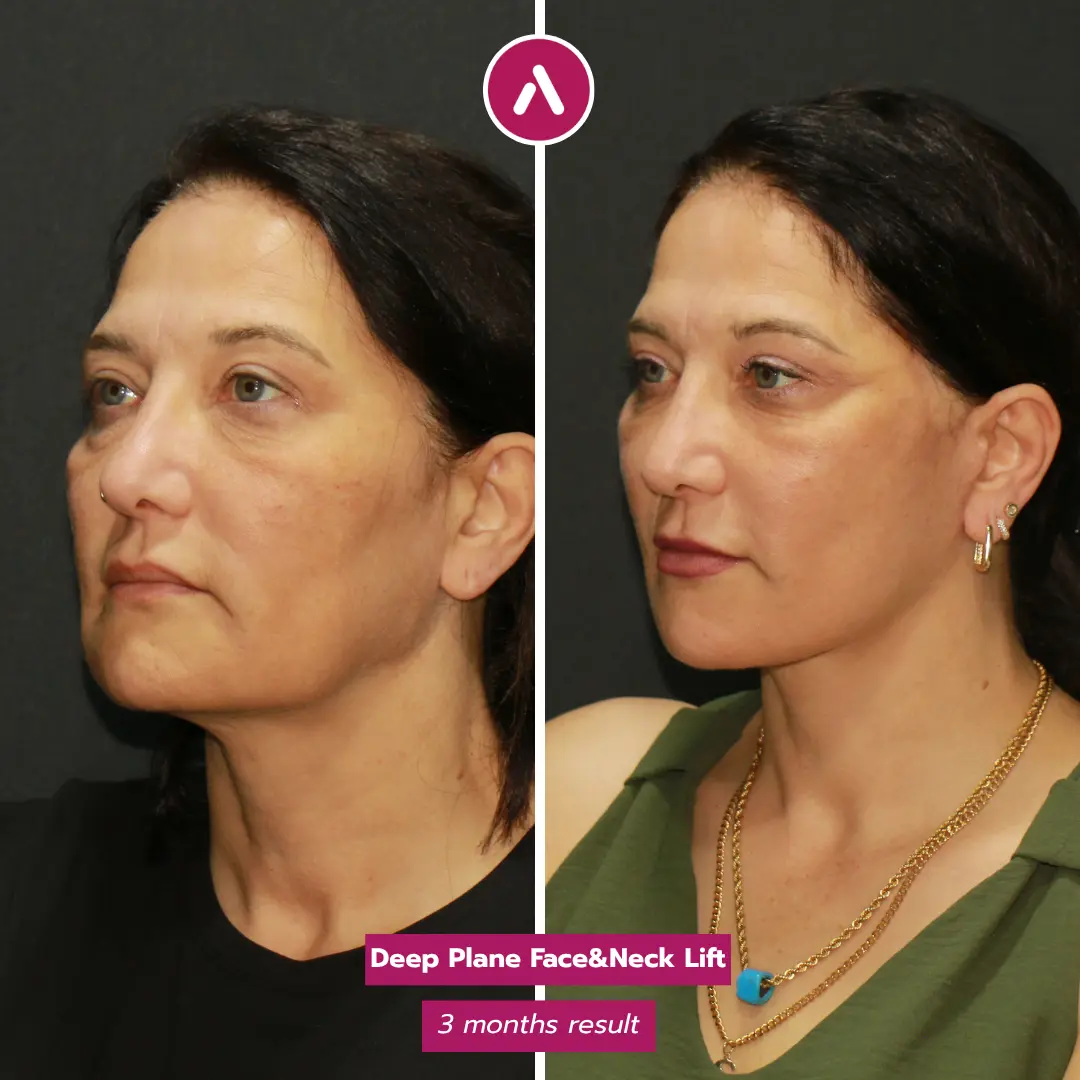
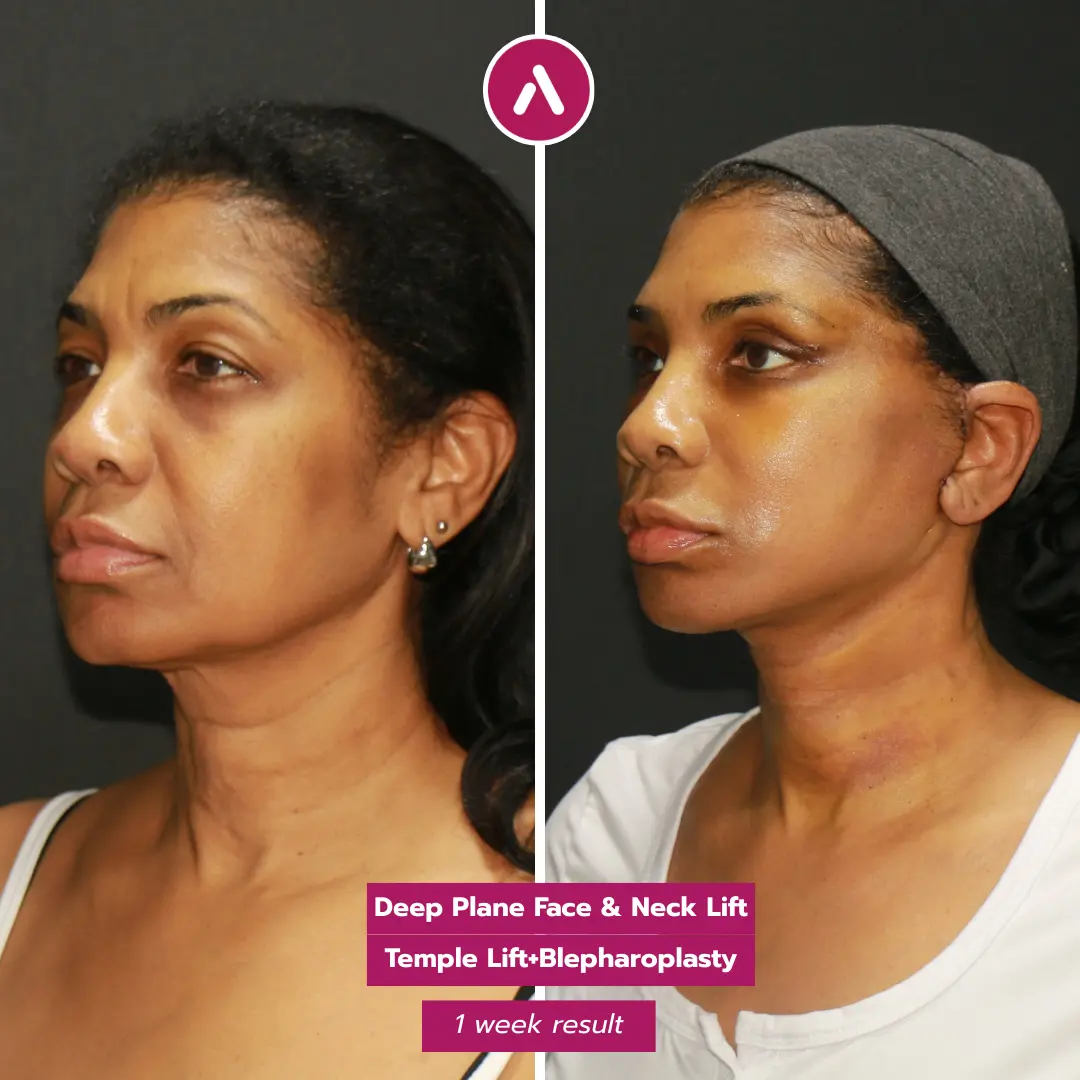
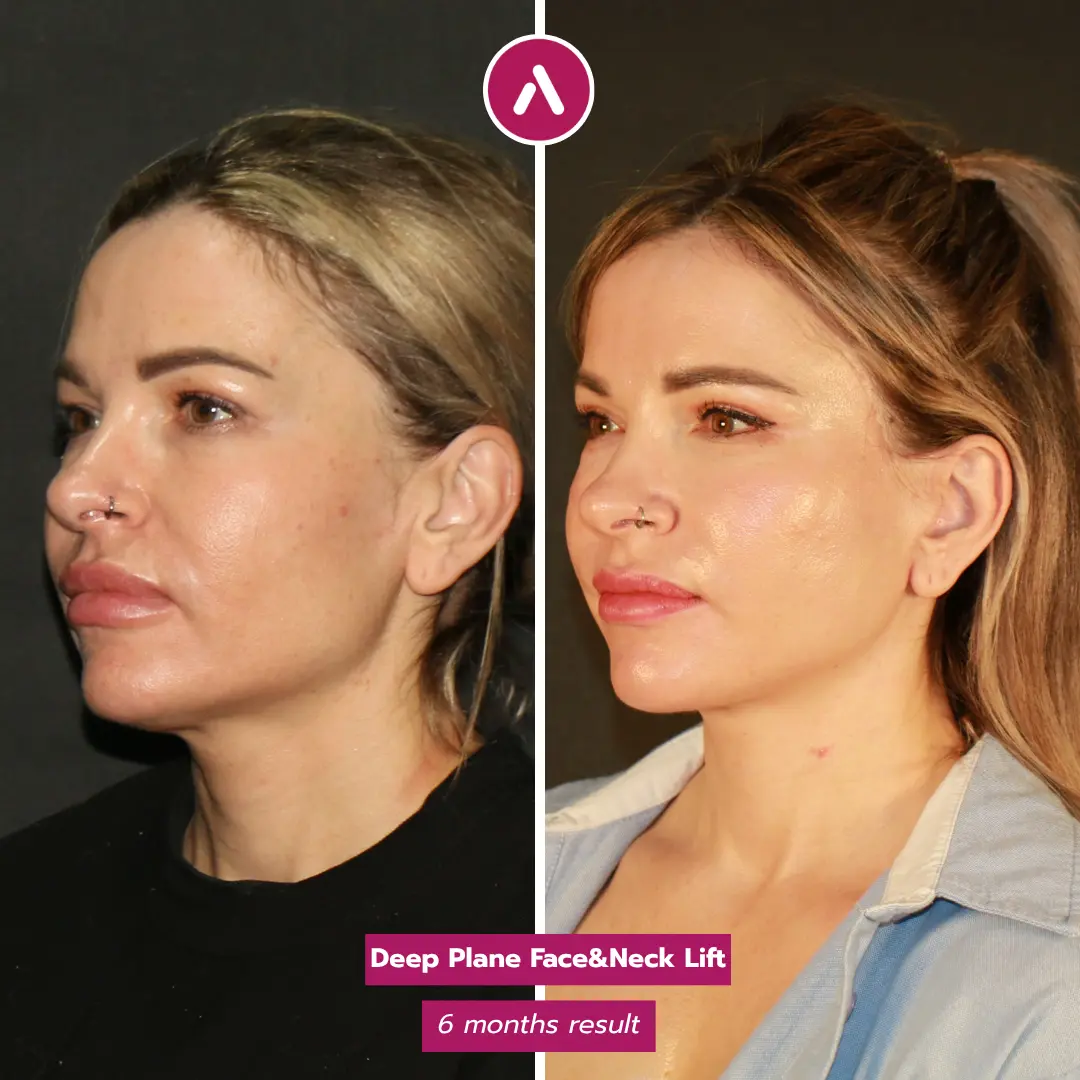
At AKM Clinic, awake facelift is not a lighter marketing version of facial surgery. For suitable patients, the awake deep plane facelift technique still works on deeper facial support layers rather than simply tightening skin. The difference is the anesthesia model: local anesthesia with sedation support instead of full general anesthesia.
This article focuses on visual outcomes. It does not cover awake pain in detail, and it does not compare every anesthesia model. For those topics, the article will link to the relevant guides where they belong.
Disclosure: These case patterns composite verified patient outcomes; identifying details have been anonymized. Individual results vary based on anatomy, skin quality, age, healing capacity, and surgical scope.
Table of Contents
What Awake Facelift Before and After Photos Show Visually
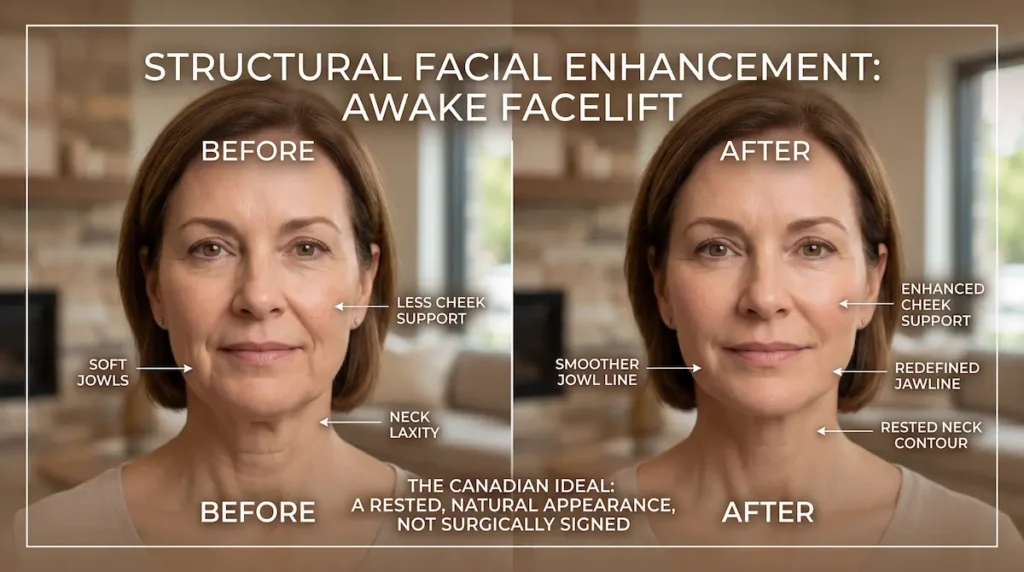
Awake facelift results should be judged by structure, not drama. A good before-and-after comparison shows a cleaner jawline, better cheek support, softer jowls, and a more rested neck without making the patient look like a different person.
The most important question is not, “Does this look dramatic?” It is, “Does this look believable?” Canadian patients usually prefer a quiet, natural change over an obvious surgical signature.
Lifting capacity compared with traditional facelift
A suitable awake facelift candidate can achieve meaningful tissue repositioning. The use of local anesthesia does not mean the surgeon is only treating the skin.
In a deep plane approach, the target is the deeper facial support system. This is why awake results can show visible improvement in the mid-face, lower face, and jawline when the patient’s anatomy is appropriate.
The best photos show vertical lift rather than backward pull. That distinction matters. A backward pull can flatten the face, widen scars, or create a tight appearance around the mouth and ears.
Why local anesthesia does not compromise the final result
The anesthesia method controls patient comfort. It does not decide the quality of the surgical plan.
Local anesthesia numbs the surgical area, while sedation support helps reduce anxiety and procedural awareness. For the right patient, this allows the surgeon to perform careful tissue repositioning without the physiological load of general anesthesia.
For readers comparing anesthesia options, see the anesthesia model comparison. That article explains which patients may be better suited to local anesthesia and which patients may still need general anesthesia.
Structural changes documented across awake patient case patterns
Across awake facelift case patterns, the most common visual changes appear in four areas: the cheek, the nasolabial fold, the jowl line, and the upper neck. These are the areas where early ageing often appears first in photos.
- Mid-face: The cheek looks better supported, especially in three-quarter views.
- Jawline: Jowls soften, and the mandibular border becomes clearer.
- Neck: Mild to moderate laxity improves without an over-tightened look.
- Expression: The face should still move naturally in smiling and conversation.
This is where AKM Clinic’s “Natural-First” approach matters. For the broader aesthetic philosophy, see the natural results philosophy applied to awake outcomes.
Canadian patient note: Patients from Toronto, Vancouver, Montreal, and Calgary often tell the clinic they do not want colleagues to identify surgery. They want to look rested, not “done.” Awake before-and-after photos should be reviewed with that standard in mind.
Patient Case Pattern 1 — Mid-Face and Jawline
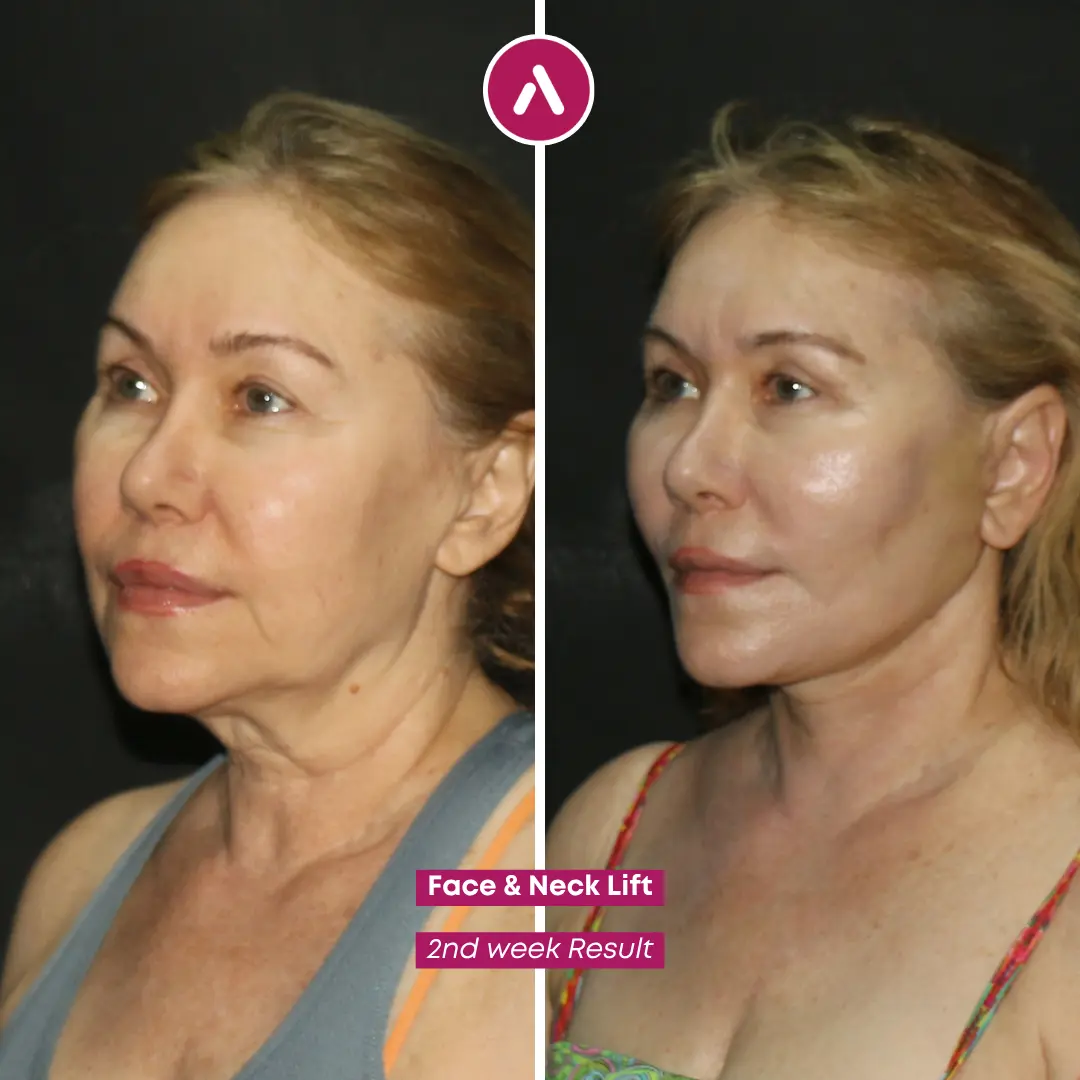
The first awake facelift case pattern is the patient whose main concern is facial heaviness rather than severe neck laxity. In before photos, this profile often shows cheek descent, early jowling, and a tired lower-face contour.
After surgery, the strongest improvement is usually seen from the front and three-quarter angle. The face looks more supported, but not stretched.
Pre-operative concerns and surgical planning
This patient profile usually asks for a refreshed look while keeping their identity intact. Common concerns include softened cheek volume, deeper smile lines, early jowls, and loss of definition along the jaw.
The surgical plan focuses on lifting the deeper facial support layer rather than simply excising extra skin. Skin removal is still part of the procedure, but it should not be the main engine of the result.
Good planning also considers facial asymmetry. Most people have one cheek, brow, or jawline that sits slightly differently from the other. The goal is improvement, not artificial symmetry.
Awake procedure experience under local anesthesia
During an awake facelift, the patient is not expected to “tough it out.” Comfort is planned through local anesthesia and sedation support.
The patient may feel pressure, movement, or vibration, but pain should be controlled. Anxiety management starts before the operating room, during consultation and expectation setting.
For the specific comfort question, see for the awake pain experience, see our awake facelift pain guide. That guide owns the pain-management topic, while this article stays focused on visible results.
“I chose the awake option because I wanted a faster, clearer recovery, but I was still worried the result might be less complete. What surprised me most was that the change looked structural, not minor. I still looked like myself.”An anonymized composite patient reflection
3-month and 6-month result patterns
At 3 months, swelling has reduced enough for the main structural change to be visible. The jawline usually looks cleaner, and the cheek support appears more stable in photographs.
At 6 months, the result looks more settled. Minor firmness and residual swelling continue to soften, especially around the ears and lower face.
This is the stage where many patients stop analyzing each small change and simply feel that their face looks more balanced. That shift matters. A good awake facelift before-and-after result should become easier to live with over time, not harder to explain.

Patient Case Pattern 2 — Neck and Lower Face
The second awake facelift case pattern is the patient whose main concern sits below the cheeks. In before photos, this profile often shows early neck looseness, jowling, and softening under the chin.
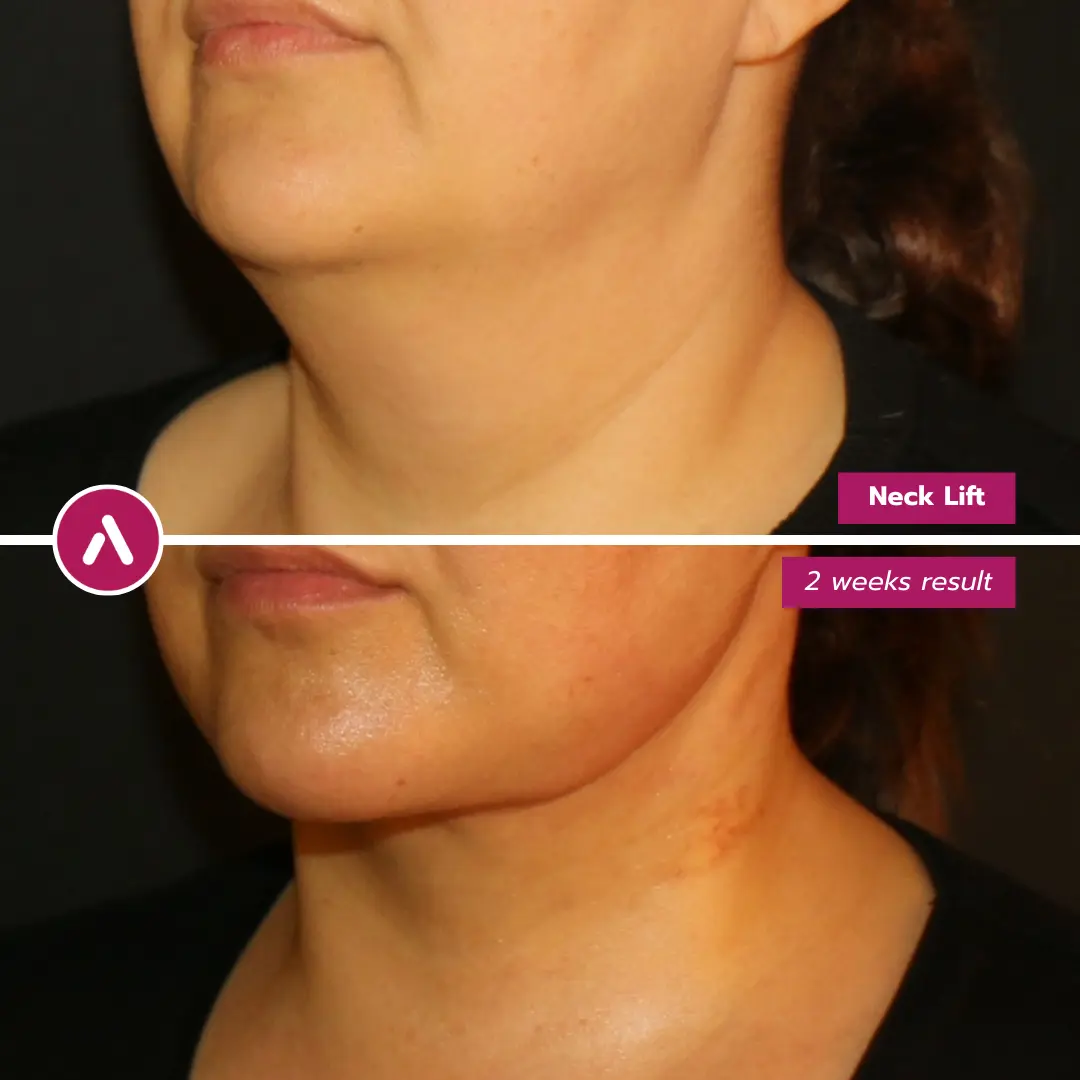
The after photos should not show a tight or pulled neck. They should show a cleaner transition from chin to neck, better lower-face support, and a jawline that looks natural in both front and side views.
Why patients in this profile choose awake over asleep
Many patients in this group want meaningful lower-face change but feel cautious about general anesthesia. That concern is common among Canadian patients who are already weighing a long-haul return flight from Istanbul to YYZ, YUL, or YVR.
Awake surgery can be attractive when the patient is medically suitable, psychologically comfortable, and anatomically appropriate for the scope of work. It may allow earlier mobility and less post-anesthesia grogginess.
It is not right for every case. Significant neck bands, major skin excess, or complex revision anatomy may require a different surgical plan.
What changes in the neck, jowls, and jawline
In this case pattern, the visual result is usually clearest along the lower border of the face. The jowl no longer interrupts the jawline as much, and the neck appears more supported.
The best after photos show a refined contour without an artificial angle. A neck that looks too tight can age the result poorly.
- Jowls: The lower-face heaviness softens, especially beside the mouth.
- Jawline: The mandibular line becomes easier to see in profile.
- Under-chin area: Mild laxity improves when the surgical plan includes adequate lower-face support.
- Neck transition: The chin-to-neck curve becomes cleaner without looking stretched.
Long-term outcome patterns after tissue settling
Lower-face and neck results continue to settle for months. Early photos can look promising, but 6-month and 12-month photos are more useful for judging final balance.
Canadian patients reviewing a gallery should ask to see different angles. A front photo can hide neck laxity. A side view and three-quarter view reveal far more.
Movement matters as well. A natural result should look believable when the patient smiles, speaks, and turns their head.
Canadian patient note: If you plan to return to work in Toronto, Vancouver, Montreal, Calgary, or Ottawa within a few weeks, review photos by recovery stage. A beautiful 6-month result does not tell you how visible swelling looked on day 10.
Patient Case Pattern 3 — Mini Awake Facelift
The third case pattern is the patient with earlier facial aging. This person may not need a full deep plane facelift but still wants improvement in the lower face, jawline, or early cheek descent.
A mini awake facelift can be effective when the problem is mild to moderate. It should not be used as a substitute for a full procedure when the anatomy clearly needs more support.
When mini scope is enough
Mini scope may be enough when the patient has good skin quality, limited neck laxity, and early jowling. In before photos, the face may look tired rather than heavily aged.
The surgical goal is subtle refinement. The after photo should show cleaner lines, not a dramatic change in facial identity.
This is often appealing to patients in professional settings who want a discreet result. They may want colleagues to notice that they look rested, not suspect surgery.
Recovery advantages with the awake protocol
A mini awake facelift generally involves a smaller surgical field than a full face and neck lift. For suitable patients, that can mean less early swelling and a shorter visible recovery period.
That said, “mini” does not mean effortless. Bruising, tightness, numbness, and temporary asymmetry can still occur.
The awake protocol may help suitable patients feel clearer shortly after surgery. This can be useful for international patients managing hotel recovery, patient-host communication, and pre-flight check-ups.
1-year photographic update patterns
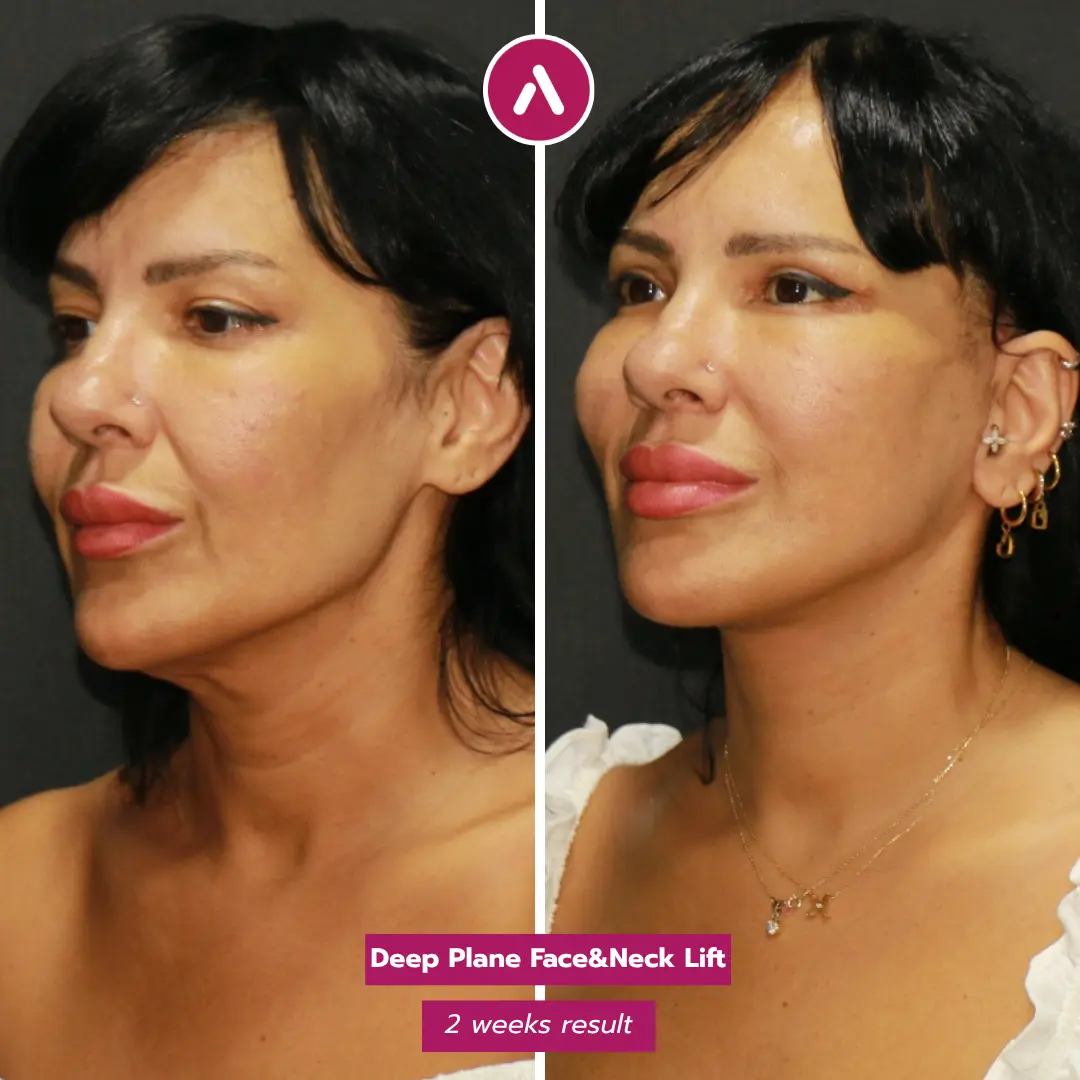
One-year photos are especially useful for mini awake facelift cases. They show whether the result held after swelling disappeared and the tissues settled.
A strong 1-year result should still show jawline improvement, natural expression, and no obvious tension around the ears. Scar placement and scar quality matter as well.
If the one-year result looks too minor, the patient may have needed a broader procedure. If it looks too tight, the surgical vector may have been too aggressive.
| Case pattern | Typical age range | Procedure scope | Anesthesia type | Useful follow-up photos | Observable change |
|---|---|---|---|---|---|
| Mid-face and jawline | Late 40s to early 60s | Awake deep plane facelift | Local anesthesia with sedation support | 3 months and 6 months | Better cheek support, softer jowls, cleaner jawline |
| Neck and lower face | 50s to mid-60s | Awake facelift with lower-face and neck focus | Local anesthesia with sedation support | 6 months and 12 months | Improved neck contour, reduced jowling, stronger chin-to-neck transition |
| Mini awake facelift | 40s to mid-50s | Shorter-scope lower-face refinement | Local anesthesia with sedation support | 3 months and 1 year | Subtle jawline refinement and early aging correction |
These case patterns are not promises. They are a practical way to understand how different anatomies respond to awake facial surgery.
The right consultation should compare your photos with your anatomy, not with someone else’s best result. That is the safest way to use before-and-after galleries.
Reading Awake Before-and-After Photos Critically
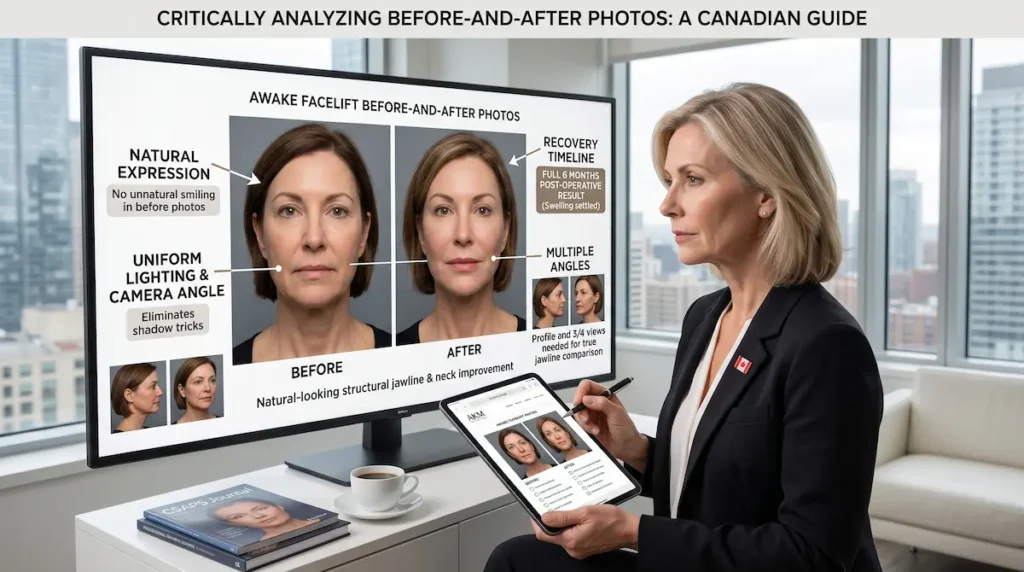
Before-and-after photos can help you understand what awake facelift can achieve, but they should be read carefully. A single beautiful image is not enough. The most useful gallery shows consistent lighting, similar facial expression, multiple angles, and enough time after surgery for swelling to settle.
Canadian patients should also remember that a photo is only one part of surgical evaluation. Your skin quality, bone structure, facial volume, neck anatomy, and healing pattern all affect your personal result.
Photographic standards used at AKM Clinic
Reliable before-and-after documentation should make comparison easy. The patient should be positioned similarly in both photos, with the same camera distance and similar facial expression.
At AKM Clinic, the goal is to help patients compare structural change rather than be distracted by styling, makeup, or lighting. You can also review the complete deep plane gallery for broader facial rejuvenation examples.
Patients should look for several angles whenever possible. Front-facing photos show facial balance, while profile and three-quarter views reveal jawline and neck improvement more clearly.
Canadian patient note: If you are comparing galleries from several clinics, save photos from the same angle and recovery stage. A 12-month result should not be compared with someone else’s 3-week result.
Lighting, angle, expression, and timing consistency
Lighting can change how the jawline, cheeks, and neck look. Shadows can exaggerate improvement or hide swelling.
Angle matters as much as lighting. A chin tilted upward can make the neck look tighter. A slight head turn can sharpen the jawline.
Expression is another common issue. A smiling before photo and a relaxed after photo cannot be compared fairly. The reverse is also true.
Professional aesthetic organizations such as the Canadian Society for Aesthetic Plastic Surgery and the International Society of Aesthetic Plastic Surgery are useful context points when patients want to understand responsible aesthetic documentation and surgeon-led care.
What before-and-after photos cannot show
Photos cannot show sensation. Temporary numbness, tightness, firmness, and small areas of swelling may still be present even when the result looks polished.
Photos also cannot show how the patient feels during recovery. A person may look socially ready before they feel fully normal.
This is why consultation matters. The gallery can show patterns, but your surgical plan should be based on your own anatomy. For more context on clinic standards and patient care, review AKM photographic documentation standards.
Frequently Asked Questions: Awake Facelift Before and After
The questions below address the concerns Canadian patients most often raise when reviewing awake facelift before-and-after results. They focus on outcome realism, verification, longevity, and recovery timing.
Is the result the same as an asleep facelift?
For suitable candidates, awake facelift can produce structural results comparable to an asleep facelift. The key factor is not the anesthesia alone. It is whether the chosen technique matches the patient’s anatomy.
Some patients still need general anesthesia because of procedure scope, anxiety profile, or medical factors. That decision should be made during surgical assessment.
Can I see Canadian patient awake before-and-afters?
During consultation, Canadian patients can ask the AKM Clinic team to show relevant case examples based on age, facial structure, and surgical goals. The most useful examples are not always the most dramatic ones.
Ask for cases that resemble your own concerns. A patient with mild jowling should not judge their likely outcome from a severe neck-laxity case.
How long do awake facelift results last?
Longevity depends on the surgical technique, tissue quality, age, lifestyle, and skin care discipline. Deep plane facelift results are commonly discussed in the 10-15 year range when performed well.
Awake surgery does not automatically shorten the result. If the structural work is appropriate, the anesthesia model should not be the limiting factor.
Are these patients verified at AKM Clinic?
AKM Clinic uses real patient documentation and anonymized case patterns where identifying details need to be protected. Patient privacy matters, especially for facial surgery.
For broader patient feedback, including Canadian and international experiences, see broader AKM Clinic patient reviews.
Can I see more cases before booking?
Yes. A consultation is the right setting to request more relevant cases. Ask for photos that match your age range, skin quality, and main concern.
It is also reasonable to ask what each photo does and does not show. A trustworthy clinic should be comfortable explaining limitations.
Will my results look like these?
Your result will not be identical to another patient’s result. Facial surgery is anatomy-dependent.
The better question is whether the same pattern of improvement is realistic for you: cleaner jawline, better cheek support, softer jowls, or improved neck contour. That is what your consultation should clarify.
What is the awake facelift recovery time?
Many patients see visible improvement within the first few weeks, but swelling and tissue settling continue for months. Social readiness is different from final recovery.
Patients travelling from Canada should plan around post-operative checks, fit-to-fly clearance, and early rest after returning home. Recovery should not be rushed to match a work calendar.
Ready to review awake facelift cases that match your anatomy? View more awake facelift examples during your consultation and ask the AKM Clinic team whether local anesthesia is suitable for your goals.
Medical Disclaimer: This page is provided for general educational purposes only and does not replace an in-person medical consultation, diagnosis, or personalized treatment plan. All surgery carries risks, and outcomes vary between individuals. Suitability for awake facelift surgery, procedure selection, and anesthesia choice can only be determined after a full clinical assessment by a qualified surgeon. Always follow your clinician’s instructions and seek urgent medical attention if you develop concerning symptoms during recovery.