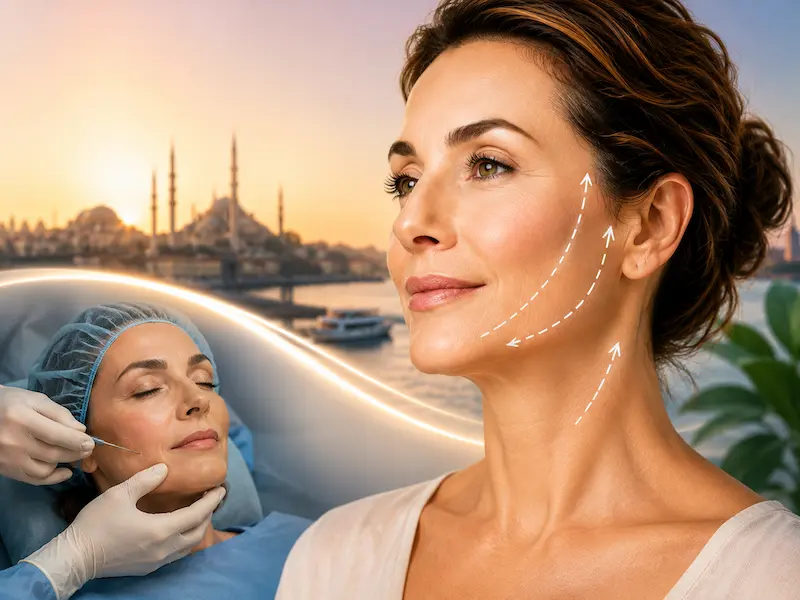

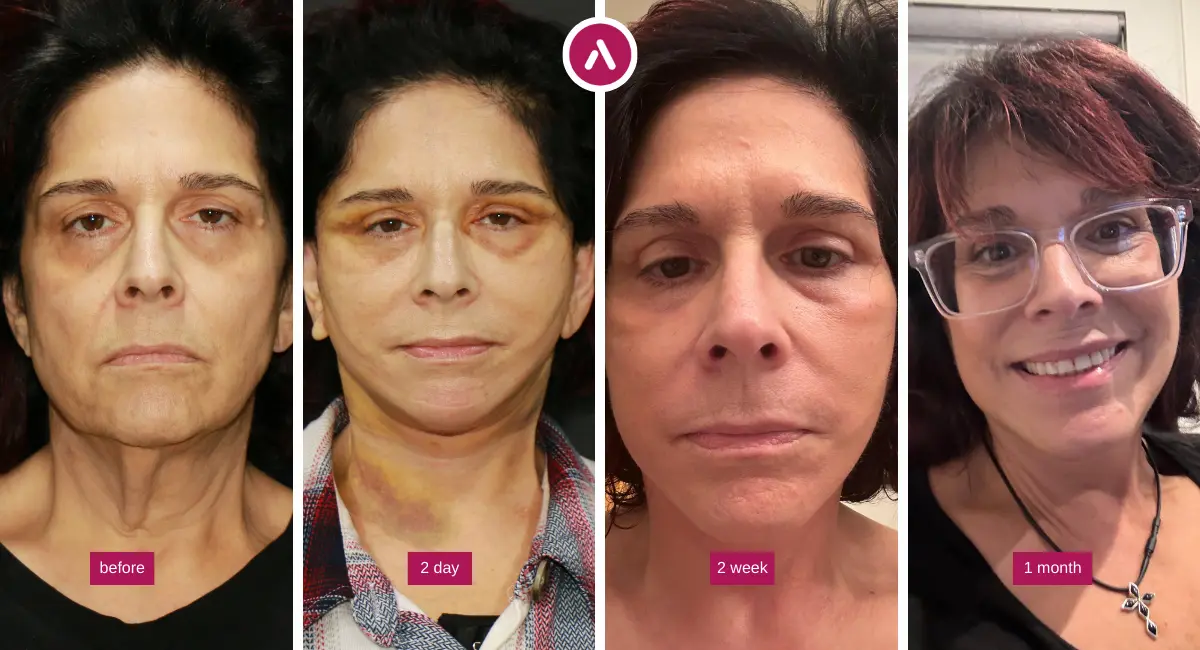
Deep plane facelift recovery day by day photos help patients understand what normal healing looks like before they travel, take time away from work, or return home to Canada. The visual recovery process is rarely linear. Swelling shifts, bruising changes colour, and the face can look more dramatic before it begins to look settled.
This guide focuses on what you see in the mirror from surgery day to Day 30. It does not replace medical advice, and it cannot predict your exact healing speed. It gives Canadian patients a realistic visual roadmap for the first month after a deep plane facelift overview at AKM Clinic.
The most important point is simple: early swelling is not the result. Most patients look most swollen between Days 3 and 5, more socially comfortable around Day 14, and much closer to normal by Day 30. Final refinement continues well beyond the first month.
Quick Summary: A deep plane facelift recovery follows a predictable visual arc: Day 1 swelling and bruising begin, Day 5 is often the most visibly swollen phase, Day 14 is when many patients become socially comfortable, and Day 30 looks close to normal for most people. This photo-led guide shows what Canadian patients can expect at each milestone when planning time away from work, travel, and social life.
| Recovery day | Typical appearance | Main restrictions | Visual milestone |
|---|---|---|---|
| Day 0 | Bandaging, early puffiness, mild facial fullness | Rest, assisted walking only, no bending | Immediate post-op baseline photo |
| Day 1 | Visible swelling around cheeks, jawline, and neck | Head elevation, short assisted walks, no screen-heavy work | First full recovery-day photo |
| Day 3 | Swelling and bruising often look more obvious | No lifting, no heat exposure, no social plans | Common “worst-looking” phase |
| Day 5 | Bruising may migrate downward; face can still look tight | Continue rest, avoid long walks, protect incisions | Peak-to-turning-point photo |
| Day 7 | Swelling begins to soften; bruising starts clearing | Surgeon-led clearance before travel decisions | Fit-to-fly visual assessment window |
| Day 14 | Most bruising is much less visible; residual swelling remains | Light daily activity, no strenuous exercise | Early social-ready stage for many patients |
| Day 21 | Jawline and neck definition become easier to see | Gradual return to normal routine with surgeon approval | Work-from-home or low-profile social stage |
| Day 30 | Face looks more natural, with subtle swelling still present | No aggressive exercise unless cleared | Near-normal public appearance for many patients |
Table of Contents
Day 0 — Surgery Day and Immediate Post-Op
Day 0 is not a beauty checkpoint. It is the controlled medical starting point of recovery. Your face will be supported by dressings, your tissues will be newly repositioned, and the first photographs are taken to document the baseline rather than the final direction of the result.
For Canadian patients arriving from Toronto, Vancouver, Montreal, or Calgary, this stage usually happens after several days of pre-operative planning in Istanbul. You should expect monitoring, rest, and limited movement. The goal is stability.
What you look like immediately after surgery
Immediately after a deep plane facelift, most patients see puffiness rather than sharp definition. The cheeks, jawline, and neck can look rounded. This is normal. Surgical swelling develops before the tissues begin to settle.
The face may also look slightly uneven in the first hours. One side can swell faster than the other. That does not mean the final result will be asymmetric.
A deep plane facelift lifts deeper facial structures, so the early appearance may feel more dramatic than the patient expected. This is part of why standardized recovery photos matter. They prevent patients from judging the outcome too early.
Bandaging and dressings explained
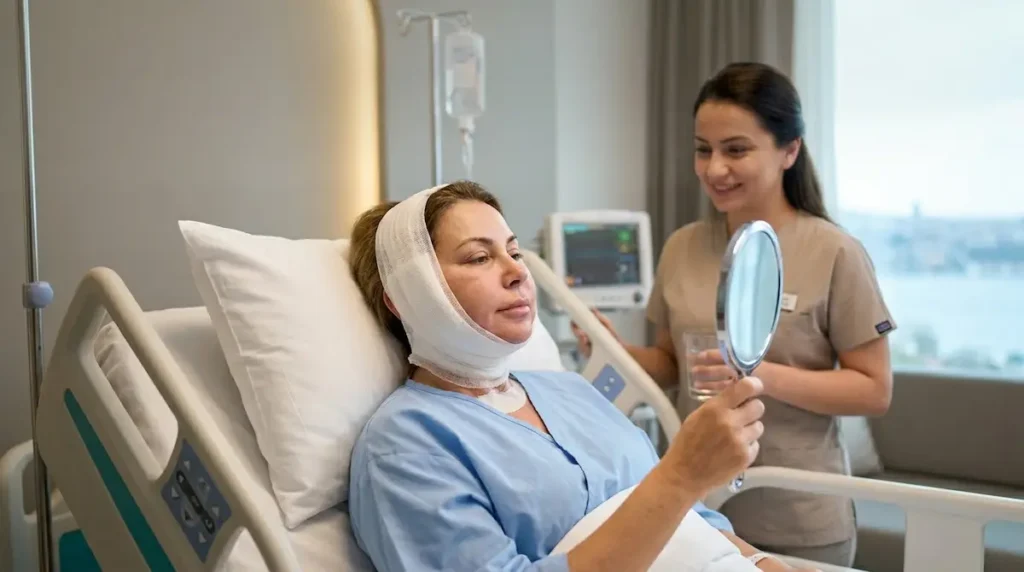
Bandaging supports the surgical area and helps control early swelling. It may cover the sides of the face, under the chin, and part of the neck. Some patients also have light compression depending on the exact surgical plan.
The dressing is not cosmetic. It protects the incisions, supports the lifted tissues, and gives the surgical team a clear system for early monitoring. Patients should not adjust bandages unless instructed by the clinic.
General facelift recovery guidance from the Canadian Society of Plastic Surgeons facelift resource notes that swelling can take weeks to subside before patients get an accurate picture of their appearance. That principle matters even more during the first 24 hours.
First mirror moment guidance
The first mirror moment can feel emotional. Some patients feel relief. Others feel startled. Both reactions are normal.
It helps to treat the first look as a medical check-in rather than a cosmetic assessment. You are looking for bandage position, comfort, and obvious concerns your care team has already taught you to monitor. You are not evaluating facial harmony yet.
Patients travelling from Canada often compare this moment to the before photos they reviewed during consultation. That comparison is too early. Day 0 is the beginning of healing, not the first reveal.
Days 1-3 — Acute Swelling and Bruising Phase
Days 1 to 3 are the acute visual phase of recovery. Swelling increases, bruising begins to show more clearly, and the face can look fuller than it did immediately after surgery. This is the stage when many patients need reassurance, especially if they are used to judging their appearance closely.
The visual changes are normal because inflammation is part of healing. The American Society of Plastic Surgeons describes the early recovery period as a time when dressings are checked, swelling is assessed, and post-operative care instructions are reinforced. The same principle applies at AKM Clinic, with close monitoring during the Istanbul recovery window through the ASPS facelift recovery guidance.
Day 1 — peak immediate swelling
Day 1 often brings more visible swelling than surgery day. The cheeks may look firm. The lower face can feel heavy. The neck may look full, even when the procedure has already improved the underlying contour.
This is expected. Edema is fluid accumulation in the healing tissues, and it tends to be most visible before it begins to drain. Patients should keep their head elevated and avoid looking downward for long periods.
For patients planning a return to Canada, Day 1 is not a travel day. It is a monitoring day. Short, assisted walks may be encouraged, but airport travel is not appropriate at this point.
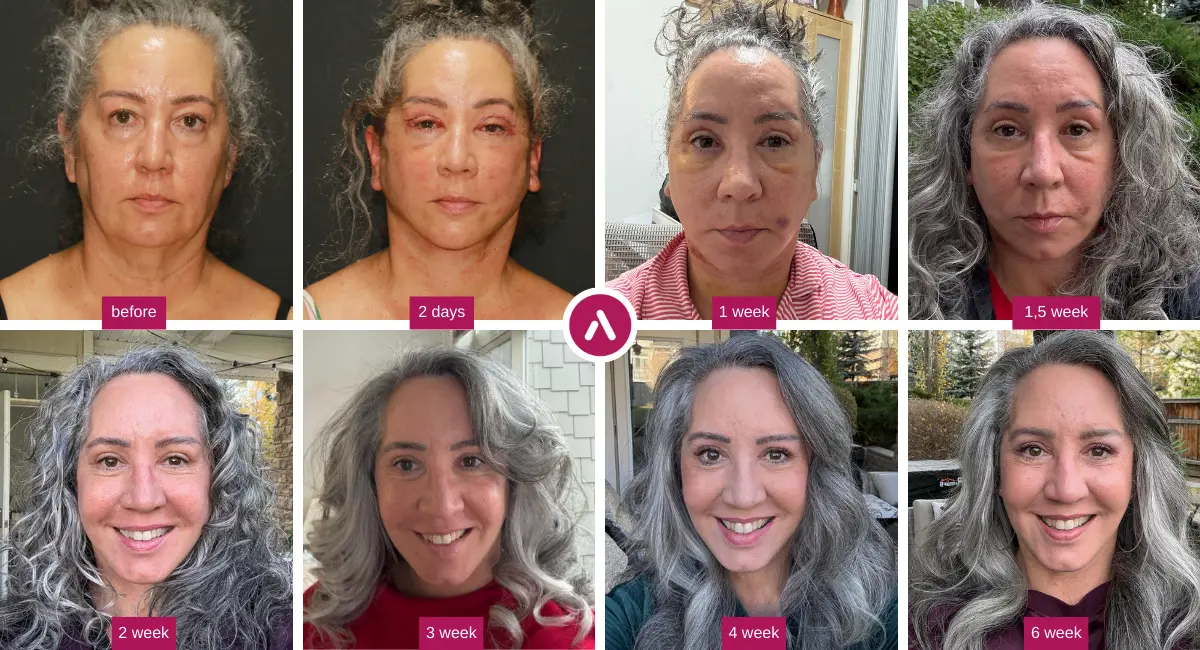
Day 2 — bruising onset and discoloration patterns
By Day 2, bruising may become more visible. It can appear purple, blue, red, or yellow depending on skin tone, circulation, and the location of the surgical work. Bruising may also be uneven.
The colour changes do not always stay near the incision lines. Bruising can migrate downward with gravity, which is why some patients see colour changes in the lower face or neck. This can look concerning, but it is often part of normal resolution.
Patients with fair skin may notice colour changes more dramatically. Patients with deeper skin tones may see swelling more than colour. Both patterns should be documented with consistent photos.
Day 3 — the “worst day” appearance and how it shifts by Day 5
Day 3 is often the hardest visual day. The face can look swollen, bruised, tight, and unfamiliar. This is the point when patients are most likely to worry that something is wrong, even when healing is on track.
The key is trajectory. If your surgical team confirms that the incisions, swelling pattern, and comfort level are appropriate, the Day 3 appearance should not be judged as the result. It is an inflammatory peak.
“Recovery photos show the surface story. They do not show tissue tension, numbness, or how the patient feels inside the healing process. That is why we interpret photos together with the clinical examination.”
By Day 5, the visual picture often begins to shift. Bruising may move downward or change colour. Swelling may still be obvious, but it usually starts to feel less alarming because the patient can see a pattern.
Days 4-7 — The Social Recovery Begins
Days 4 to 7 are usually the turning point in a deep plane facelift recovery. The face may still look swollen, but the swelling often becomes less tense. Bruising may move downward, change colour, or begin to fade at the edges.
This stage matters for Canadian patients because travel planning often begins around the Day 7 to Day 10 window. A patient from Toronto Pearson may have a direct route home, while a Vancouver patient may face a longer itinerary with connections. Visual readiness and medical readiness are not the same thing.

Bruising migration and resolution
Bruising does not always stay where it first appears. Gravity can pull discoloration into the lower face, jawline, and upper neck. This migration can make recovery look worse for a day or two before it looks better.
Colour changes are part of the normal clearing process. Purple or blue bruising may turn green, yellow, or brown as the body breaks down blood pigments. The timeline varies by skin tone, circulation, age, and procedure scope.
Patients should avoid heat, alcohol, heavy walking, and bending during this period unless their surgeon gives different instructions. The visual goal is not to “push through” recovery. The goal is to let swelling drain without adding stress to the tissues.
Swelling reduction with HBOT support
At AKM Clinic, swelling reduction is supported through a structured recovery setting and advanced post-operative care. Hyperbaric Oxygen Therapy is part of AKM’s recovery infrastructure, but this article will stay focused on visible milestones rather than the technology mechanism.
Patients who want the science behind the treatment can review AKM’s recovery technology standards. For the specific deep plane protocol, for the HBOT and LLLT recovery technology behind these visual milestones, see our protocol guide.
Visually, patients may notice that the face feels less tight before it looks fully slim. This can be confusing. The mirror may still show fullness, while the patient already feels a small improvement in facial mobility.
Canadian travel planning callout: do not book the earliest possible flight
Many Canadian patients want the fastest return home, especially if they have family responsibilities or limited leave from work. The safer approach is to plan around surgeon clearance, not the lowest airfare. Day 7 may be appropriate for some patients, but others need extra days in Istanbul before flying to YYZ, YUL, YVR, or YYC.
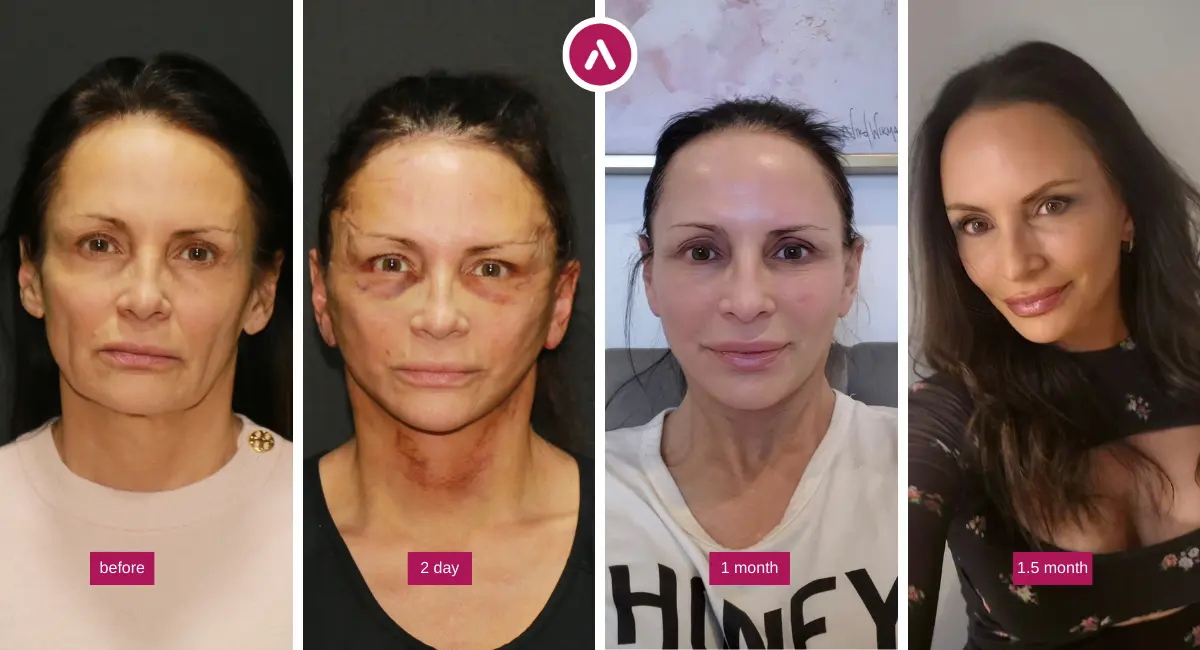
Day 7 fit-to-fly visual assessment
Day 7 is often the first meaningful fit-to-fly discussion point. The surgeon looks at incision healing, swelling stability, bruising pattern, comfort level, and overall recovery trajectory. A patient may look acceptable in photos but still need more time before a long-haul flight.
The visual assessment is only one part of clearance. If there is unusual swelling, concerning bruising, drainage, fever, or rising discomfort, travel should be delayed. For a deeper discussion of flight timing, see the fit-to-fly visual assessment criteria for facelift patients.
Some patients feel encouraged on Day 7 because the face begins to look more familiar. Others still look quite bruised. Both can be normal, but only a clinical check can decide whether travel is appropriate.
Days 8-14 — Returning to Normal Life
Days 8 to 14 are when many patients begin to feel less like surgical patients and more like themselves. Bruising continues to fade, swelling becomes easier to camouflage, and the face starts to show the early outline of the surgical result. It is still early.
For Canadian patients, this period often overlaps with flying home, settling back into a quiet routine, or preparing for remote work. The outside world may see a rested face sooner than the patient sees the final outcome. That difference can feel strange.
Bruising final clearance
By the second week, bruising usually becomes easier to conceal. Some patients have only yellow or light brown areas. Others still show colour near the lower face or neck, especially if the procedure included a neck lift.
Bruising does not disappear in a perfectly symmetrical way. One side may clear first. The other side may hold colour for several more days. This is one reason photo comparisons should be done weekly, not hourly.
Patients with sensitive skin should ask their care team before using makeup over or near incision sites. Concealer can help, but protecting healing skin matters more than hiding every mark.
Residual swelling — morning vs evening differences
Residual swelling often changes throughout the day. Many patients look puffier in the morning and more defined by afternoon. Salt intake, sleep position, screen time, walking volume, and hydration can all influence the mirror.
This fluctuation is normal. It does not mean the result is unstable. It means the lymphatic system is still clearing fluid from the surgical area.
Patients returning to work in Canada should avoid scheduling major presentations, formal photography, or high-pressure meetings too early. Remote work is usually easier than in-person visibility during this window.
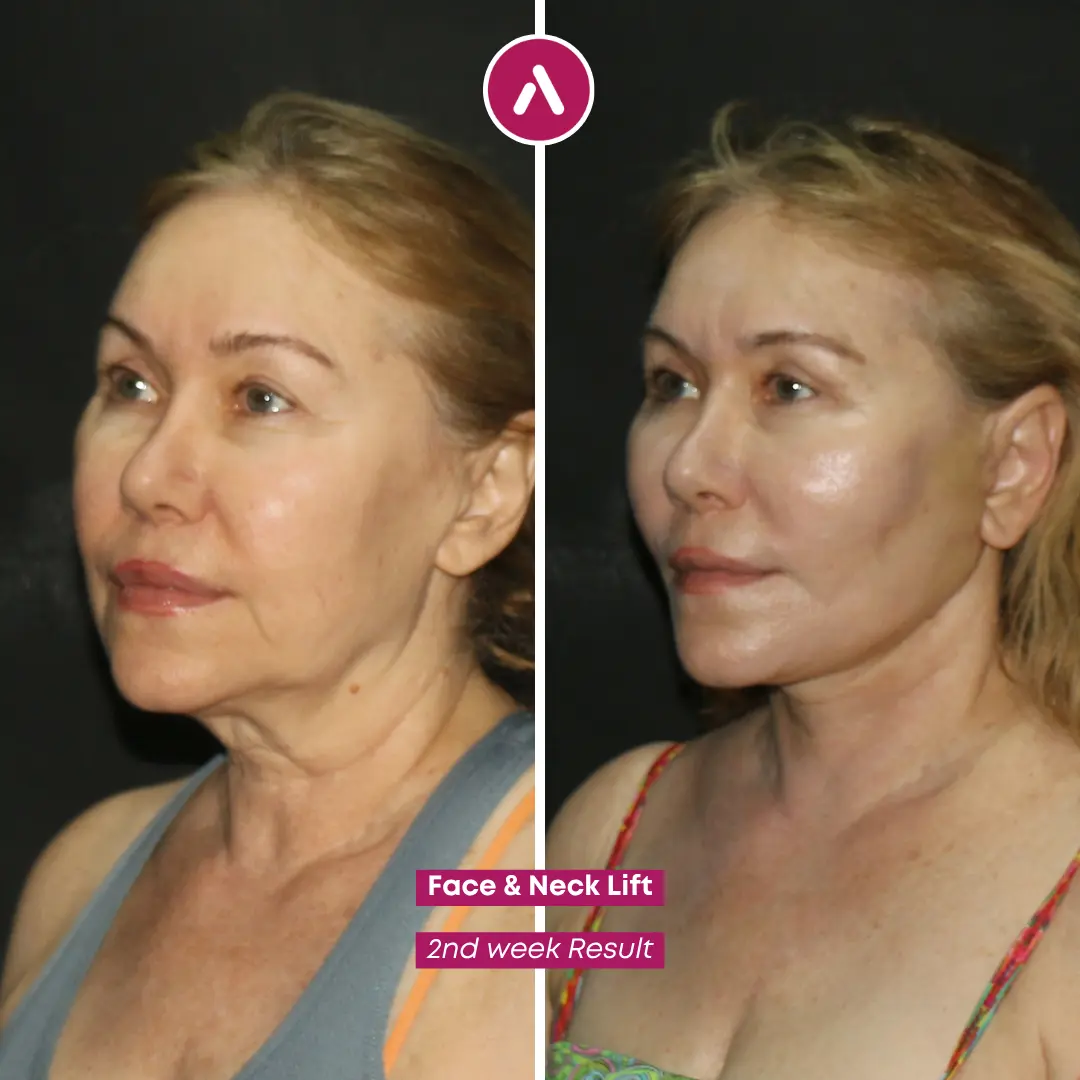
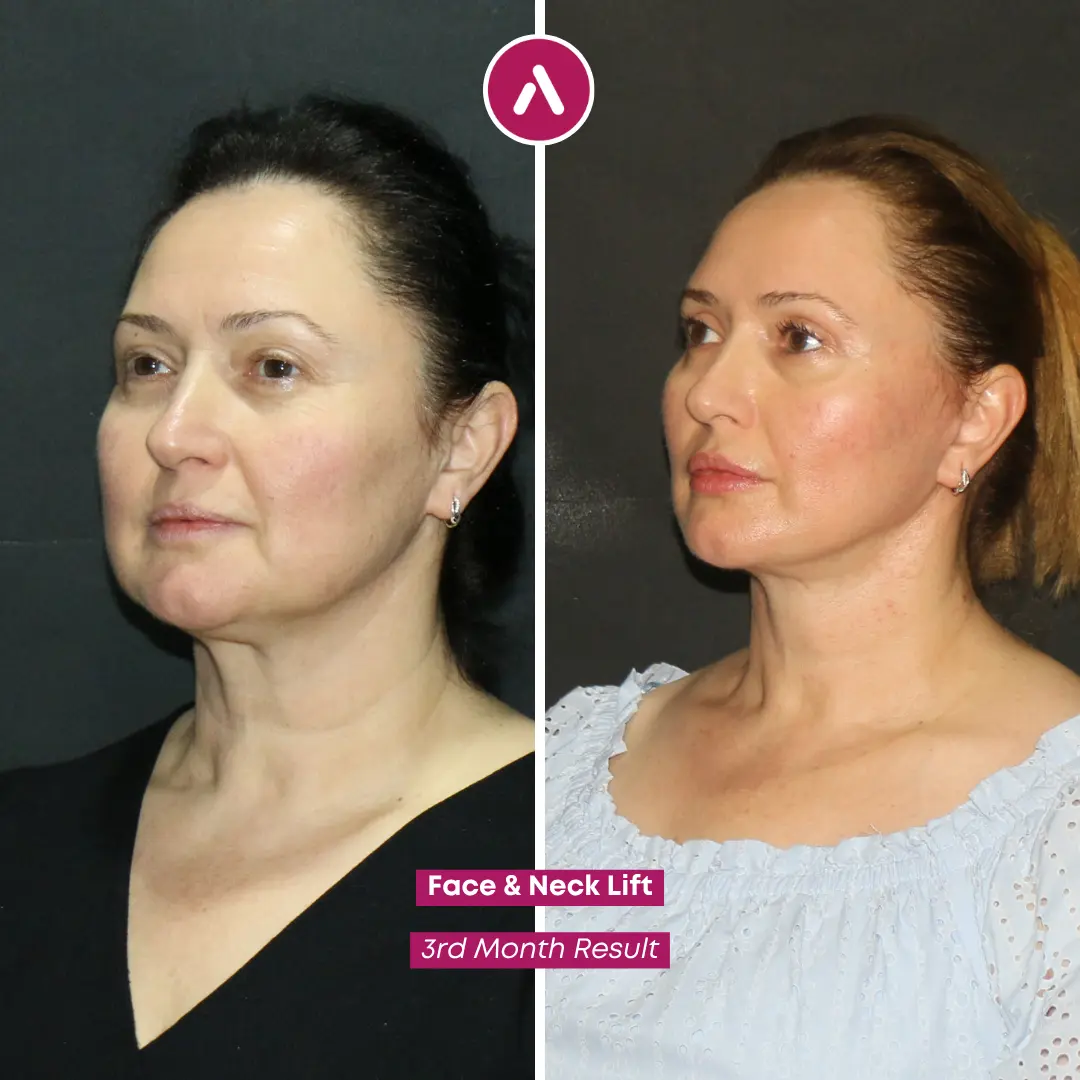
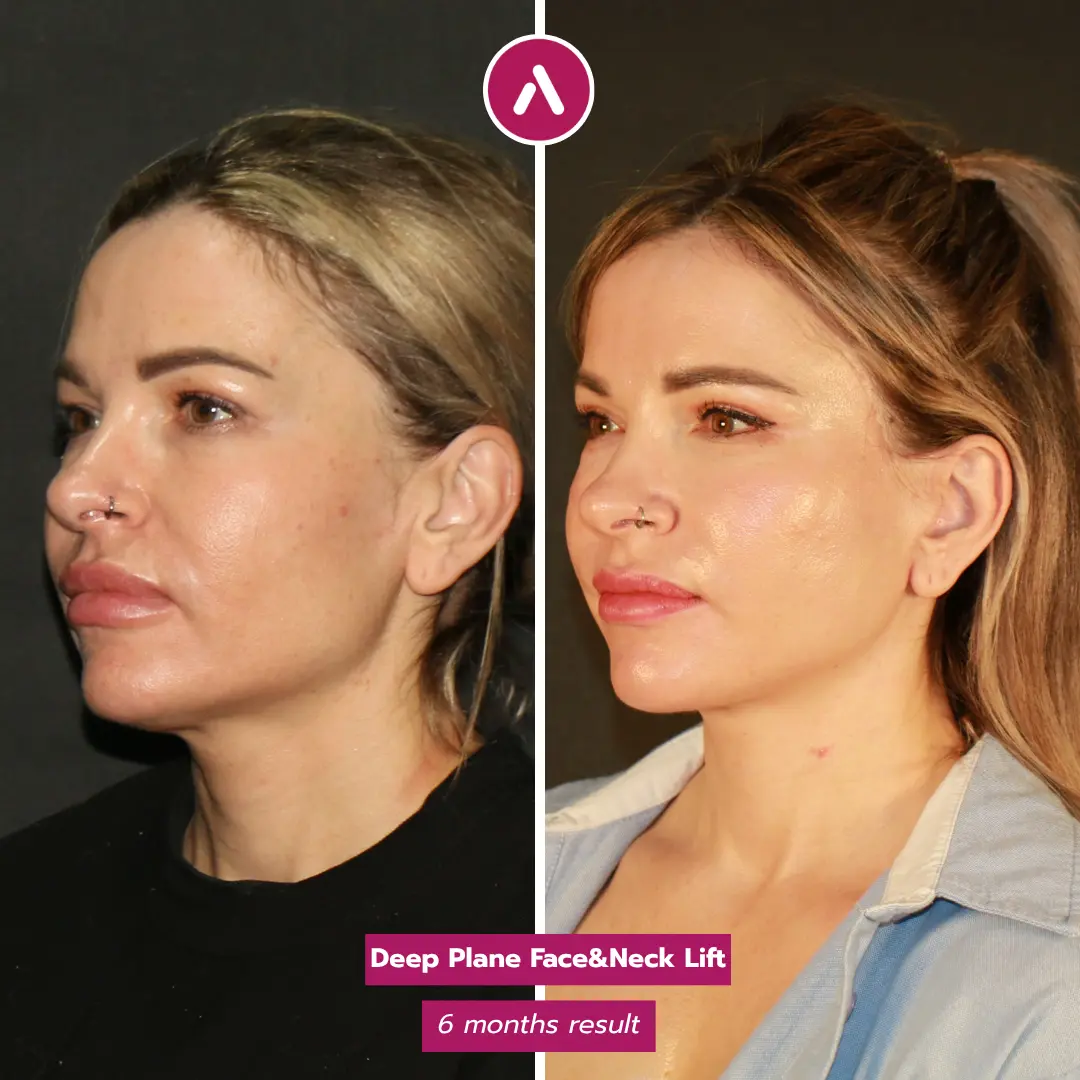
When you can be photographed without obvious surgery markers
By Day 14, many patients can be photographed casually without obvious surgical markers, especially with good lighting, simple styling, and mild camouflage. This does not mean they are fully healed. It means the visible signs are less noticeable to others.
Close friends or family may still notice swelling. Co-workers may not. The average person is usually less observant than the patient, especially if they do not know surgery occurred.
Camouflage strategies for early weeks back in Canada
For the first few weeks back in Canada, choose soft lighting, avoid high-definition video calls when possible, and use light mineral-based makeup only if your surgeon approves. A scarf, high collar, or loose hair can help conceal fading neck bruising in colder months. In summer, prioritize sunscreen and shade over heavy coverage.
Patients in public-facing roles may prefer a longer buffer before returning in person. Teachers, healthcare professionals, executives, and government employees often choose extra recovery time because they are seen closely and frequently.
Days 15-30 — Settling Into Final Form
Days 15 to 30 are the first stage when the surgical result begins to feel believable. The face looks less surgical, the jawline becomes easier to recognize, and bruising is usually much less distracting. Still, this is not the final result.
For Canadian patients, this period often happens back home. You may be recovering in Toronto winter weather, protecting your scars during a Vancouver summer, or managing video calls from a home office in Montreal. The visual recovery continues quietly in the background.
Subtle swelling resolution continues
After Day 15, swelling usually becomes less obvious to other people. The patient still notices it. That is normal.
Small pockets of fullness may remain near the cheeks, jawline, ears, or neck. These areas can look different in the morning and evening. They may also feel firmer than they look.
The face should gradually look more familiar during this period. The early tightness softens. The cheeks and lower face begin to move more naturally during expression.
Patients should avoid comparing themselves with someone else’s Day 21 photo. Age, skin thickness, procedure scope, neck involvement, and bruising tendency all affect the visual timeline.
Scar maturation visible markers
Incisions may look pink, slightly raised, or firm during the first month. That does not mean the scar is healing poorly. It means scar maturation is still active.
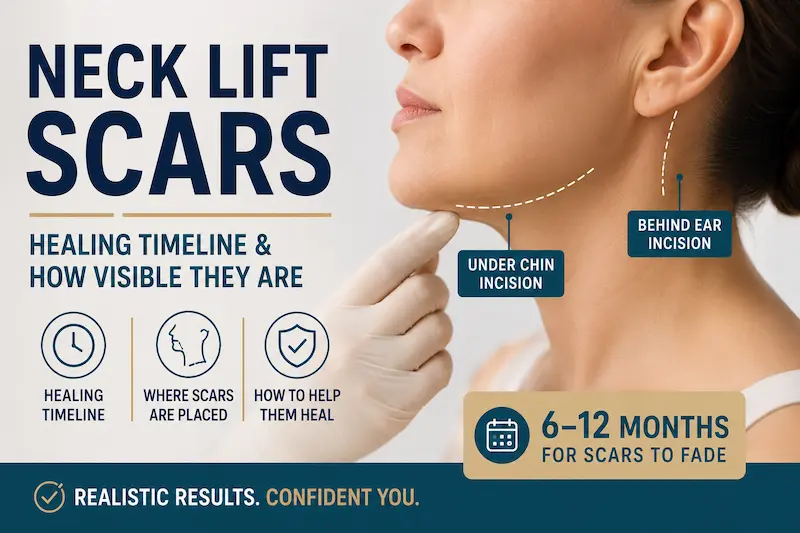
Most visible incision areas are placed around natural creases and hairline transitions. Early scar colour can be more noticeable under harsh bathroom lighting. Soft natural light gives a fairer impression.
Do not apply scar products unless your surgeon approves them. Sunscreen, physical shade, and incision protection matter, especially for Canadian patients returning during spring or summer UV exposure.
If an incision becomes increasingly red, hot, painful, or starts draining, it should be reported. Normal scar maturation should improve gradually, not worsen suddenly.
Day 30 versus Day 90 comparison preview
Day 30 is a useful milestone because the face usually looks presentable. It is not the final checkpoint. The Day 90 photo often shows better softness, cleaner definition, and a more natural resting expression.
Patients who want to compare longer-term outcomes can review the verified deep plane facelift before-and-after gallery. For a single long-term patient example, Barbara’s verified long-term recovery offers a later-stage perspective beyond the first month.
Day 30 can be emotionally reassuring. Most patients can finally see why the early swelling was temporary. The result still needs time to integrate with normal facial expression.
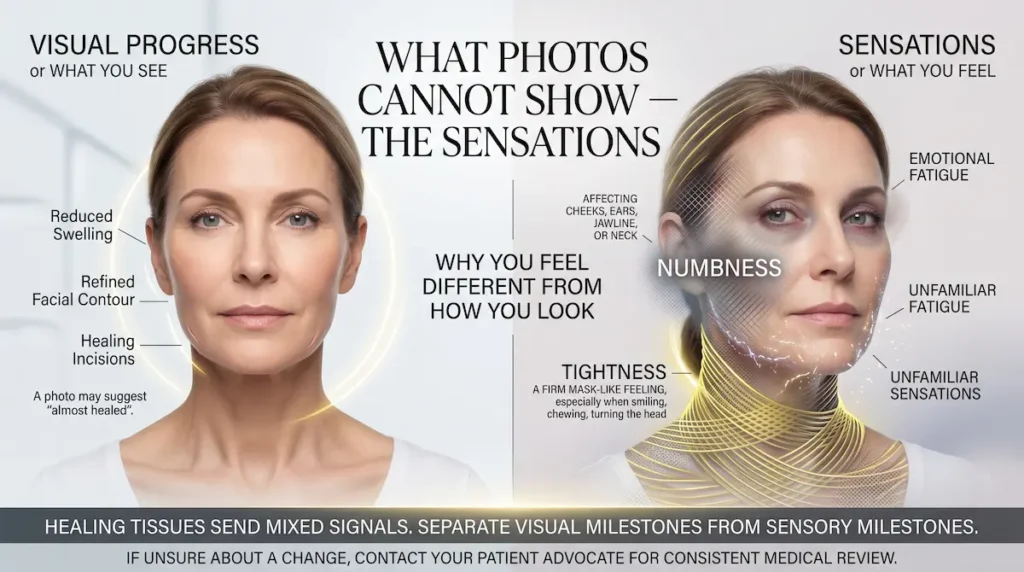
What Photos Cannot Show — The Sensations
Recovery photos are useful, but they are incomplete. They show swelling, bruising, and changing facial contours. They do not show numbness, tightness, strange skin sensations, or the emotional fatigue that sometimes comes with healing.
This section matters because patients often look better before they feel fully normal. That mismatch can be confusing. A photograph may suggest “almost healed,” while the patient still feels tightness around the cheeks, ears, or neck.
Numbness and tightness that the camera misses
Numbness is common after facelift surgery. It may affect the cheeks, ears, jawline, or neck. The camera cannot show it.
Tightness can also feel more obvious than it looks. Patients may describe it as a firm mask-like feeling, especially when turning the head, smiling, chewing, or lying down. This sensation usually improves gradually.
For the full medication and comfort framework, see for the pain management protocol during these recovery days. That guide addresses discomfort more directly, while this article stays focused on visual recovery.
Why you feel different from how you look
Healing tissues send mixed signals. A patient may look socially ready but still feel swollen, numb, or unusually aware of the surgical area. This is common during the first month.
Facial movement can also feel unfamiliar. Smiling, laughing, and chewing may feel tight for a while. That does not mean the face will stay stiff.
It helps to separate visual milestones from sensory milestones. Day 14 may be socially acceptable. Day 30 may look close to normal. Sensation can take longer to settle.
Patient self-perception versus objective state
Patients often judge their recovery more harshly than anyone else does. You see your face at close range, in every light, and with full awareness of the surgery. Other people usually see the overall impression.
This is where clinical follow-up matters. The surgical team can compare photos, check tissue healing, and explain what is still swelling versus what is already structural improvement. AKM’s AKM Clinic’s Natural-First approach is designed around subtle, identity-preserving results rather than an over-tightened appearance.
For many Canadians, the goal is not for people to ask what surgery they had. The goal is to look rested, healthier, and still recognizably themselves. Recovery photos should be interpreted through that lens.
If you are unsure whether a visual change is normal, send a clear photo to your patient advocate rather than searching online forums. Consistent medical review is safer than comparing your face with strangers.
Frequently Asked Questions: Deep Plane Facelift Recovery Day by Day Photos
These questions focus on the first 30 days of visual recovery after a deep plane facelift. They are written for Canadian patients planning work leave, return flights, video calls, and social visibility. Your surgeon’s instructions always take priority over general timelines.
When will I look social-ready?
Many patients look socially comfortable around Day 14, especially with careful lighting, gentle styling, and surgeon-approved camouflage. Some patients need closer to three weeks. Neck work, skin thickness, bruising tendency, and age can all shift the timeline.
Social-ready does not mean fully healed. It means the visible signs of surgery are less obvious to other people.
How long does bruising last?
Most visible bruising improves significantly between Days 10 and 14. Faint discoloration can remain longer, especially along the lower face or neck. Patients with fair skin may notice colour changes more clearly.
Bruising can also migrate downward before it fades. That movement can look concerning, but it often reflects normal clearing.
What is the “worst day” of recovery?
For many patients, Day 3 to Day 5 is the most difficult visually. Swelling can peak, bruising may become more obvious, and the face can look unfamiliar. This phase usually improves gradually after the first week.
Do not judge your final result during this window. It is too early.
Can I work from home during recovery?
Some patients can do light remote work after the first week, but this depends on energy level, swelling, and medication use. Video calls may feel uncomfortable before the face looks natural on camera. Short written tasks are usually easier than long meetings.
Canadian patients in public-facing roles often plan a longer buffer before returning to in-person work. This is especially helpful for teachers, healthcare workers, executives, and government employees.
When will scars fade?
Incisions usually continue maturing for months. In the first month, they may look pink, firm, or slightly raised. This does not automatically mean poor healing.
Scar visibility depends on placement, skin tone, UV exposure, genetics, and post-operative care. Canadian summer sun protection is especially important because UV exposure can darken healing scars.
Is there variation between patients?
Yes. No two patients heal exactly the same way. A 48-year-old patient with limited bruising may look social-ready faster than a 62-year-old patient who had a deep plane facelift with neck lift and eyelid surgery.
Skin thickness, smoking history, sleep quality, swelling tendency, and procedure scope all matter. Your own recovery photos should be compared against your previous photos, not someone else’s timeline.
Why does Day 7 look different than Day 14?
Day 7 is often a turning point, but swelling and bruising are still visible. Day 14 usually shows clearer improvement because the body has had another full week to drain fluid, clear bruising, and calm inflammation.
This is why many patients feel more confident during the second week. The face begins to look less surgical, even though final refinement is still ahead.
To review your own expected recovery pattern, discuss your photos, travel timing, and work-return goals during a virtual consultation. A personalized plan is safer than relying on a generic calendar.
Medical Disclaimer: This page is provided for general educational purposes only and does not replace an in-person medical consultation, diagnosis, or personalized treatment plan. All surgery carries risks, and outcomes vary between individuals. Suitability for deep plane facelift surgery, procedure selection, and anesthesia choice can only be determined after a full clinical assessment by a qualified surgeon. Always follow your clinician’s instructions and seek urgent medical attention if you develop concerning symptoms during recovery.