
Quick Summary: Stem cell facelift longevity depends on two separate outcomes: how long the lifted facial structure stays improved and how long the skin-quality benefits remain visible. In realistic terms, the structural lift often follows a 10- to 15-year pattern, while regenerative skin-quality improvements may benefit from maintenance around years 5 to 8.
For Canadian patients comparing options, the key question is not whether results are “permanent.” No facelift stops ageing. The better question is how well the result ages, what kind of maintenance may be needed, and how to protect the investment over time.
Patients researching stem cell facelift longevity often want a simple number. Ten years? Fifteen years? Longer? The honest answer is more layered because a stem cell-augmented facelift combines two different goals: structural repositioning and regenerative skin support.
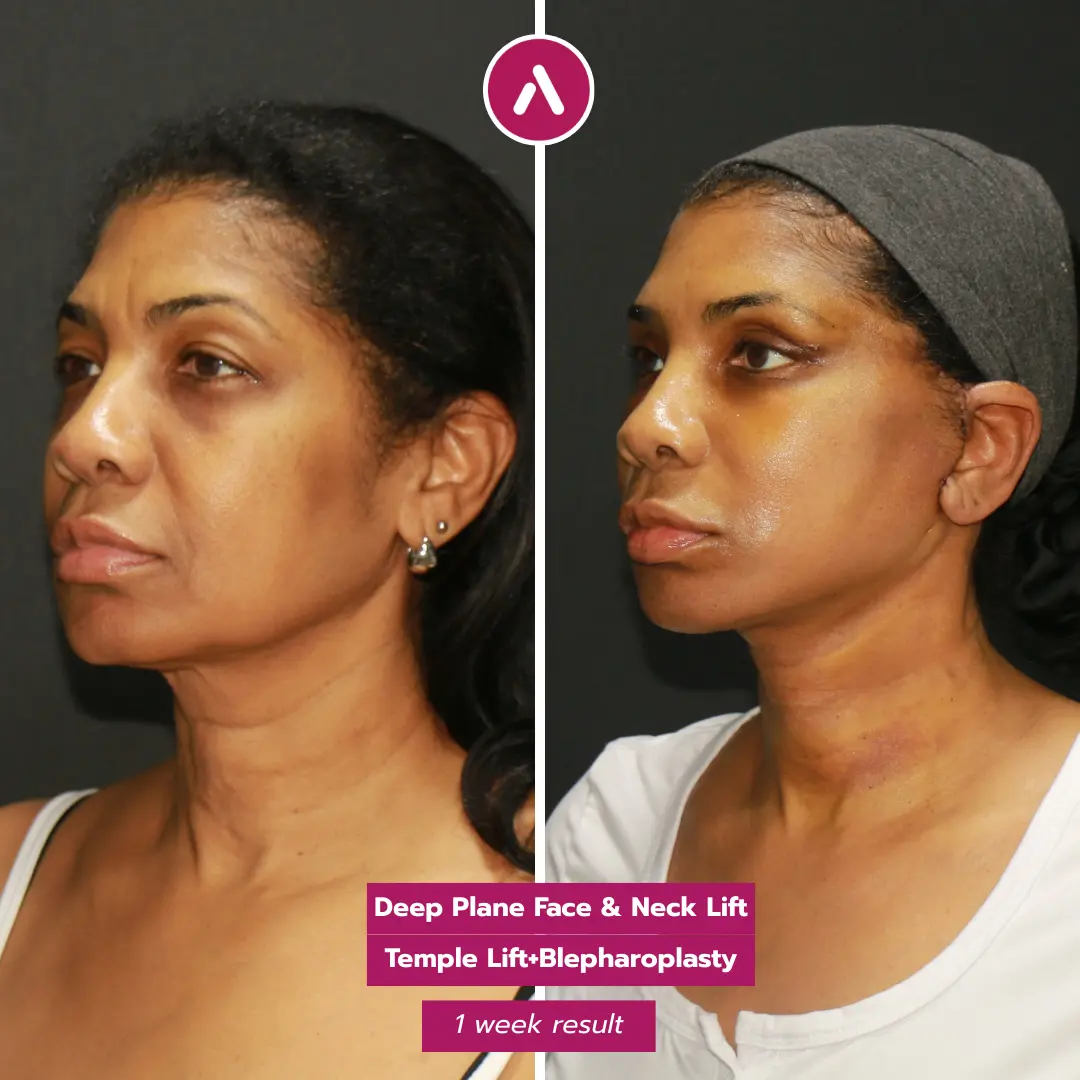
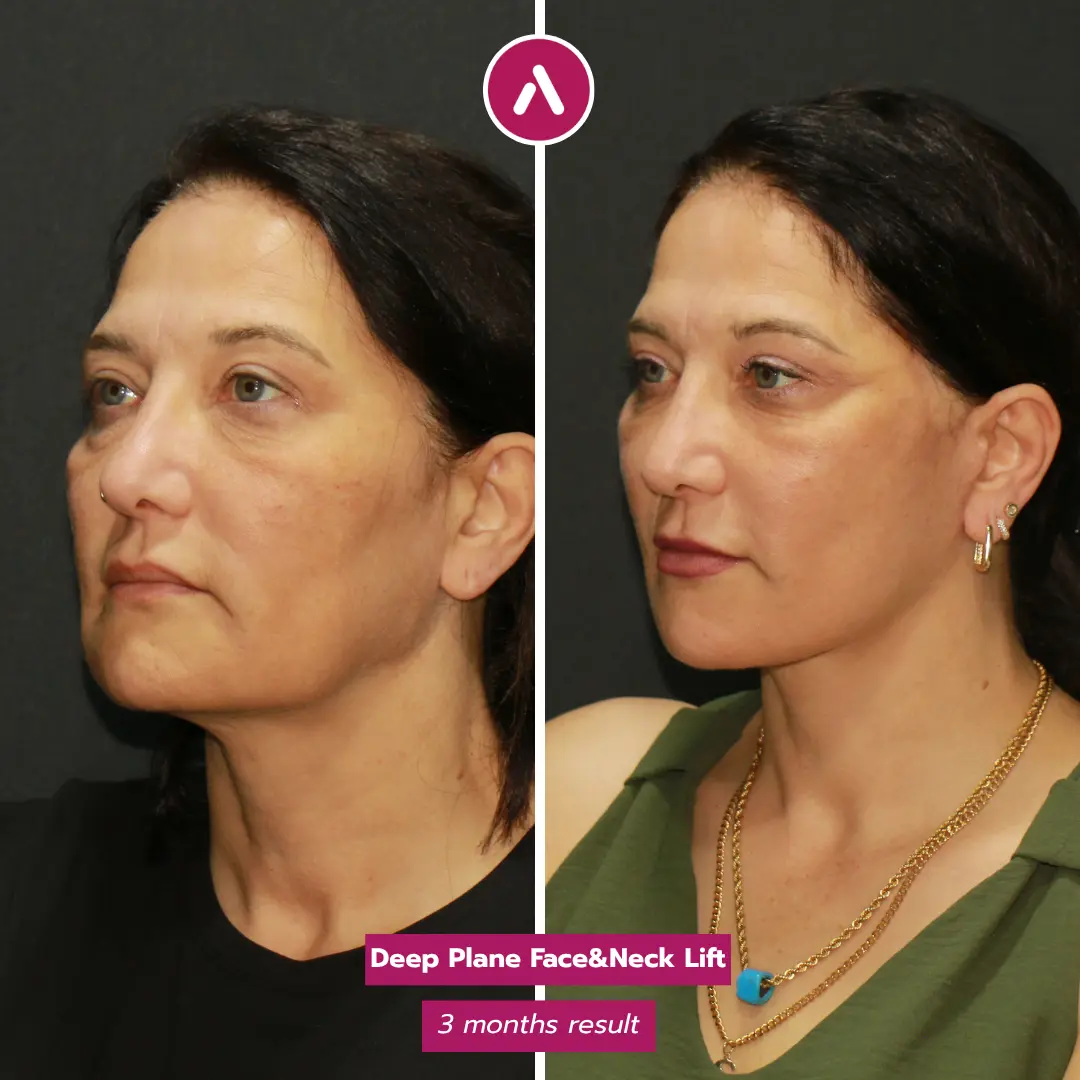
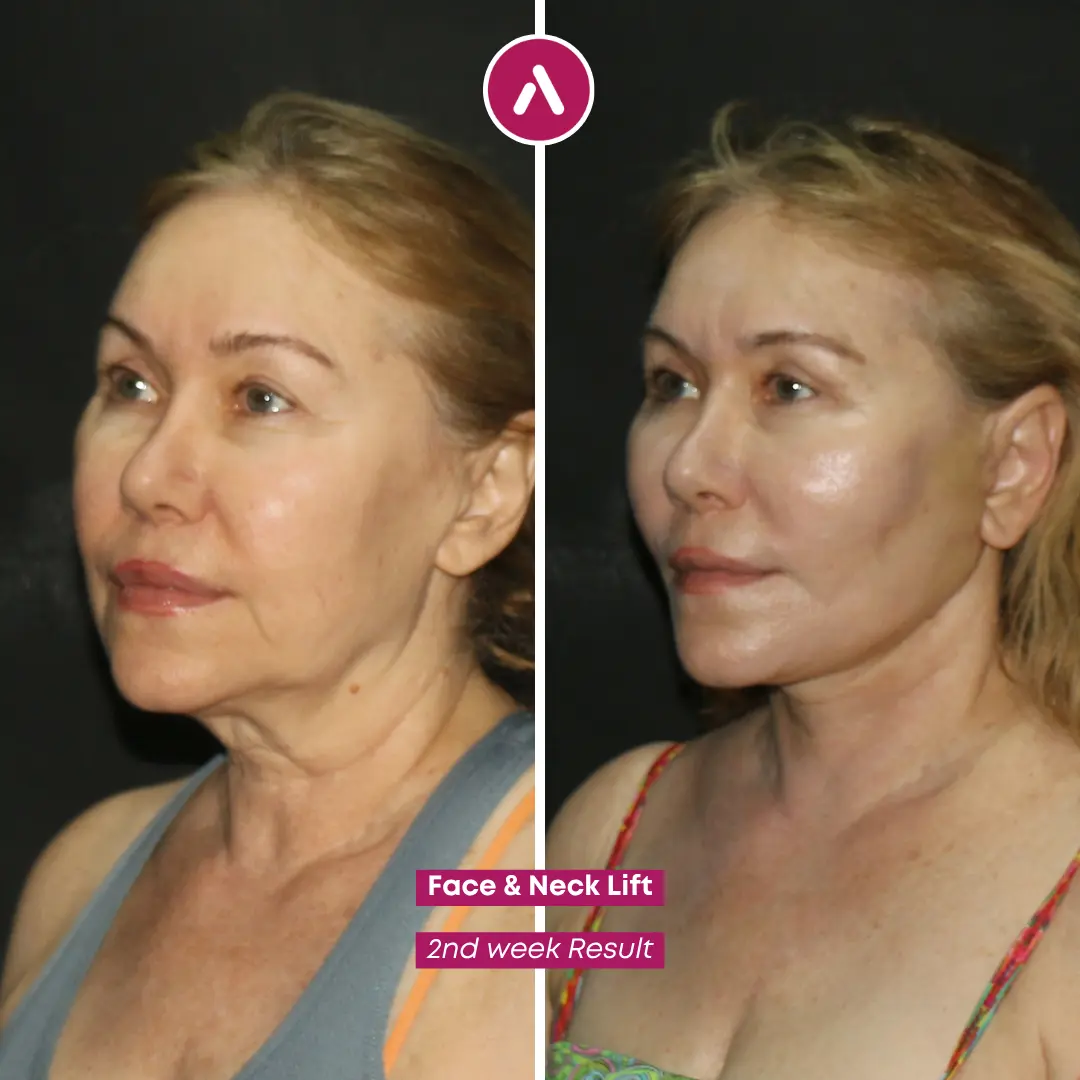
The surgical lift addresses deeper facial descent. The regenerative component is intended to support skin quality, tissue health, and soft-tissue refinement over time. If you are still comparing core facelift procedures, start with AKM Clinic’s facelift options overview before using this guide to understand long-term durability.
This article stays focused on duration. It does not compare stem cell augmentation with traditional facelift techniques, explain harvesting and processing steps in detail, or walk through the early recovery timeline. Those are separate questions. Here, the focus is what results tend to look like at 5, 10, and 15 years.
Table of Contents
What Longevity Actually Means in Facelift Outcomes?
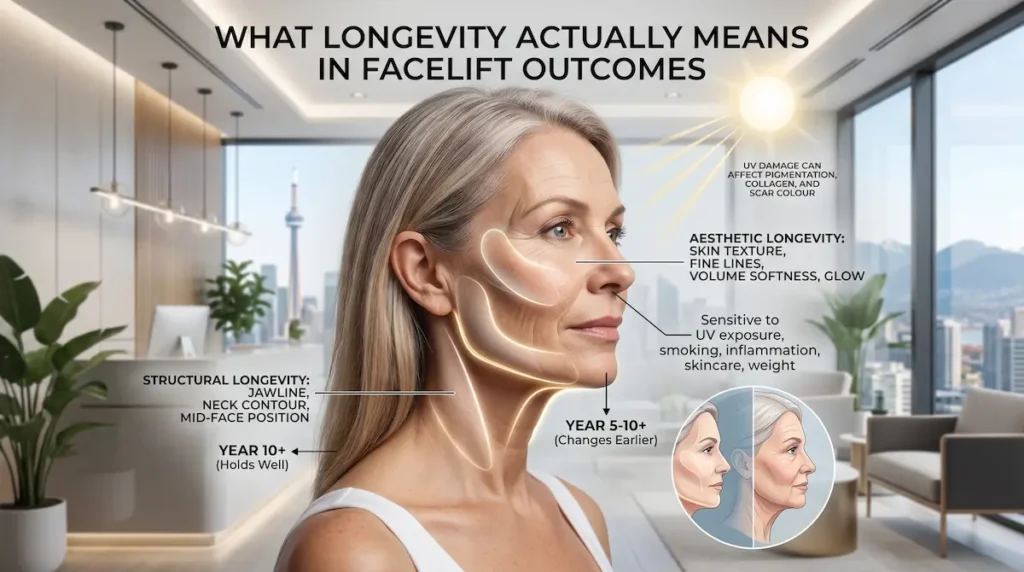
Longevity is often discussed as if it were a single number. That can mislead patients. A facelift does not expire on a fixed date, and the face does not suddenly return to its pre-surgery state.
A better way to assess longevity is to separate the structural result from the surface aesthetic. The lift, jawline, neck contour, and mid-face position may remain improved for many years. Skin texture, glow, fine lines, and volume softness can change earlier because they are more sensitive to biology, sun exposure, and lifestyle.
Structural longevity versus aesthetic longevity
Structural longevity refers to how long the deeper lifted tissues maintain their improved position. In a well-planned facelift, this includes the jawline, lower face, neck angle, and mid-face support. These changes tend to last longer than surface-level improvements.
Aesthetic longevity refers to how long the result continues to look fresh, smooth, and balanced. This includes skin quality, texture, fine lines, pigmentation, and subtle volume changes. Stem cell augmentation is usually discussed in this aesthetic category.
For that reason, a patient may still have a strong structural result at year 10 while noticing that skin maintenance would be helpful earlier. That is normal. It does not mean the facelift has failed.
Why lift and skin quality age on different timelines
The lifted tissue and the skin surface age differently because they respond to different forces. Facial structure is affected by gravity, ligament laxity, fat-pad descent, and bone support. Skin quality is affected by collagen loss, UV exposure, smoking history, weight fluctuation, inflammation, and daily skincare discipline.
This distinction matters for Canadian patients. Someone in Toronto or Vancouver may protect scars well during winter, then underestimate UV exposure during spring and summer. Even on cloudy days, UV damage can affect pigmentation, collagen quality, and scar colour.
Stem cell augmentation may support skin quality, but it does not make the skin immune to ageing. Maintenance still matters.
How long-term facelift outcomes are measured
Long-term outcomes are usually measured through patient photographs, clinical assessment, satisfaction surveys, and revision timing. A surgeon looks at whether the jawline remains cleaner than baseline, whether the neck contour still holds, and whether the face continues to age naturally rather than looking tight or distorted.
Patient satisfaction is also important. Many patients are not asking to look exactly the same at year 10 as they did at month 6. They want to know whether they will still look better than they would have without surgery.
For the full definition and biological explanation of stem cell-assisted surgery, see for the full mechanism explanation. For early healing, bruising, and swelling details, see for recovery timeline specifics.
The 5-Year Outcome Window
The 5-year mark is usually where patients begin to understand the difference between a temporary improvement and a durable facial reset. Most well-selected patients should still see meaningful improvement compared with their pre-surgery baseline.
At this stage, the structural result is generally expected to remain strong. The more common maintenance conversation involves skin quality, small volume shifts, fine lines, and how the face is responding to continued ageing.
Typical structural state at year 5
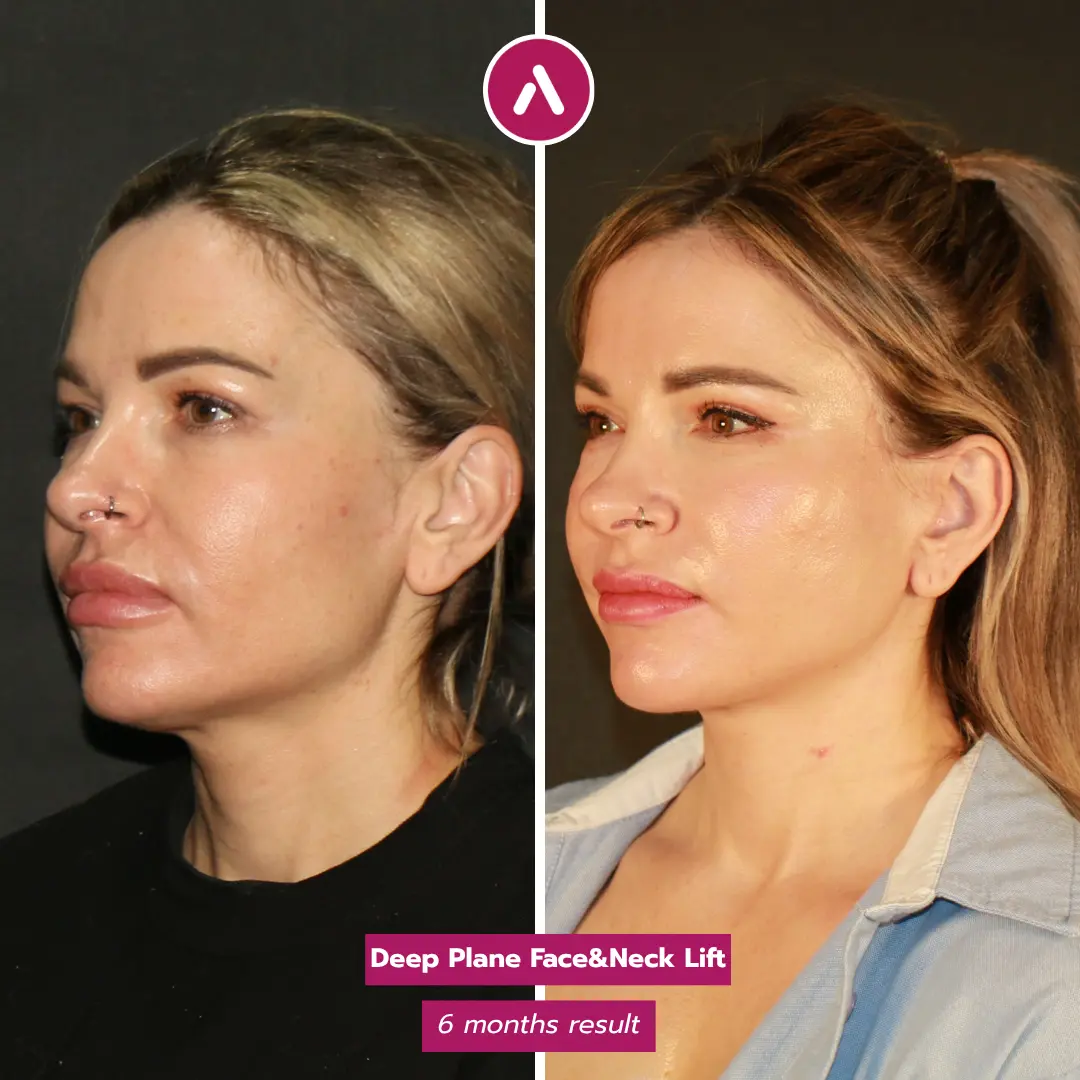
At year 5, a well-executed facelift should still show clear structural benefit. The jawline is usually cleaner than before surgery, jowling remains reduced, and the lower face often keeps a more supported contour. Neck improvement may also remain visible, especially when the original surgical plan addressed deeper tissue support rather than skin tension alone.
Canadian patients often describe this stage as “still looking like myself, just better rested.” That is the ideal. The face should not appear frozen, stretched, or disconnected from the patient’s natural features.
If a patient had significant pre-operative skin laxity, smoking history, or major weight fluctuation after surgery, year-5 changes may be more noticeable. Longevity is partly surgical. It is also biological.
Skin-quality changes and regenerative maintenance signals
Skin-quality benefits may still be visible at year 5, but this is often the period when maintenance becomes worth discussing. Patients may notice fine lines returning around the mouth, texture changes in the cheeks, or early laxity that was not present during the first two post-operative years.
These changes do not mean the stem cell component has “worn off.” They reflect ongoing ageing. Skin continues to respond to UV exposure, hormonal changes, stress, sleep quality, and collagen decline.
Maintenance may include medical-grade skincare, light-based therapies, injectable treatments, or other non-surgical options depending on anatomy. The right plan should preserve a natural result rather than chase a dramatic change.
Patient satisfaction patterns at the 5-year mark
Patient satisfaction at year 5 is usually highest when expectations were realistic from the beginning. A stem cell-augmented facelift can support a refreshed appearance, but it cannot stop time. Patients who understand that distinction tend to feel more satisfied years later.
At this window, many patients are not looking for another surgery. They are usually asking smaller questions: Should I add skin maintenance? Do I need volume support? Is my jawline still holding well? Would a non-surgical refresh help?
This is where long-term planning matters. AKM Clinic’s Natural-First approach is based on “Rejuvenation over alteration,” which means maintenance should protect facial identity, not create a new face.
The 10-Year Outcome Window
The 10-year point is where facelift longevity becomes more clinically meaningful. Early swelling is long gone, scar maturation has completed, and the face has continued to age in real life. This is the window where patients can judge whether the original surgical plan created a durable, natural-looking result.
Stem cell-augmented facelift results should be interpreted carefully at this stage. The regenerative component may support tissue quality, but the structural lift still depends on the underlying facelift technique, patient anatomy, and long-term lifestyle habits.
Where structural lift typically stands after a decade
At year 10, many patients can still look clearly improved compared with their pre-operative baseline. The jawline may not be as sharp as it was at month 6, and the neck may show some renewed softness. That is normal ageing, not surgical failure.
The most reliable long-term facelift discussions come from standardized clinical photography and follow-up comparison. A published 10-year follow-up of facelift patients, including post-operative photographs at 1, 6, and 10 years, reinforces why long-term photo documentation matters when judging durability rather than relying on early post-op impressions alone.
For Canadian patients, this matters because the decision is often made after months of research. A decade-long result should be judged by whether the face has aged better than expected, not by whether it looks identical to the first year.
Volume changes, facial ageing, and maintenance needs
Volume changes become more visible at the 10-year mark. Even when lifted tissues remain improved, the cheeks, temples, tear troughs, and perioral area may lose fullness. These changes come from natural fat atrophy, bone remodelling, and collagen loss.
Stem cell augmentation may help the soft-tissue quality, but it does not stop these deeper biological changes. A patient may still benefit from conservative maintenance, especially if the goal is to preserve a rested look rather than repeat major surgery.
This is also the point where long-term planning should become more individualized. A 52-year-old patient at surgery will face a different year-10 decision than a 64-year-old patient with thinner skin and more baseline laxity.
How to interpret decade-long results without overpromising
There is no ethical way to promise that a stem cell-augmented facelift will last exactly 15 years for every patient. Human biology is too variable. Genetics, skin thickness, sun exposure, smoking history, and weight stability all influence the result.
For technique comparison specifically, see our deep comparison at stem cell facelift versus traditional facelift. For the surgical baseline without regenerative augmentation, see deep plane longevity without stem cell augmentation.
Patients who want a structural reference point should also review the deep plane longevity baseline. The regenerative layer may support the quality of the tissue, but the underlying lift remains a major driver of long-term shape.
| Time after surgery | Typical structural state | Typical skin-quality state | Maintenance recommendation |
|---|---|---|---|
| Year 1 | Result is settling; lift is strong and visible. | Skin often looks smoother, brighter, and less inflamed. | Protect scars, maintain skincare, avoid weight swings. |
| Year 3 | Jawline and neck usually remain clearly improved. | Texture and tone may still look better than baseline. | Annual review; consider light skin maintenance if needed. |
| Year 5 | Structural improvement should still be meaningful. | Fine lines, pigmentation, or texture changes may return. | Discuss conservative skin-quality maintenance. |
| Year 7 | Some softening may appear in the lower face or neck. | Skin quality depends heavily on UV exposure and lifestyle. | Consider non-surgical refresh options if anatomy allows. |
| Year 10 | Many patients remain improved compared with baseline. | Volume and collagen changes may be more noticeable. | Evaluate whether maintenance or minor revision is appropriate. |
| Year 15 | Some patients still age well; others may consider revision. | Skin ageing is usually the dominant visible change. | Discuss revision, tuck-up, or non-surgical support based on anatomy. |
Surgeon perspective: “A long-lasting facelift is not judged by whether the patient looks unchanged after 10 years. It is judged by whether the face continues to age naturally, with better structure than the patient would have had without surgery. Stem cell support can help tissue quality, but the long-term plan must still respect biology.”Dr. Akif Mehmetoğlu, Founder and Lead Surgeon, AKM Clinic
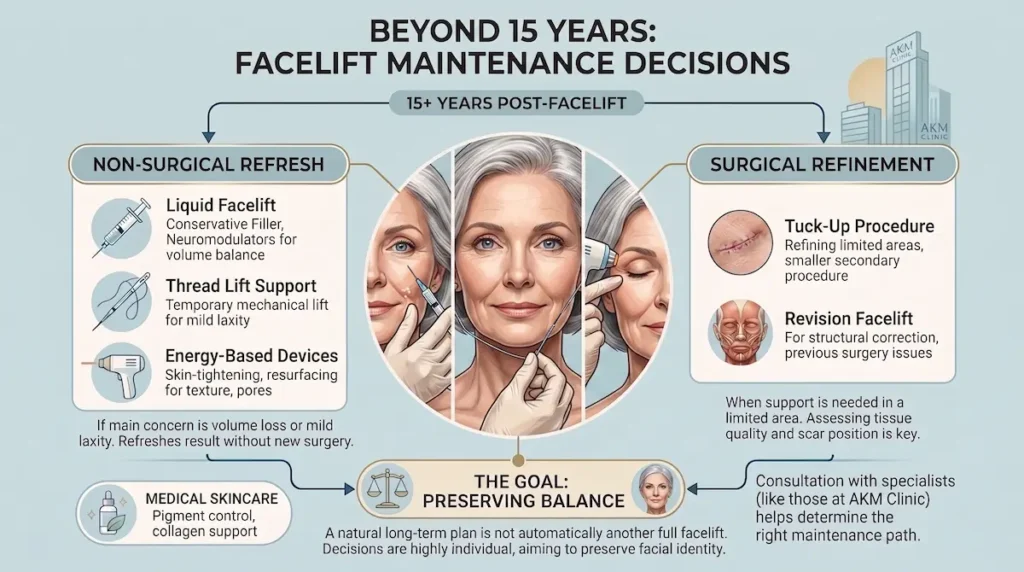
Beyond 15 Years: Maintenance Decisions
After 15 years, facelift longevity becomes highly individual. Some patients remain satisfied with no further surgery. Others notice renewed jowling, neck laxity, or skin-quality changes that make maintenance worth considering.
The right decision is not automatically another full facelift. A natural long-term plan may involve a small tuck-up, volume restoration, laser or energy-based treatment, or no intervention at all. The aim is to preserve balance.
When tuck-up procedures become relevant
A tuck-up procedure is a smaller secondary procedure designed to refine areas that have softened over time. It is not the same as a full revision facelift. It may be appropriate when the original result aged well, but a limited area now needs support.
At AKM Clinic, tuck-up planning is usually considered only after assessing tissue quality, scar position, skin elasticity, and the original surgical technique. Some patients are not good candidates for a limited tuck-up because their ageing pattern requires a broader structural correction.
Canadian patients reviewing long-term maintenance should look at revision facelift specialist care if the concern involves previous surgery, scar tissue, distortion, or a result that did not age well. For cost planning, AKM’s tuck-up and revision pricing in CAD provides the relevant Canadian-dollar reference.
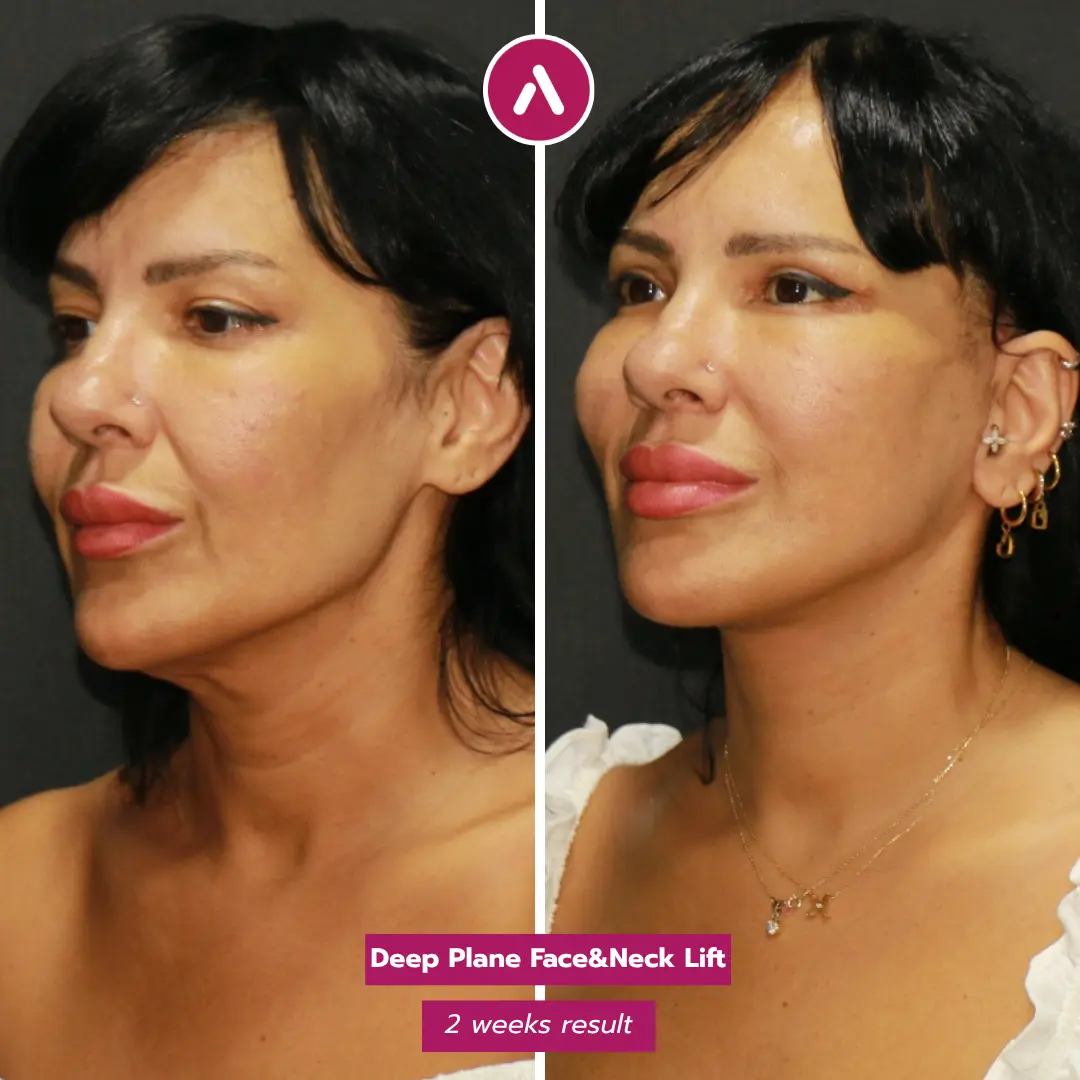
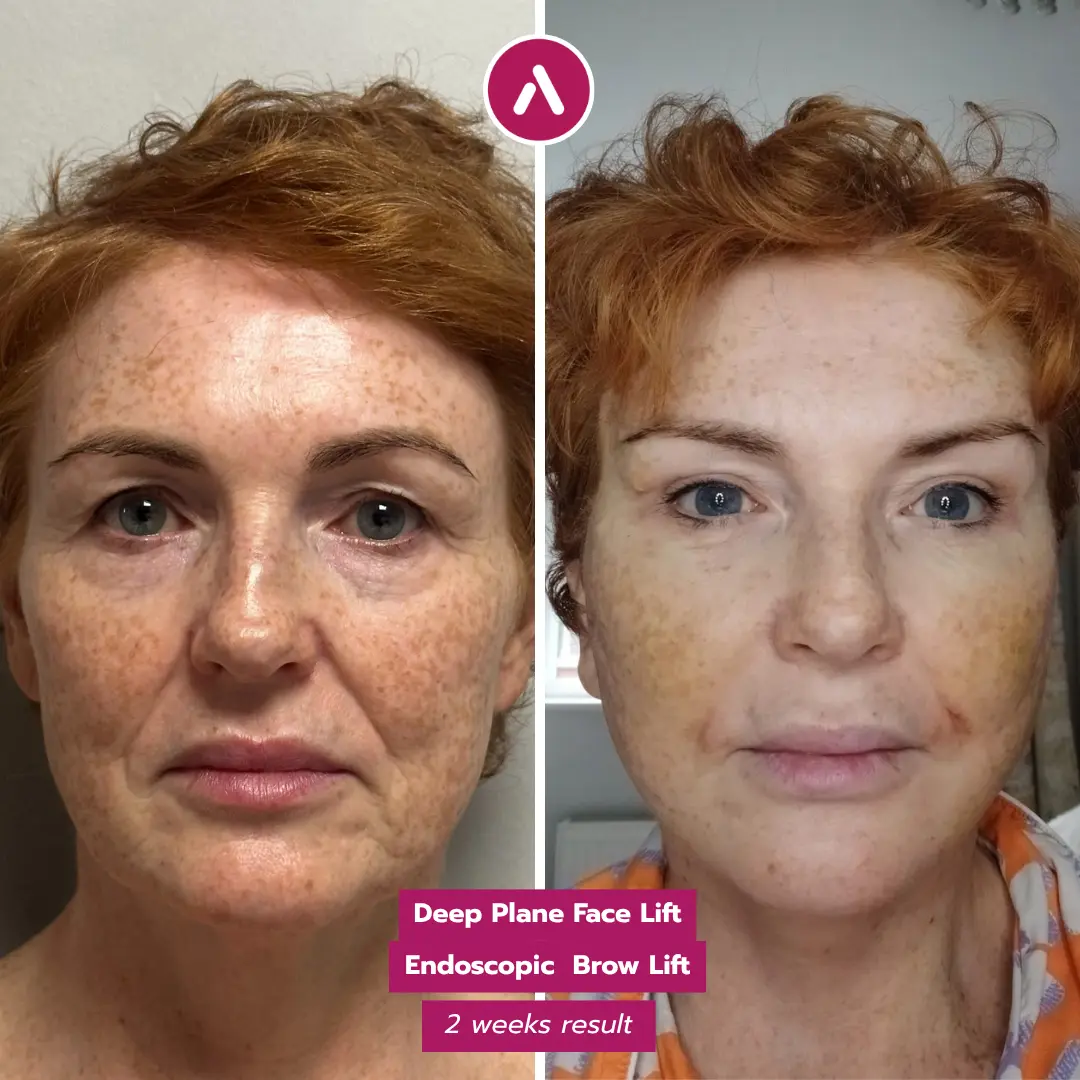
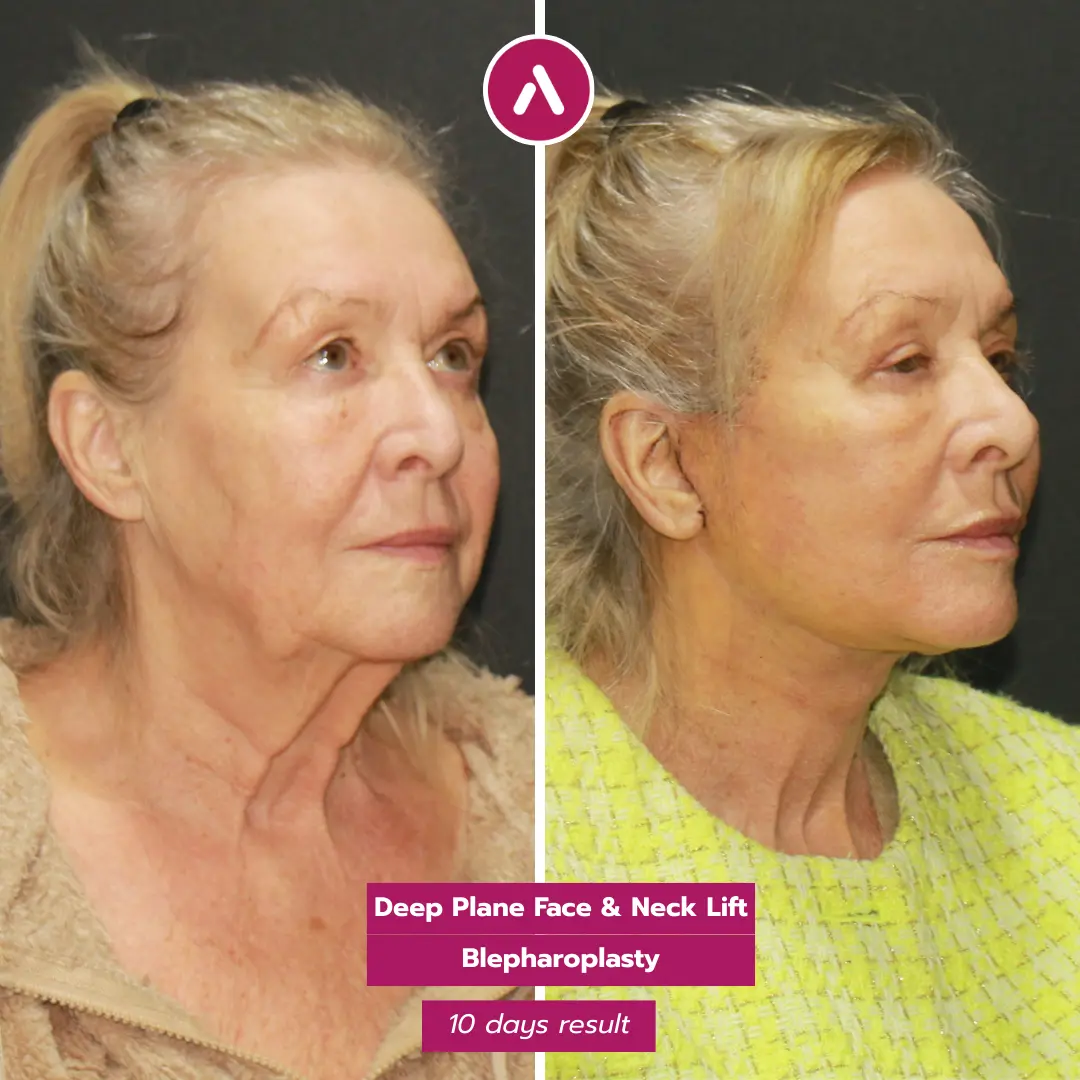
Non-surgical maintenance options: liquid facelift, threads, and energy devices
Not every long-term change requires surgery. If the main concern is volume loss, mild laxity, or surface ageing, non-surgical maintenance may be enough. These options can help refresh the result without changing the surgical foundation.
Common maintenance categories include:
- Liquid facelift maintenance: conservative filler or neuromodulator planning for volume and expression balance.
- Thread lift support: temporary mechanical lift for mild laxity in selected patients.
- Energy-based treatments: skin-tightening or resurfacing options for texture, pores, and fine lines.
- Medical skincare: pigment control, collagen support, and UV protection.
For patients considering injectable-based maintenance rather than another operation, review AKM’s guide to non-surgical maintenance options. The key is restraint. Overfilling a post-facelift face can make a natural result look heavier and less refined.
Why some patients never require revision surgery
Some patients do not require revision because their facial ageing pattern remains balanced. Their skin quality holds well, their weight stays stable, and the original surgical vector continues to age gracefully. Genetics also plays a role.
Other patients simply choose not to revise. They may still look better than their pre-surgery baseline, even if some ageing has returned. That is a valid outcome.
The best long-term plan is not the most aggressive one. It is the plan that preserves facial identity while addressing the smallest reasonable concern.
Lifestyle Factors That Influence Longevity
Stem cell facelift longevity is not controlled by the procedure alone. The way a patient ages after surgery can strengthen or weaken the long-term result. This is especially true for skin quality, scar colour, pigmentation, and collagen density.
Canadian patients should think of longevity as shared work between the surgeon and the patient. Surgery creates the reset. Daily habits protect it.
Sun exposure and Canadian seasonal UV variation
UV exposure is one of the most important long-term threats to facelift results. It affects collagen, pigmentation, scar maturation, and skin texture. It also explains why a patient can protect their face carefully in winter, then lose discipline during patio, cottage, hiking, or beach season.
Health Canada advises using the UV Index as a sun-protection guide and recommends protection when the UV Index reaches 3 or higher. That includes shade, protective clothing, sunglasses, and broad-spectrum sunscreen. For post-facelift patients, this advice is not cosmetic only. It directly affects scar colour and long-term skin quality.
Canadian Climate Callout: UV Protection After a Facelift
In Canada, UV exposure is not only a July and August issue. Reflection from snow, spring sunlight, and cloudy summer days can still affect healing skin. For the first year after surgery, treat every exposed incision and resurfaced area as UV-sensitive.
- Use a broad-spectrum SPF 30 or higher every morning.
- Wear a wide-brimmed hat during high-UV outdoor activities.
- Avoid tanning beds entirely.
- Use mineral sunscreen over scars if your skin is prone to pigmentation.
- Check the daily UV Index before extended outdoor exposure.
For Canadian sun-safety guidance, see Health Canada’s sun safety resource.
Smoking, alcohol, skincare, and collagen quality
Smoking is one of the clearest threats to long-term facial surgery outcomes. It reduces blood flow, slows healing, and weakens skin quality over time. Even after the early recovery period, smoking can accelerate visible ageing.
Alcohol can also affect longevity indirectly. Heavy or frequent intake may worsen inflammation, sleep quality, weight stability, and facial puffiness. None of these support a clean, long-lasting result.
Skincare does not replace surgery, but it protects the surface result. A practical long-term routine may include:
- Daily sunscreen to protect collagen and scar colour.
- Retinoid or retinol use if recommended by your clinician.
- Moisturizer and barrier repair during dry Canadian winters.
- Antioxidant support for patients with pigmentation concerns.
- Regular clinical review rather than reactive over-treatment.
The goal is consistency. Expensive skincare used irregularly is usually less helpful than a simple plan used every day.
Weight stability and the rebound effect
Weight fluctuation affects the face more than many patients expect. Significant weight loss after a facelift can reduce facial volume and make laxity more visible. Significant weight gain can soften the jawline and change the contours that surgery refined.
This is why surgeons often prefer patients to be near a stable, maintainable weight before surgery. The same principle applies after surgery. A stable weight protects the structural result.
The rebound effect is not only about kilograms. It is about facial balance. Repeated cycles of weight gain and loss can stretch skin, reduce elasticity, and make maintenance more complicated.
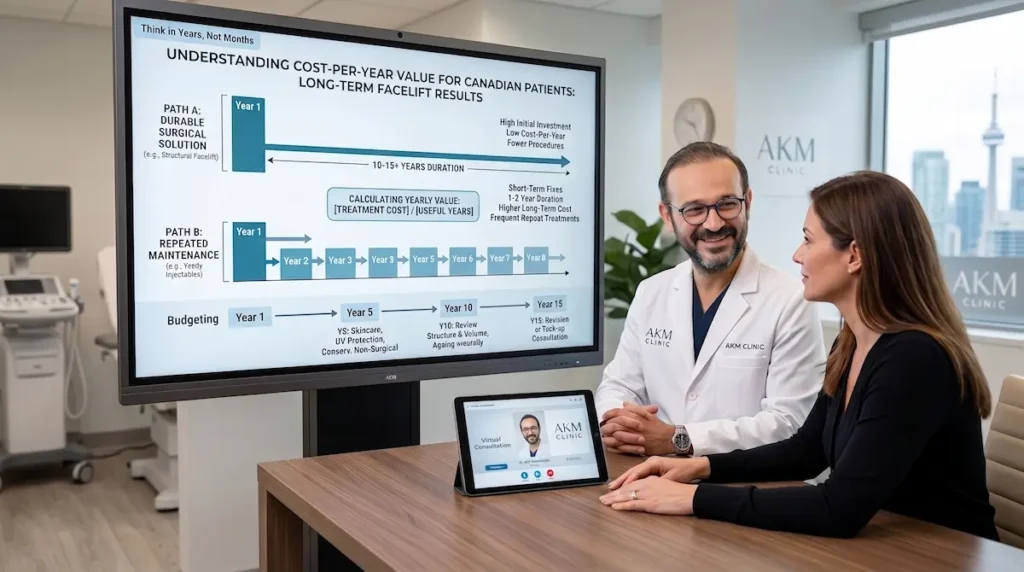
Cost-Per-Year Value for Canadian Patients
Long-term value matters because facelift results unfold over many years. A procedure with a higher initial investment may still make sense if it provides durable structural improvement and reduces the need for frequent short-term maintenance.
For Canadian patients, all pricing should be evaluated in CAD and by category. A surgical fee is not the same as an all-inclusive package. A maintenance treatment is not the same as revision surgery.
How to calculate long-term value in CAD
A simple cost-per-year calculation divides the treatment cost by the number of useful years the result provides. This does not capture every clinical factor, but it helps Value Seeker Victoria compare long-term options without falling into “cheapest price” thinking.
For example, if a durable facelift result remains meaningful for 10 to 15 years, the yearly value may be stronger than repeated short-term injectable maintenance. The answer depends on anatomy, age, skin quality, and the patient’s tolerance for future procedures.
Canadian Value Callout: Think in Years, Not Months
Many Canadian patients compare surgery with yearly injectable or device-based treatments in Toronto, Vancouver, Montreal, or Calgary. That comparison should include duration. A lower one-time treatment price may not be lower over a decade if it must be repeated frequently.
Maintenance costs versus full revision costs
Maintenance can be surgical or non-surgical. The right option depends on what has changed. Mild volume loss may not justify revision surgery. Scar tissue, recurrent jowling, or neck laxity may require a more surgical solution.
| Maintenance or revision option | Best suited for | AKM CAD pricing | Source category |
|---|---|---|---|
| Tuck-up procedure | Limited long-term softening after a previous facelift | CAD $7,500 | AKM Clinic Treatment Techniques Cost document |
| Liquid facelift maintenance | Volume support, mild contour refinement, selected non-surgical refresh | CAD $3,150 | AKM Clinic Treatment Techniques Cost document |
| Thread lift maintenance | Temporary mechanical support for mild laxity in selected patients | CAD $2,750 | AKM Clinic Treatment Techniques Cost document |
These figures should not be treated as automatic recommendations. They are reference points. A patient with strong structure and mild texture concerns may not need any of these options.
A patient with prior surgery, scar tissue, or a result that aged poorly should avoid casual maintenance decisions. In that situation, revision-focused assessment is safer than layering injectables over a structural problem.
Planning a 5-, 10-, and 15-year outcome budget
Long-term planning does not mean committing to more treatment. It means knowing what might be appropriate if changes appear. This gives Canadian patients a realistic framework before they travel.
- At 5 years: focus on skin quality, UV protection, skincare, and conservative non-surgical maintenance if needed.
- At 10 years: review structural support, volume changes, and whether the result is still ageing naturally.
- At 15 years: consider whether a tuck-up, revision consultation, or no treatment is the best fit.
The best budget is not built around fear. It is built around anatomy. A patient who protects their skin, avoids smoking, and maintains stable weight may need less intervention than someone who relies on periodic rescue treatments.
For an expert patient, the key takeaway is simple: stem cell facelift longevity is not a fixed countdown. It is a long-term interaction between surgical quality, regenerative support, biology, and maintenance discipline.
A useful long-term plan should combine clinical follow-up with objective evidence. Facelift durability is best judged through standardized photography, anatomy-based review, and realistic comparison over time. A peer-reviewed 10-year follow-up study on facelift outcomes reinforces the value of long-term photographic assessment rather than judging surgery only by early results: 10-year facelift follow-up research.
If you are planning surgery from Canada, use your consultation to discuss more than the first year. Ask what your result may look like at 5, 10, and 15 years, which maintenance options fit your anatomy, and how AKM Clinic would monitor your progress once you return home.
CTA: Discuss your long-term outcome plan in a virtual consultation with AKM Clinic, including maintenance timing, CAD pricing, and realistic expectations for your facial anatomy.
Frequently Asked Questions: Stem Cell Facelift Longevity
These questions address the most common longevity concerns Canadian patients raise before choosing a stem cell-augmented facelift. The answers are educational and should not replace a surgeon-led assessment of your anatomy, skin quality, health history, and goals.
How long does a stem cell facelift last?
A stem cell-augmented facelift may maintain structural lift for 10 to 15 years when the surgical foundation is strong and the patient follows good long-term maintenance habits. Skin-quality benefits may need support earlier, often around years 5 to 8.
The exact duration depends on age, genetics, skin thickness, UV exposure, smoking history, weight stability, and the specific facelift technique used. No ethical clinic should promise the same number of years for every patient.
Will I need a revision facelift after 10 years?
Not necessarily. Many patients remain satisfied at year 10 because they still look better than their pre-surgery baseline. Others may consider a small tuck-up, non-surgical maintenance, or a revision consultation depending on how their tissue has aged.
A revision decision should be anatomy-driven. It should not be based only on the calendar.
Does stem cell augmentation extend longevity?
Stem cell augmentation may support tissue quality, skin texture, and regenerative repair, but it should not be described as a guaranteed way to add a fixed number of years to a facelift. The structural result still depends heavily on the surgical lift itself.
The most responsible answer is that stem cell support may improve the quality of the ageing process. It does not stop ageing.
What lifestyle changes preserve facelift results?
The most important habits are consistent UV protection, no smoking, stable weight, moderate alcohol intake, good sleep, and disciplined skincare. These habits protect collagen and reduce avoidable skin damage.
Canadian patients should be especially careful during summer UV exposure and winter dryness. Both can affect skin quality in different ways.
Can I maintain results with non-surgical treatments?
Yes, if the concern is mild volume loss, fine lines, texture change, or early laxity. Liquid facelift maintenance, thread lift support, resurfacing, and skincare may help selected patients.
Non-surgical treatment cannot correct every structural issue. If jowling, neck laxity, or scar-tissue distortion is significant, a revision-focused consultation may be more appropriate.
What does maintenance cost in Canadian dollars?
AKM Clinic’s Treatment Techniques Cost document lists the tuck-up procedure at CAD $7,500, liquid facelift maintenance at CAD $3,150, and thread lift maintenance at CAD $2,750. These are reference prices, not automatic recommendations.
Your actual plan should be confirmed during consultation because maintenance depends on anatomy, previous procedures, and the degree of change.
Will Canadian winters affect my results?
Canadian winters do not shorten a facelift result by themselves. However, dry air, indoor heating, reduced humidity, and inconsistent skincare can worsen dryness, irritation, and dullness.
The bigger year-round concern is UV exposure. Snow reflection, spring sunlight, and summer outdoor activity can all affect healing skin and scar colour. Daily sunscreen remains important even outside peak summer.
Medical Disclaimer: This page is provided for general educational purposes only and does not replace an in-person medical consultation, diagnosis, or personalized treatment plan. All surgery carries risks, and outcomes vary between individuals. Suitability for facelift surgery, procedure selection, and anesthesia choice can only be determined after a full clinical assessment by a qualified surgeon. Always follow your clinician’s instructions and seek urgent medical attention if you develop concerning symptoms during recovery.