



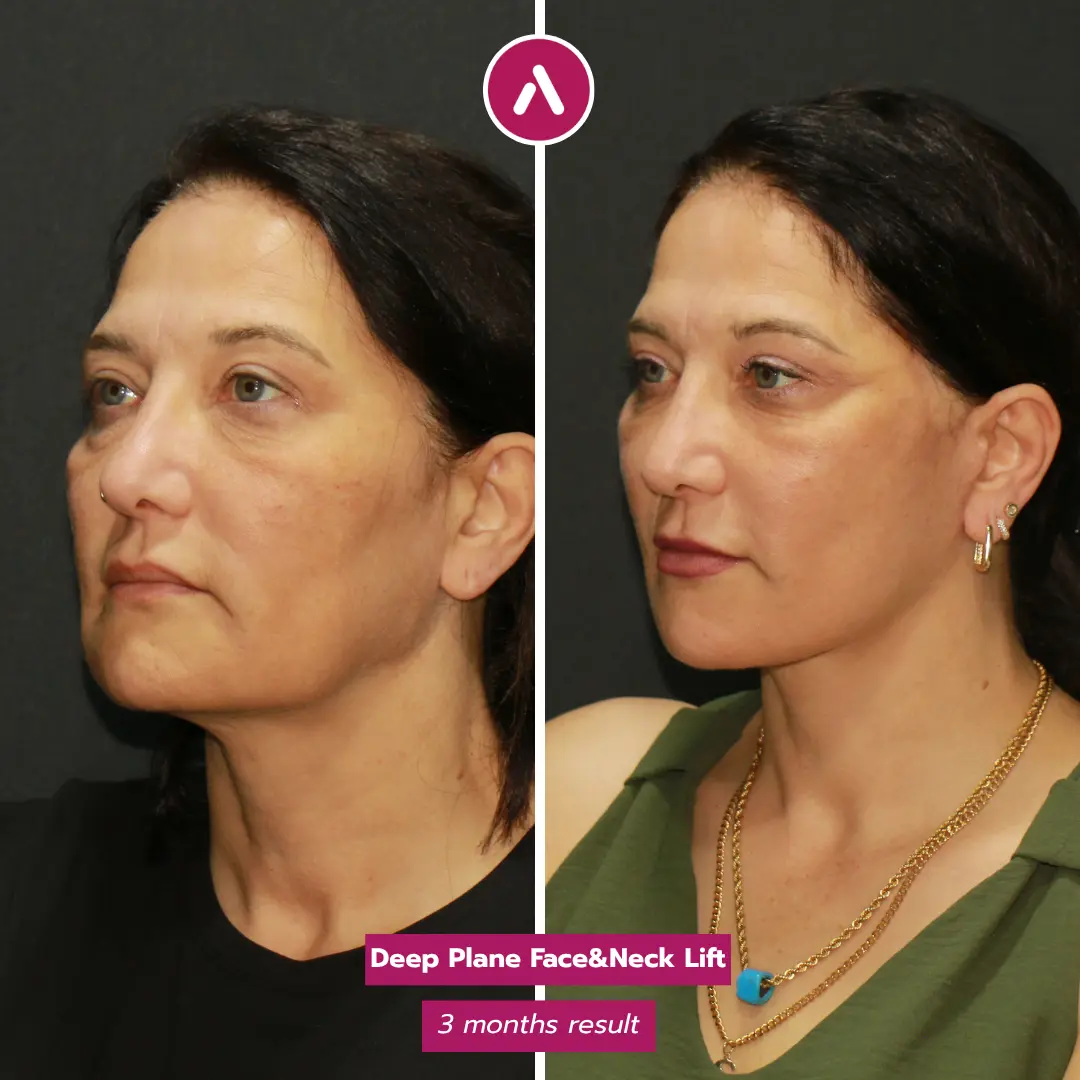
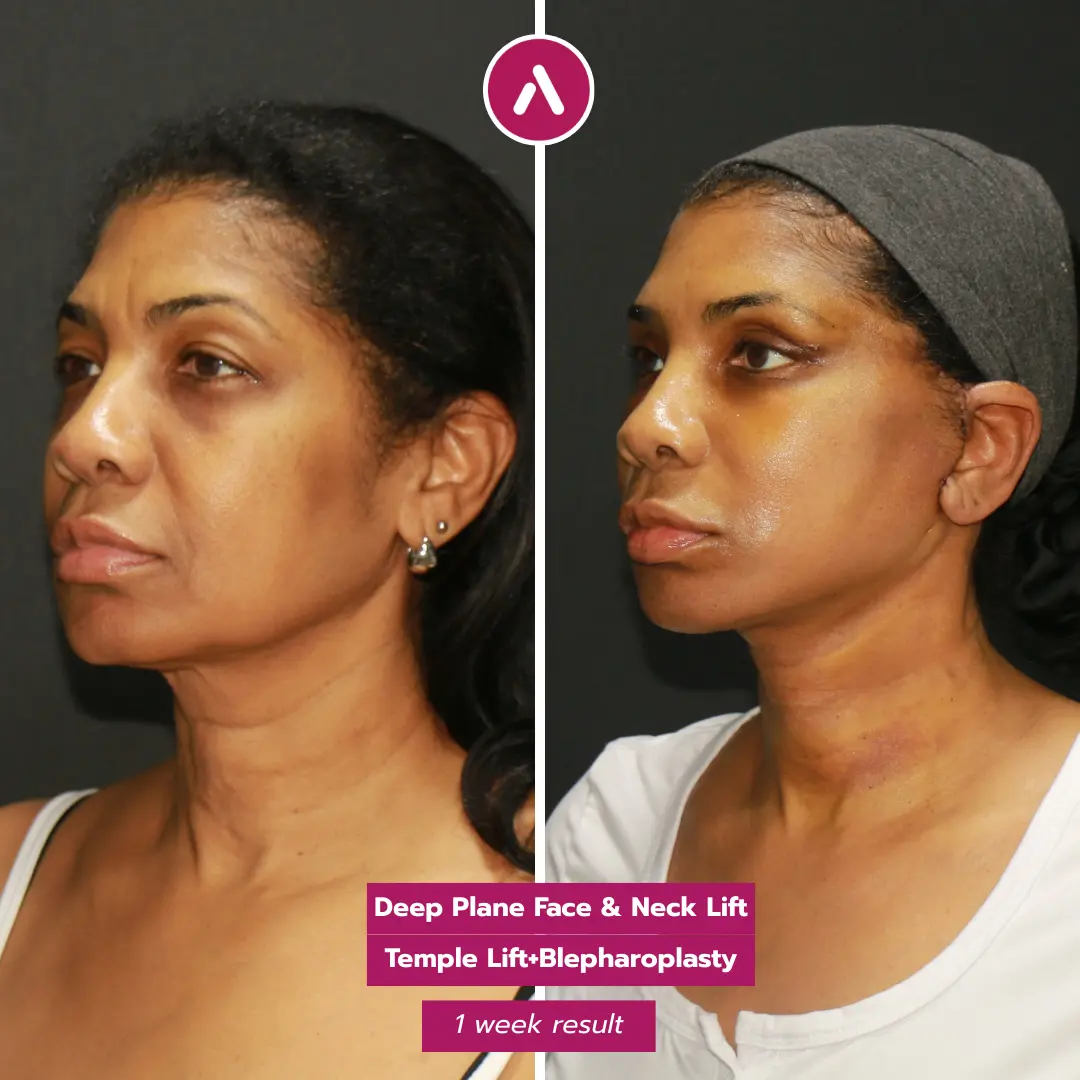
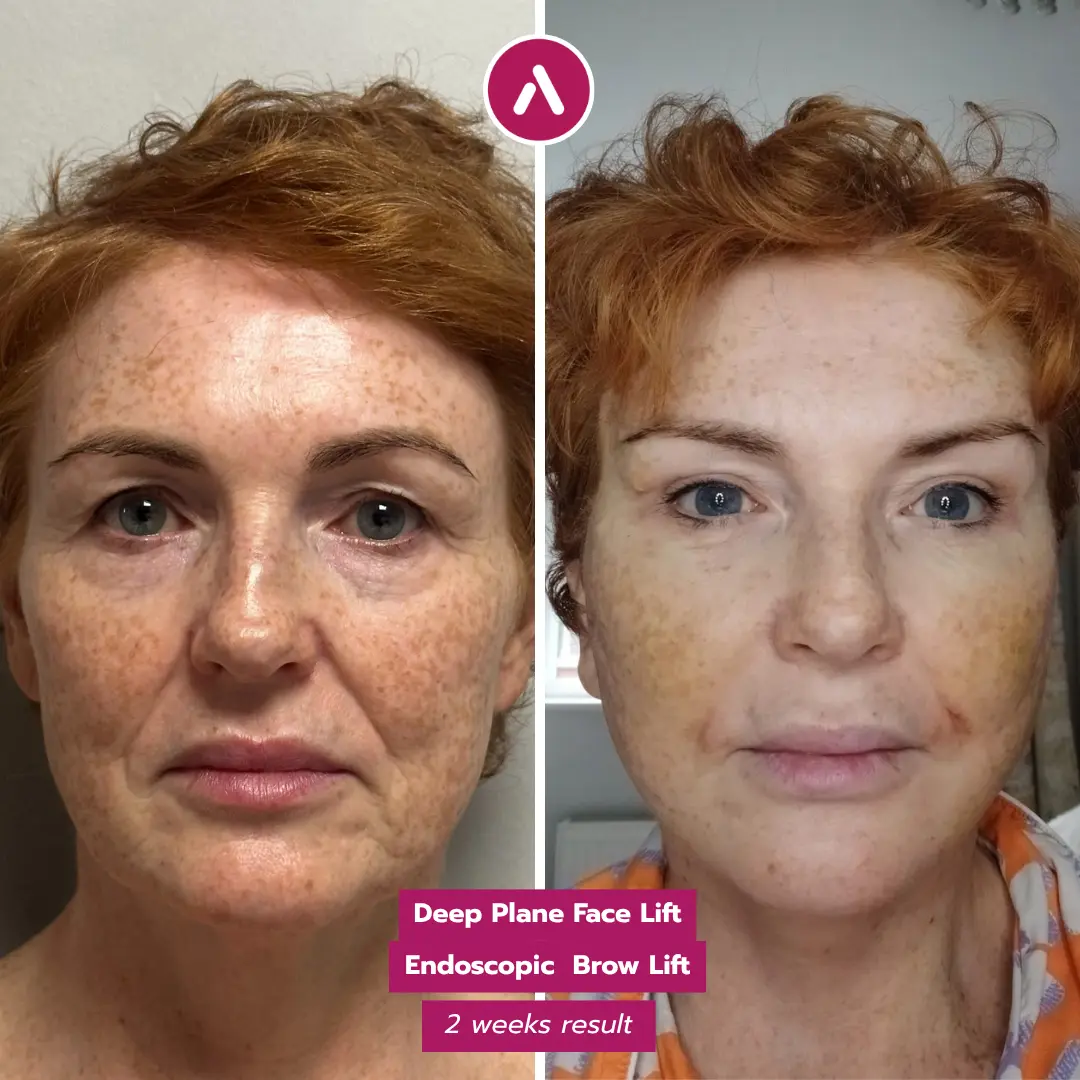
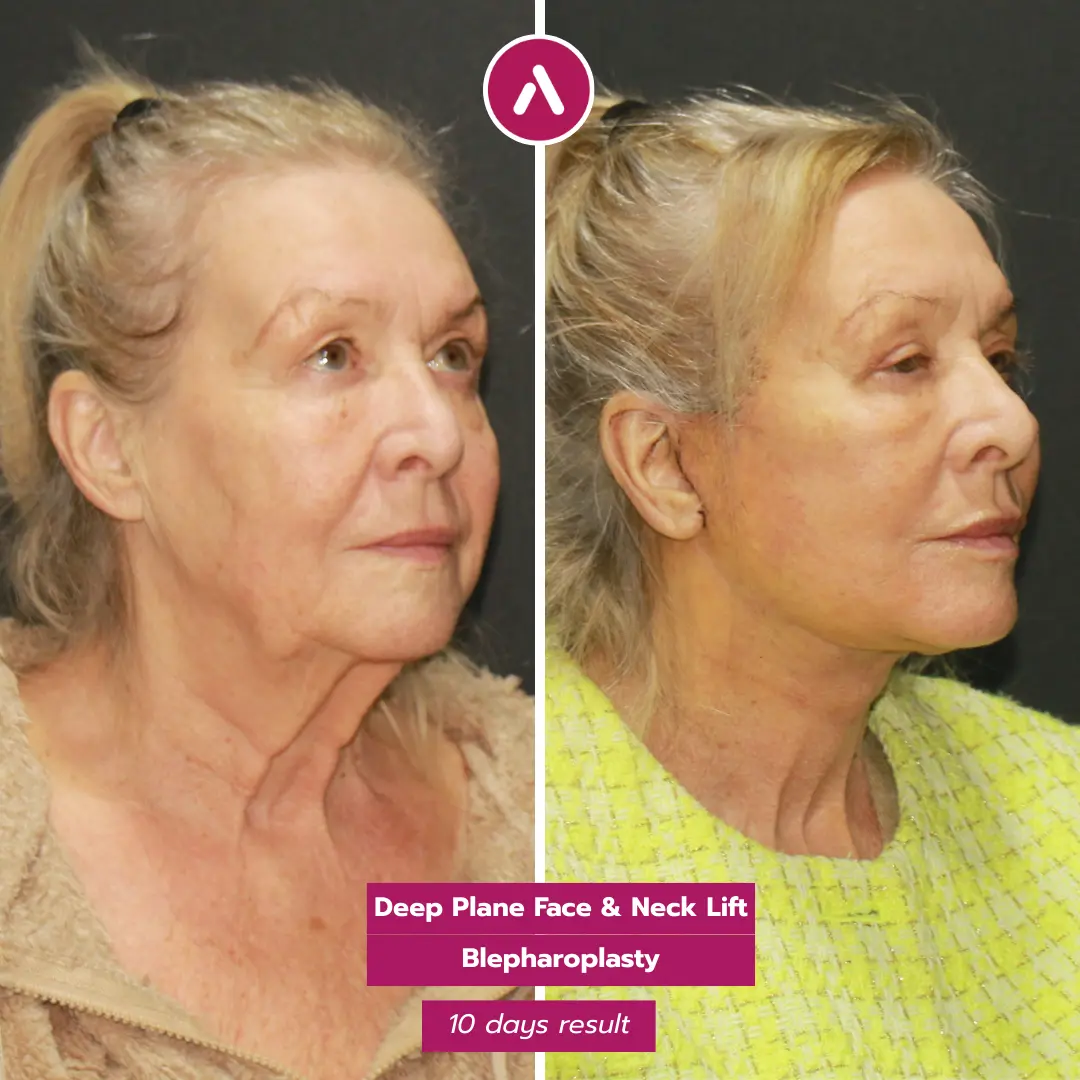
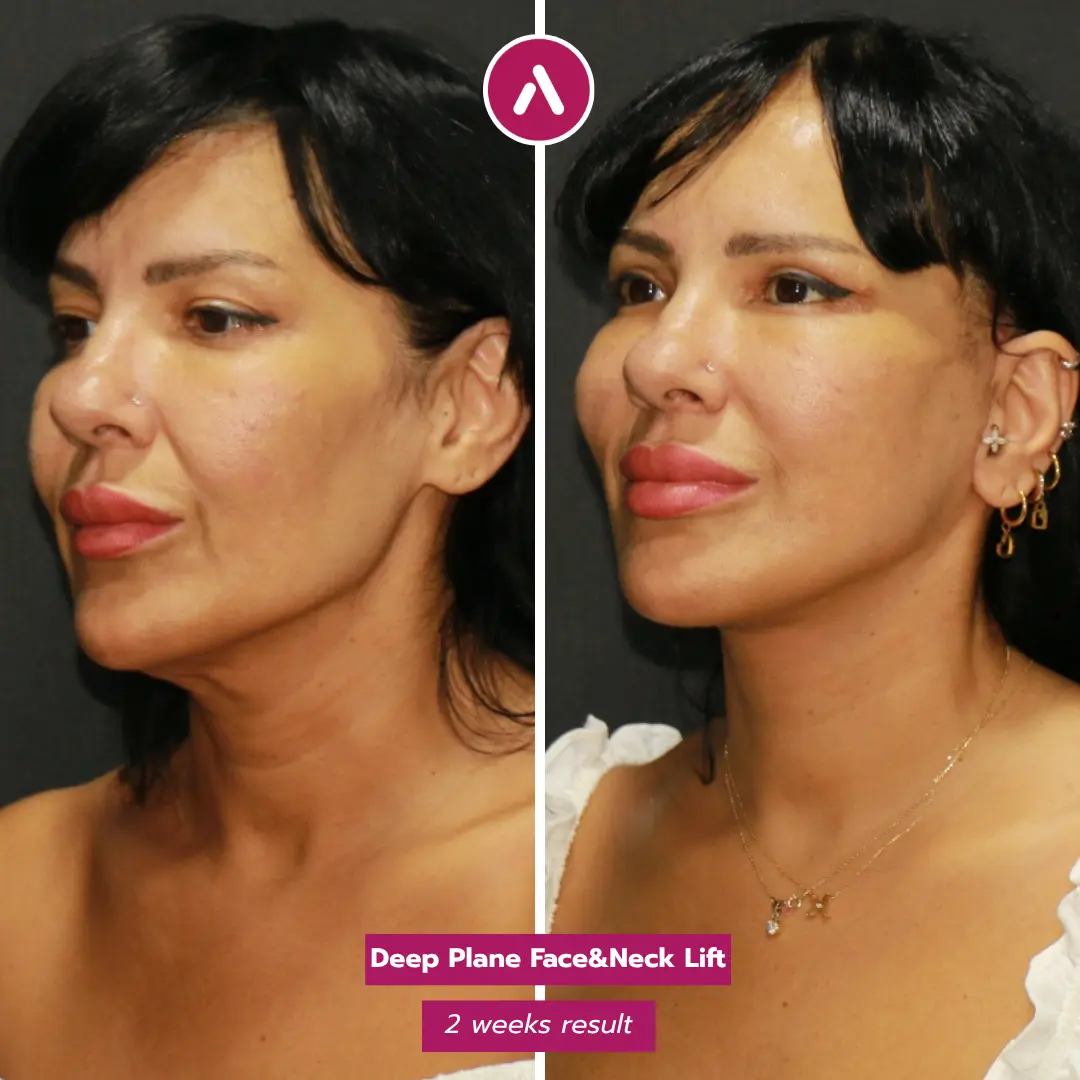
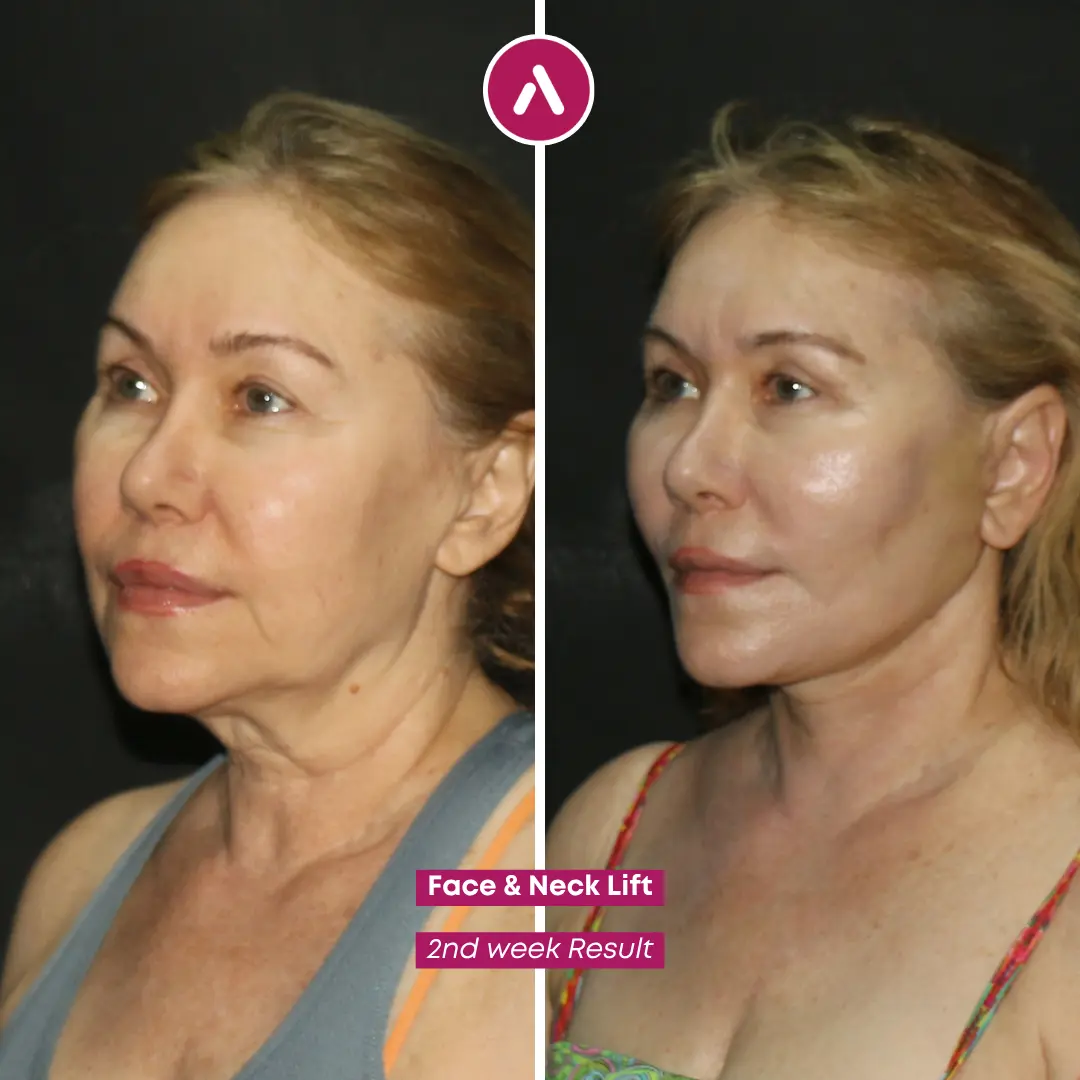
If your facelift did not turn out the way you hoped — too tight, uneven, visibly scarred, or giving a “windswept” appearance — you are not alone, and many concerns can be improved. A revision facelift corrects the outcome of a previous procedure, but it requires more planning than a first-time facelift because scar tissue and altered anatomy change the surgical field. This guide explains what can be corrected, why timing matters, and how Canadian patients can verify the right clinic before trusting a surgeon the second time.
Table of Contents
What Is a Revision Facelift? And Why Is It More Complex?
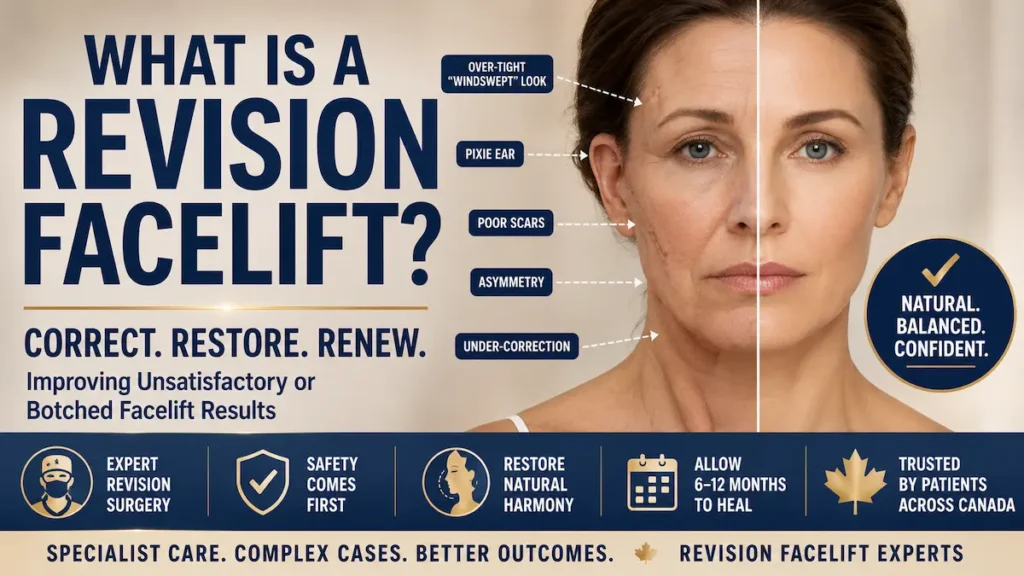
A revision facelift corrects an unsatisfactory or botched previous facelift, addressing issues such as an over-tight or “windswept” look, poor scars, asymmetry, pixie ear, or under-correction. Revisions are more complex than primary surgery and usually require 6–12 months of tissue healing before correction.
A revision facelift is a secondary facial rejuvenation procedure performed after a previous facelift, neck lift, mini facelift, SMAS facelift, or deep plane facelift has healed but left concerns that still need correction. Some patients come to us because the first result was too subtle. Others feel the face looks tight, uneven, or different from the natural result they expected.
We approach revision facelift surgery differently from a first-time facelift. The goal is not simply to “redo” the original operation. Our European Board-Certified Surgeons analyze what was done before, how the tissues healed, and which changes can be improved safely.
How a Revision Facelift Differs from a First-Time Facelift
In a primary facelift, the surgeon works with tissue planes that have not been surgically altered. In a revision facelift, those planes may contain scar tissue, shortened skin, changed blood supply, or sutures from the first procedure. This makes planning more precise.
The surgeon must answer several questions before recommending revision:
- Was the first facelift skin-only, SMAS-based, deep plane, mini, or combined with a neck lift?
- Is the problem caused by under-correction, over-correction, poor scar placement, or natural ageing after surgery?
- Is there enough healthy tissue mobility to revise the result safely?
- Would fat transfer, scar revision, or a neck correction improve the result more than a full facelift revision?
This is why we never treat revision facelift as a standard template. A patient who had a conservative mini facelift needs a different strategy from someone with a tight skin-only lift or a deep plane facelift that healed with asymmetry.
Why Revisions Are More Complex: Scar Tissue and Altered Anatomy
Scar tissue is the main reason revision facelift surgery requires specialist judgement. It can make tissues less flexible and less predictable. It may also hide normal anatomical landmarks that guide safe dissection during facial surgery.
Blood supply matters too. Skin and deeper facial layers receive circulation through small vascular networks. A previous facelift may have changed those networks. Our surgical planning respects this limitation instead of forcing a result that the tissue cannot safely support.
Altered anatomy also affects nerve safety. Facial nerves follow known pathways, but previous surgery can change the way tissue layers move around them. This is one reason revision facelift belongs with surgeons who regularly perform complex facial rejuvenation, not with high-volume clinics that apply the same plan to every patient.
“In revision facelift surgery, the first question is not how much we can lift. It is how safely we can restore balance while respecting scar tissue, blood supply, and the patient’s original facial character.”
Revision vs Touch-Up vs Second Primary Facelift
Patients often use the same words for very different situations. A “revision” usually means the previous result needs correction because of a specific concern. A “touch-up” is smaller and may address a minor scar, slight asymmetry, or limited laxity years after the first surgery.
A second primary facelift is different again. Some patients loved their first result for 10 or more years, then returned because natural ageing continued. That is not a botched facelift. It is a normal long-term ageing pattern.
| Term | What It Usually Means | Typical Timing | Common Goal |
|---|---|---|---|
| Revision facelift | Correcting a specific problem after a previous facelift | Often 6–12 months after the first surgery | Improve scars, tightness, asymmetry, or under-correction |
| Touch-up procedure | A limited correction after otherwise acceptable healing | Months or years later | Refine a small area |
| Second primary facelift | A new facelift after years of natural ageing | Often 8–15 years later | Restore ageing tissues again |
Most Unsatisfactory Results Can Be Improved
A disappointing facelift result can feel deeply personal. The face is visible, expressive, and tied to identity. Many patients who contact us from Canada are not looking for a dramatic new look; they want to feel like themselves again.
That is usually a reasonable goal. Revision facelift can often improve visible scars, tight skin tension, pixie ear, residual jowls, poor jawline definition, and facial imbalance. It can also be combined with fat transfer to the face when the first surgery left the face looking hollow or over-resected.
We are careful with promises. Some issues can be improved significantly, while others can only be softened. The first consultation is where we separate what is surgically possible from what would create new risk.
Why Facelifts Sometimes Need Revision, Without Blame
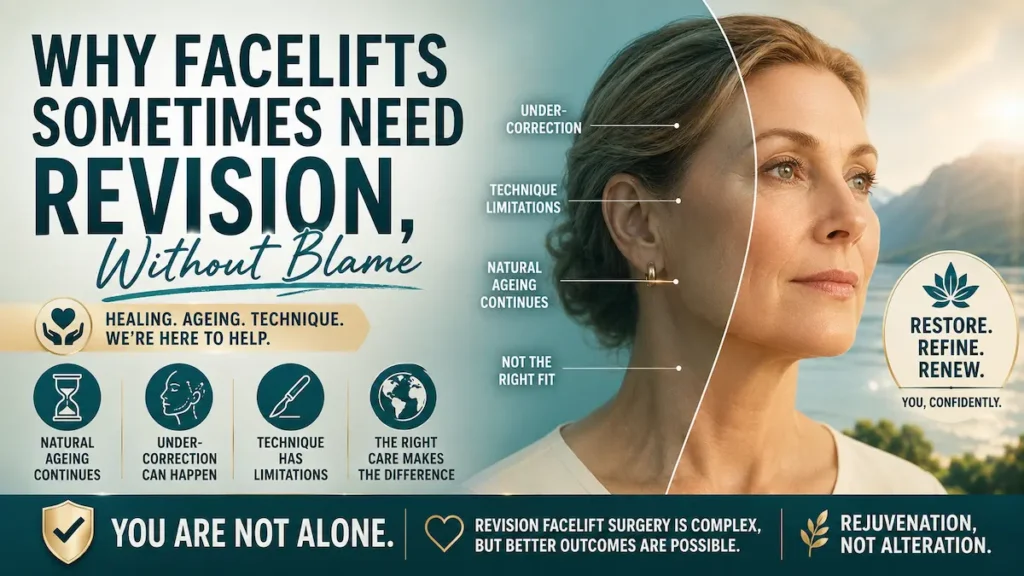
Needing a facelift revision does not mean you made a poor decision. It means the first result, healing process, technique, or long-term ageing pattern did not match your needs. Our role is to understand what happened and create a safer plan forward.
Natural Ageing Continues
Even the best facelift cannot stop time. Skin quality, facial fat, bone support, hormones, sun exposure, weight change, and genetics continue to affect the face after surgery. A patient who had a strong result years ago may eventually notice new jowling or neck laxity.
This type of revision is often less emotionally distressing than correcting a true botched facelift. The first surgery worked, then natural ageing resumed. In these cases, revision may focus on restoring the jawline, refining the neck, or updating the original lift in a conservative way.
Under-Correction After a Conservative First Result
Some patients receive a result that is technically safe but too modest. They may still see jowls, loose neck skin, or mid-face descent soon after healing. This can happen when the first surgeon used a limited technique for a problem that needed deeper support.
Under-correction is common after very conservative mini facelifts or skin-only lifts. The skin may look slightly tighter, but the deeper structures still sit low. In these cases, a more structural approach, such as a SMAS-based correction or deep-plane-style release, may be considered after healing.
Technique Limitations
Every facelift technique has boundaries. A skin-only lift may relapse faster because it relies heavily on skin tension. A limited mini facelift may not correct the neck. A facelift that ignores volume loss may improve laxity but leave the face looking tired.
This is why we often discuss related options during revision planning. Some patients need a neck lift correction. Others need scar revision, fat transfer, or careful re-elevation of deeper support layers.
When the First Clinic Was Not the Right Fit
A disappointing result can happen anywhere, including Canada, the United States, Europe, or Turkey. The issue is rarely the country alone. It is usually a mismatch between the patient’s anatomy, the surgeon’s technique, the facility standards, and the level of follow-up.
For Canadian patients researching revision abroad, this point matters. A safe international surgical programme should make the surgeon’s credentials clear, explain the facility standard, provide English-language records, and offer long-term follow-up after you return home.
You Are Not Alone
Revision facelift is a recognized part of facial plastic surgery. It is more complex, but it is not unusual. Patients seek revision because they want a result that feels more natural, balanced, and aligned with their identity.
At AKM Clinic, our philosophy is “Rejuvenation, not alteration.” That matters even more in revision surgery. The safest correction is rarely the most aggressive one. It is the one that restores proportion without creating a new problem.
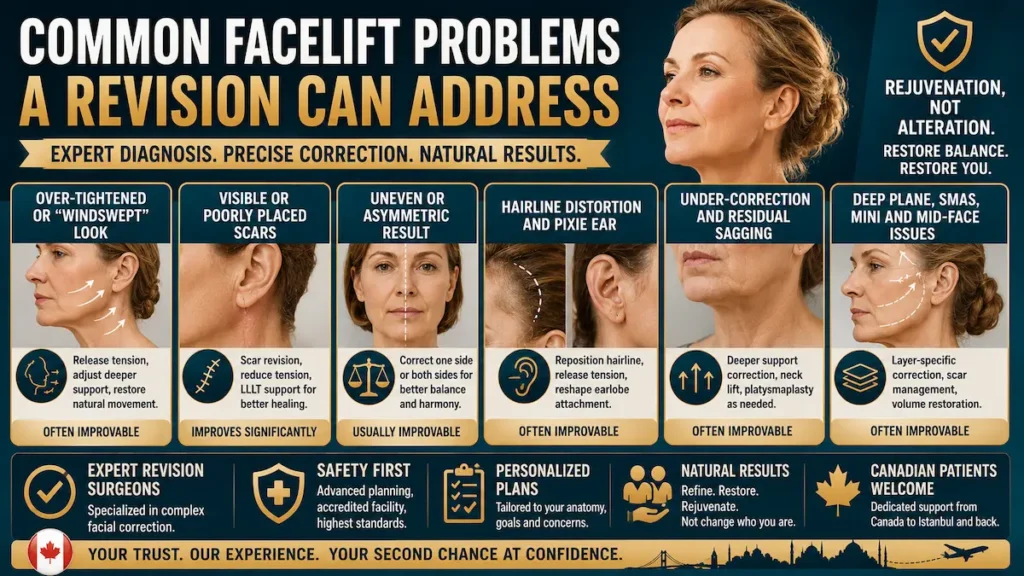
Common Facelift Problems a Revision Can Address
Revision facelift surgery begins with a precise diagnosis. “Botched facelift” is a broad phrase, but the actual problems are usually specific: skin pulled in the wrong direction, scars placed poorly, tissue lifted too little, or one side healing differently from the other. Naming the issue clearly helps us choose the safest correction.
We never assume every concern requires a full revision facelift. Some patients need scar revision only. Others need a deeper structural correction, a neck lift adjustment, pixie ear repair, or facial volume restoration. The right plan depends on what caused the result, not just what the result looks like.
Over-Tightened or “Windswept” Appearance
An over-tight facelift can make the face look stretched, flat, or pulled sideways. Patients often describe this as a “windswept” look. It may happen when too much tension was placed on the skin instead of the deeper support layers.
Revision may help by releasing scarred or tethered areas and redistributing tension into deeper structures. The aim is not to loosen the face randomly. It is to restore softer movement and a more natural direction of lift.
Some cases cannot be fully reversed immediately. If the skin is very tight, the safest approach may involve waiting, staged correction, or adding volume with fat transfer to the face to soften a hollow or over-resected appearance.
Visible or Poorly Placed Scars
Facelift scars should sit in natural folds, around the ear, and along hair-bearing areas where possible. A poor scar may be too wide, raised, shiny, pulled, or positioned in a way that makes it visible with normal hairstyles. This is one of the most common reasons patients seek a facelift revision.
Scar revision can remove the old scar and close the tissue again with less tension. Low-Level Laser Therapy may also support scar maturation after surgery. We use this carefully because scar improvement takes time; even a well-revised scar needs months to soften and fade.
A scar cannot be erased. That would not be honest. The realistic goal is to make it flatter, better positioned, and less noticeable in daily life.
Uneven or Asymmetric Result
No human face is perfectly symmetrical. Yet a facelift can leave asymmetry that feels more obvious than before, especially around the jawline, cheeks, ears, or neck. This may come from uneven tissue release, different healing patterns, or pre-existing asymmetry that was not fully discussed before surgery.
Revision planning identifies whether the asymmetry is structural, scar-related, volume-related, or skin-related. A one-sided correction may be enough in some cases. In others, both sides need careful adjustment so the face ages and moves more evenly.
We assess asymmetry with photographs, video, and in-person facial animation. A face that looks balanced at rest may move differently during smiling or speaking. That detail matters.
Hairline Distortion and Pixie Ear
Hairline distortion can occur when incision placement or skin tension shifts the sideburn, temple hairline, or hair-bearing scalp. Patients may notice that the hairline looks unnatural, too high, or difficult to conceal. This can make a facelift obvious even if the facial lift itself is acceptable.
Pixie ear is another recognizable post-facelift concern. The earlobe may look pulled downward, stretched, or attached to the jawline rather than sitting naturally. This usually happens when too much downward tension is transferred to the skin near the ear.
Revision can often improve pixie ear by releasing tension, reshaping the earlobe attachment, and redistributing lift support away from the skin. Minor pixie ear correction may not require a full revision facelift, but combined cases often benefit from a broader plan.
Under-Correction and Residual Sagging
Under-correction means the first facelift did not lift enough of the problem area. Patients may still see jowls, loose neck skin, deep folds, or a tired lower face soon after healing. This can feel frustrating because the recovery was real, but the visible change was limited.
This problem often follows a procedure that was too small for the anatomy. A limited mini facelift may not correct a heavier neck. A skin-only lift may improve surface laxity without repositioning the deeper layers that caused the sagging.
In these cases, revision may involve a more structural approach, such as a SMAS facelift, deep tissue support, or a combined neck lift. We match the correction to the layer that failed, not only the area that looks loose.
Deep Plane, SMAS, Mini, and Mid-Face Issues
A previous deep plane or SMAS facelift does not automatically mean revision is impossible. It does mean the surgeon must understand which layer was lifted before and how much mobility remains. Prior deep tissue surgery changes the pathway for a safe second procedure.
If a deep plane facelift healed with asymmetry, under-correction, or residual neck laxity, the correction may require limited re-release, scar management, or volume restoration rather than repeating the same operation. If a SMAS lift was too conservative, deeper support may be considered.
Some patients also need a mid-face correction rather than a full lower-face revision. If cheek descent, lower-eyelid support, or central facial hollowing is the main concern, we may compare revision facelift with a mid facelift or fat transfer strategy.
Mini Facelift and Neck Lift Combination Issues
A mini facelift can be helpful for early lower-face ageing, but it has limits. If the neck was already loose, the result may leave a mismatch: a slightly improved jawline with persistent neck bands or skin laxity. This is a common reason patients later seek correction.
Neck lift issues can also appear after a combined operation. Patients may notice visible platysmal bands, uneven contour, fullness under the chin, or a jawline that still lacks definition. Revision may involve platysmaplasty, scar release, or targeted fat correction depending on the anatomy.
We approach these cases as facial balance problems. The goal is not to chase one isolated line. It is to restore a coherent relationship between the cheek, jawline, neck, ear, and hairline.
| Concern After Previous Facelift | Common Cause | Possible Revision Strategy | Can It Usually Improve? |
|---|---|---|---|
| Over-tight or windswept look | Excessive skin tension or poor lift vector | Scar release, deeper support adjustment, possible fat transfer | Often, but may require staged planning |
| Visible scars | Poor scar placement, tension, delayed healing | Scar revision, tension reduction, LLLT support | Often, but scars cannot disappear completely |
| Asymmetry | Uneven lift, healing variation, pre-existing asymmetry | One-sided or bilateral tissue adjustment | Usually, depending on tissue mobility |
| Pixie ear | Downward tension near the earlobe | Earlobe release and re-anchoring | Often |
| Residual jowls or neck laxity | Under-correction or limited technique | SMAS/deep support correction, neck lift, platysmaplasty | Often |
| Hollow or aged appearance | Volume loss or over-resection | Fat transfer, conservative lift revision | Often softens visibly |
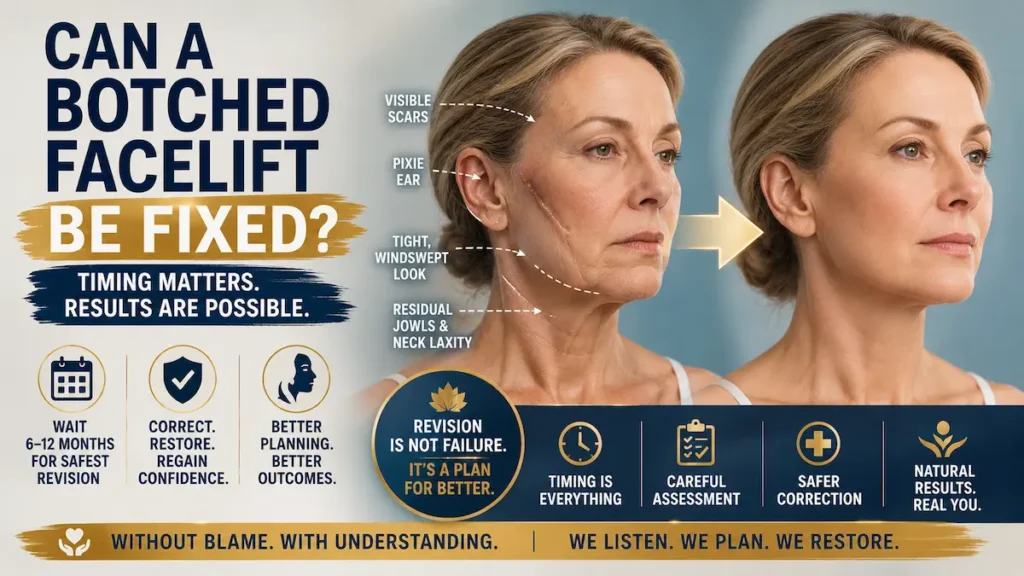
Can a Botched Facelift Be Fixed? Timing and Candidacy
Many botched or unsatisfactory facelift results can be improved, but timing is critical. A face that is still swollen, firm, or inflamed is not ready for major revision unless there is a medical reason to intervene sooner. Safe correction requires patience.
Most patients should wait 6–12 months before revision facelift surgery. This allows swelling to settle, scars to mature, blood supply to stabilize, and tissue planes to become easier to interpret. Waiting can feel difficult, but it often leads to a safer and more accurate correction.
Yes, Most Issues Can Be Improved
Correctability depends on the problem. Under-correction, visible scars, pixie ear, residual neck laxity, and moderate asymmetry often respond well to revision. Over-tightening and severe tissue shortage are more complex, but they may still be improved with careful release, fat transfer, or staged repair.
The first consultation is about separating emotional distress from surgical facts. Both matter. We listen to what bothers you, then determine whether the concern is caused by skin, scar, deep tissue, volume, or healing.
We may ask for previous surgical records, before-and-after photographs, and a healing timeline. This helps us understand what changed, when it changed, and whether the tissues are still actively settling.
Why You Usually Wait 6–12 Months Before Revision
A facelift continues to heal long after the visible bruising fades. Scar tissue changes texture over months. Skin relaxes. Swelling leaves the face gradually. Numbness and tightness can also improve without another operation.
Operating too early can create unnecessary risk. The surgeon may revise tissue that would have improved naturally, or work through inflammation that makes the anatomy harder to read. Early revision can also stress blood supply before the tissues have recovered.
“Waiting is not ignoring the problem. In revision facelift planning, time gives us better information. A calmer tissue environment lets us correct more accurately and with less risk.”
When Earlier Intervention Is Warranted
Some problems should not wait. If there is infection, wound opening, skin compromise, hematoma, severe pain, or a sudden change in facial movement, urgent medical assessment is necessary. Those situations are not cosmetic timing questions.
For Canadian patients, urgent concerns after returning home should be assessed by a local physician, emergency department, or appropriate specialist first. We can review photographs and records remotely, but immediate in-person care should happen where the patient is physically located.
Minor scar adjustments may sometimes happen earlier than a full revision, but only after direct assessment. A small problem does not always mean a small operation is safe at that moment.
Candidacy Assessment for Revision
A good revision facelift candidate is medically fit, emotionally ready, and realistic about improvement rather than perfection. Revision surgery can restore balance, soften tension, and improve scars, but it cannot make the first operation disappear. That distinction protects patients from another disappointment.
During assessment, we review:
- Your full medical history, including smoking, medications, and healing problems
- The date and type of your previous facelift or neck lift
- Photographs before your first surgery, after surgery, and during healing
- Current skin quality, scar position, facial movement, and tissue mobility
- Your priorities: scars, tightness, asymmetry, neck contour, volume loss, or all of the above
Smoking is a major issue in revision surgery because blood supply may already be reduced by previous tissue elevation. Patients who smoke usually need a strict cessation plan before we can consider revision safely.
What Can and Cannot Be Fully Corrected
Revision facelift can improve many visible problems, but honest boundaries matter. A scar can be improved, not erased. A tight look can often be softened, but severely shortened skin may not return to its original state. Asymmetry can be reduced, but natural facial asymmetry will remain.
Volume loss may need fat transfer. Neck bands may need a neck procedure. Poor skin texture may need laser or regenerative support, not more lifting. We explain these distinctions before surgery because the best revision plan often uses more than one tool.
This is also where our Natural-First philosophy matters. Revision should not swing the face from one extreme to another. The goal is a calmer, more balanced result that looks believable in motion.
The Second-Facelift Decision
A second facelift can be a good decision when the concern is real, the timing is right, and the surgeon can identify a safe correction pathway. It is not the right decision when tissues are still healing, expectations are unclear, or the patient wants an impossible reversal.
We encourage Canadian patients to slow the decision down. Ask for credential verification. Ask who will operate. Ask where the procedure will happen. Ask how follow-up works after you fly home.
This is the trust reset. A revision facelift is not only a surgical plan. It is a second chance to choose a clinical pathway with clearer standards, better communication, and long-term support.
| Situation | Typical Waiting Period | Why Timing Matters | Possible Next Step |
|---|---|---|---|
| Visible swelling or firmness after recent facelift | Usually wait 6–12 months | Swelling and scar tissue may still improve naturally | Monitor with photographs and clinical follow-up |
| Wide or raised scars | Often wait 6–12 months | Scar maturation changes colour, height, and texture | Scar care, LLLT, later scar revision if needed |
| Pixie ear | Often 6+ months, case-dependent | Earlobe tension may settle slightly before correction | Pixie ear correction or revision facelift |
| Residual jowls or under-correction | Usually 6–12 months | Final lift result must be visible before planning revision | Structural facelift or neck correction assessment |
| Infection, wound opening, hematoma, or skin compromise | Do not wait | Medical issues need prompt local assessment | Urgent care with local physician or emergency department |
What a Revision Facelift Addresses
A revision facelift is not one single correction. It is a tailored plan that may address scars, tissue tension, under-lifting, earlobe distortion, hairline changes, neck contour, or facial volume loss. The most effective plan starts by identifying which layer caused the concern.
For some patients, the skin needs revision. For others, the deeper support layer needs repositioning. In over-resected or hollow faces, lifting alone may not be enough; restoring volume can be just as important as improving laxity.
Scar Revision: Repositioning or Improving Existing Scars
Scar revision can improve a facelift scar that is wide, raised, shiny, visible, or poorly placed. The surgeon may remove the old scar, release tension, and close the incision again in a more favourable position. Around the ear, even a few millimetres can matter.
Our goal is to place the revised scar in natural shadows and contours whenever tissue allows. Common areas include the front of the ear, behind the ear, along the hairline, or around the earlobe. Revision can also improve scars that pull the earlobe downward.
We are careful with expectations. Scar revision can make a scar less noticeable, but it cannot create scar-free skin. Healing still depends on genetics, skin quality, tension, aftercare, and time.
Re-Elevation: Correcting Under-Correction
Re-elevation addresses tissue that was not lifted enough during the first procedure. Patients may still have jowls, loose neck skin, cheek descent, or a jawline that never became as defined as expected. This often means the first surgery did not adequately support the deeper layers.
During revision planning, we identify whether the remaining laxity comes from skin, SMAS, platysma, or deeper retaining structures. A second operation should not simply pull harder on the skin. That can recreate the same problem in a different form.
When under-correction involves the lower face, a structural approach may be needed. When it involves the neck, a combined neck lift correction may be more appropriate than a facelift-only revision.
Releasing Over-Tightened Tissue
An over-tight result can make the face look unnatural at rest and stiff in motion. The correction may involve releasing scarred tissue, redistributing tension, and restoring softer transitions between the cheek, jawline, and neck. This is delicate work.
Releasing tight tissue does not mean undoing every part of the first facelift. Some support may be worth keeping. The surgeon’s task is to identify which tension is helpful and which tension is distorting the face.
In hollow or flattened faces, release may be paired with volume restoration. A small amount of facial fat grafting can soften the “over-operated” appearance when tissue was lifted or reduced too aggressively.
Restoring Natural Hairline or Earlobe Position
Hairline and earlobe problems can make a facelift obvious. A shifted sideburn, visible temple scar, or stretched earlobe draws attention because these areas frame the face. Patients often notice them in photographs, when wearing hair up, or during video calls.
Revision may improve hairline distortion by adjusting scar placement, releasing tension, or carefully repositioning tissue. The options depend on how much hair-bearing scalp moved during the first surgery. Not every hairline change can be completely reversed.
Pixie ear correction focuses on restoring a more natural earlobe shape. If the lobe is pulled downward or attached too tightly to the jawline, we may release the scar, reshape the attachment, and move the lift tension away from the skin.
Volume Restoration for Over-Resected or Hollow Faces
Some unsatisfactory facelift results are not caused only by sagging or tension. They are caused by lost volume. When too much fat was removed, or when the original plan ignored facial deflation, the face may look older even if the skin is tighter.
Fat transfer can help restore softness to the cheeks, temples, jawline transition, and under-eye support. We use it selectively. Overfilling a revision face can look as unnatural as over-tightening one.
This is why fat transfer to the face is often discussed as a correction tool rather than a separate cosmetic add-on. In the right patient, it helps restore identity rather than simply adding volume.
| Revision Goal | Area Involved | Typical Method | Key Limitation |
|---|---|---|---|
| Improve visible scars | Around ear, hairline, behind ear | Scar excision, tension reduction, layered closure | Scars can improve, not disappear |
| Correct under-lifting | Jowls, lower face, neck | Re-elevation and deeper support adjustment | Depends on tissue mobility and prior technique |
| Soften a tight look | Cheeks, jawline, mouth area | Scar release, tension redistribution, possible fat transfer | Severely shortened skin may need staged planning |
| Repair pixie ear | Earlobe attachment | Earlobe release, reshaping, re-anchoring | Skin quality and scar tension affect result |
| Restore volume | Cheeks, temples, hollows | Facial fat grafting | Some transferred fat naturally reabsorbs |
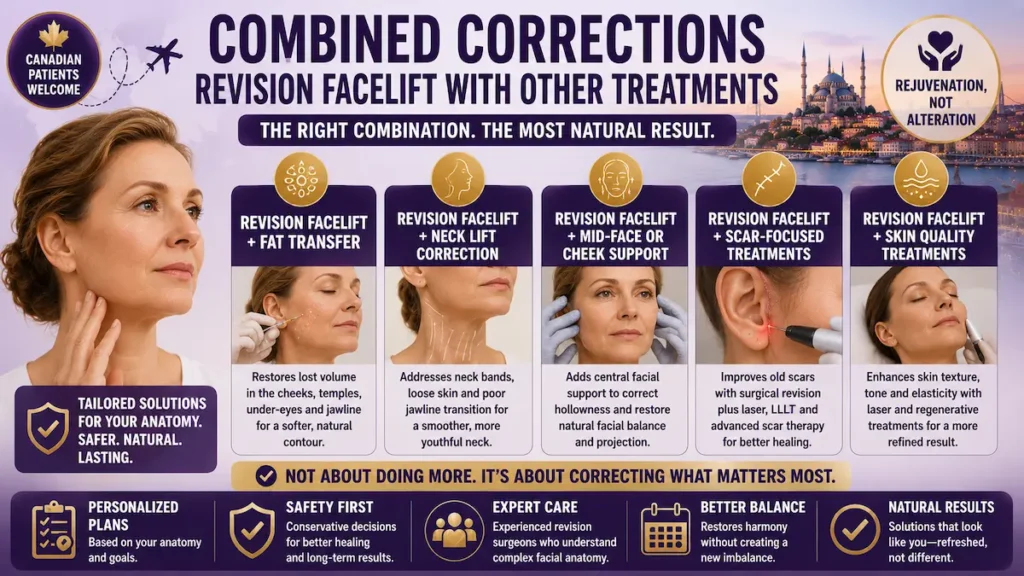
Combined Corrections: Revision Facelift With Other Treatments
Revision facelift often works best when it corrects the real cause of the concern. Sometimes that means lifting tissue. Sometimes it means improving scars, restoring volume, refining the neck, or supporting skin quality. A combined correction is not about doing more for the sake of it. It is about matching the solution to the anatomy.
We discuss combination plans carefully because revision patients need conservative decision-making. Adding procedures can improve balance, but it can also increase swelling, recovery time, and complexity. The right combination should make the result safer and more natural, not simply bigger.
Revision Facelift + Fat Transfer
Fat transfer can be valuable when the first facelift left the face looking hollow, flat, or over-tight. Lifting alone may not correct that problem. If volume has been lost from the cheeks, temples, jawline transition, or under-eye support, fat grafting may restore softness.
We use facial fat transfer conservatively in revision cases. The goal is not to create puffiness or a different face. It is to replace missing support so the lift looks more natural in motion.
Patients who need this approach can learn more from our fat transfer to face guide. During revision planning, we explain where fat may help, where it will not, and how much reabsorption is normal.
Revision Facelift + Neck Lift Correction
The neck often reveals whether the first facelift was matched correctly to the patient’s anatomy. A face may look improved while the neck still shows bands, loose skin, fullness, or poor jawline transition. This mismatch can make the result feel unfinished.
A revision neck correction may include platysma tightening, skin redraping, scar release, or targeted contouring. If the first surgery did not include the neck, or treated it too conservatively, a combined revision facelift and neck lift may create a more coherent result.
Our neck lift in Turkey guide explains the neck-specific anatomy in more detail. In revision facelift planning, we assess the face and neck together because they age and heal as one visual unit.
Revision Facelift + Mid-Face or Cheek Support
Some revision patients do not need more lower-face tightening. They need central facial support. If the cheeks look hollow, the lower eyelid area looks unsupported, or the face appears flat despite a tighter jawline, a mid facelift or fat transfer may be discussed.
This distinction prevents over-treating the wrong zone. Pulling the lower face harder will not correct every mid-face concern. The correction must match the anatomical source of the problem.
Revision Facelift + Scar-Focused Treatments
Some patients need surgery for the deeper problem and supportive treatments for the scar. A revised incision can heal better when tension is reduced, but scar quality also depends on aftercare. This may include silicone, sun protection, careful wound care, and laser-supported recovery.
LLLT can support incision maturation and reduce redness during the healing process. It does not replace precise surgical closure, but it may support the biology of repair. In revision cases, where old scars already exist, this support can be meaningful.
We discuss scar-focused treatments after evaluating your scar type. Raised scars, widened scars, pigmented scars, and tethered scars do not all respond to the same plan.
Revision Facelift + Skin Quality Treatments
A facelift revises tissue position. It does not erase sun damage, fine lines, pigmentation, or rough texture. If the first facelift improved laxity but the skin still looks aged, skin quality treatment may be more appropriate than additional lifting.
Options may include fractional laser, regenerative skin support, or LLLT-guided recovery depending on your skin type and healing history. These should be timed carefully around surgery so the skin is not overtreated.
This is especially important for Canadian patients with fair skin, sun damage, or winter dryness. Skin quality can affect how “finished” a revision result looks after the deeper correction has healed.
When a Smaller Correction Is Better
Not every patient needs a full combined plan. A small scar revision, pixie ear correction, or limited fat transfer may solve the main concern with less recovery. Sometimes restraint is the safest choice.
We tell patients when a smaller option is enough. We also tell patients when a smaller option will not address the real problem. Both forms of honesty matter.
Revision facelift is not about proving the first surgery wrong. It is about choosing the least aggressive correction that can reasonably improve the result.
“In combined revision planning, more is not automatically better. The best plan corrects the layer that caused the concern, protects tissue health, and avoids creating a new imbalance.”
Anaesthesia for Revision Facelift: General Anaesthesia
Revision facelift surgery usually requires general anesthesia. The procedure is more complex than a primary facelift, and the surgeon may need to work through scar tissue, altered planes, and multiple correction zones. Patient comfort and surgical control both matter.
Although limited scar revision or pixie ear correction may sometimes be performed under local anesthesia, a full revision facelift is different. It requires time, precision, and careful monitoring. For that reason, we generally plan full revision procedures with anesthesia support in a JCI-accredited surgical setting.
Why Revision Requires General Anaesthesia
Revision surgery can take longer than the first facelift because the tissue is less predictable. The surgeon may need to slowly separate scarred layers, protect blood supply, revise old incision lines, and adjust deeper support. This level of detail is difficult to perform safely if the patient is uncomfortable or moving.
General anesthesia allows the surgical team to maintain a controlled environment. It also helps the surgeon work symmetrically and patiently. In revision surgery, rushing creates risk.
The goal is not heavier anesthesia for its own sake. The goal is the safest operating condition for a complex correction.
Pre-Anaesthesia Assessment After Prior Surgery
Before surgery, we review your general health, medication list, allergies, prior anesthesia experience, smoking status, and any history of blood pressure, heart, lung, or clotting concerns. Canadian patients are encouraged to involve their family physician when appropriate, especially if they have chronic medical conditions.
We also ask about the first surgery. A difficult anesthesia recovery, severe nausea, prolonged swelling, bleeding, or wound-healing problem gives us useful information. Revision planning is stronger when we know what your body did the first time.
Patients travelling from Canada should be honest about supplements, blood thinners, cannabis use, nicotine, and hormone therapy. These details can affect bleeding risk, anesthesia planning, and recovery.
Reviewing Prior Operative Records When Available
Prior operative records can help us understand what technique was used, where tissue was dissected, and whether implants, sutures, drains, fat grafting, or energy devices were involved. These details are useful, but we know not every patient can obtain them.
If your first surgeon will not share records, we can still begin with photographs, video, physical examination, and healing history. Lack of records does not automatically exclude you from revision. It simply means the surgical plan must be more cautious.
Helpful documents may include:
- Operative report from your first facelift or neck lift
- Anesthesia record
- Discharge summary
- Before-and-after photographs
- Medication list and complication notes
- Any imaging or specialist letters related to healing concerns
AKM Anaesthesiology Team Credentials
Revision facelift patients are assessed by qualified anesthesia professionals before surgery. This assessment determines whether you are suitable for the planned procedure and whether any extra precautions are needed. Safety comes before scheduling.
Our procedures are performed in a JCI-accredited hospital partner environment, with monitoring and recovery protocols designed for international patients. That matters for Canadians who need to fly home after surgery and want clear medical documentation.
You will receive English-language post-operative instructions and discharge guidance. If a Canadian physician needs to review your surgical information after you return home, having clear records helps bridge the distance between Istanbul and your local health care system.
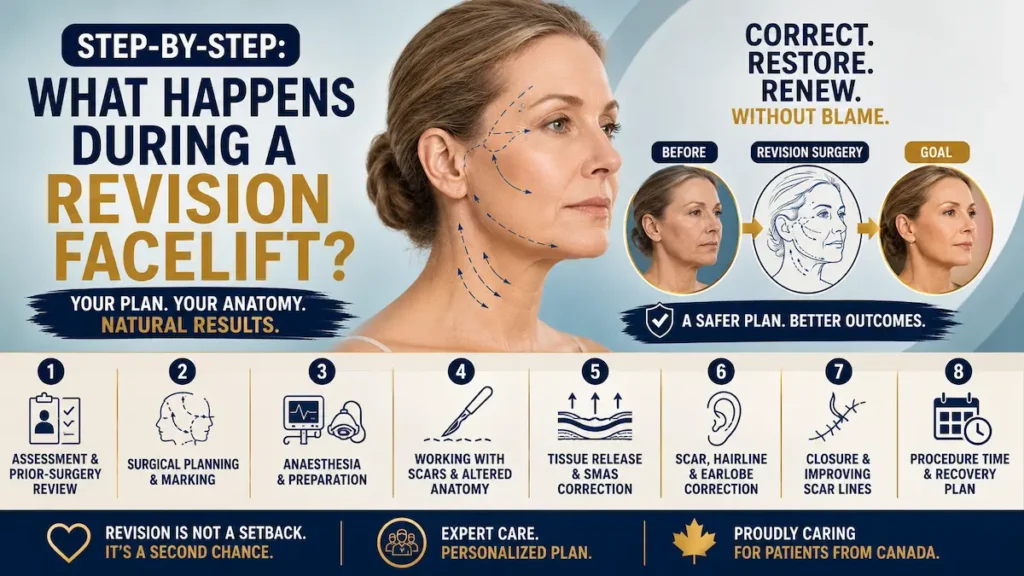
Step-by-Step: What Happens During a Revision Facelift?
A revision facelift follows a structured process, but the exact surgical sequence depends on the concern being corrected. Scar revision, pixie ear repair, under-correction, tightness, and volume loss each require different decisions. We plan the operation around your anatomy, not a preset facelift template.
Pre-Operative Assessment and Prior-Surgery Review
The process begins before you arrive in Istanbul. We review photographs, your previous surgery date, healing history, current concerns, and available operative records. This helps us decide whether revision is appropriate now or whether waiting would be safer.
Once you arrive, the in-person consultation confirms the plan. The surgeon examines scar position, skin mobility, facial movement, ear shape, hairline, jawline, neck, and volume distribution. This is where the photo-based plan becomes a surgical plan.
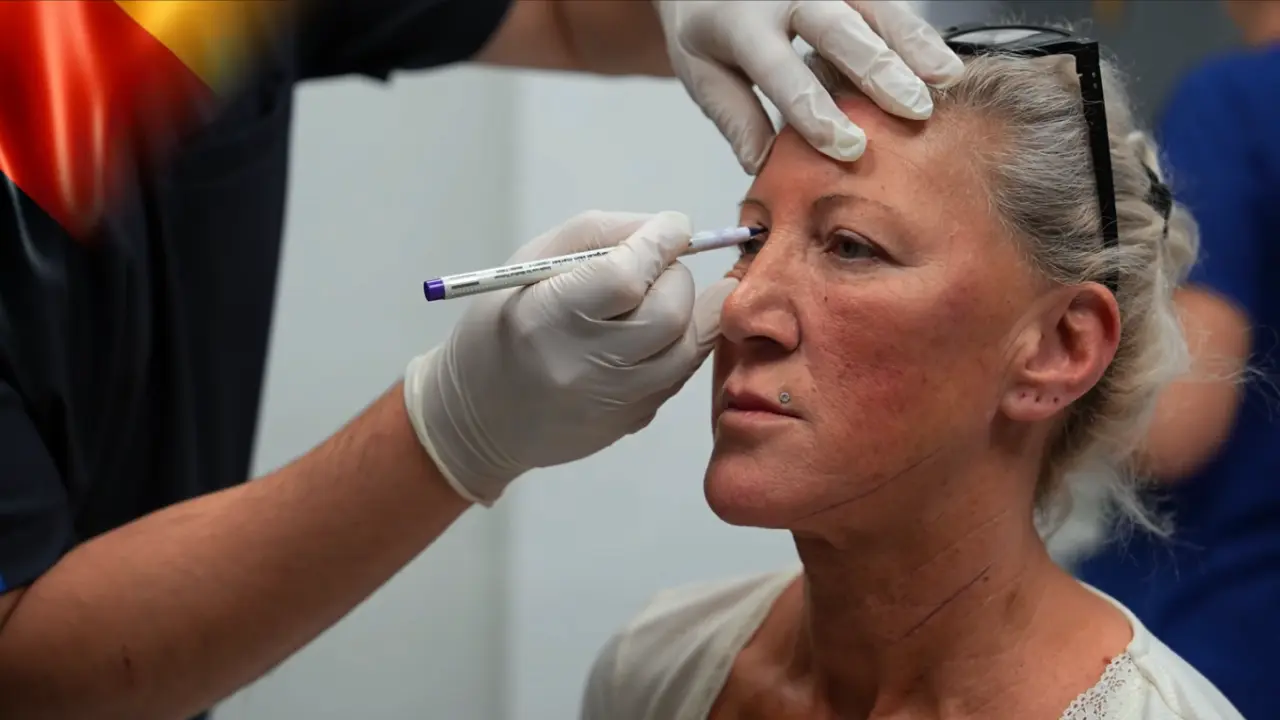
We mark the face carefully before surgery. In revision cases, markings may include old scars, areas of tethering, zones of asymmetry, and places where volume may need restoration.
Anaesthesia and Surgical Preparation
After final checks, anesthesia is administered and monitoring begins. The surgical area is prepared under sterile protocol. Hair is protected and positioned to give safe access to existing incision lines without unnecessary shaving.
Revision patients may need additional preparation because previous scar lines must be identified clearly. The surgeon must know where the old access points sit before deciding whether to reuse, modify, or extend them.
We also plan for hemostasis, which means careful bleeding control. Scarred tissue can behave differently from untouched tissue, so the surgical team works slowly and deliberately.
Working With Existing Scars and Altered Anatomy
Existing scars may be reused if they are well placed. If they are poorly placed, wide, or distorted, the surgeon may revise them. The goal is to improve access while also improving the final scar position.
Altered anatomy changes the pace of surgery. Tissue may not separate along the usual plane. There may be internal sutures, scar bands, or areas where the skin is thinner than expected. The surgeon must adapt continuously.
This is one reason revision often takes longer than primary facelift surgery. Time is part of the safety plan.
Tissue Re-Elevation, Release, and SMAS Correction
Once safe access is achieved, the surgeon may re-elevate the tissue and release scarred areas that are pulling the face in an unnatural direction. If the deeper support layer needs correction, the SMAS or related support structures are adjusted carefully.
For under-correction, the focus may be lifting and securing tissues that were not adequately supported the first time. For over-tightening, the focus may be release and redistribution. These are opposite problems, so they cannot be solved with the same manoeuvre.
If the neck is involved, the correction may include platysma work, skin redraping, or jawline refinement. This is planned in advance so the face and neck look coherent together.
Scar Revision, Hairline, and Earlobe Correction
Scar revision may happen during closure or as a dedicated step. The surgeon removes compromised scar tissue, reduces tension, and aligns the skin more favourably. Around the ear, precision is critical because scar placement affects whether the result looks discreet.
If there is pixie ear, the earlobe may be released and reshaped. If the hairline shifted, the surgeon may adjust the scar line or tissue direction to make the change less visible. These refinements can strongly affect how natural the final result feels.
Small details matter in revision facelift. A corrected jawline can still look surgical if the ear or hairline looks wrong.
Closure and Improving Prior Scar Lines
Closure is performed in layers to reduce tension on the skin. This helps the scar heal flatter and lowers the chance of repeating the same visible-scar problem. Skin should be redraped, not pulled aggressively.
Dressings are applied after closure. Drains may be used depending on the surgical plan, bleeding risk, and extent of correction. You will be monitored closely in the immediate recovery period.
Our team reviews medication, head elevation, walking, nutrition, and wound care before you return to the hotel or continue hospital observation.
Procedure Length and Immediate Recovery
A revision facelift often takes longer than a primary facelift. The exact time depends on how much correction is needed, whether the neck is involved, and whether fat transfer or scar revision is included. A limited correction may be shorter; a full secondary facial correction may take several hours.
Immediately after surgery, swelling, tightness, bruising, and temporary numbness are expected. These symptoms do not tell the final result. Revision tissues often take longer to settle than primary facelift tissues.
We plan recovery with that slower timeline in mind. The priority is not rushing you back to normal. It is helping you heal safely enough to return to Canada with clear instructions and structured follow-up.
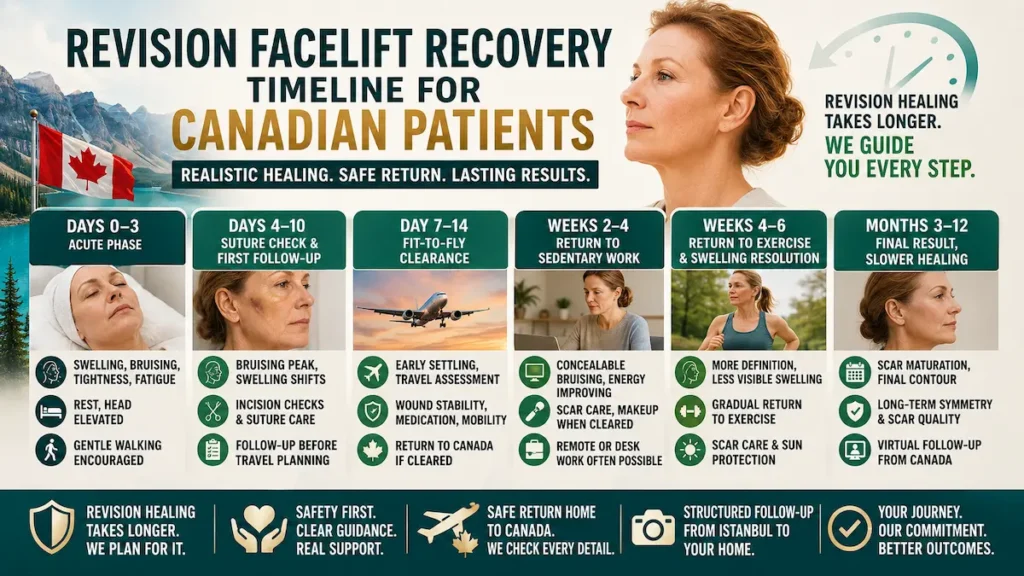
Revision Facelift Recovery: Timeline for Canadian Patients
Revision facelift recovery is usually slower than primary facelift recovery. The tissues have already been lifted once, scar tissue is present, and blood supply may have been altered by the first operation. This does not mean recovery is unsafe. It means the timeline should be realistic from the beginning.
Canadian patients often ask when they can fly home, return to Zoom meetings, or feel comfortable being seen socially. The answer depends on the extent of revision, whether the neck was corrected, and whether scar revision or fat transfer was included. We plan recovery around your actual procedure, not a generic calendar.
Days 0–3: Acute Phase
The first three days are the most intensive part of recovery. Swelling, bruising, tightness, fatigue, and numbness are expected. Revision tissues may feel firmer than primary facelift tissues because scar tissue reacts differently after surgery.
You will rest with your head elevated and avoid bending, lifting, or pressure on the face and neck. Cold compresses may be used if your surgeon recommends them. Walking gently is encouraged because circulation matters, especially before a long-haul return flight.
Pain is usually manageable with prescribed medication, but pressure and tightness are common. These sensations do not predict the final result. They are part of early healing.
Days 4–10: Suture Check and First Follow-Up
By days four to ten, bruising may become more visible before it improves. This is normal. Swelling may move downward into the jawline and neck as gravity and lymphatic drainage shift fluid through the healing tissues.
Your first follow-up focuses on incision checks, swelling pattern, bruising, skin colour, sensation, and whether any drain or dressing management is needed. If sutures are removed during this window, the timing depends on the incision area and tissue quality.
Revision patients should avoid judging the result too early. A face that looks firm or uneven at one week can settle significantly over the next several months. Early anxiety is common, especially for patients who were disappointed once before.
Our HBOT/LLLT Recovery Protocol
We use Hyperbaric Oxygen Therapy and Low-Level Laser Therapy to support recovery after facial surgery. In revision facelift patients, these technologies are especially valuable because scar tissue and altered circulation can make healing more demanding.
HBOT exposes the body to 100% oxygen in a pressurized environment. The goal is to increase oxygen delivery to healing tissues, support swelling reduction, and help the body recover after surgical trauma. For Canadian patients returning to Toronto, Vancouver, Calgary, or Montreal, we also consider the stress of a 10–12 hour long-haul flight.
LLLT uses low-level laser energy to support cellular repair. AKM’s system uses 424 medical-grade semiconductor laser diodes at 650 nm, designed to stimulate cellular ATP production without heat. For facelift patients, LLLT can support incision maturation, redness reduction, and collagen activity.
You can read more about this protocol in our technology and standards overview. For deeper aftercare reading, our LLLT scar minimization guide explains how laser-supported recovery fits into long-term scar care.
Day 7–14: Fit-to-Fly Clearance for Canadian Return Travel
Most Canadian patients plan to remain in Istanbul until the surgeon confirms they are fit to fly. This is not only about how you look. It is about swelling, bleeding risk, wound stability, mobility, medication, and whether you can manage the flight safely.
Your return flight may involve 10 or more hours in the air, depending on whether you fly to Toronto Pearson, Vancouver, Calgary, Montreal, or another Canadian city. We review walking during the flight, hydration, head positioning, medication timing, and what to avoid while travelling.
Our flight safety after surgery guide covers this topic in more detail. For revision facelift patients, we treat fit-to-fly clearance as a medical checkpoint, not a fixed date.
Week 2–4: Return to Sedentary Work
Many patients can return to remote or desk-based work during weeks two to four. The exact timing depends on swelling, bruising, job visibility, energy level, and whether your work involves public-facing meetings. Camera work may feel comfortable before in-person meetings do.
Makeup is usually delayed until incisions are ready and your surgeon approves it. Hair styling, collars, scarves, and glasses may need adjustment so they do not rub healing incision lines. These small details matter after revision.
Exercise remains limited. Walking is helpful, but heavy lifting, yoga inversions, running, and high-intensity workouts can increase swelling or bleeding risk. We clear activity gradually.
Week 4–6: Return to Exercise and Swelling Resolution
By weeks four to six, many patients feel more like themselves. Swelling is usually improving, bruising is easier to conceal, and the jawline may begin to look more defined. Revision swelling can remain firmer than primary facelift swelling.
Exercise returns in stages. Light cardio may be allowed before resistance training. Facial pressure, massage, sauna, hot yoga, and aggressive skin treatments should wait until your surgeon confirms the tissues are ready.
This is also when scar care becomes more structured. Silicone, sun protection, gentle cleansing, and LLLT-supported protocols may be discussed depending on your incision pattern.
Month 3–12: Final Result, With Slower Revision Healing
Revision facelift results evolve over months. By three months, the face usually looks more settled, but scars and deeper firmness may continue to mature. By six months, many patients see a clearer version of the result. Some scar and tissue changes continue for a full year.
This slower timeline can be emotionally challenging for revision patients. You may compare every small change to your first experience. We address this with structured follow-up, photographs, and clear milestones so you are not left guessing.
Our long-term virtual follow-up programme includes planned check-ins after you return to Canada. That continuity matters because revision healing should be monitored, not abandoned after the flight home.
| Recovery Stage | What You May Notice | What We Monitor | Canadian Travel / Work Notes |
|---|---|---|---|
| Days 0–3 | Swelling, bruising, tightness, fatigue | Skin colour, bleeding, pain control, early wound stability | Rest in Istanbul; short walks only |
| Days 4–10 | Bruising peak, incision checks, swelling shifts | Sutures, scars, asymmetry, drainage, swelling pattern | Follow-up before travel planning |
| Days 7–14 | Early settling, fit-to-fly assessment | Wound stability, medication needs, mobility | Possible return to Canada if cleared |
| Weeks 2–4 | Concealable bruising, improving energy | Scar behaviour, swelling, sensation | Remote or desk work often possible |
| Weeks 4–6 | More definition, less visible swelling | Exercise readiness, scar care progression | Gradual return to activity |
| Months 3–12 | Scar maturation, final contour, softening | Long-term symmetry, scar quality, result stability | Virtual follow-up from Canada |
Safety, Risks and Scar Reality
Revision facelift safety depends on patient selection, timing, surgical experience, facility standards, and aftercare. It is not enough to say “revision is safe” or “revision is risky.” Both statements are too simple. The real question is whether your specific tissues can be corrected safely.
We discuss risks directly because many revision patients have already felt unheard once. Clear information is part of rebuilding trust. It also helps you recognize the difference between a thoughtful revision plan and a clinic that promises to “fix everything” without explaining limitations.
Common Side Effects
Common short-term effects include swelling, bruising, tightness, numbness, itching, and temporary unevenness. These can be more noticeable after revision than after a first facelift because the tissues are reacting for a second time.
Numbness around the ears, cheeks, jawline, or neck may last weeks to months. Some sensation changes improve slowly. A small area of persistent numbness can happen after any facelift, especially if the previous surgery already affected sensation.
Bruising patterns are unpredictable in revision cases. Old scar planes can change how fluid moves through the face. We explain this before surgery so normal healing does not feel like a new problem.
Why Revision Carries Different Risks
Revision facelift carries different risks because the anatomy has changed. Scar tissue can make the tissues less flexible. Blood supply may be reduced in areas where the skin was previously lifted. Internal sutures or prior dissection planes may make the surgical pathway less predictable.
This does not mean revision should be avoided. It means the surgeon must work more conservatively and more precisely. The plan must protect tissue health before chasing a dramatic lift.
Smoking, uncontrolled diabetes, clotting disorders, active infection, and poor nutrition increase risk. So does operating too early after the first facelift. We screen these factors carefully before accepting a revision case.
Scar Revision Reality: Improving, Not Erasing
Many revision patients hope the old scar can disappear. That is understandable, but no surgeon can remove the fact that skin has been cut before. The realistic goal is improvement: better placement, lower tension, flatter texture, and a scar that is easier to hide.
Scar revision may involve excising the old scar, releasing tension, and closing the skin in layers. After surgery, scar care continues for months. Sun protection is essential because UV exposure can darken healing scars.
Our scar-focused LLLT guide explains why long-term scar maturation matters. In revision facelift, patience is part of the result.
Facial Nerve Considerations
Facial nerve safety is one of the most important revision questions. The facial nerve controls expression, including smiling, eye closure, and lower-face movement. Previous surgery can make nerve pathways harder to predict because scar tissue may obscure normal tissue planes.
Temporary weakness can occur after facial surgery due to swelling or tissue handling. Permanent injury is rare, but it is serious. This is why revision facelift should be performed by surgeons with specific experience in facial anatomy and secondary surgery.
We assess facial movement before surgery and document any pre-existing weakness or asymmetry. This protects both the patient and the surgical plan.
Realistic Risk Discussion Without Alarm
Revision facelift risks include hematoma, infection, delayed wound healing, widened scars, skin compromise, asymmetry, temporary or persistent numbness, and dissatisfaction if expectations exceed what the tissue can support. These are real risks. They should be discussed calmly.
Hematoma risk is one reason blood pressure control matters before and after surgery. Wound-healing risk is one reason nicotine cessation matters. Scar risk is one reason closure technique and aftercare matter.
The point of risk discussion is not to scare you. It is to help you choose carefully and prepare properly.
Why AKM’s Sterile Protocol and JCI-Aligned Standards Reduce Risk
We perform surgery in a JCI-accredited hospital partner environment and follow structured sterilization protocols. Our approach includes sterile operative fields, instrument sterilization, pre-operative testing, intra-operative monitoring, and post-operative follow-up. These systems are especially important for revision patients because the margin for error is smaller.
Our surgical philosophy is Natural-First: “Rejuvenation, not alteration.” In revision facelift, that means we avoid aggressive over-correction. We aim to restore balance while protecting tissue viability, scar quality, and facial movement.
A safe revision plan should feel measured. If a clinic promises a dramatic correction without discussing scar tissue, timing, blood supply, and nerve safety, that is a warning sign.
“In revision facelift, risk reduction starts before the incision. The safest result comes from the right timing, honest candidacy, conservative tissue handling, and a facility that treats aftercare as part of the surgery.”
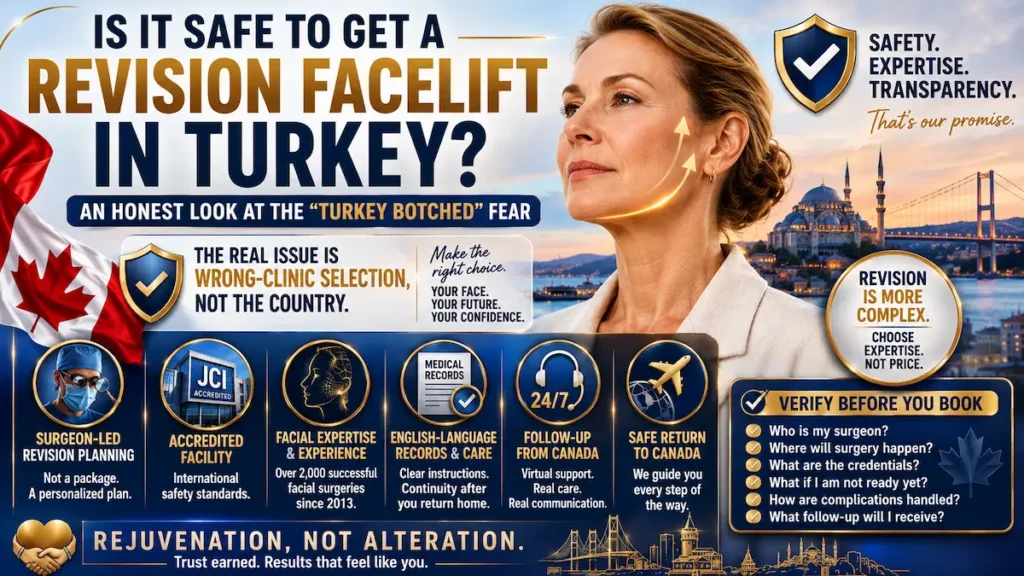
Is It Safe to Get a Revision Facelift in Turkey? An Honest Look at the “Turkey Botched” Fear
If your first surgery went wrong abroad, it is natural to feel cautious about travelling again. Some Canadian patients arrive at this page after searching “facelift gone wrong,” “botched facelift,” or “Turkey botched facelift.” We take that fear seriously.
A disappointing result can happen in any country, including Canada, the United States, the United Kingdom, Europe, or Turkey. The safer question is not “Which country is risk-free?” No country is. The safer question is: who is operating, where is the surgery performed, what credentials can be verified, and what happens after you fly home?
Addressing the “Turkey Botched Facelift” Narrative Head-On
Turkey has a large international aesthetic surgery sector. That brings a wide range of clinics, surgeons, hospitals, and service models. Some are highly specialized. Others are volume-driven and not appropriate for complex facial revision surgery.
Revision facelift is not a procedure to choose through price alone. It requires facial anatomy expertise, honest timing, scar-tissue judgement, and a surgeon who is willing to say no when the tissues are not ready. A clinic that treats revision like a standard package should raise concern.
We do not dismiss negative stories. We also do not use them to frighten patients. A bad outcome usually reflects wrong-clinic selection, weak verification, inadequate aftercare, or a poor match between technique and anatomy. That can happen anywhere.
The Real Issue Is Wrong-Clinic Selection, Not the Country
For Canadians, the domestic system feels familiar because physician licensing, hospital pathways, and complaint mechanisms are structured provincially. International care can feel less clear. That is why verification matters more, not less.
Before choosing any clinic for revision facelift, you should be able to verify:
- Who the operating surgeon is
- Whether the surgeon has facial surgery and revision experience
- Where the operation will take place
- Whether the facility has recognized accreditation and sterile protocols
- How complications are handled before and after travel
- Whether you receive English-language medical records
Our plastic surgery safety in Turkey guide explains this verification process in more detail. For revision facelift patients, these questions are not optional. They are the foundation of the second decision.
The Government of Canada also advises patients to consider the risks of receiving medical care outside Canada, including differences in hospital standards, follow-up, and travel-related complications. We recommend reviewing the official Government of Canada guidance on medical care outside Canada before making any elective surgery decision abroad.
How AKM Differs: Surgeon-Led Revision Planning
At AKM Clinic, revision facelift planning is surgeon-led. We review your previous surgery, current anatomy, scar pattern, healing timeline, and expectations before recommending a correction. The plan may involve revision facelift, scar revision, fat transfer, neck correction, or waiting longer.
Our philosophy is Natural-First: “Rejuvenation, not alteration.” In revision surgery, this matters even more than in primary surgery. The goal is not to create a more dramatic face. The goal is to restore balance, softness, and credibility after a result that did not feel right.
AKM’s facial surgery programme is built around deeper structural work rather than skin-only pulling. Our clinic documents over 2,000 successful facial surgeries since 2013, and our surgical leadership is grounded in facial rejuvenation expertise. For revision patients, that experience helps us recognize what should be corrected and what should be left alone.
You can learn more about our clinic philosophy, surgical leadership, and international patient model on our About AKM Clinic page.
Ghost Surgery: Making Sure Your Surgeon Operates
“Ghost surgery” means the patient believes one surgeon will operate, but another person performs part or all of the procedure without clear consent. For a Canadian patient seeking revision, this is a major trust concern. You should never feel uncertain about who is responsible for your face.
We encourage patients to ask direct questions:
- Who will perform the revision facelift?
- Who will be present during the operation?
- Will the same surgeon who consults with me be responsible for my surgical plan?
- How is the surgeon-of-record documented?
- Who handles follow-up if I have concerns after returning to Canada?
Our ghost surgery in Turkey guide covers the warning signs. A trustworthy clinic should answer these questions clearly and calmly.
Board Certification and Credential Verification
Canadian patients are used to checking physician credentials through provincial colleges and the Royal College of Physicians and Surgeons of Canada. International surgery requires a different credential map. That does not mean you should accept vague claims.
Look for recognized surgical training, facial plastic or aesthetic surgery focus, hospital privileges, continuing education, society memberships, and proof that the surgeon regularly performs the procedure you need. Revision experience matters. A surgeon who performs primary facelifts may not be the right choice for secondary correction.
Our plastic surgeon board certification guide explains how Canadian patients can compare RCPSC, EBOPRAS, ABFPRS, and other international credential pathways without relying on marketing language alone.
For Canadian context, the Royal College of Physicians and Surgeons of Canada explains specialist qualifications and continuing certification expectations. For facial plastic surgery comparison, the American Board of Facial Plastic and Reconstructive Surgery describes certification mechanisms for facial plastic and reconstructive surgeons.
Medical Records and Follow-Up After You Return to Canada
Safe revision surgery does not end when you leave Istanbul. Canadian patients need clear instructions, records, and a route for follow-up after flying home. This is especially true for revision patients who may feel anxious during normal swelling or scar changes.
We provide English-language guidance and scheduled virtual follow-up. Our North American support structure also helps patients communicate across time zones. If your Canadian family physician needs surgical details, clear documentation makes that conversation easier.
A clinic that cannot explain follow-up before you book is not ready for your revision. Aftercare is part of the procedure.
Trust Checklist for Canadian Patients
Revision facelift is a second decision. It should feel more informed than the first. Use the checklist below before choosing any clinic, including ours.
| Verification Question | Why It Matters | What a Clear Answer Looks Like |
|---|---|---|
| Who is my surgeon? | Prevents ghost surgery and unclear responsibility | Name, credentials, consultation, and surgeon-of-record are transparent |
| Does the surgeon perform revision facelifts? | Revision is more complex than primary surgery | The clinic explains secondary-surgery experience and limitations |
| Where will surgery happen? | Facility standards affect safety | JCI-accredited or equivalent surgical environment is specified |
| What if I am not ready yet? | Timing protects tissue health | The surgeon is willing to recommend waiting 6–12 months |
| What records will I receive? | Supports care after returning to Canada | English-language discharge instructions and follow-up plan |
| How are complications handled? | Travel distance creates anxiety | Written guidance, 24/7 contact route, and local-care escalation plan |
“For a revision facelift patient, trust is rebuilt through verification. The safest clinic is not the one that promises the most. It is the one that explains the surgeon, the facility, the timing, the limits, and the follow-up before you commit.”
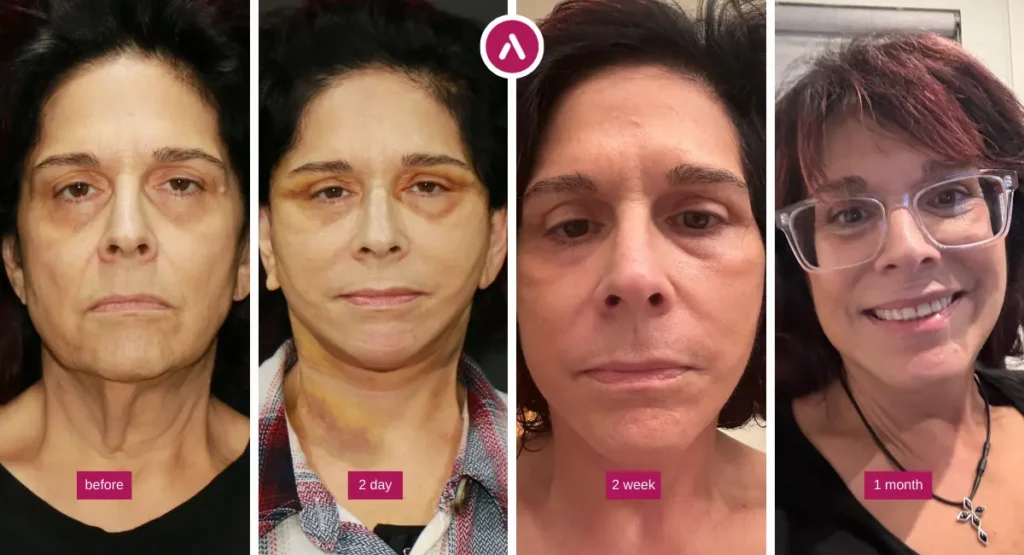
Revision Facelift Before and After: Realistic Expectations and Results
Revision facelift can be deeply reassuring when the plan is right. It can soften a tight look, improve scars, refine the jawline, correct pixie ear, and restore better balance. Yet revision surgery is not a reset button. It works within the tissue history left by the first operation.
We define success as improvement that looks natural, stable, and believable. For many patients, the most meaningful result is not looking “done.” It is looking less distorted, less tired, and more like themselves.
Revision Facelift Before and After: What to Look For
Before-and-after photos for revision facelift should be evaluated differently from primary facelift photos. A primary facelift image often shows a clear ageing-to-younger change. Revision images should show correction: softer tension, better scar placement, improved symmetry, restored earlobe shape, or a more natural jawline.
Do not judge only the most dramatic photograph. Look for consistency. A good revision result should look balanced from the front, side, and three-quarter views. It should also look believable in normal expression.
Our deep-plane facelift before-and-after gallery should be reviewed with the understanding that every revision starts from a different problem. The correction target is individualized.
What Improvement Looks Like
Improvement may be subtle or significant, depending on the concern. A scar revision may make the ear area easier to hide. Pixie ear correction may restore a more natural earlobe. Fat transfer may soften hollow cheeks or temples.
For over-tight faces, improvement may mean less tension rather than a bigger lift. For under-corrected faces, it may mean clearer jawline support. For asymmetry, it may mean reducing imbalance rather than creating mathematical symmetry.
These distinctions help protect expectations. Revision facelift should correct the problem you have, not chase an unrelated ideal.
Why Revision Results May Differ from Primary Facelift Results
Revision results are shaped by scar tissue, skin availability, blood supply, prior technique, and healing behaviour. The first operation changes what is possible during the second. This is why two patients with the same complaint may need different plans.
A patient with residual jowls after a conservative facelift may have more available correction than a patient whose skin was over-tightened and shortened. A patient with visible scars may improve with scar revision alone, while a patient with deep tissue distortion may need structural correction.
We explain these differences before surgery. A realistic revision plan is more valuable than an overly confident promise.
How Long Does a Revision Facelift Last?
Longevity depends on what was revised. A structural correction that improves deeper support may last many years, especially when skin quality, weight stability, and health habits are favourable. A scar revision can remain improved long-term if tension is controlled and healing goes well.
Natural ageing continues after revision. That is normal. The goal is to return the face to a better baseline so it can age more naturally from that point forward.
If the first procedure was skin-only or under-corrected, a structural revision may offer better durability than repeating the same limited method. We discuss this during planning so you understand why technique selection matters.
Scar Improvement Timeline
Scar improvement is slow. A revised scar may look red or firm early, then gradually soften, flatten, and fade. Many scars continue to mature for 6–12 months. Some continue improving beyond one year.
Patients who previously had a poor scar often feel nervous during this phase. That is understandable. We use structured follow-up, photographs, and scar-care guidance to separate normal scar maturation from signs that need attention.
Sun protection is essential in Canada after you return, especially during summer and winter reflection from snow. UV exposure can darken healing scars even when temperatures are cold.
Emotional Recovery After a Disappointing First Result
Revision facelift is emotionally different from a first facelift. You may feel cautious, skeptical, hopeful, and afraid at the same time. That is normal after losing trust in a previous outcome.
We encourage patients to ask more questions, not fewer. Bring your concerns. Bring your photographs. Tell us what you do not want repeated. A thoughtful revision consultation should make space for that history.
Our role is not to talk you into surgery. It is to tell you whether revision is appropriate, what can improve, what may remain imperfect, and what timeline is safest.
When a Non-Surgical Option May Be Better
Not every post-facelift concern needs surgery. Mild scar redness, early firmness, small contour irregularities, or skin texture issues may respond to time, scar care, laser support, or regenerative treatments. Surgery is not always the next step.
If the issue is hollowing rather than sagging, fat transfer may be more appropriate than another lift. If the issue is skin texture, a resurfacing or laser-based plan may help more than revision facelift. The best correction is the one that matches the cause.
This is another reason we avoid standard packages for revision. The right answer may be smaller, later, or different from what the patient originally expected.
“A successful revision facelift is not measured by how much we change. It is measured by whether the face looks calmer, more balanced, and more natural than it did before correction.”
Revision Facelift Cost 2026: Turkey vs Canada
Revision facelift cost is usually higher than primary facelift cost because the surgery is more complex. The surgeon is working with scar tissue, altered anatomy, previous incision lines, and tissue planes that may not behave predictably. In Canada, this revision premium can place private quotes well above the cost of a first-time facelift.
Canadian patients researching facelift revision cost in Toronto, Vancouver, Calgary, or Montreal often find that revision quotes range from CAD $22,000–$26,000, depending on the surgeon, facility, anesthesia, and whether neck correction, scar revision, or fat transfer is included. These quotes may not include all follow-up, medications, or facility-related fees.
At AKM Clinic, revision facelift planning is quoted after medical review because not every revision is the same. Limited scar revision may be very different from a full secondary deep plane correction. Our revision facelift programme generally starts around CAD $4,100 for scar revision lift, CAD $4,800 for pixie ear correction, CAD $7,500 for a tuck-up procedure, and CAD $9,550 for secondary deep plane correction.
For the full Canadian dollar breakdown, including revision categories and hidden fee comparisons, see our revision facelift cost guide for Canadian patients.
When appropriate, patients may be quoted through our facelift all-inclusive clinical pathway, which can include surgery, anesthesia, hospital facility fees, 5-star hotel accommodation, VIP transfers, medications, and 24/7 patient advocacy. Canadian-dollar pricing shown for planning clarity; your coordinator will confirm the final payment details before booking.
| Location | Typical Revision Facelift Range | What Often Affects Cost | Notes for Canadian Patients |
|---|---|---|---|
| Toronto | CAD $20,000–$25,000+ | Revision complexity, facility, anesthesia, surgeon seniority | Often quoted separately from aftercare and medications |
| Vancouver | CAD $22,000–$26,000+ | Higher private-clinic overhead and revision premium | Common for BC patients to compare international correction options |
| Calgary | CAD $20,000–$24,000+ | Surgeon availability and secondary-surgery complexity | Travel within Canada may still be required for subspecialized revision |
| Montreal | CAD $20,000–$24,000+ | Facility model, anesthesia, scar revision, neck correction | Follow-up structure varies by private clinic |
| AKM Clinic, Istanbul | CAD $4,100–$9,550 depending on correction type | Scar work, pixie ear repair, tuck-up, secondary deep plane correction | Comprehensive pathway may include hotel, VIP transfers, and 24/7 support |
How to Choose the Right Surgeon This Time: A Canadian Patient’s Checklist
Choosing a revision facelift surgeon is different from choosing a first-time facelift surgeon. You are not only asking, “Can this surgeon lift my face?” You are asking whether the surgeon can understand what happened before, protect tissue that has already been operated on, and correct the result without creating a new problem.
Many Canadian patients begin their second search more cautiously. That is wise. After a disappointing result, credential verification, revision experience, surgeon-of-record transparency, facility standards, and aftercare continuity matter more than polished marketing.
EBOPRAS Certification and RCPSC Equivalency
In Canada, specialist physicians are commonly evaluated through the Royal College of Physicians and Surgeons of Canada pathway. International surgeons use different credential systems. For Canadian patients, the goal is not to force every country into the same title; it is to understand whether the training pathway is structured, recognized, and relevant to the procedure.
EBOPRAS certification represents a European board pathway in plastic, reconstructive, and aesthetic surgery. ABFPRS relates to facial plastic and reconstructive surgery in the American framework. RCPSC is the Canadian specialist standard many patients know. These credentials are not identical, but comparing them helps patients ask better questions.
Our plastic surgeon board certification guide explains this comparison in greater detail. For revision facelift, credential review should be paired with procedure-specific experience. The Canadian Society of Plastic Surgeons facelift resource is also useful for understanding how facelift procedures are described in Canadian patient education.
| Credential / Body | Region | What It Signals | Why It Matters for Revision Facelift |
|---|---|---|---|
| RCPSC | Canada | Canadian specialist certification pathway | Useful reference point for Canadian patients comparing training rigour |
| EBOPRAS | Europe | European board pathway in plastic, reconstructive, and aesthetic surgery | Supports structured credential verification for international care |
| ABFPRS | United States | Facial plastic and reconstructive surgery credential framework | Helpful facial-surgery comparison point for revision cases |
| ISAPS / specialty societies | International | Professional membership and continuing education | Supports global engagement, but should not replace board verification |
Revision-Specific Experience
A surgeon who performs primary facelifts may not automatically be the right surgeon for revision. Secondary surgery requires comfort with scar tissue, altered anatomy, prior incision lines, and patient anxiety. The emotional context is different too.
Ask how the surgeon approaches common revision problems:
- Visible facelift scars
- Pixie ear
- Residual jowls
- Neck under-correction
- Over-tight or windswept appearance
- Volume loss after aggressive lifting or fat removal
You do not need a surgeon who claims to fix everything. You need one who can explain what can improve, what cannot fully change, and why timing may matter more than urgency.
Honest Assessment: Does the Surgeon Set Realistic Expectations?
A strong revision consultation should include limits. If every concern is answered with “yes, we can fix that completely,” be careful. Revision facelift is rarely that simple.
Honest assessment may include recommending:
- Waiting longer before surgery
- Scar care before scar revision
- Fat transfer instead of more lifting
- Neck correction rather than full facelift revision
- No surgery if the tissue risk is too high
This honesty can be frustrating in the moment, but it protects you. A clinic that says no when no is appropriate is safer than one that accepts every revision request.
Reviewing Your Prior Surgery Records Together
Previous operative records are helpful because they show the first technique, dissection plane, anesthesia details, complications, and closure method. They also help the surgeon avoid surprises. If you have these records, bring them.
If you do not have them, do not panic. Many patients cannot obtain complete records from the first clinic. We can still review photographs, healing history, scar position, facial movement, and current tissue mobility.
The key is transparency. Your revision surgeon should be willing to review what is known and state what remains uncertain. Unknowns do not prevent surgery in every case, but they should influence caution.
Real Revision Patient Reviews and Before/After Documentation
Reviews matter most when they describe communication, follow-up, and expectation management. For revision patients, a five-star rating is less useful than a detailed explanation of how the clinic handled anxiety, questions, and healing concerns after travel.
Before-and-after documentation should show correction, not only dramatic change. Look for scar improvement, earlobe position, jawline balance, neck refinement, and a more natural facial expression. Revision photos should be educational, not sensational.
You can review patient experience context through our professional plastic surgery reviews. During consultation, we discuss which examples are relevant to your specific problem. You can also use the ISAPS Find a Surgeon directory as one external reference point when researching international surgeon credentials.
Aftercare Continuity From Istanbul to Canada
Aftercare is a surgeon-selection issue. If you are flying back to Canada, you need a clear plan for swelling, incision questions, medication, warning signs, and virtual follow-up. This should be explained before you book, not after surgery.
At AKM Clinic, patient coordination continues after you return home. Our team provides follow-up guidance through scheduled virtual check-ins and communication support. This helps reduce the feeling of being abandoned after international surgery.
Canadian patients should still know when to seek local medical care. Urgent symptoms should be assessed where you are physically located. A responsible international clinic should support that decision, not discourage it.
Questions to Ask Before Booking
Bring direct questions to your consultation. A good clinic will not be offended by them. Clear answers are part of informed consent.
| Question | What You Are Testing | Green Flag Answer | Red Flag Answer |
|---|---|---|---|
| Who will perform my revision facelift? | Surgeon-of-record transparency | The surgeon is clearly named and involved in planning | “Our team handles it” without naming responsibility |
| How soon can I revise my first facelift? | Timing honesty | Often 6–12 months, unless there is a medical reason | Immediate booking without tissue-healing discussion |
| What cannot be corrected fully? | Expectation management | Clear limitations are explained | Everything is promised as completely fixable |
| Where will surgery take place? | Facility standards | JCI-accredited or equivalent hospital environment is identified | Facility details are vague |
| How will follow-up work in Canada? | Continuity of care | Virtual follow-up, written instructions, and escalation guidance | Follow-up is described casually or not at all |
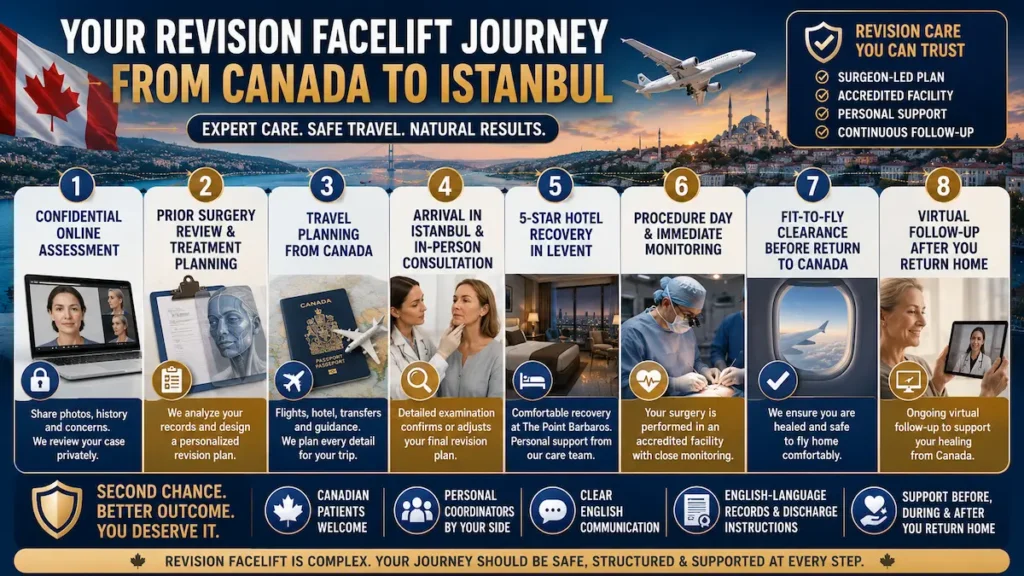
Your Revision Facelift Journey from Canada: From Consultation to Istanbul
Revision facelift travel requires more planning than a standard cosmetic trip. You are not only arranging flights and accommodation. You are bringing the history of a previous surgery, healing concerns, and understandable caution into a new clinical setting.
Our role is to make the process structured. You should know what happens before you fly, what happens after landing, how your procedure is reviewed, when you can return to Canada, and how follow-up continues once you are home.
Step 1: Confidential Online Assessment
The process begins with a private online assessment. You share current photographs, previous before-and-after images if available, the date of your first facelift, and the specific concerns you want addressed. We may also request video so the surgeon can assess facial movement.
For revision cases, photographs alone are not enough to make a final surgical plan. They help us decide whether you may be a candidate, whether the timing seems reasonable, and whether the concern appears surgically correctable.
If the tissues are still too early in healing, we may recommend waiting. That is not a refusal to help. It is a safety decision.
Step 2: Prior Surgery Review and Treatment Planning
When possible, we review your first operative report, anesthesia record, discharge summary, and complication notes. These documents help us understand what was done before. They are especially useful if your first facelift involved deep plane release, SMAS work, neck lift correction, fat transfer, implants, drains, or energy-based devices.
If you cannot access records, we still build a plan from your history, photographs, scar pattern, and physical examination after arrival. We simply state which details remain unknown. Revision planning should never pretend that missing information does not matter.
Once the surgeon reviews your case, we explain whether the likely plan is full revision facelift, limited scar revision, pixie ear correction, neck correction, fat transfer, or delayed reassessment.
Step 3: Travel Logistics from Canada
Canadian patients commonly travel from Toronto, Vancouver, Calgary, Montreal, Ottawa, Edmonton, or Halifax. Flight routes and schedules change, so we recommend checking current airline options before booking. Your coordinator helps you choose dates that allow enough time for pre-operative assessment, surgery, early recovery, and fit-to-fly clearance.
Canadian passport holders should confirm entry requirements before travel. Many Canadians can enter Turkey for short stays without a visa, but rules can change and dual citizenship or residency status may affect requirements. Always verify before purchasing flights.
We also recommend speaking with your family physician before international surgery if you have chronic medical conditions, take blood thinners, use hormone therapy, or have a history of clotting, bleeding, heart, lung, or anesthesia issues.
For a complete overview of how we coordinate travel, transfers, appointments, and recovery time, see our Canadian patient journey guide.
Step 4: Arrival in Istanbul and In-Person Consultation
After arrival in Istanbul, your private transfer brings you from the airport to your hotel. We use this structured arrival process to reduce stress, especially for patients travelling alone or returning to surgery after a difficult experience.
Your in-person consultation is where the final revision plan is confirmed. The surgeon examines your scars, tissue mobility, facial movement, neck contour, hairline, earlobes, and volume distribution. This step can confirm the online plan or adjust it.
Revision surgery should not be finalized from WhatsApp photographs alone. The in-person assessment protects you and the surgical plan. You can learn more about the clinical setting on our Istanbul clinic page.
Step 5: 5-Star Hotel Recovery in Levent
Recovery takes place in a 5-star hotel environment selected for international patient comfort. Our partner hotel, The Point Barbaros in Levent, gives patients privacy, breakfast, and access to the clinic team without the stress of navigating Istanbul alone.
Revision facelift patients need calm recovery conditions. You should not be arranging taxis, translating medical instructions, or trying to locate pharmacies while swollen and tired. Your patient host helps coordinate clinic visits, medication questions, and practical needs.
Our Canadian patients are supported by dedicated coordinators, including Hande, Emine, and Khadija. This personal support matters because revision patients often need reassurance during normal swelling, bruising, or scar changes.
Step 6: Procedure Day and Immediate Monitoring
On surgery day, the plan is reviewed again before anesthesia. The surgical markings are made while you are upright, because gravity and facial movement affect how the correction should be designed.
After surgery, you are monitored during the immediate recovery phase. The team checks pain control, blood pressure, swelling pattern, dressings, skin colour, and early wound stability. These checks are especially important after revision because the tissues have already been operated on once.
You receive post-operative instructions in English. These include wound care, medications, sleeping position, activity restrictions, warning signs, and the follow-up schedule before your return flight.
Step 7: Fit-to-Fly Clearance Before Returning to Canada
Fit-to-fly clearance is based on your healing, not only the date on the calendar. Before you return to Canada, the surgeon assesses swelling, incisions, bruising, mobility, medication needs, and whether any drains, dressings, or wound concerns remain.
During a long-haul flight, we want you walking gently, hydrating, avoiding alcohol, and following medication instructions. You should also avoid lifting heavy luggage. If possible, arrange help when arriving at Toronto Pearson, Vancouver International, Calgary International, Montréal-Trudeau, or your final airport.
We provide guidance for the flight home and the first days after arrival. If a concern arises in Canada, your local physician or urgent care team should assess urgent symptoms in person, while our team remains available for surgical context and follow-up guidance.
Step 8: Virtual Follow-Up After You Return Home
Our follow-up does not stop when you leave Turkey. We use virtual check-ins to monitor swelling, scars, symmetry, and patient concerns over time. Revision facelift healing can feel emotionally sensitive, so structured follow-up helps reduce uncertainty.
You may be asked to send photographs at specific healing milestones. We compare changes over time rather than reacting to one early image. This is important because revision swelling often settles slowly.
Your Canadian family physician can also be involved if needed. Clear English-language documentation helps bridge care between Istanbul and your provincial health care system.
| Journey Stage | What Happens | Why It Matters for Revision |
|---|---|---|
| Online assessment | Photos, history, prior surgery review | Confirms whether revision may be appropriate |
| Travel planning | Flight timing, hotel, transfers, medication preparation | Reduces stress before a complex procedure |
| Arrival consultation | In-person tissue, scar, and movement assessment | Finalizes or adjusts the surgical plan |
| Surgery and monitoring | Revision correction in accredited surgical setting | Protects blood supply, scars, nerve safety, and recovery |
| Fit-to-fly check | Healing assessment before return flight | Ensures travel timing is medically appropriate |
| Canada follow-up | Virtual monitoring and local-care guidance if needed | Supports long-term healing across distance |
Revision Facelift Surgery Frequently Asked Questions (FAQ):
Can a botched facelift really be fixed?
Many unsatisfactory facelift results can be improved, but the answer depends on the problem. Visible scars, pixie ear, residual jowls, neck under-correction, and moderate asymmetry often respond well to revision. Severe over-tightening or tissue shortage may require staged planning, fat transfer, or a more conservative correction.
How long do I need to wait before a revision facelift?
Most patients should wait 6–12 months after the first facelift before major revision. This allows swelling to settle, scars to mature, blood supply to stabilize, and the final result to become clearer. Earlier medical concerns, such as infection, wound opening, hematoma, or skin compromise, should be assessed promptly by a local physician.
Why is a revision facelift more expensive than my first facelift?
Revision facelift is more complex than primary facelift surgery. The surgeon must work through scar tissue, altered anatomy, previous incision lines, and tissue planes that may not behave normally. The procedure may also require scar revision, fat transfer, or neck correction, which can increase surgical time and planning.
Will the scars from my first facelift be removed?
Scars can often be improved, but they cannot be erased completely. A scar revision may reposition the scar, reduce tension, flatten raised tissue, or make the incision easier to hide around the ear or hairline. The final scar still depends on skin quality, genetics, closure technique, sun protection, and long-term scar care.
Does OHIP, MSP, AHCIP, or RAMQ cover a revision facelift?
Canadian provincial health plans generally do not cover cosmetic revision facelift surgery. OHIP, MSP, AHCIP, RAMQ, and other provincial plans may assess medically necessary complications differently, but aesthetic correction is usually private-pay. If your concern involves pain, wound problems, infection, or functional impairment, speak with your Canadian family physician before assuming coverage is unavailable.
How much does a revision facelift cost in Toronto vs Istanbul?
Private revision facelift quotes in Toronto and Vancouver often range from CAD $22,000–$26,000 or more, depending on complexity, facility fees, anesthesia, and whether neck correction or fat transfer is needed.
At AKM Clinic, revision planning is quoted after medical review. Published technique references include CAD $4,100 for scar revision lift, CAD $4,800 for pixie ear correction, CAD $7,500 for a tuck-up procedure, and CAD $9,550 for secondary deep plane correction. Canadian-dollar pricing shown for planning clarity; your coordinator will confirm the final payment details before booking.
Does Canadian travel insurance cover complications from elective revision facelift in Turkey?
Many Canadian travel insurance policies exclude elective cosmetic surgery and complications related to planned procedures abroad. You should review your policy in writing before travel and ask specifically about elective surgery, post-operative complications, hospital care, flight changes, and medical evacuation. Do not assume standard travel insurance will cover cosmetic revision surgery.
Isn’t it risky to get a revision in Turkey if my problem started with surgery abroad?
It is reasonable to be cautious. A disappointing result abroad can make any international option feel uncertain. The safer frame is not “Turkey vs Canada” alone. It is surgeon verification, facility accreditation, surgeon-of-record transparency, revision experience, sterile protocol, and follow-up after you return home. A bad result usually reflects wrong-clinic selection, not the country itself.
What if my first surgeon will not share my records?
Prior records are helpful, but they are not always available. We can still begin assessment with photographs, video, healing history, current scar position, facial movement, and in-person examination. Missing records make planning more cautious, but they do not automatically prevent revision.
How is recovery different from my first facelift?
Revision recovery can be slower because scar tissue and altered blood supply affect healing. Swelling may feel firmer and scars may take longer to mature. Many patients return to desk work within two to four weeks, but final scar and tissue settling can take 6–12 months.
Can you fix an over-tight or “windswept” look?
Often, an over-tight or windswept appearance can be softened, but the degree of improvement depends on skin availability, scar tissue, and how much tension was created during the first operation. Correction may involve scar release, deeper support adjustment, and sometimes fat transfer to restore softness.
Can I combine my revision with fat transfer or a neck lift correction?
Yes, when clinically appropriate. Fat transfer can help restore volume after an over-resected or hollow result, while neck lift correction can improve residual bands, loose skin, or poor jawline transition. We only recommend combination treatment when it improves balance without adding unnecessary surgical risk.
Medical Disclaimer: This content is for educational purposes only and does not replace advice from a licensed medical professional. We encourage all prospective patients to consult with their family physician or a Canadian general practitioner before pursuing any elective surgical procedure abroad. Content reviewed by the AKM Medical Board. Last updated: June 2026.