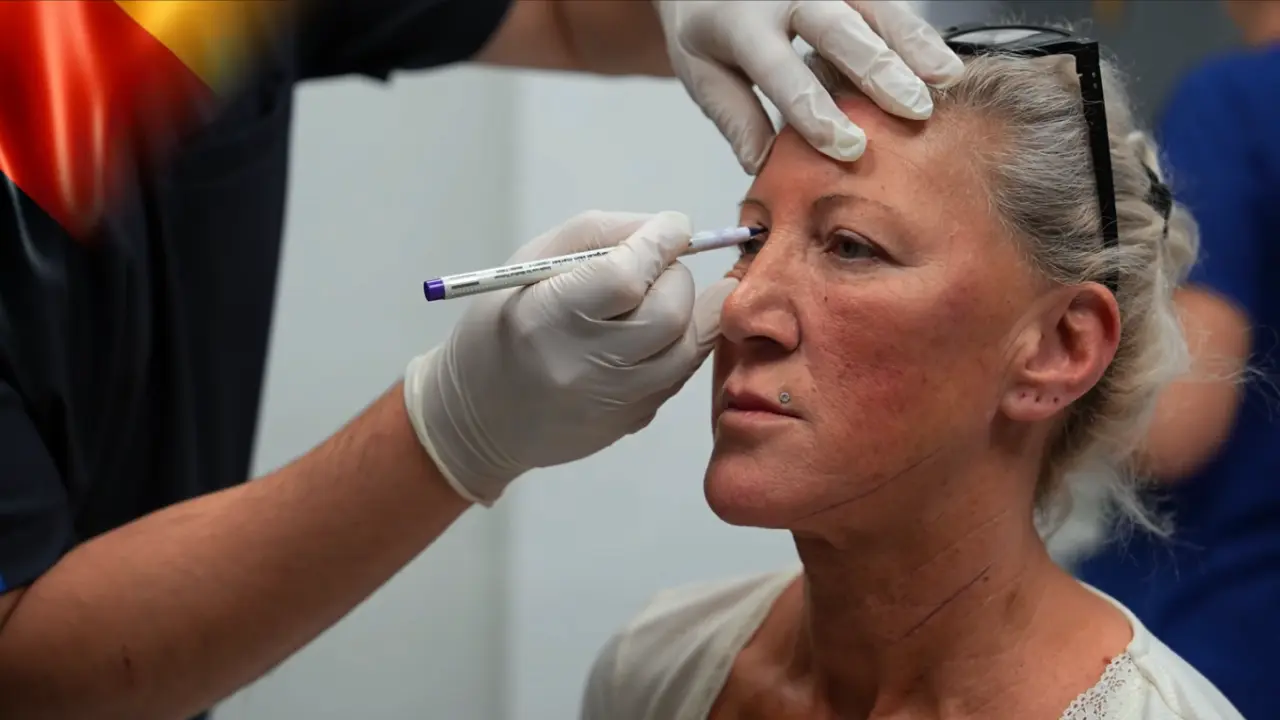





As the face ages, it does not only sag. It also deflates.
Cheeks lose softness. Temples can appear hollow. The under-eye area may look tired even after a full night of sleep. For many Canadian patients, this loss of facial volume is the difference between looking rested and looking older than they feel.
Fat transfer to the face, also called facial fat grafting, restores volume using your own fat. We gently harvest fat through liposuction, process it carefully, and re-inject it into selected facial areas. The goal is not to change your face. Our goal is to restore the softer contours that time, weight loss, or previous procedures may have reduced.
The honest part matters. Not all transferred fat survives. In most patients, about 50-70% of the grafted fat remains long-term, which is why our surgeons may slightly overfill the area at first. If the volume is still present at one year, it is generally considered stable and long-lasting.
Facial fat transfer is often the opposite of buccal fat removal. It can also help patients who feel their cheeks look too hollow after aggressive fat removal or facial surgery. This guide explains how facial fat grafting works, how it compares with dermal filler, what recovery looks like for Canadians travelling home, and how we plan natural-looking volume restoration at AKM Clinic in Istanbul.
Table of Contents
What Is Fat Transfer to the Face?
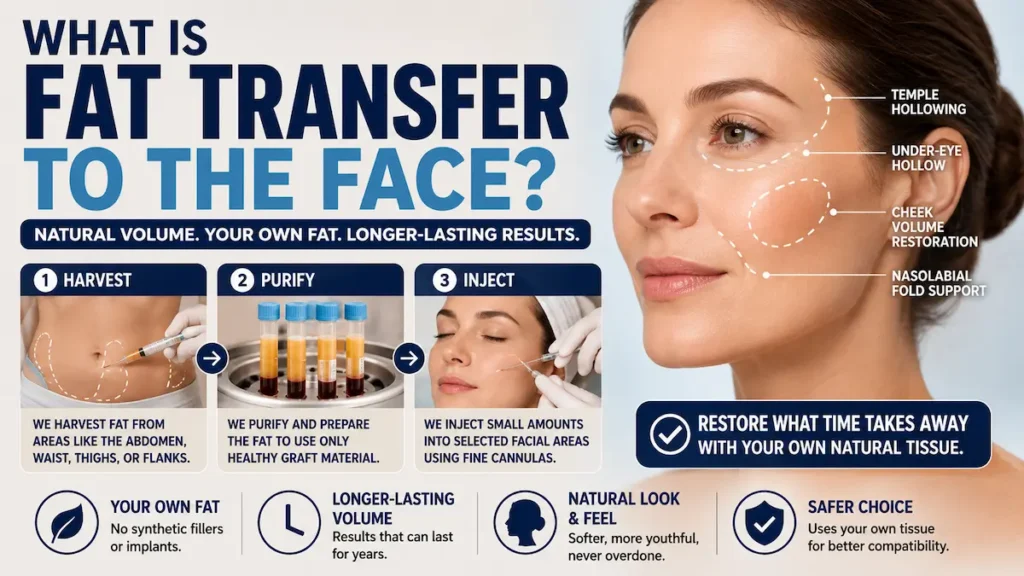
Fat transfer to the face is a surgical volume-restoration procedure that uses your own fat to refill areas of facial hollowing. The medical term is facial fat grafting. You may also see it described as facial fat transfer, autologous fat transfer, or fat injection to the face.
The procedure has three main steps:
- We harvest a small amount of fat from a donor area such as the abdomen, waist, thighs, or flanks.
- We purify and prepare the fat so only healthy graft material is used.
- We inject small amounts into selected facial areas using fine cannulas.
Because the material comes from your own body, facial fat transfer does not use synthetic filler or implants. This is one of its main advantages for patients who want natural tissue, longer-lasting volume, and a softer rejuvenation effect.
The Canadian Society of Plastic Surgeons describes facial ageing as involving cheek deflation, sagging, jowls, and neck ageing. Facial fat transfer focuses specifically on the deflation and volume-loss side of that ageing pattern.
How Facial Fat Grafting Works
Facial fat grafting is both a volume procedure and a grafting procedure. That distinction is important.
When fat is moved from one area of the body to another, it needs to develop a new blood supply. Some fat cells survive and become part of the treated area. Others are naturally reabsorbed by the body during the first few months.
This is why early fullness is not the final result. Swelling, overfilling, and natural fat reabsorption all change the appearance during recovery. We explain this clearly before surgery so Canadian patients know what to expect before flying to Istanbul.
Fat Transfer vs Fat Grafting vs Facial Fat Transfer
These terms often describe the same procedure. “Fat transfer to face” is the patient-friendly term. “Facial fat grafting” is the clinical term. “Autologous fat transfer” means the fat comes from your own body.
At AKM Clinic, we use these terms carefully because they help patients understand the technique. The key point is simple: we are not filling the face with a foreign product. We are restoring volume with living tissue harvested from you.
What Facial Fat Transfer Can Address
Facial fat transfer can improve several signs of age-related volume loss. It is especially useful when the issue is hollowing rather than loose skin alone.
Common treatment areas include:
- Hollow cheeks
- Flat or deflated midface volume
- Temple hollowing
- Under-eye hollows and tear troughs
- Nasolabial fold support
- Lower-face volume imbalance
- Subtle jawline or chin support in selected patients
The under-eye area requires special caution. Skin is thin in this zone, and irregularities are more visible. For some patients, filler, lower eyelid surgery, or fat repositioning may be more appropriate than fat grafting alone.
The Opposite of Buccal Fat Removal
Buccal fat removal takes volume away from the lower cheek. Facial fat transfer adds volume back to areas that look depleted.
This makes facial fat grafting especially relevant for patients who feel their face has become too hollow after weight loss, ageing, or previous fat-removal surgery. It can also be part of a correction plan after over-aggressive buccal fat removal.
We plan this carefully. Restoring facial volume is not about making the face look round or puffy. It is about replacing what has been lost in a controlled, anatomical way.
Benefits of Facial Fat Transfer
The main benefit of facial fat transfer is natural volume restoration. It can soften hollow areas, improve facial balance, and create a healthier, more rested look without relying on repeated filler maintenance.
For Canadian patients comparing options in Toronto, Vancouver, Montreal, or Calgary, the appeal is often practical as well as aesthetic. Fat transfer can offer long-term value because the surviving fat does not need to be replaced every 9-18 months like many fillers.
Natural Volume Using Your Own Tissue
Many patients choose fat transfer because it uses their own tissue. This matters to patients who prefer a biological approach or who feel uneasy about synthetic fillers.
The texture of transferred fat can be soft and natural when placed correctly. It is especially useful in broader zones such as the cheeks, temples, and midface, where a larger surface area needs gentle volume rather than sharp definition.
Our Natural-First philosophy guides the planning. We do not chase exaggerated fullness. We aim for volume that looks like it belongs to your face.
Long-Lasting Results for the Fat That Survives
Dermal fillers fade as the body breaks them down. Fat behaves differently.
Once transferred fat survives and develops a blood supply, it can remain for many years. The volume that is still visible at one year is generally stable, although your face will continue to age naturally.
This is why we spend time discussing fat survival before surgery. A good result is not measured at day seven. It is judged after swelling settles and graft take stabilizes over months.
Improved Skin Quality in Selected Patients
Fat grafting may also improve skin quality in some patients. Processed fat contains regenerative cellular components that can support softer texture and healthier-looking skin.
This does not replace resurfacing, laser treatment, or medical skin care. It is not a cure for deep wrinkles or sun damage. Still, many patients notice that treated areas look less tired once volume and skin support improve together.
A Donor-Site Benefit
Facial fat transfer requires a small amount of liposuction. Common donor areas include the abdomen, waist, flanks, or thighs.
The donor-site change is usually modest because facial grafting does not require large volumes of fat. It is not a body-contouring procedure. Even so, some patients appreciate that fat is taken from an area where they already carry extra fullness.
A Softer Alternative to Repeated Fillers
Fillers are useful. We do not position fat transfer as the right answer for every patient.
For small refinements, first-time treatment, or patients who want a reversible option, filler may be the better choice. For larger-volume facial deflation, fat transfer can offer a more durable and natural-feeling solution.
The best choice depends on anatomy, goals, risk tolerance, budget, and timeline. We discuss both options honestly during consultation so you understand why we recommend one pathway over another.
Am I a Good Candidate for Facial Fat Transfer?
You may be a good candidate for facial fat transfer if your main concern is facial volume loss rather than skin looseness alone. This difference matters.
Loose skin may require lifting. Hollowing may require volume. Many patients need both, which is why facial fat grafting is often combined with a facelift, mid facelift, or eyelid procedure.
Age-Related Facial Volume Loss
Facial ageing often begins as volume loss before major sagging appears. The cheeks flatten, the temples hollow, and shadows deepen around the eyes.
Facial fat transfer can help restore this lost support. It does not freeze expression or create a sharp, artificial contour. The goal is softer structure and better balance.
Canadian patients in their 40s, 50s, and 60s often choose this procedure when they feel fillers are no longer enough or require too much maintenance.
Hollow Cheeks, Temples, and Under-Eyes
Fat grafting works best in areas where natural volume has faded. Cheeks and temples are common treatment zones because they can accept volume more predictably.
The under-eye area is more delicate. We assess skin thickness, lower eyelid support, previous filler, and fat-pad position before recommending fat transfer there.
For some patients, mid facelift surgery or eyelid surgery may address the problem more accurately than adding fat alone.
Enough Donor Fat
You do not need a large amount of body fat for facial fat grafting. The face requires much smaller volumes than procedures such as fat transfer breast augmentation or BBL.
Common donor areas include:
- Lower abdomen
- Waist or flanks
- Inner thighs
- Outer thighs
- Knees in selected patients
Very lean patients can still qualify. The key question is whether we can harvest enough healthy fat without creating donor-site irregularities.
Correcting Over-Removed Buccal Fat
Some patients seek facial fat transfer after buccal fat removal has made the face look too hollow. This can happen when too much volume is removed or when the face naturally thins with age after surgery.
Fat transfer can restore selective volume to the cheek and midface. It cannot always recreate the original buccal fat pad exactly, but it can soften the hollowed appearance.
Patients considering this correction can also review our buccal fat removal guide to understand why conservative planning is so important.
Correcting Facelift Over-Resection
A facelift should reposition tissue. It should not make the face look stripped or skeletal.
If a previous facelift removed or tightened too aggressively, facial fat transfer may help restore softness. This is especially useful around the cheeks, temples, and lower eyelid-cheek transition.
For patients with scar issues, asymmetry, or a pulled appearance, revision facelift surgery may also be part of the discussion.
Realistic Expectations About Fat Survival
A good candidate understands that transferred fat is living tissue. Some survives. Some does not.
We usually plan with a long-term survival expectation of about 50-70%. That means early fullness is normal, and some reduction is expected during the first few months.
A second session may be useful if the first round settles beautifully but the patient wants more volume. This is not a failure. It is part of responsible fat-grafting planning.
When Facial Fat Transfer Is Not Recommended
Facial fat transfer may not be the best choice if you want a fully reversible treatment, very sharp contouring, or tiny millimetre-level corrections.
It may also be unsuitable for patients with poor healing, active infection, uncontrolled medical conditions, or unrealistic expectations about fat survival.
During consultation, our surgeons may recommend filler, laser, facelift surgery, or no procedure at all if facial fat transfer would not serve your anatomy well.
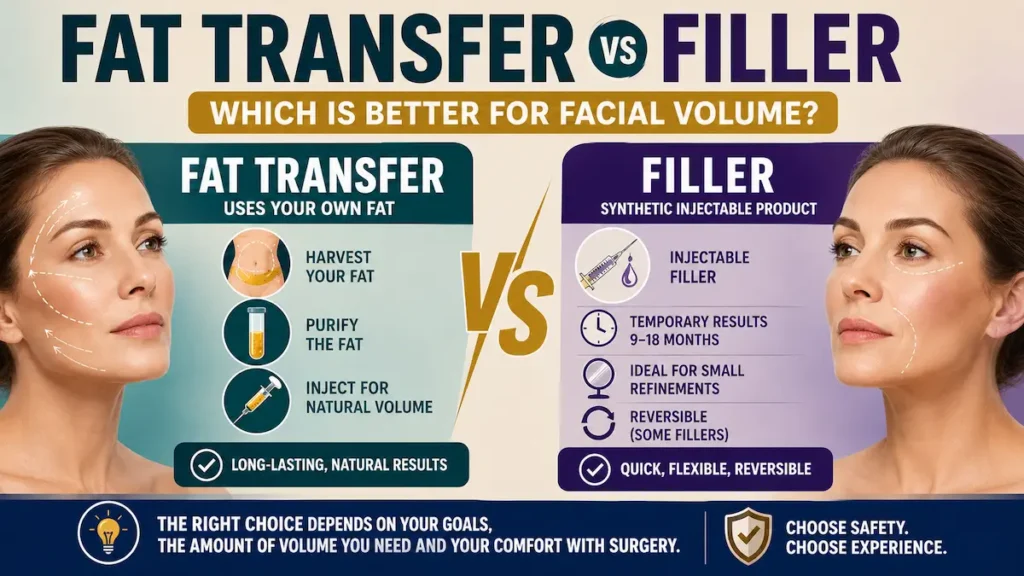
Fat Transfer vs Filler: Which Is Better for Facial Volume?
Fat transfer and dermal filler can both restore facial volume. They are not the same procedure.
Filler is a prepared injectable product. Fat transfer uses your own tissue, requires liposuction, and depends on graft survival. The right choice depends on how much volume you need, how long you want the result to last, and how comfortable you are with surgery.
| Factor | Facial Fat Transfer | Dermal Filler |
|---|---|---|
| Material | Your own purified fat | Synthetic injectable product, often hyaluronic acid |
| Best for | Broader volume loss in cheeks, temples, and midface | Small refinements, lines, lips, and reversible adjustments |
| Longevity | Long-lasting once grafted fat survives | Temporary, often 9-18 months depending on product and area |
| Procedure | Minor liposuction, fat processing, micro-injection | Office-based injection in most cases |
| Recovery | Swelling in both face and donor area | Usually shorter swelling period |
| Reversibility | Not easily reversible | Some fillers can be dissolved |
| Cost over time | Higher upfront cost, lower maintenance if fat survives well | Lower upfront cost, repeated treatments over years |
When Fat Transfer Makes More Sense
Facial fat transfer often makes sense when a patient needs broader volume restoration. This is common in the cheeks, temples, and midface.
It can also be better for patients who have been getting fillers for years and feel they are spending more each year to maintain the same result.
Fat transfer may create a softer look in larger zones because the material behaves like natural tissue once it survives.
When Filler May Be the Better Choice
Filler is often better for small, precise corrections. It is also useful for patients who want to test a look before committing to surgery.
Some patients prefer filler because there is no donor-site liposuction. Others like that certain hyaluronic-acid fillers can be dissolved if they dislike the result.
We may recommend filler first for younger patients, first-time patients, or anyone uncertain about a permanent volume change.
Cost Over Time
Filler can look cost-effective at first. The long-term cost changes when maintenance is repeated every year.
Patients who need several syringes per session may eventually spend more on filler maintenance than they would on one carefully planned fat transfer. This is especially true for cheek and temple volume.
That does not mean fat transfer is always the better value. It means the decision should include both the first invoice and the five-year maintenance picture.
Safety Differences
Both procedures require skill. Filler requires detailed vascular anatomy knowledge and careful product placement. Fat transfer requires safe harvesting, sterile processing, and layered micro-injection.
The main risk profile differs. Filler complications may include vascular occlusion, swelling, nodules, or product migration. Fat transfer risks include reabsorption, asymmetry, lumps, and donor-site bruising.
Health Canada regulates the safety, efficacy, and quality of health products, including cosmetic injectable products. Patients comparing fillers with fat transfer can review Health Canada’s cosmetic injections guidance and discuss product-specific risks with a licensed clinician.
At AKM Clinic, we explain these differences clearly. A confident patient should understand the benefits and trade-offs before choosing a treatment.
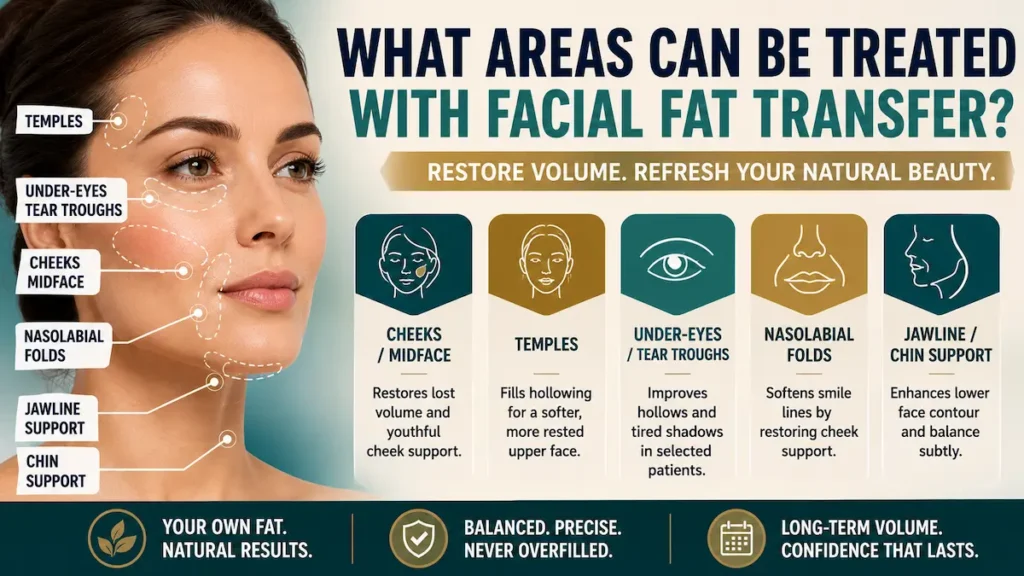
What Areas Can Be Treated with Facial Fat Transfer?
Facial fat transfer works best when volume is placed according to facial anatomy, not trends. A good plan does not fill every hollow equally.
We assess facial zones, skin thickness, bone structure, and the way light falls across the face. The goal is balanced restoration, not a swollen or rounded look.
| Facial Area | What Fat Transfer Can Improve | Planning Notes |
|---|---|---|
| Cheeks / midface | Flatness, deflation, loss of youthful cheek support | Often the most predictable facial zone for fat grafting |
| Temples | Hollowing that makes the upper face look tired or skeletal | Requires soft blending into the brow and hairline |
| Under-eyes / tear troughs | Hollows and tired shadows in selected patients | High-skill caution zone because lumps are more visible |
| Nasolabial folds | Support around the smile lines | Usually treated indirectly by restoring cheek support first |
| Jawline / chin support | Subtle contour and lower-face balance | Not a substitute for chin implant or jaw surgery |
Cheeks and Midface
The cheeks are one of the most common areas for facial fat transfer. Midface volume gives the face softness, support, and a more rested contour.
With age, cheek fat pads descend and shrink. This can create a flatter midface and deeper shadowing between the lower eyelid and cheek.
Fat transfer to the cheeks can restore that lost support. We place fat in small layers rather than one heavy deposit, which helps the result look smoother and more natural.
Temples
Temple hollowing can make the face look older, thinner, or more tired. It can also make the brow and outer eye area appear unsupported.
Fat grafting in the temple requires restraint. Too little may not correct the hollowing. Too much can look heavy, especially in patients with a naturally narrow upper face.
We aim for a soft transition from the forehead to the cheekbone. A good temple result should rarely be noticed as “filled.”
Under-Eyes and Tear Troughs
The under-eye area is delicate. Skin is thin, blood supply is complex, and even small irregularities can be visible.
Facial fat transfer can help selected patients with tear trough hollowing, but it is not the right answer for every tired-eye concern. Eye bags, skin excess, and lower eyelid laxity may need different treatment.
“The under-eye area is where conservative planning matters most. Fat must be placed in tiny amounts, at the right depth, and only when the patient’s anatomy supports it.”
For some patients, lower eyelid surgery, fat repositioning, or a staged filler approach may be safer than fat grafting in this zone.
Nasolabial Folds and Marionette Lines
Nasolabial folds are the lines running from the nose toward the corners of the mouth. Marionette lines extend downward from the mouth corners.
Fat transfer can soften these lines, but we rarely treat them as isolated grooves. Many folds look deeper because cheek support has dropped or deflated above them.
For this reason, we often restore cheek and midface volume first. This can reduce the shadow without creating a heavy, overfilled fold.
Jawline and Chin Support
Fat transfer can provide subtle support around the lower face. It may improve small contour irregularities or soften the transition between the chin and jawline.
It is not a replacement for structural procedures. A recessed chin, weak jawline, or major skeletal imbalance may require a different plan.
We use fat in this area carefully. The lower face can look heavy if too much volume is added.
Areas That Need Extra Caution
Some facial areas accept transferred fat more predictably than others. Cheeks and temples are usually more forgiving than under-eyes, lips, or very superficial lines.
Thin skin, previous filler, scar tissue, and past surgery can increase irregularity risk. This is why we ask for full treatment history during your consultation.
Our approach is conservative. We would rather under-correct slightly and refine later than overfill an area that is difficult to adjust.
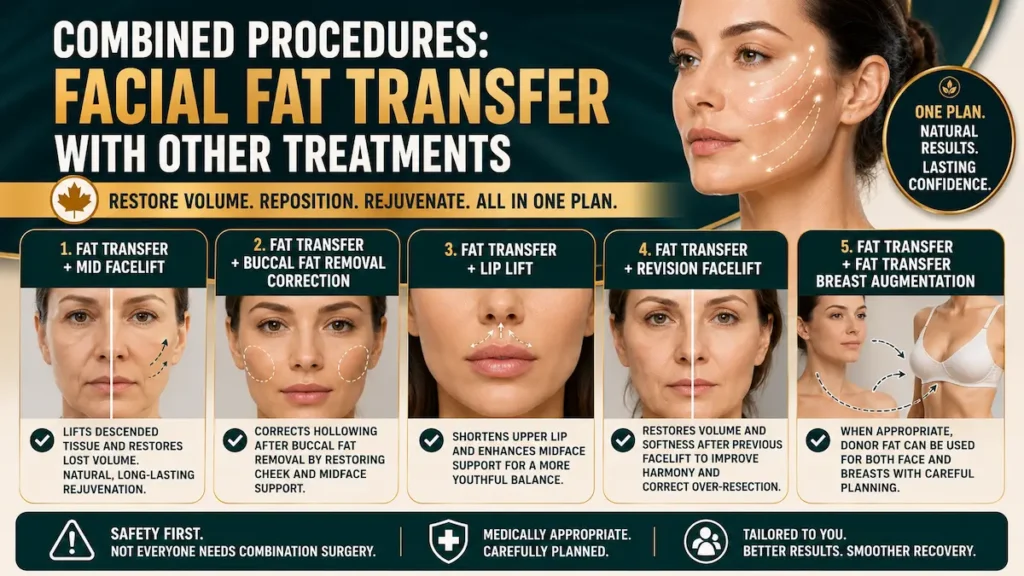
Combined Procedures: Facial Fat Transfer with Other Treatments
Facial fat transfer is often combined with other procedures because ageing rarely affects only one layer. Skin can sag while volume disappears.
A combined plan can restore structure, support, and softness in one surgical pathway. It must still be medically appropriate. More surgery is not automatically better.
Facial Fat Transfer + Mid Facelift
A mid facelift repositions descended cheek tissue. Facial fat transfer restores volume that has been lost.
Together, they can address both descent and deflation. This is useful for patients whose cheeks look flat and low rather than only hollow.
We may recommend a mid facelift when volume alone would not correct the underlying tissue position.
Facial Fat Transfer + Buccal Fat Removal Correction
Some patients seek fat transfer after buccal fat removal created too much hollowing. This can become more noticeable with ageing or weight loss.
Correction requires careful mapping. We do not simply refill the exact buccal space. Instead, we restore surrounding cheek and midface support to soften the hollowed look.
This is why conservative buccal fat removal planning matters from the beginning.
Facial Fat Transfer + Lip Lift
A lip lift shortens the distance between the nose and upper lip. Facial fat transfer can support the surrounding midface and lower-face balance.
This combination may suit patients who want a more refreshed mouth area without relying only on filler. It is not the same as adding large lip volume.
For patients focused on upper-lip proportion, our lip lift guide explains the surgical options.
Facial Fat Transfer + Revision Facelift
Revision facelift patients often need more than tightening. They may also need softness restored after over-resection, scarring, or an overly pulled result.
Fat transfer can help rebuild facial harmony when tissue has been thinned or volume has been lost. Timing matters because revision surgery requires careful healing assessment.
Patients with a previous unsatisfactory facelift should review our revision facelift guide before deciding whether fat transfer alone is enough.
Facial Fat Transfer + Fat Transfer Breast Augmentation
Some patients ask whether donor fat can be used for both the face and breasts. In selected cases, this may be possible, but the planning is more complex.
The face requires small, precise volumes. Breast fat transfer requires larger donor-fat volume and different processing priorities.
If you are considering both, our fat transfer breast augmentation guide explains the body-volume side of the decision.
When Not to Combine Procedures
Combination surgery should not be chosen only because travel is involved. Safety comes first.
We may recommend staging procedures if surgery time would be too long, swelling would make assessment difficult, or recovery would become harder than necessary.
A good combined plan should reduce burden, not increase risk.
Anesthesia for Facial Fat Transfer: Local or Sedation
Facial fat transfer is usually performed with local anesthesia and sedation. This keeps the procedure comfortable while avoiding unnecessary anesthesia depth for most patients.
The best anesthesia plan depends on treatment extent, donor area, anxiety level, and whether facial fat transfer is being combined with another procedure.
Local Anesthesia with Sedation
For many patients, local anesthesia with sedation is enough. We numb the donor area and facial treatment zones while sedation keeps you relaxed.
This approach is common when facial fat transfer is performed as a standalone procedure. It is especially suitable when the volume needed is moderate and the donor-site liposuction is limited.
Patients still receive monitoring throughout the procedure. Comfort and safety are planned together.
General Anesthesia When Combined with Other Procedures
General anesthesia may be appropriate when fat transfer is combined with a longer surgery. Examples include facelift, revision facelift, or body procedures using the same donor fat.
Combination planning is not about doing more for the sake of more. It is about deciding whether one surgical session is safer and more efficient than multiple separate procedures.
If general anesthesia is recommended, we explain why. We also review your medical history, medications, travel timing, and recovery needs before confirming the plan.
Pre-Anesthesia Assessment for Canadian Patients
Before surgery, we review your health information, photos, medications, allergies, and relevant medical history. Some patients may need blood work, ECG, or additional clearance.
Canadian patients should be honest about smoking, vaping, blood thinners, supplements, autoimmune conditions, and previous filler. These details affect both anesthesia and graft survival.
If your family physician in Canada should review your travel or surgical plan, we encourage that discussion before you book flights.
Our Anesthesia Team and Monitoring Standards
Safety does not begin in the operating room. It begins with screening.
Our team plans the anesthesia pathway before your procedure day. During surgery, vital signs are monitored, comfort is managed, and recovery-readiness is assessed before discharge.
For international patients, this matters because you are not only recovering from surgery. You are also preparing for a long-haul return flight to Canada.
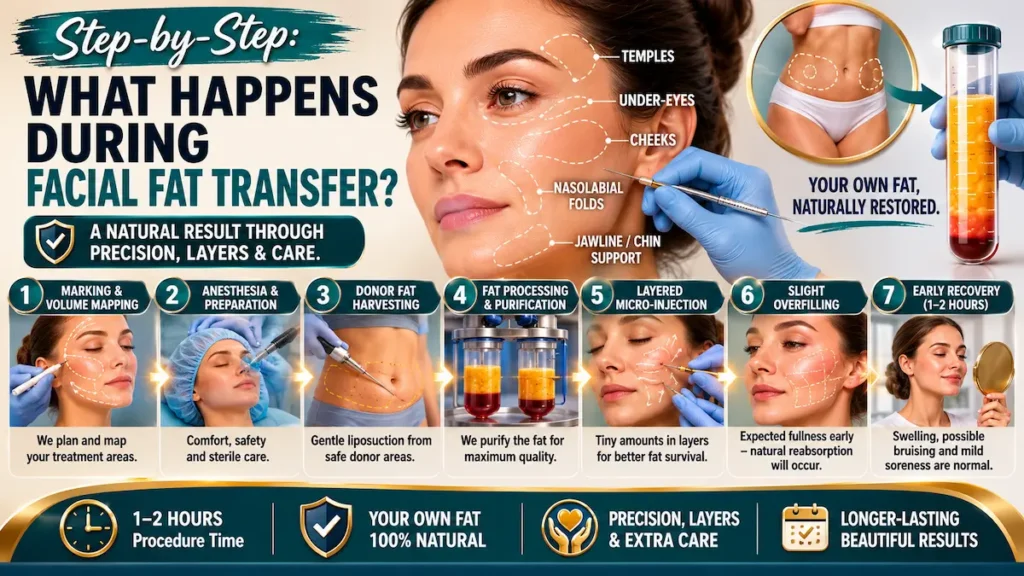
Step-by-Step: What Happens During Facial Fat Transfer?
Facial fat transfer is precise because the final result depends on small decisions repeated many times. Harvesting, processing, and injection all influence fat survival.
We plan the procedure in layers. A natural result comes from controlled placement, not simply adding more fat.
Pre-Operative Marking and Volume Mapping
Before surgery, we mark the face while reviewing your anatomy in an upright position. This helps us see how hollowing appears with normal gravity and expression.
We identify treatment zones such as the cheeks, temples, tear troughs, and nasolabial support areas. We also mark donor areas based on where fat can be harvested safely.
Volume mapping is tailored. Two patients may both ask for cheek fat transfer, but their injection plan can be completely different.
Anesthesia and Preparation
Once the plan is confirmed, anesthesia is administered according to your clinical protocol. The donor site and face are prepared with sterile technique.
We use careful positioning so the donor harvest and facial injection can be performed efficiently. Comfort, sterility, and access guide the setup.
The surgical team confirms the plan before fat harvesting begins.
Donor Fat Harvesting
Fat is harvested using gentle liposuction. Common donor sites include the abdomen, flanks, thighs, or waist.
The goal is not aggressive contouring. The goal is to collect healthy fat cells with minimal trauma so they have the best chance of survival after transfer.
We avoid over-harvesting. Donor-site smoothness matters too.
Fat Processing and Purification
After harvesting, the fat is processed to separate usable graft material from fluid, oil, and damaged cells. Clean preparation supports safer injection and better graft quality.
Different processing methods may be used depending on the target area. Larger-volume areas such as cheeks may need different fat preparation than delicate zones such as tear troughs.
This is where technique matters. Poorly processed fat can increase irregularity risk.
Layered Micro-Injection
The prepared fat is injected in small amounts through fine cannulas. We place it in multiple passes and layers.
This technique gives each small fat parcel better contact with surrounding tissue. Better contact supports blood-supply development, which is essential for fat survival.
Heavy single deposits are avoided. They can increase lumpiness and reduce predictability.
Slight Overfilling
Early facial fullness is expected. It comes from swelling, injected fat, and the deliberate overfill used to account for reabsorption.
This does not mean the final result will look that full. A portion of the transferred fat naturally reabsorbs during the first few months.
We explain this before surgery so patients do not panic in the first week or judge the result too early.
Procedure Length and Early Recovery
A standalone facial fat transfer often takes about 1-2 hours, depending on the number of treated areas and donor-site complexity.
After surgery, you recover under observation until you are ready for discharge. Most patients return to the hotel the same day with post-operative instructions.
You should expect facial swelling, possible bruising, and mild donor-site tenderness. These are normal early recovery findings.
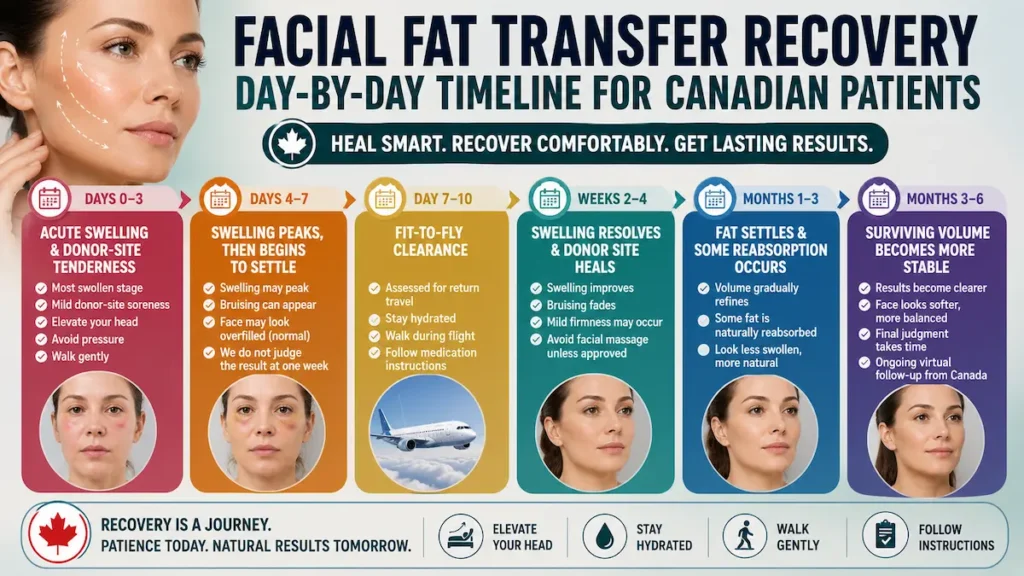
Facial Fat Transfer Recovery: Day-by-Day Timeline for Canadian Patients
Facial fat transfer recovery has two parts: the treated face and the donor area. Most patients feel well enough for light hotel recovery quickly, but swelling can make the face look fuller than expected at first.
This early fullness is normal. It is not the final result.
Days 0-3: Acute Swelling and Donor-Site Tenderness
The first three days are the most swollen stage. Your face may look overfilled, especially in the cheeks, temples, or under-eye transition.
You may also feel mild soreness in the donor area where fat was harvested. This can feel like bruising after liposuction rather than sharp pain.
- Sleep with your head elevated.
- Avoid pressure on the treated facial areas.
- Use medications exactly as instructed.
- Walk gently to support circulation.
Days 4-7: Swelling Peaks, Then Begins to Settle
Swelling often peaks around this stage before gradually improving. Bruising can appear in both the face and donor site.
Patients sometimes worry that the result looks too full. This is exactly why pre-operative counselling matters. Swelling, deliberate overfilling, and early graft behaviour all influence the first-week appearance.
We do not judge the result at one week.
Our HBOT and LLLT Recovery Protocol
We use advanced recovery support to reduce inflammation and support tissue healing. Our technology standards include Hyperbaric Oxygen Therapy and Low-Level Laser Therapy where clinically appropriate.
HBOT increases oxygen delivery to healing tissues. For facial fat transfer, oxygenation matters because transferred fat needs contact with a healthy blood supply to survive.
LLLT uses 424 medical-grade semiconductor laser diodes at 650nm to stimulate cellular ATP production. This can support donor-site healing, injection-site recovery, and general tissue repair.
For a deeper explanation of oxygen-based recovery support, see our HBOT benefits guide. For laser-supported healing, our LLLT scar and tissue recovery guide explains how photobiomodulation supports repair.
Day 7-10: Fit-to-Fly Clearance
Many Canadian patients are assessed for return travel around day 7-10, depending on swelling, donor-site comfort, and whether facial fat transfer was performed alone or with another procedure.
A long-haul flight to Toronto, Vancouver, Montreal, or Calgary needs planning. You should stay hydrated, walk during the flight when safe, and follow your post-operative medication instructions.
Our flight safety after surgery guide explains how we plan return travel for Canadian patients after aesthetic procedures.
Weeks 2-4: Swelling Resolves and Donor Site Heals
By week two, facial swelling usually improves enough that patients feel more comfortable on video calls or in casual social settings. The face may still look fuller than the final result.
The donor area continues to settle. Bruising fades. Mild firmness can occur and usually improves with time.
You should still avoid facial massage unless your surgeon specifically approves it. Pressure on the grafted area too early may affect settling.
Months 1-3: Fat Settles and Some Reabsorption Occurs
This is the stage when volume begins to reduce toward the real result. Some transferred fat survives. Some is naturally reabsorbed.
Patients should expect gradual refinement rather than a sudden final reveal. Your face should look less swollen and more natural as the early fullness fades.
Months 3-6: Surviving Volume Becomes More Stable
By three to six months, the surviving fat volume is much clearer. The face usually looks softer, more balanced, and less hollow.
Final judgment still takes time. We continue virtual follow-up after you return to Canada so we can monitor healing at key stages.
Fat Survival, Risks, and “Gone Wrong” Concerns
Facial fat grafting is powerful because it uses living tissue. That also means it is less predictable than placing a fixed-volume implant or injecting a pre-measured filler.
The result depends on fat quality, harvesting technique, processing, injection depth, blood supply, smoking status, and aftercare.
How Much Fat Survives?
In most patients, about 50-70% of transferred fat survives long-term. The rest is reabsorbed during the early months of healing.
This is not a complication. It is part of fat graft biology.
“We slightly overfill because we know some fat will not survive. The skill is knowing how much is enough without creating a heavy or artificial look.”
| Timeframe | What Happens | Expected Volume Pattern |
|---|---|---|
| Days 0-7 | Swelling, overfill, early bruising | Face looks fuller than final result |
| Weeks 2-4 | Swelling reduces | Volume starts to look more natural |
| Months 1-3 | Some fat reabsorbs | Volume decreases toward final level |
| Months 3-6 | Surviving fat stabilizes | Long-term shape becomes clearer |
| 1 year | Stable grafted fat remains | Remaining volume is generally long-lasting |
Why Surgeons Slightly Overfill
If we placed only the exact final volume you wanted, the result would likely become underfilled after reabsorption. Slight overfilling accounts for the expected loss.
This is why early fullness should not be mistaken for a poor result. It is part of the plan.
When a Second Session Is Needed
A second session may be recommended if the fat settles well but the patient wants more correction. This is most common in severe hollowing or correction cases after over-removed buccal fat.
We frame this honestly before surgery. A second session is sometimes part of precision, not a sign that the first surgery failed.
Overcorrection, Lumps, and Asymmetry
Facial fat transfer can go wrong when too much fat is placed, when fat is injected too superficially, or when the treatment plan ignores natural facial proportions.
Possible concerns include:
- Persistent puffiness
- Lumps or irregularities
- Asymmetry
- Under-eye unevenness
- Donor-site bruising or contour change
Our surgeons reduce these risks through conservative planning, layered micro-injection, sterile fat handling, and careful patient selection.
Under-Eye Lumps: Why This Area Needs Special Skill
The under-eye area is the caution zone in facial fat transfer. Thin skin makes even small irregularities visible.
We assess tear trough anatomy carefully before recommending fat in this area. In some patients, filler, lower eyelid surgery, or fat repositioning creates a safer result.
Good surgery includes knowing when not to graft.
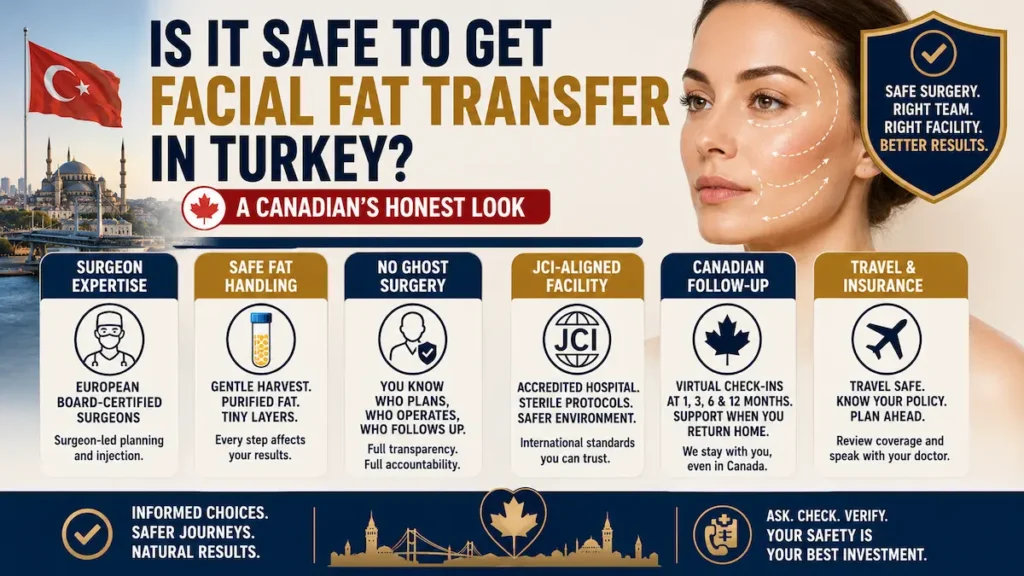
Is It Safe to Get Facial Fat Transfer in Turkey? A Canadian’s Honest Look
Yes, facial fat transfer in Turkey can be safe when it is performed by the right surgical team in the right facility. The country is not the risk factor by itself.
The real risk comes from poor clinic selection, unclear surgeon identity, weak sterilization standards, rushed volume planning, and limited follow-up after you fly home.
We address these concerns directly because Canadian patients are trained to ask careful questions. That is a strength, not an obstacle.
The Turkey Plastic Surgery Reality
Turkey has a large aesthetic surgery sector. Some clinics operate at a high international standard, while others compete mainly on price and volume.
That difference matters. Facial fat transfer may sound simple, but the procedure depends on sterile fat handling, delicate micro-injection, and careful judgement about how much volume the face can accept.
Our position is clear: a safe result depends on the clinic, surgeon, facility, and follow-up structure. It should never depend on marketing promises.
For a broader safety framework, see our guide to plastic surgery safety in Turkey.
Surgeon-Led Fat Handling and Injection Protocol
Facial fat transfer is not just liposuction plus injection. Every step affects the result.
- Fat must be harvested gently.
- Damaged cells, fluid, and oil must be removed.
- The graft must be injected in tiny parcels.
- Depth and placement must match the facial zone.
- The under-eye area must be treated with extra caution.
Our European Board-Certified Surgeons plan the facial volume map before surgery. We do not delegate the aesthetic decision-making to a technician.
“In facial fat grafting, the artistic decision matters as much as the technical step. We plan where fat can be placed safely and where restraint will protect the result.”
Ghost Surgery: Why Surgeon-of-Record Matters
Ghost surgery means the patient believes one surgeon will operate, but someone else performs the procedure. Canadian patients are right to ask about this.
Before booking, you should know:
- Who is responsible for your surgical plan
- Who performs the procedure
- Who reviews your follow-up photos
- Who answers questions if you have concerns after returning to Canada
We make surgeon identity and clinical accountability part of the consultation process. You can read more in our ghost surgery prevention guide.
JCI-Aligned Facility Standards and Sterile Protocols
Fat transfer requires strict sterility because harvested fat is handled outside the body before it is re-injected. Sterile technique protects both the donor site and the facial injection zones.
Our procedures take place in a JCI-accredited hospital partner facility. We also follow structured protocols for pre-operative testing, instrument sterilization, tissue handling, and post-operative monitoring.
These standards are especially important for international patients. You need safe surgery, clear discharge instructions, and a recovery plan that accounts for long-haul travel.
Canadian Patient Records and Follow-Up
Canadian patients often ask what happens after they fly home. That question should be answered before surgery.
We provide post-operative instructions and follow-up through virtual check-ins after you return to Canada. Our long-term follow-up programme includes review points at 1, 3, 6, and 12 months.
If you need to update your family physician, we can provide clear procedure details and recovery notes in English. This helps bridge the gap between your surgery in Istanbul and your care environment in Canada.
Travel Insurance and Elective Surgery Limitations
Many Canadian travel insurance policies do not cover complications related to elective cosmetic surgery abroad. Patients should confirm their own policy before travelling.
This does not mean you should travel without a plan. It means your clinic should reduce preventable risk through screening, safe timing, and clear follow-up.
We encourage patients to review travel health guidance, speak with their family physician when appropriate, and ask our coordinators every logistics question before booking.
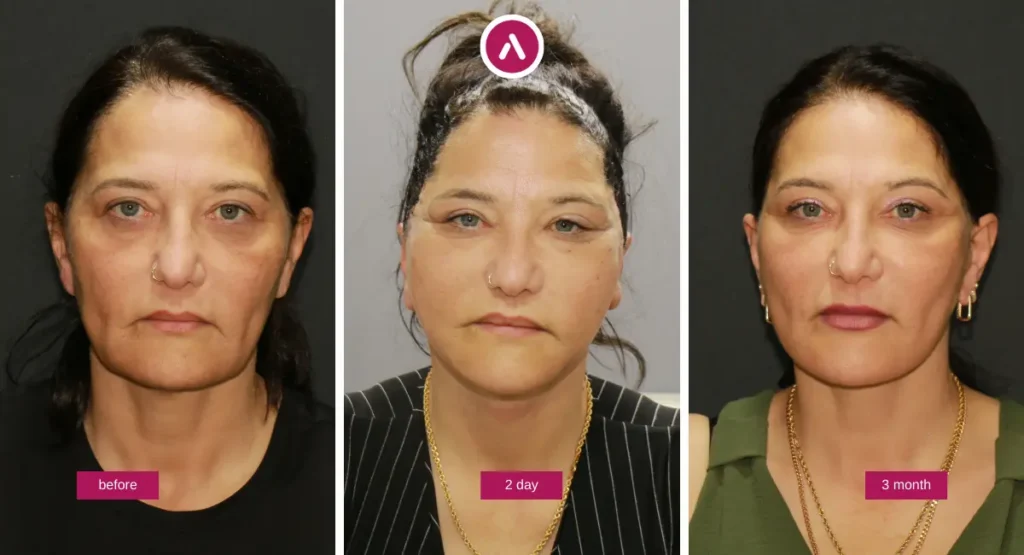
Fat Transfer to Face Before and After: Realistic Expectations and Results
Facial fat transfer can create a softer, younger-looking face, but the result evolves over months. Early swelling is not the outcome. First-week fullness is not the outcome either.
The best result looks like restored facial balance. It should not make people think you had your face filled.
What Facial Fat Transfer Before and After Results Show
Before and after results usually show improvement in facial softness, midface support, and hollowing. The cheeks may look less flat. The temples may look less skeletal. The under-eye transition may look smoother in selected patients.
The change should still respect your identity. Our philosophy is rejuvenation, not alteration.
You can review relevant outcome documentation through our before and after gallery when available for your procedure category.
Why Early Fullness Is Not the Final Result
Patients often look fuller in the first week than they expected. This is normal.
Three things create early fullness:
- Post-operative swelling
- Intentional overfilling
- Transferred fat before natural reabsorption
Judging the result too early can create unnecessary anxiety. We guide patients through the timeline so they know when to wait and when to contact us.
Results at 3 Months, 6 Months, and 1 Year
At 3 months, much of the early swelling has improved, but volume may still be settling. The face usually looks more natural than it did in the first few weeks.
At 6 months, the surviving fat is more stable. This is when many patients begin to see the real balance of the result.
At 1 year, remaining grafted fat is generally considered long-lasting. Your face will still age, but the surviving fat behaves like living tissue in its new location.
How Long Does Facial Fat Transfer Last?
The fat that survives can last for many years. It may change with ageing, weight fluctuation, and general health, just as fat elsewhere in the body can change.
This is different from filler. Filler fades as the body breaks down the product. Surviving transferred fat becomes part of the treated area.
That permanence is a benefit for the right patient. It is also why planning must be conservative.
When a Second Session Makes Sense
A second session may make sense when the first result settles well but the patient wants more volume. It may also help correction cases where severe hollowing cannot be safely corrected in one round.
We do not promise that every patient will need only one session. We prefer honest planning over exaggerated certainty.
For many patients, one session creates enough improvement. For others, staged refinement gives a better and safer result.
What a Natural Result Should Look Like
A natural facial fat transfer result should make the face look healthier, not inflated. The cheeks should have support without heaviness. The temples should look less hollow without looking round. The under-eye transition should soften without visible lumps.
The International Society of Aesthetic Plastic Surgery reported “fat grafting – face” among the leading face and head procedures in its 2024 global survey. That growth makes careful patient selection even more important, because popularity should never replace clinical judgement. You can review the source at ISAPS global statistics.
The best compliment is often simple: you look rested.
That is the result we plan for at AKM Clinic.
Facial Fat Transfer Cost 2026: Turkey vs Canada
Facial fat transfer cost varies because the procedure depends on how many facial zones are treated, how much donor fat is needed, and whether it is performed alone or combined with another surgery.
At AKM Clinic, the Fat Transfer to Face All-Inclusive Package is CAD $3,400. This includes the surgical procedure, anesthesia, hospital facility fees, pre-operative medical tests, 5-star hotel accommodation, private VIP transfers, post-operative medications, and 24/7 patient advocacy.
By comparison, Canadian private-clinic pricing for facial fat transfer often ranges from CAD $7,000 to CAD $10,000, especially in Toronto, Vancouver, Montreal, and Calgary. Many Canadian quotes separate surgeon fees, facility fees, anesthesia, post-operative garments, medications, and follow-up visits.
| Location | Typical Facial Fat Transfer Cost | What Patients Should Check |
|---|---|---|
| Toronto | CAD $7,000-$10,000 | Whether anesthesia and facility fees are included |
| Vancouver | CAD $7,500-$10,000 | Whether follow-up visits are billed separately |
| Montreal | CAD $7,000-$9,000 | Whether the quote covers donor-site liposuction |
| Calgary | CAD $7,000-$9,500 | Whether revision or touch-up policy is explained |
| AKM Clinic Istanbul | CAD $3,400 | All-inclusive clinical pathway with hotel and transfers |
For a detailed breakdown of technique pricing, donor-site planning, and what is included in the package, see our facial fat transfer cost guide and the all-inclusive fat transfer to face package.
Canadian-dollar pricing shown for planning clarity; your coordinator will confirm the final payment details before booking.
How to Find the Best Facial Fat Transfer Surgeon in Turkey: A Canadian Patient’s Checklist
Choosing a facial fat transfer surgeon is different from choosing an injector. This procedure involves liposuction, tissue processing, facial anatomy, sterile technique, and aesthetic judgement.
Canadian patients often begin by comparing local private clinics. That is reasonable. The next step is comparing surgeon qualifications, facility standards, and follow-up systems with the same discipline you would use at home.
Check Board-Level Credentials
In Canada, patients are used to seeing RCPSC certification and provincial college registration. In Turkey, you should look for internationally recognized specialist training, European board pathways, and transparent surgeon identity.
| Credential Framework | What It Means | Why It Matters for Canadians |
|---|---|---|
| RCPSC / FRCSC | Canadian specialist certification and surgical fellowship designation framework | The familiar Canadian benchmark for specialist training |
| EBOPRAS / European Board Pathways | European specialist certification structure | Helps Canadian patients compare international credentials |
| ABFPRS | Facial plastic and reconstructive surgery certification framework in the United States | Useful comparison point for facial plastic surgery training standards |
| JCI-Accredited Facility | International hospital safety and quality accreditation | Supports operating-room safety for travelling patients |
For more detail on comparing international credentials, read our plastic surgeon board certification guide.
Ask Who Performs Each Step
Facial fat transfer has several technical stages. A safe clinic should explain who harvests the fat, who processes it, who injects it, and who reviews your follow-up.
You should not accept vague answers. Your surgeon-of-record should be clear before you travel.
At AKM Clinic, our European Board-Certified Surgeons lead the facial volume plan and the surgical decision-making. This is essential for natural, proportionate results.
Look for Facial Fat-Grafting Experience
Not every plastic surgeon who performs liposuction is equally experienced in facial fat grafting. The face is less forgiving than the body.
The best surgeon for facial fat transfer should understand:
- Facial fat compartments
- Cheek and temple volume balance
- Tear trough caution zones
- How ageing changes facial proportions
- How much overfill is safe
- When filler, facelift, or eyelid surgery is better
This is where honest consultation matters. A strong surgeon will not recommend fat transfer for every hollow or every patient.
Demand an Honest Fat-Survival Discussion
A trustworthy surgeon will explain that fat survival is not 100%. Be cautious if anyone promises permanent full-volume retention.
The realistic expectation is that about 50-70% of transferred fat survives long-term. Some patients may benefit from a second session after the first result stabilizes.
“A good facial fat transfer consultation should include the word reabsorption. If a patient understands that from the beginning, recovery feels much less confusing.”
Review Before and After Results Carefully
Before and after images should show the same angles, lighting, and facial expression whenever possible. For facial fat transfer, one-year results are especially valuable because they show what survived long-term.
Be cautious with early post-operative photos. A face can look full at two weeks because of swelling, not stable fat survival.
You can also review our professional plastic surgery reviews to understand how international patients describe their care experience.
Confirm Follow-Up After Returning to Canada
Follow-up is not optional for Canadian patients. It is the bridge between surgery in Istanbul and recovery at home.
Before choosing a clinic, ask how long they follow patients, how you send photos, who reviews your healing, and how quickly someone responds if you have a concern.
Our care programme includes long-term virtual follow-up at 1, 3, 6, and 12 months. Patient hosts such as Hande, Emine, and Khadija also help coordinate communication throughout the process.
You can learn more about our Natural-First philosophy, surgical leadership, and North American patient support through our About AKM Clinic page.
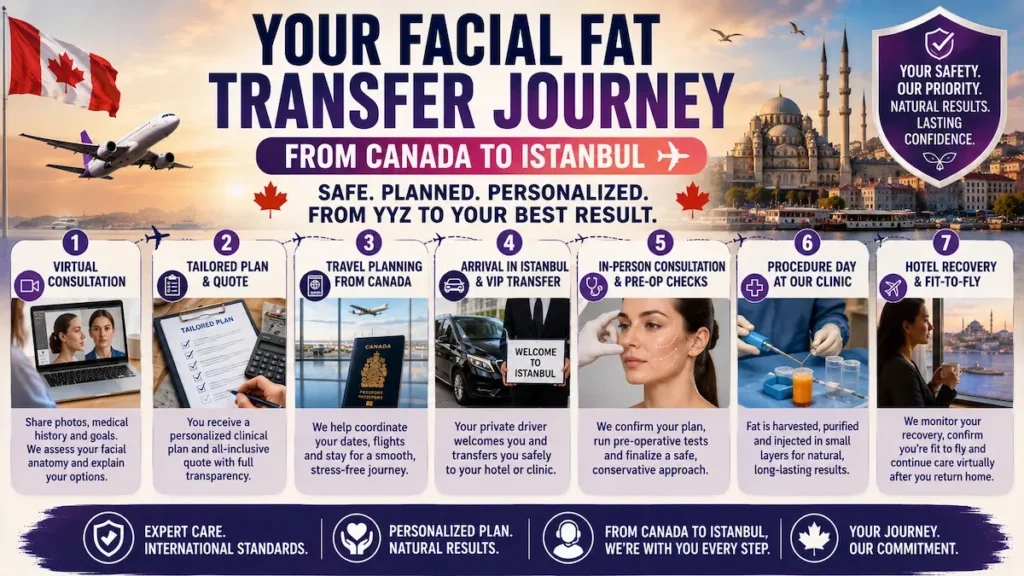
Your Facial Fat Transfer Journey from Canada: From YYZ to Istanbul, Step by Step
Travelling for facial fat transfer should feel organized before you leave Canada. The safest international surgical pathway is not improvised after you land.
We plan your consultation, arrival, hotel stay, procedure day, recovery checks, and return-flight timing before surgery. This structure helps you focus on healing rather than logistics.
Step 1: Virtual Consultation and Photo Assessment
Your journey begins with a virtual consultation. You send facial photos from specific angles, share your medical history, and explain what concerns you most.
We assess facial volume loss, skin quality, donor-fat availability, previous filler, and any past facial procedures. If you have had buccal fat removal, facelift surgery, eyelid surgery, or filler, we need to know.
This is also where we discuss expectations. We explain fat survival, possible overfill, recovery timing, and whether a second session may be useful in the future.
Step 2: Tailored Clinical Plan and Transparent Quote
After medical review, we prepare a tailored clinical protocol. This includes the treatment zones, likely donor site, anesthesia plan, recommended stay length, and all-inclusive pricing.
Our coordinators explain what is included so you are not comparing an Istanbul all-inclusive programme with a Canadian surgical-fee-only quote.
You will also know which costs are not included, such as international flights and personal spending.
Step 3: Travel Planning from Canada
Most Canadian patients travel through Toronto, Montreal, Vancouver, Calgary, or Ottawa connections. Flight availability changes, so you should confirm current routes before booking.
Canadian passport holders can generally enter Turkey visa-free for short stays, but passport validity and airline rules should be checked before travel.
Our team helps you choose arrival and departure dates that fit the procedure and follow-up schedule. Facial fat transfer usually needs less in-country recovery time than major lifting surgery, but fit-to-fly timing still matters.
For the broader logistics pathway, review our Canadian patient journey guide.
Step 4: Arrival in Istanbul and VIP Transfer
When you arrive in Istanbul, your private driver meets you and takes you to the hotel or clinic according to your schedule.
We use private transfers because post-travel stress is not helpful before surgery. You should not be trying to manage taxis, translation, luggage, and clinic directions while preparing for a procedure.
Your coordinator remains available to answer questions and confirm the next steps.
Step 5: In-Person Consultation and Pre-Operative Checks
Before surgery, you meet the clinical team in person. We review your face, confirm treatment zones, assess donor areas, and answer final questions.
Pre-operative testing is completed according to your plan. This may include blood work, medication review, and anesthesia screening.
The in-person consultation is also where we confirm conservative volume goals. We would rather build a natural result than create a puffy face that looks treated.
Step 6: Procedure Day at Our Istanbul Clinic
On procedure day, your donor area and facial zones are marked. Anesthesia is administered, fat is harvested, processed, and injected in small controlled layers.
The procedure is usually same-day when performed alone. If it is combined with facelift, eyelid surgery, or another operation, the pathway may include a longer observation period.
You can learn more about our clinical setting through our Istanbul clinic page.
Step 7: Hotel Recovery and Fit-to-Fly Clearance
After surgery, you recover at the hotel with instructions from our team. The first days focus on swelling control, donor-site comfort, hydration, and avoiding pressure on treated areas.
Before you return to Canada, we review your healing and confirm whether you are fit to fly. This check is especially important for patients travelling long-haul to Toronto, Vancouver, Montreal, or Calgary.
Your recovery continues after you fly home. We review healing at scheduled virtual follow-ups and remain available through your coordinator.
Facial Fat Transfer Frequently Asked Questions (FAQ):
How long does fat transfer to the face last?
The fat that survives the grafting process can last for many years. Most early reabsorption happens during the first few months.
By one year, remaining fat is usually considered stable. Your face will still age naturally, and weight changes can affect the transferred fat.
How much of the transferred fat survives?
Most patients retain about 50-70% of the transferred fat long-term. The rest is naturally reabsorbed.
This is why early fullness is expected. Our surgeons slightly overfill selected areas to account for normal fat loss during healing.
Is facial fat transfer permanent?
Facial fat transfer is long-lasting, but it should not be described as fully permanent in every patient. The surviving fat can remain for years, but ageing, weight fluctuation, and health changes still affect facial volume.
A realistic expectation is better than a promise. We explain the survival range before surgery so you understand how the result matures.
Fat transfer or filler — which is better?
Neither option is automatically better. Fat transfer is often better for larger-volume restoration in the cheeks, temples, and midface.
Filler may be better for small refinements, first-time patients, or anyone who wants a reversible option. During consultation, we compare both options against your anatomy and goals.
Does OHIP, MSP, AHCIP, or RAMQ cover facial fat transfer?
Provincial health plans in Canada generally do not cover cosmetic facial fat transfer. OHIP, MSP, AHCIP, and RAMQ focus on medically necessary care.
Coverage may differ for reconstructive cases after trauma, cancer, or congenital conditions. Patients should confirm directly with their provincial plan and physician.
How much does facial fat transfer cost in Toronto vs Istanbul?
Private facial fat transfer in Toronto often ranges around CAD $7,000-$10,000 depending on clinic, anesthesia, facility fees, and treatment extent.
At AKM Clinic, the Fat Transfer to Face All-Inclusive Package is CAD $3,400. It includes surgery, anesthesia, hospital facility fees, 5-star hotel accommodation, VIP transfers, post-operative medications, and 24/7 patient advocacy.
Does Canadian travel insurance cover complications from elective facial fat transfer abroad?
Many Canadian travel insurance policies exclude elective cosmetic surgery and complications related to it. You should review your policy carefully before booking and ask the insurer direct written questions.
To reduce this concern, AKM Clinic provides complimentary complication insurance for all patients. This is separate from standard Canadian travel insurance and is designed to add an extra layer of protection around your surgical care. Your coordinator will explain the coverage terms, limits, and required documentation before you confirm your booking.
What if facial fat transfer looks overdone at first?
Early fullness is common. It usually reflects swelling, deliberate overfilling, and transferred fat before natural reabsorption occurs.
The first week is not the final result. We monitor your healing through follow-up photos and scheduled virtual reviews after you return to Canada.
Can facial fat transfer cause lumps?
Lumps or irregularities can occur if fat is placed too superficially, injected in large deposits, or used in a poor candidate. The under-eye area is especially sensitive.
We reduce this risk through layered micro-injection, conservative volume planning, careful fat processing, and strict patient selection.
Will I need a second session?
Some patients do. A second session may be useful when the first result settles well but more volume is desired.
This is more common in severe hollowing, correction after over-removed buccal fat, or revision cases. We discuss this possibility before surgery.
How long is recovery after facial fat transfer?
Most patients experience the strongest swelling during the first week. Many feel comfortable with light activity within several days, but visible swelling may last longer.
The face continues to refine over several months. Final volume is usually judged between 6 months and 1 year.
Can facial fat transfer fix buccal fat removal that went too far?
Facial fat transfer can help soften hollowness after aggressive buccal fat removal. It may not recreate the original buccal fat pad exactly.
The goal is to restore surrounding cheek and midface support so the face looks healthier and less hollow. Careful volume mapping is essential.
Can I combine facial fat transfer with a facelift or lip lift?
Yes, in selected patients. Facial fat transfer is often combined with mid facelift, revision facelift, lip lift, blepharoplasty, or other facial rejuvenation procedures.
Combination surgery depends on health status, anesthesia plan, procedure length, swelling patterns, and recovery logistics. We recommend combining only when it improves the clinical plan.
Medical Disclaimer: This page is for educational purposes only and does not replace medical advice, diagnosis, or treatment from a qualified health care professional. Facial fat transfer results vary between patients. Fat survival, swelling, recovery time, symmetry, and long-term outcome depend on anatomy, health status, surgical technique, aftercare, and individual healing.