



Buccal fat removal, also called bichectomy, has become highly visible online because of the “snatched cheekbone” trend. The procedure removes the buccal fat pad from the lower cheeks through a small incision inside the mouth, but the decision should never be trend-led. Your face naturally loses fat as you age, so removing cheek volume too aggressively can look hollow years later. At AKM Clinic in Istanbul, we use a conservative, candidacy-first approach and will tell you honestly if buccal fat removal is not the right choice for your face.
Table of Contents
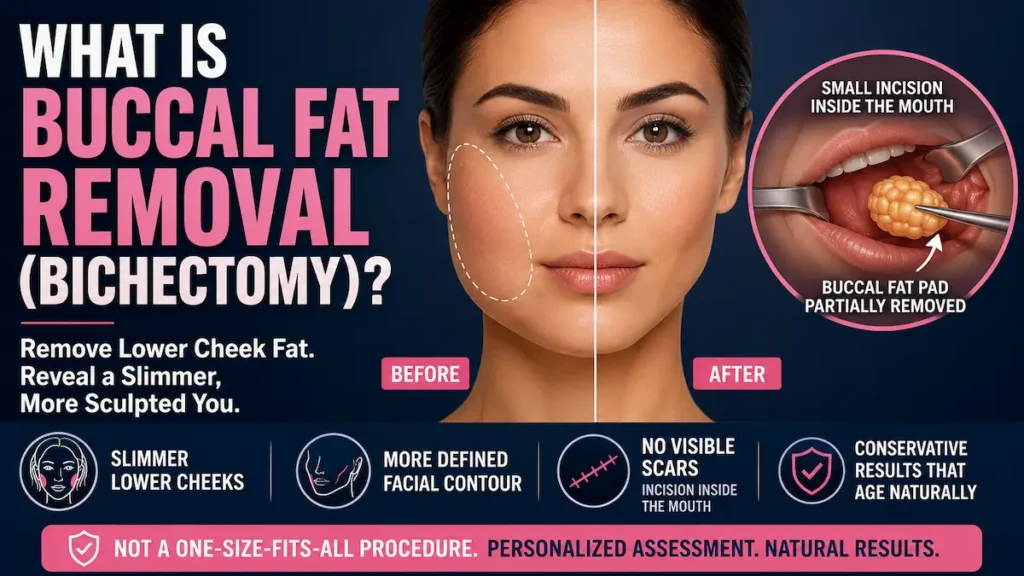
What Is Buccal Fat Removal (Bichectomy)?
Buccal fat removal, or bichectomy, extracts the buccal fat pad from the lower cheeks to create a slimmer, more sculpted lower-face contour through a small incision inside the mouth. It best suits fuller, rounder faces. Because facial fat naturally decreases with age, careful candidacy is essential.
The Buccal Fat Pad Explained
The buccal fat pad is a natural pocket of fat in the lower cheek. It sits deeper than the fat you can pinch under the skin, and it helps create the soft fullness many people notice around the mid-to-lower cheek area.
Some patients have a larger buccal fat pad because of facial anatomy, genetics, or naturally rounder cheeks. In the right face, reducing this deeper pad can make the cheek hollow slightly more visible and give the lower face a more defined shape.
That does not mean every full-looking face needs buccal fat surgery. Cheek fullness can also come from skin thickness, masseter muscle size, facial swelling, weight changes, or general facial structure. This is why photo assessment and in-person evaluation matter.
How Buccal Fat Removal Works
During buccal fat removal, our surgeon makes a small incision inside the mouth, usually near the upper molars. The buccal fat pad is gently accessed, partially reduced, and the incision is closed with dissolvable sutures.
There is no external skin incision. That means there is no visible cheek scar, which is one reason the procedure appeals to patients who want discreet contouring.
At AKM Clinic, the important word is “partial.” We do not treat buccal fat removal as a maximum-extraction procedure. Conservative removal protects the natural softness of the face and helps reduce the risk of an overly hollow appearance later.
Buccal Fat Removal vs Bichectomy vs Cheek Reduction
Buccal fat removal and bichectomy usually refer to the same procedure. “Bichectomy” is more common in some international medical contexts, while “buccal fat removal” is the phrase Canadian patients most often search.
“Cheek reduction surgery” can be broader. It may refer to buccal fat pad removal, but it can also be confused with other facial contouring procedures, such as jawline surgery, chin augmentation, filler, or facial liposuction.
For clarity, this guide focuses on buccal fat pad removal: a targeted lower-cheek procedure that removes volume. It does not lift sagging skin, reduce jowls, treat a double chin, or add cheekbone projection.
Why It Went Viral — And Why That Requires Caution
Buccal fat removal became popular because online before-and-after images can look dramatic. A rounder face may appear sharper, cheekbones may look more visible, and the jawline may seem more defined.
But online trends rarely show long-term aging. A result that photographs well at 25 may not age well at 45 if too much facial volume has been removed.
This is why we avoid celebrity speculation and trend-driven pressure. Our goal is not to create the most hollow cheek possible. Our goal is to assess whether your face can lose lower-cheek volume safely while still aging naturally.
For another example of how viral facial trends should be assessed carefully, our guide to fox eye surgery in Turkey explains why trend-led facial procedures require conservative planning.
Benefits of Buccal Fat Removal — For the Right Candidate
Slimmer, More Sculpted Lower Cheeks
For a patient with a genuinely full lower cheek, buccal fat removal can reduce roundness and create a slimmer facial contour. The effect is most visible below the cheekbone and beside the mouth, where the buccal fat pad contributes to fullness.
The change should look refined, not hollow. A good buccal fat removal result still keeps the face healthy, soft, and natural in motion.
More Defined Cheekbones and Jawline
Buccal fat removal does not build cheekbones or change bone structure. It can, however, make the natural cheekbone shadow more visible by reducing lower-cheek fullness.
This can create the impression of better cheekbone and jawline definition. The effect is indirect. Patients with weak chin projection, heavy jowls, or true skin laxity may need a different treatment plan.
Subtle, Permanent Facial Contouring
Unlike filler, buccal fat removal is effectively permanent. Once the buccal fat pad is removed, it does not grow back in a predictable way.
This permanence can be a benefit for the right person. It can also be a risk for the wrong person. We discuss both sides clearly before recommending surgery.
Quick Procedure, Minimal Downtime
Buccal fat removal is usually a short procedure. Many cases take around 30 to 45 minutes, depending on anatomy and whether it is performed alone or with another facial procedure.
Recovery is generally easier than larger facial surgeries. Swelling is still expected, and the cheeks may look fuller before they slim down. Most patients need a soft diet, mouth rinses, and careful oral hygiene during early healing.
Why “Benefit” Depends Entirely on Candidacy
Buccal fat removal is not a universal facial-slimming solution. The same procedure that enhances one face can prematurely age another.
The best candidates have enough lower-cheek fullness to reduce without compromising long-term facial volume. Thin, narrow, angular, or already-hollow faces are usually poor candidates.
“Conservative buccal fat removal is not about taking out as much fat as possible. It is about deciding whether removing any fat at all will still look balanced 10 years from now.”
Am I a Good Candidate? And Who Should NOT Get This
Good candidacy is the most important part of buccal fat removal. We look at your current face shape, age, skin quality, natural cheek volume, weight stability, and family facial-aging pattern before recommending surgery.
We also ask a harder question: will this still look good as you age? That question protects you from over-treatment.
Good Candidates — Fuller, Rounder Faces
You may be a good candidate if your lower cheeks remain full even when your body weight is stable. Many suitable patients describe having a “baby face,” rounded cheeks, or cheek fullness that does not respond to weight loss.
In these cases, conservative buccal fat pad removal can refine the face without making it look sharp or drawn. The goal is balance.
Good candidates usually have:
- Fuller lower cheeks that persist at a healthy, stable weight
- A round or soft facial shape with enough volume to reduce safely
- Good understanding that results are permanent
- Realistic expectations about subtle contouring
- No existing cheek hollowing or significant facial deflation
Who Should NOT Get Buccal Fat Removal — Thin or Narrow Faces
Patients with thin, narrow, or naturally angular faces should be very cautious. If your cheekbones are already prominent or your mid-face already looks hollow in certain lighting, removing buccal fat can make the face look older.
We may also recommend against buccal fat removal if your goal is based mainly on a viral aesthetic. A face is not a trend cycle. It has to age with you.
Poor candidates often include:
- Already-slim patients with minimal lower-cheek fullness
- Patients with visible cheek hollows at rest
- Patients with a narrow or long face shape
- Patients with major weight fluctuations
- Patients expecting dramatic cheekbone creation from fat removal alone
The Age Factor — Why Younger Is Not Always Better
Many patients considering buccal fat removal are in their 20s or early 30s. That is exactly why the decision requires caution.
Facial fat naturally decreases with age. If too much lower-cheek volume is removed early, the face may look sculpted for a few years but hollow later.
Younger patients are not automatically poor candidates. But they do need a conservative plan, a stable face shape, and a clear understanding that this is not a reversible filler treatment.
Male Candidates and Jawline Definition
Men can be good candidates for buccal fat removal when lower-cheek fullness softens jawline definition. The goal is usually a cleaner transition from cheek to jaw, not an exaggerated hollow.
For male patients, we assess chin projection, jaw width, neck fullness, and cheek volume together. Sometimes the better answer is chin augmentation or jawline contouring rather than buccal fat removal alone.
Realistic, Conservative Expectations
Buccal fat removal refines lower-cheek fullness. It does not lift loose skin, remove jowls, fix a double chin, or create cheekbones where bone structure is weak.
Good expectations sound like this: “I want my naturally round lower cheeks to look slightly slimmer.” Poor expectations sound like this: “I want a completely different face.”
Why We May Recommend Against It
At AKM Clinic, saying “no” can be the safest recommendation. If we believe buccal fat removal may age your face, create excessive hollowing, or fail to address your actual concern, we will explain why.
This is part of our Natural-First philosophy. We prefer a patient to feel disappointed by a cautious answer now rather than regret an irreversible choice later.
| Candidate Type | Face Shape | Age Consideration | AKM Recommendation |
|---|---|---|---|
| Good candidate | Fuller, rounder lower cheeks with stable weight | Enough natural volume to age well after conservative reduction | Partial buccal fat removal may be appropriate after facial assessment |
| Poor candidate | Thin, narrow, angular, or already hollow face | Higher risk of looking gaunt as natural facial fat decreases | We may recommend against surgery or suggest another contouring option |
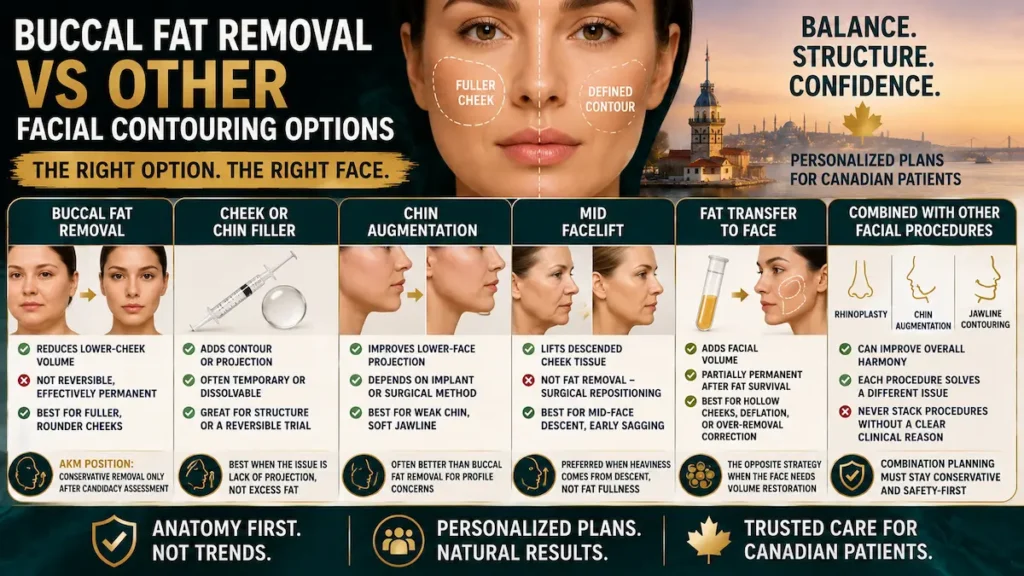
Buccal Fat Removal vs Other Facial Contouring Options
Buccal fat removal is one way to refine the lower cheek, but it is not the only way to improve facial balance. The right option depends on what is creating the concern: excess lower-cheek volume, weak chin projection, jawline softness, skin laxity, or volume loss.
This distinction matters. Removing volume from the wrong face can make the concern worse, especially if the real issue is lack of structure rather than excess cheek fat.
Buccal Fat Removal vs Cheek or Chin Filler
Filler adds volume. Buccal fat removal subtracts it. That difference sounds simple, but it changes the entire treatment logic.
If your face looks round because the lower cheek is genuinely full, conservative buccal fat pad removal may help. If your face looks soft because the chin, jawline, or cheekbone lacks projection, filler or structural surgery may create better balance without removing natural fat.
Filler can also be a useful “trial” for some patients because many hyaluronic-acid fillers are temporary or dissolvable. Buccal fat removal is not a trial. Once fat is removed, the effect is effectively permanent.
Buccal Fat Removal vs Chin Augmentation
A weak chin can make the lower face look rounder, even when the cheeks are not the main problem. In that situation, buccal fat removal may create hollowness without improving the profile.
Chin augmentation in Turkey can improve lower-face projection and bring the jawline into better proportion. For some Canadian patients, this is a safer contouring strategy than removing cheek volume.
During consultation, we evaluate the face in front view, three-quarter view, and profile. This helps us decide whether the concern is cheek fullness, chin projection, jawline structure, or a combination.
Buccal Fat Removal vs Mid Facelift
Buccal fat removal is not a lifting procedure. It does not correct sagging, jowls, or descended mid-face tissue.
Patients in their late 30s, 40s, or beyond may mistake early facial descent for “heavy cheeks.” If the cheek has dropped rather than simply being full, removing buccal fat can make the face look flatter.
In those cases, a mid facelift in Turkey may be more appropriate. A mid facelift repositions descended cheek tissue rather than removing fat from the lower cheek.
When Fat Transfer Is the Opposite Answer
Some patients need more facial volume, not less. This is common in naturally slim faces, post-weight-loss faces, or patients showing early age-related hollowing.
Fat transfer to face in Turkey is almost the opposite of buccal fat removal. Instead of removing lower-cheek fat, it restores volume to hollow or deflated areas using the patient’s own fat.
Fat transfer may also be used in selected cases to improve hollowing after over-aggressive buccal fat removal performed elsewhere. Correction is possible in some patients, but it is more complex than making the right decision first.
Combining with Other Facial Procedures — Cautiously
Buccal fat removal is sometimes combined with facial procedures such as rhinoplasty, chin augmentation, or jawline contouring. Combination planning must stay conservative.
A rhinoplasty in Turkey can improve facial harmony from the centre of the face, while buccal fat removal affects the lower-cheek shadow. These procedures can work together only when each one solves a different anatomical issue.
We do not recommend stacking procedures just to chase a sharper social-media look. Each step must have a clear clinical reason.
| Procedure | Primary Effect | Reversible? | Best For | AKM Position |
|---|---|---|---|---|
| Buccal Fat Removal | Reduces lower-cheek volume | No, effectively permanent | Fuller, rounder lower cheeks | Conservative removal only after candidacy assessment |
| Cheek or Chin Filler | Adds contour or projection | Often temporary or dissolvable, depending on product | Patients wanting structure or a reversible trial | Useful when the issue is lack of projection, not excess fat |
| Chin Augmentation | Improves lower-face projection | Depends on implant or surgical method | Weak chin, profile imbalance, soft jawline | Often better than buccal fat removal for profile concerns |
| Mid Facelift | Lifts descended cheek tissue | No, surgical repositioning | Mid-face descent, early sagging, cheek droop | Preferred when heaviness comes from descent, not fat fullness |
| Fat Transfer to Face | Adds facial volume | Partially permanent after fat survival | Hollow cheeks, age-related deflation, over-removal correction | The opposite strategy when the face needs volume restoration |
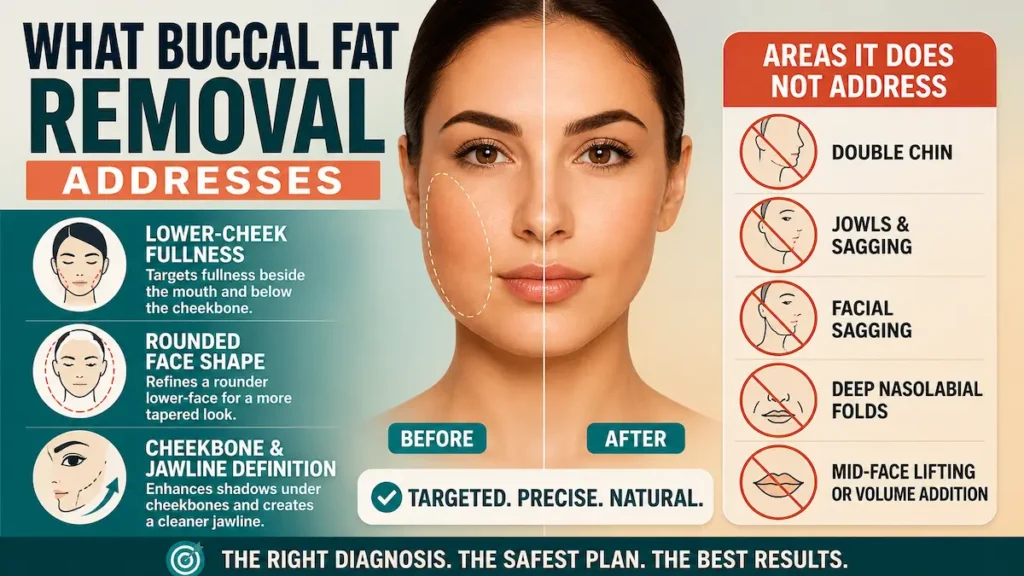
What Buccal Fat Removal Addresses
Buccal fat removal is highly specific. It targets one deep fat compartment in the lower cheek. It should never be presented as a full-face slimming surgery.
Lower-Cheek Fullness
The primary target is lower-cheek fullness caused by a prominent buccal fat pad. This is usually most noticeable beside the mouth and below the cheekbone.
In suitable patients, reducing this pad can create a more tapered lower-face shape. The result should still look soft and natural.
Rounded Face Shape
Some patients feel their face looks round even when their body weight is stable. If the roundness comes from buccal fat anatomy, partial removal can refine the contour.
We avoid treating every round face the same way. A naturally youthful face should not be over-thinned.
Cheekbone and Jawline Definition
Buccal fat removal can make cheekbone shadow more visible by reducing fullness below it. It can also help the jawline appear cleaner in selected patients.
It does not change bone structure. If the cheekbone or chin lacks projection, removing fat alone may not create the definition you want.
Areas It Does NOT Address
Buccal fat removal does not treat a double chin, loose neck skin, jowls, facial sagging, or deep nasolabial folds. It also does not lift the mid-face.
- For a double chin, submental liposuction or neck contouring may be more relevant.
- For jowls or sagging, a facelift or mid-face procedure may be more appropriate.
- For weak chin projection, chin augmentation may create better balance.
- For hollow cheeks, fat transfer may be safer than further volume loss.
This is why we assess the whole face before recommending buccal fat removal. The safest plan starts with the correct diagnosis.
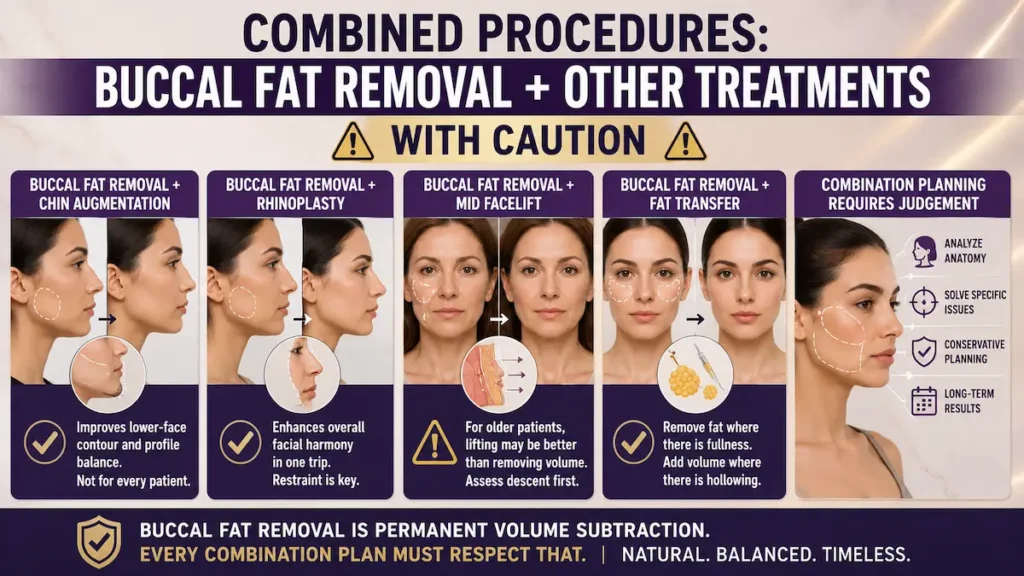
Combined Procedures: Buccal Fat Removal + Other Treatments — With Caution
Buccal fat removal can be combined with other facial procedures, but combination planning must stay conservative. More procedures do not automatically create a better face.
Each treatment should solve a specific anatomical issue. If the plan is only to chase a sharper online look, we step back and reassess.
Buccal Fat Removal + Chin Augmentation
Buccal fat removal and chin augmentation can complement each other when the patient has both lower-cheek fullness and weak chin projection. The buccal procedure reduces lower-cheek softness, while chin augmentation improves lower-face structure.
This combination can improve profile balance, but it is not right for every patient. If the cheeks are not truly full, chin augmentation alone may be a better choice.
Buccal Fat Removal + Rhinoplasty
Some patients combine buccal fat removal with rhinoplasty to address facial harmony in one trip. Rhinoplasty changes central facial balance, while buccal fat removal affects lower-cheek contour.
The key is restraint. A refined nose and excessively hollow cheeks can look mismatched, especially in younger patients.
Buccal Fat Removal + Mid Facelift — Older Patients, Caution
In patients with mid-face descent, buccal fat removal can be risky if the cheek heaviness is caused by sagging rather than fat fullness. Removing volume from a descended cheek may make the face look flatter.
A mid facelift may be the better option when tissue needs lifting, not thinning. For patients in their late 30s, 40s, and beyond, we assess descent carefully before recommending any volume-removal procedure.
Why Buccal Fat Removal + Fat Transfer Can Coexist
It may sound contradictory to remove fat from one area and add fat elsewhere. In selected cases, the logic can make sense.
For example, a patient may have lower-cheek fullness but hollow temples or under-eye volume loss. A carefully designed plan could reduce buccal fullness while using facial fat transfer to restore volume in a different anatomical zone.
This requires advanced facial judgement. It should never be a template package.
“Buccal fat removal is permanent volume subtraction. Every combination plan must respect that. We only combine it when the anatomy clearly supports each step.”
Anaesthesia for Buccal Fat Removal: Local or Sedation
Buccal fat removal is usually a short procedure, so many patients do not need general anesthesia. Most cases can be performed under local anesthesia, with sedation available for patients who feel anxious or prefer a deeper comfort level.
The anesthesia plan depends on your health, anxiety level, procedure combination, and surgeon assessment. We confirm this during your consultation and pre-operative review.
Local Anesthesia
Local anesthesia numbs the inside of the cheek while you remain awake. You should feel pressure or movement, but not sharp pain.
This option is often appropriate when buccal fat removal is performed on its own. It keeps the procedure shorter and avoids the grogginess that can come with deeper anesthesia.
For Canadian patients travelling internationally, local anesthesia can also make the early recovery period simpler. You can usually walk, drink fluids, and return to your hotel more comfortably after medical clearance.
Sedation Option for Anxious Patients
Some patients prefer sedation because they feel nervous about oral incisions or being awake during facial surgery. That is completely reasonable.
Sedation helps you feel calmer and less aware of the procedure. It may be recommended if buccal fat removal is combined with rhinoplasty, chin augmentation, or another facial treatment.
We do not choose sedation simply to make the procedure sound more dramatic. We choose the lightest safe anesthesia plan that fits your health and your comfort.
Pre-Anesthesia Assessment for Canadian Patients
Before surgery, we review your medical history, medications, allergies, smoking status, and previous anesthesia experiences. If you have a cardiac, respiratory, clotting, or metabolic condition, we may request additional documentation from your Canadian family physician.
Tell us about all prescription medications, supplements, and recreational substances. Even “natural” products can affect bleeding, bruising, or anesthesia safety.
We also ask about dental or oral-health issues because the incision is inside the mouth. Active infection, untreated dental abscess, or poor oral hygiene may delay surgery.
AKM Anaesthesiology Team Credentials
Our procedures are planned with medical oversight, not sales pressure. Your anesthesia plan is matched to your procedure, health profile, and comfort level.
We use a conservative safety approach for international patients because you are not recovering around the corner from home. Your return to Canada is part of the plan from the start.
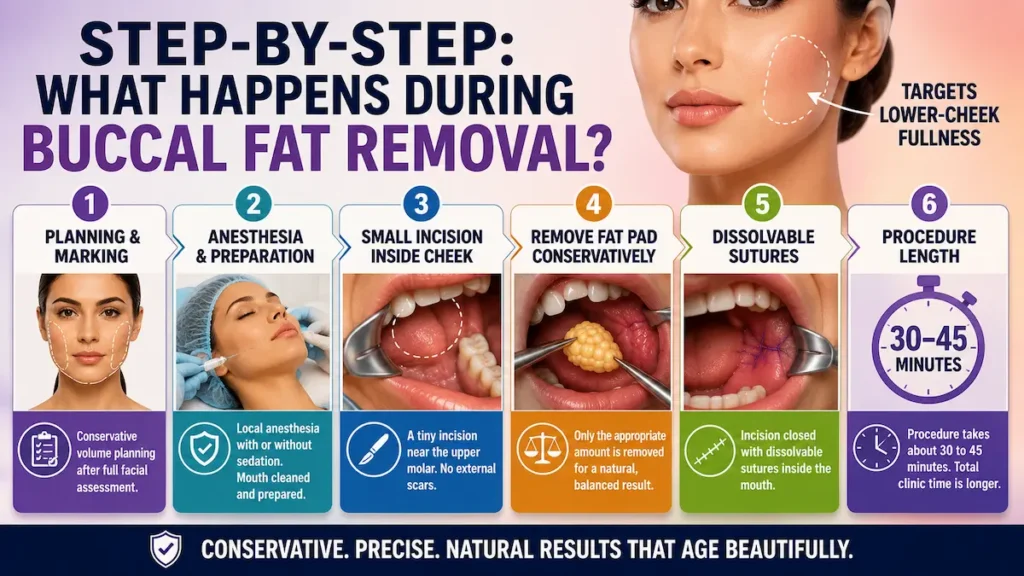
Step-by-Step: What Happens During Buccal Fat Removal?
Buccal fat removal is technically short, but it still requires careful judgement. The key surgical decision is not where to make the incision; it is how much fat to remove.
Pre-Operative Marking and Conservative Volume Planning
Before surgery, we review your facial proportions in front view, three-quarter view, and profile. We look at lower-cheek fullness, cheekbone support, chin projection, jawline structure, and age-related volume patterns.
We may mark the cheek region externally to guide symmetry, even though the incision is made inside the mouth. The goal is a balanced reduction, not a hollowed-out cheek.
This is also when we confirm whether partial removal is appropriate. In some cases, we recommend no surgery or another facial contouring option instead.
Anesthesia
The inside of the cheek is numbed with local anesthesia. If sedation is part of your plan, it is administered and monitored before the surgical step begins.
You are positioned comfortably, and the mouth is cleaned with an antiseptic protocol. We keep the field controlled because oral incisions require careful infection prevention.
Small Incision Inside the Cheek
The buccal fat removal incision site is inside the mouth, usually near the upper molar area. This intraoral approach avoids an external facial scar.
The incision is small. It gives the surgeon access to the buccal fat pad without cutting through visible cheek skin.
Because the incision is inside the mouth, aftercare focuses heavily on oral hygiene. Mouth rinses, soft foods, and avoiding trauma to the cheek are part of early healing.
Identifying and Conservatively Removing the Buccal Fat Pad
The surgeon gently exposes the buccal fat pad. This fat should never be pulled aggressively or removed blindly.
Only the appropriate amount is reduced. In many patients, a partial reduction is safer and more natural than full extraction.
We assess both sides carefully for symmetry. Faces are naturally asymmetric, so the goal is balanced improvement rather than mathematically identical fat removal.
“The safest buccal fat result is often the one that looks almost too conservative in the operating room. The face continues to slim as swelling resolves, and it will keep aging for decades.”
Dissolvable Sutures Inside the Mouth
After the fat pad is reduced, the incision is closed with dissolvable sutures. These sutures sit inside the mouth, so there is no visible stitch line on the face.
You may feel the sutures with your tongue during early healing. Avoid touching, pulling, or checking them repeatedly.
The incision usually settles gradually as swelling decreases. Your aftercare instructions will explain how to rinse and eat without disturbing the closure.
Procedure Length
Isolated buccal fat removal usually takes about 30 to 45 minutes. The total clinic time is longer because it includes preparation, anesthesia, observation, and discharge checks.
If combined with another procedure, timing changes. A rhinoplasty or chin augmentation combination requires a separate surgical plan and a longer recovery discussion.
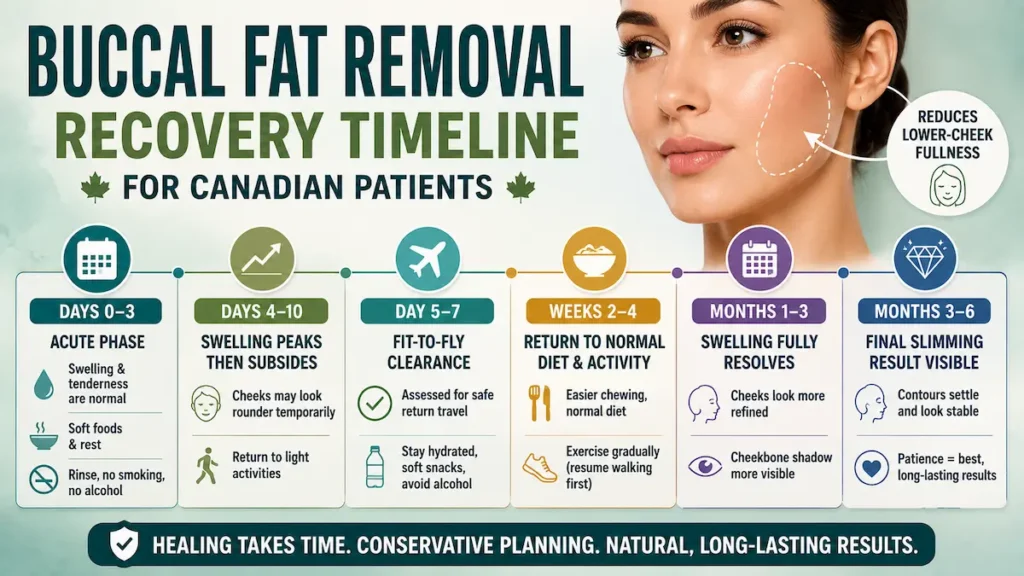
Buccal Fat Removal Recovery: Timeline for Canadian Patients
Buccal fat removal recovery is usually shorter than recovery from larger facial procedures. Swelling is still normal, and the face can look fuller before it looks slimmer.
This temporary fullness can surprise patients. It does not mean the procedure failed.
Days 0–3 — Acute Phase
The first few days focus on swelling control, oral hygiene, and comfort. Your cheeks may feel tight or puffy, and mild soreness inside the mouth is expected.
You will usually follow a soft-food plan. Smooth soups, yogurt, protein shakes, mashed foods, and cool soft meals are easier than chewing firm foods.
We may recommend salt-water rinses or prescribed mouth rinses based on your surgical plan. Do not smoke, vape, or drink alcohol during this early healing window.
Days 4–10 — Swelling Peaks, Then Subsides
Swelling often peaks before it improves. Your cheeks may look rounder during this phase, which can feel frustrating if you expected immediate slimming.
This is normal. The contour usually refines as tissue inflammation settles.
Most patients can resume light daily routines during this stage, but intense exercise should wait. Increased blood pressure can worsen swelling or bruising.
Our HBOT/LLLT Recovery Protocol
We use recovery technologies when appropriate to support tissue healing and reduce inflammation. Hyperbaric Oxygen Therapy, or HBOT, increases oxygen delivery to healing tissues, while Low-Level Laser Therapy, or LLLT, supports cellular repair.
For international patients, recovery speed is not only about appearance. It also affects comfort during hotel recovery and the return flight to Canada.
You can read more about these systems on our technology and standards page. We also link patients to our deeper guide on Hyperbaric Oxygen Therapy benefits when they want the science behind the protocol.
Day 5–7 — Fit-to-Fly Clearance for Canadian Return Travel
Many buccal fat removal patients can be assessed for return travel within about five to seven days, depending on swelling, oral healing, and whether another procedure was performed.
Fit-to-fly clearance is individualized. We check that you are healing normally, eating and drinking adequately, and not showing signs of infection or excessive swelling.
For Canadian patients flying to Toronto, Vancouver, Montreal, or Calgary, comfort planning matters. Keep hydration high, pack soft snacks, and avoid alcohol during the flight.
For broader travel guidance, our flight safety after surgery guide explains what to consider before a long-haul return.
Weeks 2–4 — Return to Normal Diet and Activity
By weeks two to four, most patients return to a more normal diet and routine. Chewing becomes easier, and the inside-mouth incision feels less noticeable.
Exercise usually resumes gradually. Start with walking, then return to more intense training only after your surgeon clears you.
Your face may still look puffy in photos. That is expected. Buccal fat removal results do not appear all at once.
Month 1–3 — Swelling Fully Resolves
Most swelling improves during the first one to three months. The lower cheeks begin to look more refined, and the cheekbone shadow may become more visible.
This is when many patients start to see why conservative planning matters. A subtle change usually ages better than an overly aggressive hollow.
Month 3–6 — Final Slimming Result Visible
The final result often becomes clearer between three and six months. By this stage, the cheeks have settled, the oral incision has healed, and the contour looks more stable.
If the result looks too subtle early on, patience matters. Removing more fat before swelling resolves can increase the risk of long-term hollowing.
Will Buccal Fat Removal Age You? Safety, Risks & Regret
This is the question every patient should ask before choosing buccal fat removal. The concern is not only how the result looks at three months. It is how your face may look after years of natural volume loss.
Buccal fat removal can be safe and effective for the right candidate. It can also be the wrong procedure for a patient whose face is already slim, narrow, or naturally hollow.
Common Short-Term Side Effects
Most short-term effects are related to swelling, oral healing, and temporary cheek soreness. The cheeks may feel tight, puffy, or tender during the first week.
Common early effects include:
- Swelling inside and outside the cheeks
- Mild bruising or facial tenderness
- Tightness when opening the mouth widely
- Temporary numbness or altered sensation near the cheek
- Mild asymmetry while swelling resolves
- Irritation around the intraoral sutures
These effects usually improve gradually. Persistent worsening pain, fever, drainage, severe one-sided swelling, or a foul taste in the mouth should be reported quickly.
The Aging Reality — Why Faces Lose Fat Over Time
Facial aging naturally includes fat loss. This is why a fuller face in your 20s can become leaner in your 40s and 50s without surgery.
Removing buccal fat reduces one of the deeper facial fat compartments. If the face later loses more fat through aging, weight loss, or hormonal change, the lower cheek can look more hollow than expected.
This does not mean buccal fat removal always ages the face. It means the procedure has to be reserved for faces with enough natural lower-cheek fullness to age well after partial reduction.
“The question is not only how your face looks today. With buccal fat removal, we also ask how the same face may age 10 or 15 years from now.”
Hollow or Gaunt Appearance Risk
The main long-term aesthetic risk is a hollow or gaunt appearance. This is more likely when too much fat is removed or when the patient was not a good candidate in the first place.
A hollow result may show as a deep shadow under the cheekbone, a drawn look around the mouth, or a face that looks older than the patient feels. Harsh lighting can make this more noticeable.
We reduce this risk through conservative planning. We would rather under-treat slightly than remove volume your face may need later.
Irreversibility — Why Buccal Fat Does Not Grow Back
Buccal fat removal is effectively permanent. The removed fat pad does not simply grow back like temporary swelling or injectable filler.
This permanence is the reason buccal fat removal should not be used as a quick response to a trend. If your goal changes, your face ages, or your weight changes, you cannot reverse the procedure by waiting.
Some correction options exist, but they are not the same as undoing the original surgery. Prevention is always better than repair.
“I Regret Buccal Fat Removal” — Why It Happens
Regret usually comes from one of four issues: poor candidacy, over-removal, unrealistic expectations, or natural aging that was not considered before surgery.
A patient may regret buccal fat removal if they expected sculpted cheekbones but instead see cheek hollowing. Another patient may feel the result looked good at first but became too sharp after weight loss or age-related facial deflation.
This is why we discuss long-term facial balance during consultation. A responsible surgeon should be willing to say that the procedure may not be right for you.
Over-Removal and Asymmetry
Over-removal can make the cheeks look sunken. Asymmetry can occur if one side heals differently, if the fat pads were naturally different sizes, or if too much tissue was removed from one side.
Minor asymmetry is normal in every face. Surgical asymmetry becomes a concern when the difference is obvious after swelling has resolved.
Our approach is measured and conservative. We do not chase maximum hollowing, and we do not treat both sides as if natural anatomy is perfectly identical.
Can Fat Transfer Correct Over-Removed Buccal Fat?
In selected patients, fat transfer to face can improve hollowing after overly aggressive buccal fat removal. Fat is taken from another area of the body, purified, and placed into areas that need volume restoration.
This can soften a hollow cheek and restore a healthier transition between the cheekbone and lower face. It is not a perfect reversal.
Fat survival varies, and correction may require staged planning. This is why our first priority is choosing the right patient and removing only what is appropriate.
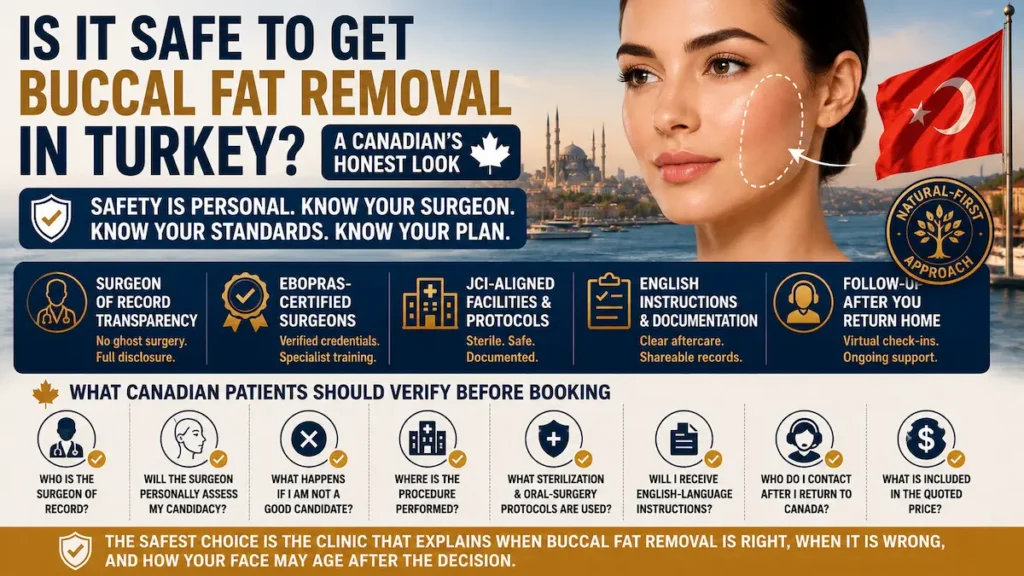
Is It Safe to Get Buccal Fat Removal in Turkey? A Canadian’s Honest Look
Turkey is one of the world’s most active destinations for aesthetic surgery. That does not mean every clinic offers the same safety standards, surgeon involvement, or aftercare.
For Canadian patients, the safer question is not “Turkey or Canada?” It is “Which surgeon, which facility, which standards, and what follow-up plan?”
The Turkey Cosmetic Surgery Reality — How AKM Differs
Some international clinics advertise buccal fat removal as if it were a simple beauty add-on. That framing is risky.
At AKM Clinic, we treat buccal fat removal as a facial surgery decision with long-term consequences. Our Natural-First approach means we consider your future facial aging, not only your current cheek fullness.
We also operate within a structured clinical pathway. That includes pre-operative assessment, surgeon evaluation, sterile protocols, documented aftercare, and long-term virtual follow-up once you return to Canada.
For a broader safety framework, our guide on whether plastic surgery in Turkey is safe explains the questions Canadian patients should ask before booking any procedure abroad.
Why Conservative Candidacy Matters More Than Marketing
The safest buccal fat removal is often the one that is not performed. That may sound strange, but it is central to ethical facial surgery.
If your face is already slim, if your cheek hollows are visible, or if your goal is based on a temporary online trend, surgery may not be the right choice. A good surgeon should tell you that clearly.
We do not believe every patient who asks for buccal fat removal should receive it. Candidacy protects the result.
“A surgeon’s judgement is measured not only by the operations they perform, but by the operations they decline.”
Ghost Surgery in Turkey — How to Avoid It
“Ghost surgery” means the patient believes one surgeon is operating, but another person performs part or all of the procedure. Canadian patients are right to ask about this.
Before booking, you should know who is evaluating you, who is operating, and who is responsible for your aftercare. These details should be documented before you travel.
We support surgeon-of-record transparency. You can also read our dedicated guide to ghost surgery in Turkey if this is one of your main concerns.
EBOPRAS-Certified Surgeon Verification
Canadian patients are used to checking credentials through provincial colleges and RCPSC-related pathways. International surgery requires a different verification framework.
In Europe and Turkey, patients should look for structured board certification, surgical specialization, hospital accreditation, and documented experience in the relevant procedure area.
Our credentialing content explains how to compare international qualifications with Canadian expectations. The plastic surgeon board certification guide is a useful starting point before any elective surgery abroad.
JCI-Aligned Standards and Documentation
Buccal fat removal involves an incision inside the mouth, so infection prevention matters. A short procedure still requires sterile technique, appropriate instrumentation, and clear aftercare.
We follow documented safety protocols, provide instructions in English, and prepare patients for recovery before they leave Istanbul. Your medical records and discharge information should be clear enough to share with a Canadian physician if needed.
Documentation is not a formality. It is part of safe international care.
Travel Insurance, Follow-Up, and the Canadian System
Most Canadian provincial health plans do not cover elective cosmetic surgery abroad. Travel insurance may also exclude complications from planned cosmetic procedures.
That does not mean you cannot travel safely. It means you need to understand the limits before you book. The Government of Canada’s guidance on medical care outside Canada is a useful reference for understanding records, insurance, and follow-up responsibilities before travelling.
We recommend that Canadian patients review insurance wording carefully, speak with their family physician when appropriate, and plan for remote follow-up. Our team provides virtual check-ins and guidance after you return home.
What Canadian Patients Should Verify Before Booking
Before choosing any clinic, ask direct questions. A trustworthy clinic should answer clearly.
- Who is the surgeon of record?
- Will the surgeon personally assess my candidacy?
- What happens if I am not a good candidate?
- Where is the procedure performed?
- What sterilization and oral-surgery protocols are used?
- Will I receive English-language discharge instructions?
- Who do I contact after I return to Canada?
- What is included in the quoted price?
The safest choice is not the clinic that says yes fastest. It is the clinic that explains when buccal fat removal is right, when it is wrong, and how your face may age after the decision.
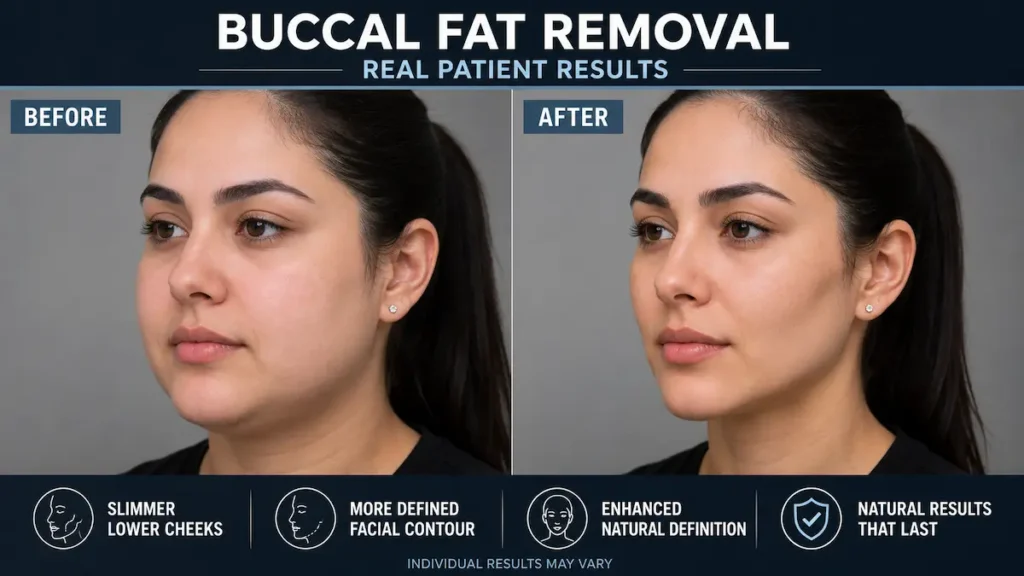
Buccal Fat Removal Before After: Realistic Expectations & Results
Buccal fat removal results should look like a subtle refinement of your natural face, not a completely different identity. The best outcome is usually the one that other people cannot immediately identify as surgery.
We aim for a cleaner lower-cheek contour while preserving enough softness for long-term facial balance. That is the Natural-First approach.
Buccal Fat Removal Before and After — What Changes
Before surgery, suitable patients often have persistent lower-cheek fullness that makes the face look rounder than they prefer. After swelling settles, the lower cheek may appear slimmer, and the cheekbone shadow may look more defined.
The change is usually most visible in three-quarter view. In front view, the face may look less rounded through the lower cheek area.
Results continue to refine as swelling decreases. Early photos can be misleading because the cheeks may look puffy before they look slimmer.
What Does NOT Change
Buccal fat removal does not change your cheekbones, jawbone, chin, or nose. It also does not tighten skin or lift facial tissue.
If your main concern is weak chin projection, jowls, skin laxity, or a double chin, another procedure may be more appropriate. Removing buccal fat from the wrong face can create imbalance instead of harmony.
This is why we assess the full face before making a recommendation. A single procedure should not be forced to solve every facial-contouring concern.
How Long Until Results Settle
Most patients see early refinement after a few weeks, but the final result usually takes several months. Swelling can hide the contour at first.
By three months, the lower cheek often looks more defined. By six months, the result is usually more stable.
Patience matters. Judging too early can lead to unnecessary worry or pressure for additional treatment.
Natural-First Contouring
Our philosophy is rejuvenation, not alteration. For buccal fat removal, that means we preserve facial softness and avoid an exaggerated hollow.
A natural result should still move well when you smile, speak, and laugh. It should not create a sharp shadow that makes the face look tired.
We plan for your face today and your face in the future. That long-term view is especially important for a procedure that removes volume permanently.
When Results Can Look Too Hollow
A hollow result can happen when too much fat is removed, when the patient was too slim to begin with, or when later weight loss and aging reduce additional facial volume.
This is why we are cautious with narrow faces, long faces, and patients who already show cheek shadows. A dramatic result is not always a better result.
If you are drawn to very hollow celebrity-style images, we will discuss how those looks may age. A surgical decision should outlast a photo trend.
Before & After Gallery
Before-and-after photos can help you understand the range of possible changes, but they should be interpreted carefully. Lighting, facial expression, camera angle, and swelling stage can all change how the result appears.
You can review relevant examples through our before and after gallery. During consultation, we focus on cases that resemble your face shape, not random dramatic examples.
Buccal Fat Removal Cost 2026: Turkey vs Canada
Canadian patients researching buccal fat removal cost often compare Toronto, Vancouver, Montreal, and Calgary private clinic pricing before considering Istanbul. Domestic quotes vary widely, and many Canadian clinics price the surgeon fee, facility fee, anesthesia, and follow-up separately.
At AKM Clinic, Traditional Intraoral Extraction and Partial Buccal Fat Removal are listed at CAD $3,000. Buccal Fat Repositioning is listed at CAD $2,050. These prices reflect AKM Clinic’s published treatment-technique pricing and allow Canadian patients to compare in CAD first.
By comparison, private buccal fat removal in major Canadian cities often falls in the CAD $5,000–$7,000 range once facility and anesthesia costs are included. The gap can be meaningful, but price should never be the reason to remove facial volume. A low quote cannot make a poor candidate safer.
For a detailed fee breakdown, see our buccal fat removal cost guide for Canadian patients. Patients looking for a bundled care pathway can also review our buccal fat removal all-inclusive package.
Canadian-dollar pricing shown for planning clarity; your coordinator will confirm the final payment details before booking.
| Location | Typical Pricing Context | What Patients Should Check |
|---|---|---|
| Toronto / GTA | Often CAD $5,000–$7,000 all-in depending on clinic billing | Whether facility, anesthesia, follow-up, and medications are included |
| Vancouver | Often similar to Toronto private aesthetic clinic pricing | Whether the quote is surgical-fee only or complete |
| Montreal / Calgary | Variable private pricing depending on surgeon and facility | Whether revision support and medical records are provided |
| AKM Clinic Istanbul | CAD $3,000 for Traditional or Partial Buccal Fat Removal | Conservative candidacy assessment, surgeon involvement, aftercare, and travel plan |
How to Find the Best Buccal Fat Removal Surgeon in Turkey: A Canadian Patient’s Checklist
Many Canadian patients begin by searching for the best buccal fat removal surgeon near them, then compare Turkey once they see the cost and wait-time difference. The best choice is not simply the closest clinic or the fastest booking.
For this procedure, the most important qualification is judgement. A technically simple operation can create a long-term problem if the surgeon removes fat from the wrong face.
EBOPRAS Certification — The European Equivalent to RCPSC
Canadian patients are familiar with the Royal College of Physicians and Surgeons of Canada’s eligibility and exams framework. In Turkey and Europe, EBOPRAS certification provides a structured board-certification pathway for plastic surgery training and standards.
Credential comparison is not about finding an identical system. It is about confirming that your surgeon has formal training, board-level oversight, hospital privileges, and relevant facial-surgery experience.
Our plastic surgeon board certification guide explains how Canadian patients can compare RCPSC, EBOPRAS, and other international credential markers. The Canadian Society of Plastic Surgeons’ guidance on choosing a surgeon is also a useful Canadian reference point for understanding plastic surgery standards and patient education.
| Credential Marker | What It Means | Why It Matters for Canadian Patients |
|---|---|---|
| RCPSC / FRCSC | Canadian specialist certification pathway | Familiar Canadian benchmark for specialist training |
| EBOPRAS | European board-certification framework for plastic surgery | Useful comparison point when evaluating European-trained surgeons |
| JCI-accredited facility | International hospital safety and quality accreditation | Supports infection-control, documentation, and surgical safety standards |
| Surgeon-of-record transparency | Clear confirmation of who evaluates, operates, and follows up | Reduces ghost-surgery risk and improves accountability |
Facial Sub-Specialization and Conservative Philosophy
Buccal fat removal is facial surgery. It should be planned by a surgeon who understands facial aging, volume compartments, cheekbone support, and the difference between fullness and descent.
A conservative philosophy is not a marketing phrase here. It is a safety principle.
Ask the surgeon how they decide how much buccal fat to remove. If the answer sounds like “as much as possible,” that is a warning sign.
A Surgeon Who Will Say No
The right surgeon should be willing to decline buccal fat removal when your face is not suited to it. This is especially true for slim patients, younger patients with delicate facial structure, and anyone with early cheek hollowing.
At AKM Clinic, we may recommend chin augmentation, mid-face support, filler, fat transfer, or no procedure at all. The recommendation depends on your anatomy.
Our broader Natural-First philosophy guides this decision-making process: we prioritize long-term facial balance over trend-driven contouring.
A “yes” should feel thoughtful, not automatic.
Long-Term-Aware Planning
Good buccal fat removal planning looks beyond the first after photo. It considers your family aging pattern, weight stability, facial fat distribution, and how your cheeks may change over time.
This is why we ask for photos from different angles and, when helpful, different stages of your facial fullness. A single selfie is not enough to plan an irreversible procedure.
Long-term planning protects the result. It also protects your future options.
Real Patient Reviews and Before/After Documentation
Reviews matter, but they should be read carefully. Look for comments about communication, honesty, aftercare, and whether the clinic managed expectations clearly.
Before-and-after images are useful when they show patients with a similar face shape to yours. Dramatic images from very different anatomy may not predict your result.
You can review broader patient experiences on our professional plastic surgery reviews page. We encourage patients to focus on trust signals, not only visual impact.
Aftercare Continuity from Istanbul to Canada
International surgery does not end when you board the flight home. You need clear instructions, a contact pathway, and follow-up access once you return to Canada.
Our follow-up programme includes structured virtual check-ins at 1, 3, 6, and 12 months when appropriate. Your patient advocate remains a point of contact for recovery questions.
That continuity is especially important for a procedure where long-term satisfaction depends on both healing and facial aging.
“With buccal fat removal, the most valuable surgical skill is restraint. The surgeon must know when to remove less, and when not to operate at all.”
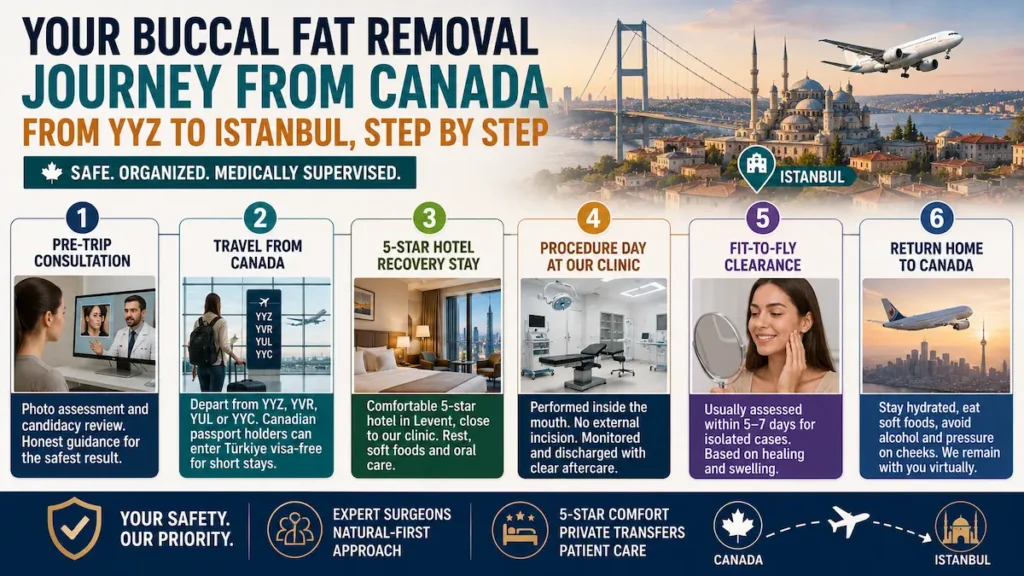
Your Buccal Fat Removal Journey from Canada: From YYZ to Istanbul, Step by Step
Travelling from Canada for buccal fat removal should feel organized, medically supervised, and clearly explained before you book your flight. Because this is a short facial procedure, the travel plan is usually simpler than a facelift or body-contouring surgery.
Simple does not mean casual. You still need honest candidacy screening, clear aftercare, and fit-to-fly planning.
Pre-Trip Consultation
Your process begins with a remote consultation and photo assessment. We review front, three-quarter, and profile images to understand your cheek fullness, chin projection, facial width, and natural volume pattern.
The most important part is the candidacy discussion. We will explain whether buccal fat removal is likely to help, whether another contouring option is safer, or whether no surgery is the best recommendation.
If your face is too slim or already hollow, we will tell you. That honesty protects your long-term result.
Travel Logistics from Canada
Canadian patients usually travel through Toronto Pearson (YYZ), Vancouver (YVR), Montreal-Trudeau (YUL), or Calgary (YYC), depending on route availability and season. Flight schedules change, so patients should confirm current options directly with the airline before booking.
Canadian passport holders can generally enter Türkiye visa-free for short stays. Your passport should be valid well beyond your travel dates, and you should confirm current entry rules before departure.
For a fuller travel overview, our Canadian patient journey guide explains how consultation, arrival, surgery, recovery, and follow-up are coordinated.
5-Star Hotel Recovery Stay in Levent
After arrival, patients recover near our Istanbul clinic in a hotel setting selected for comfort, privacy, and easy access to follow-up. Short-stay buccal fat removal patients usually need less recovery support than larger surgical patients, but location still matters.
You should be close enough for post-operative review, but comfortable enough to rest quietly. Soft foods, hydration, and oral hygiene are the priorities in the first few days.
Our comprehensive care programme can include 5-star hotel accommodation, private transfers, and patient coordination, depending on your confirmed plan.
Procedure Day at Our Istanbul Clinic
On procedure day, we confirm your surgical plan, review consent, and answer final questions. The surgeon reassesses facial balance before proceeding.
The operation is performed through the inside of the mouth, so there is no external facial incision. After the procedure, you are monitored before returning to your hotel with written aftercare instructions.
You can read more about our clinical environment on our Istanbul clinic page.
Fit-to-Fly Clearance and Return Travel
Fit-to-fly timing depends on swelling, oral healing, and whether buccal fat removal was performed alone or combined with another procedure. Many isolated cases can be assessed for travel within about five to seven days.
During the return flight, choose soft foods, avoid alcohol, stay hydrated, and avoid pressing on the cheeks. A neck pillow can help you rest without putting pressure on the surgical area.
If another procedure was combined, the longer recovery timeline controls your travel plan. Rhinoplasty, chin augmentation, or facelift-related surgery can change the fit-to-fly window.
Buccal Fat Removal Surgery Frequently Asked Questions (FAQ):
Will buccal fat removal make me look older as I age?
It can, if you are not a good candidate or if too much fat is removed. Faces naturally lose volume with age, so buccal fat removal should be conservative and reserved for fuller faces that can tolerate lower-cheek volume reduction.
Is buccal fat removal permanent or reversible?
Buccal fat removal is effectively permanent. The removed buccal fat pad does not grow back predictably. Fat transfer may improve hollowing in selected cases, but it is not a simple reversal.
Am I a good candidate, or is my face too thin already?
You may be a good candidate if your lower cheeks are full despite stable body weight. You may be a poor candidate if your face is narrow, angular, hollow, or already slim. We assess this carefully before recommending surgery.
Are there visible scars?
No external scar is usually visible because the incision is made inside the mouth. The internal incision closes with dissolvable sutures and heals inside the cheek.
Does OHIP, MSP, AHCIP, or RAMQ cover buccal fat removal?
No. Canadian provincial health plans generally do not cover cosmetic buccal fat removal. These plans focus on medically necessary care, not elective facial contouring.
How much does buccal fat removal cost in Toronto vs Istanbul?
Toronto private pricing often falls around CAD $5,000–$7,000 when facility and anesthesia fees are included. At AKM Clinic, Traditional Intraoral Extraction and Partial Buccal Fat Removal are listed at CAD $3,000. Canadian-dollar pricing shown for planning clarity; your coordinator will confirm the final payment details before booking.
Does Canadian travel insurance cover complications from elective buccal fat removal in Turkey?
Many Canadian travel insurance policies exclude elective cosmetic surgery and complications related to it. You should review your policy carefully before booking and ask the insurer direct written questions.
To reduce this concern, AKM Clinic provides complimentary complication insurance for all patients. This is separate from standard Canadian travel insurance and is designed to add an extra layer of protection around your surgical care. Your coordinator will explain the coverage terms, limits, and required documentation before you confirm your booking.
What if I regret it or too much was removed?
Regret usually comes from poor candidacy, over-removal, or later facial volume loss. Fat transfer can sometimes soften hollowing, but prevention is safer than correction. This is why we use conservative planning.
How long is recovery?
Early recovery usually takes one to two weeks, with swelling improving gradually. Final contour can take three to six months to settle. If combined with another procedure, the longer recovery timeline applies.
Can men get buccal fat removal?
Yes. Men with persistent lower-cheek fullness may be candidates, especially when the goal is a cleaner cheek-to-jaw transition. We also assess chin projection and jawline structure before recommending it.
Is the viral “snatched” look worth it long-term?
Not for every face. A very hollow look may photograph well for a short period but age poorly. Our approach prioritizes long-term facial balance over trend-based contouring.
Can I combine buccal fat removal with chin augmentation or rhinoplasty?
Yes, in selected patients. Buccal fat removal can be combined with chin augmentation or rhinoplasty when each procedure addresses a separate anatomical issue. We do not recommend combining procedures without a clear clinical reason.
Medical Disclaimer: This page is for educational purposes only and does not replace medical advice from a qualified physician. Buccal fat removal is an elective surgical procedure with risks, limitations, and permanent effects. The American Society of Plastic Surgeons’ cosmetic procedures resources and the ISAPS Find a Surgeon directory provide further patient guidance. These resources do not replace an individualized consultation.