



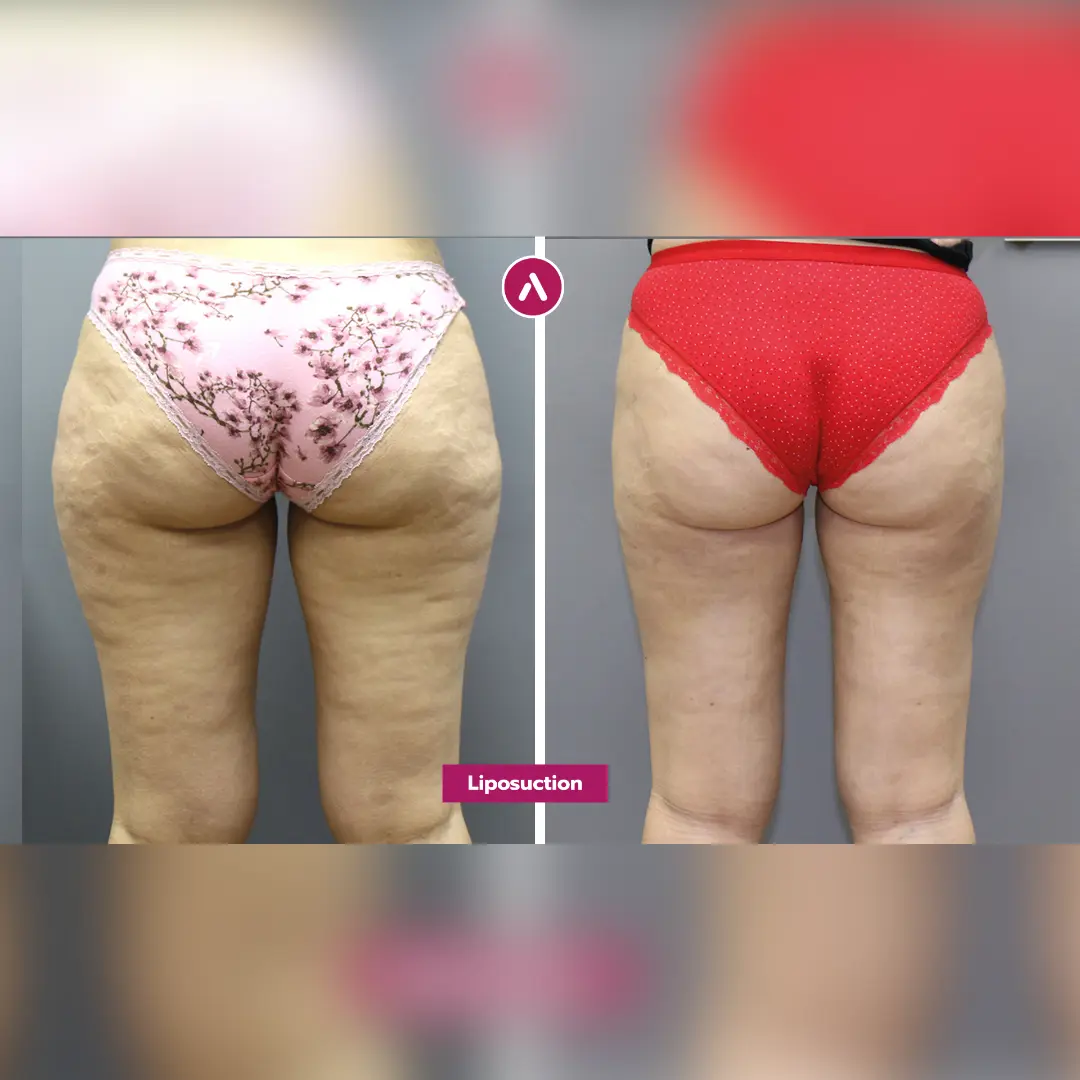
“Skin tightening” can mean very different things depending on who is using the term. In a Canadian medspa, it may refer to topical radiofrequency, laser, HIFU, Morpheus8, or a series of surface treatments. At AKM Clinic, J-Plasma — also branded as Renuvion — refers to a subdermal technology that delivers helium plasma and radiofrequency energy beneath the skin to help contract loose tissue from the inside.
This guide explains what J-Plasma actually does, how it differs from topical RF, laser, and HIFU treatments, and who is a realistic candidate. We also explain when J-Plasma is not enough and an excisional lift, such as an arm lift, thigh lift, neck lift, or 360 body lift, becomes the more honest recommendation.
For Canadian patients travelling from Toronto, Vancouver, Calgary, Montreal, Ottawa, or Edmonton, J-Plasma is most often considered in one of two ways: as a standalone tightening procedure for mild-to-moderate laxity, or as an adjunct to liposuction for better skin retraction after fat removal. Our goal is clarity. You should understand the technology before you decide whether it fits your body, your skin quality, and your recovery plan.
Table of Contents
What Is J-Plasma (Renuvion) Skin Tightening?
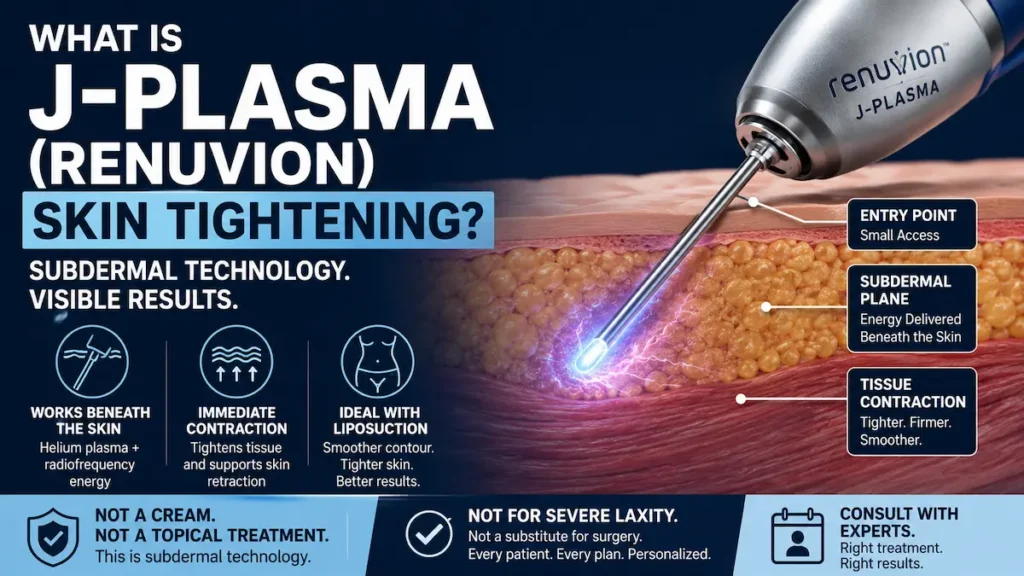
J-Plasma, also known as Renuvion, is a skin-tightening technology that combines helium plasma with radiofrequency energy delivered beneath the skin to contract tissue. It is most often used as an adjunct to liposuction or for the arms, thighs, abdomen, and neck — distinct from topical RF, laser, or HIFU devices.
J-Plasma / Renuvion Defined — Helium Plasma + Radiofrequency
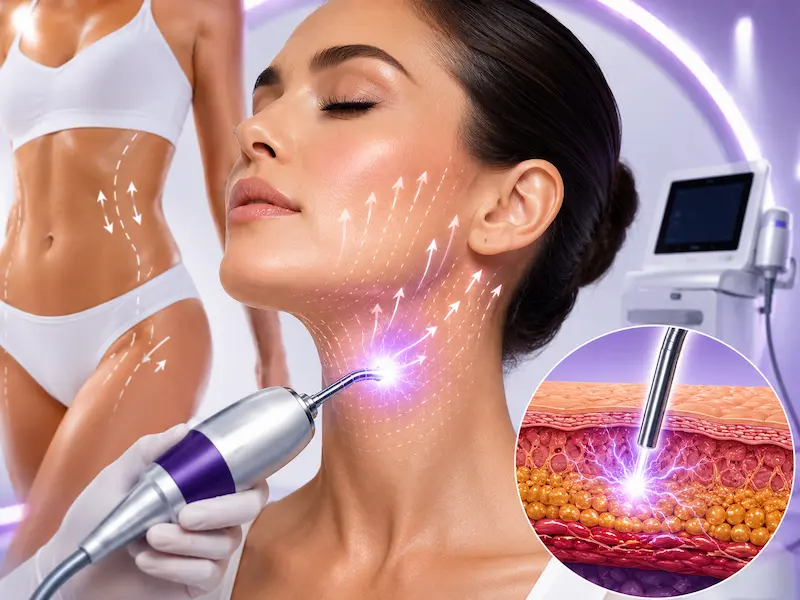
J-Plasma is a minimally invasive energy-assisted skin-tightening procedure. The technology uses helium gas and radiofrequency energy to create a controlled plasma stream under the skin. This controlled energy heats the underside of the skin and the fibrous tissue layer, encouraging immediate tissue contraction and gradual tightening during healing.
The key word is subdermal. J-Plasma is not applied on top of the skin like a facial device. It works beneath the skin through small access points, which allows the energy to reach tissue planes that surface treatments cannot target in the same way.
At AKM Clinic, we use J-Plasma in carefully selected patients with mild-to-moderate skin laxity. It can be used on its own, but its strongest role is often after liposuction, where the goal is not only to remove fat but also to support smoother skin retraction.
Why “J-Plasma” and “Renuvion” Are the Same Technology
Patients often see both terms online and wonder whether they are comparing two different treatments. In most clinical contexts, J-Plasma and Renuvion refer to the same underlying technology. “J-Plasma” is the commonly used procedure name, while “Renuvion” is the branded platform name.
This matters because some clinics use the phrase “skin tightening” very loosely. A topical radiofrequency session, a laser treatment, a cream, and Renuvion J-Plasma do not work the same way. They also do not produce the same level of tissue contraction.
During your consultation, our team assesses whether the technology being discussed is truly appropriate for your skin. We also explain whether your concern is caused mainly by fat, skin laxity, poor skin quality, muscle separation, or a combination of factors.
Subdermal vs Topical Energy — The Key Distinction
Most non-surgical skin-tightening treatments work from the surface inward. They deliver energy through the outer skin or just below it. These options may improve mild texture, early laxity, or collagen quality, but they do not physically remove extra skin and they do not reshape the deeper contour after fat removal.
J-Plasma works differently. The device is passed under the skin through small entry points, delivering helium plasma and radiofrequency energy directly into the subdermal plane. This is why it is often discussed alongside liposuction and body contouring rather than routine facial or body spa treatments.
That does not mean J-Plasma replaces surgery. It occupies the middle ground. It can be more powerful than topical energy treatments, but it is not the right answer for severe hanging skin after major weight loss.
What J-Plasma Is Not
J-Plasma is not a tightening cream, collagen supplement, body facial, or topical medspa series. It is also not a substitute for procedures that remove excess skin.
For example, a patient with mild looseness after liposuction may benefit from J-Plasma. A patient with large folds of hanging skin after massive weight loss may need an excisional procedure, such as an arm lift, thigh lift, or 360 body lift.
This distinction protects patients. We do not present J-Plasma as a universal fix. Our recommendation depends on skin quality, laxity severity, the treatment area, and whether liposuction is being performed at the same time.
Benefits of J-Plasma Skin Tightening
The main benefit of J-Plasma skin tightening is controlled contraction beneath the skin. For the right patient, this can improve the appearance of loose tissue without the longer incision pattern required by a skin-excision surgery. The result is not instant in its final form. Tightening continues as swelling settles and collagen remodelling progresses.
Subdermal Contraction: Tightening From Underneath
J-Plasma targets the layer beneath the skin rather than only treating the surface. This makes it useful for areas where the skin has started to loosen but has not stretched enough to require removal.
Common examples include the lower abdomen after pregnancy or weight fluctuation, the upper arms after moderate weight loss, the inner thighs, and the neck. These are areas where patients often say, “The fat is gone, but the skin still looks loose.”
By delivering energy under the skin, J-Plasma can support visible contraction while preserving a minimally invasive access pattern. That is why we often describe it as a bridge between topical skin tightening and full excisional surgery.
Small Access Points and Minimal Visible Scarring
J-Plasma is performed through small access points, not long incisions. For patients who are not ready for an arm lift scar, thigh lift scar, or neck lift incision, this can be appealing.
Scarring is still possible at entry sites. No procedure is scar-free. The difference is scale: access points are typically much smaller than the incisions required for removing excess skin.
For Canadian patients who work in public-facing roles or want a more discreet recovery, this can be an important advantage. We still discuss scar behaviour, compression garments, and healing expectations before the procedure.
Pairs With Liposuction in One Procedure
J-Plasma is often most valuable when combined with liposuction. Liposuction removes fat, but it does not automatically tighten skin. If the skin has limited elasticity, the treated area may look softer or looser after fat removal.
By adding J-Plasma immediately after liposuction, we can support skin retraction during the same operation. This is especially relevant for the abdomen, flanks, arms, thighs, and neck.
This single-procedure logic matters for Canadians. It can reduce the need to complete liposuction in one setting and then pursue separate skin-tightening sessions later in Toronto or Vancouver. One treatment plan, one recovery window, and one coordinated aftercare pathway are often easier to manage.
Addresses Areas Topical Devices Cannot Reach Effectively
Topical energy devices can be useful for very mild laxity or surface texture. They have limits. They do not work under the skin in the same way J-Plasma does, and they do not have the same role after fat removal.
J-Plasma allows our surgical team to work from inside the tissue plane. This is why the technology is considered a body-contouring adjunct, not a simple spa treatment.
For patients who have tried creams, radiofrequency sessions, or laser tightening without enough change, the distinction becomes practical. The question is not which option sounds more advanced. The question is which layer of tissue needs treatment.
An Option Between Non-Surgical Treatments and Full Excisional Lift
Many patients fall into a grey zone. Their skin is too loose for creams or topical RF to make a meaningful difference, but not loose enough to justify a long incision. J-Plasma may fit this middle category.
This is why candidacy matters so much. A good J-Plasma candidate has enough elasticity for the skin to contract. A poor candidate has heavy folds, severe laxity, or a skin envelope that has stretched beyond what energy-based tightening can correct.
Our consultation process is designed to make that boundary clear. If J-Plasma can help, we explain how. If you would be better served by an excisional lift, we say so directly.
Am I a Good Candidate for J-Plasma?
The best J-Plasma candidates have mild-to-moderate skin laxity, reasonable skin elasticity, and a clear understanding of what energy-based tightening can and cannot do. J-Plasma can help the skin contract, but it cannot remove a large fold of excess skin.
During your virtual assessment, our team reviews photos, weight history, previous surgeries, skin quality, and the specific area you want treated. We are looking for the difference between skin that can retract and skin that needs excision.
Mild-to-Moderate Skin Laxity: The Sweet Spot
J-Plasma is most appropriate when the skin is loose enough to bother you, but not loose enough to hang in folds. This is the middle category many patients struggle to identify on their own.
You may be a good candidate if you notice:
- Soft looseness on the lower abdomen after pregnancy or weight fluctuation
- Mild arm skin laxity without a heavy hanging fold
- Loose inner-thigh skin that is visible but not severe
- Neck laxity that feels early or moderate, rather than advanced
- Skin that looks slightly deflated after fat loss
The strongest candidates still have collagen response and skin elasticity. When we pinch or assess the area, we want to see skin that has some ability to recoil. If the skin has no recoil, energy alone becomes less predictable.
After Liposuction or Weight Loss: Skin Retraction Matters
Many Canadian patients first consider J-Plasma after learning that liposuction removes fat but does not automatically tighten skin. This is an important distinction.
If your skin is already loose before fat removal, liposuction alone may reveal more laxity. J-Plasma can be added immediately after liposuction to support skin retraction during the same recovery period.
This combination is especially relevant for the abdomen, flanks, upper arms, thighs, and neck. It can be useful for patients who want better contouring without committing to a long surgical scar.
Weight-loss patients need a more careful assessment. If you lost a moderate amount of weight and have mild looseness, J-Plasma may help. If you lost a major amount of weight and now have skin folds, an excisional procedure may be the safer and more effective option.
When You Need an Excisional Lift Instead
J-Plasma is not a substitute for removing skin. This is one of the most important points on the page.
If the skin hangs, folds over itself, causes hygiene issues, or creates a heavy roll, energy-based tightening is unlikely to deliver the result you want. In those cases, we may recommend an excisional procedure instead.
Examples include:
- Arm lift for significant upper-arm skin redundancy
- Thigh lift for heavy inner-thigh laxity
- 360 body lift for circumferential loose skin after major weight loss
- Neck lift for advanced neck bands, hanging skin, or deep structural laxity
This is not a disappointing outcome. It is a better match between anatomy and technique. The wrong procedure can waste money, time, and recovery energy.
“J-Plasma is powerful for the right skin envelope, but it is not a magic eraser for severe laxity. If the patient needs skin removal, the honest answer is an excisional lift.”
Skin Quality & Realistic Expectation Framework
Skin quality matters as much as the amount of laxity. Two patients can have the same visible looseness but respond differently because of collagen quality, age, smoking history, sun exposure, genetics, and weight stability.
We evaluate:
- Thickness of the skin
- Stretch marks and dermal damage
- Degree of collagen loss
- Previous liposuction or surgical scarring
- Recent weight changes
- Smoking or nicotine use
J-Plasma results also develop over time. You may see early contraction, but the final appearance matures as swelling settles and collagen remodelling continues. Most patients should think in months, not days.
Disqualifying Factors
J-Plasma may not be appropriate for every patient. We may decline or delay treatment if the safety profile is not acceptable or if the expected result would not justify the procedure.
Common reasons to wait or choose another option include:
- Severe loose skin that requires excision
- Unstable weight or ongoing weight-loss plans
- Poorly controlled diabetes or medical conditions that impair healing
- Active smoking or nicotine use
- Unrealistic expectation of dramatic skin removal without scars
- Pregnancy or plans for near-term pregnancy
- Active infection or inflammation in the treatment area
For Canadian patients travelling internationally, candidacy also includes travel readiness. We consider flight timing, mobility, compression garment use, and access to follow-up once you return home.
| Laxity Level | Best Option | Scar Profile | Best AKM Pathway |
|---|---|---|---|
| Mild skin looseness | J-Plasma alone or topical support, depending on area | Small access points if J-Plasma is used | J-Plasma candidacy assessment |
| Mild-to-moderate laxity after fat removal | J-Plasma with liposuction | Liposuction access points | Liposuction + J-Plasma |
| Moderate loose skin with limited folds | Case-by-case: J-Plasma or limited excision | Depends on procedure | Surgeon review required |
| Severe hanging skin | Excisional lift | Longer planned scar | Arm lift, thigh lift, or 360 body lift |
How J-Plasma Works + How It Compares to Other Skin-Tightening Treatments
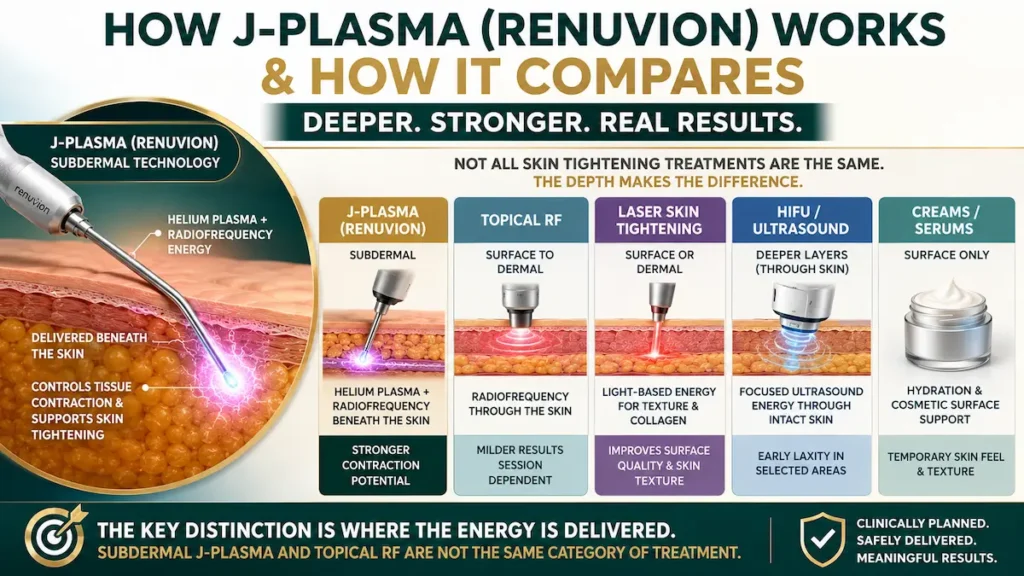
J-Plasma belongs in the energy-based skin-tightening category, but it should not be grouped casually with topical RF, laser skin tightening, HIFU, or creams. The main difference is the treatment plane. J-Plasma works under the skin; most other options work from the surface inward.
This section explains where J-Plasma fits, why the depth matters, and why “best skin tightening treatment” depends on anatomy rather than marketing language.
The Mechanism — Helium Plasma + RF Subdermal Contraction
J-Plasma uses helium gas activated by radiofrequency energy to create a controlled plasma stream. The device is inserted beneath the skin through small access points, where it delivers energy into the subdermal tissue plane.
The goal is controlled contraction. The energy affects the fibrous network under the skin, which can tighten the tissue and support smoother retraction over time.
Helium is used because it allows rapid energy delivery with controlled cooling characteristics. That does not make the procedure risk-free. It means the technology is designed for targeted subdermal use when handled by trained surgical teams.
At AKM Clinic, J-Plasma is not treated as a medspa add-on. It is planned as part of a clinical body-contouring strategy, especially when combined with liposuction or used in anatomically appropriate zones.
J-Plasma vs Topical RF Skin Tightening
RF skin tightening is a broad category. Many devices deliver radiofrequency energy from the surface of the skin. These treatments can help with mild texture changes or early laxity, but they usually require multiple sessions and have limited effect on deeper skin retraction.
J-Plasma also uses radiofrequency energy, but the delivery method is different. It works beneath the skin, not simply through it. That is why comparing J-Plasma to topical RF as if they were the same procedure can mislead patients.
Topical RF may be reasonable for very mild laxity or maintenance. J-Plasma is considered when the skin needs a stronger contraction response, particularly after fat removal.
J-Plasma vs Laser Skin Tightening
Laser skin tightening is usually surface-based or dermal. It may improve skin texture, fine lines, pigmentation, or collagen quality, depending on the device and settings. It is not the same as subdermal contraction after liposuction.
For example, laser resurfacing may improve the surface quality of facial skin. J-Plasma is more often discussed for body areas where loose skin remains after contouring, such as the abdomen, arms, thighs, or neck.
The technologies can both be useful, but they solve different problems. A laser may improve the surface. J-Plasma addresses deeper laxity from underneath.
For a North American patient-education reference on laser and radiofrequency treatments, the American Society of Plastic Surgeons explains that surface-based treatments are used for skin texture, tone, and elasticity. This is different from subdermal J-Plasma planning.
J-Plasma vs HIFU / Ultrasound Treatments
HIFU and ultrasound-based skin tightening devices deliver focused energy through the skin to target deeper tissue layers. They are non-surgical options and can be helpful for selected patients with early laxity.
J-Plasma is minimally invasive rather than non-surgical. It enters the subdermal plane through small access points and delivers energy directly under the skin. This makes the treatment more procedure-based and more recovery-dependent than many HIFU sessions.
Patients comparing HIFU, Thermage, Forma, Morpheus8, Ulthera, and J-Plasma should ask one question first: which tissue layer needs treatment? The right answer depends on laxity severity, body area, and whether fat removal is also planned.
J-Plasma vs Non-Surgical Creams & Skin-Tightening Treatments
Creams, serums, collagen supplements, and body-firming products may improve hydration or surface appearance. They cannot contract subdermal tissue in the way J-Plasma is designed to do.
That does not make every cream useless. It simply means the mechanism is different. A topical product cannot remove extra skin, tighten the fibrous layer under the skin, or compensate for poor skin retraction after liposuction.
Canadian patients often arrive after trying multiple “non surgical skin tightening” options. We review what has been tried, what changed, and whether the remaining concern is truly treatable with energy-based tightening.
Where J-Plasma Sits on the Skin-Tightening Spectrum
Think of J-Plasma as a middle category. It is more involved than topical or non-surgical treatments, but less extensive than skin-excision surgery.
This middle position is why patient selection matters so much. J-Plasma can be an excellent match for the right anatomy and a poor match for the wrong one.
| Modality | Depth | Mechanism | Best For | AKM Position |
|---|---|---|---|---|
| J-Plasma / Renuvion | Subdermal | Helium plasma + radiofrequency energy beneath the skin | Mild-to-moderate laxity, especially after liposuction | Offered for suitable candidates |
| Topical RF | Surface-to-dermal | Radiofrequency delivered through the skin | Very mild laxity, maintenance, texture support | Compared honestly; not equivalent to J-Plasma |
| Laser skin tightening | Surface or dermal, depending on device | Light-based energy for texture, collagen, or resurfacing | Surface quality, fine lines, selected mild laxity | Useful for different indications |
| HIFU / Ultrasound | Non-surgical focused energy | Ultrasound energy through intact skin | Early laxity in selected areas | Not the same as subdermal J-Plasma |
| Creams / Serums | Surface | Hydration or cosmetic surface support | Temporary skin feel and texture | Not a procedural substitute |
| Category | Access | Reach | Result Strength | Recovery | Suitability |
|---|---|---|---|---|---|
| Subdermal J-Plasma | Small access points under the skin | Direct subdermal tissue plane | Stronger contraction potential in suitable skin | Swelling, compression, activity limits | Best for mild-to-moderate laxity and lipo-adjunct cases |
| Topical energy | No surgical entry point | Surface-to-deeper layers, depending on device | Usually milder and session-dependent | Often lighter, but repeated sessions may be needed | Best for early laxity or maintenance |
“The key distinction is not whether a device sounds advanced. The key distinction is where the energy is delivered. Subdermal J-Plasma and topical RF are not the same category of treatment.”
Where J-Plasma Is Used: Body Areas + Liposuction Synergy
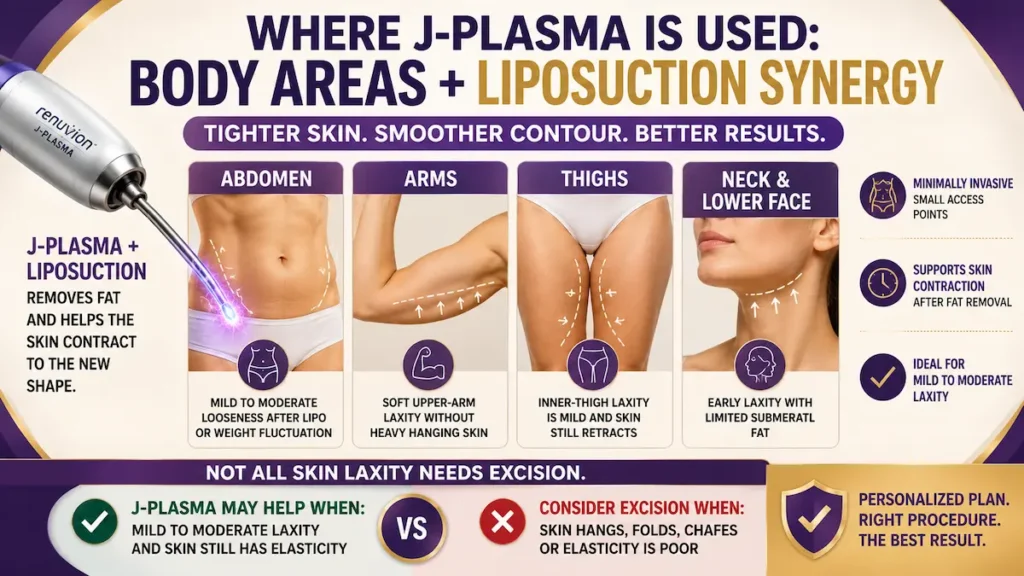
J-Plasma is most useful in areas where loose skin is mild-to-moderate and the tissue still has enough elasticity to contract. It is often used on the abdomen, arms, thighs, and neck. It may also be combined with liposuction when fat removal alone would leave the skin looking too soft.
This is why J-Plasma sits naturally beside body contouring. It does not replace liposuction, an arm lift, a thigh lift, or a neck lift. It supports the skin when the surgical goal is contouring without unnecessary excision.
J-Plasma + Liposuction / Lipo 360
J-Plasma liposuction is one of the strongest use cases for this technology. Liposuction removes fat through small cannula access points. J-Plasma can then be used through similar access points to encourage the skin to contract over the newly shaped contour.
This matters because fat removal and skin tightening are different problems. A patient may have stubborn fat around the abdomen or flanks, but also mild skin looseness. Removing the fat alone can improve shape, yet leave the skin less firm than expected.
Adding J-Plasma during liposuction in Turkey can help address that second issue. For some patients, this pairing creates a smoother result than liposuction alone.
Lipo 360 with J-Plasma is especially relevant for the waist, lower abdomen, upper abdomen, flanks, and lower back. It can support circumferential retraction when skin quality is still within the treatable range.
“Liposuction removes the volume. J-Plasma helps the skin respond to the new shape. The combination is strongest when the skin is loose but still capable of contraction.”
Abdomen / Stomach
The abdomen is one of the most common areas Canadian patients ask about. Pregnancy, weight fluctuation, aging, and previous liposuction can all leave the lower stomach looking soft or crepey.
J-Plasma may help when the abdomen has mild-to-moderate laxity without heavy overhanging skin. It can be used after abdominal liposuction or as part of a broader contouring plan.
It is not a tummy tuck substitute. If you have loose skin that folds over the lower abdomen, muscle separation, or a significant apron of skin, an excisional procedure may be more appropriate. In post-weight-loss cases, a 360 body lift may be the better pathway.
Our assessment separates three issues:
- Fat volume that may respond to liposuction
- Skin laxity that may respond to J-Plasma
- Excess skin or muscle separation that requires surgery beyond energy tightening
Arms
Renuvion arms treatment may be appropriate for early upper-arm laxity. This usually means the skin feels soft or loose, but it does not hang in a heavy fold.
For patients who are worried about a visible arm lift scar, J-Plasma can be worth discussing. It uses small access points rather than a long incision along the upper arm.
The trade-off is power. J-Plasma can contract suitable skin, but it cannot remove a true “bat wing” fold. When upper-arm skin hangs significantly, an arm lift provides a more reliable correction because it removes the excess skin directly.
We are careful with this distinction. A scar-limited procedure is only worthwhile if it can produce a meaningful change. If the anatomy needs excision, J-Plasma alone may under-treat the problem.
Thighs
The inner thighs are another common area for mild laxity. Patients may notice soft, wrinkled, or loose skin after weight loss or liposuction. In selected cases, J-Plasma can help the tissue retract without the incision pattern of a thigh lift.
Thighs require careful assessment because the skin can be thin and mobile. The inner thigh also has friction, swelling, and garment considerations during recovery.
J-Plasma may be reasonable when laxity is mild and the goal is tightening after fat reduction. A thigh lift becomes more appropriate when the inner thigh has hanging folds, significant vertical laxity, or rubbing skin that causes discomfort.
For Canadian patients planning a return flight, thigh procedures also require mobility planning. Walking, compression, hydration, and DVT-risk reduction must be discussed before travel.
Neck & Lower Face
J-Plasma can be used in selected neck cases, especially when laxity is mild-to-moderate and the patient wants a minimally invasive option. Renuvion neck before and after results depend heavily on skin quality, age, platysma bands, and whether fat is present under the chin.
When the main issue is small-volume submental fat with early laxity, J-Plasma may be paired with neck liposuction. When the issue is deeper neck structure, heavy bands, or hanging skin, a neck lift is usually more appropriate.
The neck is unforgiving. A mild problem can respond well to the right tool, but advanced neck aging needs a structural solution. We do not recommend J-Plasma for neck cases where it would create an underwhelming or temporary-looking change.
When the Area Needs Excision Instead
J-Plasma should not be used to avoid an excisional surgery when excision is clearly needed. That approach usually creates frustration. The patient goes through a procedure and recovery, but the skin fold remains.
Excision is often the better choice when:
- Skin hangs in a fold rather than appearing mildly loose
- The area causes chafing, hygiene problems, or clothing discomfort
- There is major post-weight-loss skin redundancy
- The patient expects a dramatic lifting effect
- Skin elasticity is poor and recoil is minimal
In these cases, energy cannot replace skin removal. The more honest pathway may be an arm lift, thigh lift, neck lift, tummy tuck, or 360 body lift.
| Area | J-Plasma May Help When | Consider Excision When | Relevant AKM Page |
|---|---|---|---|
| Abdomen | Mild looseness after lipo or weight fluctuation | Skin folds, apron, or muscle separation are present | 360 Body Lift |
| Arms | Soft upper-arm laxity without heavy hanging skin | True bat-wing fold or major skin redundancy | Arm Lift |
| Thighs | Inner-thigh laxity is mild and skin still retracts | Skin hangs, rubs, or folds vertically | Thigh Lift |
| Neck | Early laxity with limited submental fat | Platysma bands, hanging skin, or deep neck laxity are present | Neck Lift |
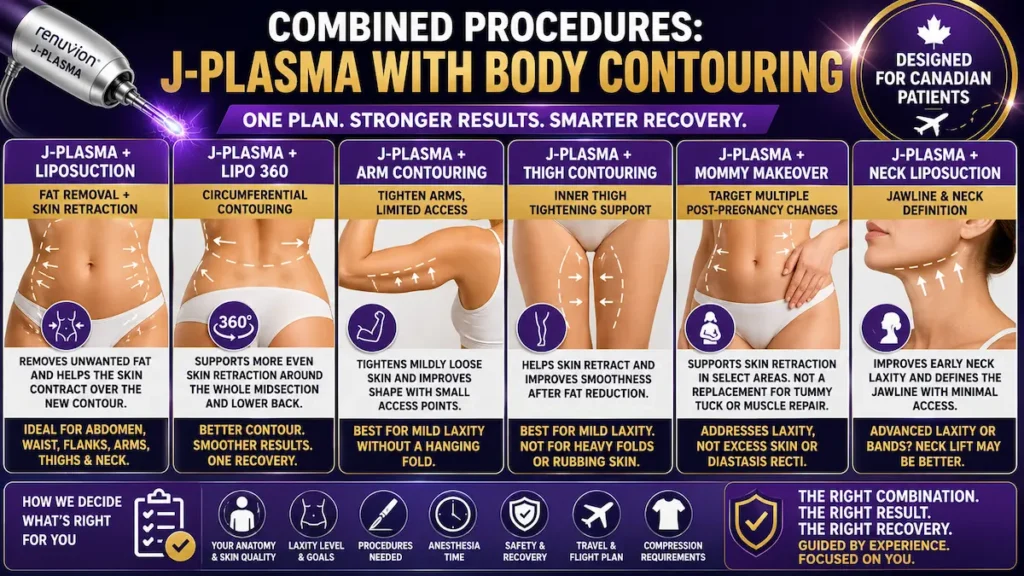
Combined Procedures: J-Plasma With Body Contouring
J-Plasma is often most valuable when it is planned with another body-contouring procedure. The technology supports skin retraction, while the primary procedure addresses fat, skin, or structure.
This is why we rarely discuss J-Plasma in isolation. We ask what the body actually needs: fat removal, skin tightening, skin excision, muscle repair, or a combination of these.
J-Plasma + Liposuction / Lipo 360
J-Plasma with liposuction is the most common combination. Liposuction removes unwanted fat, while J-Plasma helps the skin contract over the new contour.
This pairing may be useful for the abdomen, waist, flanks, arms, thighs, and neck. It is especially relevant when the skin is not tight enough to retract perfectly on its own, but not loose enough to require excision.
For Lipo 360 patients, J-Plasma can support more even circumferential skin retraction across the abdomen, waist, and lower back. It does not replace careful liposuction technique. It supports the final skin response.
Canadian patients often appreciate the efficiency of this combined approach. Instead of paying for liposuction in one setting and then exploring separate skin-tightening sessions later, both concerns can be planned within one clinical pathway.
J-Plasma + Arm or Thigh Contouring
Arms and thighs sit in a difficult middle zone. Many patients want tightening but worry about visible scars from an arm lift or thigh lift.
J-Plasma may be appropriate when the skin is mildly loose and still has enough elasticity to contract. It may be paired with liposuction when fat and laxity are both present.
When upper-arm skin hangs in a true fold, an arm lift is usually more predictable. When inner-thigh skin hangs, rubs, or creates significant vertical laxity, a thigh lift may be the better option.
We use J-Plasma only when it can reasonably match the patient’s anatomy. If a scar-based procedure is more honest, we explain that during consultation.
J-Plasma + Mommy Makeover
Some patients consider J-Plasma after pregnancy because the abdomen, waist, arms, or thighs feel softer than before. It may be useful when mild laxity remains after fat removal or weight change.
In a mommy makeover plan, J-Plasma can sometimes support skin retraction in selected areas. It is not a replacement for tummy tuck skin removal or muscle repair when those are needed.
This distinction matters. Pregnancy can create fat change, skin laxity, stretch marks, and diastasis recti. J-Plasma addresses only the skin-tightening component in suitable tissue.
J-Plasma + Neck Lift or Neck Liposuction
J-Plasma can be considered for selected neck cases, especially when early laxity is paired with mild submental fat. In that setting, neck liposuction and J-Plasma may improve definition with a smaller access pattern.
Advanced neck aging is different. If the patient has strong platysma bands, hanging skin, deep neck fullness, or structural laxity, a neck lift may offer a more reliable correction.
The neck needs careful evaluation. A small improvement can be meaningful in the right patient, but under-treating advanced neck laxity usually leads to disappointment.
How We Decide Whether to Combine Procedures
We do not combine procedures simply because it is possible. We combine them when the combination improves safety, efficiency, or result quality.
During planning, we consider:
- How many areas are being treated
- Whether liposuction is needed
- Whether skin excision is more appropriate
- Total anesthesia time
- Recovery burden
- Flight timing back to Canada
- Compression garment requirements
- Your ability to move comfortably after surgery
The best plan is not always the largest plan. It is the plan that matches your anatomy and allows a safe recovery.
| Combination | Main Goal | Best Candidate | When We Choose Another Path |
|---|---|---|---|
| J-Plasma + liposuction | Fat removal plus skin retraction | Mild-to-moderate laxity after fat reduction | Severe laxity or poor skin quality |
| J-Plasma + Lipo 360 | Circumferential contouring with skin support | Waist, abdomen, flank, and lower-back contouring candidates | Major post-weight-loss skin folds |
| J-Plasma + arm contouring | Upper-arm tightening with limited access points | Mild arm laxity without a hanging fold | True bat-wing skin requiring arm lift |
| J-Plasma + thigh contouring | Inner-thigh tightening support | Mild thigh laxity after fat reduction | Heavy thigh folds or rubbing skin |
| J-Plasma + neck liposuction | Jawline and neck refinement in selected patients | Early neck laxity with limited submental fat | Platysma bands or hanging neck skin |
Anesthesia for J-Plasma: Local, Sedation, or General
J-Plasma anesthesia depends on the treatment area, whether liposuction is being performed, and how many zones are treated in one session. A small standalone area may be suitable for local anesthesia with sedation. Larger body-contouring combinations usually require deeper anesthesia planning.
For Canadians travelling internationally, anesthesia planning is part of safety planning. We assess your medical history, medications, BMI, smoking status, travel timing, and procedure combination before recommending an anesthesia pathway.
Local Anesthesia or Sedation for Standalone J-Plasma
Small standalone J-Plasma cases may be performed with local anesthesia and sedation. This can be appropriate when the treatment area is limited and the patient does not require extensive fat removal.
The goal is comfort without unnecessary anesthesia exposure. Local anesthetic numbs the treatment area, while sedation can reduce anxiety and help the patient remain comfortable during the procedure.
This option is not chosen simply because it sounds lighter. It must match the area, duration, patient anxiety level, and safety profile.
General Anesthesia When Combined With Liposuction or Larger Areas
When J-Plasma is combined with larger-volume liposuction, Lipo 360, multiple body areas, or more complex contouring, general anesthesia may be the safer and more controlled option. It allows the surgical team to work evenly and efficiently across larger treatment zones.
This is common when J-Plasma is part of a broader body-contouring plan. For example, an abdomen-and-flank liposuction case with J-Plasma is different from a small standalone neck tightening case.
Our recommendation is based on clinical control, not marketing preference. The right anesthesia plan should support safety, precise treatment, and a manageable recovery.
Pre-Anesthesia Assessment for Canadian Patients
Before surgery, we complete a medical review and pre-operative testing. We ask about current medications, allergies, previous anesthesia reactions, heart or lung conditions, clotting history, diabetes, nicotine use, and recent illness.
Canadian patients should also speak with their family physician or relevant specialist before travelling if they have a significant medical condition. This is especially important for patients with cardiovascular disease, sleep apnea, clotting history, uncontrolled hypertension, or diabetes.
Our Istanbul team reviews your file before the procedure. If the anesthesia risk is not appropriate for elective treatment, we will delay or decline surgery.
Comfort, Monitoring, and Recovery Planning
During the procedure, monitoring depends on the anesthesia type. Sedation and general anesthesia both require trained clinical oversight, vital-sign monitoring, and a recovery plan that matches the procedure.
After J-Plasma, most patients wear compression garments and follow activity restrictions. If liposuction is performed at the same time, swelling, drainage, bruising, and garment use may be more significant.
For patients returning to Canada, we also plan around flight timing. You should be mobile, hydrated, and medically cleared before travelling long-haul.
| Anesthesia Type | Typical Use | Best For | Recovery Consideration |
|---|---|---|---|
| Local anesthesia | Very limited treatment areas | Small standalone cases | Less systemic recovery, but not suitable for all areas |
| Local + sedation | Standalone or moderate cases | Patients needing comfort support without full general anesthesia | Requires monitoring and post-sedation recovery time |
| General anesthesia | Larger areas or J-Plasma with liposuction | Lipo 360, multiple zones, larger body-contouring plans | More structured recovery and medical clearance before flying |
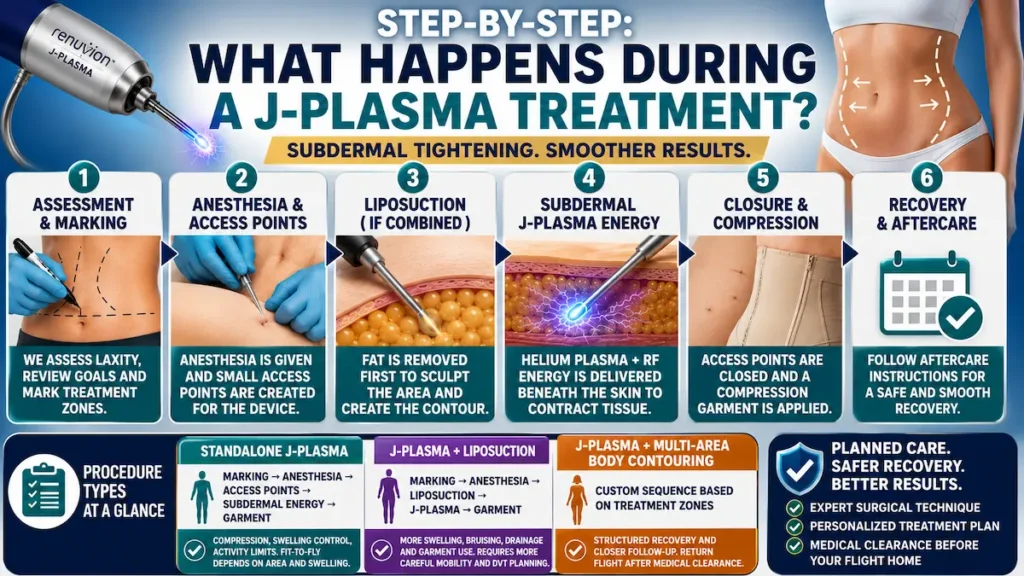
Step-by-Step: What Happens During a J-Plasma Treatment?
J-Plasma is planned like a surgical energy procedure, not like a casual spa treatment. The steps depend on whether it is performed alone or combined with liposuction, but the goal is the same: controlled subdermal tightening in the right tissue plane.
Before treatment, we confirm the area, laxity level, anesthesia plan, garment needs, and return-travel timing. For Canadian patients, this planning matters because recovery must fit both the procedure and the long-haul flight home.
Pre-Treatment Assessment & Marking
Your J-Plasma plan begins with a laxity assessment. We review the treatment area, skin quality, previous scars, weight history, and whether liposuction is also needed.
Photos help us decide whether the skin is likely to contract. They also help us identify patients who may be better served by an excisional lift instead of energy tightening.
On procedure day, the treatment zones are marked while you are standing. This allows our surgical team to see how the skin behaves under gravity, not only when you are lying down.
The markings may include:
- Areas of fat to be removed, if liposuction is included
- Zones where the skin needs support with J-Plasma
- Natural access-point locations
- Areas to avoid because of scars, thin tissue, or anatomy
Anesthesia + Small Access Points
Once the plan is confirmed, anesthesia is started according to the treatment scope. A small standalone case may use local anesthesia with sedation. A larger liposuction combination may require general anesthesia.
J-Plasma is performed through small access points. These are usually placed in discreet locations whenever anatomy allows.
The access points create a route for the device to pass beneath the skin. This is different from topical radiofrequency, laser, or HIFU devices, which work through intact skin from the outside.
Even though the access points are small, they still require sterile technique. Energy delivered in the wrong plane or with poor control can increase the risk of burns, irregularity, or uneven tightening.
Liposuction First, If Combined
If J-Plasma is paired with liposuction, the fat-removal step usually happens first. The surgeon removes selected fat deposits and shapes the treatment area before tightening is added.
This sequence is important. The skin needs to retract over the new contour, not over the old one.
After liposuction, the surgical team reassesses the skin envelope. J-Plasma is then used to encourage contraction over the newly shaped area.
This pairing is most common in the abdomen, waist, flanks, arms, thighs, and neck. It is one reason many Canadian patients choose a single Istanbul treatment plan rather than separating liposuction and skin-tightening sessions across different providers.
Subdermal J-Plasma Energy Delivery
During the J-Plasma step, the device delivers helium plasma and radiofrequency energy beneath the skin. The surgeon moves the handpiece in a controlled pattern through the treatment zone.
The goal is even energy delivery. The energy should contract tissue without overheating or over-treating one area.
Operator skill matters here. The surgeon must understand depth, speed, passes, tissue thickness, and anatomical limits.
We do not treat J-Plasma as a simple device-driven procedure. Technology helps, but judgement determines whether the energy is used safely and whether the treatment is appropriate in the first place.
“J-Plasma is not just a machine setting. It is a technique. The surgeon must understand how the skin, fat layer, and fibrous tissue respond in each body area.”
Closure & Compression Garment
After the energy step, the access points are closed or dressed according to the area treated. If liposuction was also performed, some drainage may be expected early in recovery.
A compression garment is usually applied. Compression helps support the tissue, reduce swelling, and guide the skin as it settles over the treated contour.
Garment compliance matters. Wearing it correctly can influence comfort and recovery, especially in the first few weeks.
Before discharge, our team reviews movement rules, sleeping position, shower timing, medication use, warning signs, and follow-up schedule.
Procedure Length
Procedure time depends on the number of areas treated and whether liposuction is included. A small standalone J-Plasma case may be relatively brief. A larger Lipo 360 with J-Plasma plan takes longer because fat removal and energy tightening are both performed.
Most patients should think in terms of a structured surgical day rather than a quick walk-in treatment. This is especially true for body-contouring combinations.
The consultation estimate will explain the expected duration, anesthesia plan, hotel recovery needs, and fit-to-fly timing before you travel from Canada.
| Procedure Type | Typical Sequence | Recovery Needs | Canadian Travel Note |
|---|---|---|---|
| Standalone J-Plasma | Marking → anesthesia → access points → subdermal energy → garment | Compression, swelling control, activity limits | Fit-to-fly depends on area and swelling |
| J-Plasma + liposuction | Marking → anesthesia → liposuction → J-Plasma → garment | More swelling, bruising, drainage, and garment use | Requires more careful mobility and DVT planning |
| J-Plasma + multi-area body contouring | Custom sequence based on treatment zones | Structured recovery and closer follow-up | Return flight should be planned after medical clearance |
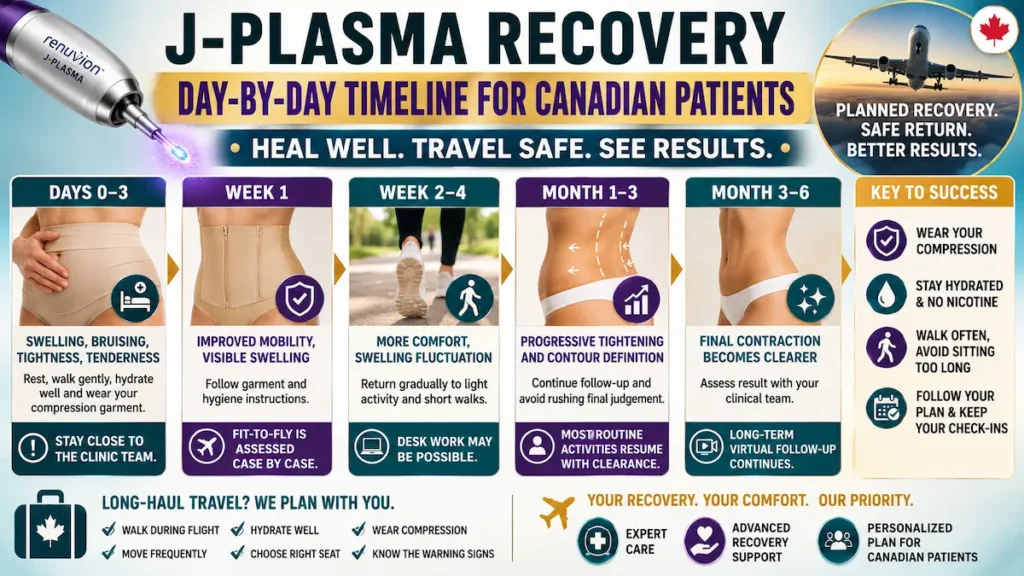
J-Plasma Recovery: Day-by-Day Timeline for Canadian Patients
J-Plasma recovery depends on the treated area, the anesthesia used, and whether liposuction was performed. Standalone J-Plasma usually has a lighter recovery than J-Plasma combined with Lipo 360 or multi-area contouring.
For Canadians, the recovery plan must also account for flight distance. A return trip from Istanbul to Toronto, Vancouver, Montreal, or Calgary is not the same as a short domestic drive home.
Days 0–3 — Swelling, Compression Garment, and Rest
The first three days focus on swelling control, garment use, hydration, and gentle movement. Bruising, tightness, tenderness, and temporary numbness can occur.
If liposuction was performed, drainage from access points may be present during the early phase. This is expected in many lipo-combination cases and will be explained before discharge.
You should rest, but not remain completely still. Short, gentle walks help circulation and reduce stiffness.
During this phase, avoid:
- Strenuous exercise
- Alcohol
- Smoking or nicotine
- Removing compression garments outside instructions
- Sleeping directly on treated areas unless cleared
Week 1 — Initial Recovery and the Minimally Invasive Advantage
By the end of the first week, many patients feel more mobile. Swelling and bruising may still be visible, but discomfort usually becomes easier to manage.
The minimally invasive advantage of J-Plasma is the lack of long excisional scars. That does not mean there is no recovery. The tissue still needs time to settle after subdermal energy treatment.
Compression remains important. If you had J-Plasma with liposuction, the garment schedule may be stricter than in a standalone case.
Our team checks healing progress and confirms whether your recovery is on track before discussing return-travel clearance.
Our HBOT / LLLT Recovery Protocol
At AKM Clinic, selected surgical patients may benefit from our recovery-support technologies, including Hyperbaric Oxygen Therapy and Low-Level Laser Therapy. These are part of our broader recovery philosophy for international patients.
HBOT supports oxygen delivery to healing tissues. LLLT uses 424 medical-grade semiconductor laser diodes at 650 nm to stimulate cellular ATP production and support tissue repair.
For J-Plasma patients, these technologies may support swelling reduction, skin recovery, and comfort during the early healing window. They do not replace good surgical technique, compression, nutrition, hydration, or rest.
Canadian patients often value this structured recovery support because they need to feel stable before a long flight home. For a deeper science review, the related AKM resources on Hyperbaric Oxygen Therapy benefits and LLLT scar and healing support explain the mechanism in more detail.
Fit-to-Fly Clearance for Canadian Return Travel
Fit-to-fly timing is individualized. It depends on the size of the treatment area, whether liposuction was included, swelling level, mobility, pain control, and your medical history.
Before you fly, we want to see that you can walk comfortably, hydrate well, manage your garment, and recognize warning signs. You should not travel while feeling faint, severely swollen, short of breath, feverish, or unable to move comfortably.
Long-haul travel requires extra planning. A flight from Istanbul to Canada can involve prolonged sitting, cabin pressure changes, and dehydration risk.
We typically discuss:
- Walking during the airport and flight
- Hydration before and during travel
- Compression garment comfort
- Medication timing
- Seat selection and luggage support
- When to contact our team after landing
For broader travel guidance, our flight safety after surgery guide explains what Canadian patients should consider before returning home.
Week 2–4 — Return to Work and Light Activity
Many patients can return to desk-based work within this period, depending on the area treated and whether liposuction was included. Remote work can make the transition easier.
Light walking is usually encouraged. Heavy lifting, high-intensity exercise, and aggressive stretching should wait until your surgeon clears you.
Compression may continue. Swelling often fluctuates, especially after long standing, salty meals, heat exposure, or travel.
Canadian patients returning to office environments should plan clothing around the garment. Loose layers often help during the first few weeks.
Month 1–3 — Progressive Skin Tightening
J-Plasma results do not finish in the first week. Skin tightening develops progressively as swelling reduces and tissue remodelling continues.
Some early contraction may be visible, but the area can look firm, swollen, or uneven during the transition. This does not always mean the final result is uneven.
By month one to three, patients often begin to see a clearer contour. The skin may feel tighter, and treated areas may settle closer to the underlying shape.
Patience is part of the procedure. Comparing your day-10 result to someone else’s month-6 result is not useful.
Month 3–6 — Final Contraction Result
Final contraction usually becomes more apparent between three and six months. This is when swelling is lower and collagen remodelling has had more time to mature.
The final result depends on the starting anatomy. Patients with mild-to-moderate laxity and good skin quality usually see the most satisfying change.
If the original problem was severe skin redundancy, J-Plasma may not produce enough tightening. This is why candidacy assessment is more important than the device name.
| Recovery Stage | What You May Notice | What To Do | Travel / Work Consideration |
|---|---|---|---|
| Days 0–3 | Swelling, bruising, tightness, tenderness | Rest, walk gently, wear compression | Stay close to the clinic team |
| Week 1 | Improved mobility, visible swelling | Follow garment and hygiene instructions | Fit-to-fly is assessed case by case |
| Week 2–4 | More comfort, swelling fluctuation | Return gradually to light activity | Desk work may be possible |
| Month 1–3 | Progressive tightening and contour definition | Continue follow-up and avoid rushing final judgement | Most routine activities resume with clearance |
| Month 3–6 | Final contraction becomes clearer | Assess result with your clinical team | Long-term virtual follow-up continues |
Safety & Risks of J-Plasma
J-Plasma is an energy-based surgical technology, so safety depends on three things: the device, the indication, and the operator. The same technology can be used appropriately in one patient and poorly in another if the anatomy, energy settings, or treatment plan are wrong.
Our safety conversation is direct. J-Plasma can be useful for selected patients, especially when paired with liposuction, but it is not risk-free. It also should not be used to promise skin removal without scars when the patient really needs an excisional lift.
Common Side Effects
Most patients experience some short-term effects after J-Plasma. These are usually related to the subdermal energy delivery, swelling response, access points, and any liposuction performed at the same time.
Common short-term effects may include:
- Swelling
- Bruising
- Tightness or firmness
- Tenderness in the treated area
- Temporary numbness or altered sensation
- Minor drainage if liposuction was performed
- Small access-point marks
These effects usually improve gradually. Swelling can fluctuate for weeks, especially after body-contouring combinations.
Temporary numbness can also occur because tissue is manipulated under the skin. Sensation usually improves as inflammation settles, although recovery timing varies by patient and treatment area.
Energy-Device Safety — Honest Context
Energy-based procedures require a different safety mindset than purely mechanical procedures. The surgical team must understand the device, the tissue plane, the treatment area, and the limits of heat-based contraction.
Radiofrequency skin tightening dangers are often discussed online because energy can cause harm if it is misused. Risks may include overheating, burns, contour irregularity, tissue injury, delayed healing, and dissatisfaction when the wrong candidate is treated.
Regulatory context also matters. Patients should not simply ask whether a device is “FDA-cleared” or “available in Canada.” They should ask what the device is cleared or licensed for, which handpiece is being used, and whether the planned use matches the appropriate indication.
Canadian patients can verify whether a medical device is licensed for sale in Canada through Health Canada’s Medical Devices Active Licence Listing (MDALL). This is useful when reviewing any energy-based technology claim.
The U.S. FDA has also published a Renuvion/J-Plasma safety communication update, including clearance context for specific aesthetic uses. Patients should check the indication, not only the brand name.
Burn and Contour Risk: Why Operator Skill Matters
J-Plasma works by delivering controlled energy beneath the skin. That word — controlled — is essential.
If energy is delivered too aggressively, too superficially, too slowly, or in the wrong patient, complications become more likely. Burn risk and contour irregularity are not just device issues. They are operator issues.
Operator skill includes:
- Correct candidate selection
- Understanding skin thickness and tissue depth
- Using appropriate energy settings
- Moving the handpiece evenly
- Avoiding over-treatment in thin tissue
- Knowing when to stop
- Recognizing when an excisional lift is the safer recommendation
This is why we treat J-Plasma as a surgical adjunct, not a casual add-on. The device does not replace surgical judgement.
“With J-Plasma, the safest result starts before the device is turned on. The first decision is whether the patient should have energy tightening at all.”
Realistic Limits: Not a Substitute for Excision
One of the most important safety risks is not a burn. It is the wrong indication.
If severe loose skin is treated with J-Plasma instead of an excisional lift, the patient may still have hanging skin after recovery. This can create disappointment, revision costs, and unnecessary recovery time.
J-Plasma can contract suitable skin. It cannot remove skin folds. It also cannot repair muscle separation, correct major post-weight-loss redundancy, or replace a procedure that surgically removes excess tissue.
That is why our team may recommend a different operation if your anatomy requires it. A longer scar can sometimes be the more honest and predictable solution.
| Risk or Limitation | Why It Happens | How We Reduce It |
|---|---|---|
| Swelling and bruising | Normal tissue response to subdermal treatment and/or liposuction | Compression, mobility guidance, follow-up, and recovery support |
| Temporary numbness | Inflammation around small sensory nerves | Conservative treatment planning and post-operative monitoring |
| Burn risk | Energy delivered too superficially, aggressively, or unevenly | Trained surgical use, appropriate settings, and controlled technique |
| Contour irregularity | Uneven fat removal, uneven contraction, or poor skin quality | Careful lipo planning, even energy delivery, and patient selection |
| Underwhelming result | Severe laxity treated with energy instead of excision | Honest candidacy screening and lift recommendation when needed |
Why Our Technology Standards Reduce Risk
At AKM Clinic, J-Plasma is integrated into a broader safety culture. We combine surgical planning, sterile technique, appropriate anesthesia, and structured aftercare rather than treating technology as a standalone selling point.
Our procedures are performed within a clinical framework that includes pre-operative assessment, sterile protocols, and surgeon-led decision-making. Our recovery planning also considers the needs of international patients who must fly home safely.
We use our technology and safety standards to support risk reduction across the patient journey. This includes recovery-support tools, clear aftercare instructions, and access to our team after you return to Canada.
Technology matters. The system around the technology matters more.
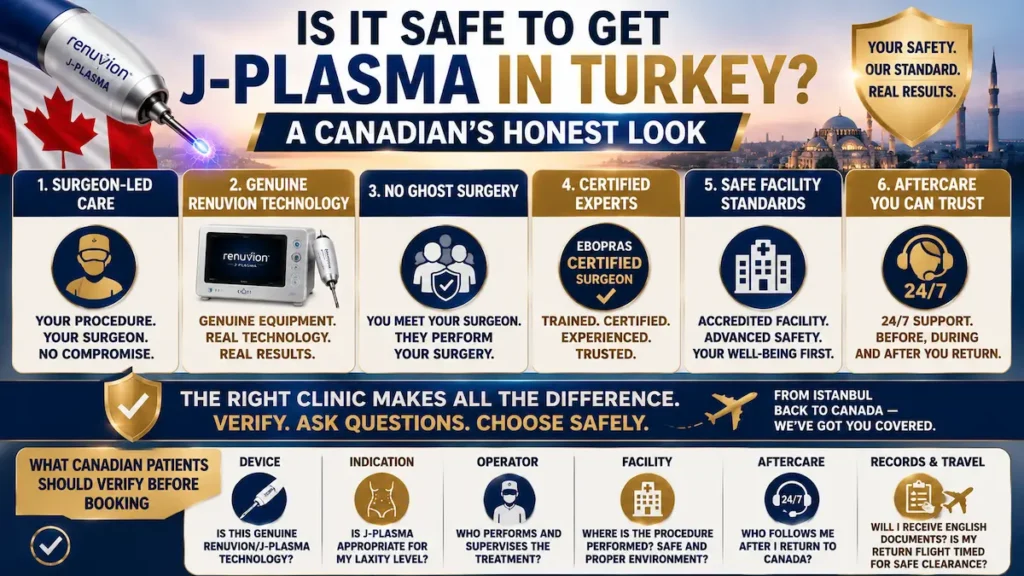
Is It Safe to Get J-Plasma in Turkey? A Canadian’s Honest Look
It can be safe to get J-Plasma in Turkey when the clinic uses proper equipment, surgeon-led care, sterile facilities, and transparent aftercare. It can also be unsafe when a clinic treats the procedure as a volume-driven device service without proper screening.
For Canadian patients, the right question is not “Is Turkey safe?” The better question is: “Is this clinic, surgeon, device, facility, and aftercare pathway safe for my specific procedure?”
The Turkey Cosmetic Surgery Reality — How We Differ
Turkey has both excellent clinics and clinics that should be avoided. That is true in every country with a high-volume aesthetic market.
The concern many Canadians have is understandable. They may have read negative stories about poor screening, technician-led procedures, poor follow-up, or patients being rushed through treatment. Those risks deserve a direct answer.
At AKM Clinic, our model is built around surgeon-led assessment, a tailored clinical protocol, and 24/7 patient coordination. We do not position J-Plasma as an automatic add-on for every patient who asks for skin tightening.
For more context on how Canadian patients can assess international surgery risks, our guide on whether it is safe to get plastic surgery in Turkey explains the verification process in more detail.
Genuine Renuvion Technology vs Imitation Devices
Because J-Plasma and Renuvion are recognizable names, some patients worry about imitation devices or vague “plasma tightening” language. That concern is reasonable.
Before booking, you should ask:
- Is the clinic using genuine Renuvion/J-Plasma technology?
- Which handpiece is being used?
- What is the intended treatment area?
- Is it being used under the skin or as a surface treatment?
- Does the surgeon believe the use matches your anatomy and the appropriate indication?
- What safety protocols are followed if liposuction is performed at the same time?
Clear answers matter. A clinic that cannot explain the device, the treatment plane, or the reason you are a candidate should not be your provider.
Our technology standards page explains how we approach advanced surgical and recovery technologies within our clinical environment.
Ghost Surgery in Turkey — How to Avoid It
“Ghost surgery” means the patient believes one surgeon will perform the procedure, but another person performs all or part of it without clear consent. This is one of the most important concerns for international patients.
For J-Plasma, ghost surgery risk is not only about who holds the handpiece. It is also about who decides whether you are a candidate, who plans the treatment area, who supervises safety, and who manages complications if they occur.
Canadian patients should ask for:
- The surgeon’s name and credentials before booking
- A clear explanation of who performs each step
- Facility details
- Written consent documents
- Aftercare contact information
- A plan for follow-up after returning to Canada
Our article on ghost surgery in Turkey explains how to protect yourself from this risk before you commit to any clinic.
EBOPRAS-Certified Surgeon Verification
Credential verification is especially important for energy-assisted procedures. The surgeon should understand both the technology and the surgical anatomy.
Canadian patients are familiar with structured medical regulation through provincial colleges and the Royal College of Physicians and Surgeons of Canada. In Europe, EBOPRAS certification provides a comparable specialist credential framework for plastic surgery training and assessment.
When comparing clinics, ask whether the surgeon has:
- Recognized board-level training
- Experience with body contouring
- Experience using energy-assisted technologies
- Before-and-after documentation for relevant body areas
- A clear policy for complications and follow-up
A device does not make the treatment safe by itself. Surgeon judgement is the key safety filter.
What Canadian Patients Should Verify Before Booking
Before booking J-Plasma in Turkey, Canadian patients should verify the same categories they would verify at home: surgeon, facility, device, indication, aftercare, and total cost.
Use this checklist before you make a deposit:
- Surgeon: Who is responsible for your procedure?
- Credentials: Are they board-certified or equivalent?
- Device: Is it genuine Renuvion/J-Plasma technology?
- Indication: Is J-Plasma appropriate for your laxity level?
- Facility: Is the procedure performed in a properly equipped clinical setting?
- Anesthesia: Who manages sedation or general anesthesia?
- Aftercare: Who answers your questions after you return to Canada?
- Records: Will you receive English-language medical documentation?
- Travel: Is your return flight timed around clinical clearance?
We build these questions into our process because informed patients make safer decisions. A strong clinic should welcome verification.
| Verification Area | What To Ask | Why It Matters |
|---|---|---|
| Device | Is this genuine Renuvion/J-Plasma technology? | Prevents vague “plasma tightening” substitutions |
| Indication | Is my laxity mild-to-moderate or severe? | Protects against using energy when excision is needed |
| Operator | Who performs and supervises the treatment? | Reduces ghost surgery and technician-only risk |
| Facility | Where is the procedure performed? | Confirms appropriate sterile and anesthesia environment |
| Aftercare | Who follows me after I return to Canada? | Supports continuity across distance |
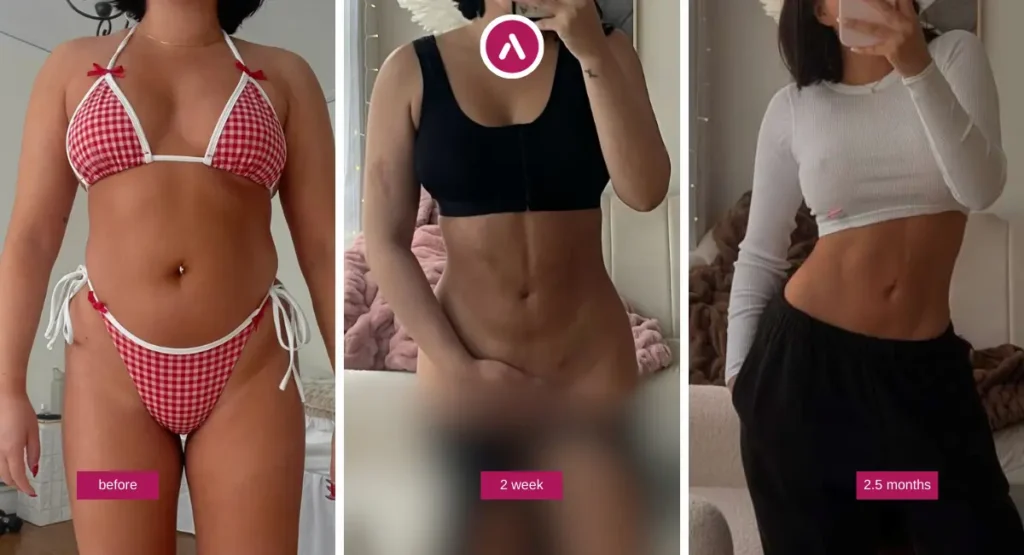
J Plasma Before and After: Realistic Expectations & Results
J-Plasma results are best understood as progressive tightening, not instant skin removal. Some patients notice early firmness or contraction, but the final result develops as swelling settles and collagen remodelling continues.
The strongest results usually appear in patients with mild-to-moderate laxity, stable weight, and good skin elasticity. If the starting problem is severe hanging skin, J-Plasma may improve texture or tightness modestly but will not replace an excisional lift.
J-Plasma / Renuvion Before and After — Realistic Outcomes
J-Plasma before and after results vary by area, skin quality, and whether liposuction is performed. A good result usually looks like smoother skin draping over a better contour, rather than a dramatic “lifted” effect.
Renuvion before and after photos should be interpreted carefully. Lighting, body position, swelling, weight change, and whether liposuction was combined can all affect how the result appears.
During consultation, we look at your starting point and explain what degree of tightening is realistic. We do not use another patient’s result as a promise for your anatomy.
Abdomen & Lipo-Combo Results
The abdomen is one of the areas where J-Plasma is often paired with liposuction. Patients searching for jplasma stomach before and after photos are usually trying to understand whether the skin will retract after fat removal.
For the right candidate, J-Plasma can help the abdominal skin sit more smoothly over the newly contoured area. This is especially relevant after lower-abdomen or Lipo 360 treatment, where fat reduction changes the shape quickly but skin tightening takes longer.
Lipo 360 with J-Plasma before and after outcomes should be judged over months, not days. Early swelling can blur the waistline, make the skin feel firm, or create temporary unevenness.
Results Develop Over 3–6 Months
J-Plasma results are not fully visible immediately after treatment. The early phase includes swelling, bruising, tightness, and tissue firmness.
Most patients see the contour become clearer over the first several weeks. Tightening continues as the tissue remodels.
By three months, many patients have a better sense of the result. By six months, the contraction pattern is usually more mature, although individual healing varies.
This timeline matters for Canadian patients planning photos, events, travel, or return to work. A result that looks swollen at week two may look much smoother by month three.
When Results Disappoint
J-Plasma results usually disappoint for one of three reasons: the skin was too loose, the patient expected skin removal without scars, or the procedure was performed without a clear contouring plan.
Severe laxity is the most common mismatch. If the skin hangs in a fold, energy tightening cannot create the same effect as surgical removal.
Results can also disappoint when fat removal is incomplete or uneven. This is why we often plan J-Plasma as part of a full body-contouring strategy rather than as an isolated device treatment.
The best way to avoid disappointment is honest assessment before treatment. If J-Plasma is not the right tool, we will say so.
| Starting Anatomy | Expected J-Plasma Outcome | Better Alternative If Needed |
|---|---|---|
| Mild looseness, good elasticity | Visible tightening and smoother skin drape | J-Plasma may be appropriate |
| Mild-to-moderate laxity after fat removal | Improved retraction over the new contour | J-Plasma with liposuction |
| Loose skin with poor elasticity | Partial tightening, less predictable change | Case-by-case surgical review |
| Hanging folds or severe redundancy | Underwhelming if treated with energy alone | Arm lift, thigh lift, neck lift, tummy tuck, or body lift |
Before & After Reference Gallery
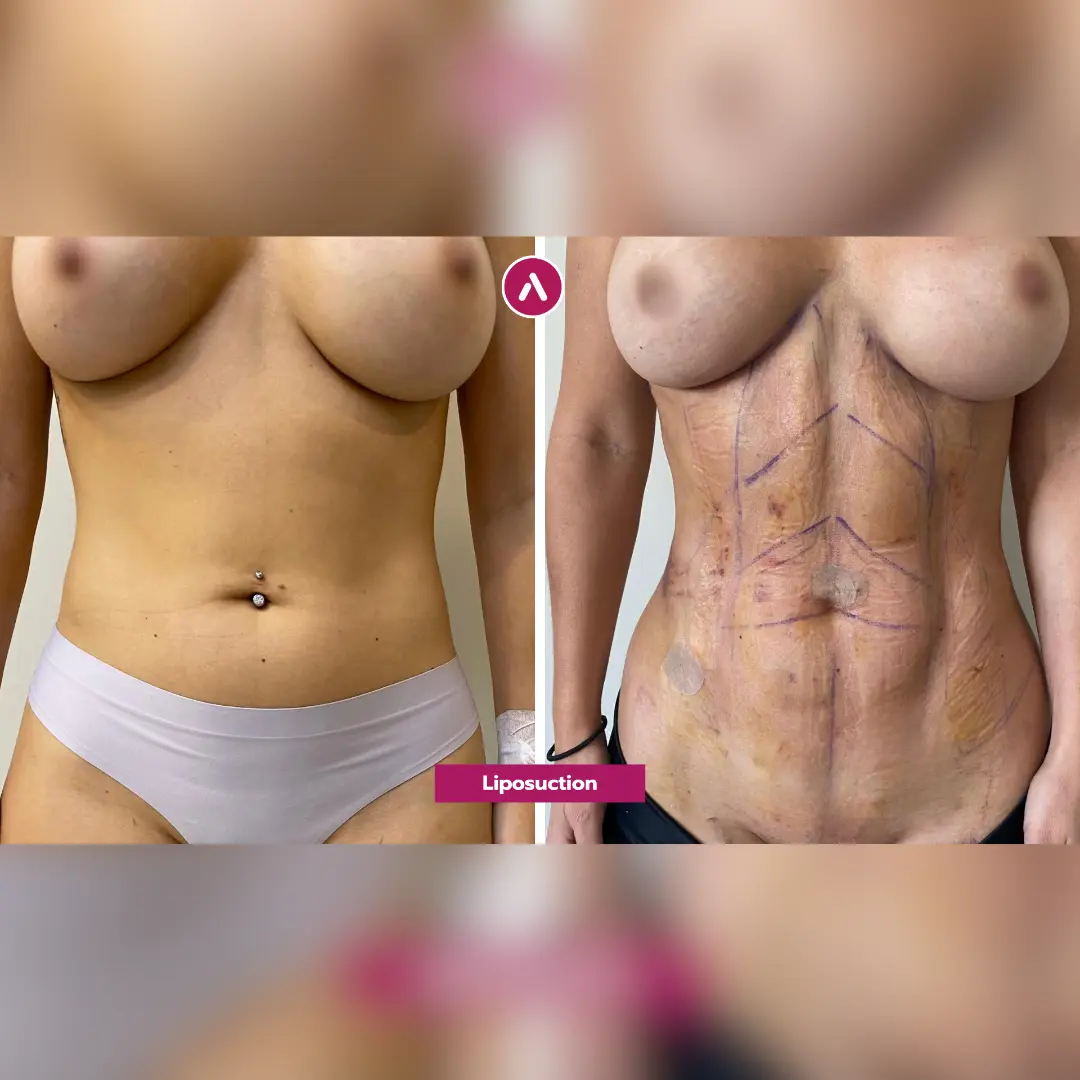
There is no dedicated public J-Plasma gallery because J-Plasma is often used as an adjunct to liposuction or body contouring. The most relevant visual reference is usually the treated body area, not the device name alone.
You can review our liposuction before and after gallery to understand how body contouring changes shape. During consultation, our team can also explain where J-Plasma may have supported skin retraction in suitable cases.
Photos are useful, but they are not a substitute for candidacy assessment. Your skin quality, laxity level, age, weight history, and treatment area determine what J-Plasma can realistically achieve.
J-Plasma Cost 2026: Turkey vs Canada
Canadian patients researching Renuvion skin tightening cost often find that pricing in Toronto or Vancouver varies widely by treatment area, provider type, anesthesia needs, and whether liposuction is included. A standalone skin tightening quote may look manageable at first, but costs can rise when facility fees, anesthesia, compression garments, and follow-up visits are added separately.
At AKM Clinic, Renuvion (J-Plasma) subdermal skin tightening is listed at CAD $5,450. J-Plasma with liposuction or body contouring is listed at CAD $6,150, while minimally invasive J-Plasma neck tightening is listed at CAD $2,750. Final candidacy and pricing depend on the treatment area, whether fat removal is needed, and whether J-Plasma is part of a larger body-contouring plan.
By comparison, private Renuvion or J-Plasma pricing in Toronto commonly falls around CAD $8,000–$11,000, while Vancouver pricing can reach CAD $8,500–$12,000, depending on area and clinic structure. The strongest value for many Canadians is not standalone J-Plasma alone. It is the ability to combine liposuction and J-Plasma in one clinical plan, one recovery window, and one coordinated Istanbul stay.
For the current CAD-first breakdown, see our J-Plasma cost in Turkey guide.
Canadian-dollar pricing shown for planning clarity; your coordinator will confirm the final payment details before booking.
| Location / Option | Typical CAD Range | What Usually Affects Price | Best For |
|---|---|---|---|
| AKM Istanbul — J-Plasma standalone | CAD $5,450 | Treatment area and candidacy | Mild-to-moderate laxity without major fat removal |
| AKM Istanbul — J-Plasma with liposuction/body contouring | CAD $6,150 | Fat removal, area size, contouring plan | Patients needing fat reduction plus skin retraction |
| AKM Istanbul — J-Plasma neck | CAD $2,750 | Neck anatomy and whether liposuction is included | Selected mild-to-moderate neck laxity |
| Toronto private clinics | CAD $8,000–$11,000 | Area, anesthesia, facility fees, provider model | Patients staying within Ontario |
| Vancouver private clinics | CAD $8,500–$12,000 | Area, clinic pricing, combination treatment needs | Patients staying within British Columbia |
How to Find the Right J-Plasma Provider in Turkey: A Canadian Patient’s Checklist
Choosing the right J-Plasma provider is not only about finding a clinic that lists Renuvion on its website. You need to verify the device, the surgeon, the indication, the facility, and the aftercare plan.
This is especially important for Canadians travelling internationally. You will not have the same provincial college oversight that you would have in Ontario, British Columbia, Alberta, or Quebec, so your pre-booking verification needs to be more deliberate.
EBOPRAS Certification — The European Equivalent to RCPSC-Level Specialist Review
Canadian patients often use RCPSC certification as a familiar specialist benchmark. In Turkey and Europe, EBOPRAS certification provides a structured European plastic surgery credential pathway.
For Canadian comparison, the Royal College of Physicians and Surgeons of Canada explains official specialist designations such as FRCSC. This helps Canadian patients understand what a specialist credential means at home before comparing international equivalents.
For J-Plasma, credentialing matters because the procedure is not just “device work.” The provider must understand body contouring, skin laxity, energy-device safety, and when to recommend an excisional lift instead.
The Canadian Society of Plastic Surgeons’ guidance on choosing a surgeon also advises patients to verify that a physician is properly certified in plastic surgery.
When reviewing a clinic, ask:
- Who is the responsible surgeon?
- What specialist certification do they hold?
- Do they routinely perform body-contouring surgery?
- Do they have experience combining liposuction and energy-based tightening?
- Will you meet the surgeon before the procedure?
Our team is built around surgeon-led treatment planning. J-Plasma candidacy is assessed clinically, not sold as a default add-on.
| Credential Framework | What It Indicates | Why Canadian Patients Should Care |
|---|---|---|
| RCPSC | Canadian specialist certification pathway | Familiar Canadian benchmark for specialist-level training |
| EBOPRAS | European board-level plastic surgery certification | Useful equivalency marker when reviewing surgeons outside Canada |
| JCI-accredited facility | International facility safety and quality benchmark | Supports confidence in the surgical environment, not only the surgeon |
| Procedure-specific experience | Hands-on skill with body contouring and subdermal energy | Essential because J-Plasma safety depends on judgement and technique |
Genuine Renuvion / J-Plasma Equipment
A clinic should be able to explain exactly what technology is being used. Vague phrases like “plasma tightening” or “RF tightening” are not enough.
Renuvion J-Plasma in Turkey should mean genuine device-based treatment, not a rebranded topical RF session. You should also understand whether the treatment is subdermal or surface-based.
Before booking, ask the clinic to clarify:
- Is this genuine Renuvion / J-Plasma technology?
- Is the treatment subdermal or topical?
- Which body areas are being treated?
- Will liposuction be performed first?
- Who operates or supervises the device?
- What safety checks are used before energy delivery?
These questions are reasonable. A strong clinic will answer them clearly.
“A patient should never book J-Plasma based only on the device name. They should verify the technology, the treatment plane, the operator, and the reason the surgeon believes the indication is appropriate.”
Surgeon Experience With Subdermal Energy + Lipo Combos
The strongest J-Plasma use case is often the lipo-combo plan: fat removal first, skin retraction support second. This means your provider should understand liposuction and skin tightening together.
A clinic that offers only surface skin treatments may not be equipped to plan body contouring. A clinic that performs liposuction without assessing skin quality may also under-plan the final result.
Look for a provider who can answer:
- How much fat should be removed?
- How will the skin respond after fat removal?
- Is J-Plasma likely to improve retraction?
- Would an excisional lift be more predictable?
- What recovery plan is realistic for a Canadian return flight?
The goal is not to add more procedures. The goal is to match the treatment plan to the anatomy.
Honest Recommendation: J-Plasma vs Excisional Lift
A trustworthy J-Plasma provider should be willing to say no. This is one of the clearest signs of clinical honesty.
If your skin laxity is severe, an excisional procedure may be the better choice. J-Plasma can support contraction, but it cannot remove a fold of excess skin.
For example, mild upper-arm laxity may suit J-Plasma. A true hanging upper-arm fold may require an arm lift. Mild inner-thigh laxity may suit energy tightening. Heavy inner-thigh folds may require a thigh lift.
Our recommendation process is designed to protect you from an underpowered procedure. The right answer may not always be the shorter recovery.
Real Patient Reviews + Documentation
Before booking, review patient experiences carefully. Look for comments about communication, realistic expectations, recovery support, and follow-up after returning home.
Reviews should not replace medical judgement, but they can reveal how a clinic behaves when patients need support. This matters for international surgery.
At AKM Clinic, Canadian patients often highlight the role of communication and coordination. Our patient hosts — Hande, Emine, and Khadija — help patients navigate logistics, appointments, recovery questions, and follow-up.
You can review more patient experience context through our professional plastic surgery reviews page.
Aftercare Continuity From Istanbul to Canada
Aftercare should not stop when you leave Istanbul. This is one of the most important questions Canadian patients should ask before booking.
Our care pathway includes long-term virtual follow-up at 1, 3, 6, and 12 months. Patients can contact our support team with recovery questions after returning to Canada.
We also provide medical documentation in English so you can share it with your Canadian family physician or local provider if needed.
For a broader view of our clinic model, surgeon-led planning, and international patient support, see our About AKM Clinic page.
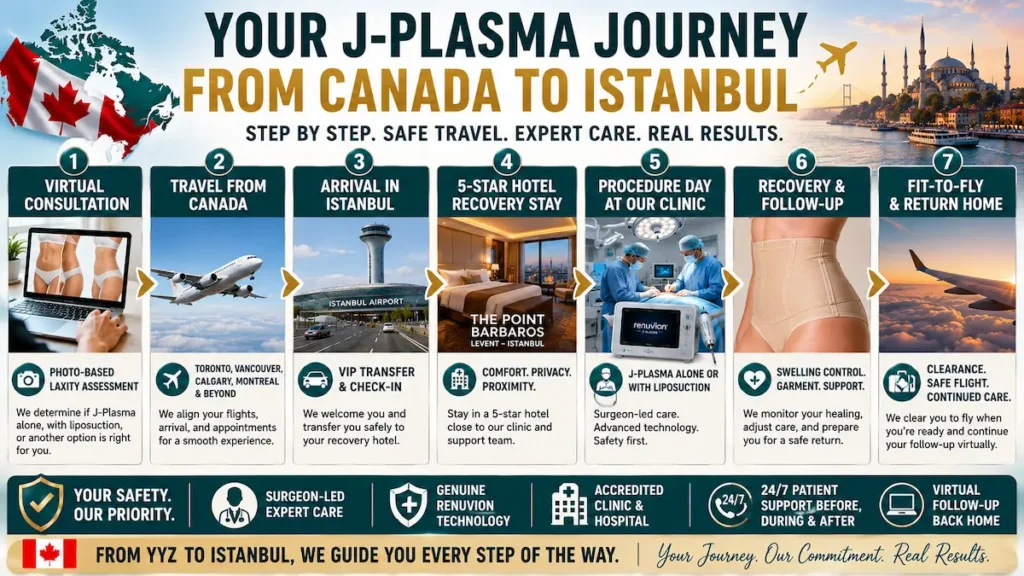
Your J-Plasma Journey From Canada: From YYZ to Istanbul, Step by Step
Travelling to Istanbul for J-Plasma should feel organized, not improvised. Canadian patients need a clear plan for consultation, flights, hotel recovery, procedure day, fit-to-fly clearance, and follow-up back home.
Our process is designed for patients travelling from Toronto, Vancouver, Calgary, Montreal, Ottawa, Edmonton, Halifax, Winnipeg, and other Canadian cities. The exact travel route varies, but the clinical pathway remains structured.
Pre-Trip Consultation: Laxity Assessment via Photos
The first step is a virtual assessment. You send photos of the treatment area, describe your goals, and explain your weight history, previous surgeries, pregnancy history if relevant, and any previous body-contouring treatments.
For J-Plasma, photos are especially useful because we need to understand the skin envelope. We look for signs of mild-to-moderate laxity, severe folds, stretch marks, poor elasticity, fat distribution, and asymmetry.
Your consultation may lead to one of several recommendations:
- J-Plasma alone
- J-Plasma with liposuction
- Liposuction without J-Plasma
- An excisional lift instead of energy tightening
- Delaying surgery until weight is stable
This pre-trip decision protects your time and budget. It also helps avoid arriving in Istanbul with the wrong expectation.
Travel Logistics: Toronto, Vancouver, Calgary, and Montreal to Istanbul
Canadian patients commonly travel through Toronto Pearson, Vancouver, Calgary, or Montreal. Flight schedules change, so you should confirm current routes directly with your airline before booking.
Many patients choose Istanbul Airport because it connects efficiently with our clinical and hotel logistics. Once your surgery date is confirmed, our coordination team helps align your arrival, hotel stay, consultation, procedure day, and recovery appointments.
You can learn more about the broader travel pathway on our patient journey from Canada to Istanbul page.
Travel planning should include:
- Arrival at least one day before your in-person consultation
- Comfortable clothing that works with compression garments
- Light luggage or companion support if multiple body areas are treated
- Time away from work that allows for swelling and early recovery
- Return flight timing based on medical clearance, not convenience alone
5-Star Hotel Recovery Stay in Levent
After arrival, patients recover in a structured hotel environment rather than trying to manage logistics alone in an unfamiliar city. Our partner hotel is The Point Barbaros, a 5-star hotel in the Levent district.
This location keeps patients close to our clinic and support team. It also provides a more comfortable environment for early recovery, especially if compression garments, swelling, or limited mobility are part of your recovery plan.
During your stay, our coordinators help organize transfer timing, appointments, and communication with the clinical team. This removes much of the stress that Canadian patients worry about before international surgery.
Our Istanbul clinic page explains the clinical setting and patient experience in more detail.
Procedure Day at Our Istanbul Clinic
On procedure day, we confirm your surgical markings, anesthesia plan, consent, and treatment areas. If J-Plasma is combined with liposuction, the team reviews the full body-contouring sequence before starting.
The procedure may involve a limited treatment area or a larger plan that includes liposuction and J-Plasma together. The length of the day depends on the number of zones and anesthesia type.
After treatment, you receive garment instructions, medication guidance, movement rules, and warning signs to watch for. Our team also confirms the next follow-up appointment before you return to the hotel.
Fit-to-Fly Clearance + Return Travel
You should not fly home simply because your ticket says it is time. Your return should be based on recovery progress and medical clearance.
Before you leave Istanbul, we assess swelling, pain control, mobility, access-point healing, garment comfort, and any liposuction-related recovery factors.
For the flight back to Canada, plan for:
- Loose clothing over compression garments
- Short walks during layovers and the flight when safe
- Hydration
- Avoiding heavy carry-on lifting
- Keeping medications accessible
- Knowing when to contact our team after landing
Once you return home, your follow-up continues virtually. J-Plasma results mature over months, so ongoing check-ins help track swelling, tightening, and contour development.
| Stage | What Happens | Canadian Patient Tip |
|---|---|---|
| Virtual consultation | Photo-based laxity assessment and treatment planning | Send clear photos in natural lighting from multiple angles |
| Travel booking | Flights and Istanbul arrival are aligned with clinical dates | Confirm airline schedules before booking |
| Arrival in Istanbul | VIP transfer, hotel check-in, and final consultation | Arrive with enough time before procedure day |
| Procedure day | J-Plasma alone or with liposuction/body contouring | Wear easy clothing and plan for compression garments |
| Recovery stay | Swelling control, follow-up, and mobility monitoring | Do not rush sightseeing during early recovery |
| Return to Canada | Fit-to-fly clearance and long-haul travel plan | Hydrate, walk, avoid heavy lifting, and contact us after landing if needed |
J Plasm Renuvion Frequently Asked Questions (FAQ):
Is J-Plasma the same as Renuvion?
Yes. In most patient-facing aesthetic contexts, J-Plasma and Renuvion refer to the same helium plasma and radiofrequency technology. "Renuvion" is the branded platform name, while "J-Plasma" is the commonly used procedure name.
The key point is not only the name. Patients should verify that the clinic uses genuine Renuvion/J-Plasma technology and that the treatment is being performed in the correct subdermal plane.
Is J-Plasma better than RF, laser, or HIFU?
It depends on what problem needs to be treated. J-Plasma is minimally invasive and works beneath the skin. Topical RF, laser, and HIFU usually work from the surface inward.
J-Plasma may be more appropriate when the concern is mild-to-moderate laxity after fat removal. Surface treatments may be enough for very mild laxity, texture, or maintenance.
The best skin tightening treatment is the one that matches the tissue layer involved.
Can J-Plasma be done without liposuction?
Yes, J-Plasma can be performed as a standalone procedure in selected patients. This is more likely when the concern is mild laxity without significant fat volume.
Many patients, though, benefit most when J-Plasma is paired with liposuction. Fat removal changes the contour, and J-Plasma supports skin retraction over that new shape.
How much skin tightening can I realistically expect?
J-Plasma can improve skin contraction in suitable candidates, but it does not remove extra skin. The best candidates have mild-to-moderate laxity and enough elasticity for the tissue to respond.
If skin hangs in folds, J-Plasma alone is unlikely to satisfy you. In that case, an excisional lift may be more appropriate.
When will I see results?
Some early tightening may be visible soon after treatment, but swelling can hide the final contour. Most patients see clearer changes over the first one to three months.
Results continue to mature as collagen remodelling progresses. Many patients judge their result more accurately around three to six months.
Is J-Plasma a substitute for an arm lift or tummy tuck?
No. J-Plasma is not a substitute for skin removal. It can tighten suitable skin, but it cannot remove a hanging fold, repair muscle separation, or replace the incision-based correction of an arm lift, thigh lift, tummy tuck, or body lift.
If you have severe laxity, we will explain why an excisional procedure may be more predictable
How much does J-Plasma / Renuvion cost in Toronto vs Istanbul?
Toronto private J-Plasma or Renuvion pricing often falls around CAD $5,000–$11,000, depending on area, anesthesia, facility fees, and whether liposuction is included. Vancouver pricing may reach CAD $8,500–$12,000.
At AKM Clinic, standalone Renuvion J-Plasma is listed at CAD $5,450. J-Plasma with liposuction or body contouring is listed at CAD $6,150. Canadian-dollar pricing shown for planning clarity; your coordinator will confirm the final payment details before booking.
Is Renuvion / J-Plasma widely available in Canada?
Renuvion is available through selected providers in Canada, but access, pricing, treatment philosophy, and combination options vary. Some Canadian clinics may offer energy-based tightening without offering full surgical body-contouring pathways.
At AKM Clinic, the value is often in the integrated plan: fat removal, J-Plasma skin retraction, hotel recovery, VIP transfers, and follow-up in one coordinated programme.
Does OHIP, MSP, AHCIP, or RAMQ cover J-Plasma skin tightening?
In most cases, no. J-Plasma skin tightening is considered elective cosmetic treatment, so provincial health plans such as OHIP, MSP, AHCIP, and RAMQ generally do not cover it.
Coverage rules can differ for reconstructive or medically necessary surgery, but cosmetic skin tightening is usually private-pay. Patients should confirm directly with their provincial plan or physician if they believe there is a functional medical indication.
Is J-Plasma safe? What about energy-device risks?
J-Plasma can be safe in properly selected patients when performed with genuine technology, trained surgical technique, appropriate settings, sterile protocols, and clear aftercare.
Risks include swelling, bruising, temporary numbness, burns, contour irregularity, underwhelming tightening, and dissatisfaction if the wrong candidate is treated. Energy-device safety depends heavily on operator judgement.
How long is recovery, and when can I fly home?
Recovery varies by treatment area and whether liposuction is included. Standalone J-Plasma usually has a lighter recovery than J-Plasma combined with Lipo 360 or multi-area body contouring.
Fit-to-fly timing is individualized. Before returning to Canada, you should be mobile, hydrated, comfortable in your compression garment, and medically cleared by our team.
Can I combine J-Plasma with liposuction or a body lift in one trip?
J-Plasma is commonly combined with liposuction when skin retraction is needed after fat removal. It may also be part of a broader body-contouring discussion.
It is not usually combined to avoid a body lift when severe skin laxity requires excision. In that case, a 360 body lift, arm lift, thigh lift, or tummy tuck may be the more honest recommendation.
Medical Disclaimer: This page is for educational purposes only and does not replace a consultation with a qualified physician or surgeon. J-Plasma / Renuvion candidacy depends on your skin quality, laxity level, medical history, treatment area, previous surgeries, weight stability, and recovery goals. All surgery and energy-based procedures carry risks. These may include swelling, bruising, temporary numbness, burns, contour irregularity, delayed healing, infection, scarring, asymmetry, dissatisfaction, or the need for revision treatment.