



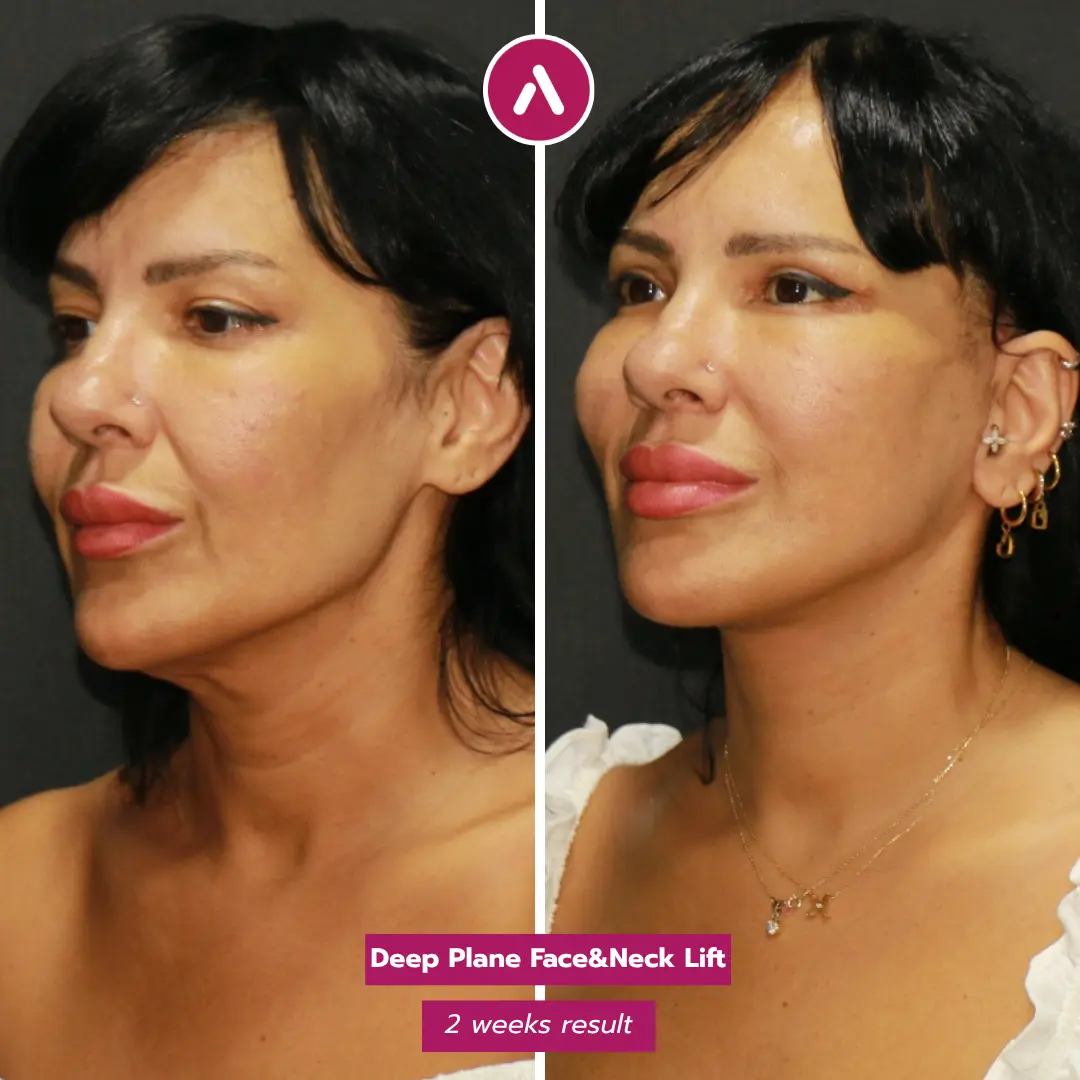
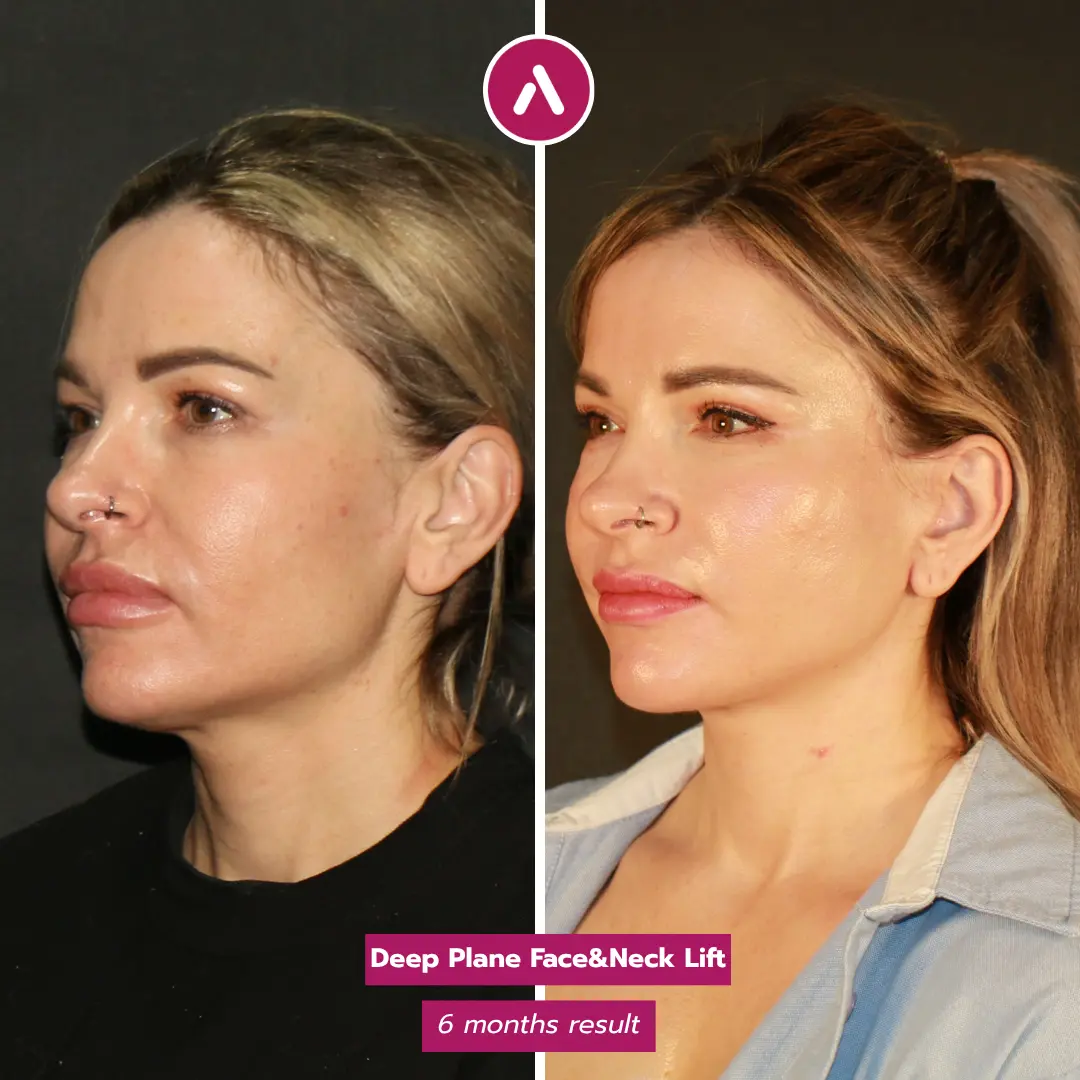
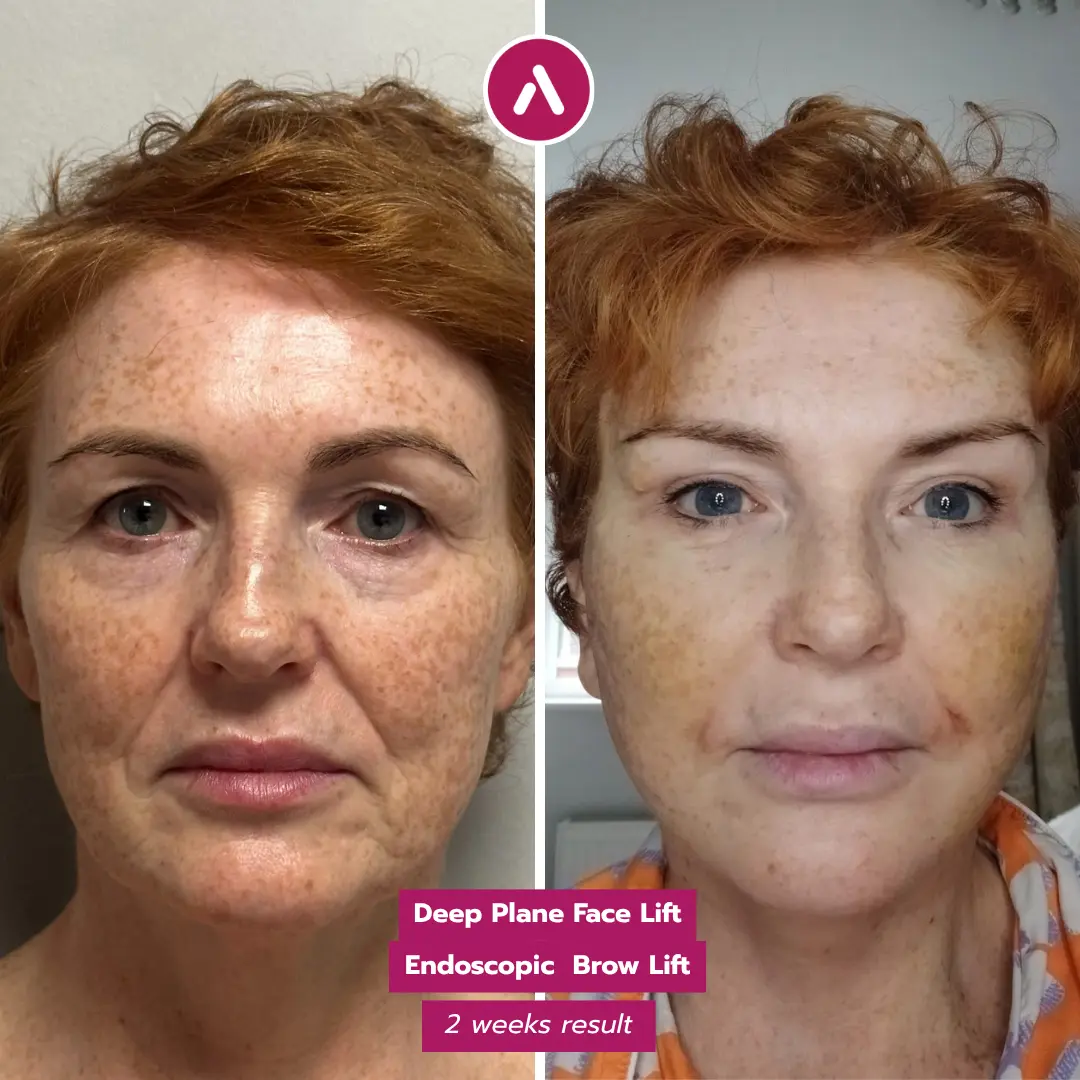
Canadian patients researching facelift options often want the structural longevity of a deep plane lift, but hesitate when they hear phrases like “general anesthesia,” “intubation,” or “overnight hospital stay.” An awake deep plane facelift offers a different surgical pathway. It uses the same deep plane rejuvenation philosophy, but replaces general anesthesia with local anesthesia and light IV sedation.
At AKM Clinic in Istanbul, we offer this approach for carefully selected patients who want natural facial rejuvenation with a no-general-anesthesia recovery experience. The goal is not to make surgery sound casual. It is to create a controlled, surgeon-led pathway for patients who are medically and psychologically suited to being comfortable, calm, and breathing independently during surgery.
This guide explains what an awake deep plane facelift is, how it differs from standard deep plane surgery, who is a good candidate, what recovery feels like, and what Canadian patients should verify before travelling to Turkey for an awake facial rejuvenation procedure.
Table of Contents

What Is an Awake Deep Plane Facelift?
An awake deep plane facelift is the same advanced surgical technique as a standard deep plane facelift, releasing retaining ligaments beneath the SMAS layer for vertical mid-face repositioning, but performed under local anesthesia with light IV sedation instead of general anesthesia. Canadian patients choose this for faster early recovery and avoidance of intubation.
The Medical Definition: Same Deep Plane Technique, Different Anesthesia Model
An awake deep plane facelift is not a “lighter” facelift. It is not a skin-only lift, thread lift, or shortcut version of a deep plane procedure. The surgical goal remains structural facial rejuvenation: repositioning the deeper facial tissues rather than simply tightening the skin.
The main difference is the anesthesia model. In a standard deep plane facelift, the patient may undergo general anesthesia or a deeper sedation protocol. In the awake version, we use local anesthesia to numb the surgical field and light IV sedation to keep the patient calm, relaxed, and comfortable.
That distinction matters. The facial tissues are still lifted with a deep plane approach, but the patient avoids full general anesthesia and intubation. For the full surgical mechanics of retaining ligament release, SMAS anatomy, and vertical repositioning, see our standard deep plane facelift guide for Canadian patients.
Why “Awake” Does Not Mean Feeling Pain
The word “awake” can sound unsettling at first. Many patients imagine being fully alert and uncomfortable throughout the operation. That is not the goal of awake facelift surgery.
Local anesthesia blocks pain in the surgical area. IV sedation helps reduce anxiety and creates a calmer experience. Most patients should not feel sharp pain, although they may notice pressure, movement, or sounds in the operating room.
This is why candidate selection matters. Awake surgery works best for patients who understand the experience, can remain calm with sedation, and prefer avoiding general anesthesia. It is not the right pathway for everyone.
For a deeper look at this concern, our dedicated article on whether an awake facelift is painful explains what patients typically feel, what they should not feel, and how comfort is managed.
Why Canadian Patients Are Considering Awake Facelift Surgery Abroad
Canadian patients often arrive at this topic after comparing private facelift options in Toronto, Vancouver, Montreal, or Calgary. Many are comfortable with the idea of travelling for surgery, but they want more control over the anesthesia experience. Some have had severe nausea after past general anesthesia. Others are anxious about intubation or prolonged grogginess after surgery.
The awake approach responds to that specific concern. It does not replace the need for surgical skill, accredited facilities, careful screening, or follow-up. It simply gives the right candidate another way to undergo deep plane facial rejuvenation.
At AKM Clinic, we position awake deep plane surgery as a selective option, not a universal promise. If general anesthesia is safer or more appropriate for a patient’s anatomy, anxiety profile, or combined procedure plan, we say so clearly.
Benefits of an Awake Deep Plane Facelift Over the Standard Approach
The benefits of an awake deep plane facelift are mainly anesthesia-related. The long-term aesthetic goal is similar to a standard deep plane facelift: a refreshed jawline, improved lower-face heaviness, and a natural-first result without a pulled appearance. The difference is how the patient moves through surgery and the first stage of recovery.
Avoiding General Anesthesia and Intubation
For many Canadian patients, the main benefit is avoiding general anesthesia. That means no full unconsciousness, no breathing tube, and no classic “waking up from general” experience. This can be reassuring for patients who have previously experienced nausea, grogginess, or anxiety around anesthesia.
Avoiding general anesthesia does not automatically make surgery risk-free. It simply changes the risk profile. The patient still needs medical screening, vital-sign monitoring, sterile surgical standards, and an experienced team that knows when awake surgery is appropriate and when it is not.
For patients comparing anesthesia pathways, our guide to local versus general anesthesia for facelift surgery explains how comfort, monitoring, recovery, and patient selection differ.
Faster Cognitive Recovery After Surgery
Many patients describe the first day after awake surgery as mentally clearer than expected. Because the patient has not undergone general anesthesia, the early recovery period may involve less grogginess and less post-anesthesia fog.
This matters for international patients. After surgery, you still need rest, support, hydration, and swelling control. Yet being mentally clearer can make the hotel recovery phase feel less disorienting, especially for patients travelling from Canada without a companion.
At AKM Clinic, your coordinator and medical team remain involved during this early recovery period. You are not expected to manage the first stage of healing alone.
Immediate Mobility Advantage for International Patients
Early walking is an important part of recovery after surgery. With awake deep plane facelift, many patients can begin gentle supervised movement sooner because they are not recovering from general anesthesia. This does not mean returning to normal activity right away.
It means short, careful movement. It means getting to the bathroom with support, walking briefly when cleared, and avoiding prolonged bed rest. For Canadian patients who will later take a long-haul flight home, early mobility is part of a sensible recovery strategy.
Same Surgical Depth, Different Surgical Experience
The awake model changes the anesthesia experience, not the natural-first philosophy. Our goal remains rejuvenation, not alteration. We do not pursue the tight, wind-swept, or operated-on look.
The deep plane approach is valued because it works beneath the skin, repositioning deeper tissues rather than relying on surface tension. In the awake version, that same principle applies. The difference is that we perform it through a local anesthesia and IV sedation pathway for the right patient.
“Awake deep plane surgery is not about doing less. It is about choosing the right anesthesia model for the right patient, while preserving the structural goal of a natural deep plane lift.”
Am I a Good Candidate for an Awake Deep Plane Facelift?
An awake deep plane facelift is best for a narrow, carefully selected group of patients. The right candidate is not simply someone who wants to avoid general anesthesia. The right candidate is someone whose anatomy, health profile, anxiety tolerance, and surgical plan all fit the awake pathway.
At AKM Clinic, we screen this carefully. We would rather recommend the standard deep plane pathway than push an awake approach for someone who may feel distressed, restless, or unsafe during a longer facial surgery.
Anxiety Tolerance Is the First Awake Candidate Criterion
The most important question is not technical. It is emotional and behavioural: can you stay calm in a controlled surgical environment while lightly sedated?
Awake surgery requires cooperation. You do not need to be “tough,” and you should not be expected to tolerate pain. Yet you do need to accept that you may hear voices, notice pressure, feel the team repositioning your head, or sense movement around the face.
Patients with strong panic history, severe claustrophobia, or fear of being aware during surgery may be better served by standard deep plane surgery. That is not a failure. It is appropriate clinical matching.
“The best awake facelift candidate is not the person who insists on avoiding general anesthesia at all costs. It is the patient who understands the awake experience, remains calm with sedation, and still meets every surgical safety requirement.”
Medical Suitability and Anesthesia History
Some patients explore awake surgery because they have had difficult experiences with general anesthesia. Common reasons include severe nausea, prolonged grogginess, fear of intubation, or a preference for breathing independently during surgery.
That history matters, but it does not automatically qualify someone for the awake pathway. We still review blood pressure, cardiovascular history, BMI, smoking status, medications, bleeding risk, and previous surgical records.
Canadian patients should be especially transparent about prescriptions, supplements, blood thinners, sleep apnea, and past anesthesia reactions. A small missing detail can change the safest plan.
Facial Aging Pattern and Surgical Scope
Awake deep plane surgery is most appropriate when the facial rejuvenation plan is focused and realistic. It may suit patients with lower-face heaviness, early-to-moderate jowls, cheek descent, and a desire for natural structural improvement.
It becomes less suitable when the surgical plan is very extensive. For example, a long multi-procedure facial transformation, major neck work, revision surgery, or complex combined treatment may be safer and more comfortable under standard anesthesia.
This is why we do not treat “awake” as a badge of superiority. Sometimes the best surgical experience is not the most minimal anesthesia model. It is the anesthesia model that fits the operation.
Health Prerequisites for Canadian Patients
Most health prerequisites are similar to standard facelift surgery. We look for stable general health, controlled blood pressure, safe medication management, and a non-smoking or smoking-cessation plan. Skin quality, healing capacity, and realistic expectations also matter.
Before travelling from Canada, many patients choose to speak with their family physician or nurse practitioner. This is helpful if you have cardiac history, diabetes, clotting concerns, sleep apnea, or prior anesthesia complications.
Your Canadian provider does not “approve” surgery at AKM Clinic, but they can help you understand your baseline health risk. That creates a safer starting point before your virtual consultation and final in-person assessment in Istanbul.
When Awake Deep Plane Facelift Is Not Recommended
Awake surgery is not ideal for every patient. We may recommend the standard deep plane pathway instead if the patient has:
- Strong anxiety about being aware during surgery
- History of panic attacks in medical settings
- Need for extensive combined procedures
- Complex revision facelift needs
- Uncontrolled blood pressure or medical instability
- Difficulty lying still for a longer procedure
- Unrealistic expectations about recovery or results
This honesty protects the patient. Awake surgery should feel controlled, calm, and appropriate. It should never feel like a compromise forced by marketing.
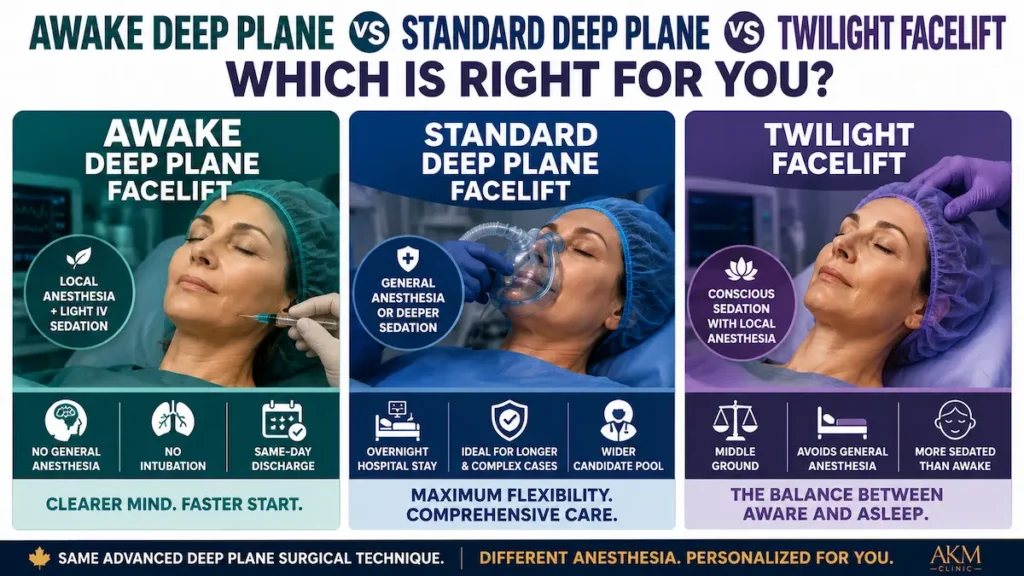
Awake Deep Plane vs Standard Deep Plane vs Twilight Facelift: Which Is Right for You?
Awake, standard, and twilight facelift pathways are often confused. They may overlap in language, but they are not the same. The surgical technique, anesthesia depth, recovery feel, and candidate pool can differ.
The key point is simple: awake deep plane and standard deep plane can use the same deep plane surgical concept. The main difference is the anesthesia model. Twilight facelift sits between fully awake local anesthesia and deeper general anesthesia.
The Surgical Technique: Same Deep Plane Principle
In an awake deep plane facelift, the surgical goal is still deep structural repositioning. The surgeon works beneath the skin and addresses deeper facial support layers, rather than relying on skin tension alone.
The full anatomy belongs on the standard deep plane page. That is where we explain retaining ligament release, SMAS relationships, vertical lift vectors, and why deep plane technique can create a natural result without the pulled look.
If you want the detailed surgical explanation, start with our deep plane facelift guide. This awake page focuses on what changes when the same concept is performed without general anesthesia.
The Anesthesia Difference
The anesthesia model is the meaningful distinction. In the awake pathway, local anesthesia numbs the face while light IV sedation helps you stay calm. You continue breathing independently, and intubation is not part of the pathway.
In the standard pathway, general anesthesia or deeper sedation may be used. This gives the surgical team broader flexibility for longer or more complex plans. It may also be more appropriate for patients who do not want any awareness of the surgical environment.
A twilight facelift offers a middle ground. It usually involves deeper conscious sedation than a pure local awake approach, but avoids full general anesthesia in selected patients. Patients comparing these options can also review our twilight facelift guide for Canadians.
Recovery Feel: Faster Mental Clarity, Same Tissue Healing Biology
Awake deep plane surgery may feel easier in the first 24 hours because there is no general anesthesia recovery. Patients may feel mentally clearer, more mobile, and less affected by post-anesthesia grogginess.
After the first few days, tissue healing follows the same biology as standard deep plane surgery. Swelling, bruising, incision healing, and scar maturation still take time. Awake surgery does not make the deep plane healing process disappear.
This distinction helps prevent disappointment. Awake surgery can change the early recovery experience. It does not create an instant recovery.
Hospital Stay and Same-Day Discharge
Standard deep plane surgery often involves an overnight hospital stay, especially when the procedure is longer or combined with other treatments. Awake deep plane surgery is designed for same-day discharge in appropriate cases.
For Canadian patients, this can feel more familiar and less intimidating. You recover in your 5-star hotel with coordinator support rather than spending the first night in hospital. You still receive medical guidance, follow-up timing, and clear instructions.
Same-day discharge is not the same as being “finished.” It simply means the anesthesia model and procedure scope allow a different early recovery setting.
Cost Difference: Awake Premium vs Standard Deep Plane
The awake option carries a modest premium because it requires a highly controlled anesthesia workflow, careful patient communication, and precise comfort management during surgery.
AKM Clinic’s technique-level pricing lists Awake Deep Plane Facelift at CAD $7,100 compared with Standard Deep Plane at CAD $6,800. That is a CAD $300 awake premium.
The value is not that awake surgery is “better” for everyone. The value is that the right patient may avoid general anesthesia while still receiving a deep plane surgical plan.
Decision Matrix: Which Pathway Fits Which Patient?
| Pathway | Anesthesia Model | Best For | Early Recovery Feel | Candidate Pool | AKM Position |
|---|---|---|---|---|---|
| Awake Deep Plane Facelift | Local anesthesia + light IV sedation | Calm, well-screened patients who want to avoid general anesthesia | Clearer first day, no general anesthesia grogginess | Narrower | Best for selected patients only |
| Standard Deep Plane Facelift | General anesthesia or deeper sedation | Broader facial aging patterns and longer surgical plans | More classic anesthesia recovery | Wider | Best for complex or extensive cases |
| Twilight Facelift | Conscious sedation with local anesthesia | Patients who want a middle ground between awake and general anesthesia | Less deep than general anesthesia, more sedated than pure local | Moderate | Useful when pure awake is too light but general anesthesia may be avoidable |
How to Read the Table as a Canadian Patient
If your main concern is anesthesia awareness, standard deep plane may feel emotionally safer. If your main concern is intubation or general anesthesia grogginess, awake may be attractive. If you want a middle ground, twilight may be worth discussing.
The final decision should not be made from a table alone. It should come from your anatomy, medical history, anxiety profile, and the surgeon’s assessment after reviewing your photos and health information.
For visual reassurance that awake outcomes can still look natural and refined, see our awake facelift before-and-after guide. The anesthesia pathway should support the surgical plan, not distract from the result.
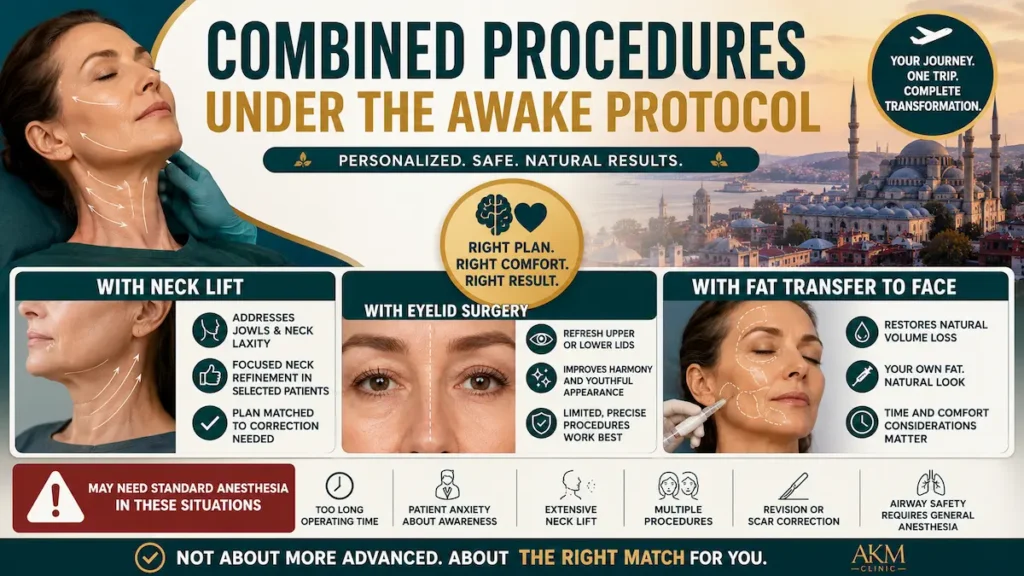
Combined Procedures Under the Awake Protocol
Combining procedures can be efficient for Canadian patients travelling to Istanbul. It can reduce the need for multiple trips, multiple recovery periods, and repeated time away from work or family. With awake deep plane surgery, though, combination planning must be more conservative than under general anesthesia.
The reason is simple. Awake surgery depends on comfort, cooperation, and a manageable operating time. If a combined plan becomes too long or too complex, the safer recommendation may be standard deep plane surgery under a deeper anesthesia model.
Awake Deep Plane Facelift With Neck Lift
A neck lift is the most common facial combination to discuss with deep plane surgery. Many patients who have jowls or lower-face heaviness also have skin laxity, platysmal banding, or fullness below the chin.
In selected patients, an awake deep plane facelift may be combined with limited neck work. This depends on the amount of correction needed. A focused neck refinement is different from a complex deep neck lift that involves deeper structures, longer dissection, and more surgical time.
If your neck is one of your main concerns, we may recommend reviewing our neck lift guide for Canadian patients before deciding whether the awake pathway is realistic. The right anesthesia plan should match the total scope, not just the facelift portion.
Awake Deep Plane Facelift With Eyelid Surgery
Upper or lower eyelid surgery can sometimes be paired with an awake facial rejuvenation plan. This may make sense when the eyelid procedure is limited, the patient is calm, and the operating time remains reasonable.
The benefit is harmony. A deep plane facelift can improve the lower face and mid-face, but it does not remove upper eyelid skin or correct lower eyelid bags. For patients with tired-looking eyes, eyelid surgery may be the missing piece.
That said, eyelid work requires precision. If a patient needs complex lower eyelid surgery, fat repositioning, or multiple facial procedures at once, we may recommend a standard anesthesia plan instead. You can compare options in our blepharoplasty guide.
Awake Deep Plane Facelift With Fat Transfer to the Face
Some patients need lift and volume. A deep plane facelift repositions descended tissues, but it does not fully replace age-related fat loss in the temples, cheeks, tear troughs, or lower face.
Fat transfer to the face can restore selected volume using the patient’s own tissue. It must be planned carefully in an awake context because donor-area harvesting, fat preparation, and facial grafting add time and stimulation.
For patients who need more extensive volume restoration, a standard anesthesia pathway may be more comfortable. Our fat transfer to face guide explains when volume restoration should be combined with a lift and when it should be staged.
When Combined Surgery Should Move to Standard Anesthesia
Awake surgery is attractive, but it has limits. If the plan includes multiple zones, a longer neck lift, eyelid surgery, laser resurfacing, or fat transfer, the awake protocol may stop being the best option.
We may recommend the standard pathway when:
- The total operating time becomes too long for patient comfort
- The patient has anxiety about being aware during surgery
- The neck component is extensive
- Several facial procedures are being combined
- The patient needs revision or scar correction
- The safest airway plan involves general anesthesia
This is not a downgrade. It is responsible planning. For broader combination options under a standard pathway, see our standard deep plane facelift page.
Why We Do Not Treat Awake Surgery as a “More Advanced” Choice
Awake surgery requires skill, but it is not automatically more advanced than standard surgery. It is simply a different pathway. The best plan is the one that lets the surgeon work safely, the patient remain comfortable, and the result look natural.
For some patients, that pathway is awake. For others, twilight or standard anesthesia is more appropriate. Good surgery begins with the right match.
The Awake Anesthesia Model: How It Actually Works
This is the core of the awake deep plane page. The facelift technique matters, but the defining feature is the anesthesia model. Local anesthesia, light IV sedation, independent breathing, and communication during surgery create a very different experience from general anesthesia.
Understanding that experience helps Canadian patients make a calmer decision. It also helps prevent two common misunderstandings: that awake surgery means “feeling everything,” or that avoiding general anesthesia means surgery becomes simple. Neither is true.
Local Anesthesia: Numbing the Surgical Field
Local anesthesia is placed into the planned surgical areas to block pain signals. The goal is to keep the face numb while the surgeon performs the lift. This is different from relying on sedation alone.
Patients may still feel pressure, pulling, or movement. These sensations are not the same as sharp pain. During an awake procedure, the team monitors comfort and can add local anesthetic when needed.
The local anesthesia phase is important. It should not be rushed. A calm, well-numbed surgical field is one of the reasons awake surgery can feel controlled rather than overwhelming.
Light IV Sedation: Calm Without Intubation
IV sedation helps reduce anxiety and improve comfort. It is titrated, which means the level can be adjusted during the procedure. The goal is relaxation, not full unconsciousness.
Because the patient is not under general anesthesia, intubation is not part of the awake pathway. The patient continues breathing independently, while the medical team monitors oxygenation, blood pressure, pulse, and overall stability.
This is one reason some Canadian patients prefer the awake approach. They want a structured surgical plan, but they want to avoid the breathing tube and grogginess associated with general anesthesia.
Conscious Sedation: What You May Actually Experience
During awake deep plane surgery, you may drift in and out of light awareness. Some patients remember very little. Others remember voices, pressure, or the feeling of the surgical team working around the face.
You should not feel sharp pain. If you do, you must be able to communicate it, and the team must respond. That communication is a safety feature, not a sign that anesthesia has failed.
For patients worried about this exact question, our detailed guide on pain management during awake facelift procedures explains the difference between pain, pressure, and awareness.
Why No Intubation Matters
Intubation is often necessary and safe in general anesthesia when performed by trained professionals. It is not something to fear automatically. Still, some patients strongly prefer to avoid it when there is a suitable alternative.
The awake protocol avoids intubation because the patient breathes independently. This may reduce certain airway-related concerns and can contribute to a smoother early recovery for selected patients.
That benefit is not universal. If airway control is safer for a patient because of medical history, procedure length, or surgical complexity, general anesthesia may be the better choice.
Awake Facelift vs General Anesthesia Facelift
The choice between awake and general anesthesia should be based on safety, comfort, and surgical scope. General anesthesia is often best for complex or longer operations. Awake anesthesia is best for selected patients with appropriate anatomy and temperament.
| Factor | Awake Deep Plane Facelift | General Anesthesia Deep Plane Facelift |
|---|---|---|
| Breathing | Independent breathing, no intubation | Airway managed by anesthesia team, often with intubation |
| Awareness | Possible light awareness, pressure, or sound | No awareness during surgery |
| Best candidate | Calm, well-screened, no-GA preference | Broader candidate pool, complex plans |
| Early recovery | Less general anesthesia grogginess | More classic anesthesia recovery period |
| Surgical flexibility | More limited by comfort and time | Greater flexibility for longer combined surgery |
For a broader decision framework, see our local versus general anesthesia facelift comparison. That article is useful for patients still deciding whether awake, twilight, or standard anesthesia fits their priorities.
Twilight Sedation vs Awake Facelift
Twilight sedation and awake facelift are related, but they are not identical. Twilight sedation usually sits between fully awake local anesthesia and general anesthesia. The patient is relaxed and breathing independently, but sedation may be deeper than a pure local awake protocol.
Awake deep plane surgery keeps the anesthesia model more focused on local anesthesia plus light IV support. Twilight is useful for patients who want less awareness but still want to avoid general anesthesia when appropriate.
If you are unsure which category fits your comfort level, our twilight facelift guide explains the sedation spectrum in more detail.
Patient Communication During Surgery
Communication is part of awake surgery. The team may ask how you feel, check your comfort, or guide you through small adjustments. This should feel organized, not chaotic.
Some patients find this reassuring. Others prefer to have no awareness at all. Both reactions are valid, which is why we ask about anxiety, past medical experiences, and personal preference during consultation.
“Awake anesthesia works best when the patient understands the experience before surgery. Comfort is not only medication. It is preparation, communication, pacing, and choosing the right candidate.”
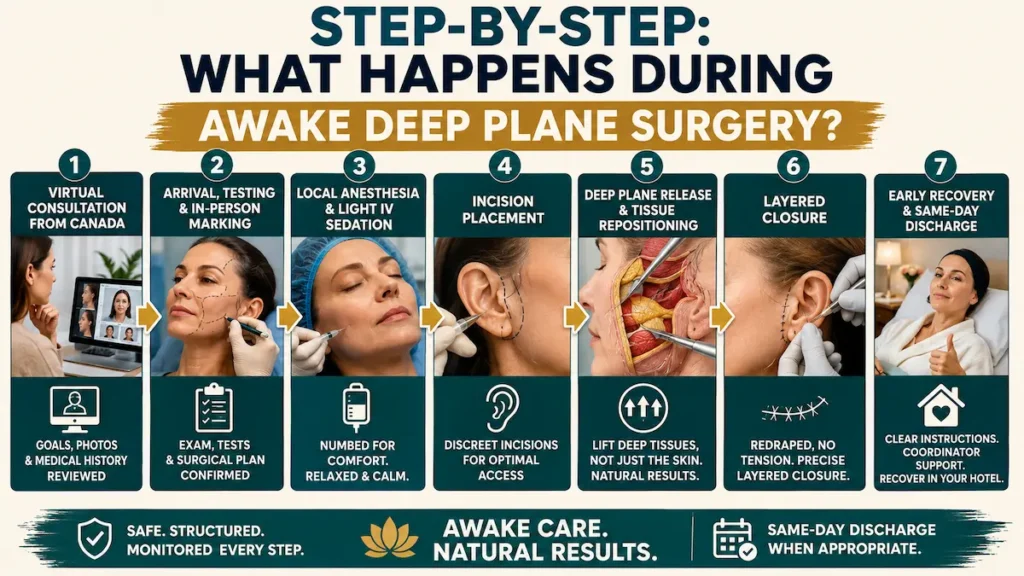
Step-by-Step: What Happens During Awake Deep Plane Surgery?
An awake deep plane facelift follows a structured sequence. The experience is different from general anesthesia surgery, but it is not informal or relaxed in a casual sense. It is still facial surgery, performed with sterile protocols, monitoring, and precise surgical planning.
For Canadian patients, knowing the sequence can reduce anxiety. You understand what happens before the procedure, when the numbing begins, what you may notice during surgery, and how the first recovery hours are managed.
Step 1: Virtual Consultation From Canada
Your first step usually happens before you book travel. You send standardized facial photos, share your goals, and provide medical history. We assess whether your concerns match a deep plane approach and whether the awake pathway may be realistic.
This is also when we ask about anxiety, previous anesthesia reactions, medication use, smoking, blood pressure, and prior facial procedures. Awake candidacy begins before you arrive in Istanbul.
If your anatomy suggests a standard deep plane, neck lift, eyelid surgery, or different anesthesia plan, we explain why. The goal is not to fit every patient into the awake option. The goal is to match the safest pathway to the patient.
Step 2: Arrival, Medical Testing, and In-Person Surgical Marking
After you arrive in Istanbul, your coordinator helps manage the local logistics. This includes VIP transfers, hotel check-in, clinic appointments, and timing. You are not expected to navigate each step alone.
Your in-person consultation confirms the surgical plan. We assess skin quality, jawline laxity, mid-face descent, neck involvement, facial asymmetry, and scar placement. Pre-operative tests are completed before surgery.
During marking, the surgeon maps incision lines and lift vectors. These markings guide the operation and help translate the plan into a controlled surgical sequence.
Step 3: Local Anesthesia and Light IV Sedation
On surgery day, the team begins with monitoring and comfort preparation. Local anesthesia is placed into the planned surgical areas. IV sedation is used to help you remain relaxed and calm.
This stage takes time. Proper numbing is essential. You should not feel sharp surgical pain, and the team checks comfort before moving forward.
You may feel pressure or movement as the local anesthetic is placed. That can feel strange, but it should remain manageable. If you feel discomfort, you can communicate with the team.
Step 4: Incision Placement
Incisions are planned around the ear and, when needed, into the hairline or natural creases. The goal is to allow access to the deep facial tissues while placing scars where they can mature discreetly.
Because you are under local anesthesia and light sedation, the team works with a controlled pace. The operating room should feel organized and calm. Comfort checks continue throughout the procedure.
Incision placement is not rushed. Precise access supports precise lifting.
Step 5: Deep Plane Release and Tissue Repositioning
The surgeon then performs the deep plane component. This is where the deeper facial support layers are released and repositioned rather than simply pulling the skin.
The detailed anatomy belongs to the standard deep plane page, but the principle is important here: the result comes from moving deeper tissues, not from stretching the skin tighter. This is how we protect the natural-first aesthetic.
During this part, you may feel pressure, movement, or awareness of the team working. Local anesthesia blocks pain, while sedation supports calmness.
Step 6: Layered Closure
After the deeper tissues are repositioned, the skin is redraped without unnecessary tension. Excess skin is removed conservatively. The incisions are closed in layers.
Layered closure matters because it reduces stress on the skin edge. Less tension can support more refined scar healing. It also helps avoid the tight, pulled appearance patients fear.
The dressing is placed once closure is complete. The team then transitions you to early recovery monitoring.
Step 7: Early Recovery and Same-Day Discharge
Because the awake pathway avoids general anesthesia, many patients feel more mentally clear during the early recovery period. You are still swollen, tired, and in the first stage of healing. You are not “back to normal.”
The team monitors you before discharge. You receive instructions on head elevation, medications, walking, eating, and warning signs. Your coordinator remains available as you return to your hotel.
Same-day discharge is only appropriate when the patient is stable, comfortable, and medically cleared. If there is any concern, safety comes first.
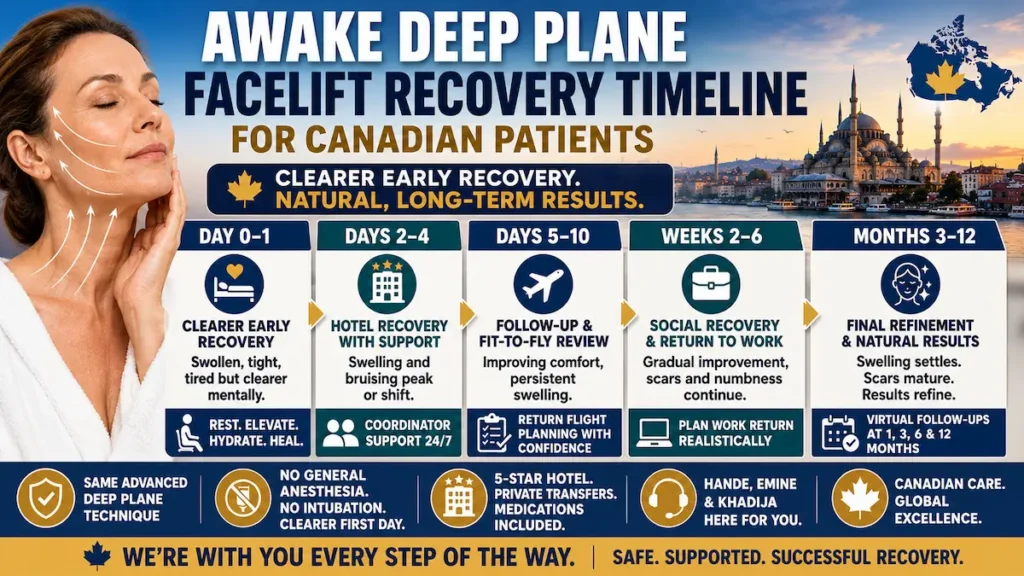
Awake Deep Plane Facelift Recovery Timeline for Canadian Patients
Awake deep plane recovery has two timelines. The first is anesthesia recovery, which may feel easier than general anesthesia. The second is tissue recovery, which still follows normal facelift biology.
This distinction is important. You may feel clearer on day one, but swelling, bruising, incision healing, numbness, and tightness still take time. Awake surgery changes the anesthesia experience. It does not erase surgical healing.
Day 0–1: Clearer Early Recovery, But Real Surgery Recovery
On the day of surgery, many awake patients feel less groggy than they expected. They may be able to speak comfortably, eat lightly, and move gently with support sooner than after general anesthesia.
Swelling and tightness are still expected. Your face may feel firm, numb, or heavy. These sensations are normal in the early phase.
Your priorities are simple: rest, head elevation, hydration, prescribed medication use, and short supervised walking. Do not judge the result at this stage.
Days 2–4: Hotel Recovery With Coordinator Support
The first few days are usually spent resting at the hotel. AKM’s all-inclusive care model includes 5-star accommodation, private transfers, medications, and 24/7 patient support, which reduces the logistical burden during early healing.
Your coordinator helps you understand appointment timing, transportation, and communication with the medical team. Our patient hosts include Hande, Emine, and Khadija. Their role is to help you feel supported, not abandoned in a foreign city.
You may still have bruising, swelling, and mild discomfort. This is expected. The key is to follow instructions, avoid overactivity, and report anything unusual promptly.
Our HBOT and LLLT Recovery Protocol
AKM Clinic uses recovery technologies to support healing for international patients. Hyperbaric Oxygen Therapy, or HBOT, helps saturate blood plasma with oxygen, supporting tissues that are temporarily stressed after surgery. It is also used as a recovery support tool for patients preparing for long-haul flights.
Low-Level Laser Therapy, or LLLT, supports cellular repair through photobiomodulation. AKM’s system uses 424 medical-grade semiconductor laser diodes at 650nm, designed to stimulate cellular ATP production without heat generation.
For facelift patients, these modalities are used to reduce swelling, support incision maturation, and help the patient progress toward fit-to-fly clearance. They do not replace surgical skill or proper aftercare. They support the healing environment.
You can read more about our clinical technology standards at our technology and standards page.
Days 5–10: Follow-Up, Swelling Control, and Fit-to-Fly Review
By days five to ten, swelling is usually still visible but more manageable. Bruising may shift downward. Incisions are checked, and the surgeon assesses whether you are healing as expected.
This is also when flight planning becomes more practical. Canadian patients returning to Toronto, Vancouver, Montreal, Calgary, Ottawa, or Halifax need clear guidance before taking a long-haul flight.
We review swelling, comfort, mobility, medication use, and any risk factors before advising travel. For a broader post-surgery travel framework, see our flight safety after surgery guide.
Weeks 2–6: Social Recovery and Return to Work
Many patients can resume desk-based work before they feel fully camera-ready. Remote work can be easier than public-facing roles. If your job involves meetings, client work, or presentations, plan for visible swelling and bruising to fade gradually.
By weeks two to six, tightness and numbness may continue. Scars are still immature. Your face may look better from week to week, but the final result is not present yet.
Canadian patients often plan surgery around quieter work periods. This may mean avoiding peak tax season, school terms, major client deadlines, or winter travel disruptions from airports like YYZ, YUL, YVR, or YYC.
Months 3–12: Final Refinement
By three months, most patients look more settled. Swelling is lower, facial movement feels more natural, and scars continue to mature. At six to twelve months, the result is much closer to its final form.
Awake surgery does not shorten the full maturation timeline. It may make the first recovery day easier, but deep tissue healing still takes months.
For visual expectations, our awake facelift before-and-after guide helps patients understand the difference between early recovery and final refinement.
| Recovery Stage | What You May Feel | What We Monitor | Canadian Planning Note |
|---|---|---|---|
| Day 0–1 | Clearer mentally, swollen, tight, tired | Comfort, blood pressure, bleeding, early mobility | Rest in Istanbul; no sightseeing |
| Days 2–4 | Swelling and bruising peak or shift | Incisions, medications, hydration, walking | Hotel recovery with coordinator support |
| Days 5–10 | Improving comfort, persistent swelling | Fit-to-fly readiness and healing pattern | Return flight may be discussed if cleared |
| Weeks 2–6 | Gradual social recovery | Scar maturation, numbness, swelling reduction | Plan work return realistically |
| Months 3–12 | Refinement and natural movement | Long-term healing and result stability | Virtual follow-ups at 1, 3, 6, and 12 months |
Pain, Safety & Risks: What Canadian Patients Should Know
An awake deep plane facelift should not feel painful during surgery, but it is still real surgery. Patients need an honest explanation of comfort, risk, and recovery. Clear expectations reduce anxiety and help you recognize what is normal versus what needs attention.
At AKM Clinic, we do not describe awake surgery as “risk-free.” No surgical procedure deserves that label. We describe it as a carefully selected pathway, performed with local anesthesia, light IV sedation, monitoring, and surgeon-led screening.
Is an Awake Deep Plane Facelift Painful?
The short answer is no: sharp pain should not be part of the experience. Local anesthesia is used to block pain in the surgical field, and IV sedation helps reduce anxiety and awareness.
You may still feel pressure, movement, vibration, or a pulling sensation. You may hear voices or recognize that the team is working around your face. These sensations can feel unusual, but they should not feel like surgical pain.
If discomfort appears, the team can pause, assess, and add local anesthesia. Communication is part of the awake protocol. The patient is not expected to silently endure pain.
Awake-Specific Discomforts
Awake surgery has a different comfort profile from general anesthesia. The benefit is avoiding intubation and deep post-anesthesia grogginess. The trade-off is possible awareness of the operating room environment.
Some patients may remember parts of the procedure. Some may notice time passing slowly. Others may feel emotionally sensitive because they are aware that surgery is happening, even though pain is controlled.
This is why anxiety screening matters. A calm, prepared patient may find the experience easier than expected. A highly anxious patient may be safer and more comfortable under standard anesthesia.
Common Short-Term Side Effects
Most side effects are similar to standard facelift recovery. The awake pathway changes the anesthesia experience, not the biology of tissue healing.
- Swelling around the cheeks, jawline, and neck
- Bruising that may shift downward over several days
- Tightness or heaviness in the lower face
- Temporary numbness near the ears or incision lines
- Mild drainage or dressing discomfort in the early phase
- Fatigue, especially after travel and surgery
These changes are expected in the early recovery period. They should improve gradually. Sudden severe swelling, increasing one-sided pain, fever, or bleeding should be reported immediately.
Rare but Serious Risks
Facelift risks include hematoma, infection, wound-healing issues, scar concerns, temporary or rarely longer-lasting nerve irritation, asymmetry, skin compromise, and dissatisfaction with the result.
Awake anesthesia does not remove these risks. It mainly avoids general anesthesia-specific elements such as intubation and deeper anesthetic recovery. The surgical risks of facial dissection, incision healing, and tissue repositioning still exist.
Good surgical planning reduces risk, but no clinic can eliminate it. That is why medical screening, sterile protocols, surgeon experience, and follow-up matter as much as the anesthesia choice.
How AKM Clinic Reduces Risk
Our risk-reduction approach begins before surgery. We review medical history, medication use, smoking, blood pressure, previous procedures, and emotional readiness for awake surgery. Patients who are not suited to the awake pathway are redirected to a safer alternative.
During surgery, monitoring continues throughout the procedure. The team tracks vital signs, sedation depth, oxygenation, and comfort. The surgical field is managed with sterile protocols and controlled pacing.
After surgery, the same safety culture continues. You receive written instructions, medications, coordinator access, and scheduled follow-up. AKM’s care model includes 24/7 patient support and post-operative medication guidance as part of its all-inclusive structure.
What Canadian Patients Should Report Immediately
Most recovery symptoms are expected, but some should never be ignored. Contact the team promptly if you notice:
- Rapid one-sided swelling
- Bleeding that soaks dressings
- Fever or chills
- Increasing redness or warmth around an incision
- Sudden severe pain
- Shortness of breath or chest pain
- Confusion, fainting, or severe dizziness
Canadian patients should also know where they would seek urgent local care after returning home. AKM’s follow-up supports you remotely, but emergency symptoms in Canada require local medical attention.
“Pain control is not the only safety question in awake surgery. The real question is whether the patient is calm, medically suitable, properly monitored, and supported before, during, and after the procedure.”
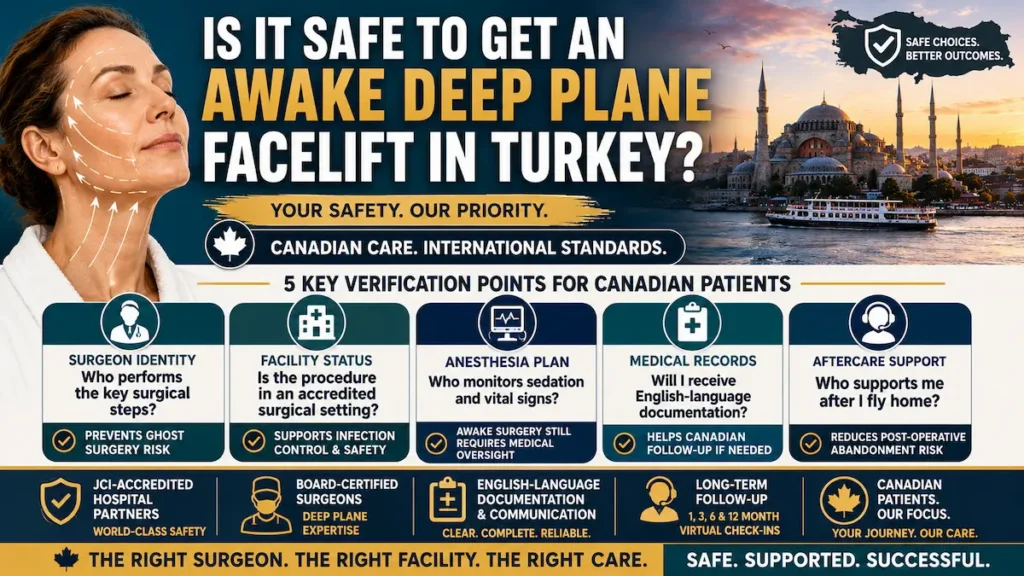
Is It Safe to Get an Awake Deep Plane Facelift in Turkey?
This is one of the most reasonable questions a Canadian patient can ask. Travelling for elective facial surgery requires more diligence than booking a local consultation. You are evaluating a surgeon, a facility, an anesthesia model, a follow-up system, and a country-specific regulatory environment.
We encourage that level of scrutiny. A careful patient is usually a safer patient. Canadian patients can also review the Government of Canada guidance on receiving medical care outside Canada before making any international surgical decision.
Start With an Honest Canadian Risk Framework
Canadian patients often worry about infection, antibiotic resistance, incomplete records, language barriers, and what happens if they need follow-up after returning home. These concerns are not irrational. They are exactly the right issues to investigate before booking surgery abroad.
The answer is not “Turkey is safe” as a blanket statement. The better answer is: the clinic, surgeon, facility, protocol, and aftercare system determine safety. A bad outcome can happen in any country when those elements are weak.
At AKM Clinic, our safety positioning is built around surgeon-led planning, JCI-accredited hospital partnerships, Turkish Ministry of Health authorization, sterile protocols, English-language documentation, and long-term follow-up.
The Wrong-Clinic Problem, Not the Wrong-Country Problem
Patients often read alarming stories about surgery abroad and assume the problem is geography. In reality, the more useful question is clinic selection.
Red flags include unclear surgeon identity, technician-led procedures, pressure-based sales, no hospital accreditation, vague aftercare, poor medical records, and a price that seems built around volume rather than safety.
AKM Clinic’s model is different. We focus on selected patients, surgeon-led treatment planning, and documented medical support. Turkey has excellent surgeons and unsafe operators, just as any country has stronger and weaker providers.
Ghost Surgery Prevention
“Ghost surgery” refers to a situation where the patient believes one surgeon will operate, but another person performs key parts of the procedure. This is a major trust concern for international patients.
Canadian patients should ask direct questions before booking:
- Who is my surgeon of record?
- Who performs the deep plane dissection?
- Who administers or supervises sedation?
- Where is the procedure performed?
- What happens if the plan changes intra-operatively?
Our article on ghost surgery in Turkey explains how patients can verify surgeon identity, documentation, and accountability before committing to a clinic.
Facility Standards and Sterilization
AKM Clinic works with JCI-accredited hospital facilities and follows strict sterilization protocols. Our technology and standards documentation describes multi-stage sterilization, WHO-aligned hygiene principles, CDC-style sterilization benchmarks, and a zero-compromise sterile field policy.
For awake deep plane surgery, facility standards matter just as much as anesthesia choice. Avoiding general anesthesia does not remove the need for a proper surgical environment.
Canadian patients should never choose an awake facelift in a setting that feels more like a medspa than a surgical facility. Awake does not mean casual. It means a different anesthesia model inside a controlled medical setting.
Surgeon Credentials and Canadian Equivalency
Canadian patients are used to verifying surgeons through provincial colleges and Royal College pathways. When evaluating a surgeon abroad, you need an equivalent framework.
Look for board-level credentials, facial surgery experience, hospital privileges, continuing education, and verifiable patient outcomes. The Royal College of Physicians and Surgeons of Canada’s public directory of certified specialists is a useful Canadian benchmark for understanding specialist training expectations, while international surgery requires its own verification process.
Our guide on plastic surgeon board certification explains how Canadian patients can compare EBOPRAS, EAFPS, RCPSC, and other credential systems. AKM’s surgical leadership includes European Board-Certified specialists and facial plastic surgery expertise, with a clinic history of over 2,000 successful facial surgeries since 2013.
| Verification Point | What Canadian Patients Should Ask | Why It Matters |
|---|---|---|
| Surgeon identity | Who performs the key surgical steps? | Prevents ghost surgery risk |
| Facility status | Is the procedure in an accredited surgical setting? | Supports infection control and emergency readiness |
| Anesthesia plan | Who monitors sedation and vital signs? | Awake surgery still requires medical oversight |
| Medical records | Will I receive English-language documentation? | Helps Canadian follow-up if needed |
| Aftercare | Who supports me after I fly home? | Reduces post-operative abandonment risk |
English-Language Documentation and Canadian Follow-Up
Medical records matter after international surgery. Canadian family physicians, walk-in clinics, or emergency departments need clear information if you seek care after returning home.
We provide discharge guidance and follow-up communication in English. Your long-term virtual follow-up programme includes check-ins at 1, 3, 6, and 12 months, which supports continuity after you return to Canada.
This does not replace your local medical system. If you develop urgent symptoms in Canada, you should seek local care. AKM’s role is to provide surgical context, records, and guidance so your local provider is not working in the dark.
Travel Insurance and Elective Surgery
Many Canadian travel insurance policies exclude elective cosmetic surgery complications. Patients should read their policy carefully before booking. Do not assume that standard travel insurance will cover post-operative concerns linked to an elective procedure.
This is especially important for awake surgery because the anesthesia model can make the procedure feel less intense. It is still surgery. Insurance, contingency planning, and emergency readiness still matter.
We recommend asking your insurer direct questions in writing before travelling. Keep copies of all replies.
Health Canada and Procedure-Related Safety Awareness
Canadian patients are used to Health Canada’s role in product, device, and safety oversight. While an awake deep plane facelift in Turkey is performed under Turkish clinical regulation, Canadians can still use Health Canada’s public information to understand how medical and aesthetic procedure safety is discussed at home.
For example, Health Canada explains that some technologies used in cosmetic procedures may be regulated as medical devices depending on their intended use. You can review its overview of devices used in cosmetic procedures as part of your wider due diligence.
The practical lesson is simple: ask what products, devices, sutures, and recovery technologies are used, and ask who is responsible for them. A serious clinic should be able to answer clearly.
Our Position on Safety
Awake deep plane facelift in Turkey can be a safe option for the right patient, with the right surgeon, in the right facility, with the right follow-up. It is not safe when used as a marketing shortcut, performed in the wrong setting, or offered to patients who are not appropriate candidates.
That is why we do not promise awake surgery to everyone. We offer it selectively, after clinical review. Safety begins with saying no when no is the better answer.
For a broader overview of international surgical safety, see our guide to plastic surgery safety in Turkey for Canadian patients.
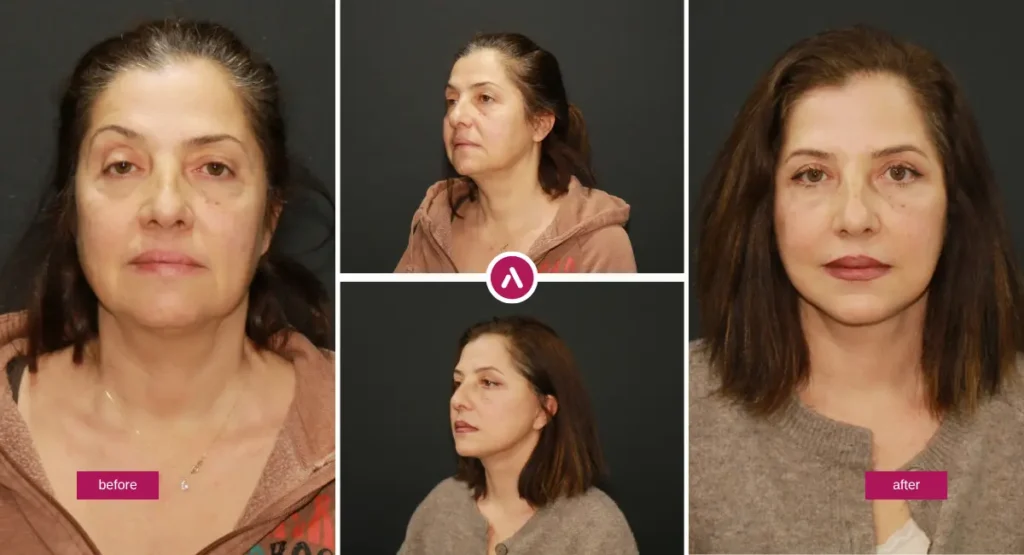
Awake Deep Plane Facelift Before and After: Realistic Expectations and Natural-First Results
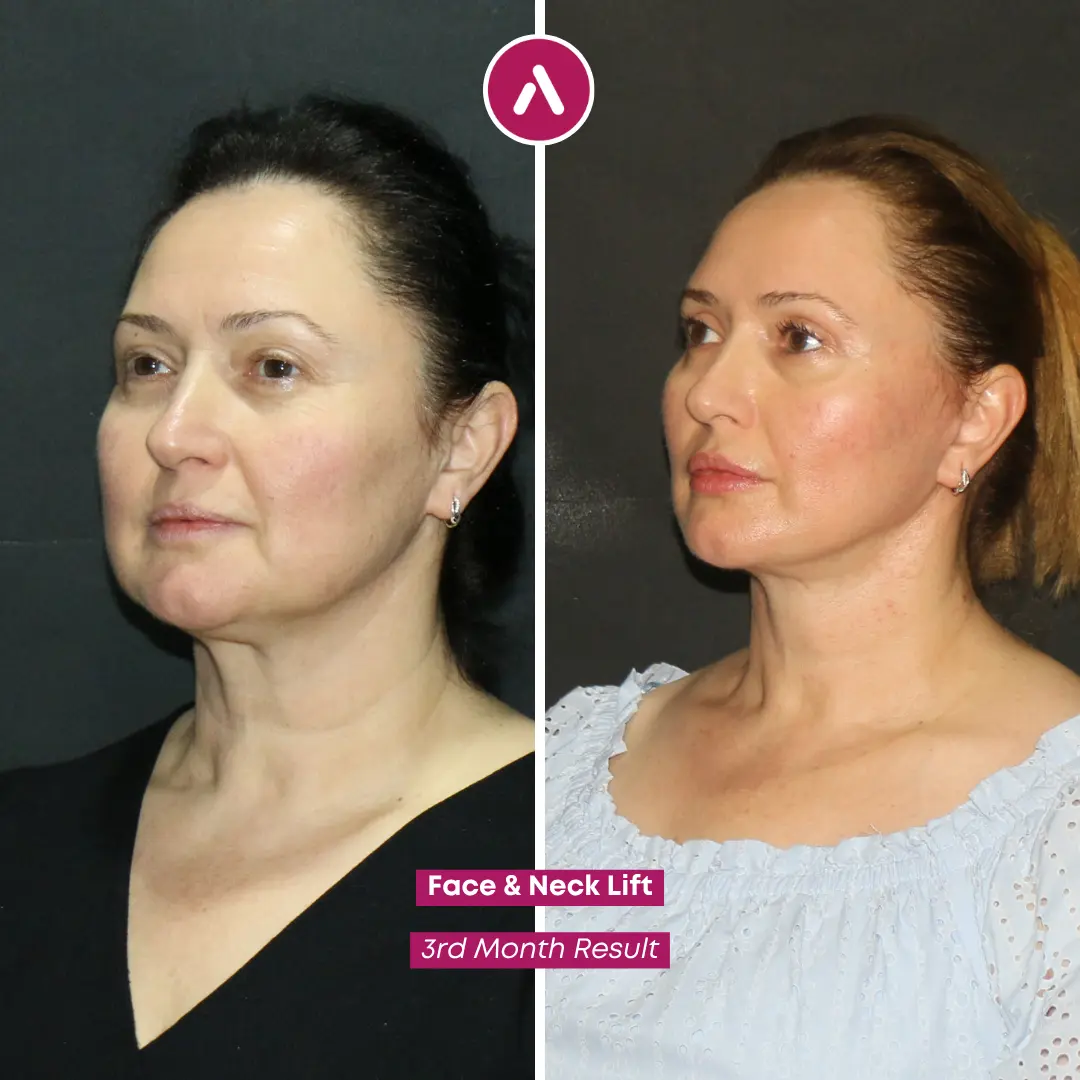
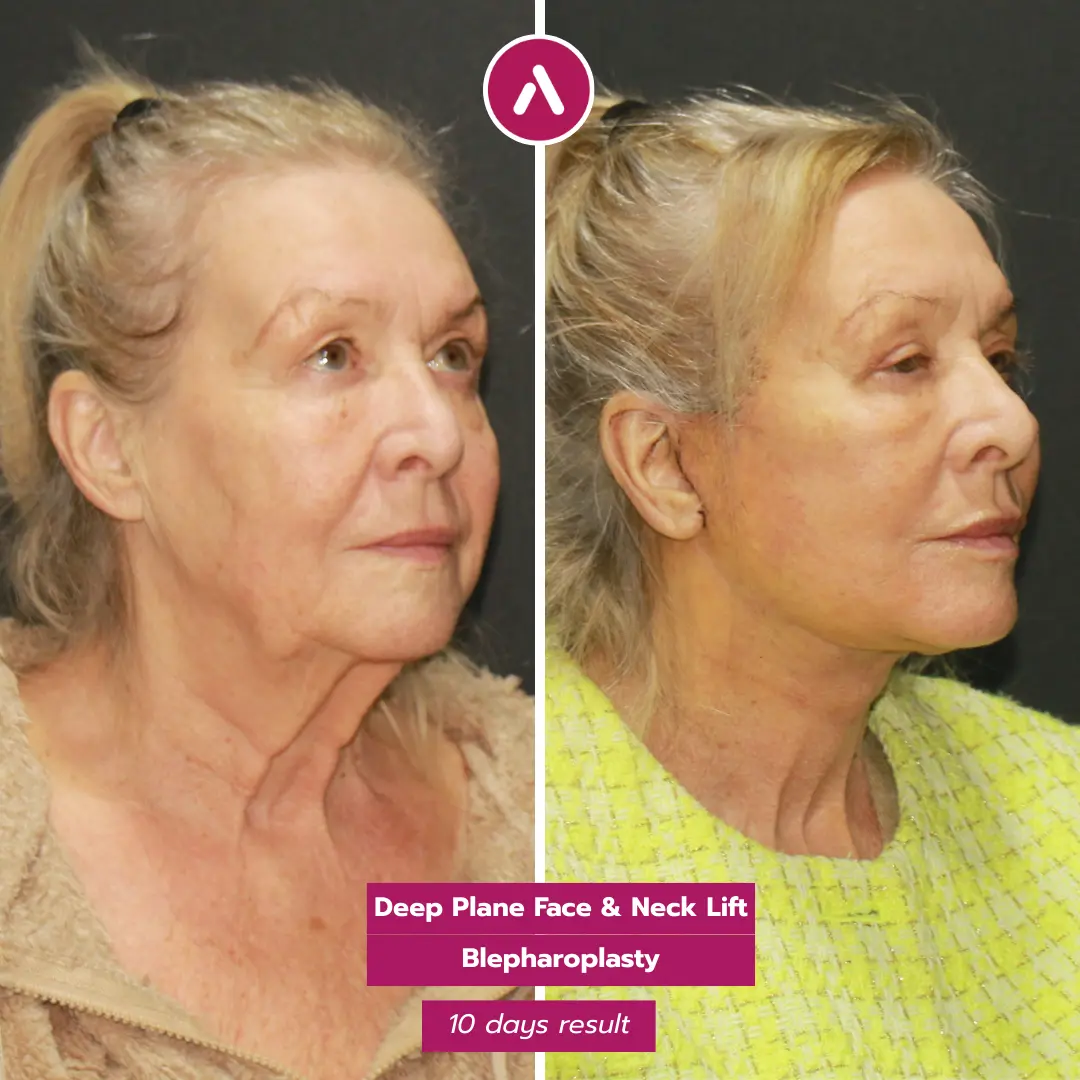
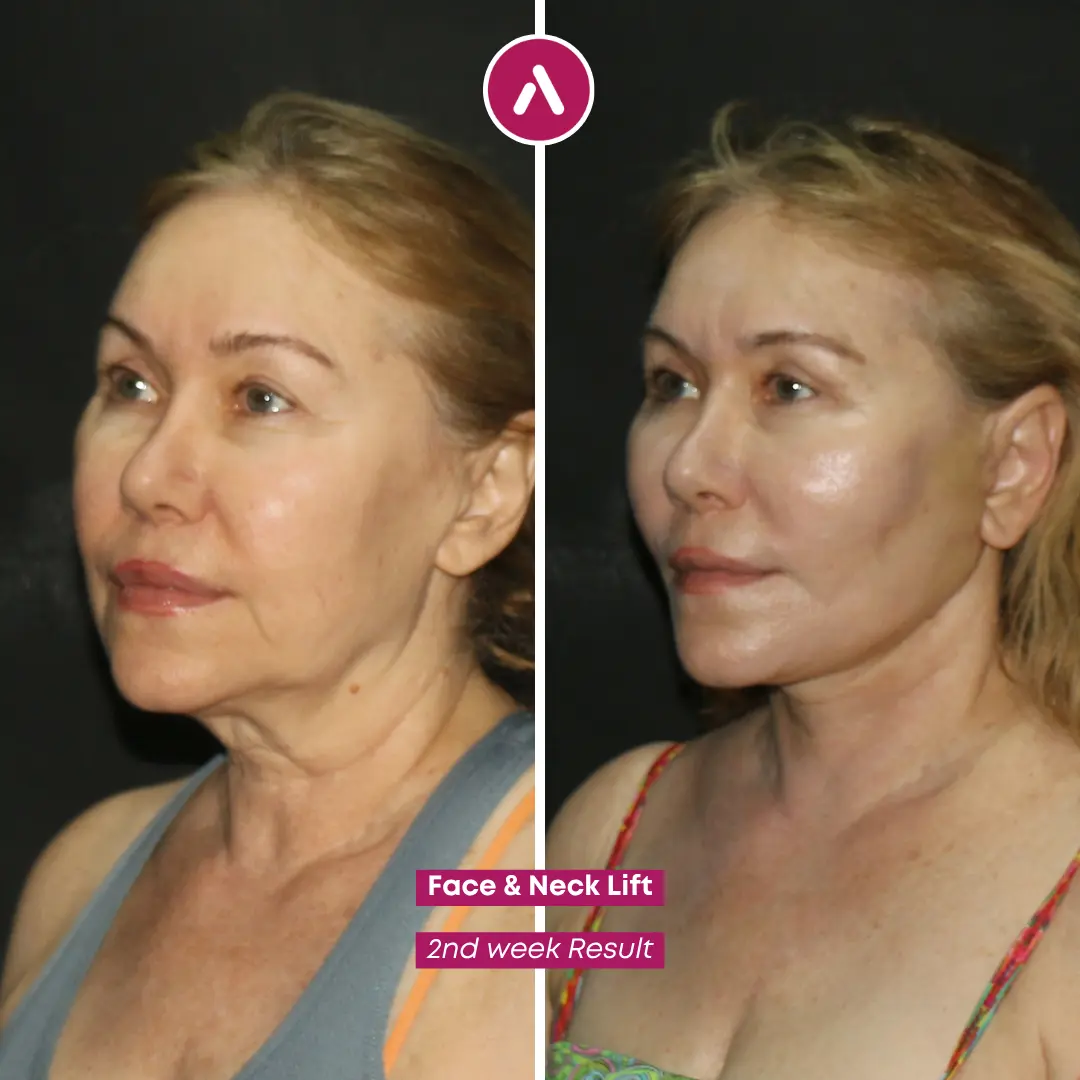
An awake deep plane facelift should be judged by the same aesthetic standard as a standard deep plane facelift. The anesthesia model changes your surgical experience. It does not change the goal: a refreshed, natural-looking face that still looks like you.
Our philosophy is “Rejuvenation, not alteration.” That means we aim to restore structure, soften heaviness, and improve definition without creating the tight or operated-on appearance many Canadian patients fear.
Awake Outcomes Should Match Standard Deep Plane Outcomes
The awake pathway does not produce a smaller result by definition. When the same deep plane technique is performed on the right candidate, the expected aesthetic outcome should match the standard deep plane approach.
The difference is not the lift itself. The difference is that local anesthesia and light IV sedation replace general anesthesia for selected patients. The surgical plan still focuses on deeper tissue repositioning rather than skin tension.
This is why we avoid framing awake surgery as “less invasive” in a vague way. It is still surgery. It is a different anesthesia pathway for the same structural rejuvenation goal.
What Usually Improves
An awake deep plane facelift can improve visible signs of lower-face and mid-face aging. Most patients are looking for sharper definition, less heaviness, and a more rested appearance.
Common improvements may include:
- Improved jawline definition
- Softening of early or moderate jowls
- Better cheek position
- Reduced lower-face heaviness
- A more rested facial expression
- Less reliance on fillers or temporary lifting treatments
These changes should look age-appropriate. We do not aim to make a 55-year-old face look 25. We aim to restore balance and structure in a way that looks believable.
What Awake Surgery Does Not Change
Awake surgery does not change your skin quality, bone structure, or natural asymmetry. It does not remove every line. It does not stop aging.
It also does not replace the need for careful recovery. Swelling, bruising, numbness, tightness, and scar maturation still follow the normal healing curve. The first day may feel easier without general anesthesia, but the deeper tissues still need time to settle.
Patients who expect an instant final result are usually disappointed. Patients who understand the 3- to 12-month refinement process usually feel more prepared.
Natural-First Means No Pulled Look
The pulled look usually happens when facial skin is asked to do too much. A deep plane approach reduces that risk by repositioning deeper tissues, then allowing the skin to redrape more naturally.
In the awake pathway, we preserve the same principle. The lift should come from structure. The skin closure should not create visible tension.
Our goal is for people around you to notice that you look rested, not that you had surgery. That is the standard Canadian patients often describe during consultation: refined, private, and difficult to detect.
Before-and-After Expectations
Before-and-after photos are useful, but they must be interpreted carefully. Lighting, angle, facial expression, swelling stage, and makeup can all change how a result appears.
When reviewing cases, look for consistency:
- Is the jawline cleaner without looking stretched?
- Do the cheeks look repositioned rather than overfilled?
- Are the ears and hairline preserved naturally?
- Do the scars appear well placed?
- Does the face still look expressive?
The Canadian Society of Plastic Surgeons facelift overview is useful for understanding the broad goals of facelift surgery from a Canadian professional society perspective. For AKM-specific visual reference, see our deep plane facelift before-and-after gallery. For awake-specific outcome context, our awake facelift before-and-after guide explains how results compare with standard deep plane surgery.
How Long Do Results Last?
Because the surgical mechanism is the same deep plane concept, longevity should follow the same broad expectation as a standard deep plane facelift. Deep plane results are commonly discussed in the 10- to 15-year range, depending on skin quality, genetics, weight stability, sun exposure, and ongoing aging.
Awake surgery does not make the result last longer. It also does not make it shorter when the same surgical technique is properly performed. The anesthesia model affects the experience, not the aging biology.
International professional organizations such as the International Society of Aesthetic Plastic Surgery can also help patients understand the broader global context of aesthetic surgery standards, although your final decision should be based on surgeon, facility, safety protocol, and follow-up.
“The goal of an awake deep plane facelift is not to create an awake-looking result. The goal is a natural deep plane result, achieved through a no-general-anesthesia pathway when the patient is suitable.”
Awake Deep Plane Facelift Cost 2026: Turkey vs Canada
Canadian patients researching awake facelift cost in Canada often discover that true awake deep plane protocols are not widely available in domestic private practice. Most Canadian deep plane facelift quotes still centre on general anesthesia or deeper sedation, with surgeon, facility, anesthesia, and follow-up fees itemized separately.
At AKM Clinic, the Awake Deep Plane Facelift is priced at CAD $7,100, compared with our Standard Deep Plane Facelift at CAD $6,800. The difference is a CAD $300 awake premium, reflecting the local anesthesia pathway, additional tolerance assessment, comfort-focused sedation workflow, and same-day discharge planning.
There is currently no separate awake deep plane cost page in the AKM Canada sitemap. For that reason, we link Canadian patients to the broader deep plane facelift cost guide, where the awake variant belongs within the deep plane pricing family.
For package planning, the closest family package is the all-inclusive deep plane facelift package, which includes a 4-night stay structure for standard deep plane care. The awake protocol can be quoted with the awake premium applied after your candidacy review.
By comparison, private deep plane facelift quotes in Toronto, Vancouver, and Montreal often reach CAD $35,000–$48,000 before travel, hotel, or extended aftercare considerations. The difference reflects health care economics, overhead, and bundled logistics, not a lower clinical standard.
Canadian-dollar pricing shown for planning clarity; your coordinator will confirm the final payment details before booking.
| Option | AKM / Canada Cost Reference | Anesthesia Model | Notes for Canadian Patients |
|---|---|---|---|
| Standard Deep Plane Facelift at AKM | CAD $6,800 | Standard anesthesia pathway | Best for broader candidate pool and complex surgical plans |
| Awake Deep Plane Facelift at AKM | CAD $7,100 | Local anesthesia + light IV sedation | CAD $300 premium for selected no-GA pathway |
| All-Inclusive Deep Plane Package Family | Package quoted after clinical review | Depends on final plan | Includes hotel, transfers, support, and post-op pathway when applicable |
| Private Deep Plane Facelift in Canada | Often CAD $35,000–$48,000 | Usually general anesthesia or deeper sedation | Surgeon, facility, anesthesia, and follow-up may be billed separately |
How to Find the Best Awake Deep Plane Facelift Surgeon in Turkey: A Canadian Patient’s Checklist
Choosing an awake deep plane facelift surgeon requires two layers of verification. First, the surgeon must be skilled in deep plane facial rejuvenation. Second, the team must understand awake surgery: pacing, communication, local anesthesia comfort, patient selection, and intra-operative monitoring.
Awake surgery should never be chosen because it sounds easier to sell. It should be chosen because the patient, surgeon, anesthesia model, and procedure scope fit together safely.
Verify Deep Plane Experience First
The first question is not “Can this be done awake?” The first question is “Can this surgeon perform deep plane facial surgery well?” An awake anesthesia model cannot compensate for weak facial anatomy experience.
Ask whether the surgeon regularly performs deep plane facelifts, how they manage retaining ligament release, how they protect facial nerves, and how they avoid skin-only tension. The answers should be specific, not promotional.
At AKM Clinic, our facial surgery programme is built around a Natural-First philosophy and over 2,000 successful facial surgeries since 2013. You can learn more about our clinic philosophy and surgical leadership on our About AKM Clinic page.
Verify Awake Surgery Experience
Awake facial surgery requires a different rhythm. The surgeon must work precisely while the patient is breathing independently and may have light awareness. The team must know how to maintain comfort without rushing.
Ask how local anesthesia is placed, how IV sedation is monitored, how discomfort is handled, and how the team decides whether to continue or convert the plan if needed. Good answers should acknowledge limits.
A clinic that says “everyone can do awake” is not being careful enough. Awake surgery is selective.
Check Board-Equivalent Credentials
Canadian patients are familiar with RCPSC pathways and provincial college verification. When evaluating a surgeon abroad, you need to look for comparable credential signals: board-level training, facial surgery focus, hospital-based practice, and international professional education.
| Credential Signal | What It Suggests | Why Canadian Patients Should Care |
|---|---|---|
| European board-level certification | Structured specialist training and examination pathway | Provides a framework comparable to formal Canadian credential review |
| Facial plastic surgery fellowship or society involvement | Specific focus on facial anatomy and rejuvenation | Important for deep plane work near facial nerve branches |
| Hospital-based surgical privileges | Procedure performed in a controlled clinical setting | Supports safety, sterility, and emergency readiness |
| Documented patient follow-up | Clinic remains accountable after surgery | Critical after you return to Canada |
For a deeper credential framework, review our guide to plastic surgeon board certification. It explains how Canadian patients can compare international credentials without relying on vague marketing language.
Ask Who Performs the Key Surgical Steps
For deep plane surgery, the key steps should be surgeon-led. These include dissection, ligament release, tissue repositioning, hemostasis, and final aesthetic judgment. Delegating non-critical support tasks is different from delegating the operation.
Ask direct questions before booking:
- Who performs the deep plane release?
- Who supervises sedation and monitoring?
- Who closes the incisions?
- Who sees me before discharge?
- Who follows me after I return to Canada?
These questions are not rude. They are responsible. A transparent clinic will welcome them.
Review Before-and-After Results Carefully
Before-and-after photos should show natural movement, appropriate jawline improvement, and no obvious over-tightening. Look beyond the most dramatic images. Consistency is more important than one impressive case.
Because awake surgery uses the same deep plane aesthetic goal, the result should not look different just because the anesthesia model was different. The face should look refreshed, balanced, and expressive.
You can review patient-facing outcomes and broader trust signals through our professional plastic surgery reviews page.
Ask About Follow-Up After Canada Return
Follow-up is one of the biggest concerns for Canadians travelling abroad. You need to know who will answer questions after you land in Toronto, Vancouver, Montreal, Calgary, Edmonton, Ottawa, Winnipeg, or Halifax.
At AKM Clinic, long-term virtual follow-up includes planned check-ins at 1, 3, 6, and 12 months. This helps track swelling, scars, asymmetry concerns, sensation changes, and overall healing.
Remote follow-up does not replace emergency care in Canada. It adds surgical continuity, documentation, and guidance from the team that performed your operation.
“A strong awake facelift surgeon must be both technically skilled and patient-aware. The operation is not only about anatomy. It is also about comfort, communication, and knowing when awake is not the right choice.”
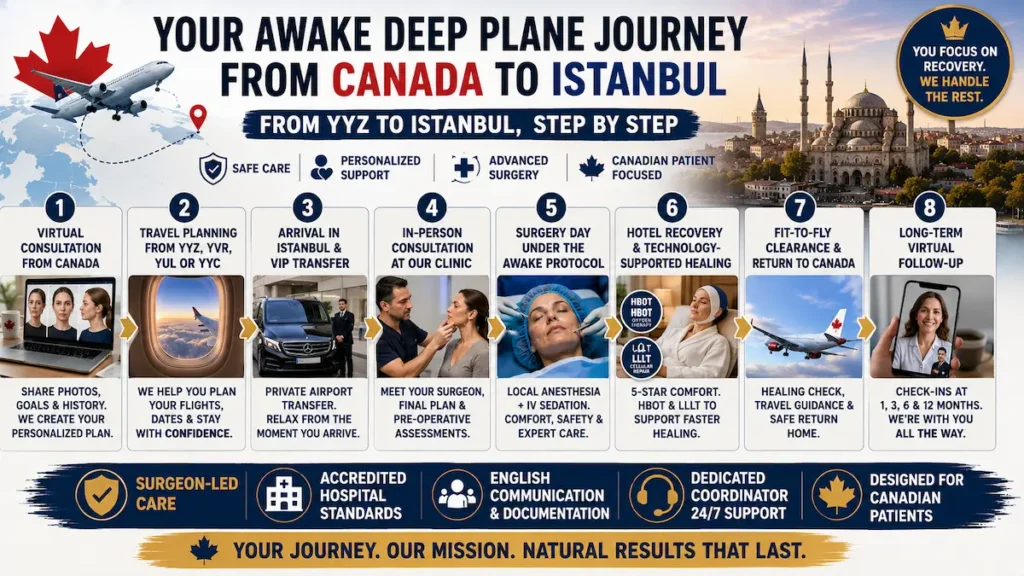
Your Awake Deep Plane Journey From Canada: From YYZ to Istanbul, Step by Step
For Canadian patients, the surgery itself is only one part of the decision. The full experience includes virtual assessment, flight planning, arrival support, hotel recovery, fit-to-fly clearance, and follow-up after returning home.
We design the process so you can focus on recovery rather than logistics. This matters more when you are travelling after facial surgery and may be managing swelling, dressing care, and fatigue in a new country.
Step 1: Virtual Consultation From Canada
Your journey begins with a virtual consultation and photo assessment. You share your goals, medical history, previous procedures, and concerns about anesthesia. We assess whether awake deep plane surgery is realistic or whether another pathway would be safer.
Photos should be clear, makeup-free, and taken from multiple angles. We usually need front, side, three-quarter, and neck views. Good photos help the surgeon evaluate jowls, cheek descent, skin laxity, neck anatomy, and facial asymmetry.
This stage also gives you space to ask practical questions: how awake you will be, how pain is controlled, how long you stay in Istanbul, and how follow-up works after you return to Canada.
Step 2: Travel Planning From Toronto, Vancouver, Montreal, or Calgary
Most Canadian patients travel through major airports such as YYZ, YVR, YUL, or YYC. Flight schedules change, so we do not recommend relying on outdated route information. Always check current airline schedules before booking.
For facial surgery, we advise planning enough time in Istanbul for pre-operative assessment, surgery, early recovery, and fit-to-fly review. Do not build a schedule around the earliest possible return date.
Canadian passport holders should also confirm current Türkiye entry rules before travel. Requirements can change. Your passport validity, flight routing, and personal immigration status may affect your plan.
Step 3: Arrival in Istanbul and VIP Transfer
After arrival, your private transfer takes you from the airport to your hotel or clinic appointment, depending on the schedule. You do not need to negotiate local transportation while tired from a long-haul flight.
Our patient journey resources explain how arrival, hotel recovery, clinic visits, and airport transfers are organized. You can review the full logistics pathway on our patient journey from Canada to Istanbul page.
Recovery logistics are not cosmetic extras. They reduce stress, missed appointments, and unnecessary walking during the early healing period.
Step 4: In-Person Consultation at Our Istanbul Clinic
Before surgery, you meet the team in person. The surgeon confirms anatomy, reviews the awake plan, answers final questions, and completes surgical markings. Pre-operative medical tests are also completed.
This is the final decision point. If the in-person assessment shows that awake surgery is not ideal, we discuss alternatives. Safety can override the original plan.
You can learn more about the clinical setting on our Istanbul clinic page.
Step 5: Surgery Day Under the Awake Protocol
On surgery day, the awake anesthesia process begins gradually. Local anesthesia is placed, IV sedation supports calmness, and monitoring continues throughout the procedure.
You should expect the team to communicate with you, check comfort, and manage the pace. You may remember parts of the experience. You should not feel sharp pain.
After surgery, you are observed before discharge. Same-day hotel recovery is possible only when you are stable, comfortable, and medically cleared.
Step 6: Hotel Recovery and Technology-Supported Healing
Your early recovery takes place in a supported hotel environment. Rest, head elevation, medications, hydration, and short walks are your priorities.
Where appropriate, we use HBOT and LLLT as part of the recovery pathway. These technologies are designed to support swelling control, tissue oxygenation, and cellular repair before your long-haul return flight. You can read more on our technology and standards page.
The first few days are not for tourism. Istanbul is a beautiful city, but healing comes first.
Step 7: Fit-to-Fly Clearance and Return to Canada
Before you fly home, we assess your healing. The team reviews swelling, bruising, incision status, comfort, medication needs, and mobility. You receive travel guidance based on your recovery, not a generic calendar.
On the flight home, plan for comfort. Choose clothing that does not press on the face or neck. Keep essentials in your carry-on. Walk gently when safe, hydrate, and follow the medication plan.
If you notice unusual symptoms after returning to Canada, contact AKM and seek local care when needed. Remote surgical follow-up and Canadian urgent care can work together when records and communication are clear.
Step 8: Long-Term Virtual Follow-Up
Healing continues after you return home. Swelling, numbness, scar maturation, and subtle asymmetry questions can appear weeks or months later. That is normal.
Our long-term virtual follow-up programme includes check-ins at 1, 3, 6, and 12 months. These touchpoints allow your surgical team to monitor progress and guide you through normal healing stages.
The journey does not end when your plane lands in Canada. Follow-up is part of the treatment plan.
Frequently Asked Questions About Awake Deep Plane Facelift in Turkey (FAQ):
Is an awake deep plane facelift painful?
Sharp surgical pain should not be part of the experience. Local anesthesia blocks pain in the surgical field, while light IV sedation helps you stay calm and comfortable.
You may feel pressure, movement, vibration, or hear voices in the operating room. These sensations can feel unusual, but they should not feel painful. If discomfort appears, the team can pause and add more local anesthesia.
Am I fully awake during the procedure?
You are not under general anesthesia, but you are also not expected to feel fully alert and tense. Most patients are relaxed with light IV sedation and may drift in and out of awareness.
Some patients remember parts of the procedure. Others remember very little. The exact experience depends on sedation response, anxiety level, procedure length, and individual physiology.
Is awake surgery safer than general anesthesia?
Awake surgery is not automatically safer for everyone. It avoids general anesthesia and intubation, which can be helpful for selected patients, but it still requires proper monitoring, sterile protocols, and experienced surgical judgment.
For some patients, general anesthesia is the safer and more comfortable option. This may apply to complex surgical plans, severe anxiety, longer combined procedures, or certain medical histories.
Who is not a good candidate for awake deep plane facelift?
You may not be a good candidate if you have severe anxiety about being aware during surgery, difficulty lying still, uncontrolled blood pressure, complex revision needs, or a surgical plan that requires multiple major procedures.
We may also recommend the standard deep plane pathway if your anatomy requires extensive neck work or a longer operating time. Awake surgery should be selected carefully, not forced into every plan.
Does an awake deep plane facelift give the same result as standard deep plane?
When performed on the right candidate, the aesthetic goal is the same: structural facial rejuvenation through deep plane tissue repositioning. The anesthesia model changes the surgical experience, not the Natural-First philosophy.
That said, patient selection matters. If your case is too complex for the awake pathway, choosing awake surgery could limit the surgical plan. In that situation, standard deep plane surgery may produce the better result.
How long does recovery take?
The first day may feel easier than general anesthesia recovery because there is less post-anesthesia grogginess. Tissue healing still takes time.
Most patients should plan for visible swelling and bruising during the first 1–2 weeks. Social recovery improves over several weeks, while deeper refinement and scar maturation continue for months.
When can I fly back to Canada?
Fit-to-fly timing depends on your healing, swelling, comfort, mobility, medication use, and surgical scope. We do not recommend booking the earliest possible return date without allowing enough time for follow-up in Istanbul.
Before your return flight, the team reviews your recovery and gives travel guidance. Long-haul flights to Canada require extra attention to hydration, gentle walking, medication timing, and swelling control.
Does OHIP, MSP, RAMQ, or AHCIP cover awake deep plane facelift?
No. Provincial health plans such as OHIP, MSP, RAMQ, and AHCIP generally do not cover elective cosmetic facelift surgery. This applies whether the procedure is performed in Canada or abroad.
Coverage may exist for some reconstructive procedures, but an awake deep plane facelift performed for facial rejuvenation is a private-pay procedure.
Does Canadian travel insurance cover complications?
Many Canadian travel insurance policies exclude elective cosmetic surgery and complications related to it. You should review your policy carefully before booking and ask the insurer direct written questions.
To reduce this concern, AKM Clinic provides complimentary complication insurance for all patients. This is separate from standard Canadian travel insurance and is designed to add an extra layer of protection around your surgical care. Your coordinator will explain the coverage terms, limits, and required documentation before you confirm your booking.
What happens if I need follow-up after returning to Canada?
AKM Clinic provides long-term virtual follow-up at 1, 3, 6, and 12 months. You can share photos, describe symptoms, and receive guidance from the surgical team.
If you develop urgent symptoms in Canada, you should seek local medical care. Remote follow-up supports continuity, but it does not replace emergency care in your province.
Can I combine awake deep plane facelift with eyelid surgery or neck lift?
Sometimes. Limited eyelid surgery or focused neck work may be appropriate for selected patients, but extensive combinations often require a standard anesthesia pathway.
The deciding factors are total operating time, comfort, anxiety level, medical history, and surgical complexity. We will recommend standard anesthesia if it provides the safer or more complete plan.
Why is awake deep plane slightly more expensive than standard deep plane?
At AKM Clinic, Awake Deep Plane Facelift is listed at CAD $7,100, compared with Standard Deep Plane at CAD $6,800. The difference is a CAD $300 awake premium.
That premium reflects the additional screening, local anesthesia workflow, comfort management, and same-day discharge planning required for the awake pathway.
Will I look pulled or operated-on?
That is exactly what our Natural-First philosophy is designed to avoid. We aim for rejuvenation, not alteration.
The deep plane approach supports natural-looking results because it repositions deeper facial tissues rather than relying on skin tension alone. The result should look refreshed, balanced, and appropriate to your face.
Can I travel alone for awake deep plane facelift?
Many international patients travel alone, but solo travel requires strong coordination. AKM’s all-inclusive clinical pathway includes private transfers, hotel support, patient hosts, medications, and follow-up guidance.
If you are highly anxious, have medical complexity, or simply feel more comfortable with support, travelling with a companion may be helpful.
How do I start the consultation process?
You can begin with a virtual consultation from Canada. You will share photos, medical history, anesthesia concerns, and your aesthetic goals.
From there, we assess whether awake deep plane facelift is appropriate or whether standard deep plane, twilight facelift, neck lift, eyelid surgery, or another plan would serve you better.
Medical Disclaimer: This page is for educational purposes only and does not replace an in-person medical assessment. Awake deep plane facelift surgery is an elective surgical procedure and may not be appropriate for every patient. All surgical procedures carry risks, including bleeding, infection, hematoma, scarring, asymmetry, temporary or persistent numbness, nerve irritation, anesthesia-related complications, and dissatisfaction with results. Individual outcomes vary.