


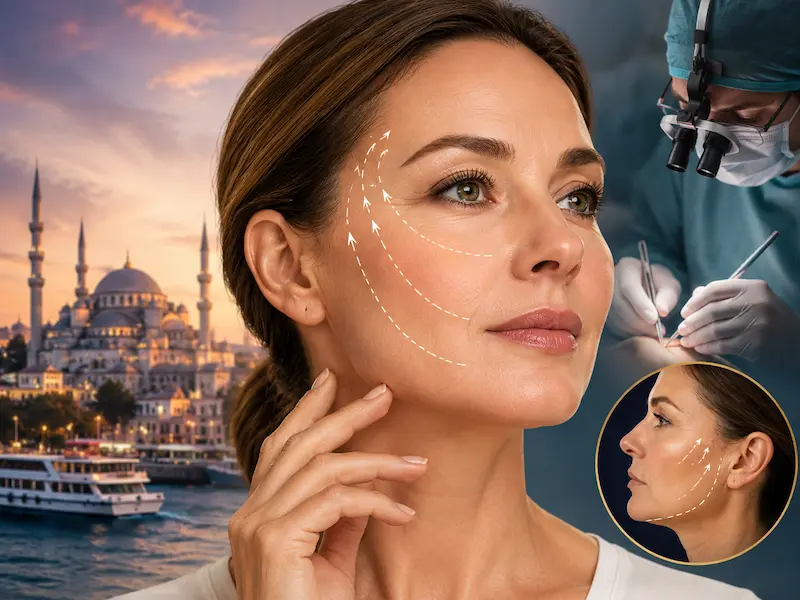
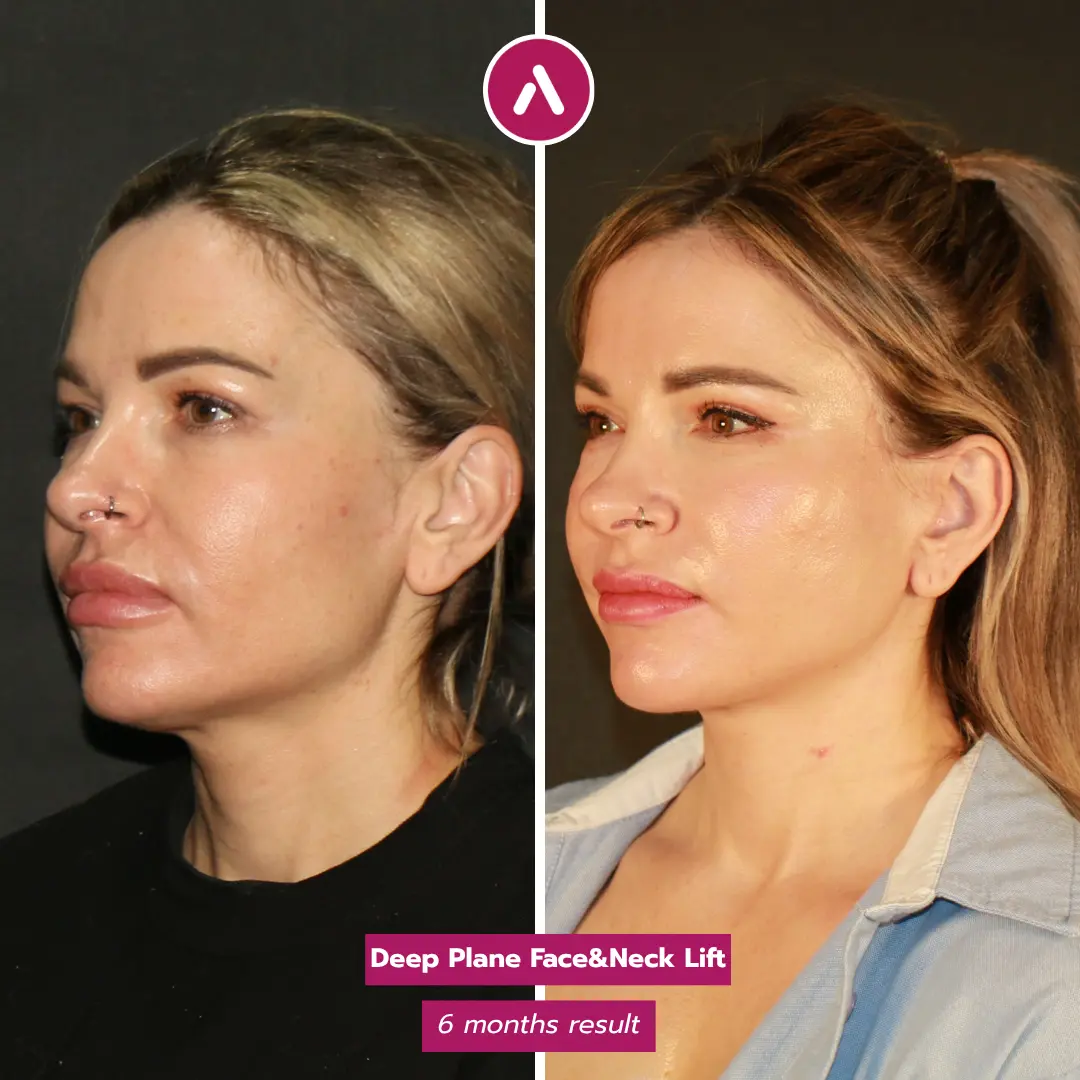
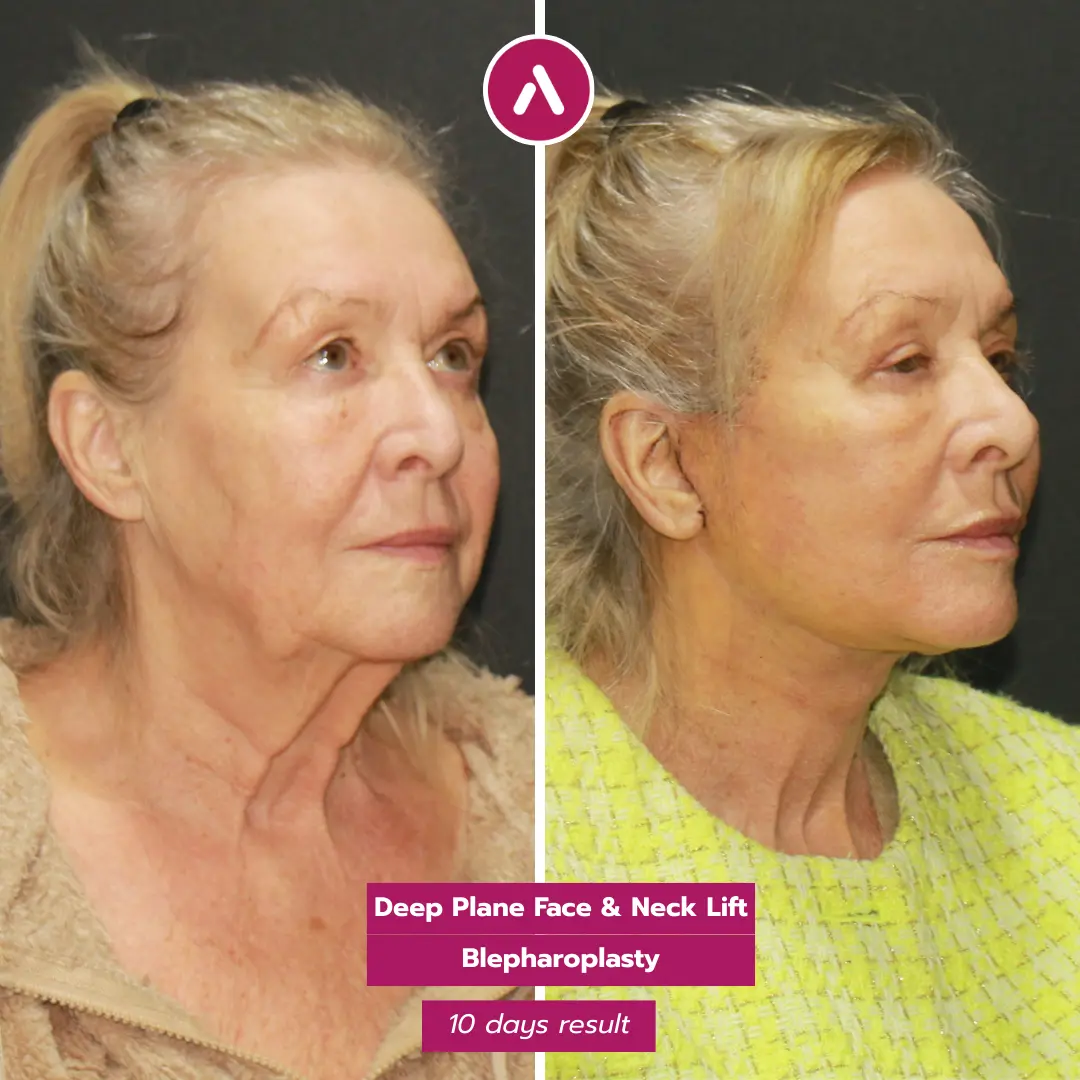
Canadian women and men researching mid-face aging often notice the same pattern first: flatter cheeks, deeper nasolabial folds, and a tired under-eye transition that filler only partially improves. A mid facelift, also called a cheek lift or midface lift, targets this central facial zone without automatically treating the jawline or neck.
For Canadians comparing Toronto, Ottawa, Vancouver, Calgary, or Montreal options, our Istanbul-based team offers an endoscopic mid-face approach focused on natural elevation, precise zone-matching, and transparent CAD-first pricing. The goal is simple: restore cheek support without creating an over-lifted or obviously operated-on look.
Table of Contents
What Is a Mid Facelift? Cheek Lift & Midface Lift Explained
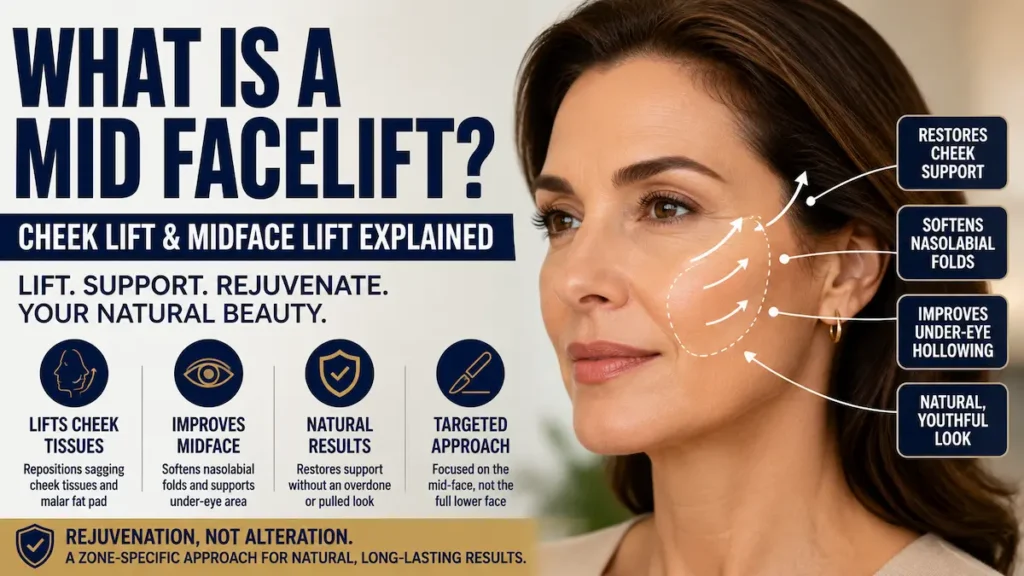
A mid facelift, also called a cheek lift or midface lift, repositions sagging cheek tissues and the malar fat pad to restore mid-face support. It improves cheek descent, nasolabial folds, and under-eye hollowing without treating the full lower face and neck like a deep plane facelift.
The mid-face is the central third of the face. It sits between the lower eyelids and the upper lip, and it includes the cheek mound, malar fat pad, lower eyelid support zone, and nasolabial folds. This is why a mid facelift is different from a mini facelift, which focuses more on the lower face, and different from a deep plane facelift, which treats deeper facial aging across a broader zone.
At AKM Clinic, we use the mid facelift as a zone-specific procedure. That matters. A patient with early cheek descent may not need a full facelift, while a patient with jowls and neck laxity may need more than a cheek lift can provide.
How a Mid Facelift Works
A mid facelift lifts the cheek tissues upward and slightly outward, restoring support where gravity has pulled the malar fat pad downward. In many patients, this creates a smoother transition between the lower eyelid and cheek. It can also soften the nasolabial fold without filling the face with extra volume.
The procedure can be performed through small incisions hidden in the temporal hairline, inside the mouth, or through a lower-eyelid route when combined with blepharoplasty. The exact access point depends on your anatomy, your scar tolerance, and whether another procedure is planned at the same time.
Our philosophy is “Rejuvenation, not alteration.” We do not pull the cheek into a high, artificial position. We reposition the tissue to match your natural facial structure.
Mid Facelift Terminology: Cheek Lift, Midface Lift, and Mid-Plane Facelift
Patients often see several names for the same general concept. A “cheek lift” usually refers to elevating the cheek mound. A “midface lift” describes the same central facial zone in more anatomical language. “Mid facelift” is the patient-friendly term most often used in consultations.
Some surgeons also use the phrase “mid-plane facelift.” This can refer to lifting tissues in a plane between the skin and deeper facial structures. The term is less standardized, so we focus less on labels and more on what is being lifted, how it is accessed, and whether the procedure matches the aging pattern.
That is the key point. The name matters less than the plan.
- Cheek lift: focuses on cheek elevation and malar support.
- Midface lift: focuses on the central third of the face.
- Endoscopic mid facelift: uses a small camera to guide tissue release and repositioning.
- Transblepharoplasty mid lift: accesses the cheek through a lower-eyelid incision, often during lower blepharoplasty.
The Mid-Face Zone: Cheeks, Nasolabial Folds, and Tear-Trough Support
Mid-face aging is not only about wrinkles. It is often about tissue descent. As the cheek fat pad drops, the upper cheek looks flatter, the lower eyelid may look more hollow, and the nasolabial fold can appear deeper.
Filler can help some patients with volume loss, but it cannot truly reposition descended tissue. In patients who already feel “puffy” or overfilled, adding more filler may make the face look heavier rather than younger. A mid facelift addresses this problem by lifting the tissue instead of adding bulk.
This distinction is especially relevant for Canadian patients who have already tried cheek filler in Toronto, Vancouver, or Ottawa and feel the result no longer looks natural. In those cases, the issue may not be volume. It may be position.
Mid Facelift vs Mini vs Full Facelift: Quick Preview
A mid facelift is best for cheek descent, early nasolabial folds, and lower-eyelid-to-cheek hollowing. A mini facelift is better for mild jowling and lower-face laxity. A full or deep plane facelift is more appropriate when the cheeks, jawline, and neck all require structural support.
We use a zone-matching approach during consultation. That means we do not recommend a larger operation when a focused cheek lift is enough, but we also do not under-treat a patient who clearly needs jawline or neck correction.
The comparison usually looks like this:
- Mid facelift: central face, cheek position, tear-trough support.
- Mini facelift: lower face, early jowls, jawline softening.
- Deep plane facelift: broader structural aging, cheeks, jawline, and neck.
- Neck lift: neck bands, loose neck skin, submental fullness.
If your concern is mainly a tired mid-face, a mid facelift may be the most direct option. If your concern includes jowls or neck looseness, we will discuss whether a facelift, neck lift, or combined facial rejuvenation plan is more appropriate.
Benefits of a Mid Facelift
A mid facelift is designed for patients whose aging pattern sits mainly in the centre of the face. It can restore cheek position, soften the lower-eyelid-to-cheek transition, and reduce the tired look that often appears before the jawline or neck becomes the main concern.
The strongest benefit is precision. Instead of treating the entire face, we focus on the mid-face structures that have actually descended. This helps us preserve your natural expression while improving the area that makes you look tired in photos.
Restored Cheek Position
As the cheek fat pad drops, the face can lose its soft upper-cheek contour. The cheek may look flatter, heavier, or lower than it did in your 30s or early 40s. A mid facelift repositions this tissue upward, creating a more supported cheek shape.
This is not the same as adding filler. Filler increases volume. A cheek lift changes position. For patients who already feel that filler has made the face look round or puffy, surgical repositioning may be the more logical option.
Softer Nasolabial Folds
Nasolabial folds run from the side of the nose toward the corners of the mouth. They deepen for several reasons: skin quality, facial movement, genetics, and cheek descent. A mid facelift can soften these folds when descent is the main driver.
We do not promise that the fold disappears completely. That would look unnatural. The goal is to reduce the heavy shadow and restore a smoother cheek-to-mouth transition.
Improved Under-Eye and Tear-Trough Support
Many Canadian patients describe the concern as “I look tired even when I sleep well.” In the mid-face, this often comes from a hollow transition between the lower eyelid and upper cheek. As cheek support drops, the under-eye area can look darker or more recessed.
A mid facelift can lift the upper cheek closer to the lower eyelid. This may reduce the need for repeated tear-trough filler in selected patients. When under-eye bags or excess eyelid skin are also present, we may discuss combining the procedure with blepharoplasty.
A Natural “Refreshed” Result
Our Natural-First approach is especially important in mid-face surgery. Too much lift can distort the eyes, over-project the cheek, or create an unfamiliar facial expression. Too little lift fails to justify surgery.
We aim for balance. Your cheeks should look supported, not pulled. Your face should look rested, not changed.
“A mid facelift should not make the patient look like someone else. The best result is usually a quiet correction: the cheek sits higher, the under-eye looks less tired, and the face still moves naturally.”
Earlier Intervention Before a Full Facelift Is Needed
Some patients are not ready for a full facelift because their jawline and neck are still relatively firm. For these patients, a mid facelift can address the first visible zone of facial descent without overtreating the lower face.
This is why candidacy matters. A focused procedure works only when the problem is focused. If jowls, neck bands, and lower-face laxity are already present, a deep plane facelift or combined face and neck approach may be more suitable.
Am I a Good Candidate for a Mid Facelift?
You may be a good candidate for a mid facelift if your main concern is cheek descent rather than jawline or neck laxity. The best candidates usually have visible flattening in the upper cheek, early-to-moderate nasolabial folds, and a tired lower-eyelid-to-cheek transition.
Age alone is not the deciding factor. We look at anatomy. Two patients who are both 45 can need very different procedures.
Mid-Face Descent Assessment
During your virtual consultation, we review front, side, and three-quarter photographs. We look for the position of the malar fat pad, the depth of the mid-cheek groove, and the relationship between the lower eyelid and cheek.
We also ask what bothers you most. If you point to your cheeks and under-eyes, a mid facelift may fit. If you pull upward on your jawline or neck in the mirror, another procedure may match your concern better.
The 35–50 Demographic
Many mid facelift patients are in their late 30s, 40s, or early 50s. This is the period when the cheek begins to descend, but the lower face may still have acceptable tone. The procedure can be useful before full facial aging becomes more advanced.
That said, a healthy patient in their 50s may still be a candidate if the aging pattern is mainly central. A patient in their 30s may not be ready if the concern is mild volume loss rather than true descent.
Nasolabial Fold Deepening
A mid facelift can help when nasolabial folds deepen because the cheek has dropped. It is less effective when the fold is mostly caused by skin thickness, deep facial anatomy, or strong expression lines.
This is one reason we do not treat every nasolabial fold the same way. Some patients need surgery. Some need conservative filler. Some need skin quality treatment, such as laser resurfacing.
Under-Eye Hollowing and Tear-Trough Concerns
If the under-eye looks hollow because the cheek has lost support, a mid facelift can improve the transition. If the issue is mainly lower-eyelid fat bulging, loose eyelid skin, or pigmentation, a cheek lift alone may not solve it.
In those cases, we may discuss lower blepharoplasty, fat repositioning, or resurfacing as part of the plan. The goal is not to add procedures. The goal is to match the diagnosis.
When Mid Facelift Is Enough vs When You Need Full or Deep Plane
A mid facelift is enough when the cheek is the main problem and the jawline remains mostly defined. It is usually not enough when the lower face has jowls, the neck has visible bands, or the skin has significant laxity across several facial zones.
| Concern | Most Likely Fit | Why |
|---|---|---|
| Flat cheeks, tired under-eye transition | Mid facelift | Targets the central face and malar fat pad |
| Early jowls, mild lower-face laxity | Mini facelift | Focuses more on lower-face support |
| Cheeks, jowls, jawline, and neck aging | Deep plane facelift | Provides broader structural repositioning |
| Loose neck skin or neck bands | Neck lift | Treats the neck directly |
Skin Quality and Realistic Expectations
A mid facelift repositions tissue. It does not erase every line, pore, sun spot, or texture change. If skin quality is also a concern, we may discuss fractional laser, LLLT-supported recovery, or a separate skin-focused treatment plan.
Patients with good skin elasticity usually see cleaner contour improvement. Patients with thin, sun-damaged, or heavily lax skin may need a broader plan.
When a Mid Facelift Is Not Recommended
We may advise against a mid facelift if your concern is too mild, if filler would be enough, or if your aging pattern is too advanced for a central-face procedure alone. We may also postpone surgery if you smoke, have uncontrolled medical conditions, or are not able to follow recovery instructions.
Safety comes first. For Canadian patients travelling internationally, we also recommend discussing elective surgery with your family physician before booking flights.
Mid vs Full vs Mini Facelift + Non-Surgical Options: The Decision Framework
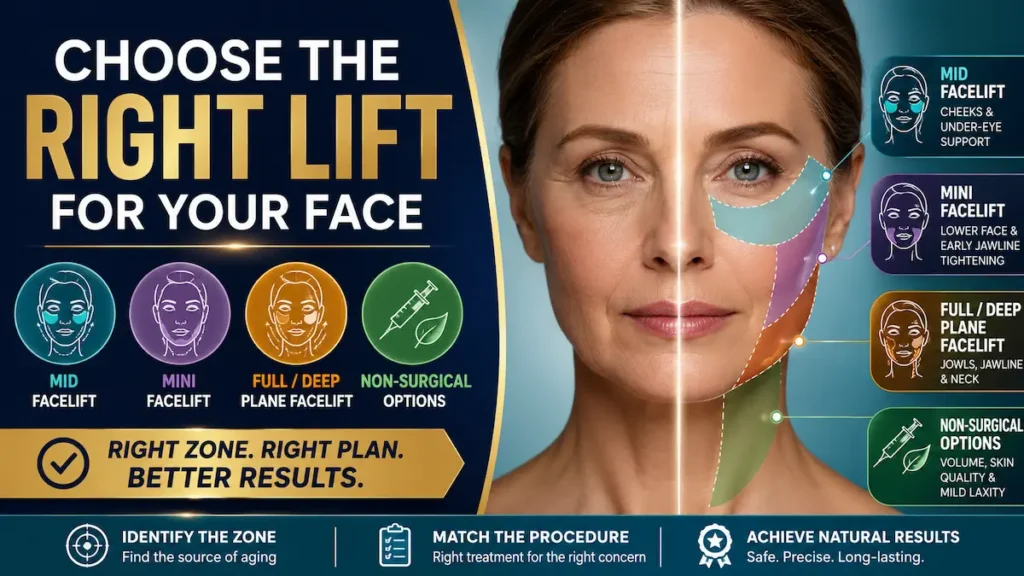
The right facial procedure depends on the zone that has actually aged. A mid facelift treats the central face. A mini facelift treats early lower-face laxity. A full or deep plane facelift treats broader structural aging across the cheeks, jawline, and neck.
This is where many patients become confused. The words “lift,” “filler,” “thread,” and “facelift” are often used loosely in online marketing. We use a zone-matching framework instead.
“The first question is not ‘Which lift is popular?’ The first question is ‘Which facial zone has descended?’ Once we answer that, the surgical plan becomes much clearer.”
The Facelift Zone-Matching Framework
Zone-matching means we identify the anatomical source of the concern before choosing the procedure. If the cheek fat pad has dropped, the mid-face needs support. If the jawline has softened, a lower-face lift may be more appropriate. If the neck has bands or loose skin, the neck must be treated directly.
This prevents two common problems. One is under-treatment, where a small procedure cannot correct a larger aging pattern. The other is over-treatment, where a patient receives a full facelift when a focused cheek lift would have been enough.
Mid Facelift: The Mid-Face Zone
A mid facelift focuses on the cheeks, malar fat pad, nasolabial folds, and the lower-eyelid-to-cheek junction. It is most useful when the face looks tired in the centre, but the jawline and neck remain relatively strong.
The procedure can be especially useful for patients who feel that cheek filler helped at first but later made the face look heavier. In those cases, the problem may be tissue position rather than lack of volume.
Mid Facelift vs Mini Facelift
A mini facelift usually focuses on the lower face. It can improve early jowls, mild jawline softness, and limited skin laxity near the lower cheek. It does not primarily lift the upper cheek or lower-eyelid-to-cheek transition.
A mid facelift works higher. It lifts the central cheek and supports the under-eye area. If you are pulling your cheek upward in the mirror, a mid facelift may fit. If you are pulling your jawline backward or upward, a mini facelift may be closer to your concern.
Mid Facelift vs Full or Deep Plane Facelift
A deep plane facelift is more comprehensive. It treats deeper facial structures, including the cheek, jowl area, jawline, and often the neck when combined with a neck lift. It is usually better for patients with multi-zone aging.
A mid facelift is more selective. It is not designed to correct significant jowls, neck bands, or heavy lower-face laxity. If those concerns are present, we may recommend a broader facelift plan rather than a cheek-only lift.
| Procedure | Main Zone Treated | Best For | Does It Treat Jowls? | Does It Treat Neck? | Typical Result Style |
|---|---|---|---|---|---|
| Mid facelift / cheek lift | Central face, cheeks, tear-trough support | Cheek descent, flatter mid-face, early nasolabial folds | No, not directly | No | Refreshed cheek support |
| Mini facelift | Lower face and early jawline laxity | Mild jowls, early lower-face sagging | Yes, mildly | Limited | Subtle lower-face tightening |
| Full facelift | Lower face, jawline, broader cheek support | Moderate facial laxity across several zones | Yes | Often paired with neck lift | Broader facial rejuvenation |
| Deep plane facelift | Deep facial tissues, cheek, jowl, jawline, neck when combined | Structural aging, heavier jowls, neck involvement | Yes | Yes, when combined | Longer-lasting structural lift |
Endoscopic Mid Facelift Technique
An endoscopic mid facelift uses small incisions and a camera-guided approach to release and elevate the mid-face tissues. This can reduce visible scarring because the incisions are usually hidden in the temporal hairline, inside the mouth, or within a lower-eyelid access route when combined with eyelid surgery.
The endoscopic approach helps us see the mid-face structures clearly while limiting unnecessary surface dissection. It is a precise technique, but it still requires careful patient selection. Not every cheek concern needs surgery.
A PubMed-indexed long-term study on endoscopic midface lift reported objective improvement in midfacial height that persisted for up to 15 years. We use this type of evidence as context, not as a guarantee. Your own result depends on anatomy, technique choice, skin quality, and healing behaviour. Review the PubMed abstract on endoscopic midface lift longevity.
Surgical vs Non-Surgical Cheek Lift: Honest Comparison
Non-surgical options can help the right patient. Cheek filler can restore volume. Threads can provide a temporary repositioning effect. Skin treatments can improve texture. The limitation is that none of these options truly release and reposition descended cheek tissue like surgery.
That is why repeated filler sometimes becomes counterproductive. When the cheek is low, adding volume can make the face look fuller without making it look lifted. Patients often describe this as “puffy but still tired.”
“Filler can replace lost volume, but it cannot move a descended cheek fat pad back to its original position. If the diagnosis is descent, a lifting procedure is usually the more anatomical solution.”
| Option | What It Does | Actual Lift Capacity | Typical Duration | Best Candidate | Key Limitation |
|---|---|---|---|---|---|
| Surgical mid facelift | Repositions cheek tissues and malar fat pad | High for true mid-face descent | Often 8–12 years | Cheek descent with good lower-face tone | Requires surgery and recovery time |
| Cheek filler | Adds volume to the cheek or tear-trough region | Low to moderate, depending on anatomy | Usually 9–18 months | Volume loss without major descent | Can look heavy if overused |
| Thread lift | Uses absorbable threads for temporary repositioning | Mild and temporary | Usually 6–18 months | Mild laxity, surgery-avoidant patients | Limited durability and lift strength |
| Skin treatments | Improves texture, collagen response, and surface quality | Minimal structural lift | Variable | Texture concerns, fine lines, dullness | Does not reposition tissue |
We may still recommend non-surgical treatment for early volume loss or mild skin quality concerns. Our role is not to push surgery. Our role is to identify when surgery is genuinely the more accurate tool.
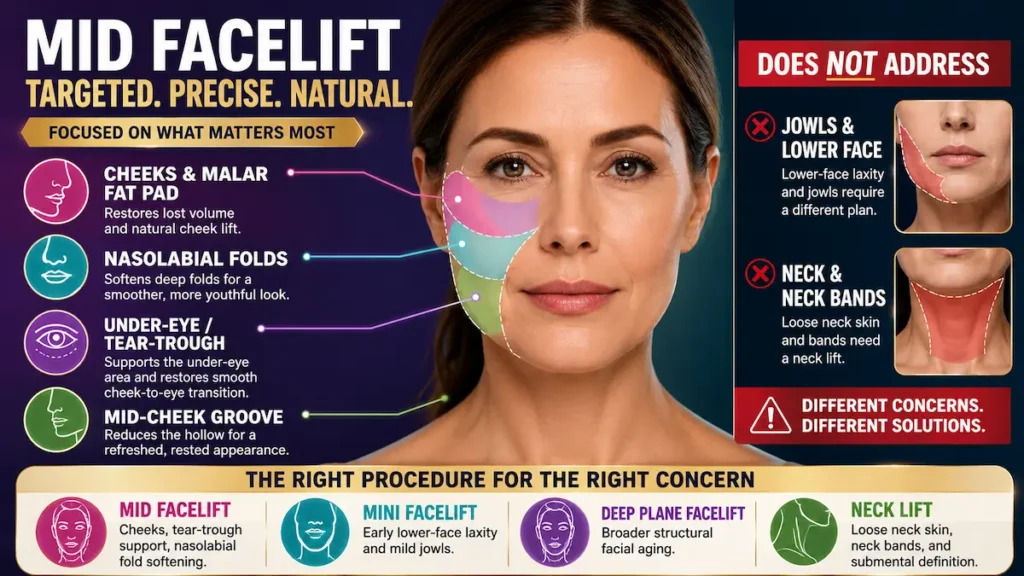
Areas Addressed by a Mid Facelift
A mid facelift is a focused procedure. It treats the central facial zone, not the entire face. This makes it valuable for patients whose main concern is cheek descent, but it also means it has clear limits.
During consultation, we explain what the procedure can and cannot change. This helps prevent disappointment and keeps the plan medically honest.
Cheeks and the Malar Fat Pad
The malar fat pad is the soft cheek tissue that gives the upper cheek its youthful curve. With aging, gravity, genetics, weight change, and skin laxity can shift this tissue downward. The cheek then looks flatter above and heavier below.
A mid facelift lifts this tissue back toward a more natural position. The goal is not to create exaggerated cheekbones. It is to restore support that has been lost over time.
Nasolabial Folds
Nasolabial folds deepen when the cheek descends over the line between the nose and mouth. A mid facelift can soften this fold when tissue descent is a major cause. It cannot erase every fold completely, and it should not try to.
A completely flat nasolabial area can look unnatural because facial movement normally creates some contour there. We aim for a softer shadow, not a frozen face.
Under-Eye and Tear-Trough Region
The lower eyelid and cheek should blend smoothly. When the cheek drops, the under-eye region can look hollow or tired. Some patients try repeated tear-trough filler, only to find that the area looks swollen or uneven.
A mid facelift can support this area by lifting the upper cheek. If lower-eyelid skin, fat bags, or muscle laxity are also present, we may recommend combining the procedure with lower blepharoplasty.
Mid-Cheek Groove
The mid-cheek groove is the diagonal hollow that can appear between the lower eyelid and the outer cheek. It often makes the face look tired even when the skin itself is healthy. A cheek lift can reduce this groove when it comes from tissue descent.
Some patients need volume restoration as well. In those cases, a conservative fat transfer or filler plan may be discussed, but we avoid overfilling the mid-face. Too much volume can make the face look heavier.
Areas a Mid Facelift Does Not Address: Jowls and Neck
A mid facelift does not directly treat jowls, loose neck skin, neck bands, or a heavy jawline. These are lower-face and neck concerns. Treating them requires a different plan.
If your main concern is the neck, a neck lift may be more appropriate. If the concern includes cheeks, jowls, jawline, and neck together, a full or deep plane approach may be a better fit.
- Mid facelift: cheeks, tear-trough support, nasolabial fold softening.
- Mini facelift: early lower-face laxity and mild jowls.
- Deep plane facelift: broader structural facial aging.
- Neck lift: loose neck skin, neck bands, and submental definition.
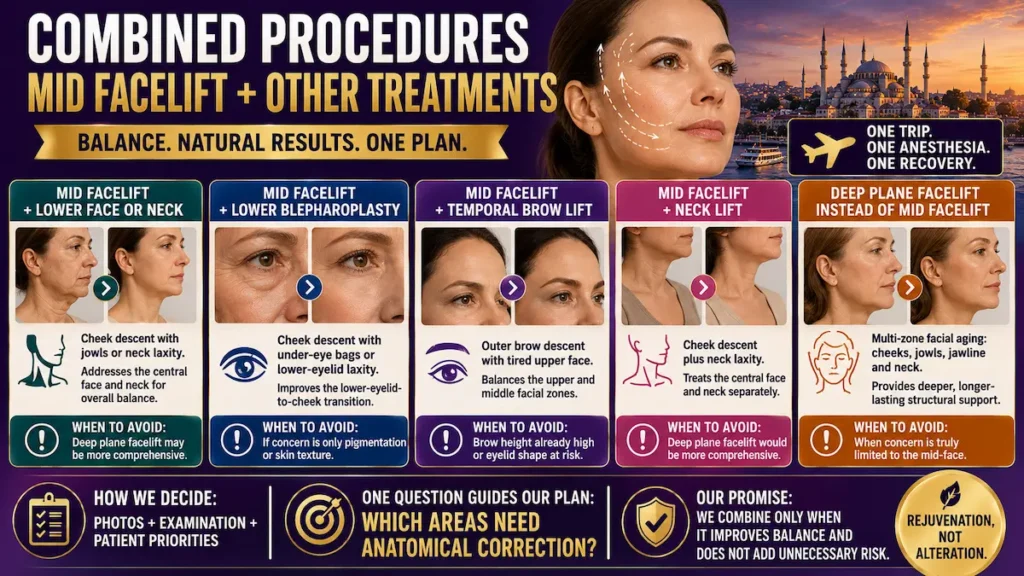
Combined Procedures: Mid Facelift + Other Treatments
A mid facelift can be performed alone, but many patients benefit from combining it with another facial procedure. The decision depends on the zones involved. We combine procedures only when the combined plan improves balance and does not add unnecessary risk.
For Canadian patients, combination planning can also reduce travel disruption. One trip, one anesthesia plan, and one recovery period may be more practical than returning to Istanbul several times.
Mid Facelift + Lower Face or Neck
If the cheek is not the only concern, a mid facelift may be paired with lower-face or neck surgery. This is common when the patient has both cheek descent and early jowling. A cheek lift alone would improve the centre of the face but leave the jawline untreated.
When the neck is the stronger concern, a neck lift may be the priority. When cheeks, jowls, jawline, and neck all need structural support, a deep plane facelift may be more suitable than adding multiple smaller lifts.
Mid Facelift + Blepharoplasty
Mid facelift and lower blepharoplasty are often considered together because the lower eyelid and cheek meet in the same visual zone. If under-eye bags, loose lower-eyelid skin, or fat herniation are present, cheek elevation alone may not fully refresh the area.
In selected cases, a transblepharoplasty mid lift can access the cheek through the lower-eyelid incision. This can be efficient when eyelid surgery is already needed. See our blepharoplasty guide for the eyelid-specific decision framework.
Mid Facelift + Brow Lift
A mid facelift does not lift the brow. If the outer brow has descended, the upper face may still look tired even after cheek support improves. In these cases, a temporal or endoscopic brow lift can help balance the upper and middle face.
The key is restraint. Too much brow elevation combined with too much cheek elevation can look artificial. We plan brow and cheek vectors together so the result remains soft and natural. Learn more in our endoscopic temporal brow lift guide.
When to Choose Full or Deep Plane Instead
Sometimes the most honest recommendation is not a mid facelift. If you have cheek descent, jowls, neck bands, and jawline laxity, a focused cheek lift may under-treat the problem. It may make the cheeks look better while the lower face still looks aged.
In that situation, a full facelift or deep plane facelift may provide a better one-stage result. Our facelift guide explains the broader category, while our deep plane page explains deeper ligament release and longer-lasting structural repositioning.
Combination Planning: How We Decide
We use photographs, in-person examination, and patient priorities to decide whether to combine procedures. The plan should answer one question clearly: which areas need anatomical correction?
| Combination | Best For | Why It May Help | When We Avoid It |
|---|---|---|---|
| Mid facelift + lower blepharoplasty | Cheek descent with under-eye bags or lower-eyelid laxity | Improves the lower-eyelid-to-cheek transition | When under-eye concern is only pigmentation or skin texture |
| Mid facelift + temporal brow lift | Outer brow descent with tired upper face | Balances upper and middle facial zones | When brow height is already high or eyelid shape is at risk |
| Mid facelift + neck lift | Cheek descent plus neck laxity | Treats central face and neck separately | When deep plane facelift would be more comprehensive |
| Deep plane facelift instead of mid facelift | Multi-zone facial aging | Addresses cheeks, jowls, jawline, and neck when combined | When the concern is truly limited to the mid-face |
Combining procedures can be efficient, but efficiency is not the same as wisdom. We combine only when the anatomy supports it.
Anesthesia for Mid Facelift: General or Sedation
Mid facelift surgery can be performed under general anesthesia or carefully controlled sedation, depending on the technique, procedure combination, and patient profile. We decide this during medical assessment, not as a marketing preference.
For Canadian patients travelling internationally, anesthesia planning is part of safety planning. We review your health history, medications, smoking status, prior anesthesia experience, and travel timeline before confirming the surgical pathway.
Mid Facelift Anesthesia Options
For endoscopic mid facelift surgery, controlled sedation or general anesthesia may be used. General anesthesia can be appropriate when the procedure is combined with blepharoplasty, brow lift, or a broader facial rejuvenation plan.
Shorter, more focused procedures may be suitable for lighter anesthesia in selected patients. The decision depends on surgical access, expected procedure length, patient comfort, and safety.
Awake Mini or Mid Facelift Variant
Some patients ask whether a cheek lift can be performed while awake. Awake facial procedures use local anesthesia with light sedation, allowing selected patients to avoid general anesthesia. This can be useful for the right candidate, but it is not appropriate for everyone.
Anxious patients, longer combined procedures, or more complex anatomy may be better treated under deeper anesthesia. For the anesthesia-model discussion, see our dedicated awake mini facelift page.
Pre-Anesthesia Assessment for Canadian Patients
Before surgery, we ask Canadian patients to share relevant medical history, current medications, allergies, smoking status, and previous anesthesia experiences. Some patients also speak with their family physician before travelling. We support that.
This is especially important for patients with high blood pressure, diabetes, sleep apnea, thyroid disease, or cardiovascular history. Elective surgery should never feel rushed.
Our Anesthesia Team and Monitoring Protocol
During surgery, your vital signs are monitored continuously. This includes oxygen saturation, blood pressure, heart rhythm, and ventilation status. Our surgical procedures are performed in a JCI-accredited hospital partner environment, with clinical monitoring aligned with international safety expectations.
The goal is not only to keep you comfortable during surgery. The goal is to help you recover clearly, walk safely, and prepare for your return flight only after medical clearance.
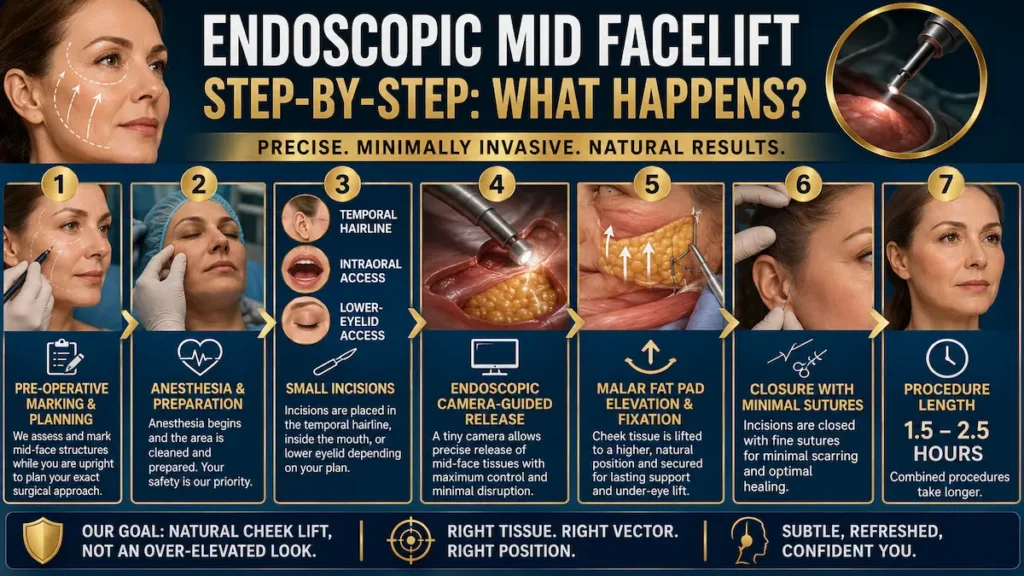
Step-by-Step: What Happens During an Endoscopic Mid Facelift?
An endoscopic mid facelift is a structured procedure. The steps may vary depending on incision route and combined treatments, but the core principle remains the same: release descended mid-face tissue and secure it in a more supportive position.
We explain each step before surgery so you understand what will happen after you arrive in Istanbul. Predictability reduces anxiety.
Pre-Operative Marking and Mid-Face Planning
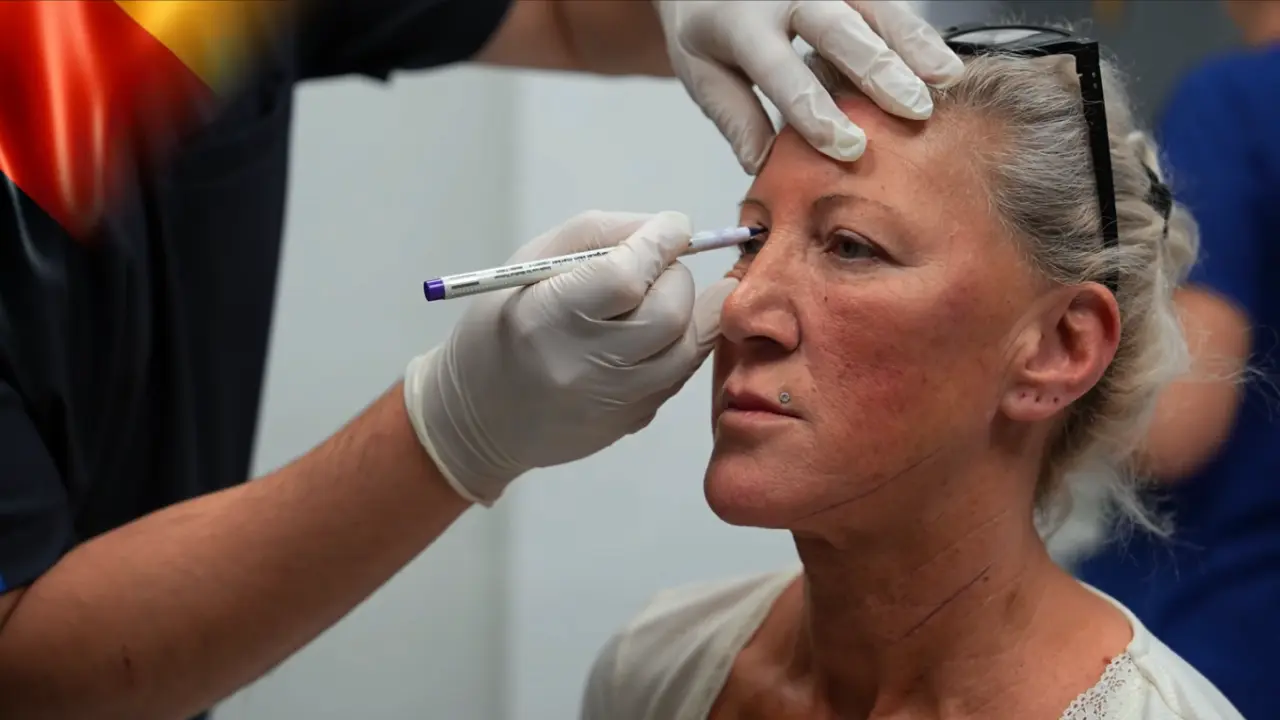
Before surgery, we mark the key mid-face structures while you are upright. This allows us to assess cheek position, asymmetry, nasolabial fold depth, and lower-eyelid-to-cheek transition in a natural position.
We also review your photographs and confirm the surgical objective. For most patients, the objective is subtle cheek elevation, not a dramatic change.
Anesthesia and Preparation
After anesthesia begins, the surgical area is cleaned and prepared under sterile conditions. Hairline, eyelid, or intraoral access points are protected according to the planned technique. Your face is positioned carefully to support precision and symmetry.
Our team confirms the treatment plan before incision. This is part of our surgical safety protocol.
Small Incisions: Temporal, Intraoral, or Lower-Eyelid Access
Endoscopic mid facelift surgery usually uses small incisions. These may be placed in the temporal hairline, inside the mouth, or through a lower-eyelid incision when the procedure is combined with lower blepharoplasty.
The access route depends on your anatomy and treatment combination. We choose the route that provides adequate release while keeping scars as discreet as possible.
Endoscopic Camera-Guided Mid-Face Release
An endoscope is a small camera that helps the surgeon visualize deeper tissues through limited incisions. This allows controlled release of the mid-face structures without requiring a long visible incision.
The release step is important. Without proper release, the tissue cannot move naturally. Pulling without release increases the risk of tension, distortion, and short-lived results.
“Endoscopic mid-face surgery is not about pulling harder. It is about releasing the right tissue, lifting it in the right vector, and securing it without creating an over-elevated cheek.”
Malar Fat Pad Elevation and Fixation
Once the cheek tissue is released, the malar fat pad is elevated into a more supportive position. The fixation method depends on the technique used and the patient’s tissue quality. In some cases, fixation devices or deep sutures may be used to maintain the lift during healing.
The vector matters. We avoid a harsh lateral pull. The lift should restore the cheek mound and under-eye support while preserving natural facial movement.
Closure with Minimal Sutures
After fixation, the incisions are closed with fine sutures. If the access point is inside the mouth, special care instructions are provided for oral hygiene. If the access point is in the temporal hairline or lower eyelid, scar care guidance is provided before discharge.
Swelling is expected. It usually peaks during the first few days and improves gradually.
Procedure Length: 1.5 to 2.5 Hours
A focused endoscopic mid facelift often takes about 1.5 to 2.5 hours. Combined procedures take longer. For example, adding lower blepharoplasty, temporal brow lift, or a broader facelift plan changes the operating time and recovery schedule.
We confirm your expected procedure length after reviewing your photos and final in-person examination in Istanbul.
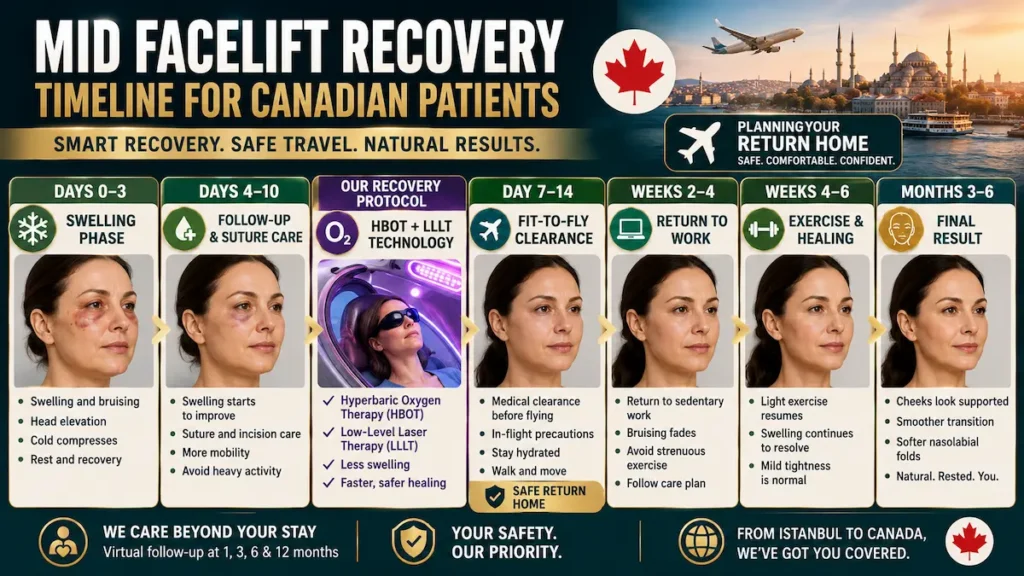
Mid Facelift Recovery: Timeline for Canadian Patients
Mid facelift recovery is usually easier than a full face and neck lift, but it still requires planning. Swelling, cheek tightness, temporary numbness, and bruising are expected during the first phase. Most patients feel presentable before they look fully healed.
For Canadian patients, recovery planning must include the long-haul flight home. We do not clear patients to fly based on the calendar alone. We assess swelling, blood pressure, wound status, mobility, and overall comfort before return travel.
Days 0–3: Swelling, Head Elevation, and Cold Compresses
The first 72 hours are the swelling phase. Your cheeks may feel tight, full, or slightly uneven. This is normal. Bruising may appear around the lower eyelid, cheek, or temple depending on the access route.
You will rest with your head elevated, avoid bending, and use cold compresses as instructed. Our patient host team checks on you during this early period and helps coordinate medication timing, follow-up visits, and hotel recovery needs.
Most patients describe discomfort as pressure rather than sharp pain. We provide post-operative medications as part of the comprehensive care programme.
Days 4–10: First Follow-Up and Suture Care
By days 4 to 10, swelling usually begins to shift downward and soften. This phase can look uneven because each side heals at a slightly different pace. Mild asymmetry during early recovery does not automatically mean a final asymmetry.
If your incisions are in the temporal hairline, we review cleaning and scar care. If an intraoral route was used, oral hygiene becomes especially important. If a lower-eyelid incision was used, eyelid care instructions are reviewed in detail.
This is also when many patients start to feel more mobile. You should still avoid heavy lifting, vigorous walking, alcohol, smoking, and any activity that increases facial pressure.
Our HBOT and LLLT Recovery Protocol
We use recovery technology because international patients need safe, predictable healing before a long return flight. Hyperbaric Oxygen Therapy (HBOT) helps deliver a higher concentration of oxygen to recovering tissues. This can support edema control, wound healing, and tissue recovery after facial surgery.
We also use Low-Level Laser Therapy (LLLT), a photobiomodulation treatment that supports cellular repair. Our system uses 424 medical-grade semiconductor laser diodes at 650 nm. This helps stimulate cellular ATP production without heating the tissue.
For a mid facelift, HBOT and LLLT are especially useful because swelling often concentrates in the cheek and under-eye region. The goal is not to rush healing unnaturally. The goal is to support the body while reducing avoidable inflammation.
You can learn more about our recovery technology on our technology and standards page. For a deeper recovery-science discussion, see our guide to hyperbaric oxygen therapy benefits and our article on LLLT for scar minimization.
Day 7–14: Fit-to-Fly Clearance for Canadian Return Travel
Most Canadian patients plan their return flight during the second week, but timing depends on the procedure and healing progress. A patient who has a focused endoscopic cheek lift may be cleared earlier than a patient who combines mid facelift with blepharoplasty, brow lift, or a broader facelift.
Before you fly, we check for excessive swelling, infection signs, blood pressure concerns, and mobility limitations. We also review in-flight precautions. These include walking during the flight, staying hydrated, avoiding alcohol, and keeping your head supported.
Flying from Istanbul to Toronto, Montreal, Vancouver, Calgary, or Ottawa is a long trip. Cabin pressure does not “undo” a facelift, but dehydration, immobility, and swelling can make recovery feel harder. For a broader travel-safety overview, see our flight safety after surgery guide.
Week 2–4: Return to Sedentary Work
Many patients return to remote or desk-based work after 10 to 14 days. Some prefer to wait longer if their job involves frequent video calls or public-facing work. Bruising can often be concealed, but swelling may still be visible under certain lighting.
If you work in a hospital, school, retail environment, or physically active role, you may need more time. Your plan should match your workday, not just the average recovery chart.
At this stage, you should still avoid strenuous exercise, saunas, facial massage, and aggressive skin treatments unless our team clears you.
Week 4–6: Exercise and Swelling Resolution
By weeks 4 to 6, most patients feel more like themselves. Cheek tightness softens, bruising usually resolves, and swelling becomes less obvious. Light exercise can often resume gradually, but heavy lifting should wait until clearance.
You may still feel mild firmness or numbness in the cheek or temple area. This is common after tissue repositioning and usually improves with time.
Do not judge your final result too early. The mid-face can look slightly full during this period because the cheek tissues are still settling.
Month 3–6: Final Mid-Face Result
The final result becomes clearer between 3 and 6 months. The cheek should look supported, the lower-eyelid-to-cheek transition should look smoother, and the nasolabial fold should look softer if cheek descent was the main cause.
Your face should still look like you. That is the point. A good mid facelift should create a rested, natural central-face improvement, not an obvious surgical signature.
We continue virtual follow-up after you return to Canada. Our long-term follow-up programme includes check-ins at 1, 3, 6, and 12 months, so your healing is monitored beyond your Istanbul stay.
Safety, Risks & Scars of Mid Facelift
Every surgical procedure has risks. A mid facelift is usually less extensive than a full face and neck lift, but it still involves tissue release, repositioning, swelling, and a healing period. We discuss these points clearly before you commit to travel.
The goal is not to make surgery sound casual. The goal is to help you make an informed decision.
Common Side Effects
Common side effects include swelling, bruising, cheek tightness, temporary numbness, and mild asymmetry during early healing. These effects usually improve gradually over several weeks. The cheeks may feel firm or over-supported at first because the tissues are still settling.
Bruising can appear around the lower eyelid, cheek, or temple depending on the incision route. Some patients heal quickly. Others hold swelling longer, especially around the under-eye and upper cheek region.
- Swelling is usually strongest during the first week.
- Bruising often improves during weeks 2 and 3.
- Tightness may soften over several months.
- Temporary numbness can occur near incision or release zones.
Cheek Lift Scars: Hidden Temporal, Intraoral, or Lower-Eyelid Access
Mid facelift scars are usually placed in discreet locations. Depending on the technique, incisions may sit in the temporal hairline, inside the mouth, or along a lower-eyelid incision when the procedure is combined with blepharoplasty. The exact scar pattern depends on your anatomy and surgical plan.
Endoscopic access can reduce visible scarring because it uses smaller entry points. It does not mean “scarless.” No surgical lift is truly scarless. We prefer honest scar planning over unrealistic promises.
We support scar maturation with careful closure, post-operative instructions, and LLLT when appropriate. Our LLLT system is designed to support cellular repair without thermal injury.
Mid Facelift Gone Wrong: Asymmetry and Over-Elevation Prevention
The main aesthetic risks of mid facelift surgery are over-elevation, asymmetry, and a cheek position that looks unfamiliar. This is why the lift vector matters. A harsh upward or lateral pull can distort the lower eyelid or make the cheek look too high.
We avoid aggressive overcorrection. Our Natural-First approach means the cheek should look restored, not inflated or pulled. We also assess pre-existing asymmetry, because most faces are not perfectly symmetrical before surgery.
“Avoiding an over-lifted cheek starts before surgery. We study the patient’s natural cheek position, eye shape, and facial movement so the lift restores support without changing identity.”
Nerve Considerations
The face contains delicate sensory and motor nerves. Temporary numbness can occur after mid-face surgery because tissues are released and repositioned. Serious nerve injury is uncommon, but it is a real risk that should be discussed before any facial procedure.
Endoscopic visualization can help the surgeon work through smaller access points with controlled tissue release. Skill and anatomical knowledge are still essential. Technology supports surgery; it does not replace surgical judgement.
Why Endoscopic Technique Can Reduce Scar and Tissue Trauma
Endoscopic mid facelift surgery allows a camera-guided view through smaller incisions. This can reduce visible scar burden and limit unnecessary surface dissection. For the right patient, it offers a focused route to cheek elevation.
That said, endoscopic surgery is not automatically better for everyone. Severe lower-face aging, heavy jowls, or neck laxity may require a different procedure. Good surgery starts with correct selection.
For patients who want a broader evidence context, PubMed includes long-term research on endoscopic midface lift durability and midfacial height improvement. We use published evidence to inform patient education, while still making recommendations based on your individual anatomy. Read the PubMed abstract.
How We Reduce Risk at AKM Clinic
Risk reduction starts before you arrive in Istanbul. We review medical history, medication use, smoking status, previous procedures, and facial anatomy during virtual assessment. Patients with uncontrolled medical issues may be asked to stabilize their health before surgery.
Your procedure is performed in a JCI-accredited hospital partner environment. We use sterile surgical protocols, pre-operative testing, continuous monitoring during anesthesia, and structured post-operative checks before return travel. You also receive English-language discharge information for your records.
After you return to Canada, our follow-up programme continues through virtual check-ins at 1, 3, 6, and 12 months. This helps bridge the distance between Istanbul and your home province.
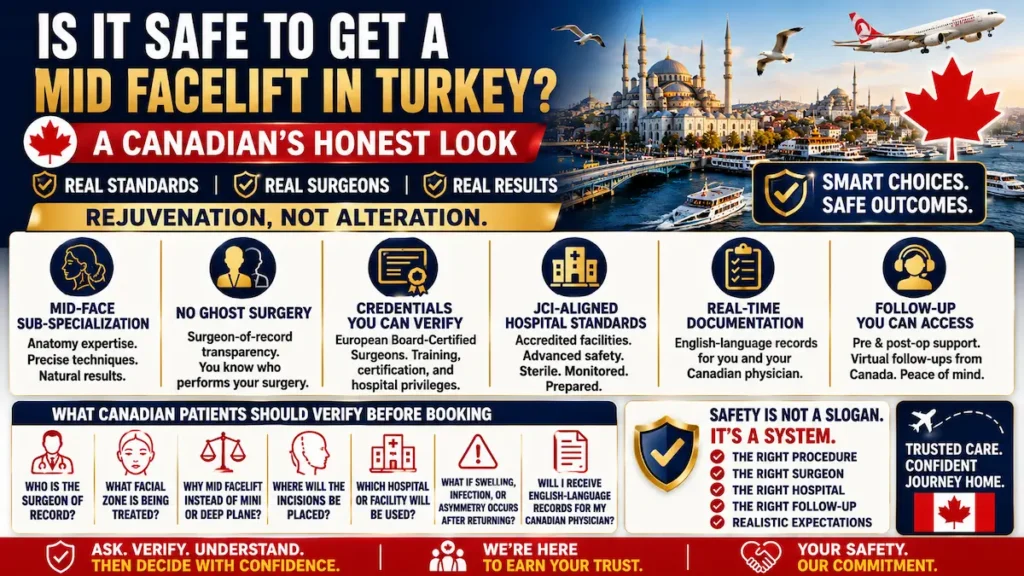
Is It Safe to Get a Mid Facelift in Turkey? A Canadian’s Honest Look
Canadian patients are right to ask this question. The Government of Canada advises travellers to research risks when considering medical care outside Canada, including different standards, follow-up challenges, and complications after returning home. We take those concerns seriously.
Our answer is not “all clinics are safe.” They are not. Turkey has excellent surgeons and hospitals, but it also has high-volume, marketing-heavy clinics that do not meet the standard Canadian patients expect. Choosing the right provider matters.
The Turkey Cosmetic Surgery Reality: How We Differ
Turkey is a major destination for aesthetic surgery because surgical volume is high, clinical experience is deep, and operational costs are lower than in Canada. Those advantages only matter when paired with proper credentials, hospital standards, and surgeon-led care.
At AKM Clinic, we do not build the experience around volume. We build it around correct diagnosis, natural results, and structured follow-up. Our philosophy is “Rejuvenation, not alteration.”
For a broader discussion of safety standards, see our guide: Is It Safe to Get Plastic Surgery in Turkey?
Endoscopic Mid-Face Sub-Specialization
Mid facelift surgery is not the same as a skin-only facelift. It requires understanding of the cheek fat compartments, lower eyelid support, facial retaining structures, and safe release vectors. A surgeon who performs general cosmetic procedures may not have enough mid-face experience.
During consultation, ask what technique will be used, where the incisions will be placed, how the cheek will be fixed, and why this procedure is being recommended over mini or deep plane facelift. The answer should be specific.
Ghost Surgery in Turkey Facial Procedures
“Ghost surgery” means the person advertised as the surgeon is not the person performing the key surgical steps. This is a valid concern for international patients. You should know who your surgeon is, what their role is, and what parts of the procedure they personally perform.
We support surgeon-of-record transparency. Your surgical plan is confirmed before the operation, and your clinical documentation should match the team that actually treats you. For more on this topic, read our guide to ghost surgery in Turkey.
Credential Verification for Canadian Patients
In Canada, patients often look for Royal College certification and membership in recognized professional bodies. The Canadian Society of Plastic Surgeons reminds patients that the term “cosmetic surgeon” can be used differently than “plastic surgeon,” so credential review matters.
For international care, Canadian patients should verify training background, board certification, hospital privileges, surgical volume, and before-and-after documentation. Our team can explain how our European Board-Certified Surgeons’ credentials compare with Canadian expectations during consultation.
For a deeper checklist, see our plastic surgeon board certification guide.
JCI-Aligned Standards and Real-Time Documentation
Facility standards matter as much as the surgeon. Your mid facelift should be performed in an environment with proper sterilization, anesthesia monitoring, emergency readiness, and post-operative care. We operate with a JCI-accredited hospital partner and follow structured safety protocols.
We also provide documentation that helps patients communicate with their Canadian family physician if needed. This includes procedure details, medication instructions, and post-operative guidance in English.
What Canadian Patients Should Verify Before Booking
Before booking any mid facelift abroad, ask direct questions. A trustworthy team should answer clearly and should not pressure you into a larger procedure without explaining why.
- Who is the surgeon of record?
- What facial zone is being treated?
- Why is mid facelift recommended instead of mini or deep plane facelift?
- Where will the incisions be placed?
- Which hospital or facility will be used?
- What happens if swelling, infection, or asymmetry appears after returning to Canada?
- Will I receive English-language records for my Canadian physician?
ISAPS also advises patients considering surgery abroad to ask whether the surgeon is board-certified or equivalent in that country, properly trained for the procedure, and a member of the relevant national plastic surgery society. We encourage Canadian patients to use that same verification mindset before travelling. Review ISAPS guidance on finding a surgeon abroad.
Safety is not a slogan. It is a system: correct procedure selection, credential transparency, hospital standards, sterile technique, follow-up access, and realistic expectations.
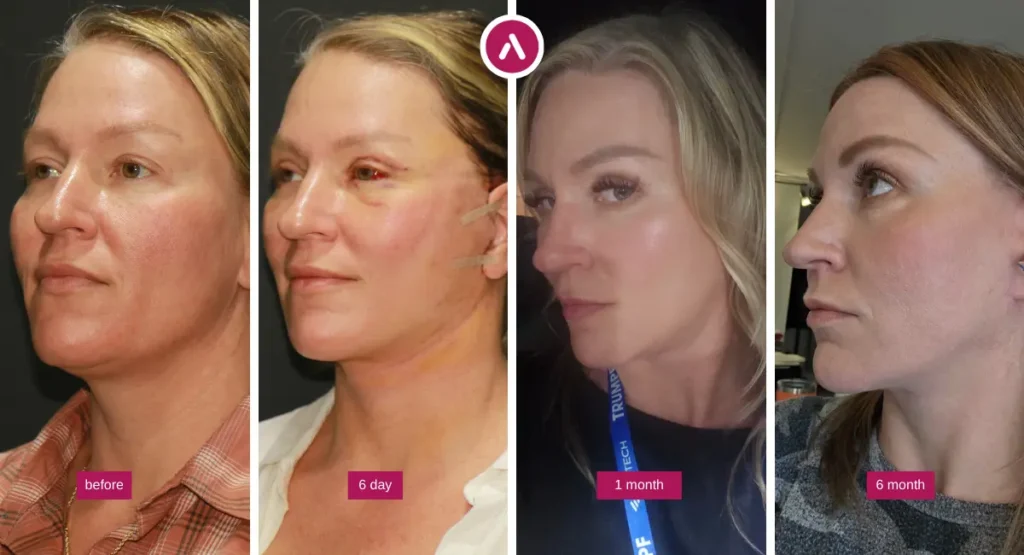
Midface Lift Before and After: Realistic Expectations & Results
A mid facelift should make the centre of the face look more supported. It should not make the face look stretched, overfilled, or unfamiliar. The best results usually look quiet: the cheeks sit higher, the lower-eyelid transition looks smoother, and the face looks less tired.
Results depend on anatomy, tissue quality, skin thickness, age, smoking status, previous filler use, and whether the mid facelift is performed alone or combined with another procedure. We explain these variables before surgery.
Cheek Lift Before and After
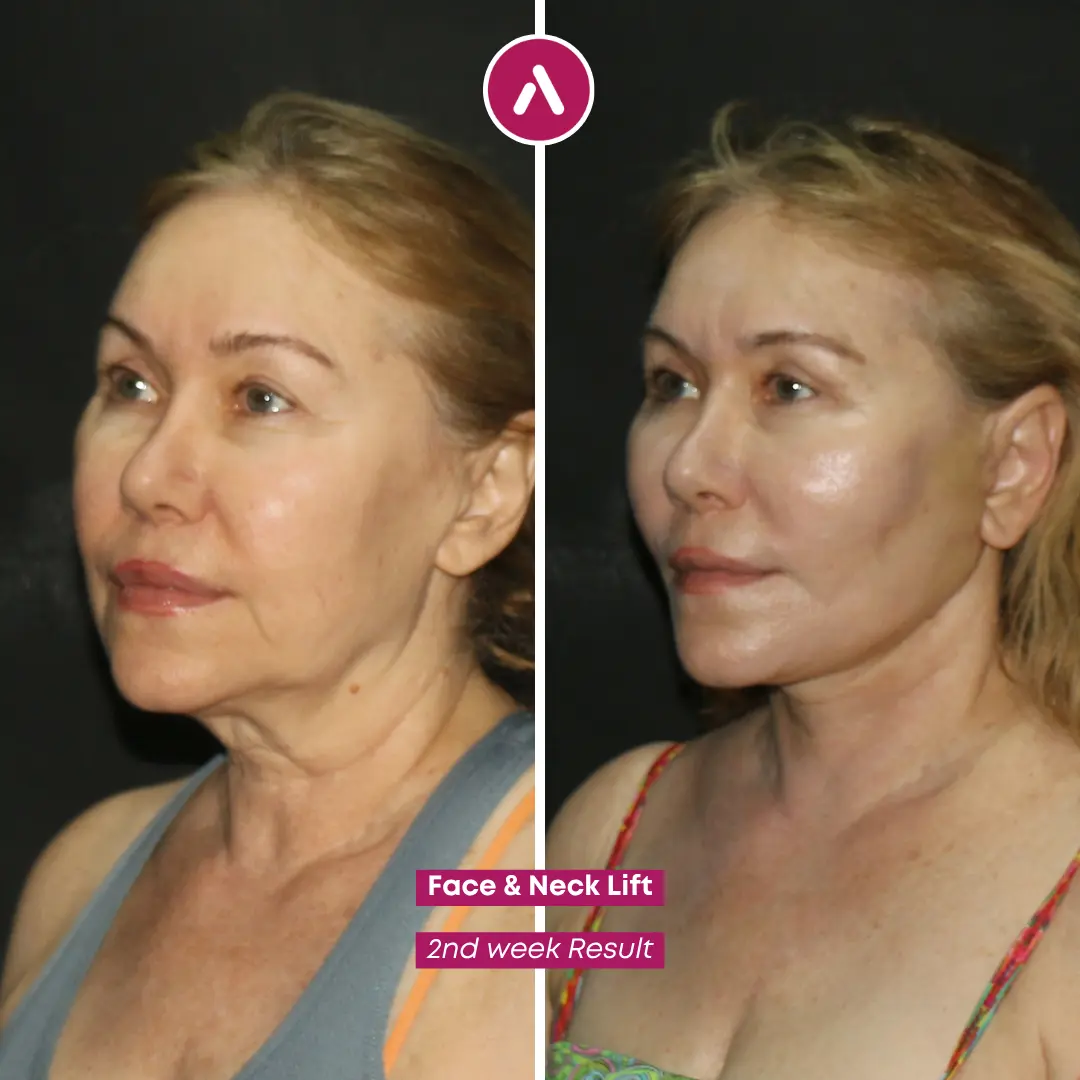
In cheek lift before-and-after results, the most visible change is usually the return of cheek support. The upper cheek looks less flat, and the lower cheek looks less heavy. This can make the face look more rested without changing the patient’s identity.
The improvement should be seen in three-quarter view as well as front view. This angle shows cheek projection, mid-cheek groove, and the lower-eyelid-to-cheek transition clearly.
Midface Lift Before and After
Midface lift before-and-after photos should not be judged only by cheek height. Look for balance. The cheek should lift without distorting the eyes, widening the mid-face excessively, or creating an overly tight expression.
We also assess symmetry. Mild asymmetry is normal in every face, and early post-operative swelling can exaggerate it. Final balance becomes clearer as swelling resolves.
Mid Facelift Before and After
A mid facelift before-and-after comparison should show softening of the central facial shadows. These may include the nasolabial fold, mid-cheek groove, and under-eye hollow. The change is structural, not just volumetric.
This is why we are cautious with filler-heavy treatment histories. If the face is already overfilled, the first step may involve dissolving or waiting before surgery. A lifted cheek should not be buried under unnecessary volume.
How Long Does a Mid Facelift Last?
A mid facelift commonly lasts about 8 to 12 years, depending on skin quality, lifestyle, weight stability, and genetics. It does not stop aging. It repositions the tissues from a better starting point, so the face continues to age from that improved position.
Patients who smoke, gain or lose significant weight, or have poor skin elasticity may see shorter durability. Patients with stable weight, good skin care, and realistic expectations often maintain their central-face improvement for many years.
Natural vs Over-Lifted
Natural mid-face surgery respects the patient’s original cheek shape. Over-lifted surgery can make the cheek look too high, distort the lower eyelid, or create an expression that does not match the rest of the face. That is not our goal.
Our Natural-First philosophy focuses on “Rejuvenation, not alteration.” We want the result to look like you on a rested day, not like a different person.
“The mid-face has to be lifted with restraint. Too little lift does not solve the problem, but too much lift changes expression. The art is in restoring support without announcing surgery.”
Before & After Gallery
Before-and-after photography is essential for mid facelift evaluation because the changes can be subtle. We recommend reviewing front, side, and three-quarter views. These angles reveal whether the cheek has been lifted naturally or simply filled.
For visual references while the dedicated mid facelift gallery is being prepared, review our broader facial rejuvenation before-and-after gallery. Our team can also share relevant cheek and mid-face examples during consultation when appropriate.
Mid Facelift Cost 2026: Turkey vs Canada
Canadian patients researching mid facelift cost often compare two very different pricing models. In Toronto, Ottawa, Vancouver, Calgary, and Montreal, private facial surgery is usually quoted as a surgical fee first, with anesthesia, facility, follow-up, medication, and revision policies discussed separately. At AKM Clinic, we present a more transparent clinical pathway so patients can understand the full commitment before travelling.
Our technique-level pricing for Mid Facelift begins at CAD $6,800 for both Endoscopic Mid Facelift and Subperiosteal Mid Facelift. The Transblepharoplasty Mid Lift, accessed through the lower eyelid during eye bag surgery, is listed at CAD $4,800. Final technique selection depends on your anatomy, eyelid status, scar preferences, and whether a combined procedure is planned.
By comparison, Canadian private clinic estimates for cheek lift or mid-face surgery commonly sit in the CAD $8,000–$14,000 range for the procedure itself, with broader facial combinations costing more. The difference is not a reduction in clinical seriousness. It reflects lower operational costs in Türkiye, high facial-surgery volume, and our integrated international patient pathway.
For a detailed cost breakdown, including what is and is not included, see our Mid Facelift cost guide for Canadian patients. For broader facial rejuvenation package options and procedure combinations, see our facelift guide for Canadian patients.
| Option | Primary Focus | AKM Clinic CAD | Best Candidate |
|---|---|---|---|
| Endoscopic Mid Facelift | Camera-guided cheek elevation with minimal visible scarring | CAD $6,800 | Cheek descent with good lower-face tone |
| Subperiosteal Mid Facelift | Deeper mid-face release from the underlying facial bones | CAD $6,800 | Patients needing stronger central-face elevation |
| Transblepharoplasty Mid Lift | Mid-face support through a lower-eyelid access route | CAD $4,800 | Patients combining cheek support with lower-eyelid surgery |
City-by-City Cost Context for Canadian Patients
Canadian private pricing varies by city, surgeon credentials, facility type, and whether the procedure is combined with eyelid, brow, or neck surgery. The table below is a planning comparison, not a substitute for a formal quote.
| Location | Typical Private Cost Context | Common Billing Pattern | What to Verify |
|---|---|---|---|
| Toronto / GTA | Often CAD $12,000–$14,000+ | Procedure fee plus possible facility and anesthesia fees | Whether follow-up and revisions are included |
| Ottawa | Often similar to Toronto for specialist facial surgery | Private quote varies by facility | Surgeon experience with endoscopic mid-face lifting |
| Vancouver | Often CAD $12,500–$15,000+ | Higher metro overhead can affect total pricing | Whether the quote includes all line items |
| Calgary | Variable, often within major-city private ranges | Clinic-specific pricing | Procedure scope: mid-face only vs full facelift |
| Montreal | Variable, often comparable to Ontario private ranges | Surgeon and facility billed according to clinic policy | Language support and post-op documentation |
| AKM Clinic, Istanbul | CAD $4,800–$6,800 depending on technique | Technique-level pricing with coordinated clinical pathway | Final plan after photo review and in-person assessment |
How to Find the Best Mid Facelift Surgeon in Turkey: A Canadian Patient’s Checklist
Many Canadian patients begin by searching for a facial plastic surgeon in Toronto, Vancouver, Ottawa, or Calgary. That is a reasonable starting point. The next step is comparing credentials, technique experience, facility standards, and total care structure.
For mid facelift surgery, the best surgeon is not simply the person who performs the most facelifts. You need a surgeon who understands the central face, lower-eyelid support, cheek vector, and the difference between filler-related fullness and true tissue descent.
EBOPRAS Certification vs RCPSC Equivalency
In Canada, patients often use the Royal College of Physicians and Surgeons of Canada as the benchmark for specialist training. The Royal College maintains a public directory where Canadians can search Fellows and specialists involved in continuing professional development.
International credentials are not identical to Canadian credentials, but they can be compared by structure: formal specialty training, board examination, hospital privileges, continuing education, and surgical scope. During consultation, we explain how our European Board-Certified Surgeons’ training aligns with the level of rigour Canadian patients expect.
Canadian patients should also understand the difference between “cosmetic surgeon” and formally trained surgical specialist. The Canadian Society of Plastic Surgeons notes that certified plastic surgeons complete medical school, surgical training, Royal College examination, and qualification to practise reconstructive and aesthetic plastic surgery.
| Credential Framework | Region | What It Signals | What Canadian Patients Should Ask |
|---|---|---|---|
| RCPSC / FRCSC | Canada | Canadian specialist certification and fellowship pathway | Is the surgeon listed in the Royal College directory? |
| EBOPRAS / European Board pathway | Europe | Structured European board-level specialist assessment | What specialty training and board certification does the surgeon hold? |
| ABFPRS / Facial Plastic Surgery pathway | United States | Facial plastic surgery focus, often ENT or plastic surgery background | Does the surgeon have facial-specific training and case volume? |
| Hospital privileges | Any region | Permission to operate in an accredited hospital setting | Where will the procedure be performed? |
For Canadian reference points, patients can review the Royal College directory at royalcollege.ca and the Canadian Society of Plastic Surgeons’ guidance on choosing a surgeon at plasticsurgery.ca.
Facial Plastic Surgery Sub-Specialization
A mid facelift sits close to the lower eyelid, cheek, facial nerve branches, and deep soft-tissue support system. This is why facial sub-specialization matters. The operation requires more than skin tightening.
Ask whether the surgeon regularly performs facial rejuvenation procedures, not only body contouring or breast surgery. Ask how often they treat the mid-face specifically. Ask to see before-and-after examples that show the cheek from front, profile, and three-quarter angles.
Endoscopic Mid-Face Capability
Endoscopic mid facelift surgery requires camera-guided tissue release through small access points. This can reduce visible scarring, but it also demands familiarity with endoscopic instruments, mid-face anatomy, and fixation methods.
A strong surgeon should be able to explain the access route clearly. They should tell you whether the incision will be temporal, intraoral, lower-eyelid, or combined. They should also explain how the cheek tissue will be secured during healing.
Zone-Matching Honesty
One of the most important signs of a trustworthy surgeon is the willingness to say “this is not the right procedure.” A mid facelift is not the answer for every aging face. It is not designed to fix heavy jowls, neck bands, or advanced lower-face laxity.
If your concern is mainly the lower face, we may discuss a mini facelift. If the cheeks, jawline, and neck all need structural support, we may recommend a deep plane facelift instead. If the neck is the main concern, a neck lift may be more direct.
Good consultation should narrow the plan. It should not inflate it without a reason.
Real Patient Reviews and Before-and-After Documentation
Reviews are not a substitute for credentials, but they help you understand communication, aftercare, and patient experience. Canadian patients should look for comments about clarity, responsiveness, recovery support, and whether the result looked natural.
Our patient experience is supported by 24/7 coordination, English-language communication, and patient hosts including Hande, Emine, and Khadija. You can review broader patient feedback on our professional plastic surgery reviews page.
Aftercare Continuity from Istanbul to Canada
The surgeon checklist should not stop on operation day. For Canadian patients, aftercare must continue after the return flight. You should know who to message if swelling worries you, what photos to send, and when virtual follow-ups happen.
Our long-term virtual follow-up programme includes check-ins at 1, 3, 6, and 12 months. We also provide English-language documentation that can be shared with your Canadian family physician if needed.
- Verify the surgeon’s training and facial procedure experience.
- Confirm the exact hospital or facility.
- Ask why mid facelift is preferred over mini or deep plane facelift.
- Review before-and-after images from multiple angles.
- Confirm written aftercare instructions before you fly home.
- Ask how post-return concerns are handled from Canada.
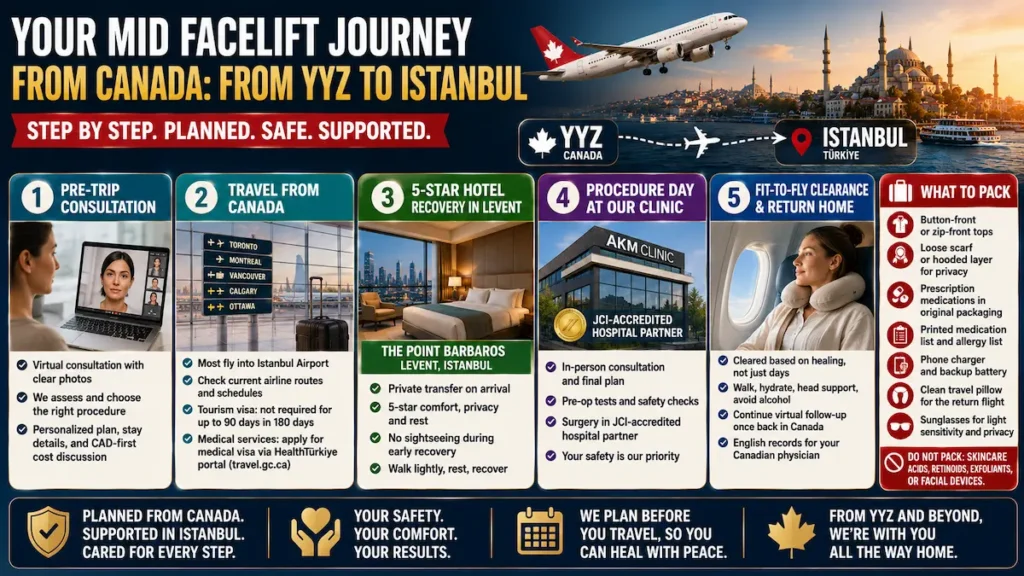
Your Mid Facelift Journey from Canada: From YYZ to Istanbul, Step by Step
A successful international surgery plan is both medical and logistical. We plan your consultation, arrival, hotel recovery, hospital timing, follow-up, and return flight before you leave Canada. This structure helps reduce stress during recovery.
Your exact travel plan depends on your city, procedure combination, and airline schedule. Flights and entry rules can change, so we ask every patient to confirm current travel requirements before booking.
Pre-Trip Consultation
Your journey begins with a virtual consultation. You send clear front, side, and three-quarter photographs so our team can assess cheek descent, tear-trough support, nasolabial folds, jawline status, and neck involvement.
We then decide whether mid facelift is the correct procedure. If your concern is actually lower-face aging, we will explain why another option may be better. If cheek filler history matters, we will ask what product was used, when it was placed, and whether dissolving is needed before surgery.
You receive a tailored clinical protocol, not a generic package. That protocol includes procedure recommendation, likely anesthesia pathway, expected stay, and CAD-first cost discussion.
Travel Logistics from Toronto, Ottawa, Vancouver, Calgary, and Montreal
Most Canadian patients fly into Istanbul Airport. Toronto and Montreal often have more direct or easier connection options, while Vancouver, Calgary, Edmonton, Ottawa, and Halifax may require one connection depending on the season and airline schedule.
Because schedules change, patients should check current airline routes before booking. We can help you choose travel dates that allow enough time for consultation, surgery, early recovery, follow-up, and fit-to-fly clearance.
Government of Canada travel guidance currently lists tourism visa as not required for stays up to 90 days in a 180-day period, but it also states that travellers seeking medical services should apply for a medical visa through the HealthTürkiye online portal. Review the official page before booking: travel.gc.ca Türkiye travel advice.
5-Star Hotel Recovery Stay in Levent
After arrival, your private transfer takes you to your hotel. Our 5-star partner hotel, The Point Barbaros, is in the Levent district, close to our clinical operations and suitable for post-operative recovery.
Your hotel stay is designed around privacy and rest. You should not plan sightseeing during early recovery. Walking lightly is useful, but shopping, long meals, and tourist activity can increase swelling and fatigue.
For a broader overview of the patient pathway, see your patient journey. For hotel and transfer details, see hotels and VIP transfers.
Procedure Day at Our Istanbul Clinic
Before surgery, you attend an in-person consultation. We review your photos, confirm the mid-face plan, examine your skin and tissue quality, and finalize the access route. Your pre-operative tests are completed before the procedure.
Your surgery is performed in our JCI-accredited hospital partner environment. The team confirms your identity, procedure, anesthesia plan, and surgical site before beginning. These checks are part of safe surgical practice.
You can learn more about the clinical environment on our Istanbul clinic page and about our standards on about AKM Clinic.
Fit-to-Fly Clearance and Return Travel
Fit-to-fly clearance is based on how you are healing, not only on the number of days after surgery. We check swelling, bruising, incision status, blood pressure, comfort, and mobility before advising return travel.
During the flight home, we usually recommend gentle walking, hydration, head support, and avoiding alcohol. Compression stockings may be advised for some patients depending on medical history and procedure combination.
Once you return to Canada, you continue virtual follow-up. If needed, your English-language discharge information can be shared with your family physician or a local provider.
What to Pack for a Mid Facelift Trip
Pack for comfort rather than fashion. Choose clothing that opens in the front, slip-on shoes, sunglasses, and a clean travel pillow. Avoid tight pull-over tops that rub the face or hairline.
- Button-front or zip-front tops
- Loose scarf or hooded layer for airport privacy
- Prescription medications in original packaging
- Printed medication list and allergy list
- Phone charger and backup battery
- Clean travel pillow for the return flight
- Sunglasses for light sensitivity and privacy
Do not pack skincare acids, retinoids, exfoliants, or facial devices for early recovery. We will tell you when it is safe to restart active skincare.
Midface Lift Surgery Frequently Asked Questions (FAQ):
What is the difference between a mid facelift, mini facelift, and full facelift?
A mid facelift treats the central face: cheeks, malar fat pad, nasolabial folds, and lower-eyelid-to-cheek support. A mini facelift treats early lower-face laxity and mild jowls. A full or deep plane facelift treats broader aging across the cheeks, jawline, and often the neck.
Can cheek filler lift my face instead of surgery?
Cheek filler can restore volume, but it cannot truly reposition descended cheek tissue. If the issue is mild volume loss, filler may be appropriate. If the issue is tissue descent, filler may make the face look fuller without creating a real lift.
Is a mid facelift done endoscopically?
Many modern mid facelift procedures use an endoscopic approach. This means a small camera helps guide tissue release through smaller incisions. The exact route may be temporal, intraoral, lower-eyelid, or combined depending on the surgical plan.
Will I have visible scars?
Scars are usually hidden in discreet locations such as the temporal hairline, inside the mouth, or along a lower-eyelid incision when combined with blepharoplasty. No surgical lift is completely scarless, but endoscopic access can reduce visible scar burden in appropriate candidates.
Does OHIP, MSP, AHCIP, or RAMQ cover a mid facelift?
No. A mid facelift is considered elective cosmetic surgery and is not covered by Canadian provincial health plans such as OHIP, MSP, AHCIP, or RAMQ. Reconstructive surgery after trauma, cancer, or congenital conditions is different and must be assessed through the provincial system.
How much does a mid facelift cost in Toronto vs Istanbul?
Toronto private clinic estimates for cheek lift or mid-face surgery often sit around CAD $8,000–$14,000 or more, depending on surgeon, facility, anesthesia, and combination procedures. At AKM Clinic, Endoscopic Mid Facelift and Subperiosteal Mid Facelift are listed at CAD $6,800, while Transblepharoplasty Mid Lift is listed at CAD $4,800.
Does Canadian travel insurance cover complications from elective mid facelift in Turkey?
Many Canadian travel insurance policies exclude elective cosmetic surgery and complications related to planned procedures abroad. You should review your policy directly and ask written questions before booking. We provide medical documentation and follow-up support, but insurance coverage is controlled by your insurer.
How long does a mid facelift last?
A mid facelift commonly lasts about 8 to 12 years. Longevity depends on skin quality, tissue strength, smoking status, sun exposure, weight stability, and genetics. The procedure does not stop aging, but it resets the cheek position to a more supported baseline.
Am I too young or too old for a mid facelift?
Age is less important than anatomy. Many candidates are in their late 30s, 40s, or early 50s, but older patients can qualify if the concern is mainly central-face descent. Younger patients may not need surgery if the issue is mild volume loss rather than true tissue descent.
When can I return to work and exercise?
Many patients return to desk-based work after 10 to 14 days, depending on swelling, bruising, and comfort. Light activity can usually resume earlier, while strenuous exercise should wait until medical clearance. Patients with public-facing jobs may prefer a longer social recovery window.
Will a mid facelift fix my jowls and neck?
No. A mid facelift does not directly correct jowls, neck bands, or loose neck skin. If those concerns are present, a mini facelift, neck lift, or deep plane facelift may be more appropriate. We explain this during consultation so the procedure matches your actual anatomy.
Can I combine a mid facelift with blepharoplasty or brow lift in one trip?
Yes, selected patients can combine a mid facelift with lower blepharoplasty, upper blepharoplasty, or endoscopic temporal brow lift. Combination surgery depends on health status, anatomy, anesthesia planning, and recovery timeline. We do not add procedures unless they improve balance and remain medically appropriate.
Medical Disclaimer: This guide is for educational purposes only and does not replace a consultation with a qualified medical professional. Mid facelift surgery is an elective procedure, and individual suitability depends on your anatomy, health status, medication use, smoking history, previous procedures, and recovery capacity.