
Plastic surgeon board certification is one of the first credentials Canadian patients should verify before choosing a surgeon abroad. It does not guarantee a perfect result, but it does confirm that a surgeon has completed a recognized training and examination pathway rather than relying on marketing language alone.
For Canadians considering surgery in Istanbul, this matters. You are comparing systems: Canadian specialist regulation, European board structures, Turkish national licensing, and international society memberships. The names can sound similar, but they do not all mean the same thing.
This guide explains what board certification means, which credentials Canadian patients commonly encounter in Turkey, and how to interpret them before booking. For AKM-specific context, you can review AKM Clinic’s surgeon credentials alongside the framework below.
Quick Summary: What Canadians Should Verify
Board certification is the baseline credential for evaluating a plastic surgeon. Canadian patients should verify the certifying body, confirm that the surgeon personally performs the procedure, and look beyond certificates to procedure-specific experience.
For Turkey, key terms include EBOPRAS, Turkish national certification, ISAPS membership, and specialty fellowships. Each has a different meaning.
Table of Contents
What Board Certification Actually Means?
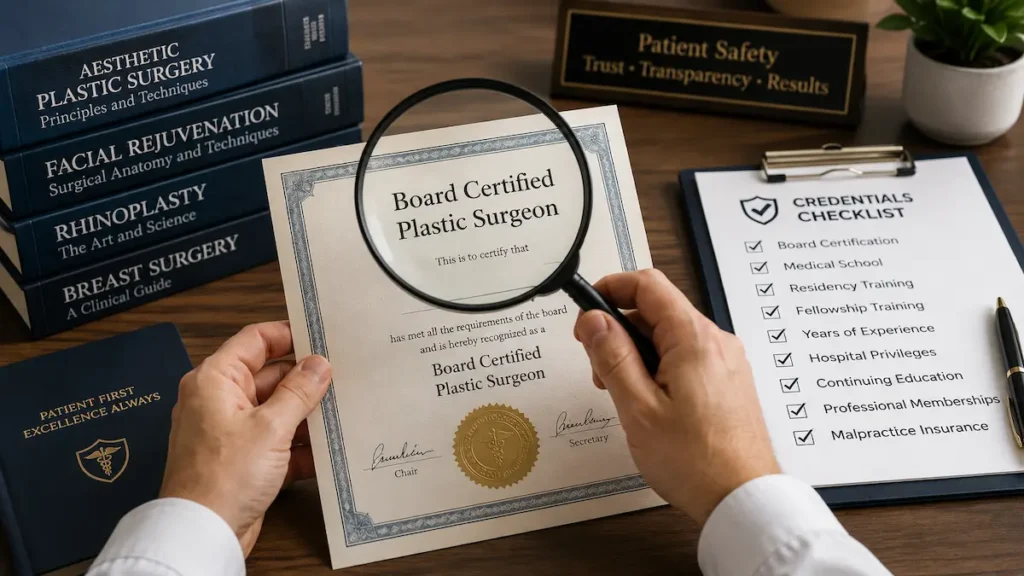
Board certification shows that a surgeon has completed a structured professional pathway. It usually includes medical school, specialty training, supervised clinical experience, and formal examinations. It is not a marketing badge.
For a Canadian patient, the value of certification is simple: it creates a minimum standard. It tells you the surgeon has been assessed by a recognized professional body, not only by a clinic website or social media profile.
The Training and Examination Pathway
A certified surgeon typically completes years of medical and surgical training before entering independent practice. This includes anatomy, operative planning, complication management, sterile technique, and patient safety.
The exact pathway differs by country. Canada uses the Royal College specialist model. Europe has board structures such as EBOPRAS. Turkey has national medical licensing and specialty recognition.
The key question is not whether the title sounds impressive. The key question is whether it can be verified.
What Certification Guarantees
Certification confirms a minimum level of training and assessment. It indicates that the surgeon has passed formal requirements set by a professional body.
It does not guarantee aesthetic judgement. It does not prove that the surgeon is the best choice for your specific procedure. A certified surgeon may still have limited experience in deep plane facelift, revision rhinoplasty, or complex body contouring.
This is why certification should be treated as the starting point, not the final decision.
Why It Is the Baseline, Not the Ceiling
Canadian patients often assume that a board-certified surgeon is automatically the safest option. Certification matters, but it is only one layer.
You should also review procedure volume, before-and-after consistency, hospital standards, communication quality, and follow-up protocols. For example, a facelift patient should ask about facial surgery experience, not only general surgical credentials.
“Board certification should be the minimum standard. After that, patients should ask what the surgeon performs often, how complications are managed, and whether the surgical plan fits their anatomy.”
The Key Certifying Bodies International Patients Encounter
Canadian patients researching surgery in Turkey often see several credential terms in the same profile. Some are board certifications. Others are memberships, fellowships, or professional affiliations.
Understanding the distinction protects you from overvaluing a title that sounds official but does not represent the same level of assessment.
EBOPRAS: European Board Certification
EBOPRAS stands for the European Board of Plastic, Reconstructive and Aesthetic Surgery. It is a European board examination and certification structure used to assess specialist competence in plastic surgery. Canadian patients can review the EBOPRAS official website to understand how the European board framework is structured.
For Canadian patients, EBOPRAS is important because it signals formal European-level assessment. It is not the same organization as the Royal College of Physicians and Surgeons of Canada, but it can be part of a credible international credential profile.
Turkish National Board Certification
Turkish surgeons must be licensed within Turkey and practise within the national medical framework. This includes medical education, specialty training, and registration requirements.
For Canadian patients, the practical issue is verification. Ask for the surgeon’s full name, specialty, registration details, and the facility where the surgery will take place.
A legitimate clinic should be comfortable explaining these credentials. Vague answers are a red flag.
ISAPS Membership — Why It Is Different from Certification
ISAPS, the International Society of Aesthetic Plastic Surgery, is a professional society. Membership can be a valuable trust signal, but it is not the same as board certification.
This distinction matters. A surgeon may be a member of an international society without that membership functioning as a board exam or national specialist licence.
Think of ISAPS as an additional professional affiliation. It can support credibility, but it should not replace verified board certification.
| Credential | What it represents | What Canadians should verify |
|---|---|---|
| EBOPRAS | European board-level assessment | Whether the surgeon is listed or can provide documentation |
| Turkish national certification | Specialty recognition and medical licensing in Turkey | Specialty, registration, and active practice status |
| FRCSC | Canadian Royal College specialist certification | Relevant for Canadian-trained surgeons practising in Canada |
| ISAPS | International professional society membership | Membership status, while remembering it is not board certification |
How European Certifications Compare with Canadian Standards?
Canadian patients often use the Royal College model as their mental benchmark. That is reasonable. Canada has a highly structured specialist certification system, and patients are used to provincial oversight through colleges of physicians and surgeons.
When evaluating surgeons abroad, the goal is not to force every credential into a Canadian label. The goal is to understand whether the international pathway is formal, verifiable, and relevant to the procedure you want.
Understanding the Royal College of Physicians and Surgeons of Canada
In Canada, specialist physicians are commonly assessed through the Royal College of Physicians and Surgeons of Canada. The designation FRCSC reflects specialist certification after approved training and examination.
For a Canadian patient in Toronto, Vancouver, Montreal, or Calgary, this model feels familiar. It separates specialist training from vague cosmetic titles.
That distinction is useful when reviewing Turkish or European credentials. Look for structured training, formal examination, and specialty recognition rather than general claims such as “aesthetic expert.”
Canadian Context: Use FRCSC as a Benchmark, Not a Requirement Abroad
A Turkish or European surgeon will not usually hold FRCSC unless they trained and certified through the Canadian system. That does not automatically make them less qualified. Instead, Canadian patients should ask what the equivalent specialist pathway is, how it is verified, and whether it applies to the exact procedure being considered.
Similarities Between European and Canadian Pathways
European board certification and Canadian specialist certification share the same basic idea: a surgeon should be assessed beyond medical school alone. Training, examinations, and specialty experience matter.
The names differ. The principle is similar.
For a Canadian patient, a credible international credential profile should include several layers. These may include board certification, fellowship training, specialty society involvement, hospital privileges, and documented case experience.
Why Canadian Patients Should Focus on Verifiable Credentials
Verification is more important than the number of letters after a surgeon’s name. A short, verifiable credential profile is stronger than a long list of unclear abbreviations.
Ask direct questions. Which board issued the certification? Is there a public registry? What specialty does the certification cover? Does it relate to plastic surgery, facial plastic surgery, dermatologic surgery, ENT, or another field?
For a more detailed research process, use the step-by-step credential verification process before committing to travel.
Certification vs Experience: What Matters More?
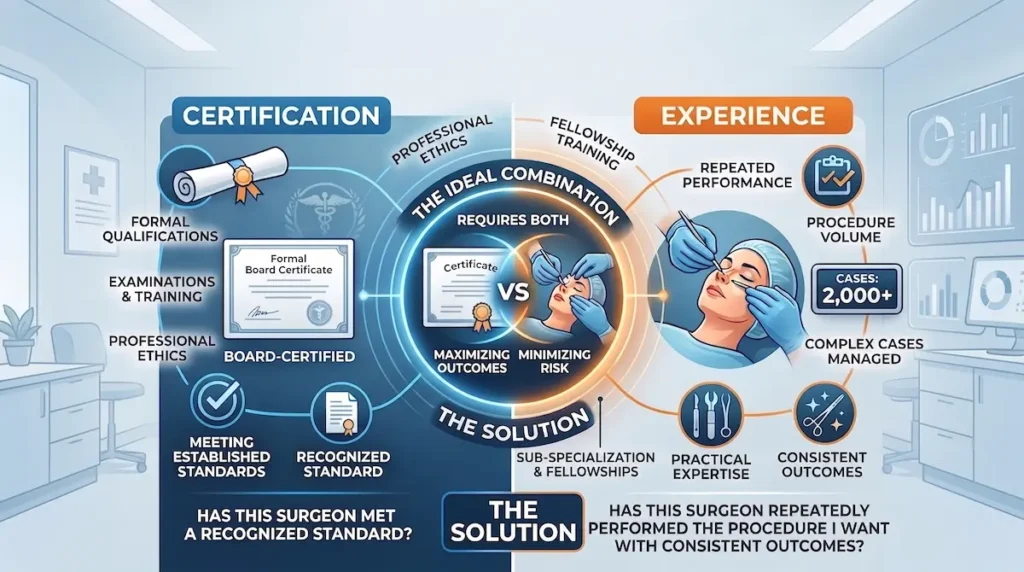
Certification and experience answer different questions. Certification asks, “Has this surgeon met a formal standard?” Experience asks, “Has this surgeon repeatedly performed the procedure I want, with consistent outcomes?”
You need both. One without the other leaves a gap.
Why Certification Alone Is Not Enough
A board-certified surgeon may be competent in general plastic surgery but rarely perform the specific operation you want. That matters in aesthetic surgery, where technical skill and visual judgement must match.
A facelift patient should ask about facelift volume. A rhinoplasty patient should ask about primary, preservation, and revision cases. A hair restoration patient should ask who designs the hairline and who performs each stage.
For example, Canadians evaluating facial surgery can compare certification with procedure-specific surgeon evaluation criteria before deciding.
Fellowship Training and Subspecialization
Fellowship training can show deeper exposure to a focused area of practice. This is especially relevant for facial plastic surgery, rhinoplasty, and complex revision work.
For rhinoplasty, this matters because nasal surgery is not only cosmetic. Breathing, structure, and long-term support must be considered.
Surgical Volume and Procedure-Specific Expertise
Surgical volume is not a credential in the formal sense, but it is a practical indicator. A surgeon who performs a procedure frequently has usually managed a wider range of anatomy, expectations, and recovery patterns.
AKM Clinic documents over 2,000 successful facial surgeries since 2013 under the leadership of Dr. Akif Mehmetoğlu. For Canadian patients considering facial rejuvenation, that procedure-specific experience should be reviewed alongside board credentials.
Volume still needs context. Ask what kinds of cases make up the number, how recent the experience is, and whether before-and-after examples match your anatomy and goals.
How Canadians Can Verify Board Certification?
Verification should happen before you book flights. Once you arrive in Istanbul, you have already committed time, money, and emotional energy. It is harder to walk away.
A careful patient verifies credentials while still in Canada. This protects your health and gives you more control over the decision.
Public Registry Verification
Start with the surgeon’s full legal name. Then ask which board, society, or national authority issued each credential.
If a public registry exists, search it yourself. If the credential is not publicly searchable, ask the clinic for documentation that clearly shows the issuing body, specialty, and current status.
Do not rely only on screenshots. They can be outdated or incomplete.
Cross-Checking Professional Memberships
Professional memberships can support credibility, but they should be checked separately from certification. ISAPS, EAFPS, and other professional bodies may have searchable member directories.
Also confirm whether the membership relates to the surgeon’s actual work. A general professional affiliation is less meaningful than a specialty-specific credential that aligns with your procedure.
Language also matters. Canadian patients should be able to ask credential questions directly, without confusion. For that reason, review verifying surgeon communication skills as part of the same due diligence process.
Reviewing AKM Clinic Surgeons’ Credentials
Patients can also meet AKM Clinic’s surgical team before making a decision. This allows you to evaluate credentials, specialty focus, and communication style together.
Credential review should not happen in isolation. You can also compare surgeon qualifications with verified patient experiences to understand how credentials translate into patient care.
Canadian Verification Checklist Before You Travel
- Ask for the surgeon’s full legal name and specialty.
- Confirm which board or professional body issued each credential.
- Check whether the credential is certification, fellowship, or membership.
- Ask who personally performs the surgery.
- Request written confirmation before leaving Canada.
Common Misunderstandings About Board Certification
Credential language can be confusing, especially in cosmetic surgery. Some terms are formal. Others are promotional. Canadian patients need to separate regulated titles from marketing phrases.
This section addresses the mistakes patients often make when reading surgeon profiles online.
“Cosmetic Surgeon” vs “Plastic Surgeon”
The term “cosmetic surgeon” can be used in different ways depending on the country and context. It may not always indicate formal plastic surgery specialty training.
“Plastic surgeon” generally implies specialty training in plastic, reconstructive, and aesthetic surgery. Still, the title should be verified rather than assumed.
If a profile avoids specific boards, training institutions, or specialty pathways, ask for clarification.
Membership vs Certification
Membership means belonging to a professional organization. Certification usually means completing a structured assessment pathway.
Both can matter. They are not interchangeable.
A strong profile may include board certification, society membership, fellowship experience, and hospital privileges. A weak profile may use society logos to imply certification that does not actually exist.
Why Marketing Claims Are Not Credentials
Phrases like “world-class surgeon,” “international expert,” or “best clinic” are not credentials. They are claims.
Credentials should be specific and checkable. A careful Canadian patient should ask: Who issued this? What does it certify? Can I verify it independently?
If the answer is unclear, pause before booking.
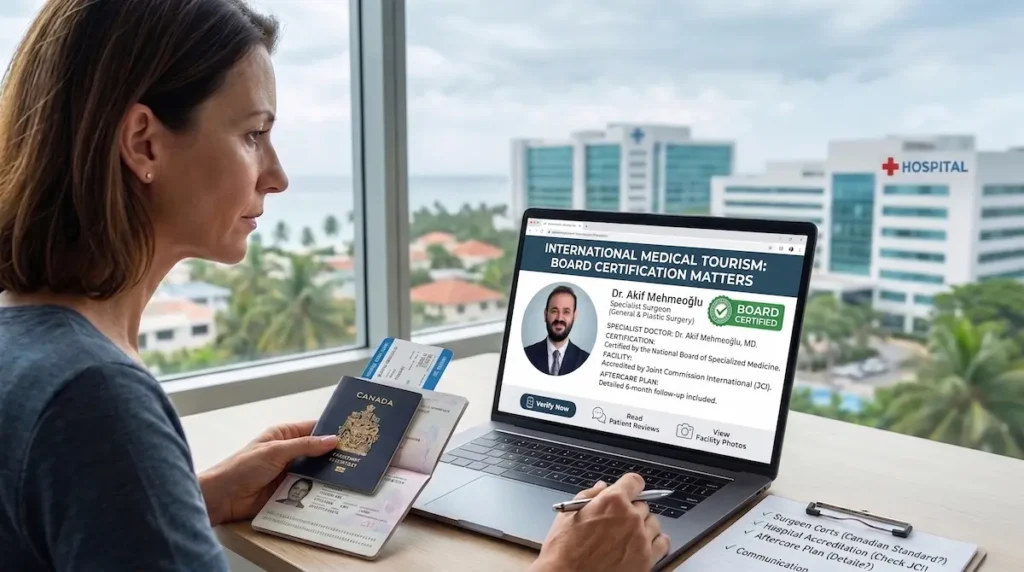
Why Board Certification Matters for Medical Tourism Patients?
Medical tourism adds distance to the decision. You are not only choosing a surgeon. You are choosing a clinic, hospital environment, recovery plan, and follow-up structure across borders.
Board certification helps reduce uncertainty, but it should be combined with facility accreditation and aftercare planning.
Trust and Transparency Across Borders
Canadian patients are used to provincial oversight and clear specialist categories. In international care, you need to recreate that structure through your own research.
This is where transparency matters. A trustworthy clinic should explain the surgeon’s role, the facility, the procedure plan, and the follow-up process in plain language.
For a broader journey framework, review how Canadian patients evaluate surgeons before travelling.
Reducing Risk Through Verification
No credential removes surgical risk. Surgery always carries risk.
However, verification reduces avoidable risk. It helps you avoid unqualified providers, unclear responsibility, and facilities that cannot explain their safety systems.
Surgeon credentials should also be paired with facility accreditation and patient safety standards, because safe surgery depends on both the person operating and the environment supporting them.
Creating a Canadian-Level Due Diligence Process
A Canadian-level due diligence process does not mean every international surgeon must hold a Canadian credential. It means you apply the same seriousness you would apply at home.
Verify the surgeon. Verify the facility. Verify the communication pathway. Verify the aftercare plan.
That process gives you a more realistic picture than any single certificate can provide.
Frequently Asked Questions: Plastic Surgeon Board Certification
These are the most common questions Canadian patients ask when they begin comparing surgeon credentials in Turkey. The answers are intentionally practical, because credential language can become confusing quickly.
What is plastic surgeon board certification?
Plastic surgeon board certification means a surgeon has completed a recognized training and assessment pathway through a professional certifying body. It usually includes specialty training, examinations, and proof of competence.
Is EBOPRAS equivalent to Canadian board certification?
EBOPRAS is not the same organization as the Royal College of Physicians and Surgeons of Canada. It is a European board certification pathway. Canadian patients should treat it as a serious European credential, then verify the surgeon's specialty and experience.
Is ISAPS membership the same as certification?
No. ISAPS is a professional society, not a board certification body. Membership can support credibility, but it should not replace formal certification or specialty verification.
How can Canadians verify a surgeon's credentials?
Ask for the surgeon's full legal name, board or society affiliations, specialty, and facility privileges. Then check public registries where available and request written documentation before travelling.
Does board certification guarantee good results?
No. Certification confirms a baseline level of professional training. Results also depend on procedure-specific experience, anatomy, surgical judgement, communication, and recovery support.
What is more important than board certification?
Nothing replaces certification as a baseline. After that, procedure-specific experience, hospital safety standards, transparent communication, and aftercare structure become the most important factors.
Can I verify certifications before travelling to Turkey?
Yes. You should verify them before booking flights. Ask for documentation, registry links, and written confirmation of who will perform your procedure.
What credentials should concern me if they are missing?
Be cautious if a clinic cannot clearly identify the surgeon's specialty, board certification, hospital affiliation, or role in the operation. Vague "expert" titles are not enough.
Why do Canadian patients place so much importance on certification?
Canadians are used to regulated specialist pathways and provincial medical oversight. When travelling abroad, certification helps recreate part of that safety framework through independent verification.
CTA: Review AKM Clinic surgeons’ credentials and bring your certification questions to a virtual consultation before making a decision.
Medical Disclaimer: This page is provided for general educational purposes only and does not replace an in-person medical consultation, diagnosis, or personalized treatment plan. All surgery carries risks, and outcomes vary between individuals. Suitability for a plastic surgery, procedure selection, and anesthesia choice can only be determined after a full clinical assessment by a qualified surgeon. Always follow your clinician’s instructions and seek urgent medical attention if you develop concerning symptoms during recovery.