
Quick summary: Natural hairline design is the planning process that makes a hair transplant look realistic rather than obviously surgical. The surgeon must balance age, facial proportions, donor capacity, graft direction, hairline density gradients, and temple integration before placing a single graft.
A natural result is rarely a perfectly straight or aggressively low hairline. It is usually slightly irregular, age-appropriate, and designed to keep looking believable as the patient ages.
For Canadian patients researching hair transplant options at AKM Clinic, the design stage is often the most important part of the procedure. Technique matters, but a technically clean transplant can still look unnatural if the hairline is drawn too low, too straight, too dense at the front, or disconnected from the temples.
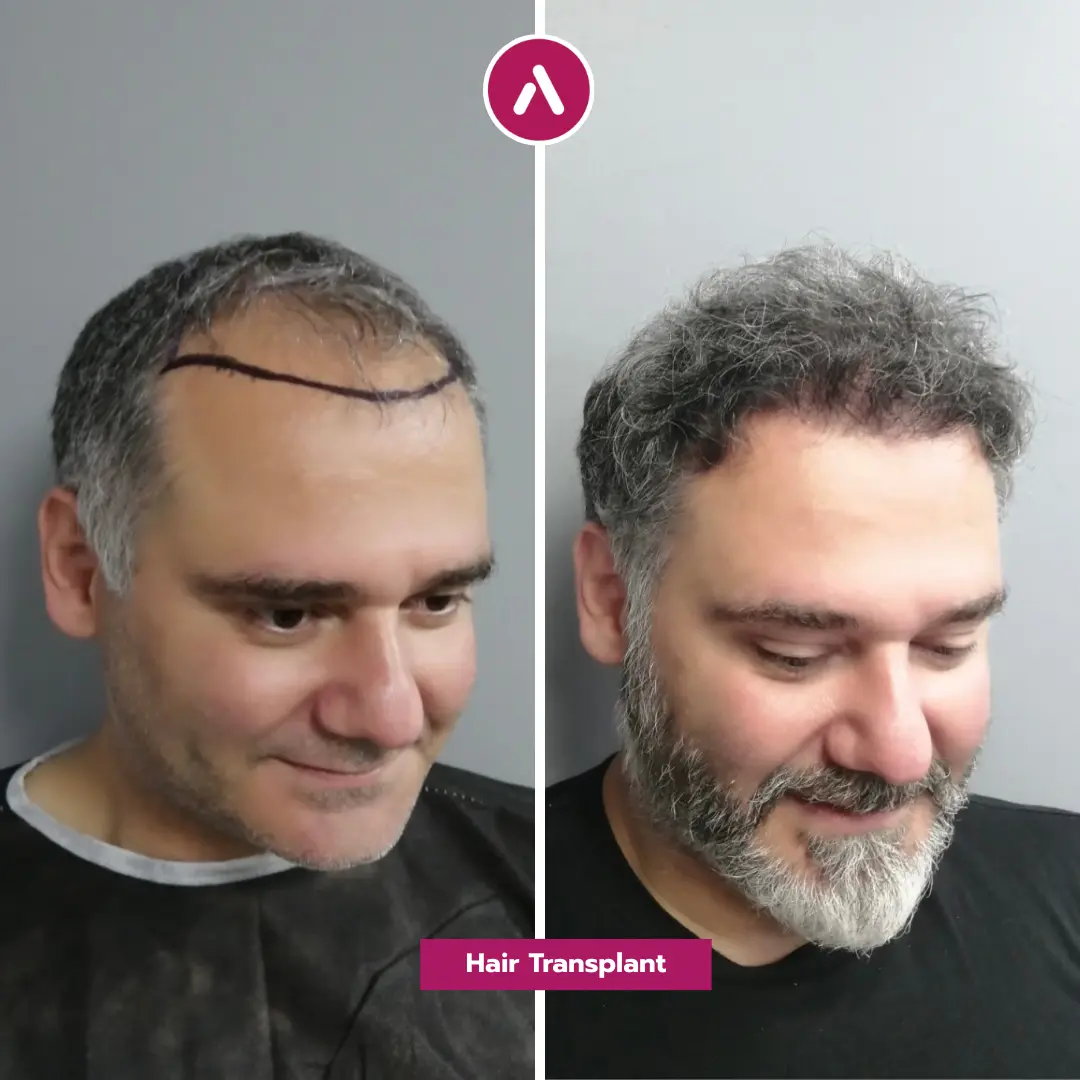
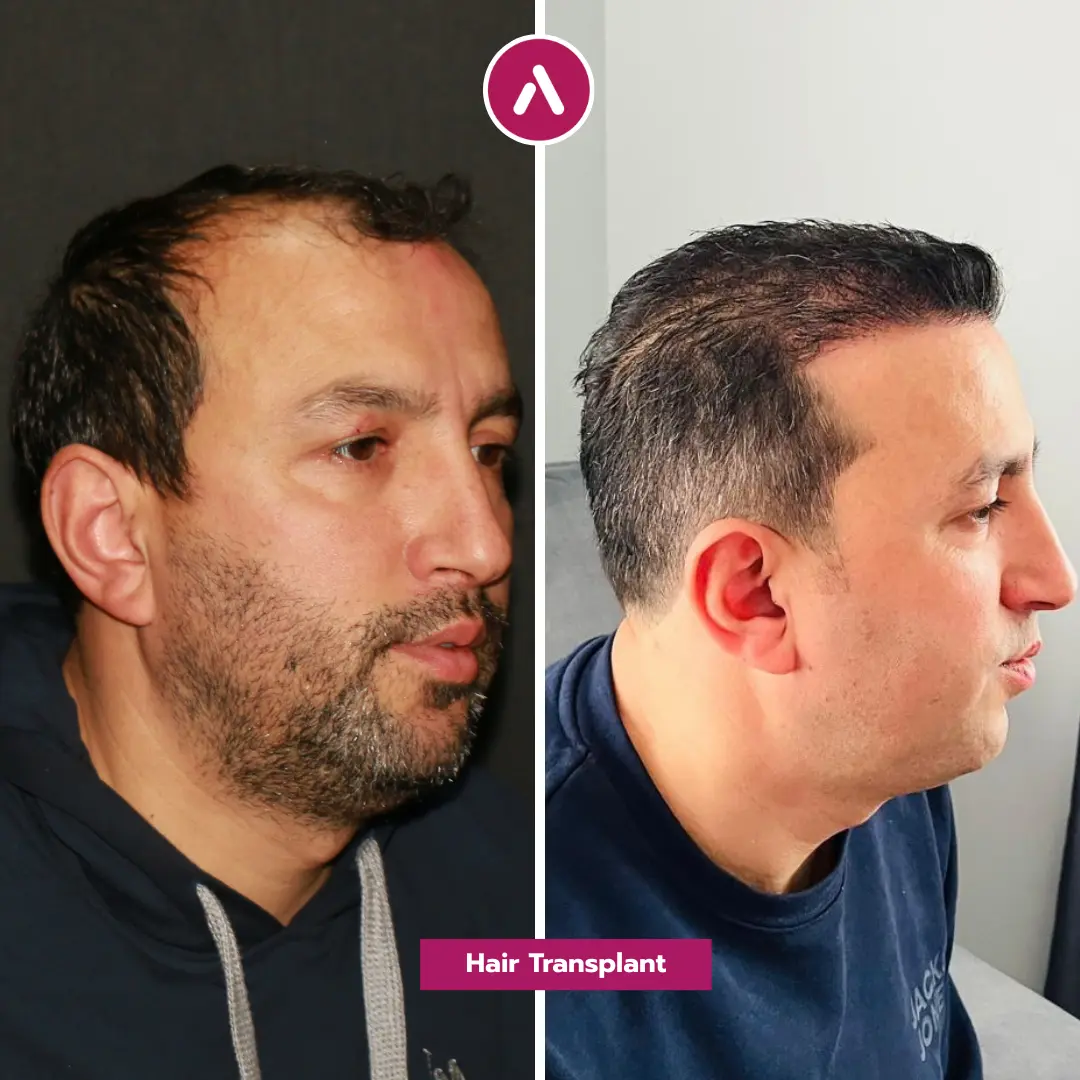
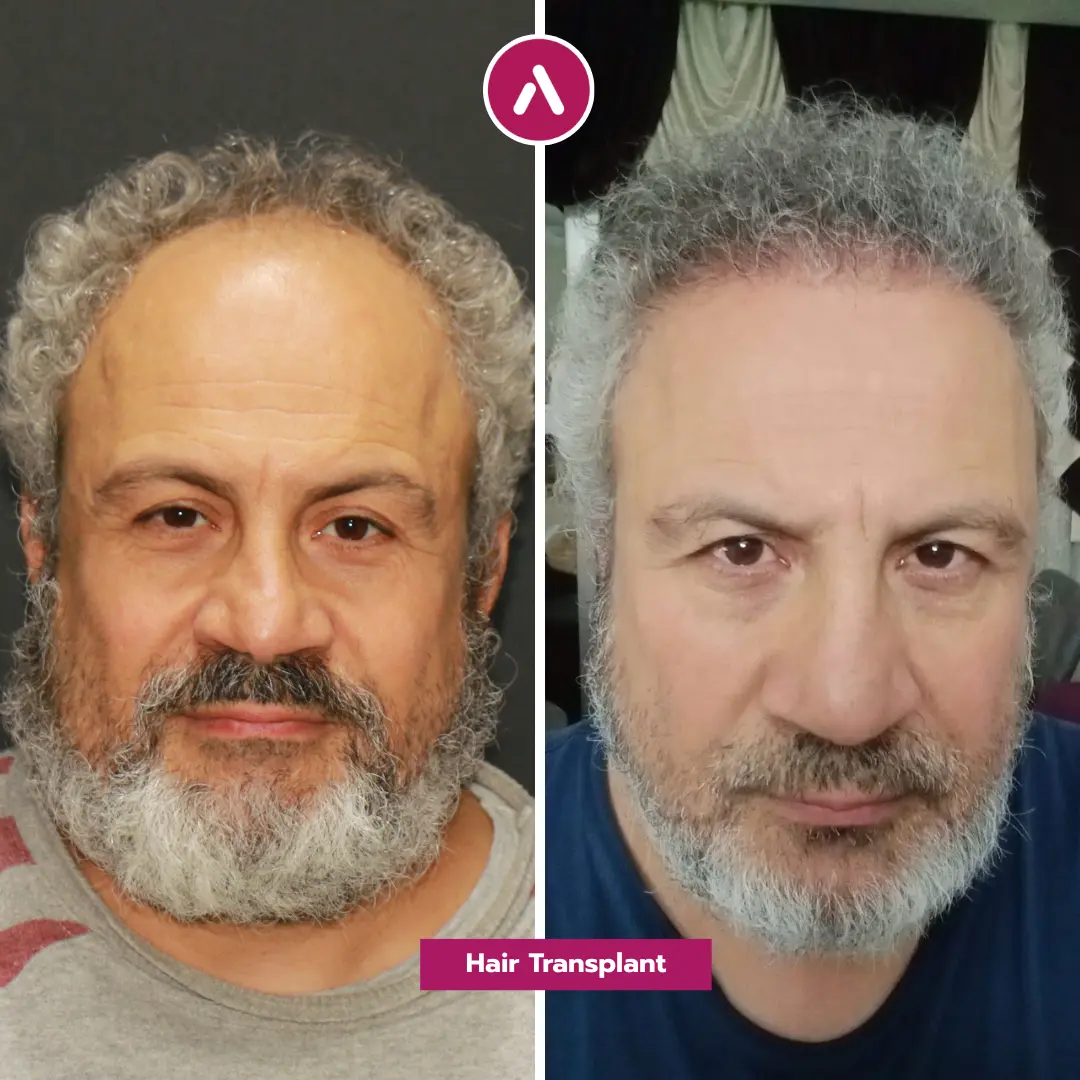
The International Society of Hair Restoration Surgery explains that natural-looking FUE results depend on more than the extraction method; hairline design, recipient-site angle, graft distribution, and atraumatic placement all influence the final appearance.
That is why AKM Clinic approaches hair restoration with a “Natural-First” planning philosophy. The goal is not to recreate the lowest hairline a patient ever had. The goal is to restore facial framing in a way that looks appropriate in Toronto boardrooms, Vancouver social settings, Montreal professional circles, and everyday life back home.
Table of Contents
Why Hairline Design Is Artistry, Not Formula?
Hairline planning is medical, technical, and visual at the same time. A surgeon must understand scalp anatomy and graft survival, but also how a face reads from conversational distance. A natural hairline should look convincing when the patient is standing under office lighting, walking outdoors, or being photographed from the side.
The most common reason transplants look “done”
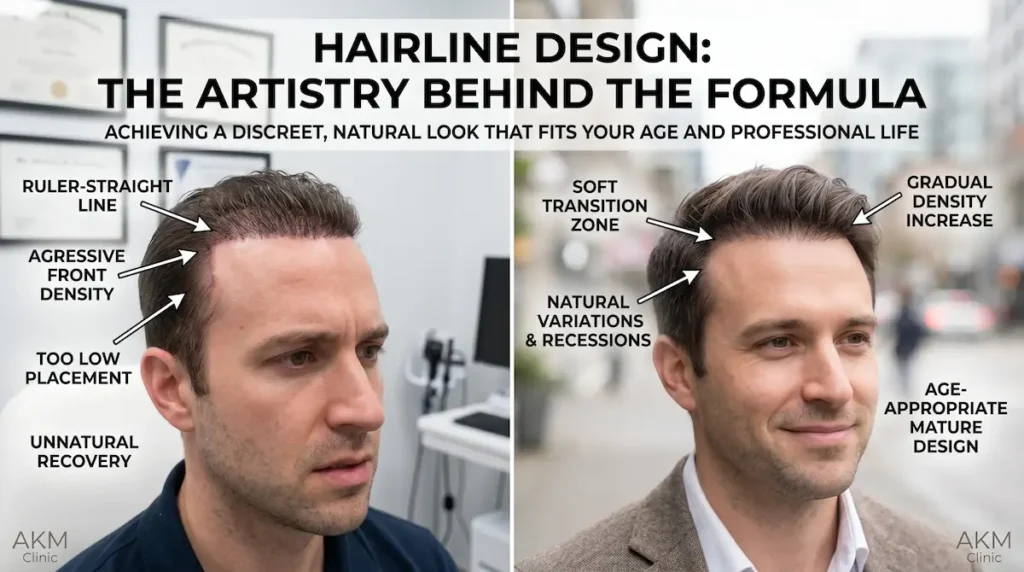
The most obvious transplanted hairlines usually share the same mistakes. They are too straight, too low, too dense at the very front, or built with multi-hair grafts where single-hair grafts should have been used.
A natural hairline has a soft transition zone. The front edge should not look like a ruler line. Real hairlines have tiny variations, slight recessions, and gradual changes in density.
This is also why technique alone does not guarantee naturalness. A patient comparing the DHI vs FUE technique decision should understand that both methods can produce excellent natural hair transplant results when the design is sound. Both can also look artificial when the planning is poor.
Age-appropriate hairline positioning
A hairline must fit the patient’s age, not just their wish photo. A 25-year-old patient may want a sharp juvenile hairline, but a 45-year-old professional usually needs a more mature frame.
This matters especially for Canadian patients who want a discreet result. The ideal reaction is not, “You had a transplant.” It is closer to, “You look rested,” or “Your hair looks better lately.” Subtlety is the point.
Age-appropriate design also protects donor supply. Donor hair is finite. Placing thousands of grafts too low can create a short-term visual gain and a long-term problem if hair loss continues behind the transplanted zone.
Why a 25-year-old’s hairline is wrong for a 45-year-old
Facial proportions change with age. A very low, flat hairline can look natural on a young adult but strange on someone with mature facial features, deeper forehead lines, or established temporal recession.
A good surgeon designs for the patient’s current face and likely future hair loss. The plan must still make sense 10 years later. This is one reason AKM Clinic avoids overcorrection in hair restoration, just as it avoids the “operated-on” look in facial surgery.
Canadian Patient Note: Professional Discretion Matters
Many Canadian hair transplant patients are not looking for a dramatic reveal. They want a hairline that fits work, family, and social life without becoming the first thing people notice. For professionals in Toronto, Ottawa, Calgary, Vancouver, and Montreal, a mature and realistic design is often more valuable than a low, attention-grabbing one.
The Principle of Irregularity
Natural hairlines are organized, but they are not perfectly symmetrical. They contain small irregularities that soften the visual edge. The challenge is to create irregularity that looks biological, not random.
Why natural hairlines are not straight lines
A straight hairline is one of the easiest transplant mistakes to spot. Human hairlines have subtle curves, small peaks, slight recessions, and soft transitions between the forehead and the denser scalp.
The surgeon should avoid drawing a hard horizontal border. Instead, the front edge should move in small, natural variations. Even 1–2 millimetres of micro-irregularity can help break the artificial “painted-on” look.
Single-graft sentinel zones
The front row of a natural hairline should be built with single-hair grafts. These act like a soft feathered edge before the density increases behind them.
Multi-hair grafts at the very front can create a pluggy appearance. They may survive well, but they do not mimic how natural hair emerges at the frontal border.
Behind the single-graft transition zone, the surgeon can gradually introduce two-hair and three-hair grafts where appropriate. This creates density without making the hairline look heavy.
Micro-irregularity at the frontal edge
Micro-irregularity refers to small, controlled variations along the first few rows of the hairline. It prevents the edge from looking drawn.
This is not the same as carelessness. The pattern must be deliberate. A skilled surgeon places irregularity within a coherent design so the overall hairline still frames the face cleanly.
“The hairline is the artistic foundation of the transplant. If the front edge is too perfect, the whole result can look artificial, even when graft survival is excellent.”
Density Gradients
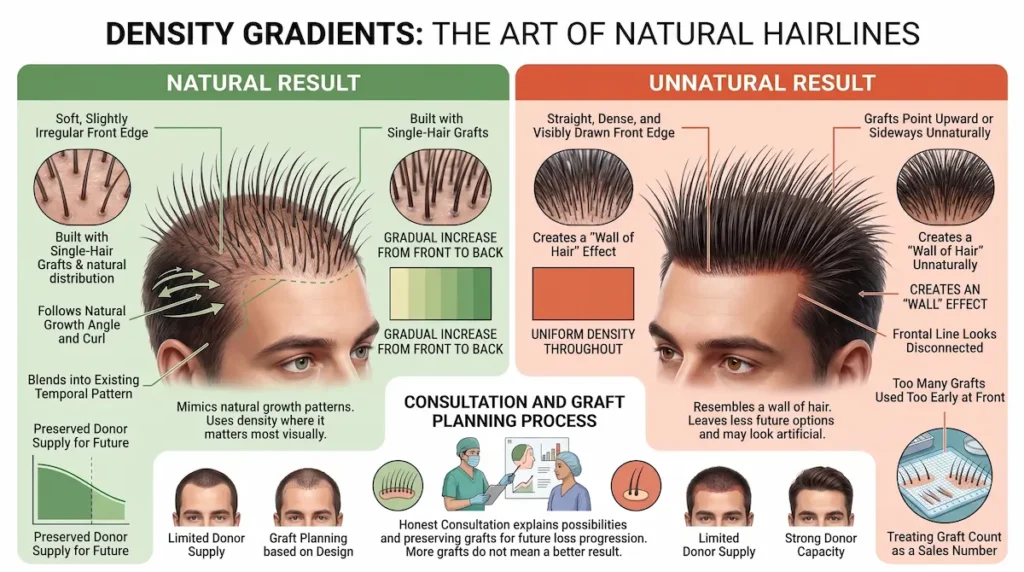
Density is not supposed to be equal everywhere. Natural hairlines start softer at the front and become denser as they move backward. This gradual transition is called a density gradient.
Front-to-back density progression
The first rows should look lighter. They create the illusion of natural emergence. Behind that, density can increase to provide coverage and visual strength.
If the front is packed too densely, the result can resemble a wall of hair. That may look impressive in early marketing photos, but it often looks unnatural in real life.
How density gradient mimics nature
Natural hair does not grow in identical spacing across the scalp. The frontal transition zone is softer. The mid-scalp is generally denser. The crown follows a different pattern again.
A realistic transplant respects these differences. It uses density where it matters most visually while preserving grafts for future needs.
Graft count planning for natural density
Graft count should be planned around the design, not treated as a sales number. More grafts do not automatically mean a better result.
A patient with limited donor supply may need a slightly more conservative hairline to achieve natural density. Another patient with strong donor capacity may be able to restore more frontal coverage while still keeping a realistic design.
This is where an honest consultation matters. The surgeon should explain what is possible, what is unwise, and what should be saved for future hair loss progression.
| Hairline Design Principle | Natural Result | Unnatural Result |
|---|---|---|
| Position | Age-appropriate and proportional to the face | Too low for the patient’s age or future hair loss pattern |
| Front edge | Soft, slightly irregular, built with single-hair grafts | Straight, dense, and visibly drawn |
| Density | Gradual increase from front to back | Uniform density that creates a “wall” effect |
| Direction | Grafts follow natural growth angle and curl | Hair points upward, forward, or sideways unnaturally |
| Temple integration | Hairline blends into existing temporal pattern | Frontal line looks disconnected from the sides |
| Future planning | Donor supply is preserved for progression | Too many grafts used too early at the front |
Frontal Angle and Direction
Even a well-positioned hairline can look wrong if the grafts are placed at unnatural angles. Hair direction is one of the quiet details that separates a believable transplant from an obvious one.
Graft angulation that mimics natural growth
Graft angulation refers to the direction and depth at which each follicular unit is implanted. At the frontal hairline, hair typically exits the scalp at a low angle.
If grafts are placed too upright, the hairline can look bristly. It may also become harder to style. The goal is to match the native growth pattern as closely as possible.
Whorl and direction mapping
Every scalp has a directional pattern. The crown may have a whorl. The temples may angle backward. The frontal zone may sweep slightly to one side.
Before implantation, the surgical team should map these patterns. This helps the transplanted hair blend with the existing hair rather than fighting against it.
Temple point integration
The temples are often where unnatural results become visible. A frontal hairline that looks acceptable from the front may still fail from a three-quarter angle if the temple points are ignored.
Temple design must be conservative. Overbuilding the temples can feminize a male hairline or create a shape that looks too sharp. Underbuilding them can leave the new hairline disconnected from the side profile.
ISHRS educational material on hairline design notes that male, female, and transgender patients can require different planning characteristics, and that temple areas are among the more challenging zones.
Facial Proportion and the Hairline
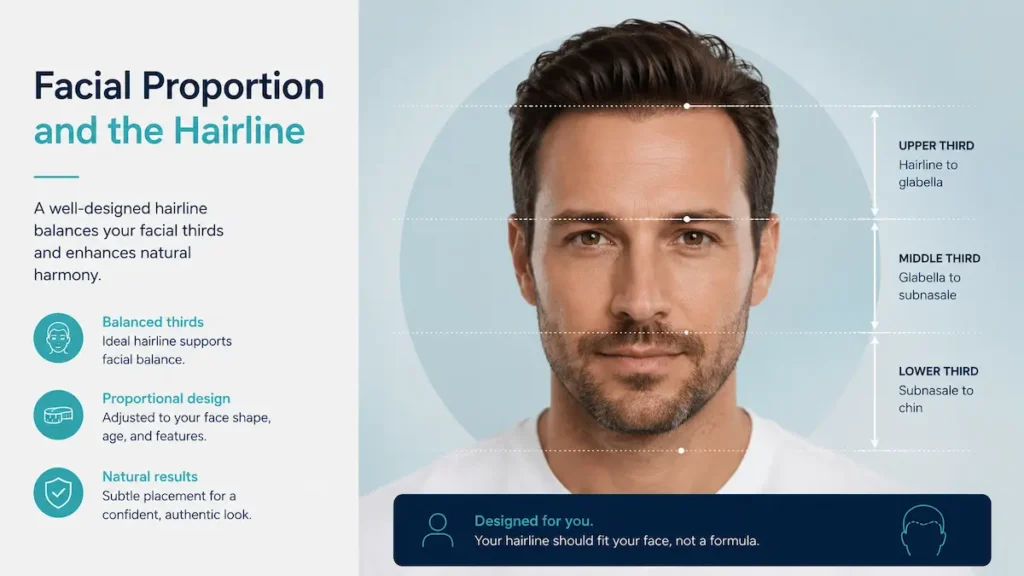
The hairline is part of the face, not a separate cosmetic feature. Its height, curve, and density affect how the forehead, brows, eyes, and jawline are perceived.
Forehead-to-face ratio mathematics
Surgeons often evaluate the face in proportional zones. The hairline influences the upper third of the face, so lowering it even slightly can change facial balance.
That does not mean every patient should receive a mathematically “ideal” hairline. Formula-based design can look rigid. Proportion is a guide, not a command.
Adapting for face shape
A narrow face, broad forehead, strong jaw, or rounded facial shape may call for different hairline curves. The same hairline template should not be applied to every patient.
For example, a sharper recession pattern may look natural on one male patient but too severe on another. A rounded female hairline may soften the face, while an overly flat one can appear artificial.
Gender-specific hairline design
Male and female hairlines usually differ in shape, height, recession pattern, and temple structure. Female hairlines often follow a softer contour, while male hairlines more commonly include some temporal recession.
ISHRS patient education on female hair transplantation describes female hairlines as typically softer and more rounded than many male hairline patterns.
Hair loss cause also matters. The Canadian Dermatology Association explains that alopecia can occur for many reasons, including aging, stress, childbirth, autoimmune disease, hormonal imbalance, medication, or underlying illness. A proper diagnosis should come before design.
Canadian Patient Note: Hairline Planning Before Combined Procedures
Some Canadian patients consider combining hair transplant with facial procedures during one Istanbul trip. In those cases, hairline design should account for facial proportions after rejuvenation, not just the pre-operative face. This is especially important if brow position, forehead framing, or temple visibility will change.
AKM Clinic’s Hairline Planning Process
At AKM Clinic, hairline planning begins before surgery day. The surgeon evaluates the patient’s photographs, donor area, hair loss pattern, age, facial proportions, and expectations. The design is then refined in person before implantation begins.
Pre-operative consultation and drawing
The first step is a consultation that evaluates both the scalp and the face. The surgeon assesses donor density, future loss risk, existing miniaturization, and the safest design range.
The proposed hairline is then drawn directly on the scalp. This visual step matters because patients often react differently once they see the design on their own face.
The design should be viewed from the front, side, and three-quarter angles. A hairline that looks good in one view may need adjustment in another.
Patient input and approval before surgery
International patients should not feel that the hairline is imposed on them. At AKM Clinic, the patient reviews the proposed design before surgery begins.
This is especially helpful for Canadians travelling from cities like Toronto, Vancouver, Montreal, Calgary, and Ottawa. The design conversation happens before graft placement, not after the point of no return.
Patients can ask why the line is placed at a certain height, why the temples are conservative, or why the surgeon recommends saving grafts for future density. A good answer should be specific to the patient’s anatomy.
Adapting the design to donor capacity
Donor capacity is the practical limit of every hair transplant. A design may look appealing on paper, but it must be supported by enough healthy grafts to create believable density.
This is where realistic planning protects the patient. A lower hairline requires more grafts. If donor supply is limited, lowering the hairline too aggressively can reduce density and create future coverage problems.
For patients comparing hair transplant pricing in CAD, AKM’s published technique-level pricing includes Micro FUE Hair Transplant at CAD $3,000, Sapphire FUE at CAD $3,000, and Standard DHI at CAD $3,400. Hairline design is part of the surgical planning process; the final recommendation depends on technique, donor capacity, and graft strategy.
Patients can also review the month-by-month growth timeline to understand when the planned hairline begins to look mature. The design may be visible on day one, but the final density and texture take time.
For value-focused patients, evaluating fixed-price hair transplant clinics can help prevent confusion around graft-count upselling. A transparent quote should support the medical plan, not pressure the patient into a lower or denser hairline than their donor supply can safely support.
Patients who want to verify the clinic’s broader standards can also review AKM’s hair restoration team and the clinic’s Natural-First philosophy before booking.
Canadian Patient Note: Pre-Surgery Hairline Approval
Because Canadian patients travel a long distance for surgery, the approval stage should feel clear and calm. Ask to see the proposed hairline in a mirror, from multiple angles, and in photos. Do not approve a design you do not understand.
ISHRS has warned patients about the risk of unlicensed personnel performing substantial aspects of hair restoration surgery. For safety and design consistency, patients should confirm who performs the surgical planning, incisions, and implantation steps before they commit.
Frequently Asked Questions: Natural Hairline Design
These are the questions Canadian patients most often ask before approving a hairline design. The answers are general and should be personalized during consultation.
How do I know if my hairline will look natural?
A natural hairline should be slightly irregular, age-appropriate, and integrated with your temple pattern. It should also use single-hair grafts at the front and gradually increase density behind the transition zone.
Can I approve the hairline before surgery?
Yes. You should review the drawn hairline before graft placement begins. Ask to see it from the front, side, and three-quarter angles so you understand how it frames your face.
Should my hairline match my younger self?
Usually, no. Recreating a teenage hairline can look unnatural later in life and may waste donor grafts. A mature version of your original pattern often looks more realistic.
How is the hairline different for men and women?
Male hairlines often include some temporal recession and a less rounded contour. Female hairlines are usually softer, rounder, and less recessed at the temples. The design must also consider the cause of hair loss.
What makes a hairline look “transplanted”?
The biggest warning signs are a straight front edge, excessive density in the first row, multi-hair grafts at the hairline, poor graft angulation, and temple points that do not blend with the face.
Can a low hairline be designed safely?
Sometimes, but only if donor supply, age, facial proportions, and future hair loss risk support it. A low hairline that cannot be maintained with adequate density may create problems later.
How many grafts does a natural hairline need?
There is no universal number. The graft count depends on hair calibre, donor density, head size, hairline height, temple work, and the amount of frontal thinning. A realistic design starts with anatomy, not a fixed graft target.
Review Your Personalized Hairline Design in a Virtual Consultation
A realistic hair transplant begins with a design that respects your age, donor supply, facial proportions, and long-term hair loss pattern. AKM Clinic’s planning process gives Canadian patients a clear opportunity to review the proposed hairline before surgery.
Use the consultation to ask specific questions: why the hairline sits at that height, how the temples will be handled, how many grafts are needed, and how the design will age. A natural result starts with those decisions.
Medical Disclaimer: This page is provided for general educational purposes only and does not replace an in-person medical consultation, diagnosis, or personalized treatment plan. All surgery carries risks, and outcomes vary between individuals. Suitability for a hair transplant, procedure selection, and anesthesia choice can only be determined after a full clinical assessment by a qualified surgeon. Always follow your clinician’s instructions and seek urgent medical attention if you develop concerning symptoms during recovery.