
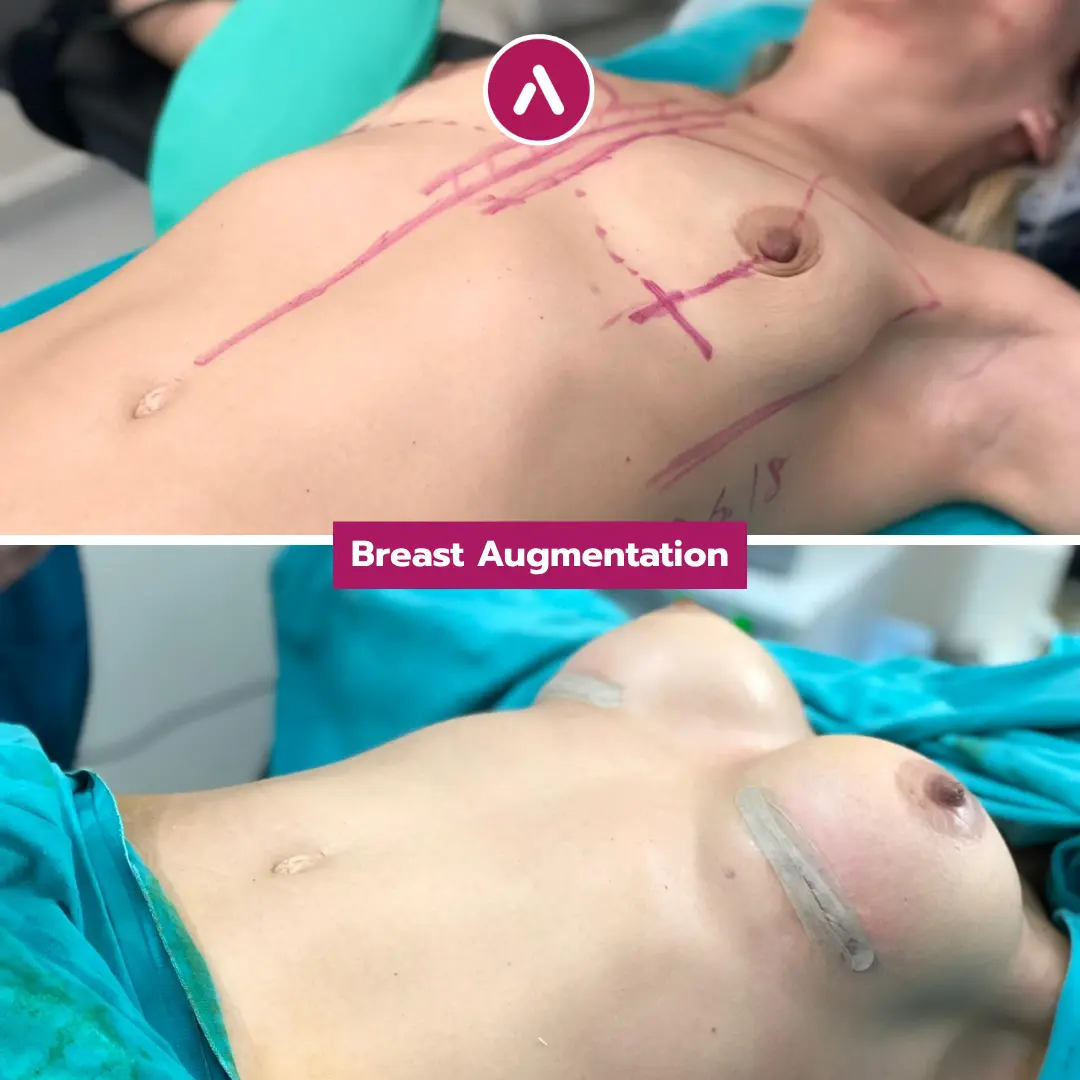
Lipofilling breast Turkey searches usually come from patients who want breast enhancement without implants, visible implant edges, or foreign material. The procedure, also called fat transfer breast augmentation, uses fat removed from another part of your body and places it into the breast in carefully layered micro-deposits.
For Canadian patients comparing options from Toronto, Vancouver, Montreal, Calgary, or Ottawa, the appeal is clear. Lipofilling can create a softer, more natural breast shape while also contouring the donor area through liposuction. It is not the right option for every body type, though.
This guide focuses specifically on implant-free breast lipofilling at AKM Clinic. For the full treatment page, see fat transfer breast augmentation at AKM Clinic.
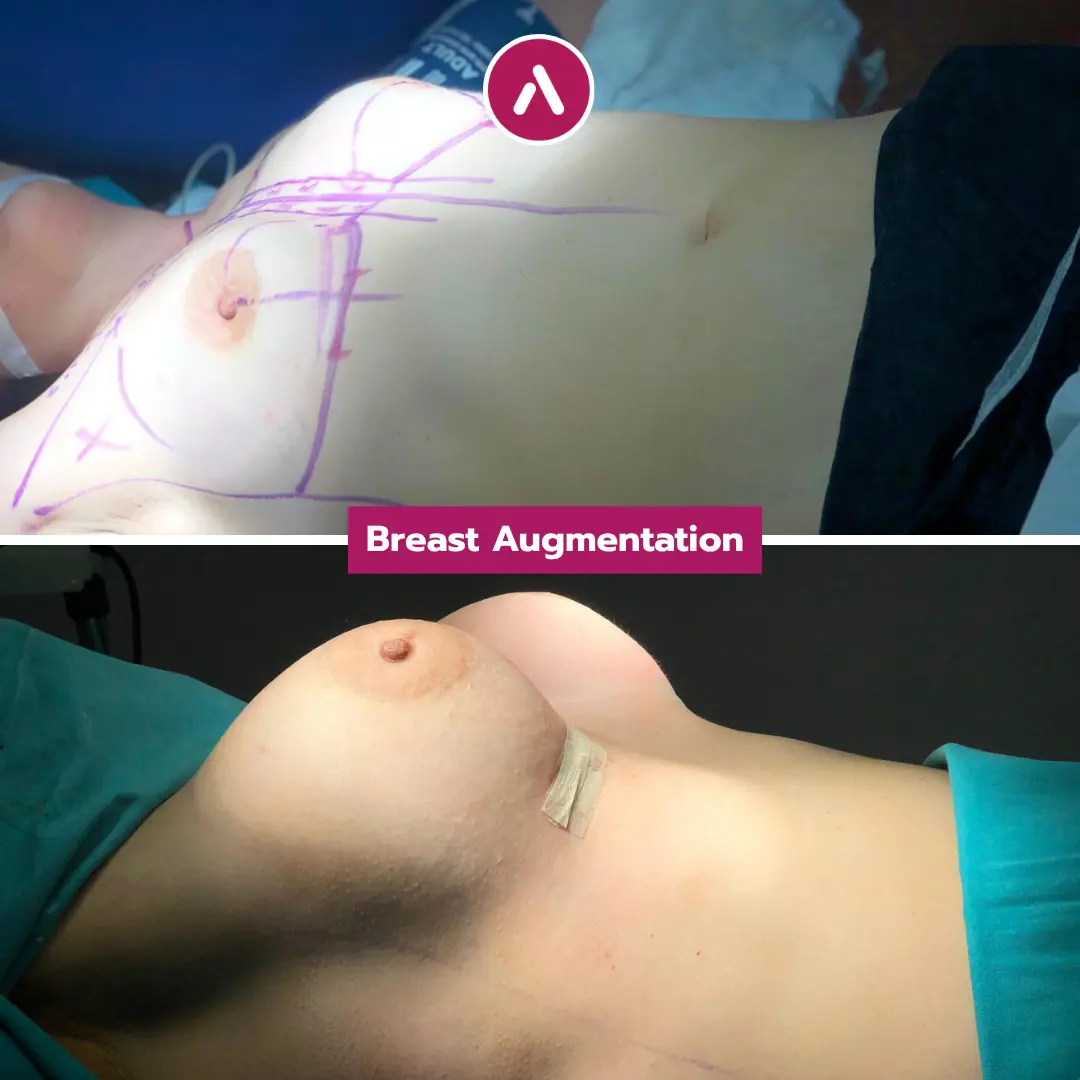
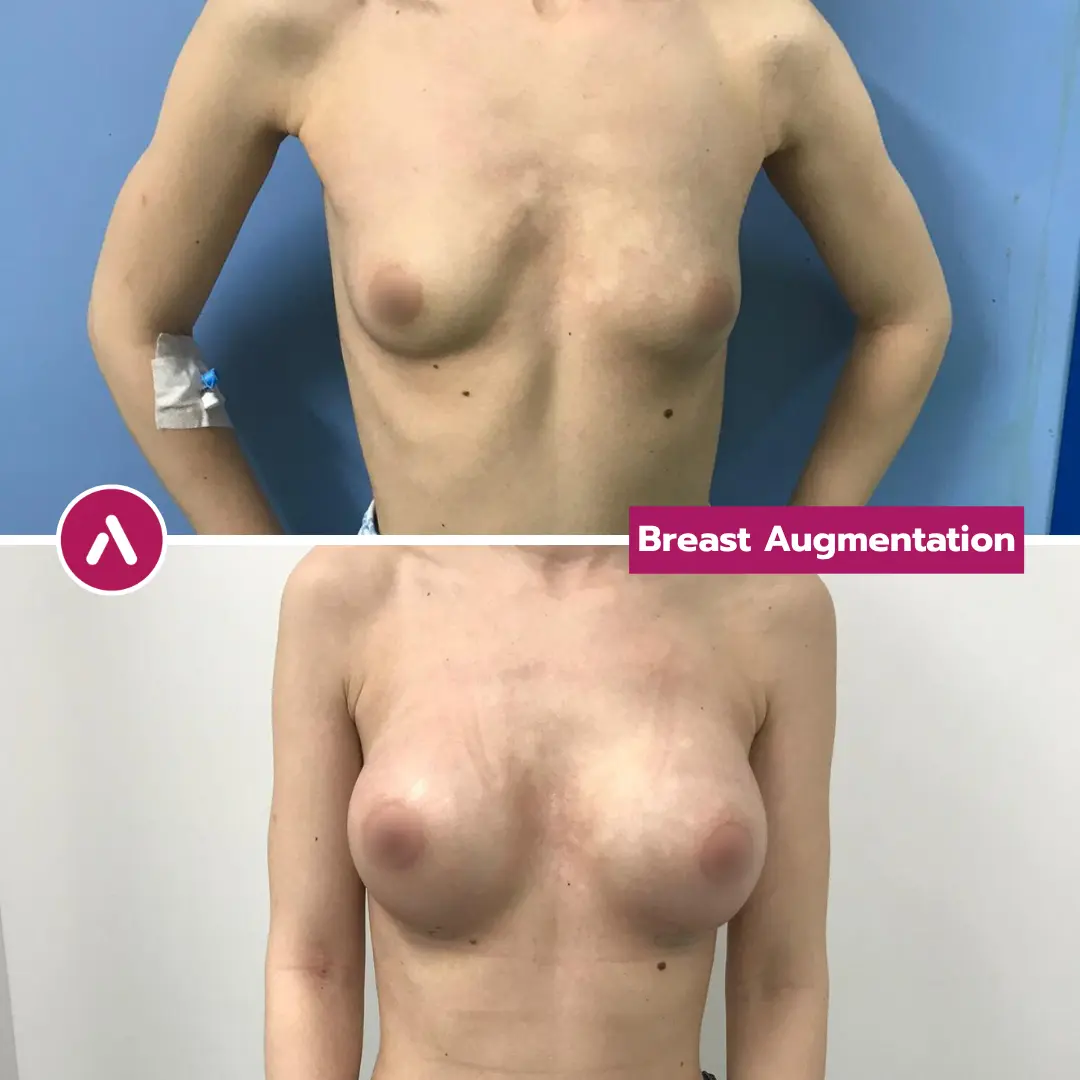
Quick Summary: Lipofilling breast augmentation uses your own fat to enhance breast shape and volume without implants. It is best suited to patients who want a modest, natural-looking increase rather than a dramatic change.
The main advantages are natural feel, no implant device, and donor-site contouring. The main limitations are fat survival unpredictability, the need for enough donor fat, and a typical size increase of about one cup.
Medical note: This article is educational and does not replace a personal consultation with a qualified surgeon. Your candidacy depends on anatomy, health history, breast screening history, and aesthetic goals.
Table of Contents
Lipofilling Breast Turkey: What Fat Transfer Breast Augmentation Is?
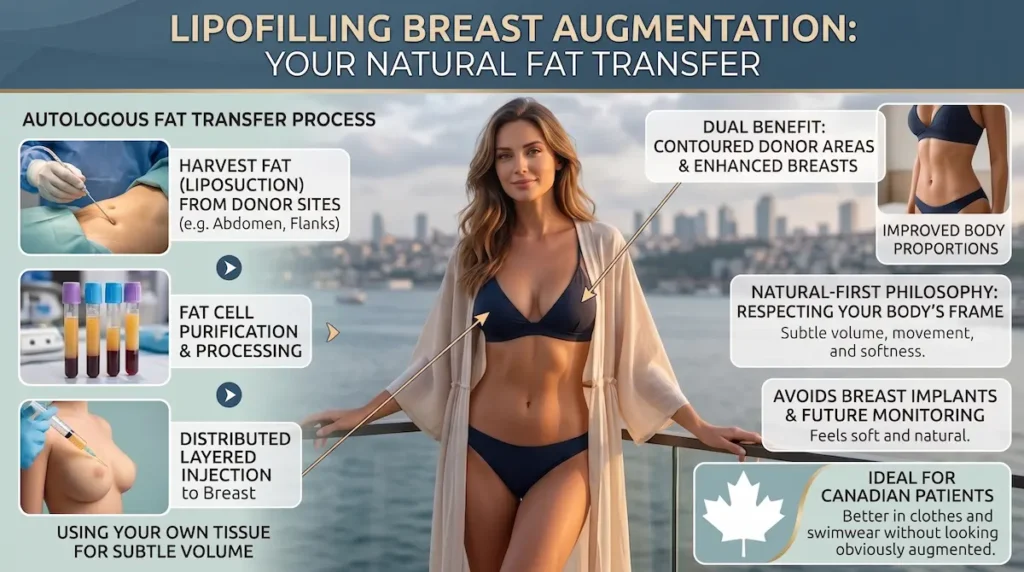
Lipofilling breast augmentation is a surgical fat grafting procedure. It combines liposuction, fat purification, and breast shaping into one operation. The goal is not to create an implant-like result, but to add subtle volume with tissue that belongs to your own body.
At AKM Clinic, this fits the Natural-First philosophy: enhancement should respect the patient’s frame, not overpower it. Canadian patients often describe this goal as looking “better in clothes and swimwear” without looking obviously augmented.
Autologous fat transfer mechanism
Autologous fat transfer means the fat comes from your own body. Common donor areas include the abdomen, flanks, thighs, or lower back, depending on where suitable fat is available.
The surgeon removes fat through liposuction, processes it, then injects it into the breast in small, distributed layers. This layered approach matters. Fat cells need contact with healthy surrounding tissue to establish blood supply.
The technique is different from simply “filling” the breast. Overfilling can increase the risk of fat necrosis, oil cysts, or uneven texture. Conservative, anatomy-led planning is safer and more predictable.
For patients comparing fat transfer in other body areas, see the implants vs fat transfer decision in body contouring. That article covers the BBL decision pathway, while this guide remains focused on breast lipofilling.
Why “no implants” appeals to many patients
Some patients want breast enhancement but do not want silicone implants, future implant monitoring, or the possibility of implant revision. Lipofilling avoids a breast implant device entirely.
The breast usually feels soft because the added volume is living fat tissue. Movement is also more natural than many implant-based outcomes, especially in patients seeking a smaller increase.
That does not mean fat transfer is automatically “better” than implants. It means the trade-offs are different. Implants are still more appropriate for patients who want a larger, more projected result.
International safety guidance for aesthetic surgery emphasizes proper training, credentialing, and appropriate surgical settings, not marketing labels alone. Canadian patients should evaluate fat transfer through that lens as they compare clinics abroad. ISAPS patient safety guidance is a useful external reference for this standard.
The dual benefit: donor-site contouring
Lipofilling has a second benefit that implants do not provide. The fat has to come from somewhere, so the donor area is contoured at the same time.
For example, a patient may add gentle breast fullness while refining the waist or lower abdomen. This is not the same as full body sculpting, but it can improve overall proportion.
This dual benefit is especially relevant for Canadian patients who want one recovery period rather than separate procedures. The trade-off is that donor-site recovery matters too. You are healing in two areas, not one.
Canadian patient note: why donor-site planning matters
Patients travelling from Canada often focus first on breast size. During consultation, donor-site planning is just as important. The surgeon must decide where enough healthy fat can be harvested without creating contour irregularity.
For a patient flying home through YYZ, YVR, or YUL, donor-site swelling and compression planning should be discussed before booking return travel.
Candidacy: Who Lipofilling Suits?
Lipofilling suits a specific type of patient. The best candidate wants a natural change, has enough donor fat, and understands that the result is limited by biology. It is a procedure for refinement, not major enlargement.
A good consultation should be honest. If your goal is a two- or three-cup increase, fat transfer alone is unlikely to meet your expectations.
Patients wanting modest, natural enhancement
The ideal lipofilling patient wants subtle fullness, better shape, or improved symmetry. Many are looking for a soft upper-pole improvement rather than a clearly augmented silhouette.
Common goals include:
- Restoring mild volume loss after pregnancy or weight change
- Improving small asymmetries between the breasts
- Adding natural fullness without an implant device
- Softening the transition between the chest wall and breast
- Combining breast enhancement with donor-site contouring
Patients who already like their breast position but want a gentle volume increase often do well. If the breast has significant sagging, a breast lift may be needed instead of, or in addition to, fat transfer.
Sufficient donor fat requirement
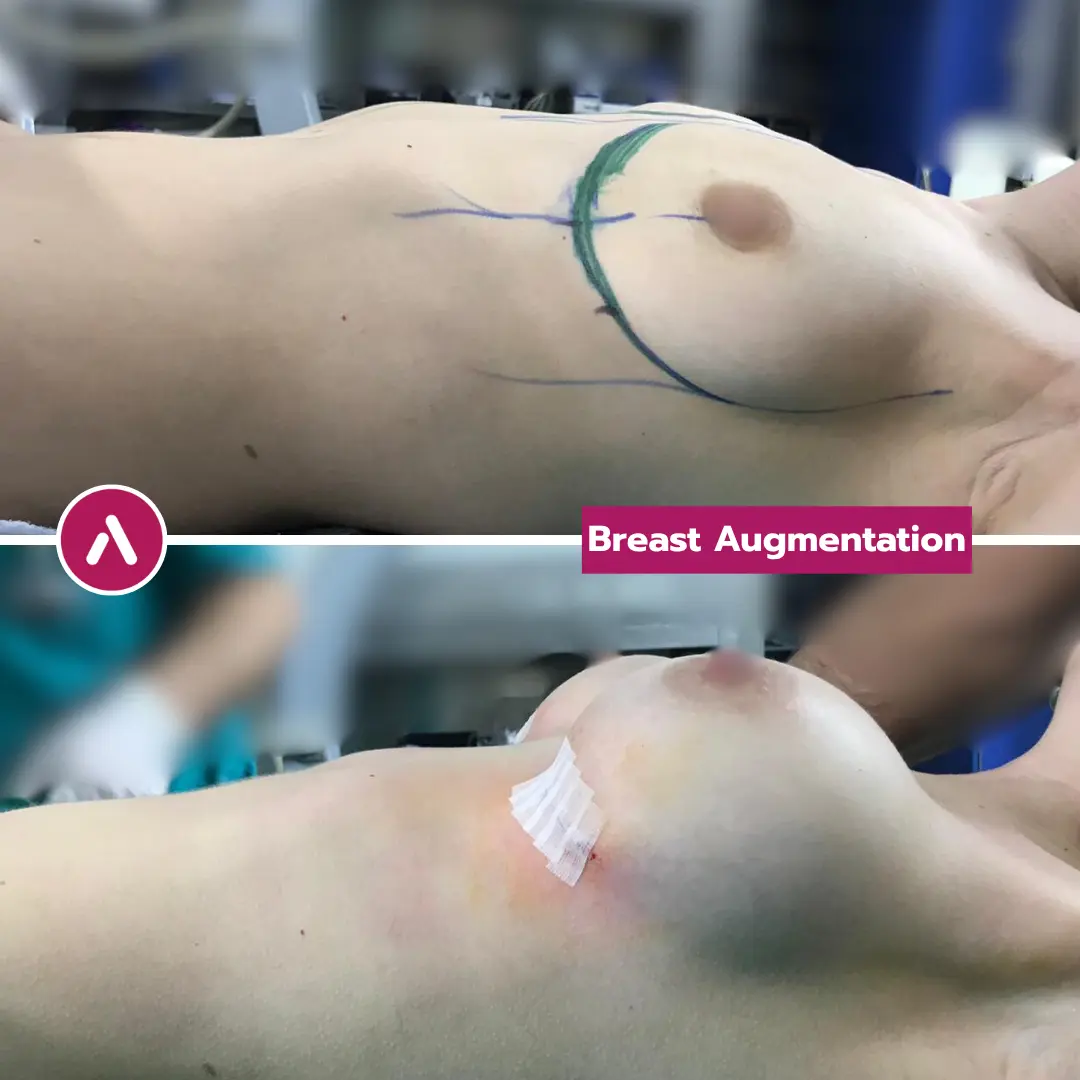
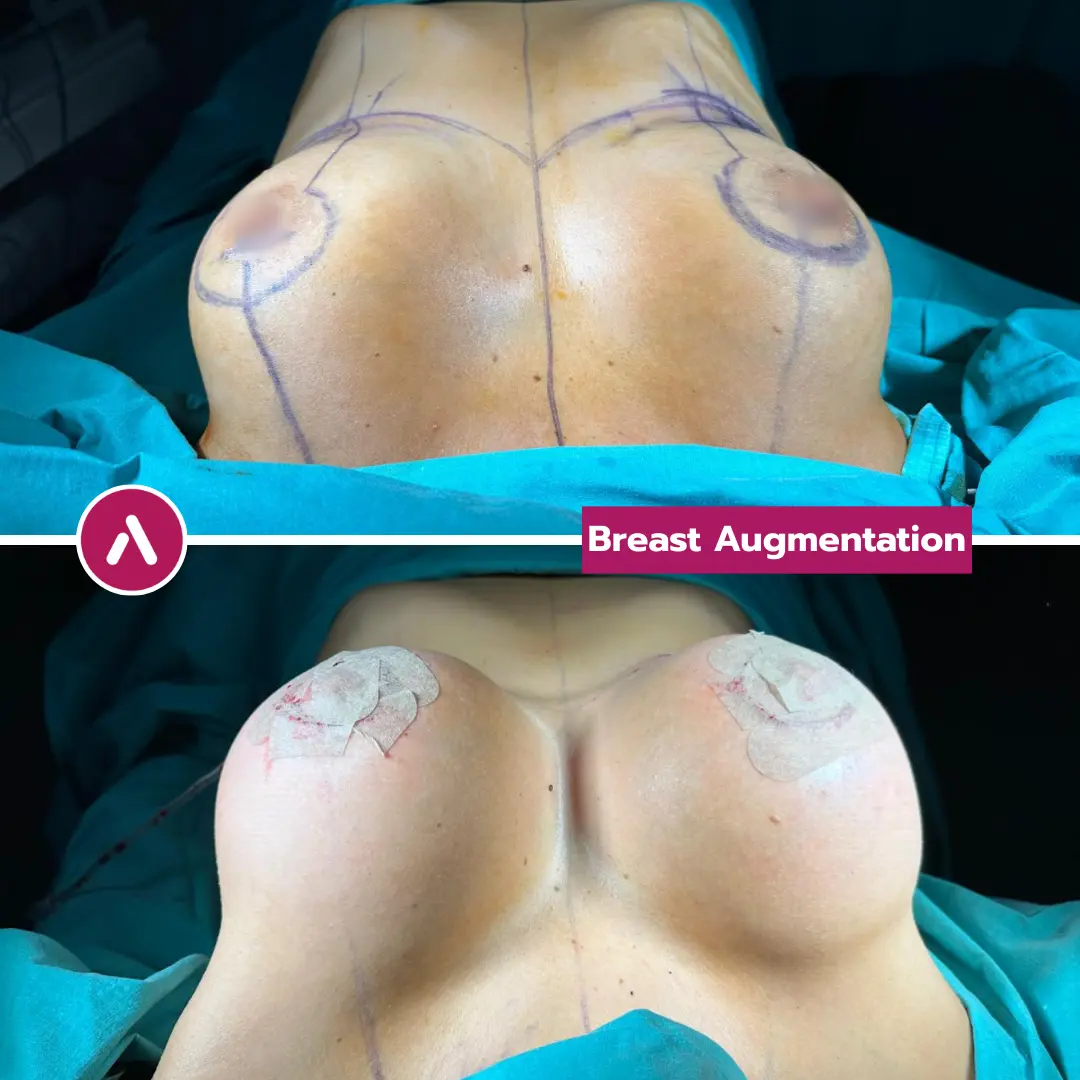
Fat transfer requires enough harvestable fat. Very lean patients may not have enough donor tissue to create a visible breast change.
The donor area also needs to be suitable for safe, even liposuction. A surgeon should assess fat quality, skin elasticity, and body proportion rather than simply choosing the area the patient dislikes most.
This is where virtual photo assessment is useful for international patients. Canadian patients can send standardized photos before travelling, then finalize the plan during the in-person consultation in Istanbul.
When implants are the better choice instead
Implants may be the better choice if a patient wants larger volume, stronger projection, or a more defined breast shape. Fat transfer cannot create the same upper-pole fullness as an implant in every anatomy.
Patients with very little donor fat may also be better served by implants. Others may choose a composite breast augmentation, which combines an implant with fat grafting to soften edges and improve contour.
For a direct comparison with implant-based surgery, review the implant-based breast augmentation comparison. For patients considering removal or replacement of existing implants, see implant explant and revision considerations.
“Breast lipofilling is strongest when the patient wants a natural, modest enhancement. The consultation should define what fat can realistically do, and where an implant or composite approach would serve the patient better.”
In practical terms, candidacy comes down to three questions: Do you have enough donor fat? Is your size goal modest? Are you comfortable with some fat resorption over time?
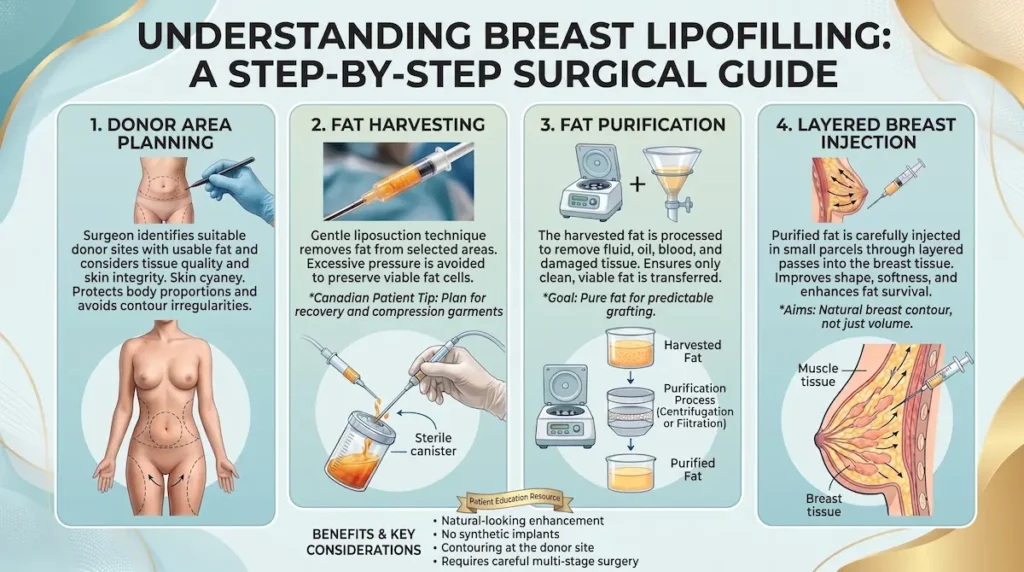
The Procedure Step by Step
Breast lipofilling is a multi-stage procedure. The final result depends on each stage being handled carefully: donor-area selection, gentle fat harvesting, purification, and precise injection into the breast tissue.
For Canadian patients, the most important point is this: lipofilling is not a quick filler treatment. It is surgery. It should be planned with the same seriousness as any breast procedure.
Fat harvesting: liposuction at the donor site
The procedure begins with donor-area liposuction. The surgeon identifies where enough usable fat can be removed without creating dents, unevenness, or an over-treated contour.
Common donor areas may include:
- Lower abdomen
- Waist and flanks
- Inner or outer thighs
- Lower back
- Upper hip area
The donor site is not chosen only because a patient wants that area smaller. The surgeon must also consider fat quality, skin elasticity, and how the area will look after fat removal.
Harvesting technique matters. Excessive suction pressure or rough handling can damage fat cells before they are transferred. Gentle liposuction helps preserve the tissue for grafting.
Canadian patient note: this is two procedures in one
Many patients focus on the breast result, but the donor-area liposuction is a real part of the recovery. Compression, swelling, bruising, and mobility planning should be discussed before flying from Canada to Istanbul.
If the donor area is the abdomen or flanks, plan loose clothing for the return flight and avoid tight waistbands during the early recovery period.
Fat processing and purification
After harvesting, the fat is processed before it is injected. This step separates usable fat cells from blood, oil, tumescent fluid, and damaged tissue.
The goal is to transfer clean, viable fat. Poor processing can reduce predictability and increase the risk of lumps, oil cysts, or uneven absorption.
Fat processing can vary by clinic and technique. Some methods use filtration, decanting, or centrifugation. What matters most is that the process protects cell viability while removing unwanted fluid and debris.
Patients researching regenerative applications of fat may also come across facial nanofat. That is a different use of fat grafting, focused more on skin quality than volume. For that related but separate topic, see the regenerative properties of fat grafting.
Layered injection into the breast
The purified fat is then injected into the breast in fine, layered passes. This is one of the most technically important parts of the procedure.
Fat cannot simply be placed as one large deposit. Small parcels of fat need close contact with healthy tissue so they can receive oxygen and develop blood supply.
The surgeon distributes the fat across multiple tissue planes to improve shape, softness, and survival. This helps avoid over-concentration in one area.
For most patients, the goal is not just bigger breasts. The goal is a better breast shape. Subtle upper-pole softness, improved side contour, and more even volume can matter more than cup-size change alone.
| Procedure stage | What happens | Why it matters |
|---|---|---|
| Donor-area planning | The surgeon identifies where suitable fat can be harvested. | Protects body proportion and avoids contour irregularity. |
| Fat harvesting | Liposuction removes fat from the selected donor area. | Gentle technique helps preserve viable fat cells. |
| Fat purification | Fluid, oil, blood, and damaged tissue are separated. | Cleaner fat preparation supports more predictable grafting. |
| Layered breast injection | Fat is placed in small parcels across planned areas. | Improves contour, softness, and fat survival potential. |
Fat Survival and Realistic Size Expectations
Fat survival is the central concept in breast lipofilling. Some transferred fat establishes blood supply and remains; some does not survive and is gradually absorbed by the body.
This is why ethical planning matters. A surgeon should not promise a dramatic implant-like result from fat transfer alone.
Why not all transferred fat survives
Transferred fat needs oxygen and blood supply. Until the grafted fat connects with surrounding tissue, it is vulnerable.
Several factors influence fat survival:
- How gently the fat is harvested
- How carefully it is purified
- How thinly it is injected
- The health of the recipient tissue
- Smoking status and circulation quality
- Post-operative pressure on the breast
Overfilling can be counterproductive. If too much fat is placed in one area, the tissue may not support it well. That can lead to firmness, cyst formation, or fat necrosis.
Peer-reviewed reviews of autologous fat grafting describe this balance clearly: fat grafting depends on both surgical handling and recipient-site biology. Patients should view fat survival as a biological process, not a fixed guarantee. A peer-reviewed overview of autologous fat grafting explains these survival and safety principles in more detail.
Typical size increase: usually one cup
Breast lipofilling is best for modest enhancement. For many patients, that means roughly one cup size, depending on starting anatomy and available donor fat.
This does not mean every patient gets the same visible change. A small-framed patient may notice a meaningful difference from a relatively modest volume. A broader-framed patient may need more volume to create the same visual effect.
Think of the procedure as shape-first, volume-second. Lipofilling can soften a breast contour, improve asymmetry, and create a more natural slope. It is less suited to patients who want a round, high-projection implant look.
Patients who want larger volume should discuss implants or composite augmentation. Fat transfer alone has limits, and those limits protect safety.
Whether a second session is needed
Some patients choose a second lipofilling session later. This may be appropriate when the first session establishes a better tissue envelope and the patient still wants more fullness.
A second session is not a failure. It is sometimes the safest way to build volume gradually without overloading the recipient tissue in one operation.
The decision depends on how much fat survives, how the breast settles, and whether enough donor fat remains. Your surgeon should reassess the result after healing, not during the early swelling phase.
Canadian patients should also consider travel practicality. A second Istanbul trip may make sense for a patient committed to implant-free enhancement, but it should be weighed against the predictability of composite or implant-based options.
“Fat survival is not a promise of exact volume. It is a biologic response. The safest results come from placing the right amount of fat in the right tissue planes and accepting that modest, natural enhancement is the true strength of lipofilling.”
For patients comparing timing, the key question is not only “How much bigger can I go?” It is also “How much fat can my tissue safely support?”
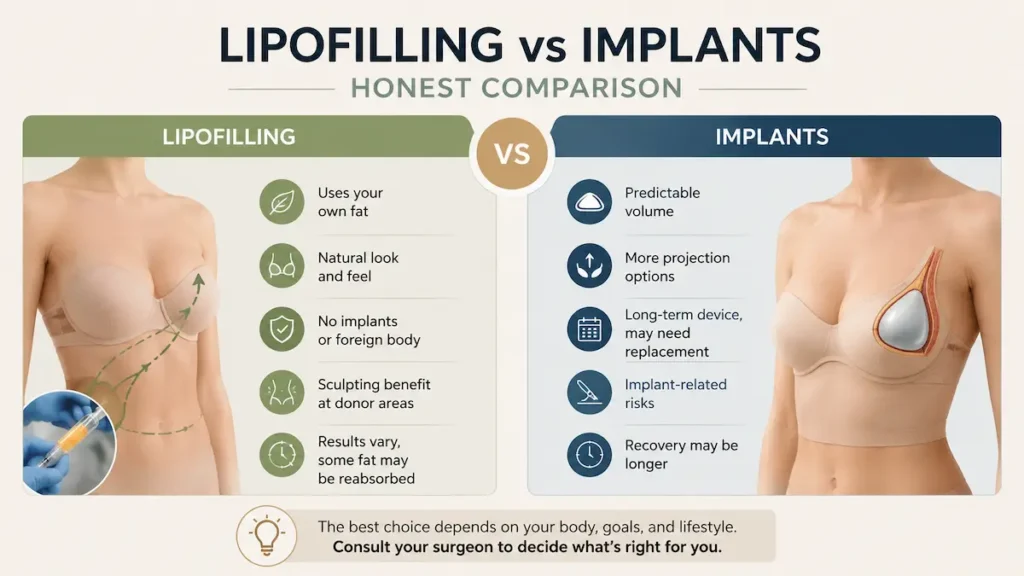
Lipofilling vs Implants: Honest Comparison
Lipofilling and implants solve different problems. Fat transfer is strongest when the goal is subtle, soft enhancement. Implants are stronger when the patient wants more volume, projection, and a more defined breast shape.
The right choice depends on anatomy, donor fat, skin envelope, breast position, and desired size. Preference matters, but biology sets the boundary.
Natural feel and movement
Lipofilling usually feels natural because the added volume is living fat tissue rather than a device. The breast tends to move like the patient’s own tissue, especially when the enhancement is modest and well distributed.
This is the main reason many Canadian patients ask about implant-free augmentation. They want shape improvement without the visual or tactile cues that sometimes come with implants.
Implants can still look natural in the right patient. Placement, implant profile, tissue coverage, and surgical planning all matter. Patients with thin tissue may benefit from composite augmentation, where fat grafting softens the implant edges.
For patients who already have implants and are considering removal, replacement, or conversion to fat transfer, see implant explant and revision considerations.
Size limitation of fat transfer
Fat transfer has a real size limit. The breast tissue can only support a certain amount of transferred fat safely in one session.
For many patients, the expected change is modest. A one-cup increase is a reasonable planning conversation, but not a promise. The visible result depends on the starting breast size, chest width, donor fat volume, and fat survival.
Implants are more predictable for patients who want a larger increase. They also provide more projection, especially in the upper pole. That can be a strength or a drawback, depending on the desired look.
A good consultation should not push one method for every patient. It should explain which method fits the body and goal.
Composite augmentation: fat + implant option
Composite breast augmentation combines an implant with fat grafting. The implant provides predictable volume, while fat softens the surrounding contour.
This can be useful for patients who want more size than fat transfer alone can provide but still want a softer, more natural transition at the upper breast or side breast.
Composite augmentation is also useful in selected revision cases. Fat can help camouflage visible implant edges or improve contour irregularities. It is more complex than either method alone, so planning should be case-specific.
| Option | Best suited for | Typical size change | Feel and movement | Longevity considerations | Recovery focus | AKM CAD pricing |
|---|---|---|---|---|---|---|
| Lipofilling / Autologous Fat Transfer | Patients wanting modest, natural enhancement without implants | Usually modest; often around one cup depending on anatomy | Very natural because the added volume is the patient’s own fat | Surviving fat can remain long-term, but some resorption is expected | Breast site plus donor-site liposuction recovery | CAD $6,150 |
| Implant-Based Breast Augmentation | Patients wanting more predictable size, projection, and upper-pole fullness | More adjustable and predictable than fat transfer alone | Can be natural, but depends on tissue coverage, implant choice, and placement | Implants may require future monitoring or revision | Breast pocket healing and implant settling | CAD $7,350 for standard implant placement options |
| Composite Breast Augmentation | Patients wanting implant volume with softer fat-grafted edges | Greater than fat transfer alone, with improved contour blending | Often softer at the edges than implant-only augmentation | Implant maintenance plus fat survival considerations | Breast implant recovery plus donor-site recovery | CAD $8,200 |
For exact single-technique pricing, see fat transfer breast augmentation pricing in CAD.
Canadian patient note: mammograms and breast screening
Before breast lipofilling, patients should tell their Canadian family physician or breast screening provider that they are planning fat transfer. After surgery, they should continue routine breast screening based on provincial guidance and personal risk.
Fat grafting can create benign imaging findings such as oil cysts, calcifications, or fat necrosis. These findings are usually manageable by experienced radiologists, but your imaging team should know your surgical history.
Breast density is assessed through mammography, not by look or feel. Canadian patients with dense breasts, family history, or prior abnormal imaging should discuss screening timing before travelling.
“Lipofilling is not the implant-free version of a large implant result. It is its own procedure. When the patient wants modest volume, natural softness, and donor-site refinement, it can be an excellent fit. When the patient wants a larger change, we discuss implants or composite augmentation honestly.”
Recovery: Two Sites to Heal
Recovery after breast lipofilling has two parts. The breast is the recipient site, and the liposuction area is the donor site. Both matter for comfort, swelling, travel planning, and the final result.
Canadian patients should plan recovery around the full procedure, not only the breast enhancement. A smooth return flight depends on swelling control, garment planning, and surgeon clearance.
Donor site recovery
The donor site usually feels more bruised and tender than patients expect. This is because liposuction creates swelling, soreness, and fluid movement under the skin.
Compression may be recommended depending on the donor area. Patients should follow the clinic’s garment instructions exactly, especially during the first few weeks.
Donor-site swelling can fluctuate. Morning may look different from evening. Long-haul travel can also temporarily increase swelling, especially in the abdomen, waist, or thighs.
For post-liposuction swelling support, see donor-site lymphatic drainage recovery. That guide covers manual lymphatic drainage in more detail.
Breast recipient site recovery
The breast area often feels swollen, tight, or mildly bruised. Pressure on the breast should be avoided during early healing because transferred fat needs a healthy blood supply.
Patients are usually advised to avoid underwire bras, chest compression, and sleeping directly on the breasts during the early recovery period. Final instructions depend on the surgeon’s plan.
Early breast size is not the final result. Swelling can make the breasts look fuller at first. As swelling decreases and some fat resorbs, the result settles into a more stable shape.
The most helpful mindset is patience. Judging the result too early can create unnecessary anxiety.
Fit-to-fly clearance for Canadian patients
Flying from Istanbul to Canada requires planning. Even when the surgery is modest, the route is long, and swelling can increase during travel.
Patients flying to Toronto Pearson, Montréal-Trudeau, Vancouver International, or Calgary should discuss return timing before booking. Direct flights may be more comfortable than multi-stop routes, but the safest plan depends on the procedure scope and the surgeon’s final assessment.
Useful return-flight strategies include:
- Wear loose clothing over compression garments.
- Keep essential medications in carry-on luggage.
- Walk gently during the flight when safe to do so.
- Stay hydrated and avoid alcohol during travel.
- Use a small pillow to protect donor areas from pressure.
Fit-to-fly clearance should be individualized. A patient having small-volume fat transfer may recover differently from a patient having larger donor-area liposuction or combined procedures.
Canadian patient note: donor-site contouring is a benefit, not a shortcut
Donor-site contouring can improve the waist, abdomen, thighs, or flanks while adding natural breast fullness. That is a valuable dual benefit.
It also means the recovery plan must include liposuction care. Swelling, garment use, and lymphatic support affect how smoothly Canadian patients return home and settle back into work.
For many patients, the breast result and donor-site contour settle at different speeds. That is normal. The breast may feel ready socially before the donor area feels fully comfortable.
Frequently Asked Questions: Lipofilling Breast Turkey
Breast lipofilling questions usually fall into three categories: how much size change is possible, how long the fat lasts, and how the procedure affects future breast screening. These answers give Canadian patients a practical starting point before a personal consultation.
Your surgeon should confirm every answer against your anatomy, health history, and imaging background. Fat transfer is highly individualized.
How much bigger can I go with fat transfer alone?
Most patients should think of breast lipofilling as a modest enhancement. A change of about one cup size is a common planning conversation, but it is not guaranteed.
The final size depends on your starting breast volume, donor fat availability, chest width, tissue quality, and fat survival. Patients wanting a dramatic increase are usually better candidates for implants or composite augmentation.
Will the fat stay permanently?
Some transferred fat survives long-term. Some is reabsorbed during the early healing period.
Once the surviving fat establishes blood supply, it generally behaves like your own body fat. Significant weight changes can still affect the result. A stable weight before and after surgery helps maintain proportion.
This is why early swelling should not be judged as the final result. The breast needs time to settle.
Is lipofilling safer than implants?
Lipofilling avoids implant-device risks because no breast implant is placed. There is no implant rupture, implant malposition, or implant exchange planning.
That does not make fat transfer risk-free. Possible issues include fat necrosis, oil cysts, infection, asymmetry, contour irregularity at the donor site, and partial fat resorption.
Implants also remain a valid option for many patients. In Canada, breast implants sold domestically are regulated as medical devices by Health Canada. The decision should be based on anatomy, goals, risk tolerance, and long-term maintenance preferences.
Can I combine fat transfer with an implant?
Yes. This is called composite breast augmentation.
The implant provides predictable volume and projection, while fat grafting can soften visible edges and improve contour transitions. This option may suit patients who want more size than fat transfer alone can provide but still prefer a softer look.
Composite breast augmentation at AKM Clinic is listed at CAD $8,200. Autologous fat transfer alone is listed at CAD $6,150. Pricing should always be confirmed against your final surgical plan.
Does fat transfer interfere with mammograms?
Fat transfer can create benign imaging findings such as oil cysts, calcifications, or fat necrosis. These can usually be interpreted by experienced breast imaging specialists, especially when they know your surgical history.
Canadian patients should continue routine breast screening based on provincial guidance, age, symptoms, family history, and physician advice. Tell your family doctor and mammography clinic that you have had breast fat transfer.
If you are due for a screening mammogram soon, discuss timing before booking surgery. A pre-operative baseline may be helpful for selected patients.
How much does lipofilling cost in CAD?
AKM Clinic’s fat transfer breast augmentation pricing is listed by technique. The key CAD figures are:
Autologous Fat Transfer: CAD $6,150
PRP-Enriched Fat Grafting: CAD $6,800
Composite Breast Augmentation: CAD $8,200
Brava-Assisted Fat Transfer: CAD $9,550
For the most specific price reference, review fat transfer breast augmentation pricing in CAD.
These figures refer to the listed technique categories. Your final recommendation may differ if you need a lift, implant revision, or combined body contouring.
Do I have enough fat for the procedure?
That depends on your donor areas. Lean patients may not have enough harvestable fat to create a visible breast change.
The surgeon will assess whether fat can be removed safely from areas such as the abdomen, flanks, thighs, or lower back. The goal is to enhance the breast without over-harvesting the donor site.
Virtual photo assessment is useful for Canadian patients before they travel. It helps determine whether lipofilling is realistic, whether implants would be more suitable, or whether composite augmentation should be considered.
Assess Your Lipofilling Candidacy at AKM Clinic
Lipofilling breast augmentation is best for patients who want a natural, modest enhancement without implants. It can be a strong choice when you have enough donor fat, realistic size expectations, and a preference for soft, subtle breast shaping.
It is not the right answer for every patient. That is the point of a careful consultation.
During a virtual consultation, AKM Clinic’s team can review your photos, donor areas, breast shape, screening history, and goals. You can then compare lipofilling, implants, and composite augmentation before making a decision.
Ready to find out if breast lipofilling fits your anatomy?
Schedule a virtual consultation with AKM Clinic to assess your donor fat, breast shape, and implant-free augmentation options.
Medical Disclaimer: This page is provided for general educational purposes only and does not replace an in-person medical consultation, diagnosis, or personalized treatment plan. All surgery carries risks, and outcomes vary between individuals. Suitability for a breast augmentation surgery, procedure selection, and anesthesia choice can only be determined after a full clinical assessment by a qualified surgeon. Always follow your clinician’s instructions and seek urgent medical attention if you develop concerning symptoms during recovery.